The Lord’s Prayer 

Shared Economy Sign

by Herb Montgomery

“When you pray, say‚ Father — may your name be kept holy! — let your reign come: Our day’s bread give us today; and cancel our debts for us, as we too have cancelled for those in debt to us; and do not put us to the test!” (Q 11:2-4)

Companion Texts:

Matthew 6:9-12: “This, then, is how you should pray: ‘Our Father in heaven, hallowed be your name, your kingdom come, your will be done, on earth as it is in heaven. Give us today our daily bread. And forgive us our debts, as we also have forgiven our debtors.”

Luke 11:2-4: “He said to them, ‘When you pray, say: “Father, hallowed be your name, your kingdom come. Give us each day our daily bread. Forgive us our sins, for we also forgive everyone who sins against us. And lead us not into temptation. ’ ”

This week, we’re looking at a saying in Q that many now call “The Lord’s Prayer.” Last week, we looked at the problematic nature of gendering God and Jesus’ naming God as our Father. This week, we’ll consider the tangible, concrete, economic nature of the rest of this prayer.

Jesus’ “reign of God,” as we have learned this year, can be defined simply as people helping people, taking responsibility for one another, living in centered relationships and community with a focus on quality of life for those whose lives and value as human beings has been denied, survival, resistance, liberation, restoration, and transformation.

Daily Bread

This prayer purposefully focuses on today: not tomorrow, but today. Gandhi is believed to have said that every day the earth produces enough for every person’s need, but not for every person’s greed. Greed can be defined as the exploitation of others and the hoarding of more than one needs for today (from fear of what may come tomorrow) while ignoring the basic daily needs of those being exploited.

In this prayer, Jesus doesn’t ask for tomorrow’s needs to be assured. He asks for our needs be met today. As we let go of our fear of the future, relinquish the exploitation of others, and choose instead a community of mutual aid, resource sharing, and mutual responsibility and care, we enter a path of trust. We trust that someone will take care of us if something should befall us tomorrow; we trust enough to be the ones who take care of those trouble has befallen today.

This is a path of abandonment and embrace. We’re abandoning values such as individualism and independence, and embracing our reality as humans who are interdependent. So we choose to balance each individual’s needs and the community where all of those needs can be met.

We take care of each other today, and leave tomorrow to worry about itself. As long as we have each other, we can together face what may come tomorrow. We don’t put our trust or hope in accumulated wealth but rather in each other as we live out the faith that Jesus modeled and the love that God shows us (see Psalms 62:10 cf. 1 Timothy 6:17).

Cancel All Debts

Next, this saying refers to debt cancellation. Some Q scholars believe that the phrase “cancel all debts” was part of the earliest form of this prayer. It’s interesting how the versions of this saying progressed from Jesus’ and the Torah’s concerns about economic liberation to a more “spiritual” language for debt that left the economic plight of the poor unaddressed. That’s convenient!

Let me explain.

It’s believed that the earliest form of the Q source text said “cancel our debts for us as we have cancelled those in debt to us.” In the spirit of the Torah’s sabbatical year (jubilee), this represented a community that had literally cancelled the debts of those who owed them, and now prayed that, like dominoes, their creditors would cancel their debts as well. They were setting something in motion and praying for its end: all debts forgiven!

When Matthew’s gospel adds this saying to Mark’s narrative, it becomes “forgive us our debts, as we also have forgiven our debtors.” This still means essentially the same thing, but notice the word “forgive.” This change sets up the phrasing in Luke.

Luke’s gospel phrases this saying, “Forgive us our sins, for we also forgive everyone who sins against us.” This final step enlarges the prayer and makes it relational rather than economic. Any sin is now included and the Torah/sabbatical year connection is lost. Now the prayer becomes a matter of forgiving wrongs other have committed in hopes that one’s own wrongs will also be forgiven.

All three versions of the prayer are valid. It’s also important to know their origins as well. We often focus on Jesus’s relational teachings today, and with good reason. Jesus’s economic teachings are challenging, and it can seem preferable to avert one’s gaze. Yet they are there in his teachings nonetheless, along with the teachings of the Torah:

“At the end of every seven years you must cancel debts.” (Deuteronomy 15:1)

Luke’s gospel also affirms the centrality of “all debts cancelled” in a unique way. Luke begins Jesus’ ministry with Jesus taking the scroll of Isaiah in a Sabbath synagogue service and reading:

“The Spirit of the Sovereign LORD is on me,
because the LORD has anointed me
to proclaim good news to the poor.
He has sent me to bind up the brokenhearted,
to proclaim freedom for the captives
and release from darkness for the prisoners,
to proclaim the year of the LORD’s favor.” (Isaiah 61:1; cf. Luke 4:18)

This “year of the Lord’s favor” is the sabbatical year Deuteronomy 15:1 refers to, a year when the people were to cancel all debts.

That commandment brought hope to indentured farmers, who used to own the farms they now worked on, and the day laborers who worked with them earning day wages. And what fear, objection, and threat it must have brought to Herod’s economy in Galilee and the wealthy aristocracy centered in Jerusalem. The economic elite in Galilee and Jerusalem would no doubt have been anxious to rid their societies of this itinerant teacher stirring up the hopes of the poor. (See The Jesus Story.)

There is a contrast, too, between the way Herod and Jesus approached politics. Politics is the subject of power and resources (wealth). Herod sought to hoard and then wield power and resources as the means whereby his Jewish people would be liberated, with him at the helm as hero, and liberation flowing unilaterally from him to the people.

Jesus, on the other hand, taught that both power and resources should be shared. Rather than the unilateral hero deliverance that we have transformed Jesus’ salvation into, Jesus taught the shared power of community where debts are cancelled, resources are shared, wealth is redistributed, and mutual aid becomes the order of the day. Jesus wanted his followers to be the source of a liberation that not only benefitted the Jewish people but would spread to and change the Roman world as well.

It is a misunderstanding to say that a community informed by Jesus’ teachings today should be relegated to spiritual matters and matters of politics should be left to the state. Jesus had much to say that was political—about power and resources. The community of Jesus followers is just as political as the state; we simply choose to go about politics differently.

Not Being Put To the Test 

Lastly this week I want to discuss the difference between choosing life with the risk of a cross as pushback from the death dealers, and thinking that a cross or suffering is in itself the goal. Choosing a cross doesn’t bring life. Choosing life brings life. And sometimes we have to choose life even when a cross is being threatened against us, but choose life and thus a cross we must.

There is a subtle difference between choosing life with the risk of a cross and choosing a cross for the cross’s sake. If we can avoid suffering without sacrificing justice or our hold on life, then that is the better choice. In Jesus’ time, the cross was state execution. When you’re dead, whatever your reasons, you’re dead. In following Jesus, we should choose life even if threatened with death from the death dealers, and we should also not go around looking to get killed. This is why, I believe, we are taught to pray:

“Do not put us to the test!”

Because Jesus followers seek to emulate Jesus, how we define “being like Jesus” is vital. Jesus chose the way of life even when being threatened with a cross; he did not choose a cross. In cases of domestic violence, many women are counseled to “be like Jesus,” though they have sacrificed their selves by remaining in environments that are destructive to their entire being. We must be careful not to glorify suffering in contexts like these, and careful as we reject redemptive violence not to teach redemptive suffering.

To be like Jesus means to choose life, even with all the risks, threats, and dangers that taking hold of life and not being willing to let go of it entails, all the while praying that we will not be brought to what the gospel writers call the time of testing.

We choose life regardless of risk, knowing there may be a cross as a result, and keeping our focus on the life found in Jesus, not the death found in Jesus. When Jesus calls a person to follow him, he does not call that person to die, he calls that person to live! It is the threats of the powers that be that overshadow our choice of life with the cross. It’s not an intrinsic connection, but an imposed one. We’ll cover this again and in much more detail when we get to Jesus’ sayings about taking up the cross.

Today, my intuition tells me we must allow ourselves to face the economic elements of the Lord’s prayer in its original form. In a dog-eat-dog world, what could be changed if we chose to strike a more radical balance between individualism and what is best for our community?

Debt cancellation is a large task. Some are doing this task well, but not all of us are creditors. I would assume that many more of us are on the “debtor” side of the coin, and so an easier entry point may be a simple choice to follow Jesus’ teachings on mutual aid and sharing.

Regardless of where we pick up Jesus’ economic teachings, we can make a choice to subvert our culture’s tendency to value property over people or even treat people as property, and instead place people before both profit and property. The power of this choice should not be underestimated. It is the very stuff that has the potential to change our world.

And so we too pray,

“Father — may your name be kept holy! — let your reign come: Our day’s bread give us today; and cancel our debts for us, as we too have cancelled for those in debt to us; and do not put us to the test!” (Q 11:2-4)

HeartGroup Application 

Too often, the church has only embraced social change once outside forces have given it no other option. We have taught that the gospel story teaches values that can create change more intrinsically. But this has never been how it has taken place, not yet. Whether we are talking about slavery, equality for the sexes, economic change, or, today, justice for our LGBT siblings, the church has seemed to lag.

For discussion this week:

  1. Discuss examples of where, historically, change did not come for the church from internal causes, but from outside pressures.
  2. Discuss why you feel this is typical, and what your group may be able to do to change that order for you.
  3. Pick one of those things and implement it this coming week.

The Lord’s Prayer could produce radical socioeconomic change for those who have the courage not just to pray it, but also to step out and implement it in the world. Let’s not just pray it. Let’s put it into action.

Thanks again for checking in this week.

Wherever you are and whatever you may find yourself in the midst of, our hope is that your heart has been renewed and inspired to continue following the salvific teachings of Jesus in your life and community.

Keep living in love, daily choosing love above all else, till the only world that remains is a world where only love reigns.

I love each of you dearly.

I’ll see you next week.

The Beatitude for the Eyes that See (God in the Othered)

Picture of an eye

“Blessed are the eyes that see what you see. For I tell you: Many prophets and kings wanted to see what you see, but never saw it, and to hear what you hear, but never heard it.” (Q 10:23-24)

Companion Texts:

Matthew 13:10-17: “The disciples came to him and asked, ‘Why do you speak to the people in parables?’ He replied, ‘Because the knowledge of the secrets of the kingdom of heaven has been given to you, but not to them. Whoever has will be given more, and they will have an abundance. Whoever does not have, even what they have will be taken from them. This is why I speak to them in parables: ‘Though seeing, they do not see; though hearing, they do not hear or understand.’ In them is fulfilled the prophecy of Isaiah: ‘You will be ever hearing but never understanding; you will be ever seeing but never perceiving. For this people’s heart has become calloused; they hardly hear with their ears, and they have closed their eyes. Otherwise they might see with their eyes, hear with their ears, understand with their hearts and turn, and I would heal them.’ But blessed are your eyes because they see, and your ears because they hear. For truly I tell you, many prophets and righteous people longed to see what you see but did not see it, and to hear what you hear but did not hear it.”

Luke 10:21-22: “At that time Jesus, full of joy through the Holy Spirit, said, ‘I praise you, Father, Lord of heaven and earth, because you have hidden these things from the wise and learned, and revealed them to little children. Yes, Father, for this is what you were pleased to do. All things have been committed to me by my Father. No one knows who the Son is except the Father, and no one knows who the Father is except the Son and those to whom the Son chooses to reveal him.’ Then he turned to his disciples and said privately, ‘Blessed are the eyes that see what you see. For I tell you that many prophets and kings wanted to see what you see but did not see it, and to hear what you hear but did not hear it.’”

This week’s saying is given two different contexts in the gospels of Matthew and Luke. For Luke, this is the third portion of the much larger saying that we have been considering over the last two weeks: the community that Jesus sent out returns and share their testimonies of success. But in Matthew, the context is different, part of Jesus’ response to why he taught using parables. Let’s take a look at both.

Matthew’s Setting

Matthew, which many scholars today believe was written to a predominantly Jewish Jesus-following audience, seems to be trying to do two things:

  1. Affirm (and possibly explain) Jesus’ teachings to that audience in the face of their larger community’s rejection; and
  2. Affirm that Jesus, his teachings, and the path his followers walked because of those teachings were all rooted in the long-held hope that injustice, oppression, and violence against Israel would be put right. Jesus fulfilled that hope.

In the early 2nd Century, Irenaeus tells us that those in the Jesus community who were Jewish Jesus followers, the Ebionites, exclusively used Matthew’s gospel (Against Heresies, Book 3, chapter 11, paragraph 7).

These Jewish-Jesus followers, holding on to the great Hebrew hope of survival, liberation, and restoration, would have been deeply encouraged to hear that Jesus and his teachings were what their ancestors had been looking forward to.

Luke’s Setting

Luke, on the other hand, is believed to have been written with a predominantly Gentile Jesus-following audience. Luke preserves the Q context of:

  1. God’s wisdom given to the most vulnerable, as opposed to those in control of the status quo.
  2. Jesus’ testimony that he received this wisdom by direct revelation and was choosing to share it.
  3. Our saying this week for Jesus’ disciples who were encountering a “God-given” wisdom from the excluded and marginalized that not many kings and prophets were privileged to know. Through following Jesus, they entered into deeper compassion and a posture of humble listening.

This setting from Luke is very important. The “kings” would have been in positions of power within exploitative systems. And the “prophets,” those of the school of the prophets, would have spoken on behalf of the exploited but not necessarily as part of the exploited community. (Exceptions to this include prophets like Amos, who was a sheep herder and farmer.)

What we are encountering this week is a wisdom seen by children, the most vulnerable among us; a wisdom directly related to their experiences from living and being marginalized in our world. This is the wisdom and perspective that the disciples were encountering. It’s as if Luke’s Jesus leans over to his followers and whispers, “You are blessed! The wisdom you are seeing, this wisdom gained through listening to the experiences and voices of those at the lowest sectors of our society is wisdom that those in other sectors of society are not able to see (see Matthew 18:2).

Today

I run into this dynamic more often than I’d like to. Recently, after I gave a presentation on Jesus’s teachings on nonviolence, I was struck once again by the resistant response of some in my audience.

I’d been careful to explain that Jesus’s teachings on nonviolence were specifically targeted at the lowest classes of his society, the poor and disinherited, as wisdom about survival and nonviolent resistance. I pointed out that it was through this nonviolent resistance that Jesus taught them they would be liberated and their enemies would be transformed.

Afterward, a couple of audience members came up to me and asked, “But what do you do if someone is breaking into your home?”

What I want you to notice is what this question reveals. My audience members were encountering Jesus’s teachings on nonviolence not from the position of the lowest class, but from the middle classes, and maybe even the upper class. Jesus’ message of nonviolence would have instead addressed those who would be breaking into homes as a method of survival, not the ones whose homes were being broken into. To the poor, Jesus taught nonviolent forms of resistance, ways for them to reclaim their humanity. To those whose homes were being broken into, Jesus would have shared a very different message: he would have told this demographic to take our extra, the stuff of which luxury is made, put the needs of our fellow human siblings above our own comfort, and share. He would have told us to take our superfluous or hoarded wealth and share it with the poor.

Just as nonviolence might not have been received well by those who felt violent means were their only means of survival, I’m sure Jesus’ teachings about mutual aid, resource sharing, and voluntary wealth redistribution was also met with resistance from the middle and upper classes.

Middle to upper class church members I recently spoke to spent the first half of our week together struggling to get their heads around the Jesus they were encountering in Matthew and Luke. This Jesus really didn’t sound like the way they were used to thinking about him.

The Jesus story’s themes of survival and liberation from the human suffering caused by systems of injustice simply don’t mean as much to those whose position in society protects them from that suffering. Those in a different societal position prefer themes that focus on their personal forgiveness, God’s love for them, and promised post mortem bliss.

I’ve been preparing a talk for this weekend on nonviolence and what Christian theologians call the atonement. One of the points I’ll be making is the importance of listening to those who have been victimized by various atonement theories. To illustrate what I’m saying, let me share the experience of Garth Kasimu Baker-Fletcher. I mentioned him last week:

“Whenever I preached this passage [God is love] as a pastor, I could always expect to gain at least one new convert! There is something inviting about such love, a love which has been poured out toward us human beings first, by GOD. For no earthly rhyme or reason the GOD of the universe has ‘loved us first,’ sending an ‘only Son’ to die for us and become ‘the atoning sacrifice for our sins’ (1 John 4:10b), that through the death and resurrection of GOD’s Son, we might die to our sins and live in the reassurance of God’s mighty love. Such is the standard ‘atonement-love doctrine’ preached weekly in Christian churches throughout the world. Abiding in this sacrificial love of GOD as expressed through the death and resurrection of ‘His’ Son Jesus is posited as the consummate experience and expression a GODly life.

“The strengths of this position are time-honored. When one conforms one’s life to a model of love-as-atoning sacrifice, then the complication of prioritizing are greatly simplified. Life becomes one’s individual sense of a calling by GOD. Life unfolds as a conflictual, strenuous, and yet not unmanageable series of testings, temptations, victories, and occasional failures to do GOD’s ‘will.’ The important norm for such a life is obedience to the will of GOD, and the GOD adored and followed is regularly consulted for guidance. GOD’s love, in such a view of love-as-atoning sacrifice, enables one to become ‘Christ-like’ because of one’s willingness to die to self and rise in Christ. There is a galvanizing power in believing that even if one dies for a particular ‘cause,’ all things will be all right because it is a redeeming and atoning sacrifice, a sacrifice of love, freely given. Such a view of love conflates sacrificial acts, all such acts, with GOD’s Christ-like love. The conflationary energy of such enables one to be Christ in situations of conflict, trial, oppression, and even abuse. It is precisely in the confectionary energies of love-as-atoning sacrifice that its greatest danger and weakness resides.” (My Sister, My Brother: Womanist and Xodus God Talk, by Karen Baker-Fletcher and Garth Kasimu Baker-Fletcher.)

Kasimu goes on to demonstrate the detriment this gospel has brought to women in domestically violent situations who are desiring to be simply “Christ-like.” He then states, “Being ‘like Christ’ or imitating Christ by sacrificing one’s self for another is dangerous.”

He contrasts the above private, individual, and personal way of seeing Jesus with Dr. Martin Luther King, Jr.’s “reformulation” of GOD’s love. King saw God’s love in the Jesus narrative as including not simply his death but also the elements of “justice, social power, hope, sacrifice, and a vision of the telos of community that has great potential for a healthier view of GOD’s love.” But all of this drives home the point.

This reformulation is the result of what the vulnerable see! Those in positions of privilege and power in our society are so indoctrinated and socialized that they don’t even see what is so wrong and dangerous about the traditional description of love-as-atoning sacrifice. Not being able to see it yet is a strong indication of one’s need to begin looking at the Jesus story from the perspective of those to whom our society’s present structure is doing the greatest harm. As we stated last week, this means looking for God in those that we and our society today have “othered.” When you do finally see it, it will be as if Jesus himself is leaning over to you, saying to you as he did his disciples long ago:

“Blessed are the eyes that see what you see. For I tell you: Many prophets and kings wanted to see what you see, but never saw it, and to hear what you hear, but never heard it.” (Q 10:23-24)

HeartGroup Applications

Matthew seems to describe what the disciples see as from Jesus himself. Luke seems to define it as the wisdom we gain from the most vulnerable. Both Matthew and Luke can be right. Let’s make some time this week to put what Jesus taught into practice by listening to those who are not like ourselves. Let’s look for God in the Othered.

July’s book for RHM’s annual reading course was J. Denny Weaver’s Nonviolent Atonement. Beginning on page 129 and then on through page 217, Weaver dialogues with the various theologies that arise out of the experiences of black liberation, feminism, and womanism.

1. I’d like you to pick one of those chapters and either through Weaver’s book or in the books that Weaver refers to (many are available from Amazon in a digital format), begin listening to various perspectives of Jesus from experiences that are unlike your own.

2.  Over the next few weeks, discuss with your HeartGroup what you are discovering and how your own beliefs are being challenged and affirmed. Share how you have been encouraged, and also discuss how some of your own cherished beliefs have not borne positive fruit for people with experiences unlike yours.

3. Discuss with your HeartGroup how each of you can move toward healthier ways of interpreting and understanding the Jesus story, ways that do not produce victims, but that bring healing for the entire human family. Lean into those changes. Choose to see the Jesus story through these new lenses and allow those changes to impact the decisions you make in your daily lives.

Learning how to listen for God in the Othered is a life changing experience for so many who have the courage and openness to engage in the process. It can be deeply challenging, deeply confronting, and deeply affirming all at once. I’m wishing you all the best.

Thank you for joining us this week.

And thank you for your decision to live in love, till the only world that remains is a world where only love reigns.

I love each of you dearly.

I’ll see you next week.

Knowing the Father through the Son 

by Herb Montgomerypicture of a father and son
“Everything has been entrusted to me by my Father, and no one knows the Son except the Father, nor does anyone know the Father except the Son and to whomever the Son chooses to reveal him.” (Q 10:22)

Companion Texts:

Matthew 11:27: “All things have been committed to me by my Father. No one knows the Son except the Father, and no one knows the Father except the Son and those to whom the Son chooses to reveal him.”

Luke 10:22: “All things have been committed to me by my Father. No one knows who the Son is except the Father, and no one knows who the Father is except the Son and those to whom the Son chooses to reveal him.”

Gospel of Thomas 61:3: “Jesus said to her: ‘I am he who comes from the one who is always the same. I was given some of that which is my Father’s.’”

Jesus’ Substantiation of the God of the Vulnerable

Last week we discussed how the God Jesus called his followers to envision was committed to the most vulnerable ones in society. The very next saying shows Jesus appealing to direct revelation to substantiate his claim that God was a God for the vulnerable and not just the strong and well-placed. Consider the possible responses to Jesus’ saying from last week—that God had actually revealed truth to those on the margins of their society rather than to their religious sages and learned leaders. Pairing that saying with this week’s implies that the Jesus community attributed this truth to direct revealation.

How did Jesus know that God was the revealer of truth for the vulnerable? That this God belonged to the marginalized and excluded in his own society? This knowledge had been given to him directly from God and he was choosing to reveal it to his followers.

And while this defense of direct and unique revelation may have established the credibility of the Jesus community in their society in the first century, it leaves some big questions untouched in our context today.  In this saying, Jesus says that what he knows was “entrusted to him by his father” and that he also chooses to “reveal” things to the folks he chooses to.

That opens up questions like:

  •                 How do we know we’re getting insights from God or Jesus?
  •                 Are there any other possible sources?
  •                 Does direct revelation have to be validated by the authorities (in Jesus’ case, it wasn’t even though he appealed to and reinterpreted the prophets)?
  •                 How can we distinguish healthy insight/revelation from destructive insight/revelation?

Some modern people worry about whether their interpretations are valid or they are self-deceiving, especially if they’ve been taught that nothing the Holy Spirit reveals will contradict scripture. Could it be that the best way to know whether or not you’re on the right track is to actually follow what Jesus is teaching in this section of the sayings and listen to the voices of the most vulnerable and how they are affected by your “revelation?” This method, which my friend Keisha McKenzie calls Listening for God in the Othered, is a way to test “revelation” by its fruit.

Jesus’ direct revelation was not attested to by the status quo authorities, but he spoke of his father entrusting insight to him as he taught that we need to listen the revelation God has given to the lowest sector of our society: we need to listen to “the children.”

There is a danger in claiming direct revelation and ending the discussion there. Direct revelation is not a method that is reproducible and that we can use ourselves at will.  But we can lean into the truth that Jesus is attesting to in this saying. We can listen to the most vulnerable. We can hear from their experiences whether or not our “revelations” or interpretations of sacred texts produce good fruit.

It’s a hermeneutical method of testing by considering results. (See Matthew 7.16-20.)

My Father

I want to discuss for a moment Jesus’ referring to God as his “Father” because of the problematic nature of gendering Divinity. There are a number of things we must take into consideration.

First, Jesus lived and taught within two deeply patriarchal cultures: Roman and Jewish. We cannot escape the reality that Jesus and those he ministered to moved about within a patriarchal world.

Second, Jesus naming God as Father was less parental and more political. This way of naming God had a historical context in Judaism.

Referring to God as “Father” and having God referring to someone as “son” was a special relationship attributed to Judah’s king and YHWH. In the Psalms, this title was applied to David and it was also extended to Solomon.

Psalms 2:7: “I will proclaim the LORD’S decree: He said to me [David], ‘You are my son; today I have become your father.’”

Psalms 89:26: “He will call out to me, ‘You are my Father, my God, the Rock my Savior.’”

2 Samuel 7:12-14: When your days are over and you rest with your ancestors, I will raise up your offspring to succeed you, your own flesh and blood, and I will establish his kingdom. He [Solomon] is the one who will build a house for my Name, and I will establish the throne of his kingdom forever. I will be his father, and he will be my son.

Matthew’s gospel, a very Jewish version of the Jesus story, identifies Jesus with this language. It makes perfect sense. Matthew’s gospel continually employs imagery of Jesus and God as Father and son, and it is impossible to determine whether this unique rhetoric was original to Jesus or was created by the Jewish community who loved and followed him. What is clear is that this rhetoric was part of the hope for the liberation and restoration of Israel in the first century. At minimum, the followers of Jesus claimed that Jesus’ coming marked the start of this restoration.

Luke’s Gentile community would have used this rhetoric as well, not to associate Jesus with a past Jewish leader but for the purposes of contrast with a present Roman one.

As we covered last December in Two Visions [or Versions] of Peace (Part 3 of 3), this language was also used in the Roman empire to refer to Caesar’s supposed divine ancestry:

“It was Augustus Caesar who, during the time of Luke’s birth-narrative, was entitled Divine, Son of God, God from God, Lord, Redeemer, Liberator, and Savior of the World. Here is why.

Rome experienced several civil wars as a democratic republic and had regressed to the point of disintegration when Octavian, later called Augustus, became Rome’s savior. Through Augustus, Rome transitioned from an imperial republic to an imperial monarchy. Augustus, the adopted son of Julius, was like his father deified, or regarded as a god. He was given the title Augustus in Latin (One who is divine) and Sebastos in Greek (One who is to be worshipped). Temples were inscribed to him with the dedication, ‘The Autocrat Caesar, the Son of God, the God to be worshipped.’

And as with all domination systems, the four imperial aspects produced a society where an elite at the top benefited from the subjugation of the many beneath them. Luke addresses all four of these aspects in his gospel. In response to Rome’s military power, Luke presents the teachings of Jesus on nonviolence. In response to Rome’s economic power, Luke presents Jesus’ teachings on wealth redistribution. In response to Rome’s political power, Luke presents Jesus, not Caesar, as Liberator, Redeemer, the bringer of Peace, Lord, and Savior of the world. And in response to Rome’s theology of a ruler who was supposedly born to divine-human parents and so was named the Son of God, God from God to be worshiped, Luke presents Jesus and his subversive ‘kingdom.’ Rome’s theology was larger than Caesar and included the worship of deities such as Mars the god of war, but it included the worship of Caesar as the incarnate representation of the Divine.

As theologian Adolf Gustav Deissmann wrote, it’s important for us to recognize the early establishment of a polemical parallelism between the cult of Christ and the cult of Caesar in the application of the term kyrios, “lord”’ (p. 349).

Knowing Augustus’ birth-narratives is also beneficial to us. The story was that on the night of Augustus’ conception, Augustus’ father had a dream in which he saw the sun rising from Atias, his wife’s womb: Caesar Augustus was the coming of light to the world. Augustus was believed to be the ‘Son of God’ fathered by Apollo, and Apollo in turn was the ‘Son of God’ fathered by Zeus, the supreme god of the Roman and Greek pantheon.

Here’s a description from the 2nd Century CE of the divine conception of Augustus Caesar; it cites an Egyptian story about Augustus that dates to 31-29 BCE:

‘When Atia [Augustus’ mother] had come in the middle of the night to the solemn service of Apollo, she had her litter set down in the temple and fell asleep, while the rest of the matrons also slept. On a sudden a serpent glided up to her and shortly went away. When she awoke, she purified herself, as if after the embraces of her husband, and at once there appeared on her body a mark in colors like a serpent, and she could never get rid of it; so that presently she ceased ever to go to the public baths. In the tenth month after that Augustus was born and was therefore regarded as the son of Apollo.’ (Suetonius, The Twelve Caesars, p. 94.4, emphasis added)”

Our Father

Gendering God as Father creates negative problems in human society but we must also consider the positive shift in Jesus’ teachings. God as Father was no longer an isolated privilege of one king at the top of a hierarchical societal structure. Jesus stands in his own prophetic tradition in affirming the communal nature of this title. The prophets had also shifted away from calling only the king the “son” of YHWH, and spoke of the entire nation as equal claimants to the parentage of YHWH.

Isaiah 63:16: “But you are our Father, though Abraham does not know us or Israel acknowledge us; you, LORD, are our Father, our Redeemer from of old is your name.”

Isaiah 64:8: “Yet you, LORD, are our Father. We are the clay, you are the potter; we are all the work of your hand.”

Jeremiah 31:9: “They will come with weeping; they will pray as I bring them back. I will lead them beside streams of water on a level path where they will not stumble, because I am Israel’s father, and Ephraim is my firstborn son.”

Hosea 11:1: “When Israel was a child, I loved him, and out of Egypt I called my son.”

Malachi 2:10: “Do we not all have one Father? Did not one God create us? Why do we profane the covenant of our ancestors by being unfaithful to one another?”

And Jesus, when asked in Matthew to give instruction about prayer, like the prophets before him, taught his followers to address God as “Our Father in heaven, hallowed be your name.” (Matthew 6:9, emphasis added)

Jesus’s teaching affirmed within a deeply patriarchal society that being able to refer to God as a parent was not the privilege of an isolated hero or king, but an egalitarian privilege that the entire community could enjoy. We are all children of Jesus’ God. We are all siblings (cf. Luke 19:9). We are all bearers of the image of God.

Luke also includes some evidence that Jesus used some feminine images for the Sacred Divine. For our time, some think it problematic that these images are domestic, but for Jesus to associate this imagery with God in his society would have been very provocative.

“Or suppose a woman has ten silver coins and loses one. Doesn’t she light a lamp, sweep the house and search carefully until she finds it? And when she finds it, she calls her friends and neighbors together and says, ‘Rejoice with me; I have found my lost coin.’ In the same way, I tell you, there is rejoicing in the presence of the angels of God over one sinner who repents.” (Luke 15:8-10, emphasis added)

Jesus is accessing portions of his own Jewish tradition in using these feminine images for God. As Garth Kasimu Baker-Fletcher so aptly points out in the book My Sister, My Brother: Womanist and Xodus God-talk, within the Torah, God is likened to a Mother Eagle:

Like an eagle that stirs up its nest and hovers over its young, that spreads its wings to catch them and carries them aloft. (Deuteronomy 32:11)

This imagery is both earthy and transcendent, nurturing and independent; it is strong, powerful, and compassionate. The motherly love of the eagle as an image of the Divine holds much promise, specifically for women. (For further discussion, please see My Sister, My Brother: Womanist and Xodus God-talk, pp. 49-51, 64-65.)

Jesus also used the Mother Hen image as well. Yet, as Karen Baker-Fletcher points out in the same volume, this image reemphasizes in patriarchal cultures negative stereotypes of women as “old hens,” “hen pecking,” and overprotectiveness.

I would strongly argue, though, that in the Jesus stories, we do not see Jesus applying the mother hen imagery to God, but to himself. He states “How often I have longed to gather your children together, as a hen gathers her chicks under her wings.” (Matthew 23:37, emphasis added.) For a man in Jesus’ context to have embraced using the mother hen language for himself could deeply affirm men as they strive to abandon harmful stereotypes of masculinity and strive toward becoming more nurturing and tender, as men, just as Jesus was.

We don’t always remember that Jesus grew up with a mother who was likely a widow for most of his adulthood. Jesus would have witnessed firsthand the struggles that women in his society faced. I think it is also telling that Luke includes a statement that women were supporting Jesus’ ministry from their own means (Luke 8:3). As the director of a nonprofit, I can attest that folks don’t financially support you unless they resonate with something you are saying or doing. In Jesus’ teachings, these women must have seen something that liberated them, too.

So what we see this week is Jesus gendering God. We must pair with his references to God as Father examples of him using female imagery for God as well. Jesus used imagery that affirmed patriarchal structure and stereotypes as well as imagery that challenged patriarchal structures and stereotypes. He did both. Like the Jewish prophets before him, Jesus enlarged the image of the divine as parent and saw the whole community having the same equal relationship. And lastly, his reference to his Father in this week’s saying substantiates a relationship where, through direct revelation, YHWH had revealed that to him that YHWH is a God who possesses a preferential option for the most vulnerable, not the “sages” and “leaders” of their society. This could have been deeply subversive in his time.

We’re considering all of these things as we contemplate this week’s saying and its possible application to our work of survival, resistance, liberation, transformation and restoration. Jesus claimed that God, in the patriarchal terms of his own place and time, is a “Father to the fatherless,” and we could add a “Mother to the motherless.” God parents the most vulnerable among us. Jesus calls us to imagine this “God” ourselves, and begin centering the most vulnerable as we seek to understand societal truths from their experiences. I’ll place both last week’s and this week’s saying together for your meditation, as we close. The title that the Q scholars give this section is Knowing the Father through the Son. What does the son reveal to us about the Father? That God is the God of the most vulnerable among us.

“At that time he said: I thank you, Father, Lord of heaven and earth, for you hid these things from sages and the learned, and disclosed them to children. Yes, Father, for that is what it has pleased you to do. Everything has been entrusted to me by my Father, and no one knows the Son except the Father, nor does anyone know the Father except the Son and to whomever the Son chooses to reveal him.” (Q 10:2122, emphasis added.)

HeartGroup Application

  1. This week, contemplate on your own and as a group the implications of affirming God as both Mother and Father. According to Genesis 1, God made us all in God’s image. How does this shift to a more inclusive image of God challenge the boundaries our culture has created? What does God as both Mother and Father say to you about the value of men and women?
  2. For the next seven days, try something new in your prayer time. If you address the Divine in your prayers, simply try using the phrase “Mother-Father God.” See what this does inside of you. What of your own prejudices and stereotypes does it push against? What might it begin to free you from?
  3. Lastly, journal your experiments with praying like this and share what positive and negative things you discover with your HeartGroup next week for discussion.

Thank you again for checking in with us this week.

Wherever you are, keep living in love, till the only world that remains is a world where love reigns.

I love each of you dearly.

I’ll see you next week.

Thanksgiving that God Reveals Only to Children

Picture of a child's Teddy Bearby Herb Montgomery

Learning to listen to the most vulnerable within our societies.

“At that time he said: I thank you, Father, Lord of heaven and earth, for you hid these things from sages and the learned, and disclosed them to children. Yes, Father, for that is what it has pleased you to do.” (Q 10:21)

Companion Texts:

Matthew 11:25-26: “At that time Jesus said, ‘I praise you, Father, Lord of heaven and earth, because you have hidden these things from the wise and learned, and revealed them to little children. Yes, Father, for this is what you were pleased to do.’”

Luke 10:21: “At that time Jesus, full of joy through the Holy Spirit, said, ‘I praise you, Father, Lord of heaven and earth, because you have hidden these things from the wise and learned, and revealed them to little children. Yes, Father, for this is what you were pleased to do.’”

Children in 1st Century Palestine

The family structure in Palestine in the first century was a hierarchical pyramid with the male patriarch at the top. On the bottom rung of the social ladder, below slaves, were children (see Galatians 4:1).

Social status is typically evaluated by the degree to which one has both power and resources. Those with large measures of control over power and resources operate in higher social positions, while those with very little access to power and resources live at the bottom.

Children have access to neither power nor resources. The typical avenues to power and control of resources are education, income, or work. In our societies, children have none of these, and they are vulnerable to abuse and neglect so child advocacy and children’s rights are much needed. Discrimination on the basis of race, gender, sexual orientation, gender identity, national origin, religion, disability, color, or ethnicity are also compounded when they apply to children.

Those on the underside and fringes of our societies often see things that are hidden to the much more educated or those labeled as “sages.” It’s not the magic of being a child that’s being highlighted in our saying this week. It’s that children were at the bottom of the social pyramid and among the most vulnerable in Jesus’ society.

Children were included in the vulnerable group repeatedly referred to throughout the synoptic Jesus stories as “little ones”:

Mark 9:37: “Whoever welcomes one of these little children in my name welcomes me; and whoever welcomes me does not welcome me but the one who sent me.”

Mark 9:42: “If anyone causes one of these little ones—those who believe in me—to stumble, it would be better for them if a large millstone were hung around their neck and they were thrown into the sea.”

Matthew 10:42: “And if anyone gives even a cup of cold water to one of these little ones who is my disciple, truly I tell you, that person will certainly not lose their reward.”

Matthew 18:6: “If anyone causes one of these little ones—those who believe in me—to stumble, it would be better for them to have a large millstone hung around their neck and to be drowned in the depths of the sea.”

Matthew 18:10: “See that you do not despise one of these little ones. For I tell you that their angels in heaven always see the face of my Father in heaven.”

Luke 9:48: “Then he said to them, ‘Whoever welcomes this little child in my name welcomes me; and whoever welcomes me welcomes the one who sent me. For it is the one who is least among you all who is the greatest.’”

Luke 17:2: “It would be better for them to be thrown into the sea with a millstone tied around their neck than to cause one of these little ones to stumble.”

The concern for children in Sayings Gospel Q is quite astounding for the 1st Century, and we should not just gloss over it. In any society where there is a top and a bottom, a subjugator and an oppressed, an insider and an outsider, the sayings of Jesus in Q are for the bottom, the oppressed, and the outsider. Reading the Jesus story from within or alongside the perspectives and experiences of those on the fringes and underside of our societies opens to us interpretations of the Jesus story that point toward survival, resistance, liberation, and restoration. We can encounter a radically different Jesus from the Jesus shared by those in positions of power, an idea Gustavo Gutierrez hints at in the following observation:

“Black, Hispanic, and Amerindian theologies in the United States, theologies arising in the complex contexts of Africa, Asia, and the South Pacific, and the especially fruitful thinking of those who have adopted the feminist perspective—all these have meant that for the first time in many centuries theology is being done outside the customary European and North American centers. The result in the so-called First World has been a new kind of dialogue between traditional thinking and new thinking. In addition, outside the Christian sphere efforts are underway to develop liberation theologies from Jewish and Muslim perspectives.” (Gustavo Gutierrez, A Theology of Liberation)

The societal position from which one reads the Jesus story makes all the difference in the world! And in our saying this week, Jesus is thanking God for things that have been revealed to even the “lowest” sectors of the society he lived in.

Today, it’s not much different. If a child belongs to an affluent home, they might be protected from what other children face. But an inner city child has a much different experience. If that child is a child of color, their experience deteriorates even more. If that inner city child is also female, it deteriorates even further. And if a child happens to identify as LGBTQ, the underage homeless statistics for LGBT youth are disproportionally higher than for any other demographic. For many, the cause is having parents who are Christian fundamentalists and rejecting. There is something wrong with any ethic or morality that causes one to reject one’s own children in the name of faithfulness to a god. Christians especially should note that Jesus said the “kingdom” belonged to children.

Consider this passage from Matthew:

“He called a little child to him, and placed the child among them. And he said: ‘Truly I tell you, unless you change and become like little children, you will never enter the kingdom of heaven. Therefore, whoever takes the lowest position of this child is the greatest in the kingdom of heaven. And whoever welcomes one such child in my name welcomes me.’” (Matthew 18:2, emphasis added.)

Ultimate, it does not matter how people justify discrimination. My eldest daughter is left-handed, and left-handedness still carries moral stigma in some cultures. Imagine for a moment that it still did in the United States, and let’s say that Christians had a list of Bible verses to ground their prejudice in. To the degree that left-handed members of the human family were treated in any way as less than fully human, even with religious support, they would be included with those that Jesus said the kingdom belongs to.

Catch this: It doesn’t matter the reason for subjugation or marginalization in domination systems. It’s not the reason for the exclusion that Jesus rejects, but the exclusion itself! Treating someone as less than a child of God, as somehow not fully made in the image of God, as less than human compared to others, subjugates them, and  the Jesus of Q is opposed to that exclusion and marginalization. Jesus always states that the changes he was calling for were good news, or the “gospel,” for this group.  Whoever was othered, regardless of why, was the group Jesus said would now be called “blessed!”

Two years ago I attended a gathering of LGBTQ Christians, and then wrote the following words on my website:

“Blessed are those who are gay, for theirs is the kingdom of heaven. Blessed are those who mourn as a result of how they are treated for identifying as lesbian, for they will be comforted. Blessed are the “erased” bisexuals, for they will inherit the earth. Blessed are those who identify as transgender, who hunger and thirst for justice, for they will be filled. Blessed are those who identify as intersex, yet show mercy to their oppressors, for they will be shown mercy. Blessed are the pure in heart, regardless of whether they are mostly straight or mostly queer, for they will see God. Blessed are the peacemakers, wherever they land on the spectrum, for they will be called children of God. And lastly, blessed are those, regardless of their sex/gender/orientation, who are persecuted because of their call for justice, equality and mercy, for theirs is the Kingdom.” (2014 Kinship Kampmeeting by Herb Montgomery)

The pushback was astounding. So many of those who were then following us, so many we lost count, questioned how we could possibly have the audacity to say such a thing. I hope that this week’s saying from Sayings Gospel Q offers some explanation.

Look at our society. Who does our society push to the edges or place on the underside? Whom does society try to pretend doesn’t exist. Who are the victims of the lies we tell ourselves to help us rest better at night? It doesn’t matter why we choose to place those people there. The fact that they are there qualifies them for Jesus’ specific blessing. They are the ones that Jesus’ words in Matthew’s Beatitudes or Luke’s Sermon on the Plain were for. They are the ones for whom Jesus’s teachings point to a path of survival, liberation, resistance, and hope for social transformation and restoration. Jesus did come announcing “salvation.” And it was a salvation that spoke of radical change for those placed in the position of being “last,” today, here, now.

“There will be weeping there, and gnashing of teeth, when you see Abraham, Isaac and Jacob and all the prophets in the kingdom of God, but you yourselves thrown out. People will come from east and west and north and south, and will take their places at the feast in the kingdom of God. Indeed there are those who are last who will be first, and first who will be last.” (Luke 13:28-30)

This week, let’s take a moment to listen to the voices and experiences of those least privileged by our socio-economic and political structures. Consider what it means that the Jesus whose feet we sit at and learn from looked at the lowest sector of his own society and said:

“I thank you, Father, Lord of heaven and earth, for you hid these things from sages and the learned, and disclosed them to children. Yes, Father, for that is what it has pleased you to do.” (Q 10:21)

HeartGroup Application

In the book My Sister, My Brother, Karen Baker-Fletcher describes womanists’ understanding of God and what it means to know God. She acknowledges our interdependent, communal reality as humans:

“Knowing the Sprit is more than a passive, emotive experience. It involves head and heart, reason and feeling. Moreover, it involves struggle and living out the experiencing of being wrapped in God’s peace. This is not an individualistic activity but a communal one that requires sharing to be authentic.” (p. 35)

It’s not sustainable for anyone to struggle daily for “justice, love, peace, and respect for others” alone. We need each other. We can only experience these realities alongside each other.

  1. This week, discuss as a group how your understanding of the values of justice, love, peace and respect have grown from the experiences you’ve had in your HeartGroup. Take note if your consciousness has been enlarged by listening to those who are most vulnerable in your group.
  2. Discuss together some practical ways you can lean even further into the communal experience of “knowing” that Baker-Fletcher speaks of in the above statement. How does being “together” enable this knowing where doing life alone does not?
  3. Take one of the things you discussed in number 2 and put it into practice this week, together.

Learning from the most vulnerable among us and their experience of life, the “sages” and the “learned” among us can enter into the wisdom of what a safer, more compassionate, more just world can look like. This week, let’s choose to listen too.

Thank you again for joining us this week.

Whatever you may be experiencing this week, thank you for checking in with this community.

I love each of you dearly.

I’ll see you next week.

Whoever Takes You in Takes Me in

Church front

Both the positive and negative implications.

by Herb Montgomery

“Whoever takes you in takes me in, and whoever takes me in takes in the one who sent me.” (Q 10:16)

Companion Texts:

Matthew 10:40-42: “Anyone who welcomes you welcomes me, and anyone who welcomes me welcomes the one who sent me. Whoever welcomes a prophet as a prophet will receive a prophet’s reward, and whoever welcomes a righteous person as a righteous person will receive a righteous person’s reward. And if anyone gives even a cup of cold water to one of these little ones who is my disciple, truly I tell you, that person will certainly not lose their reward.”

Luke 10:16: “Whoever listens to you listens to me; whoever rejects you rejects me*; but whoever rejects me rejects him who sent me.”

Since the 11th Century (1094 C.E. to be exact), thanks to Anselm of Canterbury, some Christians have thought that Jesus’s death was a vicarious substitution that satisfied something in God that needs us to die. The seeds of Anselm’s views existed before him, and his views were further developed by Calvin and Luther, but Anselm was the first to systematize this way of “believing in” Jesus and not just “believing” him.

This week, Jesus’ saying from Q describes a different kind of vicarious substitution. Jesus isn’t standing in for you: you are standing in for Jesus! Jesus was so committed to this idea that he taught his disciples that the way a village responded to the community Jesus sent out was a response not just to them but to Jesus as well.

Oppressive History of Christendom

When we look back at what we have been seeing this year in Sayings Gospel Q, it seems clear to me that the version of Christianity I was raised in and Jesus could not be more different. Religion, including Christianity, is so often employed to offer security rather than what is true.

And because of the way we Christians have acted, great swaths of the human populous immediately shut down any time we even mention the name “Jesus.”

Whomever received the people Jesus sent into the world received Jesus, and also, whomever, in the two thousand year since, witnesses racism, exploitative wealth, sexism, homophobia, colonialism, violence, or any form of oppression by Jesus’ followers witnesses it being done by “Jesus.”

For many, only when they discover for themselves the Jesus we are seeing in Sayings Gospel Q do they realize there is a Jesus that’s radically different than the Jesus they encountered in the religion that formed around him.

This discovery is an ongoing process for South Americans, Africans, African Americans, Women, Transgender people, and those who are gay, lesbian, bisexual, or questioning. In those encounters, Jesus of Nazareth is often reclaimed. That looks very different than how we originally presented Jesus to them.

There is a difference between how those with power and resources present Jesus and how those on the fringes and the underside of our societies experience him. That difference must not be dismissed.

Continuing Need for Rediscovering the Jesus of the Disinherited

Today, I often meet folks who resonate with what I believe Jesus taught. They subscribe to inclusivity, nondiscrimination, nonviolence, interdependence, and radical resource-sharing as their way of life. They see the ugliness of many of Christianity’s various forms. And as soon as I mention Jesus or they find out that I teach the Bible, the walls between us immediately go up.

I long to be able to help people see a Jesus who is not just for the religious, but for the non-religious too. Because Jesus has been so abused, part of reclaiming Jesus is simply agreeing on the set of values and ethics attributed to him in the gospels.

This love for a set of values, the same values taught by Jesus, in combination with a low tolerance for any mention of Jesus is the fruit of the dynamic that the author of Matthew’s gospel saw in his own day. For a millennia or two, those who’ve called Jesus “Lord” have not “done” or “practiced” Jesus’ actual teachings (see Matthew 7:21-24).

This is the inverse of the reality in this week’s saying: the community formed around Jesus and Jesus himself are so connected with each other that what happens to one also happens to the other, and what happens to Jesus’ followers happens to him.

Positive Connection

There’s also a positive side to the connection between Jesus and the Jesus community that we read in this week’s saying. When we are promoting the teachings of Jesus, and people respond, it is not only us that they’re responding to. They’re also responding to Jesus!

The early Jesus community talked about “the kingdom” or the “empire of God.” More contemporary folks who have uncovered its egalitarian quality have referred to it as the beloved community. Whatever we call it, we are a part of something that includes us and is also much bigger than our individual efforts. As with all power, whether isolated in one individual or shared by all alike, power can be used for great evil or great good.

This week, let’s use our community power for good, using our choices to put on display the beauty of a world transformed by Jesus’ teachings, teachings that include non-discrimination, inclusivity, egalitarianism, nonviolence, social justice, love, healing, and more in our present world today.

Remember that when we choose these teachings, when we embrace and practice them, not just as individuals but also as communities centered around these values and the value of listening to the most vulnerable, we too are listening to and embracing Jesus. Those who resonate with these values and choose to join us, they too embrace Jesus as they embrace us. This is about becoming a part of what has the potential to heal our world. What Jesus taught can heal the world we are living, moving, and breathing in today.

As we press together this week, as our relationships with each other continue to reflect the values and teachings we have been looking at this year, others will take notice. They may never say a special prayer. They may never become more “religious” than they presently are, and may never join an organization. But if in their hearts and lives, they embrace the beauty of the universal values that the Jewish Jesus also taught, and they strive within community to apply those values in their own context, much more has taken place than what institutional, religious, and too often surface judgments can see. This is a beautiful change, much more substantive than what it means for many today to simply take on the name “Christian.”

Thomas Merton MemeBecause of the classism, sexism, racism, and heterosexism that has become associated with the name of Jesus, some people may never be comfortable referring to themselves as a “Jesus-follower,” either.  I understand.  I, too, wrestle with this. I continually want to disassociate from rather than own my own complicity in injustice. Yet if a person embraces the values we have discussed, for example, methods of nonviolent conflict resolution, voluntary wealth redistribution, mutual aid, and anti-kyriarchical sharing of community power and resources, that’s what Jesus was trying to encourage within his own society as well.

I can’t help but believe that the historical Jesus understood that it was never so much about him as it was about what he taught: the beloved, humanity-affirming community. As his followers went out, sharing the values they had discovered through this Jewish teacher, what people responded to and embraced was a path, a set of values and ethics, informed by the stories of the most vulnerable. It was, in the end, a choice to embrace the risk of what it takes to heal our world. So this week, let’s contemplate both the negative and the positive implications of what it means in our day and multiple contexts to hear the following words:

 Whoever takes you in takes me in, and whoever takes me in takes in the one who sent me. (Q 10:16)

HeartGroup Application

  1. This week, go back through this year’s eSights and pick a value or principle that we have found in Gospel Sayings Q.
  2. Discuss how this principle was applied in a 1st Century Jewish context under Roman oppression.
  3. Discuss possible applications of this same principle today, and choose one of those applications to lean into together. Begin to put it practice.

Thank you so much for joining us for another week.

Keep living in love, wherever this may find you, together, making the world a safer, more compassionate, more just home for us all.

Till the only world that remains is a world where only love reigns. I love each of you, dearly. I’ll see you next week.

*There is a qualification that must be made with this passage in Luke. Just because someone is rejecting you does not always mean they are rejecting Jesus. At times, that may be true, but at other times it might be your presentation of Jesus that people are actually rejecting, even if you may be claiming Jesus’ name all the while.

Woes against Galilean Towns

Road signs saying old way new wayby Herb Montgomery

“Woe to you, Chorazin! Woe to you, Bethsaida! For if the wonders performed in you had taken place in Tyre and Sidon, they would have repented long ago, in sackcloth and ashes. Yet for Tyre and Sidon it shall be more bearable at the judgment than for you. And you, Capernaum, up to heaven will you be exalted? Into Hades shall you come down!” (Q 10:13-15)

Companion Texts:

Matthew 11:21-24: “Woe to you, Chorazin! Woe to you, Bethsaida! For if the miracles that were performed in you had been performed in Tyre and Sidon, they would have repented long ago in sackcloth and ashes. But I tell you, it will be more bearable for Tyre and Sidon on the day of judgment than for you. And you, Capernaum, will you be lifted to the heavens? No, you will go down to Hades. For if the miracles that were performed in you had been performed in Sodom, it would have remained to this day. But I tell you that it will be more bearable for Sodom on the day of judgment than for you.”

Luke 10:13-15: “Woe to you, Chorazin! Woe to you, Bethsaida! For if the miracles that were performed in you had been performed in Tyre and Sidon, they would have repented long ago, sitting in sackcloth and ashes. But it will be more bearable for Tyre and Sidon at the judgment  than for you. And you, Capernaum, will you be lifted to the heavens? No, you will go down to Hades.”

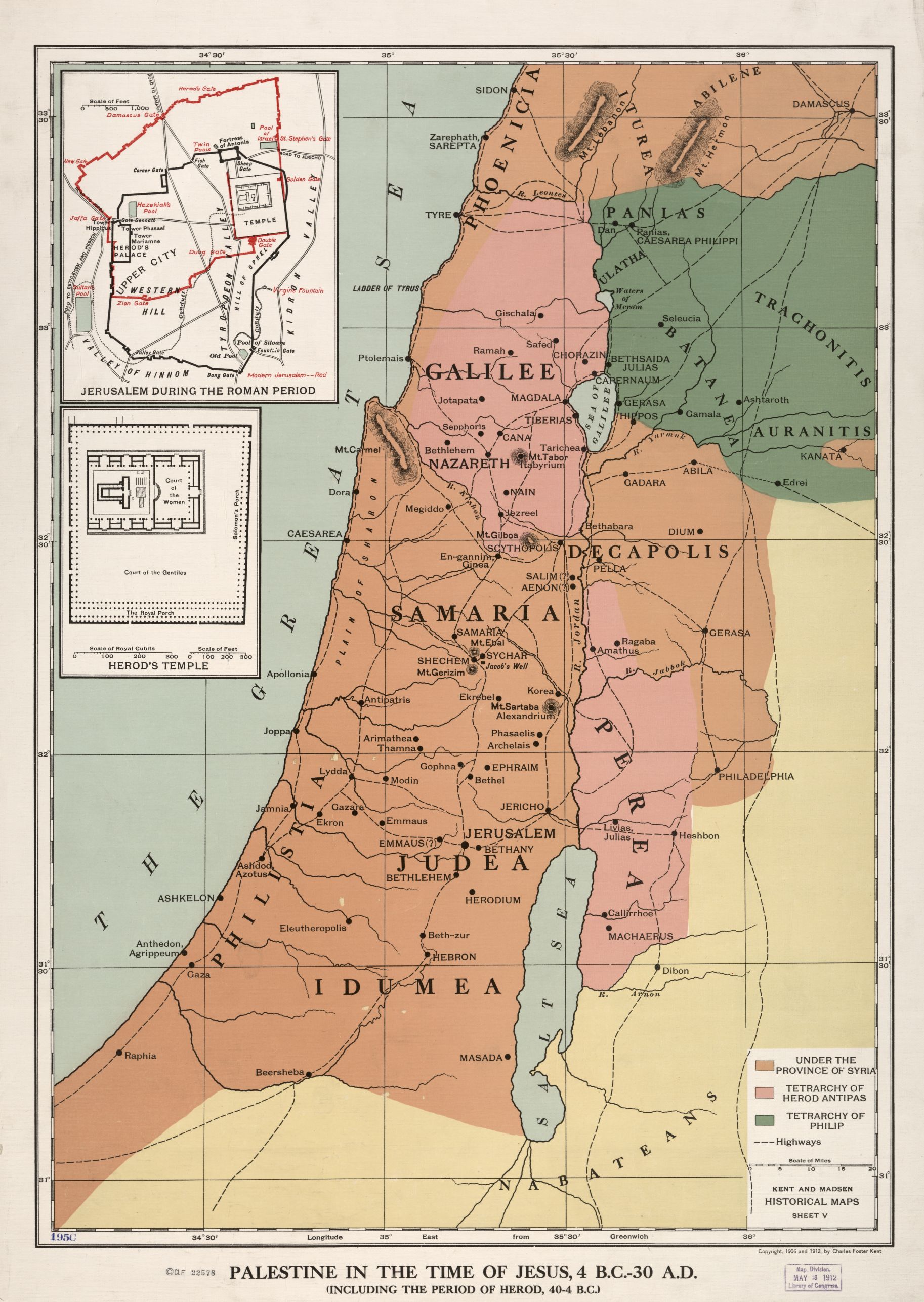
Let’s do some basic geography so that we don’t get lost in our passages this week.

First Century Palestinian Geography

First Century PalestineChorazin, was a middle-sized city in upper Galilee.

Bethsaida, to the best of our knowledge, was a fishing polis near the mouth of the Jordan river on the northern side of the sea of Galilee.

Tyre, a Gentile, maritime-merchant, Phoenician city, was captured by Alexander the Great in 332 BCE, and then by the Greek Seleucids from 316 to 125 BCE. The Roman Empire conquered it in 64 BCE.

Sidon was an ancient, Gentile, Phoenician city with a long history of being conquered repeatedly by Assyrians, Babylonians, Egyptians, Persians, Greeks, and Romans. It also belonged the often negative ancient Hebrew narrative of being “other.” Originally, it was assigned to Asher, but was never subdued (Judges 1:31). The Sidonians long oppressed Israel (Judges 10:12). By the time of David’s narrative, Sidon began to wane, and Tyre, its “virgin daughter” (Isaiah 23:12), rose to eminence. Solomon entered into a matrimonial alliance with the Sidonians, which became the accused source of “idolatrous worship” in the land of Israel (1 Kings 11:1, 33). Jezebel was also a Sidonian princess (1 Kings 16:31).

Capernaum, another fishing village on the north shore of the sea of Galilee, was a base for Jesus’ ministry in the Gospels.

James Robinson in his volume The Gospel of Jesus explains how all of these towns relate:

“Jesus developed on the north shore a small circuit of three villages, Capernaum, Bethsaida, and Chorazin. These towns may also have been helpful. His base camp at Capernaum was still in Galilee, ruled by Herod Antipas, who had put John to death. But [Capernaum] was a border town, and Jesus befriended the Roman centurion stationed nearby. It was on the frontier of the territory of Philip, a less threatening ruler. Bethsaida, across the frontier just outside Galilee, was in fact the capital of Philip’s territory, so it may well have been politically safer. It was also the hometown of one of John’s converts who became Jesus’ first disciple, Andrew.” (Kindle Location 2550)

Rejection, Hades & Sodom

The “woes” we encounter in this week’s saying are addressed to the vprimary towns Jesus conducted his ministry in. His teachings about nonviolent enemy transformation, peasant mutual-aid, community interdependence, resource sharing, and voluntary wealth redistribution from the rich, I can imagine, must have been about as popular back then as they are today.

As we have covered previously, the Hebrew prophets pronounced woes that announced or warned of impending destruction on societies whose injustice and oppression were reaching a critical breaking point. Our societies can learn from the path that many followed in Palestine and the Roman destruction that came as an intrinsic result forty years later. Violence used to solve the world’s problems, isolationism, independence and individualism, and growing global and national wealth disparities are all warnings to those today who have eyes to see that the path we are on cannot continue indefinitely. It’s not sustainable politically, socially, economically, or environmentally.

Just as Capernaum did, a society may consider its wealth a sign of being “God blessed” and “heaven” bound, all while their riches are the fruit of exploitation and they’re bound for hell or “hades.” Jesus, here, is using Hebrew prophetic liberation imagery found in Isaiah 14:

“On the day the LORD gives you relief from your suffering and turmoil and from the harsh labor forced on you, you will take up this taunt against the king of Babylon:

  How the oppressor has come to an end!

How his fury has ended!

  The LORD has broken the rod of the wicked,

the scepter of the rulers,

  which in anger struck down peoples

with unceasing blows,

and in fury subdued nations

with relentless aggression.

  All the lands are at rest and at peace;

they break into singing.

  Even the junipers and the cedars of Lebanon

gloat over you and say,

‘Now that you have been laid low,

no one comes to cut us down.’

  The realm of the dead below is all astir 

to meet you at your coming;

it rouses the spirits of the departed to greet you—

all those who were leaders in the world;

it makes them rise from their thrones—

all those who were kings over the nations.

  They will all respond,

they will say to you,

‘You also have become weak, as we are;

you have become like us.’

  All your pomp has been brought down to the grave,

along with the noise of your harps;

maggots are spread out beneath you

and worms cover you.

  How you have fallen from heaven,

morning star, son of the dawn!

You have been cast down to the earth,

you who once laid low the nations!

  You said in your heart,

‘I will ascend to the heavens;

I will raise my throne

above the stars of God;

I will sit enthroned on the mount of assembly,

on the utmost heights of Mount Zaphon.

  I will ascend above the tops of the clouds;

I will make myself like the Most High.’

  But you are brought down to the realm of the dead,

to the depths of the pit.” (Isaiah 14:3-15, emphasis added.)

The fact that Hades is mentioned at all in this saying is evidence to many scholars that this is a Galilean saying. Galilee was more influenced by their Hellenistic neighbors than the Jewish community south of them in Judea, and Sayings Gospel Q was the collection of sayings cherished by the Jewish followers of Jesus in Galilee.

Within the Hellenistic worldview, Hades was synonymous with death, and the dualism of a post mortem Heaven and Hell are late arrivals to the Jewish people of the first century. Many Jewish people subscribed instead to an apocalyptic world view.

In regards to Sodom, we discussed last week, at length, that Sodom’s story wasn’t finished yet. Sodom was envisioned by Ezekiel as being fully restored.  As stigmatic as the narrative surrounding Sodom and its economic individualism was (its independent isolationist rejection of mutual aid and basic hospitality to visitors as well as immigrants); the day of judgment coming at the end of the apocalyptic age would be more bearable for it than for the Galilean communities if they continued choose (economically, religiously, and politically) to remain on the path they were presently on.

Day of Judgement

As we discussed in An End of the World Savior versus Present Liberator, Jewish apocalypticism looked forward to a day of judgment when all oppression, violence and injustice in the world would be put right. Early Jewish followers of Jesus believed that his emergence in the Jewish community was the apocalyptic event they were looking forward to. There was much more to this view, of course, but the “day of judgment” was central.

The Day of Judgment was a day of great reversal regarding power and resources. On this day of things being put right, those in dominant positions of exploitative and oppressive power would receive their due, and those who had been oppressed and subjugated would be liberated. The Pharisees of the school of Shammai shared this view, except that their definition of the oppressed and subjugated who would be liberated and rewarded would have focused on those oppressed people who also faithfully practiced the School of Shammai’s interpretation of the Torah. Jesus enlarged his definition of those who were oppressed and soon to be liberated to include the poor, the marginalized, people labeled as “sinners” by the followers of Shammai, and even the tax collectors. Jesus’s group of oppressed and subjugated was much larger than the religious boundaries in place in his day.

Jesus taught the people that the day of things being made right was coming, and that they had to choose the way of putting things right. Remember, Jesus’ subversive “empire” of God was defined as people taking care of people. According to Jesus, those early followers were the ones through whom God would begin to put things right. Their choices and participation were essential.

Present Path

I do not believe that we here in America can continue indefinitely on our present path: we are approaching a breaking point in our history. However, I do believe that Jesus’ two thousand-year-old Jewish sayings are intrinsically valuable and are relevant to our challenges today. The path of nonviolence; the path of resource sharing, voluntary wealth redistribution, mutual aid; the power of interdependent communities, these teachings of Jesus represent rich alternative ways of doing life that offer us a different path for us. Jesus teaches us that power and resources are to be mutually shared, not wielded. Fear of the future and one another and fear of those who are unlike ourselves can be replaced by mutual love and caring. Greed, racism, hierarchies, and a myriad of phobias toward others don’t have to be our driving societal forces.

For us, if we don’t choose an alternate path as a society, then not too far in the future, the saying Jesus shares in our verses this week could be said of us as well. The woes he once uttered toward communities who chose to remain on their path until it was too late could also apply to us. In his historical context, it was not until after the people’s bright hopes for the future were devastatingly decimated that they chose alternatives. But change doesn’t have to come through such violent upheaval. It could start today. Here. Now. With you and with me, if we will choose it.

This year, we have been taking a close look at our best understanding of the sayings of Jesus. And like those who heard those sayings long ago, we are brought to a cross roads. Those sayings are still recruiting people into the “empire” of God today. They are still calling, “Follow me.” Here, once more, is our saying this week:

“Woe to you, Chorazin! Woe to you, Bethsaida! For if the wonders performed in you had taken place in Tyre and Sidon, they would have repented long ago, in sackcloth and ashes. Yet for Tyre and Sidon it shall be more bearable at the judgment than for you. And you, Capernaum, up to heaven will you be exalted? Into Hades shall you come down!” (Q 10:13-15)

HeartGroup Application

This week I want you to take a moment in your HeartGroup and do something just for me.

  1. First, please sit in a circle.
  2. Then, invite each person to go around the circle and share one thing they appreciate about everyone else in the circle.
  3. Lastly, encourage each person to then say something they appreciate about themselves.

This has been one of the most effective relationship-building exercises we’ve done in our HeartGroups. Who knows, you may like it so much, you decide to begin doing it each week.

Whatever your circumstances this week, thanks for checking in and reading along with us.

Keep living in love and loving radically, till the only world that remains is a world where only love reigns.

I love each of you dearly.

I’ll see you next week.

Response to a Town’s Rejection

by Herb Montgomery

“But into whatever town you enter and they do not take you in, on going out from that town‚ shake off the dust from your feet. I tell you: For Sodom it shall be more bearable on that day than for that town.” (Q 10:10-12)

Picture of dirty sandaled feetCompanion Texts:

Matthew 10:14-15: “If anyone will not welcome you or listen to your words, leave that home or town and shake the dust off your feet. Truly I tell you, it will be more bearable for Sodom and Gomorrah on the day of judgment than for that town.”

Luke 10:10-12: “But when you enter a town and are not welcomed, go into its streets and say, ‘Even the dust of your town we wipe from our feet as a warning to you. Yet be sure of this: The kingdom of God has come near.’ I tell you, it will be more bearable on that day for Sodom than for that town.”

Our saying this week has a long history of anti-Semitism. Christians have used the phrase “shaking the dust from one’s feet” as a symbol of Jews rejecting Gentiles. But it is simplistic to say that Jews shook the dust off of their feet when leaving Gentile territories as a rejection of Gentiles and it is anti-Semitic to use it to justify rejecting Jews for their rejection of “Jesus as their Messiah.”

What is a better way to understand this ancient practice?

Shaking Dust from One’s Feet

If this was a practice of the first century Jewish people it would have most likely been a practice of those who followed the Pharisaical school of Shammai. The school of Shammai wanted to maintain the distinctions between Jews and Gentiles in an effort to preserve Jewish identity and culture when Hellenism was threatening their culture. I don’t believe that tribal distinctions are the healthiest way to preserve identity, nor do I subscribe to Shammai’s teachings on this, but I can’t fault the people of that era either. I get it. This was a people who were still recovering from their exile and dispersion throughout the region and trying desperately to hold on to their identity.

The Pharisaical school of Hillel, which many of Jesus’ teachings are more in harmony with, did not follow that strict distinction between Jew and Gentile. Instead, Hillel taught that every person, Jew or Gentile, was created in the image of God and worthy of respect and treatment according to the Golden Rule. (We covered this in much more detail earlier this year in The Golden Rule.)

Ultimately the Jewish people abandoned the school of Shammai in favor of Hillel’s more inclusive practices. Karen Armstrong writes about the people’s choice in the wake of the destruction of Jerusalem:

“It happened that R. Johanan ben Zakkai went out from Jerusalem, and R. Joshua followed him and saw the burnt ruins of the Temple and he said: ‘Woe is it that the place, where the sins of Israel find atonement, is laid waste.’ Then said R. Johanan, ‘Grieve not, we have an atonement equal to the Temple, the doing of loving deeds, as it is said, ‘I desire love and not sacrifice.’

“Kindness was the key to the future; Jews must turn away from the violence and divisiveness of the war years and create a united community with ‘one body and one soul.’ When the community was integrated in love and mutual respect, God was with them, but when they quarreled with one another, he [sic] returned to heaven, where the angels chanted with ‘one voice and one melody.’ When two or three Jews sat and studied harmoniously together, the divine presence sat in their midst. Rabbi Akiba, who was killed by the Romans in 132 CE, taught that the commandment ‘Thou shalt love thy neighbor as thyself’ was ‘the great principle of the Torah.’ To show disrespect to any human being who had been created in God’s image was seen by the rabbis as a denial of God himself and tantamount to atheism. Murder was a sacrilege: ‘Scripture instructs us that whatsoever sheds human blood is regarded as if he had diminished the divine image.’ God had created only one man at the beginning of time to teach us that destroying only one human life was equivalent to annihilating the entire world, while to save a life redeemed the whole of humanity. To humiliate anybody—even a slave or a non-Jew—was equivalent to murder, a sacrilegious defacing of God’s image. To spread a scandalous, lying story about another person was to deny the existence of God. Religion was inseparable from the practice of habitual respect to all other human beings. You could not worship God unless you practiced the Golden Rule and honored your fellow humans, whoever they were.”

(Armstrong, Karen; The Great Transformation: The Beginning of Our Religious Traditions. Kindle Edition.)

Luke, the most Gentile of the synoptic gospels, colors Jesus’ instructions with the phrase “as a warning.” By rejecting the values and teachings that Jesus and Hillel sought to promote in Judaism, those in the school of Shammai who practiced shaking Gentile dust off their feet were headed toward the same fate that they claimed the Gentiles were headed toward. In their ethic of separation, alienation, and independence, they were actually aligning themselves more with the path of destruction then the Gentiles they wanted to be separate from.

Remember, Jesus’ community practiced interdependence, mutualism, and resource-sharing. The Jewish followers of Shammai rejected the path of interdependence for independence, isolationism, and exceptionalism, and so they shared with violent revolutionists a path that would ultimately lead to a devastating backlash from the Romans.

Shaking the dust off of one’s feet could not have indicated rejection of the Jews because Jesus was himself a Jew, not a Christian. Yet a Jewish Jesus would have felt burdened to communicate that there was no moral difference between those who rejected his values and those they claimed moral superiority to. Jesus makes this statement in Matthew’s gospel:

“If you love those who love you, what reward will you get? Are not even the tax collectors doing that? And if you greet only your own people, what are you doing more than others? Do not even gentiles do that?” (Matthew 5:46-47, emphasis added.)

Shaking dust off of one’s feet was not an act of rejection, but an act of warning. It was a warning to those one genuinely cared about, was invested in, and saw as one’s own people. It was a sign of deep concern with the direction one’s own community was headed in.

Sodom’s Story: Not Finished.

Let’s close this with the 1st Century Jewish belief that Sodom’s story was not finished. Sodom still had a future, and I believe this is important.

First, let’s be clear on what we are talking about. The atrocity of Sodom, according the Hebrew scriptures was this:

“Now this was the sin of your sister Sodom: She and her daughters were arrogant, overfed and unconcerned; they did not help the poor and needy. They were haughty and did detestable things before me.” (Ezekiel 16:49-50)

Sodom had become so wealthy and isolationist that any immigrants to Sodom were rejected, even if fleeing there for safety, and subjected to physical violence or even sexual violence. The threat of sexual violence we read about in Genesis 19, rape of men and women, was a common war practice in the ancient world, used to emasculate, dehumanize, and humiliate enemies.*

As inhospitable and greedy as Sodom was, however, Ezekiel uses Sodom’s narrative as an indictment against his own people:

“As surely as I live, declares the [LORD], your sister Sodom and her daughters never did what you and your daughters have done.” (Ezekiel 16:48)

But then Ezekiel throws in a twist with the Sodom narrative. He envisions a river of life that one day flows out from Jerusalem (Ezekiel 47.1-2). And what this river of life does for Sodom is restorative, not destructive.

“He said to me, ‘This water flows toward the eastern region and goes down into the Arabah, where it enters the Dead Sea. [In Ezekiel’s time, the Dead Sea was believed to be the region of ancient Sodom.] When it empties into the sea, the salty water there becomes fresh. Swarms of living creatures will live wherever the river flows. There will be large numbers of fish, because this water flows there and makes the salt water fresh; so where the river flows everything will live. People will fish along the shore; from En Gedi to En Eglaim there will be places for spreading nets. The fish will be of many kinds—like the fish of the Mediterranean Sea. But the swamps and marshes will not become fresh; they will be left for salt. Fruit trees of all kinds will grow on both banks of the river. Their leaves will not wither, nor will their fruit fail. Every month they will bear fruit, because the water from the sanctuary flows to them. Their fruit will serve for food and their leaves for healing.’” (Ezekiel 47.8-12, emphasis added.)

Ezekiel had previously said,

“However, I will restore the fortunes of Sodom and her daughters and of Samaria and her daughters, and your fortunes along with them, so that you may bear your disgrace and be ashamed of all you have done in giving them comfort. And your sisters, Sodom with her daughters and Samaria with her daughters, will return to what they were before; and you and your daughters will return to what you were before.” (Ezekiel 16:53-55, emphasis added)

Because of how many Christians use the New Testament passages of Jude 7 and 2 Peter 2:6 today, it is important to understand that Ezekiel saw a positive ending to Sodom’s narrative. Many Christians today use Sodom’s narrative as an example of the future destruction of some categories of people and this belief influences them to practice a hopeless exclusion of whomever they deem unlike them. But Jesus, like Ezekiel, believed that the future of his own people could still be bright.

So in this week’s saying about shaking the dust off one’s feet, Jesus stands in the tradition of the Hebrew prophets: he evokes the narrative of Sodom and compares it to his own people’s future fate. Jesus shows deep concern for the society of his day and the unbearable retaliation Rome would inflict upon Jerusalem if his community continued on its current path. Jesus’ nonviolence and the resource-sharing principles would have placed the people on a radically different trajectory.

I believe that after the destruction of Jerusalem, the Jewish people did, through the teachings of Hillel, partially transition to the path Jesus showed, and they made great strides in love, kindness, nonviolence, and radical inclusivity. Economically, Hillel’s and Jesus’ teachings were somewhat different, and I believe Jesus’ economic teachings were more in harmony with the Torah than Hillel’s. But Jesus’ radical resource sharing and ethics of nonviolence are both waiting for a present or future generation to choose.

Over the last three weeks, we’ve been looking at the interdependent elements of Jesus’ mission instructions. This week we’re beginning to transition into the next section of Jesus teachings. Just like this week’s saying, these next few sayings contain warnings for his generation if they didn’t abandon their path, if they didn’t choose the path he was presenting.

I can’t help but notice that history is cyclical. We in our society today may be being faced with the same choices that first generations of Christians were. With Jesus’ path of nonviolence and resource-sharing in mind, let’s take a moment to contemplate Jesus’ warning:

But into whatever town you enter and they do not take you in, on going out from that town‚ shake off the dust from your feet. I tell you: For Sodom it shall be more bearable on that day than for that town. (Q 10:10-12) 

HeartGroup Application

I want to introduce to you a friend of mine, Mark Van Steenwyk. If you haven’t read his books, they are well worth it and I recommend them highly. This last week, Mark posted this statement on social media:

“I hate coercion!” says the modern man. “Except for, perhaps, the many coercions of the past that have made me so prosperous.”

It is like the parable of the man who slays an entire neighborhood and takes their treasures. Afterwards, he declares himself a pacifist. When the relatives of those slain [come] to his door, angrily holding bats, he says: “You should be pacifists, like me!”

1.   In the context of this statement, discuss in your HeartGroup what it would look like for your group to lean more deeply into the nonviolence and resource-sharing that the Jesus of Sayings Gospel Q taught.

2.   List three ways you believe the teachings of Jesus call you to embrace nonviolence in today’s society. Also list three ways you believe the teachings of Jesus call you to share resources and even participate in the reparations needed in our society today.

3.   Pick one action from each list to put into practice between this week and next.

We cannot continue today on our current trajectory without reaching a breaking point. As we are contemplating the changes we so deeply need, the Jesus of Sayings Gospel Q and those whose experiences of life vary from one another can inform our choices to move toward a safer, more just, more compassionate world for us all.

It’s much easier to simply worship Jesus than to put into place the world-healing teachings he taught. But healing the world is what Jesus spent his life doing, and his story has called to those who would listen ever since saying, “follow me.”

Thanks for joining us this week.

Wherever this finds you, keep living in love, till the only world that remains is a world where only love reigns.

I love each of you, dearly.

I’ll see you next week.


*It’s part of the implicit misogyny of the original culture and contemporary Christian culture that the threatened rape of Lot’s daughters—human women—is almost always glossed over in favor of horror about the threat of rape against “male” angels, the different flesh of Jude.

Sayings Gospel Q: What to Do in Houses and Towns

BY HERB MONTGOMERY

People sharing food“Into whatever house you enter, first say:  ‘Peace to this house!’ And if a son of peace be there, let your peace come upon him; but if not, let‚ your peace return upon you. And at that house remain, eating and drinking whatever they provide, for the worker is worthy of one’s reward. Do not move around from house to house. And whatever town you enter and they take you in, eat what is set before you, and cure the sick there, and say to them: The kingdom of God has reached unto you.” (Q 10:5-9)

Companion Texts:

Matthew 10:7-13: “As you go, proclaim this message: ‘The kingdom of heaven has come near.’ Heal the sick, raise the dead, cleanse those who have leprosy, drive out demons. Freely you have received; freely give. Do not get any gold or silver or copper to take with you in your belts—no bag for the journey or extra shirt or sandals or a staff, for the worker is worth his keep. Whatever town or village you enter, search there for some worthy person and stay at their house until you leave. As you enter the home, give it your greeting. If the home is deserving, let your peace rest on it; if it is not, let your peace return to you.”

Luke 10:5-9: “When you enter a house, first say, ‘Peace to this house.’ If someone who promotes peace is there, your peace will rest on them; if not, it will return to you. Stay there, eating and drinking whatever they give you, for the worker deserves his wages. Do not move around from house to house. When you enter a town and are welcomed, eat what is offered to you. Heal the sick who are there and tell them, ‘The kingdom of God has come near to you.’”

Gospel of Thomas 14:4: “And if you go into any land and wander from place to place, and if they take you in, then eat what they will set before you. Heal the sick among them!”

Last week we discussed the interdependence in the mission instructions that Sayings Gospel Q emphasized. This week, we’ll look at the way of mutual sharing or exchange of resources and abilities found in this saying.

Survival versus Liberation

A great summary of this section of Sayings Gospel Q comes from the work of Stephen J. Patterson:

“What does it actually mean for the empire of God to come? It begins with a knock at the door. On the stoop stand two itinerant beggars, with no purse, no knapsack, no shoes, no staff. They are so ill-equipped that they must cast their fate before the feet of a would-be host. This is a point often made by historical Jesus scholar John Dominic Crossan. These Q folk are sort of like ancient Cynics, but their goal is not the Cynic goal of self-sufficiency; these itinerants are set only for dependency. To survive they must reach out to other human beings. They offer them peace—this is how the empire arrives. And if their peace is accepted, they eat and drink—this is how the empire of God is consummated, in table fellowship. Then another tradition is tacked on, beginning with the words ‘Whenever you enter a town.’ This is perhaps the older part of the tradition, for this, and only this, also has a parallel in the Gospel of Thomas (14). There is also an echo of it in Paul’s letter known as 1 Corinthians (10: 27). Here, as in the first tradition, the itinerants are instructed, ‘Eat what is set before you.’ Again, the first move is to ask. The empire comes when someone receives food from another. But then something is offered in return: care for the sick. The empire of God here involves an exchange: food for care.

This warrants pause. Food for care. In the ancient world, those who lived on the margins of peasant life were never far from death’s door. In the struggle to survive, food was their friend and sickness their enemy. Each day subsistence peasants earn enough to eat for a day. Each day they awaken with the question: Will I earn enough to eat today? This is quickly followed by a second: Will I get sick today? If I get sick, I won’t eat, and if I don’t eat, I’ll get sicker. With each passing day the spiral of starvation and sickness becomes deeper and deeper and finally, deadly. Crossan has argued that this little snippet of ancient tradition is critical to understanding why the followers of Jesus and their empire of God were compelling to the marginalized peasants who were drawn to it. ‘Eat what is set before you and care for the sick.’ Here is the beginning of a program of shared resources of the most basic sort: food and care. It’s an exchange. If some have food, all will eat; if any get sick, someone who eats will be there to care for them. The empire of God was a way to survive— which is to say, salvation.” (The Lost Way: How Two Forgotten Gospels Are Rewriting the Story of Christian Origins, pp. 74-75)

In Luke’s gospel, the goal of Jesus’ ministry is the liberation of the oppressed:

“The Spirit of the Lord is on me,

because he has anointed me

to proclaim good news to the poor.

He has sent me to proclaim freedom for the prisoners

and recovery of sight for the blind,

to set the oppressed free,

to proclaim the year of the Lord’s favor.” (Luke 4.18-19)

This week’s saying describes the way Jesus’ disciples can survive as they work toward that liberation. It reminds me of Delores Williams’ critique of early black liberation theology. Using the Hagar story, Williams explained that “God’s activity” is not always liberation. There are times when, as in the case of Hagar, God provides a way of survival in exploitative situations.

“When our hermeneutical principle is God’s word of survival and quality of life to oppressed communities (or families) living in a diaspora, we put different emphasis upon biblical texts and identify with different biblical stories than do black liberation theologians.” (Sisters in the Wilderness, p. 194)

This week’s saying, seen through the lens of mutual resource-sharing, is a plan of survival. It can also be interpreted as creating a new world while the old exploitative one is still present, building a new society within the shell of the old.

Within the Shell of the Old

I read a great article this past week from the Center for a Stateless Society’s website about Alcoholics Anonymous illustrating how people can create structures that meet their communities’ needs today even as they look forward to one day when the present structures are no longer present. For those not familiar with C4SS, one of the senior fellows of this group is Gary Chartier, professor of Law and Business Ethics and Associate Dean of the Zapara School of Business at La Sierra University.

Jesus showed how to build a new world within the shell of the old, and this was valuable in four ways:

First, the mutualism in Jesus’ sharing of resources enabled his impoverished followers to survive and, together, raise their quality of life despite Roman economic exploitation and the religious complicity of the Temple aristocracy.

Second, it empowered Jesus’ followers to speak the truth about the system that they lived in. Often, people subordinated in systems do not have the power to immediately abandon and separate themselves from their oppression. They are forced into participation against their will. So survival at times can include a type of lying about the system in order to placate oneself that it not that bad, it’s not perfect, but they can work with the present system.

Building a new world within the shell of the old does not require an impossible abandonment of the old world. It enables one to tell the truth about the present system, acknowledging one’s inability to fully escape that system, and still dedicate one’s efforts to creating a new society. We may not be able to escape it yet, but as we learned last month from Tolstoy and Gandhi, at least we can be honest about it.

Third, Jesus’ teachings encouraged his followers to direct their energy toward preparing for their liberation. Too often the need to survive is a reason one can’t abandon a present exploitative system. To use Delores Williams’ example again, Hagar had liberated herself from the oppression of Abraham and Sarah, yet she and her son were dying! They had become free, but to what end? She and her son were now alone in the wilderness and starving, and in order to survive, she had to return to the house of her oppressors.

Building a new world within the shell of the old promises that one will in the future be able to abandon present oppression because a more just society provides for the needs of the community and liberation moves everyone toward life rather than starvation.

Fourth and lastly, building a new world within the shell of the old critiques the present world, waking others to the injustices of a system they may still be complicit in. An unconscious person might ask, why build a different world if this one is so perfect, so “number one,” so “God blessed.” To work on a better world while the present world is in motion helps others to see the problems in the present system and provides an option that meets the needs of humanity without domination and subjugation. This method subverts the present world, allowing people to see and freely choose a better option. Thus they accomplish liberation through justice rather than through violence.

“When Power Resides With the Outsiders”

Lastly this week, I want to draw your attention to something in this week’s saying that I hadn’t noticed, and I want to talk about why I hadn’t noticed it. Dr. Keisha McKenzie beautifully pointed out that what we see in Jesus’ instructions to the disciples is a power dynamic working in reverse.

“So often when we talk about who is welcome or received, especially in churches, the congregation or pastor or elders are usually described as blessers. They have legal and sacramental authority, they often own the property, they can expel people or invite them into membership: we imagine the power to ‘bless’ resides with them.

That’s not the dynamic at work in this verse.

In this verse, it’s the itinerant community that blesses. The power to bring peace moves with them, and reluctant or rejecting hosts can resist it.

This is encouragement for people who don’t have conventional power yet may not realize that they aren’t without all power. Families may be icy tundras and congregations may be just as cold. But we have the ability to offer the mainstream ‘peace’ and wholeness, and they have the ability to repel both.” (Family Memories)

I encourage you to read the entire article. It is spot on!

What I also want to point out is that although Keisha gave a shout out to me for directing her attention to Luke 10, she captured an insight from our saying this week that I would never have seen on my own in a million years. Why? Because I’m an insider in most areas of the culture we live in today. I’m White. I’m male. I’m American. I’m straight. I’m cisgender. It never occurred to look at these instructions from the perspective of an outsider. I missed that! But most of Jesus’ disinherited followers were outsiders too. Jesus was empowering the outsiders of his day in a world where they had been religiously, socially, politically and economically kept out.

This illustrates for me once again why we so desperately need more eyes reading the Jesus story than just White, male, European theologians from the Western so-called “First World.” We need South American voices, we need Black voices, we need feminist voices, we need womanist voices, we need queer voices! It’s from the diverse perspectives and voices of those on the outlying edges of our societies that we can regain the original meanings of the Jewish Jesus story, not because of these identities in themselves, but because of the way people in marginal social positions experience life: they experience life differently from people in the dominant positions of our societies.

The Jesus we meet in the Jesus story resonated with the marginalized and oppressed of the 1st Century. It makes perfect sense that those who share that experience today will see within the Jesus story things that others in a more dominant social position will initially miss. In Western history, “ownership” of the Jesus story has most often been claimed by those in positions of power and privilege. This has almost obliterated the original meaning of the Jesus story to a point where we can barely recover it today. So recovering the historical Jesus is difficult for dominant society groups and may be much easier for those who parallel in our society those with whom the original story resonated so long ago. That story has been buried under interpretation after interpretation of those in positions of power, interpretations that protect the status quo, keeping it in place rather than subverting it from underneath. This is why, I believe, if we are to rediscover the historical Jesus, we must listen to the voices of those forced by society to live on the fringes of our world.

This is another example of our interdependence. We need each other. We need the value of all of our voices, and we especially need those whose experience is different from our own. Together we can integrate all of those experiences into a coherent and meaningful whole, choose to abandon our fear and insecurity toward those unlike ourselves, and work toward a world characterized by what Jesus subversively called the “empire” of God: a community of people taking care of people.

As we work toward a world that looks like this, let’s keep in mind those original instructions from Jesus, which emphasized our interdependence in concrete and practical ways:

“Into whatever house you enter, first say: Peace to this house! And if a son of peace be there, let your peace come upon him; but if not, let‚ your peace return upon you. And at that house remain, eating and drinking whatever they provide, for the worker is worthy of one’s reward. Do not move around from house to house. And whatever town you enter and they take you in, eat what is set before you, and cure the sick there, and say to them: The kingdom of God has reached unto you.” (Q 10:5-9)

HeartGroup Application

This week I have a very simple exercise for your HeartGroup.

  1. As a group, write down five ways you feel you depend on one another.
  2. Now share what each of these connections means to each of you. Define them.
  3. Now list three ways that this week you can individually and together lean into these five areas of dependence.

None of us come into this life all on our own. We don’t thrive alone either.

Thanks once again for joining us this week.

Keep living in love, till the only world that remains is a world where only love reigns.

I love each of you dearly.

I’ll see you next week.

No Provisions

by Herb Montgomery

Picture of Backpack“Carry no purse‚ not knapsack, nor sandals, nor stick, and greet no one on the road.” (Q 10:4)

Companion Texts:

Matthew 10:7-10: “As you go, proclaim this message: ‘The kingdom of heaven has come near.’ Heal the sick, raise the dead, cleanse those who have leprosy, drive out demons. Freely you have received; freely give. Do not get any gold or silver or copper to take with you in your belts—no bag for the journey or extra shirt or sandals or a staff, for the worker is worth his food. Whatever town or village you enter, search there for some worthy person and stay at their house until you leave.”

Luke 10:4-9: “Do not take a purse or bag or sandals; and do not greet anyone on the road. When you enter a house, first say, ‘Peace to this house.’ If someone who promotes peace is there, your peace will rest on them; if not, it will return to you. Stay there, eating and drinking whatever they give you, for the worker deserves his wages. Do not move around from house to house. When you enter a town and are welcomed, eat what is offered to you. Heal the sick who are there and tell them, ‘The kingdom of God has come near to you.’”

Last week we began entering into what Q scholars refer to as Jesus’ Mission Instructions. These sayings show Jesus including others in the community he was seeking to create. As we discussed last week, Jesus didn’t perceive himself as a one-man-show. He was concerned with growing a community shaped by the values and social teachings he was promoting. In these mission instructions, we get a taste of Jesus’ and the Jesus communities’ actual practice in Galilee as he traveled from Jewish village to Jewish village. We assume that Jesus “practiced what he preached”: if there had been a gap between how Jesus lived and what he taught, it’s unlikely that the Q community would have been so captivated by what he taught, or preserved it.

Let’s begin with Matthew’s mission instructions first.

Matthew, Luke and Q’s Instructions

Initially, those who formed the Jesus community would have gone out into areas they did not know to get familiar with certain villages. Over time, some houses in these areas became known as the homes of Jesus followers or homes welcoming of Jesus followers. Those going out were going out cold, as it were, totally dependent on the hospitality of those that took them in.

This is not the safest way to meet new people. In our modern Western, capitalistic culture, which places a high priority on individualism and independence, this method is counterintuitive. Yet form follows function. I’m convinced that this method put into practice the mutualism, mutual aid, and interdependence that Jesus taught. We cannot use independent, self-reliant, individualistic methods to build a world where we demonstrate that mutualism, resource sharing, mutual dependence is how life on this planet truly flourishes. The world we are working toward and the path by which we travel to arrive at that world must be of the same substance.

It was in the soil of non-alienation and mutually beneficial relationships that the mustard seed of Jesus’ subversively named “empire of God” was to sprout and grow. And so those sent out to various villages practiced total dependence on others. Domination of one another begins with denying our dependence on one another. And the way of domination ends when we embrace and begin to lean into our mutual interdependence. Life is a shared experience. Rather than a zero-sum game where there are winners and losers, life is found in mutuality. We share resources, exercise our own ability to think and act, empower others to think and act, and are empowered by others to think and act as well.

Matthew’s Instructions

The Matthean Jesus community grew out of the Q movement and so reflected the Q movement’s mission practices with, as we will see, a few updates.

Over time, Jesus’ instructions about this method must have been abused, because in chapter 11 of the Didache, it states:

But concerning the apostles and prophets, act according to the decree of the Gospel. Let every apostle who comes to you be received as the Lord. But he shall not remain more than one day; or two days, if there’s a need. But if he remains three days, he is a false prophet. And when the apostle goes away, let him take nothing but bread until he lodges. If he asks for money, he is a false prophet.

It’s not possible to harmonize Q’s instructions on taking no money bag or purse (no gold or silver) and where to lodge with the Didache’s decrees that staying in a home more than two days and asking for money for the trip marked an apostle as a “false prophet.” The most we can say is that the original saying implies mutuality, the exchange of care for the sick in exchange for food and provisions. Between Q’s instructions and the Jesus-communities who cherished the Didache, there must have been an imbalance in this exchange that the Didache strove to bring back to center.

Matthew reflects this in the statement that those sent out were to give without payment as they had received without payment: don’t put a price tag on the blessings and don’t monetize the teachings of Jesus. And Matthew also preserves the Q text’s emphasis on the apostles and the people’s interdependence and mutual generosity. Matthew does update the instructions with the Greek word trophe or food whereas Luke keeps more of the original idea with the word misthos or wages in his phrase, “the worker deserves his wages.”

These instructions delicately balanced the people’s hospitality and generosity with the “price” set or demanded for the ministry of those who were sent. Jesus was not to be transformed into a product to be sold (as he is with TV evangelists today within our culture). Givers would not be deprived of the voluntary embrace of the value of interdependence. And those genuinely laboring in this Jesus revolution were also worthy of being taken care of and provided for. They would not be neglected or made to go without. Having taken the first step towards giving freely, they weren’t to be left holding the bag; their work was to be valued and supported. Their support was to be wholly dependent on the choices of others, and they were simultaneously to be considered worthy of others’ hospitality and generosity. This was not charity, but mutuality. There is a difference.

Stephen Patterson captures the idea in his book The Lost Way: How Two Forgotten Gospels Are Rewriting the Story of Christian Origins:

“What does it actually mean for the empire of God to come? It begins with a knock at the door. On the stoop stand two itinerant beggars, with no purse, no knapsack, no shoes, no staff. They are so ill-equipped that they must cast their fate before the feet of a would-be host . . . These Q folk are sort of like ancient Cynics, but their goal is not the Cynic goal of self-sufficiency; these itinerants are set only for dependency. To survive they must reach out to other human beings. They offer them peace—this is how the empire arrives. And if their peace is accepted, they eat and drink—this is how the empire of God is consummated, in table fellowship.” (pp. 74-75)

Luke’s Instructions

Luke’s gospel includes two separate sets of mission instructions, not just one. One comes from Mark, the gospel directed at Gentile Jesus followers:

“When Jesus had called the Twelve together, he gave them power and authority to drive out all demons and to cure diseases, and he sent them out to proclaim the kingdom of God and to heal the sick. He told them: ‘Take nothing for the journey—no staff, no bag, no bread, no money, no extra shirt. Whatever house you enter, stay there until you leave that town. If people do not welcome you, leave their town and shake the dust off your feet as a testimony against them.’ So they set out and went from village to village, proclaiming the good news and healing people everywhere.” (Luke 9:1-6)

The other instruction set is from Q, the gospel of sayings cherished by Jewish Jesus followers:

“After this the Lord appointed seventy-two others and sent them two by two ahead of him to every town and place where he was about to go. He told them, ‘The harvest is plentiful, but the workers are few. Ask the Lord of the harvest, therefore, to send out workers into his harvest field. Go! I am sending you out like lambs among wolves. Do not take a purse or bag or sandals; and do not greet anyone on the road. When you enter a house, first say, “Peace to this house.” If someone who promotes peace is there, your peace will rest on them; if not, it will return to you. Stay there, eating and drinking whatever they give you, for the worker deserves his wages. Do not move around from house to house. When you enter a town and are welcomed, eat what is offered to you. Heal the sick who are there and tell them, “The kingdom of God has come near to you.” But when you enter a town and are not welcomed, go into its streets and say, “Even the dust of your town we wipe from our feet as a warning to you. Yet be sure of this: The kingdom of God has come near.” I tell you, it will be more bearable on that day for Sodom than for that town. Woe to you, Chorazin! Woe to you, Bethsaida! For if the miracles that were performed in you had been performed in Tyre and Sidon, they would have repented long ago, sitting in sackcloth and ashes. But it will be more bearable for Tyre and Sidon at the judgment than for you. And you, Capernaum, will you be lifted to the heavens? No, you will go down to Hades. Whoever listens to you listens to me; whoever rejects you rejects me; but whoever rejects me rejects him who sent me.” (Luke 10:1-16)

Luke did not revise these initial instructions as Matthew does, but leaves them in their original form. James M. Robinson’s book The Gospel of Jesus explains why:

“These constant clarifications in the mission instructions in Matthew are largely absent from the parallel text in Luke, for Q’s mission instructions are actually no longer being followed in Luke’s gentile church as it moves about in the big wide world beyond Galilee. Because Luke’s gentile Christian church had long since gone over to the practice exemplified by Paul in the book of Acts, it would have been less involved in updating the archaic mission instructions of the Jewish Christians found in the Sayings Gospel Q. As a result, Luke remained closer to the original language of Q’s mission instructions—thank goodness!”

By the time Luke’s gospel was written the Gentile Christian Church was practicing Paul’s mission methods, not Q’s (see 1 Corinthians 9:1-6, 12) Paul took a more independent, self-reliant approach of working for a living rather than depending only on the interdependent hospitality and generosity of those who would take him in.

It is also curious that Luke is the only gospel to reverse Q’s mission instructions. Later in Luke’s gospel we find:

“Then Jesus asked them, ‘When I sent you without purse, bag or sandals, did you lack anything?’ ‘Nothing,’ they answered. He said to them, ‘But now if you have a purse, take it, and also a bag; and if you don’t have a sword, sell your cloak and buy one.’” (Luke 22:35-36)

Luke’s gospel seems to use this reversal to create harmony between the instructions we find in Q and Paul’s independence. This passage has since become one that many people use to try to justify violence against one’s enemies.

Since Luke is showing that Q’s instructions are obsolete, he has no need to update them as Matthew does. Luke 10 (from Q) is believed to be more closely represent the Q original: he simply describes the movement’s early practices before the changes Paul brought.

But I believe Q’s original instructions should not be abandoned. The interdependence of the original Jewish Q community versus the independence of later methods is relevant to our struggle today. The harms of capitalist, patriarchal, individualist, dominating ways of structuring society are becoming more obvious to many people. And one of the most destructive fruits that our western individualism has perpetuated in human relationships is the suppression of our natural interdependence.

I want to return to Stephen Patterson’s words one more time as we end this week. What the Q community sought to preserve in the sayings of the Jewish Jesus was a way of forming societies or community rooted in mutualism and interdependence. Patterson notices just how remarkable this approach was given the culture Jesus taught in.

“In the ancient world, those who lived on the margins of peasant life were never far from death’s door. In the struggle to survive, food was their friend and sickness their enemy. Each day subsistence peasants earn enough to eat for a day. Each day they awaken with the question: Will I earn enough to eat today? This is quickly followed by a second: Will I get sick today? If I get sick, I won’t eat, and if I don’t eat, I’ll get sicker. With each passing day the spiral of starvation and sickness becomes deeper and deeper and finally, deadly. Crossan has argued that this little snippet of ancient tradition is critical to understanding why the followers of Jesus and their empire of God were compelling to the marginalized peasants who were drawn to it. “Eat what is set before you and care for the sick.” Here is the beginning of a program of shared resources of the most basic sort: food and care. It’s an exchange. If some have food, all will eat; if any get sick, someone who eats will be there to care for them. The empire of God was a way to survive—which is to say, salvation.” The Lost Way: How Two Forgotten Gospels Are Rewriting the Story of Christian Origins (p. 75)

Today, let’s lean more deeply into our shared lives. Let’s find ways relevant for our world today of acknowledging and tapping our interdependence and shared power, the power of community. As we do this, let’s not forget the instructions Jesus’s early movement was rooted in:

Carry no purse‚ not knapsack, nor sandals, nor stick, and greet no one on the road. (Q 10:4)

HeartGroup Application

We tend to live in one of the binary options of self-reliance, independence, and individualism or dependence, community, and mutuality. Yet reality (and the way of life) is more and more being discovered to be simultaneous embrace of our differentiation from each other as well as our mutual dependent nature.

This week, take two words, compassion and empathy, and explore their relation to our interdependence. Think of the chicken or the egg question (which came first).

1.  Compassion: How does recognizing our interdependence heighten our compassion for one another? How does practicing compassion deepen our appreciation of our interdependence?

2.  Empathy: How does recognizing our interdependence lead us to more empathy? How does practicing empathy reinforce our appreciation of our shared, interdependent existence?

3.  As a group, make a list of three things you can do this week to acknowledge and embrace our dependence on one another. This may take some practice. We are socialized to value independence and individualism instead. But with time and intention, I’m sure each of us can do this.

Thank you, once again, for joining us this week.

Keep living in love, till the only world that remains is a world where love reigns.

I love each of you, dearly.

I’ll see you next week.

Sayings Gospel Q: Sheep Among Wolves

by Herb Montgomery

sheepwolves“Be on your way! Look, I send you like sheep in the midst of wolves” (Q 10:3) .

Companion Texts:

Matthew 10.16: “I am sending you out like sheep among wolves. Therefore be as shrewd as snakes and as innocent as doves.”

Luke 10.3: “Go! I am sending you out like lambs among wolves.”

The image of this week’s saying is one of risk. In the last saying, we prayed for laborers. In the saying for this week, we encounter Jesus sending forth fellow laborers and being honest and frank about the risk involved.

I want to point out the participatory nature of this week’s saying. And lastly we’ll look closely at the imagery of sheep versus wolves and consider what this might have meant given Jesus teachings on changing the status quo with self-affirming nonviolent confrontation. Let’s talk about risk first.

An Ethic of Risk Not Sacrifice

When people interpret Jesus’s message for victims and survivors of injustice as requiring them to embrace an ethic of passive self-sacrifice in the face of injustice, there are harmful results..Karen Baker-Fletcher has gone to significant, convincing lengths to show that Jesus’s message was of self-affirmation, the affirmation of living not dying, and that, although his message was nonviolent, it was nonetheless a message that confronted with nonviolent direct action those who perpetuate injustice.

Jesus’s message of choosing life also involved an “ethic of risk.” This “risk” was not intrinsic to choosing life but was the imposed result of the elite who felt threatened by the subjugated people’s life choice. The way of life is only a way that involves a cross when the status quo threatens the work of social justice with a cross.

In other words, when we follow Jesus, we are not primarily choosing a cross: we are choosing the way of life. But because the powers that be threaten those who choose the way of life with a cross, the way of life also becomes the way of the cross. It need not be thus.

The way of the cross is simply the choice to hold onto life (not suffering), even when threatened with pushback from the dominant party that may result in suffering. It’s choosing life and stubbornly refusing to relinquish that life even when the choice confronts the powers of death and the death (cross) they would silence you with. Jesus taught a message of life, survival and liberation. It was the society around him that determined that his message should also involve a cross. For Jesus and for us, the cross is the result of working for justice and transformation within oppressive systems and social orders.

“Persecution and violence suffered by those who resist evil and injustice is the result of an ethic of risk. The assassination of a Martin King or the crucifixion of Jesus Christ is part of the risk involved in actively struggling for social justice. But such people daily resist the very power of systemic injustice that may crucify or assassinate them.” —Karen Baker-Fletcher and Garth Baker-Fletcher in My Sister, My Brother: Womanist and Xodus God-Talk, p. 79

Rosemary Ruether also elaborates:

“Jesus did not ‘come to suffer and die’. Rather Jesus conceived of his mission as one of ‘good news to the poor, the liberation of the captive’, that is, experiences of liberation and abundance of life shared between those who had been on the underside of dominant systems of religion and state of his time . . . He did not seek to be killed by the powers that be, but rather to convert them into solidarity with those they had formerly despised and victimized.” (Introducing Redemption in Christian Feminism, p. 104)

“It is not the acceptance of suffering that gives life; it is commitment to life that gives life. The question, moreover, is not, Am I willing to suffer? but Do I desire to fully live? The distinction is subtle and, to some, specious, but in the end it makes a great difference in how people interpret and respond to suffering. If you believe that acceptance of suffering gives life, than your resources for confronting perpetrators of violence and abuse will be numbed.” —Joanne Carlson Brown and Rebecca Parker in Christianity, Patriarchy and Abuse, p. 18

When we talk about the way of the cross, or our being “lambs among wolves,” we must be careful not to understand or communicate these images as an admonishment to be passive “lambs” on the way to sacrificial “slaughter.” The lamb/wolf dichotomy is a reference to methods of seeking social change. Self-affirmation and self-giving are involved, but not self-sacrifice. We are lambs only in the sense that our efforts are nonviolent in the face of wolves that use violent means to establish and maintain their position of control in society. Through nonviolent confronting means, after the example and teachings of Jesus and the early Jewish Jesus-community, we challenge privilege and favor that is enforced by violence.

Hero Liberator or Participatory Mutualism

Another element we encounter in this week’s saying is Jesus being more than an isolated hero liberator and forming a community. He not only went out himself, but also empowered a community to go out as well. This community was influenced by him, and also influenced him in a mutual give and take relationship. One example of this is found in Mark’s story, which Matthew includes in his narrative, of the Syrophoenician woman. Rita Nakashima Brock, in her fantastic work Journeys by Heart: A Christology of Erotic Power, contrasts the difference between viewing Jesus as a individual, isolated, hero-liberator and viewing him rather as a pioneer or center of a participator community where each member is participating in envisioning and creating a new social order:

“Jesus is the hero and liberator… The relationship of liberator to oppressed is unilateral. Hence the liberator must speak for victims. The brokenhearted do not speak to the strong [in] a unilateral, heroic model.” (p. 65)

What we see in this week’s saying is very different than that unilateral, heroic model. Brock would refer to it as a community participating in the work of liberation with Jesus rather than an individual Jesus doing the work of liberation alone on the community’s behalf.

“I believe the above views of Christ tend to rely on unilateral views of power and too limited understanding of the power of community. They present a heroic Jesus who alone is able to achieve an empowering self-consciousness through a solitary, private relationship with God/dess. If Jesus is reported to have been capable of profound love and concern for others, he was first loved and respected by the concrete persons of his life. If he was liberated, he was involved in a community of mutual liberation… the Gospel narratives give us glimpses of the mutuality of Jesus’ relationships… Jesus’ vision of basileia [kingdom] grew to include the disposed, women and non-Jewish . . . ‘the marginal,” because of his encounter and interaction with the real presence of such people. They co-create liberation and healing from brokenheartedness.” (p.67)

We should not underestimate that the power of the early Jewish Jesus-community was that it was a community. It was not a group rooted in the unilateral dominance of a lone, hierarchical leader, but rather in the power of community centered on the values, teachings, and ethics taught by Jesus and resonant with community members.

Even the collections of the community’s sayings, which we now recognize as our scriptures, bears witness itself to this. These writings are a manifestation of a mutually participatory group, not just a lone prophet of social change. Jesus never wrote anything down himself. The community that formed around his teachings did, and it’s because of that community that we have accounts of his ministry. We cannot simply gloss over this. We are not waiting for a heroic savior: We are the community he anticipated.

I had the privilege of witnessing two contemporary, practical examples of participatory mutualism this week in the form of two podcasts.

Both of these are community responses to the massacre of LGBTQ people in Orlando on June 12. The first is from the Evangelical Lutheran Church in America’s Young Adults Live Webcast. You can find it at:

https://www.youtube.com/watch?v=ZetBq0vJEWE

The second is The Adventist Podcast: Pulse Massacre Orlando which you can download and listen to at:

http://spectrummagazine.org/article/2016/06/20/adventist-podcast-pulse-massacre-orlando

In each of these examples, those affected, the brokenhearted, are speaking to the dominant society. Rather than waiting for unilateral heroism, the community members are working themselves for survival, liberation, and thriving.

The examples are exactly what what I envision happening among those in whom Jesus’s sayings first began to resonate in the 1st Century.

Sheep Among Wolves

As we covered in Renouncing One’s Rights, Jesus’s teachings on nonviolence were not that victims should embrace passive self-sacrifice or self-denial in a world where oppressors already denied the selves of the oppressed. Jesus gave his listeners a vision of nonviolence that confronted and discomforted those in positions of dominance and gave those being subjugated a way to affirm themselves in a social order where they were being dehumanized.

Yet to choose to only use nonviolently confronting means of challenging injustice when those you are standing up to have not made those same choices is risky. It’s a choice to be a lamb among wolves. Yet it cannot be forgotten: the goal of Jesus’ new social vision is not to replace an old hegemony with a new one. His goal was not peace through victory, the victory of slaughtering our enemies, but peace through restored justice. He was not teaching a new social pyramid to replace the old, but a shared table where victims were not passively complicit in their oppression and their oppressors were not continuing oppression in more subtle ways. Victims were confronting injustice, not in order to become oppressors themselves, but, in the words of Ruether, to “convert” oppressors “into solidarity with those they had formerly despised and victimized.”

Too often the sheep among wolves imagery of nonviolence is used to keep victims passive in the face of injustice. Making sure those being oppressed remain passive co-opts the nonviolence that Jesus and others have taught. Martin Luther Kings’ nonviolence was trouble making. Gandhi’s nonviolence became feared and avoided. Those who use violence themselves will always desire their opposition to “remain nonviolent” if one defines that nonviolence as simply rolling over. Yet true nonviolence is a force more powerful. It is not passive. It confronts, awakens, at times even shames those it is seeking, but not to defeat them, to win and convert to a new paradigm of seeing and a new set of behaviors. To use Jesus, MLK, or Gandhi to induce the subjugated to remain passive and calm is a gross way to use their teachings.

We are sheep in the midst of wolves because our methods of action and the goals we hope to achieve by those actions are radically different from the wolves we seek to transform or change. The Jewish community that cherished Jesus’s imagery was a community that held the Jewish vision of a new social order described by the words:

Isaiah 11:1-9: “A shoot will come up from the stump of Jesse; from his roots a Branch will bear fruit . . . Justice will be his belt and faithfulness the sash around his waist. The wolf will live with the lamb, the leopard will lie down with the goat, the calf and the lion and the yearling together; and a little child will lead them. The cow will feed with the bear, their young will lie down together, and the lion will eat straw like the ox. The infant will play near the cobra’s den, and the young child will put its hand into the viper’s nest. They will neither harm nor destroy on all my holy mountain. (Emphasis added.)

Isaiah 65.25: “The wolf and the lamb will feed together, and the lion will eat straw like the ox, and dust will be the serpent’s food. They will neither harm nor destroy on all my holy mountain.” (Emphasis added.)

Isaiah 58.6, TEV: “The kind of fasting I want is this: Remove the chains of oppression and the yoke of injustice, and let the oppressed go free.”

In this week’s saying, those who believe Jesus’s teachings have intrinsic value and inform the work of nonviolently confronting, liberating, and transforming our world into a safe, more just, more compassionate home for us all, are reminded that this vision involves embracing an ethic of risk. As I have said before, Jesus was not giving us a hard way to get to heaven, but a risky way to heal the earth. We are also reminded that our hope is not in following heroic, unilateral liberators but in discovering and applying the power of mutual, participatory, nonviolent communities.  And lastly, we are reminded that we are up against “wolves.” But we also hold the hope that wolves can be converted, and destruction and harm can be become, by our continued choice, a thing of the past.

A new world is coming, if we choose it. And today, while we make those choices, we find ourselves often in this story . . .

“. . . like sheep in the midst of wolves.” (Q 10:3)


HeartGroup Application

This week, discuss three sets of contrasts with your HeartGroup as you work together toward clarity.

  1. What are the significant differences you feel need to be communicated clearly between nonviolence direct action and merely being passive?
  2. What are the differences between a hero model of liberation and a community model rooted in mutual participation?
  3. What difference does it make for you to define the way of the cross we choose as Jesus followers as a refusal to let go of life rather than a way of merely sacrificing yourself with no change to the status quo around you?

Thank you for joining us this week. Keep living in love, working toward Justice, till the only world that remains is a world where only Love reigns.

I love each of you dearly.

I’ll see you next week.