I Have Much More to Say to You

We want to take this moment to express our heartfelt gratitude to all of our supporters for your support of Renewed Heart Ministry’s work of love, justice, and compassion. At a time when ministries like ours are being asked to achieve more with fewer resources, your support is so deeply appreciated, and we want to simply say thank you. Whether in our larger society or within our local faith communities, Renewed Heart Ministries remains committed to advocating for change, working towards a world that is inclusive, just, and safe for everyone, and being a source of love. From all of us here at Renewed Heart Ministries, thank you for your generous support. We deeply appreciate you.

If you’d like to join them in supporting our work, please go to renewedheartministries.com and click on “Donate.”  

Image created by Canva

I Have Much More to Say to You

Herb Montgomery | June 13, 2025

If you’d like to listen to this week’s article in podcast version click on the image below:

Our reading this first weekend after Pentecost is from the gospel of John:

“I have much more to say to you, more than you can now bear. But when he, the Spirit of truth, comes, he will guide you into all the truth. He will not speak on his own; he will speak only what he hears, and he will tell you what is yet to come. He will glorify me because it is from me that he will receive what he will make known to you. All that belongs to the Father is mine. That is why I said the Spirit will receive from me what he will make known to you.” (John 16:12-15)

One of the things I believe the gospel of John gets right is its repeated call to take Jesus’ liberation work further than Jesus could in his own lifetime. This challenge doesn’t need to fill us with anxiety, and perfection isn’t the goal. Our justice work today can follow the same trajectory as Jesus’ work, and be in harmony with the values we perceive in Jesus’ gospel. As long as we are endeavoring to do this, sometimes we will get it wrong and sometimes we will get it right. And when we do get it right, healing justice will be the result. 

You find this idea echoed in other parts of the gospel of John as well:

Very truly I tell you, whoever believes in me will do the works I have been doing, and they will do even greater things than these . . .” (John 14:12)

More revelations, greater deeds, continuation of the Spirit: all of these narrative elements hint that the Johannine community believed they were to build on Jesus’ initial work. We can do that in for our context, time, and spaces, too!

Jesus built on the justice tradition of the Hebrew Scriptures:

Speak up for those who cannot speak for themselves,

for the rights of all who are destitute.

Speak up and judge fairly;

defend the rights of the poor and needy. (Proverbs 31:8-9)

Learn to do right; seek justice.

Defend the oppressed. 

Take up the cause of the fatherless;

plead the case of the widow. (Isaiah 1:17)

Today, we can build on Jesus’ work, with these themes as our foundation too.  Literalists among us have often cited passages like this and only been concerned with those who are literally widowed or fatherless. But the principle here is to prioritize and center whomever our society makes vulnerable to harm. In patriarchal societies like the ones both Proverbs and Isaiah were written for, community members not connected to a man (widows were without a husband, while the fatherless were without a present father) were vulnerable to social, political, and economic harm. Today we can mark other differences that make certain people in our communities vulnerable to harm. Today we don’t only use patriarchal biases We also use differences like race, gender, sexuality, education, culture, legal status or citizenship, and more to make community members vulnerable. 

Today, we still have poor people, as well as the elderly and children. We must also be cognizant of how differences of race, gender, sexuality, citizenship, and other factors are used to justify cruelty and harm. As Brock and Parker remind us, “The work of justice requires paying attention to how difference is used to justify oppression.” (Rita Nakashima Brock & Rebecca Parker, Saving Paradise: How Christianity Traded Love of This World for Crucifixion and Empire, p. 396)

What Brock and Parker call the “work of justice” is essential for creating a safe, just and compassionate society. Today, several areas of society urgently require social justice to ensure that all people, regardless of their differences, experience equity and safety. The apostle James explains it well when he says, our faith without works of social justice is worthless:

Suppose a brother or a sister is without clothes and daily food. If one of you says to them, “Go in peace; keep warm and well fed,” but does nothing about their physical needs, what good is it? In the same way, faith by itself, if it is not accompanied by action, is dead. (James 2:15-17)

We must deeply question and reject a gospel that has no social impact toward justice:

If anyone has material possessions and sees a brother or sister in need but has no pity on them, how can the love of God be in that person? (1 John 3:17)

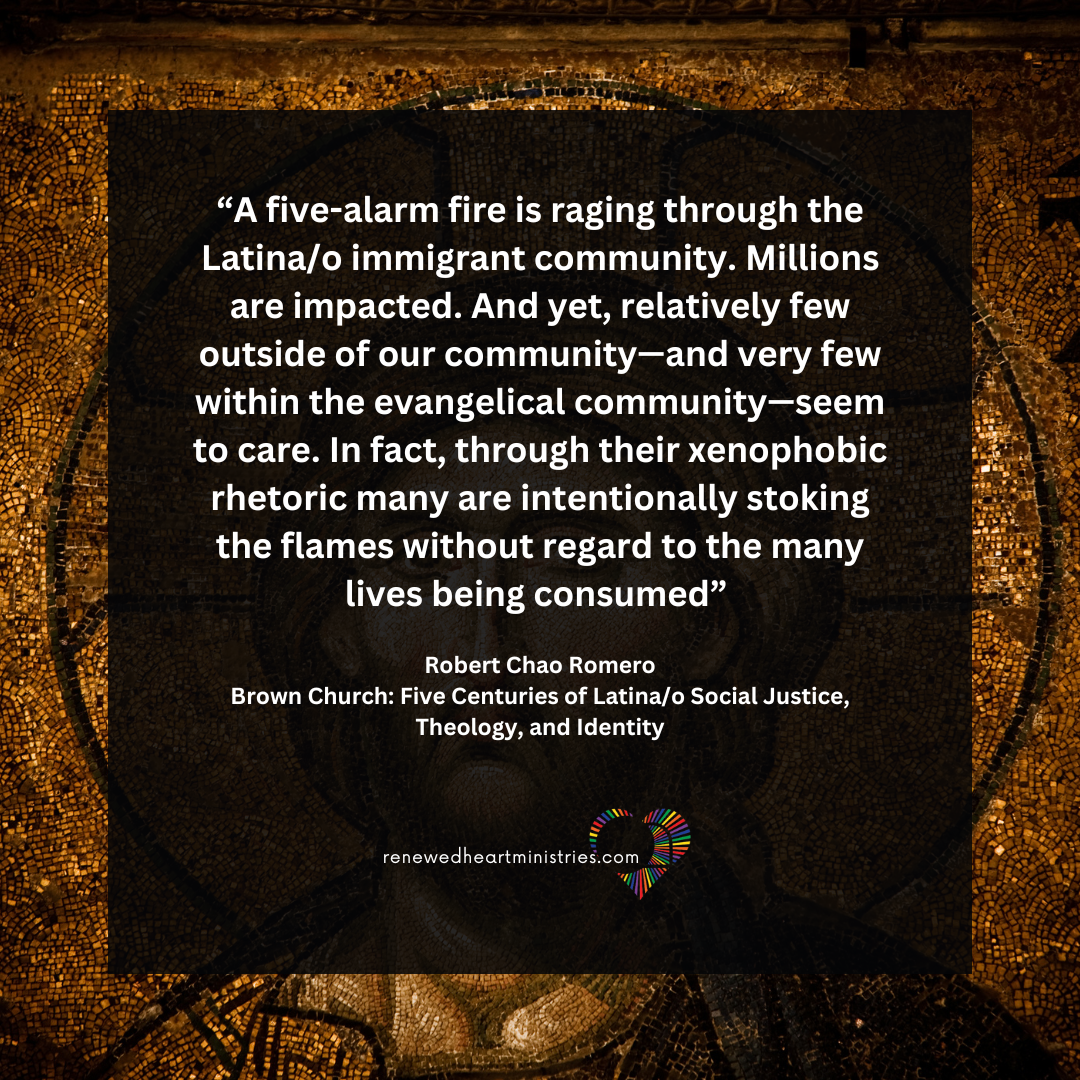
Societal sins are creating an immigration crisis in our nation today. Robert Chao Romero writes, “A five-alarm fire is raging through the Latina/o immigrant community. Millions are impacted. And yet, relatively few outside of our community—and very few within the evangelical community—seem to care. In fact, through their xenophobic rhetoric many are intentionally stoking the flames without regard to the many lives being consumed” (Brown Church: Five Centuries of Latina/o Social Justice, Theology, and Identity, p. 207. Published in 2020).

Romero continues, “Seeing ourselves in the Exodus narrative, we apply the biblical text to our present experience and declare: 

Afterward the Brown Church went to Donald Trump and said, “Thus says the LORD, the God of Israel, ‘Let my people go, so that they may live lives of shalom and abundance in the land that was once theirs.’” 

But Donald Trump said, “Who is the LORD that I should heed him and let the Hispanics go? I worship the God of Make America Great Again, Manifest Destiny, and America First. I do not know about the Christianity of which you speak—this Jesus of Galilee and the God of the Oppressed.” . . . 

But the president of the United States said to them, “Brown Church, why are you taking the people away from their work? Get to your labors!” 

—Exodus 5:1-4, Contemporary Chicana/o Version 

(Ibid., pp. 210-211)

Another prominent area in need of reform is the criminal justice system. Racial profiling, disproportionate sentencing, police brutality, and mass incarceration particularly affect marginalized communities. Social justice in this area calls for equitable law enforcement practices, judicial fairness, and rehabilitation over punishment. Ensuring accountability for law enforcement and promoting restorative justice are also crucial steps.

Consider getting involved in our education system to address inequality. Social justice in education means meeting funding gaps and providing support services to meet diverse student needs. Consider getting involved in the battle for everyone to have even basic health care. The US is considered by many to be a “major nation” due to its substantial economic influence, its powerful military presence, and its role in international organizations. Yet we are the only high-income nation in the world not to ensure everyone has healthcare as a basic human right. Justice requires that everyone can access necessary services regardless of income. You could engage social justice in the workplace. Workplace justice means ensuring fair wages, equal hiring practices, and safe, inclusive environments. Labor rights and protections against exploitation are also foundational to workplace justice. Or how about getting involved in environmental justice? Marginalized communities often live in areas with higher vulnerability to pollution, waste, and climate-related risks. Environmental justice involves pushing our elected officials toward regulating the environment and involving the community in decision-making about environmental issues.

And this only scratches the surface. Jesus’ followers today could choose to see so much more in the Jesus story than a call to charity. Hearing Jesus’ words in John’s gospel, “I have much more to say to you, more than you can now bear. But when he, the Spirit of truth, comes, he will guide you into all the truth” invites us to perceive the truth that achieving a world that is safe, compassionate, and a just home for everyone in our time requires systemic change, policy reform, and collective commitment to equity, inclusion, and human dignity that embraces and celebrates all of our differences. 

Christianity and social justice have always been deeply connected. Whether Christians have historically been found fighting against social justice movements or supporting and working alongside them, Christianity and social justice are connected first and foremost through the teachings of Jesus Christ, who emphasized love, compassion, and care for the marginalized. Central to our gospel is the belief that all humans are created in the image of God, are objects of God’s love and salvation, and deserve dignity and equality. The Hebrew scriptures, too, repeatedly call for justice, particularly for the poor, oppressed, and vulnerable, as seen in verses like Micah 6:8, which urges believers to “act justly, love mercy, and walk humbly with God.” 

Today, we can find Christians on both sides of the social justice work. Some work for a better world here and now, and others are afraid of change, biased against differences, and opposed to the efforts of more justice-oriented Christians working to address systemic injustice, advocate for peace, and end oppression and marginalization. While the different communities within the early Jesus movement held various interpretations of his teachings, the core principle for all them was that faith must be expressed through action. The book of James defines faith as including actions that strive for justice for the oppressed. Christians today who aim to reflect God’s love and build a more compassionate and safe world are wading out into the deep waters of the “much more” Jesus had to share with us, for such a time as this.

Discussion Group Questions

1. Share something that spoke to you from this week’s podcast episode with your discussion group.

2. What does expanding on the Jesus story look like for you this week? Share and discuss with your group.

3. What can you do this week, big or small, to continue setting in motion the work of shaping our world into a safe, compassionate, just home for everyone? 

Thanks for checking in with us, today.

I want to say a special thank you to all of our supporters out there. And if you would like to join them in supporting Renewed Heart Ministries’ work you can do so by going to renewedheartministries.com and clicking donate. 

My latest book Finding Jesus: A Fundamentalist Preacher Discovers the Socio-Political and Economic Teachings of the Gospels is available now on Amazon in paperback, Kindle and also on Audible in audio book format.

As always, you can find Renewed Heart Ministries each week on Bluesky, Facebook, Instagram and Meta’s Threads. If you haven’t done so already, please follow us on your chosen social media platforms for our daily posts. 

Thank you for listening to The Social Jesus Podcast. If you enjoyed this podcast please take a moment to like and subscribe and if the podcast platform you’re using offers this option, please leave us a positive review. This helps others find our podcast as well.

You can watch our YouTube show each week called “Just Talking”. Each week, Todd Leonard and I take a moment to talk about the gospel lectionary reading for the upcoming weekend. We’ll be talking about each reading in the context of love, inclusion, and social justice. Our hope is that our talking will be just talking (as in justice) and that during our brief conversations each week you’ll be inspired to also do more than just talking. If you teach from the lectionary each week, or if you’re just looking for some thoughts on the Jesus story from a more progressive perspective within the context of social justice, check it out, you might like it. You can find JustTalking each week on YouTube at youtube.com/@herbandtoddjusttalking.

Please Like, Subscribe, hit the Notification button, and leave us a comment.

And if you’d like to reach us here at Renewed Heart Ministries through email, you can reach us at info@renewedheartministries.com.

Right where you are, keep living in love, choosing compassion, taking action, and working toward justice.

I love each of you dearly,

I’ll see you next week.


New Episode of “Just Talking” Now Online!

Lectionary Readings in the context of Love, Inclusion, & Social Justice

Season 3, Episode 15: John 16.12-15. Lectionary C, Trinity Sunday

Each week, we’ll discuss the gospel lectionary reading for the upcoming weekend in the context of love, inclusion, and justice. We hope that our talking will be “just” talking (as in justice) and that we’ll be inspired to do more than “just talking” during our brief conversations each week. 

If you teach from the lectionary each week, or if you’re just looking for some thoughts on the Jesus story from a more progressive perspective within the context of social justice, check it out.


New Episode of The Social Jesus Podcast

A podcast where we talk about the intersection of faith and social justice and what a first century, prophet of the poor from Galilee might have to offer us today in our work of love, compassion and justice. 

This week:

Season 2 Episode 24: I Have Much More to Say to You

John 16:12-15

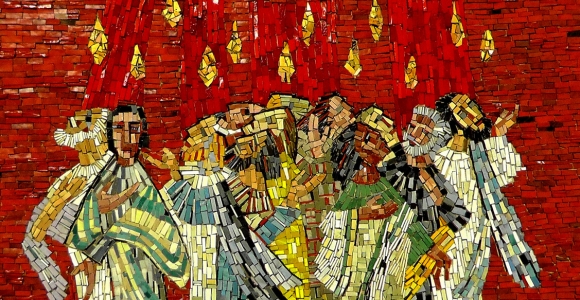
“Today, we can build on Jesus’ work, with these themes as our foundation too.  Literalists among us have often cited passages like this and only been concerned with those who are literally widowed or fatherless. But the principle here is to prioritize and center whomever our society makes vulnerable to harm. In patriarchal societies like the ones both Proverbs and Isaiah were written for, community members not connected to a man (widows were without a husband, while the fatherless were without a present father) were vulnerable to social, political, and economic harm. Today we can mark other differences that make certain people in our communities vulnerable to harm. Today we don’t only use patriarchal biases We also use differences like race, gender, sexuality, education, culture, legal status or citizenship, and more to make community members vulnerable.”

Available on all major podcast carriers and at:

https://the-social-jesus-podcast.simplecast.com/episodes/i-have-much-more-to-say-to-you


Finding Jesus: A Fundamentalist Preacher Discovers the Socio-Political & Economic Teachings of the Gospels.

 

by Herb Montgomery

Available now on Amazon!

In Finding Jesus, author Herb Montgomery delves into the profound and often overlooked political dimensions of the gospels. Through meticulous analysis of biblical texts, historical context, and social discourse, this thought-provoking book unveils the gospels’ socio-political, economic teachings as rooted in a profound concern for justice, compassion, and the well-being of the marginalized. The book navigates the intersections between faith and societal justice, presenting a compelling argument for a more socially engaged and transformative Christianity.

Finding Jesus is not just a scholarly exploration; it is a call to action. It challenges readers to reevaluate their understanding of Christianity’s role in public life and to consider how the radical teachings of the gospels can inspire a renewed commitment to justice, equality, and compassion. This book is a must-read for those seeking a deeper understanding of the social implications of Christian faith and a blueprint for building a more just and inclusive society.


Are you getting all of RHM’s Free Resources?

Free Sign Up Here

Jesus, a Greek Woman and a Magical Cure

Thank You!

We want to take this moment to express our heartfelt gratitude to all of our supporters for your invaluable role in the Renewed Heart Ministry community and for your dedication to our mission of fostering love, justice, compassion, and healing. Your support is the bedrock of our work. Your support empowers us to do what we do. At a time when ministries like ours are being asked to achieve more with fewer resources, your support is incredibly important, and we want to simply say thank you. Whether in our larger society or within our local faith communities, Renewed Heart Ministries remains committed to advocating for change, working towards a world that is inclusive, just, and safe for everyone, and being a source of love in our world. From all of us here at Renewed Heart Ministries, thank you for your generous support. We deeply appreciate each and every one of our supporters.

If you’d like to join them in supporting our work, please go to renewedheartministries.com and click on “Donate.”  


Herb Montgomery, September 7, 2024

If you’d like to listen to this week’s article in podcast version click on the image below:

Our reading this week is from the gospel of Mark:

Jesus left that place and went to the vicinity of Tyre.  He entered a house and did not want anyone to know it; yet he could not keep his presence secret. In fact, as soon as she heard about him, a woman whose little daughter was possessed by an impure spirit came and fell at his feet. The woman was a Greek, born in Syrian Phoenicia. She begged Jesus to drive the demon out of her daughter.

“First let the children eat all they want,” he told her, “for it is not right to take the children’s bread and toss it to the dogs.”

“Lord,” she replied, “even the dogs under the table eat the children’s crumbs.”

Then he told her, “For such a reply, you may go; the demon has left your daughter.”

She went home and found her child lying on the bed, and the demon gone.

Then Jesus left the vicinity of Tyre and went through Sidon, down to the Sea of Galilee and into the region of the Decapolis. There some people brought to him a man who was deaf and could hardly talk, and they begged Jesus to place his hand on him.

After he took him aside, away from the crowd, Jesus put his fingers into the man’s ears. Then he spit and touched the man’s tongue. He looked up to heaven and with a deep sigh said to him, “Ephphatha!” (which means “Be opened!”). At this, the man’s ears were opened, his tongue was loosened and he began to speak plainly.

Jesus commanded them not to tell anyone. But the more he did so, the more they kept talking about it. People were overwhelmed with amazement. “He has done everything well,” they said. “He even makes the deaf hear and the mute speak.” (Mark 7:24-36)

Our reading this week contains two stories that inspire a conversation about what it means to make our world a safer, more compassionate, and just home for everyone. 

The first story is of a Greek woman who approaches Jesus on behalf of her daughter who is possessed. There’s a lot to unpack in this story. 

First, possession in the gospel of Mark is a consistent metaphor for the very real, concrete possession the people of this region experienced from the Roman Empire. In Mark 6, the demon is named “Legion.” This was what the largest unit of the Roman Empire was called. A Legion was often placed in an indigenous people’s territory to keep them from revolting. The Jewish people were not the only ones subjugated by the Roman Empire and their territory taken as Roman possession. The Greeks were subjugated by the Romans, too.

The second thing to notice is the intersection of two different social locations Jesus is standing in simultaneously. As a Jew, Jesus belongs to a people once subjugated and oppressed by the Greeks during the Maccabean era, when the Jewish people were violently oppressed by the Greek emperor Antiochus Epiphanies. This gives us context for why a subjugated, indigenous people (the Jews in this case) would consider their oppressors and subjugators (in this case the Greeks) to be dogs. Many Jewish people also at this time referred to Romans as dogs. Social location here matters and helps us understand context. 

The other social location Jesus is standing in is being a man in a patriarchal world that subjugated and oppressed women. Jesus is oppressed and empowered simultaneously. You would be standing on two different streets simultaneously if you stood where those two streets intersected. This is called intersectionality: Jesus is standing in two intersecting social locations in his exchange with this woman. As a Jew, he is in the social location of those who were once oppressed by those he is interacting with. As a man he is in the social location of patriarchal privilege and power in relation to the woman he is interacting with  He is simultaneously standing in the privilege of oppressor (as a man) and disadvantage (as a Jew). 

Intersectionality is such a rich lens through which to relate to our world as we work for justice. Jesus being Jewish helps us understand why he would call a Greek a dog, while his being a male calling a woman a dog is unacceptable and derogatory. When this woman calls Jesus on it, she ultimately enlarges and expands his experience and understanding. We never see Jesus relating like this to Jewish women. In fact, in a patriarchal culture, Jesus’ relation to Jewish women is remarkably egalitarian. In this story, Jesus learns that Greek woman live in intersecting social locations too. He comes to see that this person before him is more than just a Greek person whose people once persecuted his people. He sees her as a human being, a parent who simply wants something better for her child than Roman oppression. Everyone who is a parent can identify with wanting something better than you’ve experienced for your children. 

We all live in intersecting social locations within our own system too. We are all oppressor and oppressed simultaneously depending on which aspect of our identities is privileged or disadvantaged in our society.  What this story models is how, in the areas of our life where we are privileged, we can all learn to compassionately listen to those who in those areas of our life are marginalized or excluded. And, in the areas of our identities that others consider less than, this story calls us to push back and hold accountable those who consider us less than, no matter who they are. Even if they are Jesus.

In the second story in this week’s passage, we have the story of a deaf and mute man. This story is omitted in the gospels of Matthew and Luke. Some Jesus scholars think it may be because the story sounds too magical for later Jesus communities. Jesus puts his fingers in this man’s ears, spits, touches the mans tongue, and speaks an Aramaic word. It’s a strange healing story, no doubt, and it’s only here in Mark. I understand why later versions of the Jesus story simply leave it out. 

But this story in our reading provides us with the opportunity to talk about ableism and considering or treating people with disabilities as inferior.

In Jesus’ society, people with certain disabilities were put in a marginalized and disenfranchised economic, social, and political position. And this week’s story doesn’t challenge that economic system that exploited the vulnerable and excluded the deaf and mute. It also doesn’t center those with disabilities and their right to self-determination and to change a system that practiced discrimination in favor of able-bodied people. Instead, this story makes a person more able-bodied so they could survive and be included in a discriminatory, competitive system. Rather than making the system more fair, this healing simply places the person in an equal place of opportunity to compete. Mark will critique and call for change of the system elsewhere in this version of the Jesus story(Mark 10:17-23). But this is not one of those times. Equal opportunity in a system that creates winners and losers is not the same as creating a system where everyone wins together and there are no more losers. 

As Jesus followers seeking ways to make our world a more compassionate and just home for everyone, we can do better than what this story offers. Let me explain. 

People who live with disabilities are not “less than.” And we also live in a system that practices discrimination against disabled people in favor of able-bodied people. It’s an ableist system. Ableism characterizes people by their disabilities and classifies disabled people as people who are inferior to non-disabled people. Where medicine and technology can grant people with disabilities with greater ability, people should be able to choose what to use, within their right of self-determination. We also have a long way to go make our world, communities, and larger society more accessible physically, socially, economically, and politically for those in our human family who live with disabilities. 

As Jesus followers, we can also practice greater care and intention than those who have told these stories before us. In the Jesus stories, we encounter a Jesus who often (except for in the case of this one Greek woman) practiced a preferential option for people with disabilities. And that is the part of the story we can hold on to. Where we need to be careful is where disabilities in the gospels are used as metaphors for sin, evil, or wickedness. An example of what I’m talking about is where gospel stories use blindness as a pejorative metaphor against people who reject Jesus (Matthew 15:14; Luke 6:39). This denigrates those people who live every day of their lives with actual blindness.

For Christians acculturated to accept the ableism in the gospels, leaving ableism behind will take effort. But the effort is worth it. I used to use the phrase “blind-spots” to describe when I or folks I interacted with had a limited outlook on an intrinsically harmful practice. Today I want to respect those in my life who live with limited vision. Rather than using phrases that harm them or imply villainy, I now just say what I mean: instead of saying a person has a “blind spot” I simply say their understanding and experience is limited and needs to expand. The story about Jesus and his interaction with the Greek woman is a great example.

Today we need more than magical cures that enable people to do better in our economy’s game of Monopoly. We need a world where there are no more winners and losers and we all win together. Others don’t need to lose for us to win. We can all thrive, genuinely, at the same time. And all of this is part of what it means to be be striving in our spheres of influence to make our world we share a safe, compassionate and just home for everyone. It’s a beautifully challenging work. And one I’m thankful to be engaged in.

Discussion Group Questions

1. Share something that spoke to you from this week’s Podcast episode with your discussion group.

2. What are some examples of where you experience the intersectionality of living simultaneously in different social locations in your own life? Share and discuss with your group.

3. What can you do this week, big or small, to continue setting in motion the work of shaping our world into a safe, compassionate, just home for everyone? 

Thanks for checking in with us, today.

I want to say a special thank you to all of our supporters out there. And if you would like to join them in supporting Renewed Heart Ministries’ work you can do so by going to renewedheartministries.com and clicking donate. 

My latest book Finding Jesus: A Fundamentalist Preacher Discovers the Socio-Political and Economic Teachings of the Gospels is available now on Amazon in paperback, Kindle and also on Audible in audio book format.

As always, you can find Renewed Heart Ministries each week on X (or Twitter), Facebook, Instagram and Meta’s Threads. If you haven’t done so already, please follow us on your chosen social media platforms for our daily posts. 

Thank you for listening to The Social Jesus Podcast. If you enjoyed this podcast please take a moment to like and subscribe and if the podcast platform you’re using offers this option, please leave us a positive review. This helps others find our podcast as well.

You can watch our YouTube show each week called “Just Talking”. Each week, Todd Leonard and I take a moment to talk about the gospel lectionary reading for the upcoming weekend. We’ll be talking about each reading in the context of love, inclusion, and social justice. Our hope is that our talking will be just talking (as in justice) and that during our brief conversations each week you’ll be inspired to also do more than just talking. If you teach from the lectionary each week, or if you’re just looking for some thoughts on the Jesus story from a more progressive perspective within the context of social justice, check it out, you might like it. You can find JustTalking each week on YouTube at youtube.com/@herbandtoddjusttalking. Please Like, Subscribe, hit the Notification button, and leave us a comment.

And if you’d like to reach us here at Renewed Heart Ministries through email, you can reach us at info@renewedheartministries.com.

Right where you are, keep living in love, choosing compassion, taking action, and working toward justice.

I love each of you dearly,

I’ll see you next week.


New Episode of “Just Talking” Now Online!

Season 2, Episode 25: Mark 7.1-8, 14-15, 21-23. Lectionary B, Proper 16

Each week, we’ll be talking about the gospel lectionary reading for the upcoming weekend in the context of love, inclusion, and social justice. Our hope is that our talking will be “just” talking (as in justice) and that during our brief conversations each week we’ll be inspired to do more than just talking.

If you teach from the lectionary each week, or if you’re just looking for some thoughts on the Jesus story from a more progressive perspective within the context of social justice, check it out at:


New Episode of The Social Jesus Podcast

A podcast where we talk about the intersection of faith and social justice and what a first century, prophet of the poor from Galilee might have to offer us today in our work of love, compassion and justice. 

This week:

Season 1 Episode 21: Jesus, a Greek Woman and a Magical Cure

Mark 7:24-36

“Intersectionality is such a rich lens through which to relate to this Jesus story as we consider how it may inform our justice work today. We each occupy intersecting social positions within our own society’s systems, where we can simultaneously be both oppressor and oppressed. Our privilege or disadvantage intersects depending on different aspects of our identities in relation to society. This story illustrates how, in the areas where we hold privilege, we can learn to listen with compassion to those who are marginalized or excluded in those same areas. At the same time, in aspects of our identity where we are deemed “less than” by others, the story encourages us to stand up and hold accountable those who diminish us—no matter who they are, even if it’s Jesus.”

Available on all major podcast carriers and at:

https://the-social-jesus-podcast.simplecast.com/episodes/jesus-a-greek-woman-and-a-magical-cure


Now Available on Audible!


Finding Jesus: A Fundamentalist Preacher Discovers the Socio-Political & Economic Teachings of the Gospels.

by Herb Montgomery, Narrated by Jeff Moon

Available now on Audible!

After two successful decades of preaching a gospel of love within the Christian faith tradition Herb felt like something was missing. He went back to the gospels and began reading them through the interpretive lenses of various marginalized communities and what he found radically changed his life forever. The teachings of the Jesus in the gospel stories express a profound concern for justice, compassion, and the well-being of those in marginalized communities. This book navigates the intersections between faith and societal justice, and presents a compelling argument for a more socially compassionate and just expression of Christianity. Herb’s findings in his latest book are shared in the hopes that it will dramatically impact how you practice your Christianity, too.


Are you getting all of RHM’s Free Resources?

Free Sign Up Here

Not Spiritualizing the Material

Thank You!

We want to take this moment to express our heartfelt gratitude to all of our supporters for your invaluable role in the Renewed Heart Ministry community and for your dedication to our mission of fostering love, justice, compassion, and healing. Your support is the bedrock of our work. Your support empowers us to do what we do. At a time when ministries like ours are being asked to achieve more with fewer resources, your support is incredibly important, and we want to simply say thank you. Whether in our larger society or within our local faith communities, Renewed Heart Ministries remains committed to advocating for change, working towards a world that is inclusive, just, and safe for everyone, and being a source of love in our world. From all of us here at Renewed Heart Ministries, thank you for your generous support. We deeply appreciate each and every one of our supporters.

If you’d like to join them in supporting our work, please go to renewedheartministries.com and click on “Donate.”  


Herb Montgomery, August 3, 2024

If you’d like to listen to this week’s article in podcast version click on the image below:

Our gospel reading from this lectionary this weekend is from the gospel of John: 

Once the crowd realized that neither Jesus nor his disciples were there, they got into the boats and went to Capernaum in search of Jesus.

When they found him on the other side of the lake, they asked him, “Rabbi, when did you get here?”

Jesus answered, “Very truly I tell you, you are looking for me, not because you saw the signs I performed but because you ate the loaves and had your fill. Do not work for food that spoils, but for food that endures to eternal life, which the Son of Man will give you. For on him God the Father has placed his seal of approval.”

Then they asked him, “What must we do to do the works God requires?”

Jesus answered, “The work of God is this: to believe in the one he has sent.”

So they asked him, “What sign then will you give that we may see it and believe you? What will you do? Our ancestors ate the manna in the wilderness; as it is written: ‘He gave them bread from heaven to eat.’”

Jesus said to them, “Very truly I tell you, it is not Moses who has given you the bread from heaven, but it is my Father who gives you the true bread from heaven. For the bread of God is the bread that comes down from heaven and gives life to the world.”

“Sir,” they said, “always give us this bread.”

Then Jesus declared, “I am the bread of life. Whoever comes to me will never go hungry, and whoever believes in me will never be thirsty.”  (John 6:24-35)

The gospel of John, the Johannine community’s version of the Jesus story, became a text during the second generation of Jesus followers who honored John’s apostleship. This makes it the latest gospel to be written in our scriptural canon. The Johannine community was not distanced from the original Jesus movement’s Jewish roots but the social location of the Jesus movement and Jesus followers had largely changed. Early Jesus followers were largely illiterate and practiced an oral tradition. Being able to read and even write was a privilege that only belonged to the wealthy. So the fact that the Jesus story began being put into written form tells us that wealthy Jesus followers had joined the movement. Many still only heard that story read to them each weekend, but that fact that a house church movement possessed people who could both write down the Jesus story and read it to the congregation demonstrated that the community was changing.

One of the many unique elements we encounter in the gospel of John and not in the other three gospels, is its tendency to convert material things into spiritual ones, and to then emphasize the spiritual as so much more important. This tendency is why so many Jesus scholars associate John’s gospel with early Christian gnosticism. (The patristic church father Iraneaus also associated the gospel of John with the gnostics in his Against Heresies.)

Being so heavenly minded that we are no earthly good means being focused on eternal bliss and the afterlife to the exclusion of being engaged, right now, in what people are materially experiencing in their concrete lives. It means being focused on saving souls while ignoring the suffering bodies. Over and over again in Christian history, this has produced destructive and death dealing fruit.

In one of James Cone’s final books, he warns of emphasizing the spiritual over the material. 

And yet the Christian gospel is more than a transcendent reality, more than “going to heaven when I die, to shout salvation as I fly.” It is also an immanent reality—a powerful liberating presence among the poor right now in their midst, “building them up where they are torn down and propping them up on every leaning side.” The gospel is found wherever poor people struggle for justice, fighting for their right to life, liberty, and the pursuit of happiness. Bee Jenkins’s claims that “Jesus won’t fail you” was made in the heat of the struggle for civil rights in Mississippi, and such faith gave her strength and courage to fight for justice against overwhelming odds. Without concrete signs of divine presence in the lives of the poor, the gospel becomes simply an opiate; rather than liberating the powerless from humiliation and suffering, the gospel becomes a drug that helps them adjust to this world by looking for “pie in the sky.” (James H. Cone, The Cross and the Lynching Tree, p. 155)

In the gospel of John, we encounter a version of the Jesus story where Jesus says, “Very truly I tell you, you are looking for me, not because you saw the signs I performed but because you ate the loaves and had your fill. Do not work for food that spoils, but for food that endures to eternal life, which the Son of Man will give you.”

We need to hold this in tension with the versions of Jesus we encounter in the other canonical gospels. In those gospels we encounter a Jesus who wants his followers to work for and pray for our material world to match the heavenly world:

“Your kingdom come, your will be done, on earth as it is in heaven.” (Matthew 6:10)

We encounter a Jesus who holds up the material, concrete, and not spiritualized liberation that people were experiencing as a result of his work and that testified of his legitimacy:

“The blind receive sight, the lame walk, those who have leprosy are cleansed, the deaf hear, the dead are raised, and the good news is proclaimed to the poor.” (Matthew 11:5)

Our daily bread wasn’t spiritualized. That every person would be able to have and eat their actual, material, daily bread was something his followers were to work and pray for:

 “Give us today our daily bread.” (Matthew 6:11)

Not spiritualizing but alleviating people’s material suffering was also lifted up as the litmus test in these gospels’ descriptions of a final judgement:

“Then the King will say to those on his right, ‘Come, you who are blessed by my Father; take your inheritance, the kingdom prepared for you since the creation of the world. For I was hungry and you gave me something to eat, I was thirsty and you gave me something to drink, I was a stranger and you invited me in, I needed clothes and you clothed me, I was sick and you looked after me, I was in prison and you came to visit me . . . for whatever you did for one of the least of these brothers and sisters of mine, you did for me.’” (Matthew 25:34-40)

Caring about our and others’ material needs, especially others who were oppressed, was rooted in the tradition of the Hebrew prophets:

“If you spend yourselves in behalf of the hungry and satisfy the needs of the oppressed, then your light will rise in the darkness, and your night will become like the noonday.” (Isaiah 58:10)

Again, the picture of a God who was concerned with supplying people’s material needs rather than spiritualizing them away is rooted in the soil of the Jewish wisdom that the Jesus movement grew out of:

“He upholds the cause of the oppressed and gives food to the hungry.” (Psalm 146:7)

And when we consider the early Jesus movement located in Jerusalem as contrasted with the Jesus moment of the Johannine community two generations later, we see resource-sharing, mutual aid, as well as hunger and poverty elimination as a central characteristic of how the early movement followed Jesus:

“With great power the apostles continued to testify to the resurrection of the Lord Jesus. And God’s grace was so powerfully at work in them all that there were no needy persons among them. For from time to time those who owned land or houses sold them, brought the money from the sales and put it at the apostles’ feet, and it was distributed to anyone who had need.”(Acts 4:33-35)

Outside of the gospels, my favorite New Testament book is the book of James.  Here too we see the material contrasted with the spiritual. But James explains that if we focus on the spiritual to the exclusion of the material, it makes our focus on spiritual realities absolutely no good.

“Suppose a brother or a sister is without clothes and daily food. If one of you says to them, ‘Go in peace; keep warm and well fed,’ but does nothing about their physical needs, what good is it?” (James 2:15-16)

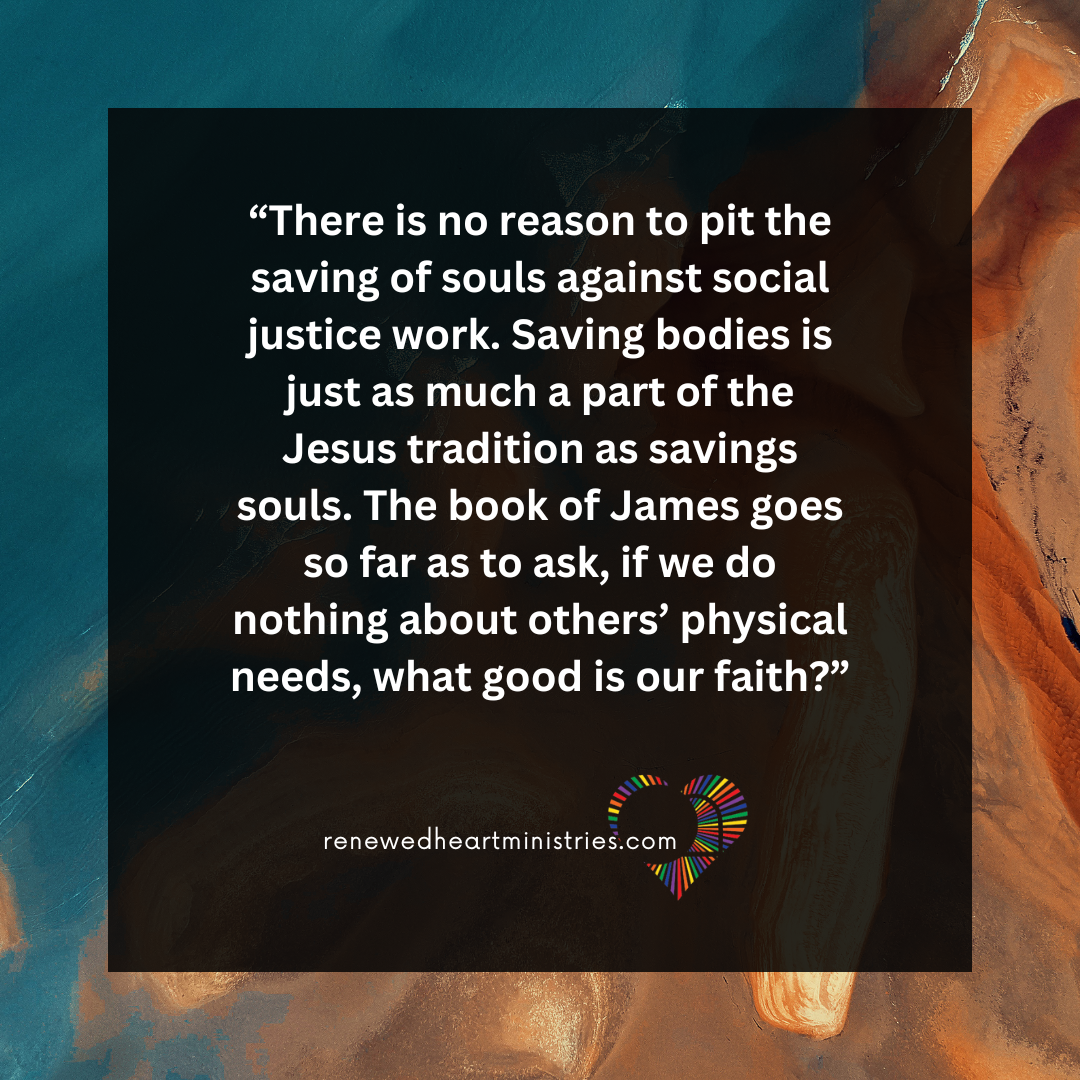
What can we take away from this? Today, some Christians contrast saving souls with the work of social justice. There is no reason to pit the saving of souls against social justice work. Saving bodies is just as much a part of the Jesus tradition as savings souls is. In fact, in the synoptic gospels, social justice is a requirement for genuinely following Jesus. How is social justice still a requirement for you?

Discussion Group Questions

1. Share something that spoke to you from this week’s Podcast episode with your discussion group.

2. How is social justice engagement a part of your Jesus following? Share and discuss with your group.

3. What can you do this week, big or small, to continue setting in motion the work of shaping our world into a safe, compassionate, just home for everyone? 

Thanks for checking in with us, today.

I want to say a special thank you to all of our supporters out there. And if you would like to join them in supporting Renewed Heart Ministries’ work you can do so by going to renewedheartministries.com and clicking donate. 

My latest book Finding Jesus: A Fundamentalist Preacher Discovers the Socio-Political and Economic Teachings of the Gospels is available now on Amazon in paperback, Kindle and also on Audible in audio book format.

As always, you can find Renewed Heart Ministries each week on X (or Twitter), Facebook, Instagram and Meta’s Threads. If you haven’t done so already, please follow us on your chosen social media platforms for our daily posts. 

Thank you for listening to The Social Jesus Podcast. If you enjoyed this podcast please take a moment to like and subscribe and if the podcast platform you’re using offers this option, please leave us a positive review. This helps others find our podcast as well.

You can watch our YouTube show each week called “Just Talking”. Each week, Todd Leonard and I take a moment to talk about the gospel lectionary reading for the upcoming weekend. We’ll be talking about each reading in the context of love, inclusion, and social justice. Our hope is that our talking will be just talking (as in justice) and that during our brief conversations each week you’ll be inspired to also do more than just talking. If you teach from the lectionary each week, or if you’re just looking for some thoughts on the Jesus story from a more progressive perspective within the context of social justice, check it out, you might like it. You can find JustTalking each week on YouTube at youtube.com/@herbandtoddjusttalking. Please Like, Subscribe, hit the Notification button, and leave us a comment.

And if you’d like to reach us here at Renewed Heart Ministries through email, you can reach us at info@renewedheartministries.com.

Right where you are, keep living in love, choosing compassion, taking action, and working toward justice.

I love each of you dearly,

I’ll see you next week.


New Episode of “Just Talking” Now Online!

Season 2, Episode 23: John 6.24-35. Lectionary B, Proper 13

Each week, we’ll be talking about the gospel lectionary reading for the upcoming weekend in the context of love, inclusion, and social justice. Our hope is that our talking will be “just” talking (as in justice) and that during our brief conversations each week we’ll be inspired to do more than just talking.

If you teach from the lectionary each week, or if you’re just looking for some thoughts on the Jesus story from a more progressive perspective within the context of social justice, check it out at:


New Episode of The Social Jesus Podcast

A podcast where we talk about the intersection of faith and social justice and what a first century, prophet of the poor from Galilee might have to offer us today in our work of love, compassion and justice. 

This week:

Season 1 Episode 16: Not Spiritualizing the Material

John 6:24-35

“There is no reason to pit the saving of souls against social justice work. Saving bodies is just as much a part of the Jesus tradition as savings souls is. In fact, in the synoptic gospels, social justice engagement is a requirement for genuinely following Jesus.”

Available on all major podcast carriers, 

Or at this link:

https://the-social-jesus-podcast.simplecast.com/episodes/not-spiritualizing-the-material


Now Available on Audible!


Finding Jesus: A Fundamentalist Preacher Discovers the Socio-Political & Economic Teachings of the Gospels.

by Herb Montgomery, Narrated by Jeff Moon

Available now on Audible!

After two successful decades of preaching a gospel of love within the Christian faith tradition Herb felt like something was missing. He went back to the gospels and began reading them through the interpretive lenses of various marginalized communities and what he found radically changed his life forever. The teachings of the Jesus in the gospel stories express a profound concern for justice, compassion, and the well-being of those in marginalized communities. This book navigates the intersections between faith and societal justice, and presents a compelling argument for a more socially compassionate and just expression of Christianity. Herb’s findings in his latest book are shared in the hopes that it will dramatically impact how you practice your Christianity, too.


Are you getting all of RHM’s Free Resources?

Free Sign Up Here

Jesus Following and Social Justice

Thank You!

We want to take this moment to express our heartfelt gratitude to all of our supporters for your invaluable role in the Renewed Heart Ministry community and for your dedication to our mission of fostering love, justice, compassion, and healing. Your support is the bedrock of our work. Your support empowers us to do what we do. At a time when ministries like ours are being asked to achieve more with fewer resources, your support is incredibly important, and we want to simply say thank you. Whether in our larger society or within our local faith communities, Renewed Heart Ministries remains committed to advocating for change, working towards a world that is inclusive, just, and safe for everyone, and being a source of love in our world. From all of us here at Renewed Heart Ministries, thank you for your generous support. We deeply appreciate each and every one of our supporters.

If you’d like to join them in supporting our work, please go to renewedheartministries.com and click on “Donate.”  


Jesus Following and Social Justice

Herb Montgomery, July 13, 2024

If you’d like to listen to this week’s article in podcast version click on the image below:

Our reading last weekend in the lectionary from the gospels was from Mark:

King Herod heard about this, for Jesus’ name had become well known. Some were saying, “John the Baptist has been raised from the dead, and that is why miraculous powers are at work in him.” Others said, “He is Elijah.” And still others claimed, “He is a prophet, like one of the prophets of long ago.” 

But when Herod heard this, he said, “John, whom I beheaded, has been raised from the dead!” For Herod himself had given orders to have John arrested, and he had him bound and put in prison. He did this because of Herodias, his brother Philip’s wife, whom he had married. For John had been saying to Herod, “It is not lawful for you to have your brother’s wife.” So Herodias nursed a grudge against John and wanted to kill him. But she was not able to, because Herod feared John and protected him, knowing him to be a righteous and holy man. When Herod heard John, he was greatly puzzled; yet he liked to listen to him. Finally the opportune time came. On his birthday Herod gave a banquet for his high officials and military commanders and the leading men of Galilee. When the daughter of Herodias came in and danced, she pleased Herod and his dinner guests. The king said to the girl, “Ask me for anything you want, and I’ll give it to you.” And he promised her with an oath, “Whatever you ask I will give you, up to half my kingdom.” She went out and said to her mother, “What shall I ask for?” “The head of John the Baptist,” she answered. At once the girl hurried in to the king with the request: “I want you to give me right now the head of John the Baptist on a platter. The king was greatly distressed, but because of his oaths and his dinner guests, he did not want to refuse her. So he immediately sent an executioner with orders to bring John’s head. The man went, beheaded John in the prison, and brought back his head on a platter. He presented it to the girl, and she gave it to her mother. On hearing of this, John’s disciples came and took his body and laid it in a tomb. (Mark 6:14-29)

This week’s reading offers us a lot to inform how we follow Jesus’ teachings today. It solidly characterizes that both Jesus and John the Baptist stood in the long Hebrew prophetic justice tradition.

Mark’s gospel seeks to soften Herod’s role in executing John, and this may sound strange to us today. Christianity was an illicit religion in the Roman Empire when Mark was written. Mark’s seeks to characterize Herod as being forced to execute John and doing so somewhat reluctantly. 

On the other hand, Josephus’ writings don’t soften Herod’s role:

“Now some of the Jews thought that the destruction of Herod’s army came from God, and was a very just punishment for what he did against John called the Baptist. For Herod had him killed, although he was a good man and had urged the Jews to exert themselves to virtue, both as to justice toward one another and reverence towards God, and having done so join together in washing. For immersion in water, it was clear to him, could not be used for the forgiveness of sins, but as a sanctification of the body, and only if the soul was already thoroughly purified by right actions. And when others massed about him, for they were very greatly moved by his words, Herod, who feared that such strong influence over the people might carry to a revolt — for they seemed ready to do any thing he should advise — believed it much better to move now than later have it raise a rebellion and engage him in actions he would regret. 

    And so John, out of Herod’s suspiciousness, was sent in chains to Machaerus, the fort previously mentioned, and there put to death; but it was the opinion of the Jews that out of retribution for John God willed the destruction of the army so as to afflict Herod. (Antiquities 18.5.2 116-119)

According to Josephus, Herod had John arrested and executed because he feared John’s popular influence and feared a possible revolt. 

Josephus and the gospels do agree John was one who called his listeners to “justice toward one another and reverence towards God.” Consider how the gospel of Luke describes him:

John answered, “Anyone who has two shirts should share with the one who has none, and anyone who has food should do the same.” Even tax collectors came to be baptized. “Teacher,” they asked, “what should we do?” “Don’t collect any more than you are required to,” he told them. Then some soldiers asked him, “And what should we do?” He replied, “Don’t extort money and don’t accuse people falsely—be content with your pay.” (Luke 3:11-14)

In fact, reverence toward God meant practicing justice toward one another. 

The gospels don’t paint Jesus as being wholly different from John, but as so similar in calling the people to practice justice toward one another that some even thought John had been raised from the dead. This is important as we understand how Mark’s gospel characterizes Jesus. Mark’s Jesus is deemed by the people to be “a prophet, like one of the prophets of long ago.” We don’t see this Jesus traveling the countryside trying to get people to say a special prayer so they can go to heaven when they die. Instead he works to establish justice here on Earth. In the wake of John the Baptist’s execution, Jesus calls the people to justice and righteousness toward one another in the same way as the Hebrew prophets of old (see Isaiah 9:7).

Consider this small collection of statements from the Hebrew, prophetic, justice tradition. Note their repeated call to the people to practice “justice toward one another.”

Learn to do right; seek justice.

Defend the oppressed. 

Take up the cause of the fatherless;

plead the case of the widow. (Isaiah 1:17)

This is what the LORD says to you, house of David:

  “Administer justice every morning;

rescue from the hand of the oppressor

the one who has been robbed.” (Jeremiah 21:12)

The people of the land practice extortion and commit robbery; 

they oppress the poor and needy and mistreat the foreigner, 

denying them justice. (Ezekiel 22:29)

But you must return to your God;

maintain love and justice,

and wait for your God always. (Hosea 12:6)

They trample on the heads of the poor 

as on the dust of the ground 

and deny justice to the oppressed. (Amos 2:7)

But let justice roll on like a river,

righteousness like a never-failing stream! (Amos 5:24)

Then I said, “Listen, you leaders of Jacob,

you rulers of Israel.

Should you not embrace justice. (Micah 3:1)

What does this mean for us today? I think of my own transition in my Jesus following: away from being so heavenly minded that I was no earthly good. When my practice of Christianity transitioned away from a post mortem focus to being concerned with oppression, injustice, and violence against those made vulnerable in our societies, some people accused me of becoming a social justice warrior. As if that’s a pejorative. That being concerned with social justice is somehow a bad thing.

In the gospels, John the Baptist stood within the Hebrew prophetic justice tradition.

In the gospels, Jesus stood within the Hebrew prophetic justice tradition. 

Today, we too, as Jesus followers, should also be concerned with social, political, and economy justice in our world around us, seeking to practice justice toward one another.

One of my favorite statements that has helped me make sense of my own journey over the past decade is from Rev. Dr. Emilie M. Townes. She states, “When you start with an understanding that God loves everyone, justice isn’t very far behind” (Dr. Emilie M. Townes, “Journey to Liberation: The Legacy of Womanist Theology”). 

When we begin to see everyone around us as those we are connected to, and then add to that connectedness that we are all objects of the Divine love, how can we be unconcerned with what affects each of us, positively and negatively? How can we love others and not be concerned with what materially affects those we love? 

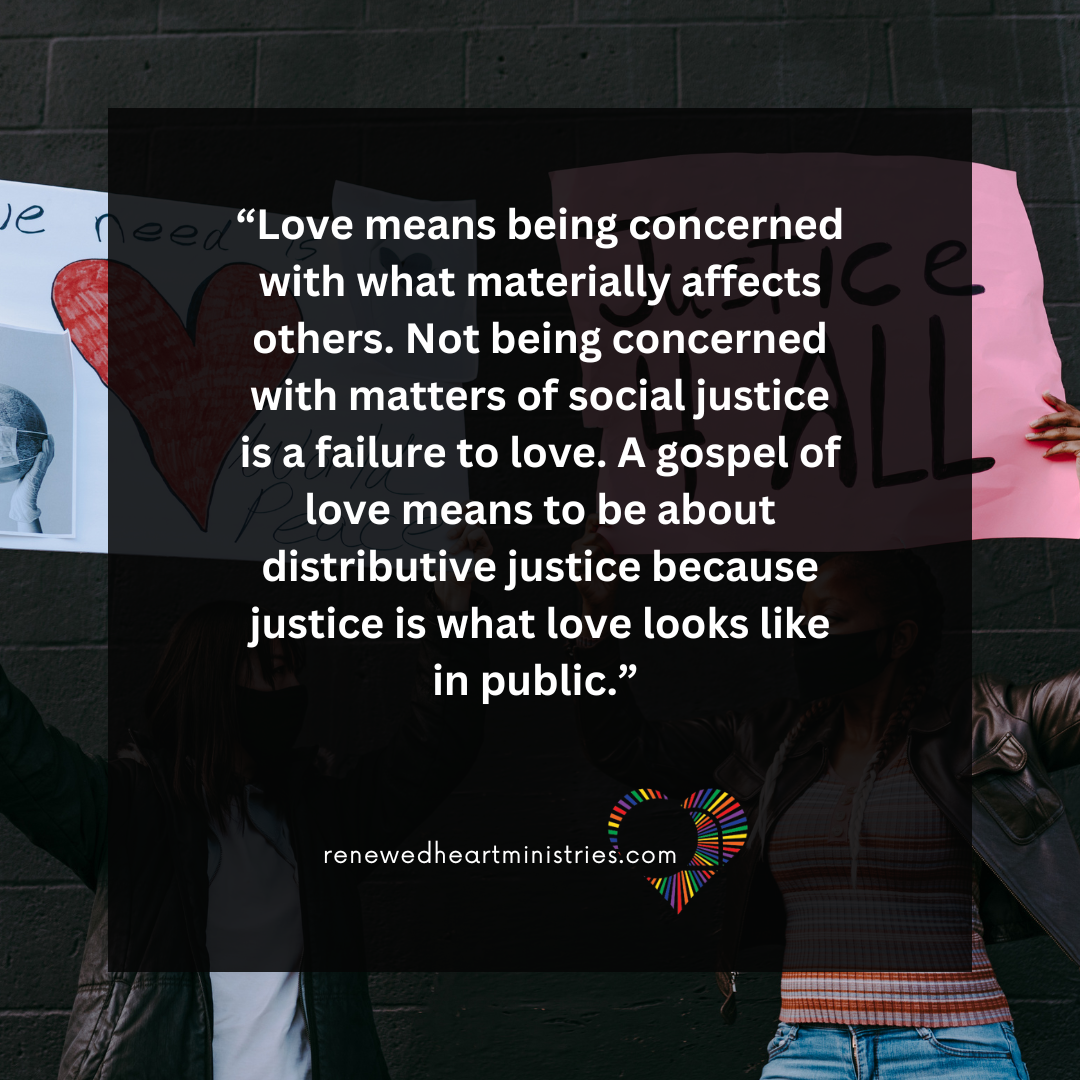
Not being concerned with matters of social justice is a failure. It’s a failure to love. It’s a failure in our Jesus-following. It may derided by those who have something to lose from making our world a more just home for everyone. That’s okay. To believe in a gospel of love means to be about justice because justice is what love looks like in public. 

Discussion Group Questions

1. Share something that spoke to you from this week’s eSight/Podcast episode with your discussion group.

2. How does your Jesus following express itself in social justice engagement? Share and discuss with your group.

3. What can you do this week, big or small, to continue setting in motion the work of shaping our world into a safe, compassionate, just home for everyone? 

Thanks for checking in with us, today.

I want to say a special thank you to all of our supporters out there. And if you would like to join them in supporting Renewed Heart Ministries’ work you can do so by going to renewedheartministries.com and clicking donate. 

My latest book Finding Jesus: A Fundamentalist Preacher Discovers the Socio-Political and Economic Teachings of the Gospels is available now on Amazon in paperback, Kindle and also on Audible in audio book format.

As always, you can find Renewed Heart Ministries each week on X (or Twitter), Facebook, Instagram and Meta’s Threads. If you haven’t done so already, please follow us on your chosen social media platforms for our daily posts. 

If you would like to listen to these articles each week in podcast form, you can find The Social Jesus podcast on all major podcast carriers. If you enjoy listening to The Social Jesus Podcast please take a moment to like and subscribe and if your podcast platform offers this option, consider taking some time to leave us a positive review. This helps others find our podcast as well.

You can watch our new YouTube show called “Just Talking” each week. Todd Leonard and I take a moment to talk about the gospel lectionary reading for the upcoming weekend. We’ll be talking about each reading in the context of love, inclusion, and societal justice. Our hope is that our talking will be just talking (as in justice) and that during our brief conversations each week you’ll be inspired to also do more than just talking. If you teach from the lectionary each week, or if you’re just looking for some thoughts on the Jesus story from a more progressive perspective within the context of social justice, check it out, you might like it. You can find JustTalking each week on YouTube at youtube.com/@herbandtoddjusttalking. Please Like, Subscribe, hit the Notification button, and leave us a comment.

And if you’d like to reach us here at Renewed Heart Ministries through email, you can reach us at info@renewedheartministries.com.

Right where you are, keep living in love, choosing compassion, taking action, and working toward justice.

I love each of you dearly,

I’ll see you next week.


New Episode of “Just Talking” Now Online!

Season 2, Episode 71: Mark 6.14-29. Lectionary B, Proper 10

Each week, we’ll be talking about the gospel lectionary reading for the upcoming weekend in the context of love, inclusion, and social justice. Our hope is that our talking will be “just” talking (as in justice) and that during our brief conversations each week we’ll be inspired to do more than just talking.

If you teach from the lectionary each week, or if you’re just looking for some thoughts on the Jesus story from a more progressive perspective within the context of social justice, check it out.


New Episode of The Social Jesus Podcast

A podcast where we talk about the intersection of faith and social justice and what a first century, prophet of the poor from Galilee might have to offer us today in our work of love, compassion and justice. 

This week:

Season 1 Episode 14: Jesus Following and Social Justice

Mark 6:14-29

“Rev. Dr. Emilie M. Townes. states, ‘When you start with an understanding that God loves everyone, justice isn’t very far behind.’ For those endeavoring to follow Jesus’ teachings, not being concerned with matters of social justice is a failure. It’s a failure to love. It’s a failure in our Jesus-following. It may derided by those who have something to lose from making our world a more just home for everyone. That’s okay. To believe in a gospel of love means to be about justice because justice is what love looks like in public.”

Available on all major podcast carriers, 

Or at this link:

Shttps://the-social-jesus-podcast.simplecast.com/episodes/jesus-following-and-social-justice


Now Available on Audible!


Finding Jesus: A Fundamentalist Preacher Discovers the Socio-Political & Economic Teachings of the Gospels.

by Herb Montgomery, Narrated by Jeff Moon

Available now on Audible!

After two successful decades of preaching a gospel of love within the Christian faith tradition Herb felt like something was missing. He went back to the gospels and began reading them through the interpretive lenses of various marginalized communities and what he found radically changed his life forever. The teachings of the Jesus in the gospel stories express a profound concern for justice, compassion, and the well-being of those in marginalized communities. This book navigates the intersections between faith and societal justice, and presents a compelling argument for a more socially compassionate and just expression of Christianity. Herb’s findings in his latest book are shared in the hopes that it will dramatically impact how you practice your Christianity, too.


Are you getting all of RHM’s Free Resources?

Free Sign Up Here

Preferential Options and Patriarchy 

Thank You!

A sharp drop in giving is hurting nonprofits everywhere. Religious charities and small nonprofits are suffering the most from a historic dip in philanthropic giving presently in the U.S. We want to take this moment to express our heartfelt gratitude to all of our supporters for your invaluable role in the Renewed Heart Ministry community and for your dedication to our mission of fostering love, justice, compassion, and healing. Your support is the bedrock of our work. Your support empowers us to do what we do. At a time when ministries like ours are being asked to achieve more with fewer resources, your support is incredibly important, and we want to simply say thank you. Whether in our larger society or within our local faith communities, Renewed Heart Ministries remains committed to advocating for change, working towards a world that is inclusive, just, and safe for everyone, and being a source of love in our world. From all of us here at Renewed Heart Ministries, thank you for your generous support. We deeply appreciate each and every one of our supporters.

If you’d like to join them in supporting our work, please go to renewedheartministries.com and click on “Donate.”  


Herb Montgomery; June 28, 2024

If you’d like to listen to this week’s article in podcast version click on the image below:

Our lectionary reading from the gospels this upcoming weekend is from the gospel of Mark:

When Jesus had again crossed over by boat to the other side of the lake, a large crowd gathered around him while he was by the lake. Then one of the synagogue leaders, named Jairus, came, and when he saw Jesus, he fell at his feet. He pleaded earnestly with him, “My little daughter is dying. Please come and put your hands on her so that she will be healed and live.” So Jesus went with him.

A large crowd followed and pressed around him. And a woman was there who had been subject to bleeding for twelve years. She had suffered a great deal under the care of many doctors and had spent all she had, yet instead of getting better she grew worse. When she heard about Jesus, she came up behind him in the crowd and touched his cloak, because she thought, “If I just touch his clothes, I will be healed.” Immediately her bleeding stopped and she felt in her body that she was freed from her suffering. At once Jesus realized that power had gone out from him. He turned around in the crowd and asked, “Who touched my clothes?”“You see the people crowding against you,” his disciples answered, “and yet you can ask, ‘Who touched me?’”  But Jesus kept looking around to see who had done it. Then the woman, knowing what had happened to her, came and fell at his feet and, trembling with fear, told him the whole truth. He said to her, “Daughter, your faith has healed you. Go in peace and be freed from your suffering.”

While Jesus was still speaking, some people came from the house of Jairus, the synagogue leader. “Your daughter is dead,” they said. “Why bother the teacher anymore?” Overhearing what they said, Jesus told him, “Don’t be afraid; just believe.” He did not let anyone follow him except Peter, James and John the brother of James. When they came to the home of the synagogue leader, Jesus saw a commotion, with people crying and wailing loudly. He went in and said to them, “Why all this commotion and wailing? The child is not dead but asleep.” But they laughed at him.

After he put them all out, he took the child’s father and mother and the disciples who were with him, and went in where the child was. He took her by the hand and said to her, “Talitha koum!” (which means “Little girl, I say to you, get up!”). Immediately the girl stood up and began to walk around (she was twelve years old). At this they were completely astonished. He gave strict orders not to let anyone know about this, and told them to give her something to eat.  (Mark 5:21-43)

In equity work today, understanding our social locations in the society we have created is important. We first have to realize that if everyone is to have enough, not everyone is going to need the same things. We must understand how social location impacts people before we can arrive at what justice says those in different social locations need. This is where our story helps this week, because in our story we have two social locations contrasted. 

The first character is the synagogue leader. It’s troubling that we are given his name when we are not given the name of the woman who shows up next in the story. She will remain nameless, but we all get to know Jairus’ name. This synagogue leader lived in a certain social location within his social system. He possessed privilege, power, and authority.

The woman’s social location was vastly different. First, she was a woman in that society. And while she may have been at one point a wealthy woman (indicated by her spending all of her money on doctors), her present social location is on the edges of society. She may have found community on those margins, but she also may have not. Her medical condition caused her to shunned according to the law:

 “When a woman has a discharge of blood for many days at a time other than her monthly period or has a discharge that continues beyond her period, she will be unclean as long as she has the discharge, just as in the days of her period. Any bed she lies on while her discharge continues will be unclean, as is her bed during her monthly period, and anything she sits on will be unclean, as during her period. Anyone who touches them will be unclean; they must wash their clothes and bathe with water, and they will be unclean till evening. When she is cleansed from her discharge, she must count off seven days, and after that she will be ceremonially clean. On the eighth day she must take two doves or two young pigeons and bring them to the priest at the entrance to the tent of meeting. The priest is to sacrifice one for a sin offering and the other for a burnt offering. In this way he will make atonement for her before the LORD for the uncleanness of her discharge. You must keep the Israelites separate from things that make them unclean . . . ” (Leviticus 15:25-31)

I find it fascinating that the author of this story spends so much time making the fact that she touched Jesus so significant. This woman, living separately from the rest of her society, took the risk of touching even the hem of Jesus’ garment in hopes that that would not be enough contact to contaminate him. Her own self image and self-loathing here is painful. But her touch doesn’t make Jesus unclean. In fact, in our story, touching Jesus makes her clean instead. There is so much we could make of how the early Markan community viewed Jesus being communicated here. They had encountered something in Jesus that had changed their lives. For them, Jesus was the source for that which had been life-giving.

When we put the synagogue leader and the woman from these two stories together, we begin to see what liberation theologians call the practice of a preferential option for the marginalized. The synagogue leader’s daughter was at the point of death. Yet Jesus pauses in the urgency of reaching her. In our story, Jesus could have looked at this marginalized woman and said he didn’t have time right now, come back later, or even no. Instead Jesus stops and makes time for her. 

Practicing a preferential option means prioritizing the well-being of the powerless in society. We typically practice a preferential option for the powerful. In fact, if our story this week was typical, Jesus would have preferred the synagogue leader because of who and what he was. But in our story, Jesus practices a preferential option for the woman. Jesus is standing squarely in the Hebrew prophetic justice tradition here. He stops and puts this woman first: the last shall be first and the first shall be last. 

While they wait, the synagogue leader’s daughter does die, and it looks like this story will affirm the social assumption that if we take care of those considered less than in our society then there won’t be enough for everyone else. We assume life is a zero-sum game. But, as the saying goes, justice isn’t like pie. In fact, we are all connected and, as Martin Luther King, Jr. later said, injustice anywhere is a threat to justice everywhere. Jesus assures the synagogue leader that it will be okay: just keep believing. 

And when Jesus arrives at the synagogue leader’s house, he takes the hand of the daughter and restores her back to life. Stopping to help the woman on the way, in the end, didn’t cost the synagogue leader his daughter. Ultimately, there was enough for both. 

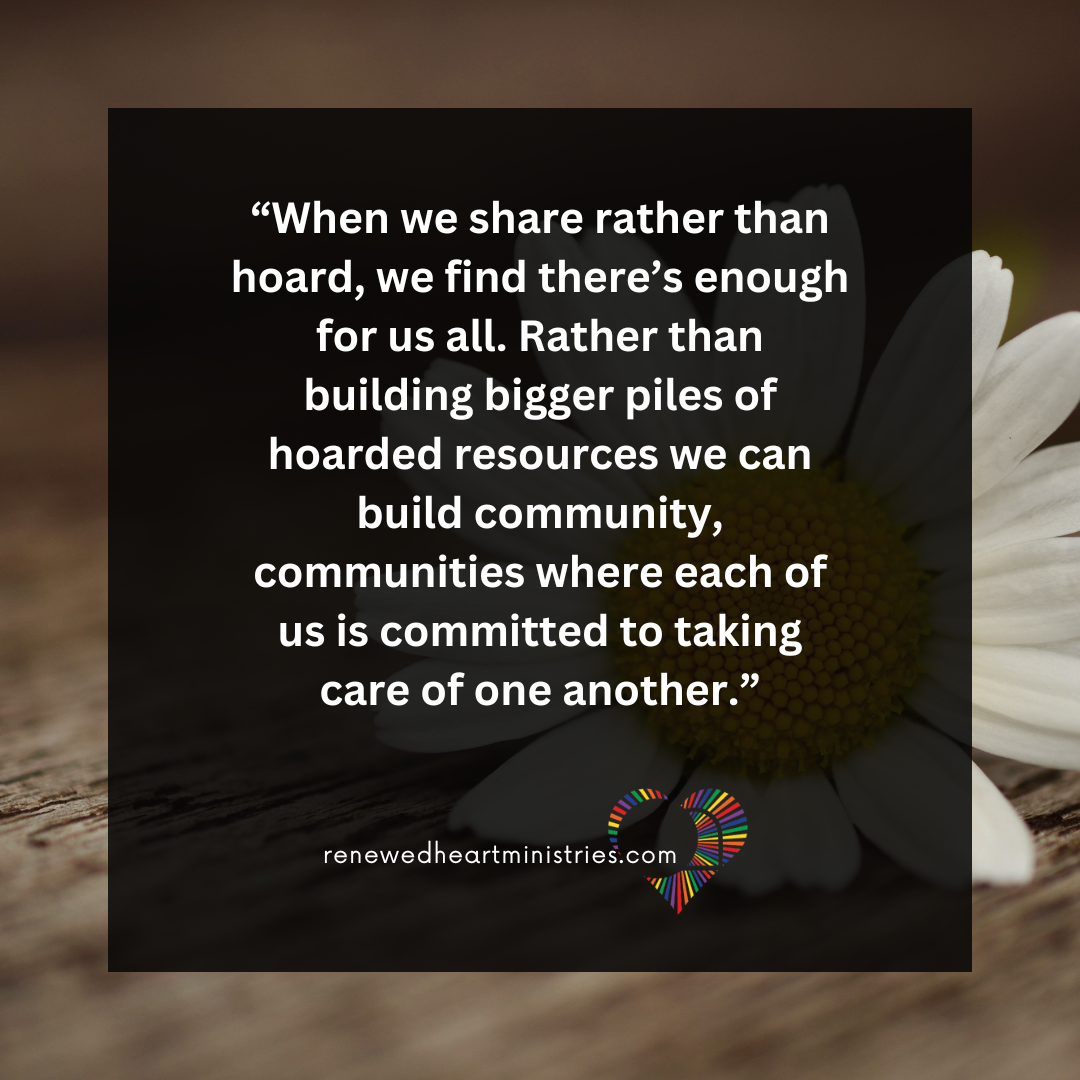
These two characters were not just connected by this story, but also in humanity. They were connected to each other the same way we are each connected to each other. The synagogue leader not only regained his daughter, but could also gain restoration of a part of his own humanity as he learned to look differently at those his society was marginalizing. When we share rather than hoard, we find there’s enough for us all. Rather than building bigger piles of hoarded resources we can build community, communities where each of us is committed to taking care of one another. As the saying states, the Earth produces each day enough for every persons’ need but not every person’s greed.

There are multiple layers to this story too. The synagogue leader’s daughter is described as 12 years old. The woman has had an issue of blood for those 12 years. The synagogue leader’s daughter was also on the verge of maturing into a kind of social death within her society. She was about to grow into a body that now placed the Torah’s purity and cleanliness laws upon her shoulders where each month her body would cause her to be considered unclean. In Journeys By Heart: A Christology of Erotic Power, Rita Nakishima Brock writes, “Both females are afflicted with crises associated with the status of women in Greco-Roman and Hebraic society” (p. 83)

This little girl is about to enter into a new relationship with the patriarchy within her society. She is on the verge of death socially. She is embarking on what it means to be a woman in her world. Mark’s gospel places Jesus in life-giving opposition to that. The women of the Jesus community of Mark’s gospel portray Jesus resurrecting and liberating them from, the injustices of their own patriarchal communities.

Placing the synagogue leader next to the woman in this week’s reading teaches us to practice a preferential option for the marginalized of our society. And placing the woman alongside this little girl calls us to reject preferential options practiced within patriarchy, pitting marginalized people against each other. Jesus’ teachings had been life-giving for those in the Markan community who were marginalized within their society. Specifically here, the story zooms in on women’s experiences in Greco-Roman and Hebrew society. 

There’s a lot to consider here today. Is our Christian practice patriarchal? Do we practice preference for the socially privileged or the marginalized? Our reading this week calls each of us to asses whether our Jesus following actually looks like the Jesus story and its ethics, values, and practices. 

How does this week’s reading define being a Jesus follower in our contexts today? What changes is this week’s story calling each of us to make?

Discussion Group Questions

1. Share something that spoke to you from this week’s eSight/Podcast episode with your discussion group.

2. What communities do you feel equity requires a preferential option for today? Share and discuss with your group.

3. What can you do this week, big or small, to continue setting in motion the work of shaping our world into a safe, compassionate, just home for everyone? 

Thanks for checking in with us, today.

I want to say a special thank you to all of our supporters out there. And if you would like to join them in supporting Renewed Heart Ministries’ work you can do so by going to renewedheartministries.com and clicking donate. 

My latest book Finding Jesus: A Fundamentalist Preacher Discovers the Socio-Political and Economic Teachings of the Gospels is available now on Amazon in paperback, Kindle and also on Audible in audio book format.

As always, you can find Renewed Heart Ministries each week on X (or Twitter), Facebook, Instagram and Meta’s Threads. If you haven’t done so already, please follow us on your chosen social media platforms for our daily posts. 

If you would like to listen to these articles each week in podcast form, you can find The Social Jesus podcast on all major podcast carriers. If you enjoy listening to The Social Jesus Podcast please take a moment to like and subscribe and if your podcast platform offers this option, consider taking some time to leave us a positive review. This helps others find our podcast as well.

You can watch our new YouTube show called “Just Talking” each week. Todd Leonard and I take a moment to talk about the gospel lectionary reading for the upcoming weekend. We’ll be talking about each reading in the context of love, inclusion, and societal justice. Our hope is that our talking will be just talking (as in justice) and that during our brief conversations each week you’ll be inspired to also do more than just talking. If you teach from the lectionary each week, or if you’re just looking for some thoughts on the Jesus story from a more progressive perspective within the context of social justice, check it out, you might like it. You can find JustTalking each week on YouTube at youtube.com/@herbandtoddjusttalking. Please Like, Subscribe, hit the Notification button, and leave us a comment.

And if you’d like to reach us here at Renewed Heart Ministries through email, you can reach us at info@renewedheartministries.com.

Right where you are, keep living in love, choosing compassion, taking action, and working toward justice.

I love each of you dearly,

I’ll see you next week.


New Episode of “Just Talking” Now Online!

Season 2, Episode 19: Mark 5.21-43. Lectionary B, Proper 8

Preferential Options and Patriarchy 

Each week, we’ll be talking about the gospel lectionary reading for the upcoming weekend in the context of love, inclusion, and social justice. Our hope is that our talking will be “just” talking (as in justice) and that during our brief conversations each week we’ll be inspired to do more than just talking.

If you teach from the lectionary each week, or if you’re just looking for some thoughts on the Jesus story from a more progressive perspective within the context of social justice, check it out.


New Episode of The Social Jesus Podcast

A podcast where we talk about the intersection of faith and social justice and what a first century, prophet of the poor from Galilee might have to offer us today in our work of love, compassion and justice. 

This week:

Season 1 Episode 12: Preferential Options and Patriarchy

Mark 5:21-43

“It initially looks like this story will affirm the social assumption that if we take care of those considered less than in our society then there won’t be enough for everyone else, assuming life is a zero-sum game. But then this story takes a sharp turn. This story ends up teaching us how to practice a preferential option for the marginalized of our society. Placing the synagogue leader next to the woman in this week’s reading affirms practicing a preferential option of the marginalized in general. Then, by placing the woman alongside this little girl too, the story calls us to reject specifically preferences practiced within patriarchy.”

Available on all major podcast carriers, 

Or at this link:

https://the-social-jesus-podcast.simplecast.com/episodes/preferential-options-and-patriarchy


Now Available on Audible!


Finding Jesus: A Fundamentalist Preacher Discovers the Socio-Political & Economic Teachings of the Gospels.

by Herb Montgomery, Narrated by Jeff Moon

Available now on Audible!

After two successful decades of preaching a gospel of love within the Christian faith tradition Herb felt like something was missing. He went back to the gospels and began reading them through the interpretive lenses of various marginalized communities and what he found radically changed his life forever. The teachings of the Jesus in the gospel stories express a profound concern for justice, compassion, and the well-being of those in marginalized communities. This book navigates the intersections between faith and societal justice, and presents a compelling argument for a more socially compassionate and just expression of Christianity. Herb’s findings in his latest book are shared in the hopes that it will dramatically impact how you practice your Christianity, too.


Are you getting all of RHM’s Free Resources?

Free Sign Up Here
When the Wind and Waves Threaten Justice

Thank You!

A sharp drop in giving is hurting nonprofits everywhere. Religious charities and small nonprofits are suffering the most from a historic dip in philanthropic giving presently in the U.S. We want to take this moment to express our heartfelt gratitude to all of our supporters for your invaluable role in the Renewed Heart Ministry community and for your dedication to our mission of fostering love, justice, compassion, and healing. Your support is the bedrock of our work. Your support empowers us to do what we do. At a time when ministries like ours are being asked to achieve more with fewer resources, your support is incredibly important, and we want to simply say thank you. Whether in our larger society or within our local faith communities, Renewed Heart Ministries remains committed to advocating for change, working towards a world that is inclusive, just, and safe for everyone, and being a source of love in our world. From all of us here at Renewed Heart Ministries, thank you for your generous support. We deeply appreciate each and every one of our supporters.

If you’d like to join them in supporting our work, please go to renewedheartministries.com and click on “Donate.”  


Herb Montgomery, June 21, 2024

If you’d like to listen to this week’s article in podcast version click on the image below:

Our lectionary reading from the gospels this week is a brief story in Mark 4:

That day when evening came, he said to his disciples, “Let us go over to the other side.” Leaving the crowd behind, they took him along, just as he was, in the boat. There were also other boats with him. A furious squall came up, and the waves broke over the boat, so that it was nearly swamped. Jesus was in the stern, sleeping on a cushion. The disciples woke him and said to him, “Teacher, don’t you care if we drown?” He got up, rebuked the wind and said to the waves, “Quiet! Be still!” Then the wind died down and it was completely calm. He said to his disciples, “Why are you so afraid? Do you still have no faith?” They were terrified and asked each other, “Who is this? Even the wind and the waves obey him!” (Mark 4:35-41)

Mark’s gospel uses multiple boat journeys as literary structural devices for organizing the narrative. Some of these journeys, like the one we are considering this week, can also be taken as metaphors of important acts in Mark’s version of the Jesus story.

Let’s begin with the last question in the passage—“Who is this?”—because it hints at the stories’ original purpose. Then we can explore how this question might inform our justice work today.

Mark 4 closes with the question, “Who is this? Even the wind and the waves obey him!” The story calls to listeners’ minds several layers. First, the Jesus community of Mark defined Jesus as a liberator, and this story affirms that characterization by connecting Jesus to the liberation actions of YHWH in Psalms 107.

In Psalms 107:29-30 we read: 

“He [YHWH] stilled the storm to a whisper; the waves of the sea were hushed.They were glad when it grew calm, and he guided them to their desired haven.”

Repeatedly in this Psalm YHWH is the liberator/deliverer of those in trouble:

Verse 6: Then they cried out to YHWH in their trouble,

and he delivered them from their distress.

Verse 13: Then they cried out to YHWH in their trouble,

and he delivered them from their distress.

Verse 19: Then they cried to YHWH in their trouble,

and he saved them from their distress

Verse 28: Then they cried out to YHWH in their trouble,

and he brought them out of their distress.

In Mark, Jesus is a liberator of the people who, in the language of the psalmist, can still the storm and even hush the waves of the sea.

Secondly, there is a remarkable similarity between Mark’s story and the Jonah story. Jesus and the disciples are in the boat going to “the other side” of the lake, and headed into Gentile or Gentile-adjacent territory just as Jonah headed to Ninevah. Let’s read the passage from Jonah:

“Then YHWH sent a great wind on the sea, and such a violent storm arose that the ship threatened to break up. All the sailors were afraid and each cried out to his own god. And they threw the cargo into the sea to lighten the ship. But Jonah had gone below deck, where he lay down and fell into a deep sleep.” (Jonah 1:4-5)

Jesus and Jonah both are sleeping in these stories, but whereas Jonah is running away from his job, Jesus is not. The power to influence wind and waves is attributed to YHWH, just as it is in the Psalms, but in Jonah YHWH causes the storm, while in the Psalms, YHWH calms the storm. Most Jesus scholars see the author(s) of Mark placing Jesus on the same level as others that were revered in that time. Whereas the gospel associates Jesus with the power of YHWH through referring to the Hebrew scriptures, the Greek and Roman world would have associated Jesus with Zeus, Poseidon, Homer’s Odyssey, and Apollonius of Tyana, a contemporary miracle worker of Jesus. All of this speaks to the Markan community’s high reverence for Jesus as a liberator/deliverer.

But what might this story have to teach us today?

This story involves winds and waves after someone has spoken out against what they have felt is not right. This applies to me too. Some years ago, I became aware as a Christian preacher of Jesus’ teachings on various topics and began to speak out on these same subjects: Jesus’ call to not use violence to change our world, for economic justice for the poor, to include those his society had pushed to the margins and excluded, and how to judge the harm Christians have done to the LGBTQ community. I spoke out about how Jesus’ message of loving others as ourselves cuts against the racism still often present in our society. I said that Jesus’ treatment of women in his own patriarchal world should inspire Christians to work toward gender justice today rather than holding on to patriarchy.

As I spoke out, there were moments when the wind and waves of opposition to justice and making our world a safer, compassionate home for everyone rose up and threatened to sink Renewed Heart Ministries’ boat. I’m deeply thankful to those among our supporters who chose to stand by us when others were walking away. You were Christians who cared about making our world a just and safer place for everyone and chose to support this message. 

I can only imagine that those in the Markan community endeavoring to follow Jesus were experiencing anxiety from pushback as they attempted to apply the ethical teachings of Jesus to the injustices of their world. This story would have asked them, “Why are you so afraid? Do you still have no faith?” People of faith within disenfranchised communities throughout history have often faced their own winds and waves and yet believed that a way will be made of out of no way. 

This month it’s Pride month for our LBGTQ family and friends, and every year this month still evokes winds and waves from certain sectors of our society. It seems like, no matter what area of justice we are working for, whenever we take three steps forward the winds and waves push us two steps back. Working from of a place of love to make our world a more equitable place continues to mean facing winds and waves from those who benefit from an inequitable world.

This week’s reading reminds us that there will be storms, there will be winds, there will be waves that threaten to sink us. This passage doesn’t promise that these won’t be part of our story. In fact, they remind us that they most certainly will. Yet the disciples weren’t alone in the boat. And neither are we. 

If you are presently facing winds and waves, take some time to lean into your community this week. Be reminded that you are all in this together. Let the community you are part of encourage you. Take some time if you need to rest. And remember, when you’re working to shape our world into a safer, more just place and the winds and waves rise up, remember that you’re in the right story. Pushback is part of the Jesus story and has always been a part of the stories of those working for positive and life-giving change. Change threatens those who benefit from injustice. Keep going! The disciples’ boat eventually did reach the “other side” and we will too.

I’m reminded of Dr. King’s words to a Memphis, TN, audience on the night before he was assassinated: “I’ve seen the Promised Land. I may not get there with you. But I want you to know tonight, that we, as a people, will get to the Promised Land”. 

Those words directly inspired the US civil rights movement, but I believe they can also apply to all justice work. In times of distress like those our country is in the thick of now, it is helpful to remember to keep choosing love, compassion, and justice. Because even if the present winds and waves threaten a more just world, if we keep choosing the way of love and inclusion, “we, as a people” will get there. 

Discussion Group Questions

1. Share something that spoke to you from this week’s eSight/Podcast episode with your discussion group.

2. What waves and winds have you faced when you were working for change? How were these obstructions overcome? Share and discuss with your group.

3. What can you do this week, big or small, to continue setting in motion the work of shaping our world into a safe, compassionate, just home for everyone? 

Thanks for checking in with us, today.

I want to say a special thank you to all of our supporters out there. And if you would like to join them in supporting Renewed Heart Ministries’ work you can do so by going to renewedheartministries.com and clicking donate. 

My latest book Finding Jesus: A Fundamentalist Preacher Discovers the Socio-Political and Economic Teachings of the Gospels is available now on Amazon in paperback, Kindle and also on Audible in audio book format.

As always, you can find Renewed Heart Ministries each week on X (or Twitter), Facebook, Instagram and Meta’s Threads. If you haven’t done so already, please follow us on your chosen social media platforms for our daily posts. 

If you would like to listen to these articles each week in podcast form, you can find The Social Jesus podcast on all major podcast carriers. If you enjoy listening to The Social Jesus Podcast please take a moment to like and subscribe and if your podcast platform offers this option, consider taking some time to leave us a positive review. This helps others find our podcast as well.

You can watch our new YouTube show called “Just Talking” each week. Todd Leonard and I take a moment to talk about the gospel lectionary reading for the upcoming weekend. We’ll be talking about each reading in the context of love, inclusion, and societal justice. Our hope is that our talking will be just talking (as in justice) and that during our brief conversations each week you’ll be inspired to also do more than just talking. If you teach from the lectionary each week, or if you’re just looking for some thoughts on the Jesus story from a more progressive perspective within the context of social justice, check it out, you might like it. You can find JustTalking each week on YouTube at youtube.com/@herbandtoddjusttalking. Please Like, Subscribe, hit the Notification button, and leave us a comment.

And if you’d like to reach us here at Renewed Heart Ministries through email, you can reach us at info@renewedheartministries.com.

Right where you are, keep living in love, choosing compassion, taking action, and working toward justice.

I love each of you dearly,

I’ll see you next week.


New Episode of “Just Talking” Now Online!

Season 2, Episode 18: Mark 4.35-41. Lectionary B, Proper 7

Each week, we’ll be talking about the gospel lectionary reading for the upcoming weekend in the context of love, inclusion, and social justice. Our hope is that our talking will be “just” talking (as in justice) and that during our brief conversations each week we’ll be inspired to do more than just talking.

If you teach from the lectionary each week, or if you’re just looking for some thoughts on the Jesus story from a more progressive perspective within the context of social justice, check it out.


New Episode of The Social Jesus Podcast

A podcast where we talk about the intersection of faith and social justice and what a first century, prophet of the poor from Galilee might have to offer us today in our work of love, compassion and justice. 

This week:

Season 1 Episode 11: When the Wind and Waves Threaten Justice

Mark 4:35-41

“It seems like, no matter what area of justice we are working for, whenever we take three steps forward the winds and waves push us two steps back. Working from of a place of love to make our world a more equitable place continues to mean facing winds and waves from those who benefit from an inequitable world. This week’s reading is for those presently facing winds and waves. It reminds us that there will be storms, there will be winds, there will be waves that threaten to sink us. This passage doesn’t promise that these won’t be part of our story. In fact, they remind us that they most certainly will. Yet the disciples weren’t alone in the boat. And neither are we. You’re in the right story.”

Available on all major podcast carriers, 

Listen at:

https://the-social-jesus-podcast.simplecast.com/episodes/when-the-wind-and-waves-threaten-justice


Now Available on Audible!


Finding Jesus: A Fundamentalist Preacher Discovers the Socio-Political & Economic Teachings of the Gospels.

by Herb Montgomery, Narrated by Jeff Moon

Available now on Audible!

After two successful decades of preaching a gospel of love within the Christian faith tradition Herb felt like something was missing. He went back to the gospels and began reading them through the interpretive lenses of various marginalized communities and what he found radically changed his life forever. The teachings of the Jesus in the gospel stories express a profound concern for justice, compassion, and the well-being of those in marginalized communities. This book navigates the intersections between faith and societal justice, and presents a compelling argument for a more socially compassionate and just expression of Christianity. Herb’s findings in his latest book are shared in the hopes that it will dramatically impact how you practice your Christianity, too.


Are you getting all of RHM’s Free Resources?

Free Sign Up Here

Hope Despite Appearances

Thank You!

A sharp drop in giving is hurting nonprofits everywhere. Religious charities and small nonprofits are suffering the most from a historic dip in philanthropic giving presently in the U.S. We want to take this moment to express our heartfelt gratitude to all of our supporters for your invaluable role in the Renewed Heart Ministry community and for your dedication to our mission of fostering love, justice, compassion, and healing. Your support is the bedrock of our work. Your support empowers us to do what we do. At a time when ministries like ours are being asked to achieve more with fewer resources, your support is incredibly important, and we want to simply say thank you. Whether in our larger society or within our local faith communities, Renewed Heart Ministries remains committed to advocating for change, working towards a world that is inclusive, just, and safe for everyone, and being a source of love in our world. From all of us here at Renewed Heart Ministries, thank you for your generous support. We deeply appreciate each and every one of our supporters.

If you’d like to join them in supporting our work, please go to renewedheartministries.com and click on “Donate.”  


Hope Despite Appearances

Herb Montgomery, June 14, 2024

If you’d like to listen to this week’s article in podcast version click on the image below:

Our lectionary reading for this upcoming week is from the gospel of Mark:

He also said, “This is what the kingdom of God is like. A man scatters seed on the ground. Night and day, whether he sleeps or gets up, the seed sprouts and grows, though he does not know how. All by itself the soil produces grain—first the stalk, then the head, then the full kernel in the head. As soon as the grain is ripe, he puts the sickle to it, because the harvest has come.”

Again he said, “What shall we say the kingdom of God is like, or what parable shall we use to describe it? It is like a mustard seed, which is the smallest of all seeds on earth. Yet when planted, it grows and becomes the largest of all garden plants, with such big branches that the birds can perch in its shade.”

With many similar parables Jesus spoke the word to them, as much as they could understand. He did not say anything to them without using a parable. But when he was alone with his own disciples, he explained everything. (Mark 4:26-34)

One of the only things scholars agree on about the historical Jesus is that he taught in parables. This version of this parable is only in Mark and is believed to be the earliest version. (Matthew adds the element of the enemy who sows the tares; see Matthew 13:24-30.)

The parable borrows from imagery in the Hebrew prophetic justice tradition and puts a positive spin on it. In Joel, the imagery is used to explain how wickedness or injustice in our world grows:

“Swing the sickle,

for the harvest is ripe.

Come, trample the grapes,

for the winepress is full 

and the vats overflow—

so great is their wickedness!” (Joel 3:13)

In the gospels, Jesus repeatedly uses this same imagery, and to illustrate how justice can grow as well. He also borrows other imagery from the Hebrew prophets. Consider this verse used to describe Egypt:

“The waters nourished it,

deep springs made it grow tall;

their streams flowed 

all around its base 

and sent their channels 

to all the trees of the field.

So it towered higher

than all the trees of the field;

its boughs increased 

and its branches grew long,

spreading because of abundant waters.

 All the birds of the sky 

nested in its boughs,

all the animals of the wild 

gave birth under its branches;

all the great nations 

lived in its shade.” (Ezekiel 31:4-6)

The prophets use this same imagery of Babylon too:

“Its leaves were beautiful, its fruit abundant, and on it was food for all. Under it the wild animals found shelter, and the birds lived in its branches; from it every creature was fed . . . The tree you saw, which grew large and strong, with its top touching the sky, visible to the whole earth, with beautiful leaves and abundant fruit, providing food for all, giving shelter to the wild animals, and having nesting places in its branches for the birds—Your Majesty, you are that tree! You have become great and strong; your greatness has grown until it reaches the sky, and your dominion extends to distant parts of the earth.” (Daniel 4:12, 20-22)

The book of Ezekiel takes this common imagery and uses it to inspire hope in a promise to restore the nation of Israel:

“‘This is what the Sovereign LORD says: I myself will take a shoot from the very top of a cedar and plant it; I will break off a tender sprig from its topmost shoots and plant it on a high and lofty mountain. On the mountain heights of Israel I will plant it; it will produce branches and bear fruit and become a splendid cedar. Birds of every kind will nest in it; they will find shelter in the shade of its branches.” (Ezekiel 17:22-23, emphasis added.)

This imagery describes a world where everyone has enough to thrive and feels safe. Micah describes that world as one where:

Everyone will sit under their own vine 

and under their own fig tree,

and no one will make them afraid. (Micah 4:4)

The gospels take all of this prophetic imagery and apply it to Jesus’ vision for a society (the gospels refer to it as the kingdom or the reign of God) where his justice teachings if followed would create a world where everyone had enough, no one is marginalized, and everyone is safe and thrives. The vision is centered in transforming our present world, not getting to heaven. It’s meant to inspire hope in those who were endeavoring to follow Jesus’ justice teachings when Mark was written for those within the Markan community.

I also love how the seed that causes this growth is a “mustard” seed. Mustard doesn’t grow into large trees where birds inhabit its branches and people sit for shelter. Jesus is using irony by describing a just and safe world being started form the most impossible of sources: a mustard. It’s unexpected, but there is also more.

In Jesus’ world, the mustard plant was not considered a plant but a weed. It was such a pervasive weed that, unless farmers were diligent in removing it from their fields, it would eventually take over the entire space. This nods to the way those in power viewed Jesus’ teachings of equity, justice, inclusion, and wealth redistribution prioritizing the poor as negative and something to be weeded out. Jesus and his teachings were not looked at as good news by this powerful, propertied, and privileged group. They viewed Jesus’s teachings and those who followed those teachings as a threat. 

In the story, Jesus is eventually weeded out. He is crucified. But his teaching, like the mustard seed, still continue to grow and spread from the actions of his followers. This reminds me of how the late Peter Gomes described the gospel as not good news for everyone. It was good news to those in a certain social, political, and economic location, but deeply problematic for others.

“When the gospel says, ‘The last will be first, and the first will be last,’ despite the fact that it is counterintuitive to our cultural presuppositions, it is invariably good news to those who are last, and at least problematic news to those who see themselves as first.” (Peter J. Gomes, The Scandalous Gospel of Jesus: What’s So Good About the Good News?, p. 42).

Again, this vision is strikingly focused on changing our present world, not escaping it. It illustrates the difference between what is too often a gospel about Jesus and the gospel that Jesus himself actually taught. If Jesus’ gospel was only about obtaining heaven in an afterlife, the hope of one day escaping this world, but being resigned to this world the way it presently is, then Jesus’ gospel would truly have been good news for everyone. If it had only been about grace and faith and heaven, those benefiting from an unjust status quo would have felt no threat. 

But what we perceive in these parables is that Jesus’ teachings were about more than grace, faith, and heaven. They were about shaping and transforming our present world into a safe, compassionate, just home for everyone. This gospel focused on changing our present world and this is why it was so threatening to those benefitting from the unjust shape of their society. 

Lastly, what I love about the parable in our reading this week is how the seed grows. How justice grows is often mysterious. Sometimes you can trace the cause and effect, but not always. How seeds became large plants was a mystery to those who lived before science could explain such things. (Although, those who garden today may still acknowledge some mystery, even with science.)

The lesson is that, just as we don’t have to understand how seeds work in order to plant the seeds, we don’t always have to understand how our world is going to be put right to take the first steps in reshaping it. Many times, the road to justice is made as we travel it. How justice is achieved from the modest beginnings of grassroots movements is often a path with twist and turns that surprise us and could not have been predicted. There is mystery in how our combined justice efforts combine with others’ justice efforts to create something that is often greater and more beautiful than the sum of all its parts. 

You don’t have to understand how our world is going to put right to be engaged in making our world world right. Just plant the seeds. Just take action and then watch how those actions grow.  Sometimes we allow our lack of understanding how something could possible even happen to rob us of the very hope that would inspire us to take the actions that would make that thing possible. But you don’t have to understand how, just do it! 

Hope doesn’t require being able to explain the how. Hope can often only exist in the soil of mystery. Yes, there may be mystery about how justice will grow if we invest our efforts, but despite appearances, we can still take action, we can still have hope. Despite appearances, even if our effort is as small as a mustard seed and surrounded by mystery, justice can prevail.

Discussion Group Questions

1. Share something that spoke to you from this week’s eSight/Podcast episode with your discussion group.

2. What is giving you hope presently? Share and discuss with your group.

3. What can you do this week, big or small, to continue setting in motion the work of shaping our world into a safe, compassionate, just home for everyone? 

Thanks for checking in with us, today.

I want to say a special thank you to all of our supporters out there. And if you would like to join them in supporting Renewed Heart Ministries’ work you can do so by going to renewedheartministries.com and clicking donate. 

My latest book Finding Jesus: A Fundamentalist Preacher Discovers the Socio-Political and Economic Teachings of the Gospels is available now on Amazon in paperback, Kindle and also on Audible in audio book format.

As always, you can find Renewed Heart Ministries each week on X (or Twitter), Facebook, Instagram and Meta’s Threads. If you haven’t done so already, please follow us on your chosen social media platforms for our daily posts. 

If you would like to listen to these articles each week in podcast form, you can find The Social Jesus podcast on all major podcast carriers. If you enjoy listening to The Social Jesus Podcast please take a moment to like and subscribe and if your podcast platform offers this option, consider taking some time to leave us a positive review. This helps others find our podcast as well.

You can watch our new YouTube show called “Just Talking” each week. Todd Leonard and I take a moment to talk about the gospel lectionary reading for the upcoming weekend. We’ll be talking about each reading in the context of love, inclusion, and societal justice. Our hope is that our talking will be just talking (as in justice) and that during our brief conversations each week you’ll be inspired to also do more than just talking. If you teach from the lectionary each week, or if you’re just looking for some thoughts on the Jesus story from a more progressive perspective within the context of social justice, check it out, you might like it. You can find JustTalking each week on YouTube at youtube.com/@herbandtoddjusttalking. Please Like, Subscribe, hit the Notification button, and leave us a comment.

And if you’d like to reach us here at Renewed Heart Ministries through email, you can reach us at info@renewedheartministries.com.

Right where you are, keep living in love, choosing compassion, taking action, and working toward justice.

I love each of you dearly,

I’ll see you next week.


New Episode of JustTalking!

New Episode of “Just Talking” Now Online!

Season 2, Episode 17: Mark 4.26-34. Lectionary B, Proper 6

The Mustard Seed

Each week, we’ll be talking about the gospel lectionary reading for the upcoming weekend in the context of love, inclusion, and social justice. Our hope is that our talking will be “just” talking (as in justice) and that during our brief conversations each week we’ll be inspired to do more than just talking.

If you teach from the lectionary each week, or if you’re just looking for some thoughts on the Jesus story from a more progressive perspective within the context of social justice, check it out.

Watch at:


New Episode of The Social Jesus Podcast

A podcast where we talk about the intersection of faith and social justice and what a first century, prophet of the poor from Galilee might have to offer us today in our work of love, compassion and justice. 

This week:

Season 1 Episode 10: Hope Despite Appearances

Mark 4:26-34

Just as we don’t have to understand how seeds work in order to plant the seeds, we don’t always have to understand how our world is going to be put right to take the first steps in reshaping it. Many times, the road to justice is made as we travel it. How justice is achieved from the modest beginnings of grassroots movements is often a path with twist and turns that surprise us and could not have been predicted. There is mystery in how our combined justice efforts combine with others’ justice efforts to create something that is often greater and more beautiful than the sum of all its parts.

Available on all major podcast carriers, 

And at this link:

https://the-social-jesus-podcast.simplecast.com/episodes/hope-despite-appearances


Now Available on Audible!


Finding Jesus: A Fundamentalist Preacher Discovers the Socio-Political & Economic Teachings of the Gospels.

by Herb Montgomery, Narrated by Jeff Moon

Available now on Audible!

After two successful decades of preaching a gospel of love within the Christian faith tradition Herb felt like something was missing. He went back to the gospels and began reading them through the interpretive lenses of various marginalized communities and what he found radically changed his life forever. The teachings of the Jesus in the gospel stories express a profound concern for justice, compassion, and the well-being of those in marginalized communities. This book navigates the intersections between faith and societal justice, and presents a compelling argument for a more socially compassionate and just expression of Christianity. Herb’s findings in his latest book are shared in the hopes that it will dramatically impact how you practice your Christianity, too.


Are you getting all of RHM’s Free Resources?

Free Sign Up Here

Pentecost as Connectedness and Distributive Justice

Thank You!

A sharp drop in giving is hurting nonprofits everywhere. Religious charities and small nonprofits are suffering the most from a historic dip in philanthropic giving presently in the U.S. We want to take this moment to express our heartfelt gratitude to all of our supporters for your invaluable role in the Renewed Heart Ministry community and for your dedication to our mission of fostering love, justice, compassion, and healing. Your support is the bedrock of our work. Your support empowers us to do what we do. At a time when ministries like ours are being asked to achieve more with fewer resources, your support is incredibly important, and we want to simply say thank you. Whether in our larger society or within our local faith communities, Renewed Heart Ministries remains committed to advocating for change, working towards a world that is inclusive, just, and safe for everyone, and being a source of love in our world. From all of us here at Renewed Heart Ministries, thank you for your generous support. We deeply appreciate each and every one of our supporters.

If you’d like to join them in supporting our work, please go to renewedheartministries.com and click on “Donate.”  


Herb Montgomery; May 17, 2024

If you’d like to listen to this week’s article in podcast version click on the image below:

Our reading this week is from two passages in the gospel of John:

When the Advocate comes, whom I will send to you from the Father—the Spirit of truth who goes out from the Father—he will testify about me. And you also must testify, for you have been with me from the beginning. (John 15:26-27)

I have told you this, so that when their time comes you will remember that I warned you about them. I did not tell you this from the beginning because I was with you, but now I am going to him who sent me. None of you asks me, ‘Where are you going?’ Rather, you are filled with grief because I have said these things. But very truly I tell you, it is for your good that I am going away. Unless I go away, the Advocate will not come to you; but if I go, I will send him to you. When he comes, he will prove the world to be in the wrong about sin and righteousness and judgment: about sin, because people do not believe in me; about righteousness, because I am going to the Father, where you can see me no longer; and about judgment, because the prince of this world now stands condemned. I have much more to say to you, more than you can now bear. But when he, the Spirit of truth, comes, he will guide you into all the truth. He will not speak on his own; he will speak only what he hears, and he will tell you what is yet to come. He will glorify me because it is from me that he will receive what he will make known to you. All that belongs to the Father is mine. That is why I said the Spirit will receive from me what he will make known to you. (John 16:4-15)

This upcoming weekend is Pentecost in the Western Christian calendar, a season that commemorates when the Spirit was poured out on the apostles and Jerusalem church:

When the day of Pentecost came, they were all together in one place. Suddenly a sound like the blowing of a violent wind came from heaven and filled the whole house where they were sitting. They saw what seemed to be tongues of fire that separated and came to rest on each of them. All of them were filled with the Holy Spirit and began to speak in other tongues  as the Spirit enabled them. (Acts 2:1-4)

The subject of the Spirit is vast and was anything but monolithic in the early Jesus movement. For example, in John’s gospel, the Spirit was not poured out after Jesus’ ascension in Jerusalem, but during an post-resurrection appearance in John 20: 

Jesus said, “Peace be with you! As the Father has sent me, I am sending you.” And with that he breathed on them and said, “Receive the Holy Spirit. If you forgive anyone’s sins, their sins are forgiven; if you do not forgive them, they are not forgiven.” (John 20:21-23)

This moment in John 20 is foreshadowed earlier in John:

By this he meant the Spirit, whom those who believed in him were later to receive. Up to that time the Spirit had not been given, since Jesus had not yet been glorified. (John 7:39)

Why do these passages give a different time for when Jesus gave the Holy Spirit to the apostles? There were power struggles in the early church when John’s gospel was written. The narrative that God poured out the Holy Spirit in Jerusalem on those gathered there supported the authority and claims of the Jesus community that honored the apostleship of Peter and James. A gospel that instead stated the Holy Spirit was given to apostles in John 20 by Jesus while he had briefly returned to them post resurrection gave validity to those Jesus communities that honored the apostleship of John, Mary Magdalene, and Thomas alongside Peter and James (though James is not mentioned in the closing chapters of John’s gospel).

Let’s remember that those in the Jesus community of that time did not all have access to the four gospels in a neatly packaged, leather-bound volume like we do today. All four of these gospels may have been known by various communities (Irenaeus later groups the four we have together in his writings), but different communities cherished different gospels. From their own oral traditions, the Johannine community produced and cherished their version of the Jesus story, and today we refer to it as the gospel of John.

In John, the Spirit is referred to as “another advocate.”

“And I will ask the Father, and he will give you another advocate to help you and be with you forever.” (John 14:16, emphasis added)

An advocate is someone who comes alongside someone and pleads their cause with them. Within the Johannine community’s sacred texts Jesus was the advocate with “the Father.”

“My dear children, I write this to you so that you will not sin. But if anybody does sin, we have an advocate with the Father—Jesus Christ, the Righteous One. He is the propitiation for our sins.” (1 John 2:1-2)

So in the gospel of John, the spirit was another advocate. The spirit was not an advocate in relation to our sins as a propitiation with God like Jesus (regardless of how we interpret the meaning of those terms today), the Spirit was more an advocate for the community as they related to the larger world.

In John’s narrative, Jewish Jesus followers were being expelled from their synagogues for being Jesus followers. While for John’s community this may be more about their more gnostic way of interpreting Jesus rather than simply being associated with Jesus, this still tracks with how the spirit as an advocate in this context is written of in the other canonical gospels:

“When they bring you to trial and hand you over, do not worry beforehand about what you are to say; but say whatever is given you at that time, for it is not you who speak, but the Holy Spirit.” (Mark 13:11)

“When they hand you over, do not worry about how you are to speak or what you are to say; for what you are to say will be given to you at that time; for it is not you who speak, but the Spirit of your Father speaking through you.” (Matthew 10:19-20)

“So make up your minds not to prepare your defense in advance; for I will give you words and a wisdom that none of your opponents will be able to withstand or contradict.” (Luke 21:14-15)

“When they bring you before the synagogues, the rulers, and the authorities, do not worry about how you are to defend yourselves or what you are to say; for the Holy Spirit will teach you at that very hour what you ought to say.” (Luke 12:11-12)

In John, the Spirit would remind the Johannine community of what Jesus taught and also reveal further truths that the historical Jesus did not necessarily teach: 

“But the Advocate, the Holy Spirit, whom the Father will send in my name, will teach you all things and will remind you of everything I have said to you.” (John 14:26, emphasis added.)

“When the Advocate comes, whom I will send to you from the Father—the Spirit of truth who goes out from the Father—he will testify about me.” (John 15:26, emphasis added.)

“But very truly I tell you, it is for your good that I am going away. Unless I go away, the Advocate will not come to you; but if I go, I will send him to you . . . I have much more to say to you, more than you can now bear. But when he, the Spirit of truth, comes, he will guide you into all the truth.” (John 16:7,12-13)

I’m interested in this last role of the Spirit, because it permits the Johannine community to be a Jesus-following community while building in ways the historical Jesus may not have intended. This laid the foundation for the battle that would soon emerge in the church in defining and defending orthodox beliefs about Jesus from the unorthodox.

Where do these battles leave us today?

One of the fruits of the Spirit (to borrow Paul’s language) in the synoptics is the restoration of social justice. The Spirit being poured out on Jesus and also Jesus followers would manifest itself in deep concern for what others were experiencing because of the shape of their society.Consider how this is expressed in Luke’s gospel:

“The Spirit of the Lord is on me, because he has anointed me to proclaim good news to the poor. He has sent me to proclaim freedom for the prisoners and recovery of sight for the blind, to set the oppressed free.” (Luke 4:18)

The Spirit bears the fruit of concern for the poor, the imprisoned, the marginalized and vulnerable, and the oppressed. Defining the manifestation of the Spirit this way has deep roots in the Hebrew prophetic justice tradition as well. Consider Isaiah, on which the passage in Luke above is based:

“The Spirit of the Sovereign LORD is on me, because the LORD has anointed me  to proclaim good news to the poor. He has sent me to bind up the brokenhearted, to proclaim freedom for the captives and release from darkness for the prisoners.” (Isaiah 61:1)

Notice how, in this next passage from Isaiah, the fruit of the Spirit being on God’s servant is restoring justice to the nations:

“Here is my servant, whom I uphold, my chosen one in whom I delight; I will put my Spirit on him, and he will bring justice to the nations.” (Isaiah 42:1)

The Spirit brings the end of violence, injustice, and oppression, and brings distributive justice where everyone has enough to thrive: 

“Till the Spirit is poured on us from on high, and the desert becomes a fertile field, and the fertile field seems like a forest.” (Isaiah 32:15)

And this brings us full circle back around to Acts’ Pentecost being in harmony with this Jewish prophetic justice tradition. The first manifestation of the Spirit in Acts is the overcoming of language barriers and reconnecting all as members of the same human family. It emphasizes our connectedness, our oneness, and began the process putting our world to right. In the book of Acts, in the immediate wake of Pentecost, Peter invites those witnessing the outpouring of the Spirit on the apostles to also receive the Holy Spirit and once they had received it, to notice how the Spirit demonstrates its presence:

Peter replied, “Repent and be baptized, every one of you, in the name of Jesus Christ for the forgiveness of your sins. And you will receive the gift of the Holy Spirit. The promise is for you and your children and for all who are far off—for all whom the Lord our God will call” . . . Those who accepted his message were baptized, and about three thousand were added to their number that day. They devoted themselves to the apostles’ teaching and to fellowship, to the breaking of bread and to prayer. Everyone was filled with awe at the many wonders and signs performed by the apostles. All the believers were together and had everything in common. They sold property and possessions to give to anyone who had need. (Acts 2:38-45, emphasis added.)

This was in direct response to Jesus’ call to those who had more than they needed to sell their possessions and give to those whose needs were not being met (see Luke 12). Two chapters later we see this distributive justice grow until poverty was eliminated among their Jesus community:

“All the believers were one in heart and mind. No one claimed that any of their possessions was their own, but they shared everything they had. With great power the apostles continued to testify to the resurrection of the Lord Jesus. And God’s grace was so powerfully at work in them all that there were no needy persons among them.” (Acts 4:32-34)

The Spirit didn’t make them more religious, per se. It instead expressed itself in economic justice among those it was poured out on, a distributive justice where everyone took responsibility for making sure their neighbor was taken care of. 

What areas of distributive injustice could use the Spirit in our society today? Where in the church or our larger world do we need the spirit’s justice work now? The list for sure is long. 

This Pentecost, let’s remember the Spirit’s call to be about making our world a safe, compassionate, just home for everyone.

Discussion Group Questions

1. Share something that spoke to you from this week’s eSight/Podcast episode with your discussion group.

2. What difference does it make for your own Jesus following to understand working toward social justice as a manifestation of the Spirit? Share and discuss with your group.

3. What can you do this week, big or small, to continue setting in motion the work of shaping our world into a safe, compassionate, just home for everyone? 

Thanks for checking in with us, today.

I want to say a special thank you to all of our supporters out there. And if you would like to join them in supporting Renewed Heart Ministries’ work you can do so by going to renewedheartministries.com and clicking donate. 

My latest book Finding Jesus: A Fundamentalist Preacher Discovers the Socio-Political and Economic Teachings of the Gospels is available now on Amazon in paperback, Kindle and also on Audible in audio book format.

As always, you can find Renewed Heart Ministries each week on X (or Twitter), Facebook, Instagram and Meta’s Threads. If you haven’t done so already, please follow us on your chosen social media platforms for our daily posts. 

If you would like to listen to these articles each week in podcast form, you can find The Social Jesus podcast on all major podcast carriers. If you enjoy listening to The Social Jesus Podcast please take a moment to like and subscribe and if your podcast platform offers this option, consider taking some time to leave us a positive review. This helps others find our podcast as well.

You can watch our new YouTube show called “Just Talking” each week. Todd Leonard and I take a moment to talk about the gospel lectionary reading for the upcoming weekend. We’ll be talking about each reading in the context of love, inclusion, and societal justice. Our hope is that our talking will be just talking (as in justice) and that during our brief conversations each week you’ll be inspired to also do more than just talking. If you teach from the lectionary each week, or if you’re just looking for some thoughts on the Jesus story from a more progressive perspective within the context of social justice, check it out, you might like it. You can find JustTalking each week on YouTube at youtube.com/@herbandtoddjusttalking. Please Like, Subscribe, hit the Notification button, and leave us a comment.

And if you’d like to reach us here at Renewed Heart Ministries through email, you can reach us at info@renewedheartministries.com.

Right where you are, keep living in love, choosing compassion, taking action, and working toward justice.

I love each of you dearly,

I’ll see you next week.


New Episode of JustTalking!


Season 2, Episode 13: John 15.26-27; 16.4b-15. Lectionary B, Pentecost

Each week, we’ll be talking about the gospel lectionary reading for the upcoming weekend. We’ll be talking about each reading in the context of love, inclusion, and societal justice. Our hope is that our talking will be just talking (as in justice) and that during our brief conversations each week you’ll be inspired to also do more than just talking.

If you teach from the lectionary each week, or if you’re just looking for some thoughts on the Jesus story from a more progressive perspective within the context of social justice, check it out, you might like it.

You can find the latest show on YouTube at:

 or (@herbandtoddjusttalking)

Please Like, Subscribe, hit the Notification button, and leave us a comment


The Social Jesus Podcast

A podcast where we talk about the intersection of faith and social justice and what a first century, prophet of the poor from Galilee might have to offer us today in our work of love, compassion and justice. 

This week:

Season 1 Episode 6: Pentecost as Connectedness and Distributive Justice

John 15:26-27; 16:4-15; Acts 2:1-4

“In the synoptic Gospels and the book of Acts, we see a fruit of the Spirit included the restoration of social justice. In these stories, whether the Spirit is poured out on Jesus or his followers, it is evident in their profound concern for the suffering caused by societal structures.”

Available on all major podcast carriers.

https://the-social-jesus-podcast.simplecast.com/episodes/pentecost-as-connectedness-and-distributive-justice


Now Available on Audible!


Finding Jesus: A Fundamentalist Preacher Discovers the Socio-Political & Economic Teachings of the Gospels.

by Herb Montgomery, Narrated by Jeff Moon

Available now on Audible!

After two successful decades of preaching a gospel of love within the Christian faith tradition Herb felt like something was missing. He went back to the gospels and began reading them through the interpretive lenses of various marginalized communities and what he found radically changed his life forever. The teachings of the Jesus in the gospel stories express a profound concern for justice, compassion, and the well-being of those in marginalized communities. This book navigates the intersections between faith and societal justice, and presents a compelling argument for a more socially compassionate and just expression of Christianity. Herb’s findings in his latest book are shared in the hopes that it will dramatically impact how you practice your Christianity, too.


Are you getting all of RHM’s Free Resources?

Free Sign Up Here

The Harmful Myth of Redemptive Death

Now Available on Amazon!


Finding Jesus: A Fundamentalist Preacher Discovers the Socio-Political & Economic Teachings of the Gospels.

by Herb Montgomery

Available now on Amazon!

After two successful decades of preaching a gospel of love within the Christian faith tradition Herb felt like something was missing. He went back to the gospels and began reading them through the interpretive lenses of various marginalized communities and what he found radically changed his life forever. The teachings of the Jesus in the gospel stories express a profound concern for justice, compassion, and the well-being of those in marginalized communities. This book navigates the intersections between faith and societal justice, and presents a compelling argument for a more socially compassionate and just expression of Christianity. Herb’s findings in his latest book are shared in the hopes that it will dramatically impact how you practice your Christianity, too.


New Episode of JustTalking!


Season 2, Episode 4: John 12.20-33. Lectionary B, Lent 5

Each week, we’ll be talking about the gospel lectionary reading for the upcoming weekend. We’ll be talking about each reading in the context of love, inclusion, and societal justice. Our hope is that our talking will be just talking (as in justice) and that during our brief conversations each week you’ll be inspired to also do more than just talking.

If you teach from the lectionary each week, or if you’re just looking for some thoughts on the Jesus story from a more progressive perspective within the context of social justice, check it out, you might like it.

You can find the latest show on YouTube at

Season 2, Episode 4: John 12.20-33. Lectionary B, Lent 5

 or (@herbandtoddjusttalking)

Please Like, Subscribe, hit the Notification button, and leave us a comment


The Harmful Myth of Redemptive Death

Herb Montgomery, March 15, 2024

“Truth can overcome falsehood, life can triumph over the death-dealing agents of our world, love can conquer hate, and, in the end, it may look differently than we expected, yet we can choose for justice, love and life to have the last word. No matter how hopeless the present moment, our story isn’t over yet.”

To listen to this week’s eSight as a podcast episode click here.

This image has an empty alt attribute; its file name is Jesus-For-Everyone-150x150.png

Our reading this week is from the gospel of John:

Jesus replied, “The hour has come for the Son of Man to be glorified. Very truly I tell you, unless a kernel of wheat falls to the ground and dies, it remains only a single seed. But if it dies, it produces many seeds. Anyone who loves their life will lose it, while anyone who hates their life in this world will keep it for eternal life. Whoever serves me must follow me; and where I am, my servant also will be. My Father will honor the one who serves me. 

Now there were some Greeks among those who went up to worship at the festival. They came to Philip, who was from Bethsaida in Galilee, with a request. “Sir,” they said, “we would like to see Jesus.” Philip went to tell Andrew; Andrew and Philip in turn told Jesus.

“Now my soul is troubled, and what shall I say? ‘Father, save me from this hour’? No, it was for this very reason I came to this hour. Father, glorify your name!”

Then a voice came from heaven, “I have glorified it, and will glorify it again.” The crowd that was there and heard it said it had thundered; others said an angel had spoken to him.

Jesus said, “This voice was for your benefit, not mine. Now is the time for judgment on this world; now the prince of this world will be driven out. And I, when I am lifted up from the earth, will draw all people to myself.” He said this to show the kind of death he was going to die. (John 12:20-33)

We continue in the gospel of John this week. Our passage, once again, has a problematic history of justifying death or abuse for those in disadvantaged or marginalized social locations or in predatory personal relationships. We must be careful and intentional not to perpetuate that harm (see God So Loved the World?). We’ll consider this further in a moment.

First, remember this is the last gospel to be written among those in our sacred canon. And it was written very late, almost a century removed from the events it writes about. This version of the Jesus story that was written by the Johannine community is radically different from the others as well. The few stories that it has in common with Mark, Matthew and Luke have different spins, different emphases, and different interpreted lessons (see Differences in John and Why They Matter).

In the other gospels, Jesus is executed by the state for speaking truth to power about the harm being done to the marginalized in his society. His protest culminates in his flipping the tables in the temple courtyard. In John’s gospel, this event has nothing to do with Jesus’ execution. Even the emphasis subtly changes. It’s no longer referred to with the overtones of a imperial execution for politically threatening the Pax Romana. Now its simply a “death” or “dying.” It’s referred to not as being crucified on a Roman cross, but, more opaquely, as being “lifted up.”  The emphasis, unlike the synoptics, is not so much on the redemptive resurrection of Jesus as it is undoing, overturning, and reversing everything accomplished through Jesus’ crucifixion.  The emphasis is on Jesus’ dying itself, and that death becomes redemptive.  

In Mark, the Markan community was trying to make sense out of Jesus’ execution. In their telling, Jesus must be crucified and resurrected. In fact, the only reason Jesus is allowed to be crucified is so that he can be resurrected. By the time we get to John’s telling, though, Jesus must simply die. Everything is accomplished through the dying. The resurrection is simply a mysterious afterward but all redemptive accomplishment is done through his dying.

These are not insignificant theological difference between the gospels. These theologies have produced very different results in the lives of Jesus communities that emphasize one or the other. 

I want to say one brief word about this shift in John. Even when Jesus’ death becomes redemptive in the Johaninne Jesus community, this death is never punitive or at the hands of God. Jesus doesn’t die as our substitute in John. Even though Jesus’ death is redemptive in that gospel, it doesn’t fit very easily within Western Christian penal substitutionary theology. It fits more easily in other atonement theories that have been held by Christians throughout history, especially the Christus Victor paradigm (“now the prince of this world will be driven out.”) and the Moral Influence paradigm (when I am lifted up from the earth, will draw all people to myself). But John’s gospel never says that Jesus’ death is to satisfy justice or a God that needs someone to stand in the gap and be punished for everyone else. That explanation doesn’t show up at all as an explanation to why Jesus (the seed in our reading) must die.

But this doesn’t completely solve the problems. Even if we embrace a different explanation of why Jesus died than penal substitutionary atonement, those other explanations have still produced harmful fruit for people who have subscribed to them.

Let’s talk about the fruit produced by the Christus Victor explanation first. Those who believe Jesus’ death was redemptive too often also interpret their own suffering with similar implications. To explain their own suffering they respond by simply and sometimes lethally being patient in the face of harm. They think something good will come of this rather than see it as an evil that must be stood up to. They then are persuaded to passively endure their suffering and come to believe that God is working through their suffering. Some go so far as to believe that even if they die as a result they are fulfilling some higher divine purpose.

Joanne Brown and Rebecca Parker correctly critique this model:

“Such a theology has devastating effects on human life. The reality is that victimization never leads to triumph. It can lead to extended pain if it is not refused or fought. It can lead to destruction of the human spirit through the death of a person’s sense of power, worth, dignity. or creativity. It can lead to actual death. By denying the reality of suffering and death, the Christus Victor theory of the atonement defames all those who suffer and trivializes tragedy.” (God So Loved the World? p. 5)

The moral influence explanation doesn’t fare much better; it’s just as harmful. Again, from the deep and insightful work of Brown and Parker:

“The moral influence theory is founded on the belief that an innocent, suffering victim and only an innocent, suffering victim for whose suffering we are in some way responsible has the power to confront us with our guilt and move us to a new decision. This belief has subtle and terrifying connections as to how victims of violence can be viewed.” (God So Loved the World? p. 9)

In our work of trying to effect social change in response to social racism, classism, sexism, cis-heterosexism, or other systems, the moral influence theory has too often been peddled as a method: we suffer for the purpose of changing the hearts and minds of our oppressors or abusers. In this paradigm, victimization is “lifted up” as an agent that, if patiently endured, will persuade those responsible for our harm to embrace justice instead. Our suffering, if patiently endured, can change them. This is very destructive. It prioritizes the oppressor’s or abuser’s need for redemption over and above the rights of those who are genuinely, concretely, being harmed, included in losing their most basic right: to simply exist and live. 

Viewing Jesus’ death as redemptive, no matter how you explain that redemption, has historically proven harmful for those who apply that theology to their own suffering, abuse, and injustice.  

This is my most serious concern with the gospel of John. It is very different from the other gospels, and these differences are not always benign. The shift away from a redemptive resurrection to the salvific agent being Jesus’ cross alone may sound good at an emotionally tugging altar call. But when we try to live this theology, we need something better. 

This is why I favor Mark, Matthew’s and Luke’s attempts to explain Jesus’ execution over the Johannine community’s explanation. The goal in John’s gospel is always Jesus getting to the cross. But in the synoptics, the goal of Jesus’ death is getting past the cross to the resurrection. This difference matters to me.  For me, it has serious life or death implications for those who are choosing how to relate to their own suffering or how to navigate the injustices they face. 

I’ll close this week with words I shared a couple weeks ago, of Dr. Katie Cannon in the foreword of the 20th anniversary edition of Dr. Delores Williams classic Sisters in the Wilderness:

“Theologians need to think seriously about the real-life consequences of redemptive suffering, God-talk that equates the acceptance of pain, misery, and abuse as the way for true believers to live as authentic Christian disciples. Those who spew such false teaching and warped preaching must cease and desist.”

For me, the Jesus story is not a story that glorifies death and suffering. It’s not about the cross. It’s a story that communicates how truth can overcome falsehood, life can triumph over the death-dealing agents of our world, love can conquer hate, and, in the end, justice, love and life will have the last word. No matter how hopeless the present moment, our story isn’t over yet.

Discussion Group Questions

1. Share something that spoke to you from this week’s eSight/Podcast episode with your discussion group.

2. How do the gospel stories call you resist suffering and injustice? Share and discuss with your group.

3. What can you do this week, big or small, to continue setting in motion the work of shaping our world into a safe, compassionate, just home for everyone? 

Thanks for checking in with us, today.

I want to say a special thank you to all of our supporters out there. And if you would like to join them in supporting Renewed Heart Ministries’ work you can do so by going to renewedheartministries.com and clicking donate. 

I want to also say a special thank you this week to Quoir Publishing, Keith Giles who wrote the foreword to my latest book, all the special people on our launch team, and all of you who made this release a success. 

Finding Jesus: A Fundamentalist Preacher Discovers the Socio-Political and Economic Teachings of the Gospels is available now on Amazon in paperback, Kindle and soon also on Audible in audio book format.

As always, you can find Renewed Heart Ministries each week on X (or Twitter), Facebook, Instagram and Meta’s new Threads. If you haven’t done so already, please follow us on your chosen social media platforms for our daily posts. Also, if you enjoy listening to the Jesus for Everyone podcast, please like and subscribe to the JFE podcast through the podcast platform you use and consider taking some time to give us a review. This helps others find our podcast as well.

You can watch our new YouTube show called “Just Talking” each week. Todd Leonard and I take a moment to talk about the gospel lectionary reading for the upcoming weekend. We’ll be talking about each reading in the context of love, inclusion, and societal justice. Our hope is that our talking will be just talking (as in justice) and that during our brief conversations each week you’ll be inspired to also do more than just talking.

If you teach from the lectionary each week, or if you’re just looking for some thoughts on the Jesus story from a more progressive perspective within the context of social justice, check it out, you might like it. You can find JustTalking each week on YouTube at youtube.com/@herbandtoddjusttalking. Please Like, Subscribe, hit the Notification button, and leave us a comment.

And if you’d like to reach us here at Renewed Heart Ministries through email, you can reach us at info@renewedheartministries.com.

Right where you are, keep living in love, choosing compassion, taking action, and working toward justice.

I love each of you dearly,

I’ll see you next week.


Are you getting all of RHM’s Free Resources?

Free Sign Up Here

A Safe, Compassionate, Just Home for Everyone

#1 Best Seller and New Release on Amazon!

Finding Jesus: A Fundamentalist Preacher Discovers the Socio-Political & Economic Teachings of the Gospels.
by Herb Montgomery

Available now on Amazon.

After two successful decades of preaching a gospel of love within the Christian faith tradition Herb felt like something was missing. He went back to the gospels and began reading them through the interpretive lenses of various marginalized communities and what he found radically changed his life forever. The teachings of the Jesus in the gospel stories express a profound concern for justice, compassion, and the well-being of those in marginalized communities. This book navigates the intersections between faith and societal justice, and presents a compelling argument for a more socially compassionate and just expression of Christianity. Herb’s findings in his latest book are shared in the hopes that it will dramatically impact how you practice your Christianity, too.

Finding Jesus by Herb Montgomery the #1 Best Seller in its category.

Get your copy on Amazon, today!


New Episode of JustTalking!

Season 1, Episode 50: Mark 1.9-15. Lectionary B, Lent 1

Each week, we’ll be talking about the gospel lectionary reading for the upcoming weekend. We’ll be talking about each reading in the context of love, inclusion, and societal justice. Our hope is that our talking will be just talking (as in justice) and that during our brief conversations each week you’ll be inspired to also do more than just talking.

If you teach from the lectionary each week, or if you’re just looking for some thoughts on the Jesus story from a more progressive perspective within the context of social justice, check it out, you might like it.

You can find the latest show on YouTube at

Season 1, Episode 50: Mark 1.9-15. Lectionary B, Lent 1

 or (@herbandtoddjusttalking)

Please Like, Subscribe, hit the Notification button, and leave us a comment

Thanks in advance for watching!


A Safe, Compassionate, Just Home for Everyone

Herb Montgomery | February 9, 2024

“The gospel has been twisted to be mostly religious in nature, but for the early Jesus followers, Jesus’ teachings were much more about how we choose to share space with one another here on earth.”

To listen to this week’s eSight as a podcast episode click here.

This image has an empty alt attribute; its file name is Jesus-For-Everyone-150x150.png

Our reading this week is from the gospel of Mark:

At that time Jesus came from Nazareth in Galilee and was baptized by John in the Jordan. Just as Jesus was coming up out of the water, he saw heaven being torn open and the Spirit descending on him like a dove. And a voice came from heaven: “You are my Son, whom I love; with you I am well pleased.”

At once the Spirit sent him out into the wilderness, and he was in the wilderness forty days, being tempted by Satan. He was with the wild animals, and angels attended him. 

After John was put in prison, Jesus went into Galilee, proclaiming the good news of God. “The time has come,” he said. “The kingdom of God has come near. Repent and believe the good news!” (Mark 1:9-15)

In our reading this week, we begin with Jesus traveling from the region of Galilee to the River Jordan to be baptized by John. Jesus heard something in John’s anti-establishment message and call to return to the Torah’s social justice principles that resonated with his own desire for Jewish renewal and his concern for how the Roman empire had coopted the Jewish Temple State and the scribal establishment in local synagogues. Scholars are torn as to whether Jesus actually began as a disciple of John’s, but his choice to be baptized by John affirmed that he resonated with John’s preaching enough to want to be baptized by John and be a part of John’s movement. We’ll see that this changes later, when John is imprisoned. 

Mark’s language around John’s baptism of Jesus was also meant to remind Mark’s original audience of language in Isaiah. Whether we date Mark’s gospel to shortly before Rome’s destruction of Jerusalem or shortly afterward, liberation from Roman occupation and oppression was the prevailing impulse among Mark’s listeners. Getting to heaven was not on the hearts and minds of Mark’s listeners. Getting out from under the thumb of Rome was. 

The language of the heavens being torn open harkens back to Isaiah 64:

  Oh, that you would rend the heavens and come down,

that the mountains would tremble before you! 

  As when fire sets twigs ablaze 

and causes water to boil,

come down to make your name known to your enemies 

and cause the nations to quake before you! 

  For when you did awesome things that we did not expect,

you came down, and the mountains trembled before you. 

Since ancient times no one has heard,

no ear has perceived,

no eye has seen any God besides you,

who acts on behalf of those who wait for him.

  You come to the help of those who gladly do right,

who remember your ways. (Isaiah 64:1-5)

The Spirit descending and declaring Jesus’s favor also harkens back to a passage in Isaiah:

  Here is my servant, whom I uphold,
my chosen one in whom I delight;

I will put my Spirit on him,

and he will bring justice to the nations . . . 

In faithfulness he will bring forth justice;

he will not falter or be discouraged 

till he establishes justice on earth. (Isaiah 42:1-4)

It seems the writer of Mark intended to associate the desire for liberation from Rome with Isaiah’s language of establishing of justice on the earth among the nations. That’s why this week’s story attaches these references to Jesus’ baptism. In Jesus, the early followers of Jesus perceived teachings that would end oppression and establish justice for all. 

After his baptism, Jesus immediately goes into the wilderness for forty days. Forty is a significant number in the Hebrew scriptures and other sacred Jewish literature. 

One example is Moses’ forty days and nights of fasting as he received the Torah:

“Moses was there with the LORD forty days and forty nights without eating bread or drinking water. And he wrote on the tablets the words of the covenant—the Ten Commandments.” (Exodus 34.28)

There are many more examples. Forty didn’t only refer to days and nights. The scriptures also named forty years, and measurements based on the number 40. The number 40 is used repeatedly in the Talmud and the history of the second Temple (see “The Number Forty”, The Jewish Encyclopedia)

But we shouldn’t gloss over Jesus’ time in the wilderness as narrative decoration. Jesus’ wilderness experience had special significance for his original Jewish followers. While in Mark, Jesus is tempted by the Satan (the Adversary), is among the wild animals, and is attended to by angels. Matthew and Luke later add that Jesus was fasting during this time, but Mark doesn’t elaborate on the temptations here. This version of the story doesn’t say there are three temptations. Nor does it detail them, as later version of the Jesus story do. What is also interesting is how Matthew and Luke overtly connect Jesus’ temptations with the language and liberation hopes of the apocalyptic book of Daniel chapter 7. Mark, the first gospel, begins this tradition much more subtly. 

Ched Myers tells us that the book of Daniel was “a Jewish resistance tract written just before the Maccabean revolt during brutal persecutions under the Hellenistic ruler Antiochus Epiphanes IV . . . By Mark’s era it was well established as a discourse of political protest” (Binding the Strong Man, p. 101). He goes on to state the way apocalyptic literature was used in Mark’s culture was to “fire the socio-political imagination of the oppressed. First, in renewing old symbols and reappropriating Hebrew narratives of liberation, it functioned as a ‘remembering.’ Secondly, it promoted a ‘creative envisioning’ of a future in which God restored justice and full humanity to all.”

Horsley writes, “Emperors were not divine . . . The apocalyptic imagination thus had a strengthening effect on people’s ability to endure, and even a motivating effect toward resistance and revolt.” (Jesus and Spiral of Violence: Popular Jewish Resistance in Roman Palestine, p. 144)

Howard Kee, writing of the disproportionate interest by Mark’s gospel in the book of Daniel states, 

“Daniel alone among all of the Old Testament books is quoted from every chapter; it is of the highest level of significance for the New Testament as a whole as a result of its overwhelming importance for Mark.” (Community of the New Age: Studies in Mark’s Gospel, p. 45)

The wild animals and angels in this week’s story would have brought to mind the liberation of the people from oppressive world empires in Daniel Chapter 7:

“In my vision at night I looked, and there before me was one like a son of man coming with the clouds of heaven. He approached the Ancient of Days and was led into his presence. He was given authority, glory and sovereign power; all nations and peoples of every language worshiped him. His dominion is an everlasting dominion that will not pass away, and his kingdom is one that will never be destroyed. (Daniel 7:13-14)

Speaking of one of the wild animals’ little horns, Daniel writes, 

“‘But the court will sit, and his [the oppressor’s] power will be taken away and completely destroyed forever. Then the sovereignty, power and greatness of all the kingdoms under heaven will be handed over to the holy people of the Most High. His [the son of man’s] kingdom will be an everlasting kingdom, and all rulers will worship and obey him.’” (Daniel 7:26-27, italics added.)

Matthew and Luke later expand this liberation theme by referencing Daniel’s visions in one of three temptations the Satan brought to Jesus:

“Again, the devil took him to a very high mountain and showed him all the kingdoms of the world [Daniel 7’s Wild Animals] and their splendor. ‘All this I will give you,’ he said, ‘if you will bow down and worship me.’” (Matthew 4:8-9)

“The devil led him up to a high place and showed him in an instant all the kingdoms of the world. And he said to him, “I will give you all their authority and splendor; it has been given to me, and I can give it to anyone I want to. If you worship me, it will all be yours.” (Luke 4:5-7)

In Mark’s version of the wilderness temptations, these connections to Daniel 7 and liberation from empires are much more subtle.

But John’s imprisonment brings us out of the wilderness. As I shared a few weeks ago, Herod, Rome’s agent in region, was deeply threatened by John’s justice preaching and the large crowds that were starting to follow him. Josephus writes, 

“John was a good man who had admonished the Jews to practice virtue and to treat each other justly, with due respect to God, and to join in the practice of baptism. John’s view was that correct behavior was a necessary preliminary to baptism, if baptism was to be acceptable to God. Baptism was not to gain pardon for sins committed but for the purification of the body, which had already been consecrated by righteousness. Herod became alarmed at the crowds that gathered around John, who aroused them to fever pitch with his sermons. Eloquence that had such a powerful effect on people might lead to sedition, since it seemed that the people were prepared to do everything he recommended.” (Josephus, History of the Jews, 18:116-119)

Once John is arrested, Jesus begins his own preaching of the gospel of the arrival of God’s just world named in Mark as “the kingdom.” Remember the gospel was a term used in the Roman empire (see The Gospel Jesus Taught). Myers explains:

“Roman propaganda focused on eulogizing Caesar as the ‘divine man.’ This ideological strategy is well documented in coins of the period, and of course in the later emperor cults of Asia Minor. The ascension to power of a new ruler was cause for ‘glad tidings,’ and celebrations and sacrifices always followed . . . [Deification of the emperor] gives euangelion [Rome’s gospel] its significance and power . . . Because the emperor is more than a common man, his ordinances are glad messages and his commands are sacred writings . . . He proclaims euangelia [gospel, glad tidings] through his appearance . . . the first euangelium is the news of his birth. As one ancient inscription puts it, ‘The birthday of the god was for the world the beginning of the joyful messages which have got forth because of him.’” (Binding the Strong Man, p. 123)

The gospel was a term from the Roman Empire. Once one begins to delve into Roman Caesar worship, it becomes beautifully obvious how Mark’s gospel was juxtaposing Jesus with Caesar and offering Jesus’ gospel of the kingdom as resistance, an alternative to the gospel of Rome, the peace of a just world contrasted with the pax Romana.

Jesus’ gospel of the kingdom was much more concerned with our concrete realities in this life than the afterlife. The socio-political and economic implications of Jesus’ gospel are profound and often overlooked. The kingdom has been twisted today to be mostly religious in nature, but for the early Jesus followers, Jesus gospel was political. By “political,” I mean how we choose to share space together here on earth. 

Jesus was announcing a just world that had “come near.” It had arrived and Jesus traversed the margins and edges of his society inviting all to be a part of it. Jesus’ just world expressed a profound concern for justice, compassion and the well-being of those the present system marginalized. His gospel still calls us to that today. 

Jesus’ gospel calls us to a more socially compassionate, socially just expression of Christianity. His gospel still has the power to radically impact how we choose to practice our Christianity today. Are we so heavenly minded that we are no earthly good? Or do we perceive in the Jesus story a life-giving path that informs us to take up the work of making our world a safe, compassionate, just home for everyone?

HeartGroup Application

1. Share something that spoke to you from this week’s eSight/Podcast episode with your HeartGroup.

2. How does the Jesus story shape your own work in making our world a safe, compassionate, just home for everyone? Share and discuss with your group.

3. What can you do this week, big or small, to continue setting in motion the work of shaping our world into a safe, compassionate, just home for everyone? 

Thanks for checking in with us, today.

I want to say a special thank you to all of our supporters out there. And if you would like to join them in supporting Renewed Heart Ministries’ work you can do so by going to renewedheartministries.com and clicking donate. 

I want to also say a special thank you this week to Quoir Publishing, Keith Giles who wrote the foreword to my latest book, all the special people on our launch team, and all of you who made this release a success. 

Finding Jesus: A Fundamentalist Preacher Discovers the Socio-Political and Economic Teachings of the Gospels is available now on Amazon in paperback, Kindle and soon also on Audible in audio book format.

As always, you can find Renewed Heart Ministries each week on X (or Twitter), Facebook, Instagram and Meta’s new Threads. If you haven’t done so already, please follow us on your chosen social media platforms for our daily posts. Also, if you enjoy listening to the Jesus for Everyone podcast, please like and subscribe to the JFE podcast through the podcast platform you use and consider taking some time to give us a review. This helps others find our podcast as well.

You can watch our new YouTube show called “Just Talking” each week. Todd Leonard and I take a moment to talk about the gospel lectionary reading for the upcoming weekend. We’ll be talking about each reading in the context of love, inclusion, and societal justice. Our hope is that our talking will be just talking (as in justice) and that during our brief conversations each week you’ll be inspired to also do more than just talking.

If you teach from the lectionary each week, or if you’re just looking for some thoughts on the Jesus story from a more progressive perspective within the context of social justice, check it out, you might like it. You can find JustTalking each week on YouTube at youtube.com/@herbandtoddjusttalking. Please Like, Subscribe, hit the Notification button, and leave us a comment.

And if you’d like to reach us here at Renewed Heart Ministries through email, you can reach us at info@renewedheartministries.com.

Right where you are, keep living in love, choosing compassion, taking action, and working toward justice.

I love each of you dearly,

I’ll see you next week.


Are you getting all of RHM’s Free Resources?

Free Sign Up Here