Conduits of Healing and Liberation

Finding Jesus Second Edition!

I have some exciting news!

I have just signed an agreement with a new book publisher (Quoir), and we are putting together a launch team for the second edition of Finding Jesus!

If you have been blessed by the first edition, and you would like to see this book have greater exposure to reach an even larger audience, I want to invite you to be a part of the launch team.  This second edition will be available in paperback, Kindle and an audio book available on Audible. And great news for those who already have a copy of the first edition, the first 25 people to sign up to be part of our launch team will also receive a FREE Audible copy of the audiobook for Finding Jesus.

To join the Finding Jesus launch team, all you need to do is three things:

1) Email us at RHM and put “Launch Team” in the subject line. We’ll email you a free advanced copy of the book

2) On February 6 go to Amazon and purchase your print copy. After purchasing and write a verified-purchaser review for Finding Jesus. (You’ll be able to do this on day one since you’ve already read the pdf copy.)

3) Share your review of Finding Jesus on your social media pages that day, also.

It’s pretty simple. That’s all. And if you already have copy of the first edition this is a great opportunity to get the audiobook version on Audible as soon as it is available.

If you would like to join our launch team, you can email us at info@renewedheartministries.com and just put in the subject of your email “Launch Team.”

Thank you in advance for being part of this special second edition publishing and ensuring this edition is a success. 


New Episode of JustTalking!

Season 1, Episode 49: Mark 1.29-39. Lectionary B, Epiphany 5

Each week, we’ll be talking about the gospel lectionary reading for the upcoming weekend. We’ll be talking about each reading in the context of love, inclusion, and societal justice. Our hope is that our talking will be just talking (as in justice) and that during our brief conversations each week you’ll be inspired to also do more than just talking.

If you teach from the lectionary each week, or if you’re just looking for some thoughts on the Jesus story from a more progressive perspective within the context of social justice, check it out, you might like it.

You can find the latest show on YouTube at

Season 1, Episode 49: Mark 1.29-39. Lectionary B, Epiphany 5

 or (@herbandtoddjusttalking)

Please Like, Subscribe, hit the Notification button, and leave us a comment

Thanks in advance for watching!


Conduits of Healing and Liberation

Herb Montgomery | February 2, 2024

“To those outside of Evangelicalism, it is quite puzzling how those who claim to follow Jesus can be so loyal to such a partisan, unChristlike ideology.”

To listen to this week’s eSight as a podcast episode click here.

This image has an empty alt attribute; its file name is Jesus-For-Everyone-150x150.png

Our reading this week is from the gospel of Mark:

As soon as they left the synagogue, they went with James and John to the home of Simon and Andrew. Simon’s mother-in-law was in bed with a fever, and they immediately told Jesus about her. So he went to her, took her hand and helped her up. The fever left her and she began to wait on them. 

That evening after sunset the people brought to Jesus all the sick and demon-possessed. The whole town gathered at the door, and Jesus healed many who had various diseases. He also drove out many demons, but he would not let the demons speak because they knew who he was.

Very early in the morning, while it was still dark, Jesus got up, left the house and went off to a solitary place, where he prayed. Simon and his companions went to look for him, and when they found him, they exclaimed: “Everyone is looking for you!” 

Jesus replied, “Let us go somewhere else—to the nearby villages—so I can preach there also. That is why I have come.” So he traveled throughout Galilee, preaching in their synagogues and driving out demons. (Mark 1:29-39)

A lot of subtle truths are being communicated in this week’s reading as we transition from Jesus’ inaugural acts to his ongoing mission. Immediately after Jesus’ inaugural exorcism, we encounter a story of healing. 

Historical Jesus scholars all agree that Jesus was characterized as a healer. Last week we saw that Jesus was associated with exorcism from the demons of Roman occupation, possession, and oppression. Similarly, Jesus’ healing was to be associated with both liberating the oppressed from Roman possession and the work of healing the vulnerable masses from harm done by Roman occupation. 

When we read these stories from our vantage point today, it’s easy to read these stories as individual occurrences of “Magic Jesus” as my friend Todd Leonard refers to them. But the stories in Mark were originally intended to be read politically, socially, and economically as signs of the arrival of God’s just world (the kingdom) and liberation from Roman oppression and harm to Jesus’ community. Mark’s Jesus is casting out the demons of Roman oppression and healing the people’s maladies that oppression has caused. 

There is also a subtle tension building between Jesus’ exorcisms in the Roman coopted synagogues (sacred space) and Jesus’ acts of healing and the restoration of the original intention of the Sabbath (sacred time). In this week’s story, Jesus heals Peter’s mother-in-law on the Sabbath and the people won’t come for healing until after sunset. As soon as the Sabbath hours are over, though, the rest of the town shows up at the door. In this story, the Sabbath is not a conduit of healing and restoration but a barrier that the people must wait out so they can come and be healed. This sets up the tension of healing on the Sabbath and the authority of the local powerbrokers that will come into even greater focus later in Mark. We’ll get to that in upcoming weeks. 

For now, we see the Sabbath had also been coopted. Healing was completely detached from it. If you were to be healed, it had to be outside of the Sabbath, after the Sabbath had passed. The Sabbath, which was originally a time of healing and restoration, had now become a day where healing was forbidden. So Restoring the Sabbath’s liberation value is also a subtle part of this story. 

Walter Brueggemann makes a modern application for the value of the Sabbath as we, too, find ourselves in contemporary systems of economic extraction:

“The way of mammon (capital, wealth) is the way of commodity that is the way of endless desire, endless productivity, and endless restlessness without any Sabbath.” (Sabbath as Resistance, p. 11)

“In our own contemporary context of the rat race of anxiety, the celebration of Sabbath is an act of both resistance and alternative. It is resistance because it is a visible insistence that our lives are not defined by the production and consumption of commodity goods. Such an act of resistance requires enormous intentionality and communal reinforcement amid the barrage of seductive pressures from the insatiable insistences of the market, with its intrusion into every part of our life from the family to the national budget . . . But Sabbath is not only resistance. It is alternative.” (Sabbath as Resistance, Preface)

In future weeks, we’ll discuss this tension between Jesus’ healings and the Sabbath as it continues to build in Mark’s stories. 

In the final part of our reading this week, Jesus withdraws from the crowds for some self-care. It’s an example of the balance that’s so vital to the sustainability of any justice work. And Jesus shares his own understanding of his mission in this version of the Jesus story:

“Let us go somewhere else—to the nearby villages—so I can preach [the gospel of the kingdom] there also. That is why I have come.”

Next Jesus embarks on an itinerant circuit throughout Galilee, preaching the gospel of the kingdom, or the good news of the arrival of God’s just world within the synagogues throughout Galilee. The story makes a point to specifically name that the gospel work includes “driving out demons.”

Preaching the arrival of God’s just world in the synagogues includes exorcisms performed in the synagogues. These exorcisms aren’t anti-synagogue, anti-Jewishness, or anti-Sabbath. Instead they’re opposing the Roman Empire coopting the synagogue and the Sabbath. They’re oppositng the complicity of those in power with the Roman Empire. They’re opposing the Empire’s possession of sacred places in both space and time. 

As I shared last week, whatever we make of it through our scientific lenses today, exorcism was a common practice in Jesus’ world. That practice typically gathered zero pushback from the establishment. But Jesus’ exorcisms in Mark’s gospel are different. Those in power push back against Jesus’ exorcisms immediately, and are threatened by them. This is because exorcism in Mark is a metaphor for exorcising Rome (see Mark 5:9):

Then the Pharisees went out and began to plot with the Herodians how they might kill Jesus. (Mark 3:6)

And the teachers of the law who came down from Jerusalem said, “He is possessed by Beelzebul! By the prince of demons he is driving out demons.” (Mark 3:22)

So what are we to make of Mark’s stories of exorcism and healing in our post-enlightenment world today?

Through rising Christian nationalism, a political party has coopted evangelical Christianity. Misinformation takes advantage of vulnerable White Christians through their personal biases and bigotries. Partisan fidelity has “possessed” evangelical Christianity to the point that, like those in the exorcism stories in Mark, they simply cannot free themselves. To those outside of Evangelicalism, it’s quite puzzling how those who claim to follow Jesus can be so loyal to such an unChristlike ideology. Evangelical Christianity today needs an “exorcism” from demons like White supremacy, Christian nationalism, heteropatriarchy, and authoritarian totalitarianism. Just as the injustices of the Roman empire coopted the Temple state in Jesus’ community, our societal demons today have possessed larger sectors of Christianity.

The good news in the Jesus story is that we see the Jesus movement grow from the margins of Galilee through nearby villages to “Jerusalem, and in all Judea and Samaria, and to the ends of the earth” (Acts 1:8). 

And today, whether we use Christian language to describe it as the kingdom, God’s just world, or the reign of God or use more accessible language about the way of distributive justice, the way of love, and the way of compassion and caring, our justice work can continue to grow, too. We may feel like our justice work is small, and it may be beset by contemporary obstacles, but we should never underestimate the power of local efforts toward making our communities a safer, more just place for everyone. We may feel like we are only working in a “nearby village,” but every act, big or small, has a ripple effect and we never know just how far those justice ripples will travel. Today, as Jesus followers, we too can “cast out” the demons of injustice and be conduits of healing to those injustice has harmed. 

HeartGroup Application

1. Share something that spoke to you from this week’s eSight/Podcast episode with your HeartGroup.

2. Where do we need systemic healing and liberation today? Share and discuss with your group.

3. What can you do this week, big or small, to continue setting in motion the work of shaping our world into a safe, compassionate, just home for everyone? 

Thanks for checking in with us, today.

I want to say a special thank you to all of our supporters out there. And if you would like to join them in supporting Renewed Heart Ministries’ work you can do so by going to renewedheartministries.com and clicking donate. 

I have some exciting news! I have just signed an agreement with a new book publisher (Quoir), and we are putting together a launch team for the second edition of Finding Jesus, coming out next week!

This second edition will be available in paperback, Kindle and an audiobook available on Audible. And great news for those who already have a copy of the first edition, the first 25 people to sign up to be part of our launch team will also receive a FREE Audible copy of the audiobook for Finding Jesus.

If you would like to join our launch team, you can email me at info@renewedheartministries.com and just put in the subject of your email “Launch Team.”

Thank you in advance for being part of this special second edition launch and ensuring this edition is a success.

You can find Renewed Heart Ministries on X (or Twitter), Facebook, Instagram and Meta’s new Threads. If you haven’t done so already, please follow us on your chosen social media platforms for our daily posts. Also, if you enjoy listening to the Jesus for Everyone podcast, please like and subscribe to the JFE podcast through the podcast platform you use and consider taking some time to give us a review. This helps others find our podcast as well.

You can watch our new YouTube show called “Just Talking” each week. Todd Leonard and I take a moment to talk about the gospel lectionary reading for the upcoming weekend. We’ll be talking about each reading in the context of love, inclusion, and societal justice. Our hope is that our talking will be just talking (as in justice) and that during our brief conversations each week you’ll be inspired to also do more than just talking.

If you teach from the lectionary each week, or if you’re just looking for some thoughts on the Jesus story from a more progressive perspective within the context of social justice, check it out, you might like it. You can find JustTalking each week on YouTube at youtube.com/@herbandtoddjusttalking. Please Like, Subscribe, hit the Notification button, and leave us a comment.

And if you’d like to reach us here at Renewed Heart Ministries through email, you can reach us at info@renewedheartministries.com.

Right where you are, keep living in love, choosing compassion, taking action, and working toward justice.

I love each of you dearly,

I’ll see you next week.



Are you getting all of RHM’s Free Resources?

Free Sign Up Here

The Gospel Jesus Taught

Finding Jesus Second Edition!

I have some exciting news!

I have just signed an agreement with a new book publisher (Quoir), and we are putting together a launch team for the second edition of Finding Jesus, coming out next month!

If you have been blessed by the first edition, and you would like to see this book have greater exposure to reach an even larger audience, I want to invite you to be a part of the launch team.  This second edition will be available in paperback, Kindle and an audio book available on Audible. And great news for those who already have a copy of the first edition, the first 25 people to sign up to be part of our launch team will also receive a FREE Audible copy of the audiobook for Finding Jesus.

To join the Finding Jesus launch team, all you need to do is four things:

1) Go to Amazon and pre-order a copy of the second edition when pre-orders become available.

2) Read the pdf copy of the second edition of Finding Jesus that I will send you after your pre-order the book so that you’re ready on launch day.

3) On launch day go back to Amazon and write a review for Finding Jesus. (You’ll be able to do this on day one since you’ve already read the pdf copy.)

4) Share your review of Finding Jesus on your social media pages that day, also.

It’s pretty simple. That’s all. And if you already have copy of the first edition this is a great opportunity to get the audiobook version on Audible as soon as it is available.

If you would like to join our launch team, you can email me at info@renewedheartministries.com and just put in the subject of your email “Launch Team.”

Thank you in advance for being part of this special second edition publishing and ensuring this edition is a success. 


New Episode of JustTalking!

Season 1, Episode 47: Mark 1.14-20. Lectionary B, Epiphany 3

Each week, we’ll be talking about the gospel lectionary reading for the upcoming weekend. We’ll be talking about each reading in the context of love, inclusion, and societal justice. Our hope is that our talking will be just talking (as in justice) and that during our brief conversations each week you’ll be inspired to also do more than just talking.

If you teach from the lectionary each week, or if you’re just looking for some thoughts on the Jesus story from a more progressive perspective within the context of social justice, check it out, you might like it.

You can find the latest show on YouTube at

Season 1, Episode 47: Mark 1.14-20. Lectionary B, Epiphany 3

 or (@herbandtoddjusttalking)

Please Like, Subscribe, hit the Notification button, and leave us a comment

Thanks in advance for watching!


The Gospel Jesus Taught

Herb Montgomery, January 19, 2024

To listen to this week’s eSight as a podcast episode click here.

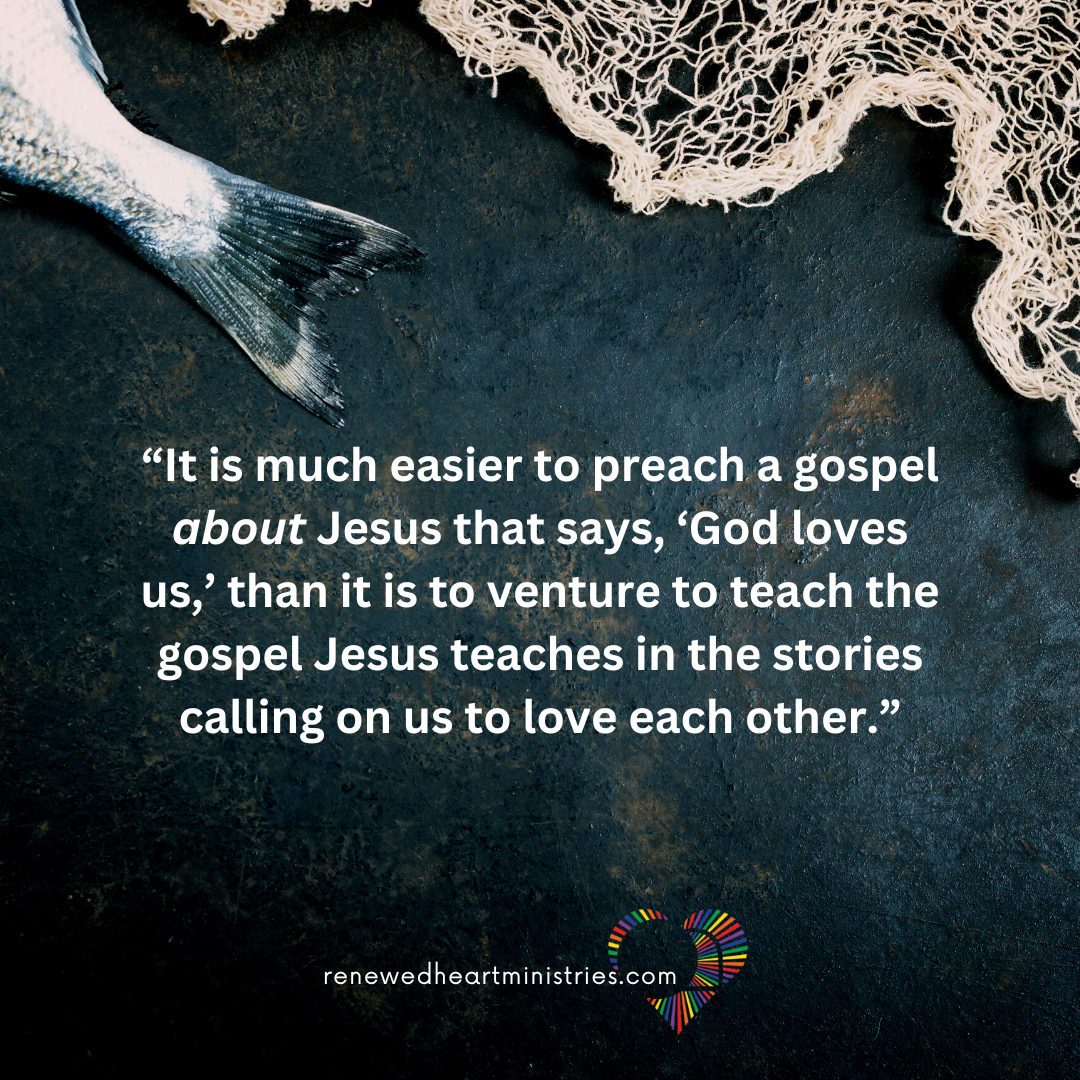
“It is much easier to preach a gospel about Jesus that says “God loves us,” than it is to venture to teach the gospel Jesus teaches in the stories calling on us to love each other.”

Our lectionary reading from the gospels for this coming weekend is from the gospel of Mark:

After John was put in prison, Jesus went into Galilee, proclaiming the good news of God. “The time has come,” he said. “The kingdom of God has come near. Repent and believe the good news!”

As Jesus walked beside the Sea of Galilee, he saw Simon and his brother Andrew casting a net into the lake, for they were fishermen. “Come, follow me,” Jesus said, “and I will send you out to fish for people.” At once they left their nets and followed him.

When he had gone a little farther, he saw James son of Zebedee and his brother John in a boat, preparing their nets. Without delay he called them, and they left their father Zebedee in the boat with the hired men and followed him. (Mark 1:14-20)

Every year around this time, I find myself writing on the themes in this passage. Take a look at two of my previous entries on Matthew’s and Luke’s versions of this passage, in 2022 and in 2023

Before we dive into the fishing metaphor, though, let’s explore how our reading begins. 

First, Herod has imprisoned John. Rome and Rome’s extensions are generally tolerant of things we consider today to be religious in nature. What Rome didn’t tolerate was anyone who became a social, political, or economic threat to Rome’s status quo and power structure. John didn’t get arrested because he was handing out tickets to heaven. He was arrested because he came to be seen as a threat the system. (In this December 2023 article, I mention Josephus’ description of how Herod viewed John the Baptist.)

After John is arrested, Jesus sets out preaching his gospel. Try and get inside the headspace of the gospel authors here. They aren’t describing a gospel about Jesus, like we would preach today. Instead they’re talking about the gospel Jesus himself taught. What was that gospel like?

The word “gospel” is not a Jewish term but a Roman one. When Rome would conquer a new territory, it would send out a messenger called an evangelist to go throughout the area announcing the gospel or “good news” that these people had just been conquered by their “savior” Caesar, “savior of the world,” and would now be subject of the Empire of Rome and the Pax Romana. Here are a few examples of how Rome used this term “gospel.”

“Even after the battle at Mantinea, which Thucydides has described, the one who first announced the victory had no other reward for his gospel [euangelion 

– singular] than a piece of meat sent by the magistrates from the public mess.” (Plutarch, Agesilaus, p. 33) 

“Accordingly, when [Aristodemus] had come near, he stretched out his hand and cried with a loud voice: ‘Hail, King Antigonus, we have conquered Ptolemy in a sea-fight, and now hold Cyprus, with 12,800 soldiers as prisoners of war.’ To this, Antigonus replied: ‘Hail to thee also, by Heaven! But for torturing us in this way, thou shalt undergo punishment; the reward for thy gospels [euangelion] thou shalt be some time in getting.’” (Plutarch, Demetrius, p. 17) 

“Why, as we are told, the Spartans merely sent meat from the public commons to the man who brought the gospel [euangelion] of the victory in Mantineia which Thucydides describes! And indeed the compilers of histories are, as it were, reporters of great exploits who are gifted with the faculty of felicitous speech, and achieve success in their writing through the beauty and force of their narration; and to them those who first encountered and recorded the events [euangelion] are indebted for a pleasing retelling of them” (Plutarch, Moralia [Glory of Athens], p. 347)

Unlike the gospel these messengers announced, Jesus’ gospel wasn’t about Rome but about what he referred to as “the kingdom.” In the kingdom or reign of God, there would be enough bread for everyone and all debts would be cancelled, all slaves set free, and land returned to its original owners (Matthew 6:11, Luke 4:18-19, and Matthew 5:45).

Jesus was also not merely announcing that God’s just future was coming. He was announcing that it had arrived, and the response he called for was for his listeners to “repent and believe the good news.” 

The phrase “repent and believe” is a difficult one for us Christians not to hear religiously as pertaining to the afterlife, but the Greek phrase is metanoesein kai pistos. Josephus uses this phrase when he tells us a story of visiting a Jewish brigand in prison for rebelling against Rome. Jospheus attempts to convince the rebel to leave that path and take up a more cooperative posture toward the empire. The phrase Josephus uses in his plea is for this brigand to “repent and believe/trust him” (metanoesein kai pistos emoi genesestha), and it’s the same language we read in Mark from Jesus’ gospel preaching (see Thackery’s The Life Of Flavius Josephus, p. 110).

So Jesus is preaching a gospel of the kingdom, not a gospel of Rome. He is not calling his listeners to repent of rebellion against Rome or to accept Rome’s governance, but rather for his listeners to repent (rethink their current path) of complicity with the status quo. He calls them to trust him and enter God’s just future now. 

It is in this context that we must understand Mark’s next narrative move of Jesus calling fishermen. We must set aside the Christian evangelism framing this passage has suffered since this story was told, and try to hear this passage as the original Jewish Jesus followers would have heard it.

First, this language of being fishers of people is not a metaphor for evangelism. Proselytizing was not widely practiced in most expressions of Judaism at this time. Though there were occasionally converts , most scholars today agree that Jews did not do much proselytizing in the 1st Century. 

Jesus was not calling to these Jewish fishermen to become proselytizers, then. Instead, the reference to fishing for people was a call to another kind of action in the justice tradition of the Hebrew prophets: joining Jesus in challenging harm being done to people in the here and now, not the hereafter.

In several Hebrew scriptures, fishing for people was about hooking or catching a certain kind of person, a powerful and unjust person, and removing them from the position of power where they were wielding harm.

Speaking of those who do harm within their positions of power, Jeremiah reads:

“But now I will send for many fishermen,” declares the LORD, “and they will catch them. After that I will send for many hunters, and they will hunt them down on every mountain and hill and from the crevices of the rocks. (Jeremiah 16:16)

Speaking of those who “oppress the poor and crush the needy,” Amos reads:

The Sovereign LORD has sworn by his holiness: “The time will surely come when you will be taken away with hooks, the last of you with fishhooks.” (Amos 4:2)

Speaking of the abusive Pharaoh, king of Egypt, Ezekiel reads:

In the tenth year, in the tenth month on the twelfth day, the word of the LORD came to me: “Son of man, set your face against Pharaoh king of Egypt and prophesy against him and against all Egypt. Speak to him and say: ‘This is what the Sovereign LORD says:

‘“I am against you, Pharaoh king of Egypt,

you great monster lying among your streams.

You say, “The Nile belongs to me;

I made it for myself.”

But I will put hooks in your jaws

and make the fish of your streams stick to your scales.

I will pull you out from among your streams,

with all the fish sticking to your scales.

I will leave you in the desert,

you and all the fish of your streams.

You will fall on the open field

and not be gathered or picked up.

I will give you as food

to the beasts of the earth and the birds of the sky.

Then all who live in Egypt will know that I am the LORD. (Ezekiel 29:1-6)

Ched Myers, in commentaries written on this week’s passage from Mark, writes:

“In the Hebrew Bible, the metaphor of ‘people like fish’ appears in prophetic censures of apostate Israel and of the rich and powerful: ‘I am now sending for many fishermen, says God, and they shall catch [the people of Israel]…’ (Jeremiah 16:16) ‘The time is surely coming upon you when they shall take you away with fishhooks…’ (Amos 4:2) ‘Thus says God: I am against you, Pharaoh king of Egypt…. I will put hooks in your jaws, and make the fish of your channels stick to your scales…’ (Ezekiel 29:3f) Jesus is, in other words, summoning working folk to join him in overturning the structures of power and privilege in the world!” (Ched Myers, Marie Dennis, Joseph Nangle, Cynthia Moe-Lobeda, Stuart Taylor; Say to This Mountain: Marks Story of Discipleship, p. 10)

“There is perhaps no expression more traditionally misunderstood than Jesus’ invitation to these workers to become ‘fishers of men.’ This metaphor, despite the grand old tradition of missionary interpretation, does not refer to the ‘saving of souls,’ as if Jesus were conferring on these men instant evangelist status. Rather the image is carefully chosen from Jeremiah 16:16, where it is used as a symbol of Yahweh’s censure of Israel. Elsewhere the ‘hooking of fish’ is a euphemism for judgment upon the rich (Amos 4:2) and powerful (Ezekiel 29:4). Taking this mandate for his own, Jesus is inviting common folk to join him in the struggle to overturn the existing order of power and privilege.” (Ched Myers, Binding the Strong Man: A Political Reading of Marks Story of Jesus, p. 132)

Jesus was calling these fishermen to join him hope, change, and participating in God’s just future. That just future begins with our challenging the existing order of power and privilege, specifically because of the harm that the status quo causes.

Love means caring for people and what they are suffering here and now. That’s why, as Cornel West often says, justice is what love looks like in public. While it is much easier to preach a gospel that says “God loves us,” it is a much more challenging venture to teach a gospel calling on people to love each other. Perhaps that’s why Jesus’ message in the gospels is rarely about God’s love toward us per se. (It is present at times, but is rarely emphasized and doesn’t even show up in the book of Acts, which is supposed to be about the gospel turning the world upside down.) 

Instead Jesus’ gospel repeats the call for us to love one another, neighbor, and even enemy. Love is not something we are to simply bask in, assured that we the objects of Divine affection. Love is the ethic that a God of love calls us to live by in our relations to each other. A gospel that is only about God’s unconditional love for us has historically served as guilt alleviation for those in positions of power and privilege. It helps those complicit in harm to rest at night. 

It doesn’t matter how much a gospel about Jesus talks about God’s love if it doesn’t include the call for us to love one another. I’m thinking specifically about distributive justice for others being harmed. Without that call, it may be a gospel about Jesus, but it’s not the same gospel that Jesus taught in the early stories. A gospel may include God’s universal and unconditional love, but if that gospel doesn’t result in adherents also loving their neighbors, then that gospel is “a resounding gong or a clanging cymbal” (1 Corinthians 13:1).

HeartGroup Application

1. Share something that spoke to you from this week’s eSight/Podcast episode with your HeartGroup.

2. What would a society shaped by love look like? Share and discuss with your group.

3. What can you do this week, big or small, to continue setting in motion the work of shaping our world into a safe, compassionate, just home for everyone? 

Thanks for checking in with us, today.

I want to say a special thank you to all of our supporters out there. And if you would like to join them in supporting Renewed Heart Ministries’ work you can do so by going to renewedheartministries.com and clicking donate. 

I have some exciting news! I have just signed an agreement with a new book publisher (Quoir), and we are putting together a launch team for the second edition of Finding Jesus, coming out next month!

If you have been blessed by the first edition, and you would like to see this book have greater exposure to reach an even larger audience, I want to invite you to be a part of the launch team.  This second edition will be available in paperback, Kindle and an audio book available on Audible. And great news for those who already have a copy of the first edition, the first 25 people to sign up to be part of our launch team will also receive a FREE Audible copy of the audiobook for Finding Jesus.

To join the Finding Jesus launch team, all you need to do is four things:

  1. Go to Amazon and pre-order a copy of the second edition when pre-orders become available.

2) Read the pdf copy of the second edition of Finding Jesus that I will send you after your pre-order the book so that you’re ready on launch day.

3) On launch day go back to Amazon and write a review for Finding Jesus. (You’ll be able to do this on day one since you’ve already read the pdf copy.)

4) Share your review of Finding Jesus on your social media pages that day, also.

It’s pretty simple. That’s all. And if you already have copy of the first edition this is a great opportunity to get the audiobook version on Audible as soon as it is available.

If you would like to join our launch team, you can email me at info@renewedheartministries.com and just put in the subject of your email “Launch Team.”

Thank you in advance for being part of this special second edition publishing and ensuring this edition is a success.

You can find Renewed Heart Ministries on X (or Twitter), Facebook, Instagram and Meta’s new Threads. If you haven’t done so already, please follow us on your chosen social media platforms for our daily posts. Also, if you enjoy listening to the Jesus for Everyone podcast, please like and subscribe to the JFE podcast through the podcast platform you use and consider taking some time to give us a review. This helps others find our podcast as well.

You can watch our new YouTube show called “Just Talking” each week. Todd Leonard and I take a moment to talk about the gospel lectionary reading for the upcoming weekend. We’ll be talking about each reading in the context of love, inclusion, and societal justice. Our hope is that our talking will be just talking (as in justice) and that during our brief conversations each week you’ll be inspired to also do more than just talking.

If you teach from the lectionary each week, or if you’re just looking for some thoughts on the Jesus story from a more progressive perspective within the context of social justice, check it out, you might like it. You can find JustTalking each week on YouTube at youtube.com/@herbandtoddjusttalking. Please Like, Subscribe, hit the Notification button, and leave us a comment.

And if you’d like to reach us here at Renewed Heart Ministries through email, you can reach us at info@renewedheartministries.com.

Right where you are, keep living in love, choosing compassion, taking action, and working toward justice.

I love each of you dearly,

I’ll see you next week.


Are you receiving all of RHM’s free resources each week?

Begin each day being inspired toward love, compassion, action, and justice. Free Sign-Up HERE

Advent and the Joy of Working for a Better World

All Year-End donations are going matched!

Please see the various thank you offers following this week’s article, below.

Logo and Website


New Episode of JustTalking!

Season 1, Episode 43: John 1.6-8, 19-28. Lectionary B, Advent 3

Each week, we’ll be talking about the gospel lectionary reading for the upcoming weekend. We’ll be talking about each reading in the context of love, inclusion, and societal justice. Our hope is that our talking will be just talking (as in justice) and that during our brief conversations each week you’ll be inspired to also do more than just talking.

If you teach from the lectionary each week, or if you’re just looking for some thoughts on the Jesus story from a more progressive perspective within the context of social justice, check it out, you might like it.

You can find the latest show on YouTube at

Season 1, Episode 43: John 1.6-8, 19-28. Lectionary B, Advent 3

 or (@herbandtoddjusttalking)

Please Like, Subscribe, hit the Notification button, and leave us a comment

Thanks in advance for watching!


Advent and the Joy of Working for a Better World

Herb Montgomery | December 15, 2023

To listen to this week’s eSight as a podcast episode click here.

“As difficult as doing preparation work in the wilderness is at times, there is joy in knowing what it is you are preparing the way for. We are preparing the way for the advent of a world where love is our guiding principle. There is joy in that assurance, and our labors are not in vain.”

Our reading this month is from the gospel of John.

There was a man sent from God whose name was John. He came as a witness to testify concerning that light, so that through him all might believe. He himself was not the light; he came only as a witness to the light. 

Now this was John’s testimony when the Jewish leaders in Jerusalem sent priests and Levites to ask him who he was. He did not fail to confess, but confessed freely, “I am not the Messiah.”

They asked him, “Then who are you? Are you Elijah?” 

He said, “I am not.” 

“Are you the Prophet?” 

He answered, “No.” 

Finally they said, “Who are you? Give us an answer to take back to those who sent us. What do you say about yourself?” 

John replied in the words of Isaiah the prophet, “I am the voice of one calling in the wilderness, ‘Make straight the way for the Lord.’” 

Now the Pharisees who had been sent questioned him, “Why then do you baptize if you are not the Messiah, nor Elijah, nor the Prophet?” 

“I baptize with water,” John replied, “but among you stands one you do not know. He is the one who comes after me, the straps of whose sandals I am not worthy to untie.”

This all happened at Bethany on the other side of the Jordan, where John was baptizing. (John 1:6-8, 19-28)

Most scholars agree that John’s gospel was the last gospel in our canon to be written. Mark’s was the earliest, and Matthew and Luke were written between Mark and John. In Mark’s gospel John is a contemporary of Jesus. Jesus begins as one of John’s disciples and part of his Jewish reformation and renewal movement. Once John is imprisoned, Jesus begins his own renewal movement. One gets the impression that John’s followers and Jesus’ followers were in two related but separate movements, contemporaries and occasionally in competition.

John’s gospel presents John the Baptist as Jesus’ forerunner, the one who announced Jesus’ arrival. In Mark, Jesus is baptized by John, but as the gospels progresses, this fact becomes less and less emphasized until John’s gospel, which conveniently leaves out John’s role in Jesus’ baptism. It is cryptic about it, and this may reflect tensions that had developed between John’s followers and Jesus’s. If that’s the case, the Jesus community may not have wanted to see Jesus subordinated to John in any way in the gospels, even if only by implication.

John’s gospel seems to downgrade John the Baptist for the purpose of exalting Jesus. One example is how, in this gospel, John the Baptist rejects attempts to be identified as Messiah, the Prophet, or Elijah.

In Mark, Matthew and Luke, on the other hand, John the Baptist is dramatically associated with Elijah:

Jesus replied, “To be sure, Elijah does come first, and restores all things. Why then is it written that the Son of Man must suffer much and be rejected? But I tell you, Elijah has come, and they have done to him everything they wished, just as it is written about him.” (Mark 9:12-13)

And if you are willing to accept it, he is the Elijah who was to come. (Matthew 11:14)

And he will go on before the Lord, in the spirit and power of Elijah, to turn the hearts of the parents to their children and the disobedient to the wisdom of the righteous—to make ready a people prepared for the Lord.” (Luke 1:17, cf. Micah 4:5)

But in our reading this week, John the Baptist rejects being associated with any of these figures, including Elijah.

What I appreciate about the picture of John the Baptist that we get in the gospel of John is that it unequivocally locates John’s ministry. Each gospel tells us where John taught. 

When John is cornered in our reading by people demanding that he answer their questions about who he was, John’s response is:

“I am the voice of one calling in the wilderness, ‘Make straight the way for the Lord.’”

Last week I wrote at length about John’s ministry being in the wilderness as we considered the way John’s ministry is characterized in the gospel of Mark. If you haven’t already read that article, you’ll find it helpful as a foundation for what I’m about to say. (Read that article)

The wilderness in the gospels is contrasted with the central location of power: the temple state, centered in the temple as the capital in Jerusalem. John is characterized as working outside the centers of power, property, and privilege. Here I want to be very clear that this is not imagery that symbolizes some conflict between Christianity and Judaism. Rather, these are symbols of long standing within the Jewish society at that time. They represent Jewish voices in conflict with one another over what fidelity to the God of the Torah looked like in relation to economics, society and politics. These were all deeply religious matters in that culture, and religious fidelity demanded people live in certain economic, social, and political ways.

The symbols being contrasted, then, are those of priest and prophet. The priesthood represented those who had been coopted by Rome and were barely more than puppets of the absentee emperor, Caesar. Whoever held the position of high priest was designated as such by Rome, and the priesthood’s chief responsibility was to ensure that whatever actions took place in the Jewish temple state, those actions did not violate the Pax Romana. 


In contrast to this elite class in John’s society was the symbol of a prophet in the wilderness. This symbol stood in a long lineage with Hebrew prophets who continually called those in positions of power back to justice. Again, how the most vulnerable in society was taken care of or exploited was a matter of fidelity to their God. Faithfulness to God implied living justly in relation to one’s neighbor. Those who participated in the Hebrew prophetic justice tradition stood on the margins of their society, calling those at the center and those in positions of power and privilege to return to a path of distributive justice. 

This rich heritage of justice prophets is the heritage that John the Baptist is characterized with in each gospel. 

What does this say to us today?

For me it tells me to keep my ear to the ground and my eyes not on the establishment; to listen to those outside, on the edges, the margins, the undersides of society, and the calls for justice they are making. It brings to mind such movements today as the Poor People’s Campaign, or the Movement for Black Lives, or movements like we saw at Standing Rock calling for justice for indigenous communities and an end to the extraction and pollution of their lands. It brings to mind the recent Women’s March on Washington and movements for LGBTQ justice and inclusion. It brings to mind those today calling for justice for the thousands of innocent Palestinian lives being taken. Who is in the wilderness today? What justice needs are they raising awareness for? Or, in the language of this week’s passage, what is the “way” that they are preparing for God’s future of love, compassion, justice and safety to arrive, a world that is a safe, compassionate, just home for us all?

Who, in other words, are the John the Baptists of today? 

In our story, John was preparing the way for the one whom the synoptic gospel authors borrowed the words of Isaiah to describe:

“Here is my servant, whom I uphold,

my chosen one in whom I delight;

I will put my Spirit on him,

and he will bring justice to the nations.” (Isaiah 42:1, cf. Matthew 3:17; Mark 1:11; Luke 3:22)

Who today are preparing the way for justice to be brought to the nations?

Who are the ones on the edges, working within the grassroots of our communities preparing the way so that when justice is accomplished, it finds rich soil to take root and remain? 

In our story, when God’s just future arrived, it was crucified by the powerful, privileged and propertied. We have the ability today to write a different ending to the story, one that stands awake to the resurrection of God’s just future. 

But this season is not the season of Easter, yet. This season is advent. And this weekend’s theme is the joy of Advent. As difficult as doing preparation work in the wilderness is at times, there is joy in knowing what it is you are preparing the way for. We are preparing the way for the advent of a world where love is our guiding principle. There is joy in that assurance, and our labors are not in vain.

HeartGroup Application

1. Share something that spoke to you from this week’s eSight/Podcast episode with your HeartGroup.

2. Advent is that season where we take time again to reflect on the joy of the kind of world we are working toward. What joy are you finding in Advent this year? Share and discuss with your group.

3. What can you do this week, big or small, to continue setting in motion the work of shaping our world into a safe, compassionate, just home for everyone?

Thanks for checking in with us, today.

I want to say a special thank you to all of our supporters out there. And if you would like to join them in supporting Renewed Heart Ministries’ work you can do so by going to renewedheartministries.com and clicking donate. 

You can find Renewed Heart Ministries on X(Twitter), Facebook, Instagram and Threads. If you haven’t done so already, please follow us on your chosen social media platforms for our daily posts. Also, if you enjoy listening to the Jesus for Everyone podcast, please like and subscribe to the JFE podcast through the podcast platform you use and consider taking some time to give us a review. This helps others find our podcast as well.

You can watch our new YouTube show called “Just Talking” each week. Todd Leonard and I take a moment to talk about the gospel lectionary reading for the upcoming weekend. We’ll be talking about each reading in the context of love, inclusion, and societal justice. Our hope is that our talking will be just talking (as in justice) and that during our brief conversations each week you’ll be inspired to also do more than just talking.

If you teach from the lectionary each week, or if you’re just looking for some thoughts on the Jesus story from a more progressive perspective within the context of social justice, check it out, you might like it. You can find JustTalking each week on YouTube at youtube.com/@herbandtoddjusttalking. Please Like, Subscribe, hit the Notification button, and leave us a comment.

And if you’d like to reach us here at Renewed Heart Ministries through email, you can reach us at info@renewedheartministries.com.

My new book, Finding Jesus: A story of a fundamentalist preacher who unexpectedly discovered the social, political, and economic teachings of the Gospels is now also available at renewedheartministries.com

Right where you are, keep living in love, choosing compassion, taking action, and working toward justice.

I love each of you dearly,

I’ll see you next week.


Matching Donations for the Rest of 2023!

As 2023 is coming to a close, we are deeply thankful for each of our supporters.

To express that gratitude we have a lot to share.

First, all donations during these last two months of the year will be matched, dollar for dollar, making your support of Renewed Heart Ministries go twice as far.

“Donate.”

Also, to everyone how makes a special one-time donation in any amount to support our work this holiday season we will be giving away a free copy of The Bible & LGBTQ Adventists.

When making your donation all you have to do indicate you would like to take advantage of this offer by writing Free Book” either in the comments section of your online donation or in the memo of your check if you are mailing your donation.

“Donate.”

Lastly, its time for our annual Shared Table event once again. For all those who choose to become one of our monthly sustaining partners for 2024 by clicking the “Check this box to make it a monthly recurring donation” online, we will be sending out one our a handmade Renewed Heart Ministries Shared-Table Pottery Bowl made by Crystal and Herb as a thank you gift for your support. Becoming a monthly sustaining parter enables RHM to set our ministry project goals and budget for the coming year.

To become a monthly sustaining partner, go to renewedheartministries.com/donate and sign up for an automated recurring monthly donation of any amount by clicking the “Check this box to make it a monthly recurring donation” option. Or if you are using Paypal, select “Make this a monthly donation.”

We will be starting out the new year by sending out these lovely bowls as our gift to you to thank you for your sustaining support. Look for them to arrive during the months of January and February.

Our prayer is that whether displayed or used these bowls will be reminder of Jesus’ gospel of love, caring and shared table fellowship. They also make a great gift or conversation starter, as well.

If you are already one of our sustaining partners for 2024, we want to honor your existing continued support of Renewed  Heart Ministries, too. You’ll also receive one of our Shared Table Pottery Bowls as a thank you.

No matter how you choose to donate to support Renewed Heart Ministries’ work this holiday season, thank you for partnering with us to further Jesus’ vision of a world filled with compassion, love, and people committed to taking care of one another. Together we are working toward a safer, more compassionate, and just world both for today and for eternity.

From each of us here at RHM, thank you!

We wish you so much joy, peace, and blessings as 2023 comes to a close. Your support sustains our ongoing work in the coming year.

You can donate online by going to renewedheartministries.com and clicking “Donate.”

Or you can make a donation by mail at:

Renewed Heart Ministries
PO Box 1211
Lewisburg, WV 24901

In this coming year, together, we will continue to be a light in our world sharing Jesus’ gospel of love, justice and compassion.


Now Available at Renewed Heart Ministries!

Herb’s new book Finding Jesus: A story of a fundamentalist preacher who unexpectedly discovered the social, political, and economic teachings of the Gospels, is available at renewedheartministries.com.

Get your copy today at renewedheartministries.com


Are you receiving all of RHM’s free resources each week?

Begin each day being inspired toward love, compassion, action, and justice. Free Sign-Up HERE

Apocalyptic Passivity

We want to say a special thank you to all of our supporters.

Please see the various thank you offers following this week’s article, below.

Logo and Website


New Episode of JustTalking!

Season 1, Episode 38: Matthew 25.1-13. Lectionary A, Proper 27

Each week, we’ll be talking about the gospel lectionary reading for the upcoming weekend. We’ll be talking about each reading in the context of love, inclusion, and societal justice. Our hope is that our talking will be just talking (as in justice) and that during our brief conversations each week you’ll be inspired to also do more than just talking.

If you teach from the lectionary each week, or if you’re just looking for some thoughts on the Jesus story from a more progressive perspective within the context of social justice, check it out, you might like it.

You can find the latest show on YouTube at

Season 1, Episode 38: Matthew 25.1-13. Lectionary A, Proper 27

 or (@herbandtoddjusttalking)

Please Like, Subscribe, hit the Notification button, and leave us a comment

Thanks in advance for watching!


Apocalyptic Passivity

Herb Montgomery | November 10, 2023

To listen to this week’s eSight as a podcast episode click here.

“To be clear, in the gospels, both a here- and-now, the “kingdom has arrived and is among you” Jesus and an apocalyptic, the “kingdom is coming” Jesus are portrayed because both matched an era of the early Jesus community. But a Jesus who taught us that God’s kingdom is already here for our participation seems to me to offer more life-giving options right now. A Jesus who only taught that hope was coming in the near future and that we must patiently, personally prepare for it doesn’t offer much hope for those who are suffering today and simply cannot wait.”

Our reading this week is from the gospel of Matthew:

“At that time the kingdom of heaven will be like ten maidens who took their lamps and went out to meet the bridegroom. Five of them were foolish and five were wise. The foolish ones took their lamps but did not take any oil with them. The wise ones, however, took oil in jars along with their lamps. The bridegroom was a long time in coming, and they all became drowsy and fell asleep.

“At midnight the cry rang out: ‘Here’s the bridegroom! Come out to meet him!’ Then all the maidens woke up and trimmed their lamps. The foolish ones said to the wise, ‘Give us some of your oil; our lamps are going out.’ ‘No,’ they replied, ‘there may not be enough for both us and you. Instead, go to those who sell oil and buy some for yourselves.’

“But while they were on their way to buy the oil, the bridegroom arrived. The maidens who were ready went in with him to the wedding banquet. And the door was shut. Later the others also came. ‘Lord, Lord,’ they said, ‘open the door for us!’ But he replied, ‘Truly I tell you, I don’t know you.’

“Therefore keep watch, because you do not know the day or the hour.” (Matthew 25:1-13)

Our reading this week offers me an opportunity to share something that has been on my heart for some time now.

The parable in our reading this week is unique compared to other parables in Matthew’s gospel in both subject and the language it uses. Absent from this parable is Jesus’ usual humor and hyperbole. The parable doesn’t critique those in power in the prophetic way most of his other parables do. There is no plot twist or surprise ending to leave listeners scratching their heads. The lesson is pretty straightforward and obvious: Be prepared. Those who are prepared go in. Those who aren’t prepared are left out. 

This lesson repeats common universal wisdom, and it’s also quite apocalyptic. It sounds a lot more like it’s addressing issues existing in the Jesus community when the gospel of Matthew was written down than when the events in the story were taking place. In Mark, for example, when Jesus is approaching his trial and death, he tells his followers he will leave them and calls them to participate with him in the speaking out that will eventually get him killed. In Matthew, these closing parables beginning in chapter 24 are about being ready when Jesus returns after his departure, and it closes with the same words found at the end of the parable in Matthew 24:42:

“Therefore keep watch, because you do not know on what day your Lord will come.” (Matthew 24:42)

This apocalyptic theme  reflects more the concerns of the Jesus community after Jesus’ death than it does the teachings of Jesus before his unjust execution. In the rest of the gospels, the writers announce the good news or gospel that the time has come, the “kingdom” is here, and all are invited to join in Jesus’ vision for a just, inclusive, compassionate community. This invitation was deeply attractive to the marginalized and those pushed to the edges and undersides of Jesus’ society, but the calls to justice in Jesus’ typical “kingdom” teachings and parables were not as attractive to those benefiting from the unjust status quo. To these people, Jesus was seen as a threat that must be silenced. 

Here at the end of Matthew it’s as if we’ve witnessed a subject change. We are no longer talking about the good news of a concrete salvation that has arrived in the here and now. Now we are discussing being prepared for its arrival at some point in the future. The community is wrestling with how to follow Jesus after Jesus’ death. On top of that, the Jewish members of this community are also wrestling what life looks like after the fall of Jerusalem and the Temple: the temple is no more and Jerusalem has been leveled to the ground. Everything has changed, and in the shadow of such deep trauma and loss, it makes a lot less sense to say God’s just future has arrived than to look to the future and focus on being prepared for when God’s just future will arrive. 

This is the context of our parable in this week. It is a lot more apocalyptic or future-looking than the typical here-and-now focus that Matthew’s Jesus has used in preceding portions of this gospel. These two different versions of Jesus in certain parts of the gospels are at the foundation of the debate among Jesus scholars as to whether Jesus was an apocalyptic preacher of a soon-to-come new world or teaching that God’s kingdom was already here and inviting folks to be participate in it here and now. (For detail, see Robert Miller’s The Apocalyptic Jesus: A Debate.) 

I have my own leanings and opinions on this subject. First, I think you can be a genuine Jesus follower regardless of which camp you subscribe to. I also think it’s more difficult and requires more intention and care if you choose to view Jesus as an apocalyptic preacher. You have to be careful not to view his economic teachings (such as selling one’s possessions and wealth redistribution to the poor) as coming from Jesus’ thinking that the world was about to end and there was no need to prepare for the future. You must be careful to see that these teachings are rooted in economic justice and reflect a Jesus who thought the best way to prepare for the future was not in hoarding resources but in investing in community and a commitment to care for one another. We can face whatever the future brings, together, knowing we have each other’s back. 

An apocalyptic Jesus offers an excuse to ignore many of Jesus’ teaching on the basis that Jesus supposedly thought the world was about to end. His teaching are not sustainable, in this reasoning, on a long-term ongoing basis. I disagree with that idea. I believe Jesus’ teachings are sustainable and place before us all a path for a safer tomorrow. 

Another area of care one has to be intentional about is when someone feels the world is about to end or their hope is rooted in the world ending. These folks are not the best ones to come up with sustainable solutions that prevent the end of our world. In other words, people whose hope rests in the world burning make the worst environmentalists! Their worldview doesn’t enable and prepare them to see long-term solutions to the problems threatening humanity’s survival today. 

Simply put, Jesus followers today who believe Jesus’ taught the kingdom has arrived have fewer theological hurdles in their way to making our world a safer, just, more compassionate home for everyone here and now. I wish I had a nickel for every time a Christian has accused me of only arranging deck chairs on the Titanic whenever I speak on social justice or environmental justice issues. Just this past week, a friend of mine was lamenting online how everything in our world seems to be crumbling and coming apart. A Christian friend of theirs who was first to respond, commented, “As in the days of Noah.”

How does that help? Rather than a call to roll up one’s sleeves and go to work relieving the harm and suffering that the most vulnerable in our communities are going through (which would look a lot like the Jesus we encounter in the majority of the gospel stories), there is a sad resignation that world will just keep getting worse and worse and there’s nothing we can really do about it until Jesus shows up.

Really? There’s really nothing we can do? It sounds more like we want the world to get worse and worse when some among us believe Jesus can’t come back until it gets a lot worse. Are we listening to ourselves when we say things like this? 

Suffering should move Jesus’ followers to action, like it moved our Jesus. It shouldn’t lead us to a passive, powerless resignation that this has all been foretold and there’s nothing we can do but wait and be prepared ourselves. In the stories, Jesus’ desire for his followers is that they join him in his work of making our world a better place here and now. He said it’s here. “The kingdom of God is in your midst.” (Luke 17:11)

Again, I understand how the Jesus movement became apocalyptic after Jesus’ death. I can see how Paul was apocalyptic. I can even see that John the Baptist was apocalyptic: he was looking for one “to come,” while Paul was looking for Jesus “to return.” But Jesus was announcing God’s just future had arrived! And if we lean into that version of Jesus in the Jesus story, it changes everything. It has for me. It has changed my focus from the future to the here and now. After all, didn’t Jesus say not to worry and be preoccupied about tomorrow, that “tomorrow will worry about itself” (Matthew 6:34)? He called his listeners to focus on today and the good they could do now. He called his followers to do whatever we can, big or small, to make our world a safe, compassionate, just home for everyone, here and now.

When I go back and look at our parable in this light, I understand we must be prepared for the future, whatever it may hold. And the best way Jesus taught us to be prepared is to be about investing in each other, caring about each other, and doing what we can to promote the common good, today, here, now. People matter. The world is on fire. Will we pick up a pail of water to help put it out or will we stand back and simply view it all as unavoidable apocalypse? 

To be clear, in the gospels, both a here- and-now, the “kingdom has arrived and is among you” Jesus and an apocalyptic, the “kingdom is coming” Jesus are portrayed because both matched an era of the early Jesus community. But a Jesus who taught us that God’s kingdom is already here for our participation seems to me to offer more life-giving options right now. A Jesus who only taught that hope was coming in the near future and that we must patiently, personally prepare for it doesn’t offer much hope for those who are suffering today and simply cannot wait. And for those who can choose a both/and approach, we must still be careful that our both/and approach doesn’t produce the fruit of apocalyptic passivity that ensures we have our own oil but doesn’t do much to make sure everyone else has the oil they need too.

HeartGroup Application

1. Share something that spoke to you from this week’s eSight/Podcast episode with your HeartGroup.

2. How does seeing Jesus’ teachings applying to the here and now affect your own Jesus following. Share and discuss with your group.

3. What can you do this week, big or small, to continue setting in motion the work of shaping our world into a safe, compassionate, just home for everyone?

Thanks for checking in with us, today.

I want to say a special thank you to all of our supporters out there. And if you would like to join them in supporting Renewed Heart Ministries’ work you can do so by going to renewedheartministries.com and clicking donate. 

You can find Renewed Heart Ministries on Twitter, Facebook, Instagram and Threads. If you haven’t done so already, please follow us on your chosen social media platforms for our daily posts. Also, if you enjoy listening to the Jesus for Everyone podcast, please like and subscribe to the JFE podcast through the podcast platform you use and consider taking some time to give us a review. This helps others find our podcast as well.

You can watch our new YouTube show called “Just Talking” each week. Todd Leonard and I take a moment to talk about the gospel lectionary reading for the upcoming weekend. We’ll be talking about each reading in the context of love, inclusion, and societal justice. Our hope is that our talking will be just talking (as in justice) and that during our brief conversations each week you’ll be inspired to also do more than just talking.

If you teach from the lectionary each week, or if you’re just looking for some thoughts on the Jesus story from a more progressive perspective within the context of social justice, check it out, you might like it. You can find JustTalking each week on YouTube at youtube.com/@herbandtoddjusttalking. Please Like, Subscribe, hit the Notification button, and leave us a comment.

And if you’d like to reach us here at Renewed Heart Ministries through email, you can reach us at info@renewedheartministries.com.

My new book, Finding Jesus: A story of a fundamentalist preacher who unexpectedly discovered the social, political, and economic teachings of the Gospels is now also available at renewedheartministries.com

Right where you are, keep living in love, choosing compassion, taking action, and working toward justice.

I love each of you dearly,

I’ll see you next week.


Matching Donations for the Rest of 2023!

As 2023 is coming to a close, we are deeply thankful for each of our supporters.

To express that gratitude we have a lot to share.

First, all donations during these last two months of the year will be matched, dollar for dollar, making your support of Renewed Heart Ministries go twice as far.

“Donate.”

Also, to everyone how makes a special one-time donation in any amount to support our work this holiday season we will be giving away a free copy of The Bible & LGBTQ Adventists.

When making your donation all you have to do indicate you would like to take advantage of this offer by writing Free Book” either in the comments section of your online donation or in the memo of your check if you are mailing your donation.

“Donate.”

Lastly, its time for our annual Shared Table event once again. For all those who choose to become one of our monthly sustaining partners for 2024 by clicking the “Check this box to make it a monthly recurring donation” online, we will be sending out one our a handmade Renewed Heart Ministries Shared-Table Pottery Bowl made by Crystal and Herb as a thank you gift for your support. Becoming a monthly sustaining parter enables RHM to set our ministry project goals and budget for the coming year.

To become a monthly sustaining partner, go to renewedheartministries.com/donate and sign up for an automated recurring monthly donation of any amount by clicking the “Check this box to make it a monthly recurring donation” option. Or if you are using Paypal, select “Make this a monthly donation.”

We will be starting out the new year by sending out these lovely bowls as our gift to you to thank you for your sustaining support. Look for them to arrive during the months of January and February.

Our prayer is that whether displayed or used these bowls will be reminder of Jesus’ gospel of love, caring and shared table fellowship. They also make a great gift or conversation starter, as well.

If you are already one of our sustaining partners for 2024, we want to honor your existing continued support of Renewed  Heart Ministries, too. You’ll also receive one of our Shared Table Pottery Bowls as a thank you.

No matter how you choose to donate to support Renewed Heart Ministries’ work this holiday season, thank you for partnering with us to further Jesus’ vision of a world filled with compassion, love, and people committed to taking care of one another. Together we are working toward a safer, more compassionate, and just world both for today and for eternity.

From each of us here at RHM, thank you!

We wish you so much joy, peace, and blessings as 2023 comes to a close. Your support sustains our ongoing work in the coming year.

You can donate online by going to renewedheartministries.com and clicking “Donate.”

Or you can make a donation by mail at:

Renewed Heart Ministries
PO Box 1211
Lewisburg, WV 24901

In this coming year, together, we will continue to be a light in our world sharing Jesus’ gospel of love, justice and compassion.


Now Available at Renewed Heart Ministries!

Herb’s new book Finding Jesus: A story of a fundamentalist preacher who unexpectedly discovered the social, political, and economic teachings of the Gospels, is available at renewedheartministries.com.

Get your copy today at renewedheartministries.com


Are you receiving all of RHM’s free resources each week?

Begin each day being inspired toward love, compassion, action, and justice. Free Sign-Up HERE

Ignored Egalitarian Themes of the Gospels

Thank you

We want to say a special thank you to all of our supporters.

If you would like to join them in supporting Renewed Heart Ministries’ work, you can do so by clicking “donate” above.


New Episode of JustTalking!

Season 1, Episode 37: Matthew 23.1-12. Lectionary A, Proper 26

Each week, we’ll be talking about the gospel lectionary reading for the upcoming weekend. We’ll be talking about each reading in the context of love, inclusion, and societal justice. Our hope is that our talking will be just talking (as in justice) and that during our brief conversations each week you’ll be inspired to also do more than just talking.

If you teach from the lectionary each week, or if you’re just looking for some thoughts on the Jesus story from a more progressive perspective within the context of social justice, check it out, you might like it.

You can find the latest show on YouTube at

Season 1, Episode 37: Matthew 23.1-12. Lectionary A, Proper 26

 or (@herbandtoddjusttalking)

Please Like, Subscribe, hit the Notification button, and leave us a comment

Thanks in advance for watching!


Ignored Egalitarian Themes of the Gospels

Herb Montgomery | November 3, 2023

To listen to this week’s eSight as a podcast episode click here.


“Is there anything life-giving we could take from this section of our reading? I do find it puzzling that these themes starkly contrast with how some Christians today in the U.S. are seeking political power to enforce their own interpretations of morality on society rather than seeking more effective ways to serve and lift the burdens of those who are most harmed by our systems.”

Our reading this week is from the gospel of Matthew:

Then Jesus said to the crowds and to his disciples: “The teachers of the law and the Pharisees sit in Moses’ seat. So you must be careful to do everything they tell you. But do not do what they do, for they do not practice what they preach. They tie up heavy, cumbersome loads and put them on other people’s shoulders, but they themselves are not willing to lift a finger to move them.

Everything they do is done for people to see: They make their phylacteries wide and the tassels on their garments long; they love the place of honor at banquets and the most important seats in the synagogues; they love to be greeted with respect in the marketplaces and to be called ‘Rabbi’ by others.

But you are not to be called ‘Rabbi,’ for you have one Teacher, and you are all siblings. And do not call anyone on earth ‘father,’ for you have one Father, and he is in heaven. Nor are you to be called instructors, for you have one Instructor, the Messiah. The greatest among you will be your servant. For those who exalt themselves will be humbled, and those who humble themselves will be exalted”. (Matthew 23:1-12)

The first portion of this passage only appears in Matthew and may be simply how this version of the Jesus story introduces the condemnations that follow. Jesus’ critique was about how the Torah (“Moses”) was being interpreted and practiced. He was not critiquing fidelity to Torah itself.

Something else to note in this reading is the phrase sitting in “Moses’ seat” indicating sole or supreme authority. At the time of Jesus, the Pharisees were competing with other groups and among many players and competitors for authority and power in the Temple state system in Jerusalem. But once the temple was destroyed and Jerusalem razed in 70 C.E., there was no longer a Sanhedrin and no longer a temple with a high priesthood aristocracy. The sole and supreme authority after 70 C.E., the “seat of Moses,” was held only by the surviving Pharisees. This phrase suggests that the gospel of Matthew was written down much closer to 70 C.E. than to the lifetime of Jesus or the events the gospel stories are about.

For early Jewish Jesus followers in Galilee, Torah observance (“Moses”) was still of moral, economic and even political significance, and their Jesus still upholds the importance of Torah fidelity. As I’ve often said, Matthew’s Jesus was not starting a new religion. He was leading a Jewish renewal movement, calling his listeners back to the economic justice themes from the Torah and Hebrew prophets that were relevant to the poor and others who were being marginalized and excluded. 

Jesus’ critiques should not be interpreted as being against the Torah. They are much more against how those still in whatever positions of power remained after 70 C.E. paid lip service to the Torah but did not lift the burdens of those the Torah socially and economically prioritized. These leaders “honored the Torah with their words,” but their actions were still out of harmony with the Torah’s economic teachings: “They tie up heavy, cumbersome loads and put them on other people’s shoulders, but they themselves are not willing to lift a finger to move them.” 

This is a reoccurring theme in Matthew. In Matthew 5:20 we read, “For I tell you that unless your righteousness surpasses that of the Pharisees and the teachers of the law, you will certainly not enter the kingdom of heaven.” It is also found in Luke’s gospel, where Jesus says, “‘And you experts in the law, woe to you, because you load people down with burdens they can hardly carry, and you yourselves will not lift one finger to help them’” (Luke 11:46). 

This statement reflects much more the Pharisees after 70 C.E. than the Pharisees active during Jesus’ life. The Pharisees’ popularity with the masses at the time of Jesus was rooted in their liberal interpretations of the Torah that lifted the masses’ burdens while the Sadducees, who were the wealthy class, had much more restrictive definitions of Torah fidelity to protect their own positions of power and privilege. (See Solidarity with the Crucified Community.)

As we progress through these initial critiques, we do pick up on a theme that are repeated in other gospels: 

“Woe to you Pharisees, because you love the most important seats in the synagogues and respectful greetings in the marketplaces.” (Luke 11:43)

“As he taught, Jesus said, ‘Watch out for the teachers of the law. They like to walk around in flowing robes and be greeted with respect in the marketplaces, and have the most important seats in the synagogues and the places of honor at banquets.’” (Mark 12:38-39)

The last half our reading this week builds on this theme with a critique of titles. It’s important to remember the context for that section. Jesus was critiquing those seeking political power and privilege over the people rather than doing the work required to bring about changes that make our present world a safer, more compassionate, just home for all. 

So Matthew’s gospel is introducing a powerful theme that I believe was intended to foster a more egalitarian environment in the Jesus followers community in Galilee. By 70 C.E. “Rabbi” had come to be used as an honorific title for great teachers, but with that title came a hierarchy of power and authority. Matthew’s gospel therefore responds with “But you are not to be called ‘Rabbi,’ for you have one Teacher, and you are all siblings.” 

The same egalitarian principle can be seen in the critique of the titles of “father” and “instructor” (see 2 Kings 2:12; 6:21). Again the theme here is opposing a growing trend toward systems of hierarchy within the early Jesus movement. We know that ultimately egalitarianism lost out in Christianity, and systems of hierarchy and harmful abuses resulted. Matthew’s gospel seems to be an early intervention. 

Lastly, Matthew’s gospel picks up the theme from Mark that if there is a hierarchy, Jesus followers should be seeking positions of service over positions of rule. It must be noted that Christians in positions of social privilege have used some of these passages against those in more subjugated social locations, encouraging them to accept their social location passively.

Is there anything life-giving we could take from this section of our reading? I do find it puzzling that these themes starkly contrast with how some Christians today in the U.S. are seeking political power to enforce their own interpretations of morality on society rather than seeking more effective ways to serve and lift the burdens of those who are most harmed by our systems. 

In Mark’s gospel we read a story that’s relevant here:

“When the ten heard about this, they became indignant with James and John. Jesus called them together and said, ‘You know that those who are regarded as rulers of the Gentiles lord it over them, and their high officials exercise authority over them. Not so with you. Instead, whoever wants to become great among you must be your servant, and whoever wants to be first must be slave of all. For even the Son of Man did not come to be served, but to serve.’” (Mark 10:41-45)

Matthew repeats this theme three times:

At that time the disciples came to Jesus and asked, “Who, then, is the greatest in the kingdom of heaven?” He called a little child to him, and placed the child among them. And he said: “Truly I tell you, unless you change and become like little children, you will never enter the kingdom of heaven. Therefore, whoever takes the lowly position of this child is the greatest in the kingdom of heaven. And whoever welcomes one such child in my name welcomes me.” (Matthew 18:1-5)

Jesus called them together and said, “You know that the rulers of the Gentiles lord it over them, and their high officials exercise authority over them. Not so with you. Instead, whoever wants to become great among you must be your servant, and whoever wants to be first must be your slave—just as the Son of Man did not come to be served, but to serve, and to give his life as a ransom for many.” (Matthew 20.24-28)

And here in our reading this week:

“The greatest among you will be your servant.” (Matthew 23:11)

These passages in Matthew have aways made me scratch my head when I consider how so many Jesus communities and institutions are structured today. Why aren’t our Jesus communities more egalitarian? Today we have all manner of escalating positions of authority and titles in our communities, and I wonder: 

  • What would Christianity look like if we practiced more egalitarianism with each other?
  • Would we still argue over who could be pastors and who couldn’t based on gender?
  • Would we argue over who could be members or who couldn’t based on their identities and orientations rather than their ethical practices?
  • How could taking seriously the egalitarian themes of this week’s readings transform our Jesus communities. Would that bleed through into how we relate to our larger society?
  • Would we seek to serve others more than obtain ecclesiastical and civil positions of power and authority?

Again, these passages have always challenged me as I consider the way we structure ourselves as Jesus followers. I have more questions than answers, but these questions have always given me pause as I seek to follow a more egalitarian practice in my work and life. 

Matthew ends this section with themes of reversal from ancient Jewish wisdom and I think it may be a great place for us to land this week, too:

“You save the humble but bring low those whose eyes are haughty.” (Psalms 18:27)

“When pride comes, then comes disgrace, but with humility comes wisdom.” (Proverbs 11:2)

HeartGroup Application

1. Share something that spoke to you from this week’s eSight/Podcast episode with your HeartGroup.

2. How do you wish our faith communities were more egalitarian today? Share and discuss with your group.

3. What can you do this week, big or small, to continue setting in motion the work of shaping our world into a safe, compassionate, just home for everyone? 

Thanks for checking in with us, today.

I want to say a special thank you to all of our supporters out there. And if you would like to join them in supporting Renewed Heart Ministries’ work you can do so by going to renewedheartministries.com and clicking donate. 

You can find Renewed Heart Ministries on Twitter, Facebook, Instagram and Threads. If you haven’t done so already, please follow us on your chosen social media platforms for our daily posts. Also, if you enjoy listening to the Jesus for Everyone podcast, please like and subscribe to the JFE podcast through the podcast platform you use and consider taking some time to give us a review. This helps others find our podcast as well.

You can watch our new YouTube show called “Just Talking” each week. Todd Leonard and I take a moment to talk about the gospel lectionary reading for the upcoming weekend. We’ll be talking about each reading in the context of love, inclusion, and societal justice. Our hope is that our talking will be just talking (as in justice) and that during our brief conversations each week you’ll be inspired to also do more than just talking.

If you teach from the lectionary each week, or if you’re just looking for some thoughts on the Jesus story from a more progressive perspective within the context of social justice, check it out, you might like it. You can find JustTalking each week on YouTube at youtube.com/@herbandtoddjusttalking. Please Like, Subscribe, hit the Notification button, and leave us a comment.

And if you’d like to reach us here at Renewed Heart Ministries through email, you can reach us at info@renewedheartministries.com.

My new book, Finding Jesus: A story of a fundamentalist preacher who unexpectedly discovered the social, political, and economic teachings of the Gospels is now also available at renewedheartministries.com

Right where you are, keep living in love, choosing compassion, taking action, and working toward justice.

I love each of you dearly,

I’ll see you next week.


Now Available at Renewed Heart Ministries!

Herb’s new book Finding Jesus: A story of a fundamentalist preacher who unexpectedly discovered the social, political, and economic teachings of the Gospels, is available at renewedheartministries.com.

Get your copy today at renewedheartministries.com


Are you receiving all of RHM’s free resources each week?

Begin each day being inspired toward love, compassion, action, and justice. Free Sign-Up HERE

A Case for a Politically Compassionate, Distributive Justice Minded Christianity

Thank you

We want to say a special thank you to all of our supporters.

If you would like to join them in supporting Renewed Heart Ministries’ work, you can do so by clicking “donate” above.


New Episode of JustTalking!

Season 1, Episode 36: Matthew 22.34-46. Lectionary A, Proper 25

Each week, we’ll be talking about the gospel lectionary reading for the upcoming weekend. We’ll be talking about each reading in the context of love, inclusion, and societal justice. Our hope is that our talking will be just talking (as in justice) and that during our brief conversations each week you’ll be inspired to also do more than just talking.

If you teach from the lectionary each week, or if you’re just looking for some thoughts on the Jesus story from a more progressive perspective within the context of social justice, check it out, you might like it.

You can find the latest show on YouTube at

Season 1, Episode 36: Matthew 22.34-46. Lectionary A, Proper 25

 or (@herbandtoddjusttalking)

Please Like, Subscribe, hit the Notification button, and leave us a comment

Thanks in advance for watching!


A Case for a Politically Compassionate, Distributive Justice Minded Christianity

Herb Montgomery | October 27, 2023

To listen to this week’s eSight as a podcast episode click here.

_________________________________________________________

“In the end, for me, it’s no longer enough to say that God is love. If our ideas of God’s love don’t also address love of neighbor in very real, concrete, material ways, then we are still missing the mark.”

_________________________________________________________ 

Our reading this week is from the gospel of Matthew:

Hearing that Jesus had silenced the Sadducees, the Pharisees got together. One of them, an expert in the law, tested him with this question: “Teacher, which is the greatest commandment in the Law?” 

Jesus replied: “‘Love the Lord your God with all your heart and with all your soul and with all your mind.’ This is the first and greatest commandment. And the second is like it: ‘Love your neighbor as yourself.’ All the Law and the Prophets hang on these two commandments.”

While the Pharisees were gathered together, Jesus asked them, “What do you think about the Messiah? Whose son is he?” “The son of David,” they replied. He said to them, “How is it then that David, speaking by the Spirit, calls him ‘Lord’? For he says,

‘The Lord said to my Lord:

“Sit at my right hand 

until I put your enemies 

under your feet.’ 

If then David calls him ‘Lord,’ how can he be his son?”

No one could say a word in reply, and from that day on no one dared to ask him any more questions. (Matthew 22:34-46)

A version of our reading this week is found in each of the synoptic gospels (Mark 12:28-34, Luke 10:25-29). Each quotes two passages from the Hebrew scriptures: Deuteronomy 6:4-5 and Leviticus 19:18:

“Hear, O Israel: The LORD our God, the LORD is one. Love the LORD your God with all your heart and with all your soul and with all your strength.” (Deuteronomy 6:4-5)

“Do not seek revenge or bear a grudge against anyone among your people, but love your neighbor as yourself. I am the LORD.” (Leviticus 19:18)

The gospels attest that the early Jesus movement and the historical Jesus both favored this interpretive move of defining fidelity to God as love of neighbor and using this lens to interpret the Torah. Fidelity to the God of the Torah impacted how one concretely and materially related to others. Love to God was expressed through the love of the neighbor believed to be made in the image of God. And that “love of neighbor” meant something specific. Social justice circles today often say that social justice is what love looks like in public. This is similar to how the early Jewish Jesus movement interpreted Torah fidelity as well. 

This interpretive lens has lots of history in Jewish wisdom. It is most often attributed to the progressive Pharisee Hillel. The story is that Hillel was approached by a proselyte one day who  asked if Hillel could teach the questioner the entire Torah while the student stood on one foot. Hillel responded, “What you find hateful do not do to another. This is the whole of the Law. Everything else is commentary. Go and learn that!” (see Hillel)

For most of the Jesus story, Jesus sides with Hillel’s more progressive interpretive lens of love. There are only two cases where Jesus departs from Hillel. The Pharisaical school of Hillel was not the only school of interpretation in Jesus’ time. Another popular sect of Pharisees was the school of Shammai. Shammai was deeply concerned with protecting Jewish culture, identity, and distinctiveness, and one of the subjects where Jesus departs from Hillel and agrees with Shammai is the subject of divorce. 

The school of Hillel taught that a husband could divorce his wife for any reason at all. In a patriarchal society, this led to systemic economic injustice toward wives sent away by their husbands. On this issue, however, Jesus sided with Shammai. In one gospel he states that divorce was simply not allowed. In another, he says that it was allowed but only in the context of infidelity. Again, I believe that this teaching was concerned with the economic hardships that unconditional divorce placed on women who found themselves on the receiving end of this practice in the patriarchal cultures of the 1st Century, trying to survive. 

The second area where Jesus disagreed with Hillel was also economic. Hillel was the originator the prozbul exception. A rich creditor could declare a loan “prozbul” and therefore immune to cancelation in years such as the year of Jubilee. Remember that there was no middle class in Jesus’ society. Many people depended on loans to survive. So if a year when debts were to be cancelled was approaching, many rich creditors would simply not make loans they believed they would lose on. This left many others without a means of survival. Out of concern, then, Hillel made an exception available: loans made close to the year of cancellation could be declared “prozbul” and be exempt from being cancelled. Jesus departs from Hillel incalling for a return to the year of the Lord’s favor (Luke 4:19) where all debts would be cancelled and all slaves set free. 

Other than these two cases, Jesus interpreted the Torah like a Hillelian Pharisee. The conflicts between Jesus and the Pharisees in the gospels are the same conflicts the Hillelian Pharisees had with the Shammai Pharisees. In those years, the Shammai Pharisees were still in positions of power and influence. But ultimately the more progressive Hillelian Pharisees won the interpretive debates in Judaism: out of Hillelian Pharisaism, Rabbinic Judaism eventually emerged and grew. (See Karen Armstrong’s The Great Transformation: The Beginning of Our Religious Traditions, Kindle Locations 7507-7540)

Gamaliel, in the book of Acts, was also most likely a Pharisee from the more progressive school of Hillel. 

“But a Pharisee named Gamaliel, a teacher of the law, who was honored by all the people, stood up in the Sanhedrin and ordered that the men be put outside for a little while.” (Acts 5:34)

Acts associates the Apostle Paul with Gamaliel, too:

“I am a Jew, born in Tarsus of Cilicia, but brought up in this city. I studied under Gamaliel and was thoroughly trained in the law of our ancestors. I was just as zealous for God as any of you are today.” (Acts 22:3)

Paul also expresses a very Hillelian way of interpreting the Torah in the book of Galatians:

“For the entire law is fulfilled in keeping this one command: ‘Love your neighbor as yourself.’” (Galatians 5:14)

All of this taken together makes a strong case for a more progressive form of Christianity that uses love as its interpretive lens. In this form of Christianity, we ensure that our interpretations of love don’t become sentimental or meaningless, and we manifest love through concern for a distributive justice for others. As Dr. Emile Townes so rightly states when you begin with the idea that God loves everyone, justice isn’t very far behind. 

This speaks volumes in the context of debates still raging between more fundamentalist and/or conservative sectors of Christianity and more progressive and/or liberal sectors. The early Jesus movement evolved during similar tensions, and the gospels characterize Jesus as siding with the more compassionate Pharisees of his time. 

As we shared earlier, there are exceptions to this. The two times Jesus departs from the Hillel Pharisees to side with the Shammai Pharisees was over economic justice issues. This says to me that the highest value was compassion. The highest value is distributive justice, treating one’s neighbor as yourself, as an extension of yourself, as you yourself would like to be treated if you were in the same situation. If we are to follow the Jesus of the gospels, we will find ourselves siding with those calling for a politics of compassion and distributive justice. We will find ourselves doing so because our chief concern is love of neighbor and justice for our neighbor as we would want for ourselves. 

Political parties don’t always get justice right because they also are endeavoring to balance the desire to stay in power. One party might most often get it right, but where they fail, we must still choose to stand on the side of distributive justice, remembering the goal is love of neighbor. Following Jesus, we may find ourselves most often in more harmony with political positions of compassion, but there will be times when we may be achieving compassion in one area but will have to be honest when we are still missing the mark in another. There are discussions like this between feminists and womanists. I also think of wealthy LGBTQ people who support systemic harm toward those in their community who are poor; Christians who are concerned for the poor but still deeply patriarchal, homophobic, biphobic, and transphobic  And there are movements for economic justice, including within White Christianity, that are still deeply racist. 

In the end, for me, it’s no longer enough to say that God is love. If our ideas of God’s love doesn’t also address love of neighbor in very real, concrete, material ways, then we are still missing the mark. In the spirit of the interpretive lens of Hillel and Jesus, as Paul said: “The entire law is fulfilled in keeping this one command: ‘Love your neighbor as yourself.’”

HeartGroup Application

1. Share something that spoke to you from this week’s eSight/Podcast episode with your HeartGroup.

2. What do politics of compassion look like for you? Share and discuss with your group.

3. What can you do this week, big or small, to continue setting in motion the work of shaping our world into a safe, compassionate, just home for everyone?

Thanks for checking in with us, today.

I want to say a special thank you to all of our supporters out there. And if you would like to join them in supporting Renewed Heart Ministries’ work you can do so by going to renewedheartministries.com and clicking donate. 

You can find Renewed Heart Ministries on Twitter, Facebook, Instagram and Threads. If you haven’t done so already, please follow us on your chosen social media platforms for our daily posts. Also, if you enjoy listening to the Jesus for Everyone podcast, please like and subscribe to the JFE podcast through the podcast platform you use and consider taking some time to give us a review. This helps others find our podcast as well.

You can watch our new YouTube show called “Just Talking” each week. Todd Leonard and I take a moment to talk about the gospel lectionary reading for the upcoming weekend. We’ll be talking about each reading in the context of love, inclusion, and societal justice. Our hope is that our talking will be just talking (as in justice) and that during our brief conversations each week you’ll be inspired to also do more than just talking.

If you teach from the lectionary each week, or if you’re just looking for some thoughts on the Jesus story from a more progressive perspective within the context of social justice, check it out, you might like it. You can find JustTalking each week on YouTube at youtube.com/@herbandtoddjusttalking. Please Like, Subscribe, hit the Notification button, and leave us a comment.

And if you’d like to reach us here at Renewed Heart Ministries through email, you can reach us at info@renewedheartministries.com.

My new book, Finding Jesus: A story of a fundamentalist preacher who unexpectedly discovered the social, political, and economic teachings of the Gospels is now also available at renewedheartministries.com

Right where you are, keep living in love, choosing compassion, taking action, and working toward justice.

I love each of you dearly,

I’ll see you next week.


Now Available at Renewed Heart Ministries!

Herb’s new book Finding Jesus: A story of a fundamentalist preacher who unexpectedly discovered the social, political, and economic teachings of the Gospels, is available at renewedheartministries.com.

Get your copy today at renewedheartministries.com


Are you receiving all of RHM’s free resources each week?

Begin each day being inspired toward love, compassion, action, and justice. Free Sign-Up HERE

Render to Caesar the Things that Are Caesar’s

Thank you

We want to say a special thank you to all of our supporters.

If you would like to join them in supporting Renewed Heart Ministries’ work, you can do so by clicking “donate” above.


Just Talking

New Episode of JustTalking!

Season 1, Episode 35: Matthew 22:15-22. Lectionary A, Proper 24

Each week, we’ll be talking about the gospel lectionary reading for the upcoming weekend. We’ll be talking about each reading in the context of love, inclusion, and societal justice. Our hope is that our talking will be just talking (as in justice) and that during our brief conversations each week you’ll be inspired to also do more than just talking.

If you teach from the lectionary each week, or if you’re just looking for some thoughts on the Jesus story from a more progressive perspective within the context of social justice, check it out, you might like it.

You can find the latest show on YouTube at

Season 1, Episode 35: Matthew 22:15-22. Lectionary A, Proper 24

 or (@herbandtoddjusttalking)

Please Like, Subscribe, hit the Notification button, and leave us a comment

Thanks in advance for watching!


Render to Caesar the Things that Are Caesar’s

Herb Montgomery | October 20, 2023

To listen to this week’s eSight as a podcast episode click here.

___________________________________________

There are times when those teachings call me to lean more deeply into my civic duties because of the demands of love of neighbor and the belief that every person is the object of Divine love. As Dr. Emilie Townes so poignantly says, “If you begin with the idea that God loves everyone, justice isn’t very far behind.” And there are times when the state demands of me actions that opposes my commitment to justice. In moments like these, this story’s wisdom is helpful in navigating a life-giving pathway forward.

__________________________________________

Our reading this week is from the Gospel of Matthew:

Then the Pharisees went out and laid plans to trap him in his words. They sent their disciples to him along with the Herodians. “Teacher,” they said, “we know that you are a man of integrity and that you teach the way of God in accordance with the truth. You aren’t swayed by others, because you pay no attention to who they are. Tell us then, what is your opinion? Is it right to pay the imperial tax to Caesar or not?” 

But Jesus, knowing their evil intent, said, “You hypocrites, why are you trying to trap me? Show me the coin used for paying the tax.” They brought him a denarius, and he asked them, “Whose image is this? And whose inscription?”

“Caesar’s,” they replied. 

Then he said to them, “So give back to Caesar what is Caesar’s, and to God what is God’s.”

When they heard this, they were amazed. So they left him and went away. (Matthew 22:15-22)

Jesus’ saying in our reading this week appears in all three synoptic gospels and in the gospel of Thomas. It’s one of the sayings of Jesus that’s most misunderstood today, especially by the Christian Right.

If we are going to arrive at a life-giving interpretation of this story, we’re going to have to back up some and consider some historical context.

Archeologists tell us that the most circulated coin in Jesus’ day was a small coin with Tiberius Caesar’s image on one side and a seated woman holding an olive branch and a scepter. On the side with Ceasar’s image were the words, “TI CAESAR DIVI AVG F AUGUSTUS”: Tiberius is both Caesar Augustus (emperor), and the son of the Divine Augustus. 

Augustus, Tiberius’ father, had been declared divine by the Roman Senate in 14 C.E. upon his death. During his life, Augustus had circulated coins that referred to him as the son of God. After Julius Caesar’s death, a star (really a comet), had appeared at the summer games dedicated to his honor. Many Romans interpreted this as a symbol of Julius Caesar’s soul ascending to the heavens to dwell with the gods. A year and half later, the Roman Senate declared Julius divine and the star that appeared in the summer began being referred to as the “Julian star.” (I find it fascinating that when Jesus is born, Matthew’s gospel describes a new star appearing in the heavens.)

Because of this tradition, Augustus had coins minted and circulated that had his image with the words “Augustus Ceasar” on one side and, on the back, the Julian Star with the words “Divine Julius,” indicating that Augustus was the Son of God. Each succeeding Caesar after Julius and Augustus also described himself as the Divine Son of God (“God” being the previous Caesar), all the way to Tiberius in Jesus’ time.

As we’ve said, on the back of the coin most likely held up in our story this week was the image of a woman holding both a scepter and an olive branch to symbolize of both the rule and the peace of Rome (or Pax Romana). The woman is most often identified as Tiberius’ mother Livia, the mother.

This gives our story this week a bit more context. When Jesus held up the coin and asked whose “image” was on the coin, there were two images, one of Tiberius Caesar claiming he was the Divine Son of God and the image of his mother Livia, the mother of the Son of God. Keep this imagery and its claims in mind for a moment. 

In our reading, Jesus doesn’t tell his followers to pay the Roman tax, nor does Jesus tell them not to pay the tax. What Jesus does tell them, holding this coin with its imagery and claims, is to know the difference between their obligations to Caesar and their obligations to the God of the Torah.

Now, consider those coin images and their claims again. Jesus’ Jewish listeners that day would have heard his reply and remembered the words of the Torah itself:

“I am the LORD your God, who brought you out of Egypt, out of the land of slavery. You shall have no other gods before me. You shall not make for yourself an image in the form of anything in heaven above or on the earth beneath or in the waters below. You shall not bow down to them or worship them.” (Exodus 20:2-5)

On the surface, the words “give to Caesar Caesar’s due” would have sounded like an affirmation of paying taxes to Rome and thus kept Jesus out of trouble with the Romans. But to his Jewish listeners who knew the words of the Torah the following words “given to God what is God’s” would have held a much deeper, subversive message. 

According to the Torah, someone could not both honor Caesar’s divine claims and honor the God of the Torah. These two claims were diametrically opposed to each other such that one could not honor one without violating the other. You could not serve both the God of the Torah and Caesar as God. The question that had been given to Jesus was an effort to entrap him before the Romans, yet his response had turned the trap around, indicting the elites and powerful who the poor viewed as serving Rome through their positions in the Temple State. 

Honestly, I love how slick this story is in the end. The people questioning Jesus sought to render him guilty of violating the Pax Romana before Rome, and instead, they end up being rendered guilty of infidelity to the God of the Torah in the eyes of the people. 

How might we apply the lessons of our story in our context today? 

I live in the United States. There are times when the claims of my citizenship here are in perfect harmony with the teachings I believe are in the Jesus story. There are times when those teachings call me to lean more deeply into my civic duties because of the demands of love of neighbor and the belief that every person is the object of Divine love. As Dr. Emilie Townes so poignantly says, “If you begin with the idea that God loves everyone, justice isn’t very far behind.”

And there are times when the state demands of me actions that oppose the teaching I perceive in the Jesus story. I think of times when I’m asked to pledge allegiance to and support the American military-industrial complex. I think of the times when I’m asked to pledge allegiance to the economic exploitative and poverty-creating elements of a global capitalism. I think of when I’m called to pledge allegiance to American policies that still systemically hurt those made vulnerable. I think of the systemic racism and misogyny still baked into how we do things. 

Being a Jesus follower who is also an American is complicated. Sometimes I’m proud of this nation and happy to participate in its society and fulfill civic duties. At other times I’m ashamed of our national actions and I participate in our society by speaking out and by obstruction. As someone who both loves the Jesus of the Jesus story and many of America’s democratic aspirations, even when I speak out, it’s because of love. Love of neighbor is my highest call. But I also love this nation, or rather, I love the ideals this nation claims to aspire to. If a human society actually could live up to these high ideals, they would not contradict the ethics and values I read in the Jesus story. What I read in the Jesus story would lead me to lean into those high ideals and my civic duties if those ideals could be realized. And that’s the big “if.”

The values of the Jesus story call me to continually choose to work toward making our world a safe, compassionate, home for everyone. Wherever people are working to make American society a safe, compassionate home for everyone, I can come alongside them and participate in the work. Where they are working to make American society unsafe, lacking in compassion, and unjust, I can come alongside those working to oppose them. My allegiance is to love and justice and compassion first and foremost. My allegiance to America is contingent upon its fidelity to these values. I don’t give my country a blank check when it comes to my allegiance. When I oppose spaces that contradict the values I am most deeply committed to, I oppose them out of love for what we as a society could be if we leaned more deeply into the just demands of love of neighbor. 

This is what the gospel teaching render to Caesar those things that are Caesar’s and to God those things that are God’s means for me in my context today. It means to know the difference between the obligations of my civic duties as an American and to understand my higher commitments to love, justice and compassion. It means to hold the former wholly dependent on my fidelity to the latter. 

HeartGroup Application

1. Share something that spoke to you from this week’s eSight/Podcast episode with your HeartGroup.

2. How are your own civic responsibilities contingent on your commitments to love, compassion, and justice? Share and discuss with your group.

3. What can you do this week, big or small, to continue setting in motion the work of shaping our world into a safe, compassionate, just home for everyone?

Thanks for checking in with us, today.

I want to say a special thank you to all of our supporters out there. And if you would like to join them in supporting Renewed Heart Ministries’ work you can do so by going to renewedheartministries.com and clicking donate. 

You can find Renewed Heart Ministries on Twitter, Facebook, Instagram and Threads. If you haven’t done so already, please follow us on your chosen social media platforms for our daily posts. Also, if you enjoy listening to the Jesus for Everyone podcast, please like and subscribe to the JFE podcast through the podcast platform you use and consider taking some time to give us a review. This helps others find our podcast as well.

You can watch our new YouTube show called “Just Talking” each week. Todd Leonard and I take a moment to talk about the gospel lectionary reading for the upcoming weekend. We’ll be talking about each reading in the context of love, inclusion, and societal justice. Our hope is that our talking will be just talking (as in justice) and that during our brief conversations each week you’ll be inspired to also do more than just talking.

If you teach from the lectionary each week, or if you’re just looking for some thoughts on the Jesus story from a more progressive perspective within the context of social justice, check it out, you might like it. You can find JustTalking each week on YouTube at youtube.com/@herbandtoddjusttalking. Please Like, Subscribe, hit the Notification button, and leave us a comment.

And if you’d like to reach us here at Renewed Heart Ministries through email, you can reach us at info@renewedheartministries.com.

My new book, Finding Jesus: A story of a fundamentalist preacher who unexpectedly discovered the social, political, and economic teachings of the Gospels is now also available at renewedheartministries.com

Right where you are, keep living in love, choosing compassion, taking action, and working toward justice.

I love each of you dearly,

I’ll see you next week.


Now Available at Renewed Heart Ministries!

Herb’s new book Finding Jesus: A story of a fundamentalist preacher who unexpectedly discovered the social, political, and economic teachings of the Gospels, is available at renewedheartministries.com.

Get your copy today at renewedheartministries.com


Are you receiving all of RHM’s free resources each week?

Begin each day being inspired toward love, compassion, action, and justice. Free Sign-Up HERE

What Gives You The Right to Call for Change?

Thank you to all of our supporters.

If you would like to join them in supporting Renewed Heart Ministries’ work you can do so by clicking “donate” above.


New Episode of JustTalking!d

Season 1, Episode 32: Matthew 21.23-32. Lectionary A, Proper 21

Each week, we’ll be talking about the gospel lectionary reading for the upcoming weekend. We’ll be talking about each reading in the context of love, inclusion, and societal justice. Our hope is that our talking will be just talking (as in justice) and that during our brief conversations each week you’ll be inspired to also do more than just talking.

If you teach from the lectionary each week, or if you’re just looking for some thoughts on the Jesus story from a more progressive perspective within the context of social justice, check it out, you might like it.

You can find the latest show on YouTube at https://youtu.be/0Usj6s3tUyk?si=QIMehXJWRl1nZYSt

 or (@herbandtoddjusttalking)

Please Like, Subscribe, hit the Notification button, and leave us a comment

Thanks in advance for watching!


What Gives You The Right to Call for Change?

Herb Montgomery | September 29, 2023

To listen to this week’s eSight as a podcast episode click here.

“Our story this week models a possible response we could use when our authority is challenged and as we stand up to injustice and harmful abuses. As Christians, some of us are looking for equal access to a seat at a table we should be flipping because of whom those systems are harming.” 

Our reading this week is from the gospel of Matthew:

Jesus entered the temple courts, and, while he was teaching, the chief priests and the elders of the people came to him. “By what authority are you doing these things?” they asked. “And who gave you this authority?” 

Jesus replied, “I will also ask you one question. If you answer me, I will tell you by what authority I am doing these things. John’s baptism—where did it come from? Was it from heaven, or of human origin?” 

They discussed it among themselves and said, “If we say, ‘From heaven,’ he will ask, ‘Then why didn’t you believe him?’ But if we say, ‘Of human origin’—we are afraid of the people, for they all hold that John was a prophet.” So they answered Jesus, “We don’t know.” 

Then he said, “Neither will I tell you by what authority I am doing these things.

“What do you think? There was a man who had two sons. He went to the first and said, ‘Son, go and work today in the vineyard.’ ‘I will not,’ he answered, but later he changed his mind and went. “Then the father went to the other son and said the same thing. He answered, ‘I will, sir,’ but he did not go.

“Which of the two did what his father wanted?” 

“The first,” they answered. 

Jesus said to them, “Truly I tell you, the tax collectors and the prostitutes are entering the kingdom of God ahead of you. For John came to you to show you the way of righteousness, and you did not believe him, but the tax collectors and the prostitutes did. And even after you saw this, you did not repent and believe him.” (Matthew 21:23-32)

If we are going to arrive at life-giving interpretations that do not devolve into anti-Semitic tropes, we’ll need to understand the context of this passage. First, this passage represents a debate within Judaism. Christianity does not exist yet. So the passage doesn’t point to a choice between Christianity and Judaism, or some embracing “Christianity” ahead of others. Jesus was a Jewish man. The tax collectors and prostitutes in this passage are all Jewish folk, as were the chief priests and all the elders. 

This is instead a debate among people in different social locations within Judaism, the elite and powerful of a society and those who were shunned or pushed to the edges of their society, about what faithfulness to the God of the Torah looked like and how to follow the Torah’s economic teachings. 

Jesus had just overturned the money changers tables in the Temple, a political symbol and not solely a religious one. The Temple was the “Capital building” of the Temple state of Jerusalem over which Rome exercised imperial control. The chief priests and elders were not only religious leaders but also held political positions of power, property, and privilege. 

By flipping over these Temple tables, Jesus staged a political protest over the exploitation of the poor, and his authority for teaching and acting was challenged by those in positions of authority within the Temple state. 

Again, all of this happening economically, politically, socially, and religiously, and within Jewish culture and society. 

This story gives those of us who are not Jewish a window into a society from which we can glean wisdom as we stand in solidarity with the oppressed and marginalized, those in underprivileged social locations in our own society.

Jesus also mentions tax collectors and prostitutes in our reading. These people were labelled transgressors of national interests (tax collectors) and of religious morality (prostitutes), but they also embraced Jesus’ vision for human community (the kingdom) and its economic teachings of sharing resources, mutual aid, wealth redistribution, taking care of the vulnerable, and including the marginalized and excluded. Zacchaeus was an example of those who breached the national interest, and it’s interesting that, in true patriarchal form, we have no names of prostitutes passed down. Instead, we have the later fabrication that labels Mary Magdalene as a prostitute. This fabrication was a patriarchal (or patristic) attempt to lessen her influence and marginalize those who recognized her apostleship. (Thus the term patristic fathers.) 

Our story this week models a possible response we could use when our authority is challenged and as we stand up to injustice and harmful abuses. As Christians, some of us are looking for equal access to a seat at a table we should be flipping because of whom those systems are harming. There is a vast difference between working for the equal opportunity to compete in a system that rewards some and harms others and working toward an entirely different social order that doesn’t produce winners and losers. This “entirely different social order” means a way of living together with enough for everyone, where we only take what we need and share the rest, and where we make sure everyone cared for. 

In this light, taking up the cross becomes a mandate to flip oppressive tables even if you are threatened with a cross for doing so. We can read a lot more from this story that may help us in our justice work today. 

If the powerful and privileged elites in Jesus’s society couldn’t recognize that John the Baptist was standing in the authority of the Hebrew prophetic justice tradition, they would not recognize him doing the same. Note that Jesus doesn’t attempt to convince them. He doesn’t waste time defending his right to speak out or his right to exist. He’s got work to do. He dismisses their challenges to his authority to speak out and gets back to his work of shaping our world into a just, compassionate, safe home for everyone, specifically those presently marginalized. 

There is a lesson in this for us. Don’t get side tracked or distracted by the naysayers or those who want to pivot away from the injustice we are challenging to ourselves and what gives us permission to speak out again the injustice. We don’t have to have anyone’s permission to speak out. The presence of injustice is permission enough. Care for our fellow human beings gives us the right to speak out. Being a member of the human family gives us intrinsic authority when we see fellow humans being harmed. This applies ecologically and environmentally also. Humans are harmed by ruining our shared home on this planet in order to profit a few in the short term. 

Lastly, our reading this week includes the parable of the two sons of which scholars have spent much ink debating on the variations of this story that we have today (there are three different versions). Thee author of this story is placing much more emphasis on a person’s actions than their words. It’s not enough say yes to Jesus kingdom if the actions that follow that yes don’t align with the ethics and values of Jesus’ kingdom. In other words, accepting a ticket to a heaven later in other words is meaningless if we aren’t attempting to follow Jesus today in making our present home safe and just for everyone. In the end, the professions of the two sons didn’t matter’ . It was their actions that mattered. This is why I value whether someone is part of the solution to today’s injustice or whether they are part of the cause far more than whether that person claims or embraces Christianity or even Jesus. Professions matter little. The question is not what you believe or don’t believe. The question is whether you are choosing to be a life-giving human to those around you. In the end, and in the words of our story, Christian or not, those making the world a safer place for everyone are the ones doing what the “father wanted.”

I’ll close this week with the words of the late Oscar Romero:

“Even when they call us mad, when they call us subversives and communists and all the epithets they put on us, we know we only preach the subversive witness of the Beatitudes, which have turned everything upside down.” (Quoted by Leonardo Vilchis, We Cry Justice, p. 93)

HeartGroup Application

1. Share something that spoke to you from this week’s eSight/Podcast episode with your HeartGroup.

2. How does the parable of the two sons inspire you to work for justice? Share and discuss with your group.

3. What can you do this week, big or small, to continue setting in motion the work of shaping our world into a safe, compassionate, just home for everyone?

Thanks for checking in with us, today.

I want to say a special thank you to all of our supporters out there. And if you would like to join them in supporting Renewed Heart Ministries’ work you can do so by going to renewedheartministries.com and clicking donate. 

You can find Renewed Heart Ministries on Twitter, Facebook and Instagram. If you haven’t done so already, please follow us on your chosen social media platforms for our daily posts. Also, if you enjoy listening to the Jesus for Everyone podcast, please like and subscribe to the JFE podcast through the podcast platform you use and consider taking some time to give us a review. This helps others find our podcast as well.

Also I want to share that we are partnering in a new weekly YouTube show called “Just Talking.” Each week, Todd Leonard and I will be talking about the gospel lectionary reading for the upcoming weekend. We’ll be talking about each reading in the context of love, inclusion, and societal justice. Our hope is that our talking will be just talking (as in justice) and that during our brief conversations each week you’ll be inspired to also do more than just talking.

If you teach from the lectionary each week, or if you’re just looking for some thoughts on the Jesus story from a more progressive perspective within the context of social justice, check it out, you might like it. You can find JustTalking each week on YouTube at youtube.com/@herbandtoddjusttalking. Please Like, Subscribe, hit the Notification button, and leave us a comment.

And if you’d like to reach us here at Renewed Heart Ministries through email, you can reach us at info@renewedheartministries.com.

My new book, Finding Jesus: A story of a fundamentalist preacher who unexpectedly discovered the social, political, and economic teachings of the Gospels is now also available at renewedheartministries.com

Right where you are, keep living in love, choosing compassion, taking action, and working toward justice.

I love each of you dearly,

I’ll see you next week.


Now Available at Renewed Heart Ministries!

Herb’s new book Finding Jesus: A story of a fundamentalist preacher who unexpectedly discovered the social, political, and economic teachings of the Gospels, is available at renewedheartministries.com.

Get your copy today at renewedheartministries.com


Are you receiving all of RHM’s free resources each week?

Begin each day being inspired toward love, compassion, action, and justice. Free Sign-Up HERE

Seventy Times Seven

Thank you to all of our supporters.

If you would like to join them in supporting Renewed Heart Ministries’ work you can do so by clicking “donate” above.


New Episode of JustTalking!d

Season 1, Episode 30: Matthew 18.21-35

Each week, we’ll be talking about the gospel lectionary reading for the upcoming weekend. We’ll be talking about each reading in the context of love, inclusion, and societal justice. Our hope is that our talking will be just talking (as in justice) and that during our brief conversations each week you’ll be inspired to also do more than just talking.

If you teach from the lectionary each week, or if you’re just looking for some thoughts on the Jesus story from a more progressive perspective within the context of social justice, check it out, you might like it.

You can find the latest show on YouTube at https://youtu.be/UECsbII4Hz8?si=hE3dv2K06J2jPF86

 or (@herbandtoddjusttalking)

Please Like, Subscribe, hit the Notification button, and leave us a comment

Thanks in advance for watching!


Seventy Times Seven

Herb Montgomery, September 15, 2023

To listen to this week’s eSight as a podcast episode click here.

“This parable originated not as allegory but as an example of real life indebtedness Jesus’ audience would have been familiar with. This was not a call for the indebted to forgive their abusive creditors, but for creditors to forgive the debts of those who owed them.”

Our reading this week is from the gospel of Matthew:

Then Peter came to Jesus and asked, “Lord, how many times shall I forgive my brother or sister who sins against me? Up to seven times?”

Jesus answered, “I tell you, not seven times, but seventy-seven times. 

“Therefore, the kingdom of heaven is like a king who wanted to settle accounts with his servants. As he began the settlement, a man who owed him ten thousand bags of gold was brought to him. Since he was not able to pay, the master ordered that he and his wife and his children and all that he had be sold to repay the debt. 

“At this the servant fell on his knees before him. ‘Be patient with me,’ he begged, ‘and I will pay back everything.’ The servant’s master took pity on him, canceled the debt and let him go. 

“But when that servant went out, he found one of his fellow servants who owed him a hundred silver coins. He grabbed him and began to choke him. ‘Pay back what you owe me!’ he demanded. His fellow servant fell to his knees and begged him, ‘Be patient with me, and I will pay it back.’

“But he refused. Instead, he went off and had the man thrown into prison until he could pay the debt. When the other servants saw what had happened, they were outraged and went and told their master everything that had happened.

“Then the master called the servant in. ‘You wicked servant,’ he said, ‘I canceled all that debt of yours because you begged me to. Shouldn’t you have had mercy on your fellow servant just as I had on you?’ In anger his master handed him over to the jailers to be tortured, until he should pay back all he owed.

“This is how my heavenly Father will treat each of you unless you forgive your brother or sister from your heart.” (Matthew 18:21-35)

Even the most progressive Jesus scholars see this parable as part of the earliest oral traditions, tracing back to the historical Jesus himself. A rich man forgives ten thousand bags of gold owed by one of his slaves. Think of how much each bag would have been worth, and then multiply that by ten thousand. In compassion, the creditor simply forgives the entire debt.

Harmful interpretations of this parable teach the abused and oppressed to passively forgive their oppressor or abuser over and over again, but require no change from the one responsible for harming them.

Before we spiritualize this parable to all relationships and offenses, though, we need to step back and look at the original economic context. In the original context, oppressors, specifically creditors, are to forgive the debts of those they were oppressing based on how much the oppressors themselves had been forgiven by Jesus’ “heavenly Father.” This was not a call for the indebted to forgive their abusive creditors, but for creditors to forgive the debts of those who owed them. 

Then the forgiven one runs into someone who owes him only 100 silver coins, a far lower amount. Rather than his own experience of forgiveness awakening more in him toward the person who owed him money, he seeks to exact every last coin from his own debtor. 

Again, this parable originated not as allegory but as an example of real life indebtedness Jesus’ audience would have been familiar with. From the beginning of Luke’s gospel, Jesus shares a call to wealthy creditors to perform the ritual of “the year of the lord’s favor” or the year of Jubilee, where all debts would be forgiven. This was part of Jesus’ gospel: the call for economic liberation of those in debt. Debts were to be cancelled. This is how Luke’s gospel sums it up:

“The Spirit of the Lord is on me,

because he has anointed me 

to proclaim good news to the poor.

He has sent me to proclaim freedom for the prisoners 

and recovery of sight for the blind,

to set the oppressed free,

  to proclaim the year of the Lord’s favor.” (Luke 4:18-19)

Matthew’s version of the lords prayer also uses economic language: 

“And forgive us our debts,

as we also have forgiven our debtors.” (Matthew 6:12)

Later in the Jesus community, this idea of forgiving debts expanded to include all offenses and trespasses, not just economic indebtedness. This is why in Luke’s later version of the same prayer no longer names the economic element but reads:

“Forgive us our sins,

for we also forgive everyone who sins against us.” (Luke 11:4)

What once called creditors (oppressors) to forgive the debts of their debtors (the oppressed) became a universal call for everyone to forgive anyone of anything based on how much they themselves had personally been forgiven by God. What once involved the wealthy cancelling the debts of their poorer fellow Jesus followers became universalized. Social location was no longer the focus. Money owed became allegorical for general offenses. And forgiveness stopped meaning the cancelling of real, concrete debts; it became letting off the hook anyone who had done anything up to 490 times if they simply came back repeatedly and said they were sorry. 

I’m not a fan of this evolution in the Jesus stories we have access to today. What it too often becomes is manipulative pressure for those who have suffered injustice or abuse to repeatedly forgive their abuses if the abuser expresses sorrow, whether they actually change or not. Some interpretations definethe one seeking forgiveness as truly changing, but if there were true, the number of times needing for forgiveness would never reach “seventy times seven.” 

But if this was actually a call for creditors to practice Jubilee, repeatedly, seventy times seven, no matter how many times people became indebted, then this story takes on an economic dimension that requires social change. If the creditors who follow Jesus must forgive the concrete debts of their debtors, then before too long those creditors would be looking at the systemic causes of why folks were repeatedly being thrown into debt. As the saying goes, when you’re continually pulling people out of the water it doesn’t take long before one walks upstream to ask why those people are being thrown in the water to begin with. 

What does this mean for us today?

First let’s say what it doesn’t mean. This parable doesn’t mean that we shouldn’t hold abusers accountable for the harm they inflict on others. Part of restorative justice is holding abusers accountable. Accountability is intrinsic to their own restoration and healing, too: it awakens and restores a sense of connection to their actions toward others. If there is an element of forgiveness involved, it refuses to sever the abuser from humanity, and the desire to hold them accountable comes not out of vengeance but out of a desire to see them reformed. Forgiveness should never be defined or interpreted as simply letting someone off the hook and pretending they did nothing wrong. Restoration and reparations must always be a part of the process of repairing harms committed for the life-giving well-being of all parties involved.

Yet this story still carries an economic element. How should Jesus followers relate to economic debt forgiveness? I heard many Christians voices over the last two years against student loan forgiveness. How would the Jesus of this week’s readings respond to the idea of students being forgiven the astronomical costs of becoming educated? How would he describe the predatory practices of the loan industry that takes advantage of those students. Consider the social location of those who have to seek student loans to gain an education. Considering these factors, certain Christians are grossly ignorant of how disconnected their religious worship of Jesus is from the values their Jesus taught and the themes of his gospel. 

And this is just one example. In our modern, global capitalist system, indebtedness is how countries continue to colonize and enslave other countries, even “independent” countries. Sometimes this debt is connected to the drive to “develop” those countries so that they their resources can be more easily exploited by global corporations. 

If we followed the economic truths of our story this week it would turn our present economic world upside down.

Maybe we could start with Christians simply forgiving the debts of their fellow Christians. There are also Christian ministries that raise funds and donations purely for the purpose of being able to pay off people’s medical debts. What a blessing to be able to say to someone they are set free from what they owed for something as vital as their own health care. 

And what about debt at faith-based hospitals? Or education debt owed to Christian colleges and universities? What about the indebtedness that comes when folks fall on hard times? How could it change the world if Christians and Christians institutions simply chose to cancel the debts of other Jesus followers? I’m not suggesting this be where the practice should end, but it would be a great place for a global “year of the Lord’s” favor to begin. 

HeartGroup Application

1. Share something that spoke to you from this week’s eSight/Podcast episode with your HeartGroup.

2. How do you imagine Jesus’ Jubilee Debt Forgiveness could be applied in our world today? Share and discuss with your group.

3. What can you do this week, big or small, to continue setting in motion the work of shaping our world into a safe, compassionate, just home for everyone? 

Thanks for checking in with us, today.

I want to say a special thank you to all of our supporters out there. And if you would like to join them in supporting Renewed Heart Ministries’ work you can do so by going to renewedheartministries.com and clicking donate. 

You can find Renewed Heart Ministries on Twitter, Facebook and Instagram. If you haven’t done so already, please follow us on your chosen social media platforms for our daily posts. Also, if you enjoy listening to the Jesus for Everyone podcast, please like and subscribe to the JFE podcast through the podcast platform you use and consider taking some time to give us a review. This helps others find our podcast as well.

Also I want to share that we are partnering in a new weekly YouTube show called “Just Talking.” Each week, Todd Leonard and I will be talking about the gospel lectionary reading for the upcoming weekend. We’ll be talking about each reading in the context of love, inclusion, and societal justice. Our hope is that our talking will be just talking (as in justice) and that during our brief conversations each week you’ll be inspired to also do more than just talking.

If you teach from the lectionary each week, or if you’re just looking for some thoughts on the Jesus story from a more progressive perspective within the context of social justice, check it out, you might like it. You can find JustTalking each week on YouTube at youtube.com/@herbandtoddjusttalking. Please Like, Subscribe, hit the Notification button, and leave us a comment.

And if you’d like to reach us here at Renewed Heart Ministries through email, you can reach us at info@renewedheartministries.com.

My new book, Finding Jesus: A story of a fundamentalist preacher who unexpectedly discovered the social, political, and economic teachings of the Gospels is now also available at renewedheartministries.com

Right where you are, keep living in love, choosing compassion, taking action, and working toward justice.

I love each of you dearly,

I’ll see you next week.


Now Available at Renewed Heart Ministries!

Herb’s new book Finding Jesus: A story of a fundamentalist preacher who unexpectedly discovered the social, political, and economic teachings of the Gospels, is available at renewedheartministries.com.

Get your copy today at renewedheartministries.com


Are you receiving all of RHM’s free resources each week?

Begin each day being inspired toward love, compassion, action, and justice. Free Sign-Up HERE

Relating to Those with Whom We Disagree

Thank you to all of our supporters.

If you would like to join them in supporting Renewed Heart Ministries’ work
you can do so by clicking “donate” above.


New Episode of JustTalking!d

Season 1, Episode 29: Matthew 18:15-20. Lectionary A, Proper 18

Each week, we’ll be talking about the gospel lectionary reading for the upcoming weekend. We’ll be talking about each reading in the context of love, inclusion, and societal justice. Our hope is that our talking will be just talking (as in justice) and that during our brief conversations each week you’ll be inspired to also do more than just talking.

If you teach from the lectionary each week, or if you’re just looking for some thoughts on the Jesus story from a more progressive perspective within the context of social justice, check it out, you might like it.

You can find the latest show on YouTube at https://youtu.be/_E6OhdHRp_Q?si=d743j2SBjL8gJLBJ

 or (@herbandtoddjusttalking)

Please Like, Subscribe, hit the Notification button, and leave us a comment

Thanks in advance for watching!


Conversation

Relating to Those with Whom We Disagree

Herb Montgomery | September 8, 2023

To listen to this week’s eSight as a podcast episode click here.

“Concerns and disagreements will always happen. Human beings are messy. We all get to choose how we navigate those concerns and disagreements in a life giving or death dealing way.”

Our reading this week is from the gospel of Matthew:

“If your brother or sister sins, go and point out their fault, just between the two of you. If they listen to you, you have won them over. But if they will not listen, take one or two others along, so that ‘every matter may be established by the testimony of two or three witnesses.’ If they still refuse to listen, tell it to the church; and if they refuse to listen even to the church, treat them as you would a pagan or a tax collector.

“Truly I tell you, whatever you bind on earth will be bound in heaven, and whatever you loose on earth will be loosed in heaven. Again, truly I tell you that if two of you on earth agree about anything they ask for, it will be done for them by my Father in heaven. For where two or three gather in my name, there am I with them.” (Matthew 18:15-20)

Our reading this week is not found in Mark’s or John’s version of the Jesus story. It is included in Luke’s version of our reading this week:

“So watch yourselves. If your brother or sister sins against you, rebuke them; and if they repent, forgive them. Even if they sin against you seven times in a day and seven times come back to you saying ‘I repent,’ you must forgive them.” (Luke 17:3-4)

I find it interesting that Matthew’s version explains to how Jesus followers should respond to a fellow Jesus follower who doesn’t listen. Luke’s version only explains how they should respond to a fellow Jesus follower who repents.

The admonition to forgive seventy times seven times if need be (Matthew 18:20-21 cf. Luke 17:3-4) has produced a lot of abuse because that passage can be interpreted in harmful ways. We’ll explore that soon. This week’s lectionary reading, though, focuses on verses 15-20.

This is a passage written when the Jesus community was grappling with how to respond to fellow Jesus community members who were making choices the community felt were out of harmony with the teaching they attributed to Jesus.

We also get a taste of the Jewishness of the Matthean Jesus community here, which cites precedent from the Hebrew scriptures:

“One witness is not enough to convict anyone accused of any crime or offense they may have committed. A matter must be established by the testimony of two or three witnesses.” (Deuteronomy 19:15)

This text from Deuteronomy would have spoken to the Matthean Jewish Jesus followers in Galilee.

Another interesting note is how this passage reflects more of the social bias against pagans and tax collectors in the larger Galilean society than the rest of the Jesus story does. This apparently negative admonition seems to contrast starkly with the way Jesus actually treated pagans and tax collectors in Matthew’s version of his story. 

Consider the following examples:

Jesus welcomed and shared table fellowship with tax collectors:

While Jesus was having dinner at Matthew’s house, many tax collectors and sinners came and ate with him and his disciples. When the Pharisees saw this, they asked his disciples, “Why does your teacher eat with tax collectors and sinners?” On hearing this, Jesus said, “It is not the healthy who need a doctor, but the sick. But go and learn what this means: ‘I desire mercy, not sacrifice.’ For I have not come to call the righteous, but sinners.” (Matthew 9:10-13)

Further, one of Jesus’ own disciples was “Matthew the tax collector.” (Matthew 10:3)

Jesus was also labelled a friend of tax collectors:

“The Son of Man came eating and drinking, and they say, ‘Here is a glutton and a drunkard, a friend of tax collectors and sinners.’ But wisdom is proved right by her deeds.” (Matthew 11:19)

Jesus even affirmed tax collectors who were entering his vision of a just human society (the kingdom) over people who refused the vision due to the economic losses they stood to suffer:

“Jesus said to them, ‘Truly I tell you, the tax collectors and the prostitutes are entering the kingdom of God ahead of you.’” (Matthew 21:31)

Although Zacchaeus’ example is found in Luke, not Matthew, it is a great representative of the tax collectors who were choosing to following Jesus:

Jesus entered Jericho and was passing through. A man was there by the name of Zacchaeus; he was a chief tax collector and was wealthy. He wanted to see who Jesus was, but because he was short he could not see over the crowd. So he ran ahead and climbed a sycamore-fig tree to see him, since Jesus was coming that way.

When Jesus reached the spot, he looked up and said to him, “Zacchaeus, come down immediately. I must stay at your house today.” So he came down at once and welcomed him gladly. All the people saw this and began to mutter, “He has gone to be the guest of a sinner.”

But Zacchaeus stood up and said to the Lord, “Look, Lord! Here and now I give half of my possessions to the poor, and if I have cheated anybody out of anything, I will pay back four times the amount.”

Jesus said to him, “Today salvation has come to this house, because this man, too, is a son of Abraham. For the Son of Man came to seek and to save the lost.” (Luke 19:1-10)

This leaves us with interpretive options. It is quite possible that the the early Jesus community created the procedure in our reading this week as the need arose. It is also possible (though less probable) that this procedure originated with Jesus himself: in this case, the passage teaches us to relate to fellow Jesus followers refusing to listen as Jesus did, as someone to be won again, and as worth extending table fellowship and an invitation to follow Jesus again. I find this interpretation less compelling given how tax collectors and pagans were treated at the time Matthew’s gospel was written. 

Regardless of its origins, I do appreciate the nugget of wisdom within the procedure: When a fellow member of your religious or non-religious community is engaging in harmful behavior, go to the person and talk to them about it. So many misunderstandings can be solved through a conversation. 

The next step in the procedure, “take one or two others along,” sounds a lot to me like an intervention. Thus the issue has to be important enough to justify bringing others in. 

When I consider real-life examples where the person being spoken to doesn’t respond in ways their friends or community members want them to, what always follows is a schism in the relationship with the person bringing the concern or in relation to the community.

I’ve been on both sides of this procedure. I’ve been among friends who in love for another friend staged an intervention which saved their life: today our friend is in a much better place than they would have been had they continued down their original path of self-destruction. 

I’ve also been on the receiving end. Many times folks attempted to intervene with me when I and Renewed Heart Ministries first began affirming and welcoming those who are part of the LGBTQ community. Eventually I and those who came to me concerned about who I was affirming and including in a gospel of love parted ways. Looking back now, as the adage goes, I’d rather be excluded over whom I include than included for whom I exclude. 

Just a few weeks ago, I answered a call from a concerned White Christian who thought I speak out about racial justice too much. Our conversation didn’t change their mind, and I’m not about to change either in the face of the racially based harm still happening in our society. So we parted ways.

In these cases, I guess I’d have to say I am now treated as a “tax collector” or a “pagan”: their relationship to me resembles much more the biases against pagans and tax collectors in 1st Century Galilee than it does the Jesus of the gospels. I would love it if they treated me the way Jesus treated tax collectors! But that’s not been my experience. 

So what is a life-giving way to relate to those with whom we have significant differences? Are all differences the same? Are some differences of such intrinsic significance that in the wake of disagreement, we must end relationships? Disagreements about a person’s worth and right to existence are much different than other conflicts. Are we sure that what we disagree about is at that level? Or are we too quick to sever relationships over the slightest differences? We must weigh both the values over which we are disagreeing and the value of the relationship that may be lost. 

On the opposite side of the spectrum, do we turn a blind eye because we are conflict averse and afraid of rocking the boat? I appreciate that in this week’s reading, Jesus followers are not encouraged to avoid conflict, but to lean in, beginning with one-on-one conversation. 

How I wish many stories that have circulated about me over the years would have begun first with a simple conversation. Conversations don’t solve everything. Sometimes the conflict is unavoidable. But how much misinformed harm can been averted with a conversation? We shouldn’t jump to rumors, nor bury our heads in the sand. The life-giving option lies somewhere in the middle, beginning with a direct discussion. Which steps come next can’t be predicted, but whatever those steps are, may we take each one thoughtfully with life-giving intent for everyone involved. 

The rest of our reading refers to binding and loosing. You can hear me and Todd Leonard discuss this teaching on YouTube. 

Lastly for this week, the promise of where two or more are agreed in our reading this week repurposes Jewish rabbinic wisdom contemporary to this passage. The wisdom stated that where two or more studied the Torah, God was present in their midst. 

The life-giving grappling for me this week revolves around the first portion of this week’s reading: What is a life-giving procedure for relating to those in our communities with whom we have concerns and disagreements? 

Concerns and disagreements will always happen. Human beings are messy. We all get to choose how we navigate those concerns and disagreements in a life giving or death dealing way.

HeartGroup Application

1. Share something that spoke to you from this week’s eSight/Podcast episode with your HeartGroup.

2. How does the counsel in week’s reading inform your relationship with others with whom you may disagree? Share and discuss with your group.

3. What can you do this week, big or small, to continue setting in motion the work of shaping our world into a safe, compassionate, just home for everyone?

Thanks for checking in with us, today.

I want to say a special thank you to all of our supporters out there. And if you would like to join them in supporting Renewed Heart Ministries’ work you can do so by going to renewedheartministries.com and clicking donate. 

You can find Renewed Heart Ministries on Twitter, Facebook and Instagram. If you haven’t done so already, please follow us on your chosen social media platforms for our daily posts. Also, if you enjoy listening to the Jesus for Everyone podcast, please like and subscribe to the JFE podcast through the podcast platform you use and consider taking some time to give us a review. This helps others find our podcast as well.

Also I want to share that we are partnering in a new weekly YouTube show called “Just Talking.” Each week, Todd Leonard and I will be talking about the gospel lectionary reading for the upcoming weekend. We’ll be talking about each reading in the context of love, inclusion, and societal justice. Our hope is that our talking will be just talking (as in justice) and that during our brief conversations each week you’ll be inspired to also do more than just talking.

If you teach from the lectionary each week, or if you’re just looking for some thoughts on the Jesus story from a more progressive perspective within the context of social justice, check it out, you might like it. You can find JustTalking each week on YouTube at youtube.com/@herbandtoddjusttalking. Please Like, Subscribe, hit the Notification button, and leave us a comment.

And if you’d like to reach us here at Renewed Heart Ministries through email, you can reach us at info@renewedheartministries.com.

My new book, Finding Jesus: A story of a fundamentalist preacher who unexpectedly discovered the social, political, and economic teachings of the Gospels is now also available at renewedheartministries.com

Right where you are, keep living in love, choosing compassion, taking action, and working toward justice.

I love each of you dearly,

I’ll see you next week.


Now Available at Renewed Heart Ministries!

Herb’s new book Finding Jesus: A story of a fundamentalist preacher who unexpectedly discovered the social, political, and economic teachings of the Gospels, is available at renewedheartministries.com.

Get your copy today at renewedheartministries.com


Are you receiving all of RHM’s free resources each week?

Begin each day being inspired toward love, compassion, action, and justice. Free Sign-Up HERE