The Parable of the Dishonest Manager

We want to take a moment to express our heartfelt gratitude to each and every one of you who supports the work of Renewed Heart Ministries. Your generosity makes it possible for us to continue our mission of love, justice, and compassion—even in a time when ministries like ours are being called to do more with less.

Your support means the world to us. Whether we’re speaking into the broader society or engaging within our faith communities, we remain committed to advocating for a world that is inclusive, just, and safe for all. Your partnership helps keep that vision alive.

From all of us at Renewed Heart Ministries, thank you. We are so deeply grateful for you—and we couldn’t do this work without you.

If you’d like to join them in supporting our work, please go to renewedheartministries.com and click on “Donate.”  


Image created by Canva

The Parable of the Dishonest Manager

Herb Montgomery | September 19, 2025

If you’d like to listen to this week’s article in podcast version click on the image below:

Our reading this week is from the gospel of Luke:

Then Jesus said to the disciples, “There was a rich man who had a manager, and charges were brought to him that this man was squandering his property. So he summoned him and said to him, ‘What is this that I hear about you? Give me an accounting of your management, because you cannot be my manager any longer.’ Then the manager said to himself, ‘What will I do, now that my master is taking the position away from me? I am not strong enough to dig, and I am ashamed to beg. I have decided what to do so that, when I am dismissed as manager, people may welcome me into their homes.’ So, summoning his master’s debtors one by one, he asked the first, ‘How much do you owe my master?’ He answered, ‘A hundred jugs of olive oil.’ He said to him, ‘Take your bill, sit down quickly, and make it fifty.’ Then he asked another, ‘And how much do you owe?’ He replied, ‘A hundred containers of wheat.’ He said to him, /‘Take your bill and make it eighty.’ And his master commended the dishonest manager because he had acted shrewdly; for the children of this age are more shrewd in dealing with their own generation than are the children of light. And I tell you, make friends for yourselves by means of dishonest wealth so that when it is gone, they may welcome you into the eternal homes.

“Whoever is faithful in a very little is faithful also in much; and whoever is dishonest in a very little is dishonest also in much. If then you have not been faithful with the dishonest wealth, a who will entrust to you the true riches? And if you have not been faithful with what belongs to another, who will give you what is your own? No slave can serve two masters; for a slave will either hate the one and love the other, or be devoted to the one and despise the other. You cannot serve God and wealth.” (Luke 16:1-13)

Our story this week is one that scholars have offered multiple interpretations of. They have spiritualized the story, taken it literally, and sought to apply the story to our context today, but most interpretation give me the feeling that something is being left on the table. One interpretation I find most convincing is by William Herzog in his classic book, Parables as Subversive Speech: Jesus as Pedagogue of the Oppressed. Herzog looks at various parables from the gospels through the lens of the Brazilian educator Paulo Freire’s work Pedagogy of the Oppressed.

With this lens, let’s begin with the context that the manager in this story would have found himself in. Losing his position as a steward and becoming a day laborer means he had fallen from the class of valued a into the ranks of the expendable poor. With only his physical strength to offer, the former steward would stand little chance against seasoned peasants or the surplus sons of village craftsmen who had long been part of the laboring class. Used to regular meals, he will also struggle with an inconsistent food supply and bouts of hunger. As his strength fades, he will eventually be reduced to begging and, like countless others, die from malnutrition and illness. His dismissal from his job as a steward isn’t a result of refusing honest work; it’s effectively a death sentence (see William R. Herzog II, Parables as Subversive Speech: Jesus as Pedagogue of the Oppressed, p. 347).

So the manager comes up with a creative solution: 

“The rich man expects that the steward will take his honest graft, but he does not care as long as the steward does his job, produces the expected profits, and keeps the peasants under control. The steward always has to balance his greed against its consequences. He will do well, but he cannot become conspicuous in his consumption. One possible meaning of the verb diaskorpizōn, translated as “wasting,” is “scattering,” or “dispersing”. . .Thus the steward may have indulged in forms of status display and conspicuous consumption inappropriate to his social standing. If he had been accumulating too much and spending it in ways that caused a stir, he could have set himself up for his fall. To engage in this behavior is to dishonor his patron by taking advantage of his position and competing with the master rather than acknowledging his own subservient and dependent position.” (William R. Herzog II, Parables as Subversive Speech: Jesus as Pedagogue of the Oppressed, p. 361)

So what the manager decides to do is adjust the debts of those indebted to his patron and subtractwhatever amount was accounted for his own graft, the manager’s profit. The manager is using what Herzog refers to as the weapons of the weak: Peasant resistance and revolt could also take everyday forms such as dissimulation, false compliance, looting, feigned ignorance, slander, arson, sabotage and more. Because one class is virtually powerless, they have to find ways of resisting their oppressors that don’t subject them to the dangers of open revolt. This is what we see happening in our reading this week: The manager is exposing the system and betraying the graft built into the system. 

“He reduces the contracts held by the debtors. Assuming a Jewish setting, the reductions represent the difference between the ostensible value of the contract and the hidden interest contained in it. The hidden interest on oil is 50 percent because oil is a commodity susceptible to adulteration and therefore less secure. The interest rate on wheat is lower (20 percent) because the commodity is easier to assess.” (William R. Herzog II, Parables as Subversive Speech: Jesus as Pedagogue of the Oppressed, p. 366)

The indebted merchants begin to talk among themselves and realized the advantage they’ve gained, something the steward likely claimed credit for. By agreeing to the reduced contracts, they’ve put themselves in the steward’s debt and will owe him a favor in return. In public, however, they will only express gratitude and admiration to their noble and generous patron. When they do, the patron faces a choice: he can accept their praise and keep the steward in his position with the newly negotiated amounts, or he can reject the revised agreements and turn the steward into a martyr.

With these moves, the steward reminds the master of his skill. He is responsible for the master’s accumulation of wealth. I’m not convinced that giving the steward temporary housing is the real goal here. It would only have been a temporary solution. What the steward is aiming for is to preserve his position. To preserve his social status, the master needs a steward who is willing to engage in these kinds of practices, and the steward has done that. Whatever faults he may have, he’s not lazy about looking after the master’s concerns. By his actions, therefore, the steward reminds the master of his value (see William R. Herzog II, Parables as Subversive Speech: Jesus as Pedagogue of the Oppressed, p. 369).

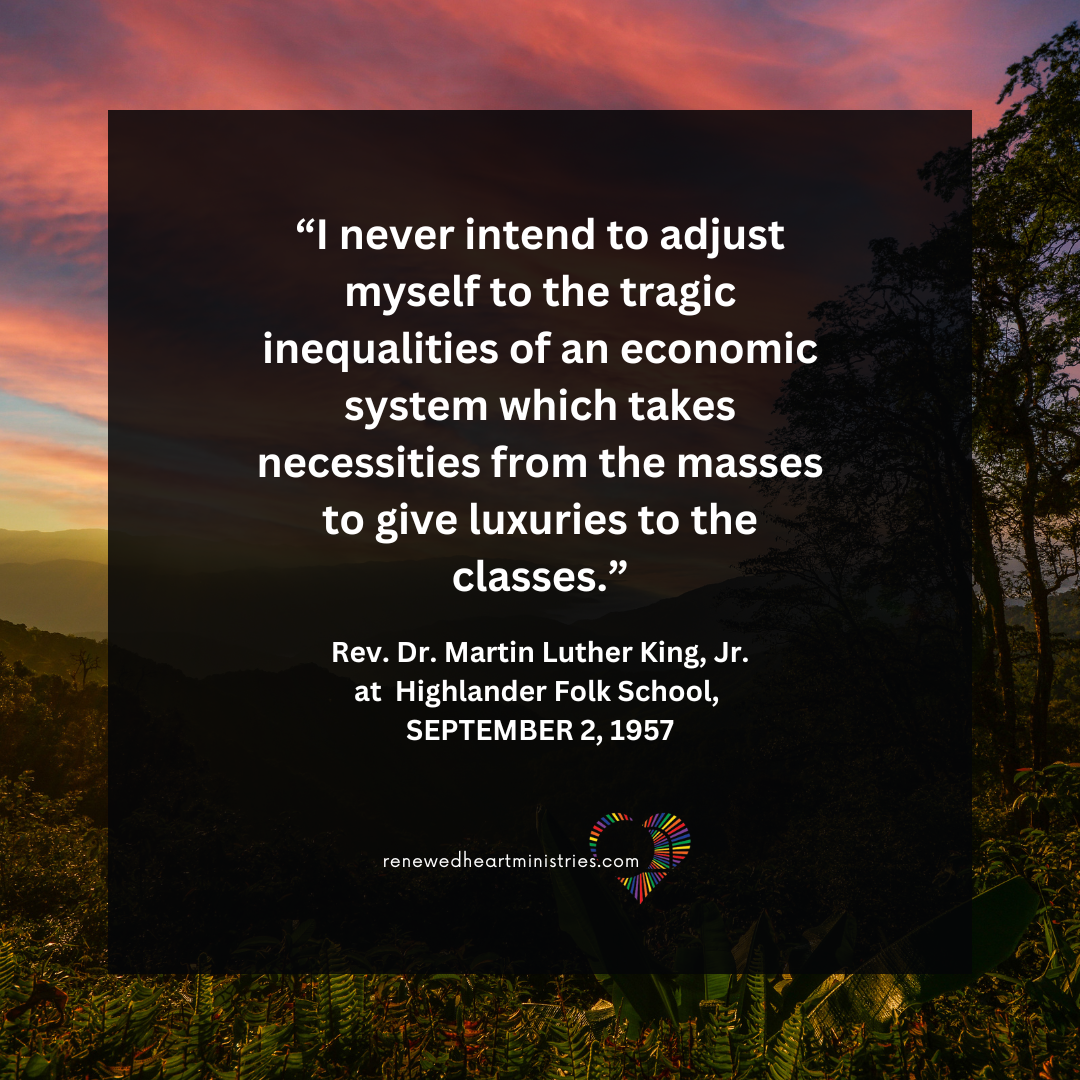
The author of Luke’s gospel takes this story from Jesus and applies another narrative lesson: “Make friends for yourselves by means of dishonest wealth so that when it is gone, they may welcome you into the eternal homes.” Again, I’m not convinced that housing was the steward’s goal in the story, butI can see how it could have been the point of Luke’s gospel. Using wealth created by taking “necessities from the masses to give luxury to the classes” and then using that wealth to create relationships for the kingdom would fit the tactics of the early Jesus movement. This is one of the central themes of the book of Luke as well as its companion book of Acts: 

Sell your possessions, and give them to the poor. Make purses for yourselves that do not wear out, an unfailing treasure in heaven, where no thief comes near and no moth destroys. For where your treasure is, there your heart will be also. (Luke 12:33-34)

All who believed were together and had all things in common; they would sell their possessions and goods and distribute the proceeds to all, as any had need. (Acts 2:44-45)

There was not a needy person among them, for as many as owned lands or houses sold them and brought the proceeds of what was sold. They laid it at the apostles’ feet, and it was distributed to each as any had need. (Acts 4:34-35)

The early Jesus movement built community through what was called ‘dishonest wealth.’ It was about forging bonds through shared resources and mutual aid. Even now, this parable whispers through time, urging us to transform the riches of the few into a wealth shared by all, to redistribute wealth not to the few, but for the good of all, and to create a robust common wealth rooted in compassionate, empathetic care for everyone’s needs.

Discussion Group Questions

1. Share something that spoke to you from this week’s podcast episode with your discussion group.

2. What “tools of the powerless” do you use in your own justice work today? Share and discuss with your group.

3. What can you do this week, big or small, to continue setting in motion the work of shaping our world into a safe, compassionate, just home for everyone? 

Thanks for checking in with us, today.

I want to say a special thank you to all of our supporters out there. And if you would like to join them in supporting Renewed Heart Ministries’ work you can do so by going to renewedheartministries.com and clicking donate. 

My latest book Finding Jesus: A Fundamentalist Preacher Discovers the Socio-Political and Economic Teachings of the Gospels is available now on Amazon in paperback, Kindle and also on Audible in audio book format.

As always, you can find Renewed Heart Ministries each week on Bluesky, Facebook, Instagram and Meta’s Threads. If you haven’t done so already, please follow us on your chosen social media platforms for our daily posts. 

Thank you for listening to The Social Jesus Podcast. If you enjoyed this podcast please take a moment to like and subscribe and if the podcast platform you’re using offers this option, please leave us a positive review. This helps others find our podcast as well.

If you’d like to reach us here at Renewed Heart Ministries through email, you can reach us at info@renewedheartministries.com.

Right where you are, keep living in love, choosing compassion, taking action, and working toward justice.

I love each of you dearly,

I’ll see you next week.


Season 3, Episode 26: Luke 16:1-13, Lectionary C, Proper 20

Just Talking is a weekly conversation centered on the upcoming weekend’s Gospel lectionary reading. Each discussion explores the text through the lenses of love, inclusion, and social justice.

Our hope is that these conversations will be more than just talking—they’ll be just talking, rooted in justice. And maybe, they’ll inspire you to go beyond just talking and into action.

Whether you preach from the lectionary or are simply curious about the Jesus story from a more progressive, justice-oriented perspective, we invite you to join us.

Herb Montgomery is speaker/director of Renewed Heart Ministries.

This week’s special guest is Alicia Johnston.

Watch at:


New Episode of The Social Jesus Podcast

A podcast where we talk about the intersection of faith and social justice and what a first century, prophet of the poor from Galilee might have to offer us today in our work of love, compassion and justice. 

This week:

Season 2 Episode 38: The Parable of the Dishonest Manager

Luke 16:1-13

“Our story this week is one that scholars have offered multiple interpretations of. They have spiritualized the story, taken it literally, and sought to apply the story to our context today, but most interpretation give me the feeling that something is being left on the table. One interpretation I find most convincing is by William Herzog in his classic book, Parables as Subversive Speech: Jesus as Pedagogue of the Oppressed. Herzog looks at various parables from the gospels through the lens of the Brazilian educator Paulo Freire’s work Pedagogy of the Oppressed. The early Jesus movement built community through what was called ‘dishonest wealth.’ It was about forging bonds through shared resources and mutual aid. Even now, this parable whispers through time, urging us to transform the riches of the few into a wealth shared by all, to redistribute wealth not to the few, but for the good of all, and to create a robust common wealth rooted in compassionate, empathetic care for everyone’s needs.”

Available on all major podcast carriers and at:

https://the-social-jesus-podcast.simplecast.com/episodes/the-parable-of-the-dishonest-manager



Finding Jesus: A Fundamentalist Preacher Discovers the Socio-Political & Economic Teachings of the Gospels.

 

by Herb Montgomery

Available now on Amazon!

In Finding Jesus, author Herb Montgomery delves into the profound and often overlooked political dimensions of the gospels. Through meticulous analysis of biblical texts, historical context, and social discourse, this thought-provoking book unveils the gospels’ socio-political, economic teachings as rooted in a profound concern for justice, compassion, and the well-being of the marginalized. The book navigates the intersections between faith and societal justice, presenting a compelling argument for a more socially engaged and transformative Christianity.

Finding Jesus is not just a scholarly exploration; it is a call to action. It challenges readers to reevaluate their understanding of Christianity’s role in public life and to consider how the radical teachings of the gospels can inspire a renewed commitment to justice, equality, and compassion. This book is a must-read for those seeking a deeper understanding of the social implications of Christian faith and a blueprint for building a more just and inclusive society.


Are you getting all of RHM’s Free Resources?

Free Sign Up Here
Hating One’s Family

We want to take a moment to express our heartfelt gratitude to each and every one of you who supports the work of Renewed Heart Ministries. Your generosity makes it possible for us to continue our mission of love, justice, and compassion—even in a time when ministries like ours are being called to do more with less.

Your support means the world to us. Whether we’re speaking into the broader society or engaging within our faith communities, we remain committed to advocating for a world that is inclusive, just, and safe for all. Your partnership helps keep that vision alive.

From all of us at Renewed Heart Ministries, thank you. We are so deeply grateful for you—and we couldn’t do this work without you.

If you’d like to join them in supporting our work, please go to renewedheartministries.com and click on “Donate.”  


Image created by Canva

Hating One’s Family

Herb Montgomery | September 6, 2025

If you’d like to listen to this week’s article in podcast version click on the image below:

Our reading this week is from the gospel of Luke:

Now large crowds were traveling with him; and he turned and said to them, “Whoever comes to me and does not hate father and mother, wife and children, brothers and sisters, yes, and even life itself, cannot be my disciple. Whoever does not carry the cross and follow me cannot be my disciple. For which of you, intending to build a tower, does not first sit down and estimate the cost, to see whether he has enough to complete it? Otherwise, when he has laid a foundation and is not able to finish, all who see it will begin to ridicule him, saying, ‘This fellow began to build and was not able to finish.’ Or what king, going out to wage war against another king, will not sit down first and consider whether he is able with ten thousand to oppose the one who comes against him with twenty thousand? If he cannot, then, while the other is still far away, he sends a delegation and asks for the terms of peace. So therefore, none of you can become my disciple if you do not give up all your possessions.” (Luke 14:25-33)

In my opinion, we would be hard-pressed to find a more dangerous passage in the gospels than the passage we’re reading this week. This passage has been used repeatedly to incite families to reject family members over religious differences. Someone in the family is an atheist? Shun them. Someone in the family believes differently? Label them as the bad apple. And God forbid, a child in an evangelical family realizes they are gay, lesbian, transgender, or bisexual? LGBTQ children in Christian families often face insurmountable challenges, particularly when their identities conflict with their family’s traditional religious beliefs. Many Christian faith communities subscribe to heteronormative values, heteronormative ways to interpret scriptures, and a heteronormative lens through which they navigate the world around them. Our reading this week, in this context, has led countless families to condemn and even reject their LGBTQ children. This rejection may come in the form of emotional distancing, forced conversion therapy, or even disowning, and such experiences can have devastating effects on a child’s mental health and lead to increased risks of depression, anxiety, and suicide. For LGBTQ youth, acceptance at home is crucial. When families choose love over exclusion, they create safe environments where their children can thrive, both in identity and faith. But when families choose to read this week’s passage in a way that affirms their biases and phobias, this passage becomes dangerous. 

I have experience with what I’m writing about this week. My own extended family has led group actions against me in my faith community because they view my alliance with LGBTQ folks as heretical. 

But Luke’s context is not choosing one’s religion or faith over loving and affirming a family member. The context is choosing justice and inclusion even when your privileged family rejects you for doing so. This passage is about times when standing up for those being rejected and shunned causes division from those who reject and shun others:

“I came to bring fire to the earth, and how I wish it were already kindled! I have a baptism with which to be baptized, and what stress I am under until it is completed! Do you think that I have come to bring peace to the earth? No, I tell you, but rather division! From now on five in one household will be divided, three against two and two against three; they will be divided:

father against son

and son against father,

mother against daughter

and daughter against mother,

mother-in-law against her daughter-in-law

and daughter-in-law against mother-in-law . . . ” (Luke 12:49-56, NRSV) 

These verses describe division but it’s the kind of division caused when someone is standing up for the vulnerable and marginalized and receive negative pushback as a result. The passage encourages standing up for justice, compassion and the wellbeing of all, even if that brings you into conflict with others you have a relationship with, and even if that relationship is family. (For more, read When Justice Means Division.)

Combine this lesson with the other theme in Luke’s gospel: that family means something very different in Jesus’ society than it has come to mean in ours. Long before our hyper-individualistic, self-reliant form of capitalism, Jesus’ society had an economic system that revolved around the family. This is one reason why widows and fatherless children were so vulnerable to harm: in a patriarchal system, their economic survival depended on them being part of a family and the mutual resource sharing that their family represented (see Lamentations 5:3 and Caring for Those Outside the Tribe).

Luke 14 isn’t about hating family as we think about family today. It is about economics. Jesus wasn’t against family, but was critiquing the economic system of his day. Jesus called his followers away from the family-based economic system that harmed widows and fatherless children who had lost their patriarch, and pointed them to a community-based economic system rooted in access and acceptance, one where social safety nets took care of all in need whether they were family or not. In our passage this week, Jesus is calling his listeners to value their commitment to justice, inclusion, and equity above their commitment to their system of economic survival through family.

In Ched Myers’ book Binding the Strong Man: A Political Reading of Mark’s Story of Jesus, Myers writes, “Among members of a family, goods and services were freely given (full reciprocity)” (p. 48). Members of a clan or family would often give each other help, care, and gifts, but they also balanced giving with  receiving. Members balanced reciprocity: receiving help and being expected to serve the family’s needs as well. In our reading this week, Jesus is calling his audience to stand with justice even when that stance potentially jeopardizes their connection to a family that is powerful, propertied, and privileged.

What I wish our reading this week did not include is the word “hate.” Jesus declares, “If anyone comes to me and does not hate father and mother, wife and children, brothers and sisters—yes, even their own life—such a person cannot be my disciple.” At first glance, this statement is shocking and appears contradictory to Jesus’ message of love and parental honor. However, many Biblical scholars and theologians interpret the phrase not as a literal command to hate, but as a Semitic expression of comparison.

In the cultural and linguistic context of the time, the word “hate” was often used hyperbolically to emphasize preference or priority, not emotional hostility. Jesus is making a radical claim: that loyalty to social justice must come before all other allegiances including the closest of human relationships, especially if those relationships offer us a level of privilege. It’s a call to total commitment where discipleship demands putting justice, love, compassion, and equity above every other cherished bond.

This teaching reflects the high cost of following Jesus’ vision for a safe, compassionate, just home for everyone in a world opposed to such. Jesus often warned that discipleship would divide families (cf. Luke 12:49-59), not because of hatred, but because devotion to him and his vision of a just society could lead to social and relational conflict. The “hatred” that Jesus references is therefore symbolic: it represents willingness to forsake all for the sake of the gospel.

Ultimately, the phrase challenges those on the side of justice to evaluate their priorities and confront the cost of true discipleship. It is not about rejecting family, but radically reordering love and loyalty and making justice, equity, compassion, and safety for all the supreme focus. In this light, the phrase becomes a powerful statement of commitment to a more just world in the face of potential rejection by a family upon whom our survival depends. It’s not a statement of cruelty or a call to reject family members if they don’t align with our religious beliefs. This difference may seem subtle, but it makes a world of difference in the work of justice. 

Discussion Group Questions

1. Share something that spoke to you from this week’s podcast episode with your discussion group.

2. In what ways have you chosen to prioritize justice in your own life? Share and discuss with your group.

3. What can you do this week, big or small, to continue setting in motion the work of shaping our world into a safe, compassionate, just home for everyone? 

Thanks for checking in with us, today.

I want to say a special thank you to all of our supporters out there. And if you would like to join them in supporting Renewed Heart Ministries’ work you can do so by going to renewedheartministries.com and clicking donate. 

My latest book Finding Jesus: A Fundamentalist Preacher Discovers the Socio-Political and Economic Teachings of the Gospels is available now on Amazon in paperback, Kindle and also on Audible in audio book format.

As always, you can find Renewed Heart Ministries each week on Bluesky, Facebook, Instagram and Meta’s Threads. If you haven’t done so already, please follow us on your chosen social media platforms for our daily posts. 

Thank you for listening to The Social Jesus Podcast. If you enjoyed this podcast please take a moment to like and subscribe and if the podcast platform you’re using offers this option, please leave us a positive review. This helps others find our podcast as well.

You can watch our YouTube show each week called “Just Talking”. Each week, Todd Leonard and I take a moment to talk about the gospel lectionary reading for the upcoming weekend. We’ll be talking about each reading in the context of love, inclusion, and social justice. Our hope is that our talking will be just talking (as in justice) and that during our brief conversations each week you’ll be inspired to also do more than just talking. If you teach from the lectionary each week, or if you’re just looking for some thoughts on the Jesus story from a more progressive perspective within the context of social justice, check it out, you might like it. You can find JustTalking each week on YouTube at youtube.com/@herbandtoddjusttalking.

Please Like, Subscribe, hit the Notification button, and leave us a comment.

And if you’d like to reach us here at Renewed Heart Ministries through email, you can reach us at info@renewedheartministries.com.

Right where you are, keep living in love, choosing compassion, taking action, and working toward justice.

I love each of you dearly,

I’ll see you next week.


New Episode of The Social Jesus Podcast

A podcast where we talk about the intersection of faith and social justice and what a first century, prophet of the poor from Galilee might have to offer us today in our work of love, compassion and justice. 

This week:

Season 2 Episode 36: Hating One’s Family

Luke 14:25-33

“Luke’s context is not choosing one’s religion or faith over loving and affirming a family member. The context is choosing justice and inclusion even when your privileged family rejects you for doing so. This passage is about times when standing up for those being rejected and shunned causes division from those who reject and shun others. Jesus often warned that discipleship would divide families (cf. Luke 12:49-59), not because of hatred, but because devotion to him and his vision of a just society could lead to social and relational conflict. The “hatred” that Jesus references is therefore symbolic: it represents willingness to forsake all for the sake of a more just, present world. Ultimately, the phrase challenges those on the side of justice to evaluate their priorities and confront the cost of true discipleship. It is not about rejecting family, but radically reordering love and loyalty and making justice, equity, compassion, and safety for all the supreme focus. In this light, this hyperbolic phrase becomes a powerful statement of commitment to a more just world in the face of potential rejection by a family upon whom our survival depends. It’s not a statement of cruelty or a call to reject family members if they don’t align with our religious beliefs. This difference may seem subtle, but it makes a world of difference in the work of justice.”

Available on all major podcast carriers and at:

https://the-social-jesus-podcast.simplecast.com/episodes/hating-ones-family


Finding Jesus: A Fundamentalist Preacher Discovers the Socio-Political & Economic Teachings of the Gospels.


by Herb Montgomery

Available now on Amazon!

In Finding Jesus, author Herb Montgomery delves into the profound and often overlooked political dimensions of the gospels. Through meticulous analysis of biblical texts, historical context, and social discourse, this thought-provoking book unveils the gospels’ socio-political, economic teachings as rooted in a profound concern for justice, compassion, and the well-being of the marginalized. The book navigates the intersections between faith and societal justice, presenting a compelling argument for a more socially engaged and transformative Christianity.

Finding Jesus is not just a scholarly exploration; it is a call to action. It challenges readers to reevaluate their understanding of Christianity’s role in public life and to consider how the radical teachings of the gospels can inspire a renewed commitment to justice, equality, and compassion. This book is a must-read for those seeking a deeper understanding of the social implications of Christian faith and a blueprint for building a more just and inclusive society.


Are you getting all of RHM’s Free Resources?

Free Sign Up Here

Bending Our World’s Arc Toward Justice

We want to take a moment to express our heartfelt gratitude to each and every one of you who supports the work of Renewed Heart Ministries. Your generosity makes it possible for us to continue our mission of love, justice, and compassion—even in a time when ministries like ours are being called to do more with less.

Your support means the world to us. Whether we’re speaking into the broader society or engaging within our faith communities, we remain committed to advocating for a world that is inclusive, just, and safe for all. Your partnership helps keep that vision alive.

From all of us at Renewed Heart Ministries, thank you. We are so deeply grateful for you—and we couldn’t do this work without you.

If you’d like to join them in supporting our work, please go to renewedheartministries.com and click on “Donate.”  


Image created by Canva

Bending Our World’s Arc Toward Justice

Herb Montgomery | August 8, 2025

If you’d like to listen to this week’s article in podcast version click on the image below:

Our reading this week is from the gospel of Luke:

“Do not be afraid, little flock, for it is your Father’s good pleasure to give you the kingdom. Sell your possessions, and give alms. Make purses for yourselves that do not wear out, an unfailing treasure in heaven, where no thief comes near and no moth destroys. For where your treasure is, there your heart will be also.

Be dressed for action and have your lamps lit; be like those who are waiting for their master to return from the wedding banquet, so that they may open the door for him as soon as he comes and knocks. Blessed are those slaves whom the master finds alert when he comes; truly I tell you, he will fasten his belt and have them sit down to eat, and he will come and serve them. If he comes during the middle of the night, or near dawn, and finds them so, blessed are those slaves.

But know this: if the owner of the house had known at what hour the thief was coming, he would not have let his house be broken into. You also must be ready, for the Son of Man is coming at an unexpected hour.” (Luke 12:32-40, NRSV)

Luke 12 is one of my favorite chapters in the gospels. It spells out how Luke understood Jesus’ economic vision for a human society under the reign of God. It’s a world where everyone has enough to thrive and no one is hoarding more than they need while others have needs that their community is not meeting. The original audiences would have thought of the Torah’s stories of the ancient Israelites receiving enough manna each day in the wilderness. 

This passage begins with the pleasure of God in creating a society like this and inviting each of us into it. Then we encounter its economic foundation. People that have more than they need will sell their superfluous possessions—in this context, farm lands stolen through predatory debt and default—and give to those their economic system had plunged into poverty. The word the NRSV uses for what they should give is “alms.” Alms used to mean money or food given to poor people. Jesus here is describing a community of resource-sharing, giving, and a commitment to making sure everyone is taken care of. It’s a community founded on a more just distribution of the wealth that had been created by the unjust economic system they already had. Scholar James Robinson describes it in his book The Gospel of Jesus: In Search of the Original Good News. We read from this book last week:

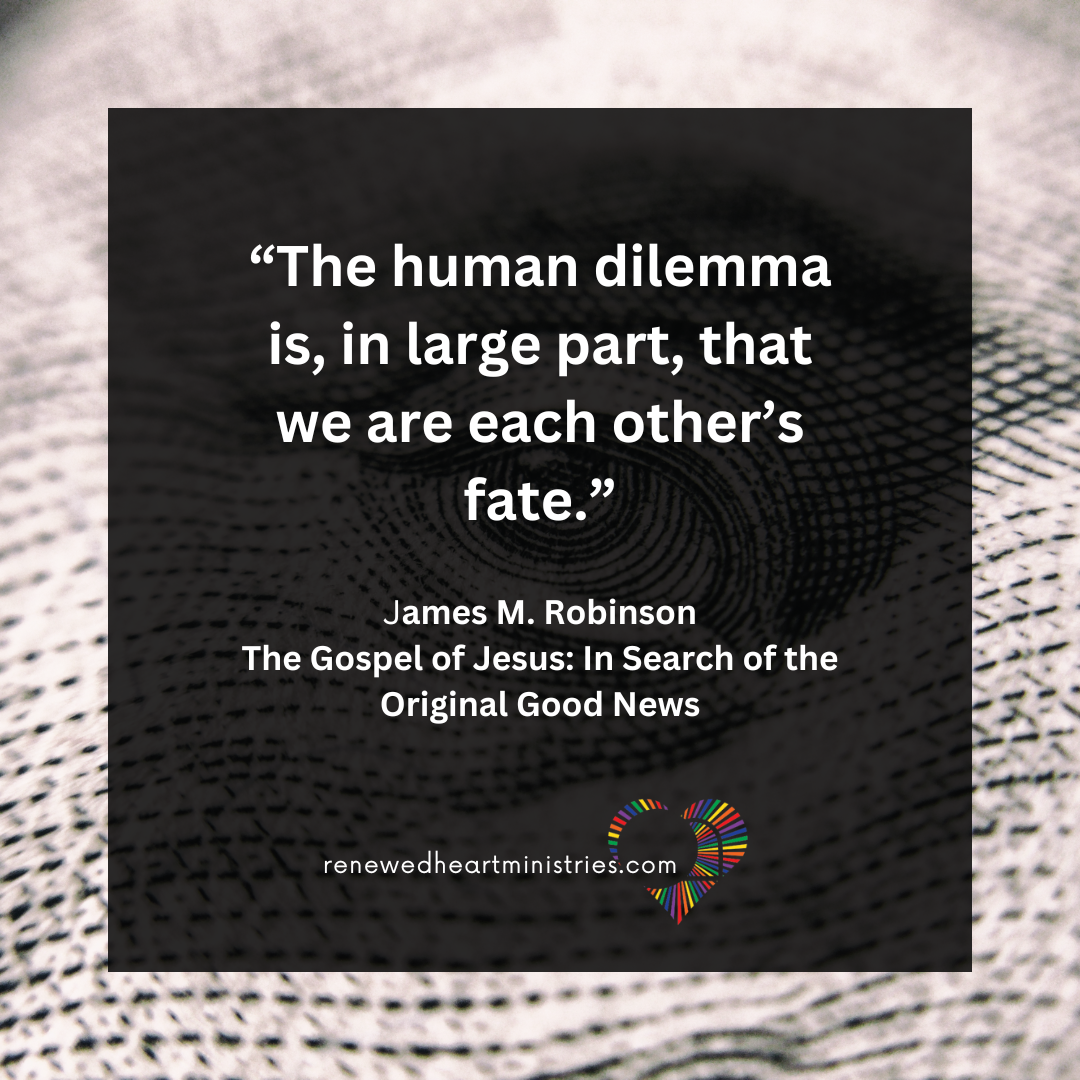
“The human dilemma is, in large part, that we are each other’s fate. We become the tool of evil that ruins another person as we look out for ourselves, having long abandoned any youthful idealism we might once have cherished. But if we each would cease and desist from pushing the other down to keep ourselves up, then the vicious cycle would be broken. Society would become mutually supportive rather than self-destructive. This is what Jesus was up to. Jesus’ message was simple, for he wanted to cut straight through to the point: trust God to look out for you by providing people who will care for you, and listen to him when he calls on you to provide for them. God is somebody you can trust, so give it a try.” (James M. Robinson, The Gospel of Jesus: In Search of the Original Good News, Kindle Edition Loc. 58) 

On the next page Robinson continues:

“Put in language derived from his sayings: I am hungry because you hoard food. You are cold because I hoard clothing. Our dilemma is that we all hoard supplies in our backpacks and put our trust in our wallets! Such ‘security”’ should be replaced by God reigning, which means both what I trust God to do (to activate you to share food with me) and what I hear God telling me to do (to share clothes with you). We should not carry money while bypassing the poor or wear a backpack with extra clothes and food while ignoring the cold and hungry lying in the gutter. This is why the beggars, the hungry, the depressed are fortunate: God, that is, those in whom God rules, those who hearken to God, will care for them. The needy are called upon to trust that God’s reigning is there for them (‘Theirs is the kingdom of God”’).” (James M. Robinson, The Gospel of Jesus: In Search of the Original Good News, Kindle Edition. Loc 71)

The early Jesus followers grasped these gospel truths and sought to put them into practice:

All the believers were together and had everything in common. They sold property and possessions to give to anyone who had need. (Acts 2:44-45)

With great power the apostles continued to testify to the resurrection of the Lord Jesus. And God’s grace was so powerfully at work in them all that there were no needy persons among them. For from time to time those who owned land or houses sold them, brought the money from the sales and put it at the apostles’ feet, and it was distributed to anyone who had need. (Acts 4:33-35)  

Next, Luke’s Jesus shares a story about expectation and preparedness in the context of the  unjust and unjustifiable practice of slavery. The original audience would have heard this story as being about restoring the reign of God, God’s just future. Today many sectors of Christians typically interpret this passage about Jesus’ second advent . But the original audience for this story would have heard this story through a different filter.

The Hebrew prophets spoke of their God as having abandoned the people as a result of societal abuses and injustices toward  vulnerable people. 

“I will forsake my house, abandon my inheritance; I will give the one I love into the hands of her enemies.” (Jeremiah 12:7)

But if their society would return to justice, their God would also return to them and their temple:

“I will send my messenger, who will prepare the way before me. Then suddenly the Lord you are seeking will come to his temple; the messenger of the covenant, whom you desire, will come,” says the LORD Almighty. (Malachi 3:1)

The underlying theme of Jesus’ story in our reading is that the coming of the kingdom, Jesus’ vision for human community, could come at any moment, so stay ready. This reminds me of the clarion call often given today to “stay woke.” Don’t allow yourself to be acculturated to injustice. Don’t let yourself become desensitized to the suffering of those being presently harmed. Don’t let inequity, corruption, and brutality become normalized. 

It is interesting to me that both last week’s and this week’s readings have us praying for and being prepared for the kingdom to arrive at some unexpected time in the future. This week’s reading also uses the figure of the Son of Man. The Son of Man was a liberating agent from imperial injustice, oppression, and violence in the apocalyptic chapter of Daniel 7. Calling us to look for these events in the future is a change in the Jesus story from those passages where Jesus announces that the kingdom had arrived or that the time had come. 

Given that Luke was most likely written not only after Jesus’ crucifixion but also after the Romans razed the temple in Jerusalem in 70 C.E., it would be much easier to call people to be ready for the kingdom. It would be much easier to tell them that it was still coming than that it had already arrived. Honestly, 2,000 years later, not much about that has changed. But I’m reminded of Dr. Martin Luther King’s vision of the moral universe as a long arc bending toward justice. We must also remember that the arc doesn’t bend toward justice automatically. If the universe’s arc is going to bend toward justice, we’re going to have to bend it that way. And that may explain the change in the gospels’ language: the people were still in the ashes of imperial violence with Jesus’ execution and Jerusalem’s destruction. 

That famous arc of justice requires deliberate and courageous efforts from those who choose to stand on the side of equity, compassion, and truth. Choosing to bend that arc toward justice is an act of hope, and also one of resistance. It means refusing to accept the world as it is and daring to imagine a world as it could be—a world where all people are treated with dignity, where systems serve the vulnerable, and where peace is rooted in justice or fairness.

This choice is not always easy. Especially right now, when we are witnessing so many caving to injustice and bowing the knee for expediency. Choosing justice may cost us comfort, popularity, or privilege. But it is a path that gives life deeper meaning. It invites us to be co-creators of a more just and loving society. Whether we are advocating for racial equity, economic fairness, gender and LGBTQ inclusion, or environmental stewardship, each small act of justice matters. Every word spoken, every protest joined, every policy challenged adds weight to the arc’s bend. History honors those who didn’t wait for justice to arrive, but who helped carry it forward. That choice—to act—is always ours. 

Discussion Group Questions

1. Share something that spoke to you from this week’s podcast episode with your discussion group.

2. How do you choose to bend our universe’s moral arc toward justice in your own life? Share and discuss with your group.

3. What can you do this week, big or small, to continue setting in motion the work of shaping our world into a safe, compassionate, just home for everyone? 

Thanks for checking in with us, today.

I want to say a special thank you to all of our supporters out there. And if you would like to join them in supporting Renewed Heart Ministries’ work you can do so by going to renewedheartministries.com and clicking donate. 

My latest book Finding Jesus: A Fundamentalist Preacher Discovers the Socio-Political and Economic Teachings of the Gospels is available now on Amazon in paperback, Kindle and also on Audible in audio book format.

As always, you can find Renewed Heart Ministries each week on Bluesky, Facebook, Instagram and Meta’s Threads. If you haven’t done so already, please follow us on your chosen social media platforms for our daily posts. 

Thank you for listening to The Social Jesus Podcast. If you enjoyed this podcast please take a moment to like and subscribe and if the podcast platform you’re using offers this option, please leave us a positive review. This helps others find our podcast as well.

You can watch our YouTube show each week called “Just Talking”. Each week, Todd Leonard and I take a moment to talk about the gospel lectionary reading for the upcoming weekend. We’ll be talking about each reading in the context of love, inclusion, and social justice. Our hope is that our talking will be just talking (as in justice) and that during our brief conversations each week you’ll be inspired to also do more than just talking. If you teach from the lectionary each week, or if you’re just looking for some thoughts on the Jesus story from a more progressive perspective within the context of social justice, check it out, you might like it. You can find JustTalking each week on YouTube at youtube.com/@herbandtoddjusttalking.

Please Like, Subscribe, hit the Notification button, and leave us a comment.

And if you’d like to reach us here at Renewed Heart Ministries through email, you can reach us at info@renewedheartministries.com.

Right where you are, keep living in love, choosing compassion, taking action, and working toward justice.

I love each of you dearly,

I’ll see you next week.


New Episode of “Just Talking” Now Online!

Lectionary Readings in the context of Love, Inclusion, & Social Justice

Season 3, Episode 23: Luke 12.32-40. Lectionary C, Proper 14

Bending Our World’s Moral Arc Toward Justice

Each week, we’ll discuss the gospel lectionary reading for the upcoming weekend in the context of love, inclusion, and justice. We hope that our talking will be “just” talking (as in justice) and that we’ll be inspired to do more than “just talking” during our brief conversations each week. 

If you teach from the lectionary each week, or if you’re just looking for some thoughts on the Jesus story from a more progressive perspective within the context of social justice, check it out.


New Episode of The Social Jesus Podcast

A podcast where we talk about the intersection of faith and social justice and what a first century, prophet of the poor from Galilee might have to offer us today in our work of love, compassion and justice. 

This week:

Season 2 Episode 32: Bending Our World’s Moral Arc Toward Justice

Luke 12:32-40

“That famous arc of justice requires deliberate and courageous efforts from those who choose to stand on the side of equity, compassion, and truth. Choosing to bend that arc toward justice is an act of hope, and also one of resistance. It means refusing to accept the world as it is and daring to imagine a world as it could be—a world where all people are treated with dignity, where systems serve the vulnerable, and where peace is rooted in justice or fairness.This choice is not always easy. Especially right now, when we are witnessing so many caving to injustice and bowing the knee for expediency. Choosing justice may cost us comfort, popularity, or privilege. But it is a path that gives life deeper meaning. It invites us to be co-creators of a more just and loving society. Whether we are advocating for racial equity, economic fairness, gender and LGBTQ inclusion, or environmental stewardship, each small act of justice matters. Every word spoken, every protest joined, every policy challenged adds weight to the arc’s bend. History honors those who didn’t wait for justice to arrive, but who helped carry it forward. That choice—to act—is always ours.”

Available on all major podcast carriers and at:

https://the-social-jesus-podcast.simplecast.com/episodes/bending-our-worlds-moral-arc-toward-justice


Finding Jesus: A Fundamentalist Preacher Discovers the Socio-Political & Economic Teachings of the Gospels.


by Herb Montgomery

Available now on Amazon!

In Finding Jesus, author Herb Montgomery delves into the profound and often overlooked political dimensions of the gospels. Through meticulous analysis of biblical texts, historical context, and social discourse, this thought-provoking book unveils the gospels’ socio-political, economic teachings as rooted in a profound concern for justice, compassion, and the well-being of the marginalized. The book navigates the intersections between faith and societal justice, presenting a compelling argument for a more socially engaged and transformative Christianity.

Finding Jesus is not just a scholarly exploration; it is a call to action. It challenges readers to reevaluate their understanding of Christianity’s role in public life and to consider how the radical teachings of the gospels can inspire a renewed commitment to justice, equality, and compassion. This book is a must-read for those seeking a deeper understanding of the social implications of Christian faith and a blueprint for building a more just and inclusive society.


Are you getting all of RHM’s Free Resources?

Free Sign Up Here
The Moral Dilemma and Challenge of Wealth

We want to take this moment to express our heartfelt gratitude to all of our supporters for your support of Renewed Heart Ministry’s work of love, justice, and compassion. At a time when ministries like ours are being asked to achieve more with fewer resources, your support is so deeply appreciated, and we want to simply say thank you. Whether in our larger society or within our local faith communities, Renewed Heart Ministries remains committed to advocating for change, working towards a world that is inclusive, just, and safe for everyone, and being a source of love. From all of us here at Renewed Heart Ministries, thank you for your generous support.

We deeply appreciate you.

If you’d like to join them in supporting our work, please go to renewedheartministries.com and click on “Donate.”  


Image created by Canva

The Moral Dilemma and Challenge of Wealth

Herb Montgomery | August 1, 2025

If you’d like to listen to this week’s article in podcast version click on the image below:

Our reading this week is from the gospel of Luke:

Someone in the crowd said to him, “Teacher, tell my brother to divide the inheritance with me.”

Jesus replied, “Man, who appointed me a judge or an arbiter between you?” Then he said to them, “Watch out! Be on your guard against all kinds of greed; life does not consist in an abundance of possessions.”

And he told them this parable: “The ground of a certain rich man yielded an abundant harvest. He thought to himself, ‘What shall I do? I have no place to store my crops.’ “Then he said, ‘This is what I’ll do. I will tear down my barns and build bigger ones, and there I will store my surplus grain. And I’ll say to myself, “You have plenty of grain laid up for many years. Take life easy; eat, drink and be merry.” ’ “But God said to him, ‘You fool! This very night your life will be demanded from you. Then who will get what you have prepared for yourself?’

“This is how it will be with whoever stores up things for themselves but is not rich toward God.” (Luke 12:13-21)

In this passage, social location matters. Inheritance was an argument for the wealthy elites, and in Jesus’ time there was no middle class. There were wealthy elites and the poor. And in the gospel stories, Jesus emerged in Galilee as a prophet of the poor.

Consider how each synoptic gospel connects Jesus not to the wealthy but to the poor. 

Jesus looked at him and loved him. “One thing you lack,” he said. “Go, sell everything you have and give to the poor . . . (Mark 10:21)

Calling his disciples to him, Jesus said, “Truly I tell you, this poor widow has put more into the treasury than all the others. (Mark 12:43)

“Blessed are the poor in spirit,

for theirs is the kingdom of heaven. (Matthew 5:3)

the good news is proclaimed to the poor. (Matthew 11:5)

Jesus answered, “If you want to be perfect, go, sell your possessions and give to the poor . . . (Matthew 19:21)

“The Spirit of the Lord is on me,

because he has anointed me 

to proclaim good news to the poor (Luke 4:18)

Looking at his disciples, he said:

  “Blessed are you who are poor,

for yours is the kingdom of God. (Luke 6:20)

So he replied to the messengers, “Go back and report to John what you have seen and heard: The good news is proclaimed to the poor. (Luke 7:22)

But now as for what is inside you—be generous to the poor, and everything will be clean for you. (Luke 11:41)

Sell your possessions and give to the poor (Luke 12:33)

But when you give a banquet, invite the poor (Luke 14:13)

When Jesus heard this, he said to him, “You still lack one thing. Sell everything you have and give to the poor (Luke 18:22)

But Zacchaeus stood up and said to the Lord, “Look, Lord! Here and now I give half of my possessions to the poor . . . Today salvation has come to this house (Luke 19:8-9)

He also saw a poor widow put in two very small copper coins. “Truly I tell you,” he said, “this poor widow has put in more than all the others. (Luke 21:2-3)

These texts place Jesus on the side of the poor. Jesus, as a  prophet of the poor, tells a story about the meaninglessness of hoarding wealth. To what end was all this man’s wealth hoarded? James Robertson, commenting on Jesus’ teaching of wealth redistribution and resource sharing, writes:

“The human dilemma is, in large part, that we are each other’s fate. We become the tool of evil that ruins another person as we look out for ourselves, having long abandoned any youthful idealism we might once have cherished. But if we each would cease and desist from pushing the other down to keep ourselves up, then the vicious cycle would be broken. Society would become mutually supportive rather than self-destructive. This is what Jesus was up to. Jesus’ message was simple, for he wanted to cut straight through to the point: trust God to look out for you by providing people who will care for you, and listen to him when he calls on you to provide for them. God is somebody you can trust, so give it a try.” (James M. Robinson, The Gospel of Jesus: In Search of the Original Good News, Kindle Edition Loc. 58) 

Robinson continues:

“Put in language derived from his sayings: I am hungry because you hoard food. You are cold because I hoard clothing. Our dilemma is that we all hoard supplies in our backpacks and put our trust in our wallets! Such ‘security’ should be replaced by God reigning, which means both what I trust God to do (to activate you to share food with me) and what I hear God telling me to do (to share clothes with you). We should not carry money while bypassing the poor or wear a backpack with extra clothes and food while ignoring the cold and hungry lying in the gutter. This is why the beggars, the hungry, the depressed are fortunate: God, that is, those in whom God rules, those who hearken to God, will care for them. The needy are called upon to trust that God’s reigning is there for them (‘Theirs is the kingdom of God”’).” (James M. Robinson, The Gospel of Jesus: In Search of the Original Good News, Kindle Edition. Loc 71)

These words give us much to think about. Robinson evaluates Jesus’ teachings by what happens in the early church when Christians tried to put them into practice. Notice the result: “There were no needy persons among them.” The early Jesus movement had accomplished the goal of these ancient stories: they eliminated poverty in their midst.

“All the believers were one in heart and mind. No one claimed that any of their possessions was their own, but they shared everything they had. With great power the apostles continued to testify to the resurrection of the Lord Jesus. And God’s grace was so powerfully at work in them all that there were no needy persons among them. For from time to time those who owned land or houses sold them, brought the money from the sales and put it at the apostles’ feet, and it was distributed to anyone who had need.” (Acts 4:32-35)

Over and over again in the gospels, Jesus places hoarding one’s wealth in tension  with sharing it with others:

“No one can serve two masters. Either you will hate the one and love the other, or you will be devoted to the one and despise the other. You cannot serve both God and money. (Matthew 6:24)

“No one can serve two masters. Either you will hate the one and love the other, or you will be devoted to the one and despise the other. You cannot serve both God and money.” (Luke 16:13)

Being “rich toward God” doesn’t mean giving all your money to religious institutions. It means using your means to mitigate the suffering of the others with whom we share this world as our home. We live in a system today that creates both wealth and poverty. As that economic system continues, the gap between the two classes continues to expand. Wealth, when viewed through the lens of compassion and responsibility, can be very powerfully shared for advancing human dignity and well-being. In a world where inequality continues to deepen and many struggle to meet basic needs, those who have access to financial resources are uniquely called to be agents of healing and justice. Using wealth to help others is not just an act of charity—it is a moral imperative that affirms our shared humanity.

At its best, wealth can serve as a bridge between abundance and need. It can fund education for children who might otherwise go without schooling, provide clean water for communities where it is scarce, support healthcare systems, build affordable housing, and sustain efforts to address climate change and systemic poverty. These are not merely abstract goals; they represent real lives changed, futures made possible, and hope restored.

And using wealth for the good of others requires more than good intentions—it also calls for intentionality, humility, and equity. True generosity listens before it gives. It involves understanding the needs of communities rather than imposing one-size-fits-all solutions. It resists the temptation to give in ways that perpetuate or preserve power imbalances. Instead, it seeks to empower, to lift up, and to restore dignity.

Faith traditions, moral philosophies, and humanitarian values all speak to the sacred responsibility that comes with wealth. Jesus taught that to love one’s neighbor means to meet their needs—not out of guilt, or duty, but out of genuine care. The Hebrew prophets cried out for justice, not just charity. Across cultures, the wise and ethical have consistently called upon those with means to see their wealth not as an end in itself, but as a resource for the greater good.

In practical terms, this might mean supporting local organizations doing transformative work, investing in sustainable enterprises that uplift communities, or simply being present and generous in the lives of neighbors, friends, and strangers. It also includes advocating for fairer systems that redistribute opportunity and reduce barriers.

In the end, wealth is not measured by how much we can accumulate, but by how much good it enables in our lives and others’. This is what it may mean to be rich toward God. It means being rich toward our fellow humans. When we use what we have to love, to serve, and to repair the world around us, we step into a deeper purpose—one that honors both the giver and the receiver.

Discussion Group Questions

1. Share something that spoke to you from this week’s podcast episode with your discussion group.

2. What would sharing wealth rather than hoarding wealth look like in our society today? Share and discuss with your group.

3. What can you do this week, big or small, to continue setting in motion the work of shaping our world into a safe, compassionate, just home for everyone? 

Thanks for checking in with us, today.

I want to say a special thank you to all of our supporters out there. And if you would like to join them in supporting Renewed Heart Ministries’ work you can do so by going to renewedheartministries.com and clicking donate. 

My latest book Finding Jesus: A Fundamentalist Preacher Discovers the Socio-Political and Economic Teachings of the Gospels is available now on Amazon in paperback, Kindle and also on Audible in audio book format.

As always, you can find Renewed Heart Ministries each week on Bluesky, Facebook, Instagram and Meta’s Threads. If you haven’t done so already, please follow us on your chosen social media platforms for our daily posts. 

Thank you for listening to The Social Jesus Podcast. If you enjoyed this podcast please take a moment to like and subscribe and if the podcast platform you’re using offers this option, please leave us a positive review. This helps others find our podcast as well.

You can watch our YouTube show each week called “Just Talking”. Each week, Todd Leonard and I take a moment to talk about the gospel lectionary reading for the upcoming weekend. We’ll be talking about each reading in the context of love, inclusion, and social justice. Our hope is that our talking will be just talking (as in justice) and that during our brief conversations each week you’ll be inspired to also do more than just talking. If you teach from the lectionary each week, or if you’re just looking for some thoughts on the Jesus story from a more progressive perspective within the context of social justice, check it out, you might like it. You can find JustTalking each week on YouTube at youtube.com/@herbandtoddjusttalking.

Please Like, Subscribe, hit the Notification button, and leave us a comment.

And if you’d like to reach us here at Renewed Heart Ministries through email, you can reach us at info@renewedheartministries.com.

Right where you are, keep living in love, choosing compassion, taking action, and working toward justice.

I love each of you dearly,

I’ll see you next week.


New Episode of “Just Talking” Now Online!

Lectionary Readings in the context of Love, Inclusion, & Social Justice

Season 3, Episode 22: Luke 12.13-21. Lectionary C, Proper 13

The Moral Dilemma and Challenge of Wealth

Each week, we’ll discuss the gospel lectionary reading for the upcoming weekend in the context of love, inclusion, and justice. We hope that our talking will be “just” talking (as in justice) and that we’ll be inspired to do more than “just talking” during our brief conversations each week. 

If you teach from the lectionary each week, or if you’re just looking for some thoughts on the Jesus story from a more progressive perspective within the context of social justice, check it out.


New Episode of The Social Jesus Podcast

A podcast where we talk about the intersection of faith and social justice and what a first century, prophet of the poor from Galilee might have to offer us today in our work of love, compassion and justice. 

This week:

Season 2 Episode 31: The Moral Dilemma and Challenge of Wealth

Luke 12:13-21

“Faith traditions, moral philosophies, and humanitarian values all speak to the sacred responsibility that comes with wealth. Jesus taught that to love one’s neighbor means to meet their needs—not out of guilt, or duty, but out of genuine care. The Hebrew prophets cried out for justice, not just charity. Across cultures, the wise and ethical have consistently called upon those with means to see their wealth not as an end in itself, but as a resource for the greater good. In the end, wealth, especially gained in an economic system such as our present one, is not measured by how much we can accumulate, but by how much good it enables in our lives and others’. This is what it may mean to be rich toward God. It means being rich toward our fellow humans. When we use what we have to love, to serve, and to repair the world around us, we step into a deeper purpose—one that honors both the giver and the receiver.”

Available on all major podcast carriers and at:

https://the-social-jesus-podcast.simplecast.com/episodes/the-moral-dilemma-and-challenge-of-wealth


Finding Jesus: A Fundamentalist Preacher Discovers the Socio-Political & Economic Teachings of the Gospels.


by Herb Montgomery

Available now on Amazon!

In Finding Jesus, author Herb Montgomery delves into the profound and often overlooked political dimensions of the gospels. Through meticulous analysis of biblical texts, historical context, and social discourse, this thought-provoking book unveils the gospels’ socio-political, economic teachings as rooted in a profound concern for justice, compassion, and the well-being of the marginalized. The book navigates the intersections between faith and societal justice, presenting a compelling argument for a more socially engaged and transformative Christianity.

Finding Jesus is not just a scholarly exploration; it is a call to action. It challenges readers to reevaluate their understanding of Christianity’s role in public life and to consider how the radical teachings of the gospels can inspire a renewed commitment to justice, equality, and compassion. This book is a must-read for those seeking a deeper understanding of the social implications of Christian faith and a blueprint for building a more just and inclusive society.


Are you getting all of RHM’s Free Resources?

Free Sign Up Here

Peace Through Justice Doesn’t Need A War Horse

We want to take this moment to express our heartfelt gratitude to all of our supporters for your support of Renewed Heart Ministry’s work of love, justice, and compassion. At a time when ministries like ours are being asked to achieve more with fewer resources, your support is so deeply appreciated, and we want to simply say thank you. Whether in our larger society or within our local faith communities, Renewed Heart Ministries remains committed to advocating for change, working towards a world that is inclusive, just, and safe for everyone, and being a source of love. From all of us here at Renewed Heart Ministries, thank you for your generous support. We deeply appreciate you.

If you’d like to join them in supporting our work, please go to renewedheartministries.com and click on “Donate.”  


Image created by Canva

Peace Through Justice Doesn’t Need A War Horse

Herb Montgomery; April 11, 2025

If you’d like to listen to this week’s article in podcast version click on the image below:

Our reading this week is from the gospel of Luke:

After Jesus had said this, he went on ahead, going up to Jerusalem. As he approached Bethphage and Bethany at the hill called the Mount of Olives, he sent two of his disciples, saying to them, “Go to the village ahead of you, and as you enter it, you will find a colt tied there, which no one has ever ridden. Untie it and bring it here. If anyone asks you, ‘Why are you untying it?’ say, ‘The Lord needs it.’ ”

Those who were sent ahead went and found it just as he had told them. As they were untying the colt, its owners asked them, “Why are you untying the colt?”

They replied, “The Lord needs it.”

They brought it to Jesus, threw their cloaks on the colt and put Jesus on it. As he went along, people spread their cloaks on the road.

When he came near the place where the road goes down the Mount of Olives, the whole crowd of disciples began joyfully to praise God in loud voices for all the miracles they had seen:

“Blessed is the king who comes in the name of the Lord!” 

“Peace in heaven and glory in the highest!”

Some of the Pharisees in the crowd said to Jesus, “Teacher, rebuke your disciples!” “I tell you,” he replied, “if they keep quiet, the stones will cry out.” (Luke 19:28-40)

There are many ways to achieve social and political peace. The most popular means empire has used historically is military force. If your military might is great enough, you can keep the peace through the mere threat of reprisal. 

Jesus offered a different path to peace: peace born of distributive justice. Distributive justice is the fair allocation of resources, opportunities, and benefits within a society. It is fairness in the distribution of goods and services as well as the burdens of the work it takes to create those goods and services. Distributive justice takes into account each individual’s needs and contributions, and seeks to balance both with the broader goals of social good and common thriving. When society experiences the fair and just distribution of rights and resources, peace is the result. 

This is the kind of peace envisioned by the Hebrew prophets: 

Everyone will sit under their own vine 

and under their own fig tree,

and no one will make them afraid,

for the LORD Almighty has spoken.  (Micah 4:4)

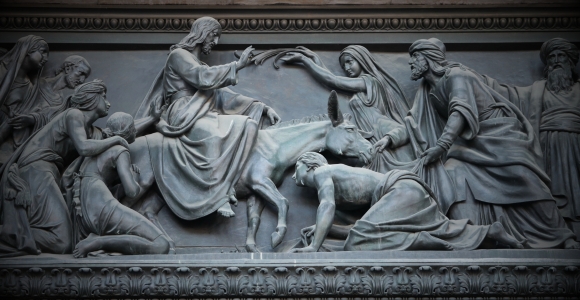
In the context of our reading this week, Rome practiced the kind of peace born instead out of military might and fear of reprisal after insurrection. When Rome would conquer a territory, the military general would enter the conquered city on a war stallion or steed, leading a military processional and sometimes even parading conquered soldiers in tow. 

But again, the Hebrew prophets envisioned a different kind of peace: peace that is born not through military might but by the spirit of justice. In Zechariah we read:

So he said to me, “This is the word of the LORD to Zerubbabel: ‘Not by might nor by power, but by my Spirit,’ says the LORD Almighty.” (Zechariah 4:6)

In chapter 9, Zechariah contrasts the typical military processional image with Jerusalem’s king bringing liberation and peace in such a way that military warhorses are not needed. This kind of peace isn’t rooted in military might at all.

But I will encamp at my temple 

to guard it against marauding forces.

Never again will an oppressor overrun my people,

for now I am keeping watch.

Rejoice greatly, Daughter Zion!

Shout, Daughter Jerusalem!

See, your king comes to you,

righteous and victorious,

lowly and riding on a donkey,

on a colt, the foal of a donkey.

I will take away the chariots from Ephraim 

and the warhorses from Jerusalem,

and the battle bow will be broken.

He will proclaim peace to the nations.

His rule will extend from sea to sea 

and from the River to the ends of the earth. (Zechariah 9:8-10)

The authors of the gospels, beginning with Mark and repeated by each successive canonical gospel afterward, pick up this imagery of peace through distributive justice from the Hebrew prophets. Each of them associates the peace of Jesus unlike the Pax Romana’s military might with the peace that comes through making sure everyone has enough to thrive. 

It is also interesting to note that our story this week begins Jesus’ entry into Jerusalem in Zechariah-like fashion in the Mount of Olives. Zechariah explains that the liberation that would come for Jerusalem would begin at the Mount of Olives:

Then the LORD will go out and fight against those nations, as he fights on a day of battle. On that day his feet will stand on the Mount of Olives, east of Jerusalem . . . (Zechariah 14:3-4)

In the years leading up to the Jewish Roman War in the late 60s C.E., the Mount of Olives was a wildly popular site of liberation rallies and starting location for insurrections against Rome because of those words in Zechariah. 

The gospel authors have Jesus begin his ride here to tie his entrance to the people’s hope of liberation. The gospel authors even include the liberation cry of the psalmist in Psalm 118:25-26:

“LORD, save us! [Hosanna] LORD, grant us success! [Hosanna] Blessed is he who comes in the name of the LORD. From the house of the LORD [the temple] we bless you.”

The authors of the gospels tap into all of this cultural liberation symbolism in our story this week. But Jesus’ peace and liberation will not come through Jesus leading a stronger military force against Rome’s military forces, but through the holistic and intrinsic work of a distributive justice so powerful, so pervasive, so stable, that it doesn’t require a war steed. It requires nothing more than a colt. 

Both Marcus Borg and John Dominic Crossan write of these contrasting paths to peace (military might versus distributive justice) in their classic volume The First Christmas. Concerning the futility of the kind of peace established through military violence they write:

“The terrible truth is that our world has never established peace through victory. Victory establishes not peace, but lull. Thereafter, violence returns once again, and always worse than before. And it is that escalator violence that then endangers our world.” (Marcus J.Borg and  John Dominic Crossan, The First Christmas: What the Gospels Really Teach About Jesus’s Birth, p. 166)

The kind of peace brought through military violence is temporary. The kind of peace that comes from everyone having what they need to thrive is lasting. This is why the Hebrew prophets also speak of this kind of peace lasting “forever”:

Of the greatness of his government and peace

there will be no end.

He will reign on David’s throne 

and over his kingdom,

establishing and upholding it 

with justice and righteousness

from that time on and forever. (Isaiah 9:7)

Where does this leave us today?

Today the way our global propertied, powerful and privileged elites seek to keep peace is through military might. But what if we sought a world where everyone had enough instead? What would that kind of global community look like? And if the global community is too large for us to try and imagine right now, let’s start closer. What would our local communities look like if each person simply had enough to thrive and we all were committed to making sure we were taking care of each other?

The late Pope John Paul II is just one example of so many who have called for this kind of peace in recent history. On the 1981 World Day for Peace, he stated, “Let us not await the peace of the balance of terror. Let us not accept violence as the way to peace. Let us instead begin by respecting true freedom: the resulting peace will be able to satisfy the world’s expectations; for it will be a peace built on justice, a peace founded on the incomparable dignity of the free human being.” On the 1998 World Day for Peace, he said, “From the justice of each comes peace for all.” And again on the 2002 World Day for Peace he reinforced the message: “No peace without justice.” 

Today, as in the time of Jesus, there are two philosophies of peace in our world. One says, “If you want peace, prepare for war.” The other says, “If you want peace, work for justice.” As MLK and so many other justice workers have rightly reminded us, true peace is not just the absence of conflict, but also the pursuit of fairness and equality for all. It is with peace through justice that the gospel authors align the work and ministry of Jesus. This is why I believe Jesus enters Jerusalem for the last time to protest in the Temple for economic justice on the back of a young donkey. Because peace through justice doesn’t need a war horse.  

Discussion Group Questions

1. Share something that spoke to you from this week’s podcast episode with your discussion group.

2. What does distributive justice mean to you? Share and discuss with your group.

3. What can you do this week, big or small, to continue setting in motion the work of shaping our world into a safe, compassionate, just home for everyone? 

Thanks for checking in with us, today.

I want to say a special thank you to all of our supporters out there. And if you would like to join them in supporting Renewed Heart Ministries’ work you can do so by going to renewedheartministries.com and clicking donate. 

My latest book Finding Jesus: A Fundamentalist Preacher Discovers the Socio-Political and Economic Teachings of the Gospels is available now on Amazon in paperback, Kindle and also on Audible in audio book format.

As always, you can find Renewed Heart Ministries each week on Bluesky, Facebook, Instagram and Meta’s Threads. If you haven’t done so already, please follow us on your chosen social media platforms for our daily posts. 

Thank you for listening to The Social Jesus Podcast. If you enjoyed this podcast please take a moment to like and subscribe and if the podcast platform you’re using offers this option, please leave us a positive review. This helps others find our podcast as well.

You can watch our YouTube show each week called “Just Talking”. Each week, Todd Leonard and I take a moment to talk about the gospel lectionary reading for the upcoming weekend. We’ll be talking about each reading in the context of love, inclusion, and social justice. Our hope is that our talking will be just talking (as in justice) and that during our brief conversations each week you’ll be inspired to also do more than just talking. If you teach from the lectionary each week, or if you’re just looking for some thoughts on the Jesus story from a more progressive perspective within the context of social justice, check it out, you might like it. You can find JustTalking each week on YouTube at youtube.com/@herbandtoddjusttalking.

Please Like, Subscribe, hit the Notification button, and leave us a comment.

And if you’d like to reach us here at Renewed Heart Ministries through email, you can reach us at info@renewedheartministries.com.

Right where you are, keep living in love, choosing compassion, taking action, and working toward justice.

I love each of you dearly,

I’ll see you next week.


New Episode of “Just Talking” Now Online!

Each week, we’ll be talking about the gospel lectionary reading for the upcoming weekend in the context of love, inclusion, and social justice. Our hope is that our talking will be “just” talking (as in justice) and that during our brief conversations each week we’ll be inspired to do more than just talking.

If you teach from the lectionary each week, or if you’re just looking for some thoughts on the Jesus story from a more progressive perspective within the context of social justice, check it out at:

https://www.youtube.com/@herbandtoddjusttalking


New Episode of The Social Jesus Podcast

A podcast where we talk about the intersection of faith and social justice and what a first century, prophet of the poor from Galilee might have to offer us today in our work of love, compassion and justice. 

This week:

Season 2 Episode 15: Peace Through Justice Doesn’t Need A War Horse

Luke 19:28-40

What would our local communities look like if each person simply had enough to thrive and we all were committed to making sure we were taking care of each other? Today, as in the time of Jesus, there are two philosophies of peace in our world. One says, “If you want peace, prepare for war.” The other says, “If you want peace, work for justice.” As MLK and so many other justice workers have rightly reminded us, true peace is not just the absence of conflict, but also the pursuit of fairness and equality for all. It is with peace through justice that the gospel authors align the work and ministry of Jesus. This is why I believe Jesus enters Jerusalem for the last time to protest in the Temple for economic justice on the back of a young donkey. Because peace through justice doesn’t need a war horse. 

Available on all major podcast carriers and at:

https://the-social-jesus-podcast.simplecast.com/episodes/peace-through-justice-doesnt-need-a-war-horse


Finding Jesus: A Fundamentalist Preacher Discovers the Socio-Political & Economic Teachings of the Gospels.


by Herb Montgomery

Available now on Amazon!

In Finding Jesus, author Herb Montgomery delves into the profound and often overlooked political dimensions of the gospels. Through meticulous analysis of biblical texts, historical context, and social discourse, this thought-provoking book unveils the gospels’ socio-political, economic teachings as rooted in a profound concern for justice, compassion, and the well-being of the marginalized. The book navigates the intersections between faith and societal justice, presenting a compelling argument for a more socially engaged and transformative Christianity.

Finding Jesus is not just a scholarly exploration; it is a call to action. It challenges readers to reevaluate their understanding of Christianity’s role in public life and to consider how the radical teachings of the gospels can inspire a renewed commitment to justice, equality, and compassion. This book is a must-read for those seeking a deeper understanding of the social implications of Christian faith and a blueprint for building a more just and inclusive society.


Are you getting all of RHM’s Free Resources?

Free Sign Up Here

Mary, Christian Patriachy and the Existence of Poverty

We want to take this moment to express our heartfelt gratitude to all of our supporters for your support of Renewed Heart Ministry’s work of love, justice, and compassion. At a time when ministries like ours are being asked to achieve more with fewer resources, your support is so deeply appreciated, and we want to simply say thank you. Whether in our larger society or within our local faith communities, Renewed Heart Ministries remains committed to advocating for change, working towards a world that is inclusive, just, and safe for everyone, and being a source of love. From all of us here at Renewed Heart Ministries, thank you for your generous support. We deeply appreciate you.

If you’d like to join them in supporting our work, please go to renewedheartministries.com and click on “Donate.”  


Image created by Canva

Mary, Christian Patriachy and the Existence of Poverty

Herb Montgomery; April 5, 2025

If you’d like to listen to this week’s article in podcast version click on the image below:

Our reading this week is from the gospel of John.

Six days before the Passover, Jesus came to Bethany, where Lazarus lived, whom Jesus had raised from the dead. Here a dinner was given in Jesus’ honor. Martha served, while Lazarus was among those reclining at the table with him. Then Mary took about a pint of pure nard, an expensive perfume; she poured it on Jesus’ feet and wiped his feet with her hair. And the house was filled with the fragrance of the perfume.

But one of his disciples, Judas Iscariot, who was later to betray him, objected, “Why wasn’t this perfume sold and the money given to the poor? It was worth a year’s wages.” He did not say this because he cared about the poor but because he was a thief; as keeper of the money bag, he used to help himself to what was put into it.

“Leave her alone,” Jesus replied. “It was intended that she should save this perfume for the day of my burial. You will always have the poor among you, but you will not always have me.”  (John 12:1-8)

I understand why this passage is a Lectionary favorite during the Lenten season. Before we speak of whether poverty is inevitable or optional, let’s take a look at the woman named Mary mentioned in John’s version of the story. 

John’s version of this story is very different from any of the other gospel versions of this story. In John’s version, we are in Mary, Martha, and Lazarus’ home. Mary’s act is one of gratitude, specifically for the events of the previous chapter. In the previous chapter, Lazarus, Mary’s brother, had gotten sick and died, and Jesus brought him back from the dead to live again. 

Let’s also consider the other versions of this story in the gospels. 

In Mark, the earliest version of this story, this event takes place not at Mary, Martha and Lazarus’ home but at the home of a leper named Simon.

“While he was in Bethany, reclining at the table in the home of Simon the Leper, a woman came with an alabaster jar of very expensive perfume, made of pure nard. She broke the jar and poured the perfume on his head.” (Mark 14:3-4)

Matthew’s gospel repeats to a large degree Mark’s version:

“While Jesus was in Bethany in the home of Simon the Leper, a woman came to him with an alabaster jar of very expensive perfume, which she poured on his head as he was reclining at the table.” (Matthew 26:6-7)

In Luke, we get a different version. Simon is no longer a leper; he’s now a Pharisee. This fits Luke’s overarching theme of Jesus being in conflict with the more nationalist sectors of the Pharisee community. And the woman is not  nameless as in the previous gospels, but a woman who had “lived a sinful life.” This evolved detail also fits conflict growing in Luke of certain Pharisees being upset with Jesus’ association with tax collectors and “sinners.”

“When one of the Pharisees invited Jesus to have dinner with him, he went to the Pharisee’s house and reclined at the table. A woman in that town who lived a sinful life learned that Jesus was eating at the Pharisee’s house, so she came there with an alabaster jar of perfume. As she stood behind him at his feet weeping, she began to wet his feet with her tears. Then she wiped them with her hair, kissed them and poured perfume on them.” (Luke 7:36-38)

But in our reading this week, we are in Mary, Martha, and Lazarus’ home, not the home of Simon the Leper (Mark and Matthew) or Simon the Pharisee (Luke). The woman who interacts with Jesus is Mary of Bethany (Martha and Lazarus’ sister), not a woman who has lived a sinful life (Luke), nor an unnamed, morally upright woman who simply wants to anoint Jesus’ body before his death (Mark and Matthew).

What I believe is most important in all these versions of this story is that the woman mentioned is definitely not Mary Magdalene. Why is this clarification important?

In the early Jesus movement, Mary Magdalene was both an influential leader in the early movement and a symbol of support for women in leadership in the early church. Beginning in the 4th Century, though, we witness a shift to disparage women leaders, and Christianity moved toward a purely patriarchal form. The different versions of this story played a part in this history.

By the close of the 6th Century, Pope Gregory’s sermon conflates all these women to disparage Mary Magdalene. It calls Mary Magdalene a “sinful” prostitute, furthering the patriarchy’s accusation that women are innately morally inferior to men, and it forever changed Mary Magdalene’s reputation: she is never referred to as a prostitute in the gospels. It is interesting that the Eastern Orthodox Church never made Pope Gregory’s error of conflating Mary of Magdala with Mary of Bethany but kept them as separate and distinct figures. Thus, Mary Magdalene in the Eastern tradition was also never conflated with Luke’s “sinful” woman and never believed to have been a prostitute.

I want to say here that women whose work is prostitution should be valued in the same way as any other human being. Work is work. At the same time, prostitution today is very dangerous work due to its legal status and other social stigmas. We need to move away from using “prostitute” as a derogatory or disparaging slur.

The transition in the 4th to 6th Centuries that took Mary Magdalene from an influential early church leader to a “sinful” prostitute advanced the goals by the patriarchy of disparaging women women as leaders in the Western Christian church.

One more note about Luke’s gospel. Mary Magdalene and Mary of Bethany and the woman who anoints Jesus are always portrayed as distinct and separate women in Luke’s narratives. 

In Luke 7 we have the woman who with the alabaster box. This story ends with Jesus blessing this woman.

Jesus said to the woman, “Your faith has saved you; go in peace.” (Luke 7:50)

In the very next chapter (Luke 8), we read:

After this, Jesus traveled about from one town and village to another, proclaiming the good news of the kingdom of God. The Twelve were with him, and also some women who had been cured of evil spirits and diseases: Mary (called Magdalene) from whom seven demons had come out; Joanna the wife of Chuza, the manager of Herod’s household; Susanna; and many others. These women were helping to support them out of their own means. (Luke 8:1-3)

Luke refers to Mary here as “called Magdalene” (from Magdala in Galilee) “out of whom seven demons were cast out.” Luke could have easily said this was Mary, the same sinful woman I was just writing about! But no, this Mary is a new woman added to the story, and she financially supported Jesus in his work.

In addition, Luke also mentions Mary of Bethany. In Luke 10, she and Martha are still sisters, but they have no brother named Lazarus in Luke’s gospel. Mary of Bethany is an additional woman in the story. 

As Jesus and his disciples were on their way, he came to a village where a woman named Martha opened her home to him. She had a sister called Mary, who sat at the Lord’s feet listening to what he said. (Luke 10:38-19)

So, in Luke, we have the woman in Luke 7, Mary of Magdala (Galilee) in Luke 8, and Mary, Martha’s sister, of Bethany (Judea, outside Jerusalem) in Luke 10. Never does Luke even remotely hint that these three are all the same women. 

By the time we get to the last gospel in our canon, John has now lifted this story from being about a sinful woman to being about Mary of Bethany, Martha’s sister. In John’s version she has a brother named Lazarus whom Jesus raises from the dead.

“Now a man named Lazarus was sick. He was from Bethany, the village of Mary and her sister Martha. (This Mary, whose brother Lazarus now lay sick, was the same one who poured perfume on the Lord and wiped his feet with her hair.) (John 11:1-2)

It’s curious that Luke never mentions Lazarus as the brother of Mary and Martha of Bethany. Stop and ponder that. Luke never mentions something so significant in John’s gospel as to be the cause of Jesus’ crucifixion. In Luke, Jesus is crucified not because he raises Lazarus but because of his protest in the temple courtyard with the money changers. Why is this significant?

So many Christians take Jesus’ words in our reading to mean that there is nothing we can do about the inevitability of poverty. After all, Jesus says here, “The poor you will always have with you.” 

However we interpret this statement, we should acknowledge its roots in the book of Deuteronomy:

At the end of every seven years you must cancel debts. This is how it is to be done: Every creditor shall cancel any loan they have made to a fellow Israelite. They shall not require payment from anyone among their own people, because the LORD’S time for canceling debts has been proclaimed. You may require payment from a foreigner, but you must cancel any debt your fellow Israelite owes you. However, there need be no poor people among you, for in the land the LORD your God is giving you to possess as your inheritance, he will richly bless you, if only you fully obey the LORD your God and are careful to follow all these commands I am giving you today. For the LORD your God will bless you as he has promised, and you will lend to many nations but will borrow from none. You will rule over many nations but none will rule over you.Ifanyone is poor among your fellow Israelites in any of the towns of the land the LORD your God is giving you, do not be hardhearted or tightfisted toward them. Rather, be openhanded and freely lend them whatever they need. Be careful not to harbor this wicked thought: “The seventh year, the year for canceling debts, is near,” so that you do not show ill will toward the needy among your fellow Israelites and give them nothing. They may then appeal to the LORD against you, and you will be found guilty of sin. Give generously to them and do so without a grudging heart; then because of this the LORD your God will bless you in all your work and in everything you put your hand to. There will always be poor people in the land. Therefore I command you to be openhanded toward your fellow Israelites who are poor and needy in your land. (Deuteronomy 15:1-11, emphasis added.)

Notice that while there “will always be” poor people in the land, there is “no need for there to be” poor people among them. And if there are poor people among the people, they have instruction in the law on how to reverse their poverty.  

The early church in the book of Acts did not take Jesus’ words as saying poverty is inevitable and there’s nothing we can do about it except for charity. They saw his words as a call to enact the principles of the book of Deuteronomy to reverse poverty. 

Notice what they did:

They devoted themselves to the apostles’ teaching and to fellowship, to the breaking of bread and to prayer. Everyone was filled with awe at the many wonders and signs performed by the apostles. All the believers were together and had everything in common. They sold property and possessions to give to anyone who had need. (Acts 2:42-45)

What effect did this practice have “among them” to quote Deuteronomy?

All the believers were one in heart and mind. No one claimed that any of their possessions was their own, but they shared everything they had. With great power the apostles continued to testify to the resurrection of the Lord Jesus. And God’s grace was so powerfully at work in them all that there were no needy persons among them. For from time to time those who owned land or houses sold them, brought the money from the sales and put it at the apostles’ feet, and it was distributed to anyone who had need. (Acts 4:32-35, emphasis added)

In this instance, Jesus may have been saying it was okay for them to care for him rather than the poor . In Mark 14:7, he says “The poor you will always have with you, and you can help them any time you want. But you will not always have me.” Jesus may also have been making a proclamation against the greed of their society, saying that because they refused to follow the debt cancellation and wealth redistribution of Deuteronomy, they would “always” have people in poverty among them. However we interpret these words, we must remember that Jesus’ gospel was good news to the poor. Jesus’ politics were good news for the poor. For Jesus, the concrete, material needs of the people were holy.

“The Spirit of the Lord is on me,

because he has anointed me 

to proclaim good news to the poor.

He has sent me to proclaim freedom for the prisoners 

and recovery of sight for the blind,

to set the oppressed free.” (Luke 4:18, italics added)

So he replied to the messengers, “Go back and report to John what you have seen and heard: The blind receive sight, the lame walk, those who have leprosy are cleansed, the deaf hear, the dead are raised, and the good news is proclaimed to the poor.” (Luke 7:22, italics added)

To say that poverty is inevitable and there’s nothing we can do to eliminate it is not good news to the poor. It fails the litmus test here and it is contrary to the gospel of Jesus.

I close this week with two statements for us to ponder, one by the late Nelson Mandela and the other by the late Gustav Gutierrez. 

Like slavery and apartheid, poverty is not natural. It is man-made and it can be overcome and eradicated by the action of human beings. (Nelson Mandela, in a 2005 speech at the Make Poverty History rally in London’s Trafalgar Square)

The poor person does not exist as an inescapable fact of destiny. His or her existence is not politically neutral, and it is not ethically innocent. The poor are a by-product of the system in which we live and for which we are responsible. They are marginalized by our social and cultural world. They are the oppressed, exploited proletariat, robbed of the fruit of their labor and despoiled of their humanity. Hence the poverty of the poor is not a call to generous relief action, but a demand that we go and build a different social order. (Gustavo Gutierrez, The Power of the Poor in History, p. 44)

Lent is about course corrections and recommitting our lives to the gospel of Jesus. This Lent, maybe one of the matters we should repent of is that poverty exists among us as Christians and as a society. 

Discussion Group Questions

1. Share something that spoke to you from this week’s podcast episode with your discussion group.

2. What does Jesus’ words in John, “The poor you will always have with you,” mean to you? Share and discuss with your group.

3. What can you do this week, big or small, to continue setting in motion the work of shaping our world into a safe, compassionate, just home for everyone? 

Thanks for checking in with us, today.

I want to say a special thank you to all of our supporters out there. And if you would like to join them in supporting Renewed Heart Ministries’ work you can do so by going to renewedheartministries.com and clicking donate. 

My latest book Finding Jesus: A Fundamentalist Preacher Discovers the Socio-Political and Economic Teachings of the Gospels is available now on Amazon in paperback, Kindle and also on Audible in audio book format.

As always, you can find Renewed Heart Ministries each week on Bluesky, Facebook, Instagram and Meta’s Threads. If you haven’t done so already, please follow us on your chosen social media platforms for our daily posts. 

Thank you for listening to The Social Jesus Podcast. If you enjoyed this podcast please take a moment to like and subscribe and if the podcast platform you’re using offers this option, please leave us a positive review. This helps others find our podcast as well.

You can watch our YouTube show each week called “Just Talking”. Each week, Todd Leonard and I take a moment to talk about the gospel lectionary reading for the upcoming weekend. We’ll be talking about each reading in the context of love, inclusion, and social justice. Our hope is that our talking will be just talking (as in justice) and that during our brief conversations each week you’ll be inspired to also do more than just talking. If you teach from the lectionary each week, or if you’re just looking for some thoughts on the Jesus story from a more progressive perspective within the context of social justice, check it out, you might like it. You can find JustTalking each week on YouTube at youtube.com/@herbandtoddjusttalking.

Please Like, Subscribe, hit the Notification button, and leave us a comment.

And if you’d like to reach us here at Renewed Heart Ministries through email, you can reach us at info@renewedheartministries.com.

Right where you are, keep living in love, choosing compassion, taking action, and working toward justice.

I love each of you dearly,

I’ll see you next week.


New Episode of “Just Talking” Now Online!

Season 3, Episode 8: John 12.1-8. Lectionary C, Lent 5

Each week, we’ll be talking about the gospel lectionary reading for the upcoming weekend in the context of love, inclusion, and social justice. Our hope is that our talking will be “just” talking (as in justice) and that during our brief conversations each week we’ll be inspired to do more than just talking.

If you teach from the lectionary each week, or if you’re just looking for some thoughts on the Jesus story from a more progressive perspective within the context of social justice, check it out at:


New Episode of The Social Jesus Podcast

A podcast where we talk about the intersection of faith and social justice and what a first century, prophet of the poor from Galilee might have to offer us today in our work of love, compassion and justice. 

This week:

Season 2 Episode 14: Mary, Christian Patriachy and the Existence of Poverty

John 12:1-8

Our story this week involving Mary was used to disparage women leaders within Christianity toward a purely patriarchal form. Characterizing Mary Magdalene as a prostitute advanced the patriarchal goals of disparaging women as somehow morally inferior to men and therefore unfit as leaders in the Western Christian church. Lastly, the latter portion or our reading this week is used to perpetuate the myth that poverty is an inevitable part of society and there is nothing we can do to erradicate it. But the Torah and prophets taught differently, and the early church interpreted these words in John differently. Today, we understand that Poverty is a by-product of the system in which we live. And we are responsible for whatever system exists. Poverty is man-made and it can be overcome and eradicated by the action of human beings. In the words of Gustavo Gutierrez, “The poverty of the poor is not a call to generous relief action, but a demand that we go and build a different social order.”

Available on all major podcast carriers and at:

https://the-social-jesus-podcast.simplecast.com/episodes/mary-christian-patriachy-and-the-existence-of-poverty


Finding Jesus: A Fundamentalist Preacher Discovers the Socio-Political & Economic Teachings of the Gospels.


by Herb Montgomery

Available now on Amazon!

In Finding Jesus, author Herb Montgomery delves into the profound and often overlooked political dimensions of the gospels. Through meticulous analysis of biblical texts, historical context, and social discourse, this thought-provoking book unveils the gospels’ socio-political, economic teachings as rooted in a profound concern for justice, compassion, and the well-being of the marginalized. The book navigates the intersections between faith and societal justice, presenting a compelling argument for a more socially engaged and transformative Christianity.

Finding Jesus is not just a scholarly exploration; it is a call to action. It challenges readers to reevaluate their understanding of Christianity’s role in public life and to consider how the radical teachings of the gospels can inspire a renewed commitment to justice, equality, and compassion. This book is a must-read for those seeking a deeper understanding of the social implications of Christian faith and a blueprint for building a more just and inclusive society.


Are you getting all of RHM’s Free Resources?

Free Sign Up Here

A Gospel of Economic Justice

We want to take this moment to express our heartfelt gratitude to all of our supporters for your support of Renewed Heart Ministry’s work of love, justice, and compassion. At a time when ministries like ours are being asked to achieve more with fewer resources, your support is so deeply appreciated, and we want to simply say thank you. Whether in our larger society or within our local faith communities, Renewed Heart Ministries remains committed to advocating for change, working towards a world that is inclusive, just, and safe for everyone, and being a source of love. From all of us here at Renewed Heart Ministries, thank you for your generous support. We deeply appreciate you.

If you’d like to join them in supporting our work, please go to renewedheartministries.com and click on “Donate.”  


Image created by Canva

A Gospel of Economic Justice

Herb Montgomery, January 25, 2025

If you’d like to listen to this week’s article in podcast version click on the image below:

Our reading this upcoming weekend is from the gospel fo Luke:

Jesus returned to Galilee in the power of the Spirit, and news about him spread through the whole countryside. He was teaching in their synagogues, and everyone praised him.

He went to Nazareth, where he had been brought up, and on the Sabbath day he went into the synagogue, as was his custom. He stood up to read, and the scroll of the prophet Isaiah was handed to him. Unrolling it, he found the place where it is written:

“The Spirit of the Lord is on me,

because he has anointed me 

to proclaim good news to the poor.

He has sent me to proclaim freedom for the prisoners 

and recovery of sight for the blind,

to set the oppressed free,

to proclaim the year of the Lord’s favor.” 

Then he rolled up the scroll, gave it back to the attendant and sat down. The eyes of everyone in the synagogue were fastened on him. He began by saying to them, “Today this scripture is fulfilled in your hearing.” (Luke 4:14-21)

Out of all of the passages in the Hebrew Scriptures that the author of Luke could have chosen, they connected Jesus with these words from the book of Isaiah:

The Spirit of the Sovereign LORD is on me,

because the LORD has anointed me 

to proclaim good news to the poor.

He has sent me to bind up the brokenhearted,

to proclaim freedom for the captives

and release from darkness for the prisoners,

to proclaim the year of the LORD’S favor

and the day of vengeance of our God,

to comfort all who mourn,

  and provide for those who grieve in Zion—

to bestow on them a crown of beauty 

instead of ashes,

the oil of joy 

instead of mourning,

and a garment of praise 

instead of a spirit of despair.

They will be called oaks of righteousness,

a planting of the LORD

for the display of his splendor. (Isaiah 61:1-3)

Luke’s gospel squarely places Jesus in the Hebrew prophetic justice tradition, speaking truth to power, on behalf of the poor in this case.

A Gospel of Wealth Redistribution

Considering how many times Luke’s gospel mentions “the poor,” it is no wonder that many consider it to be the gospel of economic justice. I’m reminded of what the late father of liberation theologies Gustavo Gutiérrez wrote in solidarity with the poor: “The poverty of the poor is not a call to generous relief action, but a demand that we go and build a different social order.” (The Power of the Poor in History, 2004, p. 45).

Certainly this was Jesus’ call in Luke, too. 

So central is Jesus’ gospel of the wealth redistribution of the kingdom for the poor that when John’s disciples ask Jesus about the authenticity of his own movement, he responds that the good news to the poor validating his ministry: 

So he replied to the messengers, “Go back and report to John what you have seen and heard: The blind receive sight, the lame walk, those who have leprosy are cleansed, the deaf hear, the dead are raised, and the good news is proclaimed to the poor. (Luke 7:22)

One of the transitional moments for me in my own journey in ministry was realizing that the Jesus of the gospels never mentions so many of the things I used to be passionate about preaching. And so many of the things Jesus taught and that were central to his emphasis in the synoptic gospels, I never even mentioned. 

The poor, poverty, and economic justice were one of themes for me. 

In Luke, Jesus centers the poor. The kingdom belongs to them. And Jesus’ “kingdom” is good news for them. As Gutiérrez would say, it’s a different social order where poverty is no longer created. Poverty is an indictment of the system it exists in, because that system creates and allows for poverty. A system of winners and losers will always have those who lose. But in Jesus’ new social order, everyone has enough to thrive:

Looking at his disciples, he said: “Blessed are you who are poor, for yours is the kingdom of God.” (Luke 6:20)

For Jesus, everything depended on how generous our attitude and actions were toward those our system places in poverty. Notwhithstanding the problematic nature of purity cultures in general, and given that this passage was written within a kind of purity culture, notice how everything “being clean” hinged on generosity toward the poor:

But now as for what is inside you—be generous to the poor, and everything will be clean for you. (Luke 11:41)

It is often said that Jesus’ advice in Luke 18 to the rich man, to sell his superfluous possessions and give them to the poor, were an isolated, private, and individual call only to that man. But this is far from the truth. Consider Jesus’ words to this man in Luke 18 and then compare them to Jesus’ words to the crowd in Luke 12. In Luke 12, this call is not to a specific wealthy person, but to all wealthy listeners in general.

When Jesus heard this, he said to him, “You still lack one thing. Sell everything you have and give to the poor, and you will have treasure in heaven. Then come, follow me.” (Luke 18:22)

“Sell your possessions and give to the poor. Provide purses for yourselves that will not wear out, a treasure in heaven that will never fail, where no thief comes near and no moth destroys.” (Luke 12:33)

The wealth redistribution Jesus was calling for actually makes sense. Today, the difference between a $30,000 income and a $60,000 for a family is dramatic for the adults but especially dramatic for that family’s children. Their stress, health, life expectancy, and social outcomes are all dramatically different. At the same time, we now know people aren’t dramatically happier or more fulfilled if their net worth grows from $1 billion to $10 billion. 

I’m reminded of Zacchaeus, who in Luke is one of those wealthy members of society (who also was a tax collector) who choose to heed Jesus’ call:

But Zacchaeus stood up and said to the Lord, “Look, Lord! Here and now I give half of my possessions to the poor, and if I have cheated anybody out of anything, I will pay back four times the amount.” (Luke 19:8)

A Gospel of a New Social Order

So central was this call to create a new social order where poverty is no more that in Luke’s companion book, Acts, the first generation of Jesus followers who put Jesus’ societal vision into practice eliminated poverty in their group entirely:

They devoted themselves to the apostles’ teaching and to fellowship, to the breaking of bread and to prayer. Everyone was filled with awe at the many wonders and signs performed by the apostles. All the believers were together and had everything in common. They sold property and possessions to give to anyone who had need. (Acts 2:42-45)

All the believers were one in heart and mind. No one claimed that any of their possessions was their own, but they shared everything they had. With great power the apostles continued to testify to the resurrection of the Lord Jesus. And God’s grace was so powerfully at work in them all that there were no needy persons among them. For from time to time those who owned land or houses sold them, brought the money from the sales and put it at the apostles’ feet, and it was distributed to anyone who had need. (Acts 4:32-35, italics added)

In our reading, Jesus’ gospel doesn’t just end with the poor. It also includes freedom for prisoners, sight for the blind, liberation for the oppressed, and the year of the Lord’s favor when slaves would be set free, debts cancelled, and lost or sold land returned back to ancestral families. The prisoners, the blind, and oppressed are all people whose social system had failed them. The blind were imprisoned in a dark Roman cell and deprived of all light. Their situation was referred to as “prison blindness.” In this context, “recovery of sight” means setting free those in these dark cells and ushering them back into the freedom of the sunlight where they could see again. This gives me pause for all whom our justice system in the U.S. is failing today. (To learn more about mass incarceration and the justice system, read The New Jim Crow: Mass Incarceration in the Age of Colorblindness by Michelle Alexander; Just Mercy: A Story of Justice and Redemption by Bryan Stevenson; and Dead Man Walking: The Eyewitness Account of the Death Penalty That Sparked a National Debate by Helen Prejean.)

Today, we could extend this list of system failures even further. Participating in Jesus’ justice work today is to combat white supremacy and anti-Blackness. It means combating misogyny and patriarchal norms. It means standing for the safety and well-being of our LGBTQ family and friends, and even more. This list ultimately includes all of us. Because to follow the Jesus of our reading this week means to engage the ongoing work of shaping our world into a safe, compassionate, just home for everyone, whatever obstacles we might face.

Discussion Group Questions

1. Share something that spoke to you from this week’s Podcast episode with your discussion group.

2. Do you consider economic justice as foundational to other areas of social justice? How so? Share and discuss with your group.

3. What can you do this week, big or small, to continue setting in motion the work of shaping our world into a safe, compassionate, just home for everyone? 

Thanks for checking in with us, today.

I want to say a special thank you to all of our supporters out there. And if you would like to join them in supporting Renewed Heart Ministries’ work you can do so by going to renewedheartministries.com and clicking donate. 

My latest book Finding Jesus: A Fundamentalist Preacher Discovers the Socio-Political and Economic Teachings of the Gospels is available now on Amazon in paperback, Kindle and also on Audible in audio book format.

As always, you can find Renewed Heart Ministries each week on Bluesky, Facebook, Instagram and Meta’s Threads. If you haven’t done so already, please follow us on your chosen social media platforms for our daily posts. 

Thank you for listening to The Social Jesus Podcast. If you enjoyed this podcast please take a moment to like and subscribe and if the podcast platform you’re using offers this option, please leave us a positive review. This helps others find our podcast as well.

You can watch our YouTube show each week called “Just Talking”. Each week, Todd Leonard and I take a moment to talk about the gospel lectionary reading for the upcoming weekend. We’ll be talking about each reading in the context of love, inclusion, and social justice. Our hope is that our talking will be just talking (as in justice) and that during our brief conversations each week you’ll be inspired to also do more than just talking. If you teach from the lectionary each week, or if you’re just looking for some thoughts on the Jesus story from a more progressive perspective within the context of social justice, check it out, you might like it. You can find JustTalking each week on YouTube at youtube.com/@herbandtoddjusttalking.

Please Like, Subscribe, hit the Notification button, and leave us a comment.

And if you’d like to reach us here at Renewed Heart Ministries through email, you can reach us at info@renewedheartministries.com.

Right where you are, keep living in love, choosing compassion, taking action, and working toward justice.

I love each of you dearly,

I’ll see you next week.


New Episode of “Just Talking” Now Online!

Season 2, Episode 44: Luke 4.14-21. Lectionary C, Epiphany 3

Each week, we’ll be talking about the gospel lectionary reading for the upcoming weekend in the context of love, inclusion, and social justice. Our hope is that our talking will be “just” talking (as in justice) and that during our brief conversations each week we’ll be inspired to do more than just talking.

If you teach from the lectionary each week, or if you’re just looking for some thoughts on the Jesus story from a more progressive perspective within the context of social justice, check it out at:


New Episode of The Social Jesus Podcast

A podcast where we talk about the intersection of faith and social justice and what a first century, prophet of the poor from Galilee might have to offer us today in our work of love, compassion and justice. 

This week:

Season 2 Episode 4: A Gospel of Economic Justice

 Luke 4:14-21

“Poverty is an indictment of the system it exists in, because that system creates and allows for poverty. A system of winners and losers will always have those who lose. But in Jesus’ new social order, everyone has enough to thrive. In our reading, Jesus’ gospel doesn’t just end with the poor. It also includes freedom for prisoners, sight for the blind, liberation for the oppressed, and the year of the Lord’s favor when slaves would be set free, debts cancelled, and lost or sold land returned back to ancestral families. Today, in addition to econimic justice, we could extend this list of system failures even further. Participating in Jesus’ justice work today is to combat white supremacy and anti-Blackness. It means combating misogyny and patriarchal norms. It means standing for the safety and well-being of our LGBTQ family and friends, and even more.”

Available on all major podcast carriers and at:

https://the-social-jesus-podcast.simplecast.com/episodes/a-gospel-of-economic-justice


Finding Jesus: A Fundamentalist Preacher Discovers the Socio-Political & Economic Teachings of the Gospels.


by Herb Montgomery

Available now on Amazon!

In Finding Jesus, author Herb Montgomery delves into the profound and often overlooked political dimensions of the gospels. Through meticulous analysis of biblical texts, historical context, and social discourse, this thought-provoking book unveils the gospels’ socio-political, economic teachings as rooted in a profound concern for justice, compassion, and the well-being of the marginalized. The book navigates the intersections between faith and societal justice, presenting a compelling argument for a more socially engaged and transformative Christianity.

Finding Jesus is not just a scholarly exploration; it is a call to action. It challenges readers to reevaluate their understanding of Christianity’s role in public life and to consider how the radical teachings of the gospels can inspire a renewed commitment to justice, equality, and compassion. This book is a must-read for those seeking a deeper understanding of the social implications of Christian faith and a blueprint for building a more just and inclusive society.


Are you getting all of RHM’s Free Resources?

Free Sign Up Here
When Faith Does Societal Harm

We want to take this moment to express our heartfelt gratitude to all of our supporters for your invaluable role in the Renewed Heart Ministry community and for your dedication to our mission of fostering love, justice, compassion, and healing. Your support is the bedrock of our work. Your support empowers us to do what we do. At a time when ministries like ours are being asked to achieve more with fewer resources, your support is incredibly important, and we want to simply say thank you. Whether in our larger society or within our local faith communities, Renewed Heart Ministries remains committed to advocating for change, working towards a world that is inclusive, just, and safe for everyone, and being a source of love in our world. From all of us here at Renewed Heart Ministries, thank you for your generous support. We deeply appreciate each and every one of our supporters.

If you’d like to join them in supporting our work, please go to renewedheartministries.com and click on “Donate.”  

Marching Donations Till End of Year

As we are seeking to reach our ministry goals here at the end of 2024, we are excited to share that all donations to Renewed Heart Ministries for the remainder of year will be matched! Every dollar you give will have twice the impact, helping us further expand the work of Renewed Heart Ministries in 2025. Join us in making a difference—together, we can maximize our collective impact!


When Faith Does Societal Harm

Herb Montgomery, November 1, 2024

If you’d like to listen to this week’s article in podcast version click on the image below:

Herb Montgomery, November 9, 2024

Our reading this week is from the gospel of Mark: 

As he taught, Jesus said, “Watch out for the teachers of the law. They like to walk around in flowing robes and be greeted with respect in the marketplaces, and have the most important seats in the synagogues and the places of honor at banquets. They devour widows’ houses and for a show make lengthy prayers. These men will be punished most severely.”

Jesus sat down opposite the place where the offerings were put and watched the crowd putting their money into the temple treasury. Many rich people threw in large amounts. But a poor widow came and put in two very small copper coins, worth only a few cents.

Calling his disciples to him, Jesus said, “Truly I tell you, this poor widow has put more into the treasury than all the others. They all gave out of their wealth; but she, out of her poverty, put in everything—all she had to live on.” (Mark 12:38-44)

Our reading this week contains one of the most misunderstood stories in Mark’s gospel. There’s quite a bit to unpack here, so let’s jump right in with the political context of Jesus’ critique of the “teachers of the law.”

Political Context of Mark 12

Interpreting Jesus’ critique of the teachers of the law without its context too often leads to thinking that Jesus was against the law (Torah) itself. Jesus was not engaging in a Protestant, post-Reformation contrast of the law versus grace. That way of reading our story is anachronistic and misses Jesus’ point entirely. 

Jesus was leading a Jewish renewal movement that hoped to liberate and restore the rural village communities disintegrating because of the Roman occupation. Jesus was calling his listeners back to fidelity to the Torah’s justice in opposition to the ruling class of his day, which was colluding with Roman oppression for its own gain. 

The tension in the gospels is not between Jesus and the law, but between Jesus and Roman oppression, including the Romans’ client regional ruler Herod and high priests of the Temple State. Roman exploitation and oppression through those Rome had placed in positions of power in the Temple State was wreaking economic and social havoc on the vast majority of people living in villages of Galilee, Samaria, and Judea. According to Richard Horsley, those named in the gospels such as the scribes, the Pharisees and the “teachers of the law” served in the Judean temple-state as “intellectual-legal retainers.” (Richard A. Horsley, Jesus and the Politics of Roman Palestine, p. xi)

This leads to some interesting political and social insights into who these “teachers of the law” were.

Teachers of the Law in Mark 12

The teachers of the law in our reading this week advised the Judean rulers of the Temple State and enjoyed political and economic favor as a result. They were those whose interpretations of the Torah provided religious justification for the unjust status quo of the Roman-appointed high priestly rulers. 

Jesus offers two critiques of these teachers in our reading: they desired status and privilege rather than the life-giving pedagogy of the Torah and they were “devouring widows’ houses,” which indicates their complicity in the economic exploitation through over-taxation taking place in the Temple-state.

The first critique, desiring the most important seats and places of honor, should be read with the backdrop of the lessons Mark’s gospel just taught in Mark 10. James and John also desired the most important seats and places of honor, and asked to sit at Jesus’ left and right hands in the kingdom. Mark 10 contrasts this request with the request of Bartimaeus, who rightly perceives Jesus’ movement and joins it. (For more, we discussed this at length in Bartimaeus and Christians of Privilege.)

Next, Jesus zeros in on the intrinsic harm the teachings of these teachers was actually doing. Their teaching made the rich powerbrokers in the Temple state richer at the expense of the most vulnerable in Jesus’ society.

Mark’s gospel critiqued this group’s teachings on the basis of the economic injustice they were causing in Mark 7:

And he continued, “You have a fine way of setting aside the commands of God in order to observe your own traditions! For Moses said, ‘Honor your father and mother,’ and, ‘Anyone who curses their father or mother is to be put to death.’ But you say that if anyone declares that what might have been used to help their father or mother is Corban (that is, devoted to God)—then you no longer let them do anything for their father or mother. Thus you nullify the word of God by your tradition that you have handed down. And you do many things like that.” (Mark 7:9-13)

“Devoted to God” meant devoted to the Temple-State, and it didn’t trickle down to the poor, but rather into the pockets of those in positions of power who already possessed so much. It gave them even more at the expense and harm of those from whom these resources were being taken, all while they piously said lengthy prayers in public to add religious influence to their economic exploitation. Standing in the Hebrew prophetic tradition, Jesus like the prophets of old who spoke truth to power, declared that these teachers of the law would be “punished most severely.”

Our reading gives a clear example of this exploitation in one of the most misunderstood economic teachings in the gospel Mark: the story of the widow’s mites. 

The Widow’s Mites of Mark 12

Whenever I heard the story of the widow’s mites growing up in church, it was always held up as an example of the piety and fidelity we should follow. She gave so much with the little she had and we should sacrificially do the same. But nothing could be further from the point of why Mark’s gospel is actually telling this story. The widow’s mites story is not a story to applaud the widow’s dedication to giving but a story that critiques how the widow was being exploited. The widow is not an example for the poor to follow but the system that exploits her is an example for the wealthy and powerful not to follow.

“The story does not provide a pious contrast to the conduct of the scribes in the preceding section (as is the customary view); rather it provides a further illustration of the ills of official devotion. Jesus’ saying is not a penetrating insight on the measuring of gifts; it is a lament…. Jesus condemns the value system that motivates her action, and he condemns the people who conditioned her to do it.” (A. Wright, 1982, ​“The Widow’s Mite: Praise or Lament? A Matter of Context.” CBQ, 44, pp. 256ff, quoted by Ched Myers, Binding the Strong Man: A Political Reading of Mark’s Story of Jesus, p. 321). 

The teachings of the Temple-State have robbed this woman of her means of livelihood. Those who were to protect the vulnerable are no longer protecting widows but exploiting them and others in their social and economic position. Jesus, in disgust, departs from the temple for the final time. 

What does this mean for us today?

Do our religious teachings today cause political and social harm and death or bring healing, life, renewal, restoration, and liberation? Is our religious teaching politically and socially death-dealing or life-giving? I can’t help but think of the way certain Christians are pro-birth but oppose state programs that ensure that same child, once born, is fed, housed, educated, and raised in a home where their parents can afford to live. I can’t help but think of the life-saving healthcare for women who have either died or almost died since the loss of Roe here in the U.S., a loss that some Christians are so proud of. I can’t help but think of how our trans community and immigrants are being scapegoated right now in our political debates.  I’m not saying that Christians are the only ones engaging in such harmful misrepresentations, or that all Christians are. What I am saying is that I’m shocked that anyone, even one person, who claims to be following Jesus and his teachings is. History will not be kind to the way Evangelicalism has embraced the politics of harm. With Jesus’ critique of the teachers of the law as our backdrop, what critique might this same Jesus make of American Christians today?

Discussion Group Questions

1. Share something that spoke to you from this week’s Podcast episode with your discussion group.

2. What societal healing do you believe your faith can be channelled toward? Share and discuss with your group.

3. What can you do this week, big or small, to continue setting in motion the work of shaping our world into a safe, compassionate, just home for everyone? 

Thanks for checking in with us, today.

I want to say a special thank you to all of our supporters out there. And if you would like to join them in supporting Renewed Heart Ministries’ work you can do so by going to renewedheartministries.com and clicking donate. 

My latest book Finding Jesus: A Fundamentalist Preacher Discovers the Socio-Political and Economic Teachings of the Gospels is available now on Amazon in paperback, Kindle and also on Audible in audio book format.

As always, you can find Renewed Heart Ministries each week on X (or Twitter), Facebook, Instagram and Meta’s Threads. If you haven’t done so already, please follow us on your chosen social media platforms for our daily posts. 

Thank you for listening to The Social Jesus Podcast. If you enjoyed this podcast please take a moment to like and subscribe and if the podcast platform you’re using offers this option, please leave us a positive review. This helps others find our podcast as well.

You can watch our YouTube show each week called “Just Talking”. Each week, Todd Leonard and I take a moment to talk about the gospel lectionary reading for the upcoming weekend. We’ll be talking about each reading in the context of love, inclusion, and social justice. Our hope is that our talking will be just talking (as in justice) and that during our brief conversations each week you’ll be inspired to also do more than just talking. If you teach from the lectionary each week, or if you’re just looking for some thoughts on the Jesus story from a more progressive perspective within the context of social justice, check it out, you might like it. You can find JustTalking each week on YouTube at youtube.com/@herbandtoddjusttalking. Please Like, Subscribe, hit the Notification button, and leave us a comment.

And if you’d like to reach us here at Renewed Heart Ministries through email, you can reach us at info@renewedheartministries.com.

Right where you are, keep living in love, choosing compassion, taking action, and working toward justice.

I love each of you dearly,

I’ll see you next week.


New Episode of “Just Talking” Now Online!

Season 2, Episode 35: Mark 12.38-44. Lectionary B, Proper 27

Each week, we’ll be talking about the gospel lectionary reading for the upcoming weekend in the context of love, inclusion, and social justice. Our hope is that our talking will be “just” talking (as in justice) and that during our brief conversations each week we’ll be inspired to do more than just talking.

If you teach from the lectionary each week, or if you’re just looking for some thoughts on the Jesus story from a more progressive perspective within the context of social justice, check it out at:


New Episode of The Social Jesus Podcast

A podcast where we talk about the intersection of faith and social justice and what a first century, prophet of the poor from Galilee might have to offer us today in our work of love, compassion and justice. 

This week:

Season 1 Episode 30: When Faith Does Societal Harm

“Whenever I heard the story of the widow’s mites growing up in church, it was always held up as an example of the piety and fidelity we should follow. She gave so much with the little she had and we should sacrificially do the same. But nothing could be further from the point of why Mark’s gospel is actually telling this story. The widow’s mites story is not a story to applaud the widow’s dedication to giving but a story that critiques how the widow was being exploited. The widow is not an example for the poor to follow but the system that exploits her is an example for the wealthy and powerful not to follow. ‘Devoted to God’ meant devoted to the Temple-State, and it didn’t trickle down to the poor, but rather into the pockets of those in positions of power who already possessed so much. It gave them even more at the expense and harm of those from whom these resources were being taken, all while they piously said lengthy prayers in public to add religious influence to their economic exploitation. Standing in the Hebrew prophetic tradition, Jesus like the prophets of old who spoke truth to power, declared that these teachers of the law would be “punished most severely.”

Available on all major podcast carriers and at:

https://the-social-jesus-podcast.simplecast.com/episodes/when-faith-does-societal-harm


Now Available on Audible!


Finding Jesus: A Fundamentalist Preacher Discovers the Socio-Political & Economic Teachings of the Gospels.

by Herb Montgomery, Narrated by Jeff Moon

Available now on Audible!

After two successful decades of preaching a gospel of love within the Christian faith tradition Herb felt like something was missing. He went back to the gospels and began reading them through the interpretive lenses of various marginalized communities and what he found radically changed his life forever. The teachings of the Jesus in the gospel stories express a profound concern for justice, compassion, and the well-being of those in marginalized communities. This book navigates the intersections between faith and societal justice, and presents a compelling argument for a more socially compassionate and just expression of Christianity. Herb’s findings in his latest book are shared in the hopes that it will dramatically impact how you practice your Christianity, too.


Are you getting all of RHM’s Free Resources?

Free Sign Up Here

God and Money

We want to take this moment to express our heartfelt gratitude to all of our supporters for your invaluable role in the Renewed Heart Ministry community and for your dedication to our mission of fostering love, justice, compassion, and healing. Your support is the bedrock of our work. Your support empowers us to do what we do. At a time when ministries like ours are being asked to achieve more with fewer resources, your support is incredibly important, and we want to simply say thank you. Whether in our larger society or within our local faith communities, Renewed Heart Ministries remains committed to advocating for change, working towards a world that is inclusive, just, and safe for everyone, and being a source of love in our world. From all of us here at Renewed Heart Ministries, thank you for your generous support. We deeply appreciate each and every one of our supporters.

If you’d like to join them in supporting our work, please go to renewedheartministries.com and click on “Donate.”  


Herb Montgomery, October 13, 2024

If you’d like to listen to this week’s article in podcast version click on the image below:

Our reading this week is from the gospel of Mark,

As Jesus started on his way, a man ran up to him and fell on his knees before him. “Good teacher,” he asked, “what must I do to inherit eternal life?”

“Why do you call me good?” Jesus answered. “No one is good—except God alone. You know the commandments: ‘You shall not murder, you shall not commit adultery, you shall not steal, you shall not give false testimony, you shall not defraud, honor your father and mother.’”

“Teacher,” he declared, “all these I have kept since I was a boy.”

Jesus looked at him and loved him. “One thing you lack,” he said. “Go, sell everything you have and give to the poor, and you will have treasure in heaven. Then come, follow me.”

At this the man’s face fell. He went away sad, because he had great wealth.

Jesus looked around and said to his disciples, “How hard it is for the rich to enter the kingdom of God!”

The disciples were amazed at his words. But Jesus said again, “Children, how hard it is to enter the kingdom of God! It is easier for a camel to go through the eye of a needle than for someone who is rich to enter the kingdom of God.”

The disciples were even more amazed, and said to each other, “Who then can be saved?”

Jesus looked at them and said, “With man this is impossible, but not with God; all things are possible with God.”

Then Peter spoke up, “We have left everything to follow you!”

“Truly I tell you,” Jesus replied, “no one who has left home or brothers or sisters or mother or father or children or fields for me and the gospel will fail to receive a hundred times as much in this present age: homes, brothers, sisters, mothers, children and fields—along with persecutions—and in the age to come eternal life. But many who are first will be last, and the last first.” (Mark 10:17-31)

This week’s reading gets to the heart of one of the central teachings of Jesus in the synoptic gospels—the gospel Jesus himself teaches in the story. It may be challenging for us today depending on how invested we are in our current economic system. To understand it in its context, let’s go back to an ancient story in the Hebrew scriptures that may have shaped Jesus’ vision of a world where everyone has enough to thrive. This is the story of the manna provided during the Exodus narratives. 

According to the Exodus stories, one of the very first lessons the Hebrews learned in their wilderness journey was to trust God to provide for their daily needs to the degree that those who had more than they needed shared with those who had less and everyone was ensured to have enough.

Moses said to them, “It is the bread the LORD has given you to eat. This is what the LORD has commanded: ‘Everyone is to gather as much as they need. Take an omer for each person you have in your tent.’” The Israelites did as they were told; some gathered much, some little. And when they measured it by the omer, the one who gathered much did not have too much, and the one who gathered little did not have too little. Everyone had gathered just as much as they needed. Then Moses said to them, “No one is to keep any of it until morning.” However, some of them paid no attention to Moses; they kept part of it until morning, but it was full of maggots and began to smell. So Moses was angry with them. Each morning everyone gathered as much as they needed, and when the sun grew hot, it melted away. (Exodus 16:15-21)

If anyone attempted to hoard rather than share, what they hoarded spoiled and was full of maggots. The point of this was, there will be more manna tomorrow. Everyone could bring what they gathered each day and find it was enough to divide between everyone, an omer per person. There was enough for every person’s need, but not every person’s greed.

Later in the book of Deuteronomy, we encounter an ethic on debt that seems to have shaped Jesus’ teachings on economics. Jesus called for the year of the Lord’s favor the first time he taught (see Luke 4:18-19). The year of the Lord’s favor was a year when all indentured slaves were set free, all lands were returned to their original owner, and all debts were forgiven/cancelled. The goal here seems to have been the same as in the manna story: there need be no poor or needy among their people.

At the end of every seven years you must cancel debts. This is how it is to be done: Every creditor shall cancel any loan they have made to a fellow Israelite. They shall not require payment from anyone among their own people, because the LORD’s time for canceling debts has been proclaimed . . . there need be no poor people among you,” (Deuteronomy 15:1-4)

In our reading this week, Jesus is accessing lessons he learned from growing up on these stories: Those who have more than they need are to take care of those who have less than they need. 

Years ago, I was deeply moved by how James Robinson describes Jesus’ teachings in the synoptic gospels in his classic book The Gospel of Jesus: In Search of the Original Good News:

“The human dilemma is, in large part, that we are each other’s fate. We become the tool of evil that ruins another person as we look out for ourselves, having long abandoned any youthful idealism we might once have cherished. But if we each would cease and desist from pushing the other down to keep ourselves up, then the vicious cycle would be broken. Society would become mutually supportive rather than self-destructive. This is what Jesus was up to. Jesus’ message was simple, for he wanted to cut straight through to the point: trust God to look out for you by providing people who will care for you, and listen to him when he calls on you to provide for them. God is somebody you can trust, so give it a try.” (James M. Robinson, The Gospel of Jesus: In Search of the Original Good News, Kindle Edition Loc. 58) 

On the next page Robinson continues:

“Put in language derived from his sayings: I am hungry because you hoard food. You are cold because I hoard clothing. Our dilemma is that we all hoard supplies in our backpacks and put our trust in our wallets! Such ‘security”’ should be replaced by God reigning, which means both what I trust God to do (to activate you to share food with me) and what I hear God telling me to do (to share clothes with you). We should not carry money while bypassing the poor or wear a backpack with extra clothes and food while ignoring the cold and hungry lying in the gutter. This is why the beggars, the hungry, the depressed are fortunate: God, that is, those in whom God rules, those who hearken to God, will care for them. The needy are called upon to trust that God’s reigning is there for them (‘Theirs is the kingdom of God”’).” (James M. Robinson, The Gospel of Jesus: In Search of the Original Good News, Kindle Edition. Loc 71)

Robinson’s words give us much to think about. Robinson evaluates Jesus’ teachings by what happens in the early church where Christians tried to follow them. Notice the result: “there were no needy persons among them.” They had accomplished the goal of the ancient stories: they had eliminated poverty in the early Jesus movement.

“All the believers were one in heart and mind. No one claimed that any of their possessions was their own, but they shared everything they had. With great power the apostles continued to testify to the resurrection of the Lord Jesus. And God’s grace was so powerfully at work in them all that there were no needy persons among them. For from time to time those who owned land or houses sold them, brought the money from the sales and put it at the apostles’ feet, and it was distributed to anyone who had need.” (Acts 4:32-35)

This explains why Jesus says that whatever we give up to practice these teachings, we get in return over 100 times within the community because everyone is sharing to make sure everyone has enough. They aren’t hoarding against the fear of future need. They created a community where no matter what the future brought, they had each other’s backs.  They could face the future as a community where the central ethic was making sure everyone’s needs were taken care of. They would receive “homes, brothers, sisters, mothers, children and fields (along with persecutions)” because no one considered any of these only their own. They considered them as belonging to the community as well. Each gave as they were able and each person received according to their need: “They sold property and possessions to give to anyone who had need.” (Acts 2:45)

Will Jesus followers today as a community ever return to these practices and teachings? We live in a very individualistic culture. The first step may be to create communities that make our hyper-self reliance obsolete. We have people in all classes in our communities. Some have nothing to give because their needs aren’t even being met. Others are living month-to-month and just barely getting by. Their needs are met, but they have no extra. Some in our communities have a little extra that they are saving for a future emergency. And others have so much extra they couldn’t possibly spend it all in multiple lifetimes, much less their own.

So today as we read Jesus’ call to share our possessions with others, questions of fairness are raised. I encourage you to lean into this tension. Peter Gomes had something to say on this:

“It is interesting to note that those who most frequently call for fair play are those who are advantaged by the play as it currently is, and that only when that position of privilege is endangered are they likely to benefit from the change required to ‘play by the rules.’ What if the ‘rules’ are inherently unfair or simply wrong, or a greater good is to be accomplished by changing them? When the gospel says, ‘The last will be first, and the first will be last,’ despite the fact that it is counterintuitive to our cultural presuppositions, it is invariably good news to those who are last, and at least problematic news to those who see themselves as first.” (Peter J. Gomes, The Scandalous Gospel of Jesus: What’s So Good About the Good News?,p. 42)

This helps me understand why Jesus said entering Jesus’ kingdom or community here on earth was difficult for some of us. It calls us to a different set of priorities:

“No one can serve two masters. Either you will hate the one and love the other, or you will be devoted to the one and despise the other. You cannot serve both God and money.” (Matthew 6:24)

Discussion Group Questions

1. Share something that spoke to you from this week’s Podcast episode with your discussion group.

2. What does the phrase, “You cannot serve both God and money” mean to you? Discuss with your group.

3. What can you do this week, big or small, to continue setting in motion the work of shaping our world into a safe, compassionate, just home for everyone? 

Thanks for checking in with us, today.

I want to say a special thank you to all of our supporters out there. And if you would like to join them in supporting Renewed Heart Ministries’ work you can do so by going to renewedheartministries.com and clicking donate. 

My latest book Finding Jesus: A Fundamentalist Preacher Discovers the Socio-Political and Economic Teachings of the Gospels is available now on Amazon in paperback, Kindle and also on Audible in audio book format.

As always, you can find Renewed Heart Ministries each week on X (or Twitter), Facebook, Instagram and Meta’s Threads. If you haven’t done so already, please follow us on your chosen social media platforms for our daily posts. 

Thank you for listening to The Social Jesus Podcast. If you enjoyed this podcast please take a moment to like and subscribe and if the podcast platform you’re using offers this option, please leave us a positive review. This helps others find our podcast as well.

You can watch our YouTube show each week called “Just Talking”. Each week, Todd Leonard and I take a moment to talk about the gospel lectionary reading for the upcoming weekend. We’ll be talking about each reading in the context of love, inclusion, and social justice. Our hope is that our talking will be just talking (as in justice) and that during our brief conversations each week you’ll be inspired to also do more than just talking. If you teach from the lectionary each week, or if you’re just looking for some thoughts on the Jesus story from a more progressive perspective within the context of social justice, check it out, you might like it. You can find JustTalking each week on YouTube at youtube.com/@herbandtoddjusttalking. Please Like, Subscribe, hit the Notification button, and leave us a comment.

And if you’d like to reach us here at Renewed Heart Ministries through email, you can reach us at info@renewedheartministries.com.

Right where you are, keep living in love, choosing compassion, taking action, and working toward justice.

I love each of you dearly,

I’ll see you next week.


New Episode of “Just Talking” Now Online!

Season 2, Episode 31: Mark 10.17-31. Lectionary B, Proper 23

Each week, we’ll be talking about the gospel lectionary reading for the upcoming weekend in the context of love, inclusion, and social justice. Our hope is that our talking will be “just” talking (as in justice) and that during our brief conversations each week we’ll be inspired to do more than just talking.

If you teach from the lectionary each week, or if you’re just looking for some thoughts on the Jesus story from a more progressive perspective within the context of social justice, check it out at:


New Episode of The Social Jesus Podcast

A podcast where we talk about the intersection of faith and social justice and what a first century, prophet of the poor from Galilee might have to offer us today in our work of love, compassion and justice. 

This week:

Season 1 Episode 26: God and Money

Mark 10:17-31

“Will Jesus followers today as a community ever return to these practices and teachings? We live in a very individualistic culture. The first step may be to create communities that make our hyper-self reliance obsolete. We have people in all classes in our communities. Some have nothing to give because their needs aren’t even being met. Others are living month-to-month and just barely getting by. Their needs are met, but they have no extra. Some in our communities have a little extra that they are saving for a future emergency. And others have so much extra they couldn’t possibly spend it all in multiple lifetimes, much less their own. So today as we read Jesus’ call to share our possessions with others, certain questions arise.”

Available on all major podcast carriers and at:

https://the-social-jesus-podcast.simplecast.com/episodes/god-and-money


Now Available on Audible!


Finding Jesus: A Fundamentalist Preacher Discovers the Socio-Political & Economic Teachings of the Gospels.

by Herb Montgomery, Narrated by Jeff Moon

Available now on Audible!

After two successful decades of preaching a gospel of love within the Christian faith tradition Herb felt like something was missing. He went back to the gospels and began reading them through the interpretive lenses of various marginalized communities and what he found radically changed his life forever. The teachings of the Jesus in the gospel stories express a profound concern for justice, compassion, and the well-being of those in marginalized communities. This book navigates the intersections between faith and societal justice, and presents a compelling argument for a more socially compassionate and just expression of Christianity. Herb’s findings in his latest book are shared in the hopes that it will dramatically impact how you practice your Christianity, too.


Are you getting all of RHM’s Free Resources?

Free Sign Up Here

Reaping What Is Sown

We want to say a special thank you to all of our supporters.

Please see the various thank you offers following this week’s article, below.

Logo and Website


New Episode of JustTalking!

Season 1, Episode 39: Matthew 25.14-30. Lectionary A, Proper 28

Each week, we’ll be talking about the gospel lectionary reading for the upcoming weekend. We’ll be talking about each reading in the context of love, inclusion, and societal justice. Our hope is that our talking will be just talking (as in justice) and that during our brief conversations each week you’ll be inspired to also do more than just talking.

If you teach from the lectionary each week, or if you’re just looking for some thoughts on the Jesus story from a more progressive perspective within the context of social justice, check it out, you might like it.

You can find the latest show on YouTube at

Season 1, Episode 39: Matthew 25.14-30. Lectionary A, Proper 28

 or (@herbandtoddjusttalking)

Please Like, Subscribe, hit the Notification button, and leave us a comment

Thanks in advance for watching!


Reaping What Is Sown

Herb Montgomery | November 17, 2023

To listen to this week’s eSight as a podcast episode click here.

“If we sow the wind, we will reap the whirlwind. But we can instead sow love, and justice, and compassion, and safety. We get to choose what we set in motion. We get to choose what we sow. What kind of world do we want? However we answer that question, we have the agency in our daily choices, big and small, to set in motion the kind of world we desire. And we aren’t the only ones who get to choose.”

Our reading this week is from the gospel of Matthew:

“Again, it will be like a man going on a journey, who called his servants and entrusted his wealth to them. To one he gave five bags of gold, to another two bags, and to another one bag, each according to his ability. Then he went on his journey. The man who had received five bags of gold went at once and put his money to work and gained five bags more. So also, the one with two bags of gold gained two more. But the man who had received one bag went off, dug a hole in the ground and hid his master’s money. 

“After a long time the master of those servants returned and settled accounts with them. The man who had received five bags of gold brought the other five. ‘Master,’ he said, ‘you entrusted me with five bags of gold. See, I have gained five more.’

“His master replied, ‘Well done, good and faithful servant! You have been faithful with a few things; I will put you in charge of many things. Come and share your master’s happiness!’

“The man with two bags of gold also came. ‘Master,’ he said, ‘you entrusted me with two bags of gold; see, I have gained two more.’

“His master replied, ‘Well done, good and faithful servant! You have been faithful with a few things; I will put you in charge of many things. Come and share your master’s happiness!’ 

“Then the man who had received one bag of gold came. ‘Master,’ he said, ‘I knew that you are a hard man, harvesting where you have not sown and gathering where you have not scattered seed. So I was afraid and went out and hid your gold in the ground. See, here is what belongs to you.’

“His master replied, ‘You wicked, lazy servant! So you knew that I harvest where I have not sown and gather where I have not scattered seed? Well then, you should have put my money on deposit with the bankers, so that when I returned I would have received it back with interest.

“‘So take the bag of gold from him and give it to the one who has ten bags. For whoever has will be given more, and they will have an abundance. Whoever does not have, even what they have will be taken from them. And throw that worthless servant outside, into the darkness, where there will be weeping and gnashing of teeth.’ 

(Matthew 25:14-30, Scriptures taken from the Holy Bible, New International Version®, NIV®. Copyright © 1973, 1978, 1984, 2011 by Biblica, Inc.™ Used by permission of Zondervan. All rights reserved worldwide. www.zondervan.com The “NIV” and “New International Version” are trademarks registered in the United States Patent and Trademark Office by Biblica, Inc.™)

Not every truth is for every audience. That’s why it makes a difference whom we perceive this parable was directed to. Most Jesus scholars trace this parable back to the historical Jesus. If Jesus was using this parable to speak to the poor indentured farmer/slaves in his society, then it paints the God of the Torah with the same character and attributes as those farmers’ harsh absentee landlords. This would contrast starkly with how the Jesus of the gospels typically presents God in the stories. 

But if we back up and understand this parable as directed to the those harsh absentee landlords whose motives were grounded in profit for a few on the backs of the many, not in economic justice, then this parable takes on a different, justice-flavored meaning. 

Let’s unpack this a bit. Earlier in Matthew’s gospel, we read:

“For in the same way you judge others, you will be judged, and with the measure you use, it will be measured to you.” (Matthew 7:1, emphasis added)

Being treated the way one has treated others has a rich history in Jewish wisdom. Injustice is unsustainable for the long term, and Jewish wisdom often reminds its listeners that we intrinsically, eventually reap what we sow. Consider the following sayings:

“A wicked person earns deceptive wages, but the one who sows righteousness reaps a sure reward.” (Proverbs 11:18)

“Whoever sows injustice reaps calamity, and the rod they wield in fury will be broken.” (Proverbs 22:8)

“They sow the wind and reap the whirlwind.” (Hosea 8:7)

This wisdom is repeated by the Paul in his letter to the Galatians, although with a slightly different application.

“Do not be deceived: God cannot be mocked. A man reaps what he sows.” (Galatians 6.7-8)

The book of James also repeats this wisdom:

“Peacemakers who sow in peace reap a harvest of righteousness.” (James 6:7)

So do the gospels:

“With the measure you use, it will be measured to you—and even more.” (Mark 4:24)

If the intended audience for this week’s reading was the unjust, harsh absentee landlords of Jesus’ society, then Jesus is pronouncing judgment on the elite and wealthy classes who were unjustly exploiting workers through indentured slavery. 

It is helpful to remember that Matthew was written after 70 C.E. Much of this section of Matthew is constructed to make sense of Rome’s tragic destruction of the Jewish people. Economic injustice is unsustainable: the poor who had finally had enough revolted and violently took over Jerusalem and the temple, burned the debt records held in the temple, and drove the wealthy elites from the city. In the wake of these events, these revolutionaries then launched the Jewish-Roman war of 66-69. The Jewish poor didn’t stop at their own liberation from the elites in their community. Instead, feeling their efforts had been blessed, they set their sights on an even bigger goal: liberating the Jewish people as a whole from their Roman oppressors too. This ultimately resulted in Rome visiting destruction on Jerusalem in 70 C.E. 

The poor indentured farmers of Jesus society were once the owners of the farms they were now working, but had lost their land by defaulting on debt. Jesus called for Jubilee, for all debts to be cancelled, all slaves set free, and all land returned to its original owner. (Luke 4:19) This is where we encounter the multiple layers of this week’s reading. If the poor farmers were the slaves of the elite absentee land owners, the absentee land owners were in a similar relationship to their absentee rulers in Rome. It was Rome that eventually “returned” to Judea, storming in and demanding an account. It was Rome that threw the elites who had failed to govern Judea peacefully into “outer darkness” along with everyone else. If we’ve correctly identified the parable’s intended audience, then God is not the absentee landlord who shows up demanding an account of his servants. Rome was. These actions correctly resemble what Rome did to Jerusalem in response to the poor people’s revolt and war with Rome that wealthy elite’s economic exploitation had intrinsically caused. In the gospels Jesus calls for a voluntary year of Jubilee, and, for Matthew’s author, that Jubilee could have circumvented this revolt.

So what can we derive from this parable in our context today?

The Jewish wisdom this week’s parable is rooted in teaches us that with what measure we use, it will be measured back to us. If we sow the wind, we will reap the whirlwind. But we can instead sow love, and justice, and compassion, and safety.

We get to choose what we set in motion. We get to choose what we sow. What kind of world do we want? However we answer that question, we have the agency in our daily choices, big and small, to set in motion the kind of world we desire. We aren’t the only ones who get to choose. Others are setting in motion the kind of world they want, and those of us who desire a world with no injustice, no oppression, no violence must be vigilant. Sowing love doesn’t guarantee we’ll get all we want, but we most definitely won’t get it if we sit back and sow nothing. I’m reminded of the wise words of Dorothy Day:

“People say, what is the sense of our small effort? They cannot see that we must lay one brick at a time, take one step at a time. A pebble cast into a pond causes ripples that spread in all directions. Each one of our thoughts, words and deeds is like that. No one has a right to sit down and feel hopeless. There is too much work to do.” (Dorothy Day, The Long Loneliness)

HeartGroup Application

1. Share something that spoke to you from this week’s eSight/Podcast episode with your HeartGroup.

2. What we sow in our communities matter, what would you like to be sowing both in your local community and larger society? Share and discuss with your group.

3. What can you do this week, big or small, to continue setting in motion the work of shaping our world into a safe, compassionate, just home for everyone?

Thanks for checking in with us, today.

I want to say a special thank you to all of our supporters out there. And if you would like to join them in supporting Renewed Heart Ministries’ work you can do so by going to renewedheartministries.com and clicking donate. 

You can find Renewed Heart Ministries on Twitter, Facebook, Instagram and Threads. If you haven’t done so already, please follow us on your chosen social media platforms for our daily posts. Also, if you enjoy listening to the Jesus for Everyone podcast, please like and subscribe to the JFE podcast through the podcast platform you use and consider taking some time to give us a review. This helps others find our podcast as well.

You can watch our new YouTube show called “Just Talking” each week. Todd Leonard and I take a moment to talk about the gospel lectionary reading for the upcoming weekend. We’ll be talking about each reading in the context of love, inclusion, and societal justice. Our hope is that our talking will be just talking (as in justice) and that during our brief conversations each week you’ll be inspired to also do more than just talking.

If you teach from the lectionary each week, or if you’re just looking for some thoughts on the Jesus story from a more progressive perspective within the context of social justice, check it out, you might like it. You can find JustTalking each week on YouTube at youtube.com/@herbandtoddjusttalking. Please Like, Subscribe, hit the Notification button, and leave us a comment.

And if you’d like to reach us here at Renewed Heart Ministries through email, you can reach us at info@renewedheartministries.com.

My new book, Finding Jesus: A story of a fundamentalist preacher who unexpectedly discovered the social, political, and economic teachings of the Gospels is now also available at renewedheartministries.com

Right where you are, keep living in love, choosing compassion, taking action, and working toward justice.

I love each of you dearly,

I’ll see you next week.


Matching Donations for the Rest of 2023!

As 2023 is coming to a close, we are deeply thankful for each of our supporters.

To express that gratitude we have a lot to share.

First, all donations during these last two months of the year will be matched, dollar for dollar, making your support of Renewed Heart Ministries go twice as far.

“Donate.”

Also, to everyone how makes a special one-time donation in any amount to support our work this holiday season we will be giving away a free copy of The Bible & LGBTQ Adventists.

When making your donation all you have to do indicate you would like to take advantage of this offer by writing Free Book” either in the comments section of your online donation or in the memo of your check if you are mailing your donation.

“Donate.”

Lastly, its time for our annual Shared Table event once again. For all those who choose to become one of our monthly sustaining partners for 2024 by clicking the “Check this box to make it a monthly recurring donation” online, we will be sending out one our a handmade Renewed Heart Ministries Shared-Table Pottery Bowl made by Crystal and Herb as a thank you gift for your support. Becoming a monthly sustaining parter enables RHM to set our ministry project goals and budget for the coming year.

To become a monthly sustaining partner, go to renewedheartministries.com/donate and sign up for an automated recurring monthly donation of any amount by clicking the “Check this box to make it a monthly recurring donation” option. Or if you are using Paypal, select “Make this a monthly donation.”

We will be starting out the new year by sending out these lovely bowls as our gift to you to thank you for your sustaining support. Look for them to arrive during the months of January and February.

Our prayer is that whether displayed or used these bowls will be reminder of Jesus’ gospel of love, caring and shared table fellowship. They also make a great gift or conversation starter, as well.

If you are already one of our sustaining partners for 2024, we want to honor your existing continued support of Renewed  Heart Ministries, too. You’ll also receive one of our Shared Table Pottery Bowls as a thank you.

No matter how you choose to donate to support Renewed Heart Ministries’ work this holiday season, thank you for partnering with us to further Jesus’ vision of a world filled with compassion, love, and people committed to taking care of one another. Together we are working toward a safer, more compassionate, and just world both for today and for eternity.

From each of us here at RHM, thank you!

We wish you so much joy, peace, and blessings as 2023 comes to a close. Your support sustains our ongoing work in the coming year.

You can donate online by going to renewedheartministries.com and clicking “Donate.”

Or you can make a donation by mail at:

Renewed Heart Ministries
PO Box 1211
Lewisburg, WV 24901

In this coming year, together, we will continue to be a light in our world sharing Jesus’ gospel of love, justice and compassion.


Now Available at Renewed Heart Ministries!

Herb’s new book Finding Jesus: A story of a fundamentalist preacher who unexpectedly discovered the social, political, and economic teachings of the Gospels, is available at renewedheartministries.com.

Get your copy today at renewedheartministries.com


Are you receiving all of RHM’s free resources each week?

Begin each day being inspired toward love, compassion, action, and justice. Free Sign-Up HERE