Christianity, Liberation and Justice

We want to take a moment to express our heartfelt gratitude to each and every one of you who supports the work of Renewed Heart Ministries. Your generosity makes it possible for us to continue our mission of love, justice, and compassion—even in a time when ministries like ours are being called to do more with less.

Your support means the world to us. Whether we’re speaking into the broader society or engaging within our faith communities, we remain committed to advocating for a world that is inclusive, just, and safe for all. Your partnership helps keep that vision alive.

From all of us at Renewed Heart Ministries, thank you. We are so deeply grateful for you—and we couldn’t do this work without you.

If you’d like to join them in supporting our work, please go to renewedheartministries.com and click on “Donate.”  


Image created by Canva

Christianity, Liberation and Justice

Herb Montgomery | August 15, 2025

If you’d like to listen to this week’s article in podcast version click on the image below:

Our reading this week is from the gospel of Luke. 

Now he was teaching in one of the synagogues on the sabbath. And just then there appeared a woman with a spirit that had crippled her for eighteen years. She was bent over and was quite unable to stand up straight. When Jesus saw her, he called her over and said, “Woman, you are set free from your ailment.” When he laid his hands on her, immediately she stood up straight and began praising God. But the leader of the synagogue, indignant because Jesus had cured on the sabbath, kept saying to the crowd, “There are six days on which work ought to be done; come on those days and be cured, and not on the sabbath day.” But the Lord answered him and said, “You hypocrites! Does not each of you on the sabbath untie his ox or his donkey from the manger, and lead it away to give it water? And ought not this woman, a daughter of Abraham whom Satan bound for eighteen long years, be set free from this bondage on the sabbath day?” When he said this, all his opponents were put to shame; and the entire crowd was rejoicing at all the wonderful things that he was doing. (Luke 13:10-17)

The Jewish weekly Shabbat (Sabbath) is a sacred day of rest and spiritual renewal observed from sunset Friday evening to sunset Saturday evening. Part of the biblical creation story, Shabbat commemorates the seventh day when God ceased from creating and declared the day holy (Genesis 2:2–3). It is one of the central practices of Judaism and is both a commandment and a gift.

For some observers today, Shabbat begins with lighting candles to mark the transition from the ordinary workweek to sacred time. Then follow blessings over kiddush (wine ) and challah(bread), and a festive meal with family and community. Observant Jews typically share three meals over the course of Shabbat, and the day is filled with songs, prayers, and Torah discussion.

The essence of Shabbat is rest. Traditional observance includes refraining from work and creative activities called melachot, which include things like cooking, writing, or using electronics. This pause from productivity is not merely about abstaining from labor: it is about making space to be present with God, with others, and with oneself.

Shabbat is also a time for worship at the synagogue, including communal prayer and the public reading of the Torah. It provides a weekly opportunity for spiritual reflection, physical rest, and deepened human connection.

More than just a day off, Shabbat is seen as a foretaste of a world still future—a day of peace, joy, and completeness. In Jewish tradition, keeping Shabbat is meant to be more than an obligation: it is intended to be a delight.

There was an original justice component to the Shabbat as well. 

Remember the Sabbath day by keeping it holy. Six days you shall labor and do all your work, but the seventh day is a sabbath to the LORD your God. On it you shall not do any work, neither you, nor your son or daughter, nor your male or female servant, nor your animals, nor any foreigner residing in your towns. For in six days the LORD made the heavens and the earth, the sea, and all that is in them, but he rested on the seventh day. Therefore the LORD blessed the Sabbath day and made it holy.” (Exodus 20:8-11)

Think of the Sabbath commandment in Exodus in the context of a narrative about liberated slaves who are being re-enslaved by Babylon. Scholars believe the Torah as we know it reached its final form through a process of redaction and compilation during the Babylonian exile. It served a purpose much like the establishment of the 8-hour workday, which emerged from the labor movements of the 19th Century. During the Industrial Revolution, workers often faced grueling 10 to 16-hour shifts. In response, labor activists began demanding “eight hours for work, eight hours for rest, and eight hours for what we will.” The movement gained momentum in the U.S. with nationwide strikes, including the 1886 Haymarket affair in Chicago. Although progress was slow, the 8-hour standard became law for federal workers in 1912, and in 1938, the Fair Labor Standards Act established the 40-hour workweek as a national labor standard in the United States. The Sabbath commandment also has a history in a kind of labor justice. In the Exodus narrative, they are establishing a 6-day workweek. Notice that the Exodus Sabbath commandment isn’t so much aimed at employees as it is aimed at employers. It’s not telling employees to rest, as much as it forbids employers from denying their employees rest. In its original context, the Sabbath was about justice and liberation. 

But in our reading this week, the Sabbath had become an excuse to object to Jesus’ justice and liberation work. The Sabbath had become an obstacle to justice and liberation, not a conduit for achieving it. Mark’s gospel even tells a story about how folks were waiting for Sabbath to end so they could come to Jesus for healing and liberation:

That evening after sunset the people brought to Jesus all the sick and demon-possessed. (Mark 1:32)

This is a history often repeated: something that was originally intended to be life-giving evolves over time into a death-dealing tool oppressors use to keep oppressed people in their places, denying them justice, and obstructing their liberation. 

Can you think of other things that have followed this same evolutionary path? I love that this week’s reading shows Jesus liberating a woman in an act of transgression against the oppressive norms of his own context. He values the woman’s liberation as paramount. It reminds me of a passage in Peter’s epistle:

Above all, love each other. (1 Peter 4:8)

Above all. 

Provocative Black intellectual and philosophy professor at Union Theological Seminary Dr. Cornel West  has often said, “Justice is what love looks like in public.” In situations where there’s a scale of competing values, we must esteem how we choose to exercise justice (the public expression of love) above all else. 

Our reading this week is about the tension between a person’s liberation and the way a religious institution (the Sabbath) was interpreted to oppose that liberation. The Christian faith tradition also has a long history of using its interpretations of our sacred texts to stand in the way of people’s liberation from injustice. Christianity has always had a dual witness regarding oppression: some advancing it, some fighting it. From the first generation in Acts to today. Some Christians have, Bibles in their hand, opposed the abolition of slavery here in the U.S., or women’s liberation from patriarchy, and the LGBTQ community’s work toward a more equitable society. Liberation and justice are deeply intertwined concepts, each depending on the other to be fully realized. Liberation speaks to the process of freeing individuals and communities from systems of oppression—whether political, economic, racial, gender-based, or religious. Justice, meanwhile, ensures that this freedom is not only achieved but sustained through structures that affirm everyone’s dignity and rights.

Historically, liberation movements have risen in response to injustice. I’m thinking of the Civil Rights Movement, Indigenous resistance to colonialism, the fight for women’s rights, and more. Each of these efforts began with a deep yearning for freedom but ultimately sought a more just society—one in which the systems that produced inequality were dismantled and replaced with equitable alternatives.

Justice is not simply the punishment of wrongdoing; it is the active creation of conditions where wrongs are less likely to occur. It involves redistribution of resources, access to education and healthcare, protection of rights, and the amplification of marginalized voices. Justice requires us to confront power and privilege, especially when they are used to exclude or dehumanize.

Liberation without justice can be fleeting. If a people are freed from one form of domination only to be subjected to another, their liberation is sham. Similarly, justice without liberation is a lie. You cannot have true justice while people remain trapped in systems that deny their full humanity.

Spiritual and philosophical traditions around the world affirm the essential link between liberation and justice, Christianity with its complicated oppressive history among them. The call to “let the oppressed go free” is not merely a metaphor; it is a summons to act in solidarity with the poor and the excluded. Our gospel must unequivocally state that justice is love made public and embodied in social, economic, and political transformation.

True liberation and justice require more than empathy. They demand action. They challenge us to listen deeply, to learn from those on the margins, and to use our resources and influence in ways that help us all reimagine a better world. It is not enough to hope or pray for a just society; we must build it, piece by piece, policy by policy, relationship by relationship.

In this sense, liberation and justice are ongoing journeys. They are the work of communities committed to healing, truth-telling, and the shared belief that another world is possible and a just, compassionate world that is a safe home for all is worth fighting for.  

Discussion Group Questions

1. Share something that spoke to you from this week’s podcast episode with your discussion group.

2. How does your practice of Christianity lead you to support justice and liberation, rather than stand against it? Share and discuss with your goup.

3. What can you do this week, big or small, to continue setting in motion the work of shaping our world into a safe, compassionate, just home for everyone? 

Thanks for checking in with us, today.

I want to say a special thank you to all of our supporters out there. And if you would like to join them in supporting Renewed Heart Ministries’ work you can do so by going to renewedheartministries.com and clicking donate. 

My latest book Finding Jesus: A Fundamentalist Preacher Discovers the Socio-Political and Economic Teachings of the Gospels is available now on Amazon in paperback, Kindle and also on Audible in audio book format.

As always, you can find Renewed Heart Ministries each week on Bluesky, Facebook, Instagram and Meta’s Threads. If you haven’t done so already, please follow us on your chosen social media platforms for our daily posts. 

Thank you for listening to The Social Jesus Podcast. If you enjoyed this podcast please take a moment to like and subscribe and if the podcast platform you’re using offers this option, please leave us a positive review. This helps others find our podcast as well.

You can watch our YouTube show each week called “Just Talking”. Each week, Todd Leonard and I take a moment to talk about the gospel lectionary reading for the upcoming weekend. We’ll be talking about each reading in the context of love, inclusion, and social justice. Our hope is that our talking will be just talking (as in justice) and that during our brief conversations each week you’ll be inspired to also do more than just talking. If you teach from the lectionary each week, or if you’re just looking for some thoughts on the Jesus story from a more progressive perspective within the context of social justice, check it out, you might like it. You can find JustTalking each week on YouTube at youtube.com/@herbandtoddjusttalking.

Please Like, Subscribe, hit the Notification button, and leave us a comment.

And if you’d like to reach us here at Renewed Heart Ministries through email, you can reach us at info@renewedheartministries.com.

Right where you are, keep living in love, choosing compassion, taking action, and working toward justice.

I love each of you dearly,

I’ll see you next week.


New Episode of The Social Jesus Podcast

A podcast where we talk about the intersection of faith and social justice and what a first century, prophet of the poor from Galilee might have to offer us today in our work of love, compassion and justice. 

This week:

Season 2 Episode 34: Christianity, Liberation and Justice 

Luke 13:10-17

“Our reading this week is about the tension between a person’s liberation and the way a religious institution (the Sabbath) was interpreted to oppose that liberation. The Christian faith tradition also has a long history of using its interpretations of our sacred texts to stand in the way of people’s liberation from injustice. Christianity has always had a dual witness regarding oppression: some advancing it, some fighting it. From the first generation in Acts to today. Some Christians have, Bibles in their hand, opposed the abolition of slavery here in the U.S., or women’s liberation from patriarchy, and the LGBTQ community’s work toward a more equitable society. Spiritual and philosophical traditions around the world affirm the essential link between liberation and justice, Christianity with its complicated oppressive history among them. The call to “let the oppressed go free” is not merely a metaphor; it is a summons to act in solidarity with the poor and the excluded. Our gospel must unequivocally state that justice is love made public and embodied in social, economic, and political transformation.”

Available on all major podcast carriers and at:

https://the-social-jesus-podcast.simplecast.com/episodes/christianity-liberation-and-justice


Finding Jesus: A Fundamentalist Preacher Discovers the Socio-Political & Economic Teachings of the Gospels.

 

by Herb Montgomery

Available now on Amazon!

In Finding Jesus, author Herb Montgomery delves into the profound and often overlooked political dimensions of the gospels. Through meticulous analysis of biblical texts, historical context, and social discourse, this thought-provoking book unveils the gospels’ socio-political, economic teachings as rooted in a profound concern for justice, compassion, and the well-being of the marginalized. The book navigates the intersections between faith and societal justice, presenting a compelling argument for a more socially engaged and transformative Christianity.

Finding Jesus is not just a scholarly exploration; it is a call to action. It challenges readers to reevaluate their understanding of Christianity’s role in public life and to consider how the radical teachings of the gospels can inspire a renewed commitment to justice, equality, and compassion. This book is a must-read for those seeking a deeper understanding of the social implications of Christian faith and a blueprint for building a more just and inclusive society.


Are you getting all of RHM’s Free Resources?

Free Sign Up Here

I Have Much More to Say to You

We want to take this moment to express our heartfelt gratitude to all of our supporters for your support of Renewed Heart Ministry’s work of love, justice, and compassion. At a time when ministries like ours are being asked to achieve more with fewer resources, your support is so deeply appreciated, and we want to simply say thank you. Whether in our larger society or within our local faith communities, Renewed Heart Ministries remains committed to advocating for change, working towards a world that is inclusive, just, and safe for everyone, and being a source of love. From all of us here at Renewed Heart Ministries, thank you for your generous support. We deeply appreciate you.

If you’d like to join them in supporting our work, please go to renewedheartministries.com and click on “Donate.”  


Image created by Canva

I Have Much More to Say to You

Herb Montgomery | June 13, 2025

If you’d like to listen to this week’s article in podcast version click on the image below:

Our reading this first weekend after Pentecost is from the gospel of John:

“I have much more to say to you, more than you can now bear. But when he, the Spirit of truth, comes, he will guide you into all the truth. He will not speak on his own; he will speak only what he hears, and he will tell you what is yet to come. He will glorify me because it is from me that he will receive what he will make known to you. All that belongs to the Father is mine. That is why I said the Spirit will receive from me what he will make known to you.” (John 16:12-15)

One of the things I believe the gospel of John gets right is its repeated call to take Jesus’ liberation work further than Jesus could in his own lifetime. This challenge doesn’t need to fill us with anxiety, and perfection isn’t the goal. Our justice work today can follow the same trajectory as Jesus’ work, and be in harmony with the values we perceive in Jesus’ gospel. As long as we are endeavoring to do this, sometimes we will get it wrong and sometimes we will get it right. And when we do get it right, healing justice will be the result. 

You find this idea echoed in other parts of the gospel of John as well:

Very truly I tell you, whoever believes in me will do the works I have been doing, and they will do even greater things than these . . .” (John 14:12)

More revelations, greater deeds, continuation of the Spirit: all of these narrative elements hint that the Johannine community believed they were to build on Jesus’ initial work. We can do that in for our context, time, and spaces, too!

Jesus built on the justice tradition of the Hebrew Scriptures:

Speak up for those who cannot speak for themselves,

for the rights of all who are destitute.

Speak up and judge fairly;

defend the rights of the poor and needy. (Proverbs 31:8-9)

Learn to do right; seek justice.

Defend the oppressed. 

Take up the cause of the fatherless;

plead the case of the widow. (Isaiah 1:17)

Today, we can build on Jesus’ work, with these themes as our foundation too.  Literalists among us have often cited passages like this and only been concerned with those who are literally widowed or fatherless. But the principle here is to prioritize and center whomever our society makes vulnerable to harm. In patriarchal societies like the ones both Proverbs and Isaiah were written for, community members not connected to a man (widows were without a husband, while the fatherless were without a present father) were vulnerable to social, political, and economic harm. Today we can mark other differences that make certain people in our communities vulnerable to harm. Today we don’t only use patriarchal biases We also use differences like race, gender, sexuality, education, culture, legal status or citizenship, and more to make community members vulnerable. 

Today, we still have poor people, as well as the elderly and children. We must also be cognizant of how differences of race, gender, sexuality, citizenship, and other factors are used to justify cruelty and harm. As Brock and Parker remind us, “The work of justice requires paying attention to how difference is used to justify oppression.” (Rita Nakashima Brock & Rebecca Parker, Saving Paradise: How Christianity Traded Love of This World for Crucifixion and Empire, p. 396)

What Brock and Parker call the “work of justice” is essential for creating a safe, just and compassionate society. Today, several areas of society urgently require social justice to ensure that all people, regardless of their differences, experience equity and safety. The apostle James explains it well when he says, our faith without works of social justice is worthless:

Suppose a brother or a sister is without clothes and daily food. If one of you says to them, “Go in peace; keep warm and well fed,” but does nothing about their physical needs, what good is it? In the same way, faith by itself, if it is not accompanied by action, is dead. (James 2:15-17)

We must deeply question and reject a gospel that has no social impact toward justice:

If anyone has material possessions and sees a brother or sister in need but has no pity on them, how can the love of God be in that person? (1 John 3:17)

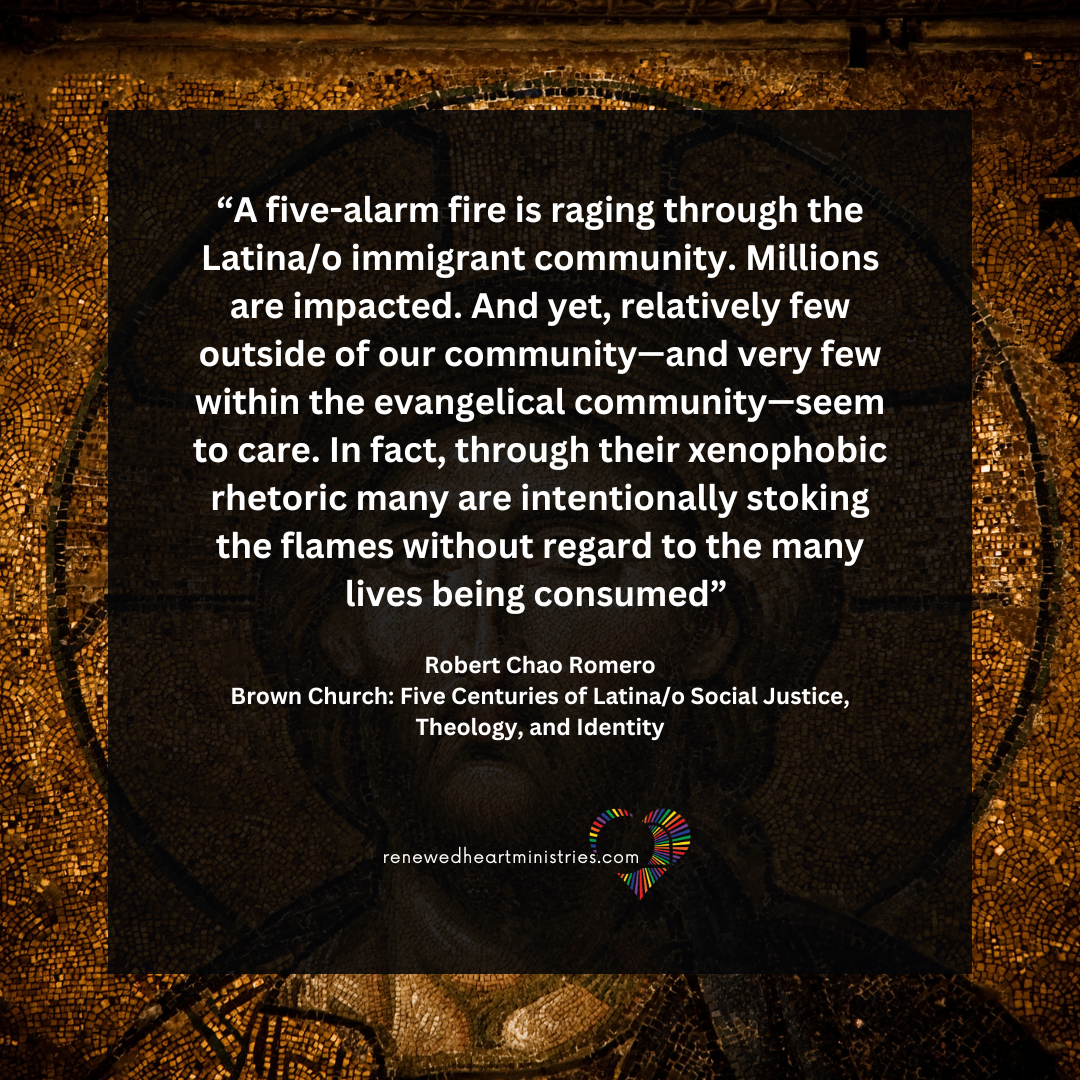
Societal sins are creating an immigration crisis in our nation today. Robert Chao Romero writes, “A five-alarm fire is raging through the Latina/o immigrant community. Millions are impacted. And yet, relatively few outside of our community—and very few within the evangelical community—seem to care. In fact, through their xenophobic rhetoric many are intentionally stoking the flames without regard to the many lives being consumed” (Brown Church: Five Centuries of Latina/o Social Justice, Theology, and Identity, p. 207. Published in 2020).

Romero continues, “Seeing ourselves in the Exodus narrative, we apply the biblical text to our present experience and declare: 

Afterward the Brown Church went to Donald Trump and said, “Thus says the LORD, the God of Israel, ‘Let my people go, so that they may live lives of shalom and abundance in the land that was once theirs.’” 

But Donald Trump said, “Who is the LORD that I should heed him and let the Hispanics go? I worship the God of Make America Great Again, Manifest Destiny, and America First. I do not know about the Christianity of which you speak—this Jesus of Galilee and the God of the Oppressed.” . . . 

But the president of the United States said to them, “Brown Church, why are you taking the people away from their work? Get to your labors!” 

—Exodus 5:1-4, Contemporary Chicana/o Version 

(Ibid., pp. 210-211)

Another prominent area in need of reform is the criminal justice system. Racial profiling, disproportionate sentencing, police brutality, and mass incarceration particularly affect marginalized communities. Social justice in this area calls for equitable law enforcement practices, judicial fairness, and rehabilitation over punishment. Ensuring accountability for law enforcement and promoting restorative justice are also crucial steps.

Consider getting involved in our education system to address inequality. Social justice in education means meeting funding gaps and providing support services to meet diverse student needs. Consider getting involved in the battle for everyone to have even basic health care. The US is considered by many to be a “major nation” due to its substantial economic influence, its powerful military presence, and its role in international organizations. Yet we are the only high-income nation in the world not to ensure everyone has healthcare as a basic human right. Justice requires that everyone can access necessary services regardless of income. You could engage social justice in the workplace. Workplace justice means ensuring fair wages, equal hiring practices, and safe, inclusive environments. Labor rights and protections against exploitation are also foundational to workplace justice. Or how about getting involved in environmental justice? Marginalized communities often live in areas with higher vulnerability to pollution, waste, and climate-related risks. Environmental justice involves pushing our elected officials toward regulating the environment and involving the community in decision-making about environmental issues.

And this only scratches the surface. Jesus’ followers today could choose to see so much more in the Jesus story than a call to charity. Hearing Jesus’ words in John’s gospel, “I have much more to say to you, more than you can now bear. But when he, the Spirit of truth, comes, he will guide you into all the truth” invites us to perceive the truth that achieving a world that is safe, compassionate, and a just home for everyone in our time requires systemic change, policy reform, and collective commitment to equity, inclusion, and human dignity that embraces and celebrates all of our differences. 

Christianity and social justice have always been deeply connected. Whether Christians have historically been found fighting against social justice movements or supporting and working alongside them, Christianity and social justice are connected first and foremost through the teachings of Jesus Christ, who emphasized love, compassion, and care for the marginalized. Central to our gospel is the belief that all humans are created in the image of God, are objects of God’s love and salvation, and deserve dignity and equality. The Hebrew scriptures, too, repeatedly call for justice, particularly for the poor, oppressed, and vulnerable, as seen in verses like Micah 6:8, which urges believers to “act justly, love mercy, and walk humbly with God.” 

Today, we can find Christians on both sides of the social justice work. Some work for a better world here and now, and others are afraid of change, biased against differences, and opposed to the efforts of more justice-oriented Christians working to address systemic injustice, advocate for peace, and end oppression and marginalization. While the different communities within the early Jesus movement held various interpretations of his teachings, the core principle for all them was that faith must be expressed through action. The book of James defines faith as including actions that strive for justice for the oppressed. Christians today who aim to reflect God’s love and build a more compassionate and safe world are wading out into the deep waters of the “much more” Jesus had to share with us, for such a time as this.

Discussion Group Questions

1. Share something that spoke to you from this week’s podcast episode with your discussion group.

2. What does expanding on the Jesus story look like for you this week? Share and discuss with your group.

3. What can you do this week, big or small, to continue setting in motion the work of shaping our world into a safe, compassionate, just home for everyone? 

Thanks for checking in with us, today.

I want to say a special thank you to all of our supporters out there. And if you would like to join them in supporting Renewed Heart Ministries’ work you can do so by going to renewedheartministries.com and clicking donate. 

My latest book Finding Jesus: A Fundamentalist Preacher Discovers the Socio-Political and Economic Teachings of the Gospels is available now on Amazon in paperback, Kindle and also on Audible in audio book format.

As always, you can find Renewed Heart Ministries each week on Bluesky, Facebook, Instagram and Meta’s Threads. If you haven’t done so already, please follow us on your chosen social media platforms for our daily posts. 

Thank you for listening to The Social Jesus Podcast. If you enjoyed this podcast please take a moment to like and subscribe and if the podcast platform you’re using offers this option, please leave us a positive review. This helps others find our podcast as well.

You can watch our YouTube show each week called “Just Talking”. Each week, Todd Leonard and I take a moment to talk about the gospel lectionary reading for the upcoming weekend. We’ll be talking about each reading in the context of love, inclusion, and social justice. Our hope is that our talking will be just talking (as in justice) and that during our brief conversations each week you’ll be inspired to also do more than just talking. If you teach from the lectionary each week, or if you’re just looking for some thoughts on the Jesus story from a more progressive perspective within the context of social justice, check it out, you might like it. You can find JustTalking each week on YouTube at youtube.com/@herbandtoddjusttalking.

Please Like, Subscribe, hit the Notification button, and leave us a comment.

And if you’d like to reach us here at Renewed Heart Ministries through email, you can reach us at info@renewedheartministries.com.

Right where you are, keep living in love, choosing compassion, taking action, and working toward justice.

I love each of you dearly,

I’ll see you next week.


New Episode of “Just Talking” Now Online!

Lectionary Readings in the context of Love, Inclusion, & Social Justice

Season 3, Episode 15: John 16.12-15. Lectionary C, Trinity Sunday

Each week, we’ll discuss the gospel lectionary reading for the upcoming weekend in the context of love, inclusion, and justice. We hope that our talking will be “just” talking (as in justice) and that we’ll be inspired to do more than “just talking” during our brief conversations each week. 

If you teach from the lectionary each week, or if you’re just looking for some thoughts on the Jesus story from a more progressive perspective within the context of social justice, check it out.


New Episode of The Social Jesus Podcast

A podcast where we talk about the intersection of faith and social justice and what a first century, prophet of the poor from Galilee might have to offer us today in our work of love, compassion and justice. 

This week:

Season 2 Episode 24: I Have Much More to Say to You

John 16:12-15

“Today, we can build on Jesus’ work, with these themes as our foundation too.  Literalists among us have often cited passages like this and only been concerned with those who are literally widowed or fatherless. But the principle here is to prioritize and center whomever our society makes vulnerable to harm. In patriarchal societies like the ones both Proverbs and Isaiah were written for, community members not connected to a man (widows were without a husband, while the fatherless were without a present father) were vulnerable to social, political, and economic harm. Today we can mark other differences that make certain people in our communities vulnerable to harm. Today we don’t only use patriarchal biases We also use differences like race, gender, sexuality, education, culture, legal status or citizenship, and more to make community members vulnerable.”

Available on all major podcast carriers and at:

https://the-social-jesus-podcast.simplecast.com/episodes/i-have-much-more-to-say-to-you


Finding Jesus: A Fundamentalist Preacher Discovers the Socio-Political & Economic Teachings of the Gospels.


by Herb Montgomery

Available now on Amazon!

In Finding Jesus, author Herb Montgomery delves into the profound and often overlooked political dimensions of the gospels. Through meticulous analysis of biblical texts, historical context, and social discourse, this thought-provoking book unveils the gospels’ socio-political, economic teachings as rooted in a profound concern for justice, compassion, and the well-being of the marginalized. The book navigates the intersections between faith and societal justice, presenting a compelling argument for a more socially engaged and transformative Christianity.

Finding Jesus is not just a scholarly exploration; it is a call to action. It challenges readers to reevaluate their understanding of Christianity’s role in public life and to consider how the radical teachings of the gospels can inspire a renewed commitment to justice, equality, and compassion. This book is a must-read for those seeking a deeper understanding of the social implications of Christian faith and a blueprint for building a more just and inclusive society.


Are you getting all of RHM’s Free Resources?

Free Sign Up Here

A Gospel of Economic Justice

We want to take this moment to express our heartfelt gratitude to all of our supporters for your support of Renewed Heart Ministry’s work of love, justice, and compassion. At a time when ministries like ours are being asked to achieve more with fewer resources, your support is so deeply appreciated, and we want to simply say thank you. Whether in our larger society or within our local faith communities, Renewed Heart Ministries remains committed to advocating for change, working towards a world that is inclusive, just, and safe for everyone, and being a source of love. From all of us here at Renewed Heart Ministries, thank you for your generous support. We deeply appreciate you.

If you’d like to join them in supporting our work, please go to renewedheartministries.com and click on “Donate.”  


Image created by Canva

A Gospel of Economic Justice

Herb Montgomery, January 25, 2025

If you’d like to listen to this week’s article in podcast version click on the image below:

Our reading this upcoming weekend is from the gospel fo Luke:

Jesus returned to Galilee in the power of the Spirit, and news about him spread through the whole countryside. He was teaching in their synagogues, and everyone praised him.

He went to Nazareth, where he had been brought up, and on the Sabbath day he went into the synagogue, as was his custom. He stood up to read, and the scroll of the prophet Isaiah was handed to him. Unrolling it, he found the place where it is written:

“The Spirit of the Lord is on me,

because he has anointed me 

to proclaim good news to the poor.

He has sent me to proclaim freedom for the prisoners 

and recovery of sight for the blind,

to set the oppressed free,

to proclaim the year of the Lord’s favor.” 

Then he rolled up the scroll, gave it back to the attendant and sat down. The eyes of everyone in the synagogue were fastened on him. He began by saying to them, “Today this scripture is fulfilled in your hearing.” (Luke 4:14-21)

Out of all of the passages in the Hebrew Scriptures that the author of Luke could have chosen, they connected Jesus with these words from the book of Isaiah:

The Spirit of the Sovereign LORD is on me,

because the LORD has anointed me 

to proclaim good news to the poor.

He has sent me to bind up the brokenhearted,

to proclaim freedom for the captives

and release from darkness for the prisoners,

to proclaim the year of the LORD’S favor

and the day of vengeance of our God,

to comfort all who mourn,

  and provide for those who grieve in Zion—

to bestow on them a crown of beauty 

instead of ashes,

the oil of joy 

instead of mourning,

and a garment of praise 

instead of a spirit of despair.

They will be called oaks of righteousness,

a planting of the LORD

for the display of his splendor. (Isaiah 61:1-3)

Luke’s gospel squarely places Jesus in the Hebrew prophetic justice tradition, speaking truth to power, on behalf of the poor in this case.

A Gospel of Wealth Redistribution

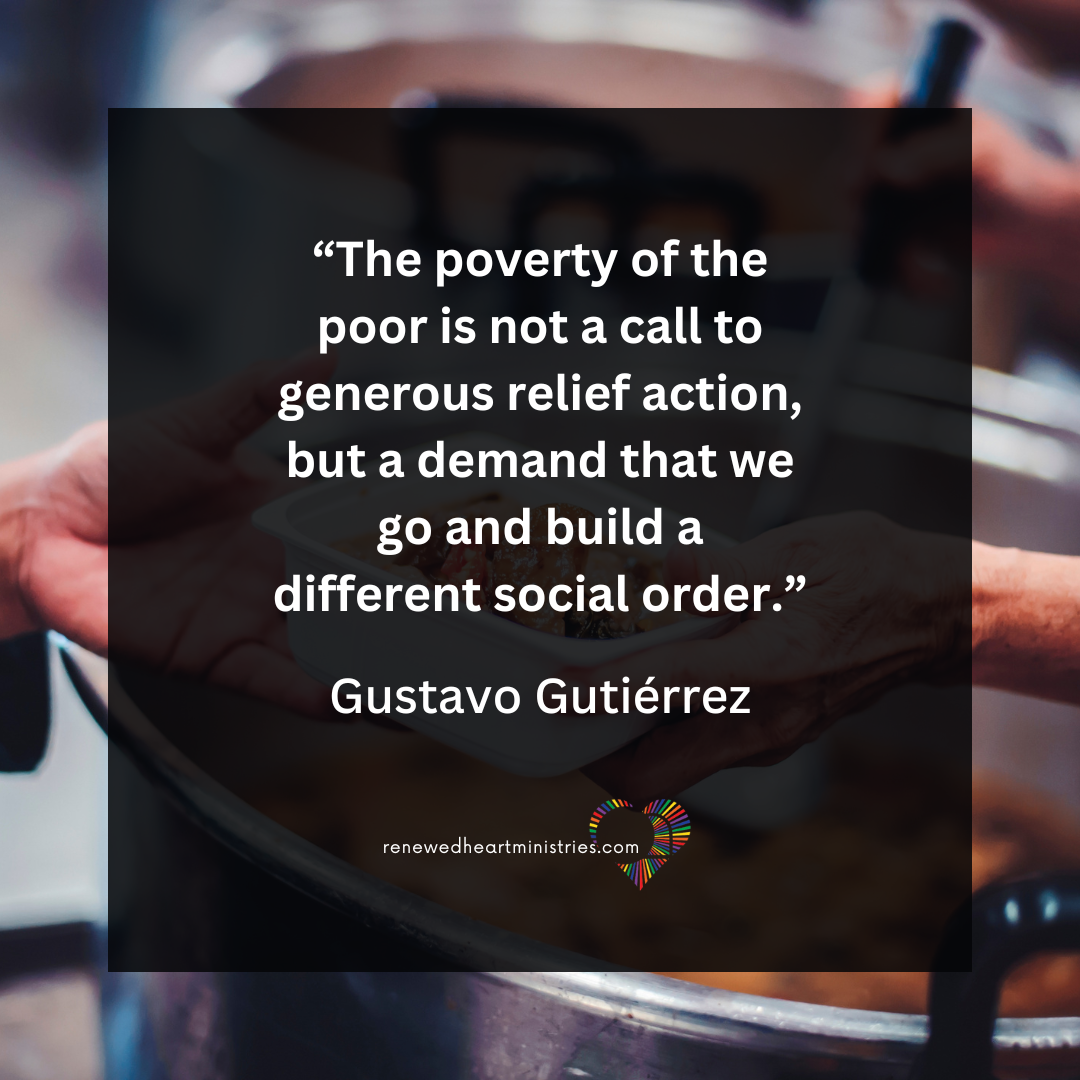
Considering how many times Luke’s gospel mentions “the poor,” it is no wonder that many consider it to be the gospel of economic justice. I’m reminded of what the late father of liberation theologies Gustavo Gutiérrez wrote in solidarity with the poor: “The poverty of the poor is not a call to generous relief action, but a demand that we go and build a different social order.” (The Power of the Poor in History, 2004, p. 45).

Certainly this was Jesus’ call in Luke, too. 

So central is Jesus’ gospel of the wealth redistribution of the kingdom for the poor that when John’s disciples ask Jesus about the authenticity of his own movement, he responds that the good news to the poor validating his ministry: 

So he replied to the messengers, “Go back and report to John what you have seen and heard: The blind receive sight, the lame walk, those who have leprosy are cleansed, the deaf hear, the dead are raised, and the good news is proclaimed to the poor. (Luke 7:22)

One of the transitional moments for me in my own journey in ministry was realizing that the Jesus of the gospels never mentions so many of the things I used to be passionate about preaching. And so many of the things Jesus taught and that were central to his emphasis in the synoptic gospels, I never even mentioned. 

The poor, poverty, and economic justice were one of themes for me. 

In Luke, Jesus centers the poor. The kingdom belongs to them. And Jesus’ “kingdom” is good news for them. As Gutiérrez would say, it’s a different social order where poverty is no longer created. Poverty is an indictment of the system it exists in, because that system creates and allows for poverty. A system of winners and losers will always have those who lose. But in Jesus’ new social order, everyone has enough to thrive:

Looking at his disciples, he said: “Blessed are you who are poor, for yours is the kingdom of God.” (Luke 6:20)

For Jesus, everything depended on how generous our attitude and actions were toward those our system places in poverty. Notwhithstanding the problematic nature of purity cultures in general, and given that this passage was written within a kind of purity culture, notice how everything “being clean” hinged on generosity toward the poor:

But now as for what is inside you—be generous to the poor, and everything will be clean for you. (Luke 11:41)

It is often said that Jesus’ advice in Luke 18 to the rich man, to sell his superfluous possessions and give them to the poor, were an isolated, private, and individual call only to that man. But this is far from the truth. Consider Jesus’ words to this man in Luke 18 and then compare them to Jesus’ words to the crowd in Luke 12. In Luke 12, this call is not to a specific wealthy person, but to all wealthy listeners in general.

When Jesus heard this, he said to him, “You still lack one thing. Sell everything you have and give to the poor, and you will have treasure in heaven. Then come, follow me.” (Luke 18:22)

“Sell your possessions and give to the poor. Provide purses for yourselves that will not wear out, a treasure in heaven that will never fail, where no thief comes near and no moth destroys.” (Luke 12:33)

The wealth redistribution Jesus was calling for actually makes sense. Today, the difference between a $30,000 income and a $60,000 for a family is dramatic for the adults but especially dramatic for that family’s children. Their stress, health, life expectancy, and social outcomes are all dramatically different. At the same time, we now know people aren’t dramatically happier or more fulfilled if their net worth grows from $1 billion to $10 billion. 

I’m reminded of Zacchaeus, who in Luke is one of those wealthy members of society (who also was a tax collector) who choose to heed Jesus’ call:

But Zacchaeus stood up and said to the Lord, “Look, Lord! Here and now I give half of my possessions to the poor, and if I have cheated anybody out of anything, I will pay back four times the amount.” (Luke 19:8)

A Gospel of a New Social Order

So central was this call to create a new social order where poverty is no more that in Luke’s companion book, Acts, the first generation of Jesus followers who put Jesus’ societal vision into practice eliminated poverty in their group entirely:

They devoted themselves to the apostles’ teaching and to fellowship, to the breaking of bread and to prayer. Everyone was filled with awe at the many wonders and signs performed by the apostles. All the believers were together and had everything in common. They sold property and possessions to give to anyone who had need. (Acts 2:42-45)

All the believers were one in heart and mind. No one claimed that any of their possessions was their own, but they shared everything they had. With great power the apostles continued to testify to the resurrection of the Lord Jesus. And God’s grace was so powerfully at work in them all that there were no needy persons among them. For from time to time those who owned land or houses sold them, brought the money from the sales and put it at the apostles’ feet, and it was distributed to anyone who had need. (Acts 4:32-35, italics added)

In our reading, Jesus’ gospel doesn’t just end with the poor. It also includes freedom for prisoners, sight for the blind, liberation for the oppressed, and the year of the Lord’s favor when slaves would be set free, debts cancelled, and lost or sold land returned back to ancestral families. The prisoners, the blind, and oppressed are all people whose social system had failed them. The blind were imprisoned in a dark Roman cell and deprived of all light. Their situation was referred to as “prison blindness.” In this context, “recovery of sight” means setting free those in these dark cells and ushering them back into the freedom of the sunlight where they could see again. This gives me pause for all whom our justice system in the U.S. is failing today. (To learn more about mass incarceration and the justice system, read The New Jim Crow: Mass Incarceration in the Age of Colorblindness by Michelle Alexander; Just Mercy: A Story of Justice and Redemption by Bryan Stevenson; and Dead Man Walking: The Eyewitness Account of the Death Penalty That Sparked a National Debate by Helen Prejean.)

Today, we could extend this list of system failures even further. Participating in Jesus’ justice work today is to combat white supremacy and anti-Blackness. It means combating misogyny and patriarchal norms. It means standing for the safety and well-being of our LGBTQ family and friends, and even more. This list ultimately includes all of us. Because to follow the Jesus of our reading this week means to engage the ongoing work of shaping our world into a safe, compassionate, just home for everyone, whatever obstacles we might face.

Discussion Group Questions

1. Share something that spoke to you from this week’s Podcast episode with your discussion group.

2. Do you consider economic justice as foundational to other areas of social justice? How so? Share and discuss with your group.

3. What can you do this week, big or small, to continue setting in motion the work of shaping our world into a safe, compassionate, just home for everyone? 

Thanks for checking in with us, today.

I want to say a special thank you to all of our supporters out there. And if you would like to join them in supporting Renewed Heart Ministries’ work you can do so by going to renewedheartministries.com and clicking donate. 

My latest book Finding Jesus: A Fundamentalist Preacher Discovers the Socio-Political and Economic Teachings of the Gospels is available now on Amazon in paperback, Kindle and also on Audible in audio book format.

As always, you can find Renewed Heart Ministries each week on Bluesky, Facebook, Instagram and Meta’s Threads. If you haven’t done so already, please follow us on your chosen social media platforms for our daily posts. 

Thank you for listening to The Social Jesus Podcast. If you enjoyed this podcast please take a moment to like and subscribe and if the podcast platform you’re using offers this option, please leave us a positive review. This helps others find our podcast as well.

You can watch our YouTube show each week called “Just Talking”. Each week, Todd Leonard and I take a moment to talk about the gospel lectionary reading for the upcoming weekend. We’ll be talking about each reading in the context of love, inclusion, and social justice. Our hope is that our talking will be just talking (as in justice) and that during our brief conversations each week you’ll be inspired to also do more than just talking. If you teach from the lectionary each week, or if you’re just looking for some thoughts on the Jesus story from a more progressive perspective within the context of social justice, check it out, you might like it. You can find JustTalking each week on YouTube at youtube.com/@herbandtoddjusttalking.

Please Like, Subscribe, hit the Notification button, and leave us a comment.

And if you’d like to reach us here at Renewed Heart Ministries through email, you can reach us at info@renewedheartministries.com.

Right where you are, keep living in love, choosing compassion, taking action, and working toward justice.

I love each of you dearly,

I’ll see you next week.


New Episode of “Just Talking” Now Online!

Season 2, Episode 44: Luke 4.14-21. Lectionary C, Epiphany 3

Each week, we’ll be talking about the gospel lectionary reading for the upcoming weekend in the context of love, inclusion, and social justice. Our hope is that our talking will be “just” talking (as in justice) and that during our brief conversations each week we’ll be inspired to do more than just talking.

If you teach from the lectionary each week, or if you’re just looking for some thoughts on the Jesus story from a more progressive perspective within the context of social justice, check it out at:


New Episode of The Social Jesus Podcast

A podcast where we talk about the intersection of faith and social justice and what a first century, prophet of the poor from Galilee might have to offer us today in our work of love, compassion and justice. 

This week:

Season 2 Episode 4: A Gospel of Economic Justice

 Luke 4:14-21

“Poverty is an indictment of the system it exists in, because that system creates and allows for poverty. A system of winners and losers will always have those who lose. But in Jesus’ new social order, everyone has enough to thrive. In our reading, Jesus’ gospel doesn’t just end with the poor. It also includes freedom for prisoners, sight for the blind, liberation for the oppressed, and the year of the Lord’s favor when slaves would be set free, debts cancelled, and lost or sold land returned back to ancestral families. Today, in addition to econimic justice, we could extend this list of system failures even further. Participating in Jesus’ justice work today is to combat white supremacy and anti-Blackness. It means combating misogyny and patriarchal norms. It means standing for the safety and well-being of our LGBTQ family and friends, and even more.”

Available on all major podcast carriers and at:

https://the-social-jesus-podcast.simplecast.com/episodes/a-gospel-of-economic-justice


Finding Jesus: A Fundamentalist Preacher Discovers the Socio-Political & Economic Teachings of the Gospels.


by Herb Montgomery

Available now on Amazon!

In Finding Jesus, author Herb Montgomery delves into the profound and often overlooked political dimensions of the gospels. Through meticulous analysis of biblical texts, historical context, and social discourse, this thought-provoking book unveils the gospels’ socio-political, economic teachings as rooted in a profound concern for justice, compassion, and the well-being of the marginalized. The book navigates the intersections between faith and societal justice, presenting a compelling argument for a more socially engaged and transformative Christianity.

Finding Jesus is not just a scholarly exploration; it is a call to action. It challenges readers to reevaluate their understanding of Christianity’s role in public life and to consider how the radical teachings of the gospels can inspire a renewed commitment to justice, equality, and compassion. This book is a must-read for those seeking a deeper understanding of the social implications of Christian faith and a blueprint for building a more just and inclusive society.


Are you getting all of RHM’s Free Resources?

Free Sign Up Here

A Socially Engaged Gospel

Now Available on Amazon!

Finding Jesus: A Fundamentalist Preacher Discovers the Socio-Political & Economic Teachings of the Gospels.

by Herb MontgomeryAvailable.

After two successful decades of preaching a gospel of love within the Christian faith tradition Herb felt like something was missing. He went back to the gospels and began reading them through the interpretive lenses of various marginalized communities and what he found radically changed his life forever. The teachings of the Jesus in the gospel stories express a profound concern for justice, compassion, and the well-being of those in marginalized communities. This book navigates the intersections between faith and societal justice, and presents a compelling argument for a more socially compassionate and just expression of Christianity. Herb’s findings in his latest book are shared in the hopes that it will dramatically impact how you practice your Christianity, too.


New Episode of JustTalking!

Season 2, Episode 3: John 3.14-21. Lectionary B, Lent 4

Each week, we’ll be talking about the gospel lectionary reading for the upcoming weekend. We’ll be talking about each reading in the context of love, inclusion, and societal justice. Our hope is that our talking will be just talking (as in justice) and that during our brief conversations each week you’ll be inspired to also do more than just talking.

If you teach from the lectionary each week, or if you’re just looking for some thoughts on the Jesus story from a more progressive perspective within the context of social justice, check it out, you might like it.

You can find the latest show on YouTube at

Season 2, Episode 3: John 3.14-21. Lectionary B, Lent 4

 or (@herbandtoddjusttalking)

Please Like, Subscribe, hit the Notification button, and leave us a comment


A Socially Engaged Gospel

Herb Montgomery | March 9, 2024

To listen to this week’s eSight as a podcast episode click here.

This image has an empty alt attribute; its file name is Jesus-For-Everyone-150x150.png

Our reading this fourth weekend of Lent is from the gospel of John:

“Just as Moses lifted up the snake in the wilderness, so the Son of Man must be lifted up, that everyone who believes may have eternal life in him. For God so loved the world that he gave his one and only Son, that whoever believes in him shall not perish but have eternal life. For God did not send his Son into the world to condemn the world, but to save the world through him. Whoever believes in him is not condemned, but whoever does not believe stands condemned already because they have not believed in the name of God’s one and only Son. This is the verdict: Light has come into the world, but people loved darkness instead of light because their deeds were evil. Everyone who does evil hates the light, and will not come into the light for fear that their deeds will be exposed. But whoever lives by the truth comes into the light, so that it may be seen plainly that what they have done has been done in the sight of God.” John 3:14-21

Most New Testament scholars today recognize the proto-gnostic or gnostic tendencies of the Johannine community that produced the gospel of John. Later Gnostic Christians even only honored and read from the gospel of John (cf. Irenaeus, Against Heresies). 

Some of the Gnostic elements we encounter in John’s gospel include glorifying the Moses’ snake (a symbol in early Jewish gnosticism); a dualistic way of dividing our experiences between the material, deemed evil, and the spiritual, deemed good; and defining salvation as when our souls are finally liberated from our bodies and this finite, material plane.

Although those who won the power in the early Christian church deemed Christian gnosticism a heresy, much of western protestant Christianity today ironically looks a lot like early gnosticism, at least relation to the elements we have mentioned here.

Today, John’s gospel is the favorite of the New Testament gospels for many who practice the kind of Christianity that is hyper-focused either on gaining heaven or attaining the inward, individual, privatized spiritual experience with a cosmic Jesus often referred to as having “a relationship with God.” If either of these kinds of Christianity happens to be your experience, I don’t want to degrade that experience in the slightest. I just want to push it further. Whether someone’s focus is getting to heaven or having a private relationship with their individual Lord and savor, we must be honest about how those two focuses can divert our attention from the focus of the Jesus in the synoptic gospels. That Jesus was a source of healing and liberation for folks, not from a private internal hell unattached to the society around them or a post mortem one but from the living hell they were suffering through concrete social realities.

In 1958, responding to a complaint that someone’s pastor was talking about the NAACP during their sermon, Rev. Dr. Martin Luther King responded, 

“Any religion that professes to be concerned about the souls of men [sic] and is not concerned about economic conditions that cripple them and the social conditions that damn them is a dry as dust religion in need of new blood. Therefore your minister by including so-called ‘worldly things’ in his sermon revealed that he is a man of great spiritual depth and deep civic conscience. He revealed his awareness of the fact that the gospel of Jesus Christ deals with the whole man [sic]—his [sic] body as well as his soul, the earthly as well as the heavenly.” (Rev. Dr. Martin Luther King, Jr. Advice for Living, September 1958)

There are two ditches on either side of the paths we journey as Christians. One ditch is to be only focused on heaven. This is what some have referred to as being “so heavenly minded that we are no earthly good.” The other ditch is to only be focused inwardly on private and personal piety or a cosmic “relationship” to the exclusion of the center: our path following Jesus which is being a source of life-giving change in our world here and now. 

It doesn’t matter which of these ditches we fall into. Whatever we believe, our beliefs should make us a more engaged and better humans in relation to our world we are living in today.

Why does this matter in relation to our text this week? This week’s passage is a favorite for those who live solely in either ditch. For those in the ditch of getting to heaven, the phrase “whoever believes in him shall not perish but have eternal life” has special resonance. For those focused on a private, individual relationship with Jesus or God’s love, the phrases “God so loved the world” and “God did not send his Son into the world to condemn the world” especially resonate. And rightly so. 

While there may be some value in these beliefs, there is no reason why this passage should only belong to those who focus on them. This passage can also speak to those who care about making a difference in our material world and on personal and systemic suffering today. 

Why can’t the condemnation in this passage be similar to how the Hebrew prophets defined divine condemnation? In the Hebrew prophets, condemnation was not focused on individuals but on people groups, societies, and communities. When their social systems engaged in harmful practices toward the poor, the stranger, the fatherless, or the widow (in a patriarchal society), that society would suffer divine condemnation. They understood that condemnation was expressed through a calamity, natural, military, or a combination of both. If the teaching in John was similar to the Hebrew prophets’ teaching, God did not send God’s son into the world to perpetuate this cycle of unsustainable injustice and the intrinsic fruit of oppression and violence, but to shows us a way out.

And this leads to us defining salvation socially not individually. As Walter Rauschenbusch so rightly stated almost a century ago, “If our theology is silent on social salvation, we compel [people] to chose between an unsocial system of theology and an irreligious system of social salvation” (A Theology for the Social Gospel, p. 7) This social salvation can lead us into some beautifully inclusive realizations and practices. As the Rev. Dr. Jacqui Lewis so beautifully states, “If there is such a thing as salvation, none of us are saved, until all of us are saved.” 

“Perish” can refer not to some post mortem hell, but to literally perishing here, now, today. As Gustavo Gutierrez often stated, poverty is death and means an early death. Eternal life can be about quality not quantity: about the abundant life now, where there is enough for everyone to thrive (cf. John 10:10) .This vision is for a world that prioritizes making sure everyone is taken care of rather than shaping the world with greed and funneling our resources into the hands of the few in positions of power. 

Today, we can lean into this passage: God actually does loves the world! And if God’s love is universal, then we are to care about justice for everyone included in that world as the objects of that love. As Rev. Dr. Emilie Townes says, “When you begin with the idea that God loves everyone, justice isn’t very far behind.” Or as so many today are fond of saying, “Justice is what love looks like in public.” This world that is loved, we must be careful to define as everyone, with no exclusions. Those who comprise our world that are loved includes those that are different from ourselves, even those whose differences trigger our own bigotries and prejudices. We must be honest here. 

I’m thinking of how women in positions of authority can trigger insecure or patriarchal men. I’m thinking of how racial and cultural differences trigger those whose internal bias is some form of White or western supremacy. I think of how trans and nonbinary differences and gender nonconformity triggers those who have cis-biases. Or how folks who identify as gay, lesbian or bisexual trigger those with heteronormative biases. I think of class bias. I think of educational bias with what is now being called the paper ceiling. 

If we are serious about leaning into the belief that every person is the object of divine love, then this would radically impact how we relate to those around us. Every person we meet is our sibling. Every person we meet is a part of ourselves. What impacts and affects one affects us all. Whether we like it or not, we are all connected to each other as part of this beautifully diverse human family that is loved by a universal love. 

And this has grave implication for our everyday choices as well. You can’t love others and not care about the things they suffer from the way our society is shaped. You can’t love them and vote for legislatures who seek to do them harm. To come full circle, you can’t love them and be focused on only your own arrival into heaven or your own personal relationship with the Divine. Otherwise, our focus on God’s love mutates from God’s loving us alongside everyone else in the world into a self-absorbed need to be loved by God above all else. It’s an only-child-like syndrome where God may love others, but privately and inwardly we begin to believe that we are God’s favorite. This is the root of Christian and too often national exceptionalism. 

To authentically reinterpret our passage this week through the lens of the Jesus we see in the Mark, Matthew, and Luke can still give us assurance of heaven, and still usher us into a relationship with the divine if that is your thing. And it also has the potential, when understood more broadly and deeply, to shape our practice of Christianity in ways that shape us into humans who make our world a safer, more compassionate, just home for everyone. 

Discussion Group Questions

1. Share something that spoke to you from this week’s eSight/Podcast episode with your discussion group.

2. How do the gospel stories call you to be more socially engaged? Share and discuss with your group.

3. What can you do this week, big or small, to continue setting in motion the work of shaping our world into a safe, compassionate, just home for everyone? 

Thanks for checking in with us, today.

I want to say a special thank you to all of our supporters out there. And if you would like to join them in supporting Renewed Heart Ministries’ work you can do so by going to renewedheartministries.com and clicking donate. 

I want to also say a special thank you this week to Quoir Publishing, Keith Giles who wrote the foreword to my latest book, all the special people on our launch team, and all of you who made this release a success. 

Finding Jesus: A Fundamentalist Preacher Discovers the Socio-Political and Economic Teachings of the Gospels is available now on Amazon in paperback, Kindle and soon also on Audible in audio book format.

As always, you can find Renewed Heart Ministries each week on X (or Twitter), Facebook, Instagram and Meta’s new Threads. If you haven’t done so already, please follow us on your chosen social media platforms for our daily posts. Also, if you enjoy listening to the Jesus for Everyone podcast, please like and subscribe to the JFE podcast through the podcast platform you use and consider taking some time to give us a review. This helps others find our podcast as well.

You can watch our new YouTube show called “Just Talking” each week. Todd Leonard and I take a moment to talk about the gospel lectionary reading for the upcoming weekend. We’ll be talking about each reading in the context of love, inclusion, and societal justice. Our hope is that our talking will be just talking (as in justice) and that during our brief conversations each week you’ll be inspired to also do more than just talking.

If you teach from the lectionary each week, or if you’re just looking for some thoughts on the Jesus story from a more progressive perspective within the context of social justice, check it out, you might like it. You can find JustTalking each week on YouTube at youtube.com/@herbandtoddjusttalking. Please Like, Subscribe, hit the Notification button, and leave us a comment.

And if you’d like to reach us here at Renewed Heart Ministries through email, you can reach us at info@renewedheartministries.com.

Right where you are, keep living in love, choosing compassion, taking action, and working toward justice.

I love each of you dearly,

I’ll see you next week.


Are you getting all of RHM’s Free Resources?

Free Sign Up Here

The Gospel Jesus Taught

Finding Jesus Second Edition!

I have some exciting news!

I have just signed an agreement with a new book publisher (Quoir), and we are putting together a launch team for the second edition of Finding Jesus, coming out next month!

If you have been blessed by the first edition, and you would like to see this book have greater exposure to reach an even larger audience, I want to invite you to be a part of the launch team.  This second edition will be available in paperback, Kindle and an audio book available on Audible. And great news for those who already have a copy of the first edition, the first 25 people to sign up to be part of our launch team will also receive a FREE Audible copy of the audiobook for Finding Jesus.

To join the Finding Jesus launch team, all you need to do is four things:

1) Go to Amazon and pre-order a copy of the second edition when pre-orders become available.

2) Read the pdf copy of the second edition of Finding Jesus that I will send you after your pre-order the book so that you’re ready on launch day.

3) On launch day go back to Amazon and write a review for Finding Jesus. (You’ll be able to do this on day one since you’ve already read the pdf copy.)

4) Share your review of Finding Jesus on your social media pages that day, also.

It’s pretty simple. That’s all. And if you already have copy of the first edition this is a great opportunity to get the audiobook version on Audible as soon as it is available.

If you would like to join our launch team, you can email me at info@renewedheartministries.com and just put in the subject of your email “Launch Team.”

Thank you in advance for being part of this special second edition publishing and ensuring this edition is a success. 


New Episode of JustTalking!

Season 1, Episode 47: Mark 1.14-20. Lectionary B, Epiphany 3

Each week, we’ll be talking about the gospel lectionary reading for the upcoming weekend. We’ll be talking about each reading in the context of love, inclusion, and societal justice. Our hope is that our talking will be just talking (as in justice) and that during our brief conversations each week you’ll be inspired to also do more than just talking.

If you teach from the lectionary each week, or if you’re just looking for some thoughts on the Jesus story from a more progressive perspective within the context of social justice, check it out, you might like it.

You can find the latest show on YouTube at

Season 1, Episode 47: Mark 1.14-20. Lectionary B, Epiphany 3

 or (@herbandtoddjusttalking)

Please Like, Subscribe, hit the Notification button, and leave us a comment

Thanks in advance for watching!


The Gospel Jesus Taught

Herb Montgomery, January 19, 2024

To listen to this week’s eSight as a podcast episode click here.

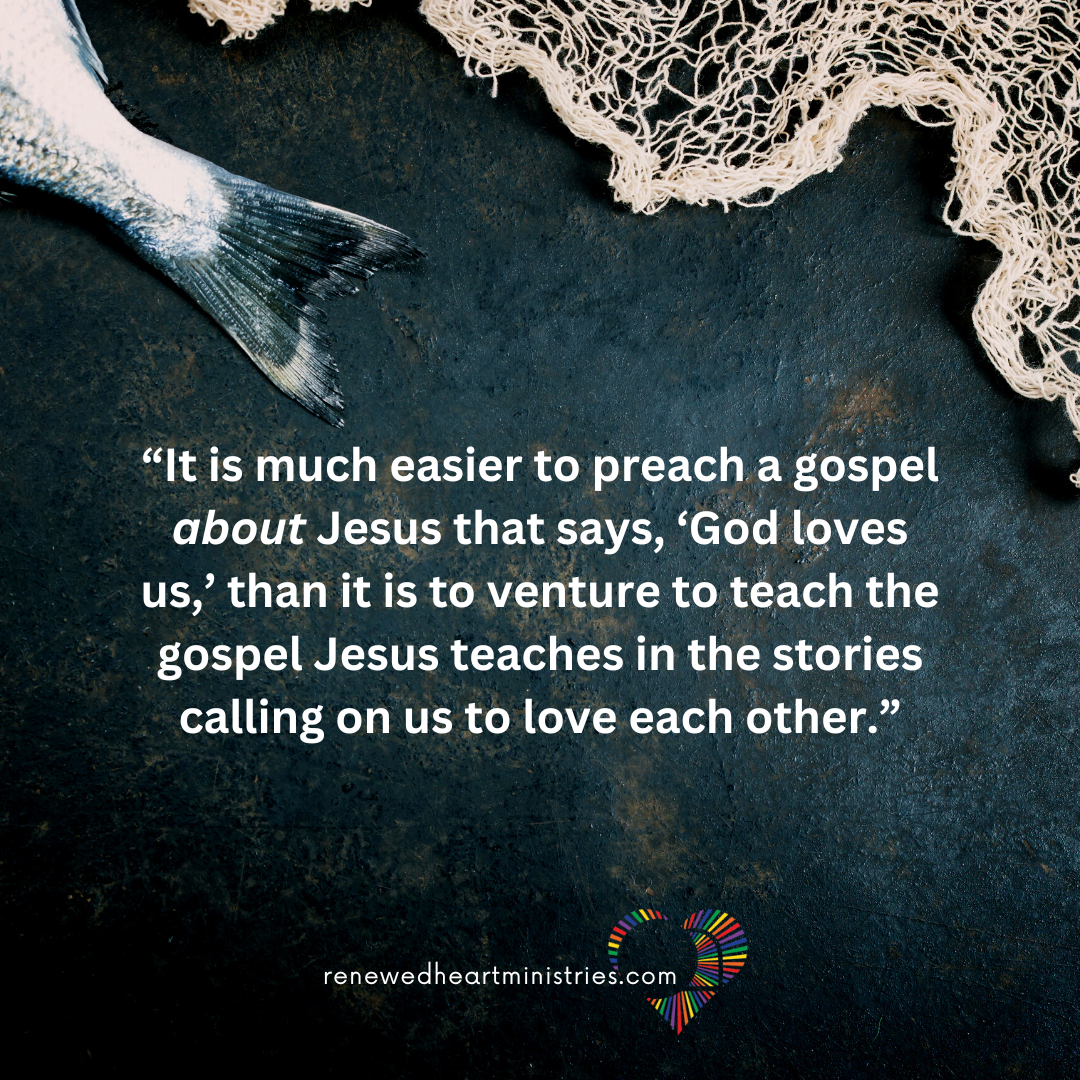
“It is much easier to preach a gospel about Jesus that says “God loves us,” than it is to venture to teach the gospel Jesus teaches in the stories calling on us to love each other.”

Our lectionary reading from the gospels for this coming weekend is from the gospel of Mark:

After John was put in prison, Jesus went into Galilee, proclaiming the good news of God. “The time has come,” he said. “The kingdom of God has come near. Repent and believe the good news!”

As Jesus walked beside the Sea of Galilee, he saw Simon and his brother Andrew casting a net into the lake, for they were fishermen. “Come, follow me,” Jesus said, “and I will send you out to fish for people.” At once they left their nets and followed him.

When he had gone a little farther, he saw James son of Zebedee and his brother John in a boat, preparing their nets. Without delay he called them, and they left their father Zebedee in the boat with the hired men and followed him. (Mark 1:14-20)

Every year around this time, I find myself writing on the themes in this passage. Take a look at two of my previous entries on Matthew’s and Luke’s versions of this passage, in 2022 and in 2023. 

Before we dive into the fishing metaphor, though, let’s explore how our reading begins. 

First, Herod has imprisoned John. Rome and Rome’s extensions are generally tolerant of things we consider today to be religious in nature. What Rome didn’t tolerate was anyone who became a social, political, or economic threat to Rome’s status quo and power structure. John didn’t get arrested because he was handing out tickets to heaven. He was arrested because he came to be seen as a threat the system. (In this December 2023 article, I mention Josephus’ description of how Herod viewed John the Baptist.)

After John is arrested, Jesus sets out preaching his gospel. Try and get inside the headspace of the gospel authors here. They aren’t describing a gospel about Jesus, like we would preach today. Instead they’re talking about the gospel Jesus himself taught. What was that gospel like?

The word “gospel” is not a Jewish term but a Roman one. When Rome would conquer a new territory, it would send out a messenger called an evangelist to go throughout the area announcing the gospel or “good news” that these people had just been conquered by their “savior” Caesar, “savior of the world,” and would now be subject of the Empire of Rome and the Pax Romana. Here are a few examples of how Rome used this term “gospel.”

“Even after the battle at Mantinea, which Thucydides has described, the one who first announced the victory had no other reward for his gospel [euangelion 

– singular] than a piece of meat sent by the magistrates from the public mess.” (Plutarch, Agesilaus, p. 33) 

“Accordingly, when [Aristodemus] had come near, he stretched out his hand and cried with a loud voice: ‘Hail, King Antigonus, we have conquered Ptolemy in a sea-fight, and now hold Cyprus, with 12,800 soldiers as prisoners of war.’ To this, Antigonus replied: ‘Hail to thee also, by Heaven! But for torturing us in this way, thou shalt undergo punishment; the reward for thy gospels [euangelion] thou shalt be some time in getting.’” (Plutarch, Demetrius, p. 17) 

“Why, as we are told, the Spartans merely sent meat from the public commons to the man who brought the gospel [euangelion] of the victory in Mantineia which Thucydides describes! And indeed the compilers of histories are, as it were, reporters of great exploits who are gifted with the faculty of felicitous speech, and achieve success in their writing through the beauty and force of their narration; and to them those who first encountered and recorded the events [euangelion] are indebted for a pleasing retelling of them” (Plutarch, Moralia [Glory of Athens], p. 347)

Unlike the gospel these messengers announced, Jesus’ gospel wasn’t about Rome but about what he referred to as “the kingdom.” In the kingdom or reign of God, there would be enough bread for everyone and all debts would be cancelled, all slaves set free, and land returned to its original owners (Matthew 6:11, Luke 4:18-19, and Matthew 5:45).

Jesus was also not merely announcing that God’s just future was coming. He was announcing that it had arrived, and the response he called for was for his listeners to “repent and believe the good news.” 

The phrase “repent and believe” is a difficult one for us Christians not to hear religiously as pertaining to the afterlife, but the Greek phrase is metanoesein kai pistos. Josephus uses this phrase when he tells us a story of visiting a Jewish brigand in prison for rebelling against Rome. Jospheus attempts to convince the rebel to leave that path and take up a more cooperative posture toward the empire. The phrase Josephus uses in his plea is for this brigand to “repent and believe/trust him” (metanoesein kai pistos emoi genesestha), and it’s the same language we read in Mark from Jesus’ gospel preaching (see Thackery’s The Life Of Flavius Josephus, p. 110).

So Jesus is preaching a gospel of the kingdom, not a gospel of Rome. He is not calling his listeners to repent of rebellion against Rome or to accept Rome’s governance, but rather for his listeners to repent (rethink their current path) of complicity with the status quo. He calls them to trust him and enter God’s just future now. 

It is in this context that we must understand Mark’s next narrative move of Jesus calling fishermen. We must set aside the Christian evangelism framing this passage has suffered since this story was told, and try to hear this passage as the original Jewish Jesus followers would have heard it.

First, this language of being fishers of people is not a metaphor for evangelism. Proselytizing was not widely practiced in most expressions of Judaism at this time. Though there were occasionally converts , most scholars today agree that Jews did not do much proselytizing in the 1st Century. 

Jesus was not calling to these Jewish fishermen to become proselytizers, then. Instead, the reference to fishing for people was a call to another kind of action in the justice tradition of the Hebrew prophets: joining Jesus in challenging harm being done to people in the here and now, not the hereafter.

In several Hebrew scriptures, fishing for people was about hooking or catching a certain kind of person, a powerful and unjust person, and removing them from the position of power where they were wielding harm.

Speaking of those who do harm within their positions of power, Jeremiah reads:

“But now I will send for many fishermen,” declares the LORD, “and they will catch them. After that I will send for many hunters, and they will hunt them down on every mountain and hill and from the crevices of the rocks. (Jeremiah 16:16)

Speaking of those who “oppress the poor and crush the needy,” Amos reads:

The Sovereign LORD has sworn by his holiness: “The time will surely come when you will be taken away with hooks, the last of you with fishhooks.” (Amos 4:2)

Speaking of the abusive Pharaoh, king of Egypt, Ezekiel reads:

In the tenth year, in the tenth month on the twelfth day, the word of the LORD came to me: “Son of man, set your face against Pharaoh king of Egypt and prophesy against him and against all Egypt. Speak to him and say: ‘This is what the Sovereign LORD says:

‘“I am against you, Pharaoh king of Egypt,

you great monster lying among your streams.

You say, “The Nile belongs to me;

I made it for myself.”

But I will put hooks in your jaws

and make the fish of your streams stick to your scales.

I will pull you out from among your streams,

with all the fish sticking to your scales.

I will leave you in the desert,

you and all the fish of your streams.

You will fall on the open field

and not be gathered or picked up.

I will give you as food

to the beasts of the earth and the birds of the sky.

Then all who live in Egypt will know that I am the LORD. (Ezekiel 29:1-6)

Ched Myers, in commentaries written on this week’s passage from Mark, writes:

“In the Hebrew Bible, the metaphor of ‘people like fish’ appears in prophetic censures of apostate Israel and of the rich and powerful: ‘I am now sending for many fishermen, says God, and they shall catch [the people of Israel]…’ (Jeremiah 16:16) ‘The time is surely coming upon you when they shall take you away with fishhooks…’ (Amos 4:2) ‘Thus says God: I am against you, Pharaoh king of Egypt…. I will put hooks in your jaws, and make the fish of your channels stick to your scales…’ (Ezekiel 29:3f) Jesus is, in other words, summoning working folk to join him in overturning the structures of power and privilege in the world!” (Ched Myers, Marie Dennis, Joseph Nangle, Cynthia Moe-Lobeda, Stuart Taylor; Say to This Mountain: Mark’s Story of Discipleship, p. 10)

“There is perhaps no expression more traditionally misunderstood than Jesus’ invitation to these workers to become ‘fishers of men.’ This metaphor, despite the grand old tradition of missionary interpretation, does not refer to the ‘saving of souls,’ as if Jesus were conferring on these men instant evangelist status. Rather the image is carefully chosen from Jeremiah 16:16, where it is used as a symbol of Yahweh’s censure of Israel. Elsewhere the ‘hooking of fish’ is a euphemism for judgment upon the rich (Amos 4:2) and powerful (Ezekiel 29:4). Taking this mandate for his own, Jesus is inviting common folk to join him in the struggle to overturn the existing order of power and privilege.” (Ched Myers, Binding the Strong Man: A Political Reading of Mark’s Story of Jesus, p. 132)

Jesus was calling these fishermen to join him hope, change, and participating in God’s just future. That just future begins with our challenging the existing order of power and privilege, specifically because of the harm that the status quo causes.

Love means caring for people and what they are suffering here and now. That’s why, as Cornel West often says, justice is what love looks like in public. While it is much easier to preach a gospel that says “God loves us,” it is a much more challenging venture to teach a gospel calling on people to love each other. Perhaps that’s why Jesus’ message in the gospels is rarely about God’s love toward us per se. (It is present at times, but is rarely emphasized and doesn’t even show up in the book of Acts, which is supposed to be about the gospel turning the world upside down.) 

Instead Jesus’ gospel repeats the call for us to love one another, neighbor, and even enemy. Love is not something we are to simply bask in, assured that we the objects of Divine affection. Love is the ethic that a God of love calls us to live by in our relations to each other. A gospel that is only about God’s unconditional love for us has historically served as guilt alleviation for those in positions of power and privilege. It helps those complicit in harm to rest at night. 

It doesn’t matter how much a gospel about Jesus talks about God’s love if it doesn’t include the call for us to love one another. I’m thinking specifically about distributive justice for others being harmed. Without that call, it may be a gospel about Jesus, but it’s not the same gospel that Jesus taught in the early stories. A gospel may include God’s universal and unconditional love, but if that gospel doesn’t result in adherents also loving their neighbors, then that gospel is “a resounding gong or a clanging cymbal” (1 Corinthians 13:1).

HeartGroup Application

1. Share something that spoke to you from this week’s eSight/Podcast episode with your HeartGroup.

2. What would a society shaped by love look like? Share and discuss with your group.

3. What can you do this week, big or small, to continue setting in motion the work of shaping our world into a safe, compassionate, just home for everyone? 

Thanks for checking in with us, today.

I want to say a special thank you to all of our supporters out there. And if you would like to join them in supporting Renewed Heart Ministries’ work you can do so by going to renewedheartministries.com and clicking donate. 

I have some exciting news! I have just signed an agreement with a new book publisher (Quoir), and we are putting together a launch team for the second edition of Finding Jesus, coming out next month!

If you have been blessed by the first edition, and you would like to see this book have greater exposure to reach an even larger audience, I want to invite you to be a part of the launch team.  This second edition will be available in paperback, Kindle and an audio book available on Audible. And great news for those who already have a copy of the first edition, the first 25 people to sign up to be part of our launch team will also receive a FREE Audible copy of the audiobook for Finding Jesus.

To join the Finding Jesus launch team, all you need to do is four things:

  1. Go to Amazon and pre-order a copy of the second edition when pre-orders become available.

2) Read the pdf copy of the second edition of Finding Jesus that I will send you after your pre-order the book so that you’re ready on launch day.

3) On launch day go back to Amazon and write a review for Finding Jesus. (You’ll be able to do this on day one since you’ve already read the pdf copy.)

4) Share your review of Finding Jesus on your social media pages that day, also.

It’s pretty simple. That’s all. And if you already have copy of the first edition this is a great opportunity to get the audiobook version on Audible as soon as it is available.

If you would like to join our launch team, you can email me at info@renewedheartministries.com and just put in the subject of your email “Launch Team.”

Thank you in advance for being part of this special second edition publishing and ensuring this edition is a success.

You can find Renewed Heart Ministries on X (or Twitter), Facebook, Instagram and Meta’s new Threads. If you haven’t done so already, please follow us on your chosen social media platforms for our daily posts. Also, if you enjoy listening to the Jesus for Everyone podcast, please like and subscribe to the JFE podcast through the podcast platform you use and consider taking some time to give us a review. This helps others find our podcast as well.

You can watch our new YouTube show called “Just Talking” each week. Todd Leonard and I take a moment to talk about the gospel lectionary reading for the upcoming weekend. We’ll be talking about each reading in the context of love, inclusion, and societal justice. Our hope is that our talking will be just talking (as in justice) and that during our brief conversations each week you’ll be inspired to also do more than just talking.

If you teach from the lectionary each week, or if you’re just looking for some thoughts on the Jesus story from a more progressive perspective within the context of social justice, check it out, you might like it. You can find JustTalking each week on YouTube at youtube.com/@herbandtoddjusttalking. Please Like, Subscribe, hit the Notification button, and leave us a comment.

And if you’d like to reach us here at Renewed Heart Ministries through email, you can reach us at info@renewedheartministries.com.

Right where you are, keep living in love, choosing compassion, taking action, and working toward justice.

I love each of you dearly,

I’ll see you next week.


Are you receiving all of RHM’s free resources each week?

Begin each day being inspired toward love, compassion, action, and justice. Free Sign-Up HERE

The Deceitfulness of Wealth

We want to say a special thank you to all of our supporters out there. If you would like to join them in supporting Renewed Heart Ministries’ work you can do so by going to renewedheartministries.com and clicking donate.


New Episode of JustTalking!

Season 1, Episode 21: Matthew 13.1-9, 18-23. Lectionary A, Proper 10

Each week, we’ll be talking about the gospel lectionary reading for the upcoming weekend. We’ll be talking about each reading in the context of love, inclusion, and societal justice. Our hope is that our talking will be just talking (as in justice) and that during our brief conversations each week you’ll be inspired to also do more than just talking.

If you teach from the lectionary each week, or if you’re just looking for some thoughts on the Jesus story from a more progressive perspective within the context of social justice, check it out, you might like it.

You can find the latest show on YouTube at https://youtu.be/vXMQHAoHjOI

 or (@herbandtoddjusttalking)

Please Like, Subscribe, hit the Notification button, and leave us a comment

Thanks in advance for watching!


The Deceitfulness of Wealth

Herb Montgomery | July 14, 2023


To listen to this week’s eSight as a podcast episode click here.


“But wealth creates in us a kind security that isolates us from fellow members of our human family. Community, on the other hand, is a way of finding security to weather potential future hardships together. Even evolutionarily, species that have proven to be the “fittest” over time, are species that don’t go it alone but that practice care for vulnerable members rather than some taking care of themselves at the expense of others.”


Our reading this week is from two sections of Matthew chapter 13:

“That same day Jesus went out of the house and sat by the lake. Such large crowds gathered around him that he got into a boat and sat in it, while all the people stood on the shore. Then he told them many things in parables, saying: “A farmer went out to sow his seed. As he was scattering the seed, some fell along the path, and the birds came and ate it up. Some fell on rocky places, where it did not have much soil. It sprang up quickly, because the soil was shallow. But when the sun came up, the plants were scorched, and they withered because they had no root. Other seed fell among thorns, which grew up and choked the plants. Still other seed fell on good soil, where it produced a crop—a hundred, sixty or thirty times what was sown. Whoever has ears, let them hear.” (Matthew 13:1-9)

and

“Listen then to what the parable of the sower means: When anyone hears the message about the kingdom and does not understand it, the evil one comes and snatches away what was sown in their heart. This is the seed sown along the path. The seed falling on rocky ground refers to someone who hears the word and at once receives it with joy. But since they have no root, they last only a short time. When trouble or persecution comes because of the word, they quickly fall away. The seed falling among the thorns refers to someone who hears the word, but the worries of this life and the deceitfulness of wealth choke the word, making it unfruitful. But the seed falling on good soil refers to someone who hears the word and understands it. This is the one who produces a crop, yielding a hundred, sixty or thirty times what was sown.” (Matthew 13:18-23)

The author of Mathew has mostly taken this section from the gospel of Mark (Mark 4:1-34). And for good reason. There is plenty here that it was important for the early Jesus community to remember.

The parable of the sower gives us a special glimpse into what the gospel Jesus himself preached actually was. What stands out to me is that of all the obstructions that the early Jesus community could have named to following Jesus, all the temptations that could have been mentioned, and all the sins that this parable could have railed against, the one thing named is “the deceitfulness of wealth.”

I ask why? How does wealth deceive and obstruct us from following Jesus? Why was it at the top of the list for the early Jesus community?

Wealth does not obstruct the contemporary gospel message of getting to heaven. You can “get to heaven” in many contemporary gospel narratives and still be immensely wealthy. But in Jesus’ gospel of wealth redistribution and resource-sharing from the haves to the have nots, it becomes immediately apparent how wealth obstructs. The desire to build or hold wealth is directly opposed to giving that wealth away to those negatively impacted in a system built to benefit a few at the expense of the many.

Jesus’ gospel was about creating a different way of being human together, here, now. It was not about a post mortem destination. Jesus was casting the vision of a beautiful community of people dedicated to making sure no one was pushed to the edges or undersides of their community, no one was made vulnerable, and every member of the community held a mutual commitment to share what they could to ensure everyone was cared for.

This was what the gospel authors called the “empire” or “kingdom” of God, a community in which God reigned. It was a community where people came first. So how does the deceitfulness of wealth obstruct this?

First, a community where God reigns according the gospel stories is a community where people are of a greater priority than profit or wealth-building. This is why the gospels repeatedly state that in a community such as the one Jesus describes, we have to choose between God and money. It’s one or the other.

“No one can serve two masters. Either you will hate the one and love the other, or you will be devoted to the one and despise the other. You cannot serve both God and money.” (Matthew 6.24)

This was also the practice of the early believers in the book of Acts:

“All the believers were together and had everything in common. They sold property and possessions to give to anyone who had need.” (Acts 2:44-45)

“All the believers were one in heart and mind. No one claimed that any of their possessions was their own, but they shared everything they had . . . there were no needy persons among them. For from time to time those who owned land or houses sold them, brought the money from the sales, and put it at the apostles’ feet, and it was distributed to anyone who had need.” (Acts 4:32-35)

But how is wealth deceitful?

Hoarded wealth gives us a sense of security, but this kind of security leaves us alone, isolated, on our own, each of us in our silos of hoarded resources, feeling that we will be able to take care of ourselves but living against the grain of reality and how we survive as a planet, together. As we discussed weeks ago, we are all connected. We are all part of one another. No one survives alone, and if there is such a thing as social salvation, no one is saved unless we all are saved.

But wealth creates in us a kind security that isolates us from fellow members of our human family. Community, on the other hand, is a way of finding security to weather potential future hardships together. Even evolutionarily, species that have proven to be the “fittest” over time, are species that don’t go it alone but that practice care for vulnerable members rather than some taking care of themselves at the expense of others.

This, too, was a common theme in the early Jesus community. Consider the following words from 1 Timothy:

“Command those who are rich in this present world not to be arrogant nor to put their hope in wealth, which is so uncertain, but to put their hope in God.” (1Timothy 6:17)

What does it mean in this context to “put their hope in God”. James Robinson, author of books on the historical Jesus and the gospel that Jesus taught, gives insights on what it might have meant for believers to “put their hope in God.”

“Such ‘security’ [or hope] should be replaced by God reigning, which means both what I trust God to do (to activate you to share food with me) and what I hear God telling me to do (to share clothes with you). We should not carry money while bypassing the poor or wear a backpack with extra clothes and food while ignoring the cold and hungry lying in the gutter. This is why the beggars, the hungry, the depressed are fortunate: God, that is, those in whom God rules, those who hearken to God, will care for them. The needy are called upon to trust that God’s reigning is there for them (“Theirs is the kingdom of God”) . . . Jesus’ message was simple, for he wanted to cut straight through to the point: trust God to look out for you by providing people who will care for you, and listen to him when he calls on you to provide for them.” (James M. Robinson, The Gospel of Jesus, Kindle Location 71)

Paul’s letter to the Corinthians also suggests how the members of early Jesus communities practiced this:

“Our desire is not that others might be relieved while you are hard pressed, but that there might be equality. At the present time your plenty will supply what they need, so that in turn their plenty will supply what you need. The goal is equality.” (2 Corinthians 8:13)

How can wealth be used, today, not to give us individual, privatized security but to build community where our security is in each other, in people? The Jesus story is offering us two options, two competing places in which to “put our trust.” We can either put our hope in hoarding money against potential future hardships, or we can put our hope in a community of people who are dedicated to making sure their resources care for those in their community. Jesus’ way is about facing the future together, rather than alone. It’s about having each other’s back.

Here in the United States, we are continuing to move toward a society that leaves each person on their own. From Supreme Court rulings to local political supermajorities, we are shaping a country in such a way that leaves people on their own to pull themselves up by bootstraps they don’t even have. Those our system makes most vulnerable are the most being harmed.

Some societies and countries are deeply committed to democracy and also have strong social commitments to one another. They make sure community members’ needs are met. We, too, can still practice the freedom of democracy while we move toward making sure everyone in our democracy has what they need to thrive. These are not mutually exclusive goals. In fact, making sure everyone in our democracy is on level ground is deeply democratic in itself.

This call also harmonizes much more with the call of Jesus to work toward shaping a world where we are committed not to isolated, self-sufficiency in facing survival challenges on our own, but to practice the Golden Rule, love our neighbor as ourselves, and share with those who are in need. As the books of Acts says, “Each according to their ability, and each according to their needs.”

HeartGroup Application


1. Share something that spoke to you from this week’s eSight/Podcast episode with your HeartGroup.

2. How do you wish our society practiced more socially responsible care. Share that with your group.

3. What can you do this week, big or small, to continue setting in motion the work of shaping our world into a safe, compassionate, just home for everyone? 

Thanks for checking in with us, today.

I want to say a special thank you to all of our supporters out there. And if you would like to join them in supporting Renewed Heart Ministries’ work you can do so by going to renewedheartministries.com and clicking donate.

You can find Renewed Heart Ministries on Twitter, Facebook and Instagram. If you haven’t done so already, please follow us on your chosen social media platforms for our daily posts. Also, if you enjoy listening to the Jesus for Everyone podcast, please like and subscribe to the JFE podcast through the podcast platform you use and consider taking some time to give us a review. This helps others find our podcast as well.

Also I want to share that we are partnering in a new weekly YouTube show called “Just Talking.” Each week, Todd Leonard and I will be talking about the gospel lectionary reading for the upcoming weekend. We’ll be talking about each reading in the context of love, inclusion, and societal justice. Our hope is that our talking will be just talking (as in justice) and that during our brief conversations each week you’ll be inspired to also do more than just talking.

If you teach from the lectionary each week, or if you’re just looking for some thoughts on the Jesus story from a more progressive perspective within the context of social justice, check it out, you might like it. You can find JustTalking each week on YouTube at youtube.com/@herbandtoddjusttalking. Please Like, Subscribe, hit the Notification button, and leave us a comment.

And if you’d like to reach us here at Renewed Heart Ministries through email, you can reach us at info@renewedheartministries.com.

My new book, Finding Jesus: A story of a fundamentalist preacher who unexpectedly discovered the social, political, and economic teachings of the Gospels is now also available at renewedheartministries.com

Right where you are, keep living in love, choosing compassion, taking action, and working toward justice.

I love each of you dearly,

I’ll see you next week.


Now Available at Renewed Heart Ministries!

Herb’s new book Finding Jesus: A story of a fundamentalist preacher who unexpectedly discovered the social, political, and economic teachings of the Gospels, is available at renewedheartministries.com.

Get your copy today at renewedheartministries.com


Are you receiving all of RHM’s free resources each week?

Begin each day being inspired toward love, compassion, action, and justice. Free Sign-Up HERE

When Marriage is Unjust

Herb Montgomery | November 4, 2022

To listen to this week’s eSight as a podcast episode click here.


“In Jesus’ worldview, if marriage was going to perpetuate patriarchal dominance and dependence, then it would be better for both men and women for there to be no marriage at all. The “age to come” breaking in on the present, even then, was an age when all oppression would cease, all violence would end, and all injustice, including that enacted through marriage, would be no more. For Jesus, then, patriarchal marriage could not persist.”


Our reading this week is from the gospel of Luke:

Some of the Sadducees, who say there is no resurrection, came to Jesus with a question. “Teacher,” they said, “Moses wrote for us that if a man’s brother dies and leaves a wife but no children, the man must marry the widow and raise up offspring for his brother. Now there were seven brothers. The first one married a woman and died childless. The second and then the third married her, and in the same way the seven died, leaving no children. Finally, the woman died too. Now then, at the resurrection whose wife will she be, since the seven were married to her?”

Jesus replied, “The people of this age marry and are given in marriage. But those who are considered worthy of taking part in the age to come and in the resurrection from the dead will neither marry nor be given in marriage, and they can no longer die; for they are like the angels. They are God’s children, since they are children of the resurrection. But in the account of the burning bush, even Moses showed that the dead rise, for he calls the Lord ‘the God of Abraham, and the God of Isaac, and the God of Jacob.’ He is not the God of the dead, but of the living, for to him all are alive.” (Luke 20:27-38)

Luke’s gospel repeats this story found also in Mark 12:18-27 and Matthew 22:23-33, and doesn’t change much. This story is rooted in the interpretation debates between the more liberal Pharisees and the more conservative Sadducees.

As we’ve discussed before, the Sadducees’ view effectively marginalized many people because they could not economically afford Torah faithfulness as the economically elite Sadducees defined it. This definition worked to preserve the Sadducees’ “purity,” social location, and privilege. As Josephus later wrote, “The Sadducees have the confidence of the wealthy alone, but no following among the populace” (Antiquities, 13.10.6).

The Pharisees had a much larger palette of sacred texts they used to color their theological, political, economic, and social views. Their interpretations put righteousness in the masses’ reach.

These contending political forces also debated whether there was a resurrection and an afterlife and whether this life is all we get. The Sadducees, who valued most of the Torah’s sacred writings, said there was not enough evidence in the Torah for belief in a resurrection. The Pharisees, who valued both the Torah and also a plethora of other sacred texts that we call the Hebrew scriptures today, taught of a resurrection in the age to come.

The Jesus of the gospels agrees with the Pharisees’ more theologically and politically liberal position. That’s why the Sadducees in this week’s reading are questioning Jesus’ belief in a resurrection. His response in each synoptic gospel is telling: and that response doesn’t seem to be good news for the patriarchy, heterosexism, or the social institution of marriage.

Jesus explains that in the age to come, an age of justice, there will be no marriage. How unjustly must the institution of marriage have been that Jesus couldn’t imagine it in the coming age of justice? Jesus states that all who are children of the resurrection will be “like the angels.” We can debate whatever that means, but the implication of the phrase is that marriage will be no more because all injustice will be no more.

Then, in language best fit for the Sadducees, Jesus references the Torah, stating that to God, those who are dead are “all are alive”: the big picture is that, if there is a resurrection, none are really gone and they will live again. This reminds me of the language Jesus uses in the gospels about the 12-year-girl who had died. In that story, he states that she is “Not dead, but only sleeping” (see Mark 5:39; Matthew 9:24; Luke 8:52). The righteous dead are not gone but simply asleep, waiting for the resurrection of the righteous in the age to come.

Let’s unpack this a bit: what relevance might this have to us today given our worldview and justice practices.

First, it helps to understand that the Sadducees are referencing Deuteronomy 25:5-6:

“If brothers are living together and one of them dies without a son, his widow must not marry outside the family. Her husband’s brother shall take her and marry her and fulfill the duty of a brother-in-law to her. The first son she bears shall carry on the name of the dead brother so that his name will not be blotted out from Israel.”

I want to be careful here with my critique. What stands out to me in this passage is the way it centers men. It also centers men with language that colors these actions as fulfilling a “duty” to the woman. The passage, though, is concerned with extending the lineage of the husband not the women. The woman here is a conduit through which the first brother can have his lineage live on through the faithfulness of the second brother. This raises many questions in our cultural context today. To the best of our knowledge, this passage was at least redacted somewhere between the 7th and 5th centuries BCE. How much did Assyrian and Babylonian patriarchal practices influence this passage? What was the lived experience of those who tried to follow this passage? Was the bodily autonomy of women respected? Did the woman have a say in this? If she also felt that this was a duty to be fulfilled to her, was this due to internalizing the patriarchal elements of her society? Or was this the price of economic survival in an economy that was patriarchal? Was her role assumed to be passive within the social construct of the way marriage was practiced at this time?

I appreciate the perspective Rev Dr. Wilda C. Gafney offers when she calls us to consider what the experience of this practice would have meant for women. Referring to Jesus’ words about the age to come being sans marriage, from the woman’s perspective, she writes, “Might that not be good news?” (Wilda C. Gafney, A Woman’s Lectionary fo the Whole Church, Year W; p. 175)

This week’s reading challenges all our institutions, systems, and social structures including marriage. If marriage is practiced in a way that creates injustice, it must change. The Jesus of our passage this week is teaching that it’s better for there to be no marriage at all than for marriage to be practiced unjustly.

The past few decades the United States debated how the institution of marriage should be practiced. When marriage was being justly expanded to include LGBTQ people, whose exclusion from marriage led to many political, economic, and social injustices, many Christians argued against it using the rhetoric of “Biblical marriage.” But when we look at Biblical definitions of marriage we see that the institution of marriage has continually evolved over the centuries when our sacred text was written and compiled. Marriage as an expression of love, as some of us know it today, simply didn’t exist in the Bible. It was most often contractual, rooted in economic, political and social considerations, and rarely included romance or being “in love.” By Jesus’ time, marriage had evolved into something so harmful to women that he solved the problem of marrage by leaving it out of the age of justice to come.

In the gospels we encounter a Jesus, like other Jewish voices at this time, who was deeply concerned about injustice to women and how marriage was being practiced in his society.

What is the lesson for us?

Today, we must ask whether our social institutions are being practiced in lifegiving or death-dealing ways. Where those institutions, like marriage, are being practiced harmfully, it’s time for them change. As uncomfortable as those still steeped in patriarchy and heterosexism may find a Jesus who does away with marriage, marriage’s evolution in our society to include same-sex marriages is in perfect harmony with the spirit of our passage this week and the spirit of the Jesus in this passage.

Marriage has a long history of change and social construction.

In Jesus’ worldview, if marriage was going to perpetuate patriarchal dominance and dependence, then it would be better for both men and women for there to be no marriage at all. The “age to come” breaking in on the present, even then, was an age when all oppression would cease, all violence would end, and all injustice, including that enacted through marriage, would be no more. For Jesus, then, patriarchal marriage could not persist. And today we might add that heterosexist marriage and the social injustices it births will also be no more because the social construct of marriage, when practiced in a way that is death dealing, has no place in an age of justice.

Which other institutions and social assumptions are practiced in ways that are death-dealing rather than life-giving?

What social constructs from our time shouldn’t be part of an age of justice?

HeartGroup Application

1. Share something that spoke to you from this week’s eSight/Podcast episode with your HeartGroup.

2. Which other institutions and social assumptions are practiced in ways that are death-dealing rather than life-giving? What social constructs from our time shouldn’t be part of an age of justice? Discuss with your group.

3. What can you do this week, big or small, to continue setting in motion the work of shaping our world into a safe, compassionate, just home for everyone?

Thanks for checking in with us, today.

You can find Renewed Heart Ministries on Twitter, Facebook and Instagram. If you haven’t done so already, please follow us on your chosen social media platforms for our daily posts. Also, if you enjoy listening to the Jesus for Everyone podcast, please like and subscribe to the JFE podcast through the podcast platform you use and consider taking some time to give us a review. This helps others find our podcast as well.

And if you’d like to reach out to us through email, you can reach us at info@renewedheartministries.com.

Right where you are, keep living in love, choosing compassion, taking action, and working toward justice.

I love each of you dearly,

I’ll see you next week


Begin each day being inspired toward love, compassion, action, and justice.

Go to renewedheartministries.com and click “sign up.”

Free Sign-Up at:

https://renewedheartministries.org/Contact-forms?form=EmailSignUp

or Follow us on Facebook, Twitter and Instagram.

Spirit of Advocacy


dove in stained glass

Herb Montgomery | May 21, 2021


“The Jesus of John calls us to not let go of life but to take hold of it, to stand up for that which is life-giving, and to stand alongside the oppressed in our fight against injustice and death in all its expressions. May the same Advocate Spirit that took the side of the oppressed, marginalized, and those pushed to the edges of society in the Jesus story be found again, poured out on us as Jesus followers again today.”


Our readings this week are from John 15 and 16:

“When the Advocate comes, whom I will send to you from the Father, the Spirit of truth who comes from the Father, he will testify on my behalf. You also are to testify because you have been with me from the beginning. (John 15:26-27)

“But I have said these things to you so that when their hour comes you may remember that I told you about them. I did not say these things to you from the beginning, because I was with you. But now I am going to him who sent me; yet none of you asks me, ‘Where are you going?’ But because I have said these things to you, sorrow has filled your hearts. Nevertheless I tell you the truth: it is to your advantage that I go away, for if I do not go away, the Advocate will not come to you; but if I go, I will send him to you. And when he comes, he will prove the world wrong about sin and righteousness and judgment: about sin, because they do not believe in me; about righteousness, because I am going to the Father and you will see me no longer; about judgment, because the ruler of this world has been condemned. I still have many things to say to you, but you cannot bear them now. When the Spirit of truth comes, he will guide you into all the truth; for he will not speak on his own, but will speak whatever he hears, and he will declare to you the things that are to come. He will glorify me, because he will take what is mine and declare it to you. All that the Father has is mine. For this reason I said that he will take what is mine and declare it to you.” (John 16:4-15)

As we mentioned last week, these two passages belong to a section of John’s gospel referred to as the farewell discourses. John 16 includes themes repeated throughout farewell addresses: departure and Jesus being on the way to “the Father” (cf. John 13:33, 36-37; 14:2-4, 28), Jesus’ promise to send the Spirit as an advocate (cf. John 14:16, 26; 15:26), the work of the advocated to guide them into truth (cf. John 14:6, 16-17). It’s worth noting how clear and direct Jesus’ speech is in these passages compared to his parables and sayings in the synoptic gospels. In those versions of the Jesus story, Jesus speaks much more cryptically, in parables and metaphors. John does not include that kind of speech.

In the passage this week, Jesus uses the term advocate for the promise of the Spirit. This concept would have held a certain meaning for the original audience, the community of early Jesus followers. By the time John’s gospel was written, the rift between Christians and the Jewish people had become wide, and so John not only includes conflict between these two now-separate communities, but also an alarming amount of anti-Jewish descriptions and antisemitic characterizations of those referred to as “the Jews.” Given how Christians have treated our Jewish siblings throughout Christianity’s history, we must be extremely careful with the gospel of John, and not perpetuate stereotypes or actions that have harmed or even proven lethal to Jewish people. This caution applies to the term “advocate,” too.

Consider the following passages in John’s version of the Jesus story where being removed from the synagogue is a penalty for Jewish people who follow Jesus.

“His parents said this because they were afraid of the Jews; for the Jews had already agreed that anyone who confessed Jesus to be the Anointed would be put out of the synagogue.” (John 9:22)

“Nevertheless many, even of the authorities, believed in him. But because of the Pharisees they did not confess it, for fear that they would be put out of the synagogue.” (John 12:42)

John’s Jesus repeats the warning in John 12: “They will put you out of the synagogues.” (John 16:2)

For that first audience, “advocate” would have called to mind actual legal proceedings Jewish leaders initated against Jesus’ followers. The theme of being brought to trial appears in the early synoptic gospels as well:

“When they bring you to trial and hand you over, do not worry beforehand about what you are to say; but say whatever is given you at that time, for it is not you who speak, but the Holy Spirit.” (Mark 13:11)

“When they hand you over, do not worry about how you are to speak or what you are to say; for what you are to say will be given to you at that time; for it is not you who speak, but the Spirit of your Father speaking through you.” (Matthew 10:19-20)

“So make up your minds not to prepare your defense in advance; for I will give you words and a wisdom that none of your opponents will be able to withstand or contradict.” (Luke 21:14-15)

“When they bring you before the synagogues, the rulers, and the authorities, do not worry about how you are to defend yourselves or what you are to say; for the Holy Spirit will teach you at that very hour what you ought to say.” (Luke 12:11-12)

Can we reclaim this idea of advocacy in life-giving ways within our social context today?

Advocacy means to publicly support a particular community, cause or policy.

In the Hebrew scriptures, advocacy meant perceiving God’s role in our world (God as advocate of the oppressed) as well as the role God’s people were to fulfill.

“God judges in favor of the oppressed and gives food to the hungry.” (Psalm 146:7, italics added.)

“Learn to do good; seek justice, rescue the oppressed, defend the orphan, plead for the widow.” (Isaiah 1:17)

“Happy are those who are concerned for the poor; the Lord will help them when they are in trouble.” (Psalms 41:1)

“Open your mouth for the voiceless, for the rights of all the unfortunate. Open your mouth, judge righteously, And defend the rights of the afflicted and needy.” (Proverbs 31:8-9)

“How terrible it will be for those who make unfair laws, and those who write laws that make life hard for people. They are not fair to the poor, and they rob my people of their rights. They allow people to steal from widows and to take from orphans what really belongs to them.” (Isaiah 10:1-2)

“Is not this the fast that I choose: to loose the bonds of injustice, to undo the thongs of the yoke, to let the oppressed go free, and to break every yoke?” (Isaiah 58:6)

“A bruised reed he will not break, and a dimly burning wick he will not quench; He will faithfully bring forth justice. He will not grow faint or be crushed until he has established justice in the earth . . . ” (Isaiah 42:3-4)

Too often, we as Christians have become fixated on helping people reach a post-mortem heaven or escape some mythical hell: our focus is always on tomorrow and never on today. But if we would be humble enough to learn from our Jewish siblings, remembering Jesus himself was a Jew long before the Christian religion ever existed, we would learn how to effectively engage systemic injustice in our world. The Jesus story calls Jesus’ followers to advocacy in the here and now. I so deeply appreciate the words of the late Rev. Dr. James H. Cone on this point:

“The Christian community, therefore, is that community that freely becomes oppressed, because they know that Jesus himself has defined humanity’s liberation in the context of what happens to the little ones. Christians join the cause of the oppressed in the fight for justice not because of some philosophical principle of “the Good” or because of a religious feeling of sympathy for people in prison. Sympathy does not change the structures of injustice. The authentic identity of Christians with the poor is found in the claim which the Jesus-encounter lays upon their own life-style, a claim that connects the word “Christian” with the liberation of the poor. Christians fight not for humanity in general but for themselves and out of their love for concrete human beings.” (James H. Cone; The God of the Oppressed, p. 135)

This weekend, we celebrate Pentecost, which memorializes the pouring out of the Spirit on the early church. What did it look like when this Advocate Spirit was poured out on Jesus? How did that Spirit characterize his life work?

“The Spirit [advocate] of the Lord is upon me, because he has anointed me to bring good news to the poor. He has sent me to proclaim release to the captives and recovery of sight to the blind, to let the oppressed go free, to proclaim the year of the Lord’s favor [cancellation of all debt].” (Luke 4:18-19, cf. Isaiah 61:1-2)

The Jesus story calls to us to have this same Spirit mark our lives today too!

I’ll close this week with words from Dr. Martin Luther King, Jr., that still give us much to consider:

“You may be 38 years old, as I happen to be, and one day, some great opportunity stands before you and calls upon you to stand for some great principle, some great issue, some great cause. And you refuse to do it because you are afraid. You refuse to do it because you want to live longer. You’re afraid that you will lose your job, or you are afraid that you will be criticized or that you will lose your popularity, or you’re afraid that somebody will stab or shoot or bomb your house. So you refuse to take a stand. Well, you may go on and live until you are ninety, but you are just as dead at 38 as you would be at ninety. And the cessation of breathing in your life is but the belated announcement of an earlier death of the spirit. You died when you refused to stand up for right. You died when you refused to stand up for truth. You died when you refused to stand up for justice.” (Dr. Martin Luther King, Jr. ; Ebenezer Baptist Church; 11/5/67; Atlanta, GA)

This is especially applicable given the recent events in Palestine. The Jesus of John calls us to not let go of life but to take hold of it, to stand up for that which is life-giving, and to stand alongside the oppressed in our fight against injustice and death in all its expressions. May the same Advocate Spirit that took the side of the oppressed, marginalized, and those pushed to the edges of society in the Jesus story be found again, poured out on us as Jesus followers again today.

This Pentecost, may this be not merely our prayer, but our choice as well.

HeartGroup Application

1. Share something that spoke to you from this week’s eSight/Podcast episode with your HeartGroup.

2. What does advocacy look like for you and how does it inform your own Jesus following? Discuss with your group.

3.  What can you do this week, big or small, to continue setting in motion the work of shaping our world into a safe, compassionate, just home for everyone?

Thanks for checking in with us, today.

Right where you are, keep living in love, choosing compassion, taking action, and working toward justice.

I love each of you dearly,

I’ll see you next week


Hated by the Right People

lonely road

Herb Montgomery | May 14, 2021


“We should first stop and ask if we are genuinely being hated at all. And if we are, we must also realize It’s not enough to be hated. We have to ask ourselves who is it who is hating us and why. If we are hated by the same social groups that hated Jesus and for the same reasons, then we can claim Jesus’ blessing in Luke. But if we find ourselves opposed by the marginalized because we are actually standing between them and justice, obstructing their path toward a society that recognizes their full humanity, then we need to serious address why it is that our story is so fundamentally different from the Jesus story that we hold so dear.”


Our reading this week is from the gospel of John:

“I have revealed you to those whom you gave me out of the world. They were yours; you gave them to me and they have obeyed your instructions. Now they know that everything you have given me comes from you. For I gave them the instructions you gave me and they accepted them. They knew with certainty that I came from you, and they believed that you sent me. I pray for them. I am not praying for the world, but for those you have given me, for they are yours. All I have is yours, and all you have is mine. And glory has come to me through them. I will remain in the world no longer, but they are still in the world, and I am coming to you. Holy Father, protect them by the power of your name, the name you gave me, so that they may be one as we are one. While I was with them, I protected them and kept them safe by that name you gave me. None has been lost except the one doomed to destruction so that Scripture would be fulfilled. I am coming to you now, but I say these things while I am still in the world, so that they may have the full measure of my joy within them. I have given them your instruction and the world has hated them, for they are not of the world any more than I am of the world. My prayer is not that you take them out of the world but that you protect them from evil. They are not of the world, even as I am not of it. Sanctify them by the truth; your instruction is truth. As you sent me into the world, I have sent them into the world. For them I sanctify myself, that they too may be truly sanctified. (John 17:6-19)

This passage ends Jesus’ farewell discourse in John’s version of the story (John 14-17). This section is unique to John, and many scholars have compared it to Matthew’s sermon on the mount because of its size and centrality to John’s version of the Jesus story. To the original audience of John, the farewell discourse would have been immediately recognized as similar to a last will and testament of a father or leader of a community, like those found in Genesis 49 or in the Judean document Testaments of the Twelve Patriarchs. Discourses like these were often deathbed instructions to children or final instructions to followers before a leader’s departure. And so they were in John.

This segment in John represents the tenets of a distinct group that emerged within the early Christian community referred to as the Johannine community. Some of what this community believed and taught would become part of the gnostic Christian community a hundred years later, and other portions would provide the foundation for the patriarchal orthodoxy established in the fourth and fifth centuries of the new Church.

Just as the sermon on the mount in Matthew contains Matthew’s version of the central teachings of Jesus, these discourses (John 14-17) contain the language and particular perspectives of the Christian Johannine community, which they attributed to Jesus.

John 17:6-19, for instance, is part of Jesus’ farewell prayer. This prayer was hugely influential in the process of defining the orthodox Christian view of the relationship between Jesus and the Father during the debates and eventual creeds of the fourth and fifth centuries. For our purposes this week, the love between the Father and Jesus is the theme of verses 1-5. The hoped-for success of Jesus followers after the crucifixion and resurrection is the theme of verses 6-10. Once we get to verse 11, the focus shifts to concern for the safety of Jesus followers in a world to which the Johannine community believed they didn’t belong (“They are not of the world any more than I am of the world”).

Being hated by the world is a theme in many sectors of Christianity that has been sorely abused since then. So let’s unpack this idea a bit.

First, Jesus’ gospel of liberation for the oppressed was not initially perceived as good news for everyone. I’m reminded of the words of Peter Gomes in his book, The Scandalous Gospel of Jesus:

“Good news to some will almost inevitably be bad news to others. In order that the gospel in the New Testament might be made as palatable as possible to as many people as possible, its rough edges have been shorn off and the radical edge of Jesus’ preaching has been replaced by a respectable middle, of which “niceness” is now God. When Jesus came preaching, it was to proclaim the end of things as they are and the breaking in of things that are to be: the status quo is not to be criticized; it is to be destroyed.” (Peter J. Gomes, The Scandalous Gospel of Jesus, p. 31)

An example of this is Luke’s sermon on the plain in Luke 6:20-26. Certainly the poor, the hungry, those the present system caused to weep, and those hated by the elite felt blessed by Jesus’ gospel of blessing. Yet those who were rich, well-fed, filled with the laughter of luxury, and liked within their fellow elite social class felt cursed. In the story, the characters of Herod, Pilate and Caiaphas did not perceive Jesus’ teachings as good news but as a threat. And in the synoptics, Jesus was loved among the common people but hated by many of those in power and positions of privilege, so much so that it was the people’s love that initially protected Jesus, making him difficult to arrest and silence (see Matthew 21:26, Mark 12:12, Luke 20:19).

So in the gospels, Jesus’ followers were to expect hatred from the powerful and elite for whom Jesus’ teachings threatened (Matthew 10:22; 24:9; Mark 13:13; Luke 21:17; John 15:18). In Luke’s gospel, Jesus goes so far as to say, “Blessed are you when people hate you.” (Luke 6:22) And this is where the teaching can be abused.

People hating you doesn’t mean you’re on the right path. You could just be a jerk! Also, too often we can conflate criticism and hate. Someone not liking something doesn’t mean they want it destroyed. And yet, if you find yourself being genuinely hated as a Jesus follower, it’s important to consider how much social location matters: ask yourself who hates you and what their social location is. If you find yourself being hated by the wealthy, the powerful, the privileged, the propertied, and those who put profit before people, then you’re in the right story.

But what if, as is so often the case within so many sectors of Christianity, we find ourselves challenged by LGBTQ folks, or by women who identify as feminists or womanists, or by people who are not White, or by those who daily struggle economically to scratch out an existence, who feel as if they will never enjoy the privileges of being a citizen of this world?

Then we need to reassess why our story looks so differently from the Jesus story. Jesus was hated, yes. But those who hated him were at the center and top of society to the exclusion and marginalization of others. Jesus was hated by many in the privileged and powerful sectors of his society. Those in the story who lived in a marginalized or disempowered social location loved him.

We should first stop and ask if we are genuinely being hated at all. And if we are, we must also realize It’s not enough to be hated. We have to ask ourselves who is it who is hating us and why. If we are hated by the same social groups that hated Jesus and for the same reasons, then we can claim Jesus’ blessing in Luke. But if we find ourselves opposed by the marginalized because we are actually standing between them and justice, obstructing their path toward a society that recognizes their full humanity, then we need to serious address why it is that our story is so fundamentally different from the Jesus story that we hold so dear.

One last word. Unique to the Johaninne community is an idea that we are in this world but not of it. Whatever this meant for the original Johannine community, it’s not a life-giving teaching today: separatist at best and exceptionalism and possibly even supremacism at worst. Today, we can tell the Jesus story in ways that, like the Jesus of the synoptics, engage this world, our families, our communities, our society, and don’t withdraw from them. We are part of this world. It’s not “the” world, it’s our world. We are not just passing through: this world is our home.

And, according to other passages in the Christian scriptures, we are to be about renewing, restoring, and transforming our world into a safe home for everyone (see Revelation 21:3-5).

So this week, let’s get to it! Let’s get to work alongside those working toward a more distributively just society, one where the full humanity of those presently othered is not only recognized, but celebrated, honored and centered.

A just, safe, equitable home for all.

Will we be hated along the way? Maybe.

But let’s make sure our gospel is good news to the same folks Jesus’ gospel was good news for, and then we will at least be able to say that those who hate us hated Jesus, too. If we do, our heads can hit the pillow each night and, whether we are hated or loved, we can know that we are making our world a better place for all.

HeartGroup Application

1.  Share something that spoke to you from this week’s eSight/Podcast episode with your HeartGroup.

2. How does considering the social location of both marginalized and privileged communities in our society impact how we read and follow the Jesus story? Discuss with your group.

3.  What can you do this week, big or small, to continue setting in motion the work of shaping our world into a safe, compassionate, just home for everyone?

Thanks for checking in with us, today.

Right where you are, keep living in love, choosing compassion, taking action, and working toward justice.

I love each of you dearly,

I’ll see you next week

The Inherent Relationship of Love and Justice


clouds in the sky

by Herb Montgomery | May 7, 2021


“There is a way to teach God’s love that is complicit in oppression and is harmful to marginalized communities. There is another way to teach love that can be foundational to the work of transforming our world into a safe, compassionate, just home for everyone . . . Love that only leaves the privileged in a conscience-appeased state so they can sleep better at night isn’t a love worth having . . . We can explore ways that understanding Universal love that lead us, not to private, assured passivity, but to the work of remaining in that love by shaping our world into a safe, compassionate, just home for each and every one of us.”


Our reading this week is from John’s gospel:

“As the Father has loved me, so have I loved you. Now remain in my love. If you keep my commands, you will remain in my love, just as I have kept my Father’s commands and remain in his love. I have told you this so that my joy may be in you and that your joy may be complete. My command is this: Love each other as I have loved you. Greater love has no one than this: to lay down one’s life for one’s friends. You are my friends if you do what I command. I no longer call you servants, because a servant does not know his master’s business. Instead, I have called you friends, for everything that I learned from my Father I have made known to you. You did not choose me, but I chose you and appointed you so that you might go and bear fruit—fruit that will last—and so that whatever you ask in my name the Father will give you. This is my command: Love each other.” (John 15:9-17)

The intended audience for this passage is the developing community of Jesus followers, and the central theme of the passage is love. Out of all the canonical gospels, John’s expresses the highest form of Christology since the writing of the gospel of Mark. Since then, the community developed its ideas about the relationship between Jesus and Jesus’ Father (see John 1:1-3). In our passage this week, this relationship and Jesus’ relationship with his followers are models for Jesus followers to emulate in their relationships with one another. Love is one of the central themes in John, more so than in Matthew, Mark, Luke and even the book of Acts where the word love does not appear even once.

Consider, by contrast, how often love is the focus of John’s version of the Jesus story:

“For God so loved the world that he gave his one and only Son, that whoever believes in him shall not perish but have eternal life.” (John 3:16, italics added.)

“The Father loves the Son and has placed everything in his hands.” (John 3:35,italics added.)

“For the Father loves the Son and shows him all he does. Yes, and he will show him even greater works than these, so that you will be amazed.” (John 5:20, italics added.)

“A new command I give you: Love one another. As I have loved you, so you must love one another. By this everyone will know that you are my disciples, if you love one another.” (John 13:34,35, italics added.)

“No, the Father himself loves you because you have loved me and have believed that I came from God.” (John 16:27, italics added.)

“I in them and you in me—so that they may be brought to complete unity. Then the world will know that you sent me and have loved them even as you have loved me.” (John 17:23, italics added.)

“I have made you known to them, and will continue to make you known in order that the love you have for me may be in them and that I myself may be in them.” (John 17:26, italics added.)

See also John 10:17; 14:15, 21-23, 31; 17:24; and 21:15-17.

Each of the synoptic gospels addresses love, but none of them repeats the theme to the degree we see in John’s gospel.

There is a way to teach God’s love that is nothing more than guilt management for the privileged, propertied, and powerful, that does nothing more than help them to silence the background noise of their troubled conscience. I’ve also found over the years that many Christians who live in an empowered or privileged social location also name John’s gospel as their favorite out of the four. I wonder if there is a connection.

There’s also another way to teach God’s love that could be foundational to our work to transform our world into a just, compassionate, safe home for all those who are vulnerable to harm in the present system. I’m reminded of the words of Dr. Emilie M. Townes:

“When you start with an understanding that God loves everyone, justice isn’t very far behind.” (Dr. Emilie M. Townes; Journey to Liberation: The Legacy of Womanist Theology)

In 2010, Dr. Cornel West firmly grounded distributive, societal justice work in the soil of universal love when he said, “Justice is what love looks like in public.”

Dr. Martin Luther King, Jr. also relied on his deep belief in a universal love and social justice for the objects of that love:

“When days grow dark [sic] and nights grow dreary, we can be thankful that our God combines in his nature a creative synthesis of love and justice which will lead us through life’s dark [sic] valleys and into sunlit pathways of hope and fulfillment.” (Dr. Martin Luther King, Jr., A Tough Mind and a Tender Heart, in A Gift of Love: Sermons from Strength to Love and Other Preachings, p. 9)

Love that only leaves the privileged in a conscience-appeased state so they can sleep better at night isn’t a love worth having. If a belief in universal love is only serves to achieve privatized, individual, internal well-being and doesn’t also move us to work publicly for justice within our communities, then we should abandon that belief and kind of love immediately. I agree with James Baldwin who wrote, “If the concept of God has any validity or any use, it can only be to make us larger, freer, and more loving. If God cannot do this, then it is time we got rid of Him.” (James Baldwin; The Fire Next Time, p. 47)

The late Thomas Merton went so far as to equate a theology of love with a theology of resistance and revolution:

“A theology of love cannot afford to be sentimental. It cannot afford to preach edifying generalities about charity, while identifying ‘peace’ with mere established power and legalized violence against the oppressed. A theology of love cannot be allowed merely to serve the interests of the rich and powerful, justifying their wars, their violence and their bombs, while exhorting the poor and underprivileged to practice patience, meekness, longsuffering, and to solve their problems, if at all, nonviolently. A theology of love may also conceivably turn out to be a theology of revolution. In any case, it is a theology of resistance, a refusal of the evil that reduces a brother or sister to homicidal desperation.” (Thomas Merton; Toward a Theology of Resistance found in Thomas Merton: Essential Writings, p.121)

I want to offer one word of caution in relation to our passage this week. As I’ve repeatedly said over the past few weeks, John’s gospel speaks to the myth of redemptive suffering more so than any of the other canonical gospels:

“My command is this: Love each other as I have loved you. Greater love has no one than this: to lay down one’s life for one’s friends.”

I’ve also written repeatedly about the harm the myth of redemptive suffering does to vulnerable communities so I will not unpack the whole discussion again here. Instead I will offer Dr. Katie Cannon’s words in the foreword to the 20th Anniversary edition of Delores Williams’ Sisters in the Wilderness:

“[Williams] contends that theologians need to think seriously about the real-life consequences of redemptive suffering, God-talk that equates the acceptance of pain, misery, and abuse as the way for true believers to live as authentic Christian disciples. Those who spew such false teaching and warped preaching must cease and desist.” (Kindle location 133)

As I wrote in Imagery of a Good Shepherd, there is a difference between empowered people sacrificing and them teaching disempowered people to sacrifice themselves. (Also see Brown and Parker’s For God So Loved The World?) The early church was largely comprised of those who, as Rev. Dr. Kelly Brown Douglas often says, didn’t have a wall to even have their back up against. While the giving of some people in privileged social locations can hardly be called sacrifice (see Mark 12:41-44), teaching disempowered people the myth of redemptive suffering can be destructive or even lethal.

I’ll close with Thomas Merton’s timely words:

“Instead of preaching the Cross for others and advising them to suffer patiently the violence which we sweetly impose on them, with the aid of armies and police, we might conceivably recognize the right of the less fortunate to use force, and study more seriously the practice of nonviolence and humane methods on our own part when, as it happens, we possess the most stupendous arsenal of power the world has ever known.” (Ibid.)

This week, let’s explore ways that understanding God loves everyone can lead us, not to private, assured passivity, but to the work of remaining in God’s love by shaping our world into a safe, compassionate, just home for each and every one of us.

HeartGroup Application

1.  Share something that spoke to you from this week’s eSight/Podcast episode with your HeartGroup.

2. Contrast some of the ways a message of love can be used to impede our justice work along with ways a message of love can be foundational.  Discuss with your group.

3.  What can you do this week, big or small, to continue setting in motion the work of shaping our world into a safe, compassionate, just home for everyone?

Thanks for checking in with us, today.

Right where you are, keep living in love, choosing compassion, taking action, and working toward justice.

I love each of you dearly,

I’ll see you next week