Mary’s Magnificat and the Intersection of Faith and Social Justice

Marching Donations Till End of Year

As we are seeking to reach our ministry goals here at the end of 2024, we are excited to share that all donations to Renewed Heart Ministries for the remainder of year will be matched! Every dollar you give will have twice the impact, helping us further expand the work of Renewed Heart Ministries in 2025. Join us in making a difference—together, we can maximize our collective impact!

We want to take this moment to express our heartfelt gratitude to all of our supporters for your invaluable role in the Renewed Heart Ministry community and for your dedication to our mission of fostering love, justice, compassion, and healing. Your support is the bedrock of our work. Your support empowers us to do what we do. At a time when ministries like ours are being asked to achieve more with fewer resources, your support is incredibly important, and we want to simply say thank you. Whether in our larger society or within our local faith communities, Renewed Heart Ministries remains committed to advocating for change, working towards a world that is inclusive, just, and safe for everyone, and being a source of love in our world. From all of us here at Renewed Heart Ministries, thank you for your generous support. We deeply appreciate each and every one of our supporters.

If you’d like to join them in supporting our work, please go to renewedheartministries.com and click on “Donate.”  


Mary’s Magnificat and the Intersection of Faith and Social Justice

Herb Montgomery, December 20, 2024

If you’d like to listen to this week’s article in podcast version click on the image below:

Our reading this week is from the gospel of Luke:

At that time Mary got ready and hurried to a town in the hill country of Judea, where she entered Zechariah’s home and greeted Elizabeth. When Elizabeth heard Mary’s greeting, the baby leaped in her womb, and Elizabeth was filled with the Holy Spirit. In a loud voice she exclaimed: “Blessed are you among women, and blessed is the child you will bear! But why am I so favored, that the mother of my Lord should come to me? As soon as the sound of your greeting reached my ears, the baby in my womb leaped for joy. Blessed is she who has believed that the Lord would fulfill his promises to her!”

And Mary said:

  “My soul glorifies the Lord

and my spirit rejoices in God my Savior,

for he has been mindful 

of the humble state of his servant.

From now on all generations will call me blessed,

for the Mighty One has done great things for me—

holy is his name.

His mercy extends to those who fear him,

from generation to generation.

He has performed mighty deeds with his arm;

he has scattered those who are proud in their inmost thoughts.

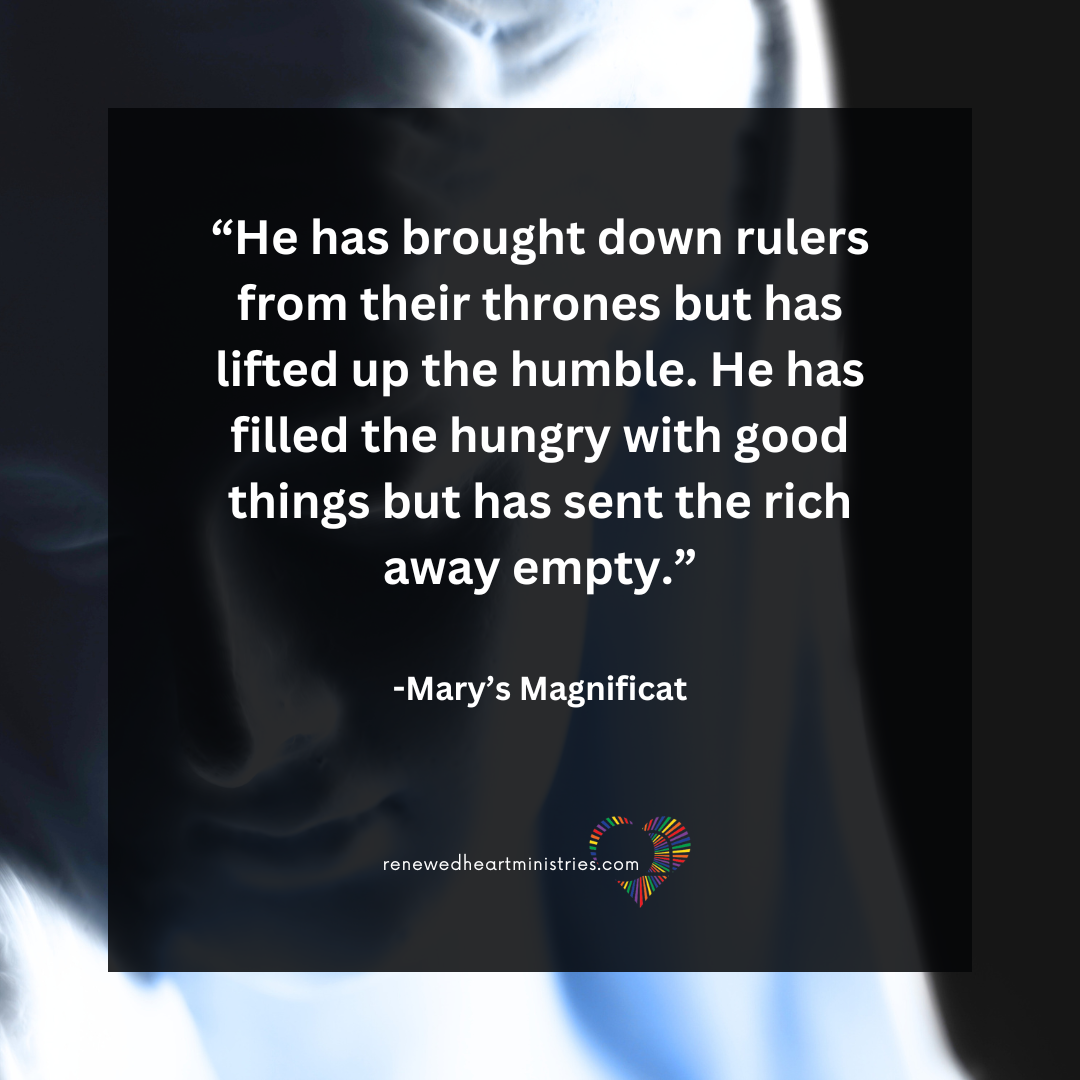
He has brought down rulers from their thrones 

but has lifted up the humble.

He has filled the hungry with good things

but has sent the rich away empty.

He has helped his servant Israel,

remembering to be merciful

to Abraham and his descendants forever,

just as he promised our ancestors.” (Luke 1:39-55)

Few stories in the gospels’ narratives of Jesus’ birth demonstrate the intersection of faith and social justice as much as Mary’s Magnificat does. This story from a patriarchal culture is packed with encouragement for us today in our struggle for justice. The story’s central figure is an unwed girl, as yet. Jesus is born to poor parents on the margins of their society, and the announcement of his birth is delivered to the working class shepherds out in the fields at night. While Jesus is still a child, his parents become migrant refugees escaping the violence of their country by fleeing across the border. For those with the awareness to notice these themes, where liberation and social salvation is emerging in this story is inspiring.  

But before any of these events, our reading this week begins with Mary’s proclamation.

Social Locations in the Christmas Narratives

A few phrases jump out at me this year as I take time to contemplate Mary’s words: the “humble state of his servant,” the actions of scattering “those who are proud in their inmost thoughts,” bringing “down rulers from their thrones,” lifting “up the humble,” filling “the hungry with good things,” and sending “the rich away empty.” Lastly, I notice that this is all a “remembering” to be “merciful to Abraham and his descendants” in accordance with a promise to their “ancestors.” This thread of a promise to the ancestors runs all the way to the book of Acts. There, the good news is not defined as something Jesus accomplished through his death. The disciples teach that death and death-dealing had been overturned by life and life-giving: Jesus, the champion of the underprivileged and marginalized, had been brought back to life. These stories connected to ancestral promises that one day injustice, oppression, and violence would be brought to an end is renewed once again: 

“We tell you the good news: What God promised our ancestors he has fulfilled for us, their children, by raising up Jesus.” (Acts 13:32-33)

Let’s start with the phrase the “humble state of his servant.” The social location of the characters in the birth stories of Jesus matters. Pay attention to who is doing what. Those on the edges and undersides of society are the ones to whom God’s social salvation and justice show up. The more socially privileged, powerful, and centered characters are the ones who feel threatened or have the role of obstructing the advent and birth of this one the hopes of a just world.

The “scattered proud” are those who believe their social standing or wealth somehow make them intrinsically worth more than those who have less money, less land, less power, and less standing. “Scattered” means that they are dispersed to various locations rather than grouped all together. It is about breaking the power the group holds over society by its concentration and centralization. They will be scattered. How? Rulers, beginning with the priesthood of the Temple State in Judea and Herod in Galilee all the way up to Caesar in Rome, will be brought down from their thrones. This isn’t the only thing that happens, though. Those scratching out survival in the more humble social locations will be lifted up too. This isn’t about those whose character or personality exhibits humility. It is about those who are living in more humble situations and stations of life. They will be lifted up. This is a precursor to such phrases as mountains being brought low, and valleys being raised, the first being made last and the last being made first. Just to make sure we are getting the point, the next phrases define what is being spoken of: the hungry who will finally be filled and the rich who will be sent away empty. 

This echoes Jesus’ sermon on the plain later in Luke where Jesus states:


“Blessed are you who are poor,

for yours is the kingdom of God.

Blessed are you who hunger now,

for you will be satisfied.

Blessed are you who weep now,

for you will laugh.” (Luke 6:20-21)

Followed immediately by:

“But woe to you who are rich,

for you have already received your comfort.

Woe to you who are well fed now,

for you will go hungry.

Woe to you who laugh now,

for you will mourn and weep.

  Woe to you when everyone speaks well of you,

for that is how their ancestors treated the false prophets.” (Luke 6:24-26)

In his book The Scandalous Gospel of Jesus, the late Peter Gomes reminds us:

“When the gospel says, ‘The last will be first, and the first will be last,’ despite the fact that it is counterintuitive to our cultural presuppositions, it is invariably good news to those who are last, and at least problematic news to those who see themselves as first.” (Peter J. Gomes, The Scandalous Gospel of Jesus: What’s So Good About the Good News?, p. 42)

And all of this is in accordance not with the hope of escaping one day to another world or retreating into inner peace. It answers the promise made to the people’s ancestors. At the time of Jesus, the Jewish prophetic hope was not to one day become a disembodied soul in some far distant heaven, but that one day all injustice, violence and oppression in our world would be put right. 

Reversing Injustice, Violence and Oppression

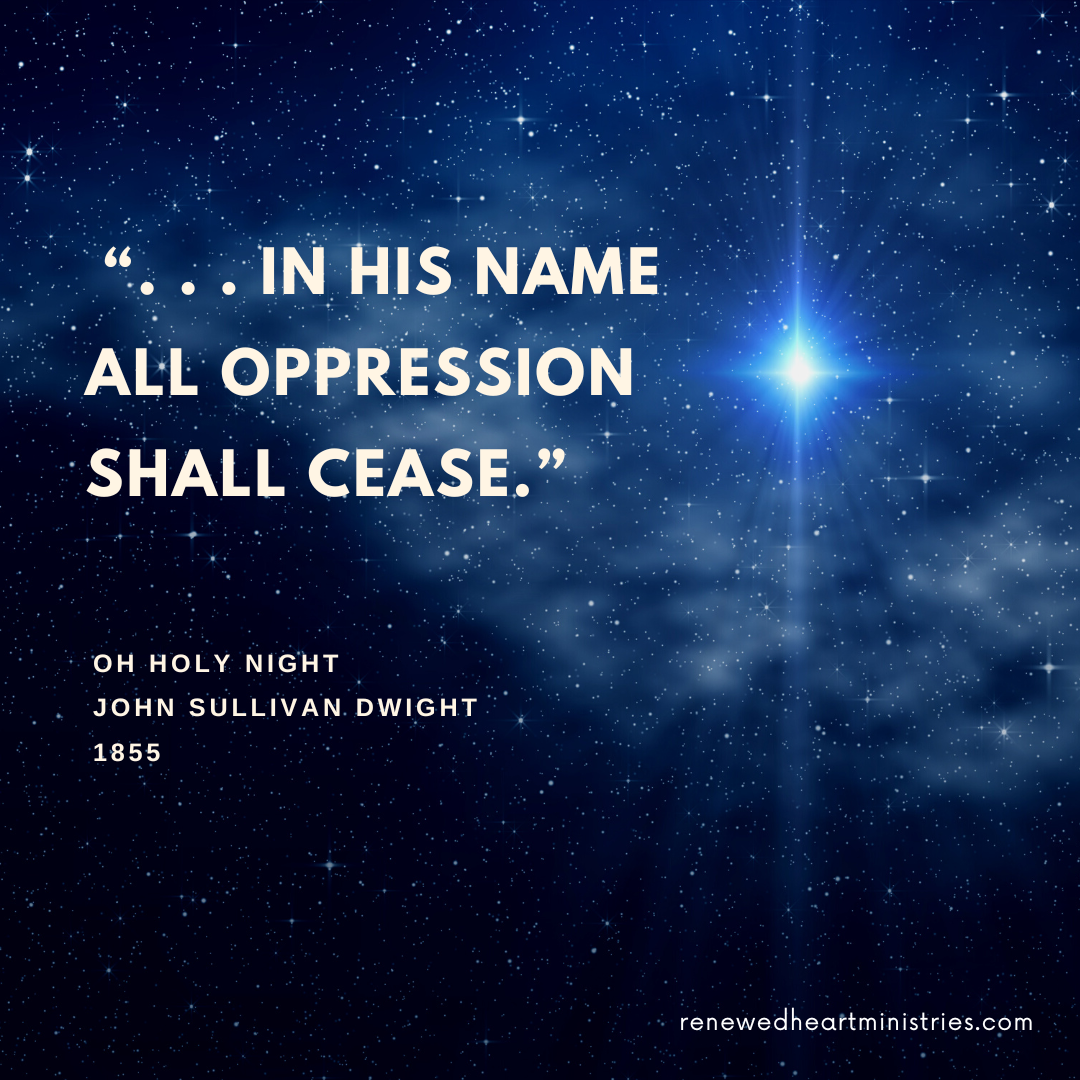
This is echoed in the words of the abolitionist Christmas hymn O, Holy Night:

“Truly He taught us to love one another;

His law is love and His gospel is peace.

Chains shall He break, for the slave is our brother,

And in His name all oppression shall cease.” 

(Placide Cappeau, translator John S. Dwight)

What I love about the birth narratives of the Jesus story is that these stories aren’t about the birth of the hope that personal, private sins can be forgiven so that one day we can go to heaven. These stores are about the hope of change being born into our world here and now. It was about the possibility of change in how our present world functions, who it privileges, and who it harms. The central figures in these stories were from classes of people the world was not built to benefit, but they saw in the birth of this child hope for a restructuring of that world until it became a world where no one has too much of anything while others don’t have enough and where everyone has enough not simply to survive but also to thrive. These are stories, historical or not, where the efforts of those working for a more compassionate, just, and safe world for everyone in every generation, are being fanned and brought back to life like coals in a fire. These are stories intended to help us connect whatever faith we may have with engagement in the world around us to mitigate or even end harm being done to those less privileged and most vulnerable. 

This year, with the events looming on our own social, political, and economic horizon, I’m pausing to allow these stories to encourage my own commitments to working for justice again. These stories whisper to me: God is with the marginalized and we are with God when we are with them.

Discussion Group Questions

1. Share something that spoke to you from this week’s Podcast episode with your discussion group.

2. How does Advent inspire you to participate in creating justice here and now, rather than than later? Share and discuss with your group.

3. What can you do this week, big or small, to continue setting in motion the work of shaping our world into a safe, compassionate, just home for everyone? 

Thanks for checking in with us, today.

I want to say a special thank you to all of our supporters out there. And if you would like to join them in supporting Renewed Heart Ministries’ work you can do so by going to renewedheartministries.com and clicking donate. 

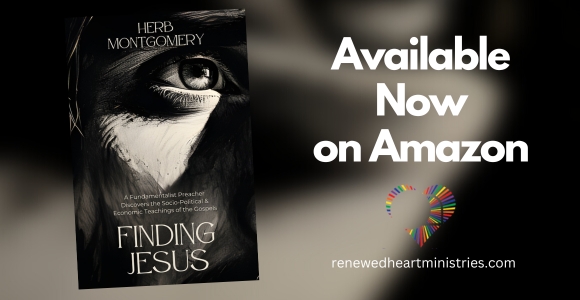
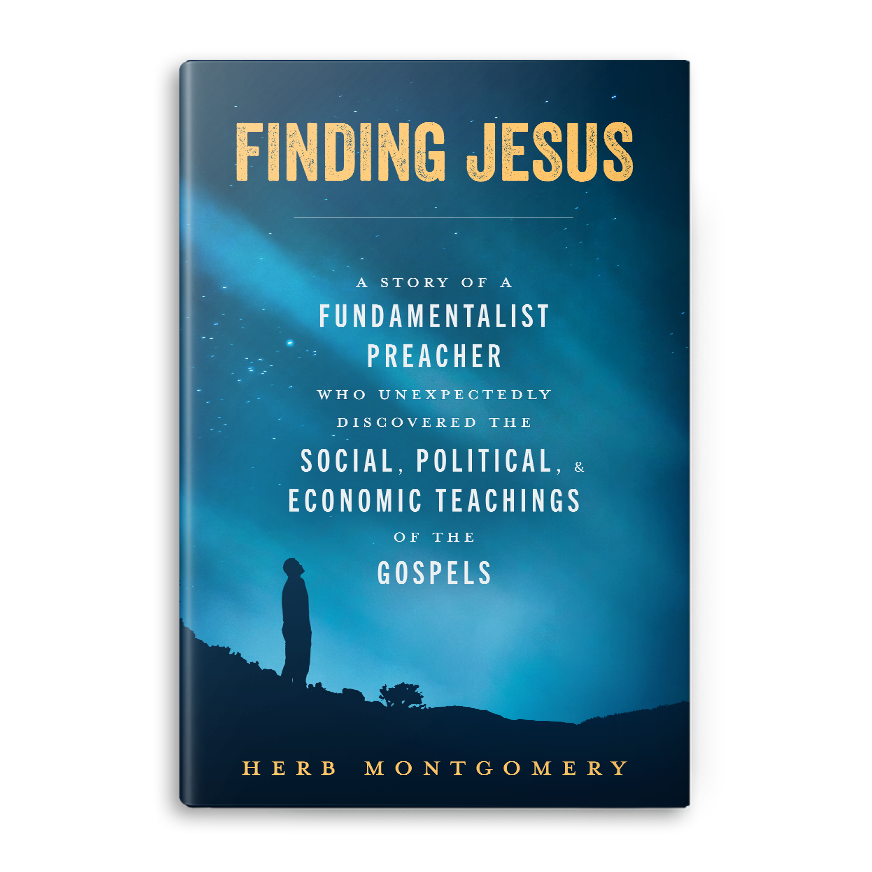
My latest book Finding Jesus: A Fundamentalist Preacher Discovers the Socio-Political and Economic Teachings of the Gospels is available now on Amazon in paperback, Kindle and also on Audible in audio book format.

As always, you can find Renewed Heart Ministries each week on X (or Twitter), Facebook, Instagram and Meta’s Threads. If you haven’t done so already, please follow us on your chosen social media platforms for our daily posts. 

Thank you for listening to The Social Jesus Podcast. If you enjoyed this podcast please take a moment to like and subscribe and if the podcast platform you’re using offers this option, please leave us a positive review. This helps others find our podcast as well.

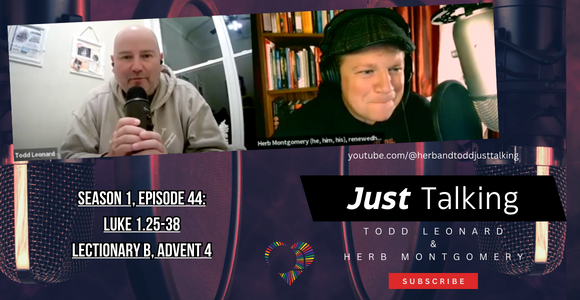
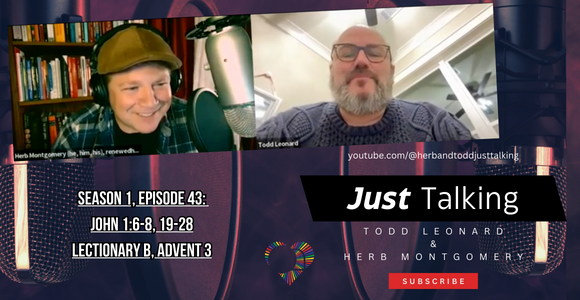
You can watch our YouTube show each week called “Just Talking”. Each week, Todd Leonard and I take a moment to talk about the gospel lectionary reading for the upcoming weekend. We’ll be talking about each reading in the context of love, inclusion, and social justice. Our hope is that our talking will be just talking (as in justice) and that during our brief conversations each week you’ll be inspired to also do more than just talking. If you teach from the lectionary each week, or if you’re just looking for some thoughts on the Jesus story from a more progressive perspective within the context of social justice, check it out, you might like it. You can find JustTalking each week on YouTube at youtube.com/@herbandtoddjusttalking. Please Like, Subscribe, hit the Notification button, and leave us a comment.

And if you’d like to reach us here at Renewed Heart Ministries through email, you can reach us at info@renewedheartministries.com.

Right where you are, keep living in love, choosing compassion, taking action, and working toward justice.

I love each of you dearly,

I’ll see you next week.


New Episode of “Just Talking” Now Online!

Season 2, Episode 41: Luke 1.39-55. Lectionary C, Advent 4

Each week, we’ll be talking about the gospel lectionary reading for the upcoming weekend in the context of love, inclusion, and social justice. Our hope is that our talking will be “just” talking (as in justice) and that during our brief conversations each week we’ll be inspired to do more than just talking.

If you teach from the lectionary each week, or if you’re just looking for some thoughts on the Jesus story from a more progressive perspective within the context of social justice, check it out at:


New Episode of The Social Jesus Podcast

A podcast where we talk about the intersection of faith and social justice and what a first century, prophet of the poor from Galilee might have to offer us today in our work of love, compassion and justice. 

This week:

Season 1 Episode 36: Mary’s Magnificat and the Intersection of Faith and Social Justice

Luke 1:39-55

“Few stories in the gospels’ narratives of Jesus’ birth demonstrate the intersection of faith and social justice as much as Mary’s Magnificat does. The social locations mentioned here matter. Pay attention to who is doing what. These stories aren’t about those whose character or personality exhibits humility. It is about those who are living in more humble situations and stations of life. They will be lifted up. This is a precursor to such phrases as mountains being brought low, and valleys being raised, the first being made last and the last being made first. And all of this is in accordance not with the hope of escaping one day to another world or retreating into inner peace. It answers the promise made to the ancestors. At the time of Jesus, the Jewish prophetic hope was not to one day become a disembodied soul in some far distant heaven, but that one day all injustice, violence and oppression in our world would be put right, here and now. For those with the awareness to notice these themes, where liberation and social salvation is emerging in these stories is inspiring for our context today.”

Available on all major podcast carriers and at:

https://the-social-jesus-podcast.simplecast.com/episodes/marys-magnificat-and-the-intersection-of-faith-and-social-justice


Finding Jesus: A Fundamentalist Preacher Discovers the Socio-Political & Economic Teachings of the Gospels.


by Herb Montgomery

Available now on Amazon!

In Finding Jesus, author Herb Montgomery delves into the profound and often overlooked political dimensions of the gospels. Through meticulous analysis of biblical texts, historical context, and social discourse, this thought-provoking book unveils the gospels’ socio-political, economic teachings as rooted in a profound concern for justice, compassion, and the well-being of the marginalized. The book navigates the intersections between faith and societal justice, presenting a compelling argument for a more socially engaged and transformative Christianity.

Finding Jesus is not just a scholarly exploration; it is a call to action. It challenges readers to reevaluate their understanding of Christianity’s role in public life and to consider how the radical teachings of the gospels can inspire a renewed commitment to justice, equality, and compassion. This book is a must-read for those seeking a deeper understanding of the social implications of Christian faith and a blueprint for building a more just and inclusive society.


Are you getting all of RHM’s Free Resources?

Free Sign Up Here

Advent and Justice Toward One Another

Marching Donations Till End of Year

As we are seeking to reach our ministry goals here at the end of 2024, we are excited to share that all donations to Renewed Heart Ministries for the remainder of year will be matched! Every dollar you give will have twice the impact, helping us further expand the work of Renewed Heart Ministries in 2025. Join us in making a difference—together, we can maximize our collective impact!

We want to take this moment to express our heartfelt gratitude to all of our supporters for your invaluable role in the Renewed Heart Ministry community and for your dedication to our mission of fostering love, justice, compassion, and healing. Your support is the bedrock of our work. Your support empowers us to do what we do. At a time when ministries like ours are being asked to achieve more with fewer resources, your support is incredibly important, and we want to simply say thank you. Whether in our larger society or within our local faith communities, Renewed Heart Ministries remains committed to advocating for change, working towards a world that is inclusive, just, and safe for everyone, and being a source of love in our world. From all of us here at Renewed Heart Ministries, thank you for your generous support. We deeply appreciate each and every one of our supporters.

If you’d like to join them in supporting our work, please go to renewedheartministries.com and click on “Donate.”  


Advent and Justice Toward One Another

Herb Montgomery, December 13, 2024

If you’d like to listen to this week’s article in podcast version click on the image below:

Our reading this third weekend of Advent is again from the gospel of Luke:

John said to the crowds coming out to be baptized by him, “You brood of vipers! Who warned you to flee from the coming wrath? Produce fruit in keeping with repentance. And do not begin to say to yourselves, ‘We have Abraham as our father.’ For I tell you that out of these stones God can raise up children for Abraham. The ax is already at the root of the trees, and every tree that does not produce good fruit will be cut down and thrown into the fire.”

“What should we do then?” the crowd asked.

John answered, “Anyone who has two shirts should share with the one who has none, and anyone who has food should do the same.”

Even tax collectors came to be baptized. “Teacher,” they asked, “what should we do?”

“Don’t collect any more than you are required to,” he told them.

Then some soldiers asked him, “And what should we do?”

He replied, “Don’t extort money and don’t accuse people falsely—be content with your pay.”

The people were waiting expectantly and were all wondering in their hearts if John might possibly be the Messiah. John answered them all, “I baptize you with water. But one who is more powerful than I will come, the straps of whose sandals I am not worthy to untie. He will baptize you with the Holy Spirit and fire. His winnowing fork is in his hand to clear his threshing floor and to gather the wheat into his barn, but he will burn up the chaff with unquenchable fire.” And with many other words John exhorted the people and proclaimed the good news to them.  (Luke 3:7-18)

In our reading, John calls the people to bear fruit worthy of their claim to have changed. Repentance involves change. Socially, this bears out. For us as a society to repent of past wrongs, we must change the parts of society that are still participating in those wrongs. To fail to bring about change is to act in a way that contradicts repentance. 

Later in Luke’s gospel, Jesus tells us that we can assess whether someone seeking to influence our communities is a “good tree” or a “bad tree,” and the test is simple: what kind of fruit does the “tree” produce? 

“No good tree bears bad fruit, nor does a bad tree bear good fruit. Each tree is recognized by its own fruit. People do not pick figs from thorn bushes, or grapes from briers. A good person brings good things out of the good stored up in their heart, and an evil person brings evil things out of the evil stored up in their heart. For the mouth speaks what the heart is full of. (Luke 6:43-45)

Character matters. Years ago I read part of Mohandas Gandhi’s autobiography where Gandhi rejects a Christian salvation that is only concerned with a “penalty for sin.” What Gandhi was questioning is whether Christianity offered any wisdom for how to bear different fruit in our lives. He was in dialogue with a Plymouth Christian who told him that change was impossible and the only hope was to be freed from the consequences of our actions. I agree with Gandhi that this is unacceptable:

‘If this be the Christianity acknowledged by all Christians, I cannot accept it. I do not seek redemption from the consequences of my sin. I seek to be redeemed from sin itself, or rather from the very thought of sin. Until I have attained that end, I shall be content to be restless.’  To which the Plymouth Brother rejoined: ‘I assure you, your attempt is fruitless. Think again over what I have said.’ (Mohandas K Gandhi; Mahadev Desai, An Autobiography: The Story of My Experiments With Truth, p. 64)

In our reading this week, John the Baptist isn’t concerned with consequences as much as change. He calls his listeners to bear different fruit in their lives.

Justice Toward One Another

In our reading this week, the fruit that John calls his listeners to bear is what we would call social justice. This term has an interesting history:

“Jesuit priest Luigi Taparelli D’Azeglio coined the term in the 1840s and based the concept on the teachings of Thomas Aquinas. Taparelli used the term to refer to the ordinary and traditional conception of justice applied to the constitutional arrangements of society. At the time, Taparelli’s concept was considered a significant contribution to conservative political philosophy… It wasn’t until the 1970s and the publication of John Rawls’s A Theory of Justice that the term became widely associated with liberal secular political philosophy, particularly with changing social institutions.” (Stephen Mattson, On Love and Mercy: A Social Justice Devotional, p. 9-10)

In our reading from Luke, John is calling for change in the social institutions of his day.

He called the crowd to distribute resources:

“Anyone who has two shirts should share with the one who has none”

He called tax collectors not to “collect any more than you are required to.” 

And he told soldiers, “Don’t extort money and don’t accuse people falsely.”

With these teachings, he was critiquing the social institutions of his time and calling for justice. Josephus corroborates Luke’s account:

“Now some of the Jews thought that the destruction of Herod’s army came from God, and was a very just punishment for what he did against John called the Baptist. For Herod had him killed, although he was a good man and had urged the Jews to exert themselves to virtue, both as to justice toward one another and reverence towards God . . .” (Antiquities 18.5.2 116-119)

Josephus told us that John’s call of renewing reverence for God was tied to the virtue of the people also practicing justice toward one another. Justice toward one another is “social” justice. Social justice is merely applying the ethic of loving your neighbor. 

In response, the people question if John could be the coming messiah they expected to put right all violence, injustice, and oppression. John response is telling.

Advent and Justice

John says, “I baptize you with water. But one who is more powerful than I will come, the straps of whose sandals I am not worthy to untie. He will baptize you with the Holy Spirit and fire. His winnowing fork is in his hand to clear his threshing floor and to gather the wheat into his barn, but he will burn up the chaff with unquenchable fire.”

The one they looked was still to come, and would plunge them in the Spirit. Luke’s gospel characterizes the what that would look like in terms of social justice: good news to the poor, freedom and sight for those imprisoned, freedom for the oppressed, and the year of the Lord’s favor when all debts would be cancelled, all slaves set free, and all lands retuned to their original owners and/or their descendants.  

“The Spirit of the Lord is on me,

because he has anointed me 

to proclaim good news to the poor.

He has sent me to proclaim freedom for the prisoners 

and recovery of sight for the blind,

to set the oppressed free,

to proclaim the year of the Lord’s favor.” (Luke 4:18-19)

Referencing language from the Hebrew, prophetic, justice tradition (see Jeremiah 15:7), John states that the coming one wouldn’t only bring justice and liberation, he would also come to clear the threshing floor, separate the wheat from the chaff, gather the wheat into his barn, and bring the chaff with unquenchable fire. 

Chaff was also a politically and socially loaded term at the time. The apocalyptic book of Daniel describes a socially just world that turns all unjust and oppressive empires into chaff.

“Then the iron, the clay, the bronze, the silver and the gold were all broken to pieces and became like chaff on a threshing floor in the summer. The wind swept them away without leaving a trace. But the rock that struck the statue became a huge mountain and filled the whole earth.” (Daniel 2:35)

This imagery resonated with the oppressed masses John spoke to, because it characterized Rome and its extensions such as Herod in Galilee and the complicit Temple State in Judea as the chaff. Systemic injustice would be burned up with fire that no human effort could halt or extinguish. And all just social elements would be like wheat to be gathered and kept, just like the wheat farmers gathered into their barns.  

All of this speaks deeply to me this year. Advent isn’t about escaping to somewhere else or about escaping inward either. Advent is about the arrival of justice where we are.And that’s what I want to be about. I have deep anxiety over what the next four years is going to bring, and I’m choosing to focus on what I can do about it. Some of us can do precious little while others, closer to the powerbrokers of our society, can do a lot. Wherever we find ourselves on that spectrum we are called to do what we can. 

Advent is about establishing justice on Earth and shaping our world into a just, safe, compassionate home for everyone. I want to be a part of the advent community, the people who bring about the arrival of that kind of world. This year, during our Advent season, I’m not looking for someone or something else to show up. I’m rededicating my commitment to show up myself in whatever ways possible for the sake of justice. 

Discussion Group Questions

1. Share something that spoke to you from this week’s Podcast episode with your discussion group.

2. Consider how is Advent could be connected to the arrival of Justice for you? Share and discuss with your group.

3. What can you do this week, big or small, to continue setting in motion the work of shaping our world into a safe, compassionate, just home for everyone? 

Thanks for checking in with us, today.

I want to say a special thank you to all of our supporters out there. And if you would like to join them in supporting Renewed Heart Ministries’ work you can do so by going to renewedheartministries.com and clicking donate. 

My latest book Finding Jesus: A Fundamentalist Preacher Discovers the Socio-Political and Economic Teachings of the Gospels is available now on Amazon in paperback, Kindle and also on Audible in audio book format.

As always, you can find Renewed Heart Ministries each week on X (or Twitter), Facebook, Instagram and Meta’s Threads. If you haven’t done so already, please follow us on your chosen social media platforms for our daily posts. 

Thank you for listening to The Social Jesus Podcast. If you enjoyed this podcast please take a moment to like and subscribe and if the podcast platform you’re using offers this option, please leave us a positive review. This helps others find our podcast as well.

You can watch our YouTube show each week called “Just Talking”. Each week, Todd Leonard and I take a moment to talk about the gospel lectionary reading for the upcoming weekend. We’ll be talking about each reading in the context of love, inclusion, and social justice. Our hope is that our talking will be just talking (as in justice) and that during our brief conversations each week you’ll be inspired to also do more than just talking. If you teach from the lectionary each week, or if you’re just looking for some thoughts on the Jesus story from a more progressive perspective within the context of social justice, check it out, you might like it. You can find JustTalking each week on YouTube at youtube.com/@herbandtoddjusttalking. Please Like, Subscribe, hit the Notification button, and leave us a comment.

And if you’d like to reach us here at Renewed Heart Ministries through email, you can reach us at info@renewedheartministries.com.

Right where you are, keep living in love, choosing compassion, taking action, and working toward justice.

I love each of you dearly,

I’ll see you next week.


New Episode of “Just Talking” Now Online!

Season 2, Episode 40: Luke 3.7-18. Lectionary C, Advent 3

Each week, we’ll be talking about the gospel lectionary reading for the upcoming weekend in the context of love, inclusion, and social justice. Our hope is that our talking will be “just” talking (as in justice) and that during our brief conversations each week we’ll be inspired to do more than just talking.

If you teach from the lectionary each week, or if you’re just looking for some thoughts on the Jesus story from a more progressive perspective within the context of social justice, check it out at:


New Episode of The Social Jesus Podcast

A podcast where we talk about the intersection of faith and social justice and what a first century, prophet of the poor from Galilee might have to offer us today in our work of love, compassion and justice. 

This week:

Season 1 Episode 35: Advent and Justice Toward One Another

Luke 3:7-18

“Advent isn’t about escaping to somewhere else or about escaping inward either. Advent is about the arrival of justice where we are. And that’s what we want to be about. We may have deep anxiety over what the next four years is going to bring, still we can choose to focus on what we can do about it. Some of us can do precious little while others, closer to the powerbrokers of our society, can do a lot. Wherever we find ourselves on that spectrum we are called to do what we can. Advent is about establishing justice on Earth and shaping our world into a just, safe, compassionate home for everyone. Let’s be a part of that kind of advent community, the people who bring about the arrival of that kind of world. This year, during our Advent season, let’s stop  looking for someone or something else to show up. Let’s rededicate our commitment to showing up in whatever ways possible for each of us for the sake of justice.”

Available on all major podcast carriers and at:

https://the-social-jesus-podcast.simplecast.com/episodes/advent-and-justice-toward-one-another


Now Available on Audible!


Finding Jesus: A Fundamentalist Preacher Discovers the Socio-Political & Economic Teachings of the Gospels.

by Herb Montgomery, Narrated by Jeff Moon

Available now on Audible!

After two successful decades of preaching a gospel of love within the Christian faith tradition Herb felt like something was missing. He went back to the gospels and began reading them through the interpretive lenses of various marginalized communities and what he found radically changed his life forever. The teachings of the Jesus in the gospel stories express a profound concern for justice, compassion, and the well-being of those in marginalized communities. This book navigates the intersections between faith and societal justice, and presents a compelling argument for a more socially compassionate and just expression of Christianity. Herb’s findings in his latest book are shared in the hopes that it will dramatically impact how you practice your Christianity, too.


Are you getting all of RHM’s Free Resources?

Free Sign Up Here

Salvation from the Margins

Marching Donations Till End of Year

As we are seeking to reach our ministry goals here at the end of 2024, we are excited to share that all donations to Renewed Heart Ministries for the remainder of year will be matched! Every dollar you give will have twice the impact, helping us further expand the work of Renewed Heart Ministries in 2025. Join us in making a difference—together, we can maximize our collective impact!

We want to take this moment to express our heartfelt gratitude to all of our supporters for your invaluable role in the Renewed Heart Ministry community and for your dedication to our mission of fostering love, justice, compassion, and healing. Your support is the bedrock of our work. Your support empowers us to do what we do. At a time when ministries like ours are being asked to achieve more with fewer resources, your support is incredibly important, and we want to simply say thank you. Whether in our larger society or within our local faith communities, Renewed Heart Ministries remains committed to advocating for change, working towards a world that is inclusive, just, and safe for everyone, and being a source of love in our world. From all of us here at Renewed Heart Ministries, thank you for your generous support. We deeply appreciate each and every one of our supporters.

If you’d like to join them in supporting our work, please go to renewedheartministries.com and click on “Donate.”  


Salvation from the Margins

Herb Montgomery, December 6, 2024

If you’d like to listen to this week’s article in podcast version click on the image below:

Our reading for the second weekend of Advent is from the gospel of Luke:

In the fifteenth year of the reign of Tiberius Caesar—when Pontius Pilate was governor of Judea, Herod tetrarch of Galilee, his brother Philip tetrarch of Iturea and Traconitis, and Lysanias tetrarch of Abilene—during the high-priesthood of Annas and Caiaphas, the word of God came to John son of Zechariah in the wilderness. He went into all the country around the Jordan, preaching a baptism of repentance for the forgiveness of sins.

As it is written in the book of the words of Isaiah the prophet:

  “A voice of one calling in the wilderness,

‘Prepare the way for the Lord,

make straight paths for him.

  Every valley shall be filled in,

every mountain and hill made low.

The crooked roads shall become straight,

the rough ways smooth.

  And all people will see God’s salvation.’ ” (Luke 3:1-6)

One of the things I appreciate about the gospel of Luke is its emphasis on distributive justice. The author of Luke models their gospel on the Hebrew justice tradition. Certain prophets began their writings in the same way:

The words of Jeremiah son of Hilkiah, one of the priests at Anathoth in the territory of Benjamin. The word of the LORD came to him in the thirteenth year of the reign of Josiah son of Amon king of Judah, and through the reign of Jehoiakim son of Josiah king of Judah, down to the fifth month of the eleventh year of Zedekiah son of Josiah king of Judah, when the people of Jerusalem went into exile. (Jeremiah 1:1-3)

The author of Luke’s gospel begins similarly, by listing those in power: The list of Roman rulers and their clients begins with Tiberius and Pilate, and ends with the regional conduits of Roman rule, Herod, Annas, and Caiaphas. This emphasizes again what we have said so often recently: the high-priesthood in Jerusalem (Annas and Caiaphas) extended the Roman government in Judea, as did Herod in Galilee. They were more than merely religious figures in the rituals of the Temple, they were also political rulers in the Temple State established and overseen by Rome. This explains why Jesus’ Temple protest at the end of this account wasn’t about maintaining the purity of religion as much as it was about Rome  economically exploiting the people through the priesthood. This is why Jesus’ protest landed him on a Roman cross as an enemy of Rome itself. 

Next, Luke’s gospel introduces to us John the Baptist as an adult. We have already been introduced to John through the story of his birth and childhood in Luke chapters 1 and 2. John was the son of a priest. He belonged to the priesthood. Yet when John became an adult, he turned his back on being part of the system and the priesthood his genealogy entitled him to be a part of. Rather than taking up the vocation of priest, John chose something different. He chose to embrace not the priestly tradition but the parallel Hebrew justice vocation of prophet. The vocations of priest (the establishment) and prophet (those who spoke truth to power when the establishment practiced injustice) were often in tension with one another. Luke’s gospel characterizes John as seeking to bring change not from the inside, from the seats of power, but from the outside speaking in. His is a voice in the “wilderness.” And this detail cannot be lost on us because it offers a bit of wisdom for many of us who feel we are in the wilderness now looking at our own political landscape.

A Voice in the Wilderness

John’s was a “voice from the wilderness.” The wilderness was more than a simple geographical location or story detail. It was also a political and economic social location as well as a religious one. In this narrative, God brings change not from within the system but from the outside in, from the margins, and from the grassroots up.

In his book Say to the Mountain, Ched Myers comments on the political, social, economic and religious implications of John’s work being located in the wilderness:

“While the margin has a primarily negative political connotation as a place of disenfranchisement, Mark ascribes to it a primarily positive theological value. It is the place where the sovereignty of God is made manifest, where the story of liberation is renewed, where God’s intervention in history occurs.” (Ched Myers, Say to This Mountain: Mark’s Story of Discipleship, p. 12)

In Luke’s gospel, John the Baptist’s and Jesus’ work is located not within the system in centered locations such as the Temple, a synagogues, or Jerusalem, but on the peripheries in places like the wilderness of Judea (John) and the rural villages of Galilee (Jesus).

These marginal social locations were charged with political meaning, meaning still relevant to us today. I want to be clear about this: In this story, God is already present and at work on the margins of this society. Often those living in centered positions of privilege mistake the work of justice as opening access so those less privileged can sit at the tables of privilege. But opening up potential to compete with others in an unjust system doesn’t change the actual system itself. Some tables shouldn’t be shared. They should be flipped (cf. Luke 19:45-46). 

Our story this week isn’t one where salvation is defined by including those on the margins at the tables of the privileged. God is already at present and at work on the margins. God and the gospel are already at work on the edges in the wilderness. God is there and those of us who live in more privileged social locations are with God when we work alongside and in solidarity with the work already in motion where God already is—on the margins.

This is the theological and political point of the “wilderness” in our narrative this week. Change, liberation, and social salvation has historically come from voices on the outside of unjust systems. It’s comes from the grassroots, the outside in and bottom up. Outside is where John shows up in our story. It’s where Jesus shows up in our story (cf. John 1:46).

The wisdom for us as we rededicate our efforts to resistance and harm mitigation in the years to come is to look to the margins. Listen to the voices of those on the edges. Look for the good that is already happening in justice efforts on the margins and get with that! Throw your energy and solidarity alongside that!

What work was taking place on the edges in this week’s story? Even in the face of deep harm and the social and economic devastation of vulnerable communities, a path for change was being prepared in the wilderness. The way was being smoothed out for justice’s arrival. In that first season of Advent, even when things looked most bleak, a way was being made out of no way on the margins. 

Preparing the Way

Our reading this week intimates what was actually happening on the margins, in the wilderness:

‘Prepare the way for the Lord,

make straight paths for him.

  Every valley shall be filled in,

every mountain and hill made low.

The crooked roads shall become straight,

the rough ways smooth.

  And all people will see God’s salvation.’” (Luke 3:1-6)

Justice doesn’t just happen in our world. It is the result of years of organizing, planning, and action. Here in my state, we still have so far to go toward economic, racial, gender and LGBTQ justice. And even though the way is uphill most of the time, there are those who are still preparing the way, straightening out crooked paths, leveling the ground, making the rough ways smoother, and working to remove the obstacles of justice. 

One such example is Fairness West Virginia, which is working in local municipalities to expand each town’s nondiscrimination ordinances to include LGBTQ nondiscrimination.  This work has been going on for over a decade now in the hope that one day we’ll have enough local municipalities with expanded ordinances that the step to make LGBTQ nondiscrimination statewide will be easy and seamless. There are many who still oppose this effort. Nonetheless, just last week another small town joined the work and expanded their nondiscrimination ordinances. 

There are others at work, too, in many other issues and areas where justice is desperately needed here in Appalachia. But this is my point: 

Even in the face of deep chaos and the many attempts to harm people, communities of justice are still present and at work. Communities of resistance formed last time we were here are still present and still at work. Yes, those at the helm of the mechanisms of injustice are more prepared this time and planning to hit the ground running the day after the inauguration. But we are still here and better prepared, too. 

Look to the margins. Look to the wilderness. Look to the voices on the edges, and to the grassroots work being done in your local communities. When you become aware of an opportunity, don’t just sit back. Add your voice. Add your energy and whatever resources you can spare. Because the promise in our reading this week is even when we are faced with the most daunting of extraordinary challenges, we can choose for justice to have the last word. The crooked roads shall become straight, the rough ways will be be made smooth. And all the people will see God’s salvation.

Discussion Group Questions

1. Share something that spoke to you from this week’s Podcast episode with your discussion group.

2. Have you ever felt like you were in the wilderness? In what ways have you experienced healing change from the margins? Share and discuss with your group.

3. What can you do this week, big or small, to continue setting in motion the work of shaping our world into a safe, compassionate, just home for everyone? 

Thanks for checking in with us, today.

I want to say a special thank you to all of our supporters out there. And if you would like to join them in supporting Renewed Heart Ministries’ work you can do so by going to renewedheartministries.com and clicking donate. 

My latest book Finding Jesus: A Fundamentalist Preacher Discovers the Socio-Political and Economic Teachings of the Gospels is available now on Amazon in paperback, Kindle and also on Audible in audio book format.

As always, you can find Renewed Heart Ministries each week on X (or Twitter), Facebook, Instagram and Meta’s Threads. If you haven’t done so already, please follow us on your chosen social media platforms for our daily posts. 

Thank you for listening to The Social Jesus Podcast. If you enjoyed this podcast please take a moment to like and subscribe and if the podcast platform you’re using offers this option, please leave us a positive review. This helps others find our podcast as well.

You can watch our YouTube show each week called “Just Talking”. Each week, Todd Leonard and I take a moment to talk about the gospel lectionary reading for the upcoming weekend. We’ll be talking about each reading in the context of love, inclusion, and social justice. Our hope is that our talking will be just talking (as in justice) and that during our brief conversations each week you’ll be inspired to also do more than just talking. If you teach from the lectionary each week, or if you’re just looking for some thoughts on the Jesus story from a more progressive perspective within the context of social justice, check it out, you might like it. You can find JustTalking each week on YouTube at youtube.com/@herbandtoddjusttalking. Please Like, Subscribe, hit the Notification button, and leave us a comment.

And if you’d like to reach us here at Renewed Heart Ministries through email, you can reach us at info@renewedheartministries.com.

Right where you are, keep living in love, choosing compassion, taking action, and working toward justice.

I love each of you dearly,

I’ll see you next week.


New Episode of “Just Talking” Now Online!

Season 2, Episode 39: Luke 3.1-6. Lectionary C, Advent 2

Each week, we’ll be talking about the gospel lectionary reading for the upcoming weekend in the context of love, inclusion, and social justice. Our hope is that our talking will be “just” talking (as in justice) and that during our brief conversations each week we’ll be inspired to do more than just talking.

If you teach from the lectionary each week, or if you’re just looking for some thoughts on the Jesus story from a more progressive perspective within the context of social justice, check it out at:


New Episode of The Social Jesus Podcast

A podcast where we talk about the intersection of faith and social justice and what a first century, prophet of the poor from Galilee might have to offer us today in our work of love, compassion and justice. 

This week:

Season 1 Episode 34: Salvation from the Margins

Luke 3:1-6

“This is the theological and political point of the “wilderness” in our narrative this week. Change, liberation, and social salvation has historically come from voices on the outside of unjust systems. It’s comes from the grassroots, the outside in and bottom up. Outside is where John shows up in our story. It’s where Jesus shows up in our story (cf. John 1:46). The wisdom for us as we rededicate our efforts to resistance and harm mitigation in the years to come is to look to the margins. Listen to the voices of those on the edges. Look for the good that is already happening in justice efforts on the margins and get with that! Throw your energy and solidarity alongside that! What work was taking place on the edges in this week’s story? Even in the face of deep harm and the social and economic devastation of vulnerable communities, a path for change was being prepared in the wilderness. The way was being smoothed out for justice’s arrival. In that first season of Advent, even when things looked most bleak, a way was being made out of no way on the margins. “

Available on all major podcast carriers and at:

https://the-social-jesus-podcast.simplecast.com/episodes/salvation-from-the-margins


Now Available on Audible!


Finding Jesus: A Fundamentalist Preacher Discovers the Socio-Political & Economic Teachings of the Gospels.

by Herb Montgomery, Narrated by Jeff Moon

Available now on Audible!

After two successful decades of preaching a gospel of love within the Christian faith tradition Herb felt like something was missing. He went back to the gospels and began reading them through the interpretive lenses of various marginalized communities and what he found radically changed his life forever. The teachings of the Jesus in the gospel stories express a profound concern for justice, compassion, and the well-being of those in marginalized communities. This book navigates the intersections between faith and societal justice, and presents a compelling argument for a more socially compassionate and just expression of Christianity. Herb’s findings in his latest book are shared in the hopes that it will dramatically impact how you practice your Christianity, too.


Are you getting all of RHM’s Free Resources?

Free Sign Up Here

Advent of Us

Marching Donations Till End of Year

As we are seeking to reach our ministry goals here at the end of 2024, we are excited to share that all donations to Renewed Heart Ministries for the remainder of year will be matched! Every dollar you give will have twice the impact, helping us further expand the work of Renewed Heart Ministries in 2025. Join us in making a difference—together, we can maximize our collective impact!

We want to take this moment to express our heartfelt gratitude to all of our supporters for your invaluable role in the Renewed Heart Ministry community and for your dedication to our mission of fostering love, justice, compassion, and healing. Your support is the bedrock of our work. Your support empowers us to do what we do. At a time when ministries like ours are being asked to achieve more with fewer resources, your support is incredibly important, and we want to simply say thank you. Whether in our larger society or within our local faith communities, Renewed Heart Ministries remains committed to advocating for change, working towards a world that is inclusive, just, and safe for everyone, and being a source of love in our world. From all of us here at Renewed Heart Ministries, thank you for your generous support. We deeply appreciate each and every one of our supporters.

If you’d like to join them in supporting our work, please go to renewedheartministries.com and click on “Donate.”  


Advent of Us

Herb Montgomery, November 29, 2024

If you’d like to listen to this week’s article in podcast version click on the image below:

Our reading this first weekend of Advent this year is from the gospel of Luke:

“There will be signs in the sun, moon and stars. On the earth, nations will be in anguish and perplexity at the roaring and tossing of the sea. People will faint from terror, apprehensive of what is coming on the world, for the heavenly bodies will be shaken. At that time they will see the Son of Man coming in a cloud with power and great glory. When these things begin to take place, stand up and lift up your heads, because your redemption is drawing near.”

He told them this parable: “Look at the fig tree and all the trees. When they sprout leaves, you can see for yourselves and know that summer is near. Even so, when you see these things happening, you know that the kingdom of God is near. Truly I tell you, this generation will certainly not pass away until all these things have happened. Heaven and earth will pass away, but my words will never pass away.

“Be careful, or your hearts will be weighed down with carousing, drunkenness and the anxieties of life, and that day will close on you suddenly like a trap. For it will come on all those who live on the face of the whole earth. Be always on the watch, and pray that you may be able to escape all that is about to happen, and that you may be able to stand before the Son of Man.” (Luke 21:25-26)

Advent is about the arrival of a looked-for event or person. Our reading this week typically looks forward to the two-millennia old hope of Jesus’ someday return. I believe the passage in our reading from the gospels this first Advent weekend can offer us some hope for our context as well.

First, this passage was written after the Romans had destroyed Jerusalem’s temple in their backlash to the liberation movement of the Jewish-Roman war of 66-69 C.E. While the preceding verses speak directly of the destruction of Jerusalem, the verses in our reading refer to a passage from the Hebrew scriptures that encouraged the Jewish people then undergoing persecution and predicted the earthly oppressors would be replaced by the eternal kingdom of God. That ancient passage was intended to offer a vision for the advent of liberation, to inspire hope when the people had very little to hope for. 

A Passage of Liberation. 

Our reading this week references apocalyptic imagery that would have been familiar to Luke’s gospel’s Jewish community. It states that even in the wake of disappointment and devastation, when their world had been turned upside down, the community could still look forward to a time of liberation: “At that time they will see the Son of Man coming in a cloud with power and great glory.”

This language from the book of Daniel was written to inspire the Jewish people suffering under the Seleucid empire. The gospels use this imagery to inspire their own people to hold on to hope despite suffering under the Roman Empire. This works because Daniel 7’s themes are of liberation from imperial oppression by foreign empires. Daniel refers to the one who will bring an end to imperial reign, violence, and injustice as the “Son of man.”

“In my vision at night I looked, and there before me was one like a son of man, coming with the clouds of heaven. He approached the Ancient of Days and was led into his presence. He was given authority, glory and sovereign power; all nations and peoples of every language worshiped him. His dominion is an everlasting dominion that will not pass away, and his kingdom is one that will never be destroyed.” (Daniel 7:13-14)

The son of man coming on the clouds to the Ancient of Days was given an everlasting kingdom where in the favor of the people suffering under oppression the power and dominance of the oppressors would be taken away:

The Ancient of Days came and pronounced judgment in favor of the holy people of the Most High, and the time came when they possessed the kingdom. (Daniel 7:22)

The court will sit, and [their] power will be taken away and completely destroyed forever. Then the sovereignty, power and greatness of all the kingdoms under heaven will be handed over to the holy people of the Most High. His kingdom will be an everlasting kingdom, and all rulers will worship and obey him.’ (Daniel 7:26-27)

In our reading, Luke takes this image and looks forward to future liberation and restoration for a people who had also experienced suffering at the hands of unjust, imperial oppressors. 

We Are The Ones We’ve Been Waiting For

Also in our reading this week is more hyperbolic and metaphorical language from the Hebrew prophets about when empires who oppressed the people would be brought down. Typically, writers disguised or hid language about earth-disrupting events such as the destruction of empires that the people hoped for in the language of heavenly disruption and upheaval. The people knew what was being referred to while also having plausible deniability for the authorities to which they answered but hoped would one day be ended. Here are a few examples:

The stars of heaven and their constellations 

will not show their light.

The rising sun will be darkened

and the moon will not give its light. (Isaiah 13:10)

When I snuff you out, I will cover the heavens 

and darken their stars;

I will cover the sun with a cloud,

and the moon will not give its light. (Ezekiel 32:7)

Before them the earth shakes,

the heavens tremble,

the sun and moon are darkened,

and the stars no longer shine. (Joel 2:10)

The sun will be turned to darkness

and the moon to blood 

before the coming of the great and dreadful day of the LORD. (Joel 2:31)

The followers of Jesus then used this same rhetoric to speak of the hope-for downfall of Rome:

I will show wonders in the heavens above 

and signs on the earth below,

blood and fire and billows of smoke.

  The sun will be turned to darkness 

and the moon to blood

before the coming of the great and glorious day of the Lord. (Acts 2:19-20)

What can we take away from all of this in our present moment?

Advent is first and foremost a time to hold on to hope in the face of every reason to have no hope. To be honest, I don’t feel like I have the energy that the next four years is going to require of us. I’m still in my own stages of grief. My anger is subsiding but it’s still there. I’ve got a long way to go to get to acceptance of what now will be, and not with resignation but with renewed commitments to justice, resistance, working harder to mitigate harms to the vulnerable in our society. I’m not looking forward to the chaos that will put so many in harm’s way.

And yet, we aren’t the first ones to have to live through times we wish we didn’t have to. The people of our passage this week found reasons to keep looking forward to hope as well. They found reasons to keep living in love, to keep choosing compassion, to keep taking action. And we must, too. The difference is that whereas the original audience of our passage was still looking forward to the advent of a hero who would save them, two millennia later, many of us realize that hero worship can be counter productive and even harmful to our justice work. To quote the poet June Jordan, “We are the ones we’ve been waiting for.” 

This Advent season I’m reminded that Advent is about something finally showing up. We are the ones who, especially at this moment, must show up. We are the ones  we are mutually depending on now. Jesus taught about the power of community to survive and transform the world around us even in the most difficult of times, shaping our world into a safe, compassionate, just home for everyone. Jesus taught us not to isolate and rely just on ourselves, but to come together. No matter what the future brought, we could get through it together, knowing we had each other’s back. This is what is described in the opening chapter of the books of Acts in the wake of Jesus’ crucifixion. And, once again, this is now the time to renew our commitment to making sure everyone is taken care of.

I know from the last time that what is coming won’t be easy. But this Advent, I’m choosing to hold on to the hope that resistance and survival is possible as we renew our commitments to each other. We are the one’s we’ve been waiting for.

Discussion Group Questions

1. Share something that spoke to you from this week’s Podcast episode with your discussion group.

2. What does Advent mean for you this year? Share and discuss with your group.

3. What can you do this week, big or small, to continue setting in motion the work of shaping our world into a safe, compassionate, just home for everyone? 

Thanks for checking in with us, today.

I want to say a special thank you to all of our supporters out there. And if you would like to join them in supporting Renewed Heart Ministries’ work you can do so by going to renewedheartministries.com and clicking donate. 

My latest book Finding Jesus: A Fundamentalist Preacher Discovers the Socio-Political and Economic Teachings of the Gospels is available now on Amazon in paperback, Kindle and also on Audible in audio book format.

As always, you can find Renewed Heart Ministries each week on X (or Twitter), Facebook, Instagram and Meta’s Threads. If you haven’t done so already, please follow us on your chosen social media platforms for our daily posts. 

Thank you for listening to The Social Jesus Podcast. If you enjoyed this podcast please take a moment to like and subscribe and if the podcast platform you’re using offers this option, please leave us a positive review. This helps others find our podcast as well.

You can watch our YouTube show each week called “Just Talking”. Each week, Todd Leonard and I take a moment to talk about the gospel lectionary reading for the upcoming weekend. We’ll be talking about each reading in the context of love, inclusion, and social justice. Our hope is that our talking will be just talking (as in justice) and that during our brief conversations each week you’ll be inspired to also do more than just talking. If you teach from the lectionary each week, or if you’re just looking for some thoughts on the Jesus story from a more progressive perspective within the context of social justice, check it out, you might like it. You can find JustTalking each week on YouTube at youtube.com/@herbandtoddjusttalking. Please Like, Subscribe, hit the Notification button, and leave us a comment.

And if you’d like to reach us here at Renewed Heart Ministries through email, you can reach us at info@renewedheartministries.com.

Right where you are, keep living in love, choosing compassion, taking action, and working toward justice.

I love each of you dearly,

I’ll see you next week.


New Episode of “Just Talking” Now Online!

Season 2, Episode 38: Luke 21.25-36. Lectionary C, Advent 1

Each week, we’ll be talking about the gospel lectionary reading for the upcoming weekend in the context of love, inclusion, and social justice. Our hope is that our talking will be “just” talking (as in justice) and that during our brief conversations each week we’ll be inspired to do more than just talking.

If you teach from the lectionary each week, or if you’re just looking for some thoughts on the Jesus story from a more progressive perspective within the context of social justice, check it out at:


New Episode of The Social Jesus Podcast

A podcast where we talk about the intersection of faith and social justice and what a first century, prophet of the poor from Galilee might have to offer us today in our work of love, compassion and justice. 

This week:

Season 1 Episode 33: Advent of Us

Luke 21:25-36

“This Advent season I’m reminded that Advent is about something finally showing up. We are the ones, especially at this moment, who must show up. We are the ones we are mutually depending on right now. Jesus taught about the power of community to survive and transform the world around us even in the most difficult of times, shaping our world into a safe, compassionate, just home for everyone. Jesus taught us not to isolate and rely just on ourselves, but to come together. No matter what the future brought, we could get through it together, knowing we had each other’s back. And, once again, this is now the time to renew our commitment to making sure everyone is taken care of. I know from the last time that what is coming won’t be easy. But this Advent, I’m choosing to hold on to the hope that resistance and survival is possible as we renew our commitments to each other. We are the one’s we’ve been waiting for.”

Available on all major podcast carriers and at:

https://the-social-jesus-podcast.simplecast.com/episodes/advent-of-us


Now Available on Audible!


Finding Jesus: A Fundamentalist Preacher Discovers the Socio-Political & Economic Teachings of the Gospels.

by Herb Montgomery, Narrated by Jeff Moon

Available now on Audible!

After two successful decades of preaching a gospel of love within the Christian faith tradition Herb felt like something was missing. He went back to the gospels and began reading them through the interpretive lenses of various marginalized communities and what he found radically changed his life forever. The teachings of the Jesus in the gospel stories express a profound concern for justice, compassion, and the well-being of those in marginalized communities. This book navigates the intersections between faith and societal justice, and presents a compelling argument for a more socially compassionate and just expression of Christianity. Herb’s findings in his latest book are shared in the hopes that it will dramatically impact how you practice your Christianity, too.


Are you getting all of RHM’s Free Resources?

Free Sign Up Here

Subversive Narratives of Advent

All Year-End donations are going matched!

Please see the various thank you offers following this week’s article, below.

Logo and Website


New Episode of JustTalking!

Season 1, Episode 44: Luke 1.25-38. Lectionary B, Advent 4

Each week, we’ll be talking about the gospel lectionary reading for the upcoming weekend. We’ll be talking about each reading in the context of love, inclusion, and societal justice. Our hope is that our talking will be just talking (as in justice) and that during our brief conversations each week you’ll be inspired to also do more than just talking.

If you teach from the lectionary each week, or if you’re just looking for some thoughts on the Jesus story from a more progressive perspective within the context of social justice, check it out, you might like it.

You can find the latest show on YouTube at

Season 1, Episode 44: Luke 1.25-38. Lectionary B, Advent 4

 or (@herbandtoddjusttalking)

Please Like, Subscribe, hit the Notification button, and leave us a comment

Thanks in advance for watching!


Subversive Narratives of Advent

Herb Montgomery | December 22, 2023

To listen to this week’s eSight as a podcast episode click here.

” The virgin birth narrative was an economic and political critique of Rome’s predation and extraction. It presented Jesus’ alternative social vision, the gospel of the kingdom rooted in the Golden rule, enemy love, nonviolence, resource-sharing, wealth redistribution as restoration and reparations, and more. It was a social vision where people committed to taking care of one another as the objects of God’s love and making sure each person had what they needed to thrive.”

Our reading this last weekend of Advent is found in the gospel of Luke. It is the story of the angel’s visit to Mary:

In the sixth month of Elizabeth’s pregnancy, God sent the angel Gabriel to Nazareth, a town in Galilee, to a virgin pledged to be married to a man named Joseph, a descendant of David. The virgin’s name was Mary. The angel went to her and said, “Greetings, you who are highly favored! The Lord is with you.” 

Mary was greatly troubled at his words and wondered what kind of greeting this might be. But the angel said to her, “Do not be afraid, Mary; you have found favor with God. You will conceive and give birth to a son, and you are to call him Jesus. He will be great and will be called the Son of the Most High. The Lord God will give him the throne of his father David, and he will reign over Jacob’s descendants forever; his kingdom will never end.”

“How will this be,” Mary asked the angel, “since I am a virgin?” 

The angel answered, “The Holy Spirit will come on you, and the power of the Most High will overshadow you. So the holy one to be born will be called the Son of God. Even Elizabeth your relative is going to have a child in her old age, and she who was said to be unable to conceive is in her sixth month. For no word from God will ever fail.”

“I am the Lord’s servant,” Mary answered. “May your word to me be fulfilled.” Then the angel left her. (Luke 1:26-38)

This is the only version of the Jesus story in our sacred canon where Jesus’ mother Mary is explicitly characterized as a “virgin.” Some translations hint at this status in Matthew, but here in Luke it is explicit. To wrap our heads around this narrative element, we need to first back up and look at the social context in which this story was originally written, and consider the larger themes of the gospel Luke for that audience. In our treatment of Rome this week, I’m deeply indebted to the work of Walter Brueggemann, specifically his book Tenacious Solidarity. If you would like to learn more about Rome’s system than we have space for this week, let me heartily suggest chapter 2 of that work.

In Rome’s economic system, money was extracted from the commoners and funneled into the various strata of the wealthy elite. This created a society in Judea where there was no middle class. The people were reduced to peasants who kept getting squeezed to become poorer, while the rich, wealthy elite continued to become richer. As Walter Brueggemann explains, systems of economic extraction are unsustainable. You can’t continue to squeeze the poor indefinitely. At some point the system breaks and we know that this system broke violently in the late 60s C.E. in Judea.

What we are reading in Luke this week happens while that overtaxation and economic predation was still going strong. The ruling elites of Jesus’ society (Herod, the priesthood, the scribes, the elders—the Temple State) were becoming wealthier and wealthier the more they complied with Rome’s extraction system. Through taxes, loans, and rents, the people became debtors, and then as debtors they were reduced to peasants. They lost their land through their inability to repay debts they’d incurred just to survive, and they became dependent on a system that continued to take from them. It was a downward economic spiral in which many of the people were helpless.

This is the social, economic and political context in which the gospel of Luke was written. And this is why in Luke’s gospel we meet Zacchaeus, a tax collector. Tax collectors were an integral part of this exploitative system, and they become wealthy themselves as a result. Luke introduces a few tax collectors (e.g. Luke 3:12, 5:27–30, 7:29, 34, 15:1, 18:10–13), but the most infamous of them is Zacchaeus. When Zacchaeus encounters Jesus’ teachings, he chooses to reject the system that made him wealthy and embraces a path of restoration and reparations instead (see Luke 19:10).

In Luke’s gospel we learn what moved Zacchaeus to change. It was Jesus’ teaching of “the Kingdom” as contrasted with the Roman Empire. Though the language of Kingdom is complicated and challenges readers today, its original audience would have understood it as a contrast to Rome’s system of imperial predation.

After all, Jesus’ ministry in Luke begins with him calling for all debts to be cancelled in the year of Jubilee, the year of the Lord’s favor (see Luke 4:18-19). Jesus’ gospel of the kingdom called for debts to be cancelled and for the Torah practices of land being given back to its original owner, indentured slaves being set free, and debt cancellation. This debt was how the system kept the masses permanently dependent and the few elites as continual recipients of funneled wealth. Jesus’ solution was simply to cancel all the debts as the Torah had taught. His “kingdom” wasn’t about saying a special prayer so you could go to heaven when you died. It was a life-giving system in the here and now as an alternative to Rome’s system of economic extraction.

In Luke’s gospel, we also encounter what we call today Mary’s Magnificat:

He has brought down rulers from their thrones 

but has lifted up the humble.

  He has filled the hungry with good things

but has sent the rich away empty. (Luke 1:52-53)

The words of Simeon are similar:

“This child is destined to cause the falling (elite, rich rulers) and rising (poor and hungry) of many in Israel.” (Luke 2:34)

Repeatedly in Luke, Jesus calls his listeners to reject Rome’s predatory system and embrace the Kingdom instead (see Luke 12:13-31). Jesus says things to those benefitting from Rome’s system like, “Watch out! Be on your guard against all kinds of greed; life does not consist in an abundance of possessions.” (Luke 12:15) 

The word for greed here is pleonexia. Thayer defines this as the covetousness or the desire to have more specifically what others have. It is the insatiable desire for what belongs to another. This is exactly what was happening at that time. The wealthy elite were insatiable, extracting everything the masses had to enrich themselves. The Roman power brokers ran after such things too, but Jesus tells his listeners, “Seek first his kingdom, and all that you need will be given to you” (Luke 12:31). Today we here in the U.S. live in a debt economy with many experiencing only subsistence living. I wonder how Luke’s gospel would read if it was written for us?

Further in Luke’s gospel, Jesus critiques his society. In Luke 14, he gives the parable of the banquet illustrating a preferential option for those societally marginalized. In the parable of the manager who cooked the books when his unsustainable situation ran out, Jesus declares that you can’t serve both God and money (Luke 16:13). This saying makes perfect sense in its social context. Luke 16 also includes the parable of the rich man and Lazarus, which ends by calling the living to listen to the law’s debt forgiveness and the prophets’ critique of economic extraction. 

This is the context in which we also need to understand Luke’s virgin birth. Jesus’ alternative vision for human society competed with the Roman system. And as difficult as it may be for post-Enlightenment minds to grapple with, if Jesus’ kingdom was to compete in that world, Jesus had to be put on the same standing as Caesar. Every Caesar around the time of Jesus (Julius, Augustus, Tiberius) was considered to be a son of God, or even divine themselves. In true Hellenistic fashion, they were each born of human mothers who had a one-night stand with one of Rome’s gods. Judaism’s culture at the time that Luke was written was a kind of purity culture. What better way for Jewish Jesus followers living under Rome to place Jesus on the same level of the Caesars, than for Jesus’ mother Mary to be a virgin who gave birth afer conceived miraculously and sexlessly by the Holy Spirit?

In our culture today, it is easy for us to fixate scientifically on the virgin birth story. But the narrative in Luke’s gospel is not a science presentation. Luke’s world was one where the supernatural was taken for granted. In that context, the virgin birth narrative was an economic and political critique of Rome’s predation and extraction. It presented Jesus’ alternative social vision, the gospel of the kingdom rooted in the Golden rule, enemy love, nonviolence, resource-sharing, wealth redistribution as restoration and reparations, and more. It was a social vision where people committed to taking care of one another as the objects of God’s love and making sure each person had what they needed to thrive. 

This brings me to our context today. Today we live in an economic system with a wealth gap that’s growing exponentially. It’s a complex system where the little that people have is being extracted from them more and more and channeled into the pockets of those who already have more than they could ever possible use.

This Advent, what is Jesus’ gospel of the kingdom in Luke saying to each of us? How is it calling us to take up the work of making our world a safe, compassionate, just home for all? Each of us is part of one another. Each bears the image of the Divine. And each is the object of a Divine love that Jesus’ kingdom calls us to participate in for them, too.

HeartGroup Application

1. Share something that spoke to you from this week’s eSight/Podcast episode with your HeartGroup.

2. As Advent wraps us and we move into Christmas, what beautiful things in our world do you see arriving at the present time? What social changes are you thankful for? What social changes presently taking place inspire you to keep working for change? Discuss with your group.

3. What can you do this week, big or small, to continue setting in motion the work of shaping our world into a safe, compassionate, just home for everyone?

Thanks for checking in with us, today.

I want to say a special thank you to all of our supporters out there. And if you would like to join them in supporting Renewed Heart Ministries’ work you can do so by going to renewedheartministries.com and clicking donate. 

You can find Renewed Heart Ministries on X (or Twitter), Facebook, Instagram and Meta’s new Threads. If you haven’t done so already, please follow us on your chosen social media platforms for our daily posts. Also, if you enjoy listening to the Jesus for Everyone podcast, please like and subscribe to the JFE podcast through the podcast platform you use and consider taking some time to give us a review. This helps others find our podcast as well.

You can watch our new YouTube show called “Just Talking” each week. Todd Leonard and I take a moment to talk about the gospel lectionary reading for the upcoming weekend. We’ll be talking about each reading in the context of love, inclusion, and societal justice. Our hope is that our talking will be just talking (as in justice) and that during our brief conversations each week you’ll be inspired to also do more than just talking.

If you teach from the lectionary each week, or if you’re just looking for some thoughts on the Jesus story from a more progressive perspective within the context of social justice, check it out, you might like it. You can find JustTalking each week on YouTube at youtube.com/@herbandtoddjusttalking. Please Like, Subscribe, hit the Notification button, and leave us a comment.

And if you’d like to reach us here at Renewed Heart Ministries through email, you can reach us at info@renewedheartministries.com.

My new book, Finding Jesus: A story of a fundamentalist preacher who unexpectedly discovered the social, political, and economic teachings of the Gospels is now also available at renewedheartministries.com

Right where you are, keep living in love, choosing compassion, taking action, and working toward justice.

I love each of you dearly,

I’ll see you next week.


Matching Donations for the Rest of 2023!

As 2023 is coming to a close, we are deeply thankful for each of our supporters.

To express that gratitude we have a lot to share.

First, all donations during these last two months of the year will be matched, dollar for dollar, making your support of Renewed Heart Ministries go twice as far.

“Donate.”

Also, to everyone how makes a special one-time donation in any amount to support our work this holiday season we will be giving away a free copy of The Bible & LGBTQ Adventists.

When making your donation all you have to do indicate you would like to take advantage of this offer by writing Free Book” either in the comments section of your online donation or in the memo of your check if you are mailing your donation.

“Donate.”

Lastly, its time for our annual Shared Table event once again. For all those who choose to become one of our monthly sustaining partners for 2024 by clicking the “Check this box to make it a monthly recurring donation” online, we will be sending out one our a handmade Renewed Heart Ministries Shared-Table Pottery Bowl made by Crystal and Herb as a thank you gift for your support. Becoming a monthly sustaining parter enables RHM to set our ministry project goals and budget for the coming year.

To become a monthly sustaining partner, go to renewedheartministries.com/donate and sign up for an automated recurring monthly donation of any amount by clicking the “Check this box to make it a monthly recurring donation” option. Or if you are using Paypal, select “Make this a monthly donation.”

We will be starting out the new year by sending out these lovely bowls as our gift to you to thank you for your sustaining support. Look for them to arrive during the months of January and February.

Our prayer is that whether displayed or used these bowls will be reminder of Jesus’ gospel of love, caring and shared table fellowship. They also make a great gift or conversation starter, as well.

If you are already one of our sustaining partners for 2024, we want to honor your existing continued support of Renewed  Heart Ministries, too. You’ll also receive one of our Shared Table Pottery Bowls as a thank you.

No matter how you choose to donate to support Renewed Heart Ministries’ work this holiday season, thank you for partnering with us to further Jesus’ vision of a world filled with compassion, love, and people committed to taking care of one another. Together we are working toward a safer, more compassionate, and just world both for today and for eternity.

From each of us here at RHM, thank you!

We wish you so much joy, peace, and blessings as 2023 comes to a close. Your support sustains our ongoing work in the coming year.

You can donate online by going to renewedheartministries.com and clicking “Donate.”

Or you can make a donation by mail at:

Renewed Heart Ministries
PO Box 1211
Lewisburg, WV 24901

In this coming year, together, we will continue to be a light in our world sharing Jesus’ gospel of love, justice and compassion.


Now Available at Renewed Heart Ministries!

Herb’s new book Finding Jesus: A story of a fundamentalist preacher who unexpectedly discovered the social, political, and economic teachings of the Gospels, is available at renewedheartministries.com.

Get your copy today at renewedheartministries.com


Are you receiving all of RHM’s free resources each week?

Begin each day being inspired toward love, compassion, action, and justice. Free Sign-Up HERE

Advent and the Joy of Working for a Better World

All Year-End donations are going matched!

Please see the various thank you offers following this week’s article, below.

Logo and Website


New Episode of JustTalking!

Season 1, Episode 43: John 1.6-8, 19-28. Lectionary B, Advent 3

Each week, we’ll be talking about the gospel lectionary reading for the upcoming weekend. We’ll be talking about each reading in the context of love, inclusion, and societal justice. Our hope is that our talking will be just talking (as in justice) and that during our brief conversations each week you’ll be inspired to also do more than just talking.

If you teach from the lectionary each week, or if you’re just looking for some thoughts on the Jesus story from a more progressive perspective within the context of social justice, check it out, you might like it.

You can find the latest show on YouTube at

Season 1, Episode 43: John 1.6-8, 19-28. Lectionary B, Advent 3

 or (@herbandtoddjusttalking)

Please Like, Subscribe, hit the Notification button, and leave us a comment

Thanks in advance for watching!


Advent and the Joy of Working for a Better World

Herb Montgomery | December 15, 2023

To listen to this week’s eSight as a podcast episode click here.

“As difficult as doing preparation work in the wilderness is at times, there is joy in knowing what it is you are preparing the way for. We are preparing the way for the advent of a world where love is our guiding principle. There is joy in that assurance, and our labors are not in vain.”

Our reading this month is from the gospel of John.

There was a man sent from God whose name was John. He came as a witness to testify concerning that light, so that through him all might believe. He himself was not the light; he came only as a witness to the light. 

Now this was John’s testimony when the Jewish leaders in Jerusalem sent priests and Levites to ask him who he was. He did not fail to confess, but confessed freely, “I am not the Messiah.”

They asked him, “Then who are you? Are you Elijah?” 

He said, “I am not.” 

“Are you the Prophet?” 

He answered, “No.” 

Finally they said, “Who are you? Give us an answer to take back to those who sent us. What do you say about yourself?” 

John replied in the words of Isaiah the prophet, “I am the voice of one calling in the wilderness, ‘Make straight the way for the Lord.’” 

Now the Pharisees who had been sent questioned him, “Why then do you baptize if you are not the Messiah, nor Elijah, nor the Prophet?” 

“I baptize with water,” John replied, “but among you stands one you do not know. He is the one who comes after me, the straps of whose sandals I am not worthy to untie.”

This all happened at Bethany on the other side of the Jordan, where John was baptizing. (John 1:6-8, 19-28)

Most scholars agree that John’s gospel was the last gospel in our canon to be written. Mark’s was the earliest, and Matthew and Luke were written between Mark and John. In Mark’s gospel John is a contemporary of Jesus. Jesus begins as one of John’s disciples and part of his Jewish reformation and renewal movement. Once John is imprisoned, Jesus begins his own renewal movement. One gets the impression that John’s followers and Jesus’ followers were in two related but separate movements, contemporaries and occasionally in competition.

John’s gospel presents John the Baptist as Jesus’ forerunner, the one who announced Jesus’ arrival. In Mark, Jesus is baptized by John, but as the gospels progresses, this fact becomes less and less emphasized until John’s gospel, which conveniently leaves out John’s role in Jesus’ baptism. It is cryptic about it, and this may reflect tensions that had developed between John’s followers and Jesus’s. If that’s the case, the Jesus community may not have wanted to see Jesus subordinated to John in any way in the gospels, even if only by implication.

John’s gospel seems to downgrade John the Baptist for the purpose of exalting Jesus. One example is how, in this gospel, John the Baptist rejects attempts to be identified as Messiah, the Prophet, or Elijah.

In Mark, Matthew and Luke, on the other hand, John the Baptist is dramatically associated with Elijah:

Jesus replied, “To be sure, Elijah does come first, and restores all things. Why then is it written that the Son of Man must suffer much and be rejected? But I tell you, Elijah has come, and they have done to him everything they wished, just as it is written about him.” (Mark 9:12-13)

And if you are willing to accept it, he is the Elijah who was to come. (Matthew 11:14)

And he will go on before the Lord, in the spirit and power of Elijah, to turn the hearts of the parents to their children and the disobedient to the wisdom of the righteous—to make ready a people prepared for the Lord.” (Luke 1:17, cf. Micah 4:5)

But in our reading this week, John the Baptist rejects being associated with any of these figures, including Elijah.

What I appreciate about the picture of John the Baptist that we get in the gospel of John is that it unequivocally locates John’s ministry. Each gospel tells us where John taught. 

When John is cornered in our reading by people demanding that he answer their questions about who he was, John’s response is:

“I am the voice of one calling in the wilderness, ‘Make straight the way for the Lord.’”

Last week I wrote at length about John’s ministry being in the wilderness as we considered the way John’s ministry is characterized in the gospel of Mark. If you haven’t already read that article, you’ll find it helpful as a foundation for what I’m about to say. (Read that article)

The wilderness in the gospels is contrasted with the central location of power: the temple state, centered in the temple as the capital in Jerusalem. John is characterized as working outside the centers of power, property, and privilege. Here I want to be very clear that this is not imagery that symbolizes some conflict between Christianity and Judaism. Rather, these are symbols of long standing within the Jewish society at that time. They represent Jewish voices in conflict with one another over what fidelity to the God of the Torah looked like in relation to economics, society and politics. These were all deeply religious matters in that culture, and religious fidelity demanded people live in certain economic, social, and political ways.

The symbols being contrasted, then, are those of priest and prophet. The priesthood represented those who had been coopted by Rome and were barely more than puppets of the absentee emperor, Caesar. Whoever held the position of high priest was designated as such by Rome, and the priesthood’s chief responsibility was to ensure that whatever actions took place in the Jewish temple state, those actions did not violate the Pax Romana. 

In contrast to this elite class in John’s society was the symbol of a prophet in the wilderness. This symbol stood in a long lineage with Hebrew prophets who continually called those in positions of power back to justice. Again, how the most vulnerable in society was taken care of or exploited was a matter of fidelity to their God. Faithfulness to God implied living justly in relation to one’s neighbor. Those who participated in the Hebrew prophetic justice tradition stood on the margins of their society, calling those at the center and those in positions of power and privilege to return to a path of distributive justice. 

This rich heritage of justice prophets is the heritage that John the Baptist is characterized with in each gospel. 

What does this say to us today?

For me it tells me to keep my ear to the ground and my eyes not on the establishment; to listen to those outside, on the edges, the margins, the undersides of society, and the calls for justice they are making. It brings to mind such movements today as the Poor People’s Campaign, or the Movement for Black Lives, or movements like we saw at Standing Rock calling for justice for indigenous communities and an end to the extraction and pollution of their lands. It brings to mind the recent Women’s March on Washington and movements for LGBTQ justice and inclusion. It brings to mind those today calling for justice for the thousands of innocent Palestinian lives being taken. Who is in the wilderness today? What justice needs are they raising awareness for? Or, in the language of this week’s passage, what is the “way” that they are preparing for God’s future of love, compassion, justice and safety to arrive, a world that is a safe, compassionate, just home for us all?

Who, in other words, are the John the Baptists of today? 

In our story, John was preparing the way for the one whom the synoptic gospel authors borrowed the words of Isaiah to describe:

“Here is my servant, whom I uphold,

my chosen one in whom I delight;

I will put my Spirit on him,

and he will bring justice to the nations.” (Isaiah 42:1, cf. Matthew 3:17; Mark 1:11; Luke 3:22)

Who today are preparing the way for justice to be brought to the nations?

Who are the ones on the edges, working within the grassroots of our communities preparing the way so that when justice is accomplished, it finds rich soil to take root and remain? 

In our story, when God’s just future arrived, it was crucified by the powerful, privileged and propertied. We have the ability today to write a different ending to the story, one that stands awake to the resurrection of God’s just future. 

But this season is not the season of Easter, yet. This season is advent. And this weekend’s theme is the joy of Advent. As difficult as doing preparation work in the wilderness is at times, there is joy in knowing what it is you are preparing the way for. We are preparing the way for the advent of a world where love is our guiding principle. There is joy in that assurance, and our labors are not in vain.

HeartGroup Application

1. Share something that spoke to you from this week’s eSight/Podcast episode with your HeartGroup.

2. Advent is that season where we take time again to reflect on the joy of the kind of world we are working toward. What joy are you finding in Advent this year? Share and discuss with your group.

3. What can you do this week, big or small, to continue setting in motion the work of shaping our world into a safe, compassionate, just home for everyone?

Thanks for checking in with us, today.

I want to say a special thank you to all of our supporters out there. And if you would like to join them in supporting Renewed Heart Ministries’ work you can do so by going to renewedheartministries.com and clicking donate. 

You can find Renewed Heart Ministries on X(Twitter), Facebook, Instagram and Threads. If you haven’t done so already, please follow us on your chosen social media platforms for our daily posts. Also, if you enjoy listening to the Jesus for Everyone podcast, please like and subscribe to the JFE podcast through the podcast platform you use and consider taking some time to give us a review. This helps others find our podcast as well.

You can watch our new YouTube show called “Just Talking” each week. Todd Leonard and I take a moment to talk about the gospel lectionary reading for the upcoming weekend. We’ll be talking about each reading in the context of love, inclusion, and societal justice. Our hope is that our talking will be just talking (as in justice) and that during our brief conversations each week you’ll be inspired to also do more than just talking.

If you teach from the lectionary each week, or if you’re just looking for some thoughts on the Jesus story from a more progressive perspective within the context of social justice, check it out, you might like it. You can find JustTalking each week on YouTube at youtube.com/@herbandtoddjusttalking. Please Like, Subscribe, hit the Notification button, and leave us a comment.

And if you’d like to reach us here at Renewed Heart Ministries through email, you can reach us at info@renewedheartministries.com.

My new book, Finding Jesus: A story of a fundamentalist preacher who unexpectedly discovered the social, political, and economic teachings of the Gospels is now also available at renewedheartministries.com

Right where you are, keep living in love, choosing compassion, taking action, and working toward justice.

I love each of you dearly,

I’ll see you next week.


Matching Donations for the Rest of 2023!

As 2023 is coming to a close, we are deeply thankful for each of our supporters.

To express that gratitude we have a lot to share.

First, all donations during these last two months of the year will be matched, dollar for dollar, making your support of Renewed Heart Ministries go twice as far.

“Donate.”

Also, to everyone how makes a special one-time donation in any amount to support our work this holiday season we will be giving away a free copy of The Bible & LGBTQ Adventists.

When making your donation all you have to do indicate you would like to take advantage of this offer by writing Free Book” either in the comments section of your online donation or in the memo of your check if you are mailing your donation.

“Donate.”

Lastly, its time for our annual Shared Table event once again. For all those who choose to become one of our monthly sustaining partners for 2024 by clicking the “Check this box to make it a monthly recurring donation” online, we will be sending out one our a handmade Renewed Heart Ministries Shared-Table Pottery Bowl made by Crystal and Herb as a thank you gift for your support. Becoming a monthly sustaining parter enables RHM to set our ministry project goals and budget for the coming year.

To become a monthly sustaining partner, go to renewedheartministries.com/donate and sign up for an automated recurring monthly donation of any amount by clicking the “Check this box to make it a monthly recurring donation” option. Or if you are using Paypal, select “Make this a monthly donation.”

We will be starting out the new year by sending out these lovely bowls as our gift to you to thank you for your sustaining support. Look for them to arrive during the months of January and February.

Our prayer is that whether displayed or used these bowls will be reminder of Jesus’ gospel of love, caring and shared table fellowship. They also make a great gift or conversation starter, as well.

If you are already one of our sustaining partners for 2024, we want to honor your existing continued support of Renewed  Heart Ministries, too. You’ll also receive one of our Shared Table Pottery Bowls as a thank you.

No matter how you choose to donate to support Renewed Heart Ministries’ work this holiday season, thank you for partnering with us to further Jesus’ vision of a world filled with compassion, love, and people committed to taking care of one another. Together we are working toward a safer, more compassionate, and just world both for today and for eternity.

From each of us here at RHM, thank you!

We wish you so much joy, peace, and blessings as 2023 comes to a close. Your support sustains our ongoing work in the coming year.

You can donate online by going to renewedheartministries.com and clicking “Donate.”

Or you can make a donation by mail at:

Renewed Heart Ministries
PO Box 1211
Lewisburg, WV 24901

In this coming year, together, we will continue to be a light in our world sharing Jesus’ gospel of love, justice and compassion.


Now Available at Renewed Heart Ministries!

Herb’s new book Finding Jesus: A story of a fundamentalist preacher who unexpectedly discovered the social, political, and economic teachings of the Gospels, is available at renewedheartministries.com.

Get your copy today at renewedheartministries.com


Are you receiving all of RHM’s free resources each week?

Begin each day being inspired toward love, compassion, action, and justice. Free Sign-Up HERE

Advent and Change from the Margins

All Year-End donations made from now

till the end of the year will be matched!

Please see the various thank you offers following this week’s article, below.

Logo and Website


New Episode of JustTalking!

Season 1, Episode 42: Mark 1.1-8. Lectionary B, Advent 2

Each week, we’ll be talking about the gospel lectionary reading for the upcoming weekend. We’ll be talking about each reading in the context of love, inclusion, and societal justice. Our hope is that our talking will be just talking (as in justice) and that during our brief conversations each week you’ll be inspired to also do more than just talking.

If you teach from the lectionary each week, or if you’re just looking for some thoughts on the Jesus story from a more progressive perspective within the context of social justice, check it out, you might like it.

You can find the latest show on YouTube at

Season 1, Episode 42: Mark 1.1-8. Lectionary B, Advent 2

 or (@herbandtoddjusttalking)

Please Like, Subscribe, hit the Notification button, and leave us a comment

Thanks in advance for watching!


Advent and Change from the Margins

Herb Montgomery | December 10, 2023

To listen to this week’s eSight as a podcast episode click here.

“Very rarely has social change ever come from the center or top of a social structure. Social change has most often come from the margins, from the outside in, and from the grassroots, from the bottom up. In the beginning of Mark, this truth is being told again.”

Our reading this second weekend of Advent is from the first chapter of Mark:

The beginning of the good news about Jesus the Messiah, the Son of God, as it is written in Isaiah the prophet: 

  “I will send my messenger ahead of you,

who will prepare your way” — 

“a voice of one calling in the wilderness,

‘Prepare the way for the Lord,

make straight paths for him.’ ” 

And so John the Baptist appeared in the wilderness, preaching a baptism of repentance for the forgiveness of sins. The whole Judean countryside and all the people of Jerusalem went out to him. Confessing their sins, they were baptized by him in the Jordan River. John wore clothing made of camel’s hair, with a leather belt around his waist, and he ate locusts and wild honey. And this was his message: “After me comes the one more powerful than I, the straps of whose sandals I am not worthy to stoop down and untie. I baptize you with water, but he will baptize you with the Holy Spirit.” (Mark 1:1-8)

Mark’s gospel associates John the Baptist with two passages from the Hebrew passages that are conflated here.

The first is from Malachi: “I will send my messenger, who will prepare the way before me. Then suddenly the Lord you are seeking will come to his temple.” (Malachi 3:1)

The second is from Isaiah:

  “A voice of one calling:

‘In the wilderness prepare 

the way for the LORD;

make straight in the desert 

a highway for our God.’” (Isaiah 40:3)

Although the text only references Isaiah by name, Mark’s author is doing something interesting by juxtaposing these two passages. The passage combines Hebrew prophetic imagery of God coming to cleanse God’s temple (Malachi) with language that originally referred to liberation from foreign oppression, specifically Babylonian captivity, and a path being made in wilderness for the liberated exiles upon which to return (Isaiah).

To understand this kind of rhetoric we have to look at what was happening in John’s and Jesus’ society when Mark was written. The temple state leadership had become corrupted, little more than a wealthy, elite class that helped maintain Roman oppression in Judea and the surrounding regions. The poor were getting poorer and the wealthy were getting richer through their complicity and cooperation with Rome. Many of the common people were simply trying to scratch out an existence. 

Then John appears in the wilderness. This narrative element clues us in to the fact that John will be working outside the establishment. He will be calling for change (repentance) from the edges and undersides of his society, outside of the official channels. Social salvation is not coming from the established center, but from the margins.

Commenting on this imagery and its possible application to our lives today, Ched Myers writes:

“The experience of wilderness is common to the vast majority of people in the world. Their reality is at the margins of almost everything that is defined by the modern Western world as ‘the good life.’ This wilderness has not been created by accident. It is the result of a system stacked against many people and their communities, whose lives and resources are exploited to benefit a very small minority at the centers of power and privilege. It is created by lifestyles that deplete and pollute natural resources. It is created by the forced labor of impoverished farmers who strip steep mountain-sides in order to eke out an existence from infertile terrain while the most arable land produces profit for a few families. Wilderness is the residue of war and greed and injustice . . . One of the first steps of hope for people in such wilderness places is to understand that their situation reflects social and political forces, not the divine will . . . While the margin has a primarily negative political connotation as a place of disenfranchisement, Mark ascribes to it a primarily positive theological value. It is the place where the sovereignty of God is made manifest, where the story of liberation is renewed, where God’s intervention in history occurs.” (Ched Myers, Marie Dennis, Joseph Nangle, Cynthia Moe-Lobeda, & Stuart Taylor, Say to This Mountain: Mark’s Story of Discipleship, Orbis Books, p. 11-23)

Luke’s gospel makes this point about John the Baptist even more forcefully by showing that John’s father was part of the temple establishment (see Luke 1:9-10). Luke’s implication is that John the Baptist came from the center of society, and chose to reject that social location with all of its privileges to work for change from the outside.

Very rarely has social change ever come from the center or top of a social structure. Social change has most often come from the margins, from the outside in, and from the grassroots, from the bottom up. In the beginning of Mark, this truth is being told again. 

John’s preaching centered on a specific place in the wilderness, the River Jordan. The Jordan provided water that was moving: flowing, “living water” for what grew to be the central ritual associated with John’s preaching, baptism by immersion in “living water.” Historical Jesus scholars today understand John’s baptism to be economic and political as well as religious. All of three categories combined in John’s preaching and baptism, calling the people to return to fidelity to the God of the Torah, especially in regards to the Torah’s economic justice teachings. Again this point would be forcibly made in Luke’s gospel as well:

“‘What should we do then?’ the crowd asked. John answered, ‘Anyone who has two shirts should share with the one who has none, and anyone who has food should do the same.’ Even tax collectors came to be baptized. ‘Teacher,’ they asked, ‘what should we do?’ ‘Don’t collect any more than you are required to,’ he told them. Then some soldiers asked him, ‘And what should we do?’ He replied, ‘Don’t extort money and don’t accuse people falsely—be content with your pay.’” (Luke 3:10-14)

Many historical Jesus scholars believe that John’s baptism was a form of protest against the temple establishment that had become an extension of oppressive Roman rule. John’s calls for repentance and promise of forgiveness weren’t for personal or individual sins that violated one private piety. In Luke, John rails against economic and social sins, practices that impact a people’s lives together, as a society.

Josephus, who was much more closely located to the characters in these stories than we are, also writes about John, his popularity with people, and the threat the established elites, specifically Herod, came to feel they were:

“John was a good man who had admonished the Jews to practice virtue and to treat each other justly, with due respect to God, and to join in the practice of baptism. John’s view was that correct behavior was a necessary preliminary to baptism, if baptism was to be acceptable to God. Baptism wasn’t not to gain pardon for sins committed but for the purification of the body, which had already been consecrated by righteousness. Herod became alarmed at the crowds that gathered around John, who aroused them to fever pitch with his sermons. Eloquence that had such a powerful effect on people might lead to sedition, since it seemed that the people were prepared to do everything he recommended.” (Josephus, History of the Jews, 18:116-119)

The story of John the Baptist in our reading this week is a story of just change originating from the margins of a society in which both John and Jesus were both figureheads. This is a story that resonates with me today too.

This Advent season, what is God doing right now on the margins? I can’t help but think of movements for change that have formed around concerns for gender justice, racial justice, LGBTQ justice, Indigenous people’s justice, economic justice, and ecological justice. There are so many more areas where justice is needed; these are just the ones that come to my mind first. 

Advent announces that something has come: something we have long hoped for is here. Of the many things we hope for, one is a world characterized by distributive justice. A world, here and now, that is a safe, compassionate and just home for everyone, where no one is afraid and, in the words of the Hebrew prophets, “Everyone will sit under their own vine and under their own fig tree” (Micah 4:4).

This second week of Advent, we read about a time when that world came to us once before. That world would soon be beheaded with John and crucified with Jesus. But when it came in both John and Jesus’s ministries, it began on the margins. This calls to me to pay attention to what’s happening in our time on the edges, the grassroots, and the wildernesses of our own society. For each time that the world we hope for has arrived throughout history, it has most often started there. 

Where is that world showing up again for us today? And who can we come alongside to participate in making that world a reality for us all?

HeartGroup Application

1. Share something that spoke to you from this week’s eSight/Podcast episode with your HeartGroup.

2. How has your own living on the margins or listening to others who do informed how you read the Jesus story? Share and discuss with your group.

3. What can you do this week, big or small, to continue setting in motion the work of shaping our world into a safe, compassionate, just home for everyone?

Thanks for checking in with us, today.

I want to say a special thank you to all of our supporters out there. And if you would like to join them in supporting Renewed Heart Ministries’ work you can do so by going to renewedheartministries.com and clicking donate. 

You can find Renewed Heart Ministries on Twitter, Facebook, Instagram and Threads. If you haven’t done so already, please follow us on your chosen social media platforms for our daily posts. Also, if you enjoy listening to the Jesus for Everyone podcast, please like and subscribe to the JFE podcast through the podcast platform you use and consider taking some time to give us a review. This helps others find our podcast as well.

You can watch our new YouTube show called “Just Talking” each week. Todd Leonard and I take a moment to talk about the gospel lectionary reading for the upcoming weekend. We’ll be talking about each reading in the context of love, inclusion, and societal justice. Our hope is that our talking will be just talking (as in justice) and that during our brief conversations each week you’ll be inspired to also do more than just talking.

If you teach from the lectionary each week, or if you’re just looking for some thoughts on the Jesus story from a more progressive perspective within the context of social justice, check it out, you might like it. You can find JustTalking each week on YouTube at youtube.com/@herbandtoddjusttalking. Please Like, Subscribe, hit the Notification button, and leave us a comment.

And if you’d like to reach us here at Renewed Heart Ministries through email, you can reach us at info@renewedheartministries.com.

My new book, Finding Jesus: A story of a fundamentalist preacher who unexpectedly discovered the social, political, and economic teachings of the Gospels is now also available at renewedheartministries.com

Right where you are, keep living in love, choosing compassion, taking action, and working toward justice.

I love each of you dearly,

I’ll see you next week.


Matching Donations for the Rest of 2023!

As 2023 is coming to a close, we are deeply thankful for each of our supporters.

To express that gratitude we have a lot to share.

First, all donations during these last two months of the year will be matched, dollar for dollar, making your support of Renewed Heart Ministries go twice as far.

“Donate.”

Also, to everyone how makes a special one-time donation in any amount to support our work this holiday season we will be giving away a free copy of The Bible & LGBTQ Adventists.

When making your donation all you have to do indicate you would like to take advantage of this offer by writing Free Book” either in the comments section of your online donation or in the memo of your check if you are mailing your donation.

“Donate.”

Lastly, its time for our annual Shared Table event once again. For all those who choose to become one of our monthly sustaining partners for 2024 by clicking the “Check this box to make it a monthly recurring donation” online, we will be sending out one our a handmade Renewed Heart Ministries Shared-Table Pottery Bowl made by Crystal and Herb as a thank you gift for your support. Becoming a monthly sustaining parter enables RHM to set our ministry project goals and budget for the coming year.

To become a monthly sustaining partner, go to renewedheartministries.com/donate and sign up for an automated recurring monthly donation of any amount by clicking the “Check this box to make it a monthly recurring donation” option. Or if you are using Paypal, select “Make this a monthly donation.”

We will be starting out the new year by sending out these lovely bowls as our gift to you to thank you for your sustaining support. Look for them to arrive during the months of January and February.

Our prayer is that whether displayed or used these bowls will be reminder of Jesus’ gospel of love, caring and shared table fellowship. They also make a great gift or conversation starter, as well.

If you are already one of our sustaining partners for 2024, we want to honor your existing continued support of Renewed  Heart Ministries, too. You’ll also receive one of our Shared Table Pottery Bowls as a thank you.

No matter how you choose to donate to support Renewed Heart Ministries’ work this holiday season, thank you for partnering with us to further Jesus’ vision of a world filled with compassion, love, and people committed to taking care of one another. Together we are working toward a safer, more compassionate, and just world both for today and for eternity.

From each of us here at RHM, thank you!

We wish you so much joy, peace, and blessings as 2023 comes to a close. Your support sustains our ongoing work in the coming year.

You can donate online by going to renewedheartministries.com and clicking “Donate.”

Or you can make a donation by mail at:

Renewed Heart Ministries
PO Box 1211
Lewisburg, WV 24901

In this coming year, together, we will continue to be a light in our world sharing Jesus’ gospel of love, justice and compassion.


Now Available at Renewed Heart Ministries!

Herb’s new book Finding Jesus: A story of a fundamentalist preacher who unexpectedly discovered the social, political, and economic teachings of the Gospels, is available at renewedheartministries.com.

Get your copy today at renewedheartministries.com


Are you receiving all of RHM’s free resources each week?

Begin each day being inspired toward love, compassion, action, and justice. Free Sign-Up HERE

Advent and the Refusal to Lose Hope

We want to say a special thank you to all of our supporters.

Please see the various thank you offers following this week’s article, below.

Logo and Website


New Episode of JustTalking!

Season 1, Episode 41: Mark 13.24-37. Lectionary B, Advent 1

Each week, we’ll be talking about the gospel lectionary reading for the upcoming weekend. We’ll be talking about each reading in the context of love, inclusion, and societal justice. Our hope is that our talking will be just talking (as in justice) and that during our brief conversations each week you’ll be inspired to also do more than just talking.

If you teach from the lectionary each week, or if you’re just looking for some thoughts on the Jesus story from a more progressive perspective within the context of social justice, check it out, you might like it.

You can find the latest show on YouTube at

Season 1, Episode 41: Mark 13.24-37. Lectionary B, Advent 1

 or (@herbandtoddjusttalking)

Please Like, Subscribe, hit the Notification button, and leave us a comment

Thanks in advance for watching!


Herb Montgomery | December 1, 2023

To listen to this week’s eSight as a podcast episode click here.

When the words of our reading this week were written the world looked, like ours, pretty hopeless. This week’s reading is a reminder to me that, as Mariame Kaba often says, hope is and has always been, a discipline. The arc of our universe can still bend toward justice if we choose. Yes, there are other forces at work for sure. But this advent, I’m renewing my efforts to not give up.”

Our reading this week is from the gospel of Mark:

“But in those days, following that distress, 

  ‘the sun will be darkened,

and the moon will not give its light;

  the stars will fall from the sky,

and the heavenly bodies will be shaken.’ 

“At that time people will see the Son of Man coming in clouds with great power and glory. And he will send his angels and gather his elect from the four winds, from the ends of the earth to the ends of the heavens.

“Now learn this lesson from the fig tree: As soon as its twigs get tender and its leaves come out, you know that summer is near. Even so, when you see these things happening, you know that it is near, right at the door. Truly I tell you, this generation will certainly not pass away until all these things have happened. Heaven and earth will pass away, but my words will never pass away.

“But about that day or hour no one knows, not even the angels in heaven, nor the Son, but only the Father. Be on guard! Be alert! You do not know when that time will come. It’s like a man going away: He leaves his house and puts his servants in charge, each with their assigned task, and tells the one at the door to keep watch. 

“Therefore keep watch because you do not know when the owner of the house will come back—whether in the evening, or at midnight, or when the rooster crows, or at dawn. If he comes suddenly, do not let him find you sleeping. What I say to you, I say to everyone: ‘Watch!’” 

(Mark 13.24-37, Scriptures taken from the Holy Bible, New International Version®, NIV®. Copyright © 1973, 1978, 1984, 2011 by Biblica, Inc.™ Used by permission of Zondervan. All rights reserved worldwide. www.zondervan.com The “NIV” and “New International Version” are trademarks registered in the United States Patent and Trademark Office by Biblica, Inc.™)

Advent begins a new year in the lectionary. Advent is the first season of the Christian church’s calendar year and comes before Christmas. The word “advent” means arrival. Considering Christianity’s claims for what has already arrived alongside what Christians still look forward to arriving in the future is a life-giving way to shape our focus as Jesus followers and renew our commitments to that focus as another year begins. 


First let’s consider the imagery used in this week’s reading. Early Jewish Jesus followers would have been familiar with this language because it appeared repeatedly in the Jewish apocalyptic scriptures. 

“In my vision at night I looked, and there before me was one like a son of man, coming with the clouds of heaven. He approached the Ancient of Days and was led into his presence. He was given authority, glory and sovereign power; all nations and peoples of every language worshiped him. His dominion is an everlasting dominion that will not pass away, and his kingdom is one that will never be destroyed. (Daniel 7:13-14)

“The stars of heaven and their constellations will not show their light. The rising sun will be darkened and the moon will not give its light.” (Isaiah 13:10)

“I will cover the heavens and darken their stars; I will cover the sun with a cloud, and the moon will not give its light.” (Ezekiel 32:7)

“Before them the earth shakes, the heavens tremble, the sun and moon are darkened, and the stars no longer shine.” (Joel 2:10)

“The sun will be turned to darkness and the moon to blood before the coming of the great and dreadful day of the LORD.” (Joel 2:31)

Remember the community these scriptures written for was not only trying to make sense of the crucifixion of Jesus, but were also absorbing the destruction of Jerusalem and the Temple. Early Christians appropriated the imagery and repurposed it for their own time:

“I will show wonders in the heavens above and signs on the earth below, blood and fire and billows of smoke. The sun will be turned to darkness and the moon to blood before the coming of the great and glorious day of the Lord.” (Acts 2:19, cf. Revelation 6:12 and 8:12)

In none of these Christian passages does the text read, “As Jesus said,” or “As Jesus told us.” Each reference relies directly on the Hebrew scriptures just as much as the gospel authors did. 

Next in this week’s reading, we encounter the imagery of the fig tree to represent the changes that the Jesus community was witnessing and being impacted by. These changes were like the buds on a fig tree, signs that the political, economic, religious and social seasons were changing. The Jesus community had just witnessed the stressful events leading up to the destruction of Jerusalem and in the wake of the tragic events that followed it. Their whole world was either in the process of being turned upside down or just had been. 

It is in this context that Mark’s author encourages their fellow Jesus community to be on watch, alert and ready for what was to come next, and to hope that what would come next would be the return of their Jesus. Consider this passage from Paul:

“Now, brothers and sisters, about times and dates we do not need to write to you, for you know very well that the day of the Lord will come like a thief in the night. While people are saying, ‘Peace and safety,’ destruction will come on them suddenly, as labor pains on a pregnant woman, and they will not escape. But you, brothers and sisters, are not in darkness so that this day should surprise you like a thief. You are all children of the light and children of the day. We do not belong to the night or to the darkness. So then, let us not be like others, who are asleep, but let us be awake and sober. For those who sleep, sleep at night, and those who get drunk, get drunk at night. But since we belong to the day, let us be sober, putting on faith and love as a breastplate, and the hope of salvation as a helmet. For God did not appoint us to suffer wrath but to receive salvation through our Lord Jesus Christ. He died for us so that, whether we are awake or asleep, we may live together with him. Therefore encourage one another and build each other up, just as in fact you are doing.” (1 Thessalonians 5:1-11)

It is helpful to remember that our reading this week was possibly written as far as two decades after Paul’s letter to the Thessalonians. A lot had happened in this region of the world between the era of Jesus ministry and then, and the area looked very different during the late 60s and early 70s C.E. than it did during the late 20s and early 30s C.E. It was important to encourage Jesus followers to hang in there, not to lose hope, and keep following the teachings of Jesus as they looked for the advent God’s just future to arrive any time. 

There are also portions of Mark where Jesus announces God’s just future had already arrived as in the very first chapter of Mark:

“The time has come,” Jesus said. “The kingdom of God has come! Repent and believe the good news!” (Mark 1:15)

But again, that was in the late 20s or early 30s. If Mark was written around Jerusalem’s destruction in the 70s, it would’ve been a hard or even impossible sell to say God’s just future had come. The Jesus community of that era could much more easily attach their hopes on the future than to the tensions and tragedies before their very eyes. 

What implications might this forward look of hope offer us today? Just that. The future can contain hope if we choose for it to. Here in the U.S. many are struggling and feeling squeezed economically, even with our economy having narrowly escaped an impending recession three years ago. Things are still tough now. Political circuses continue to inflict stress to varying degrees on parts of our population. Globally we continually witness the violence of war and killing of innocent lives. And ecologically, some say we’ve reached the point of no return when it comes to global capitalist growth and extraction, which have rapidly taxed our planet’s resources to the breaking point, setting us on a course of making our planet uninhabitable. 

It’s no wonder we have a generation now that lives with concerning levels of anxiety and/or feelings of helplessness. And in the context of our reading this week, I’m sure the originally intended audience for our reading felt something very similar in response to the challenges of their time and place.

In those anxious moments, the author of the gospel of Mark admonished their listeners not to give up and not to let go. This gospel taught them to keep following the ethics, values and life-giving teachings of their Jesus stories. To keep choosing to love one’s neighbor, and set in motion the Golden Rule so it could change the world. To keep pursuing nonviolence as a means of changing. To keep choosing to stay committed to taking care of each other in community rather than falling into the lies of self-sufficiency and independent self-reliance. And this is what our reading is whispering to me this week, too. 

When the words of our reading this week were written the world looked, like ours, pretty hopeless. This week’s reading is a reminder to me that, as Mariame Kaba often says, hope is and has always been, a discipline. The arc of our universe can still bend toward justice if we choose. Yes, there are other forces at work for sure. But this advent, I’m renewing my efforts to not give up. This advent I’m renewing my belief that the advent of a just, safe, compassionate world for all of us is still possible. I choose to continue believing that the future is not fixed but open. And I’m choosing to keep believing that, though I don’t know all our future holds, I know that we can face those challenges together in more life-giving ways than we can on our own.

HeartGroup Application

1. Share something that spoke to you from this week’s eSight/Podcast episode with your HeartGroup.

2. In what ways are you choosing to keep holding on to hope this season? Share and discuss with your group.

3. What can you do this week, big or small, to continue setting in motion the work of shaping our world into a safe, compassionate, just home for everyone?

Thanks for checking in with us, today.

I want to say a special thank you to all of our supporters out there. And if you would like to join them in supporting Renewed Heart Ministries’ work you can do so by going to renewedheartministries.com and clicking donate. 

You can find Renewed Heart Ministries on Twitter, Facebook, Instagram and Threads. If you haven’t done so already, please follow us on your chosen social media platforms for our daily posts. Also, if you enjoy listening to the Jesus for Everyone podcast, please like and subscribe to the JFE podcast through the podcast platform you use and consider taking some time to give us a review. This helps others find our podcast as well.

You can watch our new YouTube show called “Just Talking” each week. Todd Leonard and I take a moment to talk about the gospel lectionary reading for the upcoming weekend. We’ll be talking about each reading in the context of love, inclusion, and societal justice. Our hope is that our talking will be just talking (as in justice) and that during our brief conversations each week you’ll be inspired to also do more than just talking.

If you teach from the lectionary each week, or if you’re just looking for some thoughts on the Jesus story from a more progressive perspective within the context of social justice, check it out, you might like it. You can find JustTalking each week on YouTube at youtube.com/@herbandtoddjusttalking. Please Like, Subscribe, hit the Notification button, and leave us a comment.

And if you’d like to reach us here at Renewed Heart Ministries through email, you can reach us at info@renewedheartministries.com.

My new book, Finding Jesus: A story of a fundamentalist preacher who unexpectedly discovered the social, political, and economic teachings of the Gospels is now also available at renewedheartministries.com

Right where you are, keep living in love, choosing compassion, taking action, and working toward justice.

I love each of you dearly,

I’ll see you next week.


Hope is a discipline


We want to say a special thank you to all of our supporters.

Please see the various thank you offers following this week’s article, below.

Logo and Website


New Episode of JustTalking!

Season 1, Episode 40: Matthew 25.31-46. Lectionary A, Proper 29

Each week, we’ll be talking about the gospel lectionary reading for the upcoming weekend. We’ll be talking about each reading in the context of love, inclusion, and societal justice. Our hope is that our talking will be just talking (as in justice) and that during our brief conversations each week you’ll be inspired to also do more than just talking.

If you teach from the lectionary each week, or if you’re just looking for some thoughts on the Jesus story from a more progressive perspective within the context of social justice, check it out, you might like it.

You can find the latest show on YouTube at

Season 1, Episode 40: Matthew 25.31-46. Lectionary A, Proper 29

 or (@herbandtoddjusttalking)

Please Like, Subscribe, hit the Notification button, and leave us a comment

Thanks in advance for watching!


Sheep and Goats

Sheep and Goats

Herb Montgomery | November 24, 2023

To listen to this week’s eSight as a podcast episode click here.

“Pay close attention when certain sectors of Christianity choose to cherry pick and prioritize the death dealing passages of their sacred text, rather than the humanizing and life-giving passages.”

Our reading this week is from the gospel of Matthew:

“When the Son of Man comes in his glory, and all the angels with him, he will sit on his glorious throne. All the nations will be gathered before him, and he will separate the people one from another as a shepherd separates the sheep from the goats. He will put the sheep on his right and the goats on his left.

Then the King will say to those on his right, ‘Come, you who are blessed by my Father; take your inheritance, the kingdom prepared for you since the creation of the world. For I was hungry and you gave me something to eat, I was thirsty and you gave me something to drink, I was a stranger and you invited me in, I needed clothes and you clothed me, I was sick and you looked after me, I was in prison and you came to visit me.’

Then the righteous will answer him, ‘Lord, when did we see you hungry and feed you, or thirsty and give you something to drink? When did we see you a stranger and invite you in, or needing clothes and clothe you? When did we see you sick or in prison and go to visit you?’

The King will reply, ‘Truly I tell you, whatever you did for one of the least of these brothers and sisters of mine, you did for me.’

Then he will say to those on his left, ‘Depart from me, you who are cursed, into the eternal fire prepared for the devil and his angels. For I was hungry and you gave me nothing to eat, I was thirsty and you gave me nothing to drink, I was a stranger and you did not invite me in, I needed clothes and you did not clothe me, I was sick and in prison and you did not look after me.’

They also will answer, ‘Lord, when did we see you hungry or thirsty or a stranger or needing clothes or sick or in prison, and did not help you?’

He will reply, ‘Truly I tell you, whatever you did not do for one of the least of these, you did not do for me.’

“Then they will go away to eternal punishment, but the righteous to eternal life.”

(Matthew 25:31-46*)

This week’s lectionary reading is one of my favorite passages in the gospel of Matthew. Some sectors of Christianity tend to read this passage individualistically, as if it’s a scene of individual people standing before an apocalyptic judgment seat. I encourage us not to fall into the individualism ditch this week. The passage in Matthew states that it is “the nations,” collective people groups, that are being gathered. This collective view aligns with the use of the phrase “son of man” and a judgment, from the Hebrew apocalyptic book of Daniel. Daniel 7 doesn’t address individuals or their personal, private deeds or misdeeds. It uses rich imagery to address empires, nations, and collective groups, not individuals. It is also telling that no one responds in this passage responds with the question “when did I see you”: they all ask “when did we see you.”

So this parable has a collective nature. It isn’t about how we live our lives as individuals or whether we practice personal charity. It’s about how we choose to structure our collective lives together and who we choose to care for. How do we systemically, as a nation, divide up resources, and how do we collectively distribute power? Do we privilege some above others? Or do we ensure everyone in our society is taken care of? More about this in a moment.

As well as painting a collective image, this passage also divides the nations into “sheep” and “goats.” My brother is a farmer here in Appalachia. He has both sheep and goats along with other livestock. Neither the sheep or the goats are expendable: both have value and worth. But you relate to both very differently. Sheep can be led, whereas goats are stubborn and must often be driven.

This parable is about how nations choose to relate to hunger and thirst, who gets food, shelter or clothing. We know it’s an economic parable because prisons in Jesus’ culture were not used for the crimes we use prisons for today. For example, if someone was guilty of murder, they would be executed, not imprisoned. Prisons were used for economic or political reasons. If someone was in prison, they were most likely in a kind of debtors prison working off a debt after suffering economic hardship. That’s why we need to read this parable in terms of distributive justice.

The parable then states that nations enter into either eternal life or eternal punishment or turmoil. What might this mean? Nations who practice a compassionate system of distributive justice will last a long time. You could say they enter a kind of eternal life. Other nations practice an economic system rooted in extraction, exploitation, privilege (where some are worth more than others), and power (where some have more power than others). These nations intrinsically experience turmoil, conflict, striving, and punishments that are always ongoing, or eternal. Nations learn the hard way that hunger, thirst, nakedness, abuse to foreigners, denying clothing including housing, debtors’ prisons, and other things of this nature are unsustainable. They set in motion endless striving and if not corrected have brought down the most powerful empires in history from the inside out.

As an example, some contemporary Christians cite portions of Leviticus to support their own bigotry against LGBTQ folks but ignore passages like Leviticus 19:33 when it comes to immigration policies or how we treat the “stranger”:

“When a foreigner resides among you in your land, do not mistreat them. The foreigner residing among you must be treated as your native-born. Love them as yourself, for you were foreigners in Egypt. I am the LORD your God.” (italics added)

How we choose to shape our nation’s immigration policy matters. Pay close attention when certain sectors of Christianity choose to cherry pick and prioritize the death dealing passages of their sacred text, rather than the humanizing and life-giving passages.

Lastly, I want to briefly address this language of eternal life or eternal punishment. You can read a more in-depth treatment in the appendix of my new book Finding Jesus: A Story of A Fundamentalist Preacher Who Unexpectedly Discovered the Economic, Social, and Political Teachings of the Gospels.

First, the idea of an apocalyptic eternal punishment was taught by the Pharisees in Jesus society:

“They [the Pharisees] say that all souls are imperishable, but that the souls of good men only pass into other bodies while the souls of evil men are subject to eternal punishment*. (Josephus, The Wars of the Jews, Vol. II, Chapter 8, Paragraph 14)

It’s important to understand the Greek words used to describe this “eternal punishment” as taught by the Pharisees. Aidios (eternal) was “pertaining to an unlimited duration of time” (Louw and Nidas Greek–English Lexicon of the New Testament Based on Semantic Domains). Timoria (punishment) meant “to punish, with the implication of causing people to suffer what they deserve” (Louw and Nida’s Greek–English Lexicon of the New Testament Based on Semantic Domains). And penal refers to “the satisfaction of him who inflicts” (Thayers Greek-English Lexicon of the New Testament).

Why is this important? Because there were other words that one could choose to use if you were talking about eternal punishment as we understand that today. Philo, for instance, mentions eternal punishment but uses a different term than aidios timoria:

“It is better not to promise than not to give prompt assistance, for no blame follows in the former case, but in the latter there is dissatisfaction from the weaker class, and a deep hatred and eternal chastisement [aionion kolasis] from such as are more powerful.” (Philo, Fragments)

Philo uses the words aionion kolasis. Aionion is “indeterminate as to duration” (Mounces Concise Greek English Dictionary of the New Testament). In Thayer’s Greek-English Lexicon of the New Testament, the word “gives prominence to the immeasurableness of eternity.”

It’s not that aionion lasts forever, but that linear time is not a constriction. It doesn’t matter if it takes forever for whatever this adjective is describing to accomplish its purpose.

And as it relates to the definition of kolasis, Thayer’s explains, “kolasis is disciplinary and has reference to him who suffers, [while] timoria is penal and has reference to the satisfaction of him who inflicts.” (Thayers Greek-English Lexicon of the New Testament)

Plato uses kolasis in terms of discipline:

“If you will think, Socrates, of the nature of punishment, you will see at once that in the opinion of mankind virtue may be acquired; no one punishes [kolasis] the evil-doer under the notion, or for the reason, that he has done wrong—only the unreasonable fury of a beast acts in that manner. But he who desires to inflict rational punishment [kolasis] does not retaliate for a past wrong which cannot be undone; he has regard to the future, and is desirous that the man who is punished [kolasis], and he who sees him punished, may be deterred from doing wrong again. He punishes for the sake of prevention, thereby clearly implying that virtue is capable of being taught.” (Plato, “Protagoras”)

Whereas timora was punishment that satisfied a need in the punisher to see someone suffer for what they had done, kolasis was discipline or punishment to address the need in the one being punished so that they might learn to make different choices. It was redemptive punishment: restorative justice, not retributive justice.

The words the author of Matthew’s gospel choose to use for the goats in our story this week is not aidious timoria (retribution) but aionion kolasis (restoration). And this makes sense. Goats are of such a nature that they will only learn the hard way. Some nations will have to learn the hard way, too.

But whether a nation is a stubborn goat or a sheep that can be gently led, both goats and sheep only survive when they learn the lessons of distributive justice. I love the words of Rev. Dr. Jacqui Lewis speaking of social salvation within the context of our collective lives together:

“I know this to be true: The world doesn’t get great unless we all get better. If there is such a thing as salvation, then we are not saved until everyone is saved; our dignity and liberation are bound together.” (in Fierce Love, p. 14)

And that seems to be what our reading this week is hinting at. A nation’s greatness is not measured by its wealth but by its wealth disparity; not by its GDP but how much poverty it creates to produce that GDP; and not by how powerful its elite members are but by how it chooses to collectively take care of those the system deems to be “the least of these.”

HeartGroup Application

1. Share something that spoke to you from this week’s eSight/Podcast episode with your HeartGroup.

2. In what ways do you wish both our small faith communities and larger society and nation practiced more life-giving policies? How could our nation do a better job at taking care of the hungry, those in need of shelter, migrants and whom we choose to imprison? Share and discuss with your group.

3. What can you do this week, big or small, to continue setting in motion the work of shaping our world into a safe, compassionate, just home for everyone?

Thanks for checking in with us, today.

I want to say a special thank you to all of our supporters out there. And if you would like to join them in supporting Renewed Heart Ministries’ work you can do so by going to renewedheartministries.com and clicking donate.

You can find Renewed Heart Ministries on Twitter, Facebook, Instagram and Threads. If you haven’t done so already, please follow us on your chosen social media platforms for our daily posts. Also, if you enjoy listening to the Jesus for Everyone podcast, please like and subscribe to the JFE podcast through the podcast platform you use and consider taking some time to give us a review. This helps others find our podcast as well.

You can watch our new YouTube show called “Just Talking” each week. Todd Leonard and I take a moment to talk about the gospel lectionary reading for the upcoming weekend. We’ll be talking about each reading in the context of love, inclusion, and societal justice. Our hope is that our talking will be just talking (as in justice) and that during our brief conversations each week you’ll be inspired to also do more than just talking.

If you teach from the lectionary each week, or if you’re just looking for some thoughts on the Jesus story from a more progressive perspective within the context of social justice, check it out, you might like it. You can find JustTalking each week on YouTube at youtube.com/@herbandtoddjusttalking. Please Like, Subscribe, hit the Notification button, and leave us a comment.

And if you’d like to reach us here at Renewed Heart Ministries through email, you can reach us at info@renewedheartministries.com.

My new book, Finding Jesus: A story of a fundamentalist preacher who unexpectedly discovered the social, political, and economic teachings of the Gospels is now also available at renewedheartministries.com

Right where you are, keep living in love, choosing compassion, taking action, and working toward justice.

I love each of you dearly,

I’ll see you next week.

(*Scriptures taken from the Holy Bible, New International Version®, NIV®. Copyright © 1973, 1978, 1984, 2011 by Biblica, Inc.™ Used by permission of Zondervan. All rights reserved worldwide. www.zondervan.com The “NIV” and “New International Version” are trademarks registered in the United States Patent and Trademark Office by Biblica, Inc.™)


Matching Donations for the Rest of 2023!

As 2023 is coming to a close, we are deeply thankful for each of our supporters.

To express that gratitude we have a lot to share.

First, all donations during these last two months of the year will be matched, dollar for dollar, making your support of Renewed Heart Ministries go twice as far.

“Donate.”

Also, to everyone how makes a special one-time donation in any amount to support our work this holiday season we will be giving away a free copy of The Bible & LGBTQ Adventists.

When making your donation all you have to do indicate you would like to take advantage of this offer by writing Free Book” either in the comments section of your online donation or in the memo of your check if you are mailing your donation.

“Donate.”
Lastly, its time for our annual Shared Table event once again. For all those who choose to become one of our monthly sustaining partners for 2024 by clicking the “Check this box to make it a monthly recurring donation” online, we will be sending out one our a handmade Renewed Heart Ministries Shared-Table Pottery Bowl made by Crystal and Herb as a thank you gift for your support. Becoming a monthly sustaining parter enables RHM to set our ministry project goals and budget for the coming year.

To become a monthly sustaining partner, go to renewedheartministries.com/donate and sign up for an automated recurring monthly donation of any amount by clicking the “Check this box to make it a monthly recurring donation” option. Or if you are using Paypal, select “Make this a monthly donation.”

We will be starting out the new year by sending out these lovely bowls as our gift to you to thank you for your sustaining support. Look for them to arrive during the months of January and February.

Our prayer is that whether displayed or used these bowls will be reminder of Jesus’ gospel of love, caring and shared table fellowship. They also make a great gift or conversation starter, as well.

If you are already one of our sustaining partners for 2024, we want to honor your existing continued support of Renewed  Heart Ministries, too. You’ll also receive one of our Shared Table Pottery Bowls as a thank you.

No matter how you choose to donate to support Renewed Heart Ministries’ work this holiday season, thank you for partnering with us to further Jesus’ vision of a world filled with compassion, love, and people committed to taking care of one another. Together we are working toward a safer, more compassionate, and just world both for today and for eternity.

From each of us here at RHM, thank you!

We wish you so much joy, peace, and blessings as 2023 comes to a close. Your support sustains our ongoing work in the coming year.

You can donate online by going to renewedheartministries.com and clicking “Donate.”

Or you can make a donation by mail at:

Renewed Heart Ministries
PO Box 1211
Lewisburg, WV 24901

In this coming year, together, we will continue to be a light in our world sharing Jesus’ gospel of love, justice and compassion.
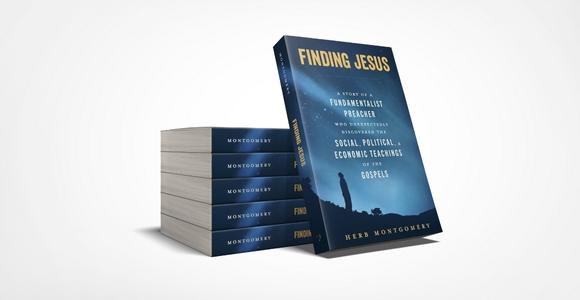

Now Available at Renewed Heart Ministries!

Herb’s new book Finding Jesus: A story of a fundamentalist preacher who unexpectedly discovered the social, political, and economic teachings of the Gospels, is available at renewedheartministries.com.

Get your copy today at renewedheartministries.com


Are you receiving all of RHM’s free resources each week?

Begin each day being inspired toward love, compassion, action, and justice. Free Sign-Up HERE

A Special Christmas Message

Herb Montgomery | December 23, 2022

To listen to this week’s eSight as a podcast episode click here.


“This Christmas, let’s celebrate in the form of a life lived every day in harmony with the belief that when it comes to those pushed to the undersides and edges of our society, this baby lying in a manger grows up to be an advocate for them.”


wFrom all of us here at Renewed Heart Ministries, Merry Christmas!

Our reading this week is from the gospel of Luke:

In those days Caesar Augustus issued a decree that a census should be taken of the entire Roman world. (This was the first census that took place while Quirinius was governor of Syria. And everyone went to their own town to register.)

So Joseph also went up from the town of Nazareth in Galilee to Judea, to Bethlehem the town of David, because he belonged to the house and line of David. He went there to register with Mary, who was pledged to be married to him and was expecting a child. While they were there, the time came for the baby to be born, and she gave birth to her firstborn, a son. She wrapped him in cloths and placed him in a manger, because there was no guest room available for them.

And there were shepherds living out in the fields nearby, keeping watch over their flocks at night. An angel of the Most High appeared to them, and the glory of God shone around them, and they were terrified. But the angel said to them, Do not be afraid. I bring you good news that will cause great joy for all the people. Today in the town of David a Savior has been born to you; who is the Messiah, the Sovereign One. This will be a sign to you: You will find a baby wrapped in cloths and lying in a manger.”

Suddenly a great company of the heavenly host appeared with the angel, praising God and saying,

Glory to God in the highest heaven,

and on earth peace to those on whom his favor rests.”

When the angels had left them and gone into heaven, the shepherds said to one another, Lets go to Bethlehem and see this thing that has happened, which the Most High has told us about.”

So they hurried off and found Mary and Joseph, and the baby, who was lying in the manger. When they had seen the child, they spread the word concerning what had been told them about him, and all who heard it were amazed at what the shepherds said to them. But Mary treasured up all these things and pondered them in her heart. The shepherds returned, glorifying and praising God for all the things they had heard and seen, which were just as they had been told. (Luke 2:1-20)

This reading of Jesus’s birth story begins with one of Luke’s unique narrative elements. In Matthew, Jesus was born under Herod’s reign. Herod died in 4 B.C.E., and the census referred to in our passage this week took place under Quirinius in 6 C.E., ten years after Herod’s death.

Remember, Matthew’s version of the Jesus story is based in Galilee, as seen in its closing chapter. Luke’s version of the Jesus story is Judean-based, and more specifically Jerusalem-based, as seen in both the closing chapters of Luke and the book of Acts. In Acts, the Jesus movement doesn’t return to Galilee but instead takes root in Jerusalem and grows from there. Luke’s burden is to tell a version of the Jesus story that takes on the oppression of the Roman empire, contrasts Jesus with Caesar, and raises up the imperial rule of Jesus’ YHWH (the basileia that is translated as “kingdom”) against the imperial rule of Rome.

From the very beginning of Luke, Jesus’s story is brought into conflict with Rome.

In Matthew, Jesus is from Nazareth (Galilee). In Luke, Jesus is from Bethlehem (Judea), the city of David. This detail would have brought to the minds of Luke’s audience Micah’s words:

But you, Bethlehem Ephrathah,

though you are small among the clans of Judah,

out of you will come for me

one who will be ruler over Israel,

whose origins are from of old,

from ancient times.” (Micah 5:2)

All of this, again, would have served the purpose of contrasting the imperial reign of the God of the Torah, which David’s kingship symbolized for many Jewish members of Luke’s audience, over and against the imperial rule of Rome.

In the first few chapters of Luke, Jesus’ movement isn’t characterized as the start of a new religion competing with or replacing Judaism, but rather it’s a Jewish renewal movement anticipating the liberation of Judea and surrounding Jewish regions from Rome.

The angel doesn’t appear to the ruling class or Jewish representatives of the empire in Jerusalem, but to rural shepherds, who we’d call “blue collar,” in the fields of Bethlehem.

Economically and socially, rural Judeans and Galileans living in agricultural villages were the people most negatively impacted by Roman imperialism. Families had to make hard decisions and often sacrificed their community bonds to survive. In these communities, indentured farmers and shepherds cultivated their own versions of the Israelite liberation traditions that had long inspired hope for liberation from oppressive rulers and renewed the Hebrew prophets’ calls for justice. (For more details on the social climate these shepherds lived in, see Richard A. Horsley’s Jesus and Empire: The Kingdom of God and the New World Disorder.)

Luke’s angelic announcement to shepherds has many layers to it. Not only did it narratively serve to link Jesus’ liberation with those most harmfully impacted by Roman imperialism, it also fits nicely with the language this week’s passage draws from Micah. Micah’s liberator would be a “shepherd-king”:

“Therefore Israel will be abandoned

until the time when she who is in labor bears a son,

and the rest of his brothers return

to join the Israelites.

  He will stand and shepherd his flock

in the strength of the Most High,

in the majesty of the name of the Sovereign God.

And they will live securely, for then his greatness

will reach to the ends of the earth.

  He will be our peace . . . he will rule . . . he will deliver . . .” (Micah 5:3-6, emphasis added.)

All of this associated Jesus with God’s imperial reign, which was symbolized by the restoration of David’s Kingdom. David was also a shepherd-king: his pre- coronation occupation was a shepherd.

Luke aligns Jesus and his liberation not with the centered and powerful, but with the marginalized and powerless rural communities being harmed most by the imperial rule of Rome.

There are so many similar layers to Luke’s version of the birth and infancy narratives of Jesus that it really is a narrative masterpiece when read through the lens of social justice.

There is no room for Jesus to be born that night in an inn or a bed. Instead he’s born in the marginalized stable out back. From that point forward, the story of this child marks a dramatic shift and hope for those marginalized in their society, including those marginalized and disenfranchised today.

Some of our more contemporary Christmas carols echo this theme. One example is “O Holy Night,” a carol whose lyrics Placide Cappeau wrote in 1843:

“Truly He taught us to love one another;

His law is love and His gospel is peace.

Chains shall He break for the slave is our brother;

And in His name all oppression shall cease.”

I know that many expressions of Christianity today have been and continue to be complicit with oppression. Others are not. But we have not always lived out the lyrics of this carol. Too often, Christians have been at the center of oppressions for vulnerable people: women, indigenous populations, slaves, the poor, and our LGBTQ friends and family.

This Christmas my heart longs for us to do better. Can we, today, find ways of following Jesus that genuinely do end oppression and come alongside others also working to end it. What does my Christianity need to look like to be life-giving to those presently being harmed? What differences do I need to choose for my Jesus-following to aid and help, to contribute rather than become an obstacle to the work of ending injustice, violence, and dehumanizing violations of everyone’s human rights? Will that carol ever ring true, that in Jesus’ name, all oppression will cease?

There is much to be thankful for this Christmas season, and I’m reminded once again that, in the spirit of a baby who was born in a manger, whose birth announcements were sent to blue-collar workers who were politically, socially, and economically marginalized, we’ll still have a lot of work to do in the coming year.

Here’s to a celebration of Jesus’ birth that doesn’t last just one day a year, or even just one season during the year, but rather celebrates him in the form of a life lived every day in harmony with the belief that when it comes to those pushed to the undersides and edges of our society, this baby lying in a manger grows up to be an advocate for them.

HeartGroup Application

1. Share something that spoke to you from this week’s eSight/Podcast episode with your HeartGroup.

2. What does Jesus’ life, aligned with those on the undersides and margins of his society, mean for you? Discuss with your group.

3. What can you do this week, big or small, to continue setting in motion the work of shaping our world into a safe, compassionate, just home for everyone?

`Thanks for checking in with us, today.

You can find Renewed Heart Ministries on Twitter, Facebook and Instagram. If you haven’t done so already, please follow us on your chosen social media platforms for our daily posts. Also, if you enjoy listening to the Jesus for Everyone podcast, please like and subscribe to the JFE podcast through the podcast platform you use and consider taking some time to give us a review. This helps others find our podcast as well.

And if you’d like to reach out to us through email, you can reach us at info@renewedheartministries.com.

My new book, Finding Jesus: A story of a fundamentalist preacher who unexpectedly discovered the social, political, and economic teachings of the Gospels is now available at renewedheartministries.com

Right where you are, keep living in love, choosing compassion, taking action, and working toward justice.

I love each of you dearly,

Merry Christmas,

I’ll see you in the new year.


Now Available at Renewed Heart Ministries!

It’s finally here!  Herb’s new book Finding Jesus: A story of a fundamentalist preacher who unexpectedly discovered the social, political, and economic teachings of the Gospels, is available at renewedheartministries.com, just in time for the holidays!

Here is just a taste of what people are saying:

“Herb has spent the last decade reading scripture closely. He also reads the world around us, thinks carefully with theologians and sociologists, and wonders how the most meaningful stories of his faith can inspire us to live with more heart, attention, and care for others in our time. For those who’ve ever felt alone in the process of applying the wisdom of Jesus to the world in which we live, Herb offers signposts for the journey and the reminder that this is not a journey we take alone. Read Finding Jesus with others, and be transformed together.” Dr. Keisha Mckenzie, Auburn University

“In Finding Jesus, Herb Montgomery unleashes the revolutionary Jesus and his kin-dom manifesto from the shackles of the domesticated religion of empire.  Within these pages we discover that rather than being a fire insurance policy to keep good boys and girls out of hell, Jesus often becomes the fiery enemy of good boys and girls who refuse to bring economic justice to the poor, quality healthcare to the underserved, and equal employment to people of color or same-sex orientation.  Because what the biblical narratives of Jesus reveal is that any future human society—heavenly or otherwise—will only be as  good as the one that we’re making right here and now. There is no future tranquil city with streets of gold when there is suffering on the asphalt right outside our front door today.  Finding Jesus invites us to pray ‘thy kingdom come, thy will be done on earth as it is in heaven’ on our feet as we follow our this liberator into the magnificent struggle of bringing the love and justice of God to all—right here, right now.”—Todd Leonard, pastor of Glendale City Church, Glendale CA.

“Herb Montgomery’s teachings have been deeply influential to me. This book shares the story of how he came to view the teachings of Jesus through the lens of nonviolence, liberation for all, and a call to a shared table. It’s an important read, especially for those of us who come from backgrounds where the myth of redemptive violence and individual (rather than collective) salvation was the focus.” – Daneen Akers, author of Holy Troublemakers & Unconventional Saints and co-director/producer of Seventh-Gay Adventists: A Film about Faith, Identity & Belonging

“So often Christians think about Jesus through the lens of Paul’s theology and don’t focus on the actual person and teachings of Jesus. This book is different. Here you find a challenging present-day application of Jesus’ teachings about the Kingdom of God and the Gospel. Rediscover why this Rabbi incited fear in the hearts of religious and political leaders two millennia ago. Herb’s book calls forth a moral vision based on the principles of Jesus’ vision of liberation. Finding Jesus helps us see that these teachings are just as disruptive today as they were when Jesus first articulated them.” Alicia Johnston, author of The Bible & LGBTQ Adventists.

“Herb Montgomery is a pastor for pastors, a teacher for teachers and a scholar for scholars. Part memoir and part theological reflection, Finding Jesus is a helpful and hope-filled guide to a deeper understanding of who Jesus is and who he can be. Herb’s tone is accessible and welcoming, while also challenging and fresh. This book is helpful for anyone who wants a new and fresh perspective on following Jesus.”— Traci Smith, author of Faithful Families

Get your copy today at renewedheartministries.com


Help Us Reach our Year End Goals

Consider making a one-time donation to support our work, inspiring hope and faith-filled action toward making our world a safe, compassionate, just home for all.

Donate to RHM online or by mail at

RHM, PO Box 1211, Lewisburg, WV 24901 

Advent and the Arrival of a Safer World for Everyone

Herb Montgomery | December 16, 2022

To listen to this week’s eSight as a podcast episode click here.


“Can the ethics in the Jesus story, ethics such as the Golden Rule, neighborly love, solidarity with the marginalized, economic justice for the poor, nonviolent resistance, and more, still promise a pathway of salvation for us today? I don’t mean salvation in the sense of guaranteed post-mortem bliss, but rather salvation as shaping our present world into a safe, compassionate, just home for everyone large enough to hold all of our differences together.”


Our Advent reading this week is from the gospels of Matthew:

This is how the birth of Jesus the Messiah came about: His mother Mary was pledged to be married to Joseph, but before they came together, she was found to be pregnant through the Holy Spirit. Because Joseph her husband was faithful to the law, and yet did not want to expose her to public disgrace, he had in mind to divorce her quietly.

But after he had considered this, an angel of the Lord appeared to him in a dream and said, Joseph son of David, do not be afraid to take Mary home as your wife, because what is conceived in her is from the Holy Spirit. She will give birth to a son, and you are to give him the name Jesus, because he will save his people from their sins.”

All this took place to fulfill what the Lord had said through the prophet: The virgin will conceive and give birth to a son, and they will call him Immanuel” (which means God with us”).

When Joseph woke up, he did what the angel of the Lord had commanded him and took Mary home as his wife. But he did not consummate their marriage until she gave birth to a son. And he gave him the name Jesus. (Matthew 1:18-25)

Many scholars believe the stories about Jesus’ birth and infancy in Matthew and Luke were the last part of the Jesus story to be developed. Paul never mentions Jesus’ birth and Mark doesn’t begin his version of the story with Jesus’ birth either. Other early sources used by Matthew and Luke’s gospels don’t include any details about the birth of Jesus. These stories don’t appear until Matthew and the later expanded version found in Luke.

This week’s reading comes from Matthew, whose birth narrative for Jesus is rooted in Jewish folklore about Jewish liberation and the hope of the people had for liberation from Roman Imperialism and its destructive results on rural life in Judea and Galilee.

Let’s consider one example of that rich folklore as context for our reading this week: Hannah’s prayer in 1 Samuel 2: 1-10:

Then Hannah prayed and said:

  My heart rejoices in the Most High;

in God my horn is lifted high.

My mouth boasts over my enemies,

for I delight in your deliverance.

  There is no one holy like the Holy One of Old;

there is no one besides you;

there is no Rock like our God.

  Do not keep talking so proudly

or let your mouth speak such arrogance,

for God is a God who knows,

and by the Ancient One deeds are weighed.

  The bows of the warriors are broken,

but those who stumbled are armed with strength.

  Those who were full hire themselves out for food,

but those who were hungry are hungry no more.

She who was barren has borne seven children,

but she who has had many sons pines away.

  The Creator brings death and makes alive;

brings down to the grave and raises up.

  The Liberator sends poverty and wealth;

humbles and exalts.

  God raises the poor from the dust

and lifts the needy from the ash heap;

seats them with princes

and has them inherit a throne of honor.

“For the foundations of the earth are the Most High’s;

on them the Creator has set the world.

  Our God will guard the feet of those who are faithful

but the wicked will be silenced in the place of darkness.

“It is not by strength that one prevails;

  those who oppose God will be broken.

The Most High will thunder from heaven;

the God of justice will judge the ends of the earth.

“And will give strength to God’s ruler

and exalt the horn of the anointed one.”

An ever-repeating theme of these Jewish liberation narratives is that God is a God who stands in solidarity with the disenfranchised, marginalized, and oppressed. The late Dr. James H. Cone cautions us about what this means:

“If theological speech is based on the traditions of the Old Testament, then it must heed their unanimous testimony to Yahweh’s commitment to justice for the poor and the weak. Accordingly it cannot avoid taking sides in politics, and the side that theology must take is disclosed in the side that Yahweh has already taken. Any other side, whether it be with the oppressors or the side of neutrality (which is nothing but a camouflaged identification with the rulers), is unbiblical. If theology does not side with the poor, then it cannot speak for Yahweh who is the God of the poor.” (God of the Oppressed, p. 65)

This tradition influences how Matthew begins his version of the Jesus story. Jesus, for Matthew’s audience, continues a liberation hope that did not begin or end with him. Rev. Dr. Wilda Gafney writes of this: “God’s saving work did not begin with Jesus; we see it borne witness to throughout the scriptures as Hannah sings of it in her time and in days to come as would Mary, echoing her song. Jesus is the continuation and embodiment of that salvation, himself an annunciation, of good news.” (A Women’s Lectionary for the Whole Church, Year W, p. 14)

We will speak more of this in a moment. Before we do, let’s ask why does Matthew emphasize a point that the Christian tradition has come to describe as Mary’s “virginity”? Mathew is paraphrasing Isaiah 7:14:

“Therefore the Lord himself will give you a sign: The virgin will conceive and give birth to a son, and will call him Immanuel.”

It’s quite illuminating to read the entire context of Isaiah’s passage. In ancient cultures, the word translated “virgin” simply meant a young girl who had reached the age where she could become pregnant. These cultures’ desire to accurately track a person’s heritage and property rights in cultures that defined lineage in terms of the father’s line developed into closely controlled regulation of women’s sexuality as a way of reliably determining paternity. (They could have regulated men’s sexuality but choose not to.) But I don’t think property or paternity are what Matthew or Isaiah are concerned about.

To understand the narrative detail in Matthew of Jesus being born from a “virgin,” we have to understand Hellenized and Roman folklore as well as Jewish tradition. These imperial stories include many tales about the childhood of famous men or “heroes.” In each of these stories, a person’s exceptionalism is traced back to the events of their birth, and in each case the gods play a role in their conception and/or childhoods.

Just a few examples: stories of Alexander the Great (see Plutarch, Parallel Lives: Alexander, 2:1-3.5), Apollonius of Tyana (see Philostratus, Life of Apollonius, 1: 4-6), Plato (see Diogenes Laertius, Lives of Eminent Philosophers, 3:1-3, 45), and Octavian who became emperor of Rome itself—”THE DIVINE AUGUSTUS CEASAR, SON OF GOD” (see Suetonius, The Deified Augustus, 94:3-4).

Remember that the original audience for Matthew viewed the world very differently than many of us do today. I believe Matthew’s version of the Jesus story sought to establish Jesus, to elevate him in the midst of others competing for people’s allegiance, including Caesar. Matthew found his way through an unrelated and remote passage in Isaiah to give Jesus a place on that stage.

Today we live in the wake of past justice movements and we are living through many others right now: climate action, the movement for Black lives, Me Too, and others. Can the ethics in the Jesus story, ethics such as the Golden Rule, neighborly love, solidarity with the marginalized, economic justice for the poor, nonviolent resistance, and more, still promise a pathway of salvation for us today? I don’t mean salvation in the sense of guaranteed post-mortem bliss, but rather salvation as shaping our present world into a safe, compassionate, just home for everyone large enough to hold all of our differences together, where “everyone will sit under their own vine and under their own fig tree, and no one will make them afraid” (Micah 4:4).

On this last weekend of Advent, what coming justice are you anticipating and working toward? As a Jesus follower today, how do the teachings of the Jesus of our stories speak into your concerns and efforts? Do they still speak to you? For me they do.

These stories continually challenge me and my Christianity not to avoid social concern and they inspire me to keep looking for ways to be life-giving, a source of healing, and a help to those our systems make vulnerable. They encourage me to reclaim my own humanity in recognizing and honoring the humanity of others.

As Advent closes the year and a new year begins in the Christian calendar, how can this season inspire you to, like Jesus, continue the work of making our world a safe home for everyone? This next year, may our efforts be intentional and effective. May love, joy, hope, peace and justice arrive more fully through the conduit of our lives and choices, too.

HeartGroup Application

1. Share something that spoke to you from this week’s eSight/Podcast episode with your HeartGroup.

2. How has this year’s season of Advent been meaningful for you? Discuss with your group.

3. What can you do this week, big or small, to continue setting in motion the work of shaping our world into a safe, compassionate, just home for everyone?

Thanks for checking in with us, today.

You can find Renewed Heart Ministries on Twitter, Facebook and Instagram. If you haven’t done so already, please follow us on your chosen social media platforms for our daily posts. Also, if you enjoy listening to the Jesus for Everyone podcast, please like and subscribe to the JFE podcast through the podcast platform you use and consider taking some time to give us a review. This helps others find our podcast as well.

And if you’d like to reach out to us through email, you can reach us at info@renewedheartministries.com.

My new book, Finding Jesus: A story of a fundamentalist preacher who unexpectedly discovered the social, political, and economic teachings of the Gospels is now available at renewedheartministries.com

Right where you are, keep living in love, choosing compassion, taking action, and working toward justice.

I love each of you dearly,

I’ll see you next week


Now Available at Renewed Heart Ministries!

It’s finally here!  Herb’s new book Finding Jesus: A story of a fundamentalist preacher who unexpectedly discovered the social, political, and economic teachings of the Gospels, is available at renewedheartministries.com, just in time for the holidays!

Here is just a taste of what people are saying:

“Herb has spent the last decade reading scripture closely. He also reads the world around us, thinks carefully with theologians and sociologists, and wonders how the most meaningful stories of his faith can inspire us to live with more heart, attention, and care for others in our time. For those who’ve ever felt alone in the process of applying the wisdom of Jesus to the world in which we live, Herb offers signposts for the journey and the reminder that this is not a journey we take alone. Read Finding Jesus with others, and be transformed together.” Dr. Keisha Mckenzie, Auburn University

“In Finding Jesus, Herb Montgomery unleashes the revolutionary Jesus and his kin-dom manifesto from the shackles of the domesticated religion of empire.  Within these pages we discover that rather than being a fire insurance policy to keep good boys and girls out of hell, Jesus often becomes the fiery enemy of good boys and girls who refuse to bring economic justice to the poor, quality healthcare to the underserved, and equal employment to people of color or same-sex orientation.  Because what the biblical narratives of Jesus reveal is that any future human society—heavenly or otherwise—will only be as  good as the one that we’re making right here and now. There is no future tranquil city with streets of gold when there is suffering on the asphalt right outside our front door today.  Finding Jesus invites us to pray ‘thy kingdom come, thy will be done on earth as it is in heaven’ on our feet as we follow our this liberator into the magnificent struggle of bringing the love and justice of God to all—right here, right now.”—Todd Leonard, pastor of Glendale City Church, Glendale CA.

“Herb Montgomery’s teachings have been deeply influential to me. This book shares the story of how he came to view the teachings of Jesus through the lens of nonviolence, liberation for all, and a call to a shared table. It’s an important read, especially for those of us who come from backgrounds where the myth of redemptive violence and individual (rather than collective) salvation was the focus.” – Daneen Akers, author of Holy Troublemakers & Unconventional Saints and co-director/producer of Seventh-Gay Adventists: A Film about Faith, Identity & Belonging

“So often Christians think about Jesus through the lens of Paul’s theology and don’t focus on the actual person and teachings of Jesus. This book is different. Here you find a challenging present-day application of Jesus’ teachings about the Kingdom of God and the Gospel. Rediscover why this Rabbi incited fear in the hearts of religious and political leaders two millennia ago. Herb’s book calls forth a moral vision based on the principles of Jesus’ vision of liberation. Finding Jesus helps us see that these teachings are just as disruptive today as they were when Jesus first articulated them.” Alicia Johnston, author of The Bible & LGBTQ Adventists.

“Herb Montgomery is a pastor for pastors, a teacher for teachers and a scholar for scholars. Part memoir and part theological reflection, Finding Jesus is a helpful and hope-filled guide to a deeper understanding of who Jesus is and who he can be. Herb’s tone is accessible and welcoming, while also challenging and fresh. This book is helpful for anyone who wants a new and fresh perspective on following Jesus.”— Traci Smith, author of Faithful Families

Get your copy today at renewedheartministries.com


Help Us Reach our Year End Goals

Consider making a one-time donation to support our work, inspiring hope and faith-filled action toward making our world a safe, compassionate, just home for all.

Donate to RHM online or by mail at

RHM, PO Box 1211, Lewisburg, WV 24901