Jesus Following and Social Justice

Thank You!

We want to take this moment to express our heartfelt gratitude to all of our supporters for your invaluable role in the Renewed Heart Ministry community and for your dedication to our mission of fostering love, justice, compassion, and healing. Your support is the bedrock of our work. Your support empowers us to do what we do. At a time when ministries like ours are being asked to achieve more with fewer resources, your support is incredibly important, and we want to simply say thank you. Whether in our larger society or within our local faith communities, Renewed Heart Ministries remains committed to advocating for change, working towards a world that is inclusive, just, and safe for everyone, and being a source of love in our world. From all of us here at Renewed Heart Ministries, thank you for your generous support. We deeply appreciate each and every one of our supporters.

If you’d like to join them in supporting our work, please go to renewedheartministries.com and click on “Donate.”  


Jesus Following and Social Justice

Herb Montgomery, July 13, 2024

If you’d like to listen to this week’s article in podcast version click on the image below:

Our reading last weekend in the lectionary from the gospels was from Mark:

King Herod heard about this, for Jesus’ name had become well known. Some were saying, “John the Baptist has been raised from the dead, and that is why miraculous powers are at work in him.” Others said, “He is Elijah.” And still others claimed, “He is a prophet, like one of the prophets of long ago.” 

But when Herod heard this, he said, “John, whom I beheaded, has been raised from the dead!” For Herod himself had given orders to have John arrested, and he had him bound and put in prison. He did this because of Herodias, his brother Philip’s wife, whom he had married. For John had been saying to Herod, “It is not lawful for you to have your brother’s wife.” So Herodias nursed a grudge against John and wanted to kill him. But she was not able to, because Herod feared John and protected him, knowing him to be a righteous and holy man. When Herod heard John, he was greatly puzzled; yet he liked to listen to him. Finally the opportune time came. On his birthday Herod gave a banquet for his high officials and military commanders and the leading men of Galilee. When the daughter of Herodias came in and danced, she pleased Herod and his dinner guests. The king said to the girl, “Ask me for anything you want, and I’ll give it to you.” And he promised her with an oath, “Whatever you ask I will give you, up to half my kingdom.” She went out and said to her mother, “What shall I ask for?” “The head of John the Baptist,” she answered. At once the girl hurried in to the king with the request: “I want you to give me right now the head of John the Baptist on a platter. The king was greatly distressed, but because of his oaths and his dinner guests, he did not want to refuse her. So he immediately sent an executioner with orders to bring John’s head. The man went, beheaded John in the prison, and brought back his head on a platter. He presented it to the girl, and she gave it to her mother. On hearing of this, John’s disciples came and took his body and laid it in a tomb. (Mark 6:14-29)

This week’s reading offers us a lot to inform how we follow Jesus’ teachings today. It solidly characterizes that both Jesus and John the Baptist stood in the long Hebrew prophetic justice tradition.

Mark’s gospel seeks to soften Herod’s role in executing John, and this may sound strange to us today. Christianity was an illicit religion in the Roman Empire when Mark was written. Mark’s seeks to characterize Herod as being forced to execute John and doing so somewhat reluctantly. 

On the other hand, Josephus’ writings don’t soften Herod’s role:

“Now some of the Jews thought that the destruction of Herod’s army came from God, and was a very just punishment for what he did against John called the Baptist. For Herod had him killed, although he was a good man and had urged the Jews to exert themselves to virtue, both as to justice toward one another and reverence towards God, and having done so join together in washing. For immersion in water, it was clear to him, could not be used for the forgiveness of sins, but as a sanctification of the body, and only if the soul was already thoroughly purified by right actions. And when others massed about him, for they were very greatly moved by his words, Herod, who feared that such strong influence over the people might carry to a revolt — for they seemed ready to do any thing he should advise — believed it much better to move now than later have it raise a rebellion and engage him in actions he would regret. 

    And so John, out of Herod’s suspiciousness, was sent in chains to Machaerus, the fort previously mentioned, and there put to death; but it was the opinion of the Jews that out of retribution for John God willed the destruction of the army so as to afflict Herod. (Antiquities 18.5.2 116-119)

According to Josephus, Herod had John arrested and executed because he feared John’s popular influence and feared a possible revolt. 

Josephus and the gospels do agree John was one who called his listeners to “justice toward one another and reverence towards God.” Consider how the gospel of Luke describes him:

John answered, “Anyone who has two shirts should share with the one who has none, and anyone who has food should do the same.” Even tax collectors came to be baptized. “Teacher,” they asked, “what should we do?” “Don’t collect any more than you are required to,” he told them. Then some soldiers asked him, “And what should we do?” He replied, “Don’t extort money and don’t accuse people falsely—be content with your pay.” (Luke 3:11-14)

In fact, reverence toward God meant practicing justice toward one another. 

The gospels don’t paint Jesus as being wholly different from John, but as so similar in calling the people to practice justice toward one another that some even thought John had been raised from the dead. This is important as we understand how Mark’s gospel characterizes Jesus. Mark’s Jesus is deemed by the people to be “a prophet, like one of the prophets of long ago.” We don’t see this Jesus traveling the countryside trying to get people to say a special prayer so they can go to heaven when they die. Instead he works to establish justice here on Earth. In the wake of John the Baptist’s execution, Jesus calls the people to justice and righteousness toward one another in the same way as the Hebrew prophets of old (see Isaiah 9:7).

Consider this small collection of statements from the Hebrew, prophetic, justice tradition. Note their repeated call to the people to practice “justice toward one another.”

Learn to do right; seek justice.

Defend the oppressed. 

Take up the cause of the fatherless;

plead the case of the widow. (Isaiah 1:17)

This is what the LORD says to you, house of David:

  “Administer justice every morning;

rescue from the hand of the oppressor

the one who has been robbed.” (Jeremiah 21:12)

The people of the land practice extortion and commit robbery; 

they oppress the poor and needy and mistreat the foreigner, 

denying them justice. (Ezekiel 22:29)

But you must return to your God;

maintain love and justice,

and wait for your God always. (Hosea 12:6)

They trample on the heads of the poor 

as on the dust of the ground 

and deny justice to the oppressed. (Amos 2:7)

But let justice roll on like a river,

righteousness like a never-failing stream! (Amos 5:24)

Then I said, “Listen, you leaders of Jacob,

you rulers of Israel.

Should you not embrace justice. (Micah 3:1)

What does this mean for us today? I think of my own transition in my Jesus following: away from being so heavenly minded that I was no earthly good. When my practice of Christianity transitioned away from a post mortem focus to being concerned with oppression, injustice, and violence against those made vulnerable in our societies, some people accused me of becoming a social justice warrior. As if that’s a pejorative. That being concerned with social justice is somehow a bad thing.

In the gospels, John the Baptist stood within the Hebrew prophetic justice tradition.

In the gospels, Jesus stood within the Hebrew prophetic justice tradition. 

Today, we too, as Jesus followers, should also be concerned with social, political, and economy justice in our world around us, seeking to practice justice toward one another.

One of my favorite statements that has helped me make sense of my own journey over the past decade is from Rev. Dr. Emilie M. Townes. She states, “When you start with an understanding that God loves everyone, justice isn’t very far behind” (Dr. Emilie M. Townes, “Journey to Liberation: The Legacy of Womanist Theology”). 

When we begin to see everyone around us as those we are connected to, and then add to that connectedness that we are all objects of the Divine love, how can we be unconcerned with what affects each of us, positively and negatively? How can we love others and not be concerned with what materially affects those we love? 

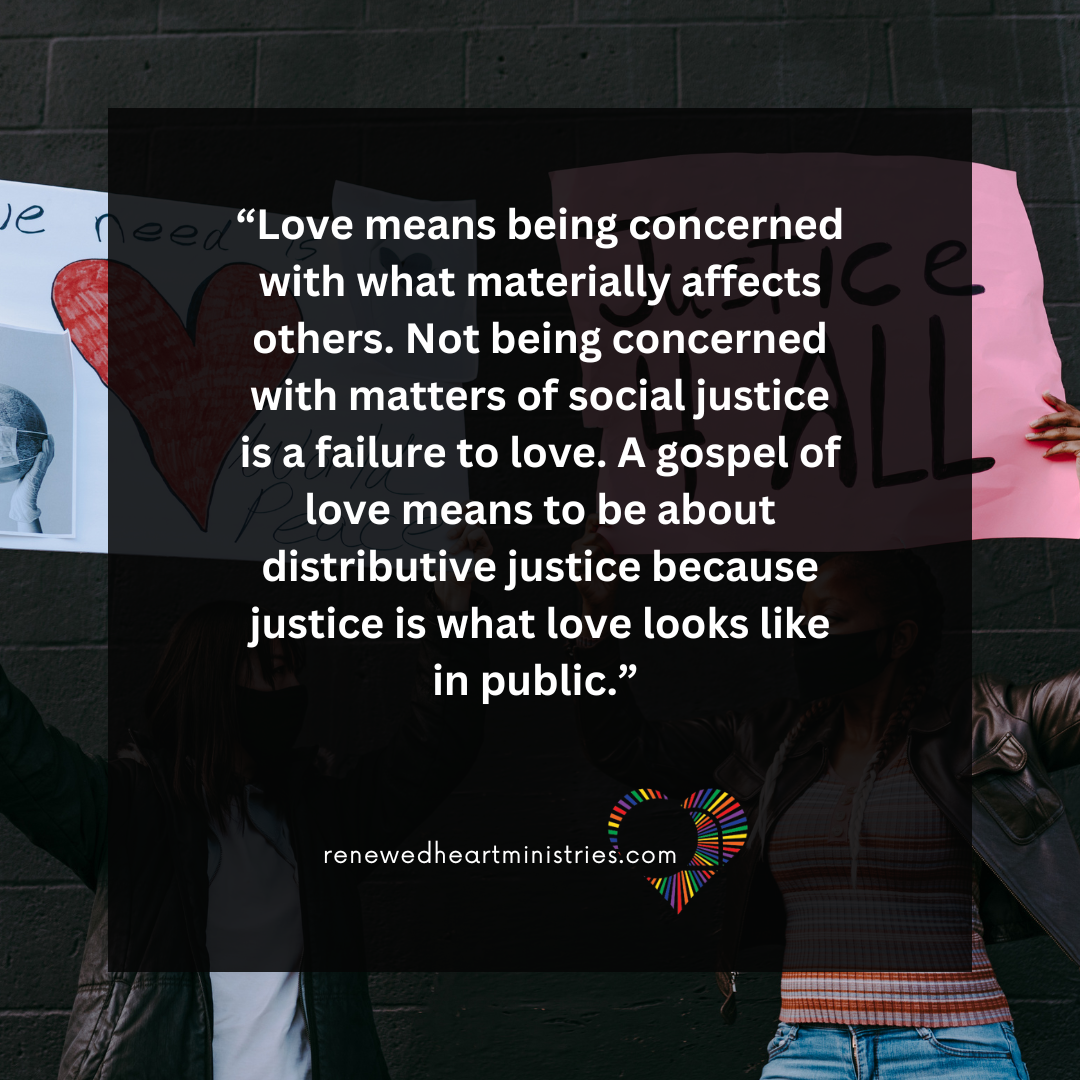
Not being concerned with matters of social justice is a failure. It’s a failure to love. It’s a failure in our Jesus-following. It may derided by those who have something to lose from making our world a more just home for everyone. That’s okay. To believe in a gospel of love means to be about justice because justice is what love looks like in public. 

Discussion Group Questions

1. Share something that spoke to you from this week’s eSight/Podcast episode with your discussion group.

2. How does your Jesus following express itself in social justice engagement? Share and discuss with your group.

3. What can you do this week, big or small, to continue setting in motion the work of shaping our world into a safe, compassionate, just home for everyone? 

Thanks for checking in with us, today.

I want to say a special thank you to all of our supporters out there. And if you would like to join them in supporting Renewed Heart Ministries’ work you can do so by going to renewedheartministries.com and clicking donate. 

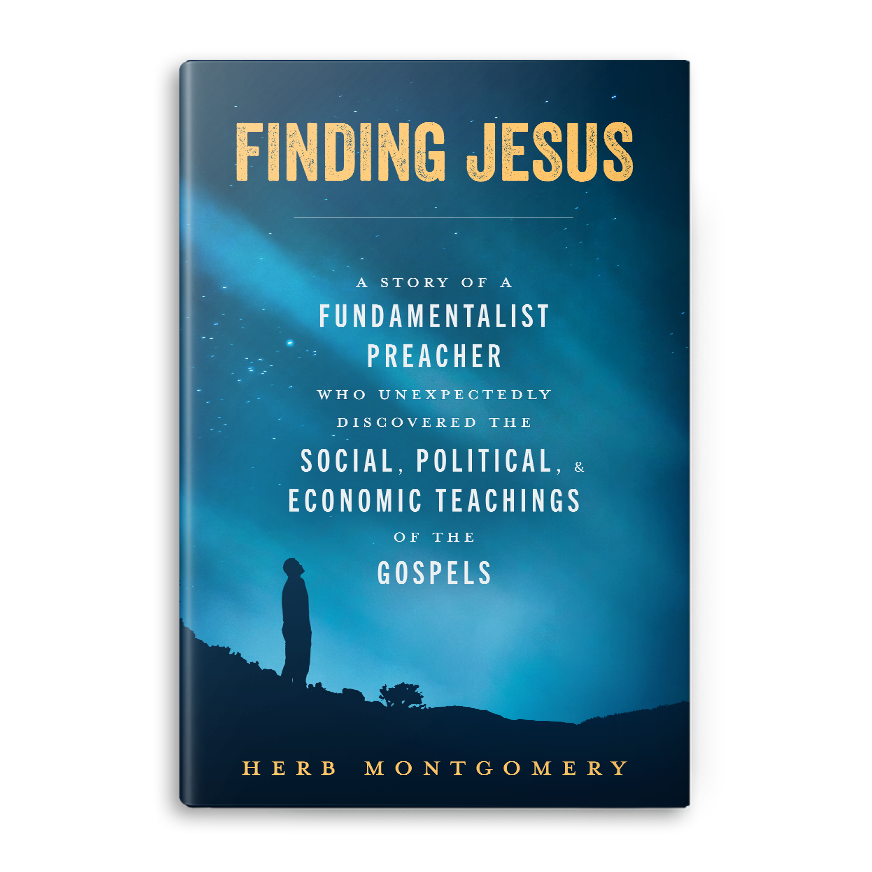
My latest book Finding Jesus: A Fundamentalist Preacher Discovers the Socio-Political and Economic Teachings of the Gospels is available now on Amazon in paperback, Kindle and also on Audible in audio book format.

As always, you can find Renewed Heart Ministries each week on X (or Twitter), Facebook, Instagram and Meta’s Threads. If you haven’t done so already, please follow us on your chosen social media platforms for our daily posts. 

If you would like to listen to these articles each week in podcast form, you can find The Social Jesus podcast on all major podcast carriers. If you enjoy listening to The Social Jesus Podcast please take a moment to like and subscribe and if your podcast platform offers this option, consider taking some time to leave us a positive review. This helps others find our podcast as well.

You can watch our new YouTube show called “Just Talking” each week. Todd Leonard and I take a moment to talk about the gospel lectionary reading for the upcoming weekend. We’ll be talking about each reading in the context of love, inclusion, and societal justice. Our hope is that our talking will be just talking (as in justice) and that during our brief conversations each week you’ll be inspired to also do more than just talking. If you teach from the lectionary each week, or if you’re just looking for some thoughts on the Jesus story from a more progressive perspective within the context of social justice, check it out, you might like it. You can find JustTalking each week on YouTube at youtube.com/@herbandtoddjusttalking. Please Like, Subscribe, hit the Notification button, and leave us a comment.

And if you’d like to reach us here at Renewed Heart Ministries through email, you can reach us at info@renewedheartministries.com.

Right where you are, keep living in love, choosing compassion, taking action, and working toward justice.

I love each of you dearly,

I’ll see you next week.


New Episode of “Just Talking” Now Online!

Season 2, Episode 71: Mark 6.14-29. Lectionary B, Proper 10

Each week, we’ll be talking about the gospel lectionary reading for the upcoming weekend in the context of love, inclusion, and social justice. Our hope is that our talking will be “just” talking (as in justice) and that during our brief conversations each week we’ll be inspired to do more than just talking.

If you teach from the lectionary each week, or if you’re just looking for some thoughts on the Jesus story from a more progressive perspective within the context of social justice, check it out.


New Episode of The Social Jesus Podcast

A podcast where we talk about the intersection of faith and social justice and what a first century, prophet of the poor from Galilee might have to offer us today in our work of love, compassion and justice. 

This week:

Season 1 Episode 14: Jesus Following and Social Justice

Mark 6:14-29

“Rev. Dr. Emilie M. Townes. states, ‘When you start with an understanding that God loves everyone, justice isn’t very far behind.’ For those endeavoring to follow Jesus’ teachings, not being concerned with matters of social justice is a failure. It’s a failure to love. It’s a failure in our Jesus-following. It may derided by those who have something to lose from making our world a more just home for everyone. That’s okay. To believe in a gospel of love means to be about justice because justice is what love looks like in public.”

Available on all major podcast carriers, 

Or at this link:

Shttps://the-social-jesus-podcast.simplecast.com/episodes/jesus-following-and-social-justice


Now Available on Audible!

 

Finding Jesus: A Fundamentalist Preacher Discovers the Socio-Political & Economic Teachings of the Gospels.

by Herb Montgomery, Narrated by Jeff Moon

Available now on Audible!

After two successful decades of preaching a gospel of love within the Christian faith tradition Herb felt like something was missing. He went back to the gospels and began reading them through the interpretive lenses of various marginalized communities and what he found radically changed his life forever. The teachings of the Jesus in the gospel stories express a profound concern for justice, compassion, and the well-being of those in marginalized communities. This book navigates the intersections between faith and societal justice, and presents a compelling argument for a more socially compassionate and just expression of Christianity. Herb’s findings in his latest book are shared in the hopes that it will dramatically impact how you practice your Christianity, too.


Are you getting all of RHM’s Free Resources?

Free Sign Up Here
Breaking With the Way Things Are

sunset road

Herb Montgomery | January 6, 2022

To listen to this week’s eSight as a podcast episode click here.


“That our participation in John’s baptism might symbolize that for us today gives me pause. Do I really want to break with the way things are? Do I really want change? How committed am I to that change? Am I committed enough to choose those differences in my daily life? All of this and more is on my heart as this new year begins. What changes will our choices and actions bring this new year?”


Happy New Year from all of us here at Renewed Heart Ministries!

Our reading this week, as we begin the new year, is from the gospel Matthew:

Then Jesus came from Galilee to the Jordan to be baptized by John. But John tried to deter him, saying, I need to be baptized by you, and do you come to me?”

Jesus replied, Let it be so now; it is proper for us to do this to fulfill all righteousness.” Then John consented.

As soon as Jesus was baptized, he went up out of the water. At that moment heaven was opened, and he saw the Spirit of God descending like a dove and alighting on him. And a voice from heaven said, This is my Son, whom I love; with him I am well pleased.” (Matthew 3:13-17)

The first thing we have to understand about this story is that the narrative details were designed for its original audience: people in Galilee. These details were designed to echo liberation and justice themes from other passages from the Hebrew scriptures. Three passages they’d have reminded that original audience of are from Isaiah and Psalms:

Oh, that you would rend the heavens and come down,

that the mountains would tremble before you!

  As when fire sets twigs ablaze

and causes water to boil,

come down to make your name known to your enemies

and cause the nations to quake before you! (Isaiah 64:1-2)

This passage is about being liberated from foreign oppression, and Matthew’s version of the Jesus story was written for people longing for liberation from Roman imperialism.

The kings of the earth rise up

and the rulers band together

against the LORD and against his anointed, saying,

I will proclaim the LORDS decree:

  He said to me, You are my son;

today I have become your father.

Therefore, you kings, be wise;

be warned, you rulers of the earth. (Psalms 2:2, 7, 10)

This verse would have reminded the Galileans of King David’s struggles against the empires around his country. It also hints at Jesus and his movement being a renewal movement of liberation and restoration in the context of Roman imperialism.

  Here is my servant, whom I uphold,

my chosen one in whom I delight;

I will put my Spirit on him,

and he will bring justice to the nations. (Isaiah 42:1)

This last passage speaks of a servant YHWH delights in as the conduit through which the nations experience justice. This association speaks to the early Jewish followers of Jesus’ belief that Jesus’ movement would begin their liberation from foreign oppression, right all injustice, and end all violence.

All of these connections to liberation and justice would have been made by those who originally heard this story read to them. What lessons might we draw from it today in our context?

First, before forming his own movement, Jesus participated in the renewal movement of John the Baptist. John’s movement called people to reject the present order, power structures, and the complicity with Roman imperialism embodied in Rome’s client overseers, Herod and his sons. John called the propertied, privileged, and powerful in his society to repent of participating with Roman oppression and be washed clean of acts of injustice through both water and restitution.

There are a lot of similarities between John’s movement and Jesus’. John was originally a mentor of Jesus. Both led a Jewish renewal movement. Like John, Jesus called for both individual repentance and social, community repentance. And in our reading this week Jesus participates in the baptism of repentance John practiced. I side with the scholars who see Jesus’ baptism as a genuine act of social repentance and a confession of past social mistakes of the society he belonged in relation to the teachings of the prophets. These societal injustices Jesus was rejecting could have been things such as complicity with Rome, injustice toward the poor, and/or the exclusion of those marginalized. His baptism by John signals his inward resolve to break away from the unjust power structures of his society and to choose a different path. Jesus’ baptism clearly rejects the social, political and economic order of Rome. As a Jewish man, Jesus isn’t rejecting his Judaism. He is rejecting the elites’ Jewish-Roman collaboration and he is canceling their approach to power and community life.

There are also some differences between Jesus’ movement and John’s. John’s movement is a forerunner movement: it announces that a change is coming! Jesus, on the other hand, announces that the time for change has already arrived: “The kingdom of God is in your midst” (Luke 17:21).

How does this relate to us today?

As this year begins, we need some honest reflection. We are living in the wake of harmful laws and social structures. Christianity in America has been complicit in or directly responsible for many of them. The legal assault on women’s bodily autonomy has roots in a patriarchal expression of Christianity that tries to regulate a woman’s choices and sexuality. Many LGBTQ folks have experienced harm at the hands of Christians. And while I’m deeply grateful for the recent Respect for Marriage Act, what stands out is the compromising exemptions that seem to say, “Fine, let them marry, but don’t involve us.” Certain Christians have loudly ensured that they don’t have to participate in social progress. I recently spoke with a pastor friend who still loses members every time his weekend sermon is about an issue of social salvation, things such as racial justice or economic justice for the poor, instead of on personal, individual (psychological) salvation.

What would it look like for Jesus followers today to participate, like Jesus, in a baptism that symbolized us breaking away from the injustices of systems in our society. What if we chose alignment and solidarity with efforts to bring about change? What could a baptism of social repentance look like for us?

Many Christians have a “Jesus-instead-of-us” religion based on the belief that Jesus died instead of us. We must be careful not to let that mean that Jesus was also righteous instead of us, that he was baptized instead of us, or that he lived a life of social concern instead of us.

To follow Jesus instead means to model our lives after the example of Jesus. I’m thinking specifically in the areas of the Golden Rule: neighborly love, solidarity with the marginalized, economic justice for the poor, egalitarianism toward women, nonviolent resistance, and more.

As we begin this new year, how can we renew our commitment to reshaping our world into a safe, compassionate, just home for everyone? How can we renew our dedication to creating a world that’s big enough for our many and varied differences, one where differences are celebrated rather than feared?

As this new year begins, I want to be baptized by John the Baptist, too! Not in the sense of traveling back in time to the banks of the Jordan, but in the sense that in my own social context, I want to, like Jesus, break with the way things are and be immersed in working toward change.

The Sermon on the Mount, remember, was not a prescription for how to make it through the pearly gates. The Sermon on the Mount announced changes breaking out in our world and invited all to participate in them. It was a pathway, not to heaven, but for a transformed earth. That transformation is hard work. But in the end, it’s worth it.

Matthew tells us that “People went out to John from Jerusalem and all Judea and the whole region of the Jordan. Confessing their sins, they were baptized by him in the Jordan River.” (Matthew 3:5-6)

Luke’s version clearly names these “sins” as social injustices:

What should we do then?” the crowd asked.

John answered, Anyone who has two shirts should share with the one who has none, and anyone who has food should do the same.”

Even tax collectors came to be baptized. Teacher,” they asked, what should we do?”

Dont collect any more than you are required to,” he told them.

Then some soldiers asked him, And what should we do?”

He replied, Dont extort money and dont accuse people falsely—be content with your pay.” (Luke 3:10-14)

I can understand why many preachers are reluctant to focus on the social elements of John’s (and Jesus) teaching and preaching. Pastors today find it much easier to talk about Jesus and John than to talk about the themes they both talked about.

Yet once you see the social emphasis of the gospel stories, it’s really hard to unsee. Now that we have, though, which social injustices might we include in our confessions and choices for change today?

What can it look like for us today to, like Jesus, break from the way things are and choose to follow a different way.

As the late Peter Gomes wrote in his book, The Scandalous Gospel of Jesus:

“When Jesus came preaching, it was to proclaim the end of things as they are and the breaking in of things that are to be: the status quo is not to be criticized; it is to be destroyed.” (p. 31)

That our participation in John’s baptism might symbolize that for us today gives me pause. Do I really want to break with the way things are? Do I really want change? How committed am I to that change? Am I committed enough to choose those differences in my daily life?

All of this and more is on my heart as this new year begins.

What changes will our choices and actions bring this new year?

HeartGroup Application

1. Share something that spoke to you from this week’s eSight/Podcast episode with your HeartGroup.

2. What hopes do you have for change in this new year? Discuss with your group.

3. What can you do this week, big or small, to continue setting in motion the work of shaping our world into a safe, compassionate, just home for everyone?

Thanks for checking in with us, today.

You can find Renewed Heart Ministries on Twitter, Facebook and Instagram. If you haven’t done so already, please follow us on your chosen social media platforms for our daily posts. Also, if you enjoy listening to the Jesus for Everyone podcast, please like and subscribe to the JFE podcast through the podcast platform you use and consider taking some time to give us a review. This helps others find our podcast as well.

And if you’d like to reach out to us through email, you can reach us at info@renewedheartministries.com.

My new book, Finding Jesus: A story of a fundamentalist preacher who unexpectedly discovered the social, political, and economic teachings of the Gospels is now available at renewedheartministries.com

Right where you are, keep living in love, choosing compassion, taking action, and working toward justice.

I love each of you dearly,

I’ll see you next week.


Now Available at Renewed Heart Ministries!

It’s here!  Herb’s new book Finding Jesus: A story of a fundamentalist preacher who unexpectedly discovered the social, political, and economic teachings of the Gospels, is available at renewedheartministries.com, just in time for the holidays!

Here is just a taste of what people are saying:

“Herb has spent the last decade reading scripture closely. He also reads the world around us, thinks carefully with theologians and sociologists, and wonders how the most meaningful stories of his faith can inspire us to live with more heart, attention, and care for others in our time. For those who’ve ever felt alone in the process of applying the wisdom of Jesus to the world in which we live, Herb offers signposts for the journey and the reminder that this is not a journey we take alone. Read Finding Jesus with others, and be transformed together.” Dr. Keisha Mckenzie, Auburn University

“In Finding Jesus, Herb Montgomery unleashes the revolutionary Jesus and his kin-dom manifesto from the shackles of the domesticated religion of empire.  Within these pages we discover that rather than being a fire insurance policy to keep good boys and girls out of hell, Jesus often becomes the fiery enemy of good boys and girls who refuse to bring economic justice to the poor, quality healthcare to the underserved, and equal employment to people of color or same-sex orientation.  Because what the biblical narratives of Jesus reveal is that any future human society—heavenly or otherwise—will only be as  good as the one that we’re making right here and now. There is no future tranquil city with streets of gold when there is suffering on the asphalt right outside our front door today.  Finding Jesus invites us to pray ‘thy kingdom come, thy will be done on earth as it is in heaven’ on our feet as we follow our this liberator into the magnificent struggle of bringing the love and justice of God to all—right here, right now.”—Todd Leonard, pastor of Glendale City Church, Glendale CA.

“Herb Montgomery’s teachings have been deeply influential to me. This book shares the story of how he came to view the teachings of Jesus through the lens of nonviolence, liberation for all, and a call to a shared table. It’s an important read, especially for those of us who come from backgrounds where the myth of redemptive violence and individual (rather than collective) salvation was the focus.” – Daneen Akers, author of Holy Troublemakers & Unconventional Saints and co-director/producer of Seventh-Gay Adventists: A Film about Faith, Identity & Belonging

“So often Christians think about Jesus through the lens of Paul’s theology and don’t focus on the actual person and teachings of Jesus. This book is different. Here you find a challenging present-day application of Jesus’ teachings about the Kingdom of God and the Gospel. Rediscover why this Rabbi incited fear in the hearts of religious and political leaders two millennia ago. Herb’s book calls forth a moral vision based on the principles of Jesus’ vision of liberation. Finding Jesus helps us see that these teachings are just as disruptive today as they were when Jesus first articulated them.” Alicia Johnston, author of The Bible & LGBTQ Adventists.

“Herb Montgomery is a pastor for pastors, a teacher for teachers and a scholar for scholars. Part memoir and part theological reflection, Finding Jesus is a helpful and hope-filled guide to a deeper understanding of who Jesus is and who he can be. Herb’s tone is accessible and welcoming, while also challenging and fresh. This book is helpful for anyone who wants a new and fresh perspective on following Jesus.”— Traci Smith, author of Faithful Families

Get your copy today at renewedheartministries.com


Are you receiving all of RHM’s free resources each week?

Begin each day being inspired toward love, compassion, action, and justice. Free Sign-Up at:

Contact forms

Speaking Truth to Those in Power

sculpture on capitol building

Herb Montgomery | July 9, 2021


Remember, there are consequences to speaking truth to those in positions of power. Those in power rarely responds well to having truth spoken to them . . . Perhaps the combination of sounding outrageous, along with the threat of consequences, is why so few of us actually practice speaking truth to power when we have the opportunity . . . Maybe we can begin with committing to tell the truth, period.”


Our reading this week is from the gospel of Mark:

King Herod heard about this, for Jesus’ name had become well known. Some were saying, John the Baptist has been raised from the dead, and that is why miraculous powers are at work in him.” Others said, He is Elijah.” And still others claimed, He is a prophet, like one of the prophets of long ago.” But when Herod heard this, he said, John, whom I beheaded, has been raised from the dead!” For Herod himself had given orders to have John arrested, and he had him bound and put in prison. He did this because of Herodias, his brother Philips wife, whom he had married. For John had been saying to Herod, It is not lawful for you to have your brothers wife.” So Herodias nursed a grudge against John and wanted to kill him. But she was not able to, because Herod feared John and protected him, knowing him to be a righteous and holy man. When Herod heard John, he was greatly puzzled; yet he liked to listen to him. Finally the opportune time came. On his birthday Herod gave a banquet for his high officials and military commanders and the leading men of Galilee. When the daughter of Herodias came in and danced, she pleased Herod and his dinner guests. The king said to the girl, Ask me for anything you want, and Ill give it to you.” And he promised her with an oath, Whatever you ask I will give you, up to half my kingdom.” She went out and said to her mother, What shall I ask for?” “The head of John the Baptist,” she answered. At once the girl hurried in to the king with the request: I want you to give me right now the head of John the Baptist on a platter.” The king was greatly distressed, but because of his oaths and his dinner guests, he did not want to refuse her. So he immediately sent an executioner with orders to bring Johns head. The man went, beheaded John in the prison, and brought back his head on a platter. He presented it to the girl, and she gave it to her mother. On hearing of this, Johns disciples came and took his body and laid it in a tomb. (Mark 6.14-29)

The parts of this story corroborated by extrabiblical sources are that John the Baptist was arrested and ultimately executed by Herod the tetrarch (son of Herod the Great). One reason could very well have been John’s outspoken criticism of Herod’s second marriage to Herodias. Herod was first married to a Nabatean princess. Herod threw that marriage away to marry Herodias, who was the wife of another Herod. We now know from historical records that the gospel of Mark records the detail about Herodias’ first husband incorrect, though. Herodias was never married to Herod’s brother Philip. Regardless, John may have been criticizing the way in which Herod took Herodias as his second wife.

In Jewish Antiquities, Josephus doesn’t mention Herod’s marriage as the reason for John’s death, but focuses instead on John’s popularity with the crowd and thus his power over the masses:

“Now many people came in crowds to him, for they were greatly moved by his words. Herod, who feared that the great influence John had over the masses might put them into his power and enable him to raise a rebellion (for they seemed ready to do anything he should advise), thought it best to put him to death. In this way, he might prevent any mischief John might cause, and not bring himself into difficulties by sparing a man who might make him repent of it when it would be too late. Accordingly John was sent as a prisoner, out of Herod’s suspicious temper, to Machaerus, the castle I already mentioned, and was put to death.” (Josephus, Jewish Antiquities, 18.118-119)

This story is an example of a familiar theme in the Hebrew prophets: the call to speak truth to unjust powers. The phrase “Speak Truth to Power” has its origins in the American Friends Service Committee in 1955 (see Speak Truth to Power: A Quaker Search for an Alternative to Violence). Yet the idea is ancient. Here are just a few examples of Hebrew prophets speaking truth to power in the Hebrew scriptures:

“Afterward Moses and Aaron went to Pharaoh and said, ‘This is what the LORD, the God of Israel, says: Let my people go.’” (Exodus 5:1)

“Then Nathan said to David, ‘You are the man! This is what the LORD, the God of Israel, says: I anointed you king over Israel, and I delivered you from the hand of Saul. I gave your masters house to you, and your masters wives into your arms. I gave you all Israel and Judah. And if all this had been too little, I would have given you even more. Why did you despise the word of the LORD by doing what is evil in his eyes? You struck down Uriah the Hittite with the sword and took his wife to be your own. You killed him with the sword of the Ammonites. Now, therefore, the sword will never depart from your house, because you despised me and took the wife of Uriah the Hittite to be your own.” (2 Samuel 12:7-10)

“When [Ahab] saw Elijah, he said to him, Is that you, you troubler of Israel?” “I have not made trouble for Israel,” Elijah replied. But you and your fathers family have. You have abandoned the LORDS commands and have followed the Baals.” (1 Kings 18:17-18)

“The vision concerning Judah and Jerusalem that Isaiah son of Amoz saw during the reigns of Uzziah, Jotham, Ahaz and Hezekiah, kings of Judah. Hear me, you heavens! Listen, earth! For the LORD has spoken: I reared children and brought them up, but they have rebelled against me . . .Learn to do right; seek justice. Defend the oppressed. Take up the cause of the fatherless; plead the case of the widow.” (Isaiah 1:1-17)

“This is what the LORD says: ‘Go down to the palace of the king of Judah and proclaim this message there: Hear the word of the LORD to you, king of Judah, you who sit on Davids throne—you, your officials and your people who come through these gates. This is what the LORD says: Do what is just and right. Rescue from the hand of the oppressor the one who has been robbed. Do no wrong or violence to the foreigner, the fatherless or the widow, and do not shed innocent blood in this place.’” (Jeremiah 22:1-3)

“When Jonahs warning reached the king of Nineveh, he rose from his throne, took off his royal robes, covered himself with sackcloth and sat down in the dust.” (Jonah 3:6)

“And the word of the LORD came again to Zechariah: ‘This is what the LORD Almighty said: Administer true justice; show mercy and compassion to one another. Do not oppress the widow or the fatherless, the foreigner or the poor. Do not plot evil against each other.” (Zechariah 7:8-10)

“Then I said, ‘Listen, you leaders of Jacob, you rulers of Israel. Should you not embrace justice?’” (Micah 3:1)

“There are those who hate the one who upholds justice in court and detest the one who tells the truth. You levy a straw tax on the poor and impose a tax on their grain. Therefore, though you have built stone mansions, you will not live in them; though you have planted lush vineyards, you will not drink their wine. For I know how many are your offenses and how great your sins. There are those who oppress the innocent and take bribes and deprive the poor of justice in the courts.” (Amos 5:10-12)

What about us? What does it mean for us to speak truth to power today?

What are some ways in which we, even if our sphere of influence is limited, can speak truth to those in power?

Remember, there are consequences to speaking truth to those in positions of power. Those in power rarely responds well to having truth spoken to them. John the Baptist’s story illustrates those consequences: he was executed. As the late Rev. Dr. James H. Cone used to say, “The truth about injustice always sounds outrageous.” Perhaps the combination of sounding outrageous, along with the threat of consequences, is why so few of us actually practice speaking truth to power when we have the opportunity.

Maybe we can start smaller than speaking truth to someone like Herod. Maybe we can begin with committing to tell the truth, period. Then, if and when the opportunity arises to speak to power, we will already be in the habit of speaking the truth. In this spirit, I have always cherished this statement by Leo Tolstoy at the end of his book The Kingdom of God is Within You:

“I do not say that if you are a landowner you are bound to give up your lands immediately to the poor; if a capitalist or manufacturer, your money to your workpeople; or that if you are Tzar, minister, official, judge, or general, you are bound to renounce immediately the advantages of your position; or if a soldier, on whom all the system of violence is based, to refuse immediately to obey in spite of all the dangers of insubordination. If you do so, you will be doing the best thing possible. But it may happen, and it is most likely, that you will not have the strength to do so. You have relations, a family, subordinates and superiors; you are under an influence so powerful that you cannot shake it off; but you can always recognize the truth and refuse to tell a lie about it. You need not declare that you are remaining a landowner, manufacturer, merchant, artist, or writer because it is useful to mankind; that you are governor, prosecutor, or tzar, not because it is agreeable to you, because you are used to it, but for the public good; that you continue to be a soldier, not from fear of punishment, but because you consider the army necessary to society. You can always avoid lying in this way to yourself and to others, and you ought to do so; because the one aim of your life ought to be to purify yourself from falsehood and to confess the truth. And you need only do that and your situation will change directly of itself. There is one thing, and only one thing, in which it is granted to you to be free in life, all else being beyond your power: that is to recognize and profess the truth.” (Leo Tolstoy, The Kingdom of God Is Within You, p. 433)

Truth telling will always carry consequences, some beneficial and others difficult to bear. We may not always have the courage or power to change unjust conditions ourselves, but maybe we can do the bare minimum of speaking the truth about them.

May we at least have the courage to speak truth. Because that truth will enable and empower us to choose to change things after all.

HeartGroup Application

1. Share something that spoke to you from this week’s eSight/Podcast episode with your HeartGroup.

2. What does the phrase “speaking truth to power” mean to you in your sphere of influence? Share with your group.

3.  What can you do this week, big or small, to continue setting in motion the work of shaping our world into a safe, compassionate, just home for everyone?

Thanks for checking in with us, today.

Right where you are, keep living in love, choosing compassion, taking action, and working toward justice.

I love each of you dearly,

I’ll see you next week


Begin each day being inspired toward love, compassion, action, and justice.

Free Sign-Up at:

https://renewedheartministries.org/Contact-forms?form=EmailSignUp