Give Us Barabbas

Marching Donations Till End of Year

As we are seeking to reach our ministry goals here at the end of 2024, we are excited to share that all donations to Renewed Heart Ministries for the remainder of year will be matched! Every dollar you give will have twice the impact, helping us further expand the work of Renewed Heart Ministries in 2025. Join us in making a difference—together, we can maximize our collective impact!

We want to take this moment to express our heartfelt gratitude to all of our supporters for your invaluable role in the Renewed Heart Ministry community and for your dedication to our mission of fostering love, justice, compassion, and healing. Your support is the bedrock of our work. Your support empowers us to do what we do. At a time when ministries like ours are being asked to achieve more with fewer resources, your support is incredibly important, and we want to simply say thank you. Whether in our larger society or within our local faith communities, Renewed Heart Ministries remains committed to advocating for change, working towards a world that is inclusive, just, and safe for everyone, and being a source of love in our world. From all of us here at Renewed Heart Ministries, thank you for your generous support. We deeply appreciate each and every one of our supporters.

If you’d like to join them in supporting our work, please go to renewedheartministries.com and click on “Donate.”  


Give Us Barabbas

Herb Montgomery, November 22, 2024

If you’d like to listen to this week’s article in podcast version click on the image below:

Our reading this week is from the gospel of John:

Pilate then went back inside the palace, summoned Jesus and asked him, “Are you the king of the Jews?”

“Is that your own idea,” Jesus asked, “or did others talk to you about me?”

“Am I a Jew?” Pilate replied. “Your own people and chief priests handed you over to me. What is it you have done?” Jesus said, “My kingdom is not of this world. If it were, my servants would fight to prevent my arrest by the Jewish leaders. But now my kingdom is from another place.”

“You are a king, then!” said Pilate.

Jesus answered, “You say that I am a king. In fact, the reason I was born and came into the world is to testify to the truth. Everyone on the side of truth listens to me.” (John 18:33-37)

In the World But Not of the World

Let’s unpack the language John’s author uses, of Jesus’ Kingdom being from another place and not this world. Christians have long understood this language in such a way as to discourage them from civic engagement and activity. It is why certain Christians are so heavenly-minded that they are no earthly good. Let’s consider what the Johannine community thought about “the world” and determine whether we can redeem this language at all. 

First, the Johannine Jesus-following community viewed our concrete, material world, including our flesh/bodies, as a negative and something our “spirits” needed to be liberated from. This is how salvation was defined by this community. In 1 John 2:16, we find this community equating the world and things they considered bad:

“For everything in the world—the lust of the flesh, the lust of the eyes, and the pride of life—comes not from the Father but from the world.” (1 John 2:16)

John’s gospel uses this dualistic language when Jesus meets Pilate:

“If you belonged to the world, it would love you as its own. As it is, you do not belong to the world, but I have chosen you out of the world.” (John 15:18-19)

“They [Jesus’ disciples] are not of the world any more than I am of the world. My prayer is not that you take them out of the world but that you protect them from the evil one. They are not of the world, even as I am not of it.” (John 17:14-16)

“As you sent me into the world, I have sent them into the world. For them I sanctify myself, that they too may be truly sanctified.” (John 17:18-19)

Again, this kind of language has led to some deeply problematic interpretations. Some Christians completely disregard the injustice, oppression, violence, and therefore concrete suffering people are experiencing now and focus solely on saving their “souls” for postmortem heaven later. Honestly, I’m struggling a bit this week. In the wake of the recent election, I sincerely wish Christians were less involved here and now. If Christians’ civic participation is going to result in harm for women, my LGBTQ and immigrant friends, and so many others, I would rather they do just focus on heaven. Please stay out of the affairs of our world! If Christians do engage this world, we must ensure our actions make our world a safe, more just, more compassionate place for everyone or we end up doing more harm than good. 

In John, responding to Jesus’ statement about being on the side of truth, Pilate asks, “What is Truth?” Let’s explore that a bit next.

What is Truth?

At the end our reading, Jesus states, “The reason I was born and came into the world is to testify to the truth. Everyone on the side of truth listens to me.”

“What is truth?” retorted Pilate. With this he went out again to the Jews gathered there and said, “I find no basis for a charge against him. But it is your custom for me to release to you one prisoner at the time of the Passover. Do you want me to release ‘the king of the Jews’?” (John 18:38-39)

I don’t believe Pilate was living in a post-enlightenment world where all truth was labelled as relative. But I do believe he understood that life is complicated, and what appears one way to one person can appear totally different to another. What benefits some can harm certain others. I read this statement as a moment of transparency for Pilate, one that reveals his own cynicism and complicity.

But I also am living in a culture where truth has been sacrificed on the altar of political power. Today we are living in a world of “alternative facts.” I’m exhausted from hearing the phrase “fake news” aimed at anything thing the Right deems disagreeable. It’s one thing to have differing political and economic views about what we as a society should do based on a shared set of facts. But how can democracy function or even survive when people have no shared reality? Democracy seems impossible without a shared reality. Disinformation has created a state where half the country lives in one reality while the other half is genuinely trying to survive in another. We are sorely missing the ability to critically think and assess what is taking place right before our eyes. In Orwellian fashion, we are being told by certain ones not to trust what our eyes are seeing in real time.

Next, Pilate addresses the crowd. Their response strikes too close to home for me and my country’s present state.

Give Us Barabbas

They shouted back, “No, not him! Give us Barabbas!” Now Barabbas had taken part in an uprising. (John 18:40)

In this story, the popular vote cried out:

Not Jesus. 

Not the sermon on the mount.

Not enemy love.

Not nonviolence.

Not economic justice for the poor. 

Not inclusivity and care for the marginalized.  

Not compassion and safety for the vulnerable.

No. 

“Give us Barabbas!” 

Give us the convicted criminal. 

Give us the insurrectionist.

Give us the indicted rapist.

Give us the twice impeached.

Give us the racist, white supremacist.

Give us the authoritarian strong man. 

Give us the misogynist grabber.

Give us the remover of protections for women’s bodily autonomy.

Give us the totalitarian dictator.

Give us the fascist. 

Give us the autocratic nationalist. 

Give us the anti-immigrant, xenophobe.

Give us the scapegoater.

Give us the plutocrat.

Give us the corporativist. 

Give us the earth-destroying, extractive industrialist.

Give us the bankrupt business man. 

Give us the compulsive liar. 

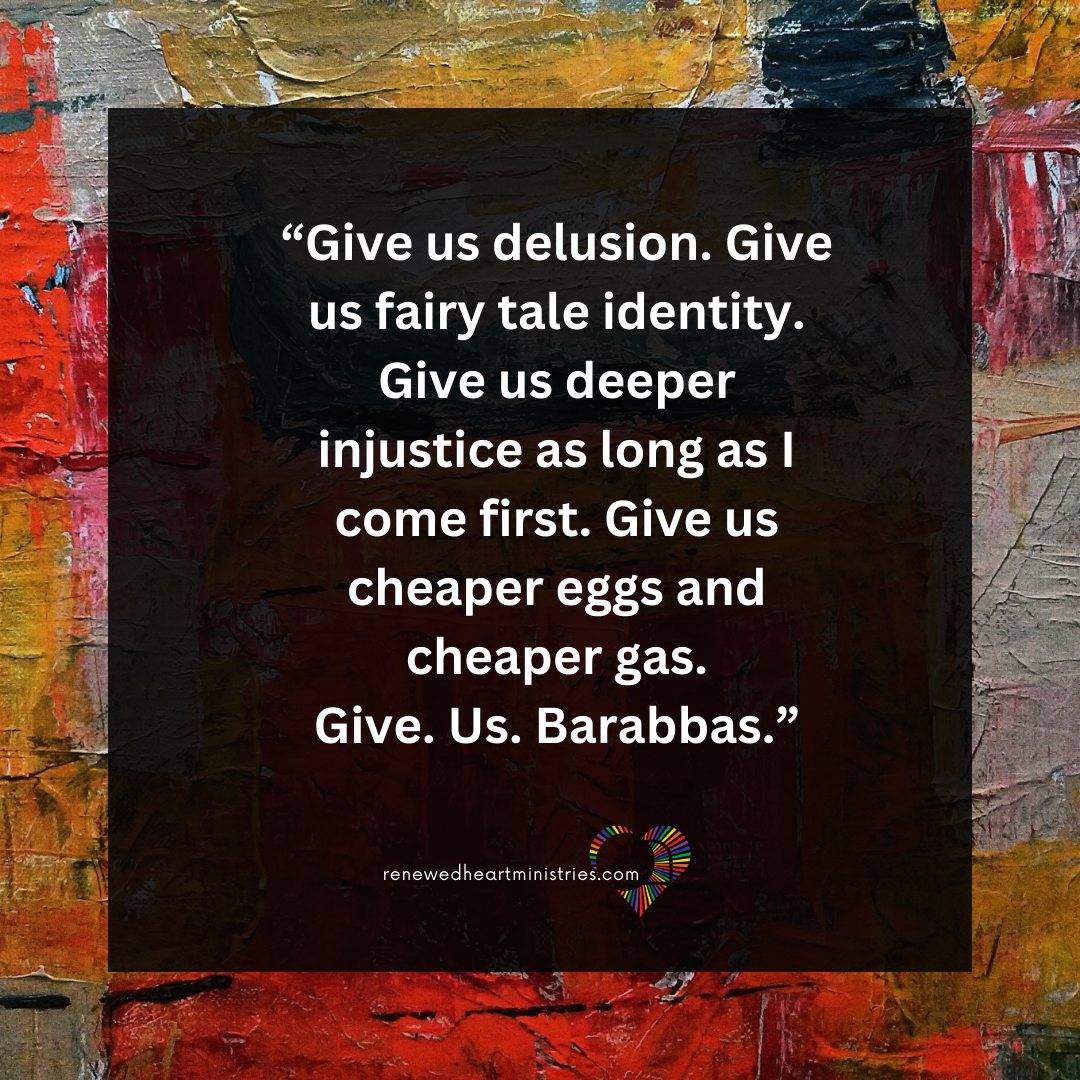
Give us delusion. 

Give us fairy tale identity.  

Give us deeper injustice as long as I come first.

Give us cheaper eggs and cheaper gas.

Give. Us. Barabbas.

In our context today, these words indict the kind of Christianity that leads adherents to work arm-in-arm to elect another Barabbas. Barabbas promised those in his society storybook liberation from whatever they felt was wrong in their society and the empire. He also claimed to be a savior of the people. 

But in the Jesus story, the people chose the wrong savior. 

So much is here in this story for us to painfully unpack and explore. So many lessons for our present movement, and I’m not rushing to positivity and hope. My work to shape our world into a safe, compassionate, just world for everyone just got a lot harder, and I’m choosing not to rush to put a positive spin on present events. Reasons to be hopeful probably do exist, but I agree with others that looking for them right now in the immediate wake of recent events may not be the healthiest choice.

Chaplain Quinn Elleen Gormley recently posted on social media, “Lament and despair are human emotions. They are necessary, and they must be metabolized, which can only be done by feeling them. Ritual, humor, screaming, crying, moving your body, these are all healthy ways to feel the emotions. Let yourself have a few bad days, it will make the hope more secure when it comes. Hope has to be allowed to blossom, it won’t stick if it’s forced.”

Today I’m choosing to sit somewhere between hope and hopelessness: simply in honesty. 

For right now we need to let the reality confront us that the majority of our society including far too many, many Christians and others of faith, either actively or passively just chose Barabbas. 

Justice and love demands we still roll up our sleeves and continue the work.  I still believe in a multicultural democracy.

Discussion Group Questions

1. Share something that spoke to you from this week’s Podcast episode with your discussion group.

2. Simply share how you are feeling at the present moment with your group. Encourage one another and build each other up.

3. What can you do this week, big or small, to continue setting in motion the work of shaping our world into a safe, compassionate, just home for everyone? 

Thanks for checking in with us, today.

I want to say a special thank you to all of our supporters out there. And if you would like to join them in supporting Renewed Heart Ministries’ work you can do so by going to renewedheartministries.com and clicking donate. 

My latest book Finding Jesus: A Fundamentalist Preacher Discovers the Socio-Political and Economic Teachings of the Gospels is available now on Amazon in paperback, Kindle and also on Audible in audio book format.

As always, you can find Renewed Heart Ministries each week on X (or Twitter), Facebook, Instagram and Meta’s Threads. If you haven’t done so already, please follow us on your chosen social media platforms for our daily posts. 

Thank you for listening to The Social Jesus Podcast. If you enjoyed this podcast please take a moment to like and subscribe and if the podcast platform you’re using offers this option, please leave us a positive review. This helps others find our podcast as well.

You can watch our YouTube show each week called “Just Talking”. Each week, Todd Leonard and I take a moment to talk about the gospel lectionary reading for the upcoming weekend. We’ll be talking about each reading in the context of love, inclusion, and social justice. Our hope is that our talking will be just talking (as in justice) and that during our brief conversations each week you’ll be inspired to also do more than just talking. If you teach from the lectionary each week, or if you’re just looking for some thoughts on the Jesus story from a more progressive perspective within the context of social justice, check it out, you might like it. You can find JustTalking each week on YouTube at youtube.com/@herbandtoddjusttalking. Please Like, Subscribe, hit the Notification button, and leave us a comment.

And if you’d like to reach us here at Renewed Heart Ministries through email, you can reach us at info@renewedheartministries.com.

Right where you are, keep living in love, choosing compassion, taking action, and working toward justice.

I love each of you dearly,

I’ll see you next week.


New Episode of “Just Talking” Now Online!

Season 2, Episode 36: Mark 13.1-8. Lectionary B, Proper 28

Each week, we’ll be talking about the gospel lectionary reading for the upcoming weekend in the context of love, inclusion, and social justice. Our hope is that our talking will be “just” talking (as in justice) and that during our brief conversations each week we’ll be inspired to do more than just talking.

If you teach from the lectionary each week, or if you’re just looking for some thoughts on the Jesus story from a more progressive perspective within the context of social justice, check it out at:


New Episode of The Social Jesus Podcast

A podcast where we talk about the intersection of faith and social justice and what a first century, prophet of the poor from Galilee might have to offer us today in our work of love, compassion and justice. 

This week:

Season 1 Episode 32: Give Us Barabbas

John 18:33-37

“Again, this kind of language has led to some deeply problematic interpretations. Some Christians completely disregard the injustice, oppression, violence, and therefore concrete suffering people are experiencing now and focus solely on saving their “souls” for postmortem heaven later. Honestly, I’m struggling a bit this week. In the wake of the recent election, I sincerely wish Christians were less involved here and now. If Christians’ civic participation is going to result in harm for women, my LGBTQ and immigrant friends, and so many others, I would rather they do just focus on heaven. Please stay out of the affairs of our world! If Christians do engage this world, we must ensure our actions make our world a safe, more just, more compassionate place for everyone or we end up doing more harm than good. So much is here in this story for us to painfully unpack and explore. So many lessons for our present movement, and I’m not rushing to positivity and hope. Our work to shape our world into a safe, compassionate, just world for everyone just got a lot harder.”

Available on all major podcast carriers and at:

https://the-social-jesus-podcast.simplecast.com/episodes/give-us-barabbas


Now Available on Audible!


Finding Jesus: A Fundamentalist Preacher Discovers the Socio-Political & Economic Teachings of the Gospels.

by Herb Montgomery, Narrated by Jeff Moon

Available now on Audible!

After two successful decades of preaching a gospel of love within the Christian faith tradition Herb felt like something was missing. He went back to the gospels and began reading them through the interpretive lenses of various marginalized communities and what he found radically changed his life forever. The teachings of the Jesus in the gospel stories express a profound concern for justice, compassion, and the well-being of those in marginalized communities. This book navigates the intersections between faith and societal justice, and presents a compelling argument for a more socially compassionate and just expression of Christianity. Herb’s findings in his latest book are shared in the hopes that it will dramatically impact how you practice your Christianity, too.


Are you getting all of RHM’s Free Resources?

Free Sign Up Here

The Beginning of Birth Pains

We want to take this moment to express our heartfelt gratitude to all of our supporters for your invaluable role in the Renewed Heart Ministry community and for your dedication to our mission of fostering love, justice, compassion, and healing. Your support is the bedrock of our work. Your support empowers us to do what we do. At a time when ministries like ours are being asked to achieve more with fewer resources, your support is incredibly important, and we want to simply say thank you. Whether in our larger society or within our local faith communities, Renewed Heart Ministries remains committed to advocating for change, working towards a world that is inclusive, just, and safe for everyone, and being a source of love in our world. From all of us here at Renewed Heart Ministries, thank you for your generous support. We deeply appreciate each and every one of our supporters.

If you’d like to join them in supporting our work, please go to renewedheartministries.com and click on “Donate.”  

Marching Donations Till End of Year

As we are seeking to reach our ministry goals here at the end of 2024, we are excited to share that all donations to Renewed Heart Ministries for the remainder of year will be matched! Every dollar you give will have twice the impact, helping us further expand the work of Renewed Heart Ministries in 2025. Join us in making a difference—together, we can maximize our collective impact!


The Beginning of Birth Pains

Herb Montgomery, November 15, 2024

If you’d like to listen to this week’s article in podcast version click on the image below:
Our reading this week is from the gospel of Mark:

As Jesus was leaving the temple, one of his disciples said to him, “Look, Teacher! What massive stones! What magnificent buildings!” “Do you see all these great buildings?” replied Jesus. “Not one stone here will be left on another; every one will be thrown down.”

As Jesus was sitting on the Mount of Olives opposite the temple, Peter, James, John and Andrew asked him privately, “Tell us, when will these things happen? And what will be the sign that they are all about to be fulfilled?”

Jesus said to them: “Watch out that no one deceives you. Many will come in my name, claiming, ‘I am he,’ and will deceive many. When you hear of wars and rumors of wars, do not be alarmed. Such things must happen, but the end is still to come. Nation will rise against nation, and kingdom against kingdom. There will be earthquakes in various places, and famines. These are the beginning of birth pains.” (Mark 13:1-8)

Jesus as More Than a Religious Figure

When we characterize Jesus purely as a religious figure, we back ourselves into a corner where our interpretations can do harm. Let me explain. 

The gospels repeatedly represent Jesus in the narratives as being against the Temple. As Richard Horsley writes, “The Gospels and the materials they incorporate portray Jesus as adamantly opposed to the high priests and the Temple and portray the high priests and scribal-Pharisaic representatives of the temple-state as eager to destroy Jesus” (In Jesus and the Politics of Roman Palestine, p. 48).

A few examples from the gospels are:

“Then the chief priests, the teachers of the law and the elders looked for a way to arrest him because they knew he had spoken the parable against them.” (Mark 12:12)

“We heard him say, ‘I will destroy this temple made with human hands and in three days will build another, not made with hands.’” (Mark 14:58)

They crucified two rebels with him, one on his right and one on his left. Those who passed by hurled insults at him, shaking their heads and saying, “So! You who are going to destroy the temple and build it in three days, come down from the cross and save yourself!” (Mark 15:27-30)

Jesus answered them, “Destroy this temple, and I will raise it again in three days.” (John 2:19)

Even in the Gospel of Thomas (71) we read a similar saying: “Jesus said, ‘I shall destroy this house, and no one will be able to build it.’

Interpreting Jesus only as religious sets us up to interpret these passages as if he were somehow against the religion of the temple, and that has led many Christians through history to separate Jesus from his Jewishness and create a Christianity-versus-Judaism tension that has done untold harm to Jewish people. 

But Jesus was not against his own religious tradition as much as he was against his people’s economic and political exploitation by the high priests and others tied to the Roman-installed Temple State. The Temple State was an extension of Rome during Jesus’ time. Through the Temple State and its complicity with Rome, Jesus’ community experienced injustice, exploitation, and social disintegration. 

So instead of reading Jesus’ critical statements about the temple, high priest, Pharisees, scribes, synagogue leaders, and teachers of the law as Jesus being against Judaism, we should understand that he critiqued the power brokers, apologists, and propagandists of a political and economic unjust system within his own society that was doing deep harm by it’s complicity with the Roman Empire. 

In the stories, these leaders spin Jesus’ critical statements about the Temple State as against the Torah and Moses. But this was their attempt to discredit Jesus and his calls for economic justice, which would have ended their power and profit at the expense of the masses. We see this interpretation in the book of Acts:

“They produced false witnesses, who testified, ‘This fellow never stops speaking against this holy place and against the law. For we have heard him say that this Jesus of Nazareth will destroy this place and change the customs Moses handed down to us.’” (Acts 6:13-14)

Remember, Jesus was a Jew. He was never a Christian. His followers started Christianity, for sure, but Jesus himself was leading a Jewish renewal movement in the tradition of the Hebrew prophets and he called the village communities of Galilee and Judea back to the Torah’s social justice teachings in opposition to the exploitation and harm being perpetrated at the Temple.

Navigating Trauma in Mark 13

Today, scholars argue over whether Mark’s gospel was written after the Jewish-Roman War or  immediately before it. I’m of the opinion that that Mark was written after the fact as an explanation for world-upheaving events. Either way, Mark’s gospel aims to provide answers for a Jewish Jesus-following community that is either having their world turned upside down or have just had it overturned. 

Our reading this week aligns with Josephus’ descriptions of the events leading up to the Jewish Roman War in 66-69 C.E. (see Josephus’ The Jewish War). He describes famine, false prophets, and  events leading up to the razing of the Temple itself. 

In his account, Mark uses the hyperbolic language of apocalyptic writings of the time and the kind of language the prophets of old used to describe destruction brought on their nation by conquering foreign empires:

“The floodgates of the heavens are opened, the foundations of the earth shake. The earth is broken up, the earth is split asunder, the earth is violently shaken. The earth reels like a drunkard, it sways like a hut in the wind; so heavy upon it is the guilt of its rebellion that it falls—never to rise again.” (Isaiah 24:18-20)

We must not underestimate the trauma that the Jewish community at large and the Jesus-following Jewish community specifically was enduring at this time. 

Looking for answers, it was only natural for the Jesus community to look back to Jesus’ calls for economic justice and his critical statements toward the Temple State to explain the devastation Rome had just wrought on Jerusalem and the surrounding regions.

Economic exploitation had reached a pivotal moment in the mid 60’s C.E., and the poor people revolted. The officials of the Temple State were driven out of Jerusalem. Revolutionaries and liberationists burned the Temple State’s debt records. This revolt then quickly evolved into an all-out assault on Rome itself as poor people tried to free themselves not just from local leaders but also from Roman occupation itself.  This led to the Jewish Roman War of 66-69 C.E. and the Roman destruction of the Temple itself in 70 C.E. This pattern repeated in the second century when Rome banished the Jews from Jerusalem and Palestine and destroyed the entire city of Jerusalem in 135 C.E.  

Mark’s gospel’s hyperbolic language in our reading this week is best understood against the back drop of this tremendous societal trauma.

The Hope that Injustice is Unsustainable

And this leads us to our application today. Injustice, whether political, economic, social, ecological or whatever, is unsustainable. It cannot endure. Injustice always eventually reaches a breaking point. And when it does, the transition is always destructive, and most destructive to those most vulnerable. Voluntarily abandoning unjust systems ahead of time is always difficult, but much less difficult and less harmful than waiting for change to be forced.

I think of the economic stress so many are under presently. I think, too, of the political divisions that continue to grow here in the U.S. I think of the acknowledged and unacknowledged radical and misogynistic biases so many of us still have inside ourselves in the country. I think of the ecological damage we cannot continue to perpetuate.“Rising inequality and global warming are the most pressing issues of our time,” says Thomas Piketty, author of Capital and Ideology. Add to all of this the recent gut punch of the recent election results and what those results reveal about who we are here in the U.S. and how far we still need to go toward a multicultural democracy. 

It’s the last phrase in the reading that gets me. Rather than a pessimistic outlook as if the world is about to end, our reading characterizes all of this pain as the “beginning of birth pains.”

This is not the end. If we choose it, all of our present challenges now could be the beginning of us giving birth to something new. We don’t have to give up hope. We can look at the world around us and still imagine a world that is a safe, compassionate, just home for everyone.  The current loss and anxiety, our energy and concerns, can be channeled into a renewed commitment to resistance giving birth to the kind of world we want to live in, a world where there is room enough for all of us thrive. Things will be different this time. But we are different this time, too. We are more organized, and we are ready. We are not alone. Our community of resistance is still here.

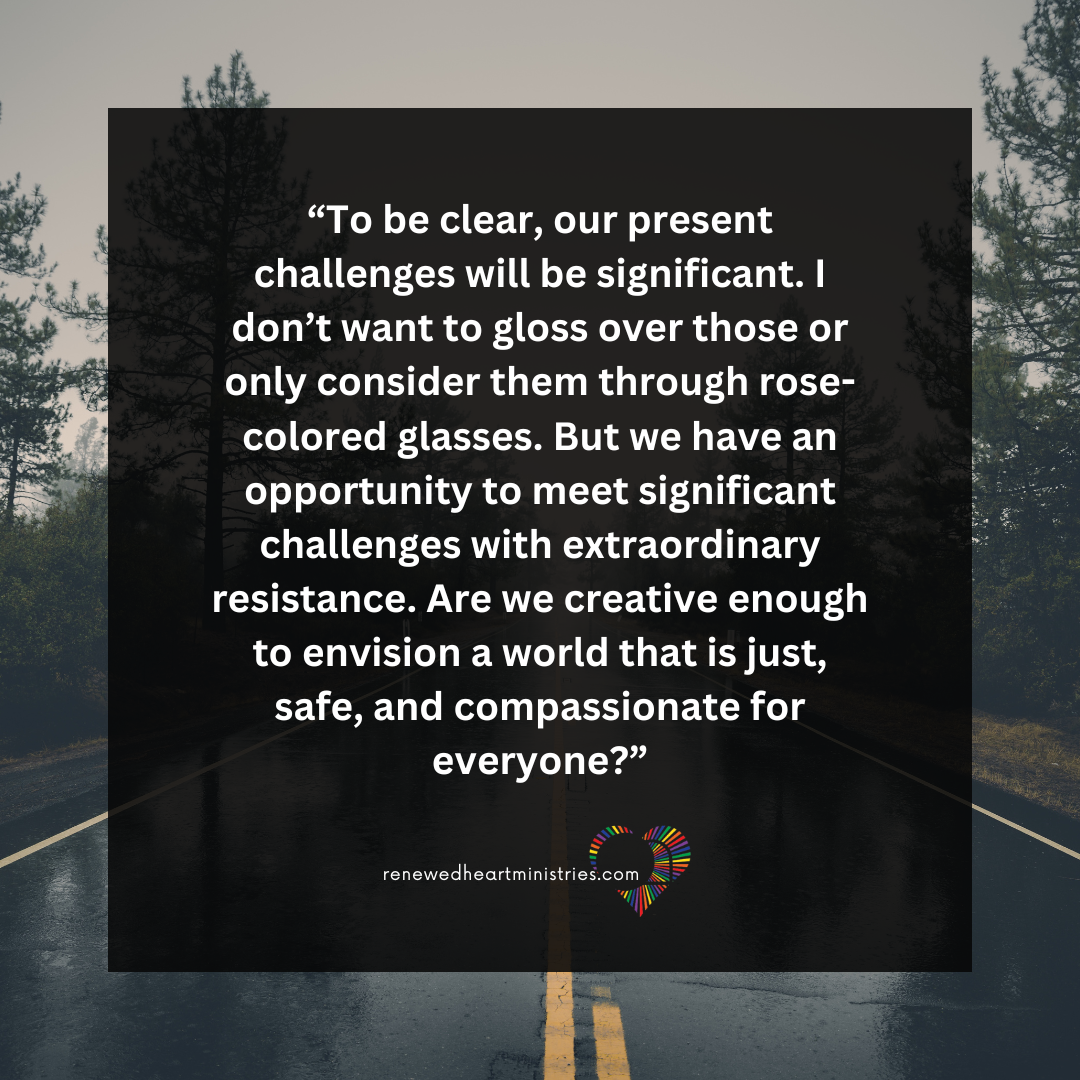
To be clear, our present challenges will be significant. I don’t want to gloss over those or only consider them through rose-colored glasses. But we have an opportunity to meet significant challenges with extraordinary resistance. Are we creative enough to envision a world that is just, safe, and compassionate for all? The Jesus of our gospels asked us to. And again, if we choose, the pain many of us are presently experiencing could be a foreboding of life rather than death. These don’t have to be death-pains. It’s still painful. Yet through our continued commitment to resistance and justice, we can transform our pain into the beginning of birth-pains instead: the beginning of something, that in the end, may be beautiful. 

We are not alone. We still have each other. And our work, once again, is laid out for us.

Discussion Group Questions

1. Share something that spoke to you from this week’s Podcast episode with your discussion group.

2. What are you feeling in the wake of last week’s election choices by the majority of our fellow citizens? Share and discuss with your group.

3. What can you do this week, big or small, to continue setting in motion the work of shaping our world into a safe, compassionate, just home for everyone? 

Thanks for checking in with us, today.

I want to say a special thank you to all of our supporters out there. And if you would like to join them in supporting Renewed Heart Ministries’ work you can do so by going to renewedheartministries.com and clicking donate. 

My latest book Finding Jesus: A Fundamentalist Preacher Discovers the Socio-Political and Economic Teachings of the Gospels is available now on Amazon in paperback, Kindle and also on Audible in audio book format.

As always, you can find Renewed Heart Ministries each week on X (or Twitter), Facebook, Instagram and Meta’s Threads. If you haven’t done so already, please follow us on your chosen social media platforms for our daily posts. 

Thank you for listening to The Social Jesus Podcast. If you enjoyed this podcast please take a moment to like and subscribe and if the podcast platform you’re using offers this option, please leave us a positive review. This helps others find our podcast as well.

You can watch our YouTube show each week called “Just Talking”. Each week, Todd Leonard and I take a moment to talk about the gospel lectionary reading for the upcoming weekend. We’ll be talking about each reading in the context of love, inclusion, and social justice. Our hope is that our talking will be just talking (as in justice) and that during our brief conversations each week you’ll be inspired to also do more than just talking. If you teach from the lectionary each week, or if you’re just looking for some thoughts on the Jesus story from a more progressive perspective within the context of social justice, check it out, you might like it. You can find JustTalking each week on YouTube at youtube.com/@herbandtoddjusttalking. Please Like, Subscribe, hit the Notification button, and leave us a comment.

And if you’d like to reach us here at Renewed Heart Ministries through email, you can reach us at info@renewedheartministries.com.

Right where you are, keep living in love, choosing compassion, taking action, and working toward justice.

I love each of you dearly,

I’ll see you next week.
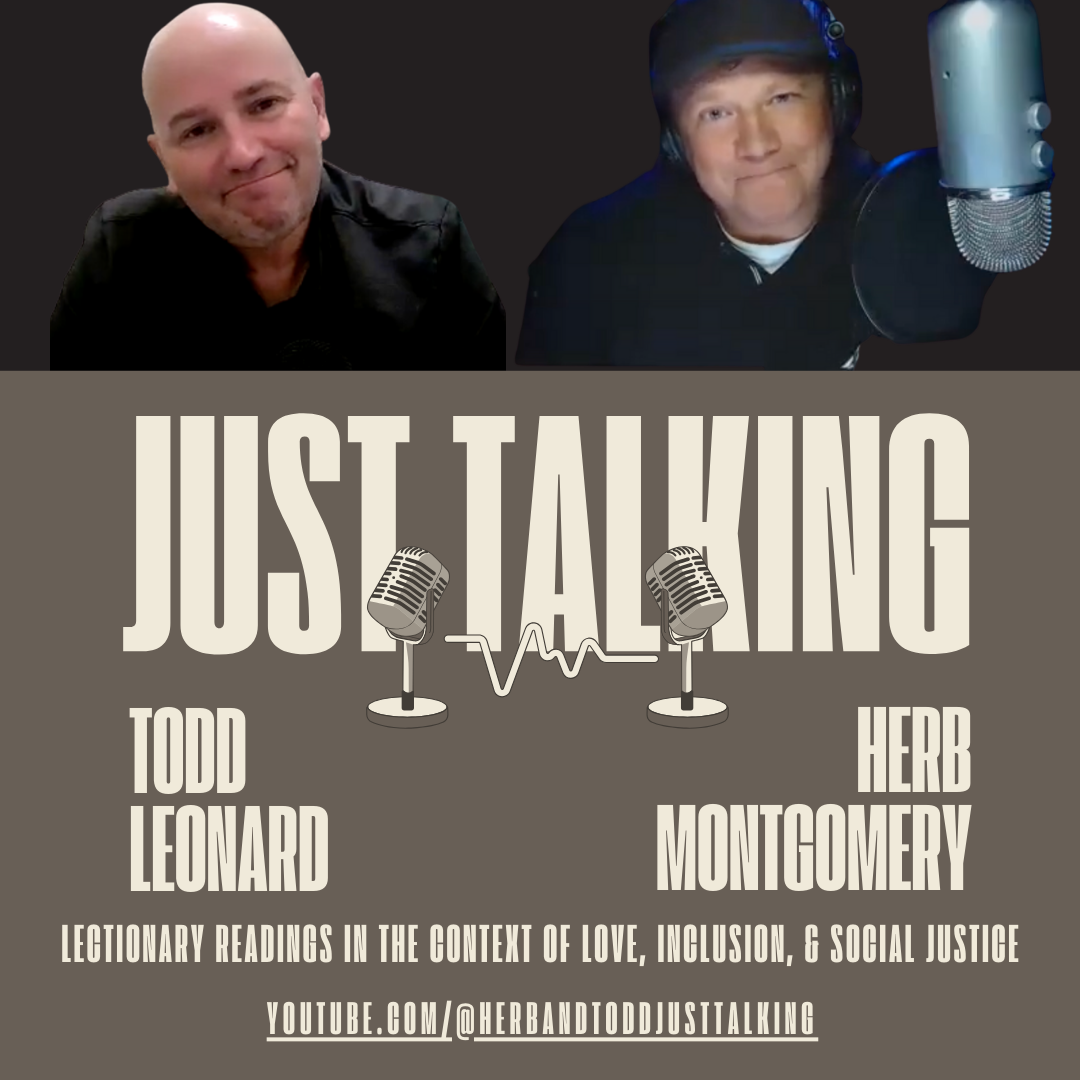

New Episode of “Just Talking” Now Online!

Season 2, Episode 36: Mark 13.1-8. Lectionary B, Proper 28

Each week, we’ll be talking about the gospel lectionary reading for the upcoming weekend in the context of love, inclusion, and social justice. Our hope is that our talking will be “just” talking (as in justice) and that during our brief conversations each week we’ll be inspired to do more than just talking.

If you teach from the lectionary each week, or if you’re just looking for some thoughts on the Jesus story from a more progressive perspective within the context of social justice, check it out at:


New Episode of The Social Jesus Podcast

A podcast where we talk about the intersection of faith and social justice and what a first century, prophet of the poor from Galilee might have to offer us today in our work of love, compassion and justice. 

This week:

Season 1 Episode 31: The Beginning of Birth Pains

Mark 13:1-8

“I think of the economic stress so many are under presently. I think, too, of the political divisions that continue to grow here in the U.S. I think of the acknowledged and unacknowledged radical and misogynistic biases so many of us still have inside ourselves in the country. I think of the ecological damage we cannot continue to perpetuate. Add to all of this the recent gut punch of the recent election results and what those results reveal about who we are here in the U.S. and how far we still need to go toward a multicultural democracy. This is not the end. If we choose it, all of our present challenges now could be the beginning of us giving birth to something new. We don’t have to give up hope. We can look at the world around us and still imagine a world that is a safe, compassionate, just home for everyone.  The current loss and anxiety, our energy and concerns, can be channeled into a renewed commitment to resistance giving birth to the kind of world we want to live in, a world where there is room enough for all of us thrive. Things will be different this time. But we are different this time, too. We are more organized, and we are ready. We are not alone. Our community of resistance is still here.”

Available on all major podcast carriers and at:

https://the-social-jesus-podcast.simplecast.com/episodes/the-beginning-of-birth-pains


Now Available on Audible!


Finding Jesus: A Fundamentalist Preacher Discovers the Socio-Political & Economic Teachings of the Gospels.

by Herb Montgomery, Narrated by Jeff Moon

Available now on Audible!

After two successful decades of preaching a gospel of love within the Christian faith tradition Herb felt like something was missing. He went back to the gospels and began reading them through the interpretive lenses of various marginalized communities and what he found radically changed his life forever. The teachings of the Jesus in the gospel stories express a profound concern for justice, compassion, and the well-being of those in marginalized communities. This book navigates the intersections between faith and societal justice, and presents a compelling argument for a more socially compassionate and just expression of Christianity. Herb’s findings in his latest book are shared in the hopes that it will dramatically impact how you practice your Christianity, too.


Are you getting all of RHM’s Free Resources?

Free Sign Up Here