

Thank You!
A sharp drop in giving is hurting nonprofits everywhere. Religious charities and small nonprofits are suffering the most from a historic dip in philanthropic giving presently in the U.S. We want to take this moment to express our heartfelt gratitude to all of our supporters for your invaluable role in the Renewed Heart Ministry community and for your dedication to our mission of fostering love, justice, compassion, and healing. Your support is the bedrock of our work. Your support empowers us to do what we do. At a time when ministries like ours are being asked to achieve more with fewer resources, your support is incredibly important, and we want to simply say thank you. Whether in our larger society or within our local faith communities, Renewed Heart Ministries remains committed to advocating for change, working towards a world that is inclusive, just, and safe for everyone, and being a source of love in our world. From all of us here at Renewed Heart Ministries, thank you for your generous support. We deeply appreciate each and every one of our supporters.
If you’d like to join them in supporting our work, please go to renewedheartministries.com and click on “Donate.”

Herb Montgomery, May 24, 2024
If you’d like to listen to this week’s article in podcast version click on the image below:
Our reading from the gospels this coming weekend is from the gospel of John.
Now there was a Pharisee, a man named Nicodemus who was a member of the Jewish ruling council. He came to Jesus at night and said, “Rabbi, we know that you are a teacher who has come from God. For no one could perform the signs you are doing if God were not with him.”
Jesus replied, “Very truly I tell you, no one can see the kingdom of God unless they are born again.” “How can someone be born when they are old?” Nicodemus asked. “Surely they cannot enter a second time into their mother’s womb to be born!”
Jesus answered, “Very truly I tell you, no one can enter the kingdom of God unless they are born of water and the Spirit. Flesh gives birth to flesh, but the Spirit gives birth to spirit. You should not be surprised at my saying, ‘You must be born again.’ The wind blows wherever it pleases. You hear its sound, but you cannot tell where it comes from or where it is going. So it is with everyone born of the Spirit.”
“How can this be?” Nicodemus asked.
“You are Israel’s teacher,” said Jesus, “and do you not understand these things? Very truly I tell you, we speak of what we know, and we testify to what we have seen, but still you people do not accept our testimony. I have spoken to you of earthly things and you do not believe; how then will you believe if I speak of heavenly things? No one has ever gone into heaven except the one who came from heaven—the Son of Man. Just as Moses lifted up the snake in the wilderness, so the Son of Man must be lifted up, that everyone who believes may have eternal life in him.”
For God so loved the world that he gave his one and only Son, that whoever believes in him shall not perish but have eternal life. For God did not send his Son into the world to condemn the world, but to save the world through him. (John 3:1-17)
If we are going to reunite the material and the spiritual, we need to understand how they became separated in the first place. In our reading this week, we encounter what scholars today describe as early Christian proto-Gnosticism. Jewish Gnosticism predates Christian Gnosticism although clear divisions between the two continue to be difficult (See Gnosticism).
Christian Gnosticism, like other forms of Gnosticism, promoted a dualistic way of understanding our experiences as flesh and spirit. Pharisaic Judaism was predominantly holistic, placing significance on our material existence along with other ways of describing how we exist in our world. The synoptic gospels, Matthew, Mark, and Luke, are all rooted in this Jewish holistic way of understanding ourselves. The synoptic gospels are deeply concerned not just with people’s spiritual needs but with their concrete, physical, and material needs as well (see Mark 2:8-11).
In our reading this week, we also see tensions that existed between the proto-gnostic, Johannine community and the Pharisees in Judaism at that time.
“Very truly I tell you, we speak of what we know, and we testify to what we have seen, but still you people do not accept our testimony. I have spoken to you of earthly things and you do not believe; how then will you believe if I speak of heavenly things?”
The division pointed to here between the Johannine community and the Pharisees was not unique. Pharisees would have opposed Jewish forms of Gnosticism, just as much they opposed Christian ones.
In harmony with the Gnostics’ definition of salvation as having secret knowledge, Nicodemus stands for someone on the inside of the Pharisees’ community who secretly followed the Johannine Jesus. Nicodemus is mentioned three times in John’s gospel and each time he’s represented as a covert Jesus follower:
Nicodemus, who had gone to Jesus earlier and who was one of their own number, asked “Does our law condemn a man without first hearing him to find out what he has been doing?” They replied, “Are you from Galilee, too? Look into it, and you will find that a prophet does not come out of Galilee.” (John 7:50-52)
Later, Joseph of Arimathea asked Pilate for the body of Jesus. Now Joseph was a disciple of Jesus, but secretly because he feared the Jewish leaders. With Pilate’s permission, he came and took the body away. He was accompanied by Nicodemus, the man who earlier had visited Jesus at night. Nicodemus brought a mixture of myrrh and aloes, about seventy-five pounds. Taking Jesus’ body, the two of them wrapped it, with the spices, in strips of linen. This was in accordance with Jewish burial customs. At the place where Jesus was crucified, there was a garden, and in the garden a new tomb, in which no one had ever been laid. (John 19:38-41)
The conversation between Jesus and Nicodemus in this week’s reading centers around distinguishing between what is born of the flesh and what is born of the spirit. This division between the flesh and the spirit, between the physical, material world and the spiritual has born seriously destructive fruit throughout Christianity.
Recently I have been reminded of what Fredrick Douglass wrote about the fruit of these kinds of divisions. If we see the ethics and teachings of the Jesus story as only applying to our spiritual dimensions and not also to our material existence, we can too often slide into contradictions between what we believe spiritually and what we practice materially.
In Narrative of the Life of Frederick Douglass: An American Slave, Douglass writes:
“Indeed, I can see no reason, but the most deceitful one, for calling the religion of this land Christianity. I look upon it as the climax of all misnomers, the boldest of all frauds, and the grossest of all libels. Never was there a clearer case of “stealing the livery of the court of heaven to serve the devil in.” I am filled with unutterable loathing when I contemplate the religious pomp and show, together with the horrible inconsistencies, which everywhere surround me. We have men-stealers for ministers, women-whippers for missionaries, and cradle-plunderers for church members. The man who wields the blood-clotted cowskin during the week fills the pulpit on Sunday, and claims to be a minister of the meek and lowly Jesus. The man who robs me of my earnings at the end of each week meets me as a class-leader on Sunday morning, to show me the way of life, and the path of salvation. He who sells my sister, for purposes of prostitution, stands forth as the pious advocate of purity. He who proclaims it a religious duty to read the Bible denies me the right of learning to read the name of the God who made me. He who is the religious advocate of marriage robs whole millions of its sacred influence.” (Frederick Douglass, The Narrative of the Life of Frederick Douglass: An American Slave.)
Some may deem Douglass’ experience an extreme example of the disconnect between material and spiritual worlds. I can’t help but think of the Inquisition, the Crusades, colonial Christianity’s treatment of Indigenous populations, and more. Even today, many Christians have an impossible time applying even the simplest golden rule ethic to the United States’ predatory capitalist economic system. We too distinguish between the spiritual and material.
But what would happen if we took seriously the Jewish Jesus of the synoptic gospels who saw the Divine as concerned about our material everyday lives materially and how his society was shaped to harm those on its margins. This Jesus didn’t traverse the countryside of Galilee to get people to say a special prayer so they could spiritually escape now and experience postmortem bliss later. The synoptic Jesus worked to bring about justice as a manifestation of God’s will being done, “on earth as it is in heaven” (Matthew 6:10). This Jesus sought to affect people’s physical realities as a source of healing, life, and liberation, and modeled salvation as relating to one’s spiritual wellbeing and material liberation as well.
The Jesus we see in the other gospels did not separate the spiritual from the fleshly or material. He taught his followers how to navigate their material world by loving their neighbor as a part of themselves (Luke 10:25-37) and relating to those our societies deems “the least of these” (Matthew 25:31-46). The Jesus of the synoptics announces the arrival of the reign of God in our material world and invites all to be a part of it. He rights injustice, ends oppression, and offers healing alternatives to violence. This Jewish Jesus did not separate the spiritual and material to offer a path of escape from the material world around us. Rather he taught his followers how to lean into the material world in life-giving ways, to bring healing to themselves and those around them, and to shape our material world into a safe, compassionate, just home for all.
Discussion Group Questions
1. Share something that spoke to you from this week’s eSight/Podcast episode with your discussion group.
2. In what ways do you believe the material needs reuniting with the spiritual again in our Christian practice today? Share and discuss with your group.
3. What can you do this week, big or small, to continue setting in motion the work of shaping our world into a safe, compassionate, just home for everyone?
Thanks for checking in with us, today.
I want to say a special thank you to all of our supporters out there. And if you would like to join them in supporting Renewed Heart Ministries’ work you can do so by going to renewedheartministries.com and clicking donate.
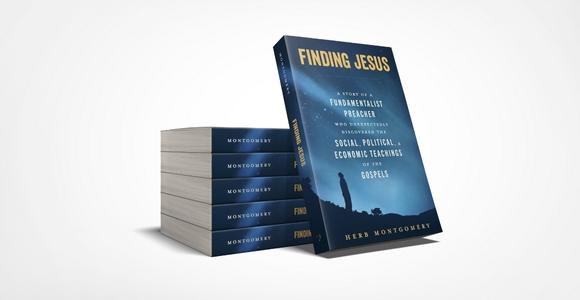
My latest book Finding Jesus: A Fundamentalist Preacher Discovers the Socio-Political and Economic Teachings of the Gospels is available now on Amazon in paperback, Kindle and also on Audible in audio book format.
As always, you can find Renewed Heart Ministries each week on X (or Twitter), Facebook, Instagram and Meta’s Threads. If you haven’t done so already, please follow us on your chosen social media platforms for our daily posts.
If you would like to listen to these articles each week in podcast form, you can find The Social Jesus podcast on all major podcast carriers. If you enjoy listening to The Social Jesus Podcast please take a moment to like and subscribe and if your podcast platform offers this option, consider taking some time to leave us a positive review. This helps others find our podcast as well.
You can watch our new YouTube show called “Just Talking” each week. Todd Leonard and I take a moment to talk about the gospel lectionary reading for the upcoming weekend. We’ll be talking about each reading in the context of love, inclusion, and societal justice. Our hope is that our talking will be just talking (as in justice) and that during our brief conversations each week you’ll be inspired to also do more than just talking. If you teach from the lectionary each week, or if you’re just looking for some thoughts on the Jesus story from a more progressive perspective within the context of social justice, check it out, you might like it. You can find JustTalking each week on YouTube at youtube.com/@herbandtoddjusttalking. Please Like, Subscribe, hit the Notification button, and leave us a comment.
And if you’d like to reach us here at Renewed Heart Ministries through email, you can reach us at info@renewedheartministries.com.
Right where you are, keep living in love, choosing compassion, taking action, and working toward justice.
I love each of you dearly,
I’ll see you next week.
New Episode of JustTalking!

Season 2, Episode 14: John 3.1-17. Lectionary B, Proper 3 (Trinity Sunday)
Reuniting the Material and the Spiritual
Each week, we’ll be talking about the gospel lectionary reading for the upcoming weekend. We’ll be talking about each reading in the context of love, inclusion, and societal justice. Our hope is that our talking will be just talking (as in justice) and that during our brief conversations each week you’ll be inspired to also do more than just talking.
If you teach from the lectionary each week, or if you’re just looking for some thoughts on the Jesus story from a more progressive perspective within the context of social justice, check it out, you might like it.
You can find the latest show on YouTube at:

New Episode of The Social Jesus Podcast
A podcast where we talk about the intersection of faith and social justice and what a first century, prophet of the poor from Galilee might have to offer us today in our work of love, compassion and justice.
This week:
Season 1 Episode 7: Reuniting the Material and the Spiritual
John 3:1-17
“This division between the flesh and the spirit, between the physical, material world and the spiritual has born seriously destructive fruit throughout Christianity. The Jesus in the synoptic gospels did not separate the spiritual from the fleshly or material. He taught his followers how to navigate their material world by righting injustice, ending oppression, and offering healing alternatives to violence. That Jewish Jesus did not separate the spiritual and material to offer a path of escape from the material world. Rather he taught his followers how to lean into their material world in life-giving ways.”
Available on all major podcast carriers.
Or at:
https://the-social-jesus-podcast.simplecast.com/episodes/reuniting-the-material-and-the-spiritual
Now Available on Audible!

Finding Jesus: A Fundamentalist Preacher Discovers the Socio-Political & Economic Teachings of the Gospels.
by Herb Montgomery, Narrated by Jeff Moon
Available now on Audible!
After two successful decades of preaching a gospel of love within the Christian faith tradition Herb felt like something was missing. He went back to the gospels and began reading them through the interpretive lenses of various marginalized communities and what he found radically changed his life forever. The teachings of the Jesus in the gospel stories express a profound concern for justice, compassion, and the well-being of those in marginalized communities. This book navigates the intersections between faith and societal justice, and presents a compelling argument for a more socially compassionate and just expression of Christianity. Herb’s findings in his latest book are shared in the hopes that it will dramatically impact how you practice your Christianity, too.
Are you getting all of RHM’s Free Resources?
Free Sign Up Here









 Meanwhile, standing near the cross of Jesus were his mother, and his mother’s sister, Mary the wife of Clopas, and Mary Magdalene. When Jesus saw his mother and the disciple whom he loved standing beside her, he said to his mother, “Woman, here is your son.” Then he said to the disciple, “Here is your mother.” And from that hour the disciple took her into his own home. (John 19:25-27)