Against Enticing Little Ones

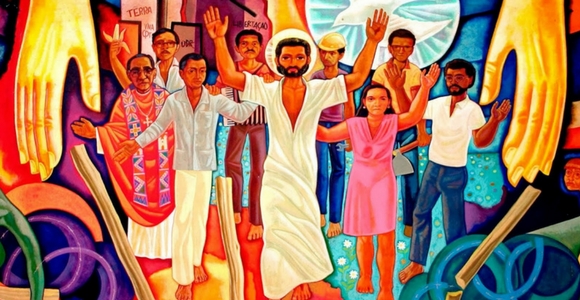
“Cristo de la Liberacion” (Christ of the Liberation) by Maximino Cerezo Barredo, who’s been dubbed “liberation painter.”

Photo Credit: “Cristo de la Liberacion” (Christ of the Liberation) by Maximino Cerezo Barredo, who’s been dubbed “liberation painter.”

“Our experiences determine not only the questions we ask, but also the answers we get back. Plain readings are not plain but are read through the lens of our own paradigms and fears. And this is one reason why it is so vital, if we are going to make our world safe and just for everyone, that we learn to listen to stories, experiences, and interpretations of our sacred texts from the most vulnerable communities in our society.”

by Herb Montgomery | October 20, 2017

Featured Text:

“It is necessary for enticements to come, but woe to the one through whom they come! It is better for him if a millstone is put around his neck and he is thrown into the sea, than that he should entice one of these little ones.” Q 17:1-2

Companion Texts:

Matthew 18:6-7: “If any of you put a stumbling block before one of these little ones who believe in me, it would be better for you if a great millstone were fastened around your neck and you were drowned in the depth of the sea. Woe to the world because of stumbling blocks! Occasions for stumbling are bound to come, but woe to the one by whom the stumbling block comes!”

Luke 17:1, 2: “Jesus said to his disciples, ‘Occasions for stumbling are bound to come, but woe to anyone by whom they come! It would be better for you if a millstone were hung around your neck and you were thrown into the sea than for you to cause one of these little ones to stumble.’”

We stumble when we’re learning to walk. This week, we are focusing on those who are walking toward a safer, more just, and compassionate world, and we’ll be considering how as they move forward, others will actively obstruct their path rather than smoothing it out. Obstructionists place stumbling blocks in the way of those moving forward, causing their advance to be harder than it should be.

We are, again, considering one of Jesus’ sayings about “little ones.” As I wrote in Thanksgiving that God Reveals Only to Children:

“The family structure in Palestine in the first century was a hierarchical pyramid with the male patriarch at the top. On the bottom rung of the social ladder, below slaves, were children (see Galatians 4:1).

Social status is typically evaluated by the degree to which one has both power and resources. Those with large measures of control over power and resources operate in higher social positions, while those with very little access to power and resources live at the bottom.

Children have access to neither power nor resources. The typical avenues to power and control of resources are education, income, or work. In our societies, children have none of these, and they are vulnerable to abuse and neglect so child advocacy and children’s rights are much needed. Discrimination on the basis of race, gender, sexual orientation, gender identity, national origin, religion, disability, color, or ethnicity are also compounded when they apply to children.”

Our focus in this week’s saying is directed toward the “little ones” Jesus spoke of—the most vulnerable sectors of society. In the Greek, “little ones” (mikros) can not only refer to children, but also any who are vulnerable to exploitation by the status quo. It doesn’t have to mean a young person; it can also refer to a person’s “rank or influence” within a society. Christianity has a long history in doing damage to our most vulnerable and most marginalized.

Native People 

One example in this history is the way Christian preachers and missionaries used the Canaanite conquest and genocide stories in the Bible to legitimize the genocide of Native peoples here in the U.S.:

“Biblical notions of extirpation influenced colonial America from the earliest days of the settlement. In a tract publicizing the new Virginia settlement, Robert Gray expressed the hope that Indians might accept Christianity, but if they did not, biblical commands were clear: ‘Saul had his kingdom rent from him and his posterity because he spared Agag . . . whom God would not have spared; so acceptable a service is it to destroy idolaters, whom God hateth.’” (Philip Jenkins, in Laying Down the Sword: Why We Can’t Ignore the Bible’s Violent Verses, p. 133)

During the colonial era, many New England preachers such as Cotton Mather compared Pequot Indians to modern Ammonites and New England to a modern Israel (see Cotton Mather, Magnalia Christi Americana, vol. 1, p. 553). With this interpretation, if Saul had had his kingdom taken away because he failed to utterly destroy the Ammonites, the new American Christians were not to fail in the complete annihilation of their modern, native “Ammonites” if they wanted ensure their place on this continent, their “promised land.” The genocide of Native people was rooted in Christians’ lethal interpretation of violent Bible passages; it was a genocide they believed God had commanded them to execute.

Slavery

During the abolitionist years leading up to the American Civil War, many Christian preachers quoted Leviticus’ passages affirming slavery and claimed that neither Paul nor Jesus had reversed those passages. One famous preacher, ironically named Moses Stuart, wrote:

“Not one word has Christ said, to annul the Mosaic law while it lasted. Neither Paul nor Peter have uttered one. Neither of these have said to Christian masters: ‘Instantly free your slaves.’ Yet they lived under Roman laws concerning slavery, which were rigid to the last degree. How is it explicable on any ground, when we view them as humane and benevolent teachers, and especially as having a divine commission-how is it possible that they should not have declared and explicitly [so] against a malum in se [something evil in itself]?”

He confidently pronounced that those calling for the end of slavery “must give up the New Testament authority, or abandon the fiery course which they are pursuing” (Moses Stuart, Conscience and the Constitution; with Remarks on the Recent Speech of the Hon. Daniel Webster in the Senate of the United States on the Subject of Slavery, 1850).

Another minister, a Southern Methodist named J.W. Tucker, proclaimed to his Confederate audience fighting for their right to own slaves, “Your cause is the cause of God, the cause of Christ, of humanity. It is a conflict of truth with error-of Bible with Northern infidelity-of pure Christianity with Northern fanaticism.” (Kurt O. Berends, “Confederate Sacrifice and the ‘Redemption’ of the South,” in Religion and the American South: Protestants and Others in History and Culture, ed. Beth Barton Schweiger and Donald G. Mathews, p. 105.) Tucker’s rhetoric sounds almost identical to the rhetoric of Christians today as they condemn movement in many faith traditions toward the affirmation of LGBTQ people.

Against Women

Christianity also has a long history with patriarchy and misogyny. Roman Catholic writer John Paul Boyer explains in Some thoughts on the Ordination of Women: 

Being a Jew, being a Palestinian, being a first century man—all these are what we might call, in the language of Aristotelian metaphysical, the ‘accidents of Christ’s humanity;’ but his being a man rather than a woman is of the ‘substance’ of his humanity. He could have been a twentieth-century Chinese and been, cultural differences notwithstanding, much the same person he was, but he could not have been a woman without having been a different sort of personality altogether.” (A Monthly Bulletin of the Church of St. Mary the Virgin, ())

Womanist scholar Jacqueline Grant rightly states in her book White Women’s Christ and Black Women’s Jesus that “the most significant use of this argument” came from Pope Paul VI on October 15, 1976, when he approved and published the following declaration:

“The Christian priesthood is therefore of a sacramental nature: the priest is a sign, the supernatural effectiveness of which comes from the ordination received, but a sign that must be perceptible and which the faithful must be able to recognize with ease. The whole sacramental economy is in fact based up on natural signs, or symbols imprinted up on the human psychology: ‘Sacramental signs’, says Saint Thomas, ‘represent what they signify by natural resemblance.’ The same natural resemblance is required for personas as for things: when Christ’s role in the Eucharist is to be expressed sacramentally there would not be this ‘natural resemblance’ which must exist between Christ and his minister if the role of Christ were not taken by a man. In such a case it would be difficult to see in the minister the image of Christ. For Christ himself was and remains a man.” (Franjo Cardinal Seper, Vatican Declaration, Feb 6, 1977, p. 6)

Never mind that the church’s own creation story states clearly that both male and female were made in the image of God. There have long been interpretations of these stories that have marginalized, wholly excluded, and damaged women personally and institutionally. Because of the patriarchal nature of many sectors of Christianity, and despite the fact that there are feminist and womanist Christians, some have gone so far as to say that Christianity is a man’s religion.

LGBTQ Fear

Anyone who lived through the 1980s here in the U.S. knows all too well how Christianity has done untold damage to the LGBTQ community, legitimizing the inmate homophobia of straight parishioners through interpretations that are trans-, bi-, genderqueer-, and homo-phobic. For a history that reaches back into the 1970s, the Southern Poverty Law Center offers an excellent history of the modern Christian anti-gay movement, starting with Anita Bryant in 1977. Just a quick read demonstrates how monstrously Christians have mischaracterized this community and used damaging interpretations of the Bible to bolster their mischaracterization. Jay Grimstead, a founder of The Coalition on Revival, bluntly stated that “Homosexuality makes God vomit”. Many similar arguments are rhetorically identical to those Christians in the 1800’s used in their opposition to ending slavery. The Christian Moral Majority didn’t get its start opposing abortion or gay people, but by opposing integration after Brown v. Board of Education. They began a network of private Christian schools to make sure their White children did not have to attend school with Black and Brown children.

I’ve given you four examples of how interpretations of our sacred text have done and continue to do damage to those who are most vulnerable within our society. I also, wrote two weeks ago:

“Interpretations are not eternal. They change with time. As we see the harmful fruit of present interpretations, we can make those interpretations give way to new ones, in the hope that new interpretations will bear the fruit of life. And if we see that our new interpretations also do harm, we will challenge them too. The goal is to continue to seek life-giving interpretations for all, work with people’s well-being and thriving in our hearts, and transform our world into a safe, just, compassionate home for us all. Anything less is not faithful to Jesus or the Spirit of our various sacred texts. Every time you’re tempted to mistake your interpretation for the sacred text itself, remember that interpretations are temporary. It’s okay for them to change, as long as what they change to is life-giving for all.”

In each of the above examples, you can come up with Bible interpretations to oppose valuing and protecting Native people and lands, ending slavery, promoting equity for women, and seeking justice for the LGBTQ community. Some claim they are just reading the Bible plainly. But we never see things objectively. As the saying goes, we do not see things as they are; we see things as we are.

Our experiences determine not only the questions we ask, but also the answers we get back. Plain readings are not plain but are read through the lens of our own paradigms and fears. And this is one reason why it is so vital, if we are going to make our world safe and just for everyone, that we learn to listen to stories, experiences, and interpretations of our sacred texts from the most vulnerable communities in our society. This is how liberation theology was born: those in South America read the Bible very differently than their colonial Christian exploiters. It’s how Black liberation theology was born: Black Christians in the U.S. read the Bible radically differently than white Christians read it. It’s how feminist and womanist theologies were born and how queer theology was born. We need these voices and perspectives if we are to arrive at interpretations of our sacred text that cease to do harm.

Today we have a broad swathe of people who want nothing to do with Jesus because of the history of the church as the largest stumbling block in the path of the vulnerable in their work toward a world of justice and compassion. They see a Christianity that seems to habitually do harm, ever landing on the wrong side of history. They don’t see a Jesus who taught survival, resistance, liberation, and justice. They don’t see a Jewish Jesus on the side of the oppressed (Luke 4:18-19). Rather, that Jesus is eclipsed by a religion that was formed in his name. This is gives me great reason to pause. I know first-hand how my own faith has been fractured by watching Christian racism, misogyny, homophobia, and transphobia just in my local community here in West Virginia. I love Jesus, but I have zero tolerance for the kind of Christianity my family seems to be surrounded by where we live.

I do not apologize for this week’s eSight. And I don’t believe the truth of our history to be too harsh to share. As someone who loves the historic, first-century Jewish Jesus, I have simply  become disillusioned with the most vocal sectors of Christianity in our culture. Just this week I’ve endured disappointment again as Christians who should have been passionately living out the value of compassionate listening to the voices of the vulnerable, who claim to believe God love’s everyone, were passionate instead to protect their own cherished theology that has been shown to be hurtful to the vulnerable. Does your God love the vulnerable or your theology? Which is it that should be given a priority of worth? As Emilie Townes states, “When you start with an understanding that God loves everyone, justice isn’t very far behind.”  But what happens when you believe God loves everyone and that doesn’t lead to justice? What about when the ones preaching “God loves everyone” are the stumbling block for those working toward a safer, just, more compassionate world for the vulnerable?

As a Christian myself, I take this week’s saying seriously. It was said to Jesus’ followers, and we who take his name today must allow this week’s saying to confront us:

“Woe to the one through [whom stumbling blocks] come! It is better for them if a millstone is put around their neck and they are thrown into the sea, than that they should cause one of the vulnerable to stumble.” Q 17:1-2 

HeartGroup Application

This week I want you to spend some time with the above article.

  1. As a group discuss what challenges this week’s eSight creates for you.
  2. Discuss together where you feel encouraged by this week’s eSight. Maybe encouragement comes just from hearing that you’re not alone in your feelings of frustration toward your Christianity being a stumbling block to so many people.
  3. What are some ways you can move toward interpretations of our sacred texts that are not damaging and don’t create stumbling blocks for those pushed to the edges of our society? Which interpretations can also move you to take tangible, concrete actions as an individual and as a group to stand in solidarity with those walking toward a more just world? How can you smooth out another person’s way toward liberation? As it states in Isaiah:

“Every valley shall be raised up,

every mountain and hill made low;

the rough ground shall become level,

the rugged places a plain.” (Isaiah 40.4)

Thank you for checking in with us this week. Wherever this finds you, keep living in love engaging the work of transforming our world.

And to each of you who are supporting the work of Renewed Heart Ministries, we simply could not do this without you. We have a lot of educational events lined up for this fall. If you’d like to support our work you can do so by going to:

https://renewedheartministries.org/donate/

Or you can always mail your support to:

Renewed Heart Ministries
PO Box 1211
Lewisburg, WV 24901

Every amount helps. Thank you!

I love each of you dearly,

I’ll see you next week.

Replaced by People from East and West

A table with varied people eating

by Herb Montgomery

“When you see who is welcomed and affirmed, when you see how wrong you were about those you thought should be forbidden from sitting at the table with you, it’s going to make you so angry!”

Featured Text:

“And many shall come from Sunrise and Sunset and recline with Abraham and Isaac and Jacob in the kingdom of God, but you will be thrown out into the outer darkness, where there will be wailing and grinding of teeth.” (Q 13:29, 28)

Companion Text:

Matthew 8:11-12: “I say to you that many will come from the east and the west, and will take their places at the feast with Abraham, Isaac and Jacob in the kingdom of heaven. But the subjects of the kingdom will be thrown outside, into the darkness, where there will be weeping and gnashing of teeth.”

Luke 13:28-29: “There will be weeping there, and gnashing of teeth, when you see Abraham, Isaac and Jacob and all the prophets in the kingdom of God, but you yourselves thrown out. People will come from east and west and north and south, and will take their places at the feast in the kingdom of God.”

The Sayings Gospel Q scholars titled this week’s saying “Replaced by People from East and West.” If I’d organized the sayings, I wouldn’t have used the term “replaced.” As we’ll see this week, it’s not original to the text and it has a long anti-Semitic history rooted in supersessionism.

By contrast, Jesus’ saying is well centered in the Jewish prophetic tradition of Isaiah:

“And the almighty Yahweh will prepare for all the nations on this mountain a banquet of rich foods, a banquet of preserved wines, of spread out rich foods, and preserved refined wines. And on this mountain he will swallow up the covering that is over all peoples, even the covering woven on all the nations. He will swallow up death forever. And the Lord Yahweh will wipe clean the tears from upon all faces. And the shame of his people he will remove from upon all the earth. For Yahweh has spoken.” (Isaiah 25:6-8)

In the prophetic tradition of Isaiah, the messianic feast is not prepared exclusively for the Hebrew people but includes “all the nations.” The apocalyptic Essenes of Jesus’ society were looking for this banquet in their “end of the age.” They expected it to mark the transition between the present age and the “age to come” (see The Rule of the Congregation 1QSa or The Community Rule 1QS.) And they understood this banquet both literally and metaphorically as definitive of the quality of the messianic age when all violence, injustice, and oppression was to be put right in the earth.

Matthew’s gospel tellingly tacks this saying on to the end of the story about the centurion and his slave (Matthew 8.5-10). For the Matthew’s community, the centurion story could have been seen as an evidence of how “all the nations” were to be included in Isaiah’s feast. If this is true, this would explain much about the inclusivity that this community hoped for.

Replacement versus Exclusion

The Q community did not understand including Gentiles in their feast as an anti-Jewish move. And they did not see “all the nations” being included only to replace the Jewish festival attendants. In this saying, some are being excluded. Yet, there is a vast difference between a party for everyone that some will be shut out of and a party meant exclusively for some and whose original audience would be replaced by others.

Why does this distinction matter?

The Pharisees included two schools of thought. One, the School of Shammai, drew strict lines between Jews and Gentiles, in a effort to preserve their Jewish identity. They also drew strict lines between those who practiced Torah according to the School’s interpretations and fellow Jewish people they labeled as “sinners.”

I t is understandable that a people removed from their original land and held captive in foreign territories or scattered abroad, would re-gather to seek liberation. It’s important to protect others’ heritage and identity as a people when they’re being erased by their oppressors and their oppressors’ heritage and culture.

Just like the indigenous people here on this continent, or the Africans uprooted, enslaved, and removed to colonial lands, the Jewish people were struggling desperately to preserve their own identities and uniquenesses among a people not like themselves and who dominated them. The Jewish people living in the empires that subjugated them were being dehumanized, and in that context, I can understand and applaud the School of Shammai for focusing on their people’s Jewish peculiarity.

How we preserve our identity and heritage matters, though. Subjugators typically preserve and parade their identity through exceptionalism. In the United States, for example, American exceptionalism and the Doctrine of Discovery was the soil out of which grew the destructive weed of Manifest Destiny. These dehumanizing philosophies made genocide possible for the Native peoples across this continent and those who, through slavery, were violently brought here.

Exceptionalism

Exceptionalism can also be a way for oppressed and subjugated peoples to survive: feeling superior to those dominating you can be a way to resist. This form of survival and resistance can also be unhealthy. Those under Roman domination in Jesus’ society who began to look forward to a feast eventually imagined that feast not for “all the nations” but for their own vindication. In that vision, the messianic feast would be an event where oppressors would be excluded or even punished. In Ezekiel, at the messianic banquet feast, YHWH turns the Hebrew people’s enemies into food for predators of both sky and the land.

“As for you, son of man, this is what the sovereign Lord says: Tell every kind of bird and every wild beast: ‘Assemble and come! Gather from all around to my slaughter which I am going to make for you, a great slaughter on the mountains of Israel! You will eat flesh and drink blood. You will eat the flesh of warriors and drink the blood of the princes of the earth – the rams, lambs, goats, and bulls, all of them fattened animals of Bashan. You will eat fat until you are full, and drink blood until you are drunk, at my slaughter which I have made for you. You will fill up at my table with horses and charioteers, with warriors and all the soldiers,’ declares the sovereign Lord.” (Ezekiel 39:17-19)

In our saying this week Jesus seems to be addressing those in his time who were looking for a retributive feast, one more like Ezekiel’s than like Isaiah’s inclusive, distributive, and restorative feast. Those looking forward to a time of retribution, who were so sure they were superior to others around them, would be found not at the places of honor around the festive table, but excluded and shut out from the feast entirely. They would be found “gnashing their teeth.”

This proverbial phrase is key. The gnashing of teeth referred to a level of anger that caused a person to clinch their jaw and grind their teeth (e.g. Acts 7:54).

In other words, Jesus is saying, those of you who are looking for a retributive feast where you are included to the exclusion of those you have deemed unworthy, like this Roman centurion, there will be so many from east to west included in my messianic feast that you’re not going to be able to emotionally cope. When you see who is welcomed and affirmed, when you see how wrong you were about those you thought should be forbidden from sitting at the table with you, it’s going to make you so angry!

In the new world that is coming, he continues, if any are left in “outer darkness,” it won’t be those you believe don’t measure up to your standards of respectability or virtue. It will be you! You cannot accept the welcome, affirmation, and inclusion of those you feel should be excluded. You will be excluded because you cannot accept those who are being accepted.

This was the same point of Luke’s parable of the older brother (Luke 15:1-2; 25-32) and Matthew’s wedding banquet parable where a guest did not want to be dressed the same as those he felt superior to (Matthew 22:8-11).

Conclusion

I’m happy to be able to say that before the end of the first century, the Rabbis choose the School of Hillel’s earlier and more inclusive interpretations of the Torah (see BET HILLEL AND BET SHAMMAI).

One takeaway from this week’s saying is that there are better ways to protect identities and heritages than exclusion. Our differences should be preserved and celebrated, acknowledged, and mutually valued. As each of us finds our place at the table, as we honor each person’s voice in relationships of egalitarianism rather than domination and subjugation, we can learn to listen to one another. And we then can integrate the many experiences of life into a meaningful and coherent whole: not a new homogenized mass, but a mosaic filled with beauty, diversity, and variations.

Lastly, this week we learn that exclusion is its own self-fulfilling prophecy. To hope for a world where certain ones are no longer there is to create a world where you yourself are no longer welcome. You get the world you always wanted. The only catch is that you’ll be the only one alone, in the “outer darkness,” in a world where exclusion is excluded. Exclusion won’t be included in a world that is characterized by inclusion, distributive justice, and peace.

Does inclusion still provoke anger? You bet. Over the last four years, Renewed Heart Ministries has become a more open, welcoming, affirming, and inclusive ministry, including for those who identify as LGBTQ. And do I have stories to tell. The common thread through all of them is anger from those who are upset that we’ve made this shift.

While I’m saddened by the loss of those who have rejected and now exclude RHM and me, I do take a small portion of comfort in the fact that at least we are in the right story. Solidarity breeds crosses. But the story of Jesus tells me that crosses can also be followed by resurrections.

When you practice inclusion of those whom others have inaccurately deemed as deserving exclusion, will some people get upset and angry with you? Absolutely. But be of courage: this is simply your story becoming more aligned with the Jesus story itself, for:

Many shall come from Sunrise and Sunset and recline with Abraham and Isaac and Jacob in the kingdom of God [and] there will be wailing and grinding of teeth.” (Q 13:29, 28)

HeartGroup Application

Jesus wasn’t a Christian. He was a Jew. Recently I was introduced to the work of Rabbi Michael Lerner of Beyt Tikkun, a San Francisco Bay area Jewish Renewal Synagogue for Spiritual and Social Transformation. The Jewish Jesus lived life at the intersection of faith and social justice in the 1st Century. In the spirit of tikkun olam, Rabbi Lerner is working today to develop intersections between Jewish faith and social transformation.

Last week, Rabbi Lerner published a meditative piece of writing he titled Ten Commitments. He states, “Many of us find the notion of ‘commandments’ oppressive and hierarchical. Yet we know that a community cannot be built on the principle of only doing what feels right at the moment–it requires a sense of responsibility to each other. So, we encourage our community to take on the following ten commitments, based roughly on a rereading of the Torah’s ten commandments (and incorporating the framework and many specific ideas articulated by Rami Shapiro in his book Minyan).”

HeartGroups are also communities engaged in the work of healing our world. The Jesus we desire to follow grew up hearing teachings on these same ten commandments.

So this week, as a group:

1. As a group, read through Rabbi Lerner’s “Ten Commitments”:

http://www.beyttikkun.org/article.php/what_we_think_ten_commitments

2. Share which commitments spoke most loudly to you and why.

3. For each person in the group, pick one commitment to spend some time contemplating and meditating on this week. Come back the following week ready to share your experiences practicing it.

I’ll let you in on the one I’m practicing: I love the inclusivity and respect of #3 in Lerner’s list.

Which one speaks most loudly to you?

Thank you for checking in this week.

Keep living in love. And may the teaching of this 1st Century prophet of the poor continue to inform your work of survival, resistance, liberation, restoration, and transformation. Till the only world that remains, is a world where only love reigns.

As we say each week, thank you to each of you who are supporting this ministry. We could not exist without you.

If you are new to Renewed Heart Ministries, we are a not-for-profit group informed by the sayings and teachings of the historical Jewish Jesus of Nazareth and passionate about centering our values and ethics in the experiences of those on the undersides and margins of our societies. You can find out more about us here.

Everything we do at Renewed Heart Ministries is done to make these resources as free as possible. To keep them free, we need the help of people like you.

If you’d like to support the work of Renewed Heart Ministries, make a one-time gift or become a monthly contributor by going to renewedheartministries.com and clicking on the Donate tab at the top right of our home page.

Or you can mail your contribution to:

Renewed Heart Ministries

PO Box 1211

Lewisburg, WV 24901

Make sure you also sign up for our on the website: we have a monthly newsletter and much, much more.

All of your support helps. Anything we receive beyond our annual budget we pass on to other not-for-profits making systemic and personal differences in the lives of those less privileged in the status quo.

For those of you already supporting our work, again, thank you.

I’m so glad you’re on this journey with us.

I love each of you dearly.

I’ll see you next week.

The Parable of the Mustard Seed 

Lone standing tree at sunset

by Herb Montgomery

Featured Text:

“What is the kingdom of God like, and with what am I to compare it? It is like a seed of mustard, which a person took and threw into his garden. And it grew and developed into a tree, and the birds of the sky nested in its branches.” (Q 13:18-19)

Companion Texts:

Matthew 13:31-32: “He told them another parable: ‘The kingdom of heaven is like a mustard seed, which a man took and planted in his field. Though it is the smallest of all seeds, yet when it grows, it is the largest of garden plants and becomes a tree, so that the birds come and perch in its branches.’”

Luke 13:18-19: “Then Jesus asked, ‘What is the kingdom of God like? What shall I compare it to? It is like a mustard seed, which a man took and planted in his garden. It grew and became a tree, and the birds perched in its branches.’”

Gospel of Thomas 20: “The disciples said to Jesus: ‘Tell us whom the kingdom of heaven is like!’ He said to them: ‘It is like a mustard seed. It is the smallest of all seeds. But when it falls on cultivated soil, it produces a large branch and becomes shelter for the birds of the sky.’”

Daniel 4:20-22: “The tree you saw, which grew large and strong, with its top touching the sky, visible to the whole earth, with beautiful leaves and abundant fruit, providing food for all, giving shelter to the wild animals, and having nesting places in its branches for the birds, Your Majesty, you are that tree!”

Mistaken Classification

In the 1st Century, mustard seeds were considered an invasive, noxious weed. If a gardener did not uproot it from their garden, they’d soon not have a garden left to tend. Then, as now, weeds should be rooted out lest they take over, crowding out crops that are intentionally planted there.

Yet mustard seeds don’t actually grow into trees. The image of a weed growing into a tree that benefits those around it means that we’ve classified as a weed something that is actually a fruit bearing tree.

Let me say it again for clarity. Mustard plants don’t grow into trees. If what we have labeled as “mustard” grows into a tree, it’s not mustard weed. We’ve made a mistake. It’s something entirely different from mustard.

This week’s saying likens Jesus new community of nonviolence, mutual aid, and resource redistribution to a tree that is originally seen as a weed. In other words, the way 1st Century farmers viewed the mustard plant was the way people viewed Jesus’s teachings and the community of Jesus-followers centered in those teachings. Their existence was to be rooted out. They were as welcome as the weed.

But then Jesus’s saying takes a hard right turn. What the people think is a noxious mustard weed doesn’t produce the same results as mustard. It doesn’t take over the garden like a weed and leave nothing for anyone. No, it becomes a tree, a source of shelter and food for all in its vicinity! It’s originally viewed as a weed, but it does not bear the same fruit as a weed.

The image Jesus uses for his community, the tree mistaken for a weed, is from a story in the Hebrew apocalyptic book of Daniel. In Daniel, Nebuchadnezzar’s kingdom was likened to a fruit tree that provided food, a resting place, and shelter to all. Our saying takes this imagery as a message: “You’re working so hard to keep me out of your garden as if I’m a mustard weed, and are trying to uproot me completely, but you have misjudged me. My fruit is not harmful, but life and peace and good for all.”

This week’s saying isn’t saying all weeds should be welcomed in the garden, that we shouldn’t weed, or that all weeds are good now. It’s asking us to check our assumptions about what we have classified as weeds. What if we’ve made a mistake? What if you’ve judged something to be a harmful weed, but that judgment is quite incorrect?

Jesus’s society was beginning to view his teachings on nonviolent resistance and wealth redistribution as a weed that must be removed. And so his saying called them to see their judgment as a mistake. What Jesus was teaching could lead to peace and liberation rooted in an expression of distributive justice for all. What the people viewed as a weed to be rooted out was actually a tree of life.

Today

I get letters from time to time asking me to explain how on earth I can be a Jesus follower and affirm the LGBTQ community. These writers typically use misinformed language such as “lifestyle” when they are actually referring to same-sex intimacy. They are often also profoundly certain about how clear the Bible’s teachings are, and they compare my LGBTQ friends with “adulterers,” “fornicators,” “alcoholics,” “drug abusers,” and “child-molesters.” And they want me to explain to them how I could affirm LGBTQ people in their allegedly “sinful behaviors.”

One of my lesbian friends is a more devoted Christian than I am. She has been with her wife for over twenty years, and I admire their commitment to each other.  She is a teetotaler: no tea or coffee, much less drugs and alcohol. To even place my friends in the same category with abusers is offensive.

As I consider the misclassification of the mustard seed in this week’s saying and the misclassification of Jesus’s kingless kingdom in the 1st Century, I can’t help but think of the misclassification of my LGBTQ friends today.

Let me be clear. This week’s saying is not calling its audience to embrace weeds but to question their classification of a tree as a weed. Similarly, the call to affirm, embrace, and include LGBTQ Christians in the church is not a call to affirm things that are intrinsically harmful. Rather it should help us recognize that the LGBTQ community does not deserve to be on that “harmful” list in the first place.

There are two lists in the New Testament that my letter writers often mention:

1 Corinthians 6:9-10 (ESV): Or do you not know that the unrighteous will not inherit the kingdom of God? Do not be deceived: neither the sexually immoral, nor idolaters, nor adulterers, nor men who practice homosexuality [arsenokoitai], nor thieves, nor the greedy, nor drunkards, nor revilers, nor swindlers will inherit the kingdom of God. (emphasis added.)

1 Timothy 1:9-11(ESV): Understanding this, that the law is not laid down for the just but for the lawless and disobedient, for the ungodly and sinners, for the unholy and profane, for those who strike their fathers and mothers, for murderers, the sexually immoral, men who practice homosexuality [arsenokoitai], enslavers, liars, perjurers, and whatever else is contrary to sound doctrine, in accordance with the gospel of the glory of the blessed God with which I have been entrusted. (emphasis added.)

The question I want us to consider is whether the modern phrase “men who practice homosexuality” is the most accurate translation of the ancient Greek word arsenokoitai. It isn’t. In English, the category “homosexuality” wasn’t even used till 1886. And the word wasn’t inserted into any English translations of the Bible for another 60 years after that (1946). There were several English language Bibles before 1946. Yet none of them used the word “homosexuality” or euphemisms for it. The Greek used when the New Testament was written included multiple terms for same-sex sexual activities, and those terms never appear in the New Testament. Instead we find the extremely rare and quite specific term arsenokoitai.

Justin Lee of the Gay Christian Network writes:

“The most likely explanation is that Paul is referring to a practice that was fairly common in the Greek culture of his day — married men who had sex with male youths on the side. The extramarital relationships of men with boys in ancient Greece are infamous even today. Archaeological and literary evidence prove that these relationships were common for centuries in Greece, though they were frowned upon by many even while they were publicly practiced. This would make a perfect target for Paul’s vice lists, and it would explain why, in both lists, he mentions the sin of the arsenokoitai separately after he mentions adultery — because technically, by Greek thought, having a boy on the side wasn’t adultery.” (https://www.gaychristian.net/justins_view.php)

What many scholars today agree on is that these two passages are referring to the then-common practice of pederasty, not to what we now know as homosexuality. Using the term homosexuality is not accurate.

Consider how the passages would read if we were more careful with our translations:

1 Corinthians 6:9-10 (ESV): “Or do you not know that the unrighteous will not inherit the kingdom of God? Do not be deceived: neither the sexually immoral, nor idolaters, nor adulterers, nor men who practice pederasty [arsenokoitai], nor thieves, nor the greedy, nor drunkards, nor revilers, nor swindlers will inherit the kingdom of God.” (emphasis added)

1 Timothy 1:9-11(ESV): “Understanding this, that the law is not laid down for the just but for the lawless and disobedient, for the ungodly and sinners, for the unholy and profane, for those who strike their fathers and mothers, for murderers, the sexually immoral, men who practice pederasty [arsenokoitai], enslavers, liars, perjurers, and whatever else is contrary to sound doctrine, in accordance with the gospel of the glory of the blessed God with which I have been entrusted.”

For more on the other passages in the Christian scriptures typically used in this debate, read Justin’s View from GCN.

Our saying this week isn’t a call to let one’s garden be overrun by weeds, and, yes, the vices in Paul’s lists are weeds. This week’s saying challenges the misclassification of Jesus’s movement as a weed that must rooted out. We could learn a lot about what it’s like to be misclassified by listening to LGBTQ people and others whom the Christian community has misclassified and tried to root out.

We have misclassified as a weed something that produces good fruit and doesn’t look like a weed at all. In fact, it’s our misclassifying the LGBTQ community on this list that’s producing noxious weed-like results. It’s at the root of the disproportionate homelessness and suicide rates among Christian LGBTQ youth rejected by their religious families and churches. The fruit of our recent translations and misclassification of LGBTQ people is not life, but quite literally death.

Here are just a few of the lessons I have learned as I’ve listened to the LGBTQ community:

  • An apology that simply calls straight Christians to a more loving and respectful form of heterosexism, homophobia, biphobia, or transphobia is not an apology.
  • The language of reconciliation devoid of liberation is empty rhetoric.
  • Saying “I’m sorry” is not enough.
  • Kindness and respect are not synonyms of reparation for harm done in the past.
  • Allowing even “respectful” disagreement over whether another person should exist is not “creating safe space.”

This last one is vital. The debate over LGBTQ people is really a disagreement over whether LGBTQ people should exist, live openly, and form families in our communities. The lists in Paul’s writings are lists of behaviors that can be changed. Sexual orientation is much more like a person’s skin color than their actions. It’s not something to be changed; it’s who people are. Reparative therapy, however, is an attempt to weed out a certain type of person—an LGBTQ person—from existence. Ultimately, it’s a form of genocide.

Learning to listen to those who are not like you as they share the harm that has been done to them through misclassification offers you the opportunity to make a choice between compassion or fear. I remember a statement that Justin Lee once made during a presentation. He likened straight, cisgender people’s emotional response to LGBTQ folks to the emotional response one might make to the statement, “Aliens have landed.” It all depends on whether you grew up watching the movie E.T. or War of the Worlds. Differences can be scary, but they don’t have to be. Remember, although we have differences, there is much we have in common, too. Those who are different from you are also someone’s child. They are someone’s sibling. They are someone’s best friend. Remember to breathe. And choose compassion.

Have you ever been misjudged or misclassified?  The mustard seed that was considered a noxious weed actually grew into a tree, providing “shelter” and “nesting places in its branches for the birds.”

Dr. Katie Cannon of Union Presbyterian Seminary says it best:

“Even when people call your truth a lie, tell it anyway. Tell it anyway.” (Journey to Liberation: The Legacy of Womanist Theology)

What is the kingdom of God like, and with what am I to compare it? It is like a seed of mustard [considered to be a noxious weed], which a person took and threw into his garden. And it grew and developed into a tree, and the birds of the sky nested in its branches.” (Q 13:18-19)

HeartGroup Application

This week I need your help. We are updating our HeartGroups page on the Renewed Heart Ministries website and we want to be able to share testimonials from those of you who’ve experienced what HeartGroups have to offer.

Please share how HeartGroups have been a benefit to you, either as a group or individually, by going to the Contact Us page and typing in your testimony.

I want to again thank all of you who support the work of Renewed Heart Ministries. People like you enable us to exist and to be a positive resource in our world in the work of survival, resistance, liberation, restoration, and transformation.

If you are new to Renewed Heart Ministries, we are a not-for-profit group informed by the sayings and teachings of the historical Jewish Jesus of Nazareth and passionate about centering our values and ethics in the experiences of those on the undersides and margins of our societies. You can find out more about us here.

Everything we do at Renewed Heart Ministries is done with the purpose of making these resources as free as possible. To do so we need the help of people like you.

If you’d like to support the work of Renewed Heart Ministries, you can make a one-time gift or become a monthly contributor by going to renewedheartministries.com and clicking on the Donate tab at the top right of our home page.

Or you can mail your contribution to:

Renewed Heart Ministries
PO Box 1211
Lewisburg, WV 24901

Make sure you also sign up for our free resources on the website: we have a monthly newsletter and much, much more.

All of your support helps. Anything we receive beyond our annual budget we pass on to other not-for-profits making systemic and personal differences in the lives of those less privileged in the status quo.

For those of you already supporting our work, again, thank you.

I’m so glad you’re on this journey with us.

Where you are, keep living in love, survival, resistance, liberation, restoration, and transformation on our way to thriving!

I love each of you dearly.

I’ll see you next week.

Confessing or Denying

woman holding drawing of zipper over her mouthby Herb Montgomery

Featured Text:

“Anyone who may speak out for me in public the son of humanity will also speak out for him before the angels. But whoever may deny me in public will be denied before the angels.” (Q 12:8-9)

Companion Texts:

Matthew 10:32-33: “Whoever acknowledges me before others, I will also acknowledge before my Father in heaven. But whoever disowns me before others, I will disown before my Father in heaven.”

Luke 12:8-9: “I tell you, whoever publicly acknowledges me before others, the Son of Man will also acknowledge before the angels of God. But whoever disowns me before others will be disowned before the angels of God.”

Not Remaining Silent

The context of this week’s saying is Jesus teachings to his followers to:

This week’s saying repeats the encouragement not to remain silent that we saw three sayings ago. What could Jesus have meant by the phrase, “Speaking out for me?” I grew up believing this was about being proud to be a Christian, about boldly engaging others in a conversation about whether they had accepted Jesus as their “personal Lord and Savior” so that they could enjoy assurance about an other-worldly post-mortem life. Nothing could be further from the social context of this saying in Sayings Gospel Q.

Jesus message in Q announced the arrival of the reign of God in the hearts of people. This reign, in Q, made itself manifest in a person’s newly embraced commitment to take responsibility for the care of the people around them—especially those pushed to the underside and margins of society by the status quo. The “kingdom” in its simplest form is people helping people. It critiqued the present system, which privileged elite at the expense of the dominated and subjugated class. It called people to dismantle society’s present arrangements and replace them with the community Jesus modeled in his shared table. 

Why would Jesus need to encourage his followers to speak out and refuse to keep silent? Because whenever you begin speaking truth to power, whenever you begin speaking out against the way things are, those benefited by societal bias will always feel threatened. Equity to those who are disproportionately privileged always feels like a threat to their way of life. And rightly so, because it is! Those who benefit push back against critiques, endeavoring to silence those who speak out against injustice. To those whom others are trying to silence, the Jesus of Sayings Q encourages, “Speak out for me and the societal vision we are casting before the imaginations of any who will listen.” Adolf Deissmann in his classic volume, New Light on the New Testament From The Records of the Graeco-Roman Period, tell us that archaeological evidence indicates that the primitive Jesus community was “ a movement of the proletarian middle class.” (p. 7) Jesus was a community organizer teaching his disinherited and oppressed proletariat followers how to speak up for and work towards the changes they wanted.

Apocalyptic Worldview

Whether Jesus subscribed to an apocalyptic world view or that was the worldview of those who preserved his story, the dualism of apocalypticism is in plain view in this saying. As we covered before, this ancient worldview assumed that there were cosmic forces of good and evil connected to earthy conduits of good and evil.

Jesus accesses the cosmic imaginations of his listeners by referencing “angels” on the Day of Judgment, one of the events where those who subscribed to this worldview believed injustice, violence and oppression in our world would be put right. Jesus’ gospel was an announcement that this long awaited “putting right” had come and it was theirs if they would embrace the reign of God manifested in people choosing to take care of people. It was a deeply held belief that the Day of Judgment was a breaking in of the cosmic world into this world: a day of reckoning, a day of reward and punishment, a day of reversal, when the oppressed would be liberated and oppressors would be removed from their places of domination. The last would be first and the first would be last. In our saying this week, this vision of a future day of judgment is used to motivate the early followers of Jesus. Jesus says that those who speak out would be spoken for on that day, and those who remained silent in the face of injustice would be repudiated.

This may have been a deeply motivating idea for the first audience of the Jesus story. Today, we can use other motives to inspire one another to take care of each other. We are interconnected. We are each other’s fate, and what affects you, affects me. Whether one subscribes to the apocalyptic worldview of the 1st Century, or a more naturalistic 21st Century worldview, the truth of our interconnectedness is universal. We are in this life together. If I do not speak out for those being marginalized and pushed under, it will come back to negatively affect me as well. The world we create for others is the world we are creating also for ourselves.

Son of Humanity

I trace the “Son of man” title for Jesus back to the political imagery of Daniel 7. In this piece of Jewish apocalyptic sacred resistance literature, the Son of Man is seen:

“Coming with the clouds of heaven. He approached the Ancient of Days and was led into his presence. He was given authority, glory and sovereign power; all nations and peoples of every language worshiped him. His dominion is an everlasting dominion that will not pass away, and his kingdom is one that will never be destroyed.” (Daniel 7:13-14)

“Then the sovereignty, power and greatness of all the kingdoms under heaven will be handed over to the holy people of the Most High. His kingdom will be an everlasting kingdom, and all rulers will worship and obey him.” (Daniel 7:27)

This is not imagery where the rulers or destroyed or annihilated, but rather they are gathered into Jesus’s ethical vision for the world, and they follow it.

This imagery is picked up in the Christian scriptures in the apocalyptic book of Revelation:

“All nations will come

and worship before you,

for your righteous acts have been revealed.” (Revelation 15:4)

“The nations will walk by its light, and the kings of the earth will bring their splendor into it.” (Revelation 21:24)

We could reclaim some of this imagery today, but not in the way that the colonial nations or modern Christian Right have used it. We don’t imagine a world where everyone embraces the evangelical Christian religion and its Western White theology—or else. We could reclaim this imagery in a much more compassionate, holistic way: a vision of human societies being transformed as they embrace the universal truth that Jesus taught: we are connected. In the “everlasting dominion that will not pass way,” human society chooses to end racism, to end classism, to end sexism, to end heterosexism, and more. Humans cease their endless efforts to gain power over others in order to preserve a world that’s safe for them, but not safe, compassionate, or just for others. Our differences are not met with fear but embraced as part of the beautiful human kaleidoscope that we all are.

Taking Hold of Life

The saying of Jesus we are considering this week is Jesus’ repeated call to “speak out.” A statement that I have referenced before and will be referencing repeatedly over the next few weeks is Joanne Carlson Brown’s and Rebecca Parker’s statement on the myth of redemptive suffering. I can’t get this statement out of my head. It deeply challenges the way I have applied the teachings of nonviolence in the past as a person who benefits from the status quo.

“It is not the acceptance of suffering that gives life; it is commitment to life that gives life. The question, moreover, is not Am I willing to suffer? but Do I desire fully to live? This distinction is subtle and, to some, specious, but in the end it makes a great difference in how people interpret and respond to suffering.” (in Christianity, Patriarchy and Abuse, p.18)

In our saying this week, Jesus calls those being intimidated into remaining silent to speak out anyway. He calls them to take hold of life and keep holding onto life even if they are threatened with a cross for doing so.

This strikes home for me. Recently I was shut out of a network of Christian churches in North Dakota, a region that has been experiencing a gold-rush like financial boon over the last few years. I was told that because of my solidarity with and support of Native people’s NoDAPL movement, they do not want me speaking in their churches at this time and so my meetings in North Dakota for this month have been cancelled.

When I heard this, I had a choice to make. Do I let go of my solidarity with Native people to be able to speak, or do I maintain my hold on life (and my humanity for that matter) in spite of the negative consequences? Many people have written to me over the past few weeks having experienced social media silencing, on Twitter and Facebook. They’ve shared stories of friends telling them they are being “too political” when they have spoken out or acted in defense of people being made vulnerable in the U.S. today.

To those experiencing that silencing, I would say, keep speaking out. People matter, and therefore politics matter. Politics is much more than arguing over individual candidates, too. Don’t misunderstand me: the character and policies of politicians matter. Yet these policies and how they affect the most vulnerable among us also matters.

The subject of politics is the discussion of how power is distributed and who gets access to resources. Jesus, like the Hebrew prophets, spoke of distributive justice and an order where power and resources are distributed in a way that ensures a world that is safe, compassionate and just for all, including the most vulnerable, and the vulnerable are no longer exploited, evicted, or excluded.

While I was in Canada a couple of weekends ago, I heard stories of Canadian citizens being refused entrance to the United States just because they are Muslim. (http://www.cbc.ca/news/canada/montreal/another-canadian-citizen-refused-entry-united-states-border-1.3976230) A sports team was allowed past the border to an event being held in Boston, except for their one Muslim team member. This week mothers who were brought to the U.S. as children and are now adults with a husband and children being ripped away from their kids and shipped to a country they have never lived in. People matter, and therefore we should be speaking out.

Jesus’ gospel, as we have defined over and over again, was people taking care of people. This is what it means to speak out for Jesus. When we speak out, it isn’t in defense of Christianity, but in defense of Jesus’ vision of a world where people matter and we choose to take care of each other rather than being afraid of one another.

Over the past three years, I’ve repeatedly experienced backlash for affirming the lives of my LGBTQ and Black siblings. And the small pushback I’ve encountered as an ally isn’t even to be compared with the real and genuine crosses that LGBTQ community members and people of color face themselves for having the courage to “take hold of life,” stand up for themselves and stand up against bigotry and racism. As someone whose starting point in theology is Jesus’s gospel to the poor, I’m reminded too of how the Occupy movement was also demonized by those in power and those benefiting from the present structure. They, too, were threatened, and those who sympathize with their “taking hold of life” were misrepresented and became the focus of misinformed prejudice.

But to every group seeking to affirm their God-given selves and thrive in life, to those who are tired of the sun and rain God sends on all being systemically prevented from reaching them too, speak up and stand up.Whether you realize it or not, you are accessing the same courage that the Jewish Jesus sought to have his first followers find and take hold of as well.

Last week, Now Toronto reported around 1,300 Torontonians joined MILCK to sing the unofficial protest anthem I Can’t Keep Quiet. You can watch it here. Speaking out has a long tradition, and the Jesus of the gospels belongs to that tradition. These historical moments give us pause and a possible way to reclaim and reframe the sayings of Jesus:

Anyone who may speak out for me [and my egalitarian social vision for society] in public the son of humanity will also speak out for him before the angels. But whoever may deny me in public will be denied before the angels. (Q 12:8-9)

Heart Group Application

This week I want you to engage in a group activity. I’m hoping at least one person in your HeartGroup is a Netflix subscriber. I’d like you to sit down together as a group and watch the documentary The 13th.

  1. Watch the documentary.
  2. Afterward list 2-3 paradigm shifts you experienced during the film. Depending on your social location you could experience more than this, but start with 2-3.
  3. As many as feel comfortable, discuss as a group each person’s reaction to the film.

Lastly, spread the word. Share this film with others and have them watch it as well.

Embracing the courage to speak out, either for oneself, or in solidarity alongside others who are speaking out, is a significant step in the work of survival, resistance, liberation, restoration, and transformation. To each of you who are speaking out, keep at it! You are not alone. Countless millions both now and throughout history are standing with you.

Keep living in love, till the only world that remains is a world where only Love reigns.

Thanks for checking in with us this week.

I love each of you dearly.

I’ll see you next week.

Not Fearing the Body’s Death

protest crowd

by Herb Montgomery

Featured Text:

“And do not be afraid of those who kill the body, but cannot kill the soul. But fear the one who is able to destroy both the soul and body in Gehenna.” (Q 12:4-5)

Companion Texts:

Matthew 10:28: “Do not be afraid of those who kill the body but cannot kill the soul. Rather, be afraid of the One who can destroy both soul and body in Gehenna.”

Luke 12:4-5: “I tell you, my friends, do not be afraid of those who kill the body and after that can do no more. But I will show you whom you should fear: Fear him who, after your body has been killed, has authority to throw you into Gehenna. Yes, I tell you, fear him.”

4 Maccabees 13:14-15: “Let us not fear him who thinks he is killing us, for great is the struggle of the soul and the danger of eternal torment lying before those who transgress the commandment of God.”

This week’s saying is rooted in a Jewish text that precedes the gospels. 2 Maccabees and 4 Maccabees tell the story of the martyrdom of seven Jewish brothers, their mother, and their teacher. During the time of the Maccabee family, the Seleucid Empire through Antiochus Epiphanies was threatening fundamentalist Hebrew people with death if they refused to become Hellenized.

In 4 Maccabees 13:14-15, one of the Jewish brothers says, “Let us not fear him who thinks he is killing us, for great is the struggle of the soul and the danger of eternal torment lying before those who transgress the commandment of God.” This was the rallying cry they used to strengthen Jewish resolve to resist their Hellenistic oppressors.

Fast forward two centuries to the time of Jesus. In Galilee, Samaria, and Judea, we know that there were continual efforts to spark revolution by following violent messiahs rising up against Rome. Rome also had a brutal history of lashing back against all violent uprisings. Josephus tells us how Varus responded to one of these attempts in Galilee:

“Upon this, Varus sent a part of his army into the country, to seek out those that had been the authors of the revolt; and when they were discovered, he punished some of them that were most guilty, and some he dismissed: now the number of those that were crucified on this account were two thousand.” (Antiquities 17: Book 10) [1]

It was in this same region, in the wake of memories like these, that Jesus grew up.

Jesus rephrases the Maccabean saying, and warns the people not to follow violent messiahs because complete annihilation from Rome would result. Let see how.

“Do not be afraid of those who kill the body, but cannot kill the soul. But fear the one who is able to destroy both the soul and body in Gehenna.”

In order to see what Jesus was saying, we have to step away from the Christian myth of hell and step back into a Jewish understanding of the term Gehenna.

Gehenna is a term that the Hebrew prophet Jeremiah uses regarding the deeds of Judean king Ahaz.

“And he [Ahaz, King of Judah] made offerings in the valley of the son of Hinnom, and made his sons pass through fire, according to the abominable practices of the nations whom the LORD drove out before the people of Israel. [Since his legitimate son by the daughter of the High Priest Hezekiah succeeded him as king, this is assumed to mean children by unrecorded pagan wives or concubines.]” (2 Chronicles 28:3)

“He [Manasseh, Ahaz’ grandson] made his son pass through fire in the valley of the son of Hinnom, practiced soothsaying and augury and sorcery, and dealt with mediums and with wizards. He did much evil in the sight of the LORD, provoking him to anger.” (2 Chronicles 33:6)

“And they go on building the high place of TOPHETH, which is in THE VALLEY OF THE SON OF HINNOM, to burn their sons and their daughters in the fire—which I did not command, nor did it come into my mind. Therefore, the days are surely coming, says the LORD, when it will no more be called TOPHETH, or THE VALLEY OF THE SON OF HINNOM, but THE VALLEY OF SLAUGHTER: for they will bury in TOPHETH until there is no more room.” (Jeremiah 7:31-32)

“And go out to THE VALLEY OF THE SON OF HINNOM at the entry of the Potsherd Gate, and proclaim there the words that I tell you. You shall say: Hear the word of the LORD, O kings of Judah and inhabitants of Jerusalem. Thus says the LORD of hosts, the God of Israel: I am going to bring such disaster upon this place that the ears of everyone who hears of it will tingle. Because the people have forsaken me, and have profaned this place by making offerings in it to other gods whom neither they nor their ancestors nor the kings of Judah have known; and because they have filled this place with the blood of the innocent, and gone on building the high places of Baal to burn their children in the fire as burnt offerings to Baal, which I did not command or decree, nor did it enter my mind. Therefore the days are surely coming, says the LORD, when this place shall no more be called Topheth, or the valley of the son of Hinnom, but THE VALLEY OF SLAUGHTER. [Emphasis Added.] (Jeremiah 19:2-6; see also Jeremiah 19:11-15)

Jeremiah repurposed a literal landmark, the valley of the son of Hinnom (Gehenna), as a symbol of Hebrew annihilation at the hands of foreign powers. In Jeremiah’s day, the foreign power would have been Babylon; in the time of Jesus, it was Rome. Jesus takes the same language Jeremiah used, and he makes it a metaphor for Roman destruction of Judea if the Jews follow a violent messiah.

In the original Maccabean phrase, a faithful Jewish worshiper risked losing his life for remaining faithful but was warned of a worse post mortem fate (eternal punishment) if he did not stay faithful. Jesus repurposes this warning but removes the post-mortem warning. Instead he adds a very this-world, this life, concrete warning: Gehenna, destruction by a foreign power.

Remember that Jesus has just been teaching nonviolent forms of resistance. In this week’s saying, he is saying do not allow fear of the violent Romans to push you to abandon nonviolent forms of resistance as futile, naive, or ineffective. He warns his followers not to fear him who can “destroy the body,” but to fear instead the one who will end up destroying both “body and soul.” “Body and soul” is a phrase that means complete annihilation in the worldview of Hellenized, Galilean, Jewish listeners, and physical violence like the violence of the Romans was a very real fear for those worried about nonviolent forms of resistance.

How would a violent messiah destroy both body and soul? The same way they had in the past. If Galilean impoverished followers took over Jerusalem’s temple (as they did in the Jewish Roman war) and lashed out violently against Rome, they would not only lose their lives (“destroy the body”), but also Jerusalem, the Temple itself, and the surrounding areas would be totally obliterated (“Gehenna”). Jesus isn’t saying that nonviolence revolution won’t fail. He saying that even if it does fail, it won’t fail to the same catastrophic degree that violent revolution will.

The Maccabees didn’t worry about what could happen to their bodies if they remained faithful. They worried about what would happen to their souls if they didn’t. Unlike the Maccabees, Jesus told his followers to fear the complete annihilation of their entire world, obliterated by Rome if they took up violent resistance in Jerusalem.

Jesus was concerned for the survival and liberation of his people. And, keeping survival and liberation in tension, he called his society to embrace nonviolent forms of resistance that allowed oppressors to be overcome through the transformation of society, and which also provided the best possible probabilities of them living to enjoy that liberation once it was achieved. Nonviolence offers no guarantees, but even when it fails it produces fewer losses.

This is a rather long passage from Walter Wink’s work, Jesus and Nonviolence. Yet I believe it is extremely relevant to this week’s saying.

“Once we determine that Jesus’ Third Way is not a perfectionistic avoidance of violence but a creative struggle to restore the humanity of all parties in a dispute, the legalism that has surrounded this issue becomes unnecessary. We cannot sit in judgment over the responses of others to their oppression. Gandhi continually reiterated that if a person could not act nonviolently in a situation, violence was preferable to submission. ‘Where there is only a choice between cowardice and violence, I would advise violence.’ But Gandhi believed that a third way can always be found, if one is deeply committed to nonviolence.

Jesus’ way, which is the way of the cross, means voluntarily taking on the violence of the Powers That Be, and that will mean casualties. But they will be nowhere near the scale that would result from violent revolution.

Britain’s Indian colony of three hundred million people was liberated nonviolently at a cost of about eight thousand lives. The British apparently suffered not a single casualty, dead or wounded. It took twenty-seven years (1919-46). France’s Algerian colony of about ten million was liberated in seven years (1955-1961) by violence, but it cost almost one million lives.

The staggering differential in lives lost certainly cannot be ascribed to the French being more barbaric or determined to keep their colony than the British. And most of the French were fighting merely to keep a colony, not their native soil.

Solidarity in Poland nonviolently stood up to the ruthless power of a Communist government and lost about three hundred lives over a period of ten years. About the same time Argentina, in a violent but fruitless effort to take the Falkland/Malvinas Islands, lost approximately one thousand lives in two weeks against the British.

The armed revolt in Hungary was crushed by the Soviets at the cost of five to six thousand Hungarian lives; forty thousand were imprisoned, tortured or detained. In Czechoslovakia, where a spontaneous nonviolent resistance was mounted, seventy died, and political prisoners were released.

In the Unites States civil rights struggle, about fifty thousand demonstrators were jailed, but fewer than one hundred of those engaged in campaigns were killed. By contrast, armed revolution in Cuba and Nicaragua cost twenty thousand lives each. In El Salvador, sixty thousand civilians died, quite apart from military casualties. Over the past thirty years one hundred thousand Guatemalans have lost their lives, out of a population of only 7.8 million. We cannot ignore the implications of these statistics, for the comparative degree of carnage is a moral issue.

We need to be very clear that this is in the interest of the Powers to make people believe that nonviolence doesn’t work. To that end they create a double standard. If a single case can be shown where nonviolence doesn’t work, nonviolence as a whole can then be discredited. No such rigorous standard is applied to violence, however, which regularly fails to achieve its goals. Close to two-thirds of all governments that assume power by means of coups d etat are ousted by the same means; only 1 in 20 post-coup governments give way to a civil government.

The issue, however, is not just which works better, but also which fails, better. While a nonviolent strategy also does not always “work” in terms of present goals—though in another sense it always “works”—at least the casualties and destruction are far less severe.” (Chapter 4)

I disagree with Wink’s statement that the way of the cross is synonymous with nonviolence: we must be careful not to glorify the cross or promote the myth of redemptive suffering, and we’ll discuss both at length when we get to Jesus’ saying on taking up a cross. For now, it’s worth considering that both violent resistance and nonviolent resistance come with a price tag. I believe that Jesus was seeking to help his fellow Jewish, oppressed people stand up to violent Rome in a way that allowed them to survive the encounter rather than being annihilated by it whether it succeeded or failed.

Wink states in the same volume, “Jesus was no less committed to opposing evil than the anti-Roman Roman resistance fighters. The only difference was over the means to be used: how one should fight evil. There are three general responses to evil: (1) passivity, (2) violent opposition, and 3) the third way of militant non-violence articulated by Jesus.”

It is this militant nonviolence that we see Jesus encouraging his followers to embrace. What we also see in this week’s saying is Jesus warning the people not to go down the path that they ultimately chose.

I wonder how far we can apply this militant nonviolence in our time.

The LGBTQ community has made great strides without great violence. Though I respect that many LGBTQ people no longer wish to be associated with Jesus because Jesus has been used to do much damage to them, they have nonetheless demonstrated how much society can be transformed positively by raising collective consciousness. Changing society from the inside out has borne positive fruit. Through relationships, marketing, lobbying, television media, and other nonviolent methods, this community has changed society not with a sword but by influence.

I remember being told by a friend when we were working for LGBTQ nondiscrimination here in my local town that here in Appalachia, once a person who was prejudiced against the LGBTQ community has five friends who identify as lesbian, gay, bisexual, transgender or queer, they can see common stereotypes as the destructive falsifications that they are. When they’ve released those stereotypes, people become allies and change how they vote for the protection of their friends’ rights. The discussion ceases to be about “issues” and rather becomes about human beings they know, are in community with, and actually care about. As someone who is always looking for modern examples of Jesus’ teachings on militant nonviolence, I believe this community’s experiences offer rich lessons.

This week, let’s consider the warning in Jesus’ saying. What might Gehenna—total destruction—look like in our society? We are to oppose injustice and resist oppression. But let’s do it together in a way that isn’t suicidal but could allow us to survive to enjoy liberation. There are no guarantees, and remaining passive is not an acceptable option.

And do not be afraid of those who kill the body, but cannot kill the soul. But fear the one who is able to destroy both the soul and body in Gehenna.” (Q 12:4-5)

HeartGroup Application

This week I want you as a group to spend some time together considering the statements above from Wink. Wink ends his first chapter with some tough questions and I think they are appropriate for HeartGroups, too.

  1. What objections do you have to non-violence? What objections do you have to violence?
  2. Do you think you could be nonviolent during a specific demonstration or vigil, if not consistently across your life?
  3. What reasons can you find for choosing to be nonviolent?

Thank you for checking in with us this week.

Keep living in love, a love manifested through solidarity in the work of survival, liberation, resistance, restoration, and transformation.

I love each of you dearly.

I’ll see you next week.


[1] Josephus writes of revolutionary prophets leading large groups of people into the desert around 50 C.E. These prophets told the people that once they were in the desert, God would show them signs of coming freedom. The Roman procurator, Felix, regarded these gatherings as the first stage of revolt, and sent cavalry and heavy infantry into the desert to cut the crowds into pieces (see Josephus, The Jewish War, Williamson and Smallwood, p. 147). The most infamous of these prophets who promised “signs to be observed” was a violent messiah known as “the Egyptian” and mentioned in Acts 21:38: “Then you are not the Egyptian who recently stirred up a revolt and led the four thousand assassins out into the wilderness?”

Josephus describes the event as follows:

“Arriving in the country, this man, a fraud who posed as a seer, collected about 30,000 dupes, led them round from the desert to the Mount of Olives and from there was ready to force an entry into Jerusalem, overwhelm the Roman garrison, and seize supreme power with his fellow-raiders as bodyguard.” (Josephus, The Jewish War, Williamson and Smallwood, p. 147)

In a parallel account of this event, Josephus includes the “sign” that this “Egyptian” had claimed would be shown to the people in the course of their liberating Jerusalem. It would be a sign like Joshua’s sign at the Battle of Jericho. At the “Egyptian’s” command, the walls of Jerusalem would fall down so that his followers could enter and seize the city. However, before any such a sign could be attempted, the Roman cavalry and infantry slew and captured hundreds and put the rest to flight, including the violent messiah, the Egyptian (Josephus, Antiquities, 170-172).

These were not lunatic leaders, but hopeful violent messiahs, action prophets who contemporary scholars see as attempting to lead movements of Jewish peasants in active engagements of specifically violent human effort that would be accompanied by divine acts of empowerment and deliverance. The logic went something like, “Success is dependent on combining human effort with divine power. If they wanted divine deliverance, they must first present the violent human effort for Yahweh to bless. God would meet their efforts if they acted.”  The necessity of our action is the truth to be found the above logic. That our action has to be violent is short sighted. The rhetoric of these violent messiahs was steeped in the symbols of the Exodus and the conquest of Canaan.

Josephus also describes another event where Romans massacred a thousand Jewish women and children who were acting in obedience to another Jewish violent messiah “prophet.” This violent messiah had declared to the people in Jerusalem that God had commanded them to go up to the Temple to receive the signs of deliverance (Josephus, The Jewish War, p. 360). Elsewhere, Josephus describes a “Samaritan prophet” who was a contemporary “messiah” of Jesus during the time of Pontius Pilate. This prophet’s “sign” was to lead the people up the sacred Mount Gerizim to find holy vessels left there by Moses. Instead, the armed crowd was attacked and overwhelmed by Pilate’s troops at the foot of the mountain (Josephus, Antiquities, 85-87).

Confronting Potential Followers 

by Herb Montgomery

Candle with rainbowBefore we begin this week, I want to take a moment to pause and remember the forty-nine victims of the Orlando Shooting. This tragic event took place at the gay nightclub Pulse, where our Lesbian, Gay, Bisexual, Transgender and Queer/Questioning siblings within our human family were targeted.  Fifty-three others were injured.  That’s 102 beautiful lives either gone or at minimum will never be the same.

Within the Jewish wisdom tradition it is said, “Whosoever sheds human blood diminishes the divine image; destroying only one human life is equivalent to annihilating the entire world.”  In this instance it was a specific demographic within our world that was purposely, hatefully, and senselessly singled out.  This was the largest targeted mass killing of LGBT people in the Western world since the Holocaust.

Our hearts at Renewed Heart Ministries are with the families and loved ones of those who were both injured and lost.  Our hearts are with the LGBTQ community at large who daily live in fear, afraid to drop their guard, constantly aware they are at some level of risk; ever performing habitual safety-checks assessing their surroundings when in public.  You are not alone.  We grieve with you.  And we at RHM will continue to stand along side you in the work to end homophobia, heterosexism, and the violence through which they most often find their expression.  We acknowledge and affirm your presence within our human family.  You deserve dignity, respect and life. And to all the critics, our time among the LGBTQ community has taught us that there really is only one, as is so called, “gay agenda” and that too often, sadly, is simply to survive. If history has proven anything it is that those who are excluded today will be eliminated and exterminated tomorrow.  To the LGBTQ community, we love you. We are standing with you, and when needed, we pledge to stand between them and you.  The names of those lost will not be forgotten.  Varied is the image of God.  Our work will continue.

As the sun continues to rise, so will our efforts till the day comes when our world is a safer, more just, more compassionate home for us all.


Jesus Facebook popularity graph

Image from my friend David Hayward at NakedPastor.com

“And someone said to him: ‘I will follow you wherever you go.’ And Jesus said to him: ‘Foxes have holes, and birds of the sky have nests; but the son of humanity does not have anywhere he can lay his head.’ But another said to him: ‘Master, permit me first to go and bury my father.’ But he said to him: ‘Follow me, and leave the dead to bury their own dead.’” (Q 9:57-60)

Companion Texts:

Luke 9:57-60: “As they were walking along the road, a man said to him, ‘I will follow you wherever you go.’ Jesus replied, ‘Foxes have dens and birds have nests, but the Son of Man  has no place to lay his head.’ He said to another man, ‘Follow me.’ But he replied, ‘Lord, first let me go and bury my father.’ Jesus said to him, ‘Let the dead bury their own dead, but you go and proclaim the kingdom of God.’”

Matthew 8:19-22: “Then a teacher of the law came to him and said, ‘Teacher, I will follow you wherever you go.’ Jesus replied, ‘Foxes have dens and birds have nests, but the Son of Man has no place to lay his head.’ Another disciple said to him, ‘Lord, first let me go and bury my father.’ But Jesus told him, ‘Follow me, and let the dead bury their own dead.’”

Gospel of Thomas 86: “Jesus says: ‘Foxes have their holes and birds have their nest. But the son of man has no place to lay his head down and to rest.’”

Jesus wasn’t a politician, and Jesus wasn’t a pastor.

Too often diplomacy, peace-keeping (as opposed to peace-making), and efforts to appeal to the largest number of people are the modus operandi of those working for social change while also trying to obtain or maintain a position of privilege in the status quo. But this wasn’t Jesus’s method in Sayings Gospel Q. I’m reminded of the lyrics to Bob Dylan’s song Like a Rolling Stone: “When you got nothing, you got nothing to lose.”

Jesus wasn’t trying to win at popularity. One of my favorite quotations from Peter Gomes’ book The Scandalous Gospel of Jesus is this: 

“Good news to some will almost inevitably be bad news to others. In order that the gospel in the New Testament might be made as palatable as possible to as many people as possible, its rough edges have been shorn off and the radical edge of Jesus’ preaching has been replaced by a respectable middle, of which “niceness” is now God. When Jesus came preaching, it was to proclaim the end of things as they are and the breaking in of things that are to be: the status quo is not to be criticized; it is to be destroyed.”(p. 31)

It seems that just about every time a crowd of followers begins to amass behind Jesus, he does something to ground them, making sure they understand exactly what they are signing up for. And what is their response? He loses that large numbers of followers every time.

Jesus wasn’t trying to get as many people to go to a post-mortem heaven as possible when they died. He was working to create change here, now, today, and he realized that lip-service wouldn’t change anything. I don’t think that Jesus would have been against large membership lists. I think he just understood that numbers are meaningless when the people that the numbers represent aren’t significantly challenging the injustice, violence and oppression of our world in their deeds.

Homelessness

This week’s statement is one of the most haunting statements that Jesus makes; at least it is for me personally. I am not homeless, and in my lifestyle here in America, I do not reflect Jesus much at all. I have a family. Crystal and I have children. We look more like foxes and birds than we do like Jesus. I do wrestle with this. I wonder: how much does my privilege, and my reluctance to jeopardize that privilege, hold me back from following Jesus’ teachings more deeply?

Also, I think of Christianity as a whole. Ever since the days of Constantine, the Church has become one of the greatest holders of land and property on Earth, all while claiming to be following the homeless Jesus. The Church’s land holdings have been at the root of poverty and complicit in economic structures that cause poverty.

Yet one of the elements of ancient Jewish hope was a vision of a day where “Everyone will sit under their own vine and under their own fig tree, and no one will make them afraid.” (Micah 4.4, emphasis added.) The vision didn’t include large land holdings exclusively owned by a small oligarchy. This ancient hope saw everyone with a secure place to live and provide for themselves.

Yet it seems that Jesus abandoned the pursuit of “property” as long as that property meant joining a coalition with a domination system that exploited the poor, transformed small independent farmers into debt-ridden indentured slaves under the Roman system, and pressured the Temple leadership to religiously legitimize the system. As a means of working toward the Jewish hope of property to all as a human right, Jesus chose solidarity with the property-less, rather than pursuing a propertied institution to establish his movement’s permanence.

The Christian Church has not done what Jesus did. This gives me much cause to pause and contemplate.

Studies of U.S. capitalism, English enclosures, Soviet collectivization, and South American latifundia have shown that there is a deep connection between the creation of a dependent labor force for the Western industrial revolution and the majority of the population’s loss of land ownership. In the United States, land was concentrated into the hands of a few and the majority of the population became dependent on working for industrialists just to scratch out a living. The same happened in state-enforced capitalism, state Soviet socialism, and colonial capitalism. (Land ownership is different from property ownership, though owning even a small home can leave people dependent on working for industrialists to pay a mortgage.) Much has been written on this history, and I recommend Joseph R. Stromberg’s English Enclosures and Soviet Collectivization

I wrestle with how to work toward Micah’s vision of everyone having their own safe vineyard. But I take that wrestling as a call to lean more deeply into experimentation to find things that work, and not stop at futility or throwing up my hands. As Dorothy Day once wrote in her journal, “No one has a right to sit down and feel hopeless. There is too much work to do.”

At bare minimum, we might begin, as Tolstoy stated in his book The Kingdom of God is Within You, with being honest about what is transpiring around us. We can begin to tell the truth.

“And therefore you cannot but reflect on your position as landowner, manufacturer, judge, emperor, president, minister, priest, and soldier, which is bound up with violence, deception, and murder, and recognize its unlawfulness. I do not say that if you are a landowner you are bound to give up your lands immediately to the poor; if a capitalist or manufacturer, your money to your workpeople; or that if you are Tzar, minister, official, judge, or general, you are bound to renounce immediately the advantages of your position; or if a soldier, on whom all the system of violence is based, to refuse immediately to obey in spite of all the dangers of insubordination. If you do so, you will be doing the best thing possible. But it may happen, and it is most likely, that you will not have the strength to do so. You have relations, a family, subordinates and superiors; you are under an influence so powerful that you cannot shake it off; but you can always recognize the truth and refuse to tell a lie about it. You need not declare that you are remaining a landowner, manufacturer, merchant, artist, or writer because it is useful to mankind; that you are governor, prosecutor, or tzar, not because it is agreeable to you, because you are used to it, but for the public good; that you continue to be a soldier, not from fear of punishment, but because you consider the army necessary to society. You can always avoid lying in this way to yourself and to others, and you ought to do so; because the one aim of your life ought to be to purify yourself from falsehood and to confess the truth. And you need only do that and your situation will change directly of itself. There is one thing, and only one thing, in which it is granted to you to be free in life, all else being beyond your power: that is to recognize and profess the truth.” (pp. 263-264, emphasis added.)

I have found this to be true in my own life: Just keep “telling the truth”; “you need only do that and your situation will change directly of itself.” Maybe this is why Jesus was unlike foxes and birds himself. He chose to speak the truth in a society that exploited the many for the elite and marginalized an other-ed few. Jesus chose not to be silent, even knowing it could cost him his life; he saw what Desmond Tutu and others said much later on about silence and neutrality: “If you are neutral in situations of injustice, you have chosen the side of the oppressor. If an elephant has its foot on the tail of a mouse and you say that you are neutral, the mouse will not appreciate your neutrality” (in Unexpected News: Reading the Bible with Third World Eyes (1984) by Robert McAfee Brown, p. 19)

Jesus chose not to be silent, even if it would cost him his life, and it did.

The Dead

Last week’s eSight helped us to understand that Jesus would refer to the lethargic, passive, complicity larger society around him as “dead.” Some scholars believe that he made this statement about the dead burying their dead about a year after the would-be disciple’s father’s death.

In that era, the burial process sometimes had two parts. It involved an initial interment in caves, hewn tombs, sarcophagi, or catacombs. Then a secondary burial of the remains into ossuaries sometimes took place about one year after the original burial, after the body had decomposed and the only remains were the bones of the deceased loved one (see Death & Bereavement in Judaism: Ancient Burial Practices).

But it is difficult to tell for sure whether Jesus’s conversation with the follower was about their request to take part in a first interment or a second. It would be impossible for me to defend this saying if it was the first interment. Both within Jewish culture and according to Torah, denying someone burial was the most humiliating indignity that could be shown to the deceased (see Jewish Encyclopedia: Burial). Also, Jesus’s social vision was rooted in people taking care of people. I have a hard time believing Jesus would be so callous (as well as non-Jewish) as to not let grieving people bury and properly grieve the loss of their loved ones. (Especially in the wake of the events of this week.)  If the context of this saying was the second interment, however, this would have been a year later, a year removed from the grief, and although still difficult to accept, the saying does contrast a Hellenistic-Jewish ceremony related to what a loved one was experiencing in their “afterlife” (see Jewish Burials), and the priority of a movement focused on taking care of those still alive. Sectors of modern Christianity place a high priority on obtaining entrance to a post mortem heaven or avoiding a hell while grossly ignoring the hell that many are living in now. It could be that, to them, the Jesus of this saying replies, “Let the dead bury their dead.”

This saying challenges me. I don’t see taking care of the living and honoring the dead as mutually exclusive; I see them as connected. However one interprets this saying of Jesus, whether one justifies this statement or believes Jesus went too far in prioritizing his revolution above what is decent and compassionate, this saying must be held in tension with a Jesus who elsewhere defined his vision for human society as people taking care of one another rather than disregarding them.

Either way, the confrontation in this week’s sayings is hard. It’s a serious wake-up call to us to genuinely understand what we are signing up for when we choose to lean more deeply into and begin following the teachings of the historical Jesus. This journey is not for those who desire to remain comfortable. It’s not about a post-mortem destination that has little to do with this present life. This journey is about change. It’s about liberation. It’s a path, sometimes very difficult, of compassionate work toward systemically resolving those things that presently cause humans suffering. It means embracing the “way of the cross,” not as “sacrifice” but, as Karen Baker-Fletcher and Garth Baker-Fletcher in My Sister, My Brother say, “actively struggling for social justice” (pp. 79-80). Make no mistake: the conventional domesticated Jesus of the American Christian religion is not the Jesus we find in the Jewish Sayings Gospel Q. And this is a difference that is worth recognizing.

Take some time this week to meditate on what this saying may mean for you:

“And someone said to him: ‘I will follow you wherever you go.’ And Jesus said to him: ‘Foxes have holes, and birds of the sky have nests; but the son of humanity does not have anywhere he can lay his head.’ But another said to him: ‘Master, permit me first to go and bury my father.’ But he said to him: ‘Follow me, and leave the dead to bury their own dead.’ (Q 9:57-60)

HeartGroup Application

It is much easier to face the challenges of societal change as a community. In fact, to follow Jesus’s teachings regarding social change, it’s impossible to do so outside of community. Jesus’s method of subverting domination systems was community.

  1. This week, to honor your community, sit down with your HeartGroup and share with each other ways you can support one another in your private and communal efforts to follow the teachings of Jesus.
  2. Actually write them out and discuss ways you can come underneath and support one another. Note what that looks like, what it doesn’t look like, and what supporting one another would cost the group, as well as what it would cost the individual.
  3. Choose at least one other person in the group to affirm and support in tangible ways this week. Begin taking responsibility for taking care of each other personally.

As we have said before, we don’t want to make following Jesus difficult. We want to be honest about where following Jesus is difficult. This is not an easy, feel-good way to arrive at a celestial shore. This is a honest and compassionate way of healing and transforming our world, till the only world that remains is a world where only love reigns.

Thanks for checking in with us this week.  Again, our hearts are with all those grieving the tragedy in Orlando.

Keep living in love.

I love each of you.

And I’ll see you next week.

The Disciple and the Teacher 

by Herb Montgomery

Road leading to a cross

“A disciple is not superior to one’s teacher. It is enough for the disciple that he become‚ like his teacher.” (Q 6:40)

Luke 6:40: The student is not above the teacher, but everyone who is fully trained will be like their teacher.

Matthew 10:24-25: The student is not above the teacher, nor a servant above his master. It is enough for students to be like their teachers, and servants like their masters. If the head of the house has been called Beelzebul, how much more the members of his household!

This week’s saying is the age-old adage, “Like teacher, like student.” We take on the characteristics of our teachers. This is why choosing an appropriate mentor or instructor is an important step in becoming who you want to be: your teachers shape the kind of person you become.

An example is a few years ago I wanted to learn how to throw pottery.  I didn’t just go out an sit at the feet of any one who does pottery. I choose teachers who throw pottery well and whose style I also appreciate.  Find teachers who, themselves, resonate with what you want to become.

This translates into every area of life.  If I want to become something different than I already am, then I need to increase the diversity of those I allow to teach me. If I want to stay the same and never risk changing, then I need to choose teachers that are just like me. If I do the latter, though, it’s not likely that genuine, revolutionary learning can take place. It is likely that my old ways of thinking will only be reinforced and more deeply ingrained.

The saying of Jesus that we’re looking at this week appears in two different contexts in Matthew and Luke. A majority of scholars believe that Luke follows the Q text more closely, so we will begin with that.

Luke

Luke‘s version follows the passage we looked at last week where Jesus asks, “Can the blind lead the blind?” The passage invites us to choose teachers with developed senses of perception. If you choose teachers who are ignorant rather than aware,, you will share in their ignorance. As Jesus taught, fully trained students are like their teachers. So if you want keen perception for yourself, stop giving the seat of instruction in your life to those who cannot see. This could be one of the most revolutionary things some of us can do to change our lives: simply choose a different set of teachers.

This seems to me to be Luke’s emphasis as he shares Jesus’s saying. In this statement, Jesus is contrasting his teaching with the popular teachings of his time. Examples of contemporary teachings include the Pharisees’ drift away from Hillel to Shammai, and the idea that violent revolution was needed to overthrow Rome. For Luke, however the strongest teachings that Jesus competed with are the economic models of his day. Luke, much like Sayings Gospel Q, presented a world based on the economics of care. The Reign of God to Jesus is people taking care of people, a world where people come before profits, and where exploitation and subjugation give way to the predominant need, as opposed to being the means of an elite’s greed.

Matthew 

Matthew’s gospel has a different focus: Jesus encouraging his disciples. When the disciples are mistreated, Jesus says, they are simply receiving the same treatment Jesus was faced with. This teaching has been helpful to me personally.

Whenever I am being lied about, misrepresented, or slandered because I’m teaching something found in the sayings of Jesus, I go back and reread the entire chapter of Matthew 10. It doesn’t make the treatment any more comfortable, but it does encourage me that I’m not alone. I’m standing in a stream that stretches far back before me and will continue on long after me. It helps me to think of all who have been ill-treated for standing up for what is right. I remember the saying, “Worse things have happened to better people.” And most of all, I realize that I’m in the right story. What I’m experiencing is nothing new, and Jesus was here before me.

Being like Jesus

Recently my friend David Hayward at NakedPastor.com drew a sketch that sums up this teaching nicely!

http://i0.wp.com/nakedpastor.com/wp-content/uploads/2016/01/more-like-jesus.jpg

What does it mean to be like Jesus? Do we really understand all that it means to become like the teacher we read about in the gospels?

Being like Jesus involves learning how to love, how to embrace those at the bottom of our society’s various pyramids of domination, oppression, and subjugation. It also means learning how to work alongside those being marginalized and embracing accusation, rejection and possibly execution. There are many who have lived that kind of life. In history, that includes Mahatma Gandhi and Dr. Martin Luther King, Jr., but there are countless others who have also lost their lives for standing up to the status quo and working to make this world a safer home for all.

I’ve learned over the last few years that following Jesus doesn’t only mean trying to teach the same things he taught. It also means standing in solidarity with those Jesus stood in solidarity with and having the courage Jesus had to keep standing with them even when threats arise from those who benefit from the way things are and who feel threatened by change.

Lucretia Mott, a historical figure I look up to, was fond of quoting William Penn’s statement, “Men are to be judged by their likeness to Christ, rather than their notions of Christ.” [1]

I’ve noticed that many of my fellow U.S. Christians have developed very strong notions about Christ at the same time that others perceive them as unlike him. (A fantastic read to understand this dynamic deeper is unChristian: What a New Generation Really Thinks about Christianity…and Why It Matters.) We may think we’re being faithful by defending strong beliefs about Jesus and yet we miss that being faithful to him includes being faithful to the people he was faithful to. Faithfulness to Jesus means standing in solidarity with those in our day who are discriminated against and marginalized as the Jesus we see in the gospels stood in solidarity with his marginalized peers.

Will this faithfulness come with accusations? Will we, like Jesus, also be accused of doing the work of Beelzebul? Quite possibly.

I appreciate Edersheim’s comments on what Beelzebul meant.

“This charge, brought of course by the Pharisaic party of Jerusalem, had a double significance . . . We almost seem to hear the coarse Rabbinic witticism in its play on the word Beelzebul. For Zebhul (Hebrew) means in Rabbinic language, not any ordinary dwelling, but specifically the Temple, and Beel-Zebul would be the Master of the Temple. On the other hand, Zibbul (Hebrew) means sacrificing to idols; and hence Beel-zebul would, in that sense, be equivalent to lord or chief of idolatrous sacrificing – the worst and chiefest of demons, who presided over, and incited to, idolatry.” (Alfred Edersheim, The Life and Times of Jesus the Messiah)

Edersheim connects the name Beelzebul to Jesus’s activity at Jerusalem’s temple. Where I part ways with Edersheim is that I see Jesus’s temple protest as being much more economic and not just religious. Jesus was protesting an economically exploitative system of which the Temple had become the center.

Don’t miss that calling Jesus Beelzebul (the “chiefest of demons”) was a response to his standing up to the status quo religiously legitimizing the subjugation and marginalization of a certain sector of society. When your choices align with this type of action, people today might call you the chiefest of demons too.

Last week I mentioned a public hearing on a nondiscrimination ordinance in my town. At the hearing, I introduced myself as a husband, father, and director of a faith-based nonprofit in West Virginia. It was the “faith-based” part of my statement that some Christians in favor of discrimination latched on to. Those watching the hearing at home later told me that in one group’s live streaming video, the commentator referred to me as a traitor, a wolf in sheep’s clothing, and lastly “the devil.” Jesus’ words in Matthew are quite on point.

Losing much, but gaining much as well. 

Over the last two years, I have lost much. I have also gained much. I used to preach about the love of a God in a way that anesthetized consciences and made my audiences passive about those who were being hurt. I regret that.

My path changed as I began to listen. Choosing to listen was not an intellectual choice; it was an intuition based on empathy. Others shared their hurt with me, and I chose to hear them. When we encounter the pain of others, pain that a system that benefits us causes, we have choices to make. We can choose to make excuses or blame the victims. We can choose to justify the way things are, as if change is not possible. Or we can stop and choose instead to listen, to be humble, and to be honest.

My personal “disciples are like their teachers” journey, began for me two years ago with a post on Facebook about those who self-identify as LGBTQ. Today, after a lot more listening, I would say things differently, but this is where my most recent journey began.

I initially lost a lot of friends over that statement, and this ministry also lost a substantial amount of support from readers and donors. Two years on, we have almost recovered from those losses, and I have also gained new friends. These new friends are some of the most beautiful people that I had no idea shared this rock with me, and yet I still miss my old friends.

I haven’t and couldn’t “replace” my old friends, and wish that they would also choose a posture of listening. As my circle of friends has gotten larger, I often wish it still included some of the people who used to love me and my work. I’m learning that they may have liked what I said or how I made them feel, but they weren’t able to grow with me.

Where I stand today is where any student eventually stands: at the choice to focus on what I understand Jesus of Nazareth taught and to promote and apply those same things in my life. I’m not trying to simply make people feel good. Rather I’m now working with others to make our world a safer, more compassionate world for us all, to make our world a place where people take care of people and only Love reigns. 

Peter Maurin co-founded The Catholic Worker with Dorothy Day, and wrote in 1936: “I want a change, and a radical change. I want a change from an acquisitive society to a functional society, from a society of go-getters to a society of go-givers.”

And I’m grateful I’ve found a community of friends who are working toward the same goals. We don’t always answer some of the smaller questions the same way, but on the big ticket items, we are teammates. I’ve only gained this community by becoming more like “the Teacher.” It is exponentially more rewarding and satisfying.

It was sometimes very scary to watch old friends change their opinions about me, sometimes publicly. But much happened in addition to that too. Jesus said that unless the seed falls into the ground and dies, it can’t produce fruit. Death is necessary for resurrection. One of my favorite quotations from James Perkinson is from his book White Theology: “A theologian—speaking of resurrection, in a body not bearing the scars of their own ‘crucifixion’? Impossible!”

To be like our teacher, Jesus, in rising to life means embracing the things that our teacher taught and the ill treatment that comes from people pushing back against those teachings as well.

So for all who have suffered push-back from teaching or living the values and ethics you have learned from Jesus of Nazareth:

A disciple is not superior to one’s teacher. It is enough for the disciple that he [or she] become‚ like his [or her] teacher. (Q 6:40)

HeartGroup Application

  1. This week, as a group, make two lists. First list the positive ways you hope to become like the Jesus of the Jesus story. On the second list, write out some negative ways you might become like Jesus. These could be similarities you would not necessarily want but that would also come with the more positive parallels.
  2. Discuss as a group whether the items on the two lists can be separated and ways in which you don’t think they can. Your answers may vary.
  3. Choose one of the similarities from the first list to lean into this coming week, knowing that it may produce a similarity from the second list.

Above all, keep living in love, till the only world that remains is a world where only love reigns.

I love each of you dearly.

I’ll see you next week .


1. Faulkner, Carol. Lucretia Mott’s Heresy: Abolition and Women’s Rights in Nineteenth-Century America (p. 43)

The Blind Leading the Blind

by Herb Montgomery

The Blind Leading the Blind by Pieter Bruegel the Elder

The Blind Leading the Blind by Pieter Bruegel the Elder

Can a blind person show the way to a blind person? Will not both fall into a pit? (Q 6:39)

Luke 6:39: “He also told them this parable: ‘Can the blind lead the blind? Will they not both fall into a pit?’

Matthew 15:14: “Leave  them; they are blind guides. If the blind lead the blind, both will fall into a pit.”

Gospel of Thomas 34: Jesus says: “If a blind person leads a blind person, both will fall into a pit.”

The earliest record of a saying like the one we’re considering today is more than 200 years older than the time of Jesus:

Abiding in the midst of ignorance, thinking themselves wise and learned, fools go aimlessly hither and thither, like blind led by the blind. (Katha Upanishad; The Upanishads written between 800 BCE-200 BCE.) [1]

Two other early references to this metaphor appear in North India and Rome during the first century BCE. In North India, the Buddhist Pali Canon recorded an oral tradition story in 29 BCE:

Suppose there were a row of blind men, each holding on to the one in front of him: the first one doesn’t see, the middle one doesn’t see, the last one doesn’t see. In the same way, the statement of the Brahmans turns out to be a row of blind men, as it were: the first one doesn’t see, the middle one doesn’t see, the last one doesn’t see. (Canki Sutta) [2]

In Rome, a similar phrase is found in the writings of Quintus Horatius Flaccus (Horace), a leading Roman lyric poet during the time of Augustus, who lived from 65 BCE to 8 BCE:

Caecus caeco dux” [“the blind leader of the blind”]. Epistles 1.17.3-4

The Jewish community that treasured the sayings of Jesus in Sayings Gospel Q included this metaphor as one Jesus used. We’ll look at Luke’s and Matthew’s versions of this saying in just a moment.

First, Jesus wasn’t talking about physical vision.  He was talking about perception, ignorance, and an unwillingness to learn, and the danger this becomes when one is in a position of influence. I’ve experienced this personally this year. In my small town of Lewisburg and statewide here in West Virginia, I’ve witnessed ignorant leaders influencing the masses that follow them, inciting them to be afraid of those they are unwilling to genuinely “see” for who they are.

At the end of last year, our local city council began the process of updating the city’s nondiscrimination ordinance. Lewisburg’s nondiscrimination ordinance already included discrimination based on race, gender, sex, and religion. The city felt the need to also include gender identification and sexual orientation, to broaden the current nondiscrimination ordinance to include members of the LGBTQ community. This effort came when a coal miner with over a decade of employment was hazed, vehicle vandalized, and fired after getting married when the Supreme Court legalized same-sex marriage last summer. In West Virginia, a person can be evicted from their housing or fired from their job because of their orientation.

During the campaign to change this ordinance, one of the council members asked my wife and me, “Every person is somebody’s child. How would you like your child to be treated?” Regardless of what differences may exist among people, everyone should have a fair chance to qualify for work, to provide for themselves, and have a safe roof over their head at night. My family believes that, and not just for our own children.

Not long after that conversation, a local minister of the largest Baptist church in Lewisburg began to incite his congregation to fear. Choosing not to perceive members of the LGBTQ community for who they are, he began a campaign of dehumanization and mischaracterization. Out-of-town lobbyists we invited, rallies were held, signs were placed all over town. The message, like Seth Brundle’s in the 1986 horror film The Fly was, “Be afraid. Be very, very afraid.” Some of the most moral, ethically upstanding people I know belong to our local LGBTQ community, so the minister’s campaign was nothing short of slander. But the folks here in small town West Virginia don’t have the exposure or education to be able to “see” people unlike them for themselves. This was a classic example of the blind leading the blind.”

Despite that rampant misinformation, in February of this year, our city council unanimously voted to update our city’s nondiscrimination policy. I’m also happy to say that it has been over a month now in our sleepy little town and the world has not come to an end.

After this decision though, many of the people who were working locally to incite fear and misinformation moved their effort to thestate level to try to undo the local vote. Lobbyists got legislators to introduce a new bill that was a West Virginia version of the “religious freedom” bills that have been popping up all over the U.S. Over and over again, those responsible for this bill denied their bill was connected to the discrimination ordinance but was simply designed to “restore” religious freedom they claimed had been lost (yet they could not show where or how).

This new bill passed in the state House but was voted down in the Senate. What made the difference? The Senate amended the bill to state that its provisions could not be used to undermine nondiscrimination ordinances in the name of religious liberty. Legislators then dropped the bill, proving that it had nothing to do with religious liberty, but was rather designed to give people a legal loop hole for continuing discrimination against others in the name of their  “sincerely held religious belief.”

Yes, each person should be free in matters between themselves and their God, with at least one exception. When one’s sincerely held religious beliefs endanger another human being, one is never free to practice those beliefs. Once, child sacrifice was a sincerely held religious belief. For some people, racism is still a sincerely held religious belief. Subjugation of women is a sincerely held religious belief, and homophobia and heterosexism are also sincerely held religious beliefs.

Religion has done good. And religion has done great harm. We must encourage the good while we limit the harm. The freedom to practice what one believes is a value that must be held subject to the greater value of “do no harm to one’s neighbor.” Anyone our religious beliefs would endanger has the right to be protected from our sincerely held religious beliefs. While we possess freedom of religion, they also possess the right to live in freedom from our religion.

So what does this have to do with the blind leading the blind?

I took a day to go and visit my state capitol and speak directly with my local representatives in both the House and the Senate about our religious freedom bill. What I was overwhelmed with as I left that day, beside disillusionment of the system, was how “blind” two of my three local representatives had been to understanding what was really behind this bill. Only one of the three understood. The truth did eventually come out, but in the meantime, the depth of ignorance and lack of exposure of my local and state leaders left me speechless.

In both secular civil governance and religious faith and worship, the metaphor of the blind leading the blind is, at times, overwhelmingly appropriate.

Now, there are plenty of instances in first-century Palestine where Jesus could have applied this metaphor.

  • The faithful, radical Zealots who felt the only way to liberate Palestine from Roman domination was through violence.
  • The Jerusalem-centered aristocracy who, in order to preserve their own place in society, copted the Temple to add religious legitimacy to Rome’s imperialism.
  • The wealthy elite who failed to share their surplus with the poor and instead used their capital to exploit the poor and make greater wealth.
  • The group of Pharisees and Sanhedrin members who subscribed to the teachings of the school of Shammai, and who not only drew strict lines between Jew and Gentile but also drew lines between themselves and other Jewish people they perceived as not orthodox enough.

How do Matthew and Luke show Jesus using this parable?

Luke includes this as one of Jesus’s sayings in the body of teachings scholars call The Sermon on the Plain.

He also told them this parable: “Can the blind lead the blind? Will they not both fall into a pit? The student is not above the teacher, but everyone who is fully trained will be like their teacher. (Luke 6:39-40)

Matthew does something quite different, and his use of the saying begins with Mark’s underlying narrative.

In Mark 7, Jesus contrasts physical “defilement” with ritual “defilement.” The author of text mistakenly claims that “all the Jews” do not eat without first washing their hands. This is historically untrue, and the later Matthew and Luke, knowing this to be untrue, correct the error by leaving it out. (Compare Mark 7, Matthew 15, and Luke 11:37-41) In fact, among the Pharisees, only Pharisees of the school of Shammai would have washed their hands before eating, and only the priests (according to both Hillel and Shammai) were required to wash their hands before eat their food. That is, the rest of the people who were not priests were not legally required to wash their hands. But the stricter Pharisees chose to conduct themselves like the priests, believing that they also held a scholarly position in Jerusalem’s religious hierarchy. So it was not a requirement for all Jews during Jesus’s time.

By refusing to wash his hands in the presence of the Pharisees, Jesus was making a political statement. I believe he was aligning himself with the “common” people of his day as opposed to the religious “elite.” In all three gospels, Jesus turns the discussion from washing hands to the religiously-justified oppression of the poor by the wealthy, religious elite of his day. As we’ve discussed in previous weeks, the religious elite included the priests and some wealthy Pharisees.

This is where our saying from Matthew comes in this week:

Then the disciples came to him and asked, “Do you know that the Pharisees were offended when they heard this?” He replied, “Every plant that my heavenly Father has not planted will be pulled up by the roots. Leave them; they are blind guides. If the blind lead the blind, both will fall into a pit.” (Matthew 15.12-14)

The context of this saying in our most Jewish gospel is Jesus’s preferential option for the poor, the common people, and even those judged as unorthodox.

We can pair this week’s metaphor, “blindness,” to the one we discussed last week, “deafness.” The inability or unwillingness to listen to the stories of those whose experience is different than your own is what these metaphors are describing. Could it be that the cure for socio-political “blindness” is using our ears to listen to the stories of those unlike ourselves? By listening, our eyes can be opened and we can begin to “hear with our ears” “see with our eyes” and “understand with our hearts” and our blindness can be “healed.” (Compare Isaiah 6:10; Matthew 13:14-17; Mark 4:12; Luke 8:10; John 12:40.)

I believe that those who desire to follow the teachings of the 1st century Jewish Jesus of Nazareth must learn to listen to each other. Especially, we must learn to listen to those who, as in Jesus’s time, are presently being marginalized and subjugated by social structures of privilege.

We must learn to stop debating about people who are being oppressed by the status quo, and begin listening to them instead. Those interested in leaning into this exercise of listening, consider beginning with listening to the experience of people of color. There are other demographics that you could start with, but this would be an excellent first step. Three books that I can recommend to get you started on your journey of listening are:

The Cross and the Lynching Tree by James H. Cone

God of the Oppressed by James H. Cone

A Black Liberation Theology (Fortieth Anniversary Edition) by James H. Cone

As we use our ears, our eyes become opened. The cure for healing our eyes is in letting others have our ears and thereby access our hearts.

In the words of the Jesus of Sayings Gospel Q:

Can a blind person show the way to a blind person? Will not both fall into a pit? (Q 6:39)

HeartGroup Application

One of the purposes of HeartGroups is to facilitate a space where we can begin to learn how to listen to each other. Yet even this is not enough. Too often the groups we listen to are the ones we most identify with. In other words, we listen to people who are most like ourselves. This can create a ideological feedback loop that becomes precious little more than philosophical inbreeding. The type of listening that cures our blindness is when we listen to those who are unlike us, especially those harmed by the way things are.

This week, I invite your HeartGroups to:

  1. Together, watch the recently released film Enough Room at the Table. You can access the film here. It will only cost your group $0.99 to watch together. That’s unbelievably affordable.
  2. Discuss with your group, after watching the film, how your group could begin taking steps to become more diverse. List the steps you discuss.
  3. Pick one item on your list to practice.

Thank you for joining us this week. We’ll continue with Sayings Gospel Q next week.

Until then, keep living in love, till the only world that remains is a world where only love reigns.

I love each of you dearly.

I’ll see you next week.

  1. Juan Mascaró. The Upanishads (Penguin Classics, 1965) p. 58
  2. Canki Sutta (Majjhima Nikaya 95), translated by Thanissaro Bhikkhu

Being Full of Pity 

by Herb Montgomery

Rainbow in mountain valley during sunset. Beautiful natural landscape

“Be full of pity, just as your Father is full of pity.” (Q 6:36)

Luke 6:36: Be merciful, just as your Father is merciful.

Matthew 5:48: Be perfect, therefore, as your heavenly Father is perfect.

We can split this week’s saying into two parts. The first portion is obvious: the call to adopt God’s “pity” and apply it to the way we relate to each other. The second portion of the saying involves Jesus naming God our “Father.” Let’s begin with this second part first.

Many have described Jesus as progressive for his era in his estimation of and relation to women. Eliel Cruz’s piece 7 Reasons Why Jesus Would Have Been a Proud Feminist highlights some of the evidence for this. Yet Jesus still taught in the gender inequality of his culture.

In a presentation I gave in the summer of 2015, The Radically Inclusive Jesus, I argued that Jesus taught that women also bore the image of the Divine. In the Gospels, Jesus uses feminine images to represent God and God’s reign. (See Matthew 13:33; Luke 15:8; Luke 13:34; and Matthew 23:37.) Writers also argue that including feminine images for God as Jesus did was perfectly in harmony with the Hebrew scriptures (see “Biblical Proofs” for the Feminine Face of God in Scripture).

There is more to the affirmation of women in the Jesus story than egalitarianism however. Marcella Althaus Reid (Indecent Theology) is just one theologian who has pointed out the problems created for women because both Matthew’s and Luke’s birth narratives begin with a virgin birth. Matthew also centers male perspectives and voices in sections of his gospel, including the Sermon on the Mount. Delores Williams (Sisters in the Wilderness), Joanne Carlson Brown and Rebecca Parker (Christianity, Patriarchy and Abuse), and Rita Nakashima Brock (Journeys of the Heart) all critique traditional interpretations of Jesus’ death and how those interpretations have contributed to the abuse of women. This week’s saying presents another challenge to the treatment of women within Judaism and Christianity, and that challenge is Jesus’ gendered term for God, “Father.”

Karen Armstrong makes a helpful statement in her book The Great Transformation: The Beginning of Our Religious Traditions about the patriarchy of Axial Age cultures like Judaism:

“The Axial Age was not perfect. A major failing was its indifference to women. These spiritualities nearly all developed in an urban environment, dominated by military power and aggressive commercial activity, where women tended to lose the status they had enjoyed in a more rural economy. There are no female Axial sages, and even when women were allowed to take an active role in the new faith, they were usually sidelined. It was not that the Axial sages hated women; most of the time, they simply did not notice them. When they spoke about the “great” or “enlightened man,” they did not mean “men and women”—though most, if challenged, would probably have admitted that women were capable of this liberation too . . . It is not as though the Axial sages were out-and-out misogynists, like some of the fathers of the church, for example. They were men of their time, and so preoccupied with the aggressive behavior of their own sex that they rarely gave women a second thought. We cannot follow the Axial reformers slavishly; indeed, to do so would fundamentally violate the spirit of the Axial Age, which insisted that this kind of conformity trapped people in an inferior and immature version of themselves. What we can do is extend the Axial ideal of universal concern to everybody, including the female sex. When we try to re-create the Axial vision, we must bring the best insights of modernity to the table.” (p. xxii)

I agree with Karen here. In the New Testament we witness a push and pull in the stories of women for liberation from male-dominated oppression in the early churches. That these stories survived means that at least some women in the early church felt Jesus’ teachings set them on a trajectory of egalitarianism. One book that made a strong case for the beginnings of equality for women in the Jesus story is Discovering Biblical Equality: Complementarity Without Hierarchy by Ronald W. Pierce, Rebecca Merrill Groothuis, and Gordon D. Fee. (Unfortunately this book assumes firm gender binaries.) Elaine Pagels also acknowledges this struggle in her book The Gnostic Gospels. She writes that one of the differences between those who won and those who lost the power struggle for control in the church of the second and third centuries was their difference of opinion on whether women and men were equal.

So again, I agree with Karen’s statement above. The trajectory of the Jesus story can inspire us to bring to our reading of the gospels the “best insights of modernity.” As we’ve seen over the last few weeks, the Pharisees eventually embrace recognizing every person as bearing the image of God, regardless of whether they were Jew or Gentile. That same trajectory eventually allowed people to recognize the image of God in women as well as men, too. We see this trajectory acknowledged in the writings of the controversial New Testament Paul: “There is neither Jew nor Gentile, neither slave nor free, neither male nor female, for you are all one in Christ Jesus.” (Galatians 3:28) James V. Brownson (Bible, Gender and Sexuality) pointedly states that within the New Testament there are two streams.  One is egalitarianism and the other patriarchy.  The question we have to answer for ourselves is whether we perceive Jesus as pointing the way from the stream of egalitarianism toward patriarchy or from patriarchy toward egalitarianism.

So today, as we recognize the equality of “male” and “female,” it is just as appropriate to speak of God as a parent, to refer to God as both mother and father, or “Mother-Father” God. We could just as accurately say, “Be full of pity, just as your Mother-Father God is full of pity.” [1]

Pity Versus Compassion

The saying for this week follows Jesus’s reference to a God who causes the sun to “rise” and the rain to fall on all indiscriminately and Jesus calls us to imitate this.

The word for “pity” in Luke, which the International Q Project most believes reflects the Q document, is oiktirmones. Oiktirmones can be translated as compassion, pity, or mercy, and each of these translations has subtle differences, so let’s discuss each of them.

Compassion is sympathy for those who are suffering and a desire to alleviate their suffering and work toward their liberation. Pity can imply a feeling of superiority; whereas mercy is compassion shown toward someone who deserves punishment or harm.

Most can more easily embrace the ethic of compassion toward the suffering than they can muster the ethic of compassion on those who deserve punishment (mercy). And pity is even easier than both.

The teachings and example of Jesus do affirm compassion toward the suffering and oppressed. Yet the sayings of Jesus we’ve explored over the last few weeks also teach us how to relate to our enemies, those who persecute and oppress other people.

When we apply pity or compassion to our persecutors, enemies, or oppressors, the differences become clearer. Pity contains the temptation to believe that we are superior and disconnected from oppressors. But our goal is interconnectedness, not superiority. All humanity is connected, and Jesus sets the radical transformation of oppressors as the goal we should strive for.

As Howard Thurman relates in Jesus and the Disinherited, the slave participating in slave masters’ Christian worship services could easily reason, “I’m having hell now. When I die, I shall have my heaven. The master’s having his heaven now. When he dies, he will have his hell.” And the following day, speaking of the master, that slave could say “Everybody talkin’ ‘bout heaven, ain’t going there!” (p. 60)

But the deep human desire is not to merely survive this life’s oppression, but to thrive through liberation. Compassion will get us closer to liberation than superiority ever will. Perhaps, oppressors should be pitied for being captive to a system of injustice that is broader than them, but compassion in the form of mercy can lift us above mere pity to work toward the transformation of our oppressors.

Let’s also note that Matthew uses the term teleios, usually translated as “perfect.” Teleios is the Greek word from which we get our modern word telos. A telos is an ultimate goal or aim. In Matthew’s gospel, Jesus explains that he had come not to abolish the Torah but to bring it to completeness (pleroo). He is in agreement with Hillel in seeing the Torah as the beginning of a trajectory that is not complete until it ends in compassion. Whether someone is our peer and able to reciprocate, lower on the social pyramid and without the ability to reciprocate, or an enemy, higher on that pyramid, we follow Jesus by treating them with the compassion and mercy we would want to receive. For Jesus, the reign of God is people taking care of people. And that was the aim that the Torah always pointed to.

In this, we come back to our original points this week. The Jesus story is part of that Jewish trajectory that ends with egalitarianism not only between men and women, but among everyone. At the end of that trajectory, no one dominates or subjugates another. We have a world where we learn to serve one another rather than create more efficient means of depriving others. In that world, we choose the way of compassion for everyone, a compassion as indiscriminate as the shining sun and falling rain. In acknowledging that our world is a shared table, we wake up, nonviolently confront evil, and transform our world into a safer, more compassionate home for us all.

The way of compassion is rooted in being “full of pity, just as your Mother/Father is full of pity.” (Q 6:36)

HeartGroup Application 

1. This week, write out what compassion looks like, in your view, for the three groups we mentioned above.

a. Those presently suffering from whom you will not receive anything in return.

b. Those you consider your peers who have the ability to reciprocate when you give.

c. Those with whom you believe you have a negative relationship.

2. Discuss with your HeartGroup what each expression of compassion looks like and which of these three you feel would most transform your world.

3. Choose one of these three compassionate actions to practice this week.

Thank you for joining us this week.

Till the only world that remains is a world where only love reigns.

I love each of you dearly.

I’ll see you next week.


1. I did not get to choose the title of my first book, Finding the Father. The publishers chose that title.

A New Liberator (Part 2 of 3)

The Subversive Narratives of Advent (Part 2 of 3) 

BY HERB MONTGOMERY

“Where is the one who has been born king of the Jews? We saw his star when it rose and have come to worship him.” (Matthew 2:2)

Our title this week is “A ‘New’ Liberator.” The title doesn’t imply that “new” means better or that “old” is bad. What we’ll see this week is that the “new” kind of liberation that Jesus brought varied from the approaches of the past. In Matthew’s birth-narrative, Jesus is a contemporary “Moses”: not a replacement, supersession, or denigration of the original Moses, but rather a contemporary expression of what Moses stood for in the minds and hearts of first century Jewish Christians.

First, let’s say a word about Matthew’s gospel itself. Matthew combines Sayings Gospel Q (Jewish copies of the Jesus Story) and Mark’s Gospel (Gentile copies of the Jesus Story). As the Jewish and Gentile sectors of Christianity blended, the Jewish-Gentile gospels of Matthew and Luke were written. Matthew combined the Jewish Sayings Q and the Gentile Gospel of Mark for the Jewish Christians population of Galilee. Luke/Acts combines Sayings Q (Jewish) and Mark’s Gospel (Gentile) for the much larger population of Gentile Christians (see The Gospel of Jesus by James M. Robinson).

So Matthew’s gospel is a much more “Jewish” telling of the Jesus story. This background helps us to understand Matthew’s gospel emphasis on the significance of Jesus being the renewed Moses.

Let’s look at Matthew’s parallels:

The Pentateuch

The Pentateuch is the Greek term for the “five scrolls” of the Torah. In the first century and still in traditional Judaism, the books of Genesis, Exodus, Leviticus, Numbers, and Deuteronomy were and are attributed to Moses.

Matthew draws our attention to these five sacred books repeatedly in his gospel. First, many scholars see the entire gospel of Matthew as framed by five discourses:

  1. The Discourse from the Mount (Matthew 5-7)
  2. Missional Discourse (Matthew 10-11)
  3. Parabolic (of the “Kingdom”) Discourse (Matthew 13)
  4. Communal (Community of Jesus Followers) Discourse (Matthew 18-19)
  5. Olivet Discourse (Matthew 23-25)


Mathew uses the number “five” in other ways as well, especially in his birth narrative. The birth narrative itself is composed of five scenes.

  1. The Conception of Jesus and Joseph’s Dilemma (Matthew 1:18-24)
  2. The Wise men and Herod (Matthew 2:1-8)
  3. Adoration of the Magi (Matthew 2:9-12)
  4. The Slaughter of the Innocents and the Flight in Egypt to Escape (Matthew 2:13-18)
  5. Return from Egypt and Move to Nazareth (Matthew 2:19-21)

And Matthew’s birth-narrative is built on five fulfillments.

  1. Conception—“All this took place to fulfill what the Lord had said through the prophet: ‘The virgin will conceive and give birth to a son, and they will call him Immanuel’ (which means ‘God with us’).” —Matthew 1:22
  2. Birthplace—In Bethlehem in Judea,’ they replied, ‚for this is what the prophet has written: “But you, Bethlehem, in the land of Judah, are by no means least among the rulers of Judah; for out of you will come a ruler who will shepherd my people Israel.”” —Matthew 2:5-6
  3. Egypt—“So he got up, took the child and his mother during the night and left for Egypt, where he stayed until the death of Herod. And so was fulfilled what the Lord had said through the prophet: “Out of Egypt I called my son.” —Matthew 2:14-15
  4. Infanticide—“Then what was said through the prophet Jeremiah was fulfilled: “A voice is heard in Ramah, weeping and great mourning, Rachel weeping for her children and refusing to be comforted, because they are no more.” —Matthew 2:17-18
  5. Nazareth—“And he went and lived in a town called Nazareth. So was fulfilled what was said through the prophets, that he would be called a Nazarene.” —Matthew 2:23

Lastly, Matthew outlines his birth-narrative with five dreams.

  1. To Joseph—“But after he had considered this, an angel of the Lord appeared to him in a dream . . .” —Matthew 1:20
  2. To the Magi—“And having been warned in a dream not to go back to Herod, they returned to their country by another route.” —Matthew 2:12
  3. To Joseph—“When they had gone, an angel of the Lord appeared to Joseph in a dream.” —Matthew 2:13
  4. To Joseph— “After Herod died, an angel of the Lord appeared in a dream to Joseph in Egypt . . .” —Matthew 2:19-20
  5. To Joseph—“[Having] been warned in a dream, he withdrew to the district of Galilee.” — Matthew 2:22

In a first century context, each of these repetitions reinforce that connection to the Pentateuch and, therefore, to Moses.

Law Giver

There’s another way Matthew’s gospel connects Jesus to Moses: the gospel shows Jesus in the Sermon on the Mount with a “new” law for the people. As Moses gave instruction on Mt. Sinai, Jesus also ascends a “mountain side” to give instruction (Matthew 5:1). And the Torah plays a significant role in Jesus’ instruction on his contemporary “Mt. Sinai.”

“You have heard that it was said to those of ancient times, ‘You shall not murder.’… But I say to you that if you are angry with a brother or sister, you will be liable to judgment…” (Matthew 5. 21-26)

“You have heard that it was said, ‘You shall not commit adultery.’… But I say to you that everyone who looks at a woman with lust has already committed adultery…” (Matthew 5.27-30)

“It was also said, ‘Whoever divorces his wife, let him give her a certificate of divorce.’ But I say to you that anyone who divorces his wife… causes her to commit adultery…” (Matthew 5.31- 32)

Again, you have heard that it was said to those of ancient times, ‘You shall not swear falsely.’… But I say to you, Do not swear at all…” (Matthew 5.33-37)

“You have heard that it was said, ‘An eye for an eye.’… But I say to you, Do not resist an evildoer…” (Matthew 5:38-42)

“You have heard that it was said, ‘You shall… hate your enemy.’… But I say to you, Love your enemies…” (Matthew 5:43-48)

Our focus this week is not merely Jesus as Lawgiver in the way of Moses, but Jesus as Liberator in the way of Moses. Matthew introduces this Jesus in his birth-narrative in such a way as to draw our imaginations to Jesus as representing Israel’s liberation from a contemporary “Egypt.”

Slaying of Innocents

There is no more obvious parallel between Matthew’s birth-narrative of Jesus and the ancient Jewish birth-narrative of Moses than the slaying of the innocents in Matthew 2.

As early Jewish Jesus followers listened to Herod’s order to “kill” all the “males” in and around Bethlehem (Matthew 2.16), they would no doubt have remembered the story of Moses’ birth:

“Then Pharaoh gave this order to all his people: ‘Every Hebrew boy that is born you must throw into the Nile . . .’” (Exodus 1.22)

This connection lays the foundation for the most fascinating parallel of Jesus to Moses in Matthew’s birth narrative, as we are about to see.


Jewish Midrash

This is where Matthew’s birth narrative becomes the most interesting to me. The primary audience for Matthew’s birth narrative would have been the Galilean Jewish Christian community. Being Jews as well as Christians, they would have been familiar with the Jewish midrash surrounding Moses’ birth. Midrashic stories are retellings of the ancient narratives that expand on the originals or add commentaries to answer questions that intelligent listeners or readers may have asked about the ancient text.

Through the Jewish midrash on Moses’ birth, Matthew’s birth-narrative might take on a whole new understanding for you. I’m going to move very slowly so I don’t lose you.

The most significant question that intelligent Jewish listeners asked about ancient birth-narratives of Moses was, “Why did those Jewish parents continue having children if they knew their newborn males would be doomed to certain death? Why did they keep having children?”

The Jewish midrash surrounding Moses’ birth sought to answer this question as we’ll see. But also notice that both the midrash about Moses and the gospel of Matthew share the following elements: 1) sending wives away 2) receiving a Divine revelation 3) re-uniting with wives. Matthew used these three elements from the Moses story in his own. Watch for the pattern of sending away, revelation, and reuniting:

Book of Biblical Antiquities, Pseudo-Philo, 9:1-10:

Sending Away:

Then the elders of the people gathered the people together in mourning [and said]…“ Let us set up rules for ourselves that a man should not approach his wife… until we know what God may do.” And Amram answered and said…“ I will go and take my wife, and I will not consent to the command of the king; and if it is right in your eyes, let us all act in this way.”

Revelation 1: 

And the strategy that Amram thought out was pleasing before God. And God said…“ He who will be born from him will serve me forever.”

Re-Uniting:

And Amram of the tribe of Levi went out and took a wife from his own tribe. When he had taken her, others followed him and took their own wives….

Revelation 2: 

And this man had one son and one daughter; their names were Aaron and Miriam. And the spirit of God came upon Miriam one night, and she saw a dream and told it to her parents in the morning, saying: I have seen this night, and behold a man in a linen garment stood and said to me, “Go and say to your parents, ‘Behold he who will be born from you will be cast forth into the water; likewise through him the water will be dried up. And I will work signs through him and save my people, and he will exercise leadership always.’” And when Miriam told of her dream, her parents did not believe her.

(Quoted from our textbook, The First Christmas by Marcus Borg and Dom Crossan)

In Josephus’ Jewish Antiquities we have a variation of the pattern, “perplexity” and “revelation”:

Perplexity:

Amaram(es), a Hebrew of noble birth, fearing that the whole race would be extinguished through lack of the succeeding generation, and seriously anxious on his own account because his wife was with child, was in grievous perplexity. He accordingly had recourse to prayer to God….

Revelation: 

And God had compassion on him and, moved by his supplication, appeared to him in his sleep, exhorted him not to despair of the future, and told him that…“ This child, whose birth has filled the Egyptians with such dread that they have condemned to destruction all the offspring of the Israelites, shall indeed be yours; he shall escape those who are watching to destroy him, and, reared in a marvelous way, he shall deliver the Hebrew race from their bondage in Egypt, and be remembered, so long as the universe shall endure, not by Hebrews alone but even by alien nations.” (2.210– 11)

In the Targum Pseudo-Jonathan, or Targum of Jerusalem I, we only have the “sending away” and “re-uniting” elements:

Sending Away and Re-Uniting: 

And Amram, a man of the tribe of Levi, went and returned to live in marriage with Jochebed his wife, whom he had put away on account of the decree of Pharaoh. And she was the daughter of a hundred and thirty years when he returned to her; but a miracle was wrought in her, and she returned unto youth as she was, when in her minority she was called the daughter of Levi. And the woman conceived and bore a son at the end of six months.

The last midrashic example endured as far as a Jewish medieval collection known as Sefer ha-Zikhronot, or Book of Memoirs.

Sending Away: 

When the Israelites heard this command of Pharaoh to cast their males into the river, some of the people separated from their wives, while others remained with them…. When, however, the word of the king and his decree became known respecting the casting of their males into the river, many of God’s people separated from their wives, as did Amram from his wife.

Revelation: 

After the lapse of three years the Spirit of God came upon Miriam, so that she went forth and prophesied in the house, saying, “Behold, a son shall be born to my mother and father, and he shall rescue the Israelites from the hands of the Egyptians.”

Re-Uniting: 

When Amram heard his young daughter’s prophecy he took back his wife, from whom he had separated in consequence of Pharaoh’s decree to destroy all the male line of the house of Jacob.

At the birth of Moses this midrash announces, “The whole house was at that moment filled with a great light, as the light of the sun and the moon in their splendour.”

Now, let’s look for these same elements in Matthew’s birth-narrative about Jesus.

Sending Away:

This is how the birth of Jesus the Messiah came about: His mother Mary was pledged to be married to Joseph, but before they came together, she was found to be pregnant through the Holy Spirit. Because Joseph her husband was faithful to the law, and yet did not want to expose her to public disgrace, he had in mind to send her away her quietly.

Divine Revelation:

But after he had considered this, an angel of the Lord appeared to him in a dream and said, “Joseph son of David, do not be afraid to take Mary home as your wife, because what is conceived in her is from the Holy Spirit. She will give birth to a son, and you are to give him the name Jesus, because he will save his people from their sins.” All this took place to fulfill what the Lord had said through the prophet: “The virgin will conceive and give birth to a son, and they will call him Immanuel” (which means “God with us”).

Re-Uniting:

When Joseph woke up, he did what the angel of the Lord had commanded him and took Mary home as his wife.

(Matthew 1.18-24, emphasis added.)

Notice that in the Jewish midrashic tradition about Moses, the birth-narratives focus primarily on Moses’ father, Amram. Contrary to Luke’s gospel, which focuses on Elizabeth and Mary, Matthew’s narrative does the opposite and focuses entirely on Joseph and his experience. For Matthew, Joseph is the new Amram.

Matthew’s birth-narrative is clear: Jesus is a new Moses; Herod, a tool of the Roman empire, is a new Pharaoh, and a new Exodus is dawning on the horizon with all the meaning and hope that expectation would have possessed for Matthew’s Jewish Christian listeners.

We have one more, brief, connection to Moses to compare.

The Magi and the King of the Jews

Herod’s imperial title was “King of the Jews.” Unlike Mark and John, Matthew does not refer to Jesus with the Davidic title of “King of Israel.” Matthew is very intentional in applying Herod’s Roman title, “King of the Jews,” to his Jesus.

And asked, “Where is the one who has been born king of the Jews? We saw his star when it rose and have come to worship him.” Matthew 2:2 (Emphasis added.)

Meanwhile Jesus stood before the governor, and the governor asked him, “Are you the king of the Jews?” “You have said so,” Jesus replied. Matthew 27:11 (Emphasis added.)

And then twisted together a crown of thorns and set it on his head. They put a staff in his right hand. Then they knelt in front of him and mocked him. “Hail, king of the Jews!” they said. Matthew 27:29 (Emphasis added.)

Above his head they placed the written charge against him: THIS IS JESUS, THE KING OF THE JEWS. Matthew 27:37 (Emphasis added.)

From a Jewish perspective, especially for Matthew and other Jewish Christians living in Galilee, no title for Jesus could have been more anti-Herodian and thereby also anti-Roman than King of the Jews. They were keenly aware of what it meant to live in Herod’s territory and claim his titles.

Matthew skillfully links the grinding of Roman imperialism against the hopes and dreams of first century Judaism with the ancient grinding of Egyptian imperialism against the liberation of Hebrew slaves. Matthew’s placement for Jesus is as the new Moses at the center this liberation.

Matthew’s subversive use of “Kings of the Jews” also helps us understand the role that the magi (magicians or wise men) play in Matthew’s birth-narrative.

Let’s take one more look at the Jewish midrash about Moses’s birth. The three story elements that surface in these midrash are 1) dream/revelation, 2) fear, and 3) interpretation/advice.

Targum Pseudo-Jonathan, or Targum of Jerusalem I on Exodus 1– 2:

Dream: 

“And Pharaoh told that he, being asleep, had seen in his dream, and, behold, all the land of Egypt was placed in one scale of a balance, and a lamb, the young of a sheep, was in the other scale; and the scale with the lamb in it overweighed.”

Interpretation: 

“Forthwith he sent and called all the magicians of Mizraim, and imparted to them his dream. Immediately Jannis and Jambres, the chief of the magicians, opened their mouth and answered Pharaoh: A certain child is about to be born in the congregation of Israel, by whose hand will be destruction to all the land of Egypt.”

Josephus’s Jewish Antiquities:

Revelation: 

“While they were in this plight, a further incident had the effect of stimulating the Egyptians yet more to exterminate our race. One of the sacred scribes— persons with considerable skill in accurately predicting the future— announced to the king that there would be born to the Israelites at that time one who would abase the sovereignty of the Egyptians and exalt the Israelites, were he reared to manhood, and would surpass all men in virtue and win everlasting renown.”

Fear: 

“Alarmed thereat, the king…”

Advice: 

“…on this sage’s advice, ordered that every male child born to the Israelites should be destroyed by being cast into the river.” (2.205-6)

Sefer ha-Zikhronot, or Book of Memoirs:

Dream: 

“In the 130th year after the Israelites had gone down to Egypt, Pharaoh dreamt a dream. While he was sitting on the throne of his kingdom he lifted up his eyes, and beheld an old man standing before him. In his hand he held a pair of scales as used by merchants. The old man then took the scales and, holding them up before Pharaoh, he laid hold of all the elders of Egypt and its princes, together with all its great men, and, having bound them together, placed them in one pan of the scales. After that he took a milch goat, and, placing it on the other pan, it outweighed all the others. Pharaoh then awoke, and it was a dream.”

Fear:

“Rising early next morning, he called all his servants, and told them the dream. They were sorely frightened by it…”

Interpretation:

“And one of the king’s eunuchs said, “This is nothing else than the foreboding of a great evil about to fall upon Egypt.” On hearing this the king said to the eunuch, “What will it be?” And the eunuch replied, “A child will be born in Israel, who will destroy all the land of Egypt. If it is pleasing to the king, let the royal command go forth in all the land of Egypt that every male born among the Hebrews should be slain, so that this evil be averted from the land of Egypt.”

Matthew uses these three midrashic story elements (revelation/dream, fear, interpretation/advice) in his parallel birth-narrative of Jesus:

Revelation:

“After Jesus was born in Bethlehem in Judea, during the time of King Herod, Magi from the east came to Jerusalem and asked, ‘Where is the one who has been born king of the Jews? We saw his star when it rose and have come to worship him.’”

Fear:

“When King Herod heard this he was disturbed, and all Jerusalem with him.”

Advice/Interpretation:

“When he had called together all the people’s chief priests and teachers of the law, he asked them where the Messiah was to be born. ‘In Bethlehem in Judea,‘ they replied, ‘for this is what the prophet has written….’” (Matthew 2:1-5)

Note a few things. First, Matthew’s narrative doesn’t match the dream of Pharaoh with a dream of Herod. Matthew seems to reserve all divine revelation (the five dreams) for the heroes of his story. Because Herod is playing the villainous role of Pharaoh, no divine vision is awarded him and he only receives a revelation through the arriving magi. This is why, although it seems counter-intuitive to us that the magi would need to stop and ask directions—they’ve been following a star—they must stop and meet Herod. Their announcement to Herod provides the story element of Herod’s “revelation.” The magi must initiate the narrative parallel of “fear” and “advice.”

Second, in Matthew’s stories we witness a literary reversal of the magi themselves. In the Jewish tradition, magicians (magi) and wise men provide the advice/interpretation as Pharaoh’s servants. But in Matthew’s birth-narrative, the magi aren’t the servants of the new “Pharaoh” (Herod); they have instead come to offer gifts and worship to the new “Moses” (Jesus). Why this deviation?

This is the core of what’s truly subversive about Matthew’s birth-narrative. The magi do not recognize Herod as the rightful “King of the Jews.” They have come from the east, following a westward-leading star (see Numbers 24.17), bringing gifts and to worship the rightful “King of the Jews,” a child named Jesus.

“Who is the ‘King of the Jews’? That was Herod the Great’s title, but Matthew’s story tells us Herod was more like Pharaoh, the lord of Egypt, the lord of bondage and oppression, violence and brutality. And his son was no better. Rather, Jesus is the true King of the Jews. And the rulers of his world sought to destroy him.”

The First Christmas, Borg, Marcus J.; Crossan, John Dominic. (p. 37).

HeartGroup Application

Matthew’s birth-narrative envisions Jesus as the new Moses who initiates a new exodus out of empire and liberates his followers from injustice, violence, and oppression. The synoptic gospels (Matthew, Mark and Luke) are deeply political, but not in the sense that many think of it today. The “politics” of the gospels is not a foaming-at-the-mouth pursuit of top positions in a secular government.

Rather, the Jesus narratives deeply subvert any political domination system that seeks to subjugate the many for the benefit of a few. These stories are more than personal or private: they are deeply politically subversive as well. The early Jesus community was becoming a new human society, a counter-society, and a common-wealth quite literally rooted in the sayings/teachings of Jesus. As such it not only made personal differences in the lives of Jesus followers, but it also confronted systemic injustice as well. Beginning in January, we’ll be looking at the saying/teachings (sayings Q) included in the Matthew narrative.

But for now, during this holiday season, let’s focus on our own American Empire:

1) In your HeartGroup, discuss together how understanding these parallels to Moses in Matthew affect your reading of the Christmas story.

2) Discuss what affect the reading of Mathew’s birth-narrative would have if we applied this story not only to Egypt (Moses) and Rome (Jesus and his followers), but to America today (us) and the liberation of those groups who are the subjugated in our contemporary domination system.

3) Together, begin reading Luke 1-2 as preparation for next week.

Happy holidays to each of you.  I know this week’s eSight is long.  If you made it all the way through you are amazing!

Remember, Matthew’s Jesus is a new liberator from all things that keep us from being fully human. (I feel like we should all go listen to Maddy Prior and The Carnival band’s Coventry Carol now.)

I love each of you, dearly.  I’m grateful that you are here, participating in this series.

Till the only world that remains is a world where only love reigns.

I’ll see you next week.