The Gospel of Interdependence

To listen to this week’s eSight as a podcast episode click here.

interdependence

Herb Montgomery | July 1, 2022

****This week’s article was written before last Friday’s devastating U.S. Supreme Court ruling. We at Renewed Heart Ministries, as a community of faith, stand in opposition to the decision to remove fifty years of federal protection for the bodily autonomy rights and privacy of cis women as well as trans and nonbinary folk. We will continue to stand alongside those harmfully impacted by these efforts. We feel this week’s article remains relevant. We will have more to say over the coming weeks. ****


“These itinerant workers were to be characterized by dependence, not independence. In the U.S.  today, we live in a hyper-individualistic culture where we are subjected daily to the philosophy of independence and self-sufficiency. Many of us forget that no matter how much we may strive for individual self-reliance and independence, we are still connected to one another. We are part of one another, and we cannot escape the fact that we are in reality truly dependent on one another.”


Our reading this week is from the gospel of Luke:

After this the Lord appointed seventy-two others and sent them two by two ahead of him to every town and place where he was about to go. He told them, The harvest is plentiful, but the workers are few. Ask the Lord of the harvest, therefore, to send out workers into his harvest field. Go! I am sending you out like lambs among wolves. Do not take a purse or bag or sandals; and do not greet anyone on the road. When you enter a house, first say, Peace to this house.’ If someone who promotes peace is there, your peace will rest on them; if not, it will return to you. Stay there, eating and drinking whatever they give you, for the worker deserves his wages. Do not move around from house to house. When you enter a town and are welcomed, eat what is offered to you. Heal the sick who are there and tell them, The kingdom of God has come near to you.’ But when you enter a town and are not welcomed, go into its streets and say, Even the dust of your town we wipe from our feet as a warning to you. Yet be sure of this: The kingdom of God has come near. Whoever listens to you listens to me; whoever rejects you rejects me; but whoever rejects me rejects him who sent me.”

The seventy-two returned with joy and said, Lord, even the demons submit to us in your name.” He replied, I saw Satan fall like lightning from heaven. I have given you authority to trample on snakes and scorpions and to overcome all the power of the enemy; nothing will harm you. However, do not rejoice that the spirits submit to you, but rejoice that your names are written in heaven.” (Luke 10:1-11, 16-20)

This week’s passage is the second time in Luke’s version of the Jesus story that Jesus instructs those he sends out (cf. Luke 9:1-6). Earlier they were instructed to take no staff, no bag, no bread, no money, and no extra shirt. Here they are instructed to not take a purse (i.e. money), a bag, or even an extra pair of shoes.

Mark and Matthew’s lists complicate the instructions. In Mark 6, the instructions were to take a staff, but no food, no bag and no money. You could wear sandals, but not take an extra shirt. In Matthew (Matthew 10) the instructions were to no take any money, no bag, no extra shirt, no extra sandals, and no staff. There was clearly some disagreement among early Christians about what exactly Jesus’ instructions were. What can we glean from these various lists?

I appreciate the insights of Stephen Patterson on this passage:


What does it actually mean for the empire of God to come? It begins with a knock at the door. On the stoop stand two itinerant beggars, with no purse, no knapsack, no shoes, no staff. They are so ill-equipped that they must cast their fate before the feet of a would-be host . . . These Q folk are sort of like ancient Cynics, but their goal is not the Cynic goal of self-sufficiency; these itinerants are set only for dependency. To survive they must reach out to other human beings. They offer them peace—this is how the empire arrives. And if their peace is accepted, they eat and drink—this is how the empire of God is consummated, in table fellowship.” (The Lost Way: How Two Forgotten Gospels Are Rewriting the Story of Christian Origins, pp. 74-75)

These itinerant workers were to be characterized by dependence, not independence. In the U.S.  today, we live in a hyper-individualistic culture where we are subjected daily to the philosophy of independence and self-sufficiency. Many of us forget that no matter how much we may strive for individual self-reliance and independence, we are still connected to one another. We are part of one another, and we cannot escape the fact that we are in reality truly dependent on one another. The COVID-19 pandemic is just the most recent example where independence and interdependence were brought into stark contrast. While many were crying about personal freedoms and individual rights, others focused on the safety of others, society’s common good, and not unnecessarily risking communities’ exposure to a very lethal infection.

I’m thankful for the masks, vaccines, boosters, and other treatments that have helped reduce infections and deaths from COVID since 2020. But through each of these years, we have seen the conflict between those who did not want anyone telling them what to do and those who realized that society’s well-being and safety requires each of us to keep one another safe.

Regardless of which version we read, Jesus’ instructions to his followers all emphasize dependence on those they were going out to serve rather than independence from them. Contrast this with Paul’s teachings—and this is one of the differences scholars recognize between Jesus and Paul:

“Am I not free? Am I not an apostle? Have I not seen Jesus our Lord? Are you not the result of my work in the Lord? Even though I may not be an apostle to others, surely I am to you! For you are the seal of my apostleship in the Lord. This is my defense to those who sit in judgment on me. Dont we have the right to food and drink? Dont we have the right to take a believing wife along with us, as do the other apostles and the Lords brothers and Cephas? Or is it only I and Barnabas who lack the right to not work for a living? . . . If others have this right of support from you, shouldnt we have it all the more? But we did not use this right. On the contrary, we put up with anything rather than hinder the gospel of Christ.” (1 Corinthians 9:1-6, 12)

Paul, as a tent-maker, could be highly independent from those he sought to serve. In some circumstances that might be commendable but given our cultural philosophy, I find Jesus’ instruction more life-giving than Paul’s practice.

We deeply need to reconnect with the reality that we are part of one another. Either we survive and thrive together, or we don’t survive or thrive. I love how Rev. Dr. Jacqui Lewis of Middle Church express this: “If there is such a thing as salvation, we are not saved till everyone is saved.” It reminds me of a joke one of my daughters used to tell when she was younger: “Communist jokes aren’t funny unless everyone gets it.”

Stephen Patterson shares another insight I’d like to draw your attention to in the context of this week’s reading.

The empire comes when someone receives food from another. But then something is offered in return: care for the sick. The empire of God here involves an exchange: food for care.

This warrants pause. Food for care. In the ancient world, those who lived on the margins of peasant life were never far from deaths door. In the struggle to survive, food was their friend and sickness their enemy. Each day subsistence peasants earn enough to eat for a day. Each day they awaken with the question: Will I earn enough to eat today? This is quickly followed by a second: Will I get sick today? If I get sick, I wont eat, and if I dont eat, Ill get sicker. With each passing day the spiral of starvation and sickness becomes deeper and deeper and finally, deadly. Crossan has argued that this little snippet of ancient tradition is critical to understanding why the followers of Jesus and their empire of God were compelling to the marginalized peasants who were drawn to it. Eat what is set before you and care for the sick.’ Here is the beginning of a program of shared resources of the most basic sort: food and care. Its an exchange. If some have food, all will eat; if any get sick, someone who eats will be there to care for them. The empire of God was a way to survive—which is to say, salvation.” (The Lost Way: How Two Forgotten Gospels Are Rewriting the Story of Christian Origins, pp. 74-75)

We should remember the social location many of the early Jesus followers lived in. For them, the gospel of interdependence was not only life-giving, but also life-saving. They had been pushed to the undersides and margins of their communities, so the gospel wasn’t about how they could escape post-mortem danger, but about how they might practically survive in this life, despite oppression, as they worked toward a world of liberation, safety, compassion and justice for all.

This makes me pause given the opposite emphasis of the culture we live in in the U.S.

What might the teachings of mutual aid or resource sharing and exchange found in the moral philosophy of Jesus in the gospels be saying to us today?

How are we still connected, still part of one another?

How else do individual freedoms and community wellbeing conflict in political debates today about the kind of society or communities we want to live in?

And how might passages like this week’s inform Jesus followers today as we apply Jesus’ social teachings in our own contexts?

There’s a lot to ponder this week. I love it when something in the Jesus story calls us to reassess the social waters we swim in. And I love how this week’s saying encourages interdependence rather than independence.

What is this week’s passage saying to you?

HeartGroup Application

1. Share something that spoke to you from this week’s eSight/Podcast episode with your HeartGroup.

2.  In what ways does this week’s story call you to lean into our interdependence either in our larger secular society or in your more local faith community? Discus with your group.

3.  What can you do this week, big or small, to continue setting in motion the work of shaping our world into a safe, compassionate, just home for everyone?

Thanks for checking in with us, today.

Right where you are, keep living in love, choosing compassion, taking action, and working toward justice.

I love each of you dearly,

I’ll see you next week


Begin each day being inspired toward love, compassion, action, and justice.

Go to renewedheartministries.com and click “sign up.”

Free Sign-Up at:

https://renewedheartministries.org/Contact-forms?form=EmailSignUp

When Liberation Becomes Complicated

Herb Montgomery | June 17, 2022

To listen to this week’s eSight as a podcast episode click here.


“And what does change cost? Is it this cost that causes us to be more moderate when we should be directly and actively opposed to things in our system that are harming the objects of the Universal Divine love we preach? Do we see ourselves in this story?”


Our reading this week is from the gospel of Luke:

They sailed to the region of the Gerasenes, which is across the lake from Galilee. When Jesus stepped ashore, he was met by a demon-possessed man from the town. For a long time this man had not worn clothes or lived in a house, but had lived in the tombs. When he saw Jesus, he cried out and fell at his feet, shouting at the top of his voice, What do you want with me, Jesus, Son of the Most High God? I beg you, dont torture me!” For Jesus had commanded the impure spirit to come out of the man. Many times it had seized him, and though he was chained hand and foot and kept under guard, he had broken his chains and had been driven by the demon into solitary places.

Jesus asked him, What is your name?”

Legion,” he replied, because many demons had gone into him. And they begged Jesus repeatedly not to order them to go into the Abyss.

A large herd of pigs was feeding there on the hillside. The demons begged Jesus to let them go into the pigs, and he gave them permission. When the demons came out of the man, they went into the pigs, and the herd rushed down the steep bank into the lake and was drowned.

When those tending the pigs saw what had happened, they ran off and reported this in the town and countryside, and the people went out to see what had happened. When they came to Jesus, they found the man from whom the demons had gone out, sitting at Jesusfeet, dressed and in his right mind; and they were afraid. Those who had seen it told the people how the demon-possessed man had been cured. Then all the people of the region of the Gerasenes asked Jesus to leave them, because they were overcome with fear. So he got into the boat and left.

The man from whom the demons had gone out begged to go with him, but Jesus sent him away, saying, Return home and tell how much God has done for you.” So the man went away and told all over town how much Jesus had done for him. (Luke 8:26-39)

This week’s story hasn’t aged well. Taking the story literally has born harmful fruit to those with disabilities because the culture in which the Jesus story was written and shared believed that things like mental disabilities and epilepsy were the result of demonic possession.

Josephus, a Jewish historian near the time of Jesus, wrote:

“Exorcism is an exceptionally powerful cure among our own people down to this very day.” (Jewish Antiquities, 8.46)

Today we know better. Things we once did not understand that once had supernatural explanations now have scientific explanations. The history of scientific discovery should make us careful about explaining things we still do not understand today with supernatural explanations, especially explanations like demon possession that have historically only hurt marginalized communities. Stories like this week’s now need to be shared with interpretive explanations to reduce the risk that Christians might use them to wittingly or unwittingly harm others.

In this story, the demonic possession is a metaphor for the very concrete, literal political reality of the Jewish people during this time. The Jewish people were possessed, that is, occupied by the Roman empire. One hint that this story should not be taken literally but as code for political oppression is that the name of the “demon” possessing the man in the story is Legion.

A Roman legion was the Roman army’s largest military unit. This occupying, militaristic presence kept Rome’s invaded and conquered territories in line during the Pax Romana, the peace of Rome. These occupying forces, literally peacekeepers, kept uprisings and rebellions repressed through their continual military presence.

Another sign of metaphor in this story is the presence of pigs and pig farmers in a Hellenized Jewish community. Pigs are unclean in the Torah and forbidden as food. I imagine that the Jewish farmers in this story may have raised them for export to other regions of the Roman empire. Pig farming in this Jewish community indicates the economic entanglement of being “possessed” by the Roman empire. Roman occupation, especially in Hellenized Galilee, was a complex reality where Roman occupation both harmed and benefited the people simultaneously.

And this is a major story theme. To be liberated from Rome would come at a cost, an economic cost at least. The community eventually rejects Jesus’ liberation ministry because even though Roman occupation harmed them in some areas of their lives, it was beneficial in others and they were willing to live with it.

Jesus’ exorcism represented a real, political repudiation of the Roman occupying force. The people’s response to Jesus reveals the sentiment in some Hellenized communities that they didn’t want to be liberated to the extent that they would lose the benefits of Rome’s occupation. They may have wanted independence but that desire simply did not outweigh the benefits occupation brought to their daily lives.

Last month, Renewed Heart Ministries recommended book of the month was Kwok Pui-lan’s Postcolonial Politics and Theology: Unraveling Empire for a Global World. The work of decolonizing our theology and unravelling from empire is relevant to our story this week. The tension we encounter in this story between the desire for liberation and the fear of uncertainty and change that freedom and independence would bring is very real and not something we should brush off too lightly.

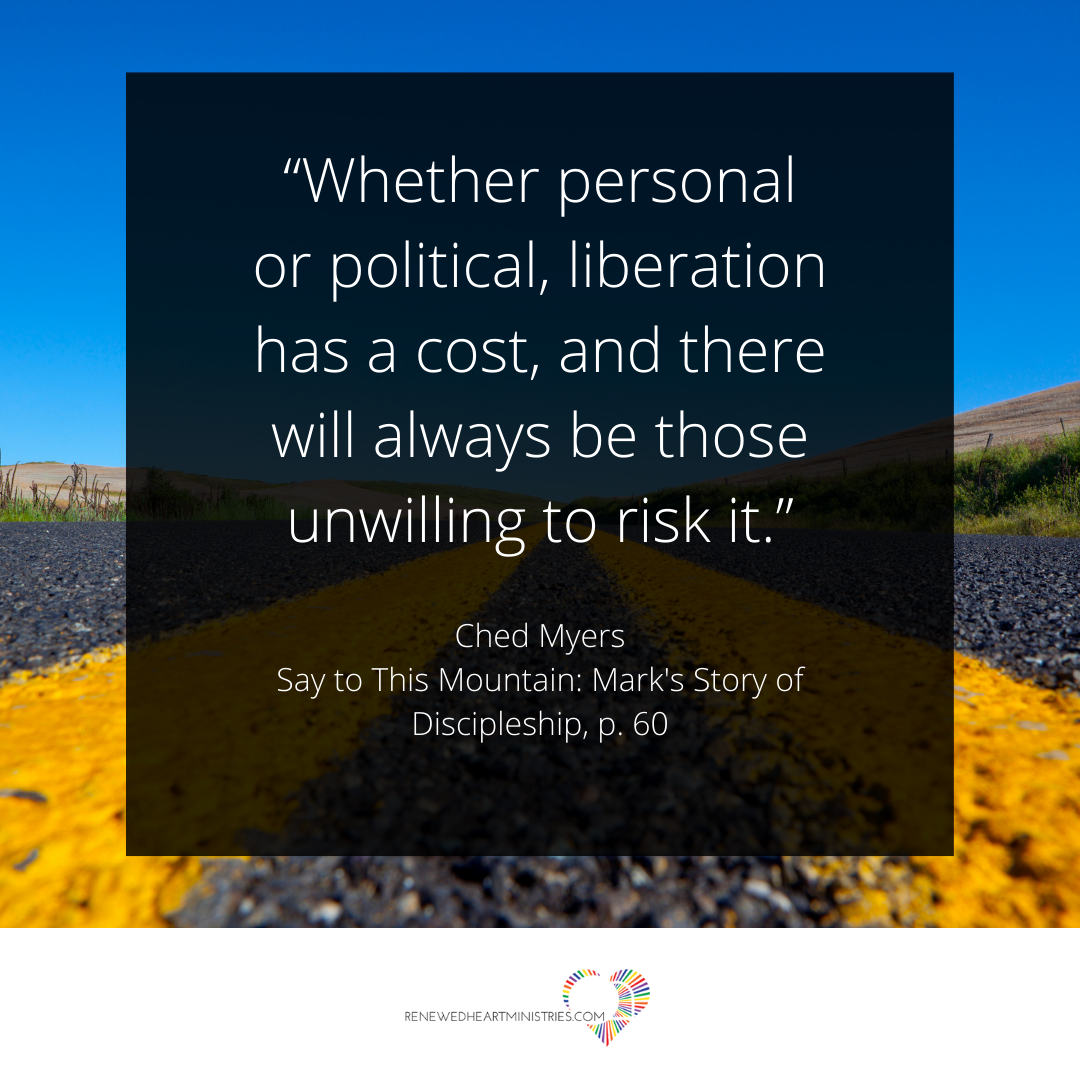
I used to read this story with eyes focused primarily on the demoniac. But as I get older, I’m starting to perceive the demoniac as a story device to connect the hearers of this story to its central characters: those so enmeshed and entangled in the system of their oppressors that they no longer want liberation when the possibility arises. Ched Myers reminds us, “Whether personal or political, liberation has a cost, and there will always be those unwilling to risk it.” (*Myers, Ched; Dennis, Marie; Nangle, Joseph; Moe-Lobeda, Cynthia; Taylor, Stuart, “Say to This Mountain”: Mark’s Story of Discipleship, p. 60)

We often have said here at Renewed Heart Ministries that our primary work as followers of the moral philosophy of Jesus in our contemporary context is to, in whatever way we can, work toward shaping our world into a safe, compassionate, just home for everyone, especially those made unsafe in our world and our societies.

As we imagine what a safer, more just world could look like, and as we work toward that kind of world, how do our entanglements with our current society create tension and reluctance for us to change things today?

For some people, this society doesn’t outweigh the desire for change; it doesn’t even come close. But for many others, and I’m thinking of many of my liberal friends who are straddling two realities, the present iteration both benefits them and causes them deep concern for the people who are harmed by capitalism, classism, the patriarchy, White supremacy, heterosexism, gun legislation, or so many other things.

There are times when it is appropriate to take inventory of whether you really want things to change? Is it enough to grant equal opportunity in a system that will continue to produce winners and losers? Or does the system itself desperately need change.

And what does change cost? Is it this cost that causes us to be more moderate when we should be directly and actively opposed to things in our system that are harming the objects of the Universal Divine love we preach?

Do we see ourselves in this story?

When liberation stands on the threshold of our lives, knocking, are we through our choices quietly asking it to also leave because we are “overcome with fear”?

As someone who didn’t ask to be born into my social location, my prayer is that when liberation comes knocking, I will have the courage to open the door and invite the change in.

HeartGroup Application

1. Share something that spoke to you from this week’s eSight/Podcast episode with your HeartGroup.

2.  What does change cost? Is it this cost that causes us to be more moderate when we should be directly and actively opposed to things in our system that are harming the objects of the Universal Divine love we preach? Discus with your group.

3.  What can you do this week, big or small, to continue setting in motion the work of shaping our world into a safe, compassionate, just home for everyone?

Thanks for checking in with us, today.

Right where you are, keep living in love, choosing compassion, taking action, and working toward justice.

I love each of you dearly,

I’ll see you next week


Begin each day being inspired toward love, compassion, action, and justice.

Go to renewedheartministries.com and click “sign up.”

Free Sign-Up at:

https://renewedheartministries.org/Contact-forms?form=EmailSignUp
 When Unity is Destructive

Unity

Herb Montgomery | May 27, 2022

To listen to this week’s eSight as a podcast episode click here.


“I don’t read this week’s reading as calling for this kind of unity. I don’t read this week’s passage as placing unity as our value of highest priority. It’s a call for unity, yes.  But it’s not a call for unity at all costs.  If we have to choose between unity and harm being done to those our status quo has made vulnerable, then in the name of justice and love and compassion, our highest concern should not be maintaining unity. This kind of unity leaves the status quo unchallenged and unchanged.”


Our reading this week is from the gospel of John:

“My prayer is not for them alone. I pray also for those who will believe in me through their message, that all of them may be one, Father, just as you are in me and I am in you. May they also be in us so that the world may believe that you have sent me. I have given them the glory that you gave me, that they may be one as we are one—I in them and you in me—so that they may be brought to complete unity. Then the world will know that you sent me and have loved them even as you have loved me. Father, I want those you have given me to be with me where I am, and to see my glory, the glory you have given me because you loved me before the creation of the world. Righteous Father, though the world does not know you, I know you, and they know that you have sent me. I have made you known to them, and will continue to make you known in order that the love you have for me may be in them and that I myself may be in them.” (John 17:20-26)

I commented a few weeks ago on the various communities represented in the closing chapters of the gospel of John, as well as the effort of the author(s) of this gospel to offer legitimacy to each of them. We encounter a “big tent” approach for the communities that recognize Mary, John, Peter, and Thomas as all valuable parts of the much larger early Jesus community. (cf. 1 Corinthians 1:12)

This week, we are meeting once again the desire of the Johannine community that all of the varied communities of those seeking to follow the moral philosophy and teachings of Jesus in those early years, would be one.

I don’t think we need to read into this call for oneness a desire for homogeneity. But that each community, with its varied emphasis and characteristics, to recognize one another as fellow Jesus followers as long as no one’s interpretation of Jesus is doing harm to the vulnerable and those on the undersides of community.  Whether that was accomplished is up for historical debate, but we read in this week’s reading at least that desire being present.

Most scholars of John see this prayer as the Johaninne community’s equivalent of “the Lord’s prayer” in the gospel of Matthew and Luke. This passage also includes some provocative statements regarding the relationship between Jesus and “the Father.”  It is ironic and sad that because of this, this prayer in John’s gospel for oneness was also one of the most significant sources of tension (at best) and harm and murder (at worst) between Christians during the 4th and 5th centuries regarding various beliefs of how Jesus was related to divinity. Much harm has been done around the question of the divinity of the Christ.

On this note briefly, early Christianity wasn’t settled on this question. What mattered most to these early Jesus followers was how folks defined and endeavored to follow the moral philosophy of Jesus. Not whether or not they all agreed to how Jesus was or was not divine.

I think we could learn from this today.  Before Christianity turned creedal, it was far more important how one practiced their Jesus following.  Beliefs were important, but they always held in tension with what fruit those beliefs were actually producing in one’s life. Are your beliefs manifesting themselves in life-giving ways or are your beliefs bearing harm.

This is important.  Today, I’d much rather have folks that are endeavoring to follow the moral philosophy of Jesus of love in their practices both personally and socially, politically, and economically, even if they have doubts and questions on the bigger faith claims of orthodox Christianity, than someone who could check off all the theological boxes on the list, but who weren’t genuinely endeavoring to follow Jesus ethical teachings in their daily lives.

Back to the prayer though.

This prayer remember was written by a community already one generation removed from the first generation of Jesus followers. These were second generation Jesus followers writing this.  And the need to repeatedly call for unity is already being felt.

And all of this leads me to a question about unity.  When is unity life-giving and when is unity death-dealing. Considering the above, one example could be unity over orthodox while ortho-praxy is ignored. This means a greater emphasis is placed on all of us believing the same thing as opposed to desire that we all be unified in our effort to follow a practice (praxy) rooted in life-giving definitions of love.

The creeds themselves can be an example of this kind of harmful unity. Take the Apostle’s creed for example:

I [We] believe in God, the Father almighty,

creator of heaven and earth.

I [We] believe in Jesus Christ, his only Son,

our Lord.

He was conceived by the power

of the Holy Spirit

and born of the Virgin Mary.

He suffered under Pontius Pilate,

was crucified, died, and was buried.

He descended to the dead.

On the third day he rose again.

He ascended into heaven,

and is seated at the right hand of the

Father.

He will come again to judge the living and

the dead.

I [We] believe in the Holy Spirit,

the holy Catholic Church,

the communion of saints,

the forgiveness of sins,

the resurrection of the body,

and the life everlasting. Amen.

There is a lot here that I find problematic for Jesus followers today, but one of my biggest concerns is right in this section:

Speaking of Jesus, it states,

“conceived by the power

of the Holy Spirit

and born of the Virgin Mary.

He suffered under Pontius Pilate,

was crucified, died, and was buried.”

We go from Jesus’ birth directly to his execution.  There are ZERO statements about Jesus’ life and teachings. Zero. And this is for many what defines whether a person is a legitimate Christian or not.  You don’t have to believe anything (much less endeavor to practice) anything regarding Jesus’ teachings if we take the creeds literally.

This is concerning.

I think of other examples of where unity is death-dealing rather than life-giving. I think of how communities that suffer harm and injustice are often called to forgive and reconcile with those who have harmed them while no efforts have been made toward restitution or reparations.

I think of how silence in regards to injustice is called for against those who “speak up for the oppressed” (Psalm 82:3) in the name of not rocking the boat or not causing a stir. Whenever I begin to feel this pressure to remain silent I take some time to go back and reread King’s Letter from a Birmingham Jail in its entirety.

Here is just a snippet:

“I felt we would be supported by the white church. I felt that the white ministers, priests and rabbis of the South would be among our strongest allies. Instead, some have been outright opponents, refusing to understand the freedom movement and misrepresenting its leaders; all too many others have been more cautious than courageous and have remained silent behind the anesthetizing security of stained glass windows . . . So often the contemporary church is a weak, ineffectual voice with an uncertain sound. So often it is an archdefender of the status quo. Far from being disturbed by the presence of the church, the power structure of the average community is consoled by the church’s silent–and often even vocal–sanction of things as they are.”

As someone who shares my social location within our present society, I want to be honest about how deep the temptation is at times to just stay quiet, to not have the energy to rock the boat once again, and to justify that silence by a pretense of concern for “unity.”

Wake up! This is that very “unity” that is indeed death-dealing.

I don’t read this week’s reading as calling for this kind of unity. I don’t read this week’s passage as placing unity as our value of highest priority. It’s a call for unity, yes.  But it’s not a call for unity at all costs.  If we have to choose between unity and harm being done to those our status quo has made vulnerable, then in the name of justice and love and compassion, our highest concern should not be maintaining unity.

This kind of unity leaves the status quo unchallenged and unchanged. And nothing could be further from the spirit of the table flipping Jesus we read of in the gospel stories.

To be a follower of this Jesus (and his ethical teachings of love) means, not to place our highest concern on maintaining unity within an unjust system. It means our highest priority being transforming our present world into a safe, compassionate, just home for everyone, just as we see the Jesus of the gospels modeling in his life.

There is a time for unity. There is also a time for disunity.

May we have the wisdom to know the difference.

HeartGroup Application

1. Share something that spoke to you from this week’s eSight/Podcast episode with your HeartGroup.

2. Share experiences of where you have witnessed both life-giving and destructive expressions of unity with your communities. What are some ways you can foster one and stand up to the other. Discuss as a group.

3.  What can you do this week, big or small, to continue setting in motion the work of shaping our world into a safe, compassionate, just home for everyone?

Thanks for checking in with us, today.

Right where you are, keep living in love, choosing compassion, taking action, and working toward justice.

I love each of you dearly,

I’ll see you next week


Begin each day being inspired toward love, compassion, action, and justice.

Go to renewedheartministries.com and click “sign up.”

Free Sign-Up at:

https://renewedheartministries.org/Contact-forms?form=EmailSignUp

Social Advocacy

mist at sunrise

Herb Montgomery | May 20, 2022

To listen to this week’s eSight as a podcast episode click here.


“The facts are that the early Jesus community was comprised of those on the undersides and margins of their society who were in deep need of advocacy or justice socially, politically, and economically within their own societal structures.  This is the context in which I understand the work of the Spirit as Advocate to bear the most life-giving fruit.” 


Our reading this week is from the gospel of John:

Jesus replied, “Anyone who loves me will obey my teaching. My Father will love them, and we will come to them and make our home with them. Anyone who does not love me will not obey my teaching. These words you hear are not my own; they belong to the Father who sent me. All this I have spoken while still with you. But the Advocate, the Holy Spirit, whom the Father will send in my name, will teach you all things and will remind you of everything I have said to you. Peace I leave with you; my peace I give you. I do not give to you as the world gives. Do not let your hearts be troubled and do not be afraid. You heard me say, ‘I am going away and I am coming back to you.’ If you loved me, you would be glad that I am going to the Father, for the Father is greater than I. I have told you now before it happens, so that when it does happen you will believe. (John 14:23-29)

There is a lot in this week’s reading, some speaks into my following the moral philosophy I see in the Jesus story and some is problematic for me.  What I love about this week’s reading is the reference to the Holy Spirit as an Advocate.

This week in the Western Christian calendar, we are post resurrection, between the resurrection and the ascension of Jesus.  And this week’s reading in John’s version of the Jesus story has Jesus taking about his departure. It is through this departure, in John, that the Holy Spirit is bestowed upon Jesus’ followers.  And this spirit is characterized repeatedly in John as Advocate.

Advocacy is public support for or recommendation of a particular cause, policy or community. It is any action that “speaks in favor of, recommends, argues for a cause, supports or defends, or pleads on behalf of others.” (See here.)

I grew up hearing the Spirit as Advocate as interpreted in some way as an intermediary interposing between sinful humans and a holy God.  Today, I reject any interpretation of this language that places humanity and divinity on polar opposites and a mediator in between. I experienced that bearing bad fruit in my own life and I believe it produces bad fruit societally, as well. 

What I now understand (and love) is the fact that the early Jesus community was comprised of those on the undersides and margins of their society who were in deep need of advocacy or justice socially, politically, and economically within their own societal structures.  This is the context in which I understand the work of the Spirit as Advocate to bear the most life-giving fruit.  

One of the social issues facing Jesus followers in the book of John was being removed from the synagogue. This is a large topic which space does not allow for here.  But I do question whether this actually ever happened. Much of the history between Judaism and Christianity is not characterized by Jews persecuting Christians but Christians persecuting Jews. This was written during a time when Gentile Christians were wanting to distance themselves from their Jewish siblings under the Roman Empire. What better way to do so than to villainize them. The following passages include anti-semitic language. We must be honest about this. My purpose in sharing it is to illustrate that John’s idea of the Spirit as an Advocate was as an advocate between humans in matters of justice not between humans and the divine in matters of sinfulness and holiness. 

Consider the following passages in John’s version of the Jesus story where being removed from the synagogue is a penalty for Jewish people who follow Jesus.

“His parents said this because they were afraid of the Jews; for the Jews had already agreed that anyone who confessed Jesus to be the Anointed would be put out of the synagogue.” (John 9:22)

“Nevertheless many, even of the authorities, believed in him. But because of the Pharisees they did not confess it, for fear that they would be put out of the synagogue.” (John 12:42)

John’s Jesus repeats the warning in John 12: “They will put you out of the synagogues.” (John 16:2)

For that first audience, “advocate” would have called to mind actual legal proceedings Jewish leaders initated against Jesus’ followers. The theme of being brought to trial appears in the early synoptic gospels as well:

“When they bring you to trial and hand you over, do not worry beforehand about what you are to say; but say whatever is given you at that time, for it is not you who speak, but the Holy Spirit.” (Mark 13:11)

“When they hand you over, do not worry about how you are to speak or what you are to say; for what you are to say will be given to you at that time; for it is not you who speak, but the Spirit of your Father speaking through you.” (Matthew 10:19-20)

“So make up your minds not to prepare your defense in advance; for I will give you words and a wisdom that none of your opponents will be able to withstand or contradict.” (Luke 21:14-15)

“When they bring you before the synagogues, the rulers, and the authorities, do not worry about how you are to defend yourselves or what you are to say; for the Holy Spirit will teach you at that very hour what you ought to say.” (Luke 12:11-12)

The Spirit as Advocate would have first and foremost been heard by John’s original audience as an advocate in matters pertaining to this life.  Early Christians were not concerned with saving people from post-mortem realities as much as they were focused on caring about people’s social condition in the here and now. 

We have confirmation of the spirt as an advocate in the context of people’s social conditions in the very beginning of Jesus ministry in Luke’s version of the story.

  “The Spirit of the Most High is on me,

because the Most High has anointed me 

to proclaim good news to the poor.

The Most High has sent me to proclaim freedom for the prisoners 

and recovery of sight for the blind,

to set the oppressed free,

  to proclaim the year of the Most High’s favor.”  (Luke 4:18-19)

Notice it was the Spirit being on Jesus here (as quoted from Isaiah) that caused him to be an advocate for those on the undersides and margins of his society.  It is also telling that he refers to the Spirit in the book of John as a second or “another” Advocate. (see John 14:16)

This work of Advocacy had deeply Jewish roots and is found throughout the Hebrew Scriptures.  One such example is Proverbs 31:8 “Speak out for those who cannot speak, for the rights of all the destitute.”

Presently in U.S. society, we are facing a radical departure from progress that has been made over the last four decades in regards to rights of bodily autonomy of women, transpeople and gender queer folk.  With the revelation of the Supreme Court’s intention to overturn Roe vs. Wade, the bodily autonomy of people in these communities is just the latest example of how advocacy work is needed today just as much as it has ever been.  

The words of one such advocate in this fight I found well said this past week.  I have tried to track down their reference. I have had no such luck. All sources of this online that I have found have the author’s name redacted. Nonetheless this is worth sharing here in the same spirit of advocacy we are discussing.

“Here’s the thing, guys. It doesn’t matter. It doesn’t matter when life begins. It doesn’t matter whether a fetus is a human being or not. That entire argument is a red herring, a distraction, a subjective and unwinnable argument that could not matter less. It doesn’t matter whether we are talking about a fertilized egg, or a fetus, or a baby, or a 5 year old, or a Nobel Peace Price winning pediatric oncologist. NOBODY has the right to use your body against your will, even to save their life, or the life of another person. That’s it. That’s the argument. You cannot be forced to donate blood, or marrow, or organs, even though thousands die every year on waiting lists. They cannot even harvest your organs after your death without your explicit, written, pre-mortem permission. Denying women the right to abortion means we have less bodily autonomy than a corpse.”

And one more, this one from Leila Cohan on Twitter:

“If it was about babies, we’d have excellent and free universal maternal care. You wouldn’t be charged a cent to give birth, no matter how complicated your delivery was. If it was about babies, we’d have months and months of parental leave, for everyone. If it was about babies, we’d have free lactation consultants, free diapers, free formula. If it was about babies, we’d have free and excellent childcare from newborns on. If it was about babies, we’d have universal preschool and pre-k and guaranteed after school placements. If it was about babies, IVF and adoption wouldn’t just be for folks with thousands and thousands of dollars to spend on expanding their families. It’s not about babies. It’s about punishing women (and all people with uteruses) and controlling our bodies.” (https://twitter.com/leilacohan/status/1521690766187237377)

As it’s been repeatedly said, you can’t outlaw abortions, only safe abortions.  And, for those who need this to be said, you don’t have to be pro-abortion to be pro-choice.  In fact, there are countless ways to socially, politically, and economically reduce abortions in a society that are infinitely more successful than outlawing abortions and that still protect a person’s bodily autonomy. Outlawing abortions doesn’t stop abortions. It only makes them unsafe. If a person really wants to lower abortions this is the most ineffective way to go about it. 

This week, this is where my advocate heart is moved to action. 

Where, as a Jesus follower, is the Spirit as Advocate impressing upon you to take action, this week?

HeartGroup Application

  1. Share something that spoke to you from this week’s eSight/Podcast episode with your HeartGroup.
  2. How does seeing the Spirit’s work through the lens of advocacy work impact your own Jesus following? Share with your group
  3. What can you do this week, big or small, to continue setting in motion the work of shaping our world into a safe, compassionate, just home for everyone?

Thanks for checking in with us, today.

Right where you are, keep living in love, choosing compassion, taking action, and working toward justice.

I love each of you dearly,

I’ll see you next week


Begin each day being inspired toward love, compassion, action, and justice.

Go to renewedheartministries.com and click “sign up.”

Free Sign-Up at:

https://renewedheartministries.org/Contact-forms?form=EmailSignUp

 Loving One Another and Justice

dominoes

Herb Montgomery | May 13, 2022


To listen to this week’s eSight as a podcast episode click here.


“You can’t love another” without desiring that those whom you love have what they need to thrive, and also doing what is in your power for them to have it . . . When we start to really consider what love means, then if we are honest we must begin to perceive love is not only personal, but also social, political, economic, religious, and even global.”


Our reading this week is from the gospel of John:

When he was gone, Jesus said, Now the Son of Man is glorified and God is glorified in him. If God is glorified in him, God will glorify the Son in himself, and will glorify him at once. My children, I will be with you only a little longer. You will look for me, and just as I told the Jews, so I tell you now: Where I am going, you cannot come. A new command I give you: Love one another. As I have loved you, so you must love one another. By this everyone will know that you are my disciples, if you love one another.” (John 13:31-35)

After Judas leaves the room, Jesus begins to speak about glorification and love.

The theme of glorifying God and being glorified in and by God is rhetoric repeated through and unique to John’s version of the Jesus story. John defines the closing scenes of Jesus’ life, his arrest, crucifixion and resurrection, as how God and Jesus are glorified.

Another difference between John’s version and the synoptics (Mark, Matthew, and Luke) is that John shifts Jesus message from love of neighbor and love of our enemies to love specifically among Jesus’s followers. The author of John, writing this late gospel, paints this shift as a “new teaching.”

These varying objects of love in the canonical gospels—neighbor, enemies, and Jesus’ disciples—point to the tension of love across three concentric circles. The inner circle is Jesus’ disciples. The next circle is those Jesus’ disciples share society with, whether disciples of Jesus themselves or not. And the outer circle includes those who are those outside the disciples’ society or the community in which we do life together. “Enemy” in this context does not necessarily mean those who do us harm; it may simply mean those who are outside the circle we draw around whomever we define as “us.”

In our time, I don’t think it’s helpful to define others as “enemies.” We can be honest about labeling choices or actions as hurtful or not without naming the people choosing them as “enemies.” And rather than speaking of “loving our enemies,” we can speak of loving those who choose to harm us. This kind of love, too, needs careful defining and explanation to be genuinely life giving and not a tool to sustain harm.

But our reading this week focuses on love amongst fellow Jesus followers. By that love, Jesus says, others would know that Jesus’ followers were the disciples of Jesus. In other words, love was to be the primary distinguishing characteristic others could use to know that we are endeavoring to follow the moral philosophy of that Jewish prophet of the poor from Galilee. That marker is not a bumper sticker, nor what station our radios are tuned to. It’s not what church denomination we choose or voting Republican (I do live in West Virginia).

The marker is not even whether we choose live inside or outside of Christianity’s faith claims. What signals to others that our attempts to follow Jesus are genuine is whether we live by an ethic of love. This is not to say that all who endorse an ethic of love as Jesus followers but that you can’t be a Jesus follower without embracing an ethic of love.

Regardless of which object of love a particular version of the Jesus story focuses on (whether neighbor, enemies, or our own community), it is important to define what that love looks like. How we define love matters: including what we define love to be and what we define love as not. Genuine love does no harm.


Love and Justice

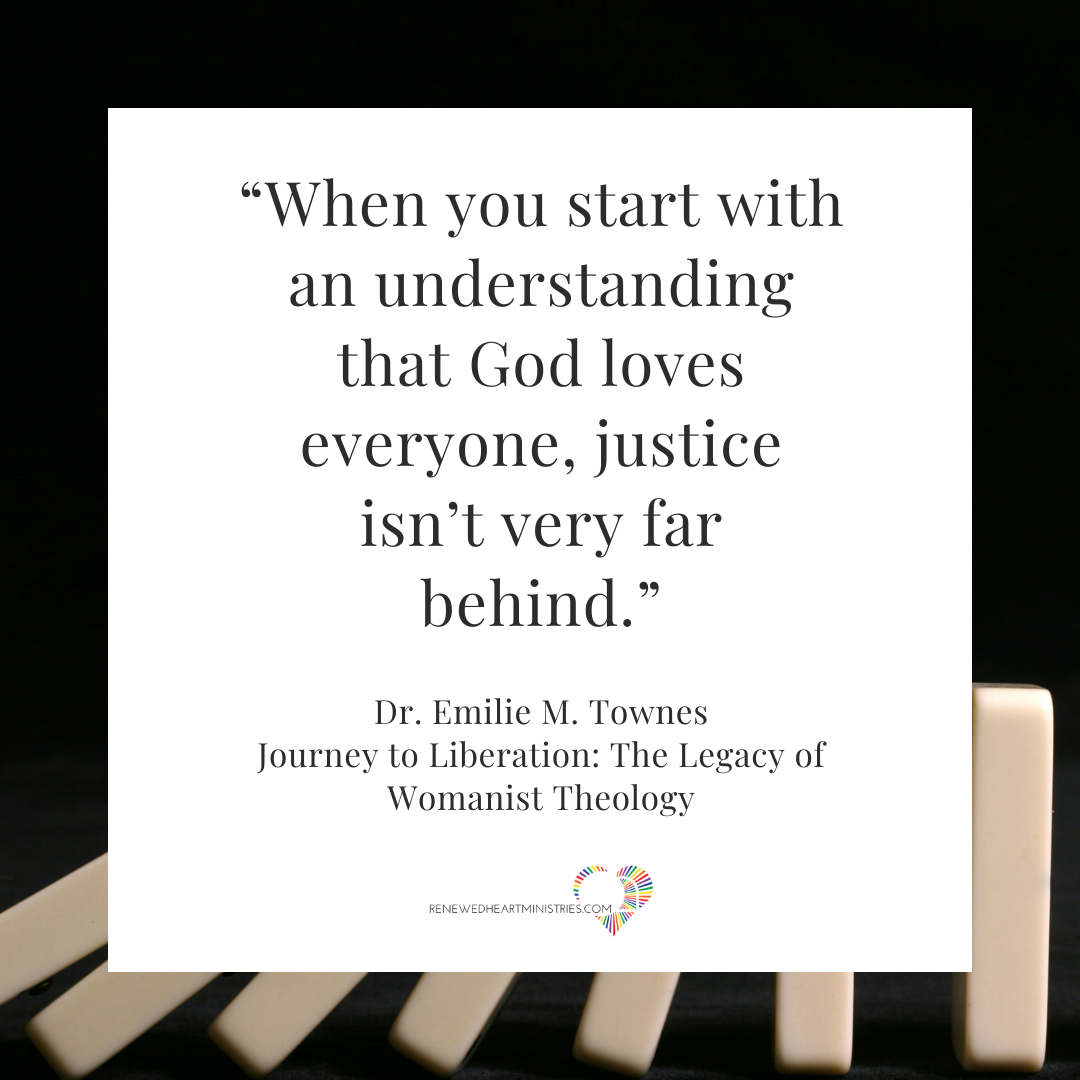
To paraphrase the great Dr. Emilie M. Townes, when we start with love, justice is isn’t very far behind. Love expresses itself in distributive justice for all. It includes the desire to make sure the objects of our love have what they need to thrive. When we love, in each area of our lives, we desire that resources are shared so everyone’s needs are met and no one has too much while others have too little. When disparities exist between those whose needs are unmet and those who have more than they could possibly need, all parties are harmed. They don’t experience the same level of harm mind you, or even the same kind of harm, but they experience harm nonetheless.

This principle is at the heart of the Hebrew prophetic justice tradition in which the Jesus we encounter in the gospels stands:


Learn to do right; seek justice.

Defend the oppressed.

Take up the cause of the fatherless;

plead the case of the widow. (Isaiah 1:17)


Woe to those who make unjust laws,

to those who issue oppressive decrees,

to deprive the poor of their rights and withhold justice from the oppressed of my people, making widows their prey and robbing the fatherless. (Isaiah 10:1-2)


A bruised reed he will not break,

and a smoldering wick he will not snuff out.

In faithfulness he will bring forth justice;

  he will not falter or be discouraged

till he establishes justice on earth.

In his teaching the islands will put their hope. (Isaiah 42:3-4)


This is what the Most High says to you, house of David:

  Administer justice every morning;

rescue from the hand of the oppressor

the one who has been robbed” (Jeremiah 21:12)


I will search for the lost and bring back the strays. I will bind up the injured and strengthen the weak . . . I will shepherd the flock with justice. (Ezekiel 34:16)


But let justice roll on like a river,

righteousness like a never-failing stream! (Amos 5:24)

In love a throne will be established . . . one who in judging seeks justice and speeds the cause of righteousness. (Isaiah 16:5)


“Maintain love and justice.” (Hosea 12:6)


Love without justice is hypocrisy. To read Jesus’ words of love as only sentimental, and not as including a call to social justice is to take Jesus out of his Jewish context and transform him into something else for another purpose. Jesus was a preacher of the kind of love that expresses itself in justice for the oppressed, marginalized, excluded, and downtrodden.

This is why Jesus scholars such as the late Marcus Borg and his co-author John Dominic Crossan made such bold statements such as, “The first passion of Jesus was the kingdom of God, namely, to incarnate the justice of God by demanding for all a fair share of a world belonging to and ruled by the covenantal God of Israel.” (Marcus J. Borg & John Dominic Crossan, The Last Week, Kindle location 44.)


This is what I think of when I hear Jesus’ admonition us to love one another.

You can’t love another without desiring that those whom you love have what they need to thrive, and also doing what is in your power for them to have it.

All of this leads me to some questions about the intrinsic relationship between love and justice that those of us who are Jesus followers and who share my social location in our society need to allow ourselves to be confronted by.

Are we as White Jesus followers practicing an ethic of love Black people and people of color?

Are we as male Jesus followers practicing an ethic of love for women?

Are we as straight Jesus followers practicing an ethic of love for people who identify as gay, lesbian, bisxexual, and/or pansexual?

Are we as cisgender Jesus followers practicing an ethic of love for transgender people?

Are we as educated Jesus followers practicing an ethic of love for those who are less educated?

Are we as middle-class Jesus followers practicing an ethic of love for the poor?

Are we as U.S. citizen Jesus followers practicing an ethic of love for refugees, migrants, and the undocumented?

Are we as settler-colonial Jesus followers practicing an ethic of love for indigenous populations and communities?

Are we as North American Jesus followers practicing an ethic of love for those who live in the Global South?

Whom does this list of questions make you think of this week?

When we start to really consider what love means, then if we are honest we must begin to perceive love is not only personal, but also social, political, economic, religious, and even global.

Whom do you think of when you hear Jesus’ words in John?

“By this everyone will know that you are my disciples, if you love one another.”


HeartGroup Application


1. Share something that spoke to you from this week’s eSight/Podcast episode with your HeartGroup.

2. How does loving others translate into societal justice for you? Share with your group

3.  What can you do this week, big or small, to continue setting in motion the work of shaping our world into a safe, compassionate, just home for everyone? 

Thanks for checking in with us, today.

Right where you are, keep living in love, choosing compassion, taking action, and working toward justice.

I love each of you dearly,

I’ll see you next week


Begin each day being inspired toward love, compassion, action, and justice.

Go to renewedheartministries.com and click “sign up.”


Free Sign-Up at:

https://renewedheartministries.org/Contact-forms?form=EmailSignUp

Being Part of One Another

connected network dots

Herb Montgomery | May 6, 2022

To listen to this week’s eSight as a podcast episode click here.


We are part of one another. Yes, some of us see life through one lens, some of us see life through others. But we are still connected. We thrive together. We survive together. What harms some, always in some way harms everyone, even those perpetrating or benefiting from that harm. You can benefit from the harm you do to others in one area of your life while being harmed in other areas.”


This week’s reading is from the gospel of John:

Then came the Festival of Dedication at Jerusalem. It was winter, and Jesus was in the temple courts walking in Solomons Colonnade. The Jews who were there gathered around him, saying, How long will you keep us in suspense? If you are the Messiah, tell us plainly.” Jesus answered, I did tell you, but you do not believe. The works I do in my Fathers name testify about me, but you do not believe because you are not my sheep. My sheep listen to my voice; I know them, and they follow me. I give them eternal life, and they shall never perish; no one will snatch them out of my hand. My Father, who has given them to me, is greater than all; no one can snatch them out of my Fathers hand. I and the Father are one.” (John 10.22-30)

This story begins with Jesus attending the Jewish Festival of lights, which many today know as Hanukkah. This festival has a rich tradition, and its background can be read in the first and second book of Maccabees.

In 167 B.C.E – 164 B.CE., under the Seleucid empire, Antiochus IV goes to great lengths to desecrate the Jewish temple. He orders a statue of Zeus to be erected in the temple and desecrates the altar by slaughtering as an offering to Zeus a pig—an animal defined in the Torah as unclean. This act sparked the Maccabean revolt.

In the revolt, Mattathias Maccabeus and his five sons successfully push the Seleucids out of the area, and Judas Maccabees, one of Mattathias’ sons, rebuilds the altar, has new holy vessels fashioned, and rededicates the temple. This festival receives its names from the lighting of the lamps during this sanctuary dedication or cleansing: the Festival of Dedication (John), Festival of Lights, and Hanukkah.

In John’s version of the Jesus story, Jesus is often portrayed as celebrating his community’s festivals (see 2:13-25; 5:1; 7:1-13). This can remind Christians both of Jesus’ deep Jewishness, and also how often the language of John is both covertly and overtly antisemitic.

In this week’s passage, it would be more life-giving to us and to our Jewish siblings to read “the people” or possibly “the political leaders” where the text reads “the Jews.” These stories are better interpreted as a struggle among classes within Jewish society, a struggle between the powerful elite and the masses, between insiders and the marginalized. These Jewish voices were having an intracommunal conversation on what faithfulness to the Torah looked like socially, economically, and politically. Not until Gentiles who wanted to distance themselves from Jewish people began to tell these stories did people begin telling and interpreting the Jesus story as a religious contest between Judaism and Christianity.

This section of the chapter also continues the Shepherd theme in verses 1-18. This theme repeats through the gospel of John because it reflects the community’s efforts to define itself. Here, the Johannine community are Jesus’ sheep and Jesus is their shepherd. But I’m afraid they define themselves in a way that harms others. We’ll unpack this in just a moment.

In these verses, the Johaninne community is once again seeking to define Jesus here, too. The gospels repeatedly define Jesus’ relation to Abraham, Torah, Judaism, and to God (see versus 31-42).

These verses define Jesus in the context of the Jewish/Christian debate, within Judaism and between Christianity and Judaism, illustrated by Jesus’ reaction to “the Anointed one,” the Messiah.

But the way the Johaninne community defines Jesus and themselves by implication in this week’s story is not life-giving.

There is a contrast between those who believe Jesus is the Messiah and those who don’t. Those who do are believers, and by implication those who do not are unbelievers. Those who believe are Jesus’ sheep and Jesus is their shepherd; those who do not believe are left out. Those who do believe, will live forever, whereas those who don’t will perish.

This is not a discussion about individuals. It’s a discussion between two communities, the Johannine community of Jesus followers and the Jewish community. The Jewish community saw massive destruction at the hands of the Roman empire in the 1st Century before this version of Jesus’ story was written. But the Johannine community implied through these verses that if they had believed Jesus was the messiah, their community would have lived forever, and because they did not believe in Jesus, they perished.

This is wrong. Whatever political and economic events happened to Jewish people in the 1st Century were simply events born out of economic and political structures (Jesus did have something to say about economics and politics). The people’s destruction or “perishing” under Rome was not an arbitrary divine punishment for Jewish rejection of Jesus as the religious, Christian Messiah.

The Johannine community defines itself as “more than” and those who do not define Jesus the way they do as “less than.” This is an intrinsically harmful exceptionalism or supremacy. It is othering that has repeatedly proven harmful to our existence as humans. It’s not life giving to define ourselves in exclusive categories of “us” and “them.” Certainly there are differences among us, yet those differences are not to divide anyone, and to the degree that we define our difference in terms of “us” and “them,” we create harm. Moving away from “us” and “them” and viewing one another with more subtlety, however, will always be life-giving.

We are connected, whether we realize it or not. Othering and dividing doesn’t breathe life; it breathes harm and death.

Many now see this truth. I think of the following statements that have been meaningful to me recently:

We belong to a mutually beneficial web of connection, well-being, and love. At the root of this connection is empathy; the result is kindness, compassion, respect, and understanding. When religion doesnt center on this mutuality, it can become one of the toxic narratives that, in the end, dismantles self-love. (Rev. Dr. Jacqui Lewis ; Fierce Love, p. 30)

“Gods dream is that you and I and all of us will realize that we are family, that we are made for togetherness, for goodness, and for compassion.” (Archbishop Desmond Tutu; quoted by Rev. Dr. Jacqui Lewis in Fierce Love, p. 129)

All men [sic, —and women, and nonbinary people] are caught in an inescapable network of mutuality, tied in a single garment of destiny. Whatever affects one directly affects all indirectly. I can never be what I ought to be until you are what you ought to be, and you can never be what you ought to be until I am what I ought to be. (Dr. Martin Luther King, Jr., The Man Who Was a Fool)

Human beings are made for each other and no people can realize their full humanity except as they participate in its realization for others. (Dr. James H. Cone, God of the Oppressed.)

We are part of one another. Yes, some of us see life through one lens, some of us see life through others. But we are still connected. We thrive together. We survive together. What harms some, always in some way harms everyone, even those perpetrating or benefiting from that harm. You can benefit from the harm you do to others in one area of your life while being harmed in other areas.

Last month’s recommended reading from Renewed Heart Ministries was Rev. Dr. Jacqui Lewis’ book Fierce Love. There are so many life-giving statements in her book, and my favorite that has been continually popping up in my heart and mind is this one:

Our multifaith community (which includes agnostics and atheists) takes seriously the prayer said every Sunday: Gods will be done on earth as it is in heaven.” For us, faith means partnering with God, whom we call by many names—including Love—to make heaven on earth. That means healing the world of brokenness; that means working hard to dismantle systems of oppression. That means accepting this: If there is such a thing as salvation, then none of us are saved until all of us are saved. Saved from poverty, saved from racism and xenophobia. Saved from gender inequality and discrimination based on whom we love.” (Lewis, Jacqui. Fierce Love, p. 185)

Christians should never have othered the Jewish people, and this week’s reading reminds us of that painful history. Repenting of this history also calls Christians to account for ways we have repeatedly practiced harmful othering with different communities also.

Today, we have the opportunity to do better. It will take some effort to undo old habits, for sure. And it’s worth it.

HeartGroup Application

1. Share something that spoke to you from this week’s eSight/Podcast episode with your HeartGroup.

2. What are some of the language choices you use to keep yourselves from othering people who are different from yourself? Share with your group

3.  What can you do this week, big or small, to continue setting in motion the work of shaping our world into a safe, compassionate, just home for everyone?

Thanks for checking in with us, today.

Right where you are, keep living in love, choosing compassion, taking action, and working toward justice.

I love each of you dearly,

I’ll see you next week


Begin each day being inspired toward love, compassion, action, and justice.

Go to renewedheartministries.com and click “sign up.”

Free Sign-Up at:

https://renewedheartministries.org/Contact-forms?form=EmailSignUp

 Another Beginning

Spring

Herb Montgomery | April 29, 2022

To listen to this week’s eSight as a podcast episode click here.


This third weekend after Easter in our western Christian calendar, how is the Jesus of this story calling you to renew how you follow him. In our world deeply in need of love, compassion, justice, and action, what does following Jesus in your context look like? This is a good time of year to reconsider all of these questions.”


Our reading this week is from the gospel of John:

Afterward Jesus appeared again to his disciples, by the Sea of Galilee. It happened this way: Simon Peter, Thomas (also known as Didymus), Nathanael from Cana in Galilee, the sons of Zebedee, and two other disciples were together. Im going out to fish,” Simon Peter told them, and they said, Well go with you.” So they went out and got into the boat, but that night they caught nothing.

Early in the morning, Jesus stood on the shore, but the disciples did not realize that it was Jesus. He called out to them, Friends, havent you any fish?” “No,” they answered. He said, Throw your net on the right side of the boat and you will find some.” When they did, they were unable to haul the net in because of the large number of fish.

Then the disciple whom Jesus loved said to Peter, It is the Messiah!” As soon as Simon Peter heard him say, It is the Messiah,” he wrapped his outer garment around him (for he had taken it off) and jumped into the water. The other disciples followed in the boat, towing the net full of fish, for they were not far from shore, about a hundred yards. When they landed, they saw a fire of burning coals there with fish on it, and some bread. Jesus said to them, Bring some of the fish you have just caught.” So Simon Peter climbed back into the boat and dragged the net ashore.

It was full of large fish, 153, but even with so many the net was not torn. Jesus said to them, Come and have breakfast.” None of the disciples dared ask him, Who are you?” They knew it was the Lord. Jesus came, took the bread and gave it to them, and did the same with the fish.

This was now the third time Jesus appeared to his disciples after he was raised from the dead.

When they had finished eating, Jesus said to Simon Peter, Simon son of John, do you love me more than these?” “Yes, Lord,” he said, you know that I love you.” Jesus said, Feed my lambs.” Again Jesus said, Simon son of John, do you love me?” He answered, Yes, Lord, you know that I love you.” Jesus said, Take care of my sheep.” The third time he said to him, Simon son of John, do you love me?” Peter was hurt because Jesus asked him the third time, Do you love me?” He said, Lord, you know all things; you know that I love you.” Jesus said, Feed my sheep.

“Very truly I tell you, when you were younger you dressed yourself and went where you wanted; but when you are old you will stretch out your hands, and someone else will dress you and lead you where you do not want to go.” Jesus said this to indicate the kind of death by which Peter would glorify God. Then he said to him, Follow me!” (John 21:1-19)

This week’s story begins with the disciples who were fishermen returning to their occupation after Jesus’ crucifixion, back to where Jesus initially found them. John 21 functions as an appendix to John’s gospel. Most scholars understand this version of the Jesus story to have ended in chapter 20, while they understand Chapter 21 to have been written by a different author. Chapter 21 also adds another post-resurrection appearance of Jesus, and carefully re-establishes Peter’s authority in the early Jesus movement since the other gospel versions paint Peter as denying Jesus during Jesus’ arrest.

The passage states that this is Jesus’ third post resurrection appearance in John. The author has counted wrong or is purposely leaving out one of Jesus’ appearances earlier in John’s gospel. As I shared a couple weeks ago, in these post-resurrection appearances in John’s gospel, three of the early Jesus communities are competing for authority: the community that recognized the leadership of Mary, the community that recognized the authority of Peter (highlighted this week), and the Johannine community in which the rest of the gospel of John was written.

Again, this chapter has more in common with the synoptic gospels than it does with the rest of John. I wrote at length about the imagery of fishing in the synoptic gospels last February in Decolonizing Fishing for People. I want to reference again how the Hebrew prophetic justice tradition interprets fishing, as a metaphor for removing unjust political rulers from power. It is not like the Christian colonialist metaphor of evangelism.

There is perhaps no expression more traditionally misunderstood than Jesus’ invitation to these workers to become fishers of men.’ This metaphor, despite the grand old tradition of missionary interpretation, does not refer to the saving of souls,’ as if Jesus were conferring on these men instant evangelist status. Rather the image is carefully chosen from Jeremiah 16:16, where it is used as a symbol of Yahwehs censure of Israel. Elsewhere the hooking of fish’ is a euphemism for judgment upon the rich (Amos 4:2) and powerful (Ezekiel 29:4). Taking this mandate for his own, Jesus is inviting common folk to join him in the struggle to overturn the existing order of power and privilege.” (Ched Myers, Binding the Strong Man: A Political Reading of Marks Story of Jesus, p. 132)

Speaking of those who do harm within their positions of power, Jeremiah reads:

But now I will send for many fishermen,” declares the LORD, “and they will catch them. After that I will send for many hunters, and they will hunt them down on every mountain and hill and from the crevices of the rocks.” (Jeremiah 16:16)

Speaking of those who oppress the poor and crush the needy,” Amos reads:

The Sovereign LORD has sworn by his holiness: “The time will surely come when you will be taken away with hooks, the last of you with fishhooks.” (Amos 4:2)

Speaking of the abusive Pharaoh, king of Egypt, Ezekiel reads:

In the tenth year, in the tenth month on the twelfth day, the word of the LORD came to me: “Son of man, set your face against Pharaoh king of Egypt and prophesy against him and against all Egypt. Speak to him and say, ‘This is what the Sovereign LORD says:

“I am against you, Pharaoh king of Egypt,

you great monster lying among your streams.

You say, ‘The Nile belongs to me;

I made it for myself.’

“But I will put hooks in your jaws

and make the fish of your streams stick to your scales.

I will pull you out from among your streams,

with all the fish sticking to your scales.

I will leave you in the desert,

you and all the fish of your streams.

You will fall on the open field

and not be gathered or picked up.

I will give you as food

to the beasts of the earth and the birds of the sky.

Then all who live in Egypt will know that I am the LORD.” (Ezekiel 29:1-6)

In this last chapter, John imbues this imagery with fresh direction and purpose for the post-resurrection Jesus followers. (Read more in “Decolonizing fishing for people.”)

As noted, we also see the authors taking great pains to reestablish Peter’s authority as a trustworthy shepherd in the early Jesus movement through three confessions that parallel his three, previous denials (John 18:15-27). The end of this appendix, written after Peter’s death, has Jesus foreshadowing the manner of Peter’s death.

Later in this chapter, outside of our reading this week, we see the tension between the communities that recognized the leadership of John and the communities that recognized the authority of Peter (cf. verses 20-23). The early movement recognizes both John and Peter, and makes room for both communities to co-exist side by side.

Jesus ends this scene by renewing his original call to Peter when he found him fishing in the beginning. We have now come full circle, and Jesus once again calls Peter saying, “Follow me.”

This third weekend after Easter in our western Christian calendar, how is the Jesus of this story calling you to renew how you follow him. In our world deeply in need of love, compassion, justice, and action, what does following Jesus in your context look like? This is a good time of year to reconsider all of these questions: the resurrection marks the beginning of a new year in the Christian calendar. How will your Jesus-following help you participate in shaping our world into a safe, compassionate just home for everyone this next cycle?

May each of us who endeavor to follow Jesus’ moral philosophy and teachings in the coming year do so in life-giving ways. May our presence in each of the communities we live in bless those around us. This spring, may tulips and daffodils not be the only ones waking up from winter, but may the rays of the sun also usher us toward choices that lead to more just world.

HeartGroup Application

1. Share something that spoke to you from this week’s eSight/Podcast episode with your HeartGroup.

2. How will your Jesus-following help you participate in shaping our world into a safe, compassionate just home for everyone this next cycle? Discuss with your group

3.  What can you do this week, big or small, to continue setting in motion the work of shaping our world into a safe, compassionate, just home for everyone?

Thanks for checking in with us, today.

Right where you are, keep living in love, choosing compassion, taking action, and working toward justice.

I love each of you dearly,

I’ll see you next week


Begin each day being inspired toward love, compassion, action, and justice.

Go to renewedheartministries.com and click “sign up.”

Free Sign-Up at:

https://renewedheartministries.org/Contact-forms?form=EmailSignUp
Breathing In Spirit, Exhaling Love and Justice

Herb Montgomery | April 22, 2022

To listen to this week’s eSight as a podcast episode click here.


“In the stories, Jesus doesn’t come back from the dead just to live another 30 or so years doing the same thing he’d done before he was executed. The attempted silencing of Jesus and his saving work is only an interruption, not an end. Each resurrection story defines Jesus’ resurrection as causing his life work to continue in the lives of his followers. Jesus commissioned his disciples to continue his life work in the same spirit that inspired him.”


Our reading this week is from the gospel of John:

On the evening of that first day of the week, when the disciples were together, with the doors locked for fear of the Jewish leaders, Jesus came and stood among them and said, Peace be with you!” After he said this, he showed them his hands and side. The disciples were overjoyed when they saw the Messiah. Again Jesus said, Peace be with you! As the Father has sent me, I am sending you.” And with that he breathed on them and said, Receive the Holy Spirit. If you forgive anyones sins, their sins are forgiven; if you do not forgive them, they are not forgiven.”

Now Thomas (also known as Didymus), one of the Twelve, was not with the disciples when Jesus came. So the other disciples told him, We have seen the Messiah!” But he said to them, Unless I see the nail marks in his hands and put my finger where the nails were, and put my hand into his side, I will not believe.”

A week later his disciples were in the house again, and Thomas was with them. Though the doors were locked, Jesus came and stood among them and said, Peace be with you!” Then he said to Thomas, Put your finger here; see my hands. Reach out your hand and put it into my side. Stop doubting and believe.” Thomas said to him, My Savior and my God!” Then Jesus told him, Because you have seen me, you have believed; blessed are those who have not seen and yet have believed.” Jesus performed many other signs in the presence of his disciples, which are not recorded in this book. But these are written that you may believe that Jesus is the Messiah, the Son of God, and that by believing you may have life in his name. (John 20:19-31)

This first weekend after Western Christianity’s Easter each year, we begin reading the stories of the early believers after the resurrection. In each post resurrection story, the good news or gospel is not that Jesus died or even died for you, but that this Jesus that was brutally murdered by the state and those who controlled the status quo is risen. He’s alive! The crucifixion and all that Jesus’ death accomplished has been undone, reversed, and overcome!

This week’s story from John is similar to yet still very different from those found in Luke 24:36-49, Mark 16:14-18, Matthew 28:18-20, and Acts 1:8.

In John, Jesus cryptically breathes the Holy Spirit onto his disciples. He then attaches to this gift of the spirit the authority of “loosing and binding,” forgiving, bringing comfort and liberation, and setting people free (cf. Matthew 16:19; Matthew 18:18).

It’s vital that the power of forgiving or not forgiving is connected to the disciples receiving the spirit of Jesus. Forgiveness divorced from that spirit serves to only perpetuate oppression and harm. I’ll explain.

Jesus uses this language in the gospel of Luke:

The Spirit of the Most High is on me,

because the Most High has anointed me

to proclaim good news to the poor.

The Most High has sent me to proclaim freedom for the prisoners

and recovery of sight for the blind,

to set the oppressed free,

to proclaim the year of the Most High’s favor.” (Luke 4:18-19)

Here the work of the Spirit is to announce good news to the poor, proclaim freedom for prisoners, set the oppressed free, and announce the year of the Most High’s favor, the year when all debts would be forgiven, regardless of creditors’ wishes. In that year, debtors were released!

Those who are forgiven in the Jesus story are those on the margins, those pushed to the underside and edges of Jesus’ society by those benefiting from the status quo. What about those whose social location was more at the center or upper class? Did Jesus extend forgiveness to them, too?

Remember the story of Zacchaeus? (see Luke 19:1-9) Jesus forgave and loosed him, too. Yet Zacchaeus was not loosed or forgiven from the consequences from his actions. Jesus instead called him to stop participating in oppression. Only then did salvation come to Zacchaeus’ house, because salvation looks like justice for the oppressed. This reminds me of Gandhi critiquing Christianity: he said he didn’t want to be saved from the consequences of his actions but from those actions themselves.

How many times have we seen those who harm others or benefit from that harm being forgiven or assured of no condemnation without being called to make restitution or reparations?

Being loosed is not conditional on acts of restoration like a quid pro quo, tit for tat, or an exchange. Rather, for oppressors, being loosed actually is these acts of restoring that which has been taken from others.

This is why I believe the disciples were given authority not to forgive, too. Reserving “forgiveness” is a way to remind them that their freedom is intrinsically tied to their choice to stop participating in the harm being done to others. Anything less than that is what Dietrich Bonhoeffer described as “cheap grace.” During the 1930s, Bonhoeffer watched Christians giving assurance to the Nazis. Assuring oppressors that everything is okay while they continuing to do harm is akin to expecting victims or survivors to reconcile with those who have harmed them but done no work of restitution. Neither of these are life-giving interpretations of the forgiveness ethic in the Jesus stories.

These stories don’t help us recover so much of the historical Jesus as much as they establish the authority of his disciples. In this week’s reading, the focus is Thomas and the story about him serves a double purpose for the fledgling Jesus movement.

First, it establishes Thomas as an early movement leader. Multiple documents in Christian history would later be attributed to this disciple. Thomas is supposed to have taken the gospel to the Parthians and then on to India. He is credited with establishing the Mar Thoma Church and was martyred there as well. Thomas is also a central figure in Syrian Christianity: his bones are claimed by that faith tradition to have been removed from India and brought to Edessa close to the end of the fourth century.

Second, this story challenges people to believe in the Jesus story even though they haven’t seen Jesus for themselves.

What speaks to me most about these stories is that Jesus didn’t come back from the dead just to live another 30 or so years doing the same thing he’d done before he was executed. The attempted silencing of Jesus and his saving work is only an interruption, not an end. Each resurrection story defines Jesus’ resurrection as causing his life work to continue in the lives of his followers. Jesus commissioned his disciples to continue his life work in the same spirit that inspired him.

I consider again how Jesus’ life work was summarized in passages like Luke 4:18-19: as good news for the poor, release for the prisoners, setting free the oppressed, and proclaiming the most High’s favor or forgiving debts. There are similar teachings in both Luke’s sermon on the plain (Luke 6) and Matthew’s sermon on the mount (beginning in Matthew 5). These are the ethics and values in the Jesus story: Jesus both comforted and challenged individuals and also, in his overturning of the tables, challenged unjust systems, demanding a different order of things in the here and now.

So I ask myself, am I breathing in this same spirit that we read of in this week’s passage? And how closely is my story aligning with the Jesus story?

In what areas does my life harmonize with the Jesus story? Where is there dissonance?

Each of us looses and binds things every day. Are the things I bind and loose similar to or vastly different from the liberation work, the love, compassion, safety and justice in the Jesus story?

This first weekend after Easter, I want to foster more harmony between my life story and this story of Jesus that I hold dear.

I’m sure you do, too.

Here’s to breathing in that spirit, together, and exhaling love and justice with those our lives touch each and every day.

HeartGroup Application

1. Share something that spoke to you from this week’s eSight/Podcast episode with your HeartGroup.

2. In what ways are you inspired to breath in spirit and exhale love and justice in your own spheres of influence this new year? Discuss with your group

3.  What can you do this week, big or small, to continue setting in motion the work of shaping our world into a safe, compassionate, just home for everyone?

Thanks for checking in with us, today.

Right where you are, keep living in love, choosing compassion, taking action, and working toward justice.

I love each of you dearly,

I’ll see you next week

Excluded by Exclusion

color spectrum

Herb Montgomery | March 25, 2022

To listen to this week’s eSight as a podcast episode click here.


This week’s parable calls us to question whom we are excluding and the basis for our exclusion. And it’s calling us to question the practice of marginalizing and excluding others regardless of the basis . . . There is no conclusion. The elder brother who would exclude his younger brother is left alone by himself in the night, outside the party going on inside, not because he himself wasn’t welcome, but because he could not affirm the one being celebrated. And maybe that’s the point.”


Our reading this week is from the gospel of Luke:

Now the tax collectors and sinners were all gathering around to hear Jesus. But the Pharisees and the teachers of the law muttered, This man welcomes sinners and eats with them.” Then Jesus told them this parable . . . Jesus continued: There was a man who had two sons. The younger one said to his father, Father, give me my share of the estate.’ So he divided his property between them. Not long after that, the younger son got together all he had, set off for a distant country and there squandered his wealth in wild living. After he had spent everything, there was a severe famine in that whole country, and he began to be in need. So he went and hired himself out to a citizen of that country, who sent him to his fields to feed pigs. He longed to fill his stomach with the pods that the pigs were eating, but no one gave him anything. When he came to his senses, he said, How many of my fathers hired servants have food to spare, and here I am starving to death! I will set out and go back to my father and say to him: Father, I have sinned against heaven and against you. I am no longer worthy to be called your son; make me like one of your hired servants.’ So he got up and went to his father. But while he was still a long way off, his father saw him and was filled with compassion for him; he ran to his son, threw his arms around him and kissed him. The son said to him, Father, I have sinned against heaven and against you. I am no longer worthy to be called your son.’ But the father said to his servants, Quick! Bring the best robe and put it on him. Put a ring on his finger and sandals on his feet. Bring the fattened calf and kill it. Lets have a feast and celebrate. For this son of mine was dead and is alive again; he was lost and is found.’ So they began to celebrate. Meanwhile, the older son was in the field. When he came near the house, he heard music and dancing. So he called one of the servants and asked him what was going on. Your brother has come,’ he replied, and your father has killed the fattened calf because he has him back safe and sound. The older brother became angry and refused to go in. So his father went out and pleaded with him. But he answered his father, Look! All these years Ive been slaving for you and never disobeyed your orders. Yet you never gave me even a young goat so I could celebrate with my friends. But when this son of yours who has squandered your property with prostitutes comes home, you kill the fattened calf for him!’ ‘My son,’ the father said, you are always with me, and everything I have is yours. But we had to celebrate and be glad, because this brother of yours was dead and is alive again; he was lost and is found.’ (Luke 15:1-3, 11–32)

In this week’s story, Jesus is not answering his listeners’ questions about who gets to heaven or not. The context of the narrative isn’t about an afterlife at all. It’s about social and political dynamics in this life, in Jesus’ society. Within that context, the narrative addresses the exclusion of certain ones, tax collectors and those labelled as “sinners”, by those privileged in their society.

I want to note that I do not believe this story accurately represents the Pharisees or Jewish scholars of that time. It might represent some leaders within those social groups, such as the Pharisees of the school of Shammai. But this story does not rightly characterize the more inclusive Pharisees of the school of Hillel. Lumping all Pharisaical and later Rabbinical schools into a monolith and then to use that group perjoratively is deeply antisemitic and has an long history. (See https://truah.org/antisemitism/)

We must also address the label of “sinner.” I’ve written at length about this before:

“The term ‘sinner’ is used in the gospels in a very particular sense. Its not used in the universal ‘everyones a sinner’ sense. We see this in Jesussocio-political context. Imagine a circle. Those at the center controlled and made the decisions for the circle while those pushed from the center toward the edges had less and less say the further away from the center they found themselves. What determined how close to the center someone operated was an idea that we now have a difficult time understanding: this was the idea of purity. Those on the edges were pushed there by labelling them ‘sinners.’ Those on the edges of the circle had no power, privilege, or voice.” (See The Lost Coin)

It would help us in our context today to read “marginalized” where the text reads “sinner.” Sinner was the pejorative religious label that those at the center of Jesus society used to marginalize whomever they chose.

This all leads us to the central point, I believe, of this week’s reading. Jesus’ parable was originally aimed at those who excluded or marginalized others and then disparaged Jesus because of the people he embraced, affirmed, and included.

Within Christian faith communities today, many exclude and marginalize LGBTQ people of faith, and then label and exclude as dangerous allies who embrace, affirm and include them. I have firsthand experience with this.

I’m also reminded of patriarchal traditions that exclude women from certain ministerial roles or credentials and then label those who don’t exclude them as dangerous. White churches have practiced similar exclusion over matters of race and multiracial diversity, not only in their congregations, but in who is allowed and supported to take on certain leadership roles.

In our larger society, there are inclusions and exclusions, too. We at Renewed Heart Ministries have condemned Russia’s recent invasion of Ukraine and our hearts are with all being harmed by this action. We continue to maintain that the road to peace is not war, but distributive justice, safety and compassion, and we affirm Ukraine’s rights of self-determination and self-defense.

I also notice the disparity in the global support for Ukraine now compared to other humanitarian crises. Journalists have even compared Putin’s problems with Ukraine to the U.S’ historical treatment of other countries. I wondered if they realized what they’re admitting about imperialism, because that is a level of truth-telling I don’t think we in the U.S. are willing to embrace. News reporters have betrayed their own racism when speaking of this conflict and their surprise at the plight of Ukrainian refugees. They use rhetoric as “relatively civilized,” “relatively European,” “blue eyes,” “blonde hair,” “not a developing, third-world nation, but Europe,” “well-dressed people.”

We should care about our Ukrainian siblings and other people living in that country as part of our human family, but we shouldn’t care about them or base our involvement or help on whether we perceive them to be White or European. Refugees from other parts of the world deserve our care and concern just as much.

The U.S. shows these patterns, too. Those who are working toward this country’s high ideals for an inclusive, multi-racial democracy or those working to transform society into a place of equity for women are characterized as dangerous. There are hundreds of legislative attacks against trans people and lesbian, gay, and bisexual people in states like Texas and Florida right now, including efforts to exclude children who belong to the LGBTQ community or have parents who do. Children this age are often asked by grandparents, aunts and uncles, and others, “Do you have a girlfriend/boyfriend yet?” Or their teachers ask them at school to “Share about your family.” But some of those children are being excluded now.

This week’s parable calls us to question whom we are excluding and the basis for our exclusion. And it’s calling us to question the practice of marginalizing and excluding others regardless of the basis.

Jesus’ story ends open-endedly. There is no conclusion. The elder brother who would exclude his younger brother is left alone by himself in the night, outside the party going on inside, not because he himself wasn’t welcome, but because he could not affirm the one being celebrated. And maybe that’s the point. As we are working toward a more inclusive, safe, compassionate, just society for everyone, if any are left out in the end, it won’t because they themselves aren’t welcome, but because they can’t accept other people.

As we consider our own practices of exclusion, this week’s story warns each of us that those we exclude may end up enjoying God’s party, while we, because of our exclusionary practices, may find ourselves outside the party, alone, in the night.

HeartGroup Application

1. Share something that spoke to you from this week’s eSight/Podcast episode with your HeartGroup.

2. We have many examples today of folks who have been excluded because of whom they include. Share some examples of how people or communities, today, are being, excluded because of their own exclusion? Discuss with your group.

3.  What can you do this week, big or small, to continue setting in motion the work of shaping our world into a safe, compassionate, just home for everyone?

Thanks for checking in with us, today.

Right where you are, keep living in love, choosing compassion, taking action, and working toward justice.

I love each of you dearly,

I’ll see you next week


March is Donor Appreciation Month at RHM

During the month of March, we want to do something special to thank you for supporting the work of Renewed Heart Ministries.

Renewed Heart Ministries provides deeply needed resources that help enable Christians to discover the intersection of their love for Jesus and their work of healing our world through actions of love, justice and compassion; actions Jesus modeled and called us to follow.

Engaging our communities in ways that shape our world into a safe, compassionate, just home for everyone is often hard work and its worth it. We appreciate the actions, big and small, each of you take each day to engage this work.

This month, we are partnering with Watchfire Media to offer a free thank you gift, shipping included. We want to offer you Watchfire Media’s absolutely beautiful Holy Troublemakers & Unconventional Saints 2022 Wall Calendar to everyone who makes a special one-time donation of $50 or more through the following special link during the month of March to support RHM’s work.

The online donation link to use is https://bit.ly/RHMCalendar.

(Or you donate by mail by sending your donation to

Renewed Heart Ministries
PO Box 1211
Lewisburg, WV 24901

*If donating by mail, simply make sure that your donation is specially marked indicating you would like a HolyTroublemakers & Unconventional Saints 2022 Wall Calendar as a thank you.)

If you are unfamiliar with this special calendar, The Holy Troublemakers & Unconventional Saints 2022 Wall Calendar features 12 “holy troublemakers,” people of faith from different faiths and different eras who worked for more love, kindness, and justice in their corner of the world. Each of them did the right thing even when it was the hard thing, and even when it rocked the religious boat.

Like the book Holy Trouble­makers & Unconventional Saints, this calendar centers holy troublemakers who are women, LGBTQ, Black, Indigenous, and other people of color who have too often been written out of religious narratives. Their stories inspire, educate, challenge, encourage, and move us all towards more love and a faith that works for the common good of everyone.

Packed with original artwork, short bios, and inspiring quotes, the calendar also includes important holidays from diverse faith traditions, social justice movement anniversaries, and dates that help us remember that joy is an essential part of holy troublemaking.

Thank you in advance for supporting the work of Renewed Heart Ministries. Together we will continue being a voice for change. And thank you to Watchfire Media, as well, for partnering with RHM this month to be able to share this special thank you gift with our supporters. We appreciate all you do, too!

Product details:

2022 Wall Calendar: 24 pages

Publisher: Watchfire Media
Language: English
Product Dimensions: 12” x 13”
Shipping Weight: 1 lb.
ISBN: 978-1-7340895-1-6

 Injustice is Not Sustainable


fig tree at dusk

Herb Montgomery | March 18, 2022


To listen to this week’s eSight as a podcast episode click here.


Democratic societies must be made to birth a distributively just society where the needs of everyone and not only an elite few are collectively met. The alternative is not sustainable, and ends with that society falling into the rubbish bin of history.”


Our reading this week is from the book of Luke:

Now there were some present at that time who told Jesus about the Galileans whose blood Pilate had mixed with their sacrifices. Jesus answered, Do you think that these Galileans were worse sinners than all the other Galileans because they suffered this way? I tell you, no! But unless you repent, you too will all perish. Or those eighteen who died when the tower in Siloam fell on them—do you think they were more guilty than all the others living in Jerusalem? I tell you, no! But unless you repent, you too will all perish.” Then he told this parable: A man had a fig tree growing in his vineyard, and he went to look for fruit on it but did not find any. So he said to the man who took care of the vineyard, For three years now Ive been coming to look for fruit on this fig tree and havent found any. Cut it down! Why should it use up the soil?’ ‘Sir,the man replied, leave it alone for one more year, and Ill dig around it and fertilize it. If it bears fruit next year, fine! If not, then cut it down.’” (Luke 13:1-9)

No other ancient writing describes the incidents that begin our passage this week. Quite honestly, we do not know what the phrases “the Galileans” or “those on whom the tower in Siloam fell” refer to. The message to the audience, though is one found often in sacred texts: repent or perish.

But repent of what? What about their present course points to self-destruction?

While we have no definite proof of what these two examples are referring to, some scholars connect them to a failed Galilean revolt where Roman soldiers surprised and slaughtered Galilean insurgents as they made sacrifices in preparation for their revolt.

In this week’s story, the religiopolitical elite question whether the people revolting had been morally upright or whether their sinfulness was to blame for their lack of success. Jesus says to them, Do you think that because these Galileans suffered in this way they were worse sinners than all other Galileans? No, I tell you; but unless you repent, you will all perish as they did.”

Similarly, a few scholars identify the tower of Siloam as a tower where Rome stored its weapons. Galilean insurgents might have tried to dig a tunnel under the tower to seize the weapons for a violent revolt. But the tunneling compromised the towers foundation, the entire structure suddenly collapsed, and several of these Galileans died. Jesus again denies they are responsible for their deaths: No, I tell you; but unless you repent, you will all perish just as they did.”

When Jesus calls for repentance in our story, I dont hear the moralistic idea of repentance so many of us are used to today. I hear a Jewish prophet of the poor calling for social change. The elites would blame the insurgents’ failures on their lack of moral uprightness, but Jesus rather points to an unjust economic structure that oppresses folks and creates insurgents who long to experience the distributive justice that the Hebrew prophets called for (see the book of Amos).

Jesus isn’t preaching in the vein of the Christian fire and brimstone preachers who have cried “repent or perish” from their pulpits. He’s teaching much more like the Hebrew prophets who saw the intrinsic connection between an exploitative system and its lack of sustainability. “Injustice is not sustainable” is the message we are encountering here.

This is a good time to pause and reflect on how injustice is unsustainable in our day as well. I think of those who long for the days of White, straight, cisgender and male privilege or domination in contrast to the multiracial, multicultural, varied, heterogeneous democracy that many are working toward today. This doesn’t just apply to our secular society. It applies to our faith communities, too.

Our faith traditions include voices that bemoan a society they have judged as morally corrupt. Yet they are merely witnessing those in society calling for equality and ways to make our world into a safe, compassionate, just home for everyone. I think of those who see the end of patriarchy in faith communities as an evil rather than a good, and those who see LGBTQ inclusion and affirmation as a sign of the times, rather than as a change where life is overcoming death and love is overcoming fear, bigotry, and hate.

Again, so many of us, like those in our story, are quick to judge as inferior those who are different than ourselves. Instead, the Jesus of our story this week would tell us the reality: that unless we change and become more just, we will perish.

Lastly, this week’s passage uses a common metaphor for the condition of Israel’s society, one that appears in both the Hebrew scriptures and the rabbinic literature (see Isaiah 5). A healthy, distributively just society was a healthy fig tree that produced much fruit for all to enjoy. Fig trees, after all, were an important source of food in the Ancient Middle East. But a sickly, desolate, or barren fig tree was an unhealthy society that benefitted only a select few through exploiting the masses. The fruitful fig tree symbolized a blessed society where everyone’s needs were being met: there was enough for everyone. A barren fig tree was cursed and under judgement from the Hebrew prophets for trampling the vulnerable.

Our story this week answers the cry to immediately cut the fig tree down by encouraging the gardener or owner to keep trying to make it healthy for one more year, to fertilize it and see if things turn around before giving up on it.

There is a love of the fig tree seen here in the desire to make it healthy.

This has applications for us today, too, in our faith communities, and in our larger society as well.

I can’t tell you how many times I’ve scratched my head in wonder at LGBTQ people of faith who keep trying to change their homophobic, transphobic, biphobic faith communities. I’ve often asked myself, why don’t they just shake the dust from their feet and say good riddance! I wonder if they’d be better off. But the reality is these faith traditions are their homes. Many have grown up in them and there is love for these faith traditions rooted in their hearts. They’d rather endure pain from continued effort than grief of leaving the barren fig tree of their faith tradition to die. I see their stories in our story this week.

In our larger society, as well, so many have said that how many minorities have been treated within the “American dream” has been a nightmare. Yet so many people from minoritized communities genuinely love the principles that the United States is supposed to embody and want to see America genuinely live out its highest ideals. They live in hope that their choices to keep at it will help this country become “that more perfect union” one day.

Recently my daughter introduced me to the play Indecent by Paula Vogel. It is a deeply moving story of the lives of Jewish immigrant actors and how they were mistreated here in America while involved with the beautiful, life-changing Yiddish Broadway play The God of Vengeance: Drama in Three Acts by Sholem Asch. Censors unjustly shut down the play, accusing it of being indecent. All the actors were arrested and thrown in jail. But in fact, the play was shut down as a result of antisemitism.

In the story, finally coming to the end of his patience, one of the central characters, Lemml, bursts out, “I’m done being in a country that laughs at the way I speak. They say America is free? What do you know here is free? All over Europe we did this play with no Cossacks shutting us down. Berlin, Moscow, Odessa—everywhere there is theater! You don’t have money for a ticket? Tickets over there cost less than a cup of tea. Then you dress up nice in your best coat and maybe you stand up in the second gallery, but you can say to your grandchildren: ‘I saw the great Rudolph Schildkraut in Sholem Asch’s The God of Vengeance!’ I am leaving this country!”

The sad end for Lemml is that he leaves America and returns to his homeland in the midst of the Holocaust and ends up dying at the hands of the Nazi’s.

At this spot in the play, I could not help but hear the echo of those for whom America has not been a blessing but a curse. Not a fruitful fig tree, but a barren one.

To all who are working for change, keep digging. Keep fertilizing. Perhaps it will ultimately bear fruit for all those who live here. But my own country is the context for how I hear the message in this week’s reading.

Democratic societies must be made to birth a distributively just society where the needs of everyone and not only an elite few are collectively met. The alternative is not sustainable, and ends with that society falling into the rubbish bin of history.

Injustice is not sustainable.


HeartGroup Application

1. Share something that spoke to you from this week’s eSight/Podcast episode with your HeartGroup.

2. What are some examples of how you see injustice as unsustainable in our various communities, both our faith communities and our larger society, today? Discuss with your group.

3.  What can you do this week, big or small, to continue setting in motion the work of shaping our world into a safe, compassionate, just home for everyone? 

Thanks for checking in with us, today.

Right where you are, keep living in love, choosing compassion, taking action, and working toward justice.

I love each of you dearly,

I’ll see you next week


March is Donor Appreciation Month

During the month of March, we want to do something special to thank you for supporting the work of Renewed Heart Ministries.

Renewed Heart Ministries provides deeply needed resources that help enable Christians to discover the intersection of their love for Jesus and their work of healing our world through actions of love, justice and compassion; actions Jesus modeled and called us to follow.

Engaging our communities in ways that shape our world into a safe, compassionate, just home for everyone is often hard work and its worth it. We appreciate the actions, big and small, each of you take each day to engage this work.

This month, we are partnering with Watchfire Media to offer a free thank you gift, shipping included. We want to offer you Watchfire Media’s absolutely beautiful Holy Troublemakers & Unconventional Saints 2022 Wall Calendar to everyone who makes a special one-time donation of $50 or more through the following special link during the month of March to support RHM’s work.

The online donation link to use is https://bit.ly/RHMCalendar.

(Or you donate by mail by sending your donation to

Renewed Heart Ministries
PO Box 1211
Lewisburg, WV 24901

*If donating by mail, simply make sure that your donation is specially marked indicating you would like a HolyTroublemakers & Unconventional Saints 2022 Wall Calendar as a thank you.)

If you are unfamiliar with this special calendar, The Holy Troublemakers & Unconventional Saints 2022 Wall Calendar features 12 “holy troublemakers,” people of faith from different faiths and different eras who worked for more love, kindness, and justice in their corner of the world. Each of them did the right thing even when it was the hard thing, and even when it rocked the religious boat.

Like the book Holy Trouble­makers & Unconventional Saints, this calendar centers holy troublemakers who are women, LGBTQ, Black, Indigenous, and other people of color who have too often been written out of religious narratives. Their stories inspire, educate, challenge, encourage, and move us all towards more love and a faith that works for the common good of everyone.

Packed with original artwork, short bios, and inspiring quotes, the calendar also includes important holidays from diverse faith traditions, social justice movement anniversaries, and dates that help us remember that joy is an essential part of holy troublemaking.

Thank you in advance for supporting the work of Renewed Heart Ministries. Together we will continue being a voice for change. And thank you to Watchfire Media, as well, for partnering with RHM this month to be able to share this special thank you gift with our supporters. We appreciate all you do, too!

Product details:

2022 Wall Calendar: 24 pages

Publisher: Watchfire Media
Language: English
Product Dimensions: 12” x 13”
Shipping Weight: 1 lb.
ISBN: 978-1-7340895-1-6