More than a Prophet

(And the Inability of Those in “Fine Clothing”)

by Herb Montgomery

Man in Tux, adjusting cufflinks.“And when they had left, he began to talk to the crowds about John: ‘What did you go out into the wilderness to look at? A reed shaken by the wind? If not, what did you go out to see? A person arrayed in finery? Look, those wearing finery are in kings’ houses. But then what did you go out to see? A prophet? Yes, I tell you, even more than a prophet! This is the one about whom it has been written: Look, I am sending my messenger ahead of you, who will prepare your path in front of you. I tell you: There has not arisen among women’s offspring anyone who surpasses John. Yet the least significant in God’s kingdom is more than he.’” (Q 7:24-28)

Companion Texts:

Matthew 11:7-11: “As John’s disciples were leaving, Jesus began to speak to the crowd about John: ‘What did you go out into the wilderness to see? A reed swayed by the wind? If not, what did you go out to see? A man dressed in fine clothes? No, those who wear fine clothes are in kings’ palaces. Then what did you go out to see? A prophet? Yes, I tell you, and more than a prophet. This is the one about whom it is written: “I will send my messenger ahead of you, who will prepare your way before you.” Truly I tell you, among those born of women there has not risen anyone greater than John the Baptist; yet whoever is least in the kingdom of heaven is greater than he.’”

Luke 7:24-28: “After John’s messengers left, Jesus began to speak to the crowd about John: ‘What did you go out into the wilderness to see? A reed swayed by the wind? If not, what did you go out to see? A man dressed in fine clothes? No, those who wear expensive clothes and indulge in luxury are in palaces. But what did you go out to see? A prophet? Yes, I tell you, and more than a prophet. This is the one about whom it is written: “I will send my messenger ahead of you, who will prepare your way before you.” I tell you, among those born of women there is no one greater than John; yet the one who is least in the kingdom of God is greater than he.’”

Gospel of Thomas 78: “Jesus says, ‘Why did you go out to the countryside? To see a reed shaken by the wind, and to see a person dressed in soft clothing [like your] kings and your great/powerful persons? They are dressed in soft clothing and will not be able to recognize the truth.’”

In the Jewish tradition, the role of a prophet was to be a gadfly to those at the top of the Jewish domination system, both priests and kings. The common thread in their work was a call for justice for the oppressed, marginalized, vulnerable and exploited. The clearest example of this focus is Amos. Hebrew prophets were not prognosticators. Rather they were those who cast a imaginative vision of a future where all violence, injustice, and oppression were put right.

Yet John the Baptist was more than this. He emerged not by casting a vision for a distant hope, but by announcing that the vision long hoped for had arrived. It was here, now, today!

Last week we discussed the differences between the proclamations of John and the actual ministry of Jesus. In our saying this week, however, Jesus reveals deep respect for John and those who followed him. John was the “real deal” calling for social change now! And, he practiced what he preached. He did not come in “fine clothes” and “luxury” bringing good news to the exploited and subjugated. He had abandoned the luxury of the priestly aristocracy (in Luke John’s father was a priest). He was a voice, in solidarity with the exploited, crying out in the wilderness, to prepare the way for the coming that Isaiah had announced.

This connection to Isaiah’s (and Malachi’s) liberation theme was central to the community that cherished Sayings Gospel Q.

Isaiah 40:3: “A voice of one calling: ‘In the wilderness prepare the way for the LORD; make straight in the desert a highway for our God.’”

Isaiah 57:14: “And it will be said: ‘Build up, build up, prepare the road! Remove the obstacles out of the way of my people.’”

Isaiah 62:10: “Pass through, pass through the gates! Prepare the way for the people. Build up, build up the highway! Remove the stones. Raise a banner for the nations.”

Malachi 3:1: “I will send my messenger, who will prepare the way before me.”


Inability to Recognize The Truth

This saying appears in Gospel of Thomas as well as in the canonical texts. This gospel captures the inability of those benefited or “privileged” by the status quo to rightly characterize the movements of John and Jesus. Those who represent the institutional establishment, its apologists, and its complicit supporters do not internally resonate with a revolution: they aren’t in a position that enables them to recognize “good news” when it emerges.

In Mark, too, the Jesus movement isn’t perceived as good news by Herod, Caiaphas, or Pilate, but rather as a threat to each. The Gospel of Thomas expresses this universal truth explicitly when it states that these leaders “will not be able” to even “recognize the truth.” The truth could be all around them and they would either miss its significance or proclaim it as dangerous or even heretical. But the oppressed know good news when they hear it.

In matters of theology, and I would now also argue in economics and politics, it is important to listen to the perspectives and interpretations of those who don’t benefit from the present system. In matters of theology, as we have discussed in previous weeks, it is White, colonial, European, and patriarchal theologians that struggle to “recognize” liberating truth, and the Church desparately needs the voices of our liberation, Black liberation, feminist, womanist, and queer theologians. As a result of their places in the present society, they are best positioned to recognize what is genuine good news and what is the same old religious endorsement of exploitative systems that benefit some at the expense of the many or benefit the majority at exclusion and marginalization of a few.


Egalitarianism in the “Empire” of God

Also notice that even though John was “more than a prophet,” in Jesus’ subversive “empire,” those considered the most insignificant are esteemed even more than John. Why? This upends the customs of the empire of Rome, but it works because in Jesus’s new world people value and take care of people. Everyone is valued and that which dehumanizes or devalues is systematically dismantled. In Jesus’s new “kingdom,” every person is of equal worth and value. This value is based on their being not on their doing; their essence, not their performance. Their value is rooted in each person’s humanity.

Again, as we have said for the last three weeks, the Q community seemed to place special emphasis on rooting Jesus’s liberation in the “good news” of Isaiah and Malachi, a book written in the same era Isaiah was redacted.


What Does This Mean For Us Today?

We’ve discussed the egalitarian nature of Jesus’ social vision at length. What I’d like to focus on this week is the inability of those in “fine clothing” to “recognize the truth.” What does this mean?

This verse reminds me of comments I received the first time I wore blue jeans and a sports coat to a church service I was speaking at: people insisted that my clothes were not quite “fine” enough. It made me wonder whether there was a link between a congregation’s fine clothes and their complicity with a status quo that leaves many impoverished for elite benefits.

The “fine clothing” in this week’s saying represents an economic privilege: it is a symbol. That economic privilege is our spring board to other areas of social, political and religious privilege, too. Today, we can simultaneously exist in positions of privilege and disadvantage in multiple areas of our lives because of the social oppressions that influence our society. A white collar woman has a different set of privileges and disadvantages than a blue collar male. A man of color has a different social position than either White men and women or women of color. A White gay male will experience society differently than a straight man of color and a gay or bisexual man of color.

My most recent encounter with this dynamic was a discussion I had with two LGBT friends. One is a white collar professional while the other is an Appalachian blue collar laborer. Both have the same concerns right now about the protection of their rights in the U.S. Both favor individuals running for office that will stand up for their rights. Yet what surprised me was my professional friend’s inability to see the economic perspective of my blue collar friend. My white collar friend preferred candidates that are pro-LGBT and support corporatism. My blue collar friend supports candidates that are pro-LGBT and have more interventionist, pro-labor policies. I expected that much.

What surprised me was my white collar friend’s inability to understand my other friend’s priorities, even to the point of near insult and derision. Their final parting statement was, “Your candidate would have no significant effect on my life so why should I care about a candidate that won’t affect me at all.”

Politics can get ugly, and this is the season of ugliness here in the States. The intersections of our own privilege and our disadvantage is complex. Our privilege and disadvantage overlap and “intersect” on multiple levels in society and at some point we must ask “What is best for us all?” not just “What is best for me?”

How does this relate to our saying this week? In every area of our lives where we are in a position of privilege, or “wearing fine clothes,” our saying this week states that we are unable to see things as they are for those who are not like ourselves. Someone else’s truth is unrecognizable to us. In that very place, a humble posture of listening becomes important as we labor to transform our world into a safer, more just, more compassionate home for us all. We saw this vision last week in the words of Micah, “Everyone will sit under their own vine and under their own fig tree, and no one will make them afraid” (Micah 4:4). As we each listen to the stories of those whose experience differs from our own, we can learn to build communities where each person receives what is necessary for them to thrive and develop into the best version of themselves that they can be.

But it’s not easy. Our defenses are easily triggered. Listening takes practice.

We typically want to protect and preserve the “fine clothes” areas of our lives, and so listening to the experiences of others can be threatening. In these moments we must make the choice to lean into our discomfort rather than away from it. For it’s in these moments of discomfort that we discover oppressive paradigms and gain an opportunity to reject them.

To each of you who are taking stands and feeling the pressure of being “shaken in the wind,” may this week’s saying be an encouragement to you. Those in “fine clothing” may not recognize the value of what you are doing. But those whom you’re working alongside often will. Together, we can create a world where each of us are equally heard, listened to, valued, and understood.

“And when they had left, he began to talk to the crowds about John: ‘What did you go out into the wilderness to look at? A reed shaken by the wind? If not, what did you go out to see? A person arrayed in finery? Look, those wearing finery are in kings’ houses. But then what did you go out to see? A prophet? Yes, I tell you, even more than a prophet! This is the one about whom it has been written: “Look, I am sending my messenger ahead of you, who will prepare your path in front of you.” I tell you: There has not arisen among women’s offspring anyone who surpasses John. Yet the least significant in God’s kingdom is more than he.’” (Q 7:24-28)

HeartGroup Application 

This week, do two things with your group.

  1. First, list all the ways you are different from one another. This list will be rather long!
  2. Second, list all the ways in which you are the same or similar to each other. Then prioritize this list. Which areas of sameness are most important to each of you?
  3. Now, focus on that second list. In the light of the ways in which you’re the same, return to your first list and see if you have more respect for the areas that make your group different as well. Where our differences cause our experiences in society to also differ, maybe, just maybe, we can begin to reach out from our private experiences and stand in solidarity with others.


Thank you for joining us this week.

Keep living in love, till the only world that remains is a world where only love reigns.

I love each of you, dearly.

I’ll see you next week.

Not Just Saying Master, Master

by Herb Montgomery

Dictionary entry of the word ethics. “Why do you call me: Master, Master, and do not do what I say?” (Q 6:46)

Companion Texts:

Luke 6:46, 47: “Why do you call me, ‘Lord, Lord,’ and do not do what I say? As for everyone who comes to me and hears my words and puts them into practice, I will show you what they are like.”

Matthew 7:21-24: “Not everyone who says to me, ‘Lord, Lord,’ will enter the kingdom of heaven, but only the one who does the will of my Father who is in heaven. Many will say to me on that day, ‘Lord, Lord, did we not prophesy in your name and in your name drive out demons and in your name perform many miracles?’ Then I will tell them plainly, ‘I never knew you. Away from me, you evildoers!’ Therefore everyone who hears these words of mine and puts them into practice is like a wise man who built his house on the rock . . . ”

Where We Stand

A couple of years ago, a friend of mine came up to me with concern after one of my evening presentations. We were in the middle of a week-long series on the Sermon of the Mount in the gospel of Matthew. We’d progressed through Jesus’s rejection of violence and his teaching on sharing our surplus with the poor, and those two teachings alone were about enough for him. He said, “Herb, I feel like you are just giving us a really difficult way to get to heaven.”At that moment, I really didn’t understand all that his statement meant. But as I thought about it, some things began to become clear for me.

First, I didn’t write the Sermon on the Mount. And yes, there are things in it that are difficult to accept, especially for Americans today. Its statements on nonviolence (e.g. Matthew 5:39) and anti-capitalism (e.g. Matthew 19:23) are potently un-American. So yes, some things in Matthew’s gospel are difficult for us.

But before we chuck the entire message, let’s first ask what sector of society we’re encountering these teachings from, where we stand in society. Those of us who are privileged in the status quo always find the teachings of Jesus difficult, whereas those who are subjugated tend to resonate with his teachings as good news. (Both oppressor and oppressed are challenged with the practice of nonviolence, although it challenges them in very different ways.)

So if a saying of Jesus initially strikes you as difficult, first begin by locating yourself within the socio-economic pyramid, and why your place in society might make his teaching hard to accept.

Second, nowhere in the gospels does Jesus present us with a nice and easy program to follow so we can obtain post-mortem bliss (i.e. heaven.) You won’t find it. Jesus teachings were about the “empire” of God here on earth “in this generation,” through people learning how to take care of people. It is Paul’s gospel that addresses post-mortem bliss, not Jesus’s. Jesus placed before us a vision of things on earth being transformed to be “as they are in heaven.” He was not giving us a difficult way to get to heaven, but rather a risky and often deeply challenging way to heal this world. I believe Jesus was showing us a path, a “way,” to a safer, more just, more compassionate world for us all through mutual participation and mutual care.

Doing As Jesus Said

G.K. Chesterton is often quoted as saying that the history of Christianity does not prove that the teachings of Jesus have been “tried and found wanting,” but that those teachings have been “found difficult and left untried” (What’s Wrong with the World). But again, Jesus isn’t trying to make it hard for us to get to heaven; he is being honest about how hard it really is to make our world a safer, more just, more compassionate home for everyone. When we tell the truth about this, we don’t make following Jesus hard. We are simply honest about how hard it can be for those at the top of our socio-economic pyramids to follow him. It’s easy to worship Jesus. It’s easy to hold a cosmological notion about Jesus. It’s much more challenging to distill his ethical teachings from a first century Jewish context and apply them to the challenges we face in our society today. And it’s still more challenging to actually follow through with those actions.

But I believe the challenge is worth it. No medical student graduates from medical school and says, “What a bunch of legalistic professors! All they told me for four years was ‘Do this and do that! Do this and don’t do that!’” Instead, they go out into the world with a set of skills and perceptions that we all hope will enable them to alleviate suffering in our world.

It’s the same with Jesus. Jesus didn’t give us a list of doctrines to believe. He left us a set of teachings, wisdom teachings. As we endeavor to put them into practice, our experience grows, our practice becomes more skilled, our listening becomes more honed, and our actions become more intrinsically healing and liberating to those who are not privileged by the current status quo.

Matthew is clear: not everyone who calls Jesus “Lord” will enter the “empire” of God. (I’m beginning to prefer the term “empire” over “kingdom,” because I believe it is more historically consistent with the time in which Jesus taught, when that whole region lived under the oppression of the Roman empire.)

Luke is clear, too, that the sayings of Jesus must be “put into practice.” This set of teachings includes the “Way” of grace, nonviolence, peace-making, loving enemies, forgiveness, restorative justice, transformative justice, social justice, economic justice, working alongside those who are oppressed, marginalized, disinherited, excluded, a generous inclusivity, a radical sharing, and a community built on the principle that the empire of God is people taking care of people, rather than people competing with people.

If I had to choose between someone who believed in all the cosmological claims about Jesus but did not wish to put into practice the teachings of Jesus, and someone who doubted the cosmological claims but saw intrinsic value in Jesus’s teachings and sought to both understand and practice them in the here and now, I would have to choose the latter. The former has brought too much suffering on our world, whereas the latter endeavors to alleviate that suffering and sometimes succeeds!

A history worth reading is Philip Jenkins’ book Laying Down the Sword: Why We Can’t Ignore the Bible’s Violent Verses. This book will be one of our Annual Reading Course books either this year or next.

Calling Jesus “Master”

I want to address the word “Master” in this week’s saying.

As we progress through Sayings Gospel Q, we are going to see that Jesus taught what we would today call anarchy. Anarchy does not mean chaos; it means the rejecting of hierarchy. Anarchy rejects the way of domination and subjugation. 

I want to be clear here. While anarchy is commonly associated with freedom, Jesus didn’t teach “freedom” as we individualistically understand it today. He taught that although we are not to seek to dominate or subjugate one another, we are also not free from one another. We are connected! We are interdependent. No person is an island, and, as branches on the vine, we are all dependent on each other. Jesus taught the way of mutual aid, and he cast a vision of a world of people mutually serving each other. The hope for our world in Sayings Gospel Q is not in our devising more efficient ways of subjugating others, but in our discovering more effective ways at taking care of one another.

And yet we have this word “Master” in this week’s verse. I don’t believe the Jesus of Sayings Gospel Q actually wants to be anyone’s “Master” or even “Lord” in the sense of an emperor or feudal baron. I see no example of Jesus grasping that kind of power in any of Sayings Gospel Q. Like all wisdom teachers, Jesus desires to lead his listeners to a better way. And I don’t see him in any of the synoptic gospels wanting to dominate others. His desire was not to be served but to model what it means to serve.

Mark 10:41-45: “When the ten heard about this, they became indignant with James and John. Jesus called them together and said, ‘You know that those who are regarded as rulers of the Gentiles lord it over them, and their high officials exercise authority over them. Not so with you. Instead, whoever wants to become great among you must be your servant, and whoever wants to be first must be slave of all. For even the Son of Man did not come to be served, but to serve, and to give his life as a ransom for many.’”

Matthew 20:24-28: “When the ten heard about this, they were indignant with the two brothers. Jesus called them together and said, ‘You know that the rulers of the Gentiles lord it over them, and their high officials exercise authority over them. Not so with you. Instead, whoever wants to become great among you must be your servant, and whoever wants to be first must be your slave—just as the Son of Man did not come to be served, but to serve, and to give his life as a ransom for many.’”

Luke 22:24-27: “A dispute also arose among them as to which of them was considered to be greatest. Jesus said to them, ‘The kings of the Gentiles lord it over them; and those who exercise authority over them call themselves Benefactors. But you are not to be like that. Instead, the greatest among you should be like the youngest, and the one who rules like the one who serves. For who is greater, the one who is at the table or the one who serves? Is it not the one who is at the table? But I am among you as one who serves.’”

Even in John, which was written much later than the other canonical gospels and uses “Lordship” language the most, we find this narrative:

John 13:4-5: “So he got up from the meal, took off his outer clothing, and wrapped a towel around his waist. After that, he poured water into a basin and began to wash his disciples’ feet, drying them with the towel that was wrapped around him.”

John 13:12-15: “When he had finished washing their feet, he put on his clothes and returned to his place. ‘Do you understand what I have done for you?’ he asked them. ‘You call me “Teacher” and “Lord,” and rightly so, for that is what I am. Now that I, your Lord and Teacher, have washed your feet, you also should wash one another’s feet. I have set you an example that you should do as I have done for you.’”

These passages suggest to me that Jesus was much more interested in modeling and teaching a different way for us to live together as members of the human family. Even when he uses the phrase “empire of God,” he subverted the Domination Empire of his day and cast a vision for a world where people no longer dominated and subjugated each other as they did in the empires of that time.

Jesus did not emerge in Judaism only to become another in the long list of lords who practice domination. Instead, he showed us something very different.

This week’s saying is a significant challenge to today’s Christian culture. Today, we overwhelmingly emphasize verbally acknowledging Jesus as “Lord” so that a person can be assured of a post-mortem seat in the non-smoking section. Yet, in many sectors of the Christian religion, the sayings of Jesus on nonviolence, his preferential option for the poor, and his critique of domination systems are largely ignored by those who call him “Lord.” We read these sayings of Jesus in the gospels, but don’t hear them. The sayings pass right by us without substantially challenging the shape of our world. It is a very strange phenomena to me, one that I, too, used to experience.

I recently finished a book entitled Dorothy Day for Armchair Theologians by Elizabeth Hinson-Hasty. If you have not read it, I recommend it. Day is an example of a modern Christian who tried to take the sayings of Jesus seriously. Day wrote, “The Gospel takes away our right forever to discriminate between the deserving and the undeserving poor.” (The Catholic Worker, May 1940) The contrast between this paradigm and the paradigm I hear from some Christians today is stark.

And yet there is hope. There are many who have woken up and are waking up to this contrast. To each of you, this week’s saying serves as encouragement. You are working in the light given off by this question:

“Why do you call me: Master, Master, and do not do what I say?” (Q 6:46)

HeartGroup Application 

This week, pick either Matthew’s Sermon on the Mount or Luke’s Sermon on the Plain. Dedicate some time to reading either one. And then, after you have read through your selection:

  1. Pick a saying that you would like to lean more deeply into.
  2. Research that saying, including different perspectives and interpretations of this saying. Start with a simple Google search if you don’t know where else to begin. Remember what we covered last week. Consider what fruit varying interpretations have yielded or could produce.
  3. Experiment putting this saying into practice in this coming week. When you do, journal about the experience before you forget, and share your reflections with your HeartGroup when you come together.

Thank you so much for joining us this week. Let’s keep putting the sayings of Jesus into practice together, till the only world that remains is a world where only Love reigns.

I love each of you dearly.

I’ll see you next week.

The Tree Is Known by its Fruit

Grape VinesBY HERB MONTGOMERY

“No healthy tree bears rotten fruit, nor, on the other hand‚ does a decayed tree bear healthy fruit. For from the fruit the tree is known. Are figs picked from thorns, or grapes from thistles? The good person from one’s good treasure casts up good things, and the evil person‚ from the evil treasure casts up evil things. For from exuberance of heart one’s mouth speaks.” (Sayings Gospel Q 6:43-45)

Companion Texts:

Luke 6.43-45: “No good tree bears bad fruit, nor does a bad tree bear good fruit. Each tree is recognized by its own fruit. People do not pick figs from thorn bushes, or grapes from briers. A good man brings good things out of the good stored up in his heart, and an evil man brings evil things out of the evil stored up in his heart. For the mouth speaks what the heart is full of.”

Matthew 7.15-18: “Watch out for false prophets. They come to you in sheep’s clothing, but inwardly they are ferocious wolves. By their fruit you will recognize them. Do people pick grapes from thorn bushes, or figs from thistles? Likewise, every good tree bears good fruit, but a bad tree bears bad fruit. A good tree cannot bear bad fruit, and a bad tree cannot bear good fruit. Every tree that does not bear good fruit is cut down and thrown into the fire. Thus, by their fruit you will recognize them.”

Matthew 12.33-35: “Make a tree good and its fruit will be good, or make a tree bad and its fruit will be bad, for a tree is recognized by its fruit. You brood of vipers, how can you who are evil say anything good? For the mouth speaks what the heart is full of. A good man brings good things out of the good stored up in him, and an evil man brings evil things out of the evil stored up in him.”

Gospel of Thomas 45: “Jesus says: Grapes are not harvested from thorns, nor are figs picked from thistles, for they do not produce fruit. A good person brings forth good from his treasure. A bad person brings forth evil from the bad treasure that is in his heart, and in fact he speaks evil. For out of the abundance of the heart he brings forth evil.”

The saying we’re considering this week answers a question that typically arises when I invite people to be open to more theological perspectives and to listen to the marginalized. People want to know, “How do you know which person’s interpretation of the Bible is correct?”

The good thing about this question is that it comes from people who understand that we all interpret the Bible. All sacred texts need to be interpreted, but sometimes, we confuse our interpretations with the text itself and fear that if we come to understand the scriptures in a new way that means the scriptures themselves are being threatened. Over the years, I’ve often been accused of “throwing out the Bible” or “ignoring what the Bible teaches.” But that isn’t the case at all.

I may challenge a certain interpretation of a Bible passage because the interpretation is destructive or harmful and, when applied to the lives of real people, results in death rather than abundant life. But that is very different from throwing out the Bible.

I may embrace a different interpretation of a text than the ones I used to teach or that some of my readers (or accusers) take for granted. But that is very different from ignoring what the Bible teaches. In order to consider interpreting the Bible differently, I first have to take the Bible seriously.

Because I take the scriptures seriously, I believe it is important, as I shared last week, that we learn how people who experience life differently than us read, hear, and understand the scriptures we have in common.

The scriptures shape our lives, and so we don’t just need to know “which person’s interpretation of the text is correct.” We also need to ask “Whose interpretation is not correct? And how can we know?” Jesus teaches us how in the saying we’re looking at this week:

“No healthy tree bears rotten fruit, nor, on the other hand‚ does a decayed tree bear healthy fruit. For from the fruit the tree is known. Are figs picked from thorns, or grapes from thistles? The good person from one’s good treasure casts up good things, and the evil person‚ from the evil treasure casts up evil things. For from exuberance of heart one’s mouth speaks.” (Q 6:43-45)

Jesus invites us to look beyond what teachers say, to look at what is left in the wake of various textual interpretations. Are lives being enriched or destroyed?

European, colonial, and patriarchal theology, which is often privileged by being referred to simply as theology with no adjective, has been the source of much harm in our world. I came to learn this through sitting at a shared table where I could hear non-homogenous voices speaking on their respective experiences. As we learn to listen to those who differ from us, we can understand what consequences scriptural interpretations and policies we’ve built on them have had for different sectors of the human family.

From this posture of listening to the stories of one another, we can begin to discern which interpretations of sacred texts are “healthy trees” bearing “healthy fruit” in people’s lives, and which interpretations are “decayed trees” producing “rotten fruit.”

Jesus’s principle is true of all religions and all of the texts that each religion holds sacred. Again, sacred texts and the interpretations and explanations of those texts are not the same thing. Every religion contains various interpretations of its texts. As followers of Jesus, we must have our blind eyes opened through perceiving the fruit of these different interpretations and having the courage to choose interpretations that are truly life giving rather than “rotten“ for all people.

Wisdom Teachings

This week’s saying from Sayings Gospel Q is included in Matthew, Luke, and the Gospel Thomas. It is classified as part of Jesus’s “wisdom” teachings (as opposed to apocalyptic teachings). We’ll discuss the differences between Wisdom sayings, Apocalypticism, and Platonism in much more detail as we continue along in the teachings of Sayings Gospel Q. For now, though, what you need to know is that the early Jesus communities saw this saying as an ethical teaching that enabled them to find the “way” that leads to life rather than to self-destruction.

It is as true for us today as it was for them. There is no such thing as an “objective” interpretation of sacred texts, and theologies tell us far more about theologians than they can ever tell us about God. As James Cone states in God of the Oppressed, “The assumption that theological thinking is objective or universal is ridiculous” (p. 41).  A few pages before this statement he explains why, “Because Christian theology is human speech about God, it is always related to historical situations, and thus all of its assertions are culturally limited . . . Theology is not universal language; it is interested language and thus is always a reflection of the goals and aspirations of a particular people in a definite social setting.” James H. Cone; God of the Oppressed (p. 36).

When a non-homogenous community can analyze the fruit of various perspectives, when that community includes diversity of race, sex, gender, orientation, and identity, we can begin to create interpretations of sacred texts that are life giving for the whole human family, not just some sectors of it.

As individuals, we do not see things as they are but rather as we ourselves are, not initially, privately, or personally. Does this mean that subjective theologies are without value? No, all theologies have moral value: they either trend toward life, or lead toward death. We determine together the value of interpretations that our communities hold sacred.

Let me give three concrete examples.  There are various interpretations of the Bible texts that some people use to address same-sex relationships and people who identify as transgender and/or gender non-conforming.  Here are the facts.

  1. Suicide is the second leading cause of death among young people from ages 10 to 24. Suicide is the leading cause of death of LGB youth nationally. LGB youth who come from highly rejecting families are 8.4 times more likely to have attempted suicide than their peers who report zero to low family rejection. Many of these parents feel they must choose between their faith and their children. (Learn more here.)
  2. LGBT youth are twice as likely to end up homeless than heterosexual youth. 20% of homeless youth are LGBT, yet only 10% of the general youth population are LGBT. And on top of this, once they are thrown out by their families, 58.7% of LGBT homeless youth have been sexually victimized compared to 33.4% of heterosexual homeless youth. No wonder LGBT homeless youth commit suicide at higher rates (62%) than heterosexual homeless youth (29%). (Learn more here.)
  3. Last year, more than 22 transgender women were murdered in the U.S. alone. The number of these hate-crimes continues to grow each year at an alarming rate.  (Learn more here and here.)

When an interpretation of any sacred text in any religion produces this type of fruit, that interpretation must be deemed “destructive.”

We could also use other examples of destructive interpretations.  Interpretations have been used to justify racism, xenophobia, subjugation of women, and the economic creation of poverty.  And that is only a few.

With this in mind, we examine the sayings and teachings of Jesus in their own social setting. Jesus was a poor, Jewish man in a 1st Century Palestine that was under Roman political and economic control. His wisdom teachings helped his followers to create an intentional community that embraced their interconnectedness with and interdependence on each other as a means of survival. Stephen J. Patterson in his book The Lost Way: How Two Forgotten Gospels Are Rewriting the Story of Christian Origins puts it quite nicely.

“To seek the empire of God might just mean seeking out that way of life by which all have access to the means to life, even the poor and the hungry . . . Here is the beginning of a program of shared resources of the most basic sort: food and care. It’s an exchange. If some have food, all will eat; if any get sick, someone who eats will be there to care for them. The empire of God was a way to survive— which is to say, salvation. (p. 74-75)

Ponder that last phrase for a moment, “ A way to survive—which is to say, salvation.”

Liberation and survival are two separate things; thriving is not surviving. And while the ultimate goal is to thrive, the “in between” goal is to survive in the process of getting there.

So for all those working toward a safer, more just, more compassionate home for us all, and especially for those who are allowing the teachings of Jesus to matter in their lives and shape their perspectives and behavior, Sayings Gospel Q states:

“No healthy tree bears rotten fruit, nor, on the other hand‚ does a decayed tree bear healthy fruit. For from the fruit the tree is known. Are figs picked from thorns, or grapes from thistles? The good person from one’s good treasure casts up good things, and the evil person‚ from the evil treasure casts up evil things. For from exuberance of heart one’s mouth speaks.” (Q 6:43-45)

 HeartGroup Application

This week, contemplate what it means for you to begin evaluating Biblical interpretations and their effects not just on yourself but also on the most vulnerable communities in our society. One good way to do this is to continue what you started with last week’s HeartGroup application.

  1. Keep reading the book your group chose! Keep listening!
  2. Begin journaling the insights, questions, and feelings that you experience as you work through the material.
  3. Circle in your journal entries what you want to share with your group when you review together next month. Review week is now only three weeks away.

To you who are joining us on this journey through Sayings Gospel Q, thank you! I’m so glad you are tracking with us.

Keep contemplating the “fruits” of your interpretations. Keep listening. And keep living in love, till the only world that remains is a world where only Love reigns.

I love each of you, dearly.

I’ll see you next week.

The Speck and the Beam 

Black and white image of an eye.BY HERB MONTGOMERY

“And why do you see the speck in your brother’s eye, but the beam in your own eye you overlook? How can you say to your brother: Let me throw out the speck from your eye, and just look at the beam in your own eye? Hypocrite, first throw out from your own eye the beam, and then you will see clearly to throw out the speck in your brother’s eye.” (Q 6:41-42) 

Luke 6.41-42: “Why do you look at the speck of sawdust in your brother’s eye and pay no attention to the plank in your own eye? How can you say to your brother, ‘Brother, let me take the speck out of your eye,’ when you yourself fail to see the plank in your own eye? You hypocrite, first take the plank out of your eye, and then you will see clearly to remove the speck from your brother’s eye.”

Matthew 7.3-5: “Why do you look at the speck of sawdust in your brother’s eye and pay no attention to the plank in your own eye? How can you say to your brother, ‘Let me take the speck out of your eye,’ when all the time there is a plank in your own eye? You hypocrite, first take the plank out of your own eye, and then you will see clearly to remove the speck from your brother’s eye.”

Gospel of Thomas 26: “Jesus says: ‘You see the splinter that is in your brother’s eye, but you do not see the beam that is in your own eye. When you remove the beam from your own eye, then you will see clearly enough to remove the splinter from your brother’s eye.’”

This week, we are looking at a saying of Jesus that’s become quite well-known here in the U.S. thanks to the culture wars of the last century. The saying has various names, but the two most popular are The Mote and the Beam or Jesus’s Discourse on Judgmentalism. 

This saying is at the root of Tony Compolo’s popular retort, “Jesus did not teach ‘love the sinner, hate the sin.’ Jesus taught ‘love the sinner, hate your own sin.’” (Read Campolo’s article, Why Love the Sinner Hate the Sin Doesn’t Work.) Historically, Campolo is right: the phrase “hate the sin, love the sinner” doesn’t come from Jesus. It came from a phrase that St. Augustine used in one of his 5th Century letters: “Cum dilectione hominum et odio vitiorum” (Letter 211). The Latin can be translated “With love for mankind and hatred of sins.” But we have no record of Jesus ever using this phrase or any like it. It is a phrase that Christians have used, but one that is foreign to the teachings of Jesus. Mahatma Gandhi also gave a pointed response to it in his time as he reflected on the legacy of the Christian British colonialists in India:

“Man and his deed are two distinct things. Whereas a good deed should call forth approbation and a wicked deed disapprobation, the doer of the deed, whether good or wicked, always deserves respect or pity as the case may be. ‘Hate the sin and not the sinner’ is a precept which, though easy enough to understand, is rarely practiced, and that is why the poison of hatred spreads in the world . . . For we are all tarred with the same brush, and are children of one and the same Creator, and as such the divine powers within us are infinite. To slight a single human being is to slight those divine powers, and thus to harm not only that being, but with him the whole world.” [Gandhi, Mohandas K.; Desai, Mahadev (2008-08-27). An Autobiography: The Story of My Experiments With Truth (pp. 143-144). Emphasis added.]

For Jesus, if one wanted to be a source of healing and help in the wider world, the place to begin was with introspection. Ultimately this close attention does go beyond one’s self—“then you will see clearly to throw out the speck in your brother’s eye.”—but it does begin with one’s self “first.” What does this mean?

I can’t answer this question for you, but I can share with you what it has meant for me.

Introspection: My Experience

I’m a white, cisgender, heterosexual American man. I have to come to grips with what that means in this society before I can help to make the world a safer, more compassionate place. When it comes to privilege in America, with the exception of not having degrees from institutions of higher learning, I’m the poster child, and I have to explore my blind spots before I can deeply serve others who are different from me.

I’ve learned that I cannot do this alone. I could probably make some progress by sitting quietly, contemplating my place in the status quo. But I’m not sure that listening to the voices within my own head would produce that much change: it would only push me deeper into my own perceptions. What I need is the voices of others.

There are many ways one can encounter others’ voices. As I shared last week, I have chosen a non-defensive posture of listening to those whose experience is not like my own. I have also encountered others by reading as many books as I can digest from those whose perspectives are different from mine.

I’ll give you two examples.

Two winters ago, Drew Hart, author of Trouble I’ve Seen, Rod Thomas from The Resist Daily, and others hosted a Twitter chat with the hashtag #JamesConeWasRight. They were inspired by Cone’s writings, and looked at events in Ferguson, Missouri, and other areas of the U.S. through the lens of what Hart calls “Anablacktivism”—Anabaptist Black activism. (You can read this chat for yourself at https://storify.com/h00die_R/jamesconewasright-an-anablacktivist-chat)

I had just begun reading James Cone when this chat happened, so I decided to follow along and just listen.

During the comments, someone mentioned a point of Cone’s which was also taught by Dietrich Bonhoeffer. Someone else replied that they should not run from Cone to White, European, male theologians so quickly. I felt my internal defensiveness surge.

What?” I thought. Bonhoeffer stood up to oppression in solidarity with the Jewish citizens of Germany, but now we were just going to lump him in with all other White European theologians just because he was white and male? Where did that leave me?

This was the only time I was tempted to jump into the flow of the conversation rather than simply listen. But I heard a voice inside me say, “There it is! Sit on that. Just listen!”

As I kept listening I began to see how much the Church has privileged White theologians’ opinions and contributions, and I also saw the great need to center theological discussions and understandings in womanist, feminist, Black, Latin, and queer theologies as well. I realized that it was inappropriate to consider theology by White theologians “real theology” while downgrading theology done by other kinds of people to a lesser category. Other theological perspectives are just as valuable as White theology, and for me who grew into Christianity with only White theologians as my authorities and teachers they are even more 

valuable because I need to broaden my view of the Church. (A great read if you would like to explore this further is the book I quoted from last week, White Theology: Outing Supremacy in Modernity by James W. Perkinson.)

Sitting with the chat comments rather than defensively responding on behalf of a writer I still respect gave me a chance to see that bigger picture. It also challenged me not to get stuck in self-defense or even self-pity, and keep reaching out to others I needed to learn from.

The second way I’ve learned to listen is not just by recognizing which theologians aren’t privileged in the Christian community but by actually reading these theologians’ work.

Again, as a white, cis-hetero, male Christian, I must choose to listen to those who approach theology and who follow Jesus from a different perspective than my own. The theologians I wasn’t exposed to during my first few years in Christianity are no more infallible than anyone else. Like me, they also have “specks” in their eyes that need removing. Yet their experience, the experience they use as they approach theology, ethics, and morality gives them a unique advantage at showing me the “beam” in my own eye. A sample of the different theological voices I’ve sought out:

Feminist Theology:
Texts of Terror: Literary-Feminist Readings of Biblical Narratives (Overtures to Biblical Theology) by Phyllis Trible

Womanist Theology:
Sisters in the Wilderness: The Challenge of Womanist God-Talk by Delores S. Williams

Liberation Theology:
A Theology of Liberation: 15th Anniversary Edition by Gustavo Gutierrez

Black Liberation Theology:
A Black Theology of Liberation – Fortieth Anniversary Edition by James H. Cone

Queer Theology:
The Queer God by Marcella Althaus-Reid

All five of these lenses have been incredibly helpful as I’ve come to see the “beams” in my eye. Each of these authors has taught me to see how easy it once was for me to judge those who were unlike me, to morally evaluate them while cherishing a subtle or subconscious sense of moral superiority to them. I found it much easier to judge those not like me than to stop and listen.

I’m still on this listening journey, and I’m thankful for those who, out of love, have chosen to be in community with me and help me grow in compassion and understanding. I hope that they grow as well. The world that actually exists is a lot larger than I once believed, and I’m deeply grateful to those who have taken painstaking steps to show it to me.

Introspection for You

What does it mean for you this week to prioritize your own eye-beams rather than rush to others’ eye-specks? Both Luke’s and Matthew’s gospels describe our “logs” as compared to other people’s “splinters.” And this saying comes in both gospels’ summaries of Jesus’s teachings about judging of others. Sayings Gospel Q places it in the same context, whereas the Gospel of Thomas groups this saying with the teachings on taking care of one’s “brother” (see Gospel of Thomas 25-26)

Luke shares this saying with Jesus’s sermon on the plain, and Matthew includes it in Jesus’s sermon on the mount, both locations that represent the core of Jesus’s ethical and moral teachings. Each of the gospel writers felt this teaching about our logs and others’ splinters was central to their memory of Jesus. If Jesus taught that we should begin changing our world by starting with ourselves, what would this mean for you?

Could this challenge the knee jerk response to the movement for Black lives, “All lives matter”? Perhaps it might halt a defensive explanation that “not all Christians are like that” when someone who has been deeply wounded by a Christian shares some of their pain. When a friend laments how they’re treated in this society, Jesus’s teaching could stop me from replying, “Not all men!”

It can at least mean we all hold our initial reflex of defensiveness and take a posture of listening to others. Where it goes from there will be different for each person, but we have to come to grips with the fact that the greatest obstacles to a safer, more just, more compassionate world for us will not be the dust in another’s eyes but the beams that are in our own.

For all those who desire to lean more deeply into the teachings of Jesus, into making the world a safer, more just, more compassionate home for us all, all who want to become more keenly aware of your own blind spots:

“And why do you see the speck in your brother’s eye, but the beam in your own eye you overlook? How can you say to your brother: Let me throw out the speck from your eye, and just look at the beam in your own eye? Hypocrite, first throw out from your own eye the beam, and then you will see clearly to throw out the speck in your brother’s eye.” (Q 6:41-42) 

HeartGroup Application

  1. This week, pick a book from the list of five above that your HeartGroup will read over the next month.
  2. Set a date a month from now to share with each other your responses to what you have read. As you engage the book you’ve chosen, also engage your fellow HeartGroup participants in conversation about it to deepen your “beam” removal.
  3. At the end of your group’s discussion, choose a new action to embrace as a result of what you have read and discussed.

Thank you, once again, for journeying with us as we work through Sayings Gospel Q.

Till the only world the remains is a world where only love reigns.

I love each of you, dearly.

I’ll see you next week.

The Blind Leading the Blind

by Herb Montgomery

The Blind Leading the Blind by Pieter Bruegel the Elder

The Blind Leading the Blind by Pieter Bruegel the Elder

Can a blind person show the way to a blind person? Will not both fall into a pit? (Q 6:39)

Luke 6:39: “He also told them this parable: ‘Can the blind lead the blind? Will they not both fall into a pit?’

Matthew 15:14: “Leave  them; they are blind guides. If the blind lead the blind, both will fall into a pit.”

Gospel of Thomas 34: Jesus says: “If a blind person leads a blind person, both will fall into a pit.”

The earliest record of a saying like the one we’re considering today is more than 200 years older than the time of Jesus:

Abiding in the midst of ignorance, thinking themselves wise and learned, fools go aimlessly hither and thither, like blind led by the blind. (Katha Upanishad; The Upanishads written between 800 BCE-200 BCE.) [1]

Two other early references to this metaphor appear in North India and Rome during the first century BCE. In North India, the Buddhist Pali Canon recorded an oral tradition story in 29 BCE:

Suppose there were a row of blind men, each holding on to the one in front of him: the first one doesn’t see, the middle one doesn’t see, the last one doesn’t see. In the same way, the statement of the Brahmans turns out to be a row of blind men, as it were: the first one doesn’t see, the middle one doesn’t see, the last one doesn’t see. (Canki Sutta) [2]

In Rome, a similar phrase is found in the writings of Quintus Horatius Flaccus (Horace), a leading Roman lyric poet during the time of Augustus, who lived from 65 BCE to 8 BCE:

Caecus caeco dux” [“the blind leader of the blind”]. Epistles 1.17.3-4

The Jewish community that treasured the sayings of Jesus in Sayings Gospel Q included this metaphor as one Jesus used. We’ll look at Luke’s and Matthew’s versions of this saying in just a moment.

First, Jesus wasn’t talking about physical vision.  He was talking about perception, ignorance, and an unwillingness to learn, and the danger this becomes when one is in a position of influence. I’ve experienced this personally this year. In my small town of Lewisburg and statewide here in West Virginia, I’ve witnessed ignorant leaders influencing the masses that follow them, inciting them to be afraid of those they are unwilling to genuinely “see” for who they are.

At the end of last year, our local city council began the process of updating the city’s nondiscrimination ordinance. Lewisburg’s nondiscrimination ordinance already included discrimination based on race, gender, sex, and religion. The city felt the need to also include gender identification and sexual orientation, to broaden the current nondiscrimination ordinance to include members of the LGBTQ community. This effort came when a coal miner with over a decade of employment was hazed, vehicle vandalized, and fired after getting married when the Supreme Court legalized same-sex marriage last summer. In West Virginia, a person can be evicted from their housing or fired from their job because of their orientation.

During the campaign to change this ordinance, one of the council members asked my wife and me, “Every person is somebody’s child. How would you like your child to be treated?” Regardless of what differences may exist among people, everyone should have a fair chance to qualify for work, to provide for themselves, and have a safe roof over their head at night. My family believes that, and not just for our own children.

Not long after that conversation, a local minister of the largest Baptist church in Lewisburg began to incite his congregation to fear. Choosing not to perceive members of the LGBTQ community for who they are, he began a campaign of dehumanization and mischaracterization. Out-of-town lobbyists we invited, rallies were held, signs were placed all over town. The message, like Seth Brundle’s in the 1986 horror film The Fly was, “Be afraid. Be very, very afraid.” Some of the most moral, ethically upstanding people I know belong to our local LGBTQ community, so the minister’s campaign was nothing short of slander. But the folks here in small town West Virginia don’t have the exposure or education to be able to “see” people unlike them for themselves. This was a classic example of the blind leading the blind.”

Despite that rampant misinformation, in February of this year, our city council unanimously voted to update our city’s nondiscrimination policy. I’m also happy to say that it has been over a month now in our sleepy little town and the world has not come to an end.

After this decision though, many of the people who were working locally to incite fear and misinformation moved their effort to thestate level to try to undo the local vote. Lobbyists got legislators to introduce a new bill that was a West Virginia version of the “religious freedom” bills that have been popping up all over the U.S. Over and over again, those responsible for this bill denied their bill was connected to the discrimination ordinance but was simply designed to “restore” religious freedom they claimed had been lost (yet they could not show where or how).

This new bill passed in the state House but was voted down in the Senate. What made the difference? The Senate amended the bill to state that its provisions could not be used to undermine nondiscrimination ordinances in the name of religious liberty. Legislators then dropped the bill, proving that it had nothing to do with religious liberty, but was rather designed to give people a legal loop hole for continuing discrimination against others in the name of their  “sincerely held religious belief.”

Yes, each person should be free in matters between themselves and their God, with at least one exception. When one’s sincerely held religious beliefs endanger another human being, one is never free to practice those beliefs. Once, child sacrifice was a sincerely held religious belief. For some people, racism is still a sincerely held religious belief. Subjugation of women is a sincerely held religious belief, and homophobia and heterosexism are also sincerely held religious beliefs.

Religion has done good. And religion has done great harm. We must encourage the good while we limit the harm. The freedom to practice what one believes is a value that must be held subject to the greater value of “do no harm to one’s neighbor.” Anyone our religious beliefs would endanger has the right to be protected from our sincerely held religious beliefs. While we possess freedom of religion, they also possess the right to live in freedom from our religion.

So what does this have to do with the blind leading the blind?

I took a day to go and visit my state capitol and speak directly with my local representatives in both the House and the Senate about our religious freedom bill. What I was overwhelmed with as I left that day, beside disillusionment of the system, was how “blind” two of my three local representatives had been to understanding what was really behind this bill. Only one of the three understood. The truth did eventually come out, but in the meantime, the depth of ignorance and lack of exposure of my local and state leaders left me speechless.

In both secular civil governance and religious faith and worship, the metaphor of the blind leading the blind is, at times, overwhelmingly appropriate.

Now, there are plenty of instances in first-century Palestine where Jesus could have applied this metaphor.

  • The faithful, radical Zealots who felt the only way to liberate Palestine from Roman domination was through violence.
  • The Jerusalem-centered aristocracy who, in order to preserve their own place in society, copted the Temple to add religious legitimacy to Rome’s imperialism.
  • The wealthy elite who failed to share their surplus with the poor and instead used their capital to exploit the poor and make greater wealth.
  • The group of Pharisees and Sanhedrin members who subscribed to the teachings of the school of Shammai, and who not only drew strict lines between Jew and Gentile but also drew lines between themselves and other Jewish people they perceived as not orthodox enough.

How do Matthew and Luke show Jesus using this parable?

Luke includes this as one of Jesus’s sayings in the body of teachings scholars call The Sermon on the Plain.

He also told them this parable: “Can the blind lead the blind? Will they not both fall into a pit? The student is not above the teacher, but everyone who is fully trained will be like their teacher. (Luke 6:39-40)

Matthew does something quite different, and his use of the saying begins with Mark’s underlying narrative.

In Mark 7, Jesus contrasts physical “defilement” with ritual “defilement.” The author of text mistakenly claims that “all the Jews” do not eat without first washing their hands. This is historically untrue, and the later Matthew and Luke, knowing this to be untrue, correct the error by leaving it out. (Compare Mark 7, Matthew 15, and Luke 11:37-41) In fact, among the Pharisees, only Pharisees of the school of Shammai would have washed their hands before eating, and only the priests (according to both Hillel and Shammai) were required to wash their hands before eat their food. That is, the rest of the people who were not priests were not legally required to wash their hands. But the stricter Pharisees chose to conduct themselves like the priests, believing that they also held a scholarly position in Jerusalem’s religious hierarchy. So it was not a requirement for all Jews during Jesus’s time.

By refusing to wash his hands in the presence of the Pharisees, Jesus was making a political statement. I believe he was aligning himself with the “common” people of his day as opposed to the religious “elite.” In all three gospels, Jesus turns the discussion from washing hands to the religiously-justified oppression of the poor by the wealthy, religious elite of his day. As we’ve discussed in previous weeks, the religious elite included the priests and some wealthy Pharisees.

This is where our saying from Matthew comes in this week:

Then the disciples came to him and asked, “Do you know that the Pharisees were offended when they heard this?” He replied, “Every plant that my heavenly Father has not planted will be pulled up by the roots. Leave them; they are blind guides. If the blind lead the blind, both will fall into a pit.” (Matthew 15.12-14)

The context of this saying in our most Jewish gospel is Jesus’s preferential option for the poor, the common people, and even those judged as unorthodox.

We can pair this week’s metaphor, “blindness,” to the one we discussed last week, “deafness.” The inability or unwillingness to listen to the stories of those whose experience is different than your own is what these metaphors are describing. Could it be that the cure for socio-political “blindness” is using our ears to listen to the stories of those unlike ourselves? By listening, our eyes can be opened and we can begin to “hear with our ears” “see with our eyes” and “understand with our hearts” and our blindness can be “healed.” (Compare Isaiah 6:10; Matthew 13:14-17; Mark 4:12; Luke 8:10; John 12:40.)

I believe that those who desire to follow the teachings of the 1st century Jewish Jesus of Nazareth must learn to listen to each other. Especially, we must learn to listen to those who, as in Jesus’s time, are presently being marginalized and subjugated by social structures of privilege.

We must learn to stop debating about people who are being oppressed by the status quo, and begin listening to them instead. Those interested in leaning into this exercise of listening, consider beginning with listening to the experience of people of color. There are other demographics that you could start with, but this would be an excellent first step. Three books that I can recommend to get you started on your journey of listening are:

The Cross and the Lynching Tree by James H. Cone

God of the Oppressed by James H. Cone

A Black Liberation Theology (Fortieth Anniversary Edition) by James H. Cone

As we use our ears, our eyes become opened. The cure for healing our eyes is in letting others have our ears and thereby access our hearts.

In the words of the Jesus of Sayings Gospel Q:

Can a blind person show the way to a blind person? Will not both fall into a pit? (Q 6:39)

HeartGroup Application

One of the purposes of HeartGroups is to facilitate a space where we can begin to learn how to listen to each other. Yet even this is not enough. Too often the groups we listen to are the ones we most identify with. In other words, we listen to people who are most like ourselves. This can create a ideological feedback loop that becomes precious little more than philosophical inbreeding. The type of listening that cures our blindness is when we listen to those who are unlike us, especially those harmed by the way things are.

This week, I invite your HeartGroups to:

  1. Together, watch the recently released film Enough Room at the Table. You can access the film here. It will only cost your group $0.99 to watch together. That’s unbelievably affordable.
  2. Discuss with your group, after watching the film, how your group could begin taking steps to become more diverse. List the steps you discuss.
  3. Pick one item on your list to practice.

Thank you for joining us this week. We’ll continue with Sayings Gospel Q next week.

Until then, keep living in love, till the only world that remains is a world where only love reigns.

I love each of you dearly.

I’ll see you next week.

  1. Juan Mascaró. The Upanishads (Penguin Classics, 1965) p. 58
  2. Canki Sutta (Majjhima Nikaya 95), translated by Thanissaro Bhikkhu

The Golden Rule 

by Herb Montgomery

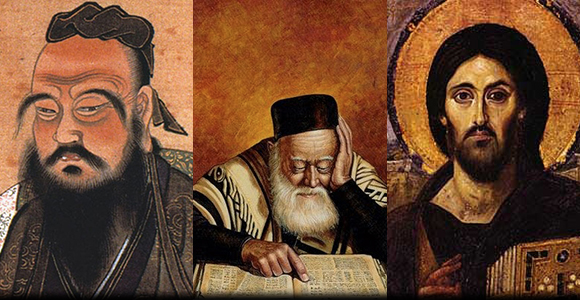
Confucius, Hillel, and Jesus

Left to right: Confucius, Hillel, Jesus of Nazareth

“And the way you want people to treat you, that is how you treat them.” (Q 6:31)

Luke 6:31: “Do to others as you would have them do to you.”

Matthew 7:12: “So in everything, do to others what you would have them do to you, for this sums up the Law and the Prophets.”

Gospel of Thomas 6:3: “And do not do what you hate.”

This week, our focus in Sayings Gospel Q is almost universally referred to as the “the Golden Rule.” The Golden Rule has a broad and lengthy history, beginning, to our best understanding, in 5th Century BCE China.

Karen Armstrong writes in The Great Transformation: The Beginning of Our Religious Traditions that “Confucius was the first to promulgate the Golden Rule. For Confucius [the rule] had transcendent value” (p. 248). Armstrong explains, “Confucius saw the ‘ego principle’ as the source of human pettiness and cruelty. If people could lose their selfishness and submit to the altruistic demands of the li [courtly rites similar to medieval European etiquette and courtesy] at every moment of their lives, they would be transformed by the beauty of holiness. They would conform to the archetypal ideal of the junzi, the superior human being.” Unlike isolated monks who seek virtue by separating from all of society including family, Confucius also saw “family” differently:

“Instead of seeing family life as an impediment to enlightenment, like the renouncers of India, Confucius saw it as the theater of the religious quest, because it taught every family member to live for others. This altruism was essential to the self-cultivation of a junzi: ‘In order to establish oneself, one should try to establish others,’ Confucius explained. ‘In order to enlarge oneself, one should try to enlarge others.’ . . . Confucius saw each person as the center of a constantly growing series of concentric circles, to which he or she must relate . . .The lessons he had learned by caring for his parents, spouse, and siblings made his heart larger, so that he felt empathy with more and more people: first with his immediate community, then with the state in which he lived, and finally with the entire world (Armstrong, p. 207).

Mozi, in the fourth century BCE, extended the Golden Rule in China. Isocrates promoted the Golden Rule in Greece in the 3rd Century BCE, and it appeared in India and Persia as well.

These centuries are what Karl Jaspers and Karen Armstrong describe as the Axial Age, the beginning of an awakening among several human cultures when most of them (except for Greece) moved away from the violence and tribalism that had characterized them before. This somewhat simultaneous transition among these cultures is fascinating.

Due to the diaspora and the continual upheaval within Judea during this time (which was not in the least conducive to the quietness that, Armstrong argues, often yields spiritual awakenings, though some would disagree), the Golden Rule does not appear clearly in Judaism until the late first century BCE. The first clear record we have of it in Judaism is the teaching of the Pharisee rabbi Hillel in the 1st Century BCE. Last week we told the story of Hillel summarizing the Torah with the line: “What is hateful to yourself, do not to your fellow man. That is the whole of the Torah and the remainder is but commentary. Go and learn it.” [1] For Hillel, the Torah was best expressed not in the legal letter, but in the law’s spirit—the Golden Rule.

For the 1st Century Jewish Christians to include the Golden Rule among their record of Jesus’s teachings indicates that this early, original Jesus community believed Jesus’s teachings represented a more compassionate, inclusive interpretation of the Torah. Let’s look at the history around Hillel and that early community.

Hillel, in the later years of his life, served as president of the Jewish Sanhedrin. The Sanhedrin handled both the legislative and judicial functions of Jewish government. When Hillel died, Shammai, then vice-president, became president and passed eighteen ordinances that reflected his own ideas more than Hillel’s. The Talmud’s redactors describe this act “as grievous to Israel as the day when the calf was made” by Aaron at the base of Mt. Sinai (See Shabbat, 17a). Shammai’s ordinances, believed to have been intended to build up Jewish identity, included harsh, divisive, antisocial separation between Jews and Gentiles. As such, a folk story developed that mimicked the story of Hillel summarizing the law for a would-be convert. When someone promised to convert to Judaism if Shammai could teach him the entire Torah while standing on one foot, Shammai rebuked him and sent him away, believing this to be impossible. Hillel’s grandson Gamaliel became president of the Sanhedrin after Shammai (30 CE), but those who subscribed to Shammai’s interpretation of Torah remained the dominant Sanhedrin party until about 70 CE. Today, Rabbinical Judaism follows Hillel’s interpretations, believing that a “Voice from Heaven” made the rulings of the house of Shammai null and void.

It is in the context of this conflict between the compassionate school of Hillel and the strict school of Shammai that Jesus’s teachings were given.

By including the Golden Rule in the teachings of Jesus, the early Jewish community believed to have been the source of Sayings Gospel Q place Jesus alongside Hillel’s more inclusive, more compassionate interpretation of the Torah and in contrast to the school of Shammai. There are only two exceptions: the prozbul that we talked about last week and divorce.

We discussed last week how Jesus parted ways with Hillel on economics and the prozbul that carved out exceptions for lenders against the interests of the poor. And he parted ways with Hillel on the subject of divorce as well. The school of Hillel believed that a man could send his wife away for almost any displeasure. Jesus’s teachings on divorce in the gospel of Matthew and Luke are more in harmony with the more stringent school of Shammai who taught that one could only send one’s wife away for infidelity.

This is not the case in Mark’s gospel, where Jesus’ teachings on divorce are even more stringent than Shammai’s and give no justification for divorce. However, I would argue that whereas Shammai’s teaching on divorce was more stringent, Jesus’ teachings were more centered in concerns of social justice for subjugated women in a patriarchal society. They increased justice in that society, as did the Deuteronomy instruction about remarriage in its era. (See Deuteronomy 24.1-4)

But please notice the political effect of Jesus’s mixed alignment with the schools of his time. The members of the Sanhedrin and Pharisees who subscribed to the school of Shammai, would have seen Jesus as a glutton and a drunkard who violated the standards they believed would strengthen their culture. There would have also been members of the Sanhedrin and Pharisees of the school of Hillel who would have loved much of what Jesus taught, yet because of his teachings on the prozbul and divorce, would have simply been “on the fence” about him. They would not have been able to fully embrace the teachings of Jesus. They would have been able to embrace Jesus on some matters, but not for everything. With the school of Shammai in the influential majority during Jesus’s teaching ministry, this would’ve been a dangerous political position. Any allies he would have had on the Sanhedrin would have been in the minority.

I believe the gospels tell a historically incomplete picture of the Pharisees. Certainly Jesus would have run into problems with the Pharisees of the school of Shammai. But I think it’s important to note that Matthew uses the phrase “some Pharisees,” and not “[all] the Pharisees” (Matthew 19:1). This is a subtle but important difference. The School of Hillel won out, eventually, over the school of Shammai within Rabbinic Judaism.

Armstrong, in the same book, backs this up. She writes:

“But the most progressive Jews in Palestine were the Pharisees [of the school of Hillel], who developed some of the most inclusive and advanced spiritualities of the Jewish Axial Age. They believed that the whole of Israel was called to be a holy nation of priests and that God could be experienced in the humblest home as well as in the temple. He [sic] was present in the smallest details of daily life, and Jews could approach him [sic] without elaborate ritual. They could atone for their sins by acts of loving-kindness rather than animal sacrifice. Charity was the most important commandment of the law . . . The Pharisees [of the school of Hillel] wanted no part in the violence that was erupting destructively around them. At the time of the rebellion against Rome [65-70], their leader was Rabbi Johanan ben Zakkai, Hillel’s greatest student. He realized that the Jews could not possibly defeat the Roman empire, and argued against the war, because the preservation of religion was more important than national independence. When his advice was rejected, he had himself smuggled out of Jerusalem hidden in a coffin in order to get past the Jewish Zealots who were guarding the city gates. He then made his way to the Roman camp and asked Vespasian for permission to live with his scholars in Javne, on the coast of southern Palestine. After the destruction of the temple, Javne became the new capital of Jewish religion. In Rabbinic Judaism, the Jewish Axial Age came of age. The Golden Rule, compassion, and loving-kindness were central to this new Judaism; by the time the temple had been destroyed, some of the Pharisees already understood that they did not need a temple to worship God, as this Talmudic story makes clear:

It happened that R. Johanan ben Zakkai went out from Jerusalem, and R. Joshua followed him and saw the burnt ruins of the Temple and he said: ‘Woe is it that the place, where the sins of Israel find atonement, is laid waste.’ Then said R. Johanan, “Grieve not, we have an atonement equal to the Temple, the doing of loving deeds, as it is said, ‘I desire love and not sacrifice.’’ 

Kindness was the key to the future; Jews must turn away from the violence and divisiveness of the war years and create a united community with “one body and one soul.” When the community was integrated in love and mutual respect, God was with them, but when they quarreled with one another, he [sic] returned to heaven, where the angels chanted with “one voice and one melody.” When two or three Jews sat and studied harmoniously together, the divine presence sat in their midst. Rabbi Akiba, who was killed by the Romans in 132 CE, taught that the commandment “Thou shalt love thy neighbor as thyself” was “the great principle of the Torah.” To show disrespect to any human being who had been created in God’s image was seen by the rabbis as a denial of God himself and tantamount to atheism. Murder was a sacrilege: “Scripture instructs us that whatsoever sheds human blood is regarded as if he had diminished the divine image.” God had created only one man at the beginning of time to teach us that destroying only one human life was equivalent to annihilating the entire world, while to save a life redeemed the whole of humanity. To humiliate anybody—even a slave or a non-Jew—was equivalent to murder, a sacrilegious defacing of God’s image. To spread a scandalous, lying story about another person was to deny the existence of God. Religion was inseparable from the practice of habitual respect to all other human beings. You could not worship God unless you practiced the Golden Rule and honored your fellow humans, whoever they were.”

(Armstrong, Karen; The Great Transformation: The Beginning of Our Religious Traditions (Kindle Locations 7507-7540). Knopf Doubleday Publishing Group. Kindle Edition.)

What does all of this mean for the Jesus of Sayings Gospel Q? It means several things.

  1. It means that the early Jewish followers of Jesus perceived Jesus and his teachings to be a part of this compassionate stream of thought represented by Hillel. That stream eventually won out in Rabbinic Judaism.
  2. Jesus’s execution was more politico-economic than religious. It was not Jesus’s teachings on nonviolence, inclusivity, and the golden rule that got him crucified. The school of Hillel was already teaching these values and Jesus came alongside of that stream and taught them as well. What created the greatest difficulty for Jesus was his solidarity with the poor and his critique of the wealthy elite and their exploitative economic system that centered in Temple and its aristocracy. In our time, it wasn’t Dr. Martin Luther King’s teachings on racial integration and inclusion that inspired his assassination. King was assassinated when he began to threaten the military and economic system of America.
  3. The anti-Semitism created by Christianity and that produced the Holocaust is based on a deeply flawed interpretation of the history of Jesus and the Jewish people. Jesus was not a Christian. Jesus was a Jew. And to a large degree he was a Jew who subscribed in most things to the school of the greatest Jewish rabbi of all time, Rabbi Hillel.
  4. There is much about Rabbinic Judaism that flows from Hillel’s teachings and is in perfect harmony with the ethical teachings of Jesus in Sayings Gospel Q. And this harmony provides much common ground for a healthy and positive interfaith discussion that needs to continue.

To believe that Jesus taught the Golden Rule is to harmonize us with the transition away from violence, tribalism, and oppression toward peace, justice, inclusivity, and egalitarianism within all of the major faith traditions. There are exceptions, but Christianity is still moving toward this transition. Just as Hillel influenced Rabbinic Judaism, it is my prayer that the Jesus revealed in Sayings Gospel Q can also influence modern Christianity.

Whether we attribute the Golden Rule to Confucius, Hillel, or the sayings of Jesus, it’s a better way than the eye-for-an-eye principle of treating people the way they have treated you. With the Golden Rule, we have the power to not only be the change we want to see but to also set those changes in motion with the principle of reciprocity. For all those who are striving toward a safer, more compassionate world for us all, in the words of the Jesus in Sayings Gospel Q:

“The way you want people to treat you, that is how you treat them.” (Sayings Gospel Q 6:31)

HeartGroup Application

  1. This week, set aside ten minutes every day for quiet contemplation. I want you to contemplate only one thing for these ten minutes—the principle of the Golden Rule. Meditate on the interconnectedness of us all, and what it looks like to live this principle in your daily life.
  2. At the end of the ten minutes each day I want you to write down the key insights you gained from the experience.
  3. Share what you discovered this week with your HeartGroup for discussion and action.

Thanks, once again, for joining us this week. I’m so glad you did.

Till the only world that remains is a world where only love reigns.

I love each of you dearly.

I’ll see you next week.


1. Shabbat 31a, in A. Cohen, ed., Everyman’s Talmud (New York, 1975), p. 65.

Renouncing One’s Rights

by Herb Montgomery

Picture of Jesus, Gandhi, Dr. King, and Dorothy Day

Left to right: Jesus of Nazareth, Mahatma Gandhi, Dr. Martin Luther King, jr., Dorothy Day

“The one who slaps you on the cheek, offer him the other as well; and to the person wanting to take you to court and get your shirt, turn over to him the coat as well. And the one who conscripts you for one mile, go with him a second. To the one who asks of you, give; and from the one who borrows, do not ask back what is yours.” (Q 6:29-30)

The International Q Project has titled this section of Sayings Gospel QRenouncing One’s Rights.” While I agree that rights are central to this passage, I want to emphasize that this teaching was not instruction to renounce those rights nor to become 1st Century door mats. Rather it was a tactical strategy for them to use in the midst of persecution (we discussed this two eSights ago), respond to their persecutors with love (see last week’s eSight), and actively furthering their work toward a safer, more compassionate world for all. That last item is what this week’s eSight is all about.

Let’s begin, as usual, by looking at our companion texts.

Luke 6.29-30: “If anyone strikes you on the cheek, offer the other also; and from anyone who takes away your coat do not withhold even your shirt. Give to everyone who begs from you; and if anyone takes away your goods, do not ask for them again.”

Matthew 5.39-42: “But I say to you, Do not [reciprocate evil toward]* an evildoer. But if anyone strikes you on the right cheek, turn the other also; and if anyone wants to sue you and take your coat, give your cloak as well; and if anyone forces you to go one mile, go also the second mile. Give to everyone who begs from you, and do not refuse anyone who wants to borrow from you.”

Thomas 95: “If you have money, do not lend it out at interest. Rather, give it to the one from whom you will not get it back.”

There is much to unpack in this week’s passage from Sayings Gospel Q. The list of peace activists from the last two centuries is long. This week’s saying has been influential, both directly and non-directly, in many of the nonviolent movements around the globe toward positive social change. Some of the most well known names in the last century were Gandhi in South Africa and India and Dr. Martin Luther King, Jr. here in America. There are lesser known names, as well, such as Dorothy Day and her nonviolent direct action on behalf of the poor in New York City. So let’s dive right in.

As we have shared repeatedly in the past, in this passage, Jesus is teaching a bold and disruptive expression of nonviolence. It’s a nonviolence that seeks to confront one’s opponent and offer an opportunity for transformation. With each of these three examples, the oppressed person is shown potential ways of taking control of the situation, confronting their subjugator, and stripping them of the power to dehumanize. Let me explain.

First, let me say how deeply indebted I am to Walter Wink’s research on the cultural backdrop of the saying of Jesus we are considering this week.  I’ll place a link to his work at the end of this section for further consideration. I consider his volume Jesus and Nonviolence: A Third Way to continue to be a revolutionary masterpiece.

Matthew’s version of this passage specifies that the cheek being struck is the “right” cheek. As most people are right-handed, the only natural way for a blow to land on the right cheek was if the striker used the back of their hand. This kind of blow in the culture of 1st Century Palestine was a show of insult from a superior to an inferior: one would not strike an equal in this humiliating way because doing so carried an fine of up to 100 times the normal amount. Four zuz was the fine for a blow to a social peer with a fist, but 400 zuz was the fine for backhanding one’s peer. To strike someone you viewed as socially inferior to yourself with a backhanded slap, was perfectly acceptable and no penalty was attached (see Mishnah Bava Kamma 8.6).

Try to picture the scene in your head. Since the left hand was only used for “unclean” tasks in that culture, people would not strike a person’s right cheek with that hand. At Qumran, even gesturing to another person while speaking using one’s left hand carried a penalty of exclusion from the community accompanied by ten days’ penance. (See The Dead Sea Scrolls, I QS 7, “Whoever has drawn out his left hand to gesticulate with it shall do penance for ten days.”) Any blows would have either been from a closed right fist with one’s right hand on someone’s left cheek, or a back-handed slap with one’s right hand on someone’s right cheek. A closed fisted blow from a person’s right hand on one’s left cheek acknowledged that the striker believed the one they were striking was their social equal.  Someone claiming superiority over another would not want to strike them in this way. They would want to use an open-handed slap with the back of their hand on the other person’s right cheek as an attempt at humiliating the one they were striking. It was the equivalent of saying, “Get back in your place.” Also, keep in mind that any retaliatory blows from the person being struck by a “superior” would have only caused the violence to escalate.

But Jesus is not admonishing the oppressed in this scene to become a doormat or simply do nothing. Turning their left cheek would not be retaliation but defiance, a sign that the one being struck is refusing to be humiliated. The oppressor would now only have two options presented to them: a right-handed punch acknowledging the one being struck was their equal or a left-handed slap with the unclean hand.  Both options would be unthinkable, and so they would lose their power in the situation.  Something I would like to add to Wink’s research is that this would not be an act of self-denial on the part of the person being struck.  The person being struck’s “self” is already being denied by their oppressor.  This is self-affirmation in the face of an attempt by another to dehumanize them.

The next example in the passage involves a serious social problem in 1st Century Palestine: indebtedness. A little background first. The Torah allowed a creditor to take the himation (or outer garment) or chiton (inner garment) as security for loans from the wealthy to impoverished laborers (see Exodus 22:25-27 and Deuteronomy 24:10-13, 17). In this era, poor people had few clothes, and wealthy creditors had to return it daily so the owners could have their cloak to sleep in.

In that culture, debt was not the result of economic incompetence, but of an unjust economic system where the wealthy elite took advantage of rural peasant farmers and poor Jewish craftsmen. In our scenario, a poor laborer has defaulted on their loan and has come under the penalty of losing their next-to-last article of clothing.

Jesus’s saying teaches this laborer to “turn over” not just their next-to-last article of clothing but also their last one as well. This would leave them stark naked in the town square. Wink explains that in that society the shame of nakedness fell not on those whose nakedness was exposed, but on those who looked upon or were the cause of their nakedness.  The honorable response would have been to respectfully help them (see Genesis 9.20-27). In a society where only the wealthy wore something similar to underwear, stripping off the undergarment along with the required outer garment would redirect the shame onto “the entire system by which the debtors are oppressed” as if to say, “Shame on you!” The teaching placed the poor laborer in control of the moment, exposing the system’s exploitation of Jesus’ fellow Jewish craftsmen and rural peasant farmers and shaming the powerful who take the last object of value from a sector of society which should be receiving their help. Here in Sayings Gospel Q, we have a 1st Century endorsement of public nudity as a valid form of radical, nonviolent protest, and the protest is designed by Jesus himself!

In our next example, Jesus teaches the oppressed to refuse to play by the rules of the game dictated by those controlling the society’s domination system.

Roman law allowed soldiers to command people in the occupied territories to carry their burdens for one mile—but only one mile. This limitation provided some protection for the people as one could otherwise find oneself having carried a soldier’s burden for an entire day only to end up now a day’s journey away from one’s home as the sun was going down.

Yet even this limitation was not good enough. We cannot be satisfied with merely accommodating the domination system; we must also refuse to cooperate with it. Remember King’s words from last week: “We cannot in all good conscience obey your unjust laws and abide by the unjust system, because non-cooperation with evil is as much a moral obligation as is cooperation with good.” So, Jesus says, when you reach the end of your first, forced mile and the soldier asks for their burden, don’t give it back! Place the soldier in the position of breaking their own system’s rules and perhaps being disciplined for it.

In each of these examples, the subjugated must make hard choices. They must decide whether they are willing to use possible further personal suffering to change society rather than resort to mere retaliation. Are they willing to accept the consequences for breaking unjust laws or policies? Are they willing to cease cooperating with the present order and its rules? And as we asked last week, do they hope for their oppressors’ transformation, or are they satisfied with the failing practice of tit-for-tat?

If you would like to further understand what may have been involved in this Saying, again, consider reading the late Walter Wink’s book Jesus and Nonviolence: A Third Way. In this volume, Wink shows how Jesus’s teaching offered the oppressed ways to:

  • Seize the moral initiative
  • Find a creative alternative to violence
  • Assert [their] own humanity and dignity as a person
  • Meet force with ridicule or humor
  • Break the cycle of humiliation
  • Refuse to submit or to accept the inferior position
  • Expose the injustice of the system
  • Take control of the power dynamic
  • Shame the oppressor into repentance
  • Stand [their] ground
  • Make the Powers make decisions for which they are not prepared
  • Recognize [their] own power
  • Force the oppressor to see [them] in a new light
  • Deprive the oppressor of a situation where a show of force is effective (pp. 186-187)

The last section of this week’s saying reminds us, once again, to trust that God will send people to take care of us when we are in need enough to let go of our self-concerned hoarding, and that we will be the people God may send today to someone else who is in need. People taking care of people, remember, is what Jesus referred to as “the reign of God” (Sayings Gospel Q) or “The Kingdom” (canonical gospels).

This call to trust had its own history with Jesus’s Jewish culture.

Hillel, one of the most important figures in Jewish history, lived somewhere between 110 BCE to 30CE. He was the first within Judaism to teach what today is referred to as the Golden Rule. Karen Armstrong in her excellent work The Great Transformation: The Beginning of Our Religious Traditions writes this about Hillel:

Perhaps the greatest of the Pharisees was Rabbi Hillel (c. 80 BCE–30 CE), who migrated to Palestine from Babylonia. In his view, the essence of the Torah was not the letter of the law but its spirit, which he summed up in the Golden Rule. In a famous Talmudic story, it was said that one day a pagan approached Hillel and promised to convert to Judaism if the rabbi could teach him the entire Torah while he stood on one leg. Hillel replied simply: “What is hateful to yourself, do not to your fellow man. That is the whole of the Torah and the remainder is but commentary. Go learn it.” (Kindle Locations 7509-7515)

The most famous of the enactments attributed to Hillel is the Prozbul.

The Torah included a rule of protection for the poor against ever-increasing debt. At the end of every seventh (Sabbatical) year, all debts among the Jewish people were to be cancelled. By the 1st Century, even though it was forbidden to withhold a loan before a Sabbatical year (see Deuteronomy 15.9-11), some members of the wealthy elite were unwilling to lend to poor craftsman and rural peasant farmers who needed loans to survive.

In this context, Hillel created a loophole in the Jewish law. A declaration could be made in court before a loan was executed to the effect that the law requiring the release of debts upon the entrance of the Sabbatical year would not apply to the loan to be transacted. This declaration was called the Prozbul, and it benefitted both the rich and the poor in that the poor could more easily obtain the loans they so desperately needed whenever they needed them, and the rich would more freely lend with the assurance that the capital loaned was exempted from the law’s Sabbatical debt relief. (For more, read the Jewish Encyclopedia’s entry: Prozbul.)

Where Jesus’s teaching on the Golden Rule placed him squarely in the teaching stream of Hillel, Jesus parts ways with Hillel on the Prozbul. (I’ll talk about Jesus’s relationship with the School of Hillel and the School of Shammai next week.)

Jesus taught that his followers should recklessly abandon their capital to aid those who need our help. We will study this in detail in upcoming weeks, but for now, know that to Jesus, a world under the reign of God looked like people trusting in God enough to believe that God would send others to take care of them tomorrow, so they could let go of what they were hoarding for future emergencies and take care of those whose emergencies were transpiring today.

Anxiety about the future can lead us down paths of accumulation, hoarding, greed, covetousness, jealousy, competition, and violence. It can cause us to look the other way and ignore those around us today who may be in need. But Jesus is calling us to let go of that anxiety about the future and all that it brings in its train. Let’s imagine, instead, a world where, rather than individualistically accumulating in order to take care of oneself in the future, everyone trusts that if we all begin taking care of one another today, we will have a future where others take care of us. In other words, if you will take care of someone else today, you will set in motion a world where, tomorrow, someone else will take care of you.

In the words of the sayings of Jesus held dear by those first-century Jewish followers:

“To the one who asks of you, give; and from the one who borrows, do not ask back what is yours” (Q 6:29-30).

HeartGroup Application

There are two parallel narratives we can chose to live by:

Scarcity                     Abundance
Anxiety                      Trust
Accumulation            Sharing
Greed                       Generosity
Monopoly                  Mutual Aid
Violence                    Peace

  1. Ponder the words in the parallel narratives above. Look up the definitions of each word. Consider how each concept leads to the next. We can live in a world where we subscribe to scarcity, believing there is not enough to go around for everyone so we’d better look out for ourselves, or we can live in a world where as Gandhi is thought to have said, there is “enough for every person’s need, but not every person’s greed.”
  2. Discuss with your HeartGroup how the worlds created by these different narratives look. How do they differ? What are their costs? What are their benefits? Which world would you rather be a part of?
  3. Make a choice. This week, make a choice to do something small or large in your life that moves you into the narrative you would rather live in.

Thanks for taking time to journey with us this week as we continue our consideration of Sayings Gospel Q. I’m so glad you are with us.

Till the only world that remains is a world where only love reigns.

I love each of you dearly.

I’ll see you next week.


* In these cases, Jesus’ instructions are NOT commands of passive nonresistance. The phrase “resist not an evildoer” could be problematic if Jesus did not then demonstrate in these stories exactly what He meant. The underlying Greek word here is anthistemi. It indicates resistance by returning violence for violence, overcoming evil with evil, rather than overcoming evil with good.

The Beatitudes for the Poor, Hungry, and Mourning

by Herb Montgomery

A loaf of bread in an old mans hands

And raising his eyes to his disciples he said: Blessed are you poor, for God’s reign is for you. Blessed are you who hunger, for you will eat your fill. Blessed are you who mourn, for you will be consoled. (Q 6:20-21, Robinson)

We begin this series on the sayings of Jesus and Sayings Gospel Q with the passage in Q where the opening narrative ends and Jesus begins to teach. This passage has parallels in Luke, Matthew, and the 1st Century Christian text The Gospel of Thomas:

Luke 6:20-21: “Looking at his disciples, he said: ‘Blessed are you who are poor, for yours is the kingdom of God. Blessed are you who hunger now, for you will be satisfied. Blessed are you who weep now, for you will laugh.’”

Matthew 5:1-4: “Now when Jesus saw the crowds, he went up on a mountainside and sat down. His disciples came to him, and he began to teach them. He said: ‘Blessed are the poor in spirit, for theirs is the kingdom of heaven. Blessed are those who mourn, for they will be comforted.’”

Gospel of Thomas 54: “Jesus says: ‘Blessed are the poor. For the kingdom of heaven belongs to you.’”

Gospel of Thomas 69.2: ”Blessed are the hungry, for the belly of him who desires will be filled.”

The ethic of charity, taking care of the less fortunate, the poor, or the weaker sections of society, long predates the teachings of Jesus. What Jesus is doing here is not admonishing us to take care of the poor but rather announcing that the situations of the poor, the mourning, and the hungry are about to be reversed! I’ll explain.

If we live in a society of limited resources, then for someone to hold on to more than what they need (i.e. wealth) means that someone else is going without what they need. Countless philosophers and sages throughout the centuries have taught this to one degree or another. Gandhi spoke of the earth providing each day enough for every person’s need but not every person’s greed. Karl Marx described our societies as pyramids with the wealthy elite at the top and the masses of working class and the poor at the bottom.

First Century Jerusalem had a similar social structure. The Greek and Roman empires had monetized the region. Historians estimate that over two million Jewish people lived outside of Jerusalem. Each male older than twenty years of age was required to pay an annual half-shekel temple tax, and so the temple amassed an enormous amount of wealth. Josephus recorded Rome forcibly taking money from the temple during its occupation of the region (Sabinus: The Jewish War 2.14; Jewish Antiquities 17.50; Pilate: The Jewish War 2.175-177; Jewish Antiquities 18.60-62; Florus: The Jewish War 2.293). When Judea was placed under a Roman Prefect, the Temple became the primary Jewish political institution. During this time, the Temple took on more of the role of a national treasury and “bank” for the wealthy aristocracy of Jerusalem.

“It is quite possible that, under pressure of this increasingly wealthy elite, the temple began to make loans on their behalf or to hold their capital so they could proffer from such loans to the poor.” – William R. Herzog, Jesus, Justice, and the Reign of God: A Ministry of Liberation.

The wealthy looking for ways to profit from investing their surplus in loans or acquiring land upon debtors’ default created an unbearable debt load for both peasants and craftsmen. The farmers needed these loans to survive, the wealthy sought greater profits, and the temple, with its politically and economically privileged priesthood and Jewish aristocracy living in luxury, was at the very heart of a system of economic exploitation. As Josephus records, the burning of all records of debts held in the temple was the first act of the Jewish Revolt that led to the Jewish Roman war (The Jewish War 2.426-427).

The temple had become more than a site for religious worship. It had become the heart of economic oppression. This system created wealth through making others impoverished. And so in our first passage this week from Sayings Gospel Q, Jesus does not prescribe charity for the poor as a way to maintain an unfortunate but unavoidable state of affairs in a system that should be left unchanged. Jesus is calling for justice toward the poor and change to the system itself for all who choose to participate.

Jesus announces a path toward a great reversal, where the poor are now benefited, the hungry finally and permanently have enough food, and those for whom the present system caused mourning, they will rejoice. The justice of Jesus involves a change for everyone.

As James M. Robinson states in his book The Gospel of Jesus, “It is no coincidence that the oldest collection of Jesus’ sayings, what we call the Sermon (what Matthew expanded into the Sermon on the Mount), begins by pronouncing just such down-and-outers fortunate: it is the poor, the hungry, the mourners who are ‘blessed.’ The kingdom of God is not God’s stamp of approval on the status quo, the powers that be, the ruling class. Rather, it is countercultural, for it gives hope to the hopeless. It is not consoling them with ‘pie in the sky by-and-by,’ but involves concrete intervention in the lives of the needy, mitigating their plight in the here and now” (p. 170).

In Luke’s gospel we come in contact with wealthy Pharisees who reject Jesus’ new plan and wealthy tax collectors who embrace it. Luke’s gospel uniquely includes the parable of the rich man and Lazarus, originally a story that the Pharisees told about a rich tax collector and a poor scholar of the Torah (see J. Jeremias, Parables, p. 183). Luke’s Jesus expands the story from being about a tax collector and a Torah scholar to being about all who are wealthy (including wealthy Pharisees) and all who are poor (Luke 16:19-31). We encounter in characters like Zacchaeus tax collectors who respond positively to Jesus’ new economics and choose to give their wealth back to the poor (Luke 19:1-10). And we encounter Pharisees who “loved money, heard all this and were sneering at Jesus” (Luke 16:14).

In Sayings Gospel Q we find:

“For John came to you, the tax collectors responded positively, but the religious authorities rejected him.” Q 7:29–30

Luke and Matthew also make this point:

“(All the people, even the tax collectors, when they heard Jesus’ words, acknowledged that God’s way was right, because they had been baptized by John. But the Pharisees and the experts in the law rejected God’s purpose for themselves, because they had not been baptized by John.)” (Luke 7:29-30)

“For John came to you to show you the way of righteousness, and you did not believe him, but the tax collectors and the prostitutes did. And even after you saw this, you did not repent and believe him.” (Matthew 21:32)

This rejection was much more than simple disagreement about Jesus’s theology. The religious authorities rejected Jesus’ new economics.

In Sayings Gospel Q, we read one of the proofs that Jesus sent back to the imprisoned John: the poor having good news proclaimed to them:

“And John, on hearing about all these things, sending through his disciples, said to him: Are you the one to come, or are we to expect someone else? And in reply he said to them: Go report to John what you hear and see: The blind regain their sight and the lame walk around, the skin-diseased are cleansed and the deaf hear, and the dead are raised, and the poor are evangelized [hear good news]. And blessed is whoever is not offended by me.” (Q 7:18–19, 22–23)

“John’s disciples told him about all these things. Calling two of them, he sent them to the Lord to ask, “Are you the one who is to come, or should we expect someone else?” So he replied to the messengers, ‘Go back and report to John what you have seen and heard: The blind receive sight, the lame walk, those who have leprosy are cleansed, the deaf hear, the dead are raised, and the good news is proclaimed to the poor. Blessed is anyone who does not stumble on account of me.’” (Luke 7:18–23)

“When John, who was in prison, heard about the deeds of the Messiah, he sent his disciples to ask him, “Are you the one who is to come, or should we expect someone else?” Jesus replied, “Go back and report to John what you hear and see: The blind receive sight, the lame walk, those who have leprosy are cleansed, the deaf hear, the dead are raised, and the good news is proclaimed to the poor. Blessed is anyone who does not stumble on account of me.” (Matthew 11:2-6)

Sayings Gospel Q tells us what that good news was, a great reversal of affairs:

“The last will be first, and the first last.” (Q 13:30)

“Indeed there are those who are last who will be first, and first who will be last.” (Luke 13:30)

“So the last will be first, and the first will be last.” (Matthew 20:16)

“For many who are first will become last.” (Gospel of Thomas 4:2)

“Everyone exalting oneself will be humbled, and the one humbling oneself will be exalted.” Q 14:11

“For all those who exalt themselves will be humbled, and those who humble themselves will be exalted.” (Luke 14:11)

“For those who exalt themselves will be humbled, and those who humble themselves will be exalted.” (Matthew 23:12)

“Nobody can serve two masters; for a person will either hate the one and love the other, or be devoted to the one and despise the other. You cannot serve God and Mammon.” (Q 16:13)

“No one can serve two masters. Either you will hate the one and love the other, or you will be devoted to the one and despise the other. You cannot serve both God and money.” (Luke 16:13)

“No one can serve two masters. Either you will hate the one and love the other, or you will be devoted to the one and despise the other. You cannot serve both God and money.” (Matthew 6:24)

“And it is impossible for a servant to serve two masters. Else he will honor the one and insult the other.” (Gospel of Thomas 47:2)

Again from James M. Robinson’s The Gospel of Jesus, “Jesus must have believed that, in spite of appearances, the givens of life were basically changed: as the ideal becomes real and God rules, there are to be no poor or hungry, no handicapped or sick, no exploiter or enemy, no mentally disturbed or force of evil. Jesus believed that this ideal was the basic reality and acted accordingly.” (Ibid. Kindle Locations 2495-2504).

As we close this week, I want to address a common misunderstanding of a statement Jesus makes in Mark and Matthew.

“The poor you will always have with you, but you will not always have me.” (Matthew 26:11)

The poor you will always have with you, and you can help them any time you want. But you will not always have me. (Mark 14:7)

Some have taken these words to indicate that Jesus is proclaiming that poverty is an unavoidable reality that will always exist no matter what we do. Yet when we understand this statement from a Jewish perspective, we see this is not the case at all.

In Jewish history, Yahweh had proclaimed that if they would follow his instruction to them, they would be poverty-free: “There will never be any poor among you if only you obey the Lord your God by carefully keeping these commandments which I lay upon you this day.” (Deuteronomy 15.4, REB, emphasis added)

Jesus is reversing this statement from Deuteronomy when he states, “You will always have the poor among you.” Poverty is a human creation, and thus, humans could reverse it if they chose to. Jesus is showing a way for his generation to do so through voluntary wealth redistribution rooted in love for our fellow human beings. Yet the wealthy elite of his day, including Judas, rejected his teachings in favor of greed. And as long as they held on to their present system, rather than eliminating poverty they would immortalize it. The choice was theirs.

The poverty of Jesus’ day was the result of an unjust system. And just as following Yahweh’s laws would have eliminated poverty in ancient Judaism, following the way of Jesus could have eliminated poverty in the 1st Century. Luke’s narrative in Acts explains the results for those who chose to give his economic teachings a try:

“All the believers were one in heart and mind. No one claimed that any of their possessions was their own, but they shared everything they had. With great power the apostles continued to testify to the resurrection of the Lord Jesus. And God’s grace was so powerfully at work in them all that there were no needy persons among them. For from time to time those who owned land or houses sold them, brought the money from the sales and put it at the apostles’ feet, and it was distributed to anyone who had need.” (Acts 4.32-35, emphasis added.)

What were Jesus’s economic teachings? We’ll learn more as we continue our study of Sayings Gospel Q, but for now, it’s important to remember that Jesus’s teachings were rooted in what he called the reign of God (the kingdom). For the Jesus of Sayings Gospel Q, a world where God “reigns” is a world where I trust God to take care of me by sending people who will care for me while I take care of you and listen to God when God calls me to take care of you!

“[Jesus’] basic issue, still basic today, is that most people have solved the human dilemma for themselves at the expense of everyone else, putting them down so as to stay afloat themselves. This vicious, antisocial way of coping with the necessities of life only escalates the dilemma for the rest of society . . . I am hungry because you hoard food. You are cold because I hoard clothing. Our dilemma is that we all hoard supplies in our backpacks and put our trust in our wallets! Such “security” should be replaced by God reigning, which means both what I trust God to do (to activate you to share food with me) and what I hear God telling me to do (to share clothes with you). We should not carry money while bypassing the poor or wear a backpack with extra clothes and food while ignoring the cold and hungry lying in the gutter. This is why the beggars, the hungry, the depressed are fortunate: God, that is, those in whom God rules, those who hearken to God, will care for them. The needy are called upon to trust that God’s reigning is there for them (“Theirs is the kingdom of God”).”

– James M. Robinson, The Gospel of Jesus 

HeartGroup Application

In the 1st Century, Jesus proclaimed good news to the poor, the hungry, and those who mourn. In our society, whom do you think Jesus would proclaim good news to today? Most definitely it would still be the poor, hungry, and mourning. But whom else would it include? Which other members of your human family would Jesus call you to trust God to send people to take care of you while calling you to take time today to take care of them?

  1. Discuss this question with your HeartGroup and see which people or communities you come up with.
  2. Dedicate time during your HeartGroup each week to share experiences you have when you reach out to take care of someone in need.
  3. At the end of this special sharing time each week, share who you might have come in contact with the previous week that may need your group’s help. Combine your group’s resources to see how you can care for them in the upcoming week.

For Jesus, the reign of God looked like people taking care of people while trusting God that if we would chose a world of “care,” this would actually bring about a new human reality for us all. It’s a world that we like to describe as a world where only love reigns.

We’ll take a look at the next passage in Sayings Gospel Q next week, but for today, here are the words of Jesus:

“Blessed are you poor, for God’s reign is for you. Blessed are you who hunger, for you will eat your fill. Blessed are you who mourn, for you will be consoled.” (Q 6:20-21, Robinson)

Thanks for taking the time to journey with me in this series.

I love each of you, dearly.

I’ll see you next week.
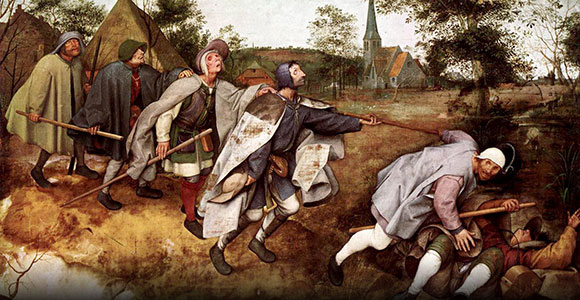
The Sayings of Jesus

by Herb Montgomery


Blue Abstract Letter Q

Now when Jesus saw the crowds, he went up on a mountainside and sat down. His disciples came to him, and he began to teach them. (Matthew 5.1-2, emphasis added.)

From each of us here at RHM, Happy New Year!

To kick off this brand new 2016, we are going to be starting a new series for our eSights and podcasts.

In 2015, we focused on the gospel of Mark. Beginning this year and for as long as it takes us, we’re going to looking at the sayings of Jesus found in Matthew and Luke, a body of texts that scholars call “Q”. Let me briefly explain this.

As we said a few weeks before Christmas, the early church was comprised of both Jewish and Gentile Christians. Mark’s version of the Jesus story was written within a Gentile Christian context. Both Matthew and Luke based their versions of the Jesus story on Mark, yet there are things Matthew and Luke have in common with each other that are not found in Mark’s gospel. Since 1801, scholars have believed that Matthew and Luke used a secondary source, Q. You can read more about it here.

Here is a diagram that may help you visualize this.

Diagram illustrating the composition of Mark, Matthew and Luke

The Q source material (also called the Sayings Gospel Q) is believed to have belonged to the Jewish Christian community and included sayings of Jesus that they cherished.

When the Jewish Christians and the Gentile Christians blended in the early church, Matthew’s gospel and Luke’s gospel were written to unite two Jesus stories, the Jewish Q and the Gentile Mark, for the blended community. Matthew’s gospel combined Mark and Q for the Jewish Galilean territories, while Luke-Acts combined Mark and Q for the larger Gentile world.

This background is important for us because it’s the sayings of Jesus, held in common by both Matthew and Luke (Q source), that have historically inspired significant positive world change. From Francis of Assisi and the anarchistic Anabaptists to Gandhi, Dr. Martin Luther King, Jr., and others, whenever those who desire to follow Jesus’ teachings have sought to rediscover what those teachings actually were, the result has been positive change in each of their societies.

I believe that can be true today. Those who desire to follow the 1st century Jesus today, including Christians, need to rediscover the teachings of Jesus found in the Q source, the gospel that the Jewish Christian community claimed Jesus actually taught.

Although the Q source manuscripts were lost after the early Gentile Christians squeezed the Jewish Christians out, we can rediscover it to the best of our ability by simply looking at the sayings of Jesus held in common by both Matthew and Luke. These are the sayings that have inspired those who’ve approached them thoughtfully toward building a safer, more just, and more compassionate world for us all.

This is going to be an exciting series. I can’t think of a better way to begin a brand new year!

I’ll close this week with this statement from James M. Robinson in his volume The Gospel of Jesus:

“Paul’s letters were of course the most popular among theologians, but it is not they who converted the Roman Empire. Rather, it was the masses from whom the foot soldiers in Constantine’s army came. They knew firsthand of the underprivileged and oppressed who had been rescued by the soup kitchens (which served more than wafers), the adoption of orphans, the absorption of widows, and the many other forms of humaneness that derive ultimately from Jesus, mediated through the Sayings Gospel Q and then through the Sermon on the Mount. So it was his foot soldiers that the emperor told of having seen the cross in the sky with the message “In this sign conquer!” The troops, heavily Christian and hence pacifistic, fell into line and marched into battle, on to victory. It seems to have been Francis of Assisi who then rediscovered the Sermon on the Mount. The Franciscan order that emerged from his leadership has been the bearer down through the centuries of much of the message of Jesus found in the Sayings Gospel Q. Then Leo Tolstoy took up the torch in his War and Peace, followed by Mahatma Gandhi with his “passive resistance” and Martin Luther King, Jr., with his “dream” of an integrated America. Now that the Sayings Gospel Q is readily available for study, we can see how Jesus’ message has indeed continued to be heard, though in quite unusual ways, down through the centuries.”

HeartGroup Application

  1. This week, become familiar with the theory of the Q source. Read about the Q source here and here.
  1. Take time to read through the critical text of Q from the International Q Project here.
  1. Begin writing down the sections of Q that you can’t wait to get to and share with your group why those sections are special to you.

As a Freshman in college taking Theology, the Q source theory was the very first thing I remember being taught that first semester. At the time, in my youthful impatience, I remember thinking, “Why are we wasting time on sources of materials when we should just be jumping into the material itself?”  Now I understand why getting back to what the early Jewish community claimed Jesus actually taught is so important. It is in these teachings that we discover the potential to choose personal change as well as positive change within our world.

I’m looking forward to next week already!

I can’t wait! Thank you for joining us for this look at what the early church taught were the sayings of Jesus.

I love each one of you.

Happy New Year.

I’ll see you next week.

Two Visions [or Versions] of Peace (Part 3 of 3)

The Subversive Narratives of Advent: Part 3 of 3 

by Herb Montgomery

“The angel said to them, ‘Do not be afraid. I bring you good news that will cause great joy for all the people. Today in the town of David a Savior has been born to you; he is the Messiah, the Lord. This will be a sign to you: You will find a baby wrapped in cloths and lying in a manger.’ Suddenly a great company of the heavenly host appeared with the angel, praising God and saying, ‘Glory to God in the highest heaven, and peace on earth on those God’s favor rests.’” (Luke 2.11-14)

We’ve arrived! This is our final installment of our Christmas series this year at RHM, and we’re looking at Luke’s birth-narrative this week. Again, I want to recommend the volume The First Christmas by Marcus Borg and John Dominic Crossan. I believe you’ll find it to be a very user-friendly resource in wresting what we today call “The Christmas Story” from ancient and modern forms of imperialism and their co-opting of these narratives.

Luke’s birth-narrative is quite different from Matthew’s, which we looked at last week. One of the differences is Luke’s narrative centers the voices of women more than Matthew. (Luke’s entire Gospel does this actually.) Luke and Matthew’s birth narratives also differ on geography. Luke progresses from Nazareth to Bethlehem to Nazareth with no time spent in Egypt. Matthew starts in Bethlehem then moves to Egypt, and then moves onto Nazareth. Another difference is that, unlike Matthew’s narrative, which was for Christian Jews in Galilee, Luke’s narrative is for a broader Gentile-Christian audience. This may help to explain the way that Matthew treats the Herodians in Galilee as the tools of Rome while Luke chooses a much more direct aim at Caesar himself.

To quote John Dominic Crossan in a recent panel discussion, what we see in the first century is not “Christianity against Judaism.” Rather we see, “Christian Judaism against Roman Imperialism . . . Of course [the followers of Jesus] are within Judaism, and of course they’re fighting with other groups as they’re elbowing one another for the future of their people in the cauldron that the Romans have created as any empire does to divide and conquer.”

This is the back drop I want us to see behind Luke’s birth narrative. In Luke, we’re not seeing Jesus versus Judaism, but rather Jesus versus Rome. (We can find signs of a growing anti-Semitism in early Christianity in Luke’s gospel: not as much as in John, but certainly more than in Matthew, and most definitely more than in Mark.)

To perceive Luke’s agenda in writing his narrative, we must read the narrative through three filters: 1) first-century Christianity, 2) Christianity in first-century Judaism, and 3) Christianity in Judaism in a context of Roman imperialism. We’ll start with the last one, Roman imperialism, and work our way backwards.

Roman Imperialism

When we speak of Roman imperialism, we’re referring to the integration of military, economic, political, and theological/philosophical layers in Rome. This four-pronged imperialism was a method of economic distribution; a type of human, social organization; a world order and its exercise of (or lack of) social justice; and specifically, Rome’s vision for global peace.

It was Augustus Caesar who, during the time of Luke’s birth-narrative, was entitled Divine, Son of God, God from God, Lord, Redeemer, Liberator, and Savior of the World. Here is why.

Rome experienced several civil wars as a democratic republic and had regressed to the point of disintegration when Octavian, later called Augustus, became Rome’s savior. Through Augustus, Rome transitioned from an imperial republic to an imperial monarchy. Augustus, the adopted son of Julius, was like his father deified, or regarded as a god. He was given the title Augustus in Latin (One who is divine) and Sebastos in Greek (One who is to be worshipped). Temples were inscribed to him with the dedication, “The Autocrat Caesar, the Son of God, the God to be worshipped.”

And as with all domination systems, the four imperial aspects produced a society where an elite at the top benefited from the subjugation of the many beneath them. Luke addresses all four of these aspects in his gospel. In response to Rome’s military power, Luke presents the teachings of Jesus on nonviolence. In response to Rome’s economic power, Luke presents Jesus’ teachings on wealth redistribution. In response to Rome’s political power, Luke presents Jesus, not Caesar, as Liberator, Redeemer, the bringer of Peace, Lord, and Savior of the world. And in response to the Rome’s theology of a ruler who was supposedly born to divine-human parents and so was named the Son of God, God from God to be worshiped, Luke presents Jesus and his subversive “kingdom.” Rome’s theology was larger than Caesar and included the worship of deities such as Mars the god of war, but it included the worship of Caesar as the incarnate representation of the Divine.

As theologian Adolf Gustav Deissmann wrote, it’s important for us to recognize the early establishment of a polemical parallelism between the cult of Christ and the cult of Caesar in the application of the term kyrios, ‘lord’” (p. 349)*.

Knowing Augustus’ birth-narratives is also beneficial to us. The story was that on the night of Augustus’ conception, Augustus’ father had a dream in which he saw the sun rising from Atias, his wife’s womb: Caesar Augustus was the coming of light to the world. Augustus was believed to be the “Son of God” fathered by Apollo, and Apollo in turn was the “Son of God” fathered by Zeus, the supreme god of the Roman and Greek pantheon.

Here’s a description from the 2nd Century CE of the divine conception of Augustus Caesar; it cites an Egyptian story about Augustus that dates to 31-29 BCE:

“When Atia [Augustus’ mother] had come in the middle of the night to the solemn service of Apollo, she had her litter set down in the temple and fell asleep, while the rest of the matrons also slept. On a sudden a serpent glided up to her and shortly went away. When she awoke, she purified her self, as if after the embraces of her husband, and at once there appeared on her body a mark in colors like a serpent, and she could never get rid of it; so that presently she ceased ever to go to the public baths. In the tenth month after that Augustus was born and was therefore regarded as the son of Apollo.” (Suetonius, The Twelve Caesars, p. 94.4, emphasis added)

Propertius’ Elegies quotes the god Apollo as saying:

“O savior of the world… Augustus… now conquer at sea: the land is already yours: my bow battles for you’” (4.6.37– 39).

An ancient inscription in what’s Turkey today refers to Augustus, “divine Augustus Caesar, son of a god, imperator of land and sea, the benefactor and savior of the whole world.”

So Caesar Augustus, conceived of Apollo, was, in Roman theology, the Savior of the World, and Luke’s gospel responds to that context.

Judaism in Roman Imperialism

Jews in Roman-occupied territory hoped for a world free from injustice and foreign oppression. In the Jewish Sibylline Oracles, a series of fictional prophecies within Judaism and early Christianity, we find this vision:

“The earth will belong equally to all, undivided by walls or fences. It will then bear more abundant fruits spontaneously. Lives will be in common and wealth will have no division. For there will be no poor man there, no rich, and no tyrant, no slave. Further, no one will be either great or small anymore. No kings, no leaders. All will be on a par together.” (2:319-324)

The hoped-for world in the Jewish vision for the future looked like a family, where YHWH as parent provided equally for all—enough for everyone, always.

There were also two competing strands in Judaism regarding the fate of the Gentiles (including the Romans) in this vision. One strand was violent and retributive:

“In anger and wrath I will execute vengeance on the nations that did not obey . . . Then my enemy will see, and shame will cover her who said to me, “Where is the Lord your God?” My eyes will see her downfall; now she will be trodden down like the mire of the streets . . . The nations shall see and be ashamed of all their might; they shall lay their hands on their mouths; their ears shall be deaf; they shall lick dust like a snake, like the crawling things of the earth; they shall come trembling out of their fortresses; they shall turn in dread to the Lord our God, and they shall stand in fear of you.” (Micah 5:15; 7:10, 16-17)

This is actually quite mild compared to some Christian versions of the future of this world that are being touted today. Nevertheless, the other Jewish option was less violent, more restorative, and involved the conversion of the Gentiles:

“In days to come the mountain of the Lord’s house shall be established as the highest of the mountains, and shall be raised up above the hills. Peoples shall stream to it, and many nations shall come and say: “Come, let us go up to the mountain of the Lord, to the house of the God of Jacob; that he may teach us his ways and that we may walk in his paths.” For out of Zion shall go forth instruction, and the word of the Lord from Jerusalem. He shall judge between many peoples, and shall arbitrate between strong nations far away; they shall beat their swords into plowshares, and their spears into pruning hooks; nation shall not lift up sword against nation, neither shall they learn war any more; but they shall all sit under their own vines and under their own fig trees, and no one shall make them afraid; for the mouth of the Lord of hosts has spoken.” (Micah. 4:1-3, cf. Isaiah 2:2-4)

All injustice, oppression and violence would cease. And other prophets envision YHWH providing a rich feast where there was enough for all, Jew and Gentile alike:

“On this mountain the Lord of hosts will make for all peoples a feast of rich food, a feast of well-aged wines, of rich food filled with marrow, of well-aged wines strained clear. And he will destroy on this mountain the shroud that is cast over all peoples, the sheet that is spread over all nations; he will swallow up death forever. Then the Lord God will wipe away the tears from all faces, and the disgrace of his people he will take away from all the earth, for the Lord has spoken.” (Isaiah 25:6-8)

By the 1st Century, this vision also included a Messiah figure through whom this new world would be birthed into existence.

Here are two examples of that pre-Christian Jewish expectation of a Messiah.

“Raise up for them their king, the Son of David . . . to smash the arrogance of sinners like a potter’s jar; to shatter all their substance with an iron rod; to destroy the unlawful nations with the word of his mouth . . . He will judge peoples and nations in the wisdom of his righteousness . . . All shall be holy, and their king shall be the Lord Messiah. (For) he will not rely on horse and rider and bow, nor will he collect gold and silver for war. Nor will he build up hope in a multitude for a day of war.” (Psalms of Solomon 17:21, 23-24, 29, 32-33, emphasis added.)

The other example is from a Dead Sea Scroll fragment found in Cave 4 at Qumran:

“He will be called Son of God, and they will call him Son of the Most High. Like sparks of a vision, so will their kingdom be; they will rule several years over the earth and crush everything; a people will crush another people, and a city another city. Until the people of God arises [or: until he raises up the people of God] and makes everyone rest from the sword. His kingdom will be an eternal kingdom, and all his paths in truth and uprightness. The earth will be in truth and all will make peace. The sword will cease in the earth, and all the cities will pay him homage. He is a great god among the gods [or: The great God will be his strength]. He will make war with him; he will place the peoples in his hand and cast away everyone before him. His kingdom will be an eternal kingdom . . . ” (4Q246, emphasis added.)

From this brief sampling we can see that at the time of Luke’s writing, many within Judaism possessed the hope of restored world where all injustice, violence and oppression would be made right through the emergence of a Messiah figure. There were some who believed this would be accompanied with violent retribution against oppressors, and others who believed it would through more restorative and reconciling means, more nonviolent, retiring justice for everyone.

Christianity within Judaism within Roman Imperialism

Like the Sayings Q and the gospel of Mark, Luke begins the Jesus story with John the Baptist. Like Matthew, he adds a birth narrative rather than starting the story with an adult Jesus. But Luke begins even his birth story with John’s conception before Jesus’s. The experience of John’s parents in Luke’s birth-narratives is curiously parallel to that of Abraham and Sarah, the patriarch and matriarch of the Jewish people (compare Genesis 15-18).

There are also parallels to the stories of Hannah and the birth of the prophet Samuel, who anointed King David (read 1 Samuel 1-2) For Luke, John is the renewed “Samuel” anointing Jesus the renewed “David.” At the baptism in the river Jordan, Jesus, through John, becomes the renewed “anointed one.”

Miraculous conceptions by divine intervention are a staple within Jewish birth-narratives, and especially so in the time of Rome. Within both Judaism and Roman imperialism, birth-narratives were not so much biological explanations as much as they were about the destiny of the children being born. In our story this week, Luke interweaves the birth-narratives of Isaac, Samuel, and Caesar Augustus with those of John the Baptist and Jesus, and he describes Jesus as “the Christ,” the Messiah, the son of David, the renewed “King of Israel” born in David’s city, “Bethlehem.”

Let’s read Luke’s proclamation of the angels to the shepherds through our filters of Judaism and Roman imperialism. Luke skillfully integrates into his story the hopes of Judaism and the subversion of the political theology of the Roman Imperialism. Jesus, for Luke, is simultaneously the fulfillment of one (Judaism) and the subversion of the other (Rome). Again, this is not Jesus against Judaism, but Christian Judaism against Roman imperialism.

I’m going to color code this passage for Christmas.

Green phrases represent fulfillment (of Jewish hopes) and Red represent subversion (of Roman imperialism). Black phrases respond to both.

“But the angel said to them, “Do not be afraid. I bring you good news that will cause great joy for all the people. Today in the town of David a Savior has been born to you; he is the Messiah, the Lord. This will be a sign to you: You will find a baby wrapped in cloths and lying in a manger.” Suddenly a great company of the heavenly host appeared with the angel, praising God and saying, “Glory to God in the highest heaven, and ON EARTH PEACE to those on whom his favor rests.” (Luke 2.10-14)

In Luke’s birth-narrative, Jesus is both the Davidic Messiah in convergence with Judaism and Lord, Savior, and Peace-bringer in divergence with Rome.

As Borg and Crossan state in The First Christmas about using the title of “Lord” for Jesus:

Used simply as “the Lord” it meant the emperor, especially from Caesar Augustus onward, just as, for example, “der Führer” simply means “the leader” in German (where all nouns are capitalized), but eventually designated Adolf Hitler as the supreme and only leader. In that context to have called Christ “der Führer” would have meant death in Dachau. (p. 154)

Two Visions/Versions of Peace

Rome also had its own gospel of peace that Luke responds to in his version of the Jesus story.

By 9 BCE, the Roman province of Asia Minor was making this declaration about Augustus:

“Since the providence that has divinely ordered our existence has applied her energy and zeal and has brought to life the most perfect good in Augustus, whom she filled with virtues for the benefit of mankind, bestowing him upon us and our descendants as a savior—he who put an end to war and will order peace, Caesar, who by his epiphany exceeded the hopes of those who prophesied good tidings [euaggelia-the gospel], not only outdoing benefactors of the past, but also allowing no hope of greater benefactions in the future; and since the birthday of the god first brought to the world the good tidings [euaggelia] residing in him…. For that reason, with good fortune and safety, the Greeks of Asia have decided that the New Year in all the cities should begin on 23rd September, the birthday of Augustus… and that the letter of the proconsul and the decree of Asia should be inscribed on a pillar of white marble, which is to be placed in the sacred precinct of Rome and Augustus.” (Quoted from The First Christmas, p.160, emphasis added.)

In that same year, a magnificent “Altar of Peace” was dedicated in Rome’s Campus Martius. It was consecrated not just to the Pax Romana (peace of Rome) but, more precisely, to the Pax Augustana (peace of Augustus). It was given the name Ara Pacis Augustae, the Altar of Augustan Peace.

The gospel of peace proclaimed through Roman Imperialism was a peace through militaristic victory and the violent overthrow of Rome’s enemies. In Luke’s gospel narrative, however, Luke channels the nonviolent, restorative Jewish visions of peace. Luke’s Jesus shares the vision of peace on earth rooted in restoration of justice for all the oppressed. Even Luke’s choice to describe shepherds as the first recipients of this angelic announcement is significant. Shepherds were from the marginalized peasant class who most acutely experienced Roman oppression and exploitation. Just two chapters after the birth narrative, Luke’s Jesus is announcing “good news to the poor,” “release to the captives,” and “sight to those with prison blindness.” He has come “to let the oppressed go free” (see Luke 4:18). The angels’ message to the poor shepherds in Luke 2 foreshadows the entire message of Jesus in the gospel of Luke.

For Luke, Rome’s peace gospel and the peace gospel of Jesus come face to face. Jesus and Rome hold out to humanity two alternative transcendental visions for arriving at peace on earth. Rome’s way, peace through the violent forces of militaristic victory and oppression, is the way of all empires. Luke’s Jesus promises peace through nonviolent, restored justice for all people.

Marcus Borg and Dominic Crossan write: “The terrible truth is that our world has never established peace through victory. Victory establishes not peace, but lull. Thereafter, violence returns once again, and always worse than before. And it is that escalator violence that then endangers our world” (The First Christmas).

The world has yet to see if choosing the way of nonviolent restoration of Jesus produces lasting peace. First, that way must be chosen.

Contrary to the ways Christian imperialism and colonialism have co-opted the Jesus story throughout history, Luke’s Jesus is a Jesus who points the way to peace based upon justice restored through nonviolent means.

Today, these two “gospels” still grind against one another, even for Christians. Today we still see a conflict, but it is not Rome versus Jesus, it’s Christian imperialism versus Jesus. Imperialism’s effort to produce peace on earth, even today, and even in Christianity, still tries to place weapons in the hands of the “good guys.”

A couple of weeks ago, in the midst of some gross Christian rhetoric (Jerry Falwell Jr.’s speech at Liberty University is an example), I created this satirical meme  and posted it online: “Peter, all that is needed to stop bad guys with swords is a good guy with a sword.” —Jesus peterswardmeme

What Jesus actually said was, “Those who live by the sword will die by it as well.”

It is important for Christians who seek to follow Luke’s Jesus to understand the history of the American empire’s second constitutional amendment. The United States was founded on peace achieved through revolutionary violence. And the American Empire is much like Rome if we substitute the word “freedom” for “peace.” As Rome proclaimed “peace,” so America proclaims “freedom,” but our freedom is not lasting. It is the type of freedom one achieves by being the biggest bully on the top of the hill, and it’s not freedom for everyone. It is a freedom achieved by violence and maintained and preserved by violence, almost identical to the “peace” of Rome that depended on its imperial armies.

This is why the American constitution has a second amendment. If citizens’ freedom were to ever be threatened again, they must have access to violent means to help them achieve it once again.

But today we are seeing the fruit of this unlimited access to violent means to ensure one’s freedom. Jesus could have very well said, “Those who achieve freedom by the sword, will be destroyed as well by the sword.”

Let me at minimum say this. The second amendment is not the standard for a follower of Luke’s Jesus. Jesus shows us a way to peace and freedom rooted in restoration, justice for all, and nonviolent means. In the face of tyranny, American followers of Luke’s Jesus are not permitted to use violence even if a secular constitution permits them to. Luke’s Jesus points out a way to peace and freedom radically different than the path of violence. Jesus taught of two paths: the broad path, though it seems right to most people, is the path that leads to death. Those who live by the sword, die by the sword. There is another path that Jesus told us leads to life, and he modeled that path for us.

Luke’s gospel is the gospel of peace achieved through the nonviolent restoration of justice and equity for everyone. Peace on earth means no more oppressed and oppressor, no more dominant and subjugated, just equity and peace for all.

“The angel said to them, “Do not be afraid. I bring you good news that will cause great joy for all the people . . . peace on earth on those God’s favor rests.” (Luke 2.11-14)

HeartGroup Application

This week:

  1. List at least three paradigm shifts you’ve had this year from Matthew’s and Luke’s birth-narratives either by reading The First Christmas or by going through this series. Share these insights with your HeartGroup.
  2. Discuss as a group how understanding the cultural matrix of Judaism and Roman imperialism changes your reading of the birth narratives of Jesus in Matthew and Luke.
  3. How can you apply the values in these narratives, especially in relation to peace, freedom, violence, and nonviolence, as followers of Jesus within our American Empire today?

This will be our last eSight before Christmas, so from all of us here at Renewed Heart Ministries, Happy Holidays to each and every one of you. We wish you also a very merry new year.

It’s our hope that, once again, your heart has been renewed and you’ve been empowered to follow Jesus more deeply in this coming year.

Till the only world that remains is a world where only love reigns.

I love each of you dearly.

I’ll see you in two weeks.

*1910, Light from the ancient East. The New Testament illustrated by recently discovered texts of the Graeco-Roman world, L.R.M. Strachan, transl., London