
Who are the Poor in Spirit?

picture of broken glass

Photo by Jilbert Ebrahimi on Unsplash

Herb Montgomery | August 3, 2018


“The system is intended to break their spirit once and for all, to make them give up and simply cycle through the judicial system indefinitely. Jesus’ vision for human society was that his kingdom would belong to those presently trodden and excluded, those whose spirit has been broken, who don’t have the will to even keep trying.”


 “The Spirit of the Lord is on me, because he has anointed me to proclaim good news to the poor. He has sent me to proclaim freedom for the prisoners and recovery of sight for the blind, to set the oppressed free, to proclaim the year of the Lord’s favor.” (Luke 4:18; cf. Isaiah 61:1-3)

Luke’s gospel sums up Jesus’ itinerant teaching ministry with  Isaiah’s words of solidarity and liberation for poor, formerly incarcerated, oppressed, indebted, vulnerable, and marginalized people. The Jewish and Christian sacred texts contain passages of liberation and of oppression. You’ll find texts that liberate women from patriarchy and that teach patriarchy itself. You’ll find passages of liberation from slavery (Deuteronomy 23.15) as well as endorsing and approving of slavery. You’ll find passages that teach xenophobic genocide and those that promote care of and generosity toward the “stranger” or “foreigner.” You’ll find passages that describe  wealth as a great blessing and those that praise liberating the exploited poor from the wealthy. And you’ll find texts that teach inclusion and acceptance of the LGBTQ community and those that teach their exclusion. 

Whatever you’re looking for in the scriptures, you can find. .The gospel writers also had those options when they picked passages from the Torah, the Songs, and the Prophets. Luke’s gospel chose a passage from the Prophets that speaks liberation for those who were oppressed by people in positions of power and privilege.

Both Matthew’s and Luke’s gospels include variations of these words: 

“Looking at his disciples, he said:
‘Blessed are you who are poor, for yours is the kingdom of God. Blessed are you who hunger now, for you will be satisfied.
Blessed are you who weep now, for you will laugh.
Blessed are you when people hate you, when they exclude you and insult you and reject your name as evil, because of the Son of Man.
Rejoice in that day and leap for joy, because great is your reward in heaven. For that is how their ancestors treated the prophets.
But woe to you who are rich, for you have already received your comfort.
Woe to you who are well fed now, for you will go hungry.
Woe to you who laugh now, for you will mourn and weep.
Woe to you when everyone speaks well of you, for that is how their ancestors treated the false prophets.’” (Luke 6:20-26)

In these words, we see Jesus’ solidarity with and liberation of those on the undersides and margins of his society’s status quo. Jesus came to call for change,  changes that would be a “blessing” for those the present structures had caused to be poor, to weep, and to go hungry. These changes would also mean “woe” for those designing and benefiting from those structures. 

Matthew’s version of these words is a little broader. In Matthew, Jesus called for changes for the meek rather than the assertive person, the pure in heart rather than those corrupted by greed, the peacemakers rather than peacekeepers, those hungering and thirsting for the Hebrew prophets’ distributive justice (righteousness) rather than those alleviating guilt with charity, and the merciful rather than the merciless. The one group that stands out to me as I reread this passage is the group that Jesus said would be blessed by the changes he called for in our world—the poor in spirit.

“Blessed are the poor in spirit, for theirs is the kingdom of heaven.” (Matthew 5.3)

I was recently revisiting Michelle Alexander’s masterpiece, The New Jim Crow: Mass Incarceration in the Age of Colorblindness. One section describes the permanent consequences of a person being branded a “felon” after they have served their sentence. From not being allowed to find housing or employment to having your right to vote and serve on a jury forever taken away, these are experiences that break people’s spirits.

Here are just three of the stories that Alexander shares:

Clinton Drake (Veteran)

“I put my life on the line for this country. To me, not voting is not right; it led to a lot of frustration, a lot of anger. My son’s in Iraq. In the army just like I was. My oldest son, he fought in the first Persian Gulf conflict. He was in the Marines. This is my baby son over there right now. But I’m not able to vote. They say I owe $900 in fines. To me, that’s a poll tax. You’ve got to pay to vote. It’s “restitution,” they say. I came off parole on October 13, 1999, but I’m still not allowed to vote. Last time I voted was in ’88. Bush versus Dukakis. Bush won. I voted for Dukakis. If it was up to me, I’d vote his son out this time too. I know a lot of friends got the same cases like I got, not able to vote. A lot of guys doing the same things like I was doing. Just marijuana. They treat marijuana in Alabama like you committed treason or something. I was on the 1965 voting rights march from Selma. I was fifteen years old. At eighteen, I was in Vietnam fighting for my country. And now? Unemployed and they won’t allow me to vote.” (The New Jim Crow; pp. 159-160)

Unnamed Woman:

“When I leave here it will be very difficult for me in the sense that I’m a felon. That I will always be a felon . . . for me to leave here, it will affect my job, it will affect my education . . . custody [of my children], it can affect child support, it can affect everywhere—family, friends, housing. . . People that are convicted of drug crimes can’t even get housing anymore. . . Yes, I did my prison time. How long are you going to punish me as a result of it? And not only on paper, I’m only on paper for ten months when I leave here, that’s all the parole I have. But, that parole isn’t going to be anything. It’s the housing, it’s the credit re-establishing. . . . I mean even to go into the school, to work with my child’s class—and I’m not a sex offender—but all I need is one parent who says, ‘Isn’t she a felon? I don’t want her with my child.’” (The New Jim Crow; pp. 162-163)

Willie Johnson:

“My felony conviction has been like a mental punishment, because of all the obstacles. . . Every time I go to put in a [job] application—I have had three companies hire me and tell me to come to work the next day. But then the day before they will call and tell me don’t come in—because you have a felony. And that is what is devastating because you think you are about to go to work and they call you and say because of your felony we can’t hire [you]. I have run into this at least a dozen times. Two times I got very depressed and sad because I couldn’t take care of myself as a man. It was like I wanted to give up—because in society nobody wants to give us a helping hand. Right now I am considered homeless. I have never been homeless until I left the penitentiary, and now I know what it feels to be homeless. If it was not for my family I would be in the streets sleeping in the cold. . . . We [black men] have three strikes against us: 1) because we are black, and 2) because we are a black male, and the final strike is a felony. These are the greatest three strikes that a black man has against him in this country. I have friends who don’t have a felony—and have a hard time getting a job. But if a black man can’t find a job to take care of himself—he is ashamed that he can’t take care of his children.” (The New Jim Crow; pp. 163-164)

These stories add new meaning to Jesus saying he had been sent “to proclaim freedom for the prisoners,” including people labeled as “felons.”

The opposite of being “poor in spirit” is being “strong in spirit” (see Luke 1:80). This society rewards those who, in addition to being privileged in other ways, are also strong in spirit. They have drive. They have fight. They compete. And they keep going till they win. The stories that Michelle Alexander tells are stories of those who, no matter how hard they try, can’t even survive. The system is intended to break their spirit once and for all, to make them give up and simply cycle through the judicial system indefinitely. Jesus’ vision for human society was that his kingdom would belong to those presently trodden and excluded, those whose spirit has been broken, who don’t have the will to even keep trying. Jesus cast a vision for a world not of charity that leaves the unjust structures in place, but where all oppression, injustice, and violence toward the vulnerable has been put right. 

What does a world look like where people aren’t in need of continual charity or relief and live instead in a just society?

What does a world look like where people who are presently broken and downtrodden are instead given what they need to thrive?

What does a world look like where people who are vulnerable and pushed to the margins by those at the center are instead cared about and cared for?

I believe we have to start with that vision. I’m not preaching utopia. Utopia movements have backfired too many times in the past with very destructive results. But we have at least to begin with the discussion of what a utopia would even look like if we are going to push our present reality in a more just, safe, compassionate direction. We can argue about whether or not a utopia is possible, but as my friend Ash-lee Woodard Henderson of the Highlander Center shared with me recently, “Discovering what our utopias even look like is very often the first step in discovering what we need to be working on in our work of shaping a better world.” 

It was to this work of shaping a better world that I believe Jesus called his disciples. And it’s really only this kind of discipleship that holds any real interest for me. I’ll close with the words of Sam Wells:

“The traditional way of understanding discipleship as one of taking people out of the world because it is a hostile place, promising them a better place in God’s heavenly kingdom, has been radically transformed by this insight. Jesus call us rather to change the world in such a way that it will cease to be the hostile place it is, as we construct the way for God’s reign on earth . . . The one thing everyone seems to agree on today is that there’s plenty wrong with the world. There are only two responses to this—either go and put it right yourself, or, if you can’t, make life pretty uncomfortable for those who can until they do. When we take stock of our relationship with the powerful, we ask ourselves, ‘Does the shape of my life reflect my longing to see God set people free, and do I challenge those who keep others in slavery?” (Sam Wells in Binding the Strong Man: a political reading of Mark’s story of Jesus by Ched Myers)

Here’s to the work of shaping a world that we may be able to look at one day and say:

“Blessed are the poor in spirit, for theirs is the kingdom…” (Matthew 5:3)

HeartGroup Application

This week, Ron Dellums passed away.  If you are unaware of who he was, here is a link to his wikipedia page: Ron Dellums 

With Mr. Dellums’ death, I’m reminded once again of the work those who have gone before us dedicated their lives to, their importance to us, and our importance to them. It is important that we continue their work of justice, peace and humanity toward all.  They took up the work from those who came before them, and we must continue the work, taking it as far as we can during the time we, together, have.

In honor of Ron Dellums, have your HeartGroup take a few moments and watch an interview with Ron from 2015 and discuss your responses with the group.

You can find the interview here.  It begins at minute marker 26:18.

What it would look like for your HeartGroup to lean more deeply into a dedication to challenging all forms of injustice. Pick something from your discussion and put it into practice, this week. 

Thanks for checking in with us. 

Wherever you are today, keep living in love, survival, resistance, liberation, reparation, and transformation.

Another world is possible. 

I love each of you dearly.

I’ll see you next week.


To support these podcasts and weekly eSight articles, go to www.renewedheartministries.comand click “donate.”
Self Affirming Nonviolence and the Myth of Redemptive Suffering (Part 2)

by Herb Montgomery | June 21, 2018

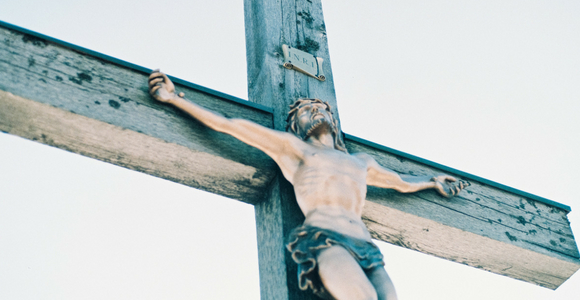
Picture of a cross

Photo Credit: Christoph Schmid on Unsplash


“Taking up one’s cross should not be interpreted as acceptance of pain, misery, and abuse, but rather as the call to stand up, resist, and refuse to let go of life, justice, and the hope that another world is possible—even in a status quo that threatens you for doing so if you do.”


 “And lead us not into temptation [time of trial], but deliver [liberate] us from evil.” (Matthew 6:13)

Last week we considered how Jesus’ nonviolence was not represented by the cross but by his Temple protest: nonviolence is another form of resistance. 

This week I want to build on that idea of nonviolent resistance and discuss what womanist and feminist scholars describe as the myth of redemptive suffering. I am deeply indebted to Joanne Carlson Brown, Rebecca Parker, and Delores Williams for helping me see the idea of redemptive suffering in a new, and what I believe is more just and healthier, and accurate light. 

Let’s begin with Jesus, who challenged his own followers to take up their crosses and follow him. 

“Then he called the crowd to him along with his disciples and said: ‘Whoever wants to be my disciple must deny themselves and take up their cross and follow me.’” (Mark 8:34)

What does it mean to take up one’s cross? 

This passage, without a doubt, has been used to encourage those who suffer abuse and/or injustice to simply remain passive hoping that their suffering will convert their abuser or oppressor. I want to argue that this is a gross misinterpretation. (This is a position I have changed on thanks to womanist scholars speaking out.) Understanding this passage within its socio-political context actually reveals that Jesus was calling his followers to join the crucified community of resisters in their culture. Jesus was not asking them to simply bear with the injustice, abuse, and exploitation that was rife in their time. Crucifixion was the way in which the status quo made an example of those who fought back against injustice and sent a message to others that the same would happen to them if any of them also resisted.

As I shared two weeks ago from the Rev. Dr. Kelly Brown Douglas, “In Jesus’ first-century world, crucifixion was the brutal tool of social-political power. It was reserved for slaves, enemy soldiers, and those held in the highest contempt and lowest regard in society. To be crucified was, for the most part, an indication of how worthless and devalued an individual was in the eyes of established power. At the same time, it indicated how much of a threat that person was believed to pose. Crucifixion was reserved for those who threatened the “peace” of the day. It was a torturous death that was also meant to send a message: disrupt the Roman order in any way, this too will happen to you. As there is a lynched class of people, there was, without doubt, a crucified class of people. The crucified class in the first-century Roman world was the same as the lynched class today. It consisted of those who were castigated and demonized as well as those who defied the status quo. Crucifixion was a stand-your-ground type of punishment for the treasonous offense of violating the rule of Roman “law and order.” (Stand Your Ground: Black Bodies and the Justice of God, p. 171)

In Mark, Jesus was challenging his followers to follow his own example and stand up, resist, protest, just like he was about to do in the courtyard of his own Temple. He was challenging them to resist even in the face of being threatened with a cross. 

This is important. Jesus was not calling his followers to suffer, but to stand up to unjust suffering, oppression, and exploitation. Joanne Carlson Brown and Rebecca Parker rightly remind us, “It is not acceptance of suffering that gives life; it is commitment to life that gives life. The question, moreover, is not, Am I willing to suffer? but Do I desire fully to live? This distinction is subtle and, to some, specious, but in the end it makes a great difference in how people interpret and respond to suffering. If you believe that acceptance of suffering gives life, then your resources for confronting perpetrators of violence and abuse will be numbed” (For God So Loved The World?, Christianity, Patriarchy, and Abuse, pp. 1-30).

Circles that teach nonviolence sometimes also teach that if we passively endure suffering, then we will win in the end. With all of the enormous good Dr. Martin Luther King, Jr. accomplished, he also allowed his teaching of nonviolence to drift into the territory of teaching redemptive suffering. 

Dr. King saw suffering as “a most creative and powerful social force…. The non-violent say that suffering becomes a powerful social force when you willingly accept that violence on yourself, so that self-suffering stands at the center of the non-violent movement and the individuals involved are able to suffer in a creative manner, feeling that unearned suffering is redemptive, and that suffering may serve to transform the social situation.” (Martin Luther King, Jr., quoted in Brown and Parker, p. 20)

Delores Williams, Joanne Carlson Brown, and Rebecca Parker all respond to King’s teachings on passive endurance of suffering, stating that the problem “is that it asks people to suffer for the sake of helping evildoers see their evil ways. It puts concern for the evildoers ahead of concern for the victim of evil. It makes victims the servants of the evildoers’ salvation.” (Brown and Parker, p. 20; see also Delores S. Williams, Sisters in the Wilderness: The Challenge of Womanist God-Talk; p. 161)

And in the foreword of Sisters in the Wilderness, Katie Cannon sternly writes, “Theologians need to think seriously about the real-life consequences of redemptive suffering, God-talk that equates the acceptance of pain, misery, and abuse as the way for true believers to live as authentic Christian disciples. Those who spew such false teaching and warped preaching must cease and desist.”

Taking up one’s cross should not be interpreted as acceptance of pain, misery, and abuse, but rather as the call to stand up, resist, and refuse to let go of life, justice, and the hope that another world is possible—even in a status quo that threatens you for doing so if you do.

Let’s plug this understanding back into our passage in Mark and see if it works. 

Mark 8:34-38: “Then he called the crowd to him along with his disciples and said: ‘Whoever wants to be my disciple must deny themselves and take up their cross [be willing to resist even if you are being threatened with a cross] and follow me. 

‘For whoever wants to save their life [by remaining quiet, passive, keeping their head down] will lose it, but whoever loses their life [being willing to stand up against injustice even if there are consequences for doing so] for me and for the gospel will save it.

‘What good is it for someone to gain the whole world, yet forfeit their soul? Or what can anyone give in exchange for their soul? 

‘If anyone is ashamed of me and my words in this adulterous and sinful generation, the Son of Man will be ashamed of them when he comes in his Father’s glory with the holy angels.’”

One phrase kicks me in my gut every time I read it:

“What good is it for someone to gain the whole world, yet forfeit their soul?”

As a person of immense privilege in this culture, this question hits home. What does it profit me if I gain the whole world by looking the other way if in so doing I lose my humanity? If I “forfeit my soul,” I, too, become a kind of “dehumanized” being as I go along with the dehumanization of the vulnerable among us. 

The Jesus story includes a Roman cross, and we cannot ignore it. That is one of the few historically provable elements of the story: Jesus was executed on a Roman cross. But we must also be careful not to glorify the cross. As Kelly Brown Douglas argues: 

“The cross reflects the lengths that unscrupulous power will go to sustain itself. It is power’s last stand. It is the ‘extinction‘ side of the Manifest Destiny ultimatum: be assimilated or become extinct. The cross reflects power’s refusal to give up its grip on the lives of others. It is the refusal of power to retreat. Essentially, the cross represents the height of humanity’s inhumanity. It shows the extent to which humans defile and disrespect other human bodies. It represents an absolute disregard for life. It reveals “human beings’… extraordinary capacity for evil” (Stand Your Ground; Black Bodies and the Justice of God, p. 177). 

The cross reveals the violence inherent in the system. And yet, the focus need not be on the fact that Jesus was executed. It should be on the fact that he resisted in the face of a threatened empire that dealt him execution on the cross. The teachings of this Jesus call us to resist in the face of threats too. 

Speaking of what this means specifically for Black women, Delores Williams hits the nail on the head: “Jesus came for life, to show humans a perfect vision of ministerial relation that humans had very little knowledge of. As Christians, black women cannot forget the cross, but neither can they glorify it. To do so is to glorify suffering and to render their exploitation sacred. To do so is to glorify the sin of defilement” (Sisters in the Wilderness: The Challenge of Womanist God-Talk, p. 132).

So what do we do with our featured text this week? Jesus’ model prayer states, “Lead us not into temptation [time of trial], but deliver [liberate] us from evil” (Matthew 6:13)

What is Jesus talking about here? Matthew’s gospel uses the same phrase: “Stay awake and pray that you may not come into the time of trial; the spirit indeed is willing, but the flesh is weak.” (Matthew 26:41, NRSV)

What is the time of trial or temptation? I believe that for the disciples it was to run away the night of Jesus’ arrest, to abandon him, and, when threatened with a cross, to hide. The temptation the disciples faced was to remain passive when threatened with a cross as opposed to standing up and joining the ranks of the crucified community. 

To be sure, there was at least one who did choose to resist, but please notice the form his resistance took:

“With that, one of Jesus’ companions reached for his sword, drew it out and struck the servant of the high priest, cutting off his ear. ‘Put your sword back in its place,’ Jesus said to him, ‘for all who draw the sword will die by the sword.’” (Matthew 26:51-52) 

In Luke’s version, Jesus had told them just moments earlier to buy swords (see Luke 22:35-38). Yet here Jesus rebukes Peter for thinking they were to be used for violence. 

“When Jesus’ followers saw what was going to happen, they said, ‘Lord, should we strike with our swords?’ And one of them struck the servant of the high priest, cutting off his right ear. But Jesus answered, ‘No more of this!’” (Luke 22:49-52)

Jesus taught resistance, but it was nonviolent resistance. It was not a path of self-sacrifice for those whose self was already being sacrificed in their society. It was a means to stand up and claim their sacred dignity. Jesus’ nonviolence was not only non-cooperative and disruptive, but also self affirming. 

Both Peter and his fellow disciples failed their temptations that night in the story. Peter gave into the temptation to rely on violence. The rest gave into the temptation to passively run away. Jesus chose a different path: he refused to let go of life, even when threatened with death. He chose to keep gripping the hope of liberation for all. 

“And lead us not into temptation [time of trial], but deliver [liberate] us from evil.” (Matthew 6:13)

HeartGroup Application

1. This week, I want to assign some homework for your group. I’d like you to listen to the series on our website, Nonviolence and the Cross.

2. Discuss with your group three things you take away from the series that are meaningful to you. 

3. What difference does it make to see Jesus’ teachings as salvific rather than just his death? Could this change the way you define salvation? What relevance to liberation here and now do you find in this way of viewing Jesus’ life? Discuss with your group.

4. Also I want to ask you to keep calling your representatives and voicing your objection to the atrocities that are happening on our southern border here in the U.S. related to immigration and those seeking refugee status from the atrocities they face in the areas they are fleeing from.  What is being touted as a solution to separating families of asylum seekers now leads to another grave injustice of imprisoning children.  Keep speaking out.

I’m so glad you checked in with us this week. Wherever you are presently, choose love, survival, resistance, liberation, reparation, and transformation. 

Another world is possible. 

I love each of you dearly.

I’ll see you next week. 


To support these podcasts, weekly eSight articles and to help us grow, go to www.renewedheartministries.com and click “donate.”

Self Affirming Nonviolence and the Myth of Redemptive Suffering (Part 1)

by Herb Montgomery | June 16, 2018

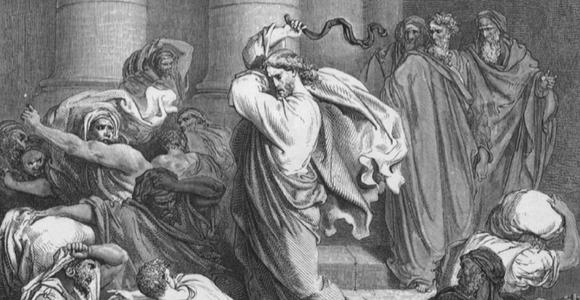
Jesus Cleanses the Temple by Gustave Dore (1832-1883)

Artwork: Jesus Cleanses the Temple by Gustave Dore (1832-1883)


“In its own cultural setting, Jesus’ nonviolence was a means of self-affirmation for those who don’t have access to common power, and it is best illustrated not by the cross but by his temple protest. Linking Jesus’ nonviolence to the cross instead is a way to promote the historical myth of redemptive suffering.”


“And lead us not into temptation [time of trial], but deliver [liberate] us from evil.” —Matthew 6:13

I want to talk about Jesus’ teachings on nonviolence this week. I have some concerns about them. I’m concerned about how those who benefit from the violence of the status quo continually co-opt nonviolence to condemn those who rise up against injustice while leaving their own use of violence on the vulnerable unaddressed and untouched. I’m also concerned about how some use Jesus’ nonviolence to promote self-sacrifice for those whose self is already being sacrificed. In its own cultural setting, Jesus’ nonviolence was a means of self-affirmation for those who don’t have access to common power, and it is best illustrated not by the cross but by his temple protest. Linking Jesus’ nonviolence to the cross instead is a way to promote the historical myth of redemptive suffering. It centers victimizers at the expense of survivors and victims. 

I want to unpack some of these ideas over the next two weeks and see if we can understand Jesus’ teachings on nonviolence in a healthier, more life-giving and socially transformative way. First let’s talk about the historical backdrop upon which Jesus took up the methods of nonviolence. We are all shaped by the times in which we live. 

Jesus grew up in the wake of the Judas Rebellion, which razed the near-to-Nazareth city of Sepphoris and led to the crucifixion of some 2,000 Jewish people outside Jerusalem. This rebellion and Rome’s violent crushing of it took place in 4 BCE (see Josephus; Jewish Antiquities 17.295) Jesus would have witnessed the aftermath of this rebellion firsthand. 

Within Judaism at that time, there was also some understanding of forms of nonviolent resistance to Rome already being practiced by some Jewish people. In 26 CE, during the time of Jesus, Josephus tells us about a Standards (Ensigns) incident that took place in Jerusalem where Rome sought to place a Roman Standard in Jerusalem itself. Viewing the Standard as a violation of the Torah against “images” or “idols,” Jewish adherents used a form of nonviolent resistance to stop these Standards from being posted. Josephus tells us, “At this the Jews as though by agreement fell to the ground in a body and bent their necks, shouting that they were ready to be killed rather than transgress the Law.” (War 2:175-203)

After Jesus we also see both methods of resistance, violent and nonviolent, being used by the Jewish community in resistance to Rome. 

In 40 CE, Rome attempted to place a statue of Gaius Caligula in the Temple in Jerusalem itself. Again, Josephus tells us that Jewish adherents to Torah used a form of nonviolent resistance. It could be that this was the only form of resistance they had at their disposal. A group, en masse, laid down before the Roman soldiers and cried out, “On no account would we fight, but we will die sooner than violate our laws” (Antiquities 18:261-309). Philo, too, tells us of this incident: “When the Jews at large got to know of the scheme, they staged mass demonstrations of protest before Petronius, who by then was in Phoenicia with an army.” (Legatio ad Gaium)

The result was that the statue of Caligula was not placed. 

Next came the Jewish-Roman War of CE 66-69, which began as a poor people’s revolt and climaxed in 70 CE with the Roman razing of Jerusalem. The Bar Kokhba revolt. which followed, is often referred to as the Third Jewish Revolt between 132-136 CE. As a result of this violent revolt, 580,000 Jews perished and many more died of hunger and disease. Rome sold many survivors into slavery. The Jewish communities of Judea were devastated to the point of genocide.

Jewish violent revolt against Rome seemed to result only in greater devastation, while nonviolent resistance gained short term and partial results. And although Jesus would only have personally witnessed some of this history, it would have been enough to have led him to the conclusion that if liberation were possible, it had the best chances with nonviolence. Rooted in liberation of the oppressed (see Luke 4:18) and a compassionate desire for those being dehumanized to stand in the power of their YHWH-given dignity and worth, Jesus emerged and began to teach: 

“You have heard that it was said, ‘Eye for eye, and tooth for tooth.’ But I tell you, do not resist an evil person. If anyone slaps you on the right cheek, turn to them the other cheek also. And if anyone wants to sue you and take your shirt, hand over your coat as well. If anyone forces you to go one mile, go with them two miles.” (Matthew 5:38-44)

RHM has several resources on how to understand these words in their own cultural setting according to the research of Walter Wink and scholars like him. Far from teaching passivity, or simply being a door mat, these words teach a type of cheek resistance. They teach a way to shame one’s oppressor and exploitative, unjust, and cruel economic structures. They also teach refusing to play by oppressors’ rules and putting power back in the hands of oppressed people. 

If this interpretation is new to you, read this eSight. This month’s featured presentation also includes relevant details. 

Jesus’ teachings on nonviolence are modeled in his Temple protest. Too often, his nonviolence is, what I believe, wrongly thought to be modeled on the cross. This leads to two mistakes.

The first mistake is that if we use the cross to understand Jesus’ nonviolence, it almost every time leads to defining nonviolence as a passive response to persecution or injustice. But the cross did not demonstrate Jesus’ passivity. The crucifixion happened because those who were protecting the status quo were rightly feeling threatened by Jesus nonviolent resistance toward the Temple state. 

The second mistake, which we’ll cover in detail next week, is that we begin to believe the myth that passive suffering is redemptive. Jesus was teaching a nonviolent form of civil disobedience, direct action and/or resistance. One of my favorite passages in Mark hint at why we should interpret Jesus’ overturning of the Temple tables as a protest against the economic exploitation of the poor:

“Jesus entered Jerusalem and went into the temple courts. He looked around at everything, but since it was already late, he went out to Bethany with the Twelve.” (Mark 11:11) 

What we today call Jesus’ “triumphal entry” was originally supposed to have ended with Jesus entering the Temple that Sunday night, dismounting the donkey, and overturning the tables immediately in protest. He was entering the heart of the Temple state to shut it down, to prevent business as usual. 

Instead, he entered, looks around, and “since it was already late”— most people were not present and not much was going on in the temple to shut down—he returned to his friends’ home in Bethany with his twelve disciples and went back to the Temple the following morning when economic exploitation was in full swing. 

This was not a passive plan. Those who respond with passivity to injustice don’t get crucified!

“And he [Jesus] has been acclaimed in the West as the prince of passive resisters. I showed years ago in South Africa that the adjective ‘passive’ was a misnomer, at least as applied to Jesus. He was the most active resister known perhaps to history. His was non-violence par excellence.” (Gandhi, Non Violence in Peace and War, Volume I, p. 16

The Jesus we see in the story didn’t teach “peace-keeping” through nonviolent passivity. He taught peace-making through the nonviolent establishment of distributive justice. (See The Lord’s Prayer.) Peace-making is never accomplished through peace-keeping iin an unjust status quo. 

“Do not suppose that I have come to bring peace to the earth. I did not come to bring peace, but a sword.” (Matthew 10:34)

Jesus’ followers were continually labeled troublemakers, and disturbers of the peace.

“These men who have caused trouble all over the world have now come here, and Jason has welcomed them into his house. They are all defying Caesar’s decrees, saying that there is another king, one called Jesus.” (Acts 17:6-7)

Dr. Martin Luther King, Jr. rightly stated, “Whenever the early Christians entered a town, the people in power became disturbed and immediately sought to convict the Christians for being “disturbers of the peace” and “outside agitators” (Letter from Birmingham Jail).

Gandhi again reminds us:

“[Nonviolence] does not mean meek submission to the will of the evil-doer, but it means the pitting of one’s whole soul against the will of the tyrant. Working under this law of our being, it is possible for a single individual to defy the whole might of an unjust empire to save his honour, his religion, his soul and lay the foundation for that empire’s fall or its regeneration.” (Mohandas Gandhi, Young India; January 8, 1920, p.3) 

The value of nonviolent forms of resistance is that they enable those who practice them to not become like their oppressors. In other words, nonviolence can provide a path for oppressed people to not dehumanize oppressors the way oppressors have dehumanized them. Understood as a form of resistance, nonviolence enables us to resist, to stop injustice, while simultaneously maintaining our connectedness to the humanity of those who oppress. As I have often said, I know of no better statement that captures this balance than the “two hands” metaphor used by Barbara Deming in the book Revolution ad Equilibrium: 

“With one hand we say to one who is angry, or to an oppressor, or to an unjust system, ‘Stop what you are doing. I refuse to honor the role you are choosing to play. I refuse to obey you. I refuse to cooperate with your demands. I refuse to build the walls and the bombs. I refuse to pay for the guns. With this hand I will even interfere with the wrong you are doing. I want to disrupt the easy pattern of your life.’ But then the advocate of nonviolence raises the other hand. It is raised out- stretched – maybe with love and sympathy, maybe not – but always outstretched . . . With this hand we say, ‘I won’t let go of you or cast you out of the human race. I have faith that you can make a better choice than you are making now, and I’ll be here when you are ready. Like it or not, we are part of one another.’” (p. 69)

When understood as resistance, nonviolence must not be used keep people facing oppression and exploitation in a state of passivity. Nonviolence is not a critique of resisters as much as it is a protest first and foremost of the violence that produces the need for resistance.

“First, Jesus’ practice and teaching demand absolutely the unmasking of and a resolute struggle against the form of violence that is the worst and most generative of others because it is the most inhuman and the historical principle at the origin of all dehumanization: structural injustice in the form of institutionalized violence. It follows that we have to unmask the frequent attitude of being scandalized at revolutionary violence and the victims it produces without having been scandalized first and more deeply at its causes.” (Jon Sobrino, Jesus the Liberator, p. 215)

Lastly, when nonviolence becomes synonymous with passivity, or, as we’ll see next week, self-sacrifice rather than resistance, the only other pathway that could lead toward change in response to injustice is violence.

“I think America must see that riots do not develop out of thin air. Certain conditions continue to exist in our society which must be condemned as vigorously as we condemn riots. But in the final analysis, a riot is the language of the unheard . . . in a real sense our nation’s summers of riots are caused by our nation’s winters of delay. And as long as America postpones justice, we stand in the position of having these recurrences of violence and riots over and over again. Social justice and progress are the absolute guarantors of riot prevention.” (Dr. Martin Luther King, Jr.; 1968; “The Other America”)

“Those who make peaceful revolution impossible will make violent revolution inevitable.” (John F. Kennedy; Remarks on the first anniversary of the Alliance for Progress, 13 March 1962)

As we move into part 2 of this article, let’s consider ways we might practice the value that is at the heart Jesus’ teachings on nonviolence—resistance.

And lead us not into temptation [time of trial], but deliver [liberate] us from evil. (Matthew 6:13)

HeartGroup Application

Resistance can come in many forms. Yes, there is public, in the streets activism, that should be done. There are other forms of resistance as well. Kneeling at football games is a nonviolent form of resistance for athletes. I know professors who intentionally teach specific methods and content as an expression of resistance. Some people tell stories, some write, some sing, some do theater, some produce films. Some organize educational events, others wash dishes or make sandwiches, have their own garden, and lend help and support anywhere they can. Resistance can begin in a coffee shop or within conversations merely with family and friends. 

As Bayard Rustin said, “We need, in every community, a group of angelic troublemakers.”

  1. What are some of the ways you resist systemic injustice in your day-to-day life? List them.
  2. What are some of the ways your HeartGroup as a community resists? List them.
  3. Lean into these lists and a living practice of resistance this week. Don’t allow the machine to drive you endlessly through the rat race of the status quo. Resist!

Thank you for checking in with us this week.

Wherever this finds you, keep living in love, survival, resistance, liberation, reparation, and transformation. 

Another world is possible. 

I love each of you dearly. 

I’ll see you next week with part 2.


To support these podcasts, weekly eSight articles and to help us grow, go to www.renewedheartministries.com and click “donate.”

It’s Easier to Build a Religion than to Build a Better World.

by Herb Montgomery | April 20, 2018

Picture of Cathedral

Photo by Alexander Watts on Unsplash


“Yet, it is far easier for those with power and privilege to merely worship Jesus, to preach a gospel about Jesus, and build a religion around Jesus, than it is for them to hear the gospel to the marginalized and pushed down that Jesus taught and build a better world now.” 


“Why do you call me, ‘Lord, Lord,’ and do not do what I say?” (Luke 6:46)

On April 4, many people around the world observed the 50-year anniversary of the assassination of Dr. Martin Luther King, Jr. One poem that I return to each year on both April 4 and January 21 (MLK Day) is Carl Wendell Hines, Jr.’s poem “A dead man’s dream.” It’s quoted in full by Vincent Harding in Martin Luther King: An Inconvenient Hero:

“A dead man’s dream”

by Carl Wendell Hines Jr.

“Now that he is safely dead, 
Let us praise him.
Build monuments to his glory.
Sing Hosannas to his name.
Dead men make such convenient heroes.
For they cannot rise to challenge the images 
That we might fashion from their lives.
It is easier to build monuments 
Than to build a better world.
So now that he is safely dead, 
We, with eased consciences will 
Teach our children that he was a great man,
Knowing that the cause for which he 
Lived is still a cause
And the dream for which he died is still a dream.
A dead man’s dream.”

(Carl Wendell Himes, Jr., “Now That He Is Safely Dead,” in Drum Major for a Dream, p. 23.; quoted by Vincent Harding, Martin Luther King: The Inconvenient Hero , rev. ed., Kindle Edition Locations 2430-2431)

Why do we turn those who threatened their social order into revered or even worshipped heroes after they’ve died? Why do so many of us praise these controversial figures from our history rather than following them? Today those in power ignore King’s radicalness, especially from 1965 to 1968, and his ideas during those years are still not taught to new generations. Yet King is lifted up by those in power as an American hero. If the King of 1968 were still alive today, he would be one of the loudest critiques of America’s capitalism, continued racism, and militarism (both domestic and foreign). The line in Hines’ poem that jumps out at me each time I read it is “it is easier to build monuments than to build a better world.”

The pattern of turning into heroes those who once spoke unpopular truth to power is part of the Jesus story as well. In both Matthew’s and Luke’s version of the story, those in power who were threatened by Jesus’ gospel to the poor and marginalized, built monuments to the prophets of old even though their actions repeated the very history that killed the prophets who critiqued those in power within their own society to an early death.

“Woe to you, teachers of the law and Pharisees, you hypocrites! You build tombs for the prophets and decorate the graves of the righteous. And you say, ‘If we had lived in the days of our ancestors, we would not have taken part with them in shedding the blood of the prophets.’ So you testify against yourselves that you are the descendants of those who murdered the prophets.” (Matthew 23:29-31)

“Woe to you, because you build tombs for the prophets, and it was your ancestors who killed them. So you testify that you approve of what your ancestors did; they killed the prophets, and you build their tombs.” (Luke 11:47-48)

In this week’s featured text above, the question is asked, “Why do you call me Lord (worship or revere me) and not do what I say?” This could be said about those who have revered the Hebrew prophets, Dr. King, Jesus, and many more in history, but not followed their teaching.

Consider just three areas of Dr. King’s teachings that are not ignored but profoundly contradicted by those in power today who publicly revere his memory.

King’s Anti Capitalism

“Call it democracy, or call it democratic socialism, but there must be a better distribution of wealth within this country for all God’s children.” (Speech to the Negro American Labor Council, 1961)

“We must recognize that we can’t solve our problem now until there is a radical redistribution of economic and political power… this means a revolution of values and other things. We must see now that the evils of racism, economic exploitation and militarism are all tied together… you can’t really get rid of one without getting rid of the others… the whole structure of American life must be changed. America is a hypocritical nation and [we] must put [our] own house in order.” (Report to SCLC staff, May 1967)

“The evils of capitalism are as real as the evils of militarism and evils of racism.” (Speech to SCLC Board, March 30, 1967)

When King was saying these things he wasn’t labelled as an American hero to be celebrated with an American federal holiday. King was labelled as the greatest threat to America. One of many reasons being King’s critique of the U.S. economic order that makes a few in our society inconceivably wealthy while forcing others into poverty. The head of the F.BI.’s domestic intelligence division, J. Edgar Hoover, labelled King “We must mark him now, if we have not done so before, as the most dangerous Negro of the future in this Nation from the standpoint of communism, the Negro and national security.” (Aug. 30, 1963, post-speech memo: “Communist Party, USA, Negro Question.”)

King’s Anti Militarism

Again In the book, Martin Luther King: The Inconvenient Hero, Vincent Harding writes about how Martin Luther King, Jr. Day originally included the pomp of the very military King decried and was instituted by the very government whose global policies he denounced. 

“Now that King seems safely dead, now that he has been properly installed in the national pantheon—to the accompaniment of military bands, with the U.S. Marine Corps chorus singing ‘We Shall Overcome,’ and the cadenced marching of the armed forces color guards— we think we know the man’s impact and influence. Didn’t President Reagan sign a bill authorizing a national holiday honoring this teacher of nonviolence (shortly after the president had sent the comrades of the singers and musicians to carry out an armed attack on Grenada, one of the smallest countries in the world)? And didn’t Vice-President Bush go to Atlanta to help inaugurate the King national holiday in January 1986 (presumably taking time off from his general oversight of the murderous Nicaraguan counterrevolutionary forces who were being brutally manipulated in this government’s cynical attempt to destroy what was one of the most hopeful revolutions for the poor in the Americas)? [Harding, Vincent. Martin Luther King: The Inconvenient Hero, rev. ed. (Kindle Edition Locations 1271-1278).

King’s Anti-Racism

The actions of the current US administration have given rise to hate speech and the expression of a myriad of violent phobias. Dog whistles have caused those like David Duke to see in the administration a champion for making America White again, and those in the administration have repeated and publicly condemned those who walk in the path of King’s legacy (Colin Kaepernick is just one example) and protest modern expressions of the very same injustices King protested. 

Yet on the fiftieth anniversary of King’s assassination, both the American President and the Vice President tweeted:

“Today we honor Dr. Martin Luther King, Jr. on the 50th anniversary of his assassination. Earlier this year I spoke about Dr. King’s legacy of justice and peace, and his impact on uniting Americans. #MLK50 Proclamation: 45.wh.gov/DrKing50th” —President Donald Trump (@realDonaldTrump) April 4, 2018

“50 years ago today, Dr. King’s life was tragically cut short – but that did not stop his immortal words, his courageous example and his faith from inspiring generations of Americans. Today we honor the man and the Dream. #MLK50” — Vice President Mike Pence (@VP) April 4, 2018

(An article worth reading on this is Dave Zirin’s article, “Donald Trump and Mike Pence Have No Business Speaking About Martin Luther King Jr.”)

In this context, read again Jesus’ words in Matthew:

“Woe to you, teachers of the law and Pharisees, you hypocrites! You build tombs for the prophets and decorate the graves of the righteous. And you say, ‘If we had lived in the days of our ancestors, we would not have taken part with them in shedding the blood of the prophets.’ So you testify against yourselves that you are the descendants of those who murdered the prophets.” (Matthew 23:29-31)

Jesus

This brings me to another thought this year that weighs heavily on me: We have done a very similar thing to the historical Jesus that we have done with Dr. King. Today we could, in Hines’ fashion, say about Jesus and the religion that has been created around him, “It is easier to build a world religion than to build a better world.”

Recently I sat in my local town hall and listened to a panel of young people including my daughter representing our local March For Our Lives campaign. These young people posed questions to those who are currently running for political election in our May 8 primary. 

One of the candidates had me on the floor. In a pious yet uninformed spirit, this candidate said that the problem in our societies is not that we need more laws but that we need a “return to God.” They said they were a “Christian” and that they felt the way to solve’ our social challenges was for “our society to return to the path” of Jesus—by implication the way or teachings of Jesus.

While I agree that Jesus’ teachings of liberation from systemic oppression, and survival, resistance, reparation, and transformation can still speak to society’s challenges, I was concerned about the contradiction between the candidate’s statement and everything else they stated. If I had to choose between someone who religiously worshiped Jesus as they passed through this world on their way to “heaven” and a secular candidate, atheist or agnostic like Kurt Vonnegut, for example, who was genuinely aligned with Jesus’ actual ethics and teachings and wrestling with how to apply them to our life with the marginalized and oppressed, I’d have to pick the latter. There are many sectors of the Christian religion that deeply contradict Jesus’ actual teachings. Consider just the following passages from the early church.

Anti Capitalism

“Sell your possessions and give to the poor. Provide purses for yourselves that will not wear out, a treasure in heaven that will never fail, where no thief comes near and no moth destroys.” (Luke 12:33)

“The disciples, as each one was able, decided to provide help for the brothers and sisters living in Judea.” (Acts 11:29, emphasis added)

“They sold property and possessions to give to anyone who had need.” (Acts 2:45, emphasis added)

“And put it at the apostles’ feet, and it was distributed to anyone who had need.” (Acts 4:35, emphasis added)

“That there were no needy persons among them. For from time to time those who owned land or houses sold them, brought the money from the sales.” (Acts 4:34)

Nonviolence, Mutual Aid and Enemy Love

“Put your sword back in its place,” Jesus said to him, “for all who draw the sword will die by the sword.” (Matthew 26:52)

“You have heard that it was said, ‘Eye for eye, and tooth for tooth.’ But I tell you, do not resist an evil person. If anyone slaps you on the right cheek, turn to them the other cheek also. And if anyone wants to sue you and take your shirt, hand over your coat as well. If anyone forces you to go one mile, go with them two miles. Give to the one who asks you, and do not turn away from the one who wants to borrow from you. “You have heard that it was said, ‘Love your neighbor and hate your enemy.’ But I tell you, love your enemies and pray for those who persecute you, that you may be children of your Father in heaven. He causes his sun to rise on the evil and the good, and sends rain on the righteous and the unrighteous. If you love those who love you, what reward will you get? Are not even the tax collectors doing that? And if you greet only your own people, what are you doing more than others? Do not even gentiles do that?” (Matthew 5:38-48)

Solidarity with the Societally Marginalized

“But the Pharisees and the teachers of the law who belonged to their sect complained to his disciples, ‘Why do you eat and drink with tax collectors and sinners?’” (Luke 5:30)

 “But go and learn what this means: ‘I desire mercy, not sacrifice.’ For I have not come to call the righteous, but sinners.” (Matthew 9:13)

Conclusion

Some who called Jesus “Lord” did also embrace his teachings. And there are some today who embrace him, too. The story of Zacchaeus represents them:

“But Zacchaeus stood up and said to the Lord, ‘Look, Lord! Here and now I give half of my possessions to the poor, and if I have cheated anybody out of anything, I will pay back four times the amount.’” (Luke 19:8)

Yet, it is far easier for those with power and privilege to merely worship Jesus, to preach a gospel about Jesus, and build a religion around Jesus, than it is for them to hear the gospel to the marginalized and pushed down that Jesus taught and build a better world now.

Both King and Jesus were radicals and both have been moderated or muted since their deaths.

Both leave us with the call to engage, apply, and live out their teachings—to “follow” them—not simply build monuments to them.

“Not everyone who says to me, ‘Lord, Lord,’ will enter the kingdom of heaven . . . Many will say to me on that day, ‘Lord, Lord, did we not prophesy in your name and in your name drive out demons and in your name perform many miracles?’ Then I will tell them plainly, ‘I never knew you. Away from me, you evildoers!’” (Matthew 7:21-23)

HeartGroups Application 

1. Which teachings of Jesus’ do you find challenging, if any?

2. Which teachings of Jesus do you think challenge the pursut of justice today, and which teachings do you see as supporting our justice work today?

3. Discuss your answers with your HeartGroup this upcoming week. How can your group more deeply engage the teachings found in the Jesus story as we make our world a safer, just, more compassionate world for everyone?

Thanks for checking in with us this week.

Wherever you are, keep living in love, in resistance, survival, liberation, reparation, and transformation.

I love each of you dearly.

Another world is possible.

I’ll see you next week.


To support these weekly podcasts and eSights and help us grow, go to renewedheartministries.com and click “Donate”!

A Preferential Option for the Vulnerable

by Herb Montgomery | March 30, 2018

City at night behind a fence

Photo by Zac Ong on Unsplash


“To have a preference is to have a greater liking for one alternative over another or others. This is not exclusive, but rather points to who should first have our solidarity.”


Jesus looked at him and loved him. “One thing you lack,” he said. “Go, sell everything you have and give to the poor, and you will have treasure in heaven. Then come, follow me.” (Mark 10:21)

This week I want to discuss what liberation theologians such as Gustav Gutierrez call Jesus’ “preferential option for the poor.” Let’s consider a broader preferential option that includes all who are vulnerable: people who are vulnerable economically and also people vulnerable because of their race, gender, orientation, ability, age, gender identity and expression, their level of education, or any other basis for oppression.

I remember standing on the lawn of Baltimore’s city hall with my daughter when she was in sixth grade, the weekend after Baltimore police murdered Freddie Grey. She stood holding a sign she had made while I looked up at snipers who lined the upper ledges of the building surrounding that lawn.

As we lined to the speakers addressing the crowd, I saw that much of what was being said was not registering with her, but for me it was resonating deeply. With the clarity that only comes from experiencing oppression for oneself, speakers repeatedly drew the connection between economic and racial oppression in the U.S. and around the globe. It’s not enough to solve poverty for some people and exclude others from that solution, especially if your economic solutions exclude some based on their race or ethnicity. We can’t afford to solve economic exploitation for some if those solutions come at the price of exploitating others whom we deem as different. It’s also not enough to simply teach a preferential option for some who are poor. We must enlarge our preferential option to include all who are targeted and made vulnerable by the status quo.

But before we do that, let’s unpack what is meant by this phrase preferential option for the poor.

The Poor 

Although there are many different types of poverty, the “poor” in this phrase first addresses people who experience material poverty. We must be careful not to romanticize the reality of poverty. For most of those who are materially poor around the world, poverty means death. As Gustav Gutiérrez says, “It is death, death before one’s time.” For theists who believe in a God who is life, or the giver of life, this death, and thus this poverty, is contrary to a God who is life.

Material poverty can take different forms and result from many different causes. At its core, though, material poverty is an expression of marginalization. Many people view those who are materially poor as insignificant, objectify them, and consider them non-persons. This marginalization calls us to consider the connection between marginalization based on poverty and other forms of marginalization such as those based on gender, race, sexual identity/orientation, etc. Addressing the complex nature of poverty can include charity for  mitigating harm while we work toward a just society, but it is vital that we don’t stop at charity and think our work is done. We must also identify and resist the structures that create poverty, and we need philosophical, social, and scientific tools to analyze what makes people poor systemically and institutionally.

Option 

The word “option” in our phrase does not mean that it is optional, something we could do without. It implies that we can make an intentional choice from a range of possibilities. It means making a commitment to stand in solidarity with and work alongside the poor. This does not mean we become the “savior” of the poor or do-gooders. The “option” is to recognize that we reclaim our own humanity as others reclaim theirs, and we begin to see our connectedness. We live into that connection. We begin to see, love, and engage others as ourselves.

Preferential

To have a preference is to have a greater liking for one alternative over another or others. This is not exclusive, but rather points to who should first have our solidarity. Jesus taught this with this famous phrase, “Last shall be first. And the first shall be last.” (Matthew 20:16) He demonstrated this in his favor toward poor, hungry, weeping, and hated people in Luke’s sermon on the plain and the woes he proclaimed against their exploiters. Think of imbalanced scales. To rectify an imbalance one has to apply greater weight to the side that’s up in the air to bring the scales back to center. Jesus’ enemies also repeatedly critiqued his table fellowship with those who were socially marginalized. Jesus modeled a bias or preference that chose the side of the poor.

Let’s look at several examples in Mark and Luke.

In Mark, Jesus also calls the wealthy to follow him in his preferential option for the poor:

Jesus looked at him and loved him. “One thing you lack,” he said. “Go, sell everything you have and give to the poor, and you will have treasure in heaven. Then come, follow me.” (Mark 10:21; cf. Matthew 19:21, Luke 18:22)

Jesus took the side of a poor widow over even the central structure of his society’s political and ideological life—the Temple:

But a poor widow came and put in two very small copper coins, worth only a few cents. Calling his disciples to him, Jesus said, “Truly I tell you, this poor widow has put more into the treasury than all the others. (Mark 12:42-43; cf. Luke 21:2-3)

As Ched Myers explains, this widow was being “impoverished by her obligations to the temple cultus . . . The temple has robbed this woman of her very means of livelihood. Like the scribal class, it no longer protects widows, but exploits them” (in Binding the Strong Man, p. 321-322). Another author states, “Jesus condemns the value system that motivates her action, and he condemns the people who conditioned her to do it” (A. Wright; The Widow’s Mite: Praise or Lament? A Matter of Context, p. 262).

In Matthew, Jesus’ preferential option for the poor and vulnerable is the sign of confirmation to be shared with the imprisoned John the Baptist:

The blind receive sight, the lame walk, those who have leprosy are cleansed, the deaf hear, the dead are raised, and the good news is proclaimed to the poor. (Matthew 11:5; cf. Luke 7.22)

In Luke, it sums up Jesus’ entire ministry:

The Spirit of the Lord is on me,because he has anointed me to proclaim good news to the poor. He has sent me to proclaim freedom for the prisoners and recovery of sight for the blind, to set the oppressed free… (Luke 4:18)

Jesus calls the Pharisees to embrace this option to the degree that everything else about their morality would depend on it:

But now as for what is inside you—be generous to the poor, and everything will be clean for you. (Luke 11:41)

In Mark, this teaching is given to a single wealthy person, but in Luke, Jesus’ call to sell excess possessions and redistribute wealth to the poor is a universal teaching for all of his followers:

Sell your possessions and give to the poor. Provide purses for yourselves that will not wear out, a treasure in heaven that will never fail, where no thief comes near and no moth destroys. (Luke 12:33)

We see Jesus’ preferential option for the poor and vulnerable in his teaching and story on who is to be invited to the banquet:

But when you give a banquet, invite the poor, the crippled, the lame, the blind,…

The servant came back and reported this to his master. Then the owner of the house became angry and ordered his servant, ‘Go out quickly into the streets and alleys of the town and bring in the poor, the crippled, the blind and the lame.’ (Luke 14:13, 21)

In one of Jesus’ best known encounters, we meet a wealthy tax collector who embraces Jesus’ preferential option for the poor as his own ethic too:

But Zacchaeus stood up and said to the Lord, “Look, Lord! Here and now I give half of my possessions to the poor, and if I have cheated anybody out of anything, I will pay back four times the amount.” (Luke 19:8)

This preferential option for the poor and the vulnerable determined whom Jesus’ reign or kingdom of God belonged to:

Looking at his disciples, he said: “Blessed are you who are poor,

for yours is the kingdom of God. (Luke 6:20)

“Blessed are the poor in spirit, for theirs is the kingdom of heaven. (Matthew 5:3)

In Luke, Jesus refers to people who are materially poor, whereas in Matthew, the blessing is for the poor “in spirit.” One interpretation of this difference spiritualizes or privatizes what it means to be poor “in spirit.” It has arbitrarily been defined as an attitude of dependence or reliance on God as opposed to reliance on oneself. The fruit of this interpretation has been to divert attention away from the liberation of those who are materially poor. But Jesus isn’t holding up some spiritual poverty or dependence on God as a character quality to strive for in this passage, and that interpretation has too often been used to subvert Jesus’ call for us to stand in solidarity with materially poor people. Jesus is speaking, just like in Luke, to those the present structure has left poor in spirit. Note that Luke describes John not as poor in spirit himself, but as strong in spirit.

And the child grew and became strong in spirit; and he lived in the wilderness until he appeared publicly to Israel. (Luke 1:80, emphasis added.)

When Jesus describes those who are poor in spirit, he is describing those who are experiencing a poverty of the spirit or will to keep fighting against oppression. Their spirit has been broken. They are worn down. They have no more spirit with which to fight. Just this week, it was announced that the police who murdered Alton Sterling will not face any chargers. Repeated occurrences as this have a way of breaking ones will or spirit to keep trying. HealingJustice.org posted a quotation from @fancisca_porchas on social media this week and commented, “In the wake of no justice for #AltonSterling , this one goes out to @blklivesmatter & all allies. You don’t have to hold this political fight or all that pain alone. All of us are with you. Check on your people & show up for action this week, fam. The quotation read, “Organizers have to do so much spiritual work every day just to get up and fight the state, fight ferocious systems, and hold so much pain at scale.”  Jesus’s preferential option for the poor and vulnerable envisioned a world where the poor in spirit were given the kingdom (Matthew 5:3) This does not mean spiritually poor.

Just two verses later in Matthew 5:5, Jesus says, “Blessed are the meek, for they will inherit the earth.” In our present world structure the meek are not given the earth but rather walked on, walked over, and bullied. Jesus calls us to create another kind of world where even the meek, the most vulnerable among us, are taken care of and ensured a safe world to call their home as well. A preferential option for the meek is what Jesus means by “poor in spirit.” Today’s world belongs to those who have a fighting, competitive spirit, a drive to succeed. But some have had their spirit so broken, so pushed down, they simply don’t have any spirit left to try. Jesus calls us to a preferential option that creates a world where those who don’t have anything left to give are taken care of as well

The passage between these two texts in Matthew is the verse,  “Blessed are those who mourn for they will be comforted.” Those who mourn are those whom the present structure so disenfranchises, disinherits, and marginalizes. Despite their present heartbreak and loss, this new world will bring reparative, restorative, and transformative comfort as they gain hope that another world is possible. Lastly, in verse 6 of Matthew 5 Jesus, speaking of this same demographic states, “Blessed are those who hunger and thirst for righteousness, for they will be filled.” This word “righteousness” is not persona or private. It’s not a meritorious credit that admits them to the afterlife. The verse describes those who hunger for righteousness or justice here, now.

The Hebrew concept of righteousness included distributive justice, structural justice, systemic justice, and societal justice. Those who hunger for this world to be put right are those Jesus calls us to a preferential option for, to ensure that they will be filled!

All Who Are Vulnerable 

All those who desire to genuinely follow Jesus must create communities that center the most vulnerable people at the table. Not only are the vulnerable to be seated at the table but the table is also to practice a preferential option for them. Examples today might include those who are vulnerable on the basis of their race, identity as LGBTQ, or their gender as a woman. Applying Jesus’ preferential option for the poor and vulnerable today means prioritizing these communities.

Jesus’ table is not one where where every person’s opinion is of equal worth and we simply agree to disagree and still get along. Such a table leaves the status quo untouched, doesn’t challenge the balance of power, and still leaves these communities vulnerable. Instead, Jesus’ table is a table where there is a preference for the vulnerable. As the saying goes, “The voice of the oppressed does not always call out for what is just, but we will not arrive at justice without listening to them.” This is what it means to practice a preferential option for the vulnerable: choosing the side of the most vulnerable.

Christians are called to look at the world from the perspective of the marginalized and to work with them in solidarity for justice. Practicing the preferential option for the poor today might include advocating for LGBTQ rights; opposing racial red lining still being practiced today (red-lining stops people of color from accessing home ownership); or organizing with young people who are repeatedly victimized by gun violence.

The good news is we can do this. We can choose to create a world that practices a preferential option for the vulnerable. In Matthew’s gospel, Jesus tells the story of a man who did just this.

When he found one of great value, he went away and sold everything he had and bought it. (Matthew 13:46)

This is the same “sell everything” language as we read previously—“sell everything you have and give to the poor” (Mark 10:21). It’s about selling out and going all-in toward a vision for a different kind of world, one that practices a preferential option for people who face oppression daily. It’s also about taking action and believing that another world is possible now. The man in Jesus’ teaching sold everything he had for the kingdom. And we can, too! In the words of someone I deeply respect, “You have to act as if it were possible to radically transform the world. And you have to do it all the time.” (Angela Davis; Southern Illinois University, February 13, 2014)

“Jesus looked at him and loved him. “One thing you lack,” he said. “Go, sell everything you have and give to the poor . . . “ (Mark 10:21)

HeartGroup Application

University of Notre Dame’s Center for Social Concerns defines the preferential option for poor and vulnerable as looking “at the world from the perspective of the marginalized and [working] in solidarity for justice.”

  1. This week, take time to read their page on the preferential option for the poor and vulnerable. Engage the discussion and reflection sections.

2. Discuss as a group what a preferential option for the poor and vulnerable could look like for your HeartGroup.

3. Choose a way to put your ideas into practice.

Wherever you are this week, thank you for checking in with us.

Remember, another world is possible!

Keep living in love, survival, resistance, liberation, reparation, and transformation.

I love each of you dearly,

I’ll see you next week.


To support these weekly podcasts and eSights and help us grow, go to renewedheartministries.com and click “Donate.”

Gun Culture, School Shootings, Racial Disparity, Militarized Police and Jesus

A preferential option for two vulnerable communities in the gun control debate.

Photo credit: Bodyguard Blanket

by Herb Montgomery | March 1, 2018


There is wisdom in his words, ‘All who draw the sword will die by the sword.’ It’s as true for societies as for individuals, as well. A society that lives by the sword will die by the sword. If we don’t learn alternatives, we will, as a society, be destroyed by these guns we love so much.”


“Put your sword back in its place,” Jesus said to him, “for all who draw the sword will die by the sword.” Matthew 26:52 

Last week, as Crystal and I drove our kids and the kids we carpool with to school, these children had a conversation on the best escape routes at their schools in case a gunman showed up at their school and began firing.

Stop and let that sink in.

Instead of chatting about an upcoming test, a high school sports game, or an after-school event, they were talking about what they could do to stay alive if a shooter showed up at their school.

This is not the world I want my kids to be growing up in.

And I believe another world is possible.

Gun Culture and School Shootings

In Splendid Literarium: A Treasury of Stories, Aphorisms, Poems, and Essays, the author Aberjhani eloquently states: “Democracy is not simply a license to indulge individual whims and proclivities. It is also holding oneself accountable to some reasonable degree for the conditions of peace and chaos that impact the lives of those who inhabit one’s beloved extended community.”

The two words that jump out at me from Aberjhani’s statement are “accountable” and “reasonable.” Community involves balancing individual rights and the well being of community. The tension between these two can be challenging. Our context this week, though, is protecting the lives of our children.

I want to echo what Deshanne Stokes tweeted last June after a mass shooting in Virginia: “Violence isn’t a Democrat or Republican problem. It’s an American problem, requiring an American solution.” Violence is not a Left versus Right debate. Both sides of the aisle should be motivated to ensure no more children die.

My country, the U.S., is obsessed with guns. Many people in my own neighborhood value their individual rights to own guns over the lives of our community’s children. This is not hyberbole.

As Emma Gonzalez, Parkland High School shooting survivor, said in her now-famous speech on February 17, 2018 in Fort Lauderdale, FL:

 “I read something very powerful [today]. It was from the point of view of a teacher. And I quote: ‘When adults tell me, “I have the right to own a gun,’ all I can hear is “My right to own a gun outweighs your students’ right to live.” All I can hear is  “Mine, mine, mine, mine.”’” (Speech Transcript)

The loudest voices right now in my neighborhood promoting individual gun rights are Christians. I Two years ago I stood across the aisle from many of these people as our town debated an inclusive nondiscrimination ordinance. Then, they wore t-shirts and held signs about bathrooms and keeping children safe. So it resonated with me last week when Dana Simpson tweeted: “Hearing Republicans say that, look, massacres of kids are very sad but we just can’t limit people’s basic freedoms is weird if you’re a trans person who’s been listening to a years-long debate about whether you need to be banned from public bathrooms TO KEEP CHILDREN SAFE.”

It seems that keeping children safe is only a concern for some Christians when that serves their personal biases or prejudices. Studies debunk the bathroom myth yet mass shootings are becoming commonplace. Mass shootings now so common in schools that some entrepreneurs are seeing an opportunity to capitalize on them. According to Business Insider, you can now purchase a school nap time pad/blanket for your small child that doubles as a bullet proof shield.

Really?

Do we really value the lives of the children in our community that little? Gun regulations can operate just like speed limits, car inspections, and driver licensing. We title and tag cars at each sale and mandate universal driver education and training. My younger daughter is studying for her driving test presently. She must complete a written test and also sit behind a wheel and demonstrate her ability to drive a car safely. My other daughter has to wear her glasses when she drives. All of us must carry liability insurance, and here in West Virginia, we must have our cars inspected every year too. All of these rules exist and anyone who complies with them can still have and drive their car. Yet the rules drive home the point that when you drive a car, you share the road with everyone else, with others who would like to stay alive themselves and keep their children alive.

Gun regulations do work. Australia is a good example. More than 130 other studies offer powerful evidence that common sense gun regulations do save lives.

In Another Day in the Death of America: A Chronicle of Ten Short Lives, Gary Younge states,

“So long as you have a society with a lot of guns—and America has more guns per capita than any other county in the world—children will be at risk of being shot. The questions are how much risk, and what, if anything, is being done to minimize it? If one thinks of various ways in which commonplace items, from car seats to medicine bottle tops, have been childproofed, it’s clear that society’s general desire has been to eliminate as many potential dangers from children as possible, even when the number of those who might be harmed is relatively small. If one child’s death is preventable, then the proper question isn’t “Why should we do this” but rather “Why shouldn’t we?” It would be strange for that principle to apply to everything but guns.”

Adam Winkler argues that even the Wild West had more gun regulations than many of our states do today. “When you entered a frontier town, you were legally required to leave your guns at the stables on the outskirts of town or drop them off with the sheriff, who would give you a token in exchange. You checked your guns then like you’d check your overcoat today at a Boston restaurant in winter. Visitors were welcome, but their guns were not.” (Did the Wild West Have More Gun Control Than We Do Today? See also Ross Collins’ Gun Control and the Old West)

Racial Disparity and the Militarization of the Police

This is not just a current news topic. It’s also an area where we can apply the teachings of Jesus. A key part of living out the shared table philosophy with a preferential option for the vulnerable that Jesus’ modeled is learning to listen to other vulnerable voices around the table. Children are not the only vulnerable people involved in the gun control debate. White, straight, cisgender paranoid males raised in an environment of toxic masculinity and claiming that they’re being oppressed and their right to own assault weapons are being infringed are not vulnerable in this world.

But gun regulations have too often been used to disproportionately target communities of color. Sameer Rao cautions, “Gun control in America won’t work for all Americans unless advocates push to demilitarize police departments and advance measures that don’t disproportionately impact people of color. Gun control reform that does not go this route will end in laws that further empower police to seize weapons and use them against whomever they choose. History shows who they’ll target first.” (Gun Control Advocates Cannot Win Without Fighting Their Own Racism.)

If this history is unfamiliar to you, Creed Newton’s article on how calls for strict gun control after mass shootings overlook how regulations have been used to disarm people of color is a fantastic read and a great place to start. In this article, Newton quotes Saul Cornell of Fordham University: “Saying gun laws are always racist is just false. Saying that gun laws have never been racist is also just wrong.”

Can we protect our children from mass shootings and also not disproportionately target people of color? Can we, like other countries, demilitarize our police so that citizens and non-citizens don’t face unilateral gun regulations that would leave them even more vulnerable?

I believe “another world” here in the U.S. is possible. Like other countries, we can keep our children safe. Regulations can be carried out democratically and with care so as to not target some vulnerable communities while we seek to protect others. I believe we can choose a path that leads to a safer, more compassionate, just society without sacrificing those who are vulnerable.

And this leads me to my final thoughts on our passage this week.

These words are about weapons.  I believe we can apply them to our modern  weapons today.

Jesus

In the gospel of Matthew, one of Jesus’ disciples pulls out a sword and strikes another person in an endeavor to protect Jesus. Jesus then turns and responds,

“‘Put your sword back in its place,’ Jesus said to him, ‘for all who draw the sword will die by the sword.’” (Matthew 26:52)

To be clear, the Bible is not a nonviolent book. Nor does it consistently teach nonviolence. But Jesus’ teachings in the gospels are consistently nonviolent. Even in Luke’s gospel, where Jesus tells his disciples to “go buy swords” the context reveals that these swords were not to be used.

There is wisdom in his words, “All who draw the sword will die by the sword.” It’s as true for societies as for individuals, as well. A society that lives by the sword will die by the sword. If we don’t learn alternatives, we will, as a society, be destroyed by these guns we love so much.

The constitution is not a moral counter-argument. The U.S. constitution gave White people the right to own other people until 1865. That leeway wasn’t right even though it was written.

Some also argue, “But it’s a heart matter. People need to learn how to deal with their anger without resorting to guns. You can’t change people’s hearts with laws.” I hear this argument whenever laws are proposed to protect vulnerable, minority groups from the majority.  Rules do train and change people. Rules train my children. Rules also shape people’s hearts and teach them to listen to others whose experience is unlike their own. Both Dr. Martin Luther King and Kwame Ture (Stokely Carmichael) address this argument, convincingly for me.

King said:

“Now the other myth that gets around is the idea that legislation cannot really solve the problem and that it has no great role to play in this period of social change because you’ve got to change the heart and you can’t change the heart through legislation. You can’t legislate morals. The job must be done through education and religion.

Well, there’s half-truth involved here.

Certainly, if the problem is to be solved then in the final sense, hearts must be changed. Religion and education must play a great role in changing the heart.

But we must go on to say that while it may be true that morality cannot be legislated, behavior can be regulated.

It may be true that the law cannot change the heart but it can restrain the heartless.

It may be true that the law cannot make a man love me but it can keep him from lynching me and I think that is pretty important, also.

So there is a need for executive orders. There is a need for judicial decrees. There is a need for civil rights legislation on the local scale within states and on the national scale from the federal government.” (Address at Western Michigan University, December 18, 1963)

Ture, who was staunchly opposed to racist gun control measures, argued:

“If a white man wants to lynch me, that’s his problem. If he’s got the power to lynch me, that’s my problem. Racism is not a question of attitude; it’s a question of power.”

I believe there is a way to reach hearts while simultaneously limiting people’s power to hurt others. It doesn’t have to be one or the other. Gun regulations are a matter of power, and we must engage the work of balancing that power for all lives involved. I believe this can be done democratically if we as a society choose to do it. Representatives who are bought and owned by the gun industry probably won’t do it for us.

It’s time to lay down and let go of the guns.

“‘Put your sword back in its place,’ Jesus said to him, ‘for all who draw the sword will die by the sword.” (Matthew 26:52)

HeartGroup Application

This week

1. Google “Nonviolent Conflict Resolution Resources.”

2. Find two to three nonviolent conflict resolution practices that resonate with you.

3. Bring these two or three practices to your HeartGroup this coming week and discuss how you might begin implementing them as a group. Conflict is inevitable, but violence is optional. Nonviolence can begin with community practice.

4. Call your representatives. Share how you feel about the mass shootings and measures you hope lawmakers will take.

Thanks for checking in with us this week.

Another world is possible!

Keep living in love, survival, resistance, liberation, reparation, and transformation.

I love each of you dearly,

I’ll see you next week.


To support RHM’s podcasts and e-Sight articles, click “donate.”

Peace through Nuclear Threat: A peace that put Jesus and numerous others on a cross


Picture of fence gate with sign that reads "no path."

Photo by Annie Spratt on Unsplash

by Herb Montgomery | February 15, 2018


“Yes, we are to engage in the work of justice alongside those working in matters of labor, race, and the developing world. We are to also engage that work in matters of gender equality, ability, age, sexual orientation, gender identity and expression, and indigenous people’s rights.  We have an important choice to make. Either we will choose to allow anxiety and frenzied desperation to lead us down a path of mass destruction we wrongly think will create peace, or we can choose to be fiercely loyal to our fellow human siblings, seeing ourselves in their eyes, seeing ourselves in their struggle toward distributive justice. We can choose the beautiful but difficult task of building a world that will eventually thrive through compassion, safety, justice, and peace.”


“To shine on those living in darkness and in the shadow of death, to guide our feet into the path of peace.” (Luke 1:79)

I had a smart mouth as a teenager. I was the quintessential little guy with a big mouth and I had a lot of growing up to do. But what kept me out of trouble was that I had a bigger friend whom no one in my school wanted to mess with. Most of the school was afraid of my friend, which ensured no one messed with me. It assured me a certain level of peace and freedom from anxiety as I walked through my school’s halls. I’m not proud of how I abused this social insurance in my public junior high school.

Now consider our global community. At the risk of oversimplification, there are a lot of parallels between junior high and high school and the international climate right now. On February 2, the Trump administration announced its new nuclear weapons strategy. It comes with a price tag of at least $1.2 trillion for upgrading the United States’ nuclear weapons arsenal and developing new nuclear weapons too.

Anti-nuclear advocates have stated this strategy is “radical” and “extreme.” As the climate breaks down around the globe, this new strategy (and the new global arms race it will set in motion) has caused the doomsday clock to be moved up 30 seconds to two minutes to midnight. (Read more at The Guardian.)

Whether I’m thinking back to my school’s locker lined hallways or at our global community today, I see two paths toward peace. One I would argue is not actually a path toward peace, but a lull before the next fight/war. The other path is rooted in what some refer to as enough-ism. I’ll explain.

Jesus lived in a culture where the known world’s peace was later called the Pax Romana (the Roman peace). That peace was similar to how peace is presently attempted in our global community. In a world controlled by capitalists whose primary motive is to protect their present and potential future profit, “peace” is achieved in the way I had peace roaming my school’s hallways: either have the biggest stick yourself, or be friends (allies) with the one who has the biggest stick. Be the biggest bully on the top of the hill yourself, or at least have that bully as a friend you keep happy with you. In this model, pragmatism takes a higher priority than people. Humanity as a whole is considered of less value than the fate of an elite few.

That’s the peace of Rome: achieved through fear of violence. To make waves in the Roman world was to court the possibility that you could end up on a Roman cross. Jon Sobrino refers to this in his evaluation of Jesus as a holy troublemaker who also unmasked injustice, making waves in solidarity with those being pushed to the margins and undersides of his own society:

“Jesus, then suffered persecution, knew why he was suffering it and where it might lead him. This persecution . . . reveals him as a human being who not only announces hope to the poor and curses their oppressors, but persists in this, despite persecution . . . The final violent death does not come as an arbitrary fate, but as a possibility always kept in mind.” (Jon Sobrino, Jesus the Liberator, p. 201)

True to form, like most people who stand up to the system in a way that significantly threatens those in positions of power and privilege, Jesus ended up on a cross. This is how threats are handled on this pathway to this kind of peace.

The Pax Romana, and the kind of peace America attempts to achieve globally, puts many Jesuses on many crosses along the way. Ultimately, it produces Hiroshima and Nagasaki. If Jesus’ cross does nothing else for us, it should at least unmask the results of this strategy. The human price tag alone should be enough to awaken opposition in the lives of Jesus followers. After all, this is the same policy that brought Jesus and many more with him to death before their time.

In the gospels we encounter a Jesus who had a different vision for peace than Rome did. Jesus’ vision was of peace through distributive justice: no one would have too much while others did not have enough. It was a reparative justice, a restorative justice, and a transformative justice. It was enoughism.

“Looking at his disciples, he said: ‘Blessed are you who are poor, for yours is the kingdom of God. Blessed are you who hunger now, for you will be satisfied. Blessed are you who weep now, for you will laugh.’” (Luke 6:20-21)

Jesus envisioned a world where the poor in spirit were given the kingdom (Matthew 5:3). This phrase does not mean spiritually poor. That interpretation has been used, too often, to circumvent Jesus’ call for us to stand in solidarity with those who are materially poor. It is also not a call to become poor in spirit. In Luke, we are told that Jesus, even as a child, was not poor in spirit, but “strong in spirit” (Luke 1:80).

So what does Jesus mean in Matthew by “poor in spirit”? We get a clue just two verses later in Matthew 5:5 where Jesus says, “Blessed are the meek, for they will inherit the earth.” In our present world, the meek are not given the earth but are rather walked on, walked over, and bullied. Jesus calls us to create another kind of world, one where even the meek, the most vulnerable among us, are taken care of and ensured a safe world to call their home as well. This is what Jesus means by “poor in spirit.”

Today’s world belongs to those who have a fighting, competitive spirit, a drive to succeed. But some have had their spirit so broken that they simply don’t have any spirit left to try. Jesus calls us to create a world where those whose spirits have been broken and who don’t have anything left to give are taken care of. “Blessed are those who mourn for they will be comforted.” For these people, the new world will bring reparative, restorative, and transformative comfort. A new world is possible!

In verse 6, Jesus speaks of this same demographic when he states, “Blessed are those who hunger and thirst for righteousness, for they will be filled.” The word “righteousness” is not personal or private. It’s not a meritorious credit that admits them into postmortem bliss. It’s about righteousness here, now. The Hebrew concept of righteousness includes distributive justice and societal justice: those who hunger for this world to be put right, they will be filled!

That leads me to the differences between the Pax Romana, the kind of global peace America seeks today, and the peace that is the fruit of the world Jesus envisioned. The peace in the gospels is not peace because the biggest bully with the biggest stick is sitting on top of the heap telling everyone to sit down and shut up. The peace we find in the gospels is a peace that is the intrinsic fruit of a world shaped by the values of distributive justice. Everyone has enough.

Two relevant statements from Borg and Crossan in their book, The First Christmas:

“For Augustus and for Rome it was always about peace, but always about peace through victory, peace through war, peace through violence….

“The terrible truth is that our world has never established peace through victory. Victory establishes not peace, but lull. Thereafter, violence returns once again, and always worse than before. And it is that escalator violence that then endangers our world.” (Marcus J. Borg and John Dominic Crossan, The First Christmas, p. 65, 166)

It was this same violent path toward peace that in the end put Jesus on a Roman cross. IAs Sobrino rightly states, it is also the source of “all other violences.”

“First, Jesus’ practice and teaching demand absolutely the unmasking of and a resolute struggle against the form of violence that is the worst and most generative of others because it is the most inhuman and the historical principle at the origin of all dehumanization: structural injustice in the form of institutionalized violence. It follows that we have to unmask the frequent attitude of being scandalized at revolutionary violence and the victims it produces without having been scandalized first and more deeply at its causes.” (Jon Sobrino, Jesus the Liberator, p. 215)

Again, there are two paths toward peace. We can work on bigger, more technologically advanced bombs. Or we can work toward reparations, restoration, and redistribution that considers not only what is just for us, but also what is just for those we share the world with and who are the most vulnerable among us.

“It is crucially important for Christians today to adopt a genuinely Christian position and support it with everything they have got. This means an unremitting fight for justice in every sphere—in labor, in race relations, in the ‘third world’ and above all in international affairs.” (Thomas Merton, Peace in the Post-Christian Era, p.133)

There are more spheres than the ones mentioned by Merton, too. Yes, we are to engage in the work of justice alongside those working in matters of labor, race, and the developing world. We are to also engage that work in matters of gender equality, ability, age, sexual orientation, gender identity and expression, and indigenous people’s rights.

We have an important choice to make. Either we will choose to allow anxiety and frenzied desperation to lead us down a path of mass destruction we wrongly think will create peace, or we can choose to be fiercely loyal to our fellow human siblings, seeing ourselves in their eyes, seeing ourselves in their struggle toward distributive justice. We can choose the beautiful but difficult task of building a world that will eventually thrive through compassion, safety, justice, and peace.

This is the path of peace that the gospels and the teachings of the Jesus we find there call us to:

“To shine on those living in darkness and in the shadow of death, to guide our feet into the path of peace.” (Luke 1:79)

HeartGroup Application

In the book I mentioned above, Borg and Crossan remind us that each path toward peace requires something of us.

“Each requires programs and processes, strategies and tactics, wisdom and patience. If you consider that peace through victory has been a highly successful vision across recorded history, why would you abandon it now? But whether you think it has been successful or not, you should at least know there has always been present an alternative option—peace through justice.” (Marcus J. Borg and John Dominic Crossan, The First Christmas, p. 75)

What does peace through justice look like?

What are some of the programs, processes, strategies, tactics, wisdom and patience that this alternative path toward peace involves? Discuss these with your group and see what you can come up with. And then find a way in your community that your HeartGroup can engage the work of distributive justice. Know that as you do so, you are working toward peace. As the saying goes, if you want peace, work for justice.

Another world is possible.

Keep living in love, survival, resistance, liberation, reparation, and transformation.

Thanks for checking in with us this week.

I love each of you dearly.

I’ll see you next week.

You Will Judge the Twelve Tribes of Israel

A long table set for a meal

Photo by Francois Pistorius on Unsplash

by Herb Montgomery | February 8, 2018


“Our saying this week tells us that another world is possible . . . Our challenge is to shape a society that reflects a set of values that shape our world into a safe, compassionate, just home for us all—a world where each of us has a seat at the table, regardless of our ability, age, race, gender, orientation, gender identity or expression; each of us seated at the table, each person having a say in the world we are creating, all with a preferential option for the most vulnerable among us.”


Featured Text:

“You who have followed me will sit on thrones judging the twelve tribes of Israel.” (Q 22:28, 30)

Companion Texts:

Matthew 19:28: “Jesus said to them, ‘Truly I tell you, at the renewal of all things, when the Son of Man sits on his glorious throne, you who have followed me will also sit on twelve thrones, judging the twelve tribes of Israel.’”

Luke 22:28-30: “You are those who have stood by me in my trials. And I confer on you a kingdom, just as my Father conferred one on me, so that you may eat and drink at my table in my kingdom and sit on thrones, judging the twelve tribes of Israel.”

In the book of Judges, judges were liberating revolutionaries.

In this week’s saying, the “judging” indicates governance. The ancient Hebrew hope was not the same as the hope of many sectors of Christianity today. Many Christians today have their hearts fixed on one day becoming a disembodied soul in some distant realm of heavenly bliss. The ancient Hebrews were much more concerned with this life than with an afterlife. They hoped that someday Messiah would come and all oppression, all injustice, all violence, and the earth would be put right. Our saying this week reflects this earthly hope.

What also strikes me about this week’s saying is the use of the word “thrones.” Few other words would seem more out of harmony with the ethical teachings we have looked at in the gospels so far. But just two verses earlier we find these words:

Luke 22:25-26: “Jesus said to them, ‘The kings of the Gentiles lord it over them; and those who exercise authority over them call themselves benefactors. But you are not to be like that. Instead, the greatest among you should be like the youngest, and the one who rules like the one who serves.’”

I, like some of you, am not interested in thrones, in having another person on a throne over me or being on one myself over others. What I do resonate with are more egalitarian, democratic, nonhierarchical, voluntary, non coercive forms of organizing human communities. As I’ve often remarked in this series, one of Jesus’ most foundational solutions to the individualism we face in our society today is community. His community is not one where someone sits on a throne and others bow. It’s a community where we each take responsibility for taking care of each other.

As I contemplated this week’s saying a bit further, however, it hit me. Jesus doesn’t use the singular word “throne.” He uses the plural word “thrones.” Now the idea behind this saying could have been akin to the model in Deuteronomy where the Hebrew men were to “choose some wise, understanding and respected men [sic] from each of your tribes, and I [Moses] will set them over you.” So the men did just that. The men they chose were appointed to have authority over the people at large “as commanders of thousands, of hundreds, of fifties and of tens and as tribal officials” (see Deuteronomy 1:13-15). The gospel of Matthew seems to agree with this model in that it mentions twelve specific thrones, sat on by twelve male disciples, over twelve Jewish tribes.

But in Luke we get a different image for this word “thrones,” one not limited to a hierarchal twelve. In Luke, these thrones are associated with eating and drinking and having a seat at Jesus’ table. This calls us to consider Jesus’ table fellowship in Luke’s gospel.

Luke 5:29-30: “Then Levi held a great banquet for Jesus at his house, and a large crowd of tax collectors and others were eating with them. But the Pharisees and the teachers of the law who belonged to their sect complained to his disciples, ‘Why do you eat and drink with tax collectors and sinners?’”

Luke 14:12-14: “Then Jesus said to his host, ‘When you give a luncheon or dinner, do not invite your friends, your brothers or sisters, your relatives, or your rich neighbors; if you do, they may invite you back and so you will be repaid. But when you give a banquet, invite the poor, the crippled, the lame, the blind, and you will be blessed.’”

Luke 15:2: “But the Pharisees and the teachers of the law muttered, ‘This man welcomes sinners and eats with them.’”

In the gospel of Luke, Jesus shares a table with people who faced religious, political and economic exclusion every day and were pushed to the margins and undersides of their society. Jon Sobrino, referring to how religion is used to do the same today, writes:

“The name of God is used as religious justification for oppressing others, and this is what must be unmasked . . . It is not difficult, then, to understand Jesus’ anger at the way religious people manipulate his God. (And maybe here is the place to think about the manipulation of theology, its ideologizing role, in tolerating—not to mention encouraging—the oppression of others in the name of God.) . . . When piety is used to go against creatureliness, religion becomes an oppressive mechanism. The creator who comes in conflict with creatures is a false God and false gods make even the pious inhuman.” (Jesus the Liberator, p. 168-170)

Jesus welcomed to the table those who were being denied a place there. Shirley Chisholm, who in 1968 became the first black woman in the U.S. Congress, often chided, “If they don’t give you a seat at the table, bring a folding chair.” She, being “unbought and unbossed,” was a force to be reckoned with in New York City as she advocated for the disenfranchised people in her district during her 14 years in Congress. We see that same solidarity with people who face various forms of oppression in the Jesus of the gospels.

Jesus associates with the marginalized, seats them at a table where they were welcomed to “eat and drink,” and also gives them thrones. Luke describes many thrones, an image that would make much more sense if we are called to care for each other. Each of us, in our own way, sits on a throne from which we set in motion the kind of world we will all experience together. Today we might use the word democracy. In Luke, we don’t find a king on a throne, but a people on many thrones, together determining a world where the meek are not walked over and where the poor are given the kingdom, the hungry are fed, and poverty is eliminated (see Acts 4:34).

This is a world described from the bottom up. Every person welcome at the table. Every person on a throne. Every person’s voice heard. Every person’s story valued. Every person experiencing worth.

Our society still associates the seat at the table with power today. One of the reasons people are excluded from the table in our society is to limit their say in the kind of world that those in power are shaping. Take the history of voting in the U.S. as an example. Originally only men who owned property were allowed to vote. Thomas Paine was one of the earliest voices stating that this was not right, and that the vote should also include those who did not own property, too. Eventually White women won the ability to vote. We still see efforts to exclude people of color from voting today.

If history teaches us anything, it’s that those whom we exclude today are those we will seek to exterminate tomorrow. Whatever world we create out of that exclusive table will invariably be unsafe, unjust, and heartless for those not allowed to sit at the table from the start. Consider the vote again. The U.S. out of all many-throned (democratic) nations has the lowest voter turnout. We don’t have a holiday so that working people can vote. And there are numerous other efforts made to “intrinsically” limit who gets a say. Noam Chomsky has repeatedly stated over the last few years that the poorest 70% of society is “literally disenfranchised.”

 “Their political representatives simply pay no attention to them, so it doesn’t matter what they think…This is a plutocracy, not a democracy . . . As you move up the [income] scale, you get a little bit more influence. When you get to the very top, [that’s where] policy’s made.”

This helps explain why most of the economic gains made over the past three decades have gone to the top 1%. The number of those who get a “throne” or seat at the table, a say in how things operate, is very limited. The top 1% are making the decisions.

Our saying this week tells us that another world is possible. Even anarchists, who are anti-hierarchy, believe that social society should have some form of voluntary organization. Our challenge is to shape a society that reflects a set of values that shape our world into a safe, compassionate, just home for us all—a world where each of us has a seat at the table, regardless of our ability, age, race, gender, orientation, gender identity or expression; each of us seated at the table, each person having a say in the world we are creating, all with a preferential option for the most vulnerable among us. In this world, there are self-determining “thrones” for everyone.

“You who have followed me will sit on thrones judging the twelve tribes of Israel.” (Q 22:28, 30)

HeartGroup Application

Last summer I had the pleasure of meeting of Rev. Otis Moss III of Trinity United Church of Christ. Each week, this historic community sends out a weekly email devotional and this past week’s devotional moved me deeply. It’s a reminder of the importance of community. It begins with the African proverb, “If you want to go quickly, go alone. If you want to go far, go together.” It continues, “One of the great tragedies of our time is that we live in an individualistic culture that teaches us that our ultimate value is not in what we give to the world, but in what we have and what we achieve. Our value must be derived from individual hard work, persistence, and determination! Then, along our path we find that this is a myth. We discover that we need others, and that ‘to go far,’ we must travel together . . . We all have the sacred responsibility to support one another. We all share the divine responsibility of ensuring that everyone in our community is growing, thriving, and prospering.”

I want to share with you Trinity UCC’s Prayer and weekly action with you as well, because I think that they have intrinsic value for you as well.

1. For the next seven days, I want you to take time each day to pray this very simple but profound prayer:

“Lord, help us to realize that our lives are dependent on each other. Help us to use the gifts You have given us to do justice, love mercy, and walk humbly with You. Amen.”

Also, I’d like you to journal how this prayer changes your own focus throughout the week.

2. Share with your HeartGroup how this prayer impacted your week.

3. Lastly, their weekly action:

“Find an organization that is engaged in work that you feel is important, and join them.”

Do this in your local community and share with your HeartGroup what you experience by doing so.

Another world is possible.

Keep living in love, survival, resistance, liberation, reparation, and transformation.

Thanks for checking in with us this week.

I love each of you dearly,

I’ll see you next week.

The Son of Humanity Like Lightning

by Herb Montgomery

“Any talk of nonviolence today must include an in-depth understanding of structural and systemic violence and oppression or nonviolence will end up being a violent form of nonviolence. It will place upon oppressed people an additional burden to remain nonviolent while the status quo preaches nonviolence to them and simultaneously ignores the violent system they live in. Nonviolence will do violence. It will be a violent nonviolence.”


Featured Text:

“If they say to you, ‘Look. He is in the wilderness,’ do not go out; look, he is indoors, do not follow. For as the lightning streaks out from sunrise and flashes as far as sunset, so will be the Son of Humanity on his day.” Q 17:23-24

Companion Texts:

Matthew 24:26-27: “So if anyone tells you, ‘There he is, out in the wilderness,’ do not go out; or, ‘Here he is, in the inner rooms,’ do not believe it. For as lightning that comes from the east is visible even in the west, so will be the coming of the Son of Man.

Luke 17:23-24: “People will tell you, ‘There he is!’ or ‘Here he is!’ Do not go running off after them. For the Son of Man in his day will be like the lightning, which flashes and lights up the sky from one end to the other.”

Gospel of Thomas 3:1-2: “Jesus says: “If those who lead you say to you: ‘Look, the kingdom is in the sky!’ Then the birds of the sky will precede you. If they say to you: ‘It is in the sea,’ then the fishes will precede you.”

Our saying this week is connected to the last two statements about Jesus’ vision for a Jewish future without an exploitative Temple State. In Jesus’s day, the Temple State exploited the vulnerable and messiah movements promoted Temple reform. These movements that grew in Galilee and Judea depended on violent liberation efforts that Jesus believed were suicidal and, because of Rome’s violence, were ultimately catastrophic for those who engaged them.

As we read last week, the messiah figures of these movements implored the people to act first in faith and then YHWH would reveal a sign of confirmation. Josephus gives us examples of followers who did “go out” to the “wilderness” with these charismatic leaders expecting a sign but instead found annihilation at the hands of the Roman empire. We discussed some of these examples last week.

Before we launch into examples of these movements Jesus was warning his followers of following, I want to share a brief word about Jesus’s vision for a Jewish future without a Temple State. Long before Jesus there was a Jewish thread of “no sacrifice” in the tradition.

Hosea 6:6—“For I desire mercy, not sacrifice, and acknowledgment of God rather than burnt offerings.”

Isaiah 1:11-12—“What to me is the multitude of your sacrifices?’ says the LORD; ‘I have had enough of burnt offerings of rams and the fat of fed beasts; I do not delight in the blood of bulls, or of lambs, or of goats. When you come to appear before me, who asked this from your hand?’”

Psalms 40:6—“Sacrifice and offering you did not desire—my ears you have opened—burnt offerings and sin offerings you did not require.”

Jeremiah 7:22—“For in the day that I brought your ancestors out of the land of Egypt, I did not speak to them or command them concerning burnt offerings and sacrifices.”

Jesus embraced this strand of the tradition in his own teachings:

Matthew 9:13—“Go and learn what this means, ‘I desire mercy, not sacrifice.’”

Matthew 12:7—“But if you had known what this means, ‘I desire mercy and not sacrifice,’ you would not have condemned the innocent.”

After the devastating experience of the Jewish people in the 1st Century, some rabbis did embrace a future without sacrifice, the Temple, and violence. Karen Armstrong shares a beautiful passage about this in The Great Transformation: The Beginning of Our Religious Traditions:

“The Golden Rule, compassion, and loving-kindness were central to this new Judaism; by the time the temple had been destroyed, some of the Pharisees already understood that they did not need a temple to worship God, as this Talmudic story makes clear: It happened that R. Johanan ben Zakkai went out from Jerusalem, and R. Joshua followed him and saw the burnt ruins of the Temple and he said: ‘Woe is it that the place, where the sins of Israel find atonement, is laid waste.’ Then said R. Johanan, ‘Grieve not, we have an atonement equal to the Temple, the doing of loving deeds, as it is said, “I desire love and not sacrifice.”’ Kindness was the key to the future; Jews must turn away from the violence and divisiveness of the war years and create a united community with ‘one body and one soul.’ When the community was integrated in love and mutual respect, God was with them, but when they quarreled with one another, he returned to heaven, where the angels chanted with ‘one voice and one melody.’ When two or three Jews sat and studied harmoniously together, the divine presence sat in their midst. Rabbi Akiba, who was killed by the Romans in 132 CE, taught that the commandment ‘Thou shalt love thy neighbor as thyself‘ was ‘the great principle of the Torah.’ To show disrespect to any human being who had been created in God’s image was seen by the rabbis as a denial of God himself and tantamount to atheism. Murder was a sacrilege: ‘Scripture instructs us that whatsoever sheds human blood is regarded as if he had diminished the divine image.’ God had created only one man at the beginning of time to teach us that destroying only one human life was equivalent to annihilating the entire world, while to save a life redeemed the whole of humanity. To humiliate anybody—even a slave or a non-Jew—was equivalent to murder, a sacrilegious defacing of God’s image. To spread a scandalous, lying story about another person was to deny the existence of God. Religion was inseparable from the practice of habitual respect to all other human beings. You could not worship God unless you practiced the Golden Rule and honored your fellow humans, whoever they were.” (pp. 454-455, emphasis added.)

Three examples of the kind of liberation efforts Jesus warned his followers about going into the wilderness to meet, and which ended in the most severe failures in the first century, were the Judas Rebellion, the Jewish-Roman War, and the Bar Kochba Revolt.

The Judas Rebellion took place during the reign of Augustus while Varus was the Roman Governor in Syria. You can read Josephus’s account in his Jewish Antiquities 17.288-295. As a result of it, 2,000 Jewish people were crucified in Jerusalem alone. In Galilee, Varus “turned over part of his army to his son and to one of his friends, and sent them out to fight against the Galileans who inhabit the region adjoining Ptolemais. His son attacked all who opposed him and routed them, and after capturing Sepphoris, he reduced its inhabitants to slavery and burnt the city” (17:288–89). Archeology tells a slightly different version of this event (no evidence of burning, for example) but confirms the devastation that resulted for the people nonetheless.

The next war was even worse: the destruction of Jerusalem in 70 CE after the Roman-Jewish War under Nero (66-69 CE). The Roman legate in Syria at this time was Cestius Gallus. Not only was Jerusalem razed by Titus, one of Cestius’ columns also killed some 2,000 rebels in Galilee as well.

And lastly, the Bar Kochba revolt (the “Third Jewish Revolt”) was met with such violence by Rome that it marks the last attempt at liberation by the Jewish people. According to Cassius Dio, 580,000 Jews perished in this war and many more died of hunger and disease. In addition, many Judean war captives were sold into slavery. The Jewish communities of Judea were devastated to an extent which some scholars describe as genocidal.

Jesus’ nonviolent liberation movement belonged to a different family of 1st Century resistance movements. Two examples of this resistance were the Standards (Ensigns) incident in 26 CE and the Temple episode over the statue of Gaius Caligula in 40 CE.

Josephus writes about both cases of nonviolent noncooperation. First is the Standards incident:

“As procurator [Greek: “hegemon”] of Judaea Tiberius sent Pilate, who during the night, secretly and under cover, conveyed to Jerusalem the images of Caesar known as standards. When day dawned this caused great excitement among the Jews; for those who were near were amazed at the sight, which meant that their laws had been trampled on — they do not permit any graven image to be set up in the City — and the angry City mob was joined by a huge influx of people from the country. They rushed off to Pilate in Caesarea, and begged him to remove the standards from Jerusalem and to respect their ancient customs. When Pilate refused, they fell prone all round his house and remained motionless for five days and nights.

The next day Pilate took his seat on the tribunal in the great stadium and summoned the mob on the pretext that he was ready to give them an answer. Instead he gave a pre-arranged signal to the soldiers to surround the Jews in full armour, and the troops formed a ring three deep. The Jews were dumbfounded at the unexpected sight, but Pilate, declaring that he would cut them to pieces unless they accepted the images of Caesar, nodded to the soldiers to bare their swords. At this the Jews as though by agreement fell to the ground in a body and bent their necks, shouting that they were ready to be killed rather than transgress the Law. Amazed at the intensity of their religious fervour, Pilate ordered the standards to be removed from Jerusalem forthwith.” (War 2:175-203, emphasis added.)

Now let’s consider the incident with the statue of Caligula:

“Meanwhile, tens of thousands of Jews came to Petronius at Ptolemais with petitions not to use force to make them transgress and violate their ancestral code. They said, ‘If you propose at all costs to set up the image, slay us first before you carry out these resolutions. For it is not possible for us to survive and to behold actions that are forbidden us by the decision both of our lawgiver and of our ancestors. … In order to preserve our ancestral code, we shall patiently endure what may be in store for us… for God will stand by us…

Petronius saw that they were determined and that it would be impossible to carry out Gaius’ order without great conflict and slaughter. He went to Tiberias to determine the situation of the Jews there. Again, many tens of thousands faced Petronius on his arrival. They besought him to not put up the statue. ‘Will you then go to war with Caesar, regardless of his resources and of your own weakness?’ he asked. ‘On no account would we fight,’ they said, ‘but we will die sooner than violate our laws.’ And falling on their faces and baring their throats, they declared that they were ready to be slain. They continued to make these supplications for forty days. Furthermore, they neglected their fields even though this was the time to sow the seed. For they showed a stubborn determination and readiness to die rather than to see the image erected.

Then members of the royal family and civic leaders appealed to Petronius to refrain from the plan and instead to write to Gaius telling how incurable was their opposition to receiving the statue and how they had left their fields to sit as a protest, and that they did not choose war, since they could not fight a war, but would be glad to die sooner than transgress their customs, and that since the land was unsown there would be no harvest and no tribute. They brought pressure to bear upon him in every way and employed every device to make their plea effective. Petronius was influenced by their plea, and saw the stubborn determination of the Jews, and thought it would be terrible to bring death on so many tens of thousands of people. He thought it best to risk sending a letter to Gaius. Perhaps he might even convince him to cancel the order. If not, he would undertake war against the Jews. And thus Petronius decided to recognize the cogency of the plea of the petitioners. (Antiquities 18:261-309, emphasis added.)

Philo also writes of the statue incident in his Legatio ad Gaium, “When the Jews at large got to know of the scheme, they staged mass demonstrations of protest before Petronius, who by then was in Phoenicia with an army.”

It was in nonviolent resistance movements such as these that Jesus saw the best chances at resistance and surviving such attempts. And this is the context of this week’s saying about not following after other more violent messiah movements.

Jesus again embraced a vision for human society without the Temple. Early Jesus followers associated Jesus’ movement with the image of the son of humanity in an earlier Jewish liberation text, Daniel 7. In that vision, violent predator beasts that symbolize Gentile world empires subjugating the Hebrew people are removed and replaced by the Hebrew hope in liberation. All violence, injustice, and oppression in the world would be put right. Over 80 times, the gospels refer to Jesus as Daniel’s “son of humanity”.

Mark 14:62—“‘I am,’ said Jesus. ‘And you will see the Son of Man sitting at the right hand of the Mighty One and coming on the clouds of heaven.’” (emphasis added)

What Jesus did was turn this image on its head: change came through nonviolence instead of the violent imagery in Daniel 7. Jesus’ vision for humanity was not like the other movements that went to the wilderness, wanting to be a source of light for the world but only adding more darkness to the darkness. Jesus’ vision for humanity was of a movement that would light up the darkness of oppression in our world as lightning lights up the night sky from the east to the west. His vision was that we would be a source of light in the darkness of domination, oppression, marginalization, and exploitation, not add more darkness to the world. As Dr. Martin Luther King, Jr. so eloquently stated, “Returning hate for hate multiplies hate, adding deeper darkness to a night already devoid of stars. Darkness cannot drive out darkness; only light can do that. Hate cannot drive out hate, only love can do that” (Loving Your Enemies, 1957; in Strength to Love, 1963).

I do want to say a word of caution about nonviolence before we wrap up.

I subscribe to nonviolence. I teach it. Yet nonviolence is also used by the status quo to keep people subjugated. To be of value to the oppressed, nonviolence must be liberatory. If nonviolence is held as the highest value and liberation is secondary, then nonviolence can then be co-opted and used to keep oppressed peoples from ever achieving their liberation. Any talk of nonviolence today must include an in-depth understanding of structural and systemic violence and oppression or nonviolence will end up being a violent form of nonviolence. It will place upon oppressed people an additional burden to remain nonviolent while the status quo preaches nonviolence to them and simultaneously ignores the violent system they live in. Nonviolence will do violence. It will be a violent nonviolence.

Jesus’ nonviolence was also rooted not only in liberation, but also in survival. Jesus’s opposition to the use of violence in the liberation movements of his day was deeply informed by Rome’s heavy response making such movements not only futile but lethal. When deciding whether violence or nonviolence will be the means whereby we strive for liberation, we must consider both their success and failure rates. Both violence and nonviolence, at times, succeed. And both violence and nonviolence, at times, fail. But when violent liberation efforts fail, the results can be catastrophic, so much more than when nonviolent efforts fail. I will address this much further in next week’s saying about the circling vultures, but for now, whether we choose violent resistance or nonviolent resistance, we must consider nonviolence from the viewpoint of the oppressed rather than from the vantage point of the privileged and ask how nonviolence will affect the oppressed’s liberation work. Again, we’ll dive into this much more deeply next week.

I’ll close this week with a word from James Douglass on how this imagery of lightning lighting up the sky from east to west can be used today. In Lightning East to West: Jesus, Gandhi, and the Nuclear Age, James warns of another type of lightning that threatens to end our world as we know it—the threat of nuclear war.

“Lightning east to west can be adopted as the image of our end-time. We live in the final time [that] offers human the clearest choice in history: the kingdom or holocaust. Either end is lightning east to west: the nuclear holocaust of lightning fire or the kingdom of Reality, a lightning spirit . . . Whoever believes in Jesus’ way deeply enough, a way of life and death which is a way of seeking an objective love-force in history, will perform the same works as he did, and even greater works—which are absolutely necessary today for the continuation of human history . . . Every living person is capable, through a particular process, of creating the conditions for the expression of an objective love-force in history, a power of Reality beyond any of us which can raise humankind from the global death of our end-time.” (James Douglas, Lightning East to West: Jesus, Gandhi, and the Nuclear Age, p. 17-23)

The choice is ours: which type of lighting up the darkness will we choose?

Will we be a source of genuine light in our world’s darkness of oppression and exploitation, or will we choose a blinding light that actually results in greater darkness for us all? James Douglass offers hope: “How does one live at the [potential] end of the world? By beginning a new one.”

“If they say to you, ‘Look. He is in the wilderness,’ do not go out; ‘look, he is indoors,’ do not follow. For as the lightning streaks out from sunrise and flashes as far as sunset, so will be the Son of Humanity on his day.” Q 17:23-24

HeartGroup Application

The holiday season is upon us. Whichever holidays you choose to celebrate at this time of year, this is a time where we can choose to replace the values of individualism, consumerism, and capitalism with community, mutual care, and sharing your extra with those who have less.

  1. As a group, take inventory of some things or services you have the ability to share with those who have less during this holiday season.
  1. Make a list of who you’d like your HeartGroup to share with during this holiday season.
  1. Now combine the two lists and put this season of caring and sharing in motion in the coming week.

Thanks for checking in with us this week. Wherever you are, keep living in love, survival, resistance, liberation, reparation, and transformation. . It matters right now more than ever which values we choose to embrace and live out. Till the only world that remains is a world where only love reigns

Happy Holidays to each of you.

I love you dearly.

I’ll see you next week.

The Kingdom of God within You

by Herb Montgomery

“Today, Jesus’s ‘Kingdom of God,’ a community that centers and puts first those our present society places as last, is within our ability. We can choose to do life differently. When it comes to the subject of immigration, we can put migrants first. When it comes to indigenous people’s rights, we can put Native lives first. When we talk about poverty and creating a new world where poverty is no more, we can put the poor first and center their voices in the discussion. When we speak of what it’s like to be a woman in our society, we can put women first. When we consider racial inequalities, we can choose to put people of color first. And in a world still largely shaped by homophobia, biphobia, and transphobia, we can center the discussion in the voices, stories and experiences of those within our community who are LGBTQ.”


Featured Text:

“But on being asked when the kingdom of God is coming, he answered them and said: The kingdom of God is not coming visibly. Nor will one say: Look, here! There! For look, the kingdom of God is within you!” (Q 17:20-21)

Companion Texts:

Matthew 24:23: “At that time if anyone says to you, ‘Look, here is the Messiah!’ or, ‘There he is!’ do not believe it.”

Luke 17:20-21: “Once, on being asked by the Pharisees when the kingdom of God would come, Jesus replied, “The coming of the kingdom of God is not something that can be observed, nor will people say, ‘Here it is,’ or ‘There it is,’ because the kingdom of God is in your midst.”

Gospel of Thomas 3:1-3: “Jesus says, ‘If those who lead you say to you: “Look, the kingdom is in the sky!”
then the birds of the sky will precede you. If they say to you: “It is in the sea,” then the fishes will precede you. Rather, the kingdom is inside of you, and outside of you.’”

Gospel of Thomas 113: “His disciples said to him: ‘The kingdom – on what day will it come?’ ‘It will not come by watching (and waiting for) it. They will not say: “Look, here!“ or “Look, there!” Rather, the kingdom of the Father is spread out upon the earth, and people do not see it.’”

The Privatized Individual Interpretation of this Saying

I want to begin this week by critiquing a popular privatized, internal, individualistic interpretation of this passage. One proponent of this individualistic interpretation is Eckhart Tolle. Here is a sample from his work, and then I’ll offer my response from a liberation perspective.

“Jesus was once asked when the kingdom of God would come. The kingdom of God, Jesus replied, is not something people will be able to see and point to. Then came these striking words: ‘Neither shall they say, Lo here! or, lo there! for, behold, the kingdom of God is within you.’ (Luke 17:21) With these words, Jesus gave voice to a teaching that is universal and timeless. Look into every great religious, spiritual, and wisdom tradition, and we find the same precept — that life’s ultimate truth, its ultimate treasure, lies within us. As Jesus made unambiguously clear, we can experience this inner treasure — and no experience could be more valuable. ‘But seek ye first the kingdom of God and His righteousness,” he declared, “and all these things shall be added unto you’ (Matthew 6:33). From this interior plane of life, he is saying, we will gain all that is needful.” (https://www.tm.org/blog/enlightenment/kingdom-of-god-is-within-you/)

“What you see, hear, feel, touch, or think about is only one half of reality, so to speak. It is form. In the teaching of Jesus, it is simply called ‘the world,’ and the other dimension is ‘the kingdom of heaven or eternal life.’” (Eckhart Tolle; A New Earth)

“When you hear of inner space, you may start seeking it, and because you are seeking it as if you were looking for an object or for an experience, you cannot find it. This is the dilemma of all those who are seeking spiritual realization or enlightenment. Hence, Jesus said, ‘The kingdom of God is not coming with signs to be observed; nor will they say, “Lo, here it is!” or “There!” for behold, the kingdom of God is in the midst of you.’” (Ibid.)

“No inner baggage, no identifications. Not with things, nor with any mental concepts that have a sense of self in them. And what is the ‘kingdom of heaven’ is. The simple but profound joy of Being that is there when you let go of identifications and so become ‘poor in spirit.’” (Ibid.)

“I think if [Jesus] lived nowadays, instead of ‘kingdom,’ he would have said, ‘dimension.’ And ‘heaven’ refers to a sense of vastness or spaciousness. So if we retranslate the words of Jesus into modern terms [it would be] ‘the dimension of spaciousness is within you.’ And then Jesus said — when they asked him, ‘Where is the kingdom of heaven and when is it going to come?’ — he said, ‘The kingdom of heaven does not come with signs to be perceived. You cannot say, ah, it’s over here or look, it’s over there, for I tell you the kingdom of heaven is within you.’” Eckhart Tolle (Lecture, February 12, 2013, Stanford University’s Center for Compassion and Altruism Research and Education)

Three Critiques from a Liberation Perspective

My first critique is to the idea that you can find this kingdom within yourself as an individual rather than within yourselves as in a community. This individualistic interpretation stands in contrast with the majority of Jesus’ teachings that taught a form of communalism. The “kingdom” in the gospels is a community of people who are committed to putting into action God’s distributively just vision for the world.

Latin American liberation theologian Jon Sobrino critiques theologies in first world countries where “the Kingdom” can be reduced to “the purely personal dimension” (Jesus the Liberator, pp 110-121). The “you” that Jesus’ kingdom is “within” or in “the midst of” is not singular. It’s not singular! The “you” where Jesus locates the Kingdom is plural: “among you” as a collective—a community.

When Angela Davis speaks on community, she speaks of a community that includes not just those who are alive now but also those who have gone before us in our work, our ancestors in social change movements. This community also includes those who will who come after us, who stand on the shoulders of our work the way we stand on the shoulders of those who have come before us. She speaks of our need to contradict “the neoliberal individualism that persuades us that we are single solitary individuals in the world. We have lost so much as a result of capitalism and not just in terms of material goods. We’ve lost a sense of our connectedness to one another” (SPIRIT OF JUSTICE: A CONVERSATION BETWEEN MICHELLE ALEXANDER AND ANGELA DAVIS, 1:11:30-1:12:30)

This communal interpretation should lift the hopes of someone coming in contact with Jesus’ kingdom as an individual who is part of a larger community, not alone.

My second critique is that this individualistic interpretation makes the kingdom abstract. It does not address systemic injustice, oppression, or violence in concrete ways. This might explain why this interpretation resonates largely with the elites. It allows them to supposedly find Jesus’ kingdom inside of them through personal disciplines without being called to confront their own complicity in injustice or the benefit they derive from their social location in the status quo.

My third critique is that one can read an entire volume expounding this interpretation of the kingdom as an internal level of consciousness and never encounter a mention of the poor. Not one! This is a huge red flag, a denial of the gospel Jesus taught. Jesus called his followers in the Kingdom to practice a preferential option for the poor, those this world makes last.

In Jesus’s “kingdom of God,” whomever the status quo places last becomes first. They are the ones to whom the kingdom belongs (see Luke 6:20). It is their experiences of life, facing marginalization, oppression, exploitation and/or discrimination, in which the community is centered and dedicated to the practice of bringing change in the larger society.

An Alternative

So how are we to understand Jesus’ response to the inquiring Pharisee, “The coming of the kingdom of God is not something that can be observed, nor will people say, ‘Here it is,’ or ‘There it is,’ because the kingdom of God is in your midst”?

This response has a social/historical context that the writings of Josephus explain. Josephus writes of incidents that occurred around the mid-1st Century when revolutionary prophets would lead large groups of people into a desert outside Jerusalem on the premise that, once there, God would show them signs of approaching freedom. The Roman procurator, Felix, regarded one of these gatherings as the first stage of revolt, and so sent cavalry and heavy infantry to cut the mob into pieces (see Josephus, The Jewish War, Williamson and Smallwood, p. 147). The most infamous of the revolutionary prophets who promised “signs to be observed” was a militaristic messiah referred to as “the Egyptian.” He’s mentioned in Acts 21:38: “Then you are not the Egyptian who recently stirred up a revolt and led the four thousand assassins out into the wilderness?” Josephus describes the event as follows:

“Arriving in the country, this man, a fraud who posed as a seer, collected about 30,000 dupes, led them round from the desert to the Mount of Olives and from there was ready to force an entry into Jerusalem, overwhelm the Roman garrison, and seize supreme power with his fellow-raiders as bodyguard.” (Josephus, The Jewish War, Williamson and Smallwood, p. 147)

Josephus wasn’t a neutral reporter. Josephus believed the future of the Jewish people depended on the elites collaborating with Rome. He was definitely biased in favor of Rome. You can see it in the difference between the “4,000 assassins” mentioned in Acts and the “30,000 dupes” mentioned in Josephus’ account. But the fact that he mentions the event is still important, even if his account possesses potentially exaggerated numbers. In a parallel account of this event, Josephus includes the “sign” that this “Egyptian” had claimed would be shown to the people. It would be a sign like Joshua’s sign at the Battle of Jericho. At the “Egyptian’s” command, the walls of Jerusalem would fall down so that his followers could enter and seize the city. However, before any such a sign could be attempted, the Roman cavalry and infantry slayed or captured hundreds and put the rest to flight, including the militaristic messiah himself. (Josephus, Antiquities, 170-172) These were not irrational leaders, but hopeful militarist messiahs, liberation prophets who tried to lead movements of Jewish peasants in action that would be accompanied by YHWH’s power and deliverance.

Josephus gives other examples of the people seeking God’s deliverance and meeting death instead. Roman soldiers massacred a thousand Jewish women and children who followed another Jewish militaristic messiah “prophet.” This man had declared to the people in Jerusalem that God had commanded them to go up to the Temple to receive the signs of deliverance (Josephus, The Jewish War, p. 360). Josephus also describes a “Samaritan prophet” who was a contemporary “messiah” of Jesus during the time of Pontius Pilate. This prophet’s “sign” was to lead the people up the sacred Mount Gerizim to find holy vessels left there by Moses. Instead, the armed crowd was attacked and overwhelmed by Pilate’s troops at the foot of the mountain (Josephus, Antiquities, 85-87).

When Jesus says “the Kingdom is not coming with signs to be observed,” he is emphatically rejecting the specific way in which popular prophets led masses of Jewish people to their deaths at the hands of Roman soldiers. The reference to such leaders becomes more specific when he warns, “They will say to you, ‘Lo there!’ or ‘Lo, here!’ Do not go, do not follow them” (Luke 17:23). Those who followed these messiahs and their methods of liberation would perish needlessly in horrific slaughters by Rome.

Jesus instead offered a new vision for human society in the form of a community that practiced survival, nonviolent resistance, liberation, and reparation, with the hope of both personal and societal transformation. This kingdom was within their grasp. Where other approaches were revolutionary suicide, Jesus gave them a methodology that was within their ability to accomplish. When Jesus says “It’s within you,” he’s quoting Moses in Deuteronomy.

“Now what I am commanding you today is not too difficult for you or beyond your reach. It is not up in heaven, so that you have to ask, ‘Who will ascend into heaven to get it and proclaim it to us so we may obey it?’ Nor is it beyond the sea, so that you have to ask, ‘Who will cross the sea to get it and proclaim it to us so we may obey it?’ No, the word is very near you; it is in your mouth and in your heart [‘within you’] so you may obey it” (Deuteronomy 30:11-14, emphasis added).

Preferential Option for the Last

Today, Jesus’s “Kingdom of God,” a community that centers and puts first those our present society places as last, is within our ability. We can choose to do life differently. When it comes to the subject of immigration, we can put migrants first. When it comes to indigenous people’s rights, we can put Native lives first. When we talk about poverty and creating a new world where poverty is no more, we can put the poor first and center their voices in the discussion. When we speak of what it’s like to be a woman in our society, we can put women first. When we consider racial inequalities, we can choose to put people of color first. And in a world still largely shaped by homophobia, biphobia, and transphobia, we can center the discussion in the voices, stories and experiences of those within our community who are LGBTQ.

We can believe, validate, and center each of these experiences. And although we may separate them for the purpose of discussion and understanding, often all of these experiences can be experienced by the same people. For example, a person can be a trans woman of color, and daily bump into multiple ways in which society seeks to place them as last rather than first. To the degree that that person fights oppressions in our world, a community seeking to follow Jesus’s vision for human society according will center their voice at the shared table, making first those the present structures place as last, and making last those the present structure places as first (see Matthew 19:30; 20:16; Mark 10:31; Luke 13:30)

Lastly, as our sayings states, the community of the Kingdom can be manifesting itself among a group of people right in front of us, and we can still miss it like the inquiring Pharisee in the story. The more invested we are in the present structures that marginalize others, the greater the likelihood of our missing it altogether. What are some of the characteristics we should look for? Jesus’ kingdom of God was communal rather than individualistic. It addressed the private/personal and also located each person within a larger community. It endeavored to address the injustice, oppression, marginalization and violence faced by those the world of the first century placed as last. And it practiced the one praxis the community of God must possess in every generation to be genuine: a preferential option for the last.

It’s not too difficult for us. It’s within our grasp. It starts with the choice to listen to those who traverse this world as last, and believing in their experiences when they tell you.

“But on being asked when the kingdom of God is coming, he answered them and said: The kingdom of God is not coming visibly. Nor will one say: Look, here! There! For look, the kingdom of God is within you!” (Q 17:20-21)

HeartGroup Application

As a group:

  1. Think about the various expressions of injustice, oppression and violence certain people face in our society. What worries, if any, come to mind when you consider centering their voices in your own community?
  2. Worries tell us a lot about ourselves. They tell us about what we attach importance to and what we are focusing our energies on. What would it look like to attach importance to “the last” instead, to focus on them, to place them as first?
  3. Schedule a HeartGroup time when anyone who would like to share their story of how they have been made to feel “last” can do so with the group. When these stories are shared, follow up each story with a no-talk-back rule. Spend time listening, believing, and validating one another.

Then see where that leads.

Also, this week, if your reading this on Friday, call your Senators. Today they are voting an a tax bill that multiple nonpartisan sources including the CBO tell us will that this will leave poorer Americans worse off, the while top earners and corporations would benefit. Making the rich richer and the poor poorer.

If you want an easy way to do it, use ResistBot. Text “Resist” to 50409.

Here is a sample script if you need it. This was written by a Facebook friend of mine Emily Timbol.

“As your constituent I am asking and demanding that you vote NO on the Tax bill currently being debated on the Senate floor. In addition to adding $1.7 TRILLION to the deficit, it will be paid for primarily by $473 million in Medicare cuts, or over one trillion dollars in cuts to Medicaid, which is beyond unacceptable. This is a redistribution of wealth, only instead of wealth, since the people who depend on Medicare & Medicaid often are the poorest Americans, it’s making the rich richer at the expense of poor people’s lives.
Average, middle class Americans who make less than $75,000 will likely pay MORE in taxes, while the most benefit will go to corporations and individuals who make multi-millions. Any gains that “trickle down” to low level employees (if any actually manifest) will be outweighed by the losses they feel from an economy reeling from the effect of this tax cut after 2018. Furthermore, according to multiple polls released today by Quinnipiac, ABC News, and the Washington Post, only 1/3 or 25% of American voters support this wildly unpopular bill. Do the smart, right thing, that your constituents want, and vote NO.”

Thanks so much for checking in with us this week.

Wherever this finds you, keep living in love, engaging the work of survival, resistance, liberation, reparation, and transformation. And remember, the Kingdom of God is within your midst, it’s within your grasp. It’s not too difficult for you.

I love each of you dearly.

I’ll see you next week.