A Primer on Self Affirming, Nonviolence (Part 2)

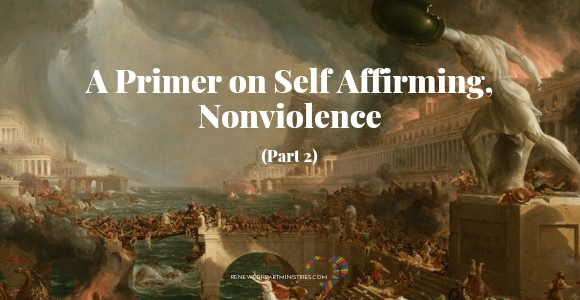
“Destruction,” 1836, part of the “Course of Empire” series, by Thomas Cole

“Today we live in the wake of these changes. Christianity and its Jesus fell in the same way as all the other religions taken in by Rome . . . If the bloody violence of Christianity’s history has taught us anything, it is that we must question the Christian theory of justified violence including redemptive violence.”


Before we begin, I want to stop for a moment and ask for your support. Renewed Heart Ministries is a nonprofit organization working for a world of love and justice. We need your support to bring the kind of resources and analysis RHM provides.

Intersections between faith, love, compassion, and justice are needed now more than ever.

Please consider making a tax-deductible donation to Renewed Heart Ministries, today.  To do so just go to our website at renewedheartministries.com and click “Donate” on the top right or if you prefer to make a donation by mail, our address is:

Renewed Heart Ministries, PO Box 1211, Lewisburg, WV 24901

And to those of you out there who already are supporting this ministry, I want to say thank you.  We could not continue being a voice for change without your support.

This week we’re continuing the series we began last week on the self-affirming, nonviolent resistance of Jesus. 

In this second part, we’ll consider the shift from what Christians originally taught about nonviolence (see A Primer on Self Affirming, Nonviolence (Part 1), and what they began to teach after their social location changed when Christianity became the official religion of the Roman Empire. Later in the series I will critique the Church Fathers’ self-sacrificial nonviolence and compare it to what I believe is Jesus’ self-affirming nonviolence. For now, I want you to note the contrast between early Christian nonviolence and the later use of violence, not as a periodic exception to Jesus’ teaching, but as the preferred method of converting non-Christians. Let’s again read from Christian teachers writing before the change:

“We [Christians] no longer take up sword against nation, nor do we learn war any more, but we have become the children of peace.” — Origin

“And shall the son of peace take part in the battle when it does not become him even to sue at law? And shall he apply the chain, and the prison, and the torture, and the punishment, who is not the avenger even of his own wrongs?” — Tertullian

“Anyone who has the power of the sword, or who is a civil magistrate wearing the purple, should desist or he should be rejected.”—Hippolytus

Hippolytus recommended that the Church excommunicate those who enlisted in the military or took a political office where they were responsible for wielding Rome’s sword.

“Rather, it is better to suffer wrong than to inflict it. We would rather shed our own blood than stain our hands and our conscience with that of another.” —Arnobius

“It makes no difference whether you put a man to death by word, or rather by the sword, since it is the act of putting to death itself which is prohibited.”—Arnobius 

Again, with “by word,” Arnobius, like Hippolytus above, is referring to holding a political office where one commands state violence.

“When God forbids killing, he doesn’t just ban murder (some translations read ‘brigandage’), which is not permitted under the law even; He is also recommending us not to do certain things which are treated as lawful among men…whether you kill a man with a sword or a word makes no difference, since killing itself is banned.”—Lactantius, the tutor of Emperor Constantine’s son.

“…no exceptions at all ought to be made to the rule that it is always wrong to kill a man, whom God has wished to be regarded as a sacrosanct creature.”—Lactantius

Yet about a hundred years after Rome embraced the Christian religion, it was illegal not to be a Christian (there was an exception for Jews), and you could not serve in the military unless you were a Christian: You were not trusted as loyal unless you were a Christian. 

How did Christianity get to that point?

On October 28, 312, Constantine was engaged in the Battle of the Milvian Bridge against his rival, Roman Emperor Maxentius. Lactantius recounts that, on the evening of October 27, just prior to the battle, Constantine had had a vision of the Christian God promising victory if his soldiers daubed the sign of the cross on their shields. (The details of the vision differ among sources reporting it. Lactantius reports that the vision promised victory if Constantine would delineate “the heavenly sign [‘the letter X, with a perpendicular line drawn through it and turned round thus at the top, being the cipher of CHRIST’] on the shields of his soldiers” (On the Deaths of the Persecutors, Chap. 44). Eusebius also reports that the sign God instructed them to use on their shields was the Chi Rho symbol. These reports of Constantine’s vision state that he saw a cross of light with the inscription, “through this sign you shall conquer.”

There are various theories today about these reports. Some view the vision as legend with no historical basis. Others believe Constantine made up the story after the fact: he was a great political strategist and saw a way to coopt Christianity’s influence by uniting Christianity and Rome. Each theory is speculation, including the popular historical interpretation that the vision was genuine and that Jesus actually supported Roman conquests. What we know for sure is what happened within Christianity after this period. The Christian church’s social location changed dramatically, and what happens to individuals and communities that transition from “Have-not” to “Have” continues to amaze me.

Constantine declared Christianity a religio licita (a legal religion) through the Edict of Milan. He lavished gifts upon all Church leaders, increasing their salaries, exempting them from paying taxes, building church buildings, and funding Bible copying. Through this support, Church became centered in a building rather than in a group of people and crucifixion and gladiatorial games were abolished because of their connection with Christian victimization and trauma. The first day of the week was also declared a weekly holiday for all people and the Christian calendar absorbed pagan holidays. Pagan temples were converted into Christian churches, with statues of Roman gods replaced by statues of the Apostles and other biblical characters.

Eventually, Christianity’s becoming the official religion of the Roman empire would lead to new theological and ethical interpretations as well as new practices. Augustine, Eusebius, and others began to see Christianity’s new social location and its political power as having been handed to them by God Himself, and for the first time in history, Christians began wielding a sword in Jesus’ name. In the subsequent centuries we would get a brand new Christian norm:

“When people falsely assert that you are not allowed to take up the physical sword or fight bodily against the enemies of the Church, it is the devil trying to attack the fabric of your Order.”—Jacques de Vitry 

Notice that the non-violent teachings of Jesus had come to be redefined as of the “devil.”

“Do not ever be ashamed, O Bride of Heaven, to take up the sword against heretics; for the God still lives who sanctified such action through the arms of David.”—John of Mantua

Jesus’ nonviolence would be sidelined and the example of more violent figures from the scriptures would began to take center stage. Military leaders such as David and Joshua and others became the models of the Christian faith, and Christians, like the majority of evangelicals today, even embraced bodily torture. As Pope Innocent IV once wrote, “Bodily torture has been found the most salutary and efficient means of leading to spiritual repentance.”

Through the Church and State becoming unified, violence in defense of both became justified. 

Some of the greatest minds in Christianity would come up with Biblical support for this turn. Augustine (354–430 C.E.) and, later, Aquinas (1225–1274 C.E.) made significant interpretive changes. Augustine, a bright theological mind in his time, developed and defended a “justified violence” theory for Christians based upon existing Roman and Greek thought. Christians were now encouraged to join the army and to become involved in government. Violence could be used as God’s instrument to “punish” evildoers (e.g., Romans 13:1- 7), and Augustine saw punishment as a more justifiable motive than self-defense. By 416 C.E., all Roman soldiers were required to be Christians. Up until this time, “pagan” had simply meant civilian as opposed to soldier. It came to mean non-Christian as opposed to believer.

Here is a sampling of the new Augustinian teaching:

“War is waged to serve the peace. You must, therefore, be a peacemaker even to waging war, so that by your conquest, you may lead those you subdue to the enjoyment of peace.”— Augustine

Peace as an end was separated from peace as the means. War was doing others a favor.

“What, indeed, is wrong with war? That people die who will eventually die anyway so that those who survive may be subdued in peace? A coward complains of this but it does not bother religious people.”— Augustine

“Does anyone doubt that it is preferable for people to be drawn to worship God by teaching rather than forced by fear of punishment or by pain? But because the one type of people is better, it does not mean that the others, who are not of that type, ought to be ignored.”— Augustine

Augustine taught that, yes, it’s better for people to come to worship the Christian God on their own rather than being tortured or threatened with violence, but just because some will choose the Christian God on their own doesn’t mean that we shouldn’t force others to worship. Thisis a complete disconnect from the teachings of Jesus. Augustine’s writing turns more and more to the Bible and to desperate attempts to find some clue in Jesus’ teachings that Jesus really didn’t mean what He taught on nonviolence and enemy love. 

Augustine also exhibited dualistic Platonic (Hellenistic/Greek) thinking, which sees the body as separate from an immortal soul. This was in contrast to the more holistic philosophy of ancient Hebrew culture. With a dualist view, you could do whatever was necessary to someone’s body if it saved their soul. So killing someone could be justified if that was how you saved their soul. Augustine taught that it was acceptable to run your enemies through with the sword, as long as you did not kill them with hatred in your heart, for Jesus taught us to love our enemies.

Augustine developed and systematized a religious philosophy that justified saving souls at any cost, even by means of torture and violence. Augustine taught that the Christian should respond to torturing confessions out of others by crying “fountains of tears” for this “necessary state of affairs.” But never did he stop to consider that torture itself might be wrong. This was the origin of Christianity embracing “justified violence” in the form of the “just war” theory supported by the contemporary, Americanized, evangelical worldview.

Today we live in the wake of these changes. Christianity and its Jesus fell in the same way as all the other religions taken in by Rome. When Rome embraced the Greek gods, their appearance in pictures and statues changed. Under Roman influence, for example, Zeus (Greek) became Jupiter (Roman). But it wasn’t just their names that changed; their attributes changed too. Under Rome, the Greek gods became more warlike, and more distant, not mingling with mortals as much. They became harsher and more powerful. They came to stand for discipline, honor, strength, and violence. For instance, Hypnos, Greek god of sleep, didn’t do much until Romanized. The Romans called him Somnus, and he liked killing people who didn’t stay alert at their jobs: if they nodded off at the wrong time, they never woke up. This same pattern took place as Rome remade the Christian God, Jesus.

If the bloody violence of Christianity’s history has taught us anything, it is that we must question the Christian theory of justified violence including redemptive violence.

Next week we will begin unpacking our first passage in this series from the Gospels. What could Jesus have meant when he taught turning the other cheek, walking the extra mile, and the stripping off of one’s under garment? Thank you for staying with us.

HeartGroup Application

  1. What value do you see in Christians specifically returning to an ethic of nonviolence within our society today? Explain with you group.
  2. In what ways do you see American values today influencing sectors of Christianity and Christian rhetoric as Roman values did in the above history?
  3. Where do you see the values and ethics of the Jesus story as being in contradiction with current practices of the American empire today or it’s leadership?

Thanks for checking in with us this week. 

Wherever you are, keep choosing love, compassion, action and reparative and distributive justice.

Another world is possible, if we choose it. 

Don’t forget, we need your support here at RHM to continue making a difference.

I love each of you dearly.

I’ll see you next week.
A Primer on Self Affirming, Nonviolence (Part 1)

Herb Montgomery | July 26, 2019

gray bird cutout decor on brown plank symbolizing nonviolence
Photo by Tamara Menzi on Unsplash

We need your support to bring the kind of resources and analysis RHM provides.
Intersections between faith, love, compassion, and justice are needed now more than ever.
Click here to make a tax-deductible donation.

“But today most of Christianity either rejects Jesus’ nonviolence outright or embraces nonviolence in a way that leaves marginalized and exploited people passive in the face of injustice and harms them. There are alternatives . . . I want to offer an interpretative lens that I refer to as Self-Affirming Nonviolent Resistance.” 


Seven years ago I wrote a series on Nonviolence.  Much has changed for me since then.  Originally, my understanding of nonviolence had been deeply influenced by those who define nonviolence  in a way that is rooted in self-sacrifice.  I’ve grown to understand nonviolence differently. I’ve grown to see that this way of defining nonviolence is itself violent.  A healthier, more life-giving form of nonviolence is needed. This is significant enough for me that I believe a rewrite of that series seven years ago on nonviolence is important.  In the words of Katie Cannon from the introduction of Delores Williams’ classic Sisters in the Wilderness, “Theologians need to think seriously about the real-life consequences of redemptive suffering, God-talk that equates the acceptance of pain, misery and abuse as the way for true believers to live as authentic Christian disciples. Those who spew such false teaching and warped preaching must cease and desist.” I have so much gratitude for Cannon and others for helping me see this. I have thought seriously in response to womanist and feminist critiques of defining nonviolence in ways that are rooted in self-sacrifice and the myth of redemptive suffering. It is as a result of listening to these critiques that I feel that this revision is needed.  

Let’s begin.

In Matthew’s Gospel we read these words:

“You have heard that it was said, ‘An eye for an eye, and a tooth for a tooth.’ But now I tell you: do not take revenge on someone who wrongs you. If anyone slaps you on the right cheek, let him slap your left cheek too. And if someone takes you to court to sue you for your shirt, let him have your coat as well. And if one of the occupation troops forces you to carry his pack one mile, carry it two miles. When someone asks you for something, give it to him; when someone wants to borrow something, lend it to him. You have heard that it was said, ‘Love your friends, hate your enemies.’ But now I tell you: love your enemies and pray for those who persecute you, so that you may become the children of your Father in heaven. For he makes his sun to shine on bad and good people alike, and gives rain to those who do good and to those who do evil. Why should God reward you if you love only the people who love you? Even the tax collectors do that! And if you speak only to your friends, have you done anything out of the ordinary? Even the gentiles do that! You must be perfect—just as your Father in heaven is perfect.” (Matthew 5:38-48)

When it comes to nonviolence in general, it seems to me that Western, Americanized Christianity has lost its way. Maybe we’ve forgotten what the road we’re supposed to be on even looks like. Since Jesus spoke the above words two millennia ago, followers and non-followers alike have read them and struggled to interpret and apply them in life-giving ways.

I want to offer an interpretative lens that I refer to as Self-Affirming Nonviolent Resistance.

The first word I want to focus on is “Nonviolent.”

Today, many Christians say that Jesus’ teaching on nonviolence is only for certain groups, certain time periods, or certain cultural circumstances. Even so it is obvious that Jesus taught a form of nonviolence.

Further, too often Christians who do teach nonviolence teach a self-sacrificing form of nonviolence rather than a self-affirming form. I once did this myself because during the first 300 years of Christian history, many Christians interpreted Jesus’ teaching as self-sacrificing nonviolence too. But listening to marginalized communities and their experiences with nonviolence opens up new understandings of what Jesus may have originally taught.

I am fully aware that some supporters of Renewed Heart Ministries who are wonderful Christians have a different opinion from me on this topic and do not subscribe to nonviolence. Thank you for tracking with us on this series anyway. It would be easier for you to focus on things that don’t pull you out of your comfort zone. Through this series, we will look at this subject again, secure and confident in our love, respect and consideration of each other.

I want to also speak to those who subscribe to self-sacrificial nonviolence. Our social structures already deny justice and full humanity to so many people. They’re forced to deny their selves. For this sector of society, I don’t believe Jesus would teach them to further sacrifice themselves in a society that already requires that. I believe Jesus’ form of nonviolence gave marginalized people a way to affirm themselves, affirm their humanity, to hold on to their selves in a world that would either prefer they did not exist or demand that they “go back to where they came from.”

Nonviolence, even self-affirming nonviolent resistance, is a disposition, an attitude, and a way of life where the means and the ends are aligned. We do not choose the way of violence in order to maintain peace: Jesus’ way of peace disrupted unjust systems. Jesus’ way arrived at peace through resistance, by establishing distributive justice for all, especially those our communities push to the edges and margins.

Today we have overwhelming evidence that the early followers of Jesus were nonviolent. Over the church’s first three centuries, those who held onto nonviolence drifted into more self-sacrificing forms of it. Yet their testimony for some form of nonviolence is still relevant and challenging to Christians today who reject nonviolence completely, regardless of its form. The U.S. Christian church has become something that early Christians wouldn’t recognize. The statements that follow are representative of the voices in Christianity for its first 300 years.

“We (Christians) no longer take up sword against nation, nor do we learn war any more, but we have become the children of peace.” —Origin

“And shall the son of peace take part in the battle when it does not become him even to sue at law? And shall he apply the chain, and the prison, and the torture, and the punishment, who is not the avenger even of his own wrongs?” —Tertullian

“Anyone who has the power of the sword, or who is a civil magistrate wearing the purple, should desist, or he should be rejected.”—Hippolytus

“Rather, it is better to suffer wrong than to inflict it. We would rather shed our own blood than stain our hands and our conscience with that of another.” —Arnobius

“It makes no difference whether you put a man to death by word, or rather by the sword, since it is the act of putting to death itself which is prohibited.”—Arnobius

“When God forbids killing, he doesn’t just ban murder, which is not permitted under the law even; he is also recommending us not to do certain things which are treated as lawful among men.”—Lactanius

In some of these statements we see love and nonviolence defined by the early church leaders as self-sacrifice, the willingness to suffer for the benefit of someone else. We’ll discuss this at greater lengths in this series when we listen to feminist and womanist voices and their critique. For now, Marcus J. Borg sums up the concern of self-sacrifice in his book The Heart of Christianity:

“Oppressed people, in society and in the family, have often been told to put their own selves last out of obedience to God. When thus understood, the message of the cross becomes an instrument of oppressive authority and self-abdication.” (p. 112)

Defining nonviolence as self-sacrifice for the oppressed has proven itself to be a violent form of nonviolence.

In this series I hope to offer an alternative view.

I interpret Jesus’ teachings on nonviolence similarly to Walter Wink who states that Jesus’ nonviolence gave oppressed communities, a way to “assert [their] own humanity and dignity . . . refuse to submit or to accept the inferior position [and] expose the injustice of the system.” (in Jesus and Nonviolence: A Third Way)

But today most of Christianity either rejects Jesus’ nonviolence outright or embraces nonviolence in a way that leaves marginalized and exploited people passive in the face of injustice and harms them.

There are alternatives.

In this series, we will consider Jesus’ sayings on the subject of nonviolence. We will then address frequently asked questions about applying nonviolence. Lastly we will listen to objections and critiques, not from those who would use violence to dominate or subjugate others, but from communities for whom a form of nonviolence has left them further oppressed, exploited and subjugated. 

My hope is that we will arrive at a form of nonviolence that’s not only faithful to the Jesus story but that’s also life-giving and that bears the fruit of liberation, too. 

This series is going to be a wonderful journey of discovery for us, regardless of where we begin. Whether we agree at the end of this series or not, our understanding will be greater as we explore what we believe and why. 

We’ll begin next week. For now, it will be enough for us to contemplate what this passage may hold for us today:

“You have heard that it was said, ‘An eye for an eye, and a tooth for a tooth.’ But now I tell you: do not take revenge on someone who wrongs you. If anyone slaps you on the right cheek, let him slap your left cheek too. And if someone takes you to court to sue you for your shirt, let him have your coat as well. And if one of the occupation troops forces you to carry his pack one mile, carry it two miles. When someone asks you for something, give it to him; when someone wants to borrow something, lend it to him. You have heard that it was said, ‘Love your friends, hate your enemies.’ But now I tell you: love your enemies and pray for those who persecute you, so that you may become the children of your Father in heaven. For he makes his sun to shine on bad and good people alike, and gives rain to those who do good and to those who do evil. Why should God reward you if you love only the people who love you? Even the tax collectors do that! And if you speak only to your friends, have you done anything out of the ordinary? Even the pagans do that! You must be perfect—just as your Father in heaven is perfect.” (Matthew 5:38-48)

HeartGroup Application

1. This week, discuss whether or not you subscribe, at least in principle, to some form of nonviolence. 

2. In what areas of your life are you practicing nonviolence?  What do these practices look like?

3. What questions do you have about nonviolence?  Have your group email some of those questions in to us here at Renewed Heart Ministers and they may just end up in this new series!  I’d love to hear what you’re thinking.

Thanks for checking in with us this week. 

Wherever you are, keep choosing love, compassion, action and reparative and distributive justice.

Another world is possible, if we choose it. 

I love each of you dearly.

I’ll see you next week. 

A Social Jesus

Herb Montgomery | April 12, 2018

picture of man standing before a wall with "Jesus" graffitied behind him.
Photo Credit: Gift Habeshaw on Unsplash

“Today, sectors of Christianity that only teach a personal Jesus deeply need a reintroduction to the gospels’ social Jesus. They need to rediscover and understand social salvation contrasted with personal salvation. They need a gospel that impacts the here and now and that isn’t just about the premium they must pay in this life to get a post-mortem fire insurance policy.”


“After John was put in prison, Jesus went into Galilee, proclaiming the good news of God. ‘The time has come,’ he said. ‘The kingdom of God has come near. Repent and believe the good news!’” (Mark 1:14-15)

“Have you accepted Jesus as your personal savior?” he shouted at me. I was at the grocery store one evening trying to grab some missing ingredients for dinner. As I left the store I passed a table on the way to the parking lot. There, a group of Christians sat or stood behind the table, trying raising money for their organization. 

I politely smiled in his direction and said, “No thank you.” I was still walking as I heard him call out, “If you die on the way home do you know for sure where you’ll end up next?”

I couldn’t believe there were still Christians who talked like this, with these well-worn phrases as conversation starters. But again, this is Appalachia and as someone born and having grown up here, if you can still find this kind of talk anywhere, you can find it here.

This month at RHM, we are featuring Walter Rauschebusch’s classic work A Theology for the Social Gospel as April’s book of the month. One of the things I appreciate about the early 20th Century Social Gospel movement is that it drew attention to Jesus’ vision for social salvation, not individual, private, personal salvation.

I recently posted this quotation from Rauschenbusch on Facebook: “If our theology is silent on social salvation, we compel [people] to choose between an unsocial system of theology and an irreligious system of social salvation” (Ibid. p. 7). Immediately one person asked, “What is social salvation?” This question reveals more than it asks. 

Firstly, contemporary, privatized, and individually focused forms of Christianity focus their adherents so much on personal salvation and Jesus as a “personal Savior” from post-mortem punishment that those who only encounter this kind of Christianity may have never even heard of the social salvation described in the gospels. 

Seeing Jesus as a social savior is the oldest Christian message. It can be argued that interpreting Jesus as a personal savior, an individual savior, or a private savior is a later interpretive addition not found until Christianity became populated with middle- to upper-class people centered in their culture. 

Secondly, how nice it must be to belong to a social class that’s so privileged that it doesn’t even know what social salvation is, much less imagine it needs it. Countless people face discrimination, marginalization, and exclusion each day and don’t need a textbook definition for the phrase “social salvation” because they know the system all too well. They know what it is to need salvation from societal and social injustice and oppression.

Let’s dive in.

Kingdom

Each author of the synoptic gospels (Mark, Matthew, and Luke-Acts) place the theme of “the kingdom” at the center of their stories about Jesus.

“After John was put in prison, Jesus went into Galilee, proclaiming the good news of God. ‘The time has come,’ he said. ‘The kingdom of God has come near. Repent and believe the good news!’” (Mark 1:14-15)

“Jesus went throughout Galilee, teaching in their synagogues, proclaiming the good news of the kingdom, and healing every disease and sickness among the people.” (Matthew 4:23)

“But he said, ‘I must proclaim the good news of the kingdom of God to the other towns also, because that is why I was sent.’” (Luke 4:43)

“Paul entered the synagogue and spoke boldly there for three months, arguing persuasively about the kingdom of God.” (Acts 19:8)

“He proclaimed thekingdom of God and taught about the Lord Jesus Christ—with all boldness and without hindrance!” (Acts 28:31)

I have my own theories about why the author of Acts ties Paul’s teaching to Jesus’ “kingdom” but the fact is that the Kingdom is the focus in the gospels and Paul must come to be associated with it in the book of Acts. Nowhere in the book of Acts is the goal to escape postmortem hell or enter into a cosmic heaven. The coming kingdom is the central theme.

The kingdom theme in the gospel stories served a twofold purpose: it hearkened back to the Maccabean era of hope in restored Jewish independence and it contrasted with the Roman empire (see Daniel 7). Matthew’s use of kingdom is more in line with the first purpose, and Luke’s is more about the second. Mark’s use can be argued to be a hybrid of both. Neither view of kingdom was about saving individuals. Instead they were about restoring distributive justice for a whole community, including all the individuals that made the community. The hope of the kingdom went beyond the personal to the social: it was about social salvation.

Gospel

In the canonized Jesus stories we have today, the term gospel meant the announcement of the coming of this kingdom. It’s important to note that the term “gospel” or “glad tidings” was originally a political term, not a religious one. The Roman empire used it to refer to announcements made when the empire annexed a new territory. The gospel was public announcement, or tidings, of the newly arrived rule of Rome. So the word “gospel” itself was not about privatized, individual, personal change but rather a fundamental social change.

Here are three examples that we have still today of contemporary, secular uses of the term gospel in the 1st Century.

“Even after the battle at Mantinea, which Thucydides has described, the one who first announced the victory had no other reward for his glad tidings [euangelion-gospel] than a piece of meat sent by the magistrates from the public mess” (Plutarch, Agesilaus, p. 33, 1st Century).

“Accordingly, when [Aristodemus] had come near, he stretched out his hand and cried with a loud voice: ‘Hail, King Antigonus, we have conquered Ptolemy in a sea-fight, and now hold Cyprus, with 12,800 soldiers as prisoners of war.’ To this, Antigonus replied: ‘Hail to thee also, by Heaven! but for torturing us in this way, thou shalt undergo punishment; the reward for thy good tidings [euangelion-gospel] thou shalt be some time in getting’” (Plutarch, Demetrius, p. 17, 1st Century).

“Why, as we are told, the Spartans merely sent meat from the public commons

to the man who brought glad tidings [euangelion-gospel] of the victory in Mantineia which Thucydides describes! And indeed the compilers of histories are, as it were, reporters of great exploits who are gifted with the faculty of felicitous speech, and achieve success in their writing through the beauty and force of their narration; and to them those who first encountered and recorded the events [εὐαγγέλιον– euangelion] are indebted for a pleasing retelling of them” (Plutarch, Moralia (Glory of Athens), p. 347, 1st Century).

The phrase “glad tidings/gospel of the kingdom” as the gospels’ authors used it was a way to signal that Jesus and his teachings held a new vision for structuring society. Those who were last in the present arrangement would now be first. Those being marginalized were to be included and centered. Those who were hungry and thirsted for a distributive, social righteousness would be filled (see Matthew 5 and Luke 6). The authors of the Jesus story used “gospel” to mean a change in society or human community that went beyond mere personal nor private change. It was about social change here, social change now. 

Eternal Life

Even when we consider the way eternal life was framed in the gospel stories, an argument can be made that even eternal life is not private, personal, or individual, but communal and social. Eternal life meant the continuance of a community as a whole, not merely continuance for individuals within that community. The path Jesus was pointing toward is a path by which the human race can continue, a path that leads to life rather than extinction for our race and not simply life for individual humans. Eternal life is about having our quality of life rooted in what Parker and Brock call an “ethical grace” lived here on earth, a path of living differently as a society today, here, now. 

“The Gospel defines three dimensions of this eternal life: knowing God; receiving the one sent by God to proclaim abundant life to all; and loving each other as he had loved them. Eternal life, in all three meanings, relates to how life is lived on earth. The concrete acts of care Jesus has shown his disciples are the key to eternal life. By following his example of love, the disciples enter eternal life now. Eternal life is thus much more than a hope for postmortem life: it is earthly existence grounded in ethical grace.” (Rita Nakashima Brock & Rev. Dr. Rebecca Parker, Saving Paradise: How Christianity Traded Love of This World for Crucifixion and Empire, p. 22)

Death by Crucifixion

Lastly, people don’t get jailed (like John the Baptist) and don’t get crucified (like Jesus) for teaching personal, private, post-mortem salvation. They get in trouble, as we saw last week, when they call out social injustice and call for social change, societal reparations, social redemption, and social salvation. Private change threatens no one, but social change threatens those privileged in the present way of organizing society who would have much to lose if the status quo changed.

Today, sectors of Christianity that only teach a personal Jesus deeply need a reintroduction to the gospels’ social Jesus. They need to rediscover and understand social salvation contrasted with personal salvation. They need a gospel that impacts the here and now and that isn’t just about the premium they must pay in this life to get a post-mortem fire insurance policy. 

There is a need to understand how the life modeled and teachings taught by Jesus have the potential to socially save. They aren’t a myth of redemptive violence and suffering that saves us from divine satisfaction. We can be deeply revived by following the teachings of Jesus, and not merely mentally assenting or believing story details about him. We need a gospel that recaptures the story truth of a resurrection, and not endless gospels that only offer people a cross.

It is to this end that we’ll be turning our attention over the next few weeks. I’m so glad you’re with us on this journey. 

“After John was put in prison, Jesus went into Galilee, proclaiming the good news of God. ‘The time has come,’ he said. ‘The kingdom of God has come near. Repent and believe the good news!’” (Mark 1:14-15)


Heart Group Application

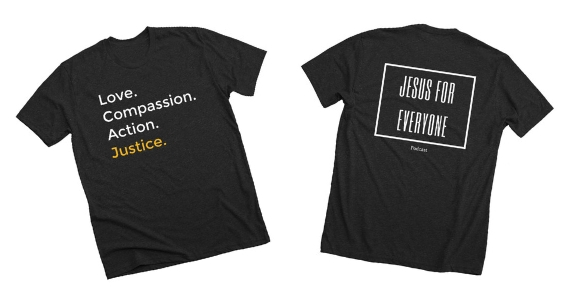
From now through April 22, we’re offering our listeners and readers this special, premium t-shirt to support our work, show others you’re a fan of our podcast, and help spread the word so others can enjoy each episode as well.

Don’t miss out on these! They’ll only be available for a limited time.

Get yours today for only $24.99 and support the JFE Podcast in making our world a safe, compassionate, just home for everyone.

Go to:

https://www.bonfire.com/love-and-justice-tee/

All Tees will be shipped out the beginning of May.

Get Your JFE Podcast Tee Today!

Thank you for checking in with us this week.  I’m so glad you did. 

Wherever you are today, choose love, choose compassion, take action and seek justice. 

Another world is possible. 

I love each of you dearly.

I’ll see you next week.
Prophets and Priests

Herb Montgomery | April 5, 2019

Picture of woman using megaphone
Photo by Melany Rochester on Unsplash

“Where else do you see institutions threatened by the voice of prophets? We may not call them prophets in every institution, yet the punishment of prophets is a universal dynamic. Whenever there are people calling not only for personal piety but also for societal change, seeking to make our world a just, safe, compassionate home for everyone, those who have much to lose will use these tactics.”


“Woe to you, teachers of the law and Pharisees, you hypocrites! You build tombs for the prophets and decorate the graves of the righteous. And you say, ‘If we had lived in the days of our ancestors, we would not have taken part with them in shedding the blood of the prophets.’ So you testify against yourselves that you are the descendants of those who murdered the prophets.” (Matthew 23:29-31) 

RHM’s book of the month for April is Walter Rauschenbusch’s 1917 classic A Theology for the Social Gospel. Although Rauschenbusch writes in the language and limits of his time and social location, he and others in the early social gospel movement nonetheless broke new ground by calling Christians to return to the gospels’ teachings on social change, social justice, and social salvation. Their call contrasted with versions of Christianity that focus on private, individualistic, or personal salvation. Many who have been raised in evangelical Christianity today still are surprised when they discover the gospels’ focus on systemic injustice. This focus was accurately labelled the “social gospel” not because it focused on social salvation instead of personal salvation (as some have wrongly accused) but because it focused on social salvation alongside personal salvation.

Forty years after A Theology for the Social Gospel was published, Rev. Dr. Martin Luther King, Jr., read it and wrote, “It has been my conviction ever since reading Rauschenbusch that any religion which professes to be concerned about the souls of men and is not concerned about the social and economic conditions that scar the soul, is a spiritually moribund religion only waiting for the day to be buried” (Stride Toward Freedom, p. 91).

This week I want to look at a juxtaposition that Rauschenbusch uses in the end of A Theology for the Social Gospel. I admit freely that it’s oversimplified in terms of what we know today. I also find Rauschenbusch’s description of the function or motivation of the ancient priestly class in this paragraph to misrepresent the priestly function in the Jewish faith tradition as a whole. I do believe Rauschenbusch’s description matches his own experience with institutionalized Christianity and the professional clergy’s push back against his call for a more socially focused gospel. I believe he is reading his own experience back into the text. I, too, can attest that it is difficult if not impossible to get professional Christian clergy to see things at times that their paychecks requires them not to see. This can happen within any faith tradition when an institution and those employed by that institution become aligned with injustice, exploitation and/or exclusion. Yet this passage from Rauschenbusch still has much to offer us as we seek to speak truth to power or call out systemic injustice despite push back from those who benefit by what Rauschenbusch named as “institutionalized sin” (whether within our faith traditions or our larger secular communities). The juxtaposition he uses is that of priest versus prophet in the Jewish faith tradition. I found his comments under what he classifies as prophetic deeply encouraging and this week I want to share them with you.

“The priest is the religious professional. He performs religious functions which others are not allowed to perform. It is therefore to his interest to deny the right of free access to God, and to interpose himself and his ceremonial between the common person and God. He has an interest in representing God as remote, liable to anger, jealous of his rights, and quick to punish, because this gives importance to the ritual methods of placating God which the priest alone can handle. It is essential to the priestly interest to establish a monopoly of rights and functions for his group. He is all for authority, and in some form or other he is always a Spokesman of that authority and shares its influence. Doctrine and history as he teaches it, establish a jure divine institution of his order, which is transmitted either by physical descent, as in the Aaronic priesthood, or by spiritual descent through some form of exclusive ordination, as in the Catholic priesthood. As history invariably contradicts his claims, he frequently tampers with history by Deuteronomic codes or Pseudo-Isidorian Decretals, in order to secure precedents and the weight of antiquity. He is opposed to free historical investigation because this tears open the protective web of idealized history and doctrine which he has woven about him. He is the middle person of religion, and like other middlemen he is sincerely convinced that he is necessary for the good of humanity and that religion would perish without him. But underneath all is the selfish interest of his class, which exploits religion. 

The prophet becomes a prophet by some personal experience of God, which henceforth is the dominant reality of his life. It creates inward convictions which become his message to men. Usually after great inward conflicts and the bursting of priest-made barriers he has discovered the way of access to God, and has found him wonderful, ‘just, merciful, free.’ As a result of his own experience he usually becomes the constitutional enemy of priestly religion, the scorner of sacrificial and ritual doings, a voice of doubt about the doctrines and the literature which shelter the priest. He too is a middle-man, but he wants no monopoly. His highest desire is to have all humans share what he has experienced. If his own caste or people claim special privileges as a divinely descended caste or a chosen people, he is always for some expansion of religious rights, for a crossing of boundaries and a larger unity. His interest is in freedom, reality, immediateness, the reverse of the priestly interest. His religious experience often gives a profound quickening to his social consciousness, an unusual sense of the value of life and a strong compassion with the suffering and weak, and therefore a keen feeling for human rights and indignation against injustice. He has a religious conviction that God is against oppression and ‘, on the side of the weak . . . The prophet is always the predestined advance agent of the Kingdom of God. His religion flings him as a fighter and protester against the Kingdom of Evil. His sense of justice, compassion, and solidarity sends him into tasks which would be too perilous for others. It connects him with oppressed social classes as their leader. He bears their risk and contempt. As he tries to rally the moral and religious forces of society, he encounters derelict and frozen religion, and the selfish and conservative interest of the classes which exploit religion. He tries to arouse institutional religion from the inside, or he pounds it from the outside. This puts him in the position of a heretic, a free thinker, an enemy of religion, an atheist. Probably no prophet escaped without bearing some such name. His opposition to social injustice arouses the same kind of antagonism from those who profit by it. How far these interests will go in their methods of suppressing the prophets depends on their power and their needs.” (A Theology for the Social Gospel, pp. 274-277, emphasis added.)

Let’s take a brief look at a few of Rauschenbusch’s statements.

History Contradicting Claims

Today, both science and history can contradict long-held religious beliefs or doctrinal claims. It’s tempting to become defensive and resistant to new information rather than learning how to lean into new information. Deconstruction is naturally uncomfortable. We must be honest in parsing the difference between resistance due to personal discomfort and resistance due to threats to institutions from which we derive privilege. As Rauschenbusch states, it’s possible to be “opposed to free historical investigation because this tears open the protective web of idealized history and doctrine which [one] has woven about [oneself].” 

Where have you seen this take place? Take some time to list examples that come to mind.

Selfish Class Interests

Religion has often been complicit in making oppressed communities passive and in exonerating or justifying one class’s exploitation of others. I agree with Rauschenbusch’s statement that when voices question the status quo, they are quickly labeled “enemy” or a “voice of doubt” or even “heretic.” We see an example of this in John’s version of the Jesus story: “Among the crowds there was widespread whispering about [Jesus]. Some said, ‘He is a good man.’ Others replied, ‘No, he deceives the people.’” (John 7:12)

All Humans Share 

Jesus, like other Jewish prophets before him, had an inclusive encounter with the Divine. His desire was egalitarian inasmuch as he wanted those being excluded to also have a seat at the table. Rauschenbusch observes, “If his own caste or people claim special privileges as a divinely descended caste or a chosen people, he is always for some expansion of religious rights, for a crossing of boundaries and a larger unity.” Those who push for a more egalitarian society transgress boundaries in their work and are often accused of not staying within the lines drawn for them and for others in society.

Social Consciousness

The Hebrew prophets, Jesus, and many others throughout history who have stood up to institutionalized injustice, seeking change in individual hearts and social and systemic change as well, can often trace their social consciousness and the roots of their passion for social justice to the belief in a Divine Universal Love. As Rauschenbusch wrote, “His religious experience often gives a profound quickening to his social consciousness, an unusual sense of the value of life and a strong compassion with the suffering and weak, and therefore a keen feeling for human rights and indignation against injustice.” For Christians, this passion for justice is grounded in the belief that if there is a God who loves everyone, this same God stands with the oppressed and is on the side of distributive justice. It is ironic that those whose belief in Love led them to the work of justice too often come to be ostracized by the very religious communities they first learned that Love through.

Heretics

Rauschenbusch’s use of this term struck home for me. When we stand up against injustice and some of those in privileged positions in our faith communities are also in positions of privilege in our larger society, it still amazes me how efficiently religious systems label and shut out or suppress voices for justice that they deem a threat. “This puts him in the position of a heretic, a free thinker, an enemy of religion, an atheist. Probably no prophet escaped without bearing some such name.” I could give quite a few examples of where I have witnessed or experienced this dynamic. 

Suppression

“His opposition to social injustice arouses the same kind of antagonism from those who profit by it. How far these interests will go in their methods of suppressing the prophets depends on their power and their needs.” I’ve seen those who side with Love and Justice go from having a packed speaking schedule for years in advance to almost overnight being treated as if they no longer exist. In the Jesus story itself, suppression took the form of false accusation and execution. 

I want to be very careful here. Jesus was not trying to start a new religion. He was deeply Jewish, and most of his more inclusive interpretations of the Torah had Jewish precedents before him. Yet his interpretations threatened those who had everything to lose politically.

Where else do you see institutions threatened by the voice of prophets? We may not call them prophets in every institution, yet the punishment of prophets is a universal dynamic. Whenever there are people calling not only for personal piety but also for societal change, seeking to make our world a just, safe, compassionate home for everyone, those who have much to lose will use these tactics. 

If you are in the midst of being treated this way, remember, you’re in the right story. You’re not alone. Another world is possible. If you need to take a break for self-care, do so. It’s okay to take a break; just don’t give up. We are in this together. And together we can make a difference.

“Woe to you, teachers of the law and Pharisees, you hypocrites! You build tombs for the prophets and decorate the graves of the righteous. And you say, ‘If we had lived in the days of our ancestors, we would not have taken part with them in shedding the blood of the prophets.’ So you testify against yourselves that you are the descendants of those who murdered the prophets.” (Matthew 23:29-31)


HeartGroup Application

We here at RHM have something special for our readers and listeners this month.

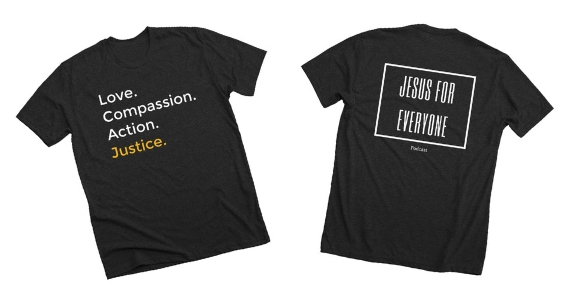
From now through April 22, we’ll be offering our listeners and readers this special, premium t-shirt to support our work, show others you’re a fan of our podcast, and help spread the word so others can enjoy each episode as well.

Don’t miss out on these! They’ll only be available for a limited time.

Get yours today for only $24.99.

And support the JFE Podcast in making our world a safe, compassionate, just home for everyone.

Go to:

https://www.bonfire.com/love-and-justice-tee/

Get Your JFE Podcast Tee Today!

Thank you for checking in with us this week.  I’m so glad you did. 

Wherever you are today, choose love, choose compassion, take action and seek justice. 

Another world is possible. 

I love each of you dearly.

I’ll see you next week. 
Calling Good Evil (Part 5 of 5)

Herb Montgomery | March 29, 2019

Picture of neon rainbow
Photo Credit:
Jason Leung on Unsplash

“The image of God is the male-female spectrum. When we speak of a person’s sex, we’re describing their bodies in terms of characteristics we define as male, female, neither, or both. Wherever nature places a person on this spectrum, they are still just as much a bearer of God’s image. With gender identity, a person may identify as male, female, neither, or both. They are still fully human. Whether your orientation is to be attracted to men, women, neither, or both, you are still fully human and still bearing the image of God.”


“No good tree bears bad fruit, nor does a bad tree bear good fruit. Each tree is recognized by its own fruit.” (Luke 6:43-44)

I initially thought this series would only have two parts, so whether you’re still tracking with me, or joined me in the middle, I’m so glad you’re here. This week we’ll wrap up this series by considering the last two passages that some Christians use to harm the LGBTQ community and their allies. 

The first one is in the New Testament book of Jude.

Jude

“Remember Sodom and Gomorrah and the neighboring towns; like the angels, they committed fornication and indulged in unnatural lusts; and in eternal fire they paid the penalty, a warning for all. In the same way these deluded dreamers continue to defile their bodies, flout authority, and insult celestial beings.” (Jude 7, 8, REB)

Just recently, a non-affirming Christian brought up this passage in a conversation we were having. You see, in the New King James Version part of this passage reads, “having given themselves over to sexual immorality and gone after strange flesh.” The person I was speaking with wanted to convince me that “strange flesh” referred to sexual activity with someone of the same sex. But nothing could be further from the context and language of this passage. 

In this series we have established that the Sodom and Gomorrah story in Genesis does not address generic same-sex activity (see Calling Good Evil, Part 2). More than that, this passage is not only referring to the Sodom story in Genesis 19, but also to the less-told story in Genesis 6 where angels initiate sexual activity with humans. 

“Strange flesh” isn’t about sex between same-sex humans. It’s not about sex between same-ness at all, but about sex across utter difference: sex between humans and cosmic beings. Matthew Vines explains:

“The other verse, Jude 7, is more frequently cited by non-affirming Christians as a potential reference to same-sex behavior. There, we read that the people of Sodom and Gomorrah ‘indulged in gross immorality and went after strange flesh’ (NASB). The phrase ‘strange flesh’ is variously translated as ‘perversion,’ ‘unnatural desire,’ and ‘other flesh,’ which some argue is a reference to same-sex relations. But the Greek phrase used in Jude 7 is sarkos heteras—literally, other or ‘different flesh.’ Hetero, of course, is the prefix for words like heterosexuality, not homosexuality. Far from arguing that the men of Sodom pursued flesh too similar to their own, Jude indicts them for pursuing flesh that was too different. In fact, the phrase ‘strange flesh’ likely refers to the attempted rape of angels instead of humans. Jude 6 supports that connection by comparing Sodom’s transgressions with the unusual sins described in Genesis 6. In that chapter, ‘sons of God’ (interpreted by many to be angels) mated with human women, arousing God’s ire before the flood.” (God and the Gay Christian: The Biblical Case in Support of Same-Sex Relationships, p. 69)

The context of this passage in Jude confirms this reading: the very next verse addresses an “insult” to “celestial beings.” 

Genesis 1

Our final passage is from the Hebrew origins story in Genesis 1.

“So God created mankind in his own image, in the image of God he created them; male and female he created them.” (Genesis 1:27)

This passage, too often interpreted through a gender binary lens, is used against those with a same-sex orientation as well as against those who are transgender, non-binary, or gender nonconforming.

Last year, Asher O’Callaghan beautifully shared a more inclusive reading of this passage.

“In the beginning, God created day and night. But have you ever seen a sunset!?!? Well trans and non-binary people are kind of like that. Gorgeous. Full of a hundred shades of color you can’t see in plain daylight or during the night.

In the beginning God created land and sea. But have you ever seen a beach?!?! Well trans and non-binary people are kind of like that. Beautiful. A balanced oasis that’s not quite like the ocean, nor quite like the land.

In the beginning God created birds of the air and fish of the sea. But have you ever seen a flying fish, or a duck or a puffin that swims and flies, spending lots of time in the water and on the land!?!? Well trans and non-binary people are kind of like that. Full of life. A creative combination of characteristics that blows people’s minds.

In the beginning God also created male and female, in God’s own image, God created them. So in the same way that God created realities in between, outside of, and beyond night and day, land and sea, or fish and birds, so God also created people with genders beyond male and female. Trans and non-binary and agender and intersex, God created us. All different sorts of people for all different sorts of relationships. Created from love to love and be loved. In God’s image we live.

God is still creating you. You are no less beautiful and wild than a sunset or a beach or a puffin. You are loved. You have a place here.” 

(Asher O’Callaghan, Facebook, October 18, 2018)

I believe the creation story also can be understood in a way that not only affirms transgender or non-binary or intersex people, but also affirms people with same-sex orientations. 

This story is about beginnings. This story speaks of a God who began the human race by creating male and female, together, in the image of that God. Think of these categories as a spectrum with what we define as “male” on one end and what we define as “female” on the other. Could the image of God be the entire spectrum of humanity regardless of where any one individual identifies on a scale between male and female? 

The image of God is the male-female spectrum. When we speak of a person’s sex, we’re describing their bodies in terms of characteristics we define as male, female, neither, or both. Wherever nature places a person on this spectrum, they are still just as much a bearer of God’s image. With gender identity, a person may identify as male, female, neither, or both. They are still fully human. Whether your orientation is to be attracted to men, women, neither, or both, you are still fully human and still bearing the image of God. 

There are so many possible combinations. You could, for example, understand your body as male, yet identity your gender closer to the female end of the spectrum, have an androgynous gender expression, and be attracted to men. Whichever combination, whether in sex, gender identify, gender expression or sexual attraction/orientation, you are still part of the human family and a bearer of the image of God. You are as much a reflection of that original Hebrew story as anyone else. You are not other.

This means that God is much more diverse than we may have assumed. 

And humanity, bearing God’s image, is much more diverse than we may have assumed, as well. 

This beautify and diverse way of seeing humanity and the Divine image is reflected in a Jewish prayer first introduced to me by my dear friend Dr. Keisha McKenzie, “Blessed are you oh Lord King of the Universe for you vary the forms of your creatures.” And in the Jewish proverb another dear friend of mine, Danneen Akers, introduced me to, “Before every person there walks an angel announcing behold the image of God.” 

Conclusion

I want to end this series with a passage from Brownson’s work on the “one flesh” language of Adam and Eve in the Genesis story.

“As I have already observed, the language of ‘one flesh’ is the language of kinship. When the man meets the woman in Genesis 2:23, he declares, “This at last is bone of my bones and flesh of my flesh.” In Genesis 29:14, Laban recognizes his kinship bond to Jacob, and says, “Surely you are my bone and my flesh!” In 2 Samuel 5:1, as the tribes of Israel move to make David their king, they declare to him, “Look, we are your bone and flesh” (similar examples can be found in Judg. 9:2; 2 Sam. 19:12f.; and 1 Chron. 11:1). In all these cases, gender distinctions play no role; the focus is entirely on kinship, shared culture, experience, and identity — the same focus that I argued is present in Genesis 2. Furthermore, the use of the word “cling,” used in Genesis 2:24 to describe the relationship of the man and the woman, does not carry sexual connotations in any other usage, but reflects the desire for association and connection that is characteristic of kinship.” (Bible, Gender, Sexuality: Reframing the Church’s Debate on Same-Sex Relationships, p. 107).

There is so much more I wish I had space to share from Brownson’s work on the Genesis narratives. If you’re interested in a more holistic understanding of the Hebrew Genesis stories, his work is well worth your time.

This Hebrew origin story points to human kinship, the foundational solidarity of the human family of which we all are a part. In a more specific way, it also points to any of the numberless committed, consensual, loving relationships between human beings, whether they be same-sex or otherwise. 

The story is about kinship. It’s about love. And any place we find genuine love, we find the image of God, for God is love. (1 John 4:8)

“No good tree bears bad fruit, nor does a bad tree bear good fruit. Each tree is recognized by its own fruit.” (Luke 6:43-44)


HeartGroup Application

As we continue to work toward creating safe places in society for people who daily face marginalization, this work is desperately needed within our faith communities as well. This week I am encouraging both our readers as well as our HeartGroups to volunteer some time with Church Clarity. From Church Clarity’s website: “Church Clarity was borne out of a genuine desire to address very simple, yet profoundly impactful shortcomings of the church.” What is this harmful shortcoming? Ambiguity. “Church Clarity is a crowd-sourced database of Christian congregations scored by our team of volunteers based on how easy it is to find a church’s Actively Enforced Policy online. We currently evaluate church websites for policies that impact LGBTQ+ people and Women in Leadership.” You can find out more about Church Clarity here

This week:

  1. Volunteer as a scorer for Church Clarity. It’s not difficult and they’ll walk you through it.
  2. Recommend new communities that you are familiar with for volunteers to score.
  3. Then share with your HeartGroup what you’ve learned from your experience and how you feel you made a difference.

Thanks you, each of you, for checking in with us this week.  If you have been with us through this entire five part series, I want to say a special thank you to you. I’m so glad you are on this journey with us. 

Where you are today, choose to live in love, compassion, action and justice. 

Another world is possible.

I love each of you dearly.

I’ll see you next week. 

Calling Good Evil (Part 3 of 5)

Herb Montgomery | March 15, 2019

Picture of ripples from a droplet in a rainbow colored pond.
Photo Credit: Jordan McDonald on Unsplash

“Using the term ‘homosexual’ in these translations represents negative cultural bias. If these passages were free from homophobic bias, they would read ‘pederasty.’ One must ask which interpretation is more culturally biased, and more so, what is the fruit of each interpretation? One produces demonstrable bodily harm to a group of human beings because they are born different. And that should warn us.”


“No good tree bears bad fruit, nor does a bad tree bear good fruit. Each tree is recognized by its own fruit.” (Luke 6:43-44)

This week we’re continuing our look at passages that Christians have typically interpreted and used in ways that harm LGBTQ people and others. There are a myriad of ways to interpret the passages we are considering in this series, so I want to remind us to continue asking ourselves, what is the fruit of how I interpret these passages? Are my interpretations doing harm or are my interpretations life giving? As Jesus said, “No good tree [or interpretation] bears bad fruit.”

A few years back, I listened to a presentation by Justin Lee where he mentioned Mark Noll’s book The Civil War as a Theological Crisis. Lee brought up Noll’s book because of the striking similarities between the theological crisis slavery and the abolition movement brought to Christianity in America and today’s schisms caused by churches’ refusal to recognize, include, embrace, and celebrate Christians who identify as LGBTQ. The United Methodist Church’s recent decisions are just one example. Immediately after listening to Lee, I purchased Noll’s book and was shocked at how similar the arguments for and against abolition were to today’s arguments for and against inclusion of LGBTQ Christians as members and as clergy in the Christian church. 

Noll writes: 

“Nuanced biblical attacks on American slavery faced rough going precisely because they were nuanced. This position could not simply be read out of any one biblical text; it could not be lifted directly from the page. Rather, it needed patient reflection on the entirety of the Scriptures; it required expert knowledge of the historical circumstances of ancient Near Eastern and Roman slave systems as well as of the actually existing conditions in the slave states; and it demanded that sophisticated interpretative practice replace a commonsensically literal approach to the sacred text.” (Mark A. Noll. The Civil War as a Theological Crisis, p. 49)

As we turn to the New Testament passages under our consideration, we too must pay attention to nuance. We must do more than engage in surface readings of passages that too easily can be interpreted through our own unseen biases. We need not throw out our sacred text. We must simply learn to look more deeply at passages in their context and in our context today to arrive at life-giving interpretations. 

This is keenly true of our first two passages.

1 Corinthians 6:9 and 1 Timothy 1:10

The term “homosexuality,” though invented in the late 1800s, did not appear in any Bible before 1946. This is significant. As I argued last week, the passages in the Hebrew scriptures that Christians typically associate with loving same-sex relationships were not addressing same-sex attraction as we understand it today. Christians for most of history read these two New Testament passages very differently than those translated recently.

I want you to see the progression in translations. 

King James Version (1611):

1 Corinthians 6:9: Know ye not that the unrighteous shall not inherit the kingdom of God? Be not deceived: neither fornicators, nor idolaters, nor adulterers, nor effeminate, nor abusers of themselves with mankind, 

1 Timothy 1:10: For whoremongers, for them that defile themselves with mankind, for menstealers, for liars, for perjured persons, and if there be any other thing that is contrary to sound doctrine;

Revised English Bible (1989):

1 Corinthians 6:9: Surely you know that wrongdoers will never possess the kingdom of God. Make no mistake: no fornicator or idolater, no adulterer or sexual pervert. 

1 Timothy 1:10: And fornicators, perverts, kidnappers, liars, perjurers—in fact all whose behaviour flouts the sound teaching

The two Greek keywords in these passages are malakoi and arsenokoitai. These words are extremely difficult to translate. We’ve seen that the passages in the Hebrew scriptures usually associated with our topic are actually referring to sexual violence that men used to terrorize or dehumanize other men in times of war. Brownson also reveals that these two passages were not speaking of what we call homosexuality today, but were describing the abusive Roman practice of pederasty (sex between an older man and a young boy): sex with a minor, which would today be condemned as rape by the LGBTQ community.

“[Arsenokoitai] is particularly problematic because there is no attested usage of this word preceding the New Testament documents — that is, in extrabiblical literature — that might provide additional information about its range of meaning. But the most important thing to recognize is that there are two words, not just one. Most scholars recognize that the presence of these two words reflects widespread assumptions throughout the ancient world about male-male homosexual activity: almost all the documents discussing male same-sex eroticism assume a distinction between active older men (commonly referred to in Greek as erastai) and passive younger males (commonly referred to as erōmenoi) — in other words, the practice of pederasty. The malakoi (“ softies”) are the younger, passive erōmenoi, and the arsenokoitai (“ man-bedders”) are the older, active erastai. (James V. Brownson, Bible, Gender, Sexuality: Reframing the Church’s Debate on Same-Sex Relationships, p. 274, emphasis added.)

Brownson concludes on the next page:

“But when we take the original social context of these vice lists seriously, we again recognize a gap between what these vice lists are rejecting and what is happening in committed same-sex relationships today.” (Ibid., p. 275.)

After 1946, though, there is an obvious homophobic bias in New Testament translations that is not warranted by the original languages. Where the original languages address sexual and power violations between an adult and a child, i.e. injustice, we begin to see after 1946 generic homophobia instead.

Here are a few examples from more contemporary translations:

New International Version (2011):

1 Corinthians 6:9: Or do you not know that wrongdoers will not inherit the kingdom of God? Do not be deceived: Neither the sexually immoral nor idolaters nor adulterers nor men who have sex with men 

1 Timothy 1:10: for the sexually immoral, for those practicing homosexuality, for slave traders and liars and perjurers—and for whatever else is contrary to the sound doctrine.

Notice how in the NIV the wording is “men who have sex with men.” The pederasty reference in the original language is completely and, with bias, ignored.

New American Standard  (1960):

1 Corinthians 6:9: Or do you not know that the unrighteous will not inherit the kingdom of God? Do not be deceived; neither fornicators, nor idolaters, nor adulterers, nor effeminate, nor homosexuals, 

1 Timothy 1:10: and immoral men and homosexuals and kidnappers and liars and perjurers, and whatever else is contrary to sound teaching, 

Today’s New International Version (2005):

1 Corinthians 6:9: Or do you not know that wrongdoers will not inherit the kingdom of God? Do not be deceived: Neither the sexually immoral nor idolaters nor adulterers nor male prostitutes nor practicing homosexuals

1 Timothy 1:10: for the sexually immoral, for those practicing homosexuality, for slave traders and liars and perjurers. And it is for whatever else is contrary to the sound doctrine

New Revised Standard Version (1989):

1 Corinthians 6:9: Do you not know that wrongdoers will not inherit the kingdom of God? Do not be deceived! Fornicators, idolaters, adulterers, male prostitutes, sodomites, 

1 Timothy 1:10: fornicators, sodomites, slave traders, liars, perjurers, and whatever else is contrary to the sound teaching.

We’ve considered what was really happening in the ancient Sodom story. The term “sodomites” used in the New Revised Standard Version is a misnomer and betrays a heterosexist bias and the cultural normativity of our day. 

That’s the biggest point this week. Those who seek to interpret these Bible texts in more life-giving ways within the LGBTQ community are often accused of allowing the present culture to bias them. But what we see in the progression of translations over the last half-century is that translating 1 Corinthians 6 and 1 Timothy 1 terms as homosexuality rather than pederasty allows contemporary cultural homophobia to bias the translations while completely ignoring the cultural context which these passages were originally intended for and written in. 

Using the term “homosexual” in these translations represents negative cultural bias. If these passages were free from homophobic bias, they would read “pederasty.” One must ask which interpretation is more culturally biased, and more so, what is the fruit of each interpretation? One produces demonstrable bodily harm to a group of human beings because they are born different. And that should warn us. 

In the Jesus story, some religious leaders (scribes, Sadducees, some Pharisees) taught interpretations of the Torah and practiced a kind of holiness that marginalized the most vulnerable. Jesus, like the prophets before him, instead valued people and interpretations of the Torah that were life-giving rather than destructive. Jesus practiced a kind of holiness that expressed itself in a preferential option for the vulnerable. Even if, as a Christian, you deem same-sex attraction as condemned by your sacred text, you still have one grave reality staring back at you in the face: As a Jesus follower, why are the results, the fruits, of your interpretation so different from Jesus and so identical to those in the story who crucified Jesus? We must let this contradiction confront us.

Regardless of our claim, the fact that LGBTQ Christian youth have such a higher suicide rate in our Christian faith tradition, a rate that is increased by their being “Christian” and having been rejected by their religious families, a rate that is eight times higher rate than non-Christian youth who are accepted, all of this screams to us that in all our piety and holiness, we have imbibed more the spirit of those who stood in opposition to the Jesus of the story than we have the spirit of Jesus himself.

Being LGBTQ has not taken the life of one Christian gay young person, but our interpretations and the way we are relating to them has.

If sin is wrong because it produces death and does harm, and how we are to responding to our LGBTQ population is producing death, you have to ask where is the sin? First get the log out of your own eye, then you will see more clearly to get the dust out of someone else’s.

For the sake of every Christian LGBTQ young person who is struggling with this right now as I write, for the sake of every last phone call made and every effort engaged to talk someone back down off the ledge, it is time for change. 

If you are following Jesus, it’s time for change. Please don’t say you’re simply standing up for what is right. Those who rejected and crucified Jesus felt they were too. Jesus stood up to defend those who were being damaged by those who were standing up for what they interperated as right. It’s time that we and our Jesus looked more like the one in the story.

Next week, we’ll consider Romans 1.

“No good tree bears bad fruit, nor does a bad tree bear good fruit. Each tree is recognized by its own fruit.” (Luke 6:43-44)

HeartGroup Application

First let me say, it’s good to be back.  While I have been traveling over the past few weeks, a lot has been happening in the Christian LGBTQ community in relation to the recent decisions made by the United Methodist Church.

It was a deeply disappointing to watch for many of us who were hoping for and even expecting a very different outcome. I’m encouraged personally to see how many within the Methodist tradition are standing their holy ground.  Churches who have been welcoming and affirming across the nation are choosing to be excluded on the basis of whom they include rather than included because of whom they exclude.

I would like your HeartGroup this week to sit down and discuss three ways your little group can become more welcoming and affirming, too. It’s never a bad time to become more inclusive of those others are marginalizing. As we have often discussed, Jesus modeled and practiced a preferential option for those others excluded. How can your group do the same. 

After you’ve listed three, make a timeline, and begin putting all three into practice.

Together we have the ability to be a source of change in our society. 

Thanks for checking in with us this week. 

Wherever you are today, keep living in love, compassion, action and justice. 

Another world is possible. 

I love each of you dearly.

I’ll see you next week.   
Calling Good Evil (Part 2 of 5)

by Herb Montgomery | February 15, 2019

“My purpose in sharing their work with you is so that each of us can do our own homework, putting in the energy to read, study, and grapple before we ask someone in the Christian LGBTQ community to answer questions they have already answered multiple times and in multiple ways. These discussions are not academic for them. They are personally invested and many are tired of continually arguing about their existence. They already exist and have callings to pursue. It’s up to you how you respond. With that said, I want to offer some help to those who are sincerely searching, doing their homework, and wanting direction.”

“By their fruit you will recognize them. Do people pick grapes from thornbushes, or figs from thistles? Likewise, every good tree bears good fruit, but a bad tree bears bad fruit. A good tree cannot bear bad fruit, and a bad tree cannot bear good fruit. Every tree that does not bear good fruit is cut down and thrown into the fire. Thus, by their fruit you will recognize them.” (Matthew 7:16-20)

As I shared last week, I’ve refrained from debating the passages we’ll be considering this week. I’ve also not wanted to be another straight, cisgender male getting air-time to speak on passages that LGBTQ people have been speaking and writing on for decades now. I didn’t want to take up space when I believe others’ voices need to be heard right now. 

And yet, as I said, I’m torn when I watch the toll it takes on my LGBTQ friends to repeatedly explain these passages. Speaking about this does not have the same emotional cost for me as it does for them. Perhaps I have been a little too silent: not silent in my affirmation, but silent on some of the ways I arrive at affirmation. 

So I’ve promised to amplify two voices on this topic: the excellent work of Matthew Vines, a writer and speaker in the LGBTQ community that Jesus followers should be listening to, and James Brownson, a Bible scholar and parent of a child in the LGBTQ community. 

My purpose in sharing their work with you is so that each of us can do our own homework, putting in the energy to read, study, and grapple before we ask someone in the Christian LGBTQ community to answer questions they have already answered multiple times and in multiple ways. These discussions are not academic for them. They are personally invested and many are tired of continually arguing about their existence. They already exist and have callings to pursue. It’s up to you how you respond. 

With that said, I want to offer some help to those who are sincerely searching, doing their homework, and wanting direction.

Matthew Vines’ God and the Gay Christian is very readable. It’s not written for scholars but for average people. Brownson’s book, The Bible, Gender, and Sexuality,is a definitive work on affirming Christian theology. It played a significant role in my own journey of learning about affirming theology.

What follows is a brief explanation of how I interpret each passage typically used to address LGBTQ people. These are not exhaustive defenses of each passage, but brief summaries—an introduction to get you started. For a more detailed discussion of each passage, I recommend the two resources above. 

Let’s begin.

Genesis 19

This passage is an ancient story of a city’s xenophobic refusal to show hospitality to strangers. This refusal came out of the townspeople’s desire to protect their affluence from the threat of having to share with others. The city, Sodom, was located in a coveted, agriculturally fertile region. Much like the U.S., which has recently separated migrant children from their parents on its southwest borders, Sodom developed an effective strategy of terrorizing potential migrants to keep foreigners away.

In the story, Lot was different. He saw two foreigners in his town and invited them to his home for the evening to keep them safe, hoping to send them secretly on their way at the first light of dawn. What happened that night was terrifying and an intentional message to all foreigners to stay away!

“The two angels arrived at Sodom in the evening, and Lot was sitting in the gateway of the city. When he saw them, he got up to meet them and bowed down with his face to the ground. ‘My lords,’ he said, ‘please turn aside to your servant’s house. You can wash your feet and spend the night and then go on your way early in the morning.’ ‘No,’ they answered, ‘we will spend the night in the square.’ But he insisted so strongly that they did go with him and entered his house. He prepared a meal for them, baking bread without yeast, and they ate. Before they had gone to bed, all the men from every part of the city of Sodom—both young and old—surrounded the house. They called to Lot, ‘Where are the men who came to you tonight? Bring them out to us so that we can have sex with them.’” (Genesis 19:1-5)

Typically, Christians use this story to marginalize those with same sex attraction/orientation or in same sex loving relationships. I believe these interpretations miss the mark in a most destructive way for those who identify as LGBTQ. 

In this story and culture, rape was a way to inflict the worst possible humiliation on another, and was rooted in ingrained, patriarchal gender roles. (See Gender and Law in the Hebrew Bible and the Ancient Near East) The laser beam of convicting truth in these ancient tales should not be focused on members of the LGBTQ community but rather on people who use sexual violence (or any form of terror) against others and on the kinds of xenophobic actions the United States is committing at its borders and against immigrants across the country. 

Hospitality toward strangers was and still is a deeply held Jewish value (see Deuteronomy 26:12; Deuteronomy 24:19-21; Deuteronomy 14:28-29; Deuteronomy 10:19).

The Jewish followers of Jesus carry on this tradition of hospitality toward strangers in the New Testament scriptures as well. This passage from the book of Hebrews almost echoes the story of Sodom:

“Do not forget to show hospitality to strangers, for by so doing some people have shown hospitality to angels without knowing it.” (Hebrews 13:2)

The story of Sodom is not about the LGBTQ community or LGBTQ people’s loving relationships. Instead it has everything to do with people who were extravagantly affluent and did not wish to share. 

“Now this was the sin of your sister Sodom: She and her daughters were arrogant, overfed and unconcerned; they did not help the poor and needy. They were haughty and did detestable things before me. Therefore I did away with them as you have seen.” (Ezekiel 16.49-50)

The story of Sodom has nothing to do with sexual orientation.or loving same-sex relationships. It’s rather about the evil of responding to strangers with violence, in this case sexual violence, especially when their lives depend on your welcome and hospitality. And it is a warning against xenophobia and the terror tactics xenophobes employ. (For additional background, read Judges 19:11-30; see also Rape as a “weapon of war” against men, Male rape survivors fight stigma in Uganda, and Male Rape and Human Rights). 

Leviticus 18

Leviticus 18:22 reads, “Do not have sexual relations with a man as one does with a woman; that is detestable.” 

Christian affirming theologies interpret this passage in many different ways. The way that speaks most deeply to me and my sense of justice is related to our previous story in Sodom, which does not address same-sex sex between women but only what men to do other men. 

Again, this passage is not informed by what we understand today as sexual orientation. It’s informed by the sexual violence that men inflict on other men to diminish them (see again Judges 19:11-30, Genesis 19:1-5, and the above sources referenced). As I just explained, a man raping another man intended to inflict the worst possible humiliation on him. In that culture, women were wrongly considered less than men and so one way to dehumanize a man was to lower him to the same status as a woman. 

So in this culture the law prohibited diminishing men by treating them as if they were women. Both men and women were raped in times of war and conquest, and still are today. But it is shocking to see how lightly many portions of our sacred text considered the rape of women. We seem to see much more concern with protecting men from being raped by other men than with protecting women from rape or raping women being “detestable.”

Again, this was an androcentric culture of deeply rooted patriarchy. Today, we still see misogyny and toxic masculinity at the heart of many men’s reaction to same sex relationships between men. Many men today seem to more easily tolerate same sex relationships between women than those between men. Some even treat same-sex sex between women as a sexual fetish. 

I remember sitting in a restaurant speaking with a friend of mine whose son had just come out to him as gay. My friend was beside himself. He stated how deeply repulsed he was by same-sex intimacy between men. He said he didn’t even want to be in the same room with “them,” and now his own son was “one of them” too! 

I looked at him and risked an accusation. I was banking on our relationship allowing me to get away with it. I looked him in the eye and said, “You just don’t like the idea of men looking at you the way you typically look at women.” 

The light came on in his eyes and the coin dropped in the slot. His misogyny and objectification of women was deeply tied to his inability to accept same sex relationships among men, including his own son’s.

I’m happy to say that conversation was a turning point for my friend. Today, he fully embraces and celebrates his son, and his relationships with women have become a million times more healthy. He is an outspoken ally of LGBTQ folks. He’s come a long way. 

What a contemporary reading of Leviticus should warn men about today is the intrinsic harm of believing women are somehow less than men. I’m convinced that if someone truly believed women were equal with men, then seeing men who don’t align with our culture’s toxic definitions of what it means to be a “man” would not threaten those of us who identify as male. And yet, even in saying all of this, it says a lot when “masculinity” is still defined as “not femininity.” When that’s the case, the rape of men is a problem because it treats men like women. The deeper violation is that sexual violence is a problem on its own terms and one that harms people of all genders. To fail to see this is still as androcentric as the culture out of which Leviticus was written.

We’ll look at four New Testament passages next week. Then we’ll close with a look at Genesis 1. 

For now, remember:

“By their fruit you will recognize them. Do people pick grapes from thornbushes, or figs from thistles? Likewise, every good tree bears good fruit, but a bad tree bears bad fruit. A good tree cannot bear bad fruit, and a bad tree cannot bear good fruit. Every tree that does not bear good fruit is cut down and thrown into the fire. Thus, by their fruit you will recognize them.” (Matthew 7:16-20)

HeartGroup Application

I grew up in a faith tradition that looked at the Bible as having only one right interpretation and many wrong interpretations. I was wrongly taught that one could objectively find this one right interpretations if one practiced the proper hermeneutics. 

I no longer subscribe to this way of looking at sacred texts. Our biases are inescapable. We all have blind spots. Even in our attempts to be objective, we rarely recognize our own biases and blind spots. Fish don’t know they are wet. When we look at the text as having only one right interpretation, the result is that we seek to find that right interpretation, regardless of whether that fruit is harmful for life giving.  We want to be right rather than being righteous.  The goal, I believe, should rather be to allow the text to speak to us in our contexts today with the most life giving, life affirming, life celebrating interpretations our present level of knowledge will enable.

Sacred texts of all religions, including the Bible, can have a myriad of interpretations and applications. The goal is to embrace life giving interpretations and move away from interpretations that do harm to oneself and others. Asking whether an interpretation is right or not, I believe is the wrong question.  We must ask if our interpretations are righteous. What fruit do they produce? Is the fruit harmful or life embracing, life giving?  Does it liberate or oppress? Do our interpretations fuel injustice or do they empower us to move away from injustice toward the work of shaping of a just, compassionate, and safe society for everyone?

The choice, including in our interpretations, is an ancient one—life or death. (Deuteronomy 30:15-2) How can you know if you’re on the right track? Consider if your interpretations are bringing life or doing harm. “By their fruit you will recognize them.” (Matthew 7:16) If your interpretation of a passage is doing harm, don’t hold on to out of a prioritized value of being right or because it is an interpretations that most resonates with your own biases, perceived or otherwise. Prioritize people first. People matter. Loosen your grip on harmful interpretations regardless of how long you’ve held on to them, and be open to embracing other interpretations that are righteous, that prioritize people’s well being, that are just, and that give life.

This week:

1. Come up with a list of three (if you can) interpretations of Bible passages that you believe are harmful. 

2. Discuss with your HeartGroup the harm you have witnessed from these interpretations.

3. Discuss with your group alternative interpretations and/or begin seeking out new interpretations with the goal of interpreting your sacred texts in more life giving ways.

Thanks for journeying with us so far. I’m deeply grateful that you’re here.  We’ll keep exploring next week. This week, wherever you are right now, keep living in love, compassion, action and justice. 

Another world is possible.

I love each of you dearly.

I’ll see you next week.
Calling Good Evil (Part 1 of 5)

Herb Montgomery | February 8, 2019

“And yet I’m torn when I watch the toll it takes on my LGBTQ friends to repeatedly explain these passages. Speaking about them does not have the same emotional cost for me as it does for them. Perhaps I have been a little too silent. I haven’t been silent in my affirmation. But I may have been too silent on some of the ways I arrive at affirmation. So this week and next, I want to amplify two voices on this topic.”

“Make a tree good and its fruit will be good, or make a tree bad and its fruit will be bad, for a tree is recognized by its fruit.” (Matthew 12:33)

In the last month, I’ve spent the last two weekends in the company of LGBTQ Christian communities. Every time I spend time with communities like these, I am deeply moved by their compassion, insight, and wisdom. The people I’ve met have always failed to match the mischaracterizations that homophobic, biphobic, and transphobic Christian communities assign to them. I walk away from each experience with a deeper understanding of my own faith and what it means for me to follow Jesus today our work of love, compassion, action, and justice.

During these visits I bumped into a high school friend who I haven’t seen since graduation. He told me of his sister, a deeply Christian lesbian woman, who recently married the love of her life, a pastor. On the morning of her wedding, her mother sent her a very ugly email. This mother, who had refused to attend the wedding, wrote this message to her daughter: “What you’re doing today makes me want to go jump off a bridge.”

When I heard this story I sat aghast. What is it about anti-LGBTQ Christianity that causes parents to so deeply reject and shame their own children? I have yet to understand this. 

For many Christian parents, discovering their child is attracted to those of the same sex or identifies with a different gender than the one on their birth certificate begins their journey of discovering that everything their faith tradition has taught them of the LGBTQ community has been deeply misinformed at best and intentionally maligning at worst. They discover they were wrong. 

But far more parents in these same faith traditions don’t make this journey. Far more often, parents reject their own children in order to be faithful to their anti-LGBTQ faith. Religion can be a powerful force of good in the world. It can also be a powerful force of the worst kinds of evil.

This week I want us to consider a story from the gospels of Mark and Matthew where Jesus was also mischaracterized and maligned. Jesus has strong words here for those who malign that which is holy, just, and good and call it evil.

But when the Pharisees heard this, they said, ‘It is only by Beelzebul, the prince of demons, that this fellow drives out demons.’ Jesus knew their thoughts and said to them, ‘Every kingdom divided against itself will be ruined, and every city or household divided against itself will not stand. If Satan drives out Satan, he is divided against himself. How then can his kingdom stand? And if I drive out demons by Beelzebul, by whom do your people drive them out? So then, they will be your judges. But if it is by the Spirit of God that I drive out demons, then the kingdom of God has come upon you. Or again, how can anyone enter a strong man’s house and carry off his possessions unless he first ties up the strong man? Then he can plunder his house. Whoever is not with me is against me, and whoever does not gather with me scatters. And so I tell you, every kind of sin and slander can be forgiven, but blasphemy against the Spirit will not be forgiven. Anyone who speaks a word against the Son of Man will be forgiven, but anyone who speaks against the Holy Spirit will not be forgiven, either in this age or in the age to come. Make a tree good and its fruit will be good, or make a tree bad and its fruit will be bad, for a tree is recognized by its fruit. You brood of vipers, how can you who are evil say anything good? For the mouth speaks what the heart is full of. A good man brings good things out of the good stored up in him, and an evil man brings evil things out of the evil stored up in him. But I tell you that everyone will have to give account on the day of judgment for every empty word they have spoken. For by your words you will be acquitted, and by your words you will be condemned.’” (Matthew 12:24-37; see also Mark 3:23-29)

In this story, Jesus teaches the principle of knowing a tree by its fruit. His community had ways to interpret their sacred texts that could gave them ample basis to reject him. But there were also other ways to interpret those same sacred texts that would have freed them to embrace him and his life-giving teachings. 

How do we know if our interpretations of our sacred text, in any religion, are moving in the right direction? Jesus tells us in this story: What is the fruit of your interpretation? If the tree is good, its fruit will be good. If the tree is bad, its fruit will be as well. 

While I was in Arizona last month, a sincere questioner asked me how I interpret the Bible’s passages that contemporary homophobic and biphobic Christians use to scare people away from affirming LGBTQ people. For a long time, I’ve refrained from debating these passages. A dear friend of mine calls such debates “text hockey.” I’ve also not wanted to be another straight, cisgender male getting air-time to speak on passages that LGBTQ people have been speaking and writing on for decades now. I didn’t what to take up space when I believe others’ voices need to be heard right now. 

And yet I’m torn when I watch the toll it takes on my LGBTQ friends to repeatedly explain these passages. Speaking about them does not have the same emotional cost for me as it does for them. Perhaps I have been a little too silent. I haven’t been silent in my affirmation. But I may have been too silent on some of the ways I arrive at affirmation. 

So this week and next, I want to amplify two voices on this topic. First is the excellent work of Matthew Vines, a voice in the LGBTQ community that Jesus followers should be listening to. The second is James Brownson, a parent of a child in the LGBTQ community. 

I want to share their work with you so that each of us can do our own homework, putting in the energy to read, study, and grapple before we ask someone in the Christian LGBTQ community to answer questions they have already answered multiple times and in multiple ways. These discussions are not academic for them. They are personally invested and many are tired of continually arguing about their existence. They already exist and have callings to pursue. It’s up to you to how you respond. With that said, I want to offer some help to those who are sincerely searching, doing their homework, and wanting direction.

Matthew Vines’ God and the Gay Christian is very readable. It’s not written for scholars but for average people. Brownson’s book, The Bible, Gender, and Sexuality is a definitive work on affirming Christian theology. It played a significant role in my own journey learning about affirming theology.

As Vines reminds us, “Christians did not change their minds about the solar system because they lost respect for their Christian forebears or for the authority of Scripture. They changed their minds because they were confronted with evidence their predecessors had never considered” (p. 24). He also writes, “The telescope didn’t lead Christians to reject Scripture. It simply led them to clarify their understanding of Scripture” (ibid. p. 38). 

Certainly there are multiple ways texts can be interpreted. We must reach for the most life-giving choices when possible. What are the fruit of the interpretations we choose? We must be honest about the fruit that is born from homophobic and biphobic theologies. We must also be honest about the life-giving fruit of our Christian LGBTQ siblings’ affirming theology. The life-giving fruit of their affirming theology is something we cannot afford to ignore.

Jesus said that it’s one thing to mistake an evil thing good, and quite another to label something that’s holy, just, and good evil. Jesus called the latter unpardonable. 

So next week, we’ll begin in the book of Genesis and progress through the texts Christians typically use to harm our LGBTQ friends, relatives, and neighbors. Each text will be well worth our time to explore. I’m so glad you’re here with us on this journey.

“Make a tree good and its fruit will be good, or make a tree bad and its fruit will be bad, for a tree is recognized by its fruit.” (Matthew 12:33)

HeartGroup Application

In your HeartGroups this week, discuss the meaning of these two words—intrinsic and imposed

  1. Have you ever experienced imposed rules within a community (religious or secular) prohibiting actions that you knew had no negative intrinsic result? 
  2. Have you ever experienced a lack of concern, acceptance or even encouragement of attitudes and actions that you knew to intrinsically bring harm or bear destructive fruit?
  3. Discuss both of these experiences within your group this week. What are the differences between actions to which are added imposed results such as imposed penalties or affirmation, and actions that have their own intrinsically harmful or beneficial results? Is there a place for imposed rules and consequences when properly associated with actual intrinsically destructive choices? Can imposed rules be abused? Can they be misapplied in ways that label things as bad or harmful that can are actually good or at least neutral?  What can your group learn from this discussion? How can your group become a healthier community that bears life-giving fruit, itself? How can your HeartGroup community impact your larger community in life-giving ways as well?

Thank you for checking in with us this week.  I’m so glad you are here. 

Wherever you are today, keep living in love, compassion, action and justice.  

Another world is possible. 

I love each of you dearly.

I’ll see you next week.

Jesus, Law and Order

Herb Montgomery | January 31, 2019


“Legality is never the end of the moral discussion. We must also ask if what is being done is right . . . Law and order arguments too often fail to account for whether the laws people are breaking are unjust. Are those breaking such laws practicing a moral responsibility by breaking laws rooted in racist ideology to begin with?”


“Then Jesus said to the chief priests, the officers of the temple police, and the elders who had come for him, “Have you come out with swords and clubs as if I were a bandit?” (Luke 22:52)

I want you to try something that will be difficult for many Christians, and that is to consider Jesus as a law breaker. In Luke’s story, just two days have passed since Jesus engaged a disruptive social protest in the Temple. 

It was not a religious protest: Jesus was not protesting his own religion. He was protesting against the aristocratic elite that was using the Temple state to exploit the poor. His concern was not the temple’s purity, a concern that drove the monastic knights of the historically brutal Christian crusades. Instead Jesus’ concern was the oppression of impoverished people in his own society, people who also bore the image of God and whose situation was worsened by the elite (see Mark 12:42-44). After his last temple protest, Jesus was arrested by the temple police. 

Think back to the statement of Dr. King that we considered last week: “I would be the first to advocate obeying just laws. One has not only a legal but a moral responsibility to obey just laws. Conversely, one has a moral responsibility to disobey unjust laws” (Letter From A Birmingham Jail, May 1963). Jesus didn’t break just laws for the sake of it. Rather, Jesus chose to break laws that he deemed were unjust.

Let’s consider some examples from our more recent past. The reason King had to even address the issue of lawbreaking was that quite a bit of the civil rights movement’s activism included civil disobedience to unjust and racially discriminatory laws. Even apparently neutral laws were disobeyed because segregationists were using them to obstruct the civil rights movement. 

When slavery became illegal in the United States, “Jim Crow” segregation laws were created in the south. And those who migrated north of the Mason-Dixon line did so only to find hostility there, as well. A racist population used Jim Crow laws to keep Black people entrenched in a type of post-slavery slavery (see Carol Anderson’s White Rage: The Unspoken Truth of Our Racial Divide.  Bloomsbury Publishing, 2016). If an emancipated person broke the law they were re-enslaved through a “justice” system that permitted slavery as a punishment for crimes. Unjust and unreasonable laws almost guaranteed a return to slavery in some form. (See Michelle Alexander in The New Jim Crow: Mass Incarceration in the Age of Colorblindness. The New Press, 2012).

After the gains of the civil rights movement, the powerful responded with a racially biased drug war. “You understand what I’m saying? We knew we couldn’t make it illegal to be either against the war or black, but by getting the public to associate the hippies with marijuana and blacks with heroin, and then criminalizing both heavily, we could disrupt those communities. We could arrest their leaders, raid their homes, break up their meetings, and vilify them night after night on the evening news. Did we know we were lying about the drugs? Of course we did.” (John Ehrlichman, Watergate conspirator and top Nixon advisor, quoted in “Legalize it all: How to win the war on drugs” by Dan Baum, Harper’s Magazine).

President Nixon’s drug war took on new vigor and popularity under President Reagan. During the 1980s, we also saw a spike in Hollywood of movies like Lethal Weapon and Beverly Hills Cop selling the narrative of hero cops fighting a pervasive and all-pervading drug war in America. 

Today, being incarcerated as a result of America’s drug war has left multitudes of people of color disenfranchised from their political system, unable to find work or housing assistance, and more. 

The story of Jesus has something to teach us here. In Luke’s gospel is a passage from Isaiah that links the liberation of the poor with emancipation of those in prison. Systems of oppression use imprisonment, as Ehrlichman and Nixon did, to silence resistance and opposition under the guise of concern for “law and order.”  

“The Spirit of the Lord is on me,
because he has anointed me 
to proclaim good news to the poor.
He has sent me to proclaim freedom for the prisoners 
and recovery of sight for the blind,
to set the oppressed free,
to proclaim the year of the Lord’s favor.” (Luke 4:18-19)

Just as “small government” and “fiscally responsible government” rhetoric have a deeply racist past, “law and order” rhetoric does too (see again Carol Anderson’s White Rage: The Unspoken Truth of Our Racial Divide).

It’s no wonder that in the gospels Jesus identifies not only with the poor, the naked, and the sick, but also with the imprisoned. 

“I was a stranger and you did not welcome me, naked and you did not give me clothing, sick and in prison and you did not take care of me.” (Matthew 25:43, emphasis added)

Note that Jesus specifically names the stranger, or immigrant, in this list, too. I find it equally offensive to see many privileged White Christians using “law and order” arguments when discussing immigration and asylum seeking. It’s lawful for anyone to enter a country to seek asylum. No one deserves to have their families separated and children torn from them and placed in inhumane facilities. And we simply do not provide a legal path toward citizenship for far too many. There must be a merciful solution, a compassionate solution for those who are fleeing social violence our global policies directly and indirectly helped to create. If you cannot see this as a matter of justice then for pity’s sake, have mercy. As Jesus taught, “Blessed are the merciful, for they, too, will be shown mercy” (Matthew 5:7). No person is illegal. They are children of God, and share the same image of God as you. They are our human siblings. 

Myers’ groundbreaking commentary on the gospel of Mark offers insight that affirms my deep feelings that it is inconsistent for those of us who identify as Christians to use law and order rhetoric to deny mercy and justice to those who are the victims of unjust and unmerciful laws. 

“As in the modern practice of civil disobedience, which might break the law in order to raise deeper issues of its morality and purpose, so Jesus, just before ‘crossing the line,’ issues a challenge to his audience. Pitting his mission of compassion and justice to the poor against the imperatives of the dominant order, Jesus calls the entire ideological edifice of the law to account.” (Ched Myers, Binding the Strong Man: a political reading of Mark’s story of Jesus, pg. 162 )

Legality is never the end of the moral discussion. We must also ask if what is being done is right. Last week many in the U.S. celebrated Martin Luther King, Jr. Day. Dr. King wrote in the same letter quoted above, “We should never forget that everything Adolf Hitler did in Germany was ‘legal’ . . . It was ‘illegal’ to aid and comfort a Jew in Hitler’s Germany. Even so, I am sure that, had I lived in Germany at the time, I would have aided and comforted my Jewish brothers” (Letter from Birmingham Jail, April 16, 1963).

Law and order arguments too often fail to account for whether the laws people are breaking are unjust. Are those breaking such laws practicing a moral responsibility by breaking laws rooted in racist ideology to begin with? (see No Room in the Inn)

Today, law and order arguments are used to defend police brutality and both the existence of and inhumane actions by agencies such as Immigration and Customs Enforcement (ICE) and Customs and Border Patrol (CBP). There must a better way. A just way. A merciful way. We can debate what those solutions might be. But whatever they are, law and order arguments have a long, oppressive history and I cannot understand, given the Jesus story itself, how Christians continue to promote them. 

When people were suffering, Jesus prioritized people over concern for law and order. As followers of Jesus, we should be practicing the same. Jesus broke the law when those laws contradicted justice and compassion for people. And his refusal to go along with law and order when people were suffering was why he was arrested in the first place. 

“Then Jesus said to the chief priests, the officers of the temple police, and the elders who had come for him . . .” (Luke 22:52, emphasis added.)


HeartGroup Application

Consider these four stories from our sacred text:

Acts 4:18-20
Acts 5:27-29
Daniel 3:13-18
Daniel 6:6-10

As a group, make a list of laws, either federal, state, or municipal that you believe are good and right.  Discuss why.

Now make a list of laws that you feel are unjust. Discuss why.

Thirdly, make a list of laws, just or unjust, that you feel could be used to discriminate and/or disenfranchise certain vulnerable sectors of our society. Discuss why.

What are some ways you can follow Jesus in putting people first by living in resistance to such laws? What does civil disobedience look like when we choose to put people who are hurt by certain laws first and foremost in our doing? Are there times when we need to be willing to risk arrest for breaking immoral laws in the course of following Jesus? Discus what that could look like? What does it look like to engage the work of changing immoral laws in our society? Consider each level of our civil systems? What does it look like on municipal, state and federal levels? And don’t forget your religious communities as well. Are their unjust laws in your religious communities that you choose to live in noncompliance with? Why?  Have you ever considered how noncompliance can be a spiritual discipline in following Jesus? 

This should give rich ground for discussion and action this week in your HeartGroup.

Thanks so much checking in with us this week. I’m so glad you’re here. 

Wherever you are, keep living in love, compassion, action and justice.

Another world is possible.

I love each you, dearly.

I’ll see you next week. 

Mary, Jesus, King, and Us

by Herb Montgomery | January 18, 2019

Picture of the Black Madonna, Jesus /crucifix and police booking picture of Dr. Martin Luther King, Jr.

“This is a much different take on women’s virginity than I was raised with. It would also allow a different interpretive lens through which to view Mary who raised a son who modeled, taught, and was crucified for being a political rebel as well.”


“He has performed mighty deeds with his arm; He has performed mighty deeds with his arm; He has scattered those who are proud in their inmost thoughts. He has brought down rulers from their thrones, but has lifted up the humble. He has filled the hungry with good things, but has sent the rich away empty.” (Luke 1:51-53)

Many have struggled with Mary’s story in the birth narratives for Jesus in Matthew and Luke. This makes sense to me. Growing up in Evangelical Christian purity culture, women’s virginity symbolized their submission to patriarchy and male dominance over women. Mary as the holy virgin triggers such religious abuse and Christians often interpret that image of Mary in ways that perpetuate the non-egalitarian treatment of women. 

This past December while I was re-reading Matthew and Luke’s birth narratives, though, I was struck by how non-compliant Mary sounds. Consider what we refer to today as Mary’s Magnificat:

“My soul glorifies the Lord

and my spirit rejoices in God my Savior,

for he has been mindful 

of the humble state of his servant.

From now on all generations will call me blessed,

for the Mighty One has done great things for me—

holy is his name.

His mercy extends to those who fear him,

from generation to generation.

He has performed mighty deeds with his arm;

he has scattered those who are proud in their inmost thoughts.

He has brought down rulers from their thrones 

but has lifted up the humble.

He has filled the hungry with good things

but has sent the rich away empty. 

He has helped his servant Israel,

remembering to be merciful

to Abraham and his descendants forever,

just as he promised our ancestors.” 

(Luke 1:46-55)

Patriarchal cultures use virginity as a symbol of submission, yet here is a young girl who sounds more like a rebel. The lines “He has scattered those who are proud in their inmost thoughts. He has brought down rulers from their thrones but has lifted up the humble. He has filled the hungry with good things, but has sent the rich away empty” are not the words of a model submissive or someone who demonstrates how not to make waves. Proclaim these words today and see what kind of trouble they stir up. Christianity has a long history of trying to explain away the edge to these words, and something doesn’t add up. 

This week, I want to suggest that the story element of Mary’s virginity in the gospel narrative may have actually been written as a nod to resistance movements in the culture of that time, not to promote purity culture’s submission.

Researchers in RHM’s suggested book of the month for December 2018 explain how virginity was used by dissident groups in the 1st Century. 

“About a decade before the birth of Jesus, Rome passed marriage laws that inflicted severe tax penalties on citizens who refused to marry and to generate offspring. With an infant mortality rate of more than 60 percent and life expectancy at age twenty-five, Rome needed every woman to begin reproducing at the onset of puberty and bear five children to keep the empire’s population at a replacement rate. A shrinking population meant a declining tax base and fewer sons to serve in the military and guard the empire’s vast frontiers. The standard marriage involved an adult male, who had proven his ability to provide for a family, and an adolescent female a decade or more younger. People joined dissident religious groups to resist conscription and overtaxation, and asceticism and virginity emerged as ways to defy imperial pressures to reproduce and marry.” (Rita Nakashima Brock & Rev. Dr. Rebecca Parker in Saving Paradise: How Christianity Traded Love of This World for Crucifixion and Empire, p. 195)

For two of the four Gospels that characterize Mary as a virgin, this may have been in the authors’ thinking when they chose to characterize Mary as a virgin. (Although she is still written as being engaged.) The elements of Matthew’s and Luke’s birth narratives show the Jesus story was resistance literature responding to Roman rule. (See The Subversive Narratives of Advent (Parts 1 – 3))

Later Christians who lived in the context of the Roman empire also used virginity and refusing to marry as a means of resisting Rome.

“In resisting domination, many early Christian women rejected the curse of women’s subordination to men, a status based on heterosexual sex. Engaging in sex with men required women to accept a subjugated role. Virginity and chastity gave them power. Virgins chose to remain so by refusing to marry, and married women left their husbands to live in women’s communities. Sex was legally regulated and restricted and socially fraught by gender and power, as it still is today. However, today many tend to regard virginity as a sign of conformity to patriarchal double standards and the disempowerment of women. The popular novel The DaVinci Code, which suggests that Mary Magdalene was Jesus’s wife and carried his bloodlines through her descendants, might appear to elevate Mary’s importance to Christianity. However, early Christians would not have regarded making her Mrs. Jesus as an improvement over her role as a preeminent apostle and teacher with her own divinity. The virginity of early Christian women was a radical statement against male dominance and in favor of women’s own power. The only legitimate virgin in a pater familias was a daughter, who was owned by her father until she could be transferred to a husband, at which point she was no longer a virgin. For daughters to refuse to marry may have aggravated Roman opposition to Christianity. As a spiritual practice, women’s abstinence from marriage granted freedom from male sexual domination. Abstinence ended the curse inflicted upon Eve when she was exiled from the Garden, “your desire shall be for your husband and he shall lord it over you” (Gen. 3:16). Therefore, Christian virginity defied the core power system upon which Rome was built, the pater familias.” (Ibid, p.193-194)

This is a much different take on women’s virginity than I was raised with. It would also allow a different interpretive lens through which to view Mary who raised a son who modeled, taught, and was crucified for being a political rebel as well. 

And this leads me to my question for us this week.

How can we, too, rebel against injustice in our society?

Seeing Mary, Jesus, and early Christian women as those who rebelled against injustice and considering the upcoming annual celebration of the life and work of Dr. Martin Luther King, Jr. brought to mind Dr. King’s words in his famous Letter From Birmingham Jail. These words paint a very different view of King from the domesticated picture that we typically get today. In this section, King defends his resistance and rebellion against injustice:

“There comes a time when the cup of endurance runs over, and men are no longer willing to be plunged into the abyss of despair. I hope, sirs, you can understand our legitimate and unavoidable impatience. You express a great deal of anxiety over our willingness to break laws. This is certainly a legitimate concern. Since we so diligently urge people to obey the Supreme Court’s decision of 1954 outlawing segregation in the public schools, at first glance it may seem rather paradoxical for us consciously to break laws. One may well ask: “How can you advocate breaking some laws and obeying others?” The answer lies in the fact that there are two types of laws: just and unjust. I would be the first to advocate obeying just laws. One has not only a legal but a moral responsibility to obey just laws. Conversely, one has a moral responsibility to disobey unjust laws. I would agree with St. Augustine that ‘an unjust law is no law at all.’” (Letter From Birmingham Jail, May 1963)

So again, how might we rebel against injustice in our society? Which injustices are especially galling to your heart? How might you resist and rebel? What difference does it make for you to view Mary, King, and even Jesus as a rebel rather than as compliant? Does it give you courage? Do you feel as if you are in good company? Are you less alone than you might think? 

Resistance to injustice is a river that stretches far back before you and will continue long after you are gone. How deeply we might wade into its waters today?

Given the details in the stories of Jesus’ mother and Jesus himself, rebelling against injustice, oppression, and violence was a staple of what it meant to follow Jesus in the first few generations of the Jesus movement. May it become a staple for us today as we follow Jesus.

“He has performed mighty deeds with his arm; He has scattered those who are proud in their inmost thoughts. He has brought down rulers from their thrones but has lifted up the humble. He has filled the hungry with good things but has sent the rich away empty.” (Luke 1:51-53)


HeartGroup Application

Compose three lists this week together as a group.

First make a list of injustices that you feel should be opposed.  Allow time for discussion as this process can be lengthy.

Second make a list of ways you could possibly exercise opposition to injustices on the first list as individuals.

Third make a list of ways you could possibly exercise resistance as a group. 

Lastly, pick some actions from the last two lists and begin putting them into practice.

I’m glad you checked in with us this week. 

Where you are this week, keep living in love, justice, compassion and action. 

Another world is possible. 

I love each of you, dearly.

I’ll see you next week.