The Seven Last Sayings of Jesus; Part 5 of 9

Part 5 of 9

Into Your Hands I Commit My Spirit

by Herb Montgomery

Wooden Rosary

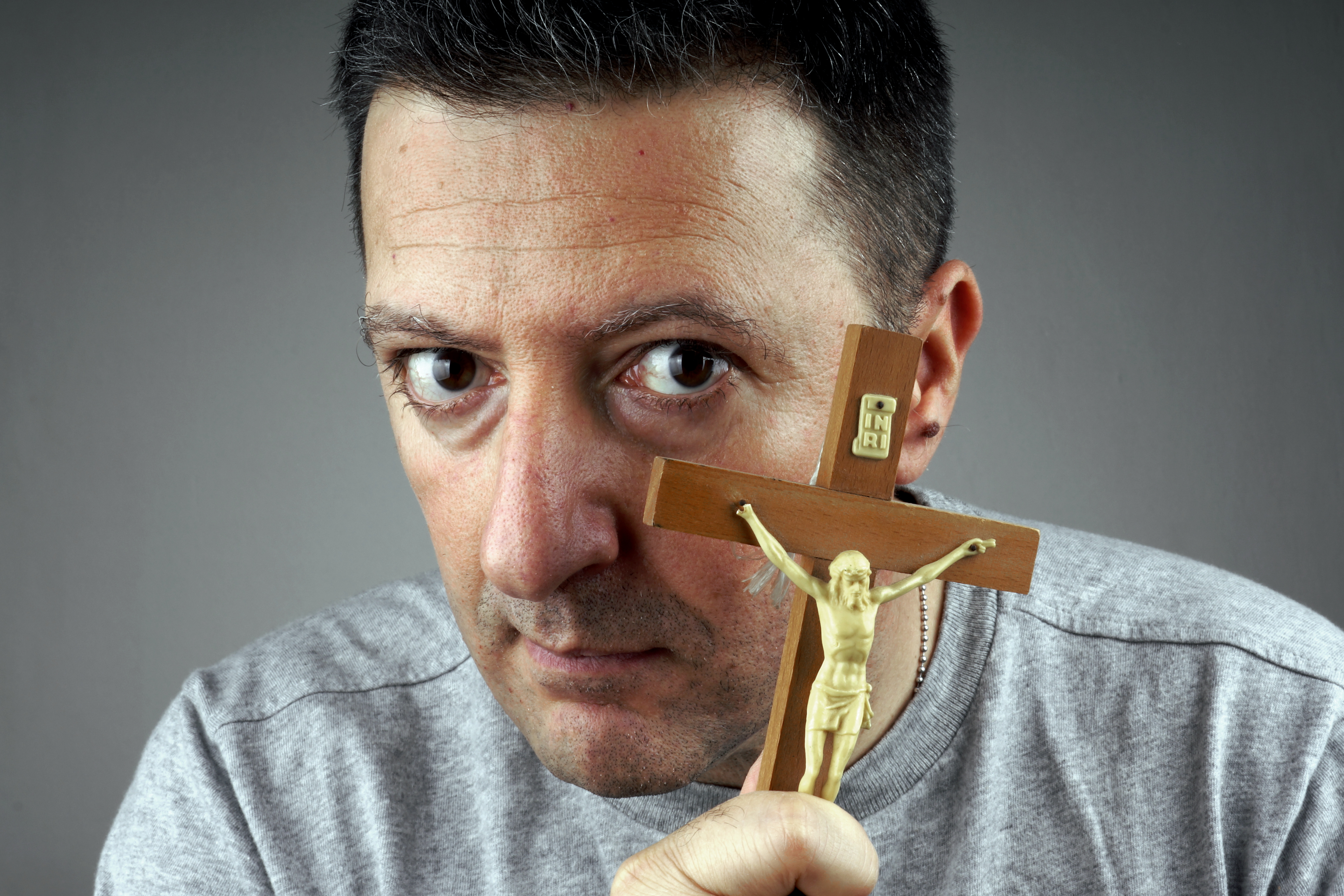
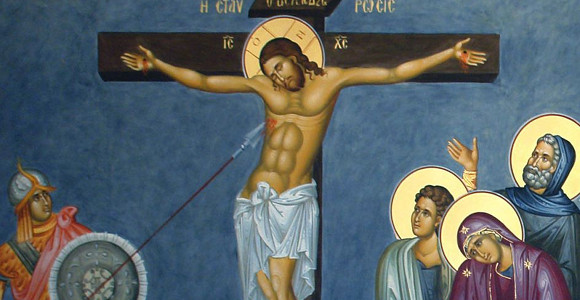
Then Jesus, crying with a loud voice, said, “Father, into your hands I commit my spirit.” Having said this, he breathed his last (Luke 23.46).

Out of all the last sayings of Jesus in the four versions of the Jesus story, this one, this week, has come to be my favorite.

When Constantine elevated Christianity from disadvantaged to privileged in the fourth century, the apparent failure of Jesus’ revolution on the cross became a source of embarrassment.  Then, coupled with the guilt-ridden consciences of the crusaders in the 11th century, the cross took on a wholly different meaning than it had for early Jesus followers.  It is no coincidence that just as Christian soldiers of the crusades returned from the violence of war with bloodstained hands, Christianity, for the first time, began to interpret the cross as God’s doing, God’s violent punishment of humanity’s sins in Jesus, and as Jesus paying for those sins, freeing humans from their deep sense of guilt.  An interpretation of Jesus death that today is labelled as a “Penal Substitutionary Atonement” arises for the first time in Christian history just when Christian military soldiers need some way of dealing with the post-traumatic stress of the merciless slaughter of Jews, Muslims, and heretics.  These soldiers, just like all soldiers exposed to the ugliness of war, were wrestling with the weight of what they had done.  Therefore, the message that Jesus had mercifully paid for their sins came as a great relief.

This interpretation of Jesus’ death, in addition to doing untold damage to Christian theists’ understanding of the character of their God, simply did not exist in the early church.

To the early followers of Jesus, the cross was the failure of Jesus’ revolution.  It was seen as the triumph of the dominating system, both political and religious, of Rome and the Temple aristocracy, over the prophetic ministry of Jesus. [1]

The victory of Jesus was not on the cross, but in his resurrection, which triumphed over and undid his unjust execution.

We will look at this more historically, and more deeply, in the ninth and final installment of this series, but for now, we must hold in mind that the good news to the early followers of Jesus was not that Jesus died, nor was it that someone had come back to life, but that this specific Jesus, who was executed by the dominating system, had been resurrected by God and that this resurrection marked the beginning of a new age when God was not in solidarity with those on the top of the pyramid’s social structures, but in solidarity with those subordinated, marginalized, and oppressed by those social structures.

In order to see and appreciate the resurrection of Jesus as a triumph, we must first see the execution of Jesus for the temporary failure that it was.  We must understand that Jesus’ death is not the victory of God, but the victory of those who opposed Jesus and his radical revolution.

This is why Jesus’ final saying in Luke holds such meaning for me.

When someone chooses to align their story with the Jesus story, when one chooses to stand up for the marginalized, those on the social fringes, and to embrace those whose society has rejected them, a “cross” of some sort will always loom in their near future.

Whether their community is political, economic, social, or religious, when one chooses to stand in solidarity with those whose community has labeled as “sinners,” the threatening nature of that solidarity to the community itself cannot be ignored.

If I could be transparent for a moment, I know something of what I’m writing about here.

This past year (2014), I chose to make some significant shifts in who I was going to stand in solidarity with.  Believing that the Jesus of Luke’s Jesus story was seeking to change the world by, one “table” after another, modeling a “shared meal” (with all its cultural implications in the first century) with those his religious, political, economic, and social community had defined as “other,” as “outsider, as the “marginalized,” I chose to position myself in a way that was intentionally standing in solidarity those whom, today, I perceive my communities treats, at times, as “other.” As a white Jesus follower, I chose to position myself in such a way that was standing in solidarity with those of us who are non-white. As a male Jesus follower, I chose to position myself in such a way that was standing in solidarity with those of us who are non-male. As someone who identifies as cisgender, I made decisions that intentionally positioned me into a space of solidarity with those of us who identify as non-cisgender.  As someone who identifies as straight, I made decisions that intentionally positioned me into a space of solidarity with those of us who identify as non-straight.  There is a Jewish blessing that states that before every person there marches an angel proclaiming, “behold the image of God.”  A Jewish blessing that a friend of mine is very fond of and recently shared with me is, “Blessed are You, Lord, our God, King of the Universe, Who varies Your creation.”

I have chosen to embrace every person I meet as the “image of God” [2] and thus deserving of compassion.

This has had consequences for me.

To make a very long story short, as the director of a nonprofit ministry, the words Jesus spoke in the Sermon on the Mount have become intensely meaningful to me, now more than ever:

Therefore I tell you, do not worry about your life, what you will eat or what you will drink, or about your body, what you will wear.  Is not life more than food, and the body more than clothing? … if God so clothes the grass of the field, which is alive today and tomorrow is thrown into the oven, will he not much more clothe you—you of little faith?  Therefore do not worry, saying, ‘What will we eat?’ or ‘What will we drink?’ or ‘What will we wear?’ … your heavenly Father knows that you need all these things.  But strive first for the kingdom of God [Jesus’ new way of arranging the world; Jesus’ new social order] and his justice, and all these things will be given to you as well. (Matthew 6:25–32, emphasis added)

I have begun to see how it was that Jesus’ ministry, by its nonviolent yet confrontational nature, ended on a Roman cross.  This was a death reserved for the enemies of the dominating system of his day.  This was how Rome, which maintained control of Judaism through its Temple, treated those whom they viewed as a threat.  Jesus’ revolution was a threat to both the Temple as well as the Empire’s control:

If we let him go on like this, everyone will believe in him, and the Romans will come and destroy both our holy place and our nation. (John 11:48)

You do not understand that it is better for you to have one man die for the people than to have the whole nation destroyed. (John 11:50)

In Luke’s version of the gospel, as a result of Jesus’ teachings and demonstration (overturning the tables) in the Temple, Jesus’ ministry had finally reached a climax and had to be addressed: “The chief priests, the scribes, and the leaders of the people kept looking for a way to kill him” (Luke 19:47).

They found their way.

Very quickly, before the next Sabbath even, Jesus was suspended on a Roman cross by their doing.

To all appearances, they had triumphed over this Jesus.  He was getting what every person receives when they color outside of their community’s defined lines.

And yet, Jesus was not dying at their hands without hope.  Jesus was incredibly courageous in the very moment when I am tempted to despair.  This week, Fr. Shay Kerns sent this quotation from Richelle E. Goodrich out via email:

Courage to me is doing something daring, no matter how afraid, insecure, intimidated, alone, unworthy, incapable, ridiculed or whatever other paralyzing emotion you might feel.  Courage is taking action … no matter what.  So you’re afraid?  Be afraid.  Be scared silly to the point you’re trembling and nauseous, but do it anyway.

Although Jesus stood alone, he had a courageous confidence that he had done the right thing.  The cross did not rob Jesus of his assurance that his life and teachings had not been in vain.  He died believing that even his death would be ultimately triumphed over.  In his most “defeated” moment, he committed to his Father the bringing of his revolution to triumphant fruition.  Jesus’ last words in Luke were, “Father, into your hands, I commit my spirit.”

There are multiple things that could be said about this dying statement. One is that it shows the confidence that Jesus had that his cause was on the side of what is right. Next, we should discuss  the title Jesus chose to use: “Father.” We are not to derive from this that the God of the Jesus story has male genitalia.  No no!  Calling God “Father” was deeply political within first century Judaism.  “Father” is not a title for the Hebrew God in the Old Testament that could be used by just anyone.  This is directly from Psalms 89.  Calling God “Father” was a right reserved only for Israel’s King [3]:

The enemy shall not outwit him, the wicked shall not humble him.   I will crush his foes before him and strike down those who hate him.  My faithfulness and steadfast love shall be with him; and in my name his horn shall be exalted.  I will set his hand on the sea and his right hand on the rivers.  He shall cry to me, “You are my Father, my God, and the Rock of my salvation! I will make him the firstborn, the highest of the kings of the earth. (verses 22–27, emphasis added)

This psalm harkens back to Psalm 2 where David retells the decree of this same God:

I will tell of the decree of the LORD: He said to me, “You are my son; today I have begotten you.  Ask of me, and I will make the nations your heritage, and the ends of the earth your possession. (Psalms 2.7–8, emphasis added)

Of King David’s royal offspring, the Hebrew God had declared, “I will be a father to him, and he shall be a son to me” (2 Samuel 7.13–14).

Lastly, to a Hebrew, death was the moment when the body returned to the earth from which it came and one’s spirit returned to God. [4]  For those Hebrews who believed in a resurrection at the end of the age, one’s spirit rests in God’s safe keeping, awaiting the resurrection when it will be reunited with a restored body.

Jesus had stated earlier to his disciples in Luke, “The Son of Man [5] must undergo great suffering, and be rejected by the elders, chief priests, and scribes, and be killed, and on the third day be raised (Luke 9.22, emphasis added).  What Jesus is saying to his disciples here in Luke is that the way to the new world he was inaugurating would be through rejection, crucifixion, and resurrection. This was Jesus’ confidence:  resurrection! Yet resurrection required crucifixion, and crucifixion required rejection.

Do you feel rejected, at times, by your community because you have chosen to follow Jesus in confronting the dominating system of your day?

Jesus, in his final moment, still believed in the intrinsic value of what he had taught and demonstrated throughout his life.  “Seek first God’s new social order and its justice and all these things (and more) will be given back to you.” [6]  This is Jesus, dying in full confidence that, although it looked like the dominating system was winning, this was not going to be the end of the story.  His revolution would not end this way.

What does this mean for us today?

In Luke chapter 9, just after Jesus tells his disciples that he must go to Jerusalem, be rejected by the Temple aristocracy, be executed on a Roman cross, and then be resurrected, he turns to his disciples and says, “‘If any want to become my followers, let them deny themselves and take up their cross daily and follow me’” (Luke 9:23, emphasis added).

Christianity is the only major religion whose central figure was executed by society’s dominant power structure.  And yet our Jesus died in full confidence, committing the keeping of his mission, in his dying moment, to the promise of his Father: “I will make him the firstborn, the highest of the kings of the earth.” (Psalms 89.27) [7]

The cross would not be the end for Jesus, and a cross will not be the end for us as well.

When we, too, embrace the way of the cross, we are at our bleakest moment; when we, too, are rejected as a result of practicing Jesus’ radical inclusivity of those our community deems as “other”; when our sky is “brass over our head and iron under our feet,” we can have that same assurance, knowing that, although this moment looks dark, the heart of the dominating system is being “torn in two” [8] and it is not the end.  We too can, in full assurance of faith, whisper: Father God, Mother God [9], into your safe keeping, “I commit my spirit.”

We need not fear our confrontation of the dominating systems of our day for we stand in the victory of Jesus over all injustice, oppression, violence, subordination, “other-ing,” privileging some while excluding and marginalizing others who are also made in “the image of God” to the fringes of our societies.  This is a victory that has already been won.  Though Jesus’ shared table and Temple confrontation lead him to being put on a cross, that was not the end of the story.

“You won’t find Jesus in the land of the dead.  He is still with us.  

The powers killed him—but they couldn’t stop him.  They crucified him and buried him in a rich man’s tomb.   But imperial execution and a tomb couldn’t hold him. 

He’s still loose in the world.  He’s still out there, still here, still recruiting people to share his passion for the Kingdom of God—a transformed world here and now.  It’s not over.”

—Marcus Borg

HeartGroup Application

  1. What is it that holds you back from standing in solidarity with those who are being excluded from a “shared table” in our world today?  This week, I would ask that you simply spend some time in contemplation, allowing this last statement by Jesus, “into your hands I commit my spirit,” to challenge whatever fears you may be entertaining.
  2. Journal what you discover.  Write down your fears, your concerns, and any breakthroughs you experience through this contemplation.
  3. Share what you experience through this exercise with your HeartGroup this upcoming week.

Whenever I became discouraged as a child, my mother, when she was alive, would always remind me, “You can gauge the size of the victory by the size of the battle.  It is always darkest just before the dawn.”

A new world is coming.  In fact, for those who have eyes to see it, it is already here, growing subversively like a mustard seed in a garden.

Keep living in love till the only world that remains is a world where love alone reigns.

Many voices, one new world.

I love each of you, and I’ll see you next week.


1. See Part 1 on the prophetic lineage of Jesus.

2.  Whoever sheds the blood of a human, by a human shall that person’s blood be shed; for in God’s own image God made humankind. (Genesis 9.6)

3.  “He [David’s offspring] shall build a house for my name, and I will establish the throne of his kingdom forever. I will be a father to him, and he shall be a son to me. When he commits iniquity, I will punish him with a rod such as mortals use, with blows inflicted by human beings” (2 Samuel 7.13-14).

4.  “And the dust returns to the earth as it was, and the breath returns to God who gave
it” (Ecclesiastes 12.7; NRSV). “Many of those who sleep in the dust of the earth shall awake, some to everlasting life, and some to shame and everlasting contempt” (Daniel 12.2; NRSV).

5.  “As I watched in the night visions, I saw one like the Son of Man coming with the clouds of heaven. And he came to the Ancient One and was presented before him. To him was given dominion and glory and kingship, that all peoples, nations, and languages should serve him. His dominion is an everlasting dominion that shall not pass away, and his kingship is one that shall never be destroyed” (Daniel 7.13-14, emphasis added). What Jesus is saying to his disciples in Luke is that the way in which this promise in Daniel would come to fruition would be through rejection, crucifixion, and resurrection.

6.  But strive first for the kingdom of God and his justice, and all these things will be given to you as well. (Matthew 6.33)

7. Remember that Jesus would redefine Kingdom away from hierarchical authority structures to egalitarian mutuality ones in their place. “But he said to them, “The kings of the Gentiles lord it over them; and those in authority over them are called benefactors. But not so with you; rather the greatest among you must become like the youngest, and the leader like one who serves. For who is greater, the one who is at the table or the one who serves? Is it not the one at the table? But I am among you as one who serves.” (Luke 22.25-27)

8.  “It was now about noon, and darkness came over the whole land until three in the afternoon, while the sun’s light failed; and the curtain of the temple was torn in two” (Luke 23:44–45).

9.  “So God created humankind in God’s image, in the image of God, God created them; male and female God created them” (Genesis 1:27, emphasis added).

The Seven Last Sayings of Jesus; Part 2 of 9


Part 2 of 9

My God, My God, Why Have You Forsaken Me?

BY HERB MONTGOMERY

Wooden Rosary


And at three in the afternoon Jesus cried out in a loud voice, “Eloi, Eloi, lema sabachthani?” (which means “My God, my God, why have you forsaken me?”). —Mark 15.34

About three in the afternoon Jesus cried out in a loud voice, “Eli, Eli, lema
sabachthani?” (which means “My God, my God, why have you forsaken me?”). —Matthew 27.46

No saying of Jesus in any of the Gospels has produced more controversy than this one.

Rather than debating whether Jesus truly felt forsaken or not, I believe we need to ask ourselves why Mark (and Matthew) would include this while later gospels would not.

Mark wants us to embrace Jesus as the Messiah, the son of David, the son of man of the Jewish restorative hope [1]. Remember that in Mark’s gospel, the title “son of God” did not mean “second member of the Godhead.” Rather, this was the return of a king to Israel. King David was Israel’s original “son of God.” To call Jesus by this title was to make the connection between Jesus and kingship! This is the one that would liberate Israel from her oppressors and put all injustice, oppression, and violence to right. (Rome also referred to some of the Caesars as the “son of God.” Some of the early followers of Jesus in Acts would subversively call Jesus the “son of God” in this context as an act of noncooperation with Rome, but this would come later.)

Early in the telling of the Jesus story, one of the chief objections to the claim that Jesus was the king, the son of God, the Messiah, was that Jesus was actually crucified by the oppressors, the Romans.

Within Judaism in the first century, for would-be messiahs to end up on Roman crosses meant that their claims to messiahship were false. They had failed! We see from the early letters attributed to Paul that being put on a Roman cross in first-century Judaism was also equated with Deuteronomy’s mention of being “put on a tree.” [2] (However, this would have been a contemporary application, as Deuteronomy was referring to a very different practice than crucifixion.) This would have been the argument: Jesus could not have been the Messiah. He could not have been another “David,” another “son of God,” [3] a new “king.” Rome had defeated him, executing him in the fashion in which Rome executed all political threats, and Jesus had died in a fashion that, according to the Hebrew scriptures, clearly reveals this would-be messiah to also be “cursed of God.” Jesus was a false messiah and his crucifixion proves this in these two accounts.

Mark addresses this objection head-on (and Matthew follows him in doing so).

How does Mark do this? He reaches back to an experience in which David, the King of Israel himself, also appeared to be forsaken, but discovered this was very much not the case.

The use of Jesus’ crucifixion as proof that Jesus could not have been the Messiah, the return of Israel’s king, must have been a very common objection. The psalm in which David expressed his own wrestling with what seemed to be his apparent forsaking by God was used over and over by first-century followers of Jesus. In Matthew’s Gospel, chapter 27, verses 39 & 43, he clearly alludes to David’s God-forsaken psalm:

Matthew 27.39—Those who passed by derided him, shaking their heads

Matthew 27.43—[“]He trusts in God; let God deliver him now, if he wants to; for he said, ‘I am God’s Son.’”

Psalms 22.7-8—All who see me mock at me; they hurl insults at me, they shake their heads; “Commit your cause to the LORD; let him deliver—let him rescue the one in whom he delights!”

John too, in chapter 19, verse 24 of his Gospel, quotes directly from David’s God-forsaken Psalm:

John 19.24—So they said to one another, “Let us not tear it, but cast lots for it to see who will get it.” This was to fulfill what the scripture says, “They divided my clothes among themselves, and for my clothing they cast lots.”

Psalms 22.18—They divide my clothes among themselves, and for my clothing they cast lots.

Matthew, Mark, and Luke quote from this section of David’s God-forsaken psalm, in part:

Matthew 27.35—And when they had crucified him, they divided his clothes among themselves by casting lots;

Mark 15.24—And they crucified him, and divided his clothes among them, casting lots to decide what each should take.

Luke 23.34—And they cast lots to divide his clothing.

Even the author of Hebrews quotes directly from David’s God-forsaken psalm, placing David’s words in the mouth of Jesus:

Hebrews 2.11-12—For this reason Jesus is not ashamed to call them brothers and sisters, saying, “I will proclaim your name to my brothers and sisters, in the midst of the congregation I will praise you.”

Psalms 22.22—I will tell of your name to my brothers and sisters; in the midst of the congregation I will praise you.

Lastly, in his Gospel, John correlates David’s God-forsaken psalm with Jesus’ dying words:

John 19.30—When Jesus had received the wine, he said, “It is accomplished.” Then he bowed his head and gave up his spirit.

Psalms 22.31—And proclaim his deliverance to a people yet unborn, saying that he has accomplished it.

All of this shows that it was very common among the early followers of Jesus to use David’s God-forsaken psalm (Psalm 22) to defend the claim that, like David, Jesus was the “son of God,” [4] Israel’s King, the long-awaited Messiah, the return of the anointed one5, the Christ.

Therefore, it should come as no surprise that Mark would make use of this psalm, too, in his Gospel. It’s rather ingenious, actually. At first, David appears to be forsaken, but by the end of the psalm he discovers that this was a false conclusion and that it only appeared to be so. David sang that God had not forsaken him, that God had not abandoned him:

Psalms 22.1—My God, my God, why have you forsaken me? Why are you so far from saving me, so far from the words of my groaning?

Psalms 22.22-24—I will declare your name to my people; in the assembly I will praise you . . . For he has not despised or scorned the suffering of the afflicted one; he has NOT hidden his face from him but has listened to his cry for help. (Emphasis added.)

If David, King of Israel, could have gone through an occurrence in which, to all appearances, it looked as if he was forsaken and yet in reality he was not, then also Jesus, King of Israel, could go through an occurrence in which, to all appearances, others might judge that he had been God-forsaken, and yet he not be.

Notice in Mark’s Gospel the way Mark aligns King David’s experience with King Jesus’ experience:

They brought Jesus to the place called Golgotha (which means “the place of the skull”). Then they offered him wine mixed with myrrh, but he did not take it. And they crucified him. Dividing up his clothes, they cast lots to see what each would get.

Mark 15.22-24 (Emphasis added.)

Dogs surround me, a pack of villains encircles me; they pierce my hands and my feet. All my bones are on display; people stare and gloat over me. They divide my clothes among them and cast lots for my garment.

Psalms 22.16-18 (Emphasis added.)

It was nine in the morning when they crucified him. The written notice of the charge against him read: THE KING OF THE JEWS. They crucified two insurgents with him, one on his right and one on his left. Those who passed by hurled insults at him, shaking their heads and saying, “So! You who are going to destroy the temple and build it in three days, come down from the cross and save yourself!” In the same way the chief priests and the teachers of the law mocked him among themselves. “He saved others,” they said, “but he can’t save himself! Let this Messiah, this king of Israel, come down now from the cross, that we may see and believe.” Those crucified with him also hurled insults on him.

Mark 15.25-32 (Emphasis added.)

All who see me mock me; they hurl insults, shaking their heads.He trusts in the LORD,” they say, “let the LORD rescue him. Let him deliver him, since he delights in him.”

Psalms 22.7 (Emphasis added.)

At noon, darkness came over the whole land until three in the afternoon. And at three in the afternoon Jesus cried out in a loud voice, “Eloi, Eloi, lema sabachthani?” (which means “My God, my God, why have you forsaken me?”).

Mark 15.33-34 (Emphasis added.)

My God, my God, why have you forsaken me? Psalms 22.1 (Emphasis added.)

Remember that the point is to link Jesus’ experience to David’s. If David could go through an experience in which he appeared to be forsaken by God but wasn’t, and could still be Israel’s king, then Jesus too could go through an experience in which he appeared to be forsaken by God but really wasn’t, and could still be Israel’s king!

This is why I believe that Psalm 22 was relied upon so heavily by the early Jesus-following community. It was their way of addressing the objection, produced by Jesus’ crucifixion, to their claim that he was the long-awaited Messiah, the return of their king. This is how they could proclaim that although Jesus had been crucified, he was still Lord.

Today, historical and textual critiques argue about whether these words were actually said by Jesus or were supplied apologetically by Mark. Either way, it matters little. Let’s say, for the sake of argument, that these words are actually original to the historical Jesus. If Jesus had quoted from Psalm 22 on the cross, we must assume that he too would have known the entire psalm, and either used it as a source of comfort, reassuring himself that it only looked as if he was God-forsaken but that he genuinely was not, or he could have been quoting this psalm to answer the derision of those who mocked him, saying that his crucifixion did not disprove his claim to be their King, as David had gone through a similar experience of appearing to be forsaken but not being so. What seems obvious to me is that Jesus could not have genuinely felt forsaken by God while quoting this psalm, because he would have known how it ends:

Psalm 22:24—For he has not despised or scorned the suffering of the afflicted one; he has not hidden his face from him but has listened to his cry for help.

Mark ends his crucifixion narrative with the proclamation of a Roman centurion:

Mark 15:37-39—With a loud cry, Jesus breathed his last. The curtain of the temple was torn in two from top to bottom. And when the centurion, who stood there in front of Jesus, saw how he died, he said, “Surely this man was the Son of God!” (Emphasis added.)

Mark, who from the beginning of his Gospel had centered the Jesus movement in Galilee as opposed to Jerusalem, described the religious leaders in Jerusalem mocking the claim that Jesus was their “king” while this Roman centurion, a gentile, “gets it.” Remember, to a first- century Jew (and also to a Roman, for that matter), the title “son of God” was not a religious title, but a political one. It meant that this one was the king.

Did Jesus actually say these words? There is no way to prove it conclusively.

Did Jesus actually feel forsaken? Whether these words were original to Jesus or were Mark’s narrative device, it is very unlikely either way, given the entirety of Psalm 22, that Jesus said these words as an expression of truly feeling that he was forsaken.

Did the God of the Jesus narrative actually forsake Jesus in this story while Jesus was on the cross? Absolutely not! The narrative element of the resurrection will show that the God of the Jesus story was standing in solidarity with Jesus every step along the way, over and against those who were executing Jesus (we’ll address this in Part 9).

What does this mean for us?

As a theist, have you ever felt forsaken by your God when the established authority stood against you, claiming God was on their side? Don’t trust appearances. Just as the early followers of Jesus were not to trust the way things appeared on the night Jesus was executed, we are not to trust the way things may look for us when we stand up against the religious, economic, or political domination systems of our day. It may appear that you are presently on a cross, presently forsaken by your God, but your God has not abandoned you. Don’t lose the hope and assurance imparted by the resurrection.

HeartGroup Application

  1. Go back and contemplate the times in your life when you felt as if your God had forsaken you. Allow the Jesus story to rewrite that narrative in your heart. Allow yourself to see yourself as not forsaken, but only appearing to be so. Don’t trust in how things appeared at the time. Choose to believe your God had not abandoned you, but was with you all along the way.
  2. Journal the paradigm shifts you experience as you go through this exercise.
  3. Share with your upcoming HeartGroup what you wrote down.

We need not fear standing up to injustice, oppression, and violence in our time. We need not fear standing up against the religious, economic, political, or social domination systems of our day. As Jesus’ followers, we stand in the light streaming from the tomb! That light tells us that the domination system of Jesus’ day could not stop him, even on the cross. Jesus is still out there, still recruiting, still calling those who will stand up and follow his lead as he shows us a way to a new world, whispering . . . “follow me.”

Until the only world that remains is a world where Love reigns. Many voices, one new world.
I love each of you.
I’ll see you next week.


1. Daniel 7.13-14—In my vision at night I looked, and there before me was one like a son of man, coming with the clouds of heaven. He approached the Ancient of Days and was led into his presence. He was given authority, glory and sovereign power; all nations and peoples of every language worshiped him. His dominion is an everlasting dominion that will not pass away, and his kingdom is one that will never be destroyed.

2. Galatians 3.13—Christ redeemed us from the curse of the law by becoming a curse for us, for it is written: “Cursed is everyone who is hung on a pole.” Deuteronomy 21.22-23—If anyone guilty of a capital offense is put to death and their body is exposed on a pole, you must not leave the body hanging on the pole overnight. Be sure to bury it that same day, because anyone who is hung on a pole is under God’s curse. You must not desecrate the land the LORD your God is giving you as an inheritance. John 19.31—Now it was the day of Preparation, and the next day was to be a special Sabbath. Because the Jewish leaders did not want the bodies left on the crosses during the Sabbath, they asked Pilate to have the legs broken and the bodies taken down.

3. Psalms 2.7—I [David] will proclaim the LORD’s decree: He said to me, “You are my son; today I have become your father.

4. Psalms 2.7—I [David] will proclaim the LORD’s decree: He said to me, “You are my son; today I have become your father.

5. Psalms 2.2—The kings of the earth rise up and the rulers band together against the LORD and against his anointed [David], saying; Psalms 18.50—He gives his king great victories; he shows unfailing love to his anointed, to David and to his descendants forever; Psalms 20.6— Now this I know: The LORD gives victory to his anointed. He answers him from his heavenly sanctuary with the victorious power of his right hand; Psalms 23.5—You prepare a table before me in the presence of my enemies. You anoint my head with oil; my cup overflows; Psalms 28.8—The LORD is the strength of his people, a fortress of salvation for his anointed one; Psalms 45.2—You are the most excellent of men and your lips have been anointed with grace, since God has blessed you forever; Psalms 45.7—You love righteousness and hate wickedness; therefore God, your God, has set you above your companions by anointing you with the oil of joy; Psalms 84.9—Look on our shield, O God; look with favor on your anointed one; Psalms 89.20—I have found David my servant; with my sacred oil I have anointed him; Psalms 89.38—But you have rejected, you have spurned, you have been very angry with your anointed one; Psalms 89.51—the taunts with which your enemies, LORD, have mocked, with which they have mocked every step of your anointed one; Psalms 105.15—“Do not touch my anointed ones; do my prophets no harm.”; Psalms 132.10—For the sake of your servant David, do not reject your anointed one; Psalms 132.17—“Here I will make a horn grow for David and set up a lamp for my anointed one.

The Seven Last Sayings of Jesus; Part 1 of 9

Part 1 of 9

Two Definitions of Holiness

BY HERB MONTGOMERY

Wooden Rosary

This week I want to begin a nine-part series leading up to this year’s Easter season. Beginning next week, we will take a look at each of the last sayings we are given in the gospels of Matthew, Mark, Luke, and John. We will begin with Mark and Matthew and progress from there. We will finally take a look at what relevance the narrative element of the Resurrection may have for us in our world today in the week leading up to Easter.

In the interest of being transparent, this series has come out of an exercise I was engaged in personally throughout 2014. As each week is composed of seven days, I took one of the last sayings of Jesus each day as the subject of contemplation—one saying, every day, for the whole year. What I’m about to share, very humbly, is simply the fruit of that year-long contemplation.

I want to begin this week by taking a look at what actually put Jesus on the cross.

Jesus’ crucifixion (and resurrection) in the gospels comes at the end of a long history of contention that began between the privileged/oppressive priesthood (Levitical) and prophets who spoke up as advocates for those the priests were oppressing. For dominating priests, holiness was defined by the purity codes attributed to Moses (sometimes referred to as holiness codes). For the prophets, holiness was defined not by ritualistic or religious “purity” but justice for the oppressed; mercy for the poor, fatherless children, and widows (within a patriarchal culture); and humility. [1]

The struggle between these two groups began, by most scholars’ reckoning, with Amos and Isaiah (Isaiah Chapters 1–39) in the eighth century BCE.

Here is just a sampling:

Amos

This is what the LORD says: “For three sins of Israel, even for four, I will not turn back my wrath. They sell the innocent for silver, and the needy for a pair of sandals. They trample on the heads of the poor as on the dust of the ground and deny justice to the oppressed. Father and son use the same girl and so profane my holy name.” (Amos 2.6–7)

There are those who turn justice into bitterness and cast righteousness to the ground. (Amos 5.7)

You levy a straw tax on the poor and impose a tax on their grain. Therefore, though you have built stone mansions, you will not live in them; though you have planted lush vineyards, you will not drink their wine. For I know how many are your offenses and how great your sins. There are those who oppress the innocent and take bribes and deprive the poor of justice in the courts. (Amos 5.11–12)

“I hate, I despise your religious festivals; I cannot stand your assemblies. Even though you bring me burnt offerings and grain offerings, I will not accept them. Though you bring choice fellowship offerings, I will have no regard for them. Away with the noise of your songs! I will not listen to the music of your harps. But let justice roll on like a river, righteousness like a never-failing stream! (Amos 5.21–24)

Hear this, you who trample the needy and do away with the poor of the land, saying, “When will the New Moon be over that we may sell grain, and the Sabbath be ended that we may market wheat?”— skimping on the measure, boosting the price and cheating with dishonest scales, buying the poor with silver and the needy for a pair of sandals, selling even the sweepings with the wheat. (Amos 8.4–6)

Notice the meticulous keeping of the New Moon and Sabbath (ritual purity codes) but utter disregard for justice toward the poor and oppressed.

Isaiah

Hear the word of the LORD, you rulers of Sodom; listen to the instruction of our God, you people of Gomorrah! [2] “The multitude of your sacrifices—what are they to me?” says the LORD. “I have more than enough of burnt offerings, of rams and the fat of fattened animals; I have no pleasure in the blood of bulls and lambs and goats. When you come to appear before me, who has asked this of you, this trampling of my courts? Stop bringing meaningless offerings! Your incense is detestable to me. New Moons, Sabbaths and convocations—I cannot bear your evil assemblies. Your New Moon feasts and your appointed festivals I hate with all my being. They have become a burden to me; I am weary of bearing them. When you spread out your hands in prayer, I will hide my eyes from you; even if you offer many prayers, I will not listen. Your hands are full of blood; wash and make yourselves clean. Take your evil deeds out of my sight! Stop doing wrong, learn to do right! Seek justice, encourage the oppressed. Defend the cause of the fatherless, plead the case of the widow. (Isaiah 1.10–17)

She once was full of justice; righteousness used to dwell in her—but now murderers! (Isaiah 1.21)

Your rulers are rebels, companions of thieves; they all love bribes and chase after gifts. They do not defend the cause of the fatherless; the widow’s case does not come before them. (Isaiah 1.23)

Woe to those who make unjust laws, to those who issue oppressive decrees, to deprive the poor of their rights and withhold justice from the oppressed of my people, making widows their prey and robbing the fatherless. (Isaiah 10.1–2)

A shoot will come up from the stump of Jesse; from his roots a Branch will bear fruit. The Spirit of the LORD will rest on him—the Spirit of wisdom and of understanding, the Spirit of counsel and of might, the Spirit of the knowledge and fear of the LORD—and he will delight in the fear of the LORD. He will not judge by what he sees with his eyes, or decide by what he hears with his ears; but with justice he will govern the needy, with equity he will give decisions for the poor of the earth. He will strike the earth with the rod of his mouth; with the breath of his lips he will slay the wicked. Justice will be his belt and integrity the sash around his waist. (Isaiah 11.1-5) [3]

LORD, you are my God; I will exalt you and praise your name . . . You have been a refuge for the poor, a refuge for the needy in their distress . . . (Isaiah 25.1-4)

The Maccabean Revolt

During the time of the Maccabean Revolt, there was a revival in fidelity to the purity codes and the definition of holiness as fidelity to those codes. It was during this time that we see the birth of the Pharisees. This group was more liberal in their theology (angels, resurrection, etc.) yet more strict in their adherence to the purity codes. They stood in alliance with the privileged class of priests, placing the blame for their captivity and foreign oppression on ritual or religious impurity in not keeping the purity codes of Moses. Yet it must be remembered that the prophets stood in direct conflict with this explanation of Israel’s history, expressing that the captivity was rather a result of the abuses of the priestly domination culture over the poor, fatherless, and widowed—of the privileged over the oppressed.

Jesus

By the time Jesus comes on the scene, the priests (along with the Pharisees) are well entrenched again within a politically and economically oppressive system consisting of the temple, the priesthood, the sacrifices, and Jerusalem/Judea at its heart. Jesus comes not as a teacher out of Judea, or the priesthood, but was rather from the northern region of Galilee, far removed. Galileans, according to the Pharisees and priestly class of Judea, were considered less faithful to the ritual purity/holiness codes as a result, not only because of their proximity to their surrounding Hellenistic culture, but also their distance from Jerusalem, the temple, and the theological leadership of the Pharisees and priestly class themselves.

When one understands this history, along with the political and economic privileges of the priestly class in Judea in the first century, the fact that Jesus takes up the heritage of the prophets in advocating for the oppressed is breathtaking.

“The Spirit of the Lord is on me, because he has anointed me to proclaim good news to the poor. He has sent me to proclaim freedom for the prisoners and recovery of sight for the blind, to set the oppressed free.” (Luke 4.18)

Just like the prophets before him, in response to the privileged, priestly ruling class of his day, Jesus denounces economic oppression. [4] Just like the prophets before him, in response to the Pharisees defining of holiness as strict adherence to the ritual purity codes of Moses, Jesus stands in solidarity with those the Pharisees label as unclean and defines holiness rather as justice/mercy for those the Pharisees are marginalizing. [5] Remember, the Pharisees defined a “sinner” as a Jew who was not observing the ritual purity codes. That Jesus embraced and ate with these “sinners” infuriated the Pharisees. Holiness to a Pharisee was exclusive and punitive. Holiness to Jesus was inclusive and restorative. Holiness to a Pharisee was defined as strict adherence to ritual purity codes including the Sabbath, the New Moon, the sacrifices, etc. [6] Holiness to Jesus was justice for those the priestly class, along with the Pharisees, were oppressing based on their non-adherence to the purity codes. Jesus would offer a way of worshiping their God that completely bypassed the temple, the sacrifices, and the purity codes. [7]

If you had known what these words mean, ‘I desire mercy, not sacrifice,’ you would not have condemned the innocent. (Matthew 12.7)

But go and learn what this means: ‘I desire mercy, not sacrifice.’ For I have not come to call the righteous, but sinners. (Matthew 9.13) [8]

Jesus would take his final stand against the political and economic oppression of the priests, temple tax and its rituals. His effort was not to “cleanse” the temple but to dismantle the entire system.

For those who believed that holiness was defined as adherence to the ritual purity codes, with the temple and sacrifices at its heart, Jesus’ acts would invite greater foreign oppression. In their opinion, contrary to the prophets, it was laxness in adherence to the purity codes that had caused foreign captivity originally. Jesus’ opposition to the Pharisees and priests, along with his doing away with the temple and its rituals would surely bring the destruction of the nation at the hands of foreign enemies once again.

Then the chief priests and the Pharisees called a meeting of the Sanhedrin . . . “If we let him go on like this, everyone will believe in him, and then the Romans will come and take away both our temple and our nation.” Then one of them, named Caiaphas, who was high priest that year, spoke up, “You know nothing at all! You do not realize that it is better for you that one man die for the people than that the whole nation perish.” (John 11.47–50, emphasis added)

It was the priests, along with the temple police, who arrested Jesus. [9] Their privileged way of life was at risk. And yet how twisted it was.

Their perception was thus:

  1. They defined holiness as adherence to ritual purity.
  2. The stricter the people were in following the purity codes, the more privileged their political and economic place in their society became.
  3. Failure to follow strict ritual purity would invite the punishment of their God.

Jesus proclaimed the very opposite:

  1. Holiness, like previous prophets proclaimed, is justice and equity for the marginalized,   oppressed, subordinated, and disadvantaged.
  2. The dominance system of the present social order, where some are privileged at the subordination and oppression of others, must be abandoned.
  3. Failure to advocate for the marginalized and the oppressed would be at the heart of all that would eventually result in the destruction of Jerusalem at the hands of Rome.

How did the ruling class of priests along with the political party of the Pharisees respond to Jesus’ teachings?

Early in the morning, all the chief priests and the elders of the people came to the decision to put Jesus to death. (Matthew 27.1, emphasis added)

I’ll close this week with a small insight we get from John’s version of the story of Jesus.

Now it was the day of Preparation, and the next day was to be a special Sabbath. Because the Jewish leaders did not want the bodies left on the crosses during the Sabbath, they asked Pilate to have the legs broken and the bodies taken down. (John 19.31)

It’s as if, right here, we step all the way back into the days of Amos and Isaiah. Once again, there are those who are more concerned with strict adherence to the ritual purity and holiness codes of Moses than this gross act of injustice against one they had just lynched. The story does not end with the success of the Pharisees and the priests in murdering Jesus. In the narrative element of the Resurrection, Jesus’ God stands victoriously against the God of the oppressors. Jesus’ God stands in solidarity with Jesus, as well as the prophets of old, bringing him back to life and overturning and undoing the lynching of Jesus over and against the political and economic oppression of Jesus’ day. The resurrection is God’s “yes” to Jesus and God’s “no” to the established authority. But we will get there. I’ll save that part for Part 9. First, let’s take a look at each of the seven last sayings of Jesus on the cross and see what those statements are whispering to us today.

Marcus Borg once stated, “”Christianity is the only major religion whose central figure was executed by established authority.” As we begin, it would be good to remember that our society today holds, in principle, the same dynamics that existed in Jesus’ day. Whether we are talking about the rich subordinating the poor, the educated subordinating the uneducated, whites subordinating nonwhites, men subordinating women, white women subordinating nonwhite women, straight people subordinating and/or extirpating those who are LGBQ, or cisgender extirpating those who self-identify as transgender, we are living in the Jesus narrative every day. Therefore, if you are a theist, you have to ask yourself how your God defines holiness. Does your God look like Jesus’ God, or does your God look like the God of the priests and Pharisees?

Jesus had a definition of holiness that radically attracted and was embraced by those who were repelled by or steered clear of the definition of holiness put forth by the priestly ruling class of Jesus’ day.

I guess what I’m asking is this: If you are a theist, does your God look like Jesus?

The answer to this question is at the heart of everything. Is your theism destructive or restorative? Inclusive or exclusive? Attractive and inspiring or repulsive? One leads to annihilation and the other to a whole new world.

HeartGroup Application

1. I’d like you to go back and reread all four Gospels. They won’t take you that long. They are shorter than you think. Watch for the dynamics I’ve put forth this week and see if you see them at work in the narrative as well. Look for why the narratives themselves tell us that Jesus’ ministry ended up on a Roman cross. Then we’ll go from there next week.

2. Journal what you discover.

3. Share with your HeartGroup what you write down this upcoming week.

Until the only world that remains is a world where love reigns. Many voices, one new world.

I love each of you.
I’ll see you next week.


1. Micah 6.8—He has shown all you people what is good. And what does the LORD require of you? To act justly and to love mercy and to walk humbly with your God.

2. Two centuries later, Ezekiel would define the sins of Sodom (and Gomorrah) as violations of social justice. Ezekiel 16.49—“Now this was the sin of your sister Sodom: She and her daughters were arrogant, overfed and unconcerned; they did not help the poor and needy.”

3. It is most interesting to read the rest of Isaiah 11 as a metaphorical description of a new social order where the present dominance order is replaced with a world where oppressors no longer oppress and victims are no longer victimized, but both, transformed, peacefully coexist.

4. Luke 6.20, 24—Looking at his disciples, he said: “Blessed are you who are poor, for yours is the kingdom of God . . . But woe to you who are rich, for you have already received your comfort. Mark 12.40—They devour widows’ houses and for a show make lengthy prayers. These men will be punished most severely. Mark 12.43—Calling his disciples to him, Jesus said, “Truly I tell you, this poor widow has put more into the treasury than all the others. Luke 18.3—And there was a widow in that town who kept coming to him with the plea, ‘Grant me justice against my adversary.’

5. Matthew 9.11—When the Pharisees saw this, they asked his disciples, “Why does your teacher eat with tax collectors and sinners?” Matthew 11.19—The Son of Man came eating and drinking, and they say, ‘Here is a glutton and a drunkard, a friend of tax collectors and sinners.’ But wisdom is proved right by her actions.” Luke 15.1–2—Now the tax collectors and sinners were all gathering around to hear Jesus. But the Pharisees and the teachers of the law muttered, “This man welcomes sinners and eats with them.”

6. John 9.16—Some of the Pharisees said, “This man is not from God, for he does not keep the Sabbath.” It is interesting to read the whole of chapter 9 with the redefinition of “holiness” and “sinner” away from the ritual purity codes to the restoration of justice and mercy toward the oppressed.

7. Mark 7.19—“For it doesn’t go into your heart but into your stomach, and then out of your body.” (In saying this, Jesus declared all foods clean.)

8. Remember, Jesus is using the Pharisee’s definition of sinner here as someone who was living outside the ritual purity codes of Moses. Jesus defined holiness and the term “sinner” much more like the prophets of old did, which was radically different than the Pharisees, priests, and experts in the purity codes (“experts in the law”).

9. Luke 22.52—Then Jesus said to the chief priests, the officers of the temple police, and the elders, who had come for him, “Am I leading a rebellion, that you have come with swords and clubs?

A New Social Order

warisover

by Herb Montgomery

Now after John was arrested, Jesus came to Galilee, proclaiming the good news of God, and saying, “The time is fulfilled, and the kingdom of God has come near; repent, and believe in the good news.” (Mark 1:14–15)

This week we are still, momentarily, in the
first chapter of Mark. I want to focus on a few details that are often overlooked in our featured text.

Jesus Came to Galilee

If the scholarly data concerning the timing of when Mark’s gospel was written is true, this is a time when the future of Jerusalem was not promising. Political tensions with Rome had been high and were continuing to escalate. It is during this time that Mark draws our attention away from a Jerusalem-centered movement of violent insurrection against the Romans, to a Galilean- centered movement following the teachings of the itinerant Jesus. Mark’s gospel also redefines the “kingdom” of Daniel’s “son of man.”[1] In Mark’s gospel, Jesus is the long-awaited “messiah.” Jesus is the “son of David” who would restore the “Kingdom.” Jesus is still the “son of God,” the anointed one to whom God is “pleased” to give the Kingdom.[2] But a few things have changed. In the Old Testament, this restoration located “Jerusalem” as the center to which the entire world would flock.[3] In Mark’s gospel, the Kingdom of the son of man would follow, instead, the destruction of Jerusalem, and rise out of Galilee rather than Judea.[4] We do not have the space here to elaborate any further on this point, but it is a study well worth your time to contemplate the differences between Judea and Galilee in the first century ethnically, geographically, politically, economically, culturally, linguistically, and religiously, contemplating what these differences might have meant for the beginnings of the early Jesus movement.

Proclaiming the Good News

This next point is so well known and agreed upon by so many that I will not spend much time on this, but it is worth noting. The term for Good News or “Gospel” in the Greek is euaggelion. This originally was neither a religious nor a Christian term. Instead, this was a political term that announced a new social order. Whenever Rome would conquer a territory, Rome would send out an “evangelist” who would proclaim to the conquered territory the “gospel” or good news that they were now under the rule of the peace of Rome (Pax Romana). The messenger would announce that Caesar was the son of God and Rome was the savior of the world. This messenger would proclaim to this newly conquered territory that Rome’s dominion would give this territory a newfound prosperity and peace just as Rome had accomplished for other places as well.

Here are a few examples of the political nature of Rome’s use of the term “gospel.”

“Even after the battle at Mantinea, which Thucydides has described, the one who first announced the victory had no other reward for his glad tidings [euangelion] than a piece of meat sent by the magistrates from the public mess” (Plutarch; Agesilaus, p. 33, 1st century).

“Accordingly, when [Aristodemus] had come near, he stretched out his hand and cried with a loud voice: ‘Hail, King Antigonus, we have conquered Ptolemy in a sea-fight, and now hold Cyprus, with 12,800 soldiers as prisoners of war.’ To this, Antigonus replied: ‘Hail to thee also, by Heaven! but for torturing us in this way, thou shalt undergo punishment; the reward for thy good tidings [euangelion] thou shalt be some time in getting’” (Plutarch; Demetrius, p. 17, 1st century).

“Why, as we are told, the Spartans merely sent meat from the public commons to the man who brought glad tidings [euangelion] of the victory in Mantineia which Thucydides describes! And indeed the compilers of histories are, as it were, reporters of great exploits who are gifted with the faculty of felicitous speech, and achieve success in their writing through the beauty and force of their narration; and to them those who first encountered and recorded the events [εὐαγγέλιον – euangelion] are indebted for a pleasing retelling of them” (Plutarch; Moralia [Glory of Athens], p. 347, 1st century).

The term Gospel originally communicated the arrival of a new social order.

The Arrival of the Kingdom

The Jesus of Mark’s gospel would take this same word, but instead of announcing the Kingdom of Rome, it would announce the Kingdom of God. It is a profound realization when it dawns on a person that the Jesus of Mark never once is found offering people a way to get to heaven. Rather, Mark’s Jesus is traveling the Galilean countryside announcing a new social order, here and now, that is “of God.”

Part of this new social order is not just a recasting of the term “gospel,” but a redefinition of the very term “Kingdom” as well.

In Mark chapter 10, Mark tells us the story of James and John wanting the honorable position of sitting next to Jesus on his left and right when Jesus’ Kingdom becomes established (Messiah’s Rule). Notice the traditional hierarchical nature of James and John’s understanding of the term “Kingdom.” Kingdom refers to a social order wherein humans are exercising dominance over others, and James and John want in on that dominance!

But Jesus is redefining the nature of the “Kingdom” promised by the Old Testament prophets. It’s as if Jesus is saying, yes, the new social order that I’ve come to inaugurate is what the

prophets were pointing to, but it won’t fit your traditional understandings of how “Kingdoms” are ordered.

“Jesus called them and said to them, ‘You know that among the Gentiles those whom they recognize as their rulers lord it over them, and their great ones are exercising authority over them. But it is not so among you; but whoever wishes to become great among you must be your servant, and whoever wishes to be first among you must be slave of all. For the Son of Man came not to be served but to serve . . .” (Mark 10.42–45).

Jesus’ new social order would not involve humans exercising dominance over one another, but rather, serving one another instead. This would be a social order characterized, not by the privileging of some at the subordination of others, but by love, equality, and justice. Jesus’ new social order would be a complete and total dismantling of the present social order. It would involve egalitarianism in matters of race, gender, and economics specifically. And, for it to become permanent, it would be a slow process where even the new social order’s enemies were won to it, through confrontational, enemy love, rather than being conquered by it. Human hierarchies would be abandoned, for brother- and sisterhood.

Everything about this new social order would be different, not simply compared to Rome, but even when compared to the political and economic social order that existed in Jerusalem at that time, which was centered on the Temple. (It was Jesus’ confrontation with the Temple and the social order centered there that got him lynched.)

Repent and Believe the Good News

The Greek word for Repent is metanoeo. It means to think differently or to reconsider. What Jesus was calling us to was a radical rethinking of how we had structured and ordered our human societies. He was calling us to reassess our values, placing our fellow humans at the top of those values. This rethinking applied to both those being oppressed by the current social order as well as those who were doing the oppressing. Things could not continue the way they had or humanity would cease to exist. The ever-burning fire of violence between oppressors and the oppressed was escalating. Jesus was first and foremost calling us to rethink everything.

Secondly, he was asking us to believe in the reordering of the human society he was proposing.

The Greek phrase for “repent and believe” is metanoesein kai pistos. Scholars today have discovered this phrase used also in other contexts than simply by Jesus in the gospels of Matthew, Mark, Luke, and John. Josephus, in his autobiography, records an event that took place in his life when he endeavored to “to put an end” to various Galilean seditions “without bloodshed.” Josephus engages with the “captain” of the brigands “who were in the confines of Ptolemais” and tells this captain that he would forgive “what he had done already, if he would repent of it, and be faithful to me [Josephus] hereafter.” Josephus was, according to scholars, requiring this brigand, to abandon his violent revolutionary inclinations, and trust Josephus for a better way. The phrase Josephus uses is “metanoesein kai pistos emoi.[5]”

This is the same phrase Jesus used in asking those in his day to rethink their present course, and forsake both the violence of oppression (economic oppression of the Temple against the poor) as well as violent forms of revolution (Jewish zealotry against Rome), trusting in and being faithful to Jesus’ alternate way forward to a new social redistribution.

Today

Today, humanity is still struggling with its addiction to establishing social orders of dominance and hierarchies, privilege and subordination. We live in a world where whites are privileged over nonwhites; where men are privileged over women; where the rich are privileged over the poor; where those who are defined as “straight” and “cis” are privileged over those who self-identify as LGBTIQ; where the formally educated are privileged over those who, in many cases, have equal intelligence, but have not had the same opportunities offered.

What is the Jesus narrative saying to us today?

In 1971 John Lennon released the single, “Happy Xmas (War is Over).” The billboards read “War is over, if you want it.” Today the Jesus narrative is saying, “A new social order has arrived . . . if you want it.” The Jesus story announces the arrival of a whole new world. It has arrived in subversive relation to the present order of things. It involves a radically new way of thinking about everything. It is a new world centered on love, mercy, forgiveness, equality, and justice . . . for all. It is “near,” if we want it.[6]

HeartGroup Application

1.  Any time one human seeks to subordinate a fellow human, whether on the basis of race, gender, economic status, formal education (or the lack of it), orientation, even if it carries the label of “Christian,” nothing could be less like the Christ. This week, first, I want you to look up the definitions of Metaphysics, Cosmology, and Ontology and then look up the definition of Ethics. Then I want you to go back and read the Sermon on the Mount in Matthew 57. Many today are “Christians” based on a cultural definition of the first three. But what will change the world is when Christians return to following Christ according to the last meaning. The Jesus of Matthew, Mark, Luke, and John spent precious little time teaching about Metaphysical realities, Cosmologies, and Ontology. I’m not saying he never mentioned those. But by comparison, the lion’s share of Jesus’ teachings centered on Ethics. Today we have a Christianity that possesses a strangely opposite emphasis. Many (thank heaven for the exceptions) define themselves and others with a prioritization on the first three (one’s beliefs when it comes to metaphysics, cosmology, and ontology) while revealing a strange ignorance about what the Jesus of the canonical gospels taught concerning our ethical practices in relation to our fellow humankind. When one encounters the ethical teachings of Jesus, one can see why he was a threat to the then present social order of his day, and why he was removed.

2.  Journal what you discover.

3.  Share what you discover with your HeartGroup.


Till the only world that remains is a world where Love reigns. Many voices, One New World. I love each and every one of you. Thanks for giving this a read.
I’ll see you next week.

1 Daniel 7.13–14— In my vision at night I looked, and there before me was one like a son of man, coming with the clouds of heaven. He approached the Ancient of Days and was led into his presence. He was given authority, glory and sovereign power; all nations and peoples of every language worshiped him. His dominion is an everlasting dominion that will not pass away, and his kingdom is one that will never be destroyed.

2 Mark 1.11—And a voice came from heaven: “You are my Son, whom I love; with you I am well pleased.” Daniel 4.17—“The decision is announced by messengers, the holy ones declare the verdict, so that the living may know that the Most High is sovereign over the kingdoms on earth and gives them to the one with whom He is pleased and sets over them the lowliest of people.”

3 Isaiah 2.2—In the last days the mountain of the LORD’s temple will be established as the highest of the mountains; it will be exalted above the hills, and all nations will stream to it.

4 Mark 13.24—“But in those days, following that distress, ‘the sun will be darkened, and the moon will not give its light; the stars will fall from the sky, and the heavenly bodies will be shaken.’ At that time people will see the Son of Man coming in clouds with great power and glory.” Daniel 7.13–14—In my vision at night I looked, and there before me was one like a son of man, coming with the clouds of heaven. He approached the Ancient of Days and was led into his presence. He was given authority, glory and sovereign power; all nations and peoples of every language worshiped him. His dominion is an everlasting dominion that will not pass away, and his kingdom is one that will never be destroyed.

5 The Life Of Flavius Josephus, (Thackery 110); cf. N.T. Wright, Jesus and the Victory of God [Minneapolis: Fortress, 1996, p. 251; NT Wright, The Challenge of Jesus (Downers Grove, IL: InterVarsity Press, 1999), p. 44

6 Matthew 3.2—And saying, “Repent, for the kingdom of heaven has come near.” Matthew 4.17—From that time on Jesus began to preach, “Repent, for the kingdom of heaven has come near.” Matthew 10.7—As you go, proclaim this message: “The kingdom of heaven has come near.” Mark 1.15—“The time has come,” he said. “The kingdom of God has come near. Repent and believe the good news!” Luke 10.9—Heal the sick who are there and tell them, “The kingdom of God has come near to you.” Luke 10.11—“Even the dust of your town we wipe from our feet as a warning to you. Yet be sure of this: The kingdom of God has come near.”

Communities of Origin and Internalized Self-Hatred

by Herb MontgomeryReligious Man

They went to Capernaum; and when the Sabbath came, he entered the synagogue and taught. They were astounded at his teaching, for he taught them as one having authority, and not as the scribes. Just then there was in their synagogue a man with an unclean spirit, and he cried out, “What have you to do with us, Jesus of Nazareth? Have you come to destroy us? I know who you are, the Holy One of God.” But Jesus rebuked him, saying, “Be silent, and come out of him!” And the unclean spirit, convulsing him and crying with a loud voice, came out of him. They were all amazed, and they kept on asking one another, “What is this? A new teaching—with authority! He commands even the unclean spirits, and they obey him.” At once his fame began to spread throughout the surrounding region of Galilee. (Mark 1:21-28)  

Within the holy hours of the Sabbath, and within the holy walls of the Synagogue, we find the story of a demoniac who encounters Jesus. Few stories are scarier to the human psyche than stories of demoniacs. Mark is careful to place this one at the beginning of his Jesus narrative, and he does so for a reason.

This is a story that takes place within the most sacred boundaries (in both time and space) of religious communities, not outside them. The social phenomenon we are going to be discussing is not reserved for only religious communities, though. The unity of religious as well as nonreligious communities alike is maintained by this phenomenon. Mark’s point is that religious communities are not immune to it; in fact, they actually fare just as equally in this regard as their nonreligious counterparts. Unless there is a clear rejection of the phenomenon we are about to discuss, the religiosity of one’s community holds no advantage over nonreligiosity. Both kinds of communities become virtually the same—one simply happens to be religious.

What social phenomenon are we referring to? It’s the social phenomenon that Jesus refers to as the way of “sacrifice.”

What is the way of sacrifice? Communities (including religious ones) rooted in exclusivity depend on a unity that is created around an agreement on whom should be excluded from their society. They need a “sacrifice,” someone to expel from within their borders in order for society to function properly. It is essential to the community’s smooth operation to find unity in being against what they define now as “other.” In fact, finding unity in vilifying someone is the very thing that gives communities of this nature their life. They depend on the existence of a “demoniac” [1].

Much is lost in our rationalistic society today when we throw out the stories of demoniacs and exorcisms within the Jesus narratives simply because we cannot find a naturalist explanation for them. A Girardian [2] interpretation of the demoniac stories offers much in the way of providing an understanding of human societies as well as the stories of demoniacs that should not be dismissed too quickly. Demoniacs, within a Girardian reading, are more than merely those whom the community has chosen to expel. They are not merely innocent victims, scapegoats, or sacrifices. They are expelled victims, scapegoats, or sacrifices who have internalized the hatred of the community as a form of self-hatred. They have embraced and accepted the assessment of the community (legion) that they are deserving of being “stoned.” (To understand more fully how demoniacs have created this self-hatred, see here.) They have come to agree with the community that they are truly evil and should be driven outside the camp.

Let’s look at each piece of the story and then put them all together:

1. The demoniac encounters Jesus.

2. The demoniac refers to Jesus as the “Holy One of God.” This title is specific and included by Mark with purpose, too. Not only was this a title that David, the King, used for himself [3], it was also the title given to Aaron [4] who was the chief priest of a system of sacrifice with a scapegoat at its heart [5].

3. The demoniac assumes Jesus, as this chief holy one, has come to execute the sacrificial destruction.

4. Yet Jesus has come not to destroy lives but to liberate, heal, and restore.

The demoniac encounters Jesus, and within the context of his internalized self-hatred the demoniac has received from his community of origin, he sees Jesus as the head or chief priest of this system of sacrifice who has come to destroy rather than heal him [6].

Jesus rejects the title given to him. Although Jesus had come in the lineage of David, he had come not to sacrifice scapegoats but to do away with the entire system of establishing societies on the sacrificing/scapegoating of those considered to be “other.”

Jesus had come to destroy not demoniacs but the very system that creates them.

We can see this in the fact that there are two “authorities” repeatedly being contrasted here. What does Mark want us to see?

Mark wants us to notice the uniqueness of Jesus’s exorcisms rather than the exorcisms attempted by the priests. First, let’s see what these latter exorcisms looked like:

“The manner of cure was this: He put a ring that had a root of one of those sorts mentioned by Solomon to the nostrils of the demoniac, after which he drew out the demon through his nostrils; and when the man fell down immediately, he adjured him to return unto him no more, making still mention of Solomon, and reciting the incantations which he composed. And when Eleazor would persuade and demonstrate to the spectators that he had such power, he set a little way off a cup or basin full of water, and commanded the demon, as he went out of the man, to overturn it, and thereby to let the spectators know that he had left the man” [7].

Priestly exorcisms were full of ritual. They sought to expel the demon from the individual in a way that preserved the very system that produced demoniacs rather than allowing the system itself be called it into question. By contrast, Jesus completely bypassed the entire temple system of sacrificing innocent victims along with all the system’s rituals. Jesus sought to liberate the demoniac with no ritual and no preservation of the way of sacrifice, calling all who were present to reassess the way of sacrifice (both religiously and sociologically) and offering to everyone in the room that there is another way for human societies to form and function. This is what is mean by Jesus’s “New Teaching.” He used NO RITUAL—no preservation of sacrifice. What Jesus did was exactly the opposite.

What does this have to do with us today?

Demoniacs are the narrative markers within the Jesus story who designate not only those whom the community has “cast out” or driven off, but also those who have adopted or internalized the community’s image of them as their own self-image, thereby producing within themselves a self-destructive self-hatred. (See here.)

As we see in this story, internalized self-hatred can cause an outcast to view those who attempt to liberate them from their self-hatred as “the enemy.”   The demoniac, who had internalized his community’s estimation of himself viewed Jesus and Jesus’ liberation from internalized self-hatred, as an antagonist and adversarial.

I believe this story applies to matters of race, economics, gender (male/female, cis or trans), education, or orientation. This does not mean that I consider those who have been labeled as “other” to be possessed. Not at all! But many times they do internalize a self-hatred that was given to them by their community of origin.

I don’t know how many times I have witnessed the following:

  • People of a different race (or from a different geographical location) internalizing and believing that they are “less than” only because they are the minority within a larger group
  • Women internalizing and genuinely believing they are “less than” men
  • Those of lesser economic status believing they really are “less than” those who possess more wealth
  • Those who possess less formal training than others in academia yet are truly amazingly intelligent and brilliantly open minded but still believe they are “less than” others who are more formally educated though also domesticated by the conventional status quo
  • Those who are transgender believing they are “less than” others within a world built for and by cisgender people
  • Those who identify as LGBTQI being afraid to “come out” even to themselves because of an internalized self-hatred bestowed upon them by their community of origin (religious or nonreligious) that says they are “less than,” evil, or—as some have arrogantly and ignorantly put forth—“possessed”

The Jesus narrative offers a Jesus who has come not to destroy us or who we are but to liberate us from the self-hatred and the internalized low self-estimation we have been given from our communities of origin because of who we are. (See here.) This is a Jesus who has come to liberate us from our own helpless captivity of believing that we are “less than” others simply because we may be different from those at the top of our societal privilege structures.

The Jesus story is whispering to us that:

  • We were all made in the image of God.
  • We are all children of the same Divine Parents.
  • There is room at the Family Table for us all.
  • There is a place in Jesus’s new world for us all.

The demoniac was delivered that day. But the congregation was, too. Maybe the world can operate differently from simply continuing to find people to expel. Instead of driving the demoniac away, Jesus both delivered him from his captivity to self accusation (think accuser) and abhorrence, and restored him to his rightful place within the new world Jesus came to announce and invited the demoniac’s community of origin to embrace this new world as well.

This is the beginning of the Liberation stories of Mark’s Jesus narrative.


HeartGroup Application

1. Spend some time this week in contemplation asking Jesus to show you where you, too, have internalized an evaluation of yourself that is different from what is true about you. According to the Jesus story, regardless of what your community of origin may tell you, you are of infinite, estimable, immeasurable worth, and there is room in Jesus’s new world for you.

2. Journal what you discover.

3. Share with your upcoming HeartGroup.

Till the only world that remains is a world where Love reigns, where each voice is valued and every person’s story is heard.

Many voices, one new world.

Keep living in Love.

I love each of you dearly.

I’ll see you next week.

[1] For a more detailed treatment of the way of “sacrifice,” please see these three links:

https://renewedheartministries.org/Esights/06-02-2014

https://renewedheartministries.org/Esights/06-23-2014

https://renewedheartministries.org/Esights/08-04-2014

[2] Rene Girard, I See Satan Fall Like Lightning.

[3] Psalm 4:3—But know ye that the Lord has done wondrous things for his holy one: the Lord will hear me when I cry to him. Psalm 15:10—Because thou wilt not leave my soul in hell, neither wilt thou suffer thine Holy One to see corruption.

[4] Psalm 106.16 LXX—They provoked Moses also in the camp, and Aaron the holy one of the Lord.

[5] See Leviticus 16.

[6] John 3:17—Indeed, God did not send the Son into the world to condemn the world, but in order that the world might be healed* through him (*Definition of the Greek word “sozo”).

[7] Josephus, Antiquities VIII, ii, 5.

Liberation Descending in the Form of a Dove

The Liberation dove and the difference between nonviolence and peace.

By Herb Montgomerywoodendove

In those days Jesus came from Nazareth of Galilee and was baptized by John in the Jordan. And just as he was coming up out of the water, he saw the heavens torn apart and the spirit descending like a dove on him. And a voice came from heaven, “You are my Son, the Beloved; with you I am well pleased.” (Mark 1:9–11) 

This week I’d like to invite you to step back into a world that revolved around Jerusalem within the first century, and to draw your attention to a few significant details in Mark’s retelling of Jesus’ baptism.

Especially focus on the spirit’s descent in the form of a dove; Jesus’s declaration of Sonship; and “the Voice’s” declaration of love for Jesus, with whom he is “well pleased.”

Some Observations

Let’s first tackle this declaration of Sonship.

Jesus’ favorite title for himself was the Son of Man. He uses this title for himself more than any other within the four canonical gospels. The roots of this title, and its apocryphal usage, go back to Daniel chapter 7. In Daniel 7:13–14 we find,

As I watched in the night visions, I saw one like a Son of Man coming with the clouds of heaven. And he came to the Ancient One and was presented before him. To him was given dominion and glory and kingship, that all peoples, nations, and languages should serve him. His dominion is an everlasting dominion that shall not pass away, and his kingship is one that shall never be destroyed.

Jesus took this text, held dear by an oppressed people who themselves dreamed one day of world domination,[1] and announced that he was this Son of Man finally come. However, the world he was bringing was going to look a little different to what the Jews had expected (more on this in a moment).

This is the cultural significance to a first century bestowal of the title “Son of God” within a Jewish context. The one declared to be “Son of God” would be the new king of Israel just like David of old. This was the “Son of Man” who would be declared the king (“Son of God”) of an everlasting kingdom. (Jesus, though, would even turn the notion of human hierarchies, including “kings” and “kingdoms,” on their heads.[2])

Notice the use of “Son of God” for the world-dominating King of Israel:

Why do the nations conspire, and the peoples plot in vain? The kings of the earth set themselves, and the rulers take counsel together, against the LORD and his anointed [David], saying, “Let us burst their bonds asunder, and cast their cords from us.” He who sits in the heavens laughs; the LORD has them in derision. Then he will speak to them in his wrath, and terrify them in his fury, saying, I have set my king on Zion, my holy hill. I will tell of the decree of the LORD: He said to me [David], “You are my son; today I have begotten you.” (Psalms 2:1–7, emphasis added)

The title of “God’s Son” was a deeply politically charged title within the culture of oppression for first century Jews.

Mark knows the political significance of what he is retelling. He pushes the point home even further by mentioning the phrase “with you I am well pleased.” This, too, was a politically charged phrase within an apocryphal context. Notice the book of Daniel’s point, which the foreign kings, through uncomfortable means, came to know:

And they shall drive thee from men, and thy dwelling shall be with the wild beasts of the field, and they shall feed thee with grass as an ox: and seven times shall pass over thee, until thou know that the Most High is Lord of the kingdom of men, and he will give it to whomsoever he shall please. (Daniel 4:29, LXX, emphasis added)

And he was driven forth from men; and his heart was given him after the nature of wild beasts, and his dwelling was with the wild ox, and his body was bathed with the dew of heaven; until he knew that the most high God is Lord of the kingdom of men, and will give it to whomsoever he shall please. (Daniel 5:21, LXX, emphasis added)

Mark is ensuring that his audience does not miss the point when he calls Jesus the son of God. This is the return of the long-awaited king of Israel, the son of God, the one in whom God is pleased to give the kingdom.

Now comes the first twist in Mark. The spirit of the Lord descends on Jesus just as it did on the Judges of old who, according to the ancient stories, repeatedly delivered the Hebrew people from foreign oppressors.[3] But rather than a violent portrayal, such as in the book of Judges, this delivering spirit of the Lord descends on this new “judge/deliverer” in the form of a nonviolent dove.

A DOVE!

The Jesus narrative announces the arrival of a new world where humans are no longer going to practice dominance over other humans (much to the dismay of those who longed for the day when Jerusalem would rule the world[4]), a world that will be birthed through the nonviolence of a dove.

I do not mean that this world will be born peacefully. No, this new world will not come in peace to the status quo. It will discomfort the status quo. It will challenge the status quo. It will even shame the status quo.[5] This is a world that will turn the present world upside down.[6] This is a world where those who are last in the present order of the world will be first, and those who have been privileged as first in the present order will be treated equally with the last.[7] It will provoke the present order to pick up a sword to defend itself.[8] Yet it will remain resolute. It will triumph over raised swords with dovelike nonviolence that will set the present order of things on fire.[9]

And what hope does this deliverance, this liberation that comes in the form of a dove, bring?

A new order. A new world. A new humanity where the presently marginalized, excluded, and oppressed are blessed while the insiders, the privileged, the powerful, and the advantaged are invited into an existence that is, at bare minimum, problematic for their current status quo (see Luke 6:20–26). This is a world where radical transformation is offered to oppressors, while radical liberation is offered to the oppressed. (Although it looks different to both, it genuinely is liberation for both those who are on top as well as those who are at the bottom.) This is a new world where privilege is not simply offered to those to whom it was previously denied, this is the arrival of a world no longer founded on the very principles of privilege and subordination. This is a humanity where, regardless of race, gender (male or female; cis or trans), wealth, education, or orientation, we see and embrace one another as part of ourselves. Each a beautiful reflection of the divine in a human kaleidoscope of wonder. No more us and them. We begin to discern how we are all siblings, all children of the same Creator, destined to sit around that same family table once again.

Mark’s Gospel does not begin with a Jesus who settles metaphysical, ontological, and cosmological debates. This is a Jesus who appears by a river along side of an announcement of the arrival of a new world where everyone is welcome, where everyone will be treated with equity and justice, which will bring beautiful liberation descending in the form of a dove.

HeartGroup Application

  1. This week I want you to contemplate the difference between peace and nonviolence. Yes, peace is the end goal. Yet, as Dr. Martin Luther King, Jr. is reported to have said, “True peace is not merely the absence of tension: it is the presence of justice.” We must not mistake the disruption of the current order of things as somehow being a negative. The dove is nonviolent. Yet it does not come in peace to the present order. It seeks to subversively undo the present order. True, it would rather have its own blood shed than stain its hands with the blood of another, yet blood is shed—its own. Conflict between the present order and the new is where this path begins. And although the present order may place martyrs on crosses, the narrative doesn’t end there. The present order will melt in the fire of the radically (and sometimes counterintuitively) different ethic of the liberated new world proclaimed in the Jesus narrative.
  2. Journal what you discover as you contemplate the difference between peace and nonviolence.
  3. Share what you discover with your upcoming HeartGroup.

Till the only world that remains is a world where love reigns. Keep living in love, loving like Jesus.

I love each of you dearly.

I’ll see you next week.

  1. “At that time Jerusalem shall be called the throne of the LORD, and all nations shall gather to it, to the presence of the LORD in Jerusalem, and they shall no longer stubbornly follow their own evil will” (Jeremiah 3:17). “In days to come the mountain of the LORD’S house shall be established as the highest of the mountains, and shall be raised above the hills; all the nations shall stream to it” (Isaiah 2:2).
  2. “But he said to them, ‘The kings of the Gentiles lord it over them; and those in authority over them are called benefactors. But not so with you; rather the greatest among you must become like the youngest, and the leader like one who serves’” (Luke 22:25–26).
  3. “The spirit of the LORD came upon him, and he judged Israel; he went out to war, and the LORD gave King Cushan-rishathaim of Aram into his hand; and his hand prevailed over Cushan-rishathaim” (Judges 3:1). “But the spirit of the LORD took possession of Gideon; and he sounded the trumpet, and the Abiezrites were called out to follow him” (6:34). “Then the spirit of the LORD came upon Jephthah, and he passed through Gilead and Manasseh. He passed on to Mizpah of Gilead, and from Mizpah of Gilead he passed on to the Ammonites” (11:29). “The spirit of the LORD began to stir him in Mahaneh-dan, between Zorah and Eshtaol” (13:25). “The spirit of the LORD rushed on him, and he tore the lion apart barehanded as one might tear apart a kid. But he did not tell his father or his mother what he had done” (14:6). “Then the spirit of the LORD rushed on him, and he went down to Ashkelon. He killed thirty men of the town, took their spoil, and gave the festal garments to those who had explained the riddle. In hot anger he went back to his father’s house” (14:19). “When he came to Lehi, the Philistines came shouting to meet him; and the spirit of the LORD rushed on him, and the ropes that were on his arms became like flax that has caught fire, and his bonds melted off his hands” (15:14).
  4. “But he said to them, ‘The kings of the Gentiles lord it over them; and those in authority over them are called benefactors. But not so with you; rather the greatest among you must become like the youngest, and the leader like one who serves’” (Luke 22:25–26).
  5. “And if anyone wants to sue you and take your coat, give your cloak as well” (Matthew 5:40).
  6. “When they could not find them, they dragged Jason and some believers before the city authorities, shouting, ‘These people who have been turning the world upside down have come here also’” (Acts 17:6).
  7. “When evening came, the owner of the vineyard said to his manager, ‘Call the laborers and give them their pay, beginning with the last and then going to the first.’ When those hired about five o’clock came, each of them received the usual daily wage. Now when the first came, they thought they would receive more; but each of them also received the usual daily wage. And when they received it, they grumbled against the landowner, saying, ‘These last worked only one hour, and you have made them equal to us who have borne the burden of the day and the scorching heat.’ But he replied to one of them, ‘Friend, I am doing you no wrong; did you not agree with me for the usual daily wage? Take what belongs to you and go; I choose to give to this last the same as I give to you. Am I not allowed to do what I choose with what belongs to me? Or are you envious because I am generous?’ So the last will be first, and the first will be last” (Matthew 20:8–15).
  8. “Do not think that I have come to bring peace to the earth; I have not come to bring peace, but a sword. For I have come to set a man against his father, and a daughter against her mother, and a daughter-in-law against her mother-in-law; and one’s foes will be members of one’s own household. Whoever loves father or mother more than me is not worthy of me; and whoever loves son or daughter more than me is not worthy of me; and whoever does not take up the cross and follow me is not worthy of me” (Matthew 10:34–38).
  9. “Even now the ax is lying at the root of the trees; every tree therefore that does not bear good fruit is cut down and thrown into the fire” (Matthew 3:10). “I baptize you with water for repentance, but one who is more powerful than I is coming after me; I am not worthy to carry his sandals. He will baptize you with the Holy Spirit and fire. His winnowing fork is in his hand, and he will clear his threshing floor and will gather his wheat into the granary; but the chaff he will burn with unquenchable fire” (Matthew 3:11–12). “For everyone will be salted with fire” (Mark 9:49). “I came to bring fire to the earth, and how I wish it were already kindled” (Luke 12:49)!

Follow Jesus, He’ll Ruin Your Life

Fishermen fishing by fishnet


by Herb Montgomery

And Jesus said to them, “Follow me and I will make you fish for people.—Jesus (Mark 1.17)

The Downward Social Mobility of Following Jesus

I’ve chosen to begin this new year with a fresh contemplation of the Jesus story, specifically Mark’s version. And what has jumped right off the page for me right here in the beginning is the social cost for the two brothers Simon and Andrew and the two brothers James and John in their choice to accept Jesus’ offer of following him. It was typical for itinerant teachers within this culture to be sought out by would-be disciples. Yet in the Jesus story, this cultural norm is turned on its head and the teacher seeks out and chooses his disciples instead.[1]

What we find in this though is counterintuitive. Jesus does not seek out the rich to be his disciples, nor does he seek out the poor. Those whom Jesus seeks out are the very ones in motion. They are the ones who are in movement, engaged in social mobility away from those who would be classified as the poor toward those who would be classified as the rich. Both of these sets of brothers are busy at work in a family fishing business. Few people in Galilee were rich; most were relatively poor. Fishermen tended to fall somewhere in the middle (although these types of distinctions were somewhat fuzzier in Galilee). Yet these were not poor men at all as the family business run by their father was doing well enough to also have “hired help.” This family business was providing income for others, not simply their own family.[2]

These were thriving family businesses where the families involved were, by the mere economic success of their business, moving from one social level to a higher one. Jesus comes to them, in the midst of their success, and asks them to walk away from it all.

The Historically Upward Social Mobility of Christianity

The reason this caught my attention is that too often groups associated with Jesus and the Jesus story are vehicles for upward social mobility rather than downward. I’ll explain. I was born here in economically challenged Appalachia. I grew up with parents, no longer married, who belonged to two very different social classes here. I was being raised by the poorer of the two.

I know firsthand the feelings of looking at social classes above you and longing for means of upward social mobility. I know what it feels like to want to move up the social ladder.

I also was raised within a Christian tradition that here in Appalachia provided that very means of upward social mobility for many. Within two generations, I have watched my family go from uneducated, blue collar workers, to a white collar world and the possession of PhDs—all because of the benefit of being connected to “the church.” And it’s not simply my family either. I’ve witnessed it in other families here in Appalachia where grandpa was an uneducated farmer whose grandkids are well on their way to becoming high paid doctors and lawyers.

What Difference Does It Make?

I’m not attaching moral value to either social direction, but simply drawing attention to the contrast of social mobility directions between the Jesus story and my own experience and observations.

There is a danger though. There is a danger that we will excuse the religious disfunction of our “spiritual” community because our personal lives are economically and socially being improved. In other words, we will resist critiquing our religious community because we feel our lives have been benefited by belonging to that community. We will overlook things such as pragmatic racism, gender exclusion, economic bias, educational favoritism, or queer erasure because we mistakenly think our lives have been improved by being a part of something simply because we ourselves have experienced some level of upward social mobility within a system, the very validity of which following Jesus should cause us to question instead.

One example of economic bias and educational favoritism that I have always been puzzled by since I first noticed it, is that typically, with few exceptions, within many of the churches I visit, there is an unspoken hierarchy between the offices of deacon and elder. Deacons typically are composed of the lesser educated, blue collar workers, while being an elder is an office for those with higher educational as well as economic status. This is alarming to me. Something doesn’t feel right. Not just about the hierarchical nature of the structure, but how that hierarchy is expressed as well.

One has to question first off whether upward social mobility is always a blessing. If it is always a good, then why do we find Jesus calling his disciples to abandon this very thing to move in the opposite direction downward in following him?

Christianity was not always like this. Before Constantine and the making of Christianity into the official religion of the empire, Christianity was a movement among the lower classes of society. They were often (but not always) persecuted by those in power. And to become a Christian, for most within the first three hundred years of the Jesus movement, was a clearly defined decision to embrace a downward social mobility. You were letting go of something socially and economically to follow Jesus during this time, not gaining more. The Constantinian shift changed all of this.

Today we are in danger of drinking the Kool-Aid of white, male-dominated, colonial, imperial, Christianity rooted in a theology defined by those at the top of our social pyramids. Jesus, instead, is offering us the opportunity of drinking the “living water” of critiquing these pyramids themselves.[3]

Jesus did not come offering his disciples a means of upward social mobility from disadvantaged to privileged within the current structure. Jesus came announcing the beginning of an entirely different world where the present structure of privilege and advantage are dismantled, where all injustice, oppression, and violence is put right, a world marked by equity and justice for those oppressed by the current structure.[4]

And this new world began with Jesus interrupting twelve men in their endeavors to climb their respective social and economic ladders and inviting them to rethink everything, to abandon the structuring of the world as they knew it, to embrace a cross rather than a throne, and to follow him.

They would not gain the world they were hoping for, they would lose it. For them, following Jesus would not mean upward social mobility, but a downward one.

It would change everything for these twelve.

And it should be the same for us as well.

Follow Jesus, he’ll ruin your life.[5] Yet it’s a life worth ruining for the sake of others. It’s a life worth throwing away for, as some have labelled it, a life of “holy mischief.” There are greater things to live for than mere upward social mobility within the present structures. Following Jesus today doesn’t mean to simply offer upward mobility to those who are presently being held down within the system. Following Jesus means to abandon the entire social structure itself that privileges some at the cost of disadvantaging and subordinating others.  For those of us who are privileged in the present system at the cost of those less privileged, this will mean downward social mobility to an egalitarian new world.  And each of us who are presently in the process of moving even further upwards are going to have to answer for ourselves whether or not we will accept that ancient invitation: “Follow me.”

HeartGroup Application

Spend some time this week contemplating what downward social mobility for the sake of others, the Jesus narrative might inspire in you this new year as 2015 begins.

Write down what you discover.

Share with your HeartGroup this upcoming week.

Till the only world that remains is a world where Love reigns, keep living in love and loving like Jesus.

I love each of you & I’ll see you next week.

1.  John 15:16—You did not choose me but I chose you. And I appointed you to go and bear fruit, fruit that will last, so that the Father will give you whatever you ask him in my name.

2.  Mark 1:20—Immediately he called them; and they left their father Zebedee in the boat with the hired men, and followed him.

3.  John 4:10—Jesus answered her, “If you knew the gift of God, and who it is that is saying to you, ‘Give me a drink,’ you would have asked him, and he would have given you living water.”

4.  Learn to do good; seek justice, rescue the oppressed, defend the orphan, plead for the widow. (Is. 1:17)

But let justice roll down like waters, and righteousness like an everflowing stream. (Amos 5:24)

A bruised reed he will not break, and a dimly burning wick he will not quench; he will faithfully bring forth justice. He will not grow faint or be crushed until he has established justice in the earth; and the coastlands wait for his teaching. (Is. 42:3–4)

He will not break a bruised reed or quench a smoldering wick until he brings justice to victory. (Matt. 12:20)

Justice is understood as fairness, correct treatment, or equitable distribution of resources. The Hebrew prophets (including Jesus) speak of justice as a chief attribute of their God. The Hebrew people were given ethical instructions (to the degree that they could comprehend in expanding stages, which also need to be expanded even more inclusively today) about their treatment of widows, orphans, and strangers; the practice of justice was tied to their mission.

The Hebrew tradition is alive with examples of men and women who brought justice to situations of oppression and injustice. From Deborah, the prophet and judge who administered justice, to the 8th-century prophets who called Israel and Judah to act justly toward the poor and oppressed, to Jesus who demonstrated the centrality of justice through his words and actions.

In the Hebrew tradition, justice is the undoing of situations of oppression or injustice. Justice is rooted in the prophets’ descriptions of their God’s character (Isa. 5:16), which Jesus too made central to his teachings and healing ministry. A central concept for the prophets was that the justice of a community is measured by their treatment of the oppressed (Isa. 1:16–17; 3:15). The prophets continually issued a strong call for the covenant community to recognize their God as the God of justice and to repent of their injustice. Their primary message can be summarized in the words of Mic. 6:8: “What does the Lord require of you but to do justice, and to love kindness, and to walk humbly with your God?”

If one goes all the way back to ancient Hebrew lore, their Jubilee tradition in Lev. 25 reflected their God’s demands for justice in the midst of an unjust society. Intended to be observed every 50 years, the Jubilee provided for land to lie fallow (ecological justice) and indentured servants to be set free every seven years (social justice). During the Jubilee Year, debts would be forgiven and lands sold because of indebtedness would be returned to the original owners (economic justice). For agrarian societies like Israel, return of land and forgiveness of debts amounted to economic restructuring of society. Undergirding the Jubilee Year is the principle of redress that corrects past wrongs to approximate equality and restores the human community to wholeness. [We have no record of this even once being practiced but that it was part of their ancient stories is interesting to say the least.]

(Gleaned from B. C. Birch, Let Justice Roll Down; S. C. Mott, Biblical Ethics and Social Change; D. N. Freedman, Eerdmans Dictionary of the Bible)

5.  I’ve used this phrase for the past four years and my intention is that for most of us, we belong to either a middle or upper class. Following Jesus, for us, is not going to move us further up the pyramid of privilege, but be characterized by throwing all of that away. It was the oppressed who would be “blessed” by Jesus’ new world. For those presently benefited by the present structure the new world that had arrived in Jesus would be problematic, to say the least. (See Luke 6:20–26)

Why Christians Should Be the Last People on Earth to Justify the Use of Torture for the Protection of National Security

crucifixioniconblue

by Herb Montgomery

“You do not understand that it is better for you to have one man die for the people than to have the whole nation destroyed.”—Caiaphas (John 11.50)

Substitute the word “tortured” in place of the word “die” in the above passage and you’ve got quite a provocative story.

I’m presently alarmed at hearing how many Christians are justifying America’s use of torture, saying things like, “They did what they had to do to protect the American nation.”

The first time I heard those words, the words of Caiaphas rang in my ears. This mentality, this logic, this philosophy, this way of reasoning should be the last for any follower of Jesus, for it was this way of reasoning that led to the death of our Lord. It’s this reasoning that killed Jesus.

It’s this line of reasoning that led to the torturing of your Jesus. It’s this line of reasoning that led to your Jesus being bound and “blindfolded,” made to stand within a circle of men and guards who “spat in his face,” “slapped him” repeatedly, “struck” him, shouting “insults,” tauntingly endeavoring to intimidate him by asking him over and over to tell them, “Who struck you?”[1] And this was only by the ecclesiastical structure.

Jesus was charged with suspicion of insurrection[2] against the Roman Empire and then turned over to a group of Roman soldiers who had no knowledge of the preceding case. The soldiers didn’t know Pilate believed he was innocent. If Jesus was standing before them he must have been guilty, and they were required to follow orders. After all, the peace of Rome (the Pax Romana, Rome’s national interests) was at stake!

So the military soldiers of the Roman Empire did to Jesus what they did to all suspected insurgents. (Remember that torture and crucifixion was reserved for the political enemies of Rome.)

The whole cohort of military soldiers was gathered around Jesus. They “stripped” him and made him stand naked in front of them all. After they chained him to a post and tortured him, they dressed this insurgent in the royal garb of an opposing empire. Then they taunted him, spat in his face and struck him repeatedly upon his wounds. [3]

Then they led him away to be torturously executed.

Yes, it’s ugly to consider—but this, the torture of your Jesus, is where your philosophy that torture is necessary to protect national interests leads.

The resurrection of Jesus is God’s critique of Caiaphas’ justification of using violence, including torture, for the purpose of protecting national interests (“Better for one man to die than the whole nation destroyed”—John 11.50). When Jesus died as a result of Caiaphas’ methodology, the entire philosophy of justifying violence for national preservation was unmasked. By God resurrecting Jesus, God is, once and for all, unequivocally critiquing the way of the empire, torturing suspected threats included. The resurrection locates God within the narrative. God was not with Caiaphas, protecting Jewish national interests. God was not with Herod, protecting economic interests of the wealthy. God was not with Pilate, protecting Roman imperial interests. The resurrection reveals that God was in the one shamefully tortured and suspended on a tree at the orders of superiors and at the hands of those who were simply following the chain of command. The resurrection is God’s action over and against the torture and death of Jesus as a necessary evil for national security. In the resurrection, God undoes and reverses the torture and death of Jesus and makes known for all to acknowledge, “I’m in solidarity with this one whom you tortured.”[4]

The narrative of the death and resurrection of Jesus is saying to us that this entire philosophy is flawed, for if even God were to show up and be perceived as potential threat, a suspected insurgent, even with due process, the system would torture and murder God, too.

As Mark Van Steenwyk recently stated, “In case Christians need reminding, we worship a suspected Middle Eastern insurgent who was tortured.”

It is always the fear of a foreign threat that drives the methodology of violence, including torture. In the 16th century, it was fear of the Turks taking over Europe that led to the torture and murder of the Anabaptists who spoke out against violence in the name of national interest. In Jesus’ day, it was fear of the Romans that caused Jesus’ Jewish audience to reject his critique of violence. In our time, Martin Luther King Jr. was quickly assassinated when he added a critique of the use of violence for the protection of national interests in Vietnam to his platform of racial equality. Gandhi, too, was murdered when his nonviolence was seen as no longer a tool for national interest, but as a threat. It was this fear of foreign threat that has also radically changed the face of Christianity for the last 1,700 years.

Let me tell you a story. For the first 300 years of Christianity, Jesus’ followers were a nonviolent people who felt it was better to have their own blood shed than to have their hands stained with the blood of another. As Christianity began to exponentially grow, this became a problem to the Roman Empire in the fourth century—for if everyone became a Jesus follower and embraced Jesus’ teachings on nonviolence, who, then, would protect the national interests of Rome against foreign threats? Everyone would become a noncombatant.

Thus began the long and much disputed history of the Constantinian shift within Christianity, where Christianity simply became the tool of the empire.

But let’s imagine for a moment that the national interests of Rome in the fourth century had never compromised Christianity. As Christianity continued to grow, more and more Roman citizens would have embraced Jesus’ teachings on nonviolence.  Rome would have eventually fallen to foreign invaders. But the Christians would still have been present, and they would have continued to grow exponentially. Eventually, the new foreign empire would be facing the same challenges to its national interests that Rome had faced and would fall to its foreign threat. But, again, the Christians would still be present and still continue to grow. The third empire coming in contact with these Christians would eventually, too, be facing the same dilemmas.  This history would be repeated over and over, until, eventually, you would run out of empires, and Jesus’ new world would have been the last one standing.  All empires and national interests (beasts and dragons; see the book of Revelation) would have been overcome by a Lamb—not by a sword, but by a cross.

Would many Christians have died in the process? Absolutely. Yet they would have died with the hope of a resurrection into this new world once it became unobstructed. This is why Jesus emphatically said that the way we are going to change the world is through crosses not swords. Remember, crosses were only used by Rome for those suspected of being a threat to her nation interests.

“Then Jesus told his disciples, ‘If any want to become my followers, let them deny themselves and take up their cross and follow me.’” (Matthew 16.24, emphasis added.)

“Whoever does not carry the cross and follow me cannot be my disciple.” (Luke 14.27, emphasis added.)

What does this all mean to American Christians today?

What if America, like Rome, has to fail for Jesus’ New World to succeed? Which allegiance would you choose? Would you remain a Jesus follower, or would your American patriotism and the protection of America’s national interests be of greater value? In other words, would you give up being an American to follow the ethical teachings of Jesus?

As Jesus followers, we are to call the nations to embrace the new world that has been founded by this Jesus.[5] When his followers historically have genuinely followed Jesus’ teachings, they have always been seen as a threat to the national interests of whichever empire they were living amidst. They were accused of turning society “upside down, ” as acting “contrary” to the interests of the Roman “empire.”[6] Rather than calling Caesar “Lord,” they proclaimed Jesus was “Lord.” (Acts 16.31.) Rather than calling Caesar “King” and “Son of God,” they proclaimed Jesus as “King” and “Son of God.” (Acts 17.5–7, 9.20.) Rather than justifying actions for the preservation of the “Pax Romana” (Peace through Rome), they proclaimed the “Pax Jesus Christo” (Peace through Jesus Christ). (Acts 10.36.) The refused to subscribe to Rome’s propaganda as being the “Savior of the World,” but instead proclaimed Jesus as the “Savior of the World.” (1 John 4.14.)

For all of these reasons, Jesus followers should be the last to justify the use of torture by any nation to protect that nation’s national interests. Not only was our Lord tortured and killed as a result of this way of reasoning, but Jesus also said we, as those who announce the new world founded by Jesus, we would also be seen as threats to our respective national interests, and tortured and killed as well.

“Then they will hand you over to be tortured and will put you to death, and you will be hated by all nations because of my name.” (Matthew 24.9, emphasis added.)

Please, my fellow Christians here in America, stop justifying America’s use of torture.

“Love your enemies.”—Jesus, The Gospel of Matthew

“In everything do to others as you would have them do to you.”—Jesus, The Gospel of Matthew

Till the only world that remains is a world where love reigns …

I love each of you.

I’ll see you next week.

1. “Then they spat in his face and struck him; and some slapped him, saying, ‘Prophesy to us, you Messiah! Who is it that struck you?’” (Matthew 26. 67–68.)

“Some began to spit on him, to blindfold him, and to strike him, saying to him, ‘Prophesy!’ The guards also took him over and beat him.” (Mark 14.64–65.)

“Now the men who were holding Jesus began to mock him and beat him; they also blindfolded him and kept asking him, ‘Prophesy! Who is it that struck you?’ They kept heaping many other insults on him.” (Luke 22.63–65.)

“When he had said this, one of the police standing nearby struck Jesus on the face, saying, ‘Is that how you answer the high priest?’” (John 18.22.)

2. “But they were insistent and said, ‘He stirs up the people by teaching throughout all Judea, from Galilee where he began even to this place.’” (Luke 23.5.)

3.  “Then the soldiers of the governor took Jesus into the governor’s headquarters, and they gathered the whole cohort around him. They stripped him and put a scarlet robe on him, and after twisting some thorns into a crown, they put it on his head. They put a reed in his right hand and knelt before him and mocked him, saying, ‘Hail, King of the Jews!’ They spat on him, and took the reed and struck him on the head. After mocking him, they stripped him of the robe and put his own clothes on him. Then they led him away to crucify him.” (Matthew 27.27–31.)

“Then the soldiers led him into the courtyard of the palace (that is, the governor’s headquarters); and they called together the whole cohort. And they clothed him in a purple cloak; and after twisting some thorns into a crown, they put it on him. And they began saluting him, ‘Hail, King of the Jews!’ They struck his head with a reed, spat upon him, and knelt down in homage to him. After mocking him, they stripped him of the purple cloak and put his own clothes on him. Then they led him out to crucify him.” (Mark 15.16–20.)”

“And the soldiers wove a crown of thorns and put it on his head, and they dressed him in a purple robe. They kept coming up to him, saying, ‘Hail, King of the Jews!’ and striking him on the face.” (John 19.2–3.)

4.  “Jesus of Nazareth, a man attested to you by God with deeds of power, wonders, and signs that God did through him among you, as you yourselves know—this man, given to you according to the definite plan and purpose of God, you crucified and killed by the hands of those outside the law. But God raised him up, having freed him from death, because it was impossible for him to be held in its power.” (Acts 2.22–24.)

“This Jesus God raised up, and of that all of us are witnesses. Being therefore exalted at the right hand of God, and having received from the Father the promise of the Holy Spirit, he has poured out this that you both see and hear.” (Acts 2.32–33.)

“Therefore let the entire house of Israel know with certainty that God has made him both Lord and Messiah, this Jesus whom you crucified.” (Acts 2.36.)

“The God of Abraham, the God of Isaac, and the God of Jacob, the God of our ancestors, has glorified his servant Jesus, whom you handed over and rejected in the presence of Pilate, though he had decided to release him. But you rejected the Holy and Righteous One and asked to have a murderer given to you, and you killed the Author of life, but God raised from the dead. To this we are witnesses. And by faith in his name, his name itself has made this man strong, whom you see and know; and the faith that is through Jesus has given him this perfect health in the presence of all of you.” (Acts 3.12–16.)

“Let it be known to all of you, and to all the people of Israel, that this man is standing before you in good health by the name of Jesus Christ of Nazareth, whom you crucified, but whom God raised from the dead. This Jesus is ‘the stone that was rejected by you, the builders; it has become the cornerstone.’” (Acts 4.10–11.)

“The God of our ancestors raised up Jesus, whom you had killed by hanging him on a tree. God exalted him at his right hand as Founder and Savior.” (Acts 5.30–32.)

“You know the message he sent to the people of Israel, preaching peace by Jesus Christ—he is Lord of all. That message spread throughout Judea, beginning in Galilee after the baptism that John announced: how God anointed Jesus of Nazareth with the Holy Spirit and with power; how he went about doing good and healing all who were oppressed by the devil, for God was with him. We are witnesses to all that he did both in Judea and in Jerusalem. They put him to death by hanging him on a tree; but God raised him on the third day.” (Acts 10.36–43.)

“Even though they found no cause for a sentence of death, they asked Pilate to

have him killed. When they had carried out everything that was written about him, they took him down from the tree and laid him in a tomb. But God raised him from the dead; and for many days he appeared to those who came up with him from Galilee to Jerusalem, and they are now his witnesses to the people. And we bring you the good news that what God promised to our ancestors he has fulfilled for us, their children, by raising Jesus.” (Acts 13.23–38.)

5.  “Jesus came and said to them, ‘All authority in heaven and on earth has been given to me. Go therefore and make disciples of all the nations.’” (Matthew 28.18–17, emphasis added.)

“That night the Lord stood near him and said, ‘Keep up your courage! For just as you have testified for me in Jerusalem, so you must bear witness also in Rome.’” (Acts 23.11, emphasis added.)

“Then I saw another angel flying in midheaven, with an eternal gospel to proclaim to those who live on the earth—to every nation and tribe and language and people.” (Revelation 14.6, emphasis added.)

“Great and amazing are your deeds, Lord God the Almighty! Just and true are your ways, King of the nations! Lord, who will not fear and glorify your name? For you alone are holy. All the nations will come and worship before you, for your judgments have been revealed.” (Revelation 15.3–4, emphasis added.)

“To him was given dominion and glory and kingship, that all the peoples, the nations, and the languages should serve him. His dominion is an everlasting dominion that shall not pass away, and his kingship is one that shall never be destroyed.” (Daniel 7.13–14, emphasis added.)

“I saw no temple in the city, for its temple is the Lord God the Almighty and the Lamb … the nations will walk by its light, and the kings of the earth will bring their glory into it. Its gates will never be shut by day—and there will be no night there. People will bring into it the glory and the honor of the nations. … On either side of the river is the tree of life with its twelve kinds of fruit, producing its fruit each month; and the leaves of the tree are for the healing of the nations.” (Revelation 21.22–22.2, emphasis added.)

6.  “While they were searching for Paul and Silas to bring them out to the assembly, they attacked Jason’s house. When they could not find them, they dragged Jason and some believers before the city authorities, shouting, ‘These people who have been turning the world upside down have come here also, and Jason has entertained them as guests. They are all acting contrary to the decrees of the emperor, saying that there is another king named Jesus.’” (Acts 17.5–7, emphasis added.)

Newton’s Amazingly Inaccurate Grace Myth by Herb Montgomery (Title by Keisha McKenzie)

2

“The Spirit of the Lord is on me…to set the oppressed free.” — Jesus (Luke 4.18)

I want to thank all of you for the overwhelmingly positive feedback I received from last week’s eSight.

I also want to thank Keisha McKenzie for her timely correction of my comments regarding John Newton.  For those who missed our exchange on Facebook, let me share it here.

Keisha pointed out:

“John Newton didn’t turn away from slaving ‘immediately’ after his conversion. He didn’t confess support for abolition for another 40 years. He converted to evangelicalism in 1748. Stopped active trading in 1754 (but only for medical reasons—he had a stroke). And he did not write against the slave trade until 1788. In other words, his private conversion had no impact on his relationship to the slave trade for 4 decades. Christianity switched no lights on for him regarding the relationship of white people and black people. For 40 years.”

Keisha went on to say, “we don’t have that kind of time to wait for the privately pious to become publicly concerned.”

And I agree.

According to historians, John Newton gave up profanity, gambling, and drinking after converting to evangelical Christianity in 1748, but continued to work in the slave trade. Although Newton did say, “I cannot consider myself to have been a believer in the full sense of the word, until a considerable time afterwards” (Out of the Depths, John Newton), what I want you to notice is that while he saw nothing fundamentally wrong with the slave trade for another forty years, the first fruit of his Christian life was in giving up swearing, gambling, and alcohol.I do not fault Newton for this; I fault the type of Christianity that Newton became a convert of. Notice, Newton applied to be ordained as a priest in 1757; studied Greek, Hebrew, and Syriac; was a lay minister, and was finally accepted and ordained in 1764.  Mind you, he still would not publicly speak out against the slave trade, of which he had been a part, for another twenty years.

In 1788, Newton published Thoughts Upon the Slave Trade (almost a decade after Newton’s famous hymn, Amazing Grace, was published).  He also apologized for “a confession, which … comes too late … It will always be a subject of humiliating reflection to me, that I was once an active instrument in a business at which my heart now shudders” (Bury the Chains, The British Struggle to Abolish Slavery, Adam Hochschild).

Newton later joined William Wilberforce in publicly working to end the African slave trade for the next twenty years. Still, he had privately been a “Christian” in the forty years leading up to this.

In last week’s eSight, I made the statement, “If one is privately a follower of Jesus, then one should publicly be involved in ending systems of oppression and privilege”. How does one privately become a Christian, publicly become a priest in the Church of England, but it takes twenty more years of being exposed to Jesus to publicly come out as believing that there is something fundamentally wrong with treating other humans as lesser beings or items of property?

I can speak somewhat to this, for this, to a degree, is my story too.

Before the night of August 27, 2010, when I encountered Jesus’ Sermon on the Mount, I too was reading the Bible through the conventional, domestic lens that had been handed to me by white, evangelical, male-dominated, Christian culture. It was this encounter that marked a beginning for me. There I was, encountering Jesus’ Sermon on the Mount alone in a hotel room after a radio interview on the second largest Christian radio station in America, and feeling as if I was meeting Jesus for the very first time. I want to be clear: This was only a beginning. I’m still discovering ways in which I think and interpret the world around me, ways of reading the Jesus story, that are the product of a conventional, domestic Christianity that serves the purposes of a privileged class rather than Jesus’ New World.

This is a Christianity focused more on post-mortem destinations than on healing the world around us in the here and now. [1]

This is a Christianity intent on escaping this world, judging it as too far gone, instead of following a Jesus who is “making everything new”.[2]

This is a Christianity that directs its devotees toward a private, personal, individual, “spiritual” relationship with God, while neglecting the need to be publicly engaged in confronting oppressive systems and cleansing the modern day “temples” of the privileged.

It’s a Christianity that allows its adherents to live respectable, religiously pious lives, rather than be put on crosses or lynched for standing against the status quo.

It’s a Christianity that doesn’t need the resurrection, because it will never find itself upon a cross.

It will never find itself on trial before the economic (Herod), political (Pilate), or religious (Caiaphas) social structures of the day, in danger of an execution that is being demanded by the democratic majority (the crowd).[3]

It has very little to do with changing the world around us, for it is too preoccupied with “getting off this rock”. It fails to embrace the life-giving truth found in an old Spiritual sung by African slaves under the yoke of their white owners, “I gotta home IN that rock”.

In short, what I’m discovering daily is that I’ve been wrong. As I listen to the theological voices of those who read the Jesus narrative through the lens of oppression (whether it be in matters of race, economics, gender, or orientation), I’m discovering that I’ve been wrong. The Jesus I was worshiping was very different from the one I’m encountering and learning to follow in the stories of Matthew, Mark, Luke, and John. The Jesus I was worshipping conveniently never changed the world of the oppressors who hold their tickets to heaven in one hand and their oppression in the other. In the end, it will not be my white, evangelical background that I will be able to credit. Just like John Newton, this background did not “turn the lights on” for me.  When I one day take my place at the Creator’s table, it will be the intersectional lenses of black stories, female voices, queer theologians, and the wisdom of those who walk in our societies without two pennies to rub together, that I will be able to thank for introducing this straight, white, cisgender male preacher to the Jesus of the Jesus narrative.

I still believe that a New World began in the first century.

I still believe that those to whom the announcement of this New World was entrusted allowed themselves to experience a radical change.

To this day, many of their progeny are still unaware that their course has even changed.

Others, while feeling strangely out of place in their own spiritual communities, sense that something has gone wrong and spend their lives trying to rediscover what has been lost.

Others simply feel that it’s all too far gone.

Yet, undeterred, the Spirit has continued to speak in every generation. The New World grows—regardless of creed, race, gender, or orientation—in those who were willing to listen to its whispering.

This holiday season, it strikes me that although much of what I’m discovering in the Jesus narrative is revolutionary to me personally, it is a narrative with a long history among this world’s oppressed. I am discovering a path that not only stretches far ahead of me, but far behind me as well (this is not a path we are called to blaze). This is a pathway that reaches all the way back to the Gospels and has woven its way, not through Imperial Christendom, but along its societal fringes instead. It is also a path that we (especially white Christian males like myself) are being invited to step onto today, so that in humility, we may be taught by those already on this path what it has always, truly meant to follow a liberating Jesus: a Jesus who has been standing all along in solidarity with those at the bottom of our societies.[4]

Happy holidays to each of you this week.

Till the only world that remains is a world where Love reigns;

I’ll see you next week.


1. Luke 9:2—“And he sent them out to proclaim the kingdom of God and to heal the sick.”

2. Rev. 21:5—“He who was seated on the throne said, ‘I am making everything new!’”

3. Mark 15.15—Wanting to satisfy the crowd, Pilate released Barabbas to them. He had Jesus flogged, and handed him over to be crucified.

4. Luke 6:20-26—“Looking at his disciples, he said: ‘Blessed are you who are poor, for yours is the kingdom of God. Blessed are you who hunger now, for you will be satisfied. Blessed are you who weep now, for you will laugh. Blessed are you when people hate you, when they exclude you and insult you and reject your name as evil, because of the Son of Man. Rejoice in that day and leap for joy, because great is your reward in heaven. For that is how their ancestors treated the prophets. But woe to you who are rich, for you have already received your comfort. Woe to you who are well fed now, for you will go hungry. Woe to you who laugh now, for you will mourn and weep. Woe to you when everyone speaks well of you, for that is how their ancestors treated the false prophets.’”

7 Reasons Why White Christians Should Be Standing in Solidarity Right Now With Their Brothers And Sisters Of Color by Herb Montgomery

blacklivesmatter

Over the last few weeks, I have witnessed a very disturbing pushback from individuals I respect. This pushback is against the Black Lives Matter movement born out of the stories of Eric Garner, Michael Brown, Tamir Rice and many more.

I’d like to offer a few reasons why I am convinced that as white Jesus followers, our place is beside our brothers and sisters within the Black Lives Matter movement.

1. Jesus’ New World Is Not Color Blind

Whenever racism is discussed, you will always have a few well-meaning people who seek to dismiss the conversation by saying, “I’m color blind. I don’t see color. There is no such thing as race. We are all part of the human race. The more we talk about this, the more we continue to keep racism alive.” Part of that statement is correct. Yes, we are all part of the human race, but the idea that talking about a problem somehow keeps the problem alive is misinformed at best. We can’t fix a problem without talking about it. Racism will not go away by ignoring it. Not to mention that there is a significant difference between a white person saying, “We are all part of the human race,” in an effort to shut down a discussion on racism, and a person of color saying, “We are all part of the human race,” in an effort to open up the discussion and address the blind spots of privileged white people. One is insensitive and perpetuates racism; the other does not.

My black friends will be the first to tell you that there is nothing wrong with seeing their color or their race. It’s part of who they are, and there is nothing wrong with their race that I shouldn’t see it. It’s a huge part of their identity. The problem is when we treat one another as “less than” based on their race. THAT is racism.

Racism is a social construct created to divide human beings from other human beings in order to privilege some at the cost of others. When monarchies were thrown down and people began to believe that “all men are created equal,” hierarchy could no longer to be rooted in the bloodlines of kings and queens. So hierarchy took a new form. A new idea was created. This idea was that some races are superior to others, and this is how hierarchical privilege lived on.

Jesus’ new world is a world where there will be equity and justice between the races. It will not be a world where race does not exist. And thank goodness we will not all be white.[1]

2. Jesus Was About Liberation

Out of all the Old Testament pictures of Yahweh that Jesus could have chosen, Jesus chose the Advocate God, the Liberator of the Oppressed.[2]

Jesus chose to stand in a deeply oppression-confronting, prophetic lineage.[3] Each of the prophets made his respective privileged class uncomfortable by calling for systemic change as each stood in solidarity with the oppressed.

James Cone, in his book God of the Oppressed, states, “Any interpretation of the gospel in any historical period that fails to see Jesus as the Liberator of the oppressed is heretical.” This has grave implications for us as Jesus followers. We are called to be liberators, too! This is why Cone goes on to say, “Any view of the gospel that fails to understand the Church as that community whose work and consciousness are defined by the community of the oppressed is not Christian and is thus heretical.” (Emphasis added.)

Gustavo Gutiérrez, in his landmark book, A Theology of Liberation wrote, “The gospel itself contains the seed of liberation from all things that oppress.”

3. Jesus’ Liberation Is From Systemic “Sin” As Well As Private

One of the deepest disconnects for many of my white friends is that they still are looking at these stories emerging from the black community as isolated and individual occurrences without connecting the dots. They want to debate the intricacies of each case individually without stepping back and looking at the big picture. If we will stop and listen first, we will discover that our fellow Christians of color overwhelmingly see these cases not as disconnected, but as one example after another of an entire systemic problem. The stories of Eric Garner, Michael Brown and Tamir Rice somehow hit the news and caught everyone’s attention, but they are not isolated occurrences. These stories are symbolic of the larger experiences—the daily experiences for people of color.

We follow a Jesus who came to liberate us from systemic sin as well as personal or private. I want to share two more statements from Gustavo Gutiérrez:

“Grace moves individually AND socially.” (Emphasis added.)

“Sin is evident in oppressive structures, in the exploitation of man by man, in the domination and slavery of peoples, races and social classes.”

When we focus on liberating individuals from personal sin while ignoring systemic sin, we create a reality that is deeply problematic. Let me try and illustrate why. Imagine systemic sin within a society as an automated locomotive train racing down the tracks. We are all on this train together. We as individuals may not participate personally in the operation of the train, yet we are still on the train with everyone else as it is moving along.

Someone can choose, privately or personally, to be a Jesus follower, but that person is still a member of a much larger society around him or her that is racing down a track. Just because the person is not racist doesn’t mean he or she is not on an automated train that is. As a white follower of Jesus in society, I may be completely unaware of how vastly unfair the societal structures are. Or, I may know, but choose in my private life to be different. But the train we are on is still moving us all together down the tracks.

Some will ask, “If we just focus just on healing hearts, won’t we heal the systems as well?” It’s a beautiful thought. It’s simply not that automatic. John Newton, the slave trader who wrote “Amazing Grace,” did not look at the slave trade after his conversion and simply say, “Eh, it will take care of itself if we keep converting souls.” No, he intuitively saw the difference between systems and the people who live within those systems. Just because he was converted didn’t mean the system had changed. He immediately went to work changing the social order of slave trading in his society. (*****This paragraph has been corrected here*****.)

If one is privately a follower of Jesus, than one should publicly be involved in ending systems of oppression and privilege. We must purposefully, as Jesus followers, be swimming against the current—swimming upstream, if you will forgive the mixing of metaphors. It’s not enough to be neutral; we must actually be anti-racist. We must be intentionally standing against present racial inequality, while putting on display a world that could be radically and racially different. That the current train is moving down the tracks and remaining neutral or privately non-racist isn’t enough. We must privately and publicly be anti-racists.

Neither is it anti-police to want law enforcement systems to be fair. Today, we live within an automated racist system (train) without racists (conductors). Therefore, if we are going to be following a liberating Jesus, we, like Jesus, must seek to take apart racist systems as well, even if we don’t personally think we ourselves are being racist.

As Peter Gomes stated, “Social sin does not differ from private sin: both stink in God’s nostrils.” Jesus came to heal us from more than individual and private sickness. We must not only embrace the private healing and shun the public healing. Jesus came not only to heal the heart but to heal our sick, social structures as well.[4] (I’ll come back to Jesus’ healing motif in #7.)

4. Jesus Shut It Down

In Mark’s gospel, we get a little tidbit that is most often overlooked.

“Then he entered Jerusalem and went into the temple; and when he had looked around at everything, as it was already late, he went out to Bethany with the twelve.” (Mark 11.11, emphasis added.)

When Jesus arrived at the temple, it was already too late in the day for his temple protest to accomplish his desired result. So he had to go back to Bethany, spend the night and come back the next day, when there would be a sufficient amount of people to make shutting down the temple sacrifices an effective demonstration. (Imagine if Jesus had had Twitter.)

Luke tells us that as a result of Jesus shutting down the temple, the priests began “looking for a way to put Jesus to death.” And it would not be long before the temple police showed up at night with swords and clubs to arrest Jesus.[5] (Talk about police brutality.) During Jesus’ trial, Jesus was even subjected to police brutality according to John’s gospel.  “When he had said this, one of the police standing nearby struck Jesus on the face, saying, “Is that how you answer the high priest?” (John 18.22 ) We can respond to this two ways. We can either say Jesus should have known how to talk to law enforcement respectfully, or we can see Jesus as not being disrespectful, but that there was a much more deeply systemic problem here with a very long history.

James Cone, again in his book God of the Oppressed, writes, “The only meaningful Christian response is to resist unjust suffering and to accept the painful consequence of that resistance.”

Jesus, in shutting down the temple, had “resisted” the oppression of unjust exploitation and ecclesiastical abuse, and now he must “accept the painful consequence of that resistance.” To their violence, he must respond by turning the other cheek. He must love his enemies—and even seek to restore them. He must do whatever it takes to endeavor to win them away from their own enslavement to systemic evil—even if it is through death and resurrection.

This is where the power, not of Jesus’ death, but of the resurrection of the Jesus narrative, takes center stage. Jesus’ death is nothing more than yet another lynching by those at the top of oppressive systems when their privileged way of life was threatened (economic via Herod, political via Pilate and religious via Caiaphas).

At the moment of Jesus’ lynching, Matthew tells us: “the temple was torn in two, from top to bottom” (Matthew 27.51).

The priests claimed God dwelt at the heart of their temple, at the heart of their system of oppression. But when the curtain that covered the central room of their temple, where they said God dwelt, was torn in two, it was seen that the room was empty. No “presence.” No “ark of the covenant.” Only an empty room, uncomfortably announcing the absence of God.

Now, place alongside this the story detail of the resurrection—where the torn curtain tells us where God was not. The resurrection tells us where God actually was. God is not at the heart of that system of oppression. The resurrection reveals that God was in solidarity with the one being lynched. Whether it is civic violence (Pilate), religious violence (Caiaphas) or economic violence (Herod), or what today is racial violence at the hands of law enforcement, the Jesus story puts on display that the presence of God is not found within the most exclusive holy places belonging to those systems of oppression. The true dwelling place of the presence is found in the one shamefully suspended, lynched on the “hanging tree” at the orders of those oppressive systems. In other words, God is standing, and always has stood, in solidarity with those our systemic injustice is oppressing. No matter what white theologians say, oppressive systems are not of divine origin, but actually capable of lynching God, too, if God were come as one among us and be viewed as an intrusive threat to such systems.

We have before us the story of an innocent man, born into poverty, who questioned authority and was unjustly executed because of it. Through religiosity, the story has lost its impact. Yet it is the story that is repeated in every Eric Garner.

“The cross was God’s critique of power—white power—with powerless love, snatching victory out of defeat.” (The Cross and the Lynching Tree.)

5. Jesus Taught Us How To Protest Civil Justice Issues Effectively

Jesus gave us three examples in the Sermon on the Mount of how to protest injustice both nonviolently and effectively. Please notice that “peaceful protest” and “nonviolent resistance” are not always the same. There is a subtle difference between passive nonresistance taught by those in positions of privilege because they would like to have their lives left undisturbed and what Jesus taught as nonviolent, de-centering and discomforting noncooperation that endeavors to disturb and wake up oppressors to their participation and perpetuation of systemic injustice. Let’s look at those three examples.

The first was the turning of the left cheek to be struck as a social equal instead of being humiliatingly backhandedly slapped on the right. This was a demeaning act whereby a supposed superior (master over slave, husband over wife, parent over a child, Roman over Jew, man over woman) purposed to humiliate and dehumanize. This is especially relevant in matters of race today. At its heart, racism dehumanizes, saying some races are “less human” than others. In Jesus’ example, a blow in retaliation would have most definitely invited escalating retribution. But in offering the left cheek, the one being dehumanized showed that the supposed inferior defiantly REFUSED to be humiliated in such a way. And with the left cheek now bared, the one struck was effectively stating that if a blow was to be given, it would have to be given on the proper cheek with a closed fist, which would have been an acknowledgement that the one struck was the social equal of his or her striker. Jesus is giving the one struck a nonviolent way to protest the intended dehumanization of the oppressor.

The second example was of standing stark naked in a court setting as if to “shame” an oppressor. Whether we like it or not, Jesus is endorsing in this example public nudity as a valid form of nonviolent protest.

And the last example is of putting the Roman soldier in the uncomfortable bind of causing him to break his own law by allowing the voluntary carrying of the conscripted burden a second mile.

In each of these examples, Jesus is putting the oppressed person in charge of the moment while exposing the exploitative system and decentering, shaming and discomforting the oppressors. Jesus was teaching nonviolent ways for oppressed people to take the initiative, to affirm their humanity, to expose and neutralize oppression. Jesus is demonstrating nonviolent ways in which people at the bottom of society or under the thumb of systemic oppression can learn to recover their humanity while at the same time reach out to redeem and restore those who are their “oppressors.” (I have written more about the cultural context of these three examples here. )

These were methods whereby oppressed people (such as the Jews under the Romans) could overthrow systems of injustice through waking their oppressors to their own victimhood to systemic injustice and winning their oppressors away from these systems to standing in solidarity with the oppressed.

This is what Martin Luther King refers to as the “double victory”:

“We shall match your capacity to inflict suffering by our capacity to endure suffering. We shall meet your physical force with soul force. Do to us what you will, and we shall continue to love you. We cannot in all good conscience obey your unjust laws because noncooperation with evil is as much a moral obligation as is cooperation with good. Throw us in jail, and we shall still love you. Bomb our homes and threaten our children, and we shall still love you. Send your hooded perpetrators of violence into our community at the midnight hour and beat us and leave us half dead, and we shall still love you. But be ye assured that we will wear you down by our capacity to suffer. One day we shall win freedom but not only for ourselves. We shall so appeal to your heart and conscience that we shall win you in the process and our victory will be a double victory.” (Christmas 1957.)

This is especially why white Christians most of all should be standing alongside people of color at this moment in America. It is time for white Christians to proclaim the liberating power of Jesus in putting on a display of how Jesus woke them up to their own victimhood to systemic injustice as perpetrators of racial inequality. It’s time for white Christians especially to put on display a Jesus who has set them free to now stand in solidarity with those their white forefathers disadvantaged, marginalized and oppressed. THIS is what it means to announce the new world that has arrived in Jesus.

We must not close our ears, as some have done, by saying, “Well, maybe there is something wrong, but they are destroying their own neighborhoods. How does that help?” I want to go on record that, as a Jesus follower, I do believe that nonviolent protest is a force more powerful than violent protest. But it’s not my place as the white person who is benefitting from systems of oppression to dictate how those who feel harmed express their frustration. As Dr. Martin Luther King said, “A riot is the language of the unheard.” Let’s assume King is right. What isn’t being heard? Yes, there are looters, but this happens every day on white Wall Street as well. We cannot use this as an excuse to tune out the legitimate groaning of a group of people who are trying to say that their experience in the world is very different than ours.

Those who benefit from white privilege must take great care not to do more damage by writing off the voice of the protestors because of a few who become violent. It smacks of what Broderick Greer tweeted recently: “So the loss of property is more important than the loss of Michael Brown’s life? #capitalism.” It is not the place of white Jesus followers to critique the voice of the black community who is giving voice to its oppression. A Jesus follower of color may do this, but as a white Jesus follower, I cannot. I am disqualified by my place of privilege within this system. No matter how sincere my critique may be, it comes across as only desiring to have my place of privilege not be made uncomfortable. As white Jesus followers, our place is to mourn with those who are mourning, lament with those who lament, march with those who march nonviolently, and to participate alongside people of color in nonviolent demonstrations. (The sit-ins of the ’60s have now become die-ins.) All the while continuing to ask ourselves, “What are we not hearing?” Before we judge, we must genuinely listen.

Again, I do believe nonviolence is a force more powerful. Yet it is not my place as a person of privilege to critique the oppressed. That only breeds further oppression. I’m not justifying violence protest; I’m simply saying we should care more about the voices who feel they are not being heard, voices who feel that their only option is violence. We should care more about the value of those voices than the value of our property.

6. Jesus’ “Kingdom” Is Not Of A Mere “Spiritual Nature”

When Jesus said to Pilate, “My Kingdom is not of this world” (John 18.36), he was not saying that his kingdom is “spiritual” rather than this worldly. This is the tragic mistake of dualism. Jesus’ kingdom is not “OF” this world—meaning, his kingdom is not from this world. It doesn’t operate the way kingdoms of this world operate. It’s a kingdom that is really an upside-down kingdom—an un-kingdom, so to speak.

Jesus also refers to it as the kingdom “of heaven.” He does not say that his kingdom was in heaven; rather, it was of or from heaven, and had come to earth.[6] And its arrival contained significant implications for the present social structures of his day. These implications are outlined in Jesus’ Sermon on the Mount. With this, Jesus was not telling of a future, post-mortem heaven one could be assured of by experiencing personal, private, individual spiritual renewal now; rather, Jesus announces that if you are hungry, weeping, morning, or hated because of the present system, this new world he had come to found was especially for you. It was a message of liberation now for the presently oppressed. The arrival of Jesus’ un-kingdom marked the beginning of a new world of restoration, liberation, redistribution and a rearrangement of how life on earth was structured. (See Luke 6.20–26.) (I give more detailed explanation of how Jesus’ Sermon on the Mount was announcing liberation to the oppressed here.) This is why Jesus’ followers of the first century were seen as such a threat to the elite and privileged of their day. If Jesus’ followers of the first century were endeavoring to only promote a “spiritual” kingdom, Rome would have never given it a second thought. But instead, those at the top of their social conventions felt especially threatened by this new Jesus movement.[7]

Some say, “Well, this all sounds too political.” Let me say “political” doesn’t go far enough. Not only does Jesus’ new world confront political systems, it confronts social systems, ecclesiastical (religious) systems and economic systems as well. Wherever there is oppression, Jesus stands in solidarity with the oppressed being the beacon of liberation from, yes, both private and social evil.

Notice how politically, socially, economically and ecclesiastically challenging the early Jesus movement really was.

In protest to calling Caesar “Lord” they proclaimed Jesus was “Lord.” (Acts 16.31.)

In protest to calling Caesar “Son of God” they proclaimed Jesus as “Son of God.” (Acts 9.20.)

In protest to calling “Pax Romana” (Peace through Rome), they proclaimed the “Pax Jesus Christo” (Peace through Jesus Christ). (Acts 10.36.)

In protest to Rome being called “Savior of the World,” they proclaimed Jesus as the “Savior of the World.” (1 John 4.14.)

Jesus called us to make disciples of the nations. We are not to only call individuals to follow Jesus, but systems, structures of the nations as well.[8]

“All nations” includes America. As Jesus followers, we are to call the nations to abandon their abuse of humanity and follow the teachings of Jesus as well. This is radically different than calling on America to enforce Christian values (often by the sword). This would be an abandonment of the teachings of Jesus by the Christians themselves who called for such. This is a call for America, as well as all nations, to no longer be conduits of oppression, to no longer depend on systems of injustice, but to submit themselves to the liberating new world that has arrived in Jesus, too.

7. Jesus Came To Heal The World

Jesus emphatically taught that his purpose in coming to this world was to heal it.[9]

Nowhere in the gospels do we ever find Jesus going around trying to get people to say a special prayer so they could go to heaven when they died. Jesus wasn’t focused on getting people to heaven later, but on bringing heaven into people’s lives in the here and now, today! For Jesus, salvation meant healing. And when he sent his first followers out themselves, he told them not only to proclaim the good news of a radically new world, but to “heal the sick” as well.[10] There are more sicknesses in this world than mere physical sickness. There is social sickness, ecclesiastical sickness, political sickness and economic sickness. (For more on this, you can check out the presentation I gave, A Time For Change, here.)

Jesus died to liberate us, not from the evils of a future, disembodied age, but to “set us free from the present evil age.” (Galatians 1.4.) White Christians—praise God for the exceptions—historically have been too busy saving people’s souls for eternity to even consider the bondage to social injustices and oppression that their potential converts are under in “the present.”

What Would Jesus Have You Do, Right Here, Right Now?

Some have said, “Why don’t we just focus on Syrian Christians who are suffering at the hands of ISIS in the Middle East, rather than civil, racial equality issues here in America?”

To those I would ask, “Why assume that racial inequality here is not affecting your brother and sister ‘Christians’ here?”

In all actuality, the question itself is born out of an experience only rooted in white theology. White theology is not the standard, default, “real” theology. There is no such thing. There is no such thing as just “theology.” All theology is done from someone’s vantage point. It is time we start naming what has passed as “theology” as really “white theology,” and allow other voices, other theologies that are speaking from different vantage points, to be heard.

ISIS is rebellion against the oppressive empires of the West that are associated with imperial Christiandom. Nonviolent noncooperation or protest was never something Jesus offered to empires as a means of defeating insurrectionists, but something Jesus offered insurrectionists as a powerful means of overthrowing oppressive empires. (I write more about this here.)

But most importantly, the fight with ISIS, for most of us in the States, is far, far away rather than right in front of us. The fact that we would rather identify with Syrian Christians thousands of miles away rather than our fellow black Christians right here is very telling. But Syrian Christians are a safe distance away. We will likely never meet them. We will likely never have to wrestle with their narratives. We can speak about our solidarity with them without ever having to bear a cross (or a lynching tree) with any of them.

Right before us is a very tangible but costly option. The stories of our black brothers and sisters are stories that we cannot project our own stories onto to justify our solidarity with them. These stories call us, like none other presently, to embrace what has too long been labeled, even among Christians, as “other,” as “equal but separate.” It’s time to embrace the liberating narrative of Jesus and to choose, in solidarity, to stand against the systemic racial injustice around us.

We do not look at physical sicknesses such as cancer and refuse to search for a cure, saying, “This will not be solved till Jesus’ return.” Why should we do this with social, political, ecclesiastical or economic sicknesses? Why should we do this with the cancer of systemic racism?

“As you go, proclaim this message: ‘The kingdom of heaven has come near.’ Heal the sick.”—Jesus, Matthew 10.7–8

“And until the white body writhes with red rage, until the white heart heaves with black tremors, until the white head bows before yellow dreams and tan schemes and olive screams for a different world, any communion claimed will be contrivance of denial. A theologian—speaking of resurrection, in a body not bearing the scars of their own ‘crucifixion’? Impossible!”—James Perkinson, White Theology

“White Christians that refuse to affirm that #BlackLivesMatter are rejecting the concrete option for Christian Solidarity in the way of Jesus.”—Drew G.I. Hart, @druhart on Twitter

“If your success is defined by being well adjusted to injustice and well adapted to indifference, then we don’t want successful leaders. We want great leaders who love the people enough and respect the people enough to be unbought, unbound, unafraid and unintimidated, to tell the truth.”—Dr. Cornel West

“True peace is not the absence of conflict but the presence of justice.”—Dr. Martin Luther King, Jr.

The resurrection assures us that we need not fear the consequences of our engagement against systemic injustice, racial or otherwise.  We stand in the victory of Christ over all injustice, a victory that has already been won.

Please accept my humble apology for departing from our Advent series this week. This is on my heart. And, really, isn’t the coming of the one who set the oppressed free really what Advent is all about?

I love each of you. I’ll see you next week.

Till the only world that remains is a world where love reigns …

#BlackLivesMatter
#HandsUpDontShoot
#ICantBreathe
#GodCantBreathe
#JesusCantBreathe
#SolidarityJesus
#JesusShutItDown

iStock_000053545016Large

[1] “He governs the world in righteousness and judges the peoples with equity.” (Psalms 9.8.)

“After this I looked, and there before me was a great multitude that no one could count, from every nation, tribe, people and language, standing before the throne and in front of the Lamb. They were wearing white robes and were holding palm branches in their hands.” (Revelation 7.9, emphasis added.)

[2] “The Spirit of the Lord is upon me, because he has anointed me to bring good news to the poor. He has sent me to proclaim release to the captives and recovery of sight to the blind, to let the oppressed go free.” (Luke 4.18, emphasis added.)

[3]“Open your mouth for the mute, for the rights of all the unfortunate. Open your mouth, judge righteously, and defend the rights of the afflicted and needy.” (Proverbs 31:8–9.)

“God judges in favor of the oppressed.” (Psalms 146:6–7.)

“Is not this the fast that I choose: to loose the bonds of injustice, to undo the thongs of the yoke, to let the oppressed go free, and to break every yoke?” (Isaiah 58:6.)

“How terrible it will be for those who make unfair laws, and those who write laws that make life hard for people.” (Isaiah 10:1.)

“Learn to do good; seek justice, rescue the oppressed.” (Isaiah 1.17.)

“I hate, I despise your festivals, and I take no delight in your solemn assemblies. Even though you offer me your burnt offerings and grain offerings, I will not accept them; and the offerings of well-being of your fatted animals I will not look upon. Take away from me the noise of your songs; I will not listen to the melody of your harps. But let justice roll down like waters, and righteousness like an ever-flowing stream.” (Amos 5.21–24.)

[4] “God did not send the son into the world to condemn the world [as the political party of the Pharisees were desiring] but that the world, through the son, might be healed.” (John 3.17; sozo means healed, emphasis added.)

[5] “Then Jesus said to the chief priests, the officers of the temple police and the elders who had come for him, ‘Have you come out with swords and clubs as if I were a bandit?’” (Luke 22.52, emphasis added.)

[6] “Your kingdom come, your will be done, on earth as it is in heaven.” (Matthew 6.10.)

“Blessed are the meek, for they will inherit the earth.” (Matthew 5.5.)

[7] “While they were searching for Paul and Silas to bring them out to the assembly, they attacked Jason’s house. When they could not find them, they dragged Jason and some believers before the city authorities, shouting, ‘These people who have been turning the world upside down have come here also, and Jason has entertained them as guests. They are all acting contrary to the decrees of the emperor, saying that there is another king named Jesus.’” (Acts 17.5–7, emphasis added.)

[8] Jesus came and said to them, “All authority in heaven and on earth has been given to me. Go therefore and make disciples of all the nations.” (Matthew 28.18–17, emphasis added.)

“That night the Lord stood near him and said, ‘Keep up your courage! For just as you have testified for me in Jerusalem, so you must bear witness also in Rome.’” (Acts 23.11, emphasis added.)

“Then I saw another angel flying in midheaven, with an eternal gospel to proclaim to those who live on the earth—to every nation and tribe and language and people.” (Revelation 14.6, emphasis added.)

“Great and amazing are your deeds, Lord God the Almighty! Just and true are your ways, King of the nations! Lord, who will not fear and glorify your name? For you alone are holy. All the nations will come and worship before you, for your judgments have been revealed.” (Revelation 15.3–4, emphasis added.)

“To him was given dominion and glory and kingship, that all the peoples, the nations and the languages should serve him. His dominion is an everlasting dominion that shall not pass away, and his kingship is one that shall never be destroyed.” (Daniel 7.13–14, emphasis added.)

“I saw no temple in the city, for its temple is the Lord God the Almighty and the Lamb … the nations will walk by its light, and the kings of the earth will bring their glory into it. Its gates will never be shut by day—and there will be no night there. People will bring into it the glory and the honor of the nations. … On either side of the river is the tree of life with its twelve kinds of fruit, producing its fruit each month; and the leaves of the tree are for the healing of the nations.” (Revelation 21.22–22.2, emphasis added.)

[9] “God did not send the son into the world to condemn the world [as the political party of the Pharisees were desiring] but that the world, through the son, might be healed.” (John 3.17; sozo means healed, emphasis added.)

[10] “Heal the sick, raise the dead, cleanse those who have leprosy, drive out demons. Freely you have received, freely give.” (Matthew 10.8, emphasis added.)

“And he sent them out to proclaim the kingdom of God and to heal the sick.” (Luke 9.2, emphasis added.)

Heal the sick who are there and tell them, ‘The kingdom of God has come near to you.’” (Luke 10.9, emphasis added.)