Against Enticing Little Ones

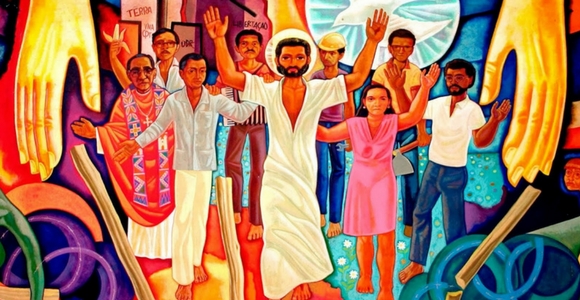
“Cristo de la Liberacion” (Christ of the Liberation) by Maximino Cerezo Barredo, who’s been dubbed “liberation painter.”

Photo Credit: “Cristo de la Liberacion” (Christ of the Liberation) by Maximino Cerezo Barredo, who’s been dubbed “liberation painter.”

“Our experiences determine not only the questions we ask, but also the answers we get back. Plain readings are not plain but are read through the lens of our own paradigms and fears. And this is one reason why it is so vital, if we are going to make our world safe and just for everyone, that we learn to listen to stories, experiences, and interpretations of our sacred texts from the most vulnerable communities in our society.”

by Herb Montgomery | October 20, 2017

Featured Text:

“It is necessary for enticements to come, but woe to the one through whom they come! It is better for him if a millstone is put around his neck and he is thrown into the sea, than that he should entice one of these little ones.” Q 17:1-2

Companion Texts:

Matthew 18:6-7: “If any of you put a stumbling block before one of these little ones who believe in me, it would be better for you if a great millstone were fastened around your neck and you were drowned in the depth of the sea. Woe to the world because of stumbling blocks! Occasions for stumbling are bound to come, but woe to the one by whom the stumbling block comes!”

Luke 17:1, 2: “Jesus said to his disciples, ‘Occasions for stumbling are bound to come, but woe to anyone by whom they come! It would be better for you if a millstone were hung around your neck and you were thrown into the sea than for you to cause one of these little ones to stumble.’”

We stumble when we’re learning to walk. This week, we are focusing on those who are walking toward a safer, more just, and compassionate world, and we’ll be considering how as they move forward, others will actively obstruct their path rather than smoothing it out. Obstructionists place stumbling blocks in the way of those moving forward, causing their advance to be harder than it should be.

We are, again, considering one of Jesus’ sayings about “little ones.” As I wrote in Thanksgiving that God Reveals Only to Children:

“The family structure in Palestine in the first century was a hierarchical pyramid with the male patriarch at the top. On the bottom rung of the social ladder, below slaves, were children (see Galatians 4:1).

Social status is typically evaluated by the degree to which one has both power and resources. Those with large measures of control over power and resources operate in higher social positions, while those with very little access to power and resources live at the bottom.

Children have access to neither power nor resources. The typical avenues to power and control of resources are education, income, or work. In our societies, children have none of these, and they are vulnerable to abuse and neglect so child advocacy and children’s rights are much needed. Discrimination on the basis of race, gender, sexual orientation, gender identity, national origin, religion, disability, color, or ethnicity are also compounded when they apply to children.”

Our focus in this week’s saying is directed toward the “little ones” Jesus spoke of—the most vulnerable sectors of society. In the Greek, “little ones” (mikros) can not only refer to children, but also any who are vulnerable to exploitation by the status quo. It doesn’t have to mean a young person; it can also refer to a person’s “rank or influence” within a society. Christianity has a long history in doing damage to our most vulnerable and most marginalized.

Native People 

One example in this history is the way Christian preachers and missionaries used the Canaanite conquest and genocide stories in the Bible to legitimize the genocide of Native peoples here in the U.S.:

“Biblical notions of extirpation influenced colonial America from the earliest days of the settlement. In a tract publicizing the new Virginia settlement, Robert Gray expressed the hope that Indians might accept Christianity, but if they did not, biblical commands were clear: ‘Saul had his kingdom rent from him and his posterity because he spared Agag . . . whom God would not have spared; so acceptable a service is it to destroy idolaters, whom God hateth.’” (Philip Jenkins, in Laying Down the Sword: Why We Can’t Ignore the Bible’s Violent Verses, p. 133)

During the colonial era, many New England preachers such as Cotton Mather compared Pequot Indians to modern Ammonites and New England to a modern Israel (see Cotton Mather, Magnalia Christi Americana, vol. 1, p. 553). With this interpretation, if Saul had had his kingdom taken away because he failed to utterly destroy the Ammonites, the new American Christians were not to fail in the complete annihilation of their modern, native “Ammonites” if they wanted ensure their place on this continent, their “promised land.” The genocide of Native people was rooted in Christians’ lethal interpretation of violent Bible passages; it was a genocide they believed God had commanded them to execute.

Slavery

During the abolitionist years leading up to the American Civil War, many Christian preachers quoted Leviticus’ passages affirming slavery and claimed that neither Paul nor Jesus had reversed those passages. One famous preacher, ironically named Moses Stuart, wrote:

“Not one word has Christ said, to annul the Mosaic law while it lasted. Neither Paul nor Peter have uttered one. Neither of these have said to Christian masters: ‘Instantly free your slaves.’ Yet they lived under Roman laws concerning slavery, which were rigid to the last degree. How is it explicable on any ground, when we view them as humane and benevolent teachers, and especially as having a divine commission-how is it possible that they should not have declared and explicitly [so] against a malum in se [something evil in itself]?”

He confidently pronounced that those calling for the end of slavery “must give up the New Testament authority, or abandon the fiery course which they are pursuing” (Moses Stuart, Conscience and the Constitution; with Remarks on the Recent Speech of the Hon. Daniel Webster in the Senate of the United States on the Subject of Slavery, 1850).

Another minister, a Southern Methodist named J.W. Tucker, proclaimed to his Confederate audience fighting for their right to own slaves, “Your cause is the cause of God, the cause of Christ, of humanity. It is a conflict of truth with error-of Bible with Northern infidelity-of pure Christianity with Northern fanaticism.” (Kurt O. Berends, “Confederate Sacrifice and the ‘Redemption’ of the South,” in Religion and the American South: Protestants and Others in History and Culture, ed. Beth Barton Schweiger and Donald G. Mathews, p. 105.) Tucker’s rhetoric sounds almost identical to the rhetoric of Christians today as they condemn movement in many faith traditions toward the affirmation of LGBTQ people.

Against Women

Christianity also has a long history with patriarchy and misogyny. Roman Catholic writer John Paul Boyer explains in Some thoughts on the Ordination of Women: 

Being a Jew, being a Palestinian, being a first century man—all these are what we might call, in the language of Aristotelian metaphysical, the ‘accidents of Christ’s humanity;’ but his being a man rather than a woman is of the ‘substance’ of his humanity. He could have been a twentieth-century Chinese and been, cultural differences notwithstanding, much the same person he was, but he could not have been a woman without having been a different sort of personality altogether.” (A Monthly Bulletin of the Church of St. Mary the Virgin, ())

Womanist scholar Jacqueline Grant rightly states in her book White Women’s Christ and Black Women’s Jesus that “the most significant use of this argument” came from Pope Paul VI on October 15, 1976, when he approved and published the following declaration:

“The Christian priesthood is therefore of a sacramental nature: the priest is a sign, the supernatural effectiveness of which comes from the ordination received, but a sign that must be perceptible and which the faithful must be able to recognize with ease. The whole sacramental economy is in fact based up on natural signs, or symbols imprinted up on the human psychology: ‘Sacramental signs’, says Saint Thomas, ‘represent what they signify by natural resemblance.’ The same natural resemblance is required for personas as for things: when Christ’s role in the Eucharist is to be expressed sacramentally there would not be this ‘natural resemblance’ which must exist between Christ and his minister if the role of Christ were not taken by a man. In such a case it would be difficult to see in the minister the image of Christ. For Christ himself was and remains a man.” (Franjo Cardinal Seper, Vatican Declaration, Feb 6, 1977, p. 6)

Never mind that the church’s own creation story states clearly that both male and female were made in the image of God. There have long been interpretations of these stories that have marginalized, wholly excluded, and damaged women personally and institutionally. Because of the patriarchal nature of many sectors of Christianity, and despite the fact that there are feminist and womanist Christians, some have gone so far as to say that Christianity is a man’s religion.

LGBTQ Fear

Anyone who lived through the 1980s here in the U.S. knows all too well how Christianity has done untold damage to the LGBTQ community, legitimizing the inmate homophobia of straight parishioners through interpretations that are trans-, bi-, genderqueer-, and homo-phobic. For a history that reaches back into the 1970s, the Southern Poverty Law Center offers an excellent history of the modern Christian anti-gay movement, starting with Anita Bryant in 1977. Just a quick read demonstrates how monstrously Christians have mischaracterized this community and used damaging interpretations of the Bible to bolster their mischaracterization. Jay Grimstead, a founder of The Coalition on Revival, bluntly stated that “Homosexuality makes God vomit”. Many similar arguments are rhetorically identical to those Christians in the 1800’s used in their opposition to ending slavery. The Christian Moral Majority didn’t get its start opposing abortion or gay people, but by opposing integration after Brown v. Board of Education. They began a network of private Christian schools to make sure their White children did not have to attend school with Black and Brown children.

I’ve given you four examples of how interpretations of our sacred text have done and continue to do damage to those who are most vulnerable within our society. I also, wrote two weeks ago:

“Interpretations are not eternal. They change with time. As we see the harmful fruit of present interpretations, we can make those interpretations give way to new ones, in the hope that new interpretations will bear the fruit of life. And if we see that our new interpretations also do harm, we will challenge them too. The goal is to continue to seek life-giving interpretations for all, work with people’s well-being and thriving in our hearts, and transform our world into a safe, just, compassionate home for us all. Anything less is not faithful to Jesus or the Spirit of our various sacred texts. Every time you’re tempted to mistake your interpretation for the sacred text itself, remember that interpretations are temporary. It’s okay for them to change, as long as what they change to is life-giving for all.”

In each of the above examples, you can come up with Bible interpretations to oppose valuing and protecting Native people and lands, ending slavery, promoting equity for women, and seeking justice for the LGBTQ community. Some claim they are just reading the Bible plainly. But we never see things objectively. As the saying goes, we do not see things as they are; we see things as we are.

Our experiences determine not only the questions we ask, but also the answers we get back. Plain readings are not plain but are read through the lens of our own paradigms and fears. And this is one reason why it is so vital, if we are going to make our world safe and just for everyone, that we learn to listen to stories, experiences, and interpretations of our sacred texts from the most vulnerable communities in our society. This is how liberation theology was born: those in South America read the Bible very differently than their colonial Christian exploiters. It’s how Black liberation theology was born: Black Christians in the U.S. read the Bible radically differently than white Christians read it. It’s how feminist and womanist theologies were born and how queer theology was born. We need these voices and perspectives if we are to arrive at interpretations of our sacred text that cease to do harm.

Today we have a broad swathe of people who want nothing to do with Jesus because of the history of the church as the largest stumbling block in the path of the vulnerable in their work toward a world of justice and compassion. They see a Christianity that seems to habitually do harm, ever landing on the wrong side of history. They don’t see a Jesus who taught survival, resistance, liberation, and justice. They don’t see a Jewish Jesus on the side of the oppressed (Luke 4:18-19). Rather, that Jesus is eclipsed by a religion that was formed in his name. This is gives me great reason to pause. I know first-hand how my own faith has been fractured by watching Christian racism, misogyny, homophobia, and transphobia just in my local community here in West Virginia. I love Jesus, but I have zero tolerance for the kind of Christianity my family seems to be surrounded by where we live.

I do not apologize for this week’s eSight. And I don’t believe the truth of our history to be too harsh to share. As someone who loves the historic, first-century Jewish Jesus, I have simply  become disillusioned with the most vocal sectors of Christianity in our culture. Just this week I’ve endured disappointment again as Christians who should have been passionately living out the value of compassionate listening to the voices of the vulnerable, who claim to believe God love’s everyone, were passionate instead to protect their own cherished theology that has been shown to be hurtful to the vulnerable. Does your God love the vulnerable or your theology? Which is it that should be given a priority of worth? As Emilie Townes states, “When you start with an understanding that God loves everyone, justice isn’t very far behind.”  But what happens when you believe God loves everyone and that doesn’t lead to justice? What about when the ones preaching “God loves everyone” are the stumbling block for those working toward a safer, just, more compassionate world for the vulnerable?

As a Christian myself, I take this week’s saying seriously. It was said to Jesus’ followers, and we who take his name today must allow this week’s saying to confront us:

“Woe to the one through [whom stumbling blocks] come! It is better for them if a millstone is put around their neck and they are thrown into the sea, than that they should cause one of the vulnerable to stumble.” Q 17:1-2 

HeartGroup Application

This week I want you to spend some time with the above article.

  1. As a group discuss what challenges this week’s eSight creates for you.
  2. Discuss together where you feel encouraged by this week’s eSight. Maybe encouragement comes just from hearing that you’re not alone in your feelings of frustration toward your Christianity being a stumbling block to so many people.
  3. What are some ways you can move toward interpretations of our sacred texts that are not damaging and don’t create stumbling blocks for those pushed to the edges of our society? Which interpretations can also move you to take tangible, concrete actions as an individual and as a group to stand in solidarity with those walking toward a more just world? How can you smooth out another person’s way toward liberation? As it states in Isaiah:

“Every valley shall be raised up,

every mountain and hill made low;

the rough ground shall become level,

the rugged places a plain.” (Isaiah 40.4)

Thank you for checking in with us this week. Wherever this finds you, keep living in love engaging the work of transforming our world.

And to each of you who are supporting the work of Renewed Heart Ministries, we simply could not do this without you. We have a lot of educational events lined up for this fall. If you’d like to support our work you can do so by going to:

https://renewedheartministries.org/donate/

Or you can always mail your support to:

Renewed Heart Ministries
PO Box 1211
Lewisburg, WV 24901

Every amount helps. Thank you!

I love each of you dearly,

I’ll see you next week.

Divorce Leading to Adultery

by Herb Montgomery

“Christians taking Jesus’ saying on divorce at face value have forced women to stay in untold situations of abuse. I want to argue this week that in the context of the 1st Century’s economic realities for women in Roman and Jewish patriarchal society, and in the context of the debate between the Pharisaical schools of Shammai and Hillel on divorce, Jesus’s saying about divorce did not judge women but was instead concerned with social justice for them.”

Featured Text:

“Everyone who divorces his wife and marries another‚ commits adultery, and the one who marries a divorcée commits adultery.” (Q 16:18)

Companion Texts:

Matthew 5:32: “But I tell you that anyone who divorces his wife, except for sexual immorality, makes her the victim of adultery, and anyone who marries a divorced woman commits adultery.”

Luke 16:18: “Anyone who divorces his wife and marries another woman commits adultery, and the man who marries a divorced woman commits adultery.”

Christians taking Jesus’ saying on divorce at face value have forced women to stay in untold situations of abuse. I want to argue this week that in the context of the 1st Century’s economic realities for women in Roman and Jewish patriarchal society, and in the context of the debate between the Pharisaical schools of Shammai and Hillel on divorce, Jesus’s saying about divorce did not judge women but was instead concerned with social justice for them.

Let’s unpack that a bit.

First, within at least Jewish society at the time of Jesus, divorce was the prerogative of the man. The laws were patriarchal:

Deuteronomy 22:13-18: “If a man takes a wife and, after sleeping with her, dislikes her and slanders her and gives her a bad name, saying, ‘I married this woman, but when I approached her, I did not find proof of her virginity,’ then the young woman’s father and mother shall bring to the town elders at the gate proof that she was a virgin. Her father will say to the elders, ‘I gave my daughter in marriage to this man, but he dislikes her. Now he has slandered her and said,  “I did not find your daughter to be a virgin.” But here is the proof of my daughter’s virginity.’ Then her parents shall display the cloth before the elders of the town, and the elders shall take the man and punish him. They shall fine him a hundred shekels of silver and give them to the young woman’s father, because this man has given an Israelite virgin a bad name. She shall continue to be his wife; he must not divorce her as long as he lives.”

This passage is disturbing for multiple reasons, but this week  I’d like to focus on the fact that reparation for the unjust slander in the text would be paid “to the young woman’s father.” There is no reparation to the woman in that case and she would also have to remain married to her offender.

Another disturbing example is found a few verses further on in Deuteronomy 22:

Deuteronomy 22:23-24: “If a man happens to meet in a town a virgin pledged to be married and he sleeps with her, you shall take both of them to the gate of that town and stone them to death—the young woman because she was in a town and did not scream for help, and the man because he violated another man’s wife. You must purge the evil from among you.”

Blaming the victim because “she didn’t scream for help” is sick. This law blames rape victims for their own rape. But also notice that the man is punished because he violated “another man’s wife.” The crime is against the other man, not against the woman who is simply “another man’s wife.”

The last deeply disturbing example to consider is just a few more verses even further:

Deuteronomy 22:28-29: “If a man happens to meet a virgin who is not pledged to be married and rapes her and they are discovered, he shall pay her father fifty shekels of silver. He must marry the young woman, for he has violated her. He can never divorce her as long as he lives.”

This is sick on multiple levels, too! The victim of rape must marry her rapist, and without the option of divorce? Again the financial penalty is one that must be paid to the woman’s “father.”

Jesus’s saying must be interpreted in light of a culture where a women had few rights. She could not send her husband away with a certificate of divorce; only men were allowed to do that.

Also, the Torah’s criteria for divorce was problematic.

Deuteronomy 24:1-4: “If a man marries a woman who becomes displeasing to him because he finds something indecent about her, and he writes her a certificate of divorce, gives it to her and sends her from his house, and if after she leaves his house she becomes the wife of another man, and her second husband dislikes her and writes her a certificate of divorce, gives it to her and sends her from his house, or if he dies, then her first husband, who divorced her, is not allowed to marry her again after she has been defiled.”

Notice that within the Torah, the only prerequisite for divorce was if the woman “displeased” her husband in any way. Deuteronomy was at the heart of the debate between the Pharisaical schools of Shammai and Hillel. Hillel focused on the “displeasing” portion of this text and stated that a man could send his wife away, giving her a certificate of divorce, for any reason if he was “displeased” with her. Shammai, on the other hand, focused on the word “indecent” and said the permissible reason for a man to send his wife away was if she had committed an indecent act of infidelity, such as adultery. Notice that language. “Only if she” did. His adultery was not addressed because until Hellenistic influence, only men could issue a certificate of divorce. So you have two arguing factions. One said a man could divorce a woman for any reason he chose. And the other sought to limit the justification for divorce only to adultery.

Jesus and Hillel had so much in common in their teachings. Yes, Jesus and Hillel differed on the prozbul. Jesus called for the year of Jubilee where all debts would be forgiven and accumulated wealth redistributed to the poor. But in most every other area, Jesus interpreted the Torah in much the same way as Hillel. In the case of divorce, however, Jesus rejected the school of Hillel and sided either in the gospel of Matthew with Shammai, or in the gospel of Mark, a more stringent rejection of divorce than even Shammai (and Moses as well for that matter) would have been comfortable with.

Let’s look at each.

In Matthew, Jesus states that divorce in the Torah was a concession or an accommodation to male “hard-heartedness” within patriarchal marriages. Reasons could include something as minor as “finding something objectionable or unpleasing” about one’s wife (see Deuteronomy 24:1). In Matthew, Jesus goes beyond Torah and limits the reasons for a husband to divorce his wife to only infidelity.

Matthew 19:8-9: “He said to them, ‘It was because you were so hard-hearted that Moses allowed you to divorce your wives, but from the beginning it was not so. And I say to you, whoever divorces his wife, except for unchastity, and marries another commits adultery.’”

In Mark, we find a Jesus that is even more strident than in Matthew. There is no justification of divorce here, and even the reason of “infidelity” in Matthew is left out. “Whoever divorces his wife,” period.

Mark 10:5-10: “But Jesus said to them, ‘Because of your hardness of heart he wrote this commandment for you. But from the beginning of creation, “God made them male and female. For this reason a man shall leave his father and mother and be joined to his wife, and the two shall become one flesh.” So they are no longer two, but one flesh. Therefore what God has joined together, let no one separate.” In the house, the disciples ask Jesus again about this matter. He said to them, “Whoever divorces his wife and marries another commits adultery against her; and if she divorces her husband and marries another, she commits adultery.*”[*Mark was written for a gentile audience, and within Roman culture women could divorce men as is seen here. In first-century Judaism it remained that only men could serve a certificate of divorce to a woman.]

I would argue that in each of these examples we see a Jesus who is living within the boundaries of his own Roman and Jewish patriarchal social order and marriage. His concern, within those constraints, is justice for women in a culture that disadvantages women, making women dependent on fathers and husbands for survival, with very few exceptions. In more egalitarian marriages, the principle would be the same: distributive justice for all parties involved.

I come from a long history of divorce on both my mother’s and my father’s sides of the family. I am the son of both my mother’s and father’s second marriages. My mother would go on to be married a total of four times and my father, three. I grew up with my mother living despite a physically and emotionally abusive situation, afraid to leave because there had been no case of marital infidelity on her or husband’s part. I see this as a gross misunderstanding of the cultural context of Jesus’ words. In Jesus’ culture, where Jesus speaks of divorce, we see a double standard where men didn’t commit adultery against their wives, but only against the husbands of the married women they may have had sex with. If woman was unmarried, the man paid a penalty to the father of the woman (cf. Deuteronomy 22:29), but it was not labeled as adultery, even if the man himself was married. This was a culture whose adultery laws were written when men were permitted to have multiple wives, as long as the rights of fathers in those wives’s lives were “respected.”

Jesus words in the gospels regarding divorce should not be shallowly interpreted and lifted out of their context to promote injustice and abuse toward women today. This would be to contradict the spirit of justice for women originally within those words.

Nor should they be used today to support patriarchal marriage as an ideal for human society. Speaking of Jesus’ words in the Temple debates (see Mark 12:24-27) where he unequivocally denounces patriarchal marriage as having a place in the world transformed, made just, safe and compassionate for all, Elizabeth Schüssel Fiorenza writes in In Memory of Her: A Feminist Theological Reconstruction of Christian Origins:

“[Jesus is not claiming] that sexual differentiation and sexuality do not exist in the ‘world’ of God, but that ‘patriarchal marriage is no more,’ because its function in maintaining and continuing patriarchal economic and religious structures is no longer necessary . . . [Mark 12:26-27] replies directly to the question of the continuation of the patriarchal family: in the burning bush God is revealed to Moses as the God of promise given to the patriarchs and their posterity. The ‘house’ of Israel is not guaranteed in and through patriarchal marriage structures, but through the promise and faithfulness of Israel’s powerful, life-giving God. While the God of the patriarchal systems and its securities is the ‘God of the dead,’ the God of Israel is the ‘God of the living.’ In God’s world women and men no longer relate to each other in terms of patriarchal dominance and dependence, but as persons who live in the presence of the living God . . . The Sadducees have ‘erred much’ in assuming that the structures of patriarchy are unquestionably a dimension of God’s world as well. So, too, all subsequent Christians have erred in maintaining oppressive patriarchal structures.” (pp. 144-145)

Today, I hear Jesus’ words this week calling us to prioritize the vulnerable within our societies. Whether that vulnerability is rooted in discrimination based on race, ethnicity, gender, gender expression, gender identity, class, education, sexuality, ability, age, culture, language, and/or religion, we are called to put people and their well-being first, even if that means we going against traditional and popular interpretations of our sacred texts. This week’s saying speaks of women being more than disposable objects, easily discarded in consumer-style patriarchal marriages. People couldn’t simply discard or trade wives based on legal loopholes in the Torah without acknowledging the damage done to the women involved. In Spirit, it calls us to reject seeing anyone as a disposable means to our own pleasure and gratification. People matter.

“Everyone who divorces his wife and marries another‚ commits adultery, and the one who marries a divorcée commits adultery.” (Q 16:18)

HeartGroup Application

Our saying this week has been used to harm spouses in abusive marriages.

  1. How have you witnessed our saying this week used to keep people in abusive relationships?
  2. Does seeing this week’s saying through the lens of a call for social justice toward women in a patriarchal society make a difference for you?
  3. Discuss as a group which other sectors of society are presently being objectified, used for another sector’s benefit, or scapegoated in the name of community integrity and unity? Brainstorm things your group can do to make a change.

People matter. They aren’t disposable. They aren’t means to another person’s ends. We are worthy of more than being cogs in other people’s machinery.

Thanks for checking in with us this week.

Where you are, keep living in love. Keep engaging the work of survival, resistance, liberation, reparation, and transformation. Change is possible. The moral arc of the universe can bend toward justice if we choose to bend it that way.

Thank you, also, to each of you who are supporting our work here at Renewed Heart Ministries. We have multiple events coming up this fall. If you’d like to support our work you can do so by giving on our Donate page.

Please consider becoming one of our monthly donors. Together we are making a difference! This month an attendee of one of our events contacted us via our website and shared:

“I heard Herb speak today for the first time and was deeply moved by his presentation. I came away understanding The Lord’s Prayer from a new perspective and committed to become more involved in social justice. Thank you for your honesty and ability to shed new light on basis truths.”—Attendee in Arizona

If you prefer, you can also mail your support to:

Renewed Heart Ministries
PO Box 1211
Lewisburg, WV 24901

Thank you in advance for your partnership in the work of making our world a safe, compassionate, just home for us all.

I love each of you dearly.

I’ll see you next week.

No Serif of the Law to Fall

Aged picture of the Hebrew Bibleby Herb Montgomery

Interpretations are not eternal. They change with time. As we see the harmful fruit of present interpretations, we can make those interpretations give way to new ones, in the hope that new interpretations will bear the fruit of life. And if we see that our new interpretations also do harm, we will challenge them too. The goal is to continue to seek life-giving interpretations for all, work with people’s well-being and thriving in our hearts, and transform our world into a safe, just, compassionate home for us all. Anything less is not faithful to Jesus or the Spirit of our various sacred texts. Every time you’re tempted to mistake your interpretation for the sacred text itself, remember that interpretations are temporary. It’s okay for them to change, as long as what they change to is life-giving for all.

Featured Text:

“But it is easier for heaven and earth to pass away than for one iota or one serif of the law to fall.” (Q 16:17)

Companion Text:

Matthew 5:17-18: “Do not think that I have come to abolish the Law or the Prophets; I have not come to abolish them but to fulfill them. For truly I tell you, until heaven and earth disappear, not the smallest letter, not the least stroke of a pen, will by any means disappear from the Law until everything is accomplished.”

Luke 16:17: “It is easier for heaven and earth to disappear than for the least stroke of a pen to drop out of the Law.”

This week we see Jesus’s Jewishness. We see a Jesus who holds the Torah in high regard. For him, the Torah is eternal. The Jesus of this week’s saying is not teaching a new religion or trying to replace a current one. This Jewish Jesus is offering an interpretation of the Torah that includes a preferential option for the poor, the disenfranchised, and the marginalized.

Jesus’s interpretation contrasted with the elites in Jerusalem, and also differed from the populist Pharisees’ interpretation. The Pharisees opened the privilege of adhering to the Torah’s purity codes to a wider social group, but still left themselves in the position to control who was centered and who was pushed the margins. Jesus didn’t withdrawal from society and politics like the Essenes, nor did he champion raising the sword in revolt like other Judean Messiah figures during the first half of the 1st Century. His interpretation stood out from all of these.

Jesus’s interpretation of the Torah centered those on the edges of his society and invited them to be seated too alongside others at a shared table. Some have labeled him as radical; others as simply compassionate and just in the tradition of the Hebrew prophets. For our purposes this week, we can say that, at minimum, it was still Jewish and the Torah was still central. His teachings appealed to the poor and outcast because he was interpreting the Torah, not because he offered something novel to replace the Torah.

Luke’s use of this week’s saying reassured those who were suffering violence because they followed Jesus’s interpretation and social vision. You can read about that here.

Matthew’s use of this saying is quite different from Luke’s. Luke’s gospel explained how what began as a Jewish movement of the lower class became so populated by Gentiles from the middle and upper classes. Matthew’s gospel, on the other hand, corrects many of the mistakes Mark’s gospel makes about Jewish culture, which leads many scholars to believe Mark’s gospel was primarily for lower class Gentile followers of Jesus. Matthew’s version of the saying is about completion and assures the community that Jesus had not come to supersede the Torah. Two words in the saying that help us understand this are “fulfill” and “accomplished.” Let’s look at both.

The Greek word translated as fulfill is pleroo. Pleroo means to fill to the full like a 1st Century fishing net full of fish, or to level up a hollow place in the ground by filling it with dirt. It means to fill to the very top, to the brim. It’s as if Jesus is saying that contemporary interpretations of the Torah were leaving gaps and weren’t full. Some parts of the Torah made provisions for the poor, that Pharisaical teachings negated. These were hollow places in their caretaking, hollow places that Jesus claimed to be filling up. With Jesus, those being kept on the margins, even by the Pharisees’ interpretations, were to be welcomed, affirmed and included. They were valuable. They, too, were the children of Abraham (cf. Luke 19:9).

The second word is translated as accomplished is ginomai. Ginomai carries with it the idea of becoming: something comes into existence or onto the stage; something appears in public. I hear Jesus saying that his interpretation is not a destruction of the Torah, but simply an interpretation coming onto the stage that sought to re-prioritize the poor and socially vulnerable.

This is a rich teaching for us today.

Not all of the vulnerable sectors of 1st Century Jewish society were addressed by the Torah’s provisions, or even by the teachings of Jesus. I believe we must build on Jesus’s work and include those who today should also be affirmed and valued.

Who are vulnerable among us today? Is it the estimated 2,150 to 10,790 transgender military personnel now being targeted and scapegoated in the U.S.? Is it the DACA Dreamers whom some believe legislators will try to use to bargain for border wall funding? Is it people of color who continue to be the victims of implicit bias and systemic racism in this country? Surely the vulnerable includes Native people still fighting to preserve their right to clean drinking water despite the U.S. and state-protected oil industry. It includes women disproportionally targeted by diminishing access to women’s health services.

What does it mean to stand up for the vulnerable even while being accused of “destroying the Torah?” For Christians today, advocating for the vulnerable is sometimes met with the accusation that we are ignoring, throwing out, or contradicting the Bible. White Christians in antebellum America placed before Christian abolitionists the false choice of holding onto their abolitionism or holding onto the scriptures. Sternly those Christians told abolitionists that they could not continue to hold both. My own faith tradition still struggles to recognize women have equal status as men. Those institutions who are for ordaining women ministers are being given the same ultimatum: “the scriptures or the ordination of women,” it is said, “you can’t hold on to both.” I also know something about this. Over the last two years, I have had cancellation after cancellation from those concerned by my and RHM’s affirmation, welcome, and inclusion of our LGBTQ siblings. These Christians have claimed that we have “abandoned the clear teachings of the Bible.”

But those standing alongside the vulnerable in our society today could follow Jesus’s teaching here and say to those holding on to old and destructive interpretations of sacred texts, “Do not think we are abolishing our sacred text. We aren’t throwing out the scriptures; we are simply interpreting the text in a way that fills up the glaring gaps in interpretations that are destroying vulnerable people. We aren’t destroying the scriptures; we are replacing interpretations that destroy people with interpretations that give life and liberate.”

For those who feel like they must choose between people’s well being and fidelity to a sacred text, that’s not the choice at all. You may have to let go of destructive interpretations of your sacred text. You may have to let go of the way you have viewed your sacred text. But you can still be an affirming Christian and hold your sacred text in a way that understands that text that affirms people. Choose people. Value people. When you do, you’ll see you aren’t destroying your text, but interpreting it in a way that, like Jesus and the Torah, includes those who are presently being harmed.

Interpretations are not eternal. They change with time. As we see the harmful fruit of present interpretations, we can make those interpretations give way to new ones, in the hope that new interpretations will bear the fruit of life. And if we see that our new interpretations also do harm, we will challenge them too. The goal is to continue to seek life-giving interpretations for all, work with people’s well-being and thriving in our hearts, and transform our world into a safe, just, compassionate home for us all. Anything less is not faithful to Jesus or the Spirit of our various sacred texts. Every time you’re tempted to mistake your interpretation for the sacred text itself, remember that interpretations are temporary. It’s okay for them to change, as long as what they change to is life-giving for all.

It is easier for heaven and earth to pass away than for one iota or one serif of the Torah to fall. (Q 16:17)

HeartGroup Application

In the context of working alongside the vulnerable and advocating for their rights, a verse that Jesus would have grown up hearing read in the synagogues is:

“Speak up for those who cannot speak for themselves, for the rights of all who are destitute.” Proverbs 31:8

I would add today that many of those who can speak up for themselves are speaking up, so add your voice to theirs. The work of reclaiming of your own humanity is bound up with theirs. Speak up in tangible, concrete ways.

I shared this quote from Dr. Martin Luther King some weeks ago:

“The other myth that gets around is the idea that legislation cannot really solve the problem and that it has no great role to play in this period of social change because you’ve got to change the heart and you can’t change the heart through legislation. You can’t legislate morals. The job must be done through education and religion. Well, there’s half-truth involved here. Certainly, if the problem is to be solved then in the final sense, hearts must be changed. Religion and education must play a great role in changing the heart. But we must go on to say that while it may be true that morality cannot be legislated, behavior can be regulated. It may be true that the law cannot change the heart but it can restrain the heartless. It may be true that the law cannot make a man love me but it can keep him from lynching me and I think that is pretty important, also. So there is a need for executive orders. There is a need for judicial decrees. There is a need for civil rights legislation on the local scale within states and on the national scale from the federal government.” (Western Michigan University, December 18, 1963)

This week, I want to emphasis that social location matters. Some people can’t afford to wait for an inside-out approach, for a future kingdom or new social order. Some people are dying now.

As I’ve shared, change happens from the outside in, not from the center, but from the edges or margins inward. The same is true for people. It took people outside of me to change me. Spiritual disciplines and community rituals also shape people over time. The gospels portray a Jesus who gave his listeners a list of practices that would change the way they saw, thought, and felt about themselves and the others with whom they shared their world.

Sam Wells, in the introduction of Ched Myers’ Binding the Strong Man, draws a line in the sand:

“We seem to have picked up the idea that holiness is a trance-like sense of peace and well-being in relation to those all around, an experience of floating on a magic carpet of tranquility. Wherever that picture of holiness came from, it certainly wasn’t Mark’s Gospel. Jesus is constantly having heated debates with everyone who held Israel in check. The one thing everyone seems to agree on today is that there’s plenty wrong with the world. There are only two responses to this—either go and put it right yourself, or, if you can’t, make life pretty uncomfortable for those who can until they do. When we take stock of our relationship with the powerful, we ask ourselves, ‘Does the shape of my life reflect my longing to see God set people free, and do I challenge those who keep others in slavery?’”

How do we, in the short term, make life uncomfortable for those who can change things until they do? One way to do that is by connecting with your elected officials.

1. This week, find out the name and phone number of the following and write them down:

Your Federal House Representative
Your Federal Senators
Your State Governor
Your State House Representatives
Your State Senate Members
County Officials
City Mayor and Council members

2. Check out the following two websites. https://www.indivisibleguide.com and https://5calls.org

On these sites, you’ll find helpful instructions for how to connect with your officials in memorable and effective ways to create the changes you’d like to see.

3. If this is new to you, start out by making one phone call a week. Then graduate to two or three.

If you can put something right yourself, then by all means, take action and do so. If you do not have the power to change much larger systems that perpetuate injustice, take stock of your relationship with those in power and make their life pretty uncomfortable until they make those changes. Stand in solidarity with those on the edges and undersides of society. Reclaim your own humanity by working alongside those engaging the work of reclaiming theirs.

Where you are, keep living in love. Keep engaging the work of survival, resistance, liberation, reparation and transformation. Change is possible. The moral arc of the universe can bend toward justice is we choose to bend it that way.

Thank you, also, to each of you who are supporting our work here at Renewed Heart Ministries. We have multiple events coming up this fall. If you’d like to support our work you can do so at by going to:

https://renewedheartministries.org/donate/

Please consider becoming one of our monthly donors. Together we are making a difference. If you prefer, you can also mail you support to:

Renewed Heart Ministries
PO Box 1211
Lewisburg, WV 24901

Thank you in advance for your partnership in the world of making our world a safe, compassionate, just home for us all.

I love each of you dearly.
I’ll see you next week.

Since John the Kingdom of God

Picture of protestorsby Herb Montgomery

“It’s one thing to mistake something bad as good. It’s quite another to mistake the Sprit’s work of liberating and re-humanizing those who have been dehumanized and objectified as an evil that should be opposed. This is the sin that is ‘unpardonable.’”

Featured Text:

“The law and the prophets were until John. From then on the kingdom of God is violated and the violent oppose it.” (Q 16:16)

Companion Texts:

Matthew 11:12-13: “From the days of John the Baptist until now, the kingdom of heaven has been subjected to violence, and violent people have been raiding it. For all the Prophets and the Law prophesied until John.”

Luke 16:16: “The law and the prophets were until John; from that time the kingdom of God is preached, and every one useth violence towards it. But it is easier for heaven and earth to pass, than one tittle of the law to fall.” (Douay-Rheims)

The Law and the Prophets

I have to confess that I used to interpret this passage differently than I do today. Growing up in a sector of Christianity that taught replacement theology, I interpreted this passage to mean that the Kingdom superseded the “Law and the Prophets.” I no longer believe that. Jesus was a Jew. He was never a Christian. As my friend Charlie Kraybill is fond of saying:

“Where did Jesus get his inspiration? From the Torah, the Prophets, and the Writings, of course. Little of what Jesus said was original with him. His genius was not so much in the substance of his sayings as in the way he curated his source material, the methodology he used for selecting what to highlight and what to leave on the shelf. And Jesus left a lot on the shelf. He ignored the negative qualities attributed to Yahweh: the wrath, the retribution, the jealousy, the rage, the pettiness. He also ignored Yahweh’s military exploits, the occasions where God was portrayed as siding with one tribe over other tribes on the battlefield. Jesus knew, intuitively, that stories of Yahweh behaving badly were projections of the humans who had written the texts. He understood that “Yahweh the Warrior” is a literary character, created by the scribes for their patriotic tales of Israel’s glorious past. At the same time, Jesus resonated with Yahweh’s noblest qualities: mercy, compassion, generosity, forgiveness, non-judgment, etc. He scoured the scrolls for passages where God is shown in the best light. These became Jesus’s favorite passages. They inspired his philosophy of conciliation, affirmation, and pacifism. Because Jesus was confident that the God who really exists — the Source of All Truth and Beauty in the Universe — is conciliatory, affirming, and non-violent. All the time. Any teachings or texts that contradict the mercy and compassion of God carry no weight. It was a radical perspective for a marginal Jew from the Galilean hinterlands, yet it’s the perspective that has made Jesus such a provocative and inspirational figure for the past two millennia.” (Marginal Mennonite Society)

The teachings that have been attributed to the historical Jesus are deeply Jewish. Here are a few examples of where we see Jesus’s teachings directly influenced by his Judaism:

Leviticus 19:17: “‘Do not hate a fellow Israelite in your heart. Rebuke your neighbor frankly so you will not share in their guilt.

Leviticus 19:18: “You shall not take vengeance or bear a grudge, but rather love your neighbor as yourself.”

Deuteronomy 4:31: “God is merciful. God will neither abandon you nor destroy you.”

Deuteronomy 15:11: “Open your hand to the poor and needy.”

Psalms 37:26: “The righteous are always giving liberally and lending.”

Psalms 103:8: “God is merciful, gracious, and abounding in steadfast love.”

Psalms 145:9: “God is good to All. God’s compassion is over all that God has made.”

Psalms 147:9: “God gives to the animals their food, and to the young ravens when they cry.”

Proverbs 20:22: “Do not say ‘I will repay evil.’ Wait for God and God will help you.”

Proverbs 23:4-5: “Don’t wear yourself out to get rich. Be wise enough to desist. When your eyes light upon it, it is gone, for suddenly it takes wings to itself, flying like an eagle toward heaven.”

Proverbs 25:21: “If your enemies are hungry, give them bread to eat. If they are thirsty, water to drink.”

Proverbs 29:13: “The poor and the oppressor have this in common: God gives light to the eyes of both.”

Isaiah 44:22: “I have swept away your offenses like a cloud, your sins like the morning mist.”

Isaiah 49:15: “Can a woman forget her nursing child, or show no compassion for the child of her womb? Even these may forget, yet I won’t forget you.”

Jeremiah 31:34: “I will forgive your iniquities, and remember your sins no more.”

Lamentations 3:30: “It is good to give one’s cheek to the smiter and be filled with insults.”

These verses show that Jesus’s vision for humanity (the kingdom) grew from these seeds found in the Law and the Prophets.

The Violation of Violence

In the second phrase of this week’s saying, “the kingdom of God is violated and the violent plunder it,” I hear Jesus speaking of the violence of the establishment’s opposition. In every version of the Jesus story in the gospels, the established social and political order responded violently to Jesus’s social vision. Mark, held by many as the earliest gospel, also describes violence as an early response to Jesus. In chapter three, “the Pharisees went out and began to plot with the Herodians how they might kill Jesus” (Mark 3:6).

Ched Myers explains that this violence is “the bottom line of the power of the state.”

“Fear of [the threat of death] keeps the dominant order intact. By resisting this fear and pursuing kingdom practice even at the cost of death, the disciple contributes to the shattering of the power’s reign of death in history. To concede the state’s sovereignty in death is to refuse its authority in life.” (Binding the Strong Man, A Political Reading of Mark’s Story of Jesus)

This may sound like fatalistic nihilism, but it’s not. It’s the realization that sometimes protest and resistance come at the very high price of having to endure violence from the establishment.

Rome used crucifixion as political or military punishment inflicted on the lower classes and the unruly elements in rebellious provinces like Galilee and Judea. Crucifixion was reserve primarily for people who, in Roman society, had no rights. These were groups whose organizing had to be suppressed by whatever means necessary to ensure law and order within the state. As we have often said in this series, those in power will use violence when they feel threatened. Stand up anyway.

Reassurance

Luke assures Jesus’s followers facing the threat of violence: it is easier for heaven and earth to pass, than one tittle of the law to fall. Luke harmonizes Jesus’s teachings with the Torah, especially his teachings on debt cancellation and wealth redistribution. Jesus’s “kingdom” teachings were not anti-Torah, and in the 1st Century, assurances rooted in comparisons to the endurance of the earth held more meaning than they do today.

Today we are living in the midst of climate breakdown and realizing that the moral arc of the universe only bends toward justice if we choose to bend it that way. So today I would use different rhetoric than Jesus did to inspire people to keep hoping and to keep working despite the fact that there is violent pushback. We must work for justice anyway. The fact that we are all connected and share each other’s fate should make us engage with more intent, not less. As Alice Walker has said, “We are the ones we have been waiting for.”

Contemporary Displays of Violence Against Liberation

Those in positions of power and privilege accused Jesus’s liberation ministry of being demonic. He responded by defining that accusation as blasphemy. Juan Luis Segundo writes, “Blasphemy resulting from bad apologetics will always be pardonable . . . What is not pardonable is using theology to turn real human liberation into something odious. The real sin against the Holy Spirit is refusing to recognize, with ‘theological’ joy, some concrete liberation that is taking place before one’s very eyes” (in Capitalism Versus Socialism: Crux Theologica).

It’s one thing to mistake something bad as good. It’s quite another to mistake the Sprit’s work of liberating and re-humanizing those who have been dehumanized and objectified as an evil that should be opposed. This is the sin that is “unpardonable.” Ched Myers echoes Segundo when he writes, “To be captive to the way things are, to resist criticism and change, to brutally suppress efforts at humanization—is to be bypassed by the grace of God.”

This past week, Evangelical Christians once again engaged in violence against fellow Image-bearers. As in the days of Christian genocide of Native peoples, or enslavement of Africans, or objections to equal treatment of women, a group of Christians are again on the wrong side of history. The Coalition for Biblical Sexuality has repeated the anti-LGBT activism of the 1980s with a 14-article statement of bigotry signed by Evangelical Christian leaders including James Dobson, John Piper, John MacArthur, and Francis Chan. This document has been titled the Nashville Statement, although the Mayor of Nashville has made it clear that Nashville had absolutely nothing to do with it.

You can read it if you’d like, but you also don’t need to. It’s the same fear-driven, hateful rhetoric that has inspired violence toward the LGBTQ community throughout history. The Christian privileged elite has never been short of Biblical justifications for their oppression, exclusion, marginalization and dehumanization of socially vulnerable people.

Renewed Heart Ministries rejects the Nashville Statement in its entirety. We recognize and affirm our lesbian, gay, bisexual, transgender and gender nonconforming community members as fellow image-bearers, as sacred, as being fully human and deserving our respect, of love, and justice. Objectification and dehumanization is violence. And in response to this violence we join our voices and our actions with all those saying “No” to efforts such as these.

If you are reading this and are part of the LGBTQ community, you are holy. You are worthy. You are valuable. And you are not alone.

The outcry against this document on social media platforms such as Twitter and Facebook was swift and stern demonstrating a turning of the tide in our society. These are steps that must be taken as we together work to make our world a just, safe, compassionate home for us all. There is still a lot of work to be done. And I am committed to that work.

Maybe this week’s saying can offer us some encouragement as we stand up to violence, bigotry and fear. The narrative of violence has been repeated over and over throughout history. We learn from the stories of Jesus in the gospels that God was not aligned with those placing others on crosses but in solidarity with the one they crucified for standing with the marginalized and calling for change.

We are not alone today. We are in the right story. If nothing else, may this give a little comfort, and encourage you to keep going.

“The law and the prophets were until John. From then on the kingdom of God is violated and the violent oppose it.” (Q 16:16)

Heart Group Application

This week I want you to do something simple. As Oscar Romero wrote in The Long View, “That is what we are about: We plant seeds that one day will grow. We water seeds already planted, knowing that they hold future promise. We lay foundations that will need further development. We provide yeast that produces effects beyond our capabilities.” Gandhi also wrote similarly, “It’s the action, not the fruit of the action, that’s important. You have to do the right thing. It may not be in your power, may not be in your time, that there’ll be any fruit. But that doesn’t mean you stop doing the right thing. You may never know what results come from your action. But if you do nothing, there will be no result.”

In times like this, we must remember we are each other’s keeper.

This week at your HeartGroup meeting, go around the room and say something you value and appreciate about each person in the group. Make sure no person is left out, and encourage one another. When there are those who are continually endeavoring to tear us down, we must take the time to build each other back up.
Go home and journal some of the things that others said to you during this exercise and read from those pages when you need to be reminded how valuable you really are.

Wherever you are this week, know you are loved, you are fully human, and you are worthy. I’m so glad you checked in with us. Keep living in love, survival, resistance, liberation, restoration, and transformation.

We are making a difference and weeks like last week only demonstrate that. If there weren’t folks threatened by change, they wouldn’t be acting out of such desperation.

Thank you to each of you supporting our work. To support Renewed Heart Ministries directly, you can go to http://bit.ly/RHMSupport

or you can mail your contribution to:

Renewed Heart Ministries
PO Box 1211
Lewisburg, WV 24901

If you are new to RHM, find out more about us at http://bit.ly/WhoIsRHM

So glad you’re journeying with us.
I love each of you dearly.

I’ll see you next week.

God or Money

picture of the monopoly game board

“Jesus’s ethic is not capitalist. In a capitalist system, the goal is simply to create capital. The game is won by those who are able to create the most capital and use it to create more . . . Jesus asks us to lift all boats together, rather than lift one or a few boats while others sink.”

by Herb Montgomery

Featured Text:

“No one can serve two masters; for a person will either hate the one and love the other, or be devoted to the one and despise the other. You cannot serve God and Mammon.” (Q 16:13)

Companion Texts:

Matthew 6:24: “No one can serve two masters. Either you will hate the one and love the other, or you will be devoted to the one and despise the other. You cannot serve both God and money.”

Luke 16:13: “No one can serve two masters. Either you will hate the one and love the other, or you will be devoted to the one and despise the other. You cannot serve both God and money.”

Gospel of Thomas 47:1-2: “Jesus says, ‘It is impossible for a person to mount two horses and to stretch two bows. And it is impossible for a servant to serve two masters. Else he will honor the one and insult the other.’”

Jesus taught a gospel that was “easy” to hear for laborers who were weary and heavy laden (Matthew 11:28-30). It was “hard” to hear and practice for those who were “rich” (Matthew 19:23) When it came to God and money, Jesus’s message was you can’t serve both. Why? Because the God that Jesus envisioned and asked others to envision was a God who caused the rain to fall and the sun to shine on everyone.

Jesus cast a moral vision of a world where we don’t compete with one another, but rather cooperate with and help one another. It’s a world where people are valued over profit, property, power, and privilege. Jesus’s vision was of a world where people take responsibility for taking care of one another, and our resources are shared as we mutually aid each other. Jesus preached a radical wealth redistribution from the haves to the have-nots (Matthew 19:21). Not everyone would be poor. The goal was “equity,” for no one to have too much while there were those who did not have enough (2 Corinthians 8:13). The Jesus of Q did not teach a contemplative path toward privatized peace of mind. He taught a distributively just path toward peace on earth. On his path, we recognize the reality that we are in this together. We are not each our own. We are not alone here. We are connected. We belong to each other. We are part of one another. We not only share each other’s fate; we are each other’s fate.

A quotation often attributed to Gandhi is, “The world has enough for everyone’s need, but not enough for everyone’s greed.” There is truth in this. Whenever we serve money, whenever we try to hoard more than we could ever possibly need, most often someone somewhere will be going without or being exploited so we can have that surplus. You can’t serve both the accumulation of money and God too, because the God Jesus was referring to is a God who tells us to take care of people including those who would be exploited for you to accumulate. The bottom line is not our profit, but people, and taking care of people most often eats away at our profits.

Jesus’s ethic is not capitalist. In a capitalist system, the goal is simply to create capital. The game is won by those who are able to create the most capital and use it to create more, just as in Monopoly. Jesus asks us to lift all boats together, rather than lift one or a few boats while others sink. His world is not a closed end, win-lose world, but a world that is win-win. We all thrive together and no one is left out. Every person matters, and even our competitors or enemies are not disposable.

Edward Abby defines growth purely for “growth’s sake” as the “ideology of the cancer cell.” (Desert Solitaire, p. 114). If he’s right, this could mean that capitalism itself is a cancer for the global poor as well as our global environment. The wealthiest capitalist countries on the planet also have the largest disparities of wealth and inequality and all the harmful, intrinsic results for society that such inequality brings.

In this week’s saying, Jesus juxtaposed people and money. He did not teach that the way to help people is to make more money. He put the pursuit of wealth and the welfare of people in opposition: you can only pursue one or the other, but you cannot do both. This strikes at the core of differences between charity and justice.

To be clear, I think both charity and justice work are necessary. As retired Episcopal Bishop Gene Robinson accurately stated, “There‘s an old saying that the church is pretty good at pulling drowning people out of a river. You know, we‘re good at the charity thing.

But what we need to do is to walk back upstream and figure out who‘s throwing them in, in the first place.”

Pursuing money in order to help people often leaves the system unchanged. Charity can be vital for the short term. But too often it leaves systemic injustice unchallenged. It’s easy to feed the homeless without asking why people lose their homes to begin with. Our work must go beyond charity to include justice work, the work of challenging, disrupting, and changing the systemic causes of injustice.

When Jesus says you can’t serve God and money, I hear him say you can’t put people first and keep seeking to advance in a system that pushes people down the line in your priorities. People matter. Poor and working class people matter. Black people matter. Women matter. Latinx people matter. Native people matter. Arab people matter. Asian people matter. Muslim people matter. Immigrant communities matter. Lesbian, gay, bisexual, transgender, and gender non-conforming people matter. In Jesus’s social vision, it’s money or people. We must make a choice.

This month in RHM’s annual reading course, we are reading James M. Robinson’s The Gospel of Jesus. In this volume, Robinson endeavors to rediscover what could have been the first gospel that the first Jesus-followers might have heard. This passage from his book is long, but it relates to our saying this week.

“By using the ‘kingdom of God,’ Jesus put his ideal for society in an antithetical relation both to other political and social systems and to individual self-interest (‘looking out for number one’). The human dilemma is, in large part, that we are each other’s fate. We become the tool of evil that ruins another person as we look out for ourselves, having long abandoned any youthful idealism we might once have cherished. But if we each would cease and desist from pushing the other down to keep ourselves up, then the vicious cycle would be broken. Society would become mutually supportive rather than self-destructive. This is what Jesus was up to. Jesus’ message was simple, for he wanted to cut straight through to the point: trust God to look out for you by providing people who will care for you, and listen to him when he calls on you to provide for them. God is somebody you can trust, so give it a try. Jesus found his role models for such godly living in the world of nature around him. Ravens and lilies do not seem to focus their attention on satisfying their own needs in order to survive, and yet God sees to it that they prosper. Sparrows are sold a dime a dozen and, one might say, who cares? God cares! Even about the tiniest things—he knows exactly how many hairs are on your head! So God will not give a stone when asked for bread or a snake when asked for fish, but can be counted on to give what you really need. You can trust him to know what you need even before you ask. This utopian vision of a caring God was the core of what Jesus had to say and what he himself put into practice. It was both good news—reassurance that in your actual experience good would happen to mitigate your plight—and the call upon you to do that same good toward others in actual practice. This radical trust in and responsiveness to God is what makes society function as God’s society. This was, for Jesus, what faith and discipleship were all about. As a result, nothing else had a right to claim any functional relationship to him. Put in language derived from his sayings: I am hungry because you hoard food. You are cold because I hoard clothing. Our dilemma is that we all hoard supplies in our backpacks and put our trust in our wallets! Such “security” should be replaced by God reigning, which means both what I trust God to do (to activate you to share food with me) and what I hear God telling me to do (to share clothes with you). We should not carry money while bypassing the poor or wear a backpack with extra clothes and food while ignoring the cold and hungry lying in the gutter. This is why the beggars, the hungry, the depressed are fortunate: God, that is, those in whom God rules, those who hearken to God, will care for them. The needy are called upon to trust that God’s reigning is there for them, ‘Theirs is the kingdom of God.'” (Robinson, James M.. The Gospel of Jesus: A Historical Search for the Original Good News, Kindle Locations 64-77, emphasis added.)

I agree with Robinson. Jesus vision for the world was one where people took care of people. It was a call not to rest your peace of mind about the future in hoarded wealth. Jesus called his followers to build a community where we trust God to send people who will take care of us if we come into a place of need and also trust God enough to be the one God is sending today to take care of those among us in need right now.

“No one can serve two masters; for a person will either hate the one and love the other, or be devoted to the one and despise the other. You cannot serve God and Mammon.” Q 16:13

HeartGroup Application

This week I want you to do something out of the ordinary. Monopoly is a game that was created in 1903 as a “fun” way to demonstrate the benefits of an economy that rewards wealth creation and the pursuit of capital.

  1. Get a version of this game and, as a HeartGroup, sit down and play the game for 30 minutes.
  2. At the thirty minute mark I want you to change the rules. Take Jesus’s teachings on mutual aid, resource-sharing, and wealth redistribution, and try and play the game based on these teachings.
  3. What challenges do you run into with the new rules? How do you overcome those challenges? How does the goal of the game change? Can you change the rules enough so that it’s possible for everyone to thrive?
  4. Share what jumps out most to you by this exercise with the rest of the group.

Thanks for checking in with us this week. Remember, we are in this together. You are not alone. We are connected. We belong to each other. We are part of one another. We not only share each other’s fate, but we are each other’s fate. It’s not just about peace of mind, it’s a distributively just path toward peace on earth.

To those who are supporting our work, I want to say a special thank you to you this week. In a couple of weeks I’ll be in Arizona for a weekend of presentations and then off to Canada for a weekend as well. Each of these events depends on your contributions to RHM. Your support enables us to keep being a positive voice for change in our world today. Thank you! Together we are making a difference.

If you’ve benefited from RHM, and you’d like to support our ongoing work, you can make a one-time gift or become one of our regular monthly supporters by going to http://bit.ly/RHMSupport

You can also mail your contribution to:

Renewed Heart Ministries
PO Box 1211
Lewisburg WV 24901

Any amount helps!

Keep living in love, and keep following Jesus in the work of survival, resistance, liberation, restoration, and transformation till the only world that remains is a world where only love reigns.

I love each of you dearly.

I’ll see you next week.

The Parable of the Mustard Seed 

Lone standing tree at sunset

by Herb Montgomery

Featured Text:

“What is the kingdom of God like, and with what am I to compare it? It is like a seed of mustard, which a person took and threw into his garden. And it grew and developed into a tree, and the birds of the sky nested in its branches.” (Q 13:18-19)

Companion Texts:

Matthew 13:31-32: “He told them another parable: ‘The kingdom of heaven is like a mustard seed, which a man took and planted in his field. Though it is the smallest of all seeds, yet when it grows, it is the largest of garden plants and becomes a tree, so that the birds come and perch in its branches.’”

Luke 13:18-19: “Then Jesus asked, ‘What is the kingdom of God like? What shall I compare it to? It is like a mustard seed, which a man took and planted in his garden. It grew and became a tree, and the birds perched in its branches.’”

Gospel of Thomas 20: “The disciples said to Jesus: ‘Tell us whom the kingdom of heaven is like!’ He said to them: ‘It is like a mustard seed. It is the smallest of all seeds. But when it falls on cultivated soil, it produces a large branch and becomes shelter for the birds of the sky.’”

Daniel 4:20-22: “The tree you saw, which grew large and strong, with its top touching the sky, visible to the whole earth, with beautiful leaves and abundant fruit, providing food for all, giving shelter to the wild animals, and having nesting places in its branches for the birds, Your Majesty, you are that tree!”

Mistaken Classification

In the 1st Century, mustard seeds were considered an invasive, noxious weed. If a gardener did not uproot it from their garden, they’d soon not have a garden left to tend. Then, as now, weeds should be rooted out lest they take over, crowding out crops that are intentionally planted there.

Yet mustard seeds don’t actually grow into trees. The image of a weed growing into a tree that benefits those around it means that we’ve classified as a weed something that is actually a fruit bearing tree.

Let me say it again for clarity. Mustard plants don’t grow into trees. If what we have labeled as “mustard” grows into a tree, it’s not mustard weed. We’ve made a mistake. It’s something entirely different from mustard.

This week’s saying likens Jesus new community of nonviolence, mutual aid, and resource redistribution to a tree that is originally seen as a weed. In other words, the way 1st Century farmers viewed the mustard plant was the way people viewed Jesus’s teachings and the community of Jesus-followers centered in those teachings. Their existence was to be rooted out. They were as welcome as the weed.

But then Jesus’s saying takes a hard right turn. What the people think is a noxious mustard weed doesn’t produce the same results as mustard. It doesn’t take over the garden like a weed and leave nothing for anyone. No, it becomes a tree, a source of shelter and food for all in its vicinity! It’s originally viewed as a weed, but it does not bear the same fruit as a weed.

The image Jesus uses for his community, the tree mistaken for a weed, is from a story in the Hebrew apocalyptic book of Daniel. In Daniel, Nebuchadnezzar’s kingdom was likened to a fruit tree that provided food, a resting place, and shelter to all. Our saying takes this imagery as a message: “You’re working so hard to keep me out of your garden as if I’m a mustard weed, and are trying to uproot me completely, but you have misjudged me. My fruit is not harmful, but life and peace and good for all.”

This week’s saying isn’t saying all weeds should be welcomed in the garden, that we shouldn’t weed, or that all weeds are good now. It’s asking us to check our assumptions about what we have classified as weeds. What if we’ve made a mistake? What if you’ve judged something to be a harmful weed, but that judgment is quite incorrect?

Jesus’s society was beginning to view his teachings on nonviolent resistance and wealth redistribution as a weed that must be removed. And so his saying called them to see their judgment as a mistake. What Jesus was teaching could lead to peace and liberation rooted in an expression of distributive justice for all. What the people viewed as a weed to be rooted out was actually a tree of life.

Today

I get letters from time to time asking me to explain how on earth I can be a Jesus follower and affirm the LGBTQ community. These writers typically use misinformed language such as “lifestyle” when they are actually referring to same-sex intimacy. They are often also profoundly certain about how clear the Bible’s teachings are, and they compare my LGBTQ friends with “adulterers,” “fornicators,” “alcoholics,” “drug abusers,” and “child-molesters.” And they want me to explain to them how I could affirm LGBTQ people in their allegedly “sinful behaviors.”

One of my lesbian friends is a more devoted Christian than I am. She has been with her wife for over twenty years, and I admire their commitment to each other.  She is a teetotaler: no tea or coffee, much less drugs and alcohol. To even place my friends in the same category with abusers is offensive.

As I consider the misclassification of the mustard seed in this week’s saying and the misclassification of Jesus’s kingless kingdom in the 1st Century, I can’t help but think of the misclassification of my LGBTQ friends today.

Let me be clear. This week’s saying is not calling its audience to embrace weeds but to question their classification of a tree as a weed. Similarly, the call to affirm, embrace, and include LGBTQ Christians in the church is not a call to affirm things that are intrinsically harmful. Rather it should help us recognize that the LGBTQ community does not deserve to be on that “harmful” list in the first place.

There are two lists in the New Testament that my letter writers often mention:

1 Corinthians 6:9-10 (ESV): Or do you not know that the unrighteous will not inherit the kingdom of God? Do not be deceived: neither the sexually immoral, nor idolaters, nor adulterers, nor men who practice homosexuality [arsenokoitai], nor thieves, nor the greedy, nor drunkards, nor revilers, nor swindlers will inherit the kingdom of God. (emphasis added.)

1 Timothy 1:9-11(ESV): Understanding this, that the law is not laid down for the just but for the lawless and disobedient, for the ungodly and sinners, for the unholy and profane, for those who strike their fathers and mothers, for murderers, the sexually immoral, men who practice homosexuality [arsenokoitai], enslavers, liars, perjurers, and whatever else is contrary to sound doctrine, in accordance with the gospel of the glory of the blessed God with which I have been entrusted. (emphasis added.)

The question I want us to consider is whether the modern phrase “men who practice homosexuality” is the most accurate translation of the ancient Greek word arsenokoitai. It isn’t. In English, the category “homosexuality” wasn’t even used till 1886. And the word wasn’t inserted into any English translations of the Bible for another 60 years after that (1946). There were several English language Bibles before 1946. Yet none of them used the word “homosexuality” or euphemisms for it. The Greek used when the New Testament was written included multiple terms for same-sex sexual activities, and those terms never appear in the New Testament. Instead we find the extremely rare and quite specific term arsenokoitai.

Justin Lee of the Gay Christian Network writes:

“The most likely explanation is that Paul is referring to a practice that was fairly common in the Greek culture of his day — married men who had sex with male youths on the side. The extramarital relationships of men with boys in ancient Greece are infamous even today. Archaeological and literary evidence prove that these relationships were common for centuries in Greece, though they were frowned upon by many even while they were publicly practiced. This would make a perfect target for Paul’s vice lists, and it would explain why, in both lists, he mentions the sin of the arsenokoitai separately after he mentions adultery — because technically, by Greek thought, having a boy on the side wasn’t adultery.” (https://www.gaychristian.net/justins_view.php)

What many scholars today agree on is that these two passages are referring to the then-common practice of pederasty, not to what we now know as homosexuality. Using the term homosexuality is not accurate.

Consider how the passages would read if we were more careful with our translations:

1 Corinthians 6:9-10 (ESV): “Or do you not know that the unrighteous will not inherit the kingdom of God? Do not be deceived: neither the sexually immoral, nor idolaters, nor adulterers, nor men who practice pederasty [arsenokoitai], nor thieves, nor the greedy, nor drunkards, nor revilers, nor swindlers will inherit the kingdom of God.” (emphasis added)

1 Timothy 1:9-11(ESV): “Understanding this, that the law is not laid down for the just but for the lawless and disobedient, for the ungodly and sinners, for the unholy and profane, for those who strike their fathers and mothers, for murderers, the sexually immoral, men who practice pederasty [arsenokoitai], enslavers, liars, perjurers, and whatever else is contrary to sound doctrine, in accordance with the gospel of the glory of the blessed God with which I have been entrusted.”

For more on the other passages in the Christian scriptures typically used in this debate, read Justin’s View from GCN.

Our saying this week isn’t a call to let one’s garden be overrun by weeds, and, yes, the vices in Paul’s lists are weeds. This week’s saying challenges the misclassification of Jesus’s movement as a weed that must rooted out. We could learn a lot about what it’s like to be misclassified by listening to LGBTQ people and others whom the Christian community has misclassified and tried to root out.

We have misclassified as a weed something that produces good fruit and doesn’t look like a weed at all. In fact, it’s our misclassifying the LGBTQ community on this list that’s producing noxious weed-like results. It’s at the root of the disproportionate homelessness and suicide rates among Christian LGBTQ youth rejected by their religious families and churches. The fruit of our recent translations and misclassification of LGBTQ people is not life, but quite literally death.

Here are just a few of the lessons I have learned as I’ve listened to the LGBTQ community:

  • An apology that simply calls straight Christians to a more loving and respectful form of heterosexism, homophobia, biphobia, or transphobia is not an apology.
  • The language of reconciliation devoid of liberation is empty rhetoric.
  • Saying “I’m sorry” is not enough.
  • Kindness and respect are not synonyms of reparation for harm done in the past.
  • Allowing even “respectful” disagreement over whether another person should exist is not “creating safe space.”

This last one is vital. The debate over LGBTQ people is really a disagreement over whether LGBTQ people should exist, live openly, and form families in our communities. The lists in Paul’s writings are lists of behaviors that can be changed. Sexual orientation is much more like a person’s skin color than their actions. It’s not something to be changed; it’s who people are. Reparative therapy, however, is an attempt to weed out a certain type of person—an LGBTQ person—from existence. Ultimately, it’s a form of genocide.

Learning to listen to those who are not like you as they share the harm that has been done to them through misclassification offers you the opportunity to make a choice between compassion or fear. I remember a statement that Justin Lee once made during a presentation. He likened straight, cisgender people’s emotional response to LGBTQ folks to the emotional response one might make to the statement, “Aliens have landed.” It all depends on whether you grew up watching the movie E.T. or War of the Worlds. Differences can be scary, but they don’t have to be. Remember, although we have differences, there is much we have in common, too. Those who are different from you are also someone’s child. They are someone’s sibling. They are someone’s best friend. Remember to breathe. And choose compassion.

Have you ever been misjudged or misclassified?  The mustard seed that was considered a noxious weed actually grew into a tree, providing “shelter” and “nesting places in its branches for the birds.”

Dr. Katie Cannon of Union Presbyterian Seminary says it best:

“Even when people call your truth a lie, tell it anyway. Tell it anyway.” (Journey to Liberation: The Legacy of Womanist Theology)

What is the kingdom of God like, and with what am I to compare it? It is like a seed of mustard [considered to be a noxious weed], which a person took and threw into his garden. And it grew and developed into a tree, and the birds of the sky nested in its branches.” (Q 13:18-19)

HeartGroup Application

This week I need your help. We are updating our HeartGroups page on the Renewed Heart Ministries website and we want to be able to share testimonials from those of you who’ve experienced what HeartGroups have to offer.

Please share how HeartGroups have been a benefit to you, either as a group or individually, by going to the Contact Us page and typing in your testimony.

I want to again thank all of you who support the work of Renewed Heart Ministries. People like you enable us to exist and to be a positive resource in our world in the work of survival, resistance, liberation, restoration, and transformation.

If you are new to Renewed Heart Ministries, we are a not-for-profit group informed by the sayings and teachings of the historical Jewish Jesus of Nazareth and passionate about centering our values and ethics in the experiences of those on the undersides and margins of our societies. You can find out more about us here.

Everything we do at Renewed Heart Ministries is done with the purpose of making these resources as free as possible. To do so we need the help of people like you.

If you’d like to support the work of Renewed Heart Ministries, you can make a one-time gift or become a monthly contributor by going to renewedheartministries.com and clicking on the Donate tab at the top right of our home page.

Or you can mail your contribution to:

Renewed Heart Ministries
PO Box 1211
Lewisburg, WV 24901

Make sure you also sign up for our free resources on the website: we have a monthly newsletter and much, much more.

All of your support helps. Anything we receive beyond our annual budget we pass on to other not-for-profits making systemic and personal differences in the lives of those less privileged in the status quo.

For those of you already supporting our work, again, thank you.

I’m so glad you’re on this journey with us.

Where you are, keep living in love, survival, resistance, liberation, restoration, and transformation on our way to thriving!

I love each of you dearly.

I’ll see you next week.

Hearings before Synagogues

Slaves liberation, Goree Island, Dakar, Best of Senegal

by Herb Montgomery

Featured Text:

“When they bring you before synagogues, do not be anxious about how or what you are to say; for the holy Spirit will teach you in that hour what you are to say.” Q 12:11-12 

Companion Texts:

Matthew 10:19: “But when they arrest you, do not worry about what to say or how to say it. At that time you will be given what to say.”

Luke 12:11-12: “When you are brought before synagogues, rulers and authorities, do not worry about how you will defend yourselves or what you will say, for the Holy Spirit will teach you at that time what you should say.”

Synagogues

Rome referred to the synagogue as a Jewish “public school” (Josephus, Antiquities of the Jews, book 16.6.2). The book of Acts describes synagogues of places of religious worship and instruction. These were places for the local community to assemble for social, intellectual and spiritual reasons. Today, Jewish synagogues are overseen by rabbis. While 1st Century synagogues did have leadership, rabbinical leadership did not become universal till some time in the Middle Ages.

One of the ways Rome kept the peace in the territories it conquered was by working closely through the territories’ religious institutions. So the synagogues, though much more local than the temple in Jerusalem, would have played a part in the Roman occupation.

Also keep in mind that in 1st Century Jewish society, strict divisions between political/civil and religious life did not exist. These were intertwined as they are often in our time.

This week’s saying is an encouragement to followers of Jesus who got arrested for following him. In the U.S. today. Christians don’t get arrested for following Jesus. We’ll discuss a few possible reasons for this in a moment.

First, rather than pointing a finger at how the Jewish elites joined religious and civil authorities to oppose the threat of Jesus’ vision for Jewish societies, I’d like to consider our history: how most of Christianity has witnessed this same opposition to Jesus’ societal vision.

Christianity

Most scholars point to the conversion of Constantine as the period when Christianity began colluding with empire. Feminist scholars point back to patriarchal abuses of women, which have always plagued Christianity. (See Christianity, Patriarchy and Abuse, edited by Joanne Carlson Brown and Carole R. Bohn.) Christianity, embracing the violent use of the sword as justifiable in the face of Rome’s enemies, grew to become the political head of most of Europe. Christianity then became the empire itself. As the right arm of Orthodox, Catholic, and Protestant countries in Europe, imperial Christianity laid the foundation for the church’s endorsement and use of colonialism in the 15th Century during the so-called “age of discovery.” In my twenties, I visited Trinidad and Tobago as young, naive Christian “preacher.” Much to my horror I discovered history my Christian education had conveniently left out. I heard stories from the people there of how, rather than condemning colonialism as the genocidal rape of indigenous lands and people, Christianity and the name of Jesus was part and parcel of colonialism. Colonialism was viewed as an acceptable and even preferable means of carrying the “gospel” around the globe, making “disciples of all nations, baptizing them in the name of the Father and of the Son and of the Holy Spirit” with the Bible in one hand and a sword in the other (see Matthew 18:29).

Christian Colonialism took lands and resources from indigenous people viewing them as “modern Canaanites,” treating indigenous people themselves as capitalist resources that could be taken forcefully from their lands as slaves. (See Philip Jenkins, Laying Down the Sword: Why We Can’t Ignore the Bible’s Violent Verses, pp.123-142) Christians participated with clear consciences in the slave trade. (See Delores Williams, Sisters in the Wilderness, pp. 66-68) After all, their sacred text had given them permission:

“However, you may purchase male and female slaves from among the nations around you. You may also purchase the children of temporary residents who live among you, including those who have been born in your land. You may treat them as your property, passing them on to your children as a permanent inheritance. You may treat them as slaves, but you must never treat your fellow Israelites this way.” (Leviticus 25:44-46)

This moral stain still rests with Christianity today. The end of slavery in the U.S. was brought about by secularists partnering with a minority of Christians derogatorily labeled “radical Christians.” (See Susan Jacoby’s Freethinkers: A History of American Secularism and Carol Faulkner’s Lucreitta Mott’s Heresy: Abolition and Women’s Rights in Nineteenth Century America.) Jim Crow, too, was ended by secular federal legislation opposed by the majority of white Christians in the southern states. (The Real Origins of the Religious Right)

Today, Christianity again has raised its head to support the most outspokenly misogynist, racist, xenophobic American administration in modern history.  For most of my socially conscious friends, Christianity is seen not just as out of touch with Jesus’ societal vision, but actively opposed to a world that resembles what Jesus was working so tirelessly to inspire among his 1st Century followers.

Today

In the 1960s and 1970s, in North and South America, a different Christian movement was born. Latin voices in South and Central America, and Black voices here in the U.S. developed differently focused theologies that would come to be known as liberation theologies:

“If theological speech is based on the traditions of the Old Testament, then it must heed their unanimous testimony to Yahweh’s commitment to justice for the poor and the weak. Accordingly it cannot avoid taking sides in politics, and the side that theology must take is disclosed in the side that Yahweh has already taken. Any other side, whether it be with the oppressors or the side of neutrality (which is nothing but a camouflaged identification with the rulers), is unbiblical. If theology does not side with the poor, then it cannot speak for Yahweh who is the God of the poor.” (James H. Cone, God of the Oppressed, p. 65)

“Under these circumstances, can it honestly be said that the Church does not interfere in ’the temporal sphere’? Is the Church fulfilling a purely religious role when by its silence or friendly relationships it lends legitimacy to a dictatorial and oppressive government? We discover, then, that the policy of nonintervention in political affairs holds for certain actions which involve ecclesiastical authorities, but not for others. In other words, this principle is not applied when it is a question of maintaining the status quo, but it is wielded when, for example, a lay apostolic movement or a group of priests holds an attitude considered subversive to the established order.” (Gustavo Gutierrez, A Theology of Liberation, 15th Anniversary Edition, p. 40)

Both statements reveal a challenge to Christianity’s historic complicity with and empowerment of the status quo. Christian liberation movements were born in solidarity with oppressed. This marked a significant shift in theology away from North American and European centered interpretations and toward theologies being done from within oppressed communities.

These theologies were labeled “radical” expressions of Christianity and they have yet to become popularly emphasized in status quo, White, patriarchal, heterosexist Christianity. These theologies have not gone beyond the halls of academia in order to reach the people in the pew listening to most of North America’s weekly evangelical preaching.

Today, U.S. society is markedly a secular society with a plurality of religious beliefs, and the religion with the most followers is Christianity. Too often, this kind of Christianity is simply concerned with spiritual and/or post-mortem matters that prove to leave systemic oppression unchallenged for those in positions of privilege. It also leaves those underprivileged in a state of pious passivity.

Yet, if liberation theologies rooted in the experience of the oppressed and informed by their sacred texts are a reflection of what early Christianity possibly was in the first century, they sound a clarion call for Christianity to wrest itself free of its historical failures, to make reparations for the damage it has done, and to begin charting a new course where the poor, women, people of color, and those of varied orientations and gender identities are no longer the victims of Christianity but the community Jesus would call us to stand in solidarity with instead. This is not a “liberal agenda,” or “gay agenda” threatening the gospel of Jesus Christ. This IS the gospel of Jesus Christ: liberation for the oppressed. (Luke 4:18-19)

As I mentioned above, Christians are not getting arrested in the U.S. today. Is that because society has become just, safe, and compassionate for everyone so that Christianity has no opposition to a status quo to mount? Or is it because Christianity, as it has done historically, is being complicit in systemic injustices, exploitation, and harm being perpetrated out of societal fear of those who are different?

American Christians have a long way to go before they are being brought before “rulers and authorities” for standing up against injustice and a lack of compassion in our world today. It’s more likely that if one is “arrested” and brought to trial today, it will be the Christians who comprise the prosecutors.

“When they bring you before synagogues, do not be anxious about how or what you are to say; for the holy Spirit will teach you in that hour what you are to say.” Q 12:11-12 

HeartGroup Application

This week I have some passages from the Hebrew scriptures that I’d like you to contemplate together. James H. Cone in our book of the month for March, God of the Oppressed, wrote:

“For theologians to speak of this God, they too must become interested in politics and economics, recognizing that there is no truth about Yahweh unless it is the truth of freedom as that event is revealed in the oppressed people’s struggle for justice in this world.” (p. 57)

  1. Consider the following passages:

“Yahweh ’heard their groaning, and remembered his covenant with Abraham, Isaac and Jacob; he saw the plight of Israel, he took heed of it’” (Exodus 2:24—25 NEB).

“I will sing to the Lord, for he has risen up in triumph; the horse and his rider he has hurled into the sea.” (Exodus 15:1 NEB)

“The Lord is my refuge and my defense, he has shown himself my deliverer.” (Exodus 15:2 NEB)

“You have seen with your own eyes what I did to Egypt, and how I carried you on eagles’ wings and brought you here to me. If only you will now listen to me and keep my covenant, then out of all peoples you shall become my special possession; for the whole earth is mine. You shall be my kingdom of priests, my holy nation.” (Exodus 19:4—5 NEB)

“You shall not wrong a stranger or oppress him; for you were strangers in the land of Egypt.” (Exodus 22:21; cf. 23:9 RSV)

“You shall not ill-treat any widow or fatherless child. If you do, be sure that I will listen if they appeal to me; my anger will be roused and I will kill you with the sword.” (Exodus 22:23—24 NEB)

What do these passages tell us about the Hebrew God’s relationship to the oppressed?

2. The narrative states that the liberated people eventually became oppressors of the vulnerable. Consider these passages from the Hebrew prophets:

“For you alone have I cared among all the nations of the world; therefore I will punish you for all your iniquities.” (Amos 3:2 NEB)

“Shall not the earth shake for this?  Shall not all who live on it grieve? All earth shall surge and seethe like the Nile and subside like the river of Egypt. Did I not bring Israel up from Egypt, the Philistines from Caphtor, the Aramaeans from Kir? Behold, I, the Lord God, have my eyes on this sinful kingdom, and I will wipe it off the face of the earth. (Amos 8:6-8; 9:7-8 NEB)

“For among my people there are wicked men.. . Their houses are full of fraud, as a cage is full of birds. They grow rich and grand, bloated and rancorous; their thoughts are all of evil, and they refuse to do justice, the claims of the orphan they do not put right nor do they grant justice to the poor.” (Jeremiah 5:26-28 NEB)

“God has told you what is good; and what is it that the Lord asks of you? Only to act justly, to love loyally, to walk wisely before your God. (Micah 6:8 NEB)

“Put away the evil of your deeds, away out of my sight. Cease to do evil and learn to do right, pursue justice and champion the oppressed; give the orphan his rights, plead the widow’s cause.” (Isaiah 1:16–17 NEB)

3. The Davidic Kingly narrative texts teach us that the king was to rescue the needy from their rich oppressors:

“May he have pity on the needy and the poor, deliver the poor from death; may he redeem them from oppression and violence and may their blood be precious in his eyes.” (Psalm 72:12-14 NEB)

Yet we don’t see this being the ultimate outcome:

“The Lord comes forward to argue his case and stands to judge his people. The Lord opens the indictment against the elders of his people and their officers: They have ravaged the vineyard, and the spoils of the poor are in your houses. Is it nothing to you that you crush my people and grind the faces of the poor?” (Isaiah 3:13–15 NEB)

God’s people were to stand with the oppressed, like their God did:

“He who is generous to the poor lends to the Lord.” (Proverbs 19:17 NEB)

“He who oppresses the poor insults his Maker; he who is generous to the needy honors him.” (Proverbs 14:31 NEB)

“Do not move the ancient boundary-stone or encroach on the land of orphans: they have a powerful guardian who will take their cause against you.” (Proverbs 23:10-11 NEB)

In the book of Luke, we find these two descriptions of the work of Jesus:

“His name is Holy; his mercy sure from generation to generation toward those who fear him; the deeds his own right arm has done disclose his might: the arrogant of heart and mind he has put to rout, he has brought down monarchs from their thrones, but the humble have been lifted high. The hungry he has satisfied with good things, the rich sent empty away.” (Luke 1:49-53 NEB)

“The spirit of the Lord is upon me because he has anointed me, he has sent me to announce good news to the poor, to proclaim release for prisoners and recovery of sight for the blind; to let the broken victims go free, to proclaim the year of the Lord’s favor.” (Luke 4:18-19 NEB)

What does it mean to see Jesus as part of a Jewish liberation tradition?

What does it mean for us today who desire to follow this Jewish, liberative Jesus?

What if you belong to the community of the oppressed?

What if you don’t belong to the community of the oppressed?

Does this liberative Jesus call us each to stand in solidarity with those on the undersides and edges of our society?

As I mentioned a moment ago, I believe much of Western Christianity has a long way to go before this week’s saying holds any relevance to it. At most right now it is a strong rebuke of how far we have drifted from being a community of the oppressed rather than a community of oppressors.

But that doesn’t mean things are hopeless. The choice is yours today. As a follower of Jesus, whom are you being called to stand in solidarity with? Who knows, you may find yourself standing before “rulers and authorities” for living like the Jesus community of old.

Thanks for checking in with us this week. Wherever this finds you, keep living in love. Keep up the good work of survival, resistance, liberation, restoration, and transformation. Till the only world that remains is a world where only love reigns. We have our work cut out for us. Let’s get to it.

I love each of you dearly.

I’ll see you next week.