Is Transformative Justice Enough?

BY HERB MONTGOMERY

“Those who are well have no need of a physician.” (Mark 2.17)

This week, we continue exploring the passage that we looked at last week. Last week we said that the inclusive table of Jesus made room for “tax collectors” and “sinners,” and indicted the religious leaders who looked down on both. There is something else taking place in this passage as well.

Jesus perceived himself as a liberating physician who came not to condemn but to heal. His focus was transformation, not punishment. Tax collectors and sinners were being transformed (see Luke 19.1-9), and yet some of the people, for whatever reason, wanted to see these tax collectors and sinners suffer some chastisement for violating the Torah’s purity laws or for being unfaithful to the political interests of the Jewish people and collaborating with Rome.

I also want to be clear. The tax collectors and sinners were not changing in the ways the scribes and Pharisees wanted them to change, but they were changing. They were abandoning their participation in the systemic oppression of the poor and embracing Jesus’s teachings on the redistribution of their riches to those they had previously robbed.

There are two things to consider.

First: the tax collectors’ and sinners’ changes didn’t match the changes the scribes and Pharisees prescribed. Those who choose to follow the teachings of Jesus will be changed, but those changes may not look anything like the changes that religious onlookers expect.

This is not an “Anything goes if you turn to Jesus” approach. This is the reality that the changes that happen when we decide to follow the teachings of Jesus rarely reflect the values of religions that support and empower the status quo. The tax collectors and sinners who ate with Jesus were embracing Jesus’s bias toward the poor, but not necessarily the purity laws that the scribes and Pharisees passionately defended. And we have no indication that they were being indoctrinated into the mainstream definition of the Romans as the enemy.

Today the same is true. When someone turns to Jesus’s teachings, they may not change in all the ways others may think they need to. Change does occur. But the Jesus story offers transformation and a change in values as well. It is this values change that threatens the onlookers.

Just recently, I was accused of preaching a gospel that doesn’t produce change in the lives of those who embrace it: “Herb is preaching a gospel that tells people they can be saved in their sins.” Nothing could be further than the truth. What this claim misses is that radical change is in fact occurring, just not the changes some critics prescribe. Jesus’s gospel liberates us from both personal and systemic sin, and yet what you define as sin and what Jesus defined as sin may be radically different. We can miss ways people are changing right before our eyes because we don’t have Jesus’ tailor made plan of change for those people. Some status quo-supporting religions define as sin things that aren’t sin but are simply things that the status quo wants to suppress to maintain their societal  position. The personal and systemic transformation that Jesus’s teachings call for is transformation that will ultimately turn the status quo on its head.

Second: Jesus is much more concerned with transformation than with chastisement.

The stories of the divided kingdoms of Israel and Judah told of the ancient judges who guided the Hebrews before the days of the kings. These Judges were the people’s liberators, not their punishers.

In the books of the Old Testament prophets, justice is primarily restorative and transformative. They do speak of charity, but charity only helps with the immediate needs of those at the bottom of our societies. When justice works personal and systemic transformation, it works at the root of the system itself, and it produces no more societal tops or bottoms. It produces equity.

It may always be important to pull people out of the water who are drowning. But at some point, as Martin Luther King, Jr., taught us, somebody has to ask the question, “Who keep throwing these people in the water?”

When people benefit from the status quo, their gospel tends to define justice as punishment or retribution. These definitions work to preserve the status quo and the benefits that some can draw from it.

By contrast, Jesus’s teachings focus on justice transforming the status quo rather than a justice defined punishing those who violate the rules that preserve the status quo. Both the Old Testament prophets and Jesus taught a justice that invites transformation and not mere penal chastisement.

Hear Jesus: “You have heard that it was said, ‘An eye for an eye and a tooth for a tooth.’ BUT I say to you, Do not retaliate against an evildoer…You have heard that it was said, ‘You shall love your neighbor and hate your enemy.’ But I say to you, LOVE YOUR ENEMIES and pray for those who persecute you” (Matthew 5:38-39, 43-44, emphasis added.)

The cheek defiance and enemy love that Jesus taught affirmed those being violated, and it also sought creative ways to transform those violating them. (See the presentation entitled The Way of Enemy Love here.) Jesus’s enemy love was not in the least bit passive. It was nonviolent, and it lovingly confronted for the sake of transforming those at the helm of a harmful status quo.

The question I want to ask today is, “Is transformation enough?”

This question is for those who have already been hurt. Is it enough for those who have wronged you to be radically transformed, or do you need them to suffer something punitive as well? Can transformation take the place of retribution? Or is retribution necessary even when transformation has taken place? In my studies over the last five years, I’ve learned that there are two qualities of punishment (For more this see the presentation Do I Have To Believe in Hell? here.): One kind of punishment is transformative, and disciplines for the purpose of awakening and changing those who have hurt others. A second type of punishment is not concerned with transformation, but only seeks to satisfy the claim in the heart of the one who was hurt that says the guilty party needs to suffer.

If the Heart of the Universe is anything like the heart we see in the story and teachings of Jesus, it is primarily concerned with transformation, not penal, retributive punishment. And this insight should challenge all of us.

“An eye for an eye will leave everyone blind”.—frequently attributed to Mahatma Gandhi


HeartGroup Application

When I consider the intrinsic value of the shared table, the transformation of those who share the table is, for me, its greatest quality.

As I share here, another indispensable quality of the shared table is the room it makes for those around the table who are unlike us. As we listen to each voice around the table share their stories and experiences, we are challenged to see the world through a different lens than our own and we start out on the beautiful journey of integrating these diverse experiences into a meaningful and coherent whole. We’re each called to choose and work hard at creating a safer more compassionate world for us all.

This week:

  1. Sit down with your HeartGroup and list the similarities and the differences that exist among your group.
  2. Discuss together the differences you feel are missing within your group, what those differences would create if they were present, and active ways you could enlarge your group to include and embrace those differences.
  3. Select one of those ways to put into practice during the week.

Our differences have the potential to scare us, because when we come together, all of us walk away from the table different than when we arrived. But this is just the point of coming together—transformation. When we come to a table such as the one Jesus has set, if we will only listen to each other, every one of us gets up a different person.

It truly is a beautiful journey!

Many voices, one new world.

Till the only world that remains is a world where Love reigns.

I love each of you, and I’ll see you next week.

Jesus, the Meek, and the Golden Rule

Jesus’ non-exclusive, non-homogenous, non-kyriachical, shared table.

BY HERB MONTGOMERY

Blessed are the meek, for they will inherit the earth. (Matthew 5:5)

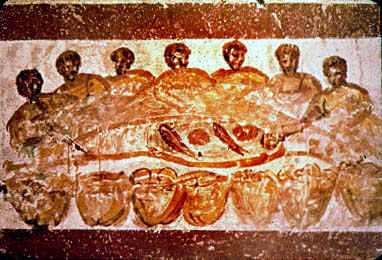
Agape_feast_07

Early Christian Painting of the Shared Table

As we look at the “blessings” of Matthew 5 this week, know that they do not say that any state is  an intrinsic blessing. Rather they each say, that if you have any of the experiences Jesus describes—poverty, mourning, or persecution you will be particularly blessed by the changes Jesus came to make.

The first blessing, “Blessed are the poor,” is a great example. It’s not a blessing to be poor. No one strives and works hard so that one day they can be poor. But Jesus was saying that if the present arrangement of this world has left you poor, you are blessed because the changes I’ve come to make are in your favor. This is also true in the statement we’re  looking at this week, “Blessed are the meek.”

Merriam-Webster defines “meek” as having or showing a quiet and gentle nature, not wanting to fight or argue with other people. It can also be defined as easily imposed on or submissive. There is no intrinsic blessing in being meek in the present world structure. In fact, meekness is a disadvantage in a world where everyone’s looking out for number one, trying to get ahead, looking out for themselves. The world is presently arranged in such a way that it does not reward the meek, it steam rolls over them.

I experienced multiple examples of the truth of this in my travels this summer.

The first was driving in Los Angeles. Driving in L.A. is very different from driving in Lewisburg, WV. In Lewisburg, we look out for everyone on the road. Even cautious drivers are let in and taken care of. Suffice it to say, it is not this way in L.A. If you drive with any degree of meekness, that’s the degree to which you’re going to get run over!

On one of our flights, a large, muscular young man threw a fit in order to intimidate a flight attendant into giving him the seat he wanted. And it worked! As he passed by my seat, I noticed the tattoo on his arm in large lettering: “I trust no one.”

In this world, a world based on competition rather than cooperation, it’s not the meek who are blessed but those who know how to play the game with the greatest skill. Even in something as simple as getting on the airplane, we don’t look after the meek. Each passenger already has their seat assignment, and we will all be taking off and arriving together at the same time. Yet some people need to be the first on the plane to the degree that they will roll over others to do so.

Jesus isn’t telling the people in his day to be meek.  He is telling those listening that the world he was creating would bless even the meek, by contrast to the present world that doesn’t.

Can you imagine a world, where everyone—everyone—treats another simply the way they would like to be treated? Matthew’s Jesus points to that world using the language of his own Jewish tradition:

So in everything, do to others what you would have them do to you, for this sums up the Law and the Prophets. (Matthew 7.12)

Jesus is sharing a universal truth here. This is how it sounds in the language of other cultures:

“Never impose on others what you would not choose for yourself.” –Confucius (Ancient China)

“That which you hate to be done to you, do not do to another.”—Egyptian, Late Period Papyrus (Ancient Egypt)

“Do not do to others that which angers you when they do it to you.” –DIsocrates (Ancient Greece)

“Hurt not others in ways that you yourself would find hurtful.” —Udanavarga (Ancient Buddhism)

“Do to no one what you yourself dislike.”—Tobit 4:16 (Ancient Judaism, at least 200 years before Jesus)

“Recognize that your neighbor feels as you do, and keep in mind your own dislikes.”—Sirach 31:15 (Ancient Judaism)

“That which is hateful to you, do not do to your fellow. That is the whole Torah; the rest is the explanation; go and learn.”—Talmud, Shabbat 31a (Judaism)

“One should never do that to another which one regards as injurious to one’s own self. This, in brief, is the rule of dharma. Other behavior is due to selfish desires.”—Brihaspati, Mahabharata (Anusasana Parva, Section CXIII, Verse 8) (Ancient Hinduism)

This universal truth that Jesus teaches in Matthew’s and Luke’s gospels contains the building blocks of a whole new world. And if we follow it to its furthest conclusion, we find it’s a world that takes care even of the meek. Follow closely.

Jesus modeled this new world for us in his practice of a shared table. Let’s look:

“Now all the tax collectors and sinners were coming near to listen to him. And the Pharisees and the scribes were grumbling and saying, “This fellow welcomes sinners and eats with them.” (Luke 15.1)

When the Pharisees saw this, they said to his disciples, “Why does your teacher eat with tax collectors and sinners?” (Matthew 9.11)

The Pharisees and their scribes were complaining to his disciples, saying, “Why do you eat and drink with tax collectors and sinners?” (Luke 5.30)

For John the Baptist has come eating no bread and drinking no wine, and you say, ‘He has a demon’; the Son of Man has come eating and drinking, and you say, ‘Look, a glutton and a drunkard, a friend of tax collectors and sinners!’ (Luke 7.33-34)

Please remember that Jesus was not a Christian. Jesus was a Jew. In first-century Judaism, unlike in our time and culture, the label “sinner” was not a universal term. It referred only to those within the covenant community who were thought to be living out of harmony with the Torah.

Jesus chose a table that included those who, at best, were politically and religiously marginalized, and, at worst, were excluded by their culture’s status quo. Jesus modeled a table, that to a certain degree, was non-homogenous (think of Simon the zealot and Matthew the tax collector).

In other places in the canonical gospels, Jesus is clear that his table must also be non-kyriarchical.

I do not call you servants any longer, because the servant does not know what the master is doing; but I have called you friends. (John 15.15)

But he said to them, “The kings of the Gentiles lord it over them; and those in authority over them are called benefactors. But not so with you.” (Luke 22.25-26)

But Jesus called them to him and said, “You know that the rulers of the Gentiles lord it over them, and their great ones are tyrants over them. t will not be so among you.” (Matthew 20.25-26)

So Jesus called them and said to them, “You know that among the Gentiles those whom they recognize as their rulers lord it over them, and their great ones are tyrants over them. But it is not so among you.” (Mark 10.42-43)

After he had washed their feet, had put on his robe, and had returned to the table, he said to them, “Do you know what I have done to you?” (John 13.12)

He modeled an inclusive, non-homogenous, non-kyriarchical shared table. And he invited us to sit with him there.

I believe Jesus understood that exclusivity creates a world where certain voices and perspectives are not heard, a world that does not fully take into account how others would desire to be treated or how we would wish to be treated if we were in their position.

I believe Jesus understood that homogeneity creates a world that’s unsafe for anyone who is different or unlike those seated at the table. To the degree that someone is not at the table, to that same degree those present will create an unsafe world. Ultimately, homogeneity leads to exclusion and exclusion leads to extinction.

Jesus understood that hierarchies where one human exercises authority over another human deny the image of God within both, and create a subjugation that leads to oppression.

I see this truth modeled in the Eucharist. We honor the memory of all who have been excluded, subjugated, and exterminated in the past. These were the ones Jesus also stood in solidarity with, and that solidarity cost him his life at the hands of the status quo. We choose, in the name of Jesus and in the face of this world’s present structures, to shape communities in the form a shared meal, a share table.

Regardless of gender, race, orientation, sex, education, and economic achievement, everyone must be invited to the non-kyriarchical, non-homogenous table. And if we would only choose to learn to follow Jesus and sit around this table with others, especially those who are not like ourselves, we could embrace a world devoid of oppression, subjugation and destructive violence.

I have not always understood this myself, but I am continuously learning. Today I see that if we would choose to live in the manner of a shared table, this would create a world respectfully and compassionately shared by and with us all, even the meek. 

In that world, even the meek are blessed, for they, too, will inherit the earth.

Many voices.

One shared table.

One new world.

HeartGroup Application

1. What are some ways your HeartGroup can lean more deeply into practicing the universal truth of treating others the way you’d like to be treated?

List, together, at least ten.

2. Discuss what it is going to take to begin putting this into practice.

3. What challenges does your HeartGroup face now that this principle would significantly help?

List them.


It’s my hope that your heart will, with mine, continue to be liberated, healed and renewed, till the only world that remains is a world where Love reigns.

I love each of you.

I’ll see you next week.

The Seven Last Sayings of Jesus; Part 9 of 9

Part 9 of 9

by Herb Montgomery


The Gospel of an Unstoppable Liberation

Wooden Rosary

“We tell you the good news: What God promised our ancestors he has fulfilled for us, their children, by raising up Jesus.” (Acts 13:32-33)

I want to end this series on the seven last sayings of Jesus, not on Jesus’ execution by the domination systems of his day, but with the reversal and undoing of that execution by the resurrection. This is what the early church proclaimed as the gospel.

Notice that the early church did not preach that Jesus had died to pay a divinely demanded penalty so that you can go to heaven instead of hell when you die. It was not that Jesus had died, but that Jesus had been executed and that his execution had been reversed. Remember that the great Hebrew hope was not of one day becoming some disembodied soul in some far distant heaven. No. The hope of the Hebrew people, that which had been promised to their ancestors, is that the Messiah would come and put right all oppression, violence and injustice.

Salvation, to the early church, was liberation from oppression. And this had been accomplished by God’s resurrection of the one who had been executed by their oppressors.

Notice the following passages.

“And we bring you the good news that what God promised to our ancestors he has fulfilled for us, their children, by raising Jesus…. Let it be known to you therefore, my brothers, that through this man forgiveness of sins is proclaimed to you.” [Liberation and a New Social Order] (Acts 13:23-38)

You that are Israelites, listen to what I have to say: Jesus of Nazareth, a man attested to you by God with deeds of power, wonders, and signs that God did through him among you, as you yourselves know—this man, given to you according to the definite plan and foreknowledge of God, you crucified and killed by the hands of those outside the law. But God raised him up, having freed him from death, because it was impossible for him to be held in its power…. This Jesus God raised up, and of that all of us are witnesses…. Therefore let the entire house of Israel know with certainty that God has made him both Lord and Messiah, this Jesus whom you crucified.” (Acts 2:22-36)

The God of Abraham, the God of Isaac, and the God of Jacob, the God of our ancestors has glorified his servant Jesus, whom you handed over and rejected in the presence of Pilate, though he had decided to release him. But you rejected the Holy and Righteous One and asked to have a murderer given to you, and you killed the author of life, but God raised him from the dead. To this we are witnesses.” (Acts 3:12-16)

Let it be known to all of you, and to all the people of Israel, that this man is standing before you in good health by the name of Jesus Christ of Nazareth, whom you crucified, but whom God raised from the dead. This Jesus is ‘the stone that was rejected by you, the builders; it has become the cornerstone.’” (Acts 4:10-11)

“The God of our ancestors raised up Jesus, whom you had killed by hanging him on a tree. God exalted him at his right hand as Founder and Healer that he might give repentance to Israel and forgiveness of sins.” (Acts 5:30-32)

“We are witnesses to all that he did both in Judea and in Jerusalem. They put him to death by hanging him on a tree; but God raised him on the third day…. He is the one ordained by God as LIBERATOR of the living and the dead. All the prophets testify about him that everyone who believes in him receives forgiveness of sins through his name.” (Acts 10:36-43)

The good news was not that Rome had executed someone or that someone had died. That happened all the time. The good news was that this Jesus, whose teachings offered such radical hope for a transformed world, and who had been executed by the systems his teachings threatened, had been brought back to life. This Jesus had triumphed over the religious, political and economic systems of their day, for his execution had been reversed!

In this great reversal, a new world had begun. Those systems, even the religious one that had claimed to house “God” at its heart, had been exposed, shamed and shown to be what they truly were.

The Presence was not found to be with them, but with the One they had shamefully suspended on a Roman cross.

What I want you to notice is that what liberates us, what “saves” us, for the early church, was not Jesus’ execution, but his resurrection, the undoing and reversal of Jesus’ execution by the powers, but the solidarity of The Sacred (i.e. “God”), The Divine, not simply with Jesus, but will all that had been, or would be the recipients of Oppression.

“And having disarmed the powers and authorities [i.e. religious, social, economic, and political oppression], a public spectacle of them was made, triumphing over them by him.” (Colossians 2:15)

The Sacred Dream of the Divine is of a different world, here and now, where everybody has enough, not as a product of charity, but as a result of the way the world is put together. The present way of assembling the world has been exposed and shamed by the way it executed Jesus. And it has been rendered impotent. The power by which the present systems subordinate others–using “the fear of death” and the threat of being executed at the hands of the present domination systems, what I call the “do what we say, or else” system–has been triumphed over and made of no more consequence. Through Jesus’ execution by the powers and then being resurrected by The Divine, Jesus has liberated “those who all their lives were held in slavery by their fear of death.” (Hebrews 2:14-15)

Why Do I Love Easter?

It’s not because of its co-opted pagan roots of celebrating fertility and the rebirth of spring, though I genuinely appreciate both. It’s because this is the one time Christianity remembers, though I think many have forgotten what it means, why Christianity, as a revolution (as opposed to a religion) came into being.

The story of Matthew, Mark, Luke and John is of an itinerant teacher from prophetic lineage (just like the prophets of old), who travelled the countryside giving a passionate indictment of the religious, political, economic and social systems of his day and putting on display the beauty of a world assembled in the form of a shared nonhomogenous table where every voice is valued and every story heard. A world where we all, from the varied experiences of life that we each represent, learn together how to integrate our differences into a coherent and meaningful whole.

The old order of things was to be deconstructed. Both the voiceless minorities that had been marginalized to the fringes of their society and the voiceless masses that had been oppressed were to find space at this new shared table. Transformed oppressors and the liberated oppressed  were going to have to learn how to sit beside (neither above nor below) one another, recognizing each other as the image of God, both children of the same Divine Parents, welcomed to the same family table.

This was good news to the outsiders, the disadvantaged and the dispossessed. THIS was the gospel! But to insiders, and those in top positions of privilege in the current domination system (the Pharisees, the Priests and the Scribes), this was seen as anything but “good news.”

Jesus’ nonviolent confrontation and disruption of the system in the Temple (Jesus shut it down) was the last straw. Who did he think he was? They had had enough. The priestly aristocracy and the Pharisees combined efforts to manipulate the economic systems of Herod and the political system of Pilate to create a cooperative act of lynching this radical named Jesus.

The torn veil in the temple [1] revealed the Sacred was not dwelling in the most holy places of those institutions, as they claimed. No, the Divine, as was mentioned previously, was dwelling in the One shamefully suspended on a Roman cross at the hands of those combined domination forces. [2]

THIS is the good news: Liberation has come. And it is a liberation that is unstoppable. Yes, for those placed in the position of “last” by the present system this is good news, as they learn how they are to be treated as those who had arrived “first.” And for those who had arrived “first,” well, it is at least problematic as they discover they will now be treated equally with those who had arrived “last.” The point is that each person will be “paid the same,” as the parable teaches, or treated simply as equal. [3]

This liberation could not be stopped. And I dare say, it cannot be stopped today.

They tried to kill it. But even that didn’t work.

I want to close this week with Mark’s telling of the resurrection. Very early versions of Mark’s manuscript ended at Mark 16:8. I want to highlight the value of those manuscripts. Notice the open-ended way that these Jesus stories would have concluded.

“When the Sabbath was over, Mary Magdalene, Mary the mother of James, and Salome bought spices so that they might go to anoint Jesus’ body. Very early on the first day of the week, just after sunrise, they were on their way to the tomb and they asked each other, ‘Who will roll the stone away from the entrance of the tomb?’ But when they looked up, they saw that the stone, which was very large, had been rolled away. As they entered the tomb, they saw a young man dressed in a white robe sitting on the right side, and they were alarmed. ‘Don’t be alarmed,’ he said. ‘You are looking for Jesus the Nazarene, who was crucified. He has risen! He is not here.’” (Mark 16.2-6)

Then Mark’s gospel ends with:

“Trembling and bewildered, the women went out and fled from the tomb. They said nothing to anyone, because they were afraid.” (Mark 16:8)

What is the unspoken point Mark is endeavoring to make? What is the impression he is trying to leave?

Just as Luke’s gospel would later do, Mark is whispering, “Why do you look for the living among the dead? He is not here; he has risen! Yes, those in charge killed him—but they couldn’t stop him. They crucified him and buried him in a rich man’s tomb. But imperial lynching and a tomb couldn’t hold him. He’s still loose in the world. He’s still out there, still here, still recruiting people to share, to participate in his mustard seed subversively planted in the garden, his leaven placed within the dough, his pearl of great price revolution toward a radically new social order that he called ‘the Kingdom of God’—a transformed world here and now.”

What Mark is whispering to us is the good news that yes, they killed our Jesus, but… it’s… not… over. This liberation is unstoppable, for it possesses the solidarity of The Divine.

“You killed the author of this way of life, but God raised him from the dead.” — Peter; (Acts 3:15)

HeartGroup Application

  1. This week as Easter is approaching for the West, take a moment and contemplate what the resurrection actually means for us. Lots of people have been killed for standing up against the status quo. Lots of people have suffered for attempting to dismantle the status quo. But Jesus was one with whom the Divine stood in solidarity and brought back to life.
  2. I want you, as you are contemplating the resurrection and its meaning, to also ponder what it means to follow this resurrected One. What is the most important thing you could be doing right now to further the work of healing, restoration, transformation, liberation and redemption that this Jesus began here on earth?
  3. Share what you discover with your HeartGroup.

I want to thank each one of you who has checked in each week for this nine-part series. It is my prayer that you have been inspired and encouraged to put on display, as a community, the beauty of what a world changed by that radical Jesus looks like. And who knows? It may do just that. It may change the world.

I love each of you dearly. And for those of you who will be celebrating Easter this coming weekend, The Lord Is Risen! He Is Risen Indeed!

Keep living in love, loving like Jesus, ’til the only world that remains is a world where Love reigns.

I’ll see you next week.


1. “The curtain of the temple was torn in two from top to bottom.” (Mark 15:38)

2. “God was in Christ, reconciling the world…” (2 Corinthians 5:19)

3. “For the kingdom of heaven is like a landowner who went out early in the morning to hire workers for his vineyard. He agreed to pay them a denarius for the day and sent them into his vineyard. About nine in the morning he went out and saw others standing in the marketplace doing nothing. He told them, ‘You also go and work in my vineyard, and I will pay you whatever is right.’ So they went. He went out again about noon and about three in the afternoon and did the same thing. About five in the afternoon he went out and found still others standing around. He asked them, ‘Why have you been standing here all day long doing nothing?’ ‘Because no one has hired us,’ they answered. He said to them, ‘You also go and work in my vineyard.’ When evening came, the owner of the vineyard said to his foreman, ‘Call the workers and pay them their wages, beginning with the last ones hired and going on to the first.’ The workers who were hired about five in the afternoon came and each received a denarius. So when those came who were hired first, they expected to receive more. But each one of them also received a denarius. When they received it, they began to grumble against the landowner. ‘These who were hired last worked only one hour,’ they said, ‘and you have made them equal to us who have borne the burden of the work and the heat of the day.’ But he answered one of them, ‘I am not being unfair to you, friend. Didn’t you agree to work for a denarius? Take your pay and go. I want to give the one who was hired last the same as I gave you. Don’t I have the right to do what I want with my own money? Or are you envious because I am generous?’ So the last will be first, and the first will be last.” (Matthew 20:1-15)


The  Seven Last Sayings of Jesus; Part 8 of 9

Part 8 of 9

by Herb Montgomery

 

Wooden RosaryIt Is Finished

“When Jesus had drank the sour wine, he said, ‘It is finished.’ Then he bowed his head and gave up his spirit.” (John 19:30)

The parallels between John’s telling of the Jesus story and the Hebrew creation narrative of the first few chapters of Genesis are unmistakable. As I shared last week, John is reframing the Jewish creation story, using Jesus, now, as the Christian’s origin story of a brand new world.[1]

When all of the parallels between Genesis 1 and John’s Jesus story are lined up, Jesus’ dying words, “It is finished,” become revolutionarily radical. What John is whispering to us is, “new creation.” In Jesus’ teachings, a new world has begun! (See last week’s eSight here.)

As we have often said in this series, Jesus’ death is the result of his nonviolent confrontation with the current domination system of his day, and his announcement that a new social order had arrived. This is a new world where those who are poor as a result of the way the present world is arraigned will be the first to be blessed. Where those who mourn as a result of the present order will laugh, those who are hungry will be fed. Yet, if we stop to pay attention to John, economic changes are not the entirety of the liberating work of Jesus’ teachings. In other words, certainly liberation for the economically oppressed of this world’s present social order is where the Jesus narratives begin. Jesus’ story is about no less than economic liberation. What John is telling us next, though, in his resurrection narrative, is that economic liberation is simply the starting point. Jesus liberation for the poor [2] is the launching pad. Following Jesus is about no less than “good news to the poor,” and it is so much more about liberating all who are oppressed, whether in matters of gender, race, and even today, orientation. Follow John’s logic.

John moves next to the desire of the religious aristocracy for Jesus’ body to be taken down from the tree. Then two very wealthy men, who would have belonged to this aristocracy, abandon their place to privilege to come out in solidarity, now even more so after his execution, with this Jesus.  It is Joseph of Arimathea and Nicodemus who are caring for Jesus’ corpse. Do not miss the importance of these details. This is John’s demonstration of social movement among two of the economically rich away from their wealth to embracing Jesus’ new world, which begins with a bias for the poor. Then John immediately moves from economic liberation to gender liberation.

In John’s telling, Mary Magdalene comes to the tomb early on the first day of the week. Where the first story of the old Hebrew creation narrative is a story where women become blamed for the entrance of “sin” into this world, forever labelling women as the first to be deceived, John begins the new world with the woman being the first to be enlightened, the first to believe, the first to proclaim the message of a risen Jesus. The first work of John’s resurrection narrative is to liberate women from subservience to men. It is not by accident that women play the superior role in John’s resurrection story. The women believe and are bold, while the men are scared and doubtful. (If any of us men are offended by this, welcome to what women have endured from the telling of the Genesis story for two millennia now.)

This means becoming the first to see Jesus, the first to embrace the reality of his resurrection, is now given a duty by Jesus himself. Jesus sends her forth as an Apostle (“one who is sent”) to the other apostles, “Go to my brothers and say to them, ‘I am ascending to my Father and your Father, to my God and your God.’” (John 20:17)

Have you ever wondered why the resurrection story features women as those who “get it,” while the men are deeply struggling? It’s not by accident and John knows exactly what he is doing.

It would not be long before those of the Jesus movement would have to wrestle also with matters of race, ethnicity, and nationality, at least within their own social context.

“God has shown me that I should not call anyone profane or unclean.” – Peter (Acts 10:28, emphasis added.)

“In that renewal there is no longer Greek and Jew, circumcised and uncircumcised, barbarian, Scythian, slave and free; but Christ is all and in all!” – Paul (Colossians 3:11)

“Can anyone withhold the water for baptizing these people who have received the Holy Spirit just as we have?” – Peter (Acts 10:47)

“There is no longer Jew or Greek, there is no longer slave or free, there is no longer male and female; for all of you are one in Christ Jesus.” – Paul (Galatians 3:28)

What we see, therefore, is that although the Jesus story is not about less than economic liberation for the poor, it is certainly about more than that also. It’s about liberation from all that oppresses. Remember, the great Hebrew hope was not of one day becoming some disembodied soul in some far-distant heaven. It was of a time when Messiah would come and set right all injustice, oppression, and violence here on this earth. It was of a time when the Hebrews’ “Eden” would be restored. And just as the Hebrew “Eden” began with Elohim announcing, “It is finished,”[3] John’s new world, rooted in and centered around the teachings of Jesus, begins with Jesus crying out, “It is finished” as well.

The Jesus narratives dismantle a world arranged by pyramids of privilege where some are subordinated for the opulence of others. The Jesus narrative breaks down circles of exclusion where hard lines divide “them” from “us,” marginalizing those we deem as “other” and even in certain cases going beyond marginalization to extirpation. It’s a new world, not characterized by pyramids and circles, but by a shared table, where, regardless of economic status, gender, race, or sexual orientation, all are welcome to share their stories as we all, in our endeavors to follow this Jesus of the early Jesus community, learn to integrate all the varied forms of the Divine’s creation, as well as diverse experience of life into a meaningful and coherent whole. (Maybe I should do a future eSight series titled Pyramids, Circles and a Shared Table.)

Where does this leave us now though?

This new world does not come without a price.

Peter Gomes in his book, The Scandalous Gospel of Jesus, states, “When the gospel says, ‘The last will be first, and the first will be last,’ despite the fact it is counterintuitive to our cultural presuppositions, it is invariably good news to those who are last, and at least problematic news to those who see themselves as first . . . Good news to some will almost inevitably be bad news to others. In order that the gospel in the New Testament might be made as palatable as possible to as many people as possible, its rough edges have been shorn off and the radical edge of Jesus’ preaching has been replaced by a respectable middle, of which ‘niceness’ is now God. When Jesus came preaching, it was to proclaim the ends of things as they are and the breaking in of things that are to be: the status quo is not to be criticized; it is to be destroyed.”

This is why Jesus emphasized loving one’s enemies, seeking to win one’s enemies rather than simply overcoming them. Those benefited by the present social order (think people like me, white, male, cisgender, straight) will find the embrace of Jesus’ new world problematic at best.

Jesus is careful to add to the list of changes he is going to make, a blessing on the “hated.” “Blessed are you when people hate you, and when they exclude you, revile you, and defame you on account of the Son of Man. Rejoice in that day and leap for joy, for surely your reward is great in heaven; for that is what their ancestors did to the prophets” (Luke 6: 22–23). Who is it that would hate those promoting this new social order? Those who have everything to lose by its arrival. It must be remembered, when one is hated for turning the present world upside down [4], we are standing in the lineage of prophets who did not call these changes charity, they called it justice.[5]

Jesus would pay the price of losing his life for confronting the present social order of things. And the servant is not greater than the master. Jesus virtually said, “If you belonged to the present social order, then they would love you as their own. But because you do not belong to the present arraignment, but I have chosen you out of it for a new social arraignment—therefore the present social order hates you. Remember the word that I said to you, ‘Servants are not greater than their master.’ If they persecuted me, they will persecute you.”[6]

And this is where the purpose of this series comes in.

Yes, Jesus was lynched for the changes he had come to make. This new world was his pearl of great price for which he would give up everything. He was the seed that must go into the earth and die in order to produce much fruit. His life, teachings, death, and resurrection would be the mustard seed planted in the soil that would subversively replace the present order of things. This was his passion, that the “earth” would be like “heaven.”[7] His teachings were the leaven that would permeate the entire dough. And although he would lose his life for these teachings, the resurrection would vindicate his life and teachings, showing for all time that the Divine stands in solidarity, not only with Jesus, but with all who have been the oppressed by the injustice and violence of the “present age.” The resurrection is the first morning of the new world. It is the undoing and reversing of the execution of Jesus by the domination systems of the present order. It is the vindication of the world whose arrival Jesus had come to announce. And we need not fear the consequences of our embracing this new world too. At the center of our lives is a narrative, not of old creation, but of a new. We are not people of a Hebraic “fall” in the old stories of Genesis. We are children of the resurrection, which is not Jesus’ alone, but ours as well.

But we will get to all of that next week as we conclude this series.

For now, let’s remember,

Acts 13:32–33 – “We bring you the good news that what God promised to our ancestors, he has fulfilled for us, their children, by raising Jesus.”

Acts 17:18 – “He was telling the good news about Jesus and the resurrection.”

1 Corinthians 15:14 – “If Christ has not been raised, then our proclamation has been in vain.”

2 Corinthians 5:17 – “Therefore, if anyone is in Christ, the new creation has come: The old has gone, the new is here!”

HeartGroup Application

This isn’t theory. It’s not spiritualizing the lessons. It’s intensely practical.

This week I want you to take the progression of Liberation (from the poor, to gender, to race) of the early Jesus community and go further in our day. Each generation is called to follow Jesus, further up and further in. There are two passage I want you to contemplate this week:

“God has shown me that I should not call anyone profane or unclean.” – Peter (Acts 10:28, emphasis added.)

“Can anyone withhold the water for baptizing these people who have received the Holy Spirit just as we have?” – Peter (Acts 10:47)

  1. I want you to hold these two passages in your heart and sit down sometime this week and watch the documentary Seventh Gay Adventist. This is a documentary produced by some dear friends of mine. What I can attest to personally in my own experience over the last two years, is that I too, like Peter of old, have witnessed the Holy Spirit being received by dear Christians who also self-identify as belonging to the LGBTQ community. Just sit down and watch the documentary, for me. My friends have offered you, as a follower of RHM, something special. You can download a FREE Deluxe HD Digital version (the one that is normally $9.99) using the coupon code: watchfreeRHM. You can access it here, select Deluxe Version, $9.99 and enter the code. You can also read all about the film and what others are saying about it here.

2. After you have finished watching it, journal any insights, questions, thoughts, or feelings you may have. Then go back and reread this eSight with these glasses on and see what new insights Jesus gives you in regard to carry forward his work of liberation into Jesus’ new world in our lives today.

3. Share what you experience this week with your HeartGroup.

Easter is coming up for Western Christianity. (For Eastern Christianity, it is a week later.) What marks the greatest contradiction within Christianity today, for me, is celebrating the Divine act of resurrection, vindicating the liberating work of Jesus for this world, while we still leave a marginalized and oppressed group still outside in the cold. Regardless of how one interprets the teachings of the Torah, Jesus’ new world, as we see in Matthew, Mark, Luke, and John, trumped Torah in matters of economics, gender, and race, too. A new world is coming, characterized by a shared table where we all discover what it means to sit together and share side by side. And in fact, for those who have eyes to see it, this new world has already, subversively, begun.

I’m still praying for your hearts. Praying that as we lead up to the narrative element of Jesus’ resurrection, we all may be able, together, to move through the portals of the tomb to Jesus’ restored, transformed, healed, and liberated new world.

Keep living in Love, till the only world that remains is a world where Love reigns.

I love each of you.

Next week we finally arrive at what all of the Jesus narratives (Matthew, Mark, Luke, and John) speak of as Jesus’ resurrection and the good news it announces.

I’ll see you next week.


1.  Genesis 1 begins with the phrase, “in the beginning . . .” So does John: “In the beginning . . .” (John 1:1). In Genesis 1 there are seven days of creation. In John’s version Jesus’ life is divided up and told with seven “signs.” Genesis 1’s narrative of the physical creation of the world climaxes with Elohim, meaning “It is finished.” So John’s telling of the Jesus story climaxes as Jesus cries out over his restored (new) creation with the words, “It is finished.” As Genesis 1 has Elohim resting on the Sabbath day, so Jesus rests from his work of restoration in the tomb on the seventh day. As the narrative of Genesis then moves quickly into a garden with a woman being the first to be deceived, John’s gospel moves quickly into another garden with a woman being the first to be enlightened, becoming an apostle to the apostles.

2.  Luke 4:18 – “The Spirit of the Lord is upon me, because he has anointed me to bring good news to the poor.

3.  Genesis 2:1–3 – “Thus the heavens and the earth were finished, and all their multitude. And on the seventh day God finished the work that he had done, and he rested on the seventh day from all the work that he had done. So God blessed the seventh day and hallowed it, because on it God rested from all the work that he had done in creation.”

 4.  Acts 17:6–7 – “When they could not find them, they dragged Jason and some believers before the city authorities, shouting, ‘These people who have been turning the world upside down have come here also, and Jason has entertained them as guests. They are all acting contrary to the decrees of the emperor, saying that there is another king named Jesus.’”

5.  Amos 5:24 – “But let justice roll down like waters, and righteousness like an everflowing stream.” Matthew 5:6  – “Blessed are those who hunger and thirst for righteousness, for they will be filled.” Matthew 6:33 – “But strive first for the kingdom of God and his justice, and all these things will be given to you as well.” Matthew 5:10 – “Blessed are those who are persecuted for justice’s sake, for theirs is the kingdom of heaven.” (Justice in these passages, remember, is restorative and transformative justice, not punitive or retributive.)

6.  John 15:19–20 – “If you belonged to the world, the world would love you as its own. Because you do not belong to the world, but I have chosen you out of the world—therefore the world hates you. Remember the word that I said to you, ‘Servants are not greater than their master.’ If they persecuted me, they will persecute you; if they kept my word, they will keep yours also.”

7.  Mathew 6:10 – “Your kingdom come. Your will be done, on earth as it is in heaven.”