Is Your Theism An Opiate? 

BY HERB MONTGOMERY

A priest happened to be going down the same road, and when he saw the man, he passed by on the other side. So too, a Levite, when he came to the place and saw him, passed by on the other side. (Luke 10.31-32, Emphasis added.)

The German philosopher and economist Karl Marx’s statement, “Religion is an opiate of the people,” Is often quoted. Does your flavor of Theism function as an opiate for you? Let me explain what this means.

One website estimates that 73% of theists, when faced with injustice in the world around them, do nothing. This is a shocking statistic on its face. And many of you may be part of the 27% it doesn’t apply to. Nonetheless, 73% is an incredibly high ratio.

If this is true, why should it be? It could very well be that many kinds of theism include a belief in the apocalyptic and the afterlife. We talked a few weeks ago about apocalypticism and how beliefs about the afterlife often accompany pessimistic views of the present: people tend to believe that things simply are the way they are in the present and cannot be fixed until the next life. As a result, theists from several religions may look at injustice in this world as an unfixable reality that we must simply accept until God puts it right in the hereafter.

That is the philosophical background we discussed recently. Yet there is another possible reason for theists who do not intervene in injustice, and I’d like to address it this week.

A Personal Relationship With A God That Is Love

The deep disregard for injustice that I’ve witnessed among theists seems to be rooted in a drug-like attachment to a private relationship with a Divine being, and they believe this Being is the very essence of Love. How can something so good yield something so damaging?

If you find great value, meaning, and purpose in a relationship with a Divine being that fits this description of ultimate love, by all means, please continue to do so. And also please hear me out. There is another aspect to this that we must also hold in tension to avoid being spiritually deformed.

Have you ever noticed how a couple that is newly in love can be completely oblivious to the world around them? Hold this illustration in your mind as we continue.

“God Loves You”

I find it curious that the idea of God’s love for us does not surface in three of the four, earliest canonical gospels that we have today. The gospel of John is loaded with this concept, but John’s gospel was not written until the end of the first century or beginning of the second. That means that for most of the Jesus’s movement’s first century, followers focused on the principles of Matthew, Mark and Luke—the teaching that calls us to love rather than to bask in being loved.

In these three early Gospels, Jesus spends his time teaching us how to love God, how to love our neighbor, the marginalized, the “sinner,” and how to love our enemies. There is not one example in these three gospels of Jesus sharing a teaching where the focal point of the teaching was trying to get us to embrace how much we are individually, privately loved by a Divine being.

It’s also curious that in the book of Acts, which is the story of the early Jesus movement growing and proclaiming the gospel, the early Apostles preached the good news without once discussing love. Search the entire book of Acts; the word “Love” can’t be found.

As New Testament historian N.T. Wright stated in the podcast Jesus and the Kingdom of God — Today and Tomorrow, “The good news is not a message about you, it’s a message about Jesus. Now, of course, because it’s a message about Jesus it is then a message about you. But if you say, ‘The Gospel is — God loves you and has a wonderful plan for your life — this makes it incredibly me-centered. The gospel is ‘Jesus Christ is Lord!’ The crucified and risen Jesus is the Lord of the World. And under that great statement there is all the room for you to find new life in the present and in the future. There is all the room for you to find new work to do for the Kingdom, but that’s the Gospel — the message about Jesus.”

The message the early apostles proclaimed was the good news, and that good news was not the news that God loves you. Rather they proclaimed the message that the crucified Jesus was risen and is Lord* of this world.

Lastly, I find it curious that nowhere in the New Testament are we ever encouraged to or told how to have a private, personal relationship with God. The language of “personal relationship” that modern evangelicals are so familiar with simply isn’t there.

The Sermon on the Mount may be the most famous summary of the teachings of Jesus, and even it never encourages us to embrace a God who loves you privately. Rather it’s a list of things for the followers of Jesus to do, not to get to heaven, but to heal the hurt of the world around us. In these chapters, we find teachings about a God who loves THE WORLD. Our God loves the world and the people of the world, and therefore we are called to love them, too. (See Matthew 5.45-48.)

Yes, there are Christians that are so heavenly minded that they are no earthly good. And there’s another extreme in the cult of the “private Jesus.” We must guard against getting so lost in being loved in a private, internalized, individual love-fest with our own personal Divine being. The risk is of being so wrapped up in how much we feel God loves us personally that we become insulated against awareness of our culpability in the injustice, suffering, and oppression of this world and our responsibility to reduce it.

My own experience is some of the people who’ve given the loudest “amens” to my teachings on a God of love are also the very ones who’ve offered the loudest objections to my presentations on Jesus’s followers being agents of healing, restoration, and social justice.

We must be careful that the message of a God who loves does not simply become a pacifying drug for those privileged in our social/economic/political pyramid, something that absolves them of conviction about our responsibility to act. The message of God’s love must be more to us than something that helps the privileged—us!—to sleep better at night.

Yes, God is love, and, as Cornel West has said, “Justice is what love looks like in public.”

Again, if you, have found great value, meaning, and purpose in having a relationship with a Divine being that to you is the very essence of love, by all means, please continue. But please don’t allow yourself to get so lost in the Divine, Loving embrace that you forget about those around you who your God loves just as much as God loves you yet may not be in as beneficial a position as you are in the present social order. A God who is love, also loves them, and this should cause us to be keenly aware of those whose suffering make our “blessings” possible.

A suffering world cannot find us credible when we speak of a God who is love and yet “pass by on the other side” when it comes to systemic violence. It matters little whether someone is lost in the hope of an afterlife or entranced by their own private spiritual experience if they are not making a difference in the world around them. Both forms can be subtle denials of the way that our Jewish teacher, Jesus, taught us through his life.

The Way of Jesus (and the prophets)

Did Jesus spend personal, private time, alone with God? Absolutely! Here are a few examples.

Mark 1:35—Very early in the morning, while it was still dark, Jesus got up, left the house and went off to a solitary place, where he prayed.

Mark 6:46—After leaving them, he went up on a mountainside to pray.

Matthew 14:23—After he had dismissed them, he went up on a mountainside by himself to pray.

Luke 5:16—But Jesus often withdrew to lonely places and prayed.

Luke 6:12—One of those days Jesus went out to a mountainside to pray, and spent the night praying to God.

Matthew 26:39—Going a little farther, he fell with his face to the ground and prayed . . .

Notice that Jesus’ time in private prayer empowered him to return to the public scene rather than retreat from it: he engaged the world as an agent of healing and did not perpetually isolate himself. Jesus, like the prophets before him, engaged in a contemplative practice that moved him to action, not withdrawal.

“The prophets have dirty hands (and mouths too sometimes), because you’ll find them wading without apology through the mess of life. Their target audience begins with the church and its religious leaders but extends to nations and heads of state and to corporations with their economic power brokers. They have unabashed social agendas and are not afraid of being perceived as political. Their concern is for the oppressed, the poor, the widow, the orphan, and the enslaved. The mature prophets call for both personal righteousness and social justice. They retreat inward in contemplation then explode onto the public scene as spokespersons for God’s heart and as advocates for the downtrodden.” —Brad Jersak, Can You Hear Me

Speak up and judge fairly;

defend the rights of the poor and needy. (Proverbs 31.9)

In our society, today, the “rights of the poor and needy” include those of all races, cultures, countries, genders, orientations, sexes, education levels, not merely economic status. And this makes it even more important that theists, especially the followers of Jesus, learn how to be agents of healing. Just as our Jesus was.

HeartGroup Application

This week I’m going to let you into something very private for me: my own personal contemplative practice.

I spend a set time every day contemplating the values and teachings taught in the Jesus story. Even if you only have 15 minutes, you’d be surprised what a difference 15 minutes can actually make.

My weekly schedule is:

Sunday: Restoration

Monday: Forgiveness

Tuesday: Reconciliation

Wednesday: Golden Rule / Interconnectedness

Thursday: Nonviolence

Friday: Justice

Saturday: Compassion

This list changes regularly, but this is what it is right now. You can make your own list of values from those in the Jesus story and dedicate some time each day to contemplate them.

  1. Try this yourself. Either create your own list or use mine for now. Set a timer for 15 minutes, and contemplate what each value means; what it looks like in daily life; what its application may be for your own journey; how you can embody this value. Just spend 15 minutes meditating and contemplating each value, daily, for a week.
  1. Journal what insights, changes, challenges, motivations, or benefits this exercise produces in you.
  1. Share your experience with your HeartGroup.

Till the only world that remains, is a world where Love reigns,

I love each of you, dearly.

I’ll see you next week.

* We hold the term Lord in tension with the non-kyriarchical teachings of Jesus. (Mark 9.33-35; Mark 10.42-44; John 15:15; John 13.12-15)

Ethical Teachings Versus Supernatural Claims


BY HERB MONTGOMERY

IMG_0065“Why do you call me, ‘Lord, Lord,’ and do not do as I teach? As for everyone who comes to me and hears my words and puts them into practice, I will show you what they are like. They are like a man building a house, who dug down deep and laid the foundation on rock. When a flood came, the torrent struck that house but could not shake it, because it was well built.” (Luke 6:46-49)   

I’m just returning from Phoenix, Arizona, where I conducted a five-day religious re-education series for adults on the revolutionary teachings of Jesus.

A sampling of the teachings we looked at were:

  • Self-affirming, enemy-transforming nonviolence for the oppressed (Matthew 5.39-40)
  • A preferential option for the poor (Matthew 5.42; Luke 4.18-19; 6.30; 11.41)
  • Enemy love (Matthew 5.44; Luke 6.27-28)
  • Forgiveness (Mark 11.25; Matthew 6.14-15; Luke 6.37)
  • Restorative/transformative justice (Matthew 23.23; Luke 11.42; 18.7)
  • Redistribution of wealth (Mark 10.21; Matthew 6.19-34; Luke 12.33-34)
  • The Golden Rule (Matthew 7.12)
  • The modeling of a heterogenous shared table (Mark 2.16; Luke 14.12-14)

(You can listen to this series here.)

What I’ve noticed more and more over the last couple years as I’ve spoken about the Jesus of Matthew, Mark, and Luke is that the teachings he taught are somehow new thoughts and ideas for many of the Christians I meet. At least where I’ve traveled, Western, American, mostly white* Christians are unfamiliar with Jesus’s actual teachings, and at the same time have very strong ideas about what it means for them to be “Christian.” 

This phenomenon has a long history in the United States, at least as far back as the 1700s. A significant voice for 18th Century American patriotism was Thomas Paine’s. Paine was one of the founding fathers of the American revolution and also among the first to speak out against slavery and in favor of abolition. But what landed Paine in the most trouble was his book, The Age of Reason. In this book, Paine critiques institutional religion as an oppressive force and also questions the supernatural claims contemporary Christianity made about Jesus.

These supernatural claims have historically included:

  • The divinity of Jesus
  • The virgin birth
  • The miracles of Jesus
  • The substitutionary death of Jesus to satisfy the wrath of God
  • The resurrection

What struck me as odd as I wrote the above list is that many of my readers have been conditioned to place greater importance on mentally assenting to this list than on endeavoring to follow the first list of teachings I shared. We have learned to call the second list “faith” and the first list “behaviorism.” The Jesus of the gospels taught that first list himself. And mentally assenting to any item on the second list doesn’t necessarily change the world around us for the better whereas endeavoring to practice even one item on the list of Jesus’s teachings transforms each practitioner into an agent of healing in this world.

Historically, Freethinkers and secularists like Thomas Paine have agreed with and sought to apply the teachings, values, and ethics found in the Jesus story. They’ve seen in those teachings deep intrinsic worth, especially the Golden Rule, which could change our societies if we practiced it.

My concern this week is this: more and more, I see the harm we’re doing as Christians in the world today rather than being the sources of healing our Jesus story calls us to be.

If I had to choose between 1) someone who was highly certain about the supernatural claims of traditional Christianity yet was unfamiliar with or simply disregarded the actually ethical teachings of the Jesus story and 2) someone who questioned or even doubted those supernatural claims yet were dedicated to learning more deeply how to apply and follow Jesus’s  ethical teachings, I would choose the latter and consider them to be a Jesus follower. Again, it is the first list that the Jesus of the gospels taught himself.

We have enough highly certain humans already, in our Christian religion and beyond, and in so many ways the dogmatically certain who will not do as Jesus taught continue to make the world an unsafe and less compassionate place for many. This group is not in a moral position to critique the morality of those they are harming, though they often do. People who may doubt the church’s explanations and yet do as Jesus taught can at least assist with the moral development of humanity as they sit around the table, equals with us, sharing and listening to the stories of those whose life experience differs vastly from their own.

I expect to get a few emails this week from those who feel I have underestimated the traditional supernatural claims of Christianity. What I’m hoping for, nevertheless, is that a few of us will begin to ask why we feel more passionate about defending those claims while we experience comparatively little concern that so many Christians disregard the practical ethics that Jesus taught during his lifetime.  To be fair, many Christians, today, ARE waking up to the imbalance we are looking at, this week.  I’m pushing for more than acknowledgment, more than reformation, what is needed is a revolution.  Christianity is in desperate need of a revolutionary fusion that puts us back in touch with its original Revolutionary—Jesus.

HeartGroup Application

  1. This week, pick one of the values, ethics, or topics from our first list above and do some research on it. As you study it, contemplate the ways in which you could experiment with the teaching in your own life.
  2. Write down what you discover.
  3. Share and discuss your findings within your HeartGroup.

I’ll close this week with a book recommendation. If you would like to understand the long history mentioned in this week’s eSight, you can find a great overview in Susan Jacoby’s Freethinkers: A History of American Secularism (Holt Paperbacks; January 7, 2005) 

I believe it’s time to reassess what it means to follow the Jesus of the synoptic gospels. Marcus Borg explains:

“Was Jesus a social revolutionary? In the ordinary sense in which we use the phrase ‘social revolutionary,’ yes. Like the Jewish prophets before him, he was passionate about economic justice and peace, and advocated active non-violent resistance to the domination system of his time. He was a voice of peasant social protest against the economic inequity and violence of the imperial domination system, mediated in the Jewish homeland by client rulers of the Roman Empire – in Galilee, Herod Antipas, and in Judea and Jerusalem, the temple authorities. He spoke of God’s kingdom on earth, as the Lord’s Prayer puts it: Your kingdom come on earth, as it already is in heaven. Heaven is not the problem – earth is.

But he was not a secular social revolutionary. He was God’s revolutionary. And God’s passion – what God is passionate about, according to Jesus – is for an earth in which swords are beaten into plowshares, in which nations do not make war against nations anymore, in which every family shall live under their own vine and fig tree (not just subsistence, but more than subsistence), and no one shall make them afraid (Micah 4.1-4, with close parallel in Isaiah 2.1-4). This was the passion of Jesus, and for Christians, Jesus is the revelation of God’s passion.

Violent revolution? No. Non-violent revolution? Yes.

Of course, Jesus and the Bible are also personal as well as political. Of course. But we have not often seen the political meaning of Jesus and the Bible. It is there – and once one sees it, it is so obvious. Not to see it is the product of habituated patterns of thought, or of willful blindness.

Jesus was (and is) not about endorsing the rule of domination systems that privilege the wealthy and powerful. Jesus was (and is) about God’s passion for a very different kind of world.” — God’s Non-Violent Revolutionary by Marcus J. Borg

Till the only world that remains, is a world where Love reigns.

I love each of you dearly.

I’ll see you next week.

*This is not true of the non-white congregations I have come in contact with, though I am told of existing non-white congregations that are still very colonial in their thinking, as well.

Humanizing the Monsters 

by Herb Montgomery

“Don’t be alarmed,” he said. “You are looking for Jesus the Nazarene, who was crucified. He has risen! He is not here. See the place where they laid him.” (Mark 16:6)

Tomorrow is Halloween so let’s talk about that first. Halloween has roots in the Western Christian tradition of All Saints’ Day or All Hallows. In the Eastern Orthodox community, Christians celebrate All Saints Day on the first Sunday after Pentecost during the spring, not the fall. But the West has observed it on November 1 since the 8th Century CE, which makes October 31 its eve and thus All Saints’ Day Eve, All Hallows Eve, or “Halloween” as pronounced by the Scots. Over time, Halloween became influenced by Gaelic and Welsh harvest festival traditions and folklore. It is important to keep Celtic Fall Festivals and the Christian roots of Halloween separate in our thinking. They are related; they are not the same.

In these festivals, humanity’s fascination with and fear of death is invoked. Whether we are memorializing the lives of “saints” who have died (in the spring or the fall), or Celtic fall festivals marking the transition from summer to winter, we’re tracing the transitions from light to darkness, plenty to paucity, life to death.

Humanity and Death

Death is at the heart of all our discussions about morality and ethics. That which leads to life is seen as good and right, and that which leads to death is seen as evil or wrong. Our entire moral compass as a race is dictated by how certain behaviors relate to life and death, the continuance of humanity or its end.

Historically, religion has held out hope for some type of existence beyond death (e.g. Egyptian religion, Christianity, Islam) or a more mystical resignation with death (e.g. Buddhism and Ancient Judaism).

The Jesus Story and the Resurrection

The resurrection is the most potent force in the early Jesus movement. The original followers believed they had witnessed Jesus, whom the status quo had executed, alive again, and it was his resurrection event that liberated them from the fear of death. Because of that event, they could stand up to domination systems and threats of execution if they stepped out of line, because death had become a conquered enemy.

Notice how the letter to the Hebrews, in true apocalyptic fashion, states this:

Since the children have flesh and blood, he too shared in their humanity so that by his death he might break the power of him who holds the power of death—that is, the devil—and free those who all their lives were held in slavery by their fear of death. (Hebrews 2:14, 15, emphasis added.)

These early Jesus followers could stand against the violence, injustice and oppression of earthly principalities and powers whom they viewed as conduits of cosmic evil Powers, because they no longer feared death and no longer feared what these earthly powers could do to them.

Through Jesus, death had been overthrown and so if his followers were executed by the domination systems as their Jesus had been, they believed they would also follow him in being resurrected at the time of universal restoration (see Acts 3.21; 1 Thessalonians 4.16-18, 1 Corinthians 15.22-23)

As a side note, I find it fascinating when humanists and secularists who do not believe in life after death but are resigned about death are still willing to lay down their lives unselfishly for those who may come after them. The gift of their life is genuinely selfless but is given purely for betterment of others. (Some researchers think Dr. Martin Luther King, Jr. may have been such a humanist in his later years.)

Humanizing Monsters

Regardless of how we arrive at that point, from my own experience, being liberated from one’s fear of dying is a breathtakingly beautiful thing, especially when it has the potential to change how we relate to each other.

Morality rooted in our fear of dying influences the way in which we view one another: those who threaten our lives are viewed, too often, as evil. And those who significantly threaten our lives in ways that terrify us the most—those people we deem monsters.

The first step in ridding someone from society is to villainize them. If we can cease to see someone or a group as human and begin to see them as monsters, then we are well on our way to imagining an existence without them. These people must be seen to threaten the “good” —the life—of a society. And if they are, then fear drives out compassion, just as perfect love drives out all fear.

Tomorrow, millions of children will don masks and costumes, and go from door to door asking for cheap chocolate and industrially produced sweets. But underneath each mask is a child. I wonder if there is a deeper lesson in this.

Could the masks we see over the faces of those we fear simply hide children of a divine being, children just like you and I? Whether it’s fear of someone of a different culture or race than you, fear of someone from a different economic status than you, fear of a person with a different gender than you, or fear of someone whose orientation and sexuality is different than yours, our challenge is to pull back the mask that we have fixed upon them in our own hearts, and see that person as the genuine human being that they are. They are a child, just like you, of God, a sibling of yours within the divine/human family. It takes effort to humanize our monsters. Yet it’s only by doing so that we can fully to embody the value of loving our neighbors as ourselves.

Our choices are fear or compassion, death or life.

HeartGroup Application

1. This week I want you to take inventory of the people on this planet that you are afraid of. They can be specific people or simply types of people. I want you actually write down a list. I want you to name your fear this week.

2. Secondly I want you to do some research on your similarities with those you fear. This may be difficult for some, but it will be well worth it. Write down ten ways that those you are afraid of are like you: where do you not differ from them?

3. Journal the insights you gain from this exercise and share your results with your HeartGroup this upcoming week.

We are all children of divinity. We are all siblings of the same divine/human family. Our hope lies in learning how to sit beside one another at the same family table once again. There are no monsters! There are only people, who feel, who love, who hurt, who, like us, are scared. Everyone has a story, and it’s time we give those we are afraid of an opportunity to share theirs.

Till the only world that remains is a world where love reigns.

I love each of you dearly, and I’ll see you next week.

Jesus’ Vision for Community, Wealth Redistribution, and Closing the Inequality Gap 

By Herb Montgomery

Jesus looked around and said to his disciples, “How hard it is for the rich to enter the kingdom of God!” (Mark 10:23)

First, I didn’t say the above statement! So don’t be upset with me. But it is in Mark’s version of the Jesus story, so I’d like to address it.

Most believe Mark’s gospel was written just before or just after the destruction of the Jerusalem during the Roman-Jewish war. The events taking place in the Jesus community at this time help us understand re-emphasizing Jesus’ teachings on sharing our superfluous wealth with each other.

According to the book of Acts, the Jesus community practiced communal care: they took care of the needs of those within their community.

All the believers were together and had everything in common. They sold property and possessions to give to anyone who had need. (Acts 2.44-45)

All the believers were one in heart and mind. No one claimed that any of their possessions was their own, but they shared everything they had. With great power the apostles continued to testify to the resurrection of the Lord Jesus. And God’s grace was so powerfully at work in them all that there were no needy persons among them. For from time to time those who owned land or houses sold them, brought the money from the sales and put it at the apostles’ feet, and it was distributed to anyone who had need. (Acts 4:32-35, emphasis needed.)

What is so amazing about both of these passages is the result: the early Jesus community eliminated poverty in their group. “There were no needy persons among them”—this is what a world influenced by the teachings of Jesus could look like.

One of the purposes of Mark’s gospel is to encourage Jesus’s followers to continue this care-taking. Here’s how he does it. Mark dedicates a large portion of the narrative to this topic.

First, we have the miraculous feeding of the five thousand, with twelve baskets of leftovers in chapter 6:34-44. Then, two chapters later, we have another feeding a multitude (Mark 8:1-10). This time it’s four thousand fed, and seven basketfuls left over.

Just one of these stories would be expected; it’s the repetition of the elements that should cause us to sit up and ask “Why.”

Mark answers this question in verses 14-21 of chapter 8:

“The disciples had forgotten to bring bread, except for one loaf they had with them in the boat. ‘Be careful,’ Jesus warned them. ‘Watch out for the yeast of the Pharisees and that of Herod.’ They discussed this with one another and said, ‘It is because we have no bread.’ Aware of their discussion, Jesus asked them: “Why are you talking about having no bread? Do you still not see or understand? Are your hearts hardened? Do you have eyes but fail to see, and ears but fail to hear? And don’t you remember? When I broke the five loaves for the five thousand, how many basketfuls of pieces did you pick up?’ ‘Twelve,’ they replied. ‘And when I broke the seven loaves for the four thousand, how many basketfuls of pieces did you pick up?’ They answered, ‘Seven.’ He said to them, ‘Do you still not understand?’

Let’s begin to unpack this exchange: “Are your hearts hardened?,” Jesus asks. In Hebrew folklore, the quintessential hardened heart was Pharaoh’s in Exodus. Within that story, Egypt symbolizes a world empire built on scarcity, accumulation, and storage that over time grew into a domination system rooted in greed, oppression, and ruthless brick-production. The story climaxes with a stand off between Moses the liberator and Pharaoh the oppressor; the story says Pharaoh’s heart was “hard,” meaning that “he would not let the Israelites go.”

Jesus emerged within 1st Century Judaism as a liberator of the poor and oppressed. To the degree that Jesus’ disciples would not participate in this liberation, they, like the Pharaoh in the story, choose the way of a hardened heart. Jesus called for his followers to radically embrace one another to the degree that even the wealthy would embrace the poor and liquidate superfluous assets to eradicate need. Two chapters after the conversation in chapter 8, we see Jesus telling a rich questioner, “Sell everything you have and give it to the poor” (Mark 10:18-25).

There are two obstacles to this level of radical sharing. One is feeling like you don’t have enough to share; the other is having enough today but being so afraid of not having enough in the future that you refuse to share now. The stories of the feedding of the multitudes address the first obstacle, whereas the rich man in Mark 10 represents the second.

In each of the “multitude” stories, there is not enough to go around. But in these stories, each person brings what they have and “miraculously” there is somehow enough with more to spare.

In Mark 8, in the boat, the disciples are bumping up against a “scarcity” mentality once again. There is only one loaf to be divided among them, and their temptation is to revert to the narrative of hoarding or “competing” for what there is. Jesus warns them to beware of the leaven of Herod and the wealthy Pharisees. The leaven Jesus is referring to here is that fear of future scarcity that leads to accumulation, hoarding, greed, and a hard heart that ignores the needs of others today. The hard heart makes you a mini “pharaoh,” one who refuses to liberate those around you from whatever prevents them from being fully human.

Jesus’ solution to the oppression of the poor is not charity, but community. I don’t think there is anything wrong with charity. Charity is vital! Charity takes care of hungry stomachs right now. Certainly following Jesus includes no less than sharing charitably with the needy, but it also includes more. Following Jesus means community, where each person, rich and poor alike, brings what they have to the shared table. Even though we may be tempted to think that we only have two loaves and a few fish to feed an entire community, when we come together, something magical happens. As each person contributes what they have, somehow every person’s needs are met.

A couple weekends ago, I encountered an organization in Glendale, CA, called Communitas. Communitas is a Latin noun referring to an unstructured community in which people are equal or to the very spirit of community. The philosophy is that we can choose to network together in a community where each one of us has something that someone else needs. Our needs put us in touch with one another. As we choose to take care of each other, each ability connecting with each need, we can eliminate need by applying the abilities we already possess. Even those who are “in need” have abilities and talents they can bring to the shared table. Communitas is an amazing organization that does more than offer bandaid solutions to poverty. It’s an organization subversively casts a vision of systemic change.

In Mark, Jesus’ solution to “need” or poverty is to close the inequality gap by inviting each person into community where every need is supplied by another person’s shared ability. Some of the wealthy responded well: think of those among the wealthy tax collectors who had chosen to follow Jesus. Others did not: think of those among the Pharisees who viewed Jesus’ teaching with contempt and dismissal.

Mark finishes his story in chapter 10 with these words:

“Children, how hard it is for the rich to enter the kingdom of God! It is easier for a camel to go through the eye of a needle than for someone who is rich to enter the kingdom of God.”

Notice that he does not say it was impossible. He did say it was hard. Jesus was simply being honest about the difficulty. In the words of Bob Dylan, “When you ain’t got nothin’, you ain’t got nothin’ to lose.” But for those who felt as if they had much to lose, choosing the way of compassion and bringing what they possessed to the shared table was, at best, a challenge.

An aside: there actually wasn’t a camel gate in Jerusalem that camels had to get down on their knees to enter. This is a myth that began in the 16th Century to allow the wealthy to follow Jesus and still hold on to their wealth. The phrase “eye of the needle” is beautiful Hebrew hyperbole, and also appears in the Babylonian Talmud: Tractate Baba Mezi’a 38b. Jesus is also using an Aramaic play on words. The Aramaic word gamla can be translated as “rope” as well as camel, because most ropes were made of camel hair. And so the phrase can be read as “getting a rope through the eye of a needle.” The pun holds as Mark’s gospel is translated from Greek into Latin: The Latin word for rope is kamilos, and the Latin word for camel is kamelos.

So what does the pun mean? For a rope to go through an eye of a needle, it must undergo a change: it must be pared down significantly. The rope must become thread. Jesus is saying that the way the wealthy are saved is through choosing to let go of their fear of the future, their trust in the safety of what they have accumulated, and to accept instead the way of compassion that values fellow humans more than wealth. Jesus calls the wealthy to place their wealth on the shared table alongside everything that others bring to the shared table. No hoarding allowed.

The emphasis is not about reducing individual wealth; it’s about making wealthy communities. Jesus is casting the vision of sharing communities that create shared wealth. In these communities, as it states in Acts, there will no longer be a needy person among us.

“A needle’s eye is not too narrow for two friends, but the world is not wide enough for two enemies.” — Solomon Ben Judah Ibn Gabirol (Spanish Jew and Collector of Jewish Aphorisms; Spain, c. 1021 – c.1069; see Geary’s Guide to the Worlds Great Aphorists)

“Never doubt that a small group of thoughtful, committed citizens can change the world. Indeed, it is the only thing that ever has.” — attributed to Margaret Mead

HeartGroup Application

This week I have a special activity for each HeartGroup.

  1. Before you meet as a group make time to personally watch Richard Wilkonson’s 16 minute Ted talk How Economic Inequality Harms Societies. Write down any thoughts, questions, or insights you get as you watch.
  2. When you meet together for your HeartGroup this upcoming week, watch the short presentation again as a group and then spend some time sharing with each other your response.
  3. As a group, write down ways you could close the gaps that exist within your own HeartGroup. Then pick one of these ways to experiment with over the next few weeks. Schedule a time a month from now when you can, as a group, discuss what you have discovered through this exercise.

I’d love to hear what your group discovers. Shoot me an email and let me know what has happened.

Till the only world that remains is a world where Love reigns. Here’s to a safer, more compassionate world, through the means of a shared table, for us all.

I love each of you dearly.

I’ll see you next week.

Jesus and Naturalism

BY HERB MONTGOMERY

science“Go out and train everyone you meet, far and near, in this way of life . . . instruct them in the practice of all I have [taught] you” (Matthew 28:17, 18-19, The Message, emphasis added).

Last week, we talked about one of the worldviews that informed the writers of the gospels. We learned about the traits of the ancient apocalyptic worldview and how it differs from the modern Christian focus on the end-times. This week, let’s talk about another worldview that influences how we read the gospels: naturalism. It is important to understand how the beliefs that we take for granted in our time mirror and differ from the worldview of the Jesus of the gospels and the disciples who wrote about him.

What is Naturalism?

Naturalism seeks to explain what happens in this world by natural causes (natural laws) rather than appealing to supernatural explanations. In its purest form, it assumes that this world is a closed system, which means that nothing that isn’t already a part of this world can be looked to as a cause to explain why something in this world is happening.

Not all naturalists are pure naturalists, however. Many people in the West would much rather look for a natural cause and cure for conditions like lupus than assume a person’s lupus is caused by a supernatural demon and they should see the exorcist. They’re not going to the doctor for prayer. They’re going to the doctor for medicine. Yet many of these same naturalists are also theists and still accept the possibility of supernatural intervention. They still believe in the healing Jesus.

Naturalism in its purest form leaves a person with three options when it comes to a Divine being.

  1. No God exists. (Atheism)
  2. God exists but is disconnected from and uninvolved in this world. (Deism)
  3. Nature is God (Pantheism)

The atheist, deist, and pantheist naturalists can also be referred to as metaphysical naturalists: they agree that the supernatural does not exist. But there are other naturalists, like the theists who seek natural medical explanations for illness, who are merely methodological naturalists: they prioritize natural causes, effects, and explanations for things that happen on this planet. Scientific research and discovery is possible whether one is a metaphysical naturalist or a methodological one. Many of my theist friends who are naturalists still maintain a belief in a personal God from whom these natural laws of cause and effect originated. And recent surveys of professional scientists have shown that more than half conduct their research and also believe in a higher power.

Strengths of Naturalism

Discovery of Actual Causation

Naturalism began with the ancient Greek philosophers’ attempts to explain this world without appealing to “the gods.” Naturalism as we know it today made its first significant inroads into Christianity during the 12th Century Renaissance thanks to Christian natural philosophers. It then picked up steam in the 16th Century where Christian scientists referred to the study of nature as the study of God’s secondary causes. Galileo promoted naturalism during this time, and the approach allowed early scientists to discover some of the basic laws of nature.

Prevention and Cure

If one can discover and predict the causes of things that promote human suffering, then one can discover ways to prevent and/or cure human suffering as well. Over the last several centuries, scientific naturalism has significantly lessened human suffering and increased quality of life for the beneficiaries of its discoveries.

Deliverance from Superstition

Using a scientific basis, Christian naturalist scientists like Galileo began noticing the observable and measurable forces that have repeatable results on things in the world. They found causes for the things that were happening around them rather than appealing to the existence of devils or angels behind every bush and event.

This is significant on a religious level. As people began to discover natural reasons for their suffering through science, they lost fear of provoking the anger of the church’s God and fear of varying from the teachings and explanations of church officials. The Black Death, for example, was not the result of God’s wrath; it was the result of germs. Lightning strikes were not the sign of an angry God; they were the product of observable changes in the atmosphere.

Connectedness

Naturalists believe that all of the natural world is connected in a network of causes and effects. This connectedness we share with one another can lead to concern and care for others besides just ourselves or those like us. Ultimately naturalism has empowered human compassion with tangible methods and means to make a difference in the lives of those hurting.

Responsibility and Accountability

Naturalism may have more benefits than what I’ve listed here, but another that is meaningful to me is the emphasis on human responsibility for the things that happen on this planet: the worldview encourages people to embrace accountability toward each another and not excuse themselves by blaming supernatural forces. A pastor friend of mine who is deeply concerned with climate change also lives in the fundamentalist Bible-belt. Each time a natural disaster occurs, he is fond of saying, “When bad things happen, God gets blamed for things God didn’t do. A devil gets blamed for things a devil didn’t do. And people continue to not take responsibility for the things we are setting in motion.”

Weakness of Naturalism

The naturalist worldview has some beautiful strengths and a few weaknesses as well.

Dependence on Rationalism

Science has no explanation for many of the things that happen on this planet. Although my metaphysical naturalist friends would be quick to say, “Science has no explanation, YET…”, time will tell whether everything on this planet can truly be explained by only appealing to nature without accounting for the supernatural. We can’t yet know.

Addiction to Explanations

While we can explain most things, we sometimes have a tendency to have to explain everything. Naturalism can produce an intolerance of mystery. I do agree that many mysteries need solving and some things that become more beautiful as they are explained. I also believe some things become less beautiful once their mystery is removed and they become explainable. Life must not only be explainable, it must also possess enough beauty and mystery that it’s still worth living.

Meaninglessness, Absence of Compassion, Lack of Ethics

There are a number of popular Christian critiques of the naturalistic world view. First, some Christians say that naturalism produces a meaningless existence. I have found this to be untrue: instead life takes on new and different meanings. Second, some Christians say the naturalistic world view robs humanity of any compassion because it doesn’t root service to humans in service to God. I have also found this to be untrue.  Human compassion results from our discovery of our connectedness. Naturalists and supernaturalists differ in the explanation of why we are connected.  Yet they agree with each other that we are all connected.  In many naturalists, that discovery has deepened their compassion and empowered them with the tools to make a difference in others’ lives. Finally, some Christians warn that if the naturalistic world view is embraced it will produce a world devoid of ethics. I have yet to meet an amoral naturalist. Their ethics may have a different basis than an apocalypticist’s, but it is unfair to say naturalism ultimately removes our ethics.


Jesus Followers and Naturalism

Although the writers of the early Jesus story were not naturalists, the Jesus we find in the story offered a wisdom teaching that I believe can be relevant even for contemporary naturalists today.

Notice what is said in our feature text this week, Matthew 28:17-19. Jesus invited his disciples to produce other Jesus followers. A Jesus follower is not someone who has embraced the worldview of the 1st Century people who first heard Jesus speak. What it meant to be a Jesus follower then was to be “trained” in a “way of life,” in the “practice” of the ethics and values of the 1st Century, Jewish, revolutionary Jesus.  Many in that era embraced a Jewish Apocalyptic world view, yet they were not followers of Jesus. That worldview and discipleship were not the same thing. The question we must wrestle with today is whether someone must embrace a 1st Century Jewish apocalyptic worldview to follow Jesus in the 21st Century. And I don’t believe they do.

The Jesus of the Jesus story offered alternative wisdom to the social norms of his own day. He valued every human being as a being of inestimable worth, and so he contrasted with the way the culture used purity codes to marginalize some of the people. He taught within his context, and his teachings had a political dimension. Jesus opposed arranging human society according to domination systems. He challenged the Roman domination system and its religious legitimization in the Jewish temple at that time, especially among the priesthood and some of the Jewish leaders. (We can gain much from paying attention to the religious legitimization of political domination in our own time and culture. For more on this aspect of Jesus’ teachings, please see Borg’s and Crossan’s The Last Week: What the Gospels Really Teach About Jesus’ Final Days in Jerusalem)

In addition, Jesus taught nonviolent noncooperation and nonviolent confrontation in response to unjust domination systems. This nonviolence can be tested, observed, and seen to have tangible and repeatable results in the lives of those such as Gandhi and Dr. Martin Luther King Jr. Jesus’ teachings had an economic dimension that called to account systems that produce poverty. He offered a preferential option for the poor in our societies, and his stories, like the good Samaritan and the prodigal son, called his audience to look at themselves and others in a different way.

Jesus made original contributions for his own place and time within Jewish culture. He was offering a transformative and restorative justice for all based on a universal and non-discriminatory love for all.

As we said last week, since the 4th Century, Christianity has transitioned away from Earth and begun focusing on how people might enter a post-mortem heaven. This focus was not the focus of the early Jesus’ community. Jesus offered the people teachings on matters directly related to this world, not another. And although the Jesus in the story spoke of supernatural entities, his teachings primarily offer a set of values and ethics that we can test to discern whether they help us find The Way to a safer more compassionate world for us all. As he taught, we can “know by their fruit” whether they have value.

A naturalistic worldview is common in our time. It may remodel our cosmology, and it may adjust our understanding of history, yet I do not believe it requires us to remove our sense of a Heart at the center of the Universe or relegate the 1st Century Jesus to irrelevance.

Science and Jesus can be good neighbors to each other! Again, there is not one Jesus follower I know today who subscribes to a purely apocalyptic or a purely naturalist worldview. We subscribe to a hybrid of both, and I believe there is room in the human family for us all. As we learn to listen to each other, even with our differences, we will together find our way to Jesus’ safer, more compassionate world. (Those of you who are further down the naturalist spectrum than me and are curious to see ways that other naturalists embrace Jesus: check out these four articles—Christian naturalism is possible: Naturalistic Christianity 101, Christian Naturalism, A Christian Naturalism: Developing the Thinking of Gordon Kaufman, and Christianity Without Religion.)

I’ll close this week with a statement by Arthur G Broadhurst, a Christian naturalist:

“Once we get beyond the mythological language [in the gospels], it is clear that the disciples had a life-transforming experience that resulted in a re-ordering of their priorities toward a new way of thinking… and led to their commitment to carry on with Jesus’ teachings… [Being] a Christian does not require a simultaneous belief in gods or theological propositions, in magic or superstition… Anyone who claims to be a follower of Jesus should be seen standing with the weak against the powerful and the rich, feeding the hungry, comforting the sick, bandaging the wounded, holding the hand of a child, standing with the oppressed against the oppressor. It means humility rather than arrogance and pride. It means becoming fully human.”

HeartGroup Application

This week we are learning to listen to those who may see things differently than we do. HeartGroups are intended to help us experience what Jesus modeled at his own shared table.

Chogyam Trungpa Rinpoche once wrote, “Some people live closely guarded lives, fearful of encountering someone or something that might shatter their insecure spiritual foundation. This attitude, however, is not the fault of religion but of their own limited understanding.”

The beauty of Jesus’ shared table is that it enables us to begin integrating various and diverse perspectives into a meaningful and consistent whole, each of us discovering our own blind spots as we chose to listen to another. Jesus is calling us to choose love for one another over the fear of one another.

  1. This week, take Matthew chapters 5-7 and list the teachings of Jesus there that you find meaningful and maybe even challenging for you personally.
  2. List the teachings you have questions about or don’t readily understand.
  3. Present both lists to your HeartGroup and then invite anyone who is willing to share from their own perspectives what the teachings in your second list may mean.

I’ve witnessed some amazingly beautiful moments emerge from members of a diverse group following these three simple steps. The purpose is not for everyone to see everything the same. These are moments for us to practice listening: difference is inevitable but division is optional.

Till the only world that remains is Jesus’ safe and compassionate world where Love reigns.

I love each of you, and I’ll see you next week.

 Jesus—Liberator of the Oppressed, Physician of the Sick

IMG_0283BY HERB MONTGOMERY

As Jesus was walking along, he saw Levi son of Alphaeus sitting at the tax booth, and he said to him, “Follow me.” And he got up and followed him. And as he sat at dinner in Levi’s house, many tax collectors and sinners were also sitting with Jesus and his disciples—for there were many who followed him. When the scribes of the Pharisees saw that he was eating with sinners and tax collectors, they said to his disciples, “Why does he eat with tax collectors and sinners?” When Jesus heard this, he said to them, “Those who are well have no need of a physician, but those who are sick; I have come to call not the righteous but sinners.” Mark 2:14-17

I want to begin this week by thanking you for your patience over the last couple weeks. We’ve been moving our oldest daughter into college. She is our first-born child, and we’ve felt a mixture of bittersweet emotions: business, grief, excitement, joy and sorrow. I was not prepared for what I’ve been feeling about her leaving home. Please pray for me and for us as family.

We started by reading from Mark’s gospel, chapter 2. Let’s take a look at Jesus and the dinner he attended at Levi’s house.

In Mark’s gospel, salvation is defined as Jesus’ liberation from all that oppresses. Mark’s Jesus is not preoccupied with getting people through life in moral condition so their post-mortem, disembodied soul is eligible for the pearly gates. Mark’s Jesus is busy liberating those he encounters from whatever oppresses them today, right now.

Mark’s gospel also draws from the apocalyptic, dualistic world view that connects everything here on earth with a fight between good cosmic forces and evil cosmic forces. In other words, if someone is being oppressed, their oppressors are the puppets of cosmic evil. Jesus envisioned himself as a conduit of cosmic good, here to liberate those oppressed on earth. This is why Mark jumps into supernatural acts of liberation this early in the Jesus story.

Mark shows us that Jesus possessed a preferential option for the poor. Jesus wasn’t working for the equal opportunity of all to compete in a system of winners and losers. He aimed instead at a radical restructuring of human communities where there are no more winners and losers. Jesus pointed us toward communities of mutual aid, where we each strove to take care of one another rather than competing against each other. In Mark 10, Jesus tells the man, “You lack one thing; go, sell what you own, and give the money to the poor.” He envisioned community not rooted in win/lose survival, but win/win cooperation.

In the second chapter of Mark, we see the wealthy tax collectors and “sinners” responding to Jesus’ call to wealth redistribution and the wealthy Pharisees not responding well. We begin here to see in Mark’s gospel a Jesus who prioritizes liberating the oppressed over religiously defined purity and fidelity to religious ritual.

In Luke’s gospel, Jesus makes his mission clear:

“The Spirit of the Lord is upon me,
because he has anointed me
to bring good news to the poor.
He has sent me to proclaim release to the captives
and recovery of sight to those with prison-blindness,
to let the oppressed go free.”
Jesus, Luke 4:18

The Pharisees in Mark are upset that Jesus is eating with “tax-collectors and sinners.”  Jewish tax-collectors were viewed as unfaithful to the national interests of their own people and collaborators with the oppressive political and economic power of Rome. A sinner in the gospels was someone perceived to be living contrary to the Pharisees’ and teachers’ interpretation of the Torah.

Notice that those who were thought to be guilty of nationally infidelity and/or religiously disobedient were responding to Jesus’ economic teachings, yet the Pharisees, who valued national faithfulness and strict obedience to the Torah’s ritual and purity laws, were not.

Mark offers another clue to understanding what’s happening in Mark 2. In the next two stories in his gospel, Mark focuses on the Pharisees and the rituals of fasting and the Sabbath. Asked about the Sabbath, Jesus responds, “Have you never read what David did when he and his companions were hungry and in need of food” (Mark 2:25). The Torah declared it was not lawful for anyone but the priests to eat the bread of the Presence. But when it came to feeding the hungry and strict adhering to the ritual laws, Jesus chose to labor for the oppressed and to prioritize feeding the hungry over the Torah rule. The people were a weightier matter than the law.

Jesus’ teaching matches something that Judaism refers to as pikuach nefesh, the principle that the preservation of human life overrides other religious considerations. The Pharisees in our story this week subscribed to a different way of interpreting the Torah; their principle was that ritual and purity laws may not be violated, even when a life is in danger. (You can see this principle at work in Mark 3 as well. Some members of every religion still argue for this approach to religious obedience today.)

Mark’s Jesus prioritizes the lives of those who are being economically oppressed.

Following Jesus is not about greater patriotism to nationalistic interests, nor is it primarily about religious observances. Following Jesus means defining salvation not as getting to heaven but as liberating humanity today from all things that oppress and using the principles Jesus taught himself.

Those who participate in this liberation work are, by definition, following Jesus in his work. Those who don’t may be very religious, yet are not following him in the way he walked while here on earth.

Our story ends with Jesus responding, “Those that are well don’t need a physician. I came to call not the righteous, but the sinners.”

I believe Jesus was using the religious leaders’ own paradigm here. They felt they were “righteous,” and called those Jesus embraced “sinners.” Yet Jesus took on the role of a liberating physician, and those labeled “sinners” and “sick” were responding to him. They were the ones seeing the sickness of the system they’d participated in. They were the ones choosing to move in a different direction. Jesus hadn’t come to affirm or reward those who were “righteous.” He had come to heal the sick, to liberate the oppressed.

Jesus suggests to the religious leaders that even if they were more politically “righteous” than the tax collectors and more ritually “righteous” than those they referred to as “sinners,” they were just as much economic “sinners” as the wealthy tax-collectors, and just as much in need of liberation as the people they condemned. As long as they refused to consider this reality, they could have no part in and no understanding of Jesus’ work for the poor and oppressed.

This week, don’t ask yourself how successful you are in the merely religious aspects of your life. Ask yourself what you and those around you need to be liberated from so you can be fully human. Ask what you are doing in your own sphere to live out Jesus’ liberation.

Just recently, someone responded to one of my critiques of social political and economic abuses.  “What are you, Herb,” they asked me. “A minister or a politician?” My response is that I’m neither. I am simply a human being endeavoring to obediently follow Jesus. And it is that obedience that dictates that I must concern myself with more than the afterlife. I must also concern myself with whatever people need liberation from today in order to be what the great Heart at the center of the universe brought them into existence to be.

To the degree that we’re living out Jesus’ ministry of liberation from all things that oppress, to that same degree we’re working alongside Jesus. Unless we live out the wisdom of the Jesus story, we may still possess some assurance that helps us sleep at night, but we’re not following Jesus’ way.

If our Jesus today is not first and foremost a liberator of the oppressed as he declared in Luke 4:18, then we must at least ask whether our Jesus is the same one the gospels describe.

HeartGroup Application

The Jesus story calls us to fundamentally rethink theology from the standpoint of the poor and oppressed, to envision a God who is on the side of the poor and the oppressed of our world. The Jesus story calls us away from being preoccupied with getting people through life in good religious or moral condition so that when they die they can be admitted into heaven. Hope of a post-mortem Heaven, dear as it may be, cannot be our cause for excluding or ignoring the basic conditions anyone lives in today. The Jesus story calls us to ask, “What do we need to be fully liberated from in order to be fully human?”—and that liberation is physical, economic, political, religious, and social.

What do we and those around us need to be fully liberated from?

This week:

  1. Sit down with your HeartGroup and take inventory: what in your everyday lives do each of you need to be liberated from? List the issues, experiences, or needs.
  1. Brainstorm ways the group can come together along side of those needs, and live out the liberation values of the Jesus story. Write them down.
  1. Pick three things you have written down in number 2, and coordinate the carrying out of the actions previously discussed.

Charity addresses our immediate needs, but justice gets at the root of what is causing the oppression. Again, the Jesus story defines salvation as liberation from all things that oppress. Within the teachings of Jesus are the seeds of how we can embody Jesus’ work of healing in this world (see John 3:17). His teachings are where a Jesus follower begins to discover how we live out this gospel in our community and incarnate the values of this story which we hold dear.

Till the only world that remains, is a world where love reigns. 

Here’s to Jesus’ safer, more compassionate home for us all. I wish each of you much love, peace and liberation this week.

I love each one of you and I’ll see you next week.

The Last Shall Be the Same as the First and the First the Same as the Last

BY HERB MONTGOMERY

“But he answered one of them, ‘I am not being unfair to you, friend. Didn’t you agree to work for a denarius? Take your pay and go. I want to give the one who was hired last the same as I gave you. Don’t I have the right to do what I want with my own money? Or are you envious because I am generous?’ So the last will be first, and the first will be last.”  (Matthew 20:13-16)   

12345It’s good to be back!  At the end of last month, I found myself needing to take a break for a little self-care.  I had just completed giving 27 presentations to three separate audiences within nine days.  I appreciate the patience of each of you.  I’ve missed you!  Let’s dive in this week.

I want to begin by asking you to experiment with me.  Let’s, for the sake of experimentation, just for a bit, NOT spiritualize everything Jesus said about money and economics.  Not spiritualizing Jesus’ teachings on money enable us to gain deep insights into Jesus’ new alternate society that we are simply prevented from seeing when we spiritualize it all.

I also want to define the word denounce.  To denounce means to “publicly declare to be wrong or evil” (New Oxford American Dictionary); its synonyms include condemn, criticize, attack, censure, decry, revile, vilify, discredit, damn, reject, proscribe, malign, rail against, lay into, formally castigate, expose, betray, inform on, incriminate, implicate, cite, name, and accuse (Oxford American Writer’s Thesaurus). A denouncement can also be a public accusation or reporting (Wikipedia).

In Matthew 11:20, this version of the Jesus story tells us that “Jesus began to denounce the towns in which most of his miracles had been performed.”  What did this look like?  What form did Jesus’ denouncements take?  They come to us in the same form as the denouncements of the Old Testament prophets.  They come in the pronouncement of a “woe.” In the very next verse (Matthew 11:21) we find “Woe to you, Chorazin! Woe to you, Bethsaida!” Eerdmans Dictionary states that “In the New Testament ‘Woe’ functions as prophetic denunciation.”  Jesus is standing in his prophetic lineage in his use of language here.

Yet what I want us to contemplate this week is another denouncement Jesus made.  This denouncement is made in Luke’s Jesus story, chapter 6:

“But woe to you who are rich, for you have already received your comfort.  Woe to you who are well fed now, for you will go hungry.  Woe to you who laugh now [as opposed to mourn over the present social order], for you will mourn and weep.  Woe to you when everyone speaks well of you, for that is how their ancestors treated the false prophets.” (Luke 6:24–26)

Let’s back up and look at the big picture.  Jesus had just pronounced a blessing (the opposite of a denouncement) on the opposite group.  Remember, Jesus is not saying that there is something “righteous” about being poor.  He is saying that for those whom the present social order has left poor, hungry and morning, the changes Jesus had come to make were especially favorable.  The alternate human society Jesus was inviting all to join would be a blessing for those who were poor under the present system and, at a bare minimum, be problematic for those benefiting from the present system.  But we will talk about that in a moment. Let’s look at the two groups first.

“Looking at his disciples, he said: ‘Blessed are you who are poor, for yours is the kingdom of God.  Blessed are you who hunger now [as a result of the present system], for you will be satisfied.  Blessed are you who weep now, for you will laugh.’” (Luke 6:20–22)

“But woe to you who are rich, for you have already received your comfort.  Woe to you who are well fed now, for you will go hungry.  Woe to you who laugh now, for you will mourn and weep.” (Luke 6:24–25)

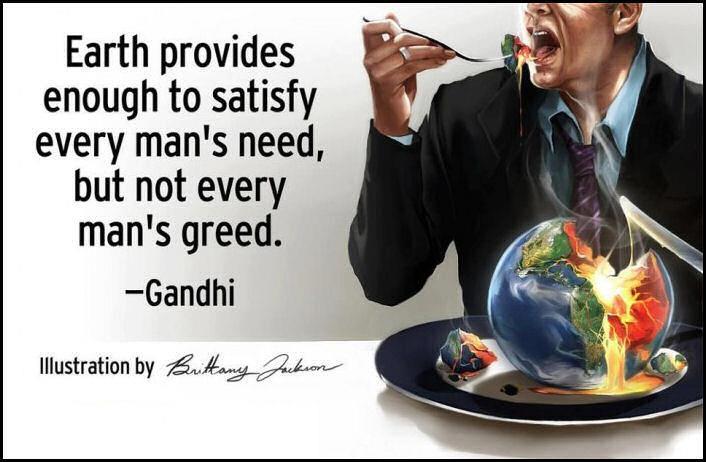
Jesus is doing two things.  First, yes, he is proclaiming that the new social order he is teaching is good news for those who are presently in the position of being “last” and at least problematic for those who were presently “first,” benefitting from the present system.  Second, he is indicting the rich.  There is no way around it.  To understand the logic of this, this planet and its resources are not infinite.  It provides enough for every person’s needs, Gandhi once said, but not every person’s greed.  I understand the “opulence” for everyone argument, but the resources of this earth simply do not work that way.  If someone is hoarding more than he or she needs, someone else is going without what he or she needs. (Think of the truth of the Hebrew manna story; everyone had what he or she needed because those who “gathered much” shared with those who “gathered little.”)  To say that Jesus was putting forth an alternate society seeking the equal distribution of earth’s resources so that each person could have what he or she needed was good news to the poor.

“The Spirit of the Lord is on me, because he has anointed me to proclaim good news to the poor.” (Luke 4:18)

What does this mean? At minimum, it means that if our Jesus is not first and foremost systemic good news for the poor, we have to at least wonder if our Jesus is the same Jesus as the one in the story.

Jesus’ new economic teachings also have something to say about debts that had been incurred under the present system.  All debts are to be cancelled!  This, too, is good news to the debtors and problematic for creditors.  But remember, Jesus’ goal is equality, not just in opportunity, but in result.  What Jesus is announcing is the never-practiced Hebrew tradition of “Jubilee,” during which all debts were to be forgiven.

“And forgive us our debts, as we also have forgiven our debtors.” (Matthew 6:12)

This was hard news for those economically benefiting from the present system.

“Indeed, it is easier for a camel to go through the eye of a needle than for someone who is rich to enter the kingdom of God.” (Luke 18:25)

The idea that there was a gate called a “needle” that camels had to get down on their knees to enter and was difficult to enter but not impossible has long been debunked by scholars.  That’s a made-up story.  What Jesus is saying is that it’s impossible for the rich to enter Jesus’ new alternative society here on earth because fundamental to this new society’s core is a sharing of one’s superfluous riches with those who have less.  At its core, Jesus’ new alternate society is a divestment of and a redistribution of the riches of the dominant class with the aim of equality.

Notice how this played out in the Corinthian church:

“Our desire is not that others might be relieved while you are hard pressed, but that there might be equality. At the present time your plenty will supply what they need, so that in turn their plenty will supply what you need. The goal is EQUALITY.” (2 Corinthians 8:13–14)

The reason the rich cannot enter is not an imposed reason but an intrinsic one.  The first step for the rich in following Jesus is a divestment of their riches.  It’s making the rich un-rich.  It’s alleviating the poverty of the poor through sharing those riches, not, as some claim, making all people poor but equal.  Jesus taught the rich, “Go, sell your possessions and give to the poor, and you will have treasure in heaven. Then come, follow me.” (Matthew 19:21)

This was not an isolated occurrence only privately applied to this specific person.  This was a staple of Jesus’ words to all who were rich:

“But seek his kingdom, and these things will be given to you as well. Do not be afraid, little flock (Jesus’ alternate society), for your Father has been pleased to give you the kingdom.  Sell your possessions and give to the poor.  Provide purses for yourselves that will not wear out, a treasure in heaven that will never fail, where no thief comes near and no moth destroys. For where your treasure is, there your heart will be also.” (Luke 12:31–34)

This is exactly why the very first expression of following Jesus in the book of Acts was manifested in Jesus-followers’ selling their properties and giving to anyone who was in need.

“Those who accepted his message were baptized, and about three thousand were added to their number that day.  They devoted themselves to the apostles’ teaching and to fellowship, to the breaking of bread and to prayer.  Everyone was filled with awe at the many wonders and signs performed by the apostles.  All the believers were together and had everything in common.  They sold property and possessions to give to anyone who had need.” (Acts 2:41–45)

When the wealthy young man heard this, it was too much.  “He went away sad, because he had great wealth.  Then Jesus said to his disciples, ‘Truly I tell you, it is hard for someone who is rich to enter the kingdom of heaven [new alternative society, here, now].’” (Matthew 19:22–23)

I want to juxtapose this statement from Jesus, that it is “hard” for those with wealth to enter into Jesus’ beautiful alternative community, with the statement of Matthew’s Jesus just eight chapters earlier:

“Come to me, all you who are weary and burdened, and I will give you rest.  Take my yoke upon you and learn from me, for I am gentle and humble in heart, and you will find rest for your souls.  For my yoke is easy and my burden is light.” (Matthew 11:28–30)

What can’t be missed is that Jesus is saying if the present system has caused you to not be at ease and not be surrounded by riches but to be “weary,” “heavy laden,” and in need of “rest,” you will find entering Jesus’ alternate society “easy.” It is a blessing!  But if you are one presently benefiting from the current system, Jesus unmistakably states that you’re going to have a harder time embracing Jesus’ teaching on economics.  Entering into this alternate society centered in the teachings of Jesus is impossible on your own and only possible with God (see Matthew 19:26).

Again, why is it so “hard?” It is hard because Jesus is not selling the American definition of “equality.”  Jesus is not simply offering equality as a matter of “opportunity.”  Jesus is calling for a system which creates equality in results as well.

This is the point in the story at which Jesus tells of the workers who arrived at the end of the day but were paid the same as those who had been there all day:

“But he answered one of them, ‘I am not being unfair to you, friend.  Didn’t you agree to work for a denarius?  Take your pay and go.  I want to give the one who was hired last the same as I gave you.  Don’t I have the right to do what I want with my own money?  Or are you envious because I am generous?’  So the last will be first, and the first will be last.’” (Matthew 20:13–16)

This, again, was good news to the last.  It was at least problematic for those who were first.

Gandhi is one of the many in history who have experimented with Jesus’ teachings on equal pay.  There are two books that Gandhi states had a bigger effect on his life and thinking than any other books he read.  The first was Leo Tolstoy’s The Kingdom of God Is Within You.  The second was John Ruskin’s Unto The Last.  Gandhi, in his autobiography, states that this second book crystalized for him three truths.  In the words of Gandhi himself:

1. The good of the individual is contained in the good of all.

2. A lawyer’s work has the same value as the barber’s, inasmuch as all have the same right to earn their livelihoods from their work.

3. The life of labor, e.g., the life of the tiller of the soil and the handicraftsman, is the life worth living.

Gandhi embarked, from Ruskin’s book (the title of which was taken from our featured text this week: “I desire to give unto the last the same as I give to the first”), on an experiment called the Phoenix Project, in which everyone was paid the same amount regardless of the job they did.  The sense of community and mission this produced is breathtaking if one takes the time to read about it.  Everyone worked for the mission; they looked at each other as equals.

We all know how Hasbro’s Monopoly game ends.  Gehenna, in the Old Testament prophet’s sense, may be unavoidable. Jesus is offering a way to life—an alternate, beautiful community.

There are two narratives we can live by:

Narrative 1: Scarcity – Anxiety – Competitive Accumulation – Stockpiling/Hoarding – Violence

Narrative 2: Abundance – Confidence – Cooperative Sharing – Generosity – Peace

Narrative 1 involves believing that there is not enough for everyone’s needs and allowing the anxiety that belief produces to drive you to a life of accumulating stockpiles that you must protect with violence.  The other narrative involves believing that there actually is enough for everyone’s needs to be met if we share and cooperate.  We can subscribe to a narrative of confidence rather than anxiety, of generosity rather than hoarding.  And rather than producing stockpiles one needs to protect with violence, a shared mutuality that produces peace arises.

The least we can do is begin to be honest about our narratives.

I’ll close this week with the words of Leo Tolstoy.

“I do not say that if you are a landowner you are bound to give up your lands immediately to the poor; if a capitalist or manufacturer, your money to your workpeople; or that if you are Tzar, minister, official, judge, or general, you are bound to renounce immediately the advantages of your position; or if a soldier, on whom all the system of violence is based, to refuse immediately to obey in spite of all the dangers of insubordination.

If you do so, you will be doing the best thing possible.  But it may happen, and it is most likely, that you will not have the strength to do so.  You have relations, a family, subordinates and superiors; you are under an influence so powerful that you cannot shake it off; but you can always recognize the truth and refuse to tell a lie about it.  You need not declare that you are remaining a landowner, manufacturer, merchant, artist, or writer because it is useful to mankind; that you are governor, prosecutor, or Tzar, not because it is agreeable to you, because you are used to it, but for the public good; that you continue to be a soldier, not from fear of punishment, but because you consider the army necessary to society.  You can always avoid lying in this way to yourself and to others, and you ought to do so; because the one aim of your life ought to be to purify yourself from falsehood and to confess the truth.  And you need only do that and your situation will change directly of itself.

There is one thing, and only one thing, in which it is granted to you to be free in life, all else being beyond your power: that is to recognize and profess the truth.”

The Kingdom of God Is Within You

HeartGroup Application

This week for our HeartGroup Application, I want to recommend to you the book The Kingdom of God Is Within You by Leo Tolstoy.  You can download a copy free of charge at amazon.com.

1.  Dedicate some time each day to reading and contemplating what you are reading.

2.  Journal your thoughts, feelings, questions, and insights.

3.  Spend some time in your HeartGroup this upcoming week discussing what you are reading.  In other words, process some of what you’re reading out loud with others.  Jesus’ teachings were never meant to be understood or applied in isolation but with “one another.”

Together we can make a difference.  Together we can learn to recognize and participate in Jesus’ alternate society, the beloved and beautiful community, centered around a shared table.  It is a beautiful community.

Keep living in love until the only world that remains is a world where Love reigns.

I love each of you, and I’ll see you next week

IMG_0332


The Seven Last Sayings of Jesus; Part 9 of 9

Part 9 of 9

by Herb Montgomery


The Gospel of an Unstoppable Liberation

Wooden Rosary

“We tell you the good news: What God promised our ancestors he has fulfilled for us, their children, by raising up Jesus.” (Acts 13:32-33)

I want to end this series on the seven last sayings of Jesus, not on Jesus’ execution by the domination systems of his day, but with the reversal and undoing of that execution by the resurrection. This is what the early church proclaimed as the gospel.

Notice that the early church did not preach that Jesus had died to pay a divinely demanded penalty so that you can go to heaven instead of hell when you die. It was not that Jesus had died, but that Jesus had been executed and that his execution had been reversed. Remember that the great Hebrew hope was not of one day becoming some disembodied soul in some far distant heaven. No. The hope of the Hebrew people, that which had been promised to their ancestors, is that the Messiah would come and put right all oppression, violence and injustice.

Salvation, to the early church, was liberation from oppression. And this had been accomplished by God’s resurrection of the one who had been executed by their oppressors.

Notice the following passages.

“And we bring you the good news that what God promised to our ancestors he has fulfilled for us, their children, by raising Jesus…. Let it be known to you therefore, my brothers, that through this man forgiveness of sins is proclaimed to you.” [Liberation and a New Social Order] (Acts 13:23-38)

“You that are Israelites, listen to what I have to say: Jesus of Nazareth, a man attested to you by God with deeds of power, wonders, and signs that God did through him among you, as you yourselves know—this man, given to you according to the definite plan and foreknowledge of God, you crucified and killed by the hands of those outside the law. But God raised him up, having freed him from death, because it was impossible for him to be held in its power…. This Jesus God raised up, and of that all of us are witnesses…. Therefore let the entire house of Israel know with certainty that God has made him both Lord and Messiah, this Jesus whom you crucified.” (Acts 2:22-36)

“The God of Abraham, the God of Isaac, and the God of Jacob, the God of our ancestors has glorified his servant Jesus, whom you handed over and rejected in the presence of Pilate, though he had decided to release him. But you rejected the Holy and Righteous One and asked to have a murderer given to you, and you killed the author of life, but God raised him from the dead. To this we are witnesses.” (Acts 3:12-16)

“Let it be known to all of you, and to all the people of Israel, that this man is standing before you in good health by the name of Jesus Christ of Nazareth, whom you crucified, but whom God raised from the dead. This Jesus is ‘the stone that was rejected by you, the builders; it has become the cornerstone.’” (Acts 4:10-11)

“The God of our ancestors raised up Jesus, whom you had killed by hanging him on a tree. God exalted him at his right hand as Founder and Healer that he might give repentance to Israel and forgiveness of sins.” (Acts 5:30-32)

“We are witnesses to all that he did both in Judea and in Jerusalem. They put him to death by hanging him on a tree; but God raised him on the third day…. He is the one ordained by God as LIBERATOR of the living and the dead. All the prophets testify about him that everyone who believes in him receives forgiveness of sins through his name.” (Acts 10:36-43)

The good news was not that Rome had executed someone or that someone had died. That happened all the time. The good news was that this Jesus, whose teachings offered such radical hope for a transformed world, and who had been executed by the systems his teachings threatened, had been brought back to life. This Jesus had triumphed over the religious, political and economic systems of their day, for his execution had been reversed!

In this great reversal, a new world had begun. Those systems, even the religious one that had claimed to house “God” at its heart, had been exposed, shamed and shown to be what they truly were.

The Presence was not found to be with them, but with the One they had shamefully suspended on a Roman cross.

What I want you to notice is that what liberates us, what “saves” us, for the early church, was not Jesus’ execution, but his resurrection, the undoing and reversal of Jesus’ execution by the powers, but the solidarity of The Sacred (i.e. “God”), The Divine, not simply with Jesus, but will all that had been, or would be the recipients of Oppression.

“And having disarmed the powers and authorities [i.e. religious, social, economic, and political oppression], a public spectacle of them was made, triumphing over them by him.” (Colossians 2:15)

The Sacred Dream of the Divine is of a different world, here and now, where everybody has enough, not as a product of charity, but as a result of the way the world is put together. The present way of assembling the world has been exposed and shamed by the way it executed Jesus. And it has been rendered impotent. The power by which the present systems subordinate others–using “the fear of death” and the threat of being executed at the hands of the present domination systems, what I call the “do what we say, or else” system–has been triumphed over and made of no more consequence. Through Jesus’ execution by the powers and then being resurrected by The Divine, Jesus has liberated “those who all their lives were held in slavery by their fear of death.” (Hebrews 2:14-15)

Why Do I Love Easter?

It’s not because of its co-opted pagan roots of celebrating fertility and the rebirth of spring, though I genuinely appreciate both. It’s because this is the one time Christianity remembers, though I think many have forgotten what it means, why Christianity, as a revolution (as opposed to a religion) came into being.

The story of Matthew, Mark, Luke and John is of an itinerant teacher from prophetic lineage (just like the prophets of old), who travelled the countryside giving a passionate indictment of the religious, political, economic and social systems of his day and putting on display the beauty of a world assembled in the form of a shared nonhomogenous table where every voice is valued and every story heard. A world where we all, from the varied experiences of life that we each represent, learn together how to integrate our differences into a coherent and meaningful whole.

The old order of things was to be deconstructed. Both the voiceless minorities that had been marginalized to the fringes of their society and the voiceless masses that had been oppressed were to find space at this new shared table. Transformed oppressors and the liberated oppressed  were going to have to learn how to sit beside (neither above nor below) one another, recognizing each other as the image of God, both children of the same Divine Parents, welcomed to the same family table.

This was good news to the outsiders, the disadvantaged and the dispossessed. THIS was the gospel! But to insiders, and those in top positions of privilege in the current domination system (the Pharisees, the Priests and the Scribes), this was seen as anything but “good news.”

Jesus’ nonviolent confrontation and disruption of the system in the Temple (Jesus shut it down) was the last straw. Who did he think he was? They had had enough. The priestly aristocracy and the Pharisees combined efforts to manipulate the economic systems of Herod and the political system of Pilate to create a cooperative act of lynching this radical named Jesus.

The torn veil in the temple [1] revealed the Sacred was not dwelling in the most holy places of those institutions, as they claimed. No, the Divine, as was mentioned previously, was dwelling in the One shamefully suspended on a Roman cross at the hands of those combined domination forces. [2]

THIS is the good news: Liberation has come. And it is a liberation that is unstoppable. Yes, for those placed in the position of “last” by the present system this is good news, as they learn how they are to be treated as those who had arrived “first.” And for those who had arrived “first,” well, it is at least problematic as they discover they will now be treated equally with those who had arrived “last.” The point is that each person will be “paid the same,” as the parable teaches, or treated simply as equal. [3]

This liberation could not be stopped. And I dare say, it cannot be stopped today.

They tried to kill it. But even that didn’t work.

I want to close this week with Mark’s telling of the resurrection. Very early versions of Mark’s manuscript ended at Mark 16:8. I want to highlight the value of those manuscripts. Notice the open-ended way that these Jesus stories would have concluded.

“When the Sabbath was over, Mary Magdalene, Mary the mother of James, and Salome bought spices so that they might go to anoint Jesus’ body. Very early on the first day of the week, just after sunrise, they were on their way to the tomb and they asked each other, ‘Who will roll the stone away from the entrance of the tomb?’ But when they looked up, they saw that the stone, which was very large, had been rolled away. As they entered the tomb, they saw a young man dressed in a white robe sitting on the right side, and they were alarmed. ‘Don’t be alarmed,’ he said. ‘You are looking for Jesus the Nazarene, who was crucified. He has risen! He is not here.’” (Mark 16.2-6)

Then Mark’s gospel ends with:

“Trembling and bewildered, the women went out and fled from the tomb. They said nothing to anyone, because they were afraid.” (Mark 16:8)

What is the unspoken point Mark is endeavoring to make? What is the impression he is trying to leave?

Just as Luke’s gospel would later do, Mark is whispering, “Why do you look for the living among the dead? He is not here; he has risen! Yes, those in charge killed him—but they couldn’t stop him. They crucified him and buried him in a rich man’s tomb. But imperial lynching and a tomb couldn’t hold him. He’s still loose in the world. He’s still out there, still here, still recruiting people to share, to participate in his mustard seed subversively planted in the garden, his leaven placed within the dough, his pearl of great price revolution toward a radically new social order that he called ‘the Kingdom of God’—a transformed world here and now.”

What Mark is whispering to us is the good news that yes, they killed our Jesus, but… it’s… not… over. This liberation is unstoppable, for it possesses the solidarity of The Divine.

“You killed the author of this way of life, but God raised him from the dead.” — Peter; (Acts 3:15)

HeartGroup Application

  1. This week as Easter is approaching for the West, take a moment and contemplate what the resurrection actually means for us. Lots of people have been killed for standing up against the status quo. Lots of people have suffered for attempting to dismantle the status quo. But Jesus was one with whom the Divine stood in solidarity and brought back to life.
  2. I want you, as you are contemplating the resurrection and its meaning, to also ponder what it means to follow this resurrected One. What is the most important thing you could be doing right now to further the work of healing, restoration, transformation, liberation and redemption that this Jesus began here on earth?
  3. Share what you discover with your HeartGroup.

I want to thank each one of you who has checked in each week for this nine-part series. It is my prayer that you have been inspired and encouraged to put on display, as a community, the beauty of what a world changed by that radical Jesus looks like. And who knows? It may do just that. It may change the world.

I love each of you dearly. And for those of you who will be celebrating Easter this coming weekend, The Lord Is Risen! He Is Risen Indeed!

Keep living in love, loving like Jesus, ’til the only world that remains is a world where Love reigns.

I’ll see you next week.


1. “The curtain of the temple was torn in two from top to bottom.” (Mark 15:38)

2. “God was in Christ, reconciling the world…” (2 Corinthians 5:19)

3. “For the kingdom of heaven is like a landowner who went out early in the morning to hire workers for his vineyard. He agreed to pay them a denarius for the day and sent them into his vineyard. About nine in the morning he went out and saw others standing in the marketplace doing nothing. He told them, ‘You also go and work in my vineyard, and I will pay you whatever is right.’ So they went. He went out again about noon and about three in the afternoon and did the same thing. About five in the afternoon he went out and found still others standing around. He asked them, ‘Why have you been standing here all day long doing nothing?’ ‘Because no one has hired us,’ they answered. He said to them, ‘You also go and work in my vineyard.’ When evening came, the owner of the vineyard said to his foreman, ‘Call the workers and pay them their wages, beginning with the last ones hired and going on to the first.’ The workers who were hired about five in the afternoon came and each received a denarius. So when those came who were hired first, they expected to receive more. But each one of them also received a denarius. When they received it, they began to grumble against the landowner. ‘These who were hired last worked only one hour,’ they said, ‘and you have made them equal to us who have borne the burden of the work and the heat of the day.’ But he answered one of them, ‘I am not being unfair to you, friend. Didn’t you agree to work for a denarius? Take your pay and go. I want to give the one who was hired last the same as I gave you. Don’t I have the right to do what I want with my own money? Or are you envious because I am generous?’ So the last will be first, and the first will be last.” (Matthew 20:1-15)


The Seven Last Sayings of Jesus; Part 2 of 9


Part 2 of 9

My God, My God, Why Have You Forsaken Me?

BY HERB MONTGOMERY

Wooden Rosary


And at three in the afternoon Jesus cried out in a loud voice, “Eloi, Eloi, lema sabachthani?” (which means “My God, my God, why have you forsaken me?”). —Mark 15.34

About three in the afternoon Jesus cried out in a loud voice, “Eli, Eli, lema
sabachthani?” (which means “My God, my God, why have you forsaken me?”). —Matthew 27.46

No saying of Jesus in any of the Gospels has produced more controversy than this one.

Rather than debating whether Jesus truly felt forsaken or not, I believe we need to ask ourselves why Mark (and Matthew) would include this while later gospels would not.

Mark wants us to embrace Jesus as the Messiah, the son of David, the son of man of the Jewish restorative hope [1]. Remember that in Mark’s gospel, the title “son of God” did not mean “second member of the Godhead.” Rather, this was the return of a king to Israel. King David was Israel’s original “son of God.” To call Jesus by this title was to make the connection between Jesus and kingship! This is the one that would liberate Israel from her oppressors and put all injustice, oppression, and violence to right. (Rome also referred to some of the Caesars as the “son of God.” Some of the early followers of Jesus in Acts would subversively call Jesus the “son of God” in this context as an act of noncooperation with Rome, but this would come later.)

Early in the telling of the Jesus story, one of the chief objections to the claim that Jesus was the king, the son of God, the Messiah, was that Jesus was actually crucified by the oppressors, the Romans.

Within Judaism in the first century, for would-be messiahs to end up on Roman crosses meant that their claims to messiahship were false. They had failed! We see from the early letters attributed to Paul that being put on a Roman cross in first-century Judaism was also equated with Deuteronomy’s mention of being “put on a tree.” [2] (However, this would have been a contemporary application, as Deuteronomy was referring to a very different practice than crucifixion.) This would have been the argument: Jesus could not have been the Messiah. He could not have been another “David,” another “son of God,” [3] a new “king.” Rome had defeated him, executing him in the fashion in which Rome executed all political threats, and Jesus had died in a fashion that, according to the Hebrew scriptures, clearly reveals this would-be messiah to also be “cursed of God.” Jesus was a false messiah and his crucifixion proves this in these two accounts.

Mark addresses this objection head-on (and Matthew follows him in doing so).

How does Mark do this? He reaches back to an experience in which David, the King of Israel himself, also appeared to be forsaken, but discovered this was very much not the case.

The use of Jesus’ crucifixion as proof that Jesus could not have been the Messiah, the return of Israel’s king, must have been a very common objection. The psalm in which David expressed his own wrestling with what seemed to be his apparent forsaking by God was used over and over by first-century followers of Jesus. In Matthew’s Gospel, chapter 27, verses 39 & 43, he clearly alludes to David’s God-forsaken psalm:

Matthew 27.39—Those who passed by derided him, shaking their heads

Matthew 27.43—[“]He trusts in God; let God deliver him now, if he wants to; for he said, ‘I am God’s Son.’”

Psalms 22.7-8—All who see me mock at me; they hurl insults at me, they shake their heads; “Commit your cause to the LORD; let him deliver—let him rescue the one in whom he delights!”

John too, in chapter 19, verse 24 of his Gospel, quotes directly from David’s God-forsaken Psalm:

John 19.24—So they said to one another, “Let us not tear it, but cast lots for it to see who will get it.” This was to fulfill what the scripture says, “They divided my clothes among themselves, and for my clothing they cast lots.”

Psalms 22.18—They divide my clothes among themselves, and for my clothing they cast lots.

Matthew, Mark, and Luke quote from this section of David’s God-forsaken psalm, in part:

Matthew 27.35—And when they had crucified him, they divided his clothes among themselves by casting lots;

Mark 15.24—And they crucified him, and divided his clothes among them, casting lots to decide what each should take.

Luke 23.34—And they cast lots to divide his clothing.

Even the author of Hebrews quotes directly from David’s God-forsaken psalm, placing David’s words in the mouth of Jesus:

Hebrews 2.11-12—For this reason Jesus is not ashamed to call them brothers and sisters, saying, “I will proclaim your name to my brothers and sisters, in the midst of the congregation I will praise you.”

Psalms 22.22—I will tell of your name to my brothers and sisters; in the midst of the congregation I will praise you.

Lastly, in his Gospel, John correlates David’s God-forsaken psalm with Jesus’ dying words:

John 19.30—When Jesus had received the wine, he said, “It is accomplished.” Then he bowed his head and gave up his spirit.

Psalms 22.31—And proclaim his deliverance to a people yet unborn, saying that he has accomplished it.

All of this shows that it was very common among the early followers of Jesus to use David’s God-forsaken psalm (Psalm 22) to defend the claim that, like David, Jesus was the “son of God,” [4] Israel’s King, the long-awaited Messiah, the return of the anointed one5, the Christ.

Therefore, it should come as no surprise that Mark would make use of this psalm, too, in his Gospel. It’s rather ingenious, actually. At first, David appears to be forsaken, but by the end of the psalm he discovers that this was a false conclusion and that it only appeared to be so. David sang that God had not forsaken him, that God had not abandoned him:

Psalms 22.1—My God, my God, why have you forsaken me? Why are you so far from saving me, so far from the words of my groaning?

Psalms 22.22-24—I will declare your name to my people; in the assembly I will praise you . . . For he has not despised or scorned the suffering of the afflicted one; he has NOT hidden his face from him but has listened to his cry for help. (Emphasis added.)

If David, King of Israel, could have gone through an occurrence in which, to all appearances, it looked as if he was forsaken and yet in reality he was not, then also Jesus, King of Israel, could go through an occurrence in which, to all appearances, others might judge that he had been God-forsaken, and yet he not be.

Notice in Mark’s Gospel the way Mark aligns King David’s experience with King Jesus’ experience:

They brought Jesus to the place called Golgotha (which means “the place of the skull”). Then they offered him wine mixed with myrrh, but he did not take it. And they crucified him. Dividing up his clothes, they cast lots to see what each would get.

Mark 15.22-24 (Emphasis added.)

Dogs surround me, a pack of villains encircles me; they pierce my hands and my feet. All my bones are on display; people stare and gloat over me. They divide my clothes among them and cast lots for my garment.

Psalms 22.16-18 (Emphasis added.)

It was nine in the morning when they crucified him. The written notice of the charge against him read: THE KING OF THE JEWS. They crucified two insurgents with him, one on his right and one on his left. Those who passed by hurled insults at him, shaking their heads and saying, “So! You who are going to destroy the temple and build it in three days, come down from the cross and save yourself!” In the same way the chief priests and the teachers of the law mocked him among themselves. “He saved others,” they said, “but he can’t save himself! Let this Messiah, this king of Israel, come down now from the cross, that we may see and believe.” Those crucified with him also hurled insults on him.

Mark 15.25-32 (Emphasis added.)

All who see me mock me; they hurl insults, shaking their heads. “He trusts in the LORD,” they say, “let the LORD rescue him. Let him deliver him, since he delights in him.”

Psalms 22.7 (Emphasis added.)

At noon, darkness came over the whole land until three in the afternoon. And at three in the afternoon Jesus cried out in a loud voice, “Eloi, Eloi, lema sabachthani?” (which means “My God, my God, why have you forsaken me?”).

Mark 15.33-34 (Emphasis added.)

My God, my God, why have you forsaken me? Psalms 22.1 (Emphasis added.)

Remember that the point is to link Jesus’ experience to David’s. If David could go through an experience in which he appeared to be forsaken by God but wasn’t, and could still be Israel’s king, then Jesus too could go through an experience in which he appeared to be forsaken by God but really wasn’t, and could still be Israel’s king!

This is why I believe that Psalm 22 was relied upon so heavily by the early Jesus-following community. It was their way of addressing the objection, produced by Jesus’ crucifixion, to their claim that he was the long-awaited Messiah, the return of their king. This is how they could proclaim that although Jesus had been crucified, he was still Lord.

Today, historical and textual critiques argue about whether these words were actually said by Jesus or were supplied apologetically by Mark. Either way, it matters little. Let’s say, for the sake of argument, that these words are actually original to the historical Jesus. If Jesus had quoted from Psalm 22 on the cross, we must assume that he too would have known the entire psalm, and either used it as a source of comfort, reassuring himself that it only looked as if he was God-forsaken but that he genuinely was not, or he could have been quoting this psalm to answer the derision of those who mocked him, saying that his crucifixion did not disprove his claim to be their King, as David had gone through a similar experience of appearing to be forsaken but not being so. What seems obvious to me is that Jesus could not have genuinely felt forsaken by God while quoting this psalm, because he would have known how it ends:

Psalm 22:24—For he has not despised or scorned the suffering of the afflicted one; he has not hidden his face from him but has listened to his cry for help.

Mark ends his crucifixion narrative with the proclamation of a Roman centurion:

Mark 15:37-39—With a loud cry, Jesus breathed his last. The curtain of the temple was torn in two from top to bottom. And when the centurion, who stood there in front of Jesus, saw how he died, he said, “Surely this man was the Son of God!” (Emphasis added.)

Mark, who from the beginning of his Gospel had centered the Jesus movement in Galilee as opposed to Jerusalem, described the religious leaders in Jerusalem mocking the claim that Jesus was their “king” while this Roman centurion, a gentile, “gets it.” Remember, to a first- century Jew (and also to a Roman, for that matter), the title “son of God” was not a religious title, but a political one. It meant that this one was the king.

Did Jesus actually say these words? There is no way to prove it conclusively.

Did Jesus actually feel forsaken? Whether these words were original to Jesus or were Mark’s narrative device, it is very unlikely either way, given the entirety of Psalm 22, that Jesus said these words as an expression of truly feeling that he was forsaken.

Did the God of the Jesus narrative actually forsake Jesus in this story while Jesus was on the cross? Absolutely not! The narrative element of the resurrection will show that the God of the Jesus story was standing in solidarity with Jesus every step along the way, over and against those who were executing Jesus (we’ll address this in Part 9).

What does this mean for us?

As a theist, have you ever felt forsaken by your God when the established authority stood against you, claiming God was on their side? Don’t trust appearances. Just as the early followers of Jesus were not to trust the way things appeared on the night Jesus was executed, we are not to trust the way things may look for us when we stand up against the religious, economic, or political domination systems of our day. It may appear that you are presently on a cross, presently forsaken by your God, but your God has not abandoned you. Don’t lose the hope and assurance imparted by the resurrection.

HeartGroup Application

  1. Go back and contemplate the times in your life when you felt as if your God had forsaken you. Allow the Jesus story to rewrite that narrative in your heart. Allow yourself to see yourself as not forsaken, but only appearing to be so. Don’t trust in how things appeared at the time. Choose to believe your God had not abandoned you, but was with you all along the way.
  2. Journal the paradigm shifts you experience as you go through this exercise.
  3. Share with your upcoming HeartGroup what you wrote down.

We need not fear standing up to injustice, oppression, and violence in our time. We need not fear standing up against the religious, economic, political, or social domination systems of our day. As Jesus’ followers, we stand in the light streaming from the tomb! That light tells us that the domination system of Jesus’ day could not stop him, even on the cross. Jesus is still out there, still recruiting, still calling those who will stand up and follow his lead as he shows us a way to a new world, whispering . . . “follow me.”

Until the only world that remains is a world where Love reigns. Many voices, one new world.
I love each of you.
I’ll see you next week.


1. Daniel 7.13-14—In my vision at night I looked, and there before me was one like a son of man, coming with the clouds of heaven. He approached the Ancient of Days and was led into his presence. He was given authority, glory and sovereign power; all nations and peoples of every language worshiped him. His dominion is an everlasting dominion that will not pass away, and his kingdom is one that will never be destroyed.

2. Galatians 3.13—Christ redeemed us from the curse of the law by becoming a curse for us, for it is written: “Cursed is everyone who is hung on a pole.” Deuteronomy 21.22-23—If anyone guilty of a capital offense is put to death and their body is exposed on a pole, you must not leave the body hanging on the pole overnight. Be sure to bury it that same day, because anyone who is hung on a pole is under God’s curse. You must not desecrate the land the LORD your God is giving you as an inheritance. John 19.31—Now it was the day of Preparation, and the next day was to be a special Sabbath. Because the Jewish leaders did not want the bodies left on the crosses during the Sabbath, they asked Pilate to have the legs broken and the bodies taken down.

3. Psalms 2.7—I [David] will proclaim the LORD’s decree: He said to me, “You are my son; today I have become your father.

4. Psalms 2.7—I [David] will proclaim the LORD’s decree: He said to me, “You are my son; today I have become your father.

5. Psalms 2.2—The kings of the earth rise up and the rulers band together against the LORD and against his anointed [David], saying; Psalms 18.50—He gives his king great victories; he shows unfailing love to his anointed, to David and to his descendants forever; Psalms 20.6— Now this I know: The LORD gives victory to his anointed. He answers him from his heavenly sanctuary with the victorious power of his right hand; Psalms 23.5—You prepare a table before me in the presence of my enemies. You anoint my head with oil; my cup overflows; Psalms 28.8—The LORD is the strength of his people, a fortress of salvation for his anointed one; Psalms 45.2—You are the most excellent of men and your lips have been anointed with grace, since God has blessed you forever; Psalms 45.7—You love righteousness and hate wickedness; therefore God, your God, has set you above your companions by anointing you with the oil of joy; Psalms 84.9—Look on our shield, O God; look with favor on your anointed one; Psalms 89.20—I have found David my servant; with my sacred oil I have anointed him; Psalms 89.38—But you have rejected, you have spurned, you have been very angry with your anointed one; Psalms 89.51—the taunts with which your enemies, LORD, have mocked, with which they have mocked every step of your anointed one; Psalms 105.15—“Do not touch my anointed ones; do my prophets no harm.”; Psalms 132.10—For the sake of your servant David, do not reject your anointed one; Psalms 132.17—“Here I will make a horn grow for David and set up a lamp for my anointed one.

A New Social Order

warisover

by Herb Montgomery

Now after John was arrested, Jesus came to Galilee, proclaiming the good news of God, and saying, “The time is fulfilled, and the kingdom of God has come near; repent, and believe in the good news.” (Mark 1:14–15)

This week we are still, momentarily, in the
first chapter of Mark. I want to focus on a few details that are often overlooked in our featured text.

Jesus Came to Galilee

If the scholarly data concerning the timing of when Mark’s gospel was written is true, this is a time when the future of Jerusalem was not promising. Political tensions with Rome had been high and were continuing to escalate. It is during this time that Mark draws our attention away from a Jerusalem-centered movement of violent insurrection against the Romans, to a Galilean- centered movement following the teachings of the itinerant Jesus. Mark’s gospel also redefines the “kingdom” of Daniel’s “son of man.”[1] In Mark’s gospel, Jesus is the long-awaited “messiah.” Jesus is the “son of David” who would restore the “Kingdom.” Jesus is still the “son of God,” the anointed one to whom God is “pleased” to give the Kingdom.[2] But a few things have changed. In the Old Testament, this restoration located “Jerusalem” as the center to which the entire world would flock.[3] In Mark’s gospel, the Kingdom of the son of man would follow, instead, the destruction of Jerusalem, and rise out of Galilee rather than Judea.[4] We do not have the space here to elaborate any further on this point, but it is a study well worth your time to contemplate the differences between Judea and Galilee in the first century ethnically, geographically, politically, economically, culturally, linguistically, and religiously, contemplating what these differences might have meant for the beginnings of the early Jesus movement.

Proclaiming the Good News

This next point is so well known and agreed upon by so many that I will not spend much time on this, but it is worth noting. The term for Good News or “Gospel” in the Greek is euaggelion. This originally was neither a religious nor a Christian term. Instead, this was a political term that announced a new social order. Whenever Rome would conquer a territory, Rome would send out an “evangelist” who would proclaim to the conquered territory the “gospel” or good news that they were now under the rule of the peace of Rome (Pax Romana). The messenger would announce that Caesar was the son of God and Rome was the savior of the world. This messenger would proclaim to this newly conquered territory that Rome’s dominion would give this territory a newfound prosperity and peace just as Rome had accomplished for other places as well.

Here are a few examples of the political nature of Rome’s use of the term “gospel.”

“Even after the battle at Mantinea, which Thucydides has described, the one who first announced the victory had no other reward for his glad tidings [euangelion] than a piece of meat sent by the magistrates from the public mess” (Plutarch; Agesilaus, p. 33, 1st century).

“Accordingly, when [Aristodemus] had come near, he stretched out his hand and cried with a loud voice: ‘Hail, King Antigonus, we have conquered Ptolemy in a sea-fight, and now hold Cyprus, with 12,800 soldiers as prisoners of war.’ To this, Antigonus replied: ‘Hail to thee also, by Heaven! but for torturing us in this way, thou shalt undergo punishment; the reward for thy good tidings [euangelion] thou shalt be some time in getting’” (Plutarch; Demetrius, p. 17, 1st century).

“Why, as we are told, the Spartans merely sent meat from the public commons to the man who brought glad tidings [euangelion] of the victory in Mantineia which Thucydides describes! And indeed the compilers of histories are, as it were, reporters of great exploits who are gifted with the faculty of felicitous speech, and achieve success in their writing through the beauty and force of their narration; and to them those who first encountered and recorded the events [εὐαγγέλιον – euangelion] are indebted for a pleasing retelling of them” (Plutarch; Moralia [Glory of Athens], p. 347, 1st century).

The term Gospel originally communicated the arrival of a new social order.

The Arrival of the Kingdom

The Jesus of Mark’s gospel would take this same word, but instead of announcing the Kingdom of Rome, it would announce the Kingdom of God. It is a profound realization when it dawns on a person that the Jesus of Mark never once is found offering people a way to get to heaven. Rather, Mark’s Jesus is traveling the Galilean countryside announcing a new social order, here and now, that is “of God.”

Part of this new social order is not just a recasting of the term “gospel,” but a redefinition of the very term “Kingdom” as well.

In Mark chapter 10, Mark tells us the story of James and John wanting the honorable position of sitting next to Jesus on his left and right when Jesus’ Kingdom becomes established (Messiah’s Rule). Notice the traditional hierarchical nature of James and John’s understanding of the term “Kingdom.” Kingdom refers to a social order wherein humans are exercising dominance over others, and James and John want in on that dominance!

But Jesus is redefining the nature of the “Kingdom” promised by the Old Testament prophets. It’s as if Jesus is saying, yes, the new social order that I’ve come to inaugurate is what the

prophets were pointing to, but it won’t fit your traditional understandings of how “Kingdoms” are ordered.

“Jesus called them and said to them, ‘You know that among the Gentiles those whom they recognize as their rulers lord it over them, and their great ones are exercising authority over them. But it is not so among you; but whoever wishes to become great among you must be your servant, and whoever wishes to be first among you must be slave of all. For the Son of Man came not to be served but to serve . . .” (Mark 10.42–45).

Jesus’ new social order would not involve humans exercising dominance over one another, but rather, serving one another instead. This would be a social order characterized, not by the privileging of some at the subordination of others, but by love, equality, and justice. Jesus’ new social order would be a complete and total dismantling of the present social order. It would involve egalitarianism in matters of race, gender, and economics specifically. And, for it to become permanent, it would be a slow process where even the new social order’s enemies were won to it, through confrontational, enemy love, rather than being conquered by it. Human hierarchies would be abandoned, for brother- and sisterhood.

Everything about this new social order would be different, not simply compared to Rome, but even when compared to the political and economic social order that existed in Jerusalem at that time, which was centered on the Temple. (It was Jesus’ confrontation with the Temple and the social order centered there that got him lynched.)

Repent and Believe the Good News

The Greek word for Repent is metanoeo. It means to think differently or to reconsider. What Jesus was calling us to was a radical rethinking of how we had structured and ordered our human societies. He was calling us to reassess our values, placing our fellow humans at the top of those values. This rethinking applied to both those being oppressed by the current social order as well as those who were doing the oppressing. Things could not continue the way they had or humanity would cease to exist. The ever-burning fire of violence between oppressors and the oppressed was escalating. Jesus was first and foremost calling us to rethink everything.

Secondly, he was asking us to believe in the reordering of the human society he was proposing.

The Greek phrase for “repent and believe” is metanoesein kai pistos. Scholars today have discovered this phrase used also in other contexts than simply by Jesus in the gospels of Matthew, Mark, Luke, and John. Josephus, in his autobiography, records an event that took place in his life when he endeavored to “to put an end” to various Galilean seditions “without bloodshed.” Josephus engages with the “captain” of the brigands “who were in the confines of Ptolemais” and tells this captain that he would forgive “what he had done already, if he would repent of it, and be faithful to me [Josephus] hereafter.” Josephus was, according to scholars, requiring this brigand, to abandon his violent revolutionary inclinations, and trust Josephus for a better way. The phrase Josephus uses is “metanoesein kai pistos emoi.[5]”

This is the same phrase Jesus used in asking those in his day to rethink their present course, and forsake both the violence of oppression (economic oppression of the Temple against the poor) as well as violent forms of revolution (Jewish zealotry against Rome), trusting in and being faithful to Jesus’ alternate way forward to a new social redistribution.

Today

Today, humanity is still struggling with its addiction to establishing social orders of dominance and hierarchies, privilege and subordination. We live in a world where whites are privileged over nonwhites; where men are privileged over women; where the rich are privileged over the poor; where those who are defined as “straight” and “cis” are privileged over those who self-identify as LGBTIQ; where the formally educated are privileged over those who, in many cases, have equal intelligence, but have not had the same opportunities offered.

What is the Jesus narrative saying to us today?

In 1971 John Lennon released the single, “Happy Xmas (War is Over).” The billboards read “War is over, if you want it.” Today the Jesus narrative is saying, “A new social order has arrived . . . if you want it.” The Jesus story announces the arrival of a whole new world. It has arrived in subversive relation to the present order of things. It involves a radically new way of thinking about everything. It is a new world centered on love, mercy, forgiveness, equality, and justice . . . for all. It is “near,” if we want it.[6]

HeartGroup Application

1.  Any time one human seeks to subordinate a fellow human, whether on the basis of race, gender, economic status, formal education (or the lack of it), orientation, even if it carries the label of “Christian,” nothing could be less like the Christ. This week, first, I want you to look up the definitions of Metaphysics, Cosmology, and Ontology and then look up the definition of Ethics. Then I want you to go back and read the Sermon on the Mount in Matthew 57. Many today are “Christians” based on a cultural definition of the first three. But what will change the world is when Christians return to following Christ according to the last meaning. The Jesus of Matthew, Mark, Luke, and John spent precious little time teaching about Metaphysical realities, Cosmologies, and Ontology. I’m not saying he never mentioned those. But by comparison, the lion’s share of Jesus’ teachings centered on Ethics. Today we have a Christianity that possesses a strangely opposite emphasis. Many (thank heaven for the exceptions) define themselves and others with a prioritization on the first three (one’s beliefs when it comes to metaphysics, cosmology, and ontology) while revealing a strange ignorance about what the Jesus of the canonical gospels taught concerning our ethical practices in relation to our fellow humankind. When one encounters the ethical teachings of Jesus, one can see why he was a threat to the then present social order of his day, and why he was removed.

2.  Journal what you discover.

3.  Share what you discover with your HeartGroup.


Till the only world that remains is a world where Love reigns. Many voices, One New World. I love each and every one of you. Thanks for giving this a read.
I’ll see you next week.

1 Daniel 7.13–14— In my vision at night I looked, and there before me was one like a son of man, coming with the clouds of heaven. He approached the Ancient of Days and was led into his presence. He was given authority, glory and sovereign power; all nations and peoples of every language worshiped him. His dominion is an everlasting dominion that will not pass away, and his kingdom is one that will never be destroyed.

2 Mark 1.11—And a voice came from heaven: “You are my Son, whom I love; with you I am well pleased.” Daniel 4.17—“The decision is announced by messengers, the holy ones declare the verdict, so that the living may know that the Most High is sovereign over the kingdoms on earth and gives them to the one with whom He is pleased and sets over them the lowliest of people.”

3 Isaiah 2.2—In the last days the mountain of the LORD’s temple will be established as the highest of the mountains; it will be exalted above the hills, and all nations will stream to it.

4 Mark 13.24—“But in those days, following that distress, ‘the sun will be darkened, and the moon will not give its light; the stars will fall from the sky, and the heavenly bodies will be shaken.’ At that time people will see the Son of Man coming in clouds with great power and glory.” Daniel 7.13–14—In my vision at night I looked, and there before me was one like a son of man, coming with the clouds of heaven. He approached the Ancient of Days and was led into his presence. He was given authority, glory and sovereign power; all nations and peoples of every language worshiped him. His dominion is an everlasting dominion that will not pass away, and his kingdom is one that will never be destroyed.

5 The Life Of Flavius Josephus, (Thackery 110); cf. N.T. Wright, Jesus and the Victory of God [Minneapolis: Fortress, 1996, p. 251; NT Wright, The Challenge of Jesus (Downers Grove, IL: InterVarsity Press, 1999), p. 44

6 Matthew 3.2—And saying, “Repent, for the kingdom of heaven has come near.” Matthew 4.17—From that time on Jesus began to preach, “Repent, for the kingdom of heaven has come near.” Matthew 10.7—As you go, proclaim this message: “The kingdom of heaven has come near.” Mark 1.15—“The time has come,” he said. “The kingdom of God has come near. Repent and believe the good news!” Luke 10.9—Heal the sick who are there and tell them, “The kingdom of God has come near to you.” Luke 10.11—“Even the dust of your town we wipe from our feet as a warning to you. Yet be sure of this: The kingdom of God has come near.”