Seventy Times Seven

Thank you to all of our supporters.

If you would like to join them in supporting Renewed Heart Ministries’ work you can do so by clicking “donate” above.


New Episode of JustTalking!d

Season 1, Episode 30: Matthew 18.21-35

Each week, we’ll be talking about the gospel lectionary reading for the upcoming weekend. We’ll be talking about each reading in the context of love, inclusion, and societal justice. Our hope is that our talking will be just talking (as in justice) and that during our brief conversations each week you’ll be inspired to also do more than just talking.

If you teach from the lectionary each week, or if you’re just looking for some thoughts on the Jesus story from a more progressive perspective within the context of social justice, check it out, you might like it.

You can find the latest show on YouTube at https://youtu.be/UECsbII4Hz8?si=hE3dv2K06J2jPF86

 or (@herbandtoddjusttalking)

Please Like, Subscribe, hit the Notification button, and leave us a comment

Thanks in advance for watching!


Seventy Times Seven

Herb Montgomery, September 15, 2023

To listen to this week’s eSight as a podcast episode click here.

“This parable originated not as allegory but as an example of real life indebtedness Jesus’ audience would have been familiar with. This was not a call for the indebted to forgive their abusive creditors, but for creditors to forgive the debts of those who owed them.”

Our reading this week is from the gospel of Matthew:

Then Peter came to Jesus and asked, “Lord, how many times shall I forgive my brother or sister who sins against me? Up to seven times?”

Jesus answered, “I tell you, not seven times, but seventy-seven times. 

“Therefore, the kingdom of heaven is like a king who wanted to settle accounts with his servants. As he began the settlement, a man who owed him ten thousand bags of gold was brought to him. Since he was not able to pay, the master ordered that he and his wife and his children and all that he had be sold to repay the debt. 

“At this the servant fell on his knees before him. ‘Be patient with me,’ he begged, ‘and I will pay back everything.’ The servant’s master took pity on him, canceled the debt and let him go. 

“But when that servant went out, he found one of his fellow servants who owed him a hundred silver coins. He grabbed him and began to choke him. ‘Pay back what you owe me!’ he demanded. His fellow servant fell to his knees and begged him, ‘Be patient with me, and I will pay it back.’

“But he refused. Instead, he went off and had the man thrown into prison until he could pay the debt. When the other servants saw what had happened, they were outraged and went and told their master everything that had happened.

“Then the master called the servant in. ‘You wicked servant,’ he said, ‘I canceled all that debt of yours because you begged me to. Shouldn’t you have had mercy on your fellow servant just as I had on you?’ In anger his master handed him over to the jailers to be tortured, until he should pay back all he owed.

“This is how my heavenly Father will treat each of you unless you forgive your brother or sister from your heart.” (Matthew 18:21-35)

Even the most progressive Jesus scholars see this parable as part of the earliest oral traditions, tracing back to the historical Jesus himself. A rich man forgives ten thousand bags of gold owed by one of his slaves. Think of how much each bag would have been worth, and then multiply that by ten thousand. In compassion, the creditor simply forgives the entire debt.

Harmful interpretations of this parable teach the abused and oppressed to passively forgive their oppressor or abuser over and over again, but require no change from the one responsible for harming them.

Before we spiritualize this parable to all relationships and offenses, though, we need to step back and look at the original economic context. In the original context, oppressors, specifically creditors, are to forgive the debts of those they were oppressing based on how much the oppressors themselves had been forgiven by Jesus’ “heavenly Father.” This was not a call for the indebted to forgive their abusive creditors, but for creditors to forgive the debts of those who owed them. 

Then the forgiven one runs into someone who owes him only 100 silver coins, a far lower amount. Rather than his own experience of forgiveness awakening more in him toward the person who owed him money, he seeks to exact every last coin from his own debtor. 

Again, this parable originated not as allegory but as an example of real life indebtedness Jesus’ audience would have been familiar with. From the beginning of Luke’s gospel, Jesus shares a call to wealthy creditors to perform the ritual of “the year of the lord’s favor” or the year of Jubilee, where all debts would be forgiven. This was part of Jesus’ gospel: the call for economic liberation of those in debt. Debts were to be cancelled. This is how Luke’s gospel sums it up:

“The Spirit of the Lord is on me,

because he has anointed me 

to proclaim good news to the poor.

He has sent me to proclaim freedom for the prisoners 

and recovery of sight for the blind,

to set the oppressed free,

  to proclaim the year of the Lord’s favor.” (Luke 4:18-19)

Matthew’s version of the lords prayer also uses economic language: 

“And forgive us our debts,

as we also have forgiven our debtors.” (Matthew 6:12)

Later in the Jesus community, this idea of forgiving debts expanded to include all offenses and trespasses, not just economic indebtedness. This is why in Luke’s later version of the same prayer no longer names the economic element but reads:

“Forgive us our sins,

for we also forgive everyone who sins against us.” (Luke 11:4)

What once called creditors (oppressors) to forgive the debts of their debtors (the oppressed) became a universal call for everyone to forgive anyone of anything based on how much they themselves had personally been forgiven by God. What once involved the wealthy cancelling the debts of their poorer fellow Jesus followers became universalized. Social location was no longer the focus. Money owed became allegorical for general offenses. And forgiveness stopped meaning the cancelling of real, concrete debts; it became letting off the hook anyone who had done anything up to 490 times if they simply came back repeatedly and said they were sorry. 

I’m not a fan of this evolution in the Jesus stories we have access to today. What it too often becomes is manipulative pressure for those who have suffered injustice or abuse to repeatedly forgive their abuses if the abuser expresses sorrow, whether they actually change or not. Some interpretations definethe one seeking forgiveness as truly changing, but if there were true, the number of times needing for forgiveness would never reach “seventy times seven.” 

But if this was actually a call for creditors to practice Jubilee, repeatedly, seventy times seven, no matter how many times people became indebted, then this story takes on an economic dimension that requires social change. If the creditors who follow Jesus must forgive the concrete debts of their debtors, then before too long those creditors would be looking at the systemic causes of why folks were repeatedly being thrown into debt. As the saying goes, when you’re continually pulling people out of the water it doesn’t take long before one walks upstream to ask why those people are being thrown in the water to begin with. 

What does this mean for us today?

First let’s say what it doesn’t mean. This parable doesn’t mean that we shouldn’t hold abusers accountable for the harm they inflict on others. Part of restorative justice is holding abusers accountable. Accountability is intrinsic to their own restoration and healing, too: it awakens and restores a sense of connection to their actions toward others. If there is an element of forgiveness involved, it refuses to sever the abuser from humanity, and the desire to hold them accountable comes not out of vengeance but out of a desire to see them reformed. Forgiveness should never be defined or interpreted as simply letting someone off the hook and pretending they did nothing wrong. Restoration and reparations must always be a part of the process of repairing harms committed for the life-giving well-being of all parties involved.

Yet this story still carries an economic element. How should Jesus followers relate to economic debt forgiveness? I heard many Christians voices over the last two years against student loan forgiveness. How would the Jesus of this week’s readings respond to the idea of students being forgiven the astronomical costs of becoming educated? How would he describe the predatory practices of the loan industry that takes advantage of those students. Consider the social location of those who have to seek student loans to gain an education. Considering these factors, certain Christians are grossly ignorant of how disconnected their religious worship of Jesus is from the values their Jesus taught and the themes of his gospel. 

And this is just one example. In our modern, global capitalist system, indebtedness is how countries continue to colonize and enslave other countries, even “independent” countries. Sometimes this debt is connected to the drive to “develop” those countries so that they their resources can be more easily exploited by global corporations. 

If we followed the economic truths of our story this week it would turn our present economic world upside down.

Maybe we could start with Christians simply forgiving the debts of their fellow Christians. There are also Christian ministries that raise funds and donations purely for the purpose of being able to pay off people’s medical debts. What a blessing to be able to say to someone they are set free from what they owed for something as vital as their own health care. 

And what about debt at faith-based hospitals? Or education debt owed to Christian colleges and universities? What about the indebtedness that comes when folks fall on hard times? How could it change the world if Christians and Christians institutions simply chose to cancel the debts of other Jesus followers? I’m not suggesting this be where the practice should end, but it would be a great place for a global “year of the Lord’s” favor to begin. 

HeartGroup Application

1. Share something that spoke to you from this week’s eSight/Podcast episode with your HeartGroup.

2. How do you imagine Jesus’ Jubilee Debt Forgiveness could be applied in our world today? Share and discuss with your group.

3. What can you do this week, big or small, to continue setting in motion the work of shaping our world into a safe, compassionate, just home for everyone? 

Thanks for checking in with us, today.

I want to say a special thank you to all of our supporters out there. And if you would like to join them in supporting Renewed Heart Ministries’ work you can do so by going to renewedheartministries.com and clicking donate. 

You can find Renewed Heart Ministries on Twitter, Facebook and Instagram. If you haven’t done so already, please follow us on your chosen social media platforms for our daily posts. Also, if you enjoy listening to the Jesus for Everyone podcast, please like and subscribe to the JFE podcast through the podcast platform you use and consider taking some time to give us a review. This helps others find our podcast as well.

Also I want to share that we are partnering in a new weekly YouTube show called “Just Talking.” Each week, Todd Leonard and I will be talking about the gospel lectionary reading for the upcoming weekend. We’ll be talking about each reading in the context of love, inclusion, and societal justice. Our hope is that our talking will be just talking (as in justice) and that during our brief conversations each week you’ll be inspired to also do more than just talking.

If you teach from the lectionary each week, or if you’re just looking for some thoughts on the Jesus story from a more progressive perspective within the context of social justice, check it out, you might like it. You can find JustTalking each week on YouTube at youtube.com/@herbandtoddjusttalking. Please Like, Subscribe, hit the Notification button, and leave us a comment.

And if you’d like to reach us here at Renewed Heart Ministries through email, you can reach us at info@renewedheartministries.com.

My new book, Finding Jesus: A story of a fundamentalist preacher who unexpectedly discovered the social, political, and economic teachings of the Gospels is now also available at renewedheartministries.com

Right where you are, keep living in love, choosing compassion, taking action, and working toward justice.

I love each of you dearly,

I’ll see you next week.


Now Available at Renewed Heart Ministries!

Herb’s new book Finding Jesus: A story of a fundamentalist preacher who unexpectedly discovered the social, political, and economic teachings of the Gospels, is available at renewedheartministries.com.

Get your copy today at renewedheartministries.com


Are you receiving all of RHM’s free resources each week?

Begin each day being inspired toward love, compassion, action, and justice. Free Sign-Up HERE

Relating to Those with Whom We Disagree

Thank you to all of our supporters.

If you would like to join them in supporting Renewed Heart Ministries’ work
you can do so by clicking “donate” above.


New Episode of JustTalking!d

Season 1, Episode 29: Matthew 18:15-20. Lectionary A, Proper 18

Each week, we’ll be talking about the gospel lectionary reading for the upcoming weekend. We’ll be talking about each reading in the context of love, inclusion, and societal justice. Our hope is that our talking will be just talking (as in justice) and that during our brief conversations each week you’ll be inspired to also do more than just talking.

If you teach from the lectionary each week, or if you’re just looking for some thoughts on the Jesus story from a more progressive perspective within the context of social justice, check it out, you might like it.

You can find the latest show on YouTube at https://youtu.be/_E6OhdHRp_Q?si=d743j2SBjL8gJLBJ

 or (@herbandtoddjusttalking)

Please Like, Subscribe, hit the Notification button, and leave us a comment

Thanks in advance for watching!


Conversation

Relating to Those with Whom We Disagree

Herb Montgomery | September 8, 2023

To listen to this week’s eSight as a podcast episode click here.

“Concerns and disagreements will always happen. Human beings are messy. We all get to choose how we navigate those concerns and disagreements in a life giving or death dealing way.”

Our reading this week is from the gospel of Matthew:

“If your brother or sister sins, go and point out their fault, just between the two of you. If they listen to you, you have won them over. But if they will not listen, take one or two others along, so that ‘every matter may be established by the testimony of two or three witnesses.’ If they still refuse to listen, tell it to the church; and if they refuse to listen even to the church, treat them as you would a pagan or a tax collector.

“Truly I tell you, whatever you bind on earth will be bound in heaven, and whatever you loose on earth will be loosed in heaven. Again, truly I tell you that if two of you on earth agree about anything they ask for, it will be done for them by my Father in heaven. For where two or three gather in my name, there am I with them.” (Matthew 18:15-20)

Our reading this week is not found in Mark’s or John’s version of the Jesus story. It is included in Luke’s version of our reading this week:

“So watch yourselves. If your brother or sister sins against you, rebuke them; and if they repent, forgive them. Even if they sin against you seven times in a day and seven times come back to you saying ‘I repent,’ you must forgive them.” (Luke 17:3-4)

I find it interesting that Matthew’s version explains to how Jesus followers should respond to a fellow Jesus follower who doesn’t listen. Luke’s version only explains how they should respond to a fellow Jesus follower who repents.

The admonition to forgive seventy times seven times if need be (Matthew 18:20-21 cf. Luke 17:3-4) has produced a lot of abuse because that passage can be interpreted in harmful ways. We’ll explore that soon. This week’s lectionary reading, though, focuses on verses 15-20.

This is a passage written when the Jesus community was grappling with how to respond to fellow Jesus community members who were making choices the community felt were out of harmony with the teaching they attributed to Jesus.

We also get a taste of the Jewishness of the Matthean Jesus community here, which cites precedent from the Hebrew scriptures:

“One witness is not enough to convict anyone accused of any crime or offense they may have committed. A matter must be established by the testimony of two or three witnesses.” (Deuteronomy 19:15)

This text from Deuteronomy would have spoken to the Matthean Jewish Jesus followers in Galilee.

Another interesting note is how this passage reflects more of the social bias against pagans and tax collectors in the larger Galilean society than the rest of the Jesus story does. This apparently negative admonition seems to contrast starkly with the way Jesus actually treated pagans and tax collectors in Matthew’s version of his story. 

Consider the following examples:

Jesus welcomed and shared table fellowship with tax collectors:

While Jesus was having dinner at Matthew’s house, many tax collectors and sinners came and ate with him and his disciples. When the Pharisees saw this, they asked his disciples, “Why does your teacher eat with tax collectors and sinners?” On hearing this, Jesus said, “It is not the healthy who need a doctor, but the sick. But go and learn what this means: ‘I desire mercy, not sacrifice.’ For I have not come to call the righteous, but sinners.” (Matthew 9:10-13)

Further, one of Jesus’ own disciples was “Matthew the tax collector.” (Matthew 10:3)

Jesus was also labelled a friend of tax collectors:

“The Son of Man came eating and drinking, and they say, ‘Here is a glutton and a drunkard, a friend of tax collectors and sinners.’ But wisdom is proved right by her deeds.” (Matthew 11:19)

Jesus even affirmed tax collectors who were entering his vision of a just human society (the kingdom) over people who refused the vision due to the economic losses they stood to suffer:

“Jesus said to them, ‘Truly I tell you, the tax collectors and the prostitutes are entering the kingdom of God ahead of you.’” (Matthew 21:31)

Although Zacchaeus’ example is found in Luke, not Matthew, it is a great representative of the tax collectors who were choosing to following Jesus:

Jesus entered Jericho and was passing through. A man was there by the name of Zacchaeus; he was a chief tax collector and was wealthy. He wanted to see who Jesus was, but because he was short he could not see over the crowd. So he ran ahead and climbed a sycamore-fig tree to see him, since Jesus was coming that way.

When Jesus reached the spot, he looked up and said to him, “Zacchaeus, come down immediately. I must stay at your house today.” So he came down at once and welcomed him gladly. All the people saw this and began to mutter, “He has gone to be the guest of a sinner.”

But Zacchaeus stood up and said to the Lord, “Look, Lord! Here and now I give half of my possessions to the poor, and if I have cheated anybody out of anything, I will pay back four times the amount.”

Jesus said to him, “Today salvation has come to this house, because this man, too, is a son of Abraham. For the Son of Man came to seek and to save the lost.” (Luke 19:1-10)

This leaves us with interpretive options. It is quite possible that the the early Jesus community created the procedure in our reading this week as the need arose. It is also possible (though less probable) that this procedure originated with Jesus himself: in this case, the passage teaches us to relate to fellow Jesus followers refusing to listen as Jesus did, as someone to be won again, and as worth extending table fellowship and an invitation to follow Jesus again. I find this interpretation less compelling given how tax collectors and pagans were treated at the time Matthew’s gospel was written. 

Regardless of its origins, I do appreciate the nugget of wisdom within the procedure: When a fellow member of your religious or non-religious community is engaging in harmful behavior, go to the person and talk to them about it. So many misunderstandings can be solved through a conversation. 

The next step in the procedure, “take one or two others along,” sounds a lot to me like an intervention. Thus the issue has to be important enough to justify bringing others in. 

When I consider real-life examples where the person being spoken to doesn’t respond in ways their friends or community members want them to, what always follows is a schism in the relationship with the person bringing the concern or in relation to the community.

I’ve been on both sides of this procedure. I’ve been among friends who in love for another friend staged an intervention which saved their life: today our friend is in a much better place than they would have been had they continued down their original path of self-destruction. 

I’ve also been on the receiving end. Many times folks attempted to intervene with me when I and Renewed Heart Ministries first began affirming and welcoming those who are part of the LGBTQ community. Eventually I and those who came to me concerned about who I was affirming and including in a gospel of love parted ways. Looking back now, as the adage goes, I’d rather be excluded over whom I include than included for whom I exclude. 

Just a few weeks ago, I answered a call from a concerned White Christian who thought I speak out about racial justice too much. Our conversation didn’t change their mind, and I’m not about to change either in the face of the racially based harm still happening in our society. So we parted ways.

In these cases, I guess I’d have to say I am now treated as a “tax collector” or a “pagan”: their relationship to me resembles much more the biases against pagans and tax collectors in 1st Century Galilee than it does the Jesus of the gospels. I would love it if they treated me the way Jesus treated tax collectors! But that’s not been my experience. 

So what is a life-giving way to relate to those with whom we have significant differences? Are all differences the same? Are some differences of such intrinsic significance that in the wake of disagreement, we must end relationships? Disagreements about a person’s worth and right to existence are much different than other conflicts. Are we sure that what we disagree about is at that level? Or are we too quick to sever relationships over the slightest differences? We must weigh both the values over which we are disagreeing and the value of the relationship that may be lost. 

On the opposite side of the spectrum, do we turn a blind eye because we are conflict averse and afraid of rocking the boat? I appreciate that in this week’s reading, Jesus followers are not encouraged to avoid conflict, but to lean in, beginning with one-on-one conversation. 

How I wish many stories that have circulated about me over the years would have begun first with a simple conversation. Conversations don’t solve everything. Sometimes the conflict is unavoidable. But how much misinformed harm can been averted with a conversation? We shouldn’t jump to rumors, nor bury our heads in the sand. The life-giving option lies somewhere in the middle, beginning with a direct discussion. Which steps come next can’t be predicted, but whatever those steps are, may we take each one thoughtfully with life-giving intent for everyone involved. 

The rest of our reading refers to binding and loosing. You can hear me and Todd Leonard discuss this teaching on YouTube. 

Lastly for this week, the promise of where two or more are agreed in our reading this week repurposes Jewish rabbinic wisdom contemporary to this passage. The wisdom stated that where two or more studied the Torah, God was present in their midst. 

The life-giving grappling for me this week revolves around the first portion of this week’s reading: What is a life-giving procedure for relating to those in our communities with whom we have concerns and disagreements? 

Concerns and disagreements will always happen. Human beings are messy. We all get to choose how we navigate those concerns and disagreements in a life giving or death dealing way.

HeartGroup Application

1. Share something that spoke to you from this week’s eSight/Podcast episode with your HeartGroup.

2. How does the counsel in week’s reading inform your relationship with others with whom you may disagree? Share and discuss with your group.

3. What can you do this week, big or small, to continue setting in motion the work of shaping our world into a safe, compassionate, just home for everyone?

Thanks for checking in with us, today.

I want to say a special thank you to all of our supporters out there. And if you would like to join them in supporting Renewed Heart Ministries’ work you can do so by going to renewedheartministries.com and clicking donate. 

You can find Renewed Heart Ministries on Twitter, Facebook and Instagram. If you haven’t done so already, please follow us on your chosen social media platforms for our daily posts. Also, if you enjoy listening to the Jesus for Everyone podcast, please like and subscribe to the JFE podcast through the podcast platform you use and consider taking some time to give us a review. This helps others find our podcast as well.

Also I want to share that we are partnering in a new weekly YouTube show called “Just Talking.” Each week, Todd Leonard and I will be talking about the gospel lectionary reading for the upcoming weekend. We’ll be talking about each reading in the context of love, inclusion, and societal justice. Our hope is that our talking will be just talking (as in justice) and that during our brief conversations each week you’ll be inspired to also do more than just talking.

If you teach from the lectionary each week, or if you’re just looking for some thoughts on the Jesus story from a more progressive perspective within the context of social justice, check it out, you might like it. You can find JustTalking each week on YouTube at youtube.com/@herbandtoddjusttalking. Please Like, Subscribe, hit the Notification button, and leave us a comment.

And if you’d like to reach us here at Renewed Heart Ministries through email, you can reach us at info@renewedheartministries.com.

My new book, Finding Jesus: A story of a fundamentalist preacher who unexpectedly discovered the social, political, and economic teachings of the Gospels is now also available at renewedheartministries.com

Right where you are, keep living in love, choosing compassion, taking action, and working toward justice.

I love each of you dearly,

I’ll see you next week.



Now Available at Renewed Heart Ministries!

Herb’s new book Finding Jesus: A story of a fundamentalist preacher who unexpectedly discovered the social, political, and economic teachings of the Gospels, is available at renewedheartministries.com.

Get your copy today at renewedheartministries.com


Are you receiving all of RHM’s free resources each week?

Begin each day being inspired toward love, compassion, action, and justice. Free Sign-Up HERE
What Taking Up a Cross Doesn’t Mean

Thank you to all of our supporters.

If you would like to join them in supporting Renewed Heart Ministries’ work you can do so by clicking “donate” above.


New Episode of JustTalking!d

Season 1, Episode 28: Matthew 16.21-28. Lectionary A, Proper 17

Each week, we’ll be talking about the gospel lectionary reading for the upcoming weekend. We’ll be talking about each reading in the context of love, inclusion, and societal justice. Our hope is that our talking will be just talking (as in justice) and that during our brief conversations each week you’ll be inspired to also do more than just talking.

If you teach from the lectionary each week, or if you’re just looking for some thoughts on the Jesus story from a more progressive perspective within the context of social justice, check it out, you might like it.

You can find the latest show on YouTube at https://youtu.be/IWvmLXmKTss?si=8h2rhEwJMyGUpIFB

 or (@herbandtoddjusttalking)

Please Like, Subscribe, hit the Notification button, and leave us a comment

Thanks in advance for watching!


What Taking Up a Cross Doesn’t Mean

Herb Montgomery | September 1, 2023

To listen to this week’s eSight as a podcast episode click here.

“Jesus’ state execution was not seen as something he suffered substitutionally, instead of them. Instead, the cross was Rome’s tool to silence protest and insurrection in relation to the Pax Romana. Christians interpreted the cross as something to participate in rather than as something Jesus suffered in their place.”

Our reading this week is from the gospel of Matthew:

From that time on Jesus began to explain to his disciples that he must go to Jerusalem and suffer many things at the hands of the elders, the chief priests and the teachers of the law, and that he must be killed and on the third day be raised to life.

Peter took him aside and began to rebuke him. “Never, Lord!” he said. “This shall never happen to you!” Jesus turned and said to Peter, “Get behind me, Satan! You are a stumbling block to me; you do not have in mind the concerns of God, but merely human concerns.”

Then Jesus said to his disciples, “Whoever wants to be my disciple must deny themselves and take up their cross and follow me. For whoever wants to save their life will lose it, but whoever loses their life for me will find it. What good will it be for someone to gain the whole world, yet forfeit their soul? Or what can anyone give in exchange for their soul? For the Son of Man is going to come in his Father’s glory with his angels, and then he will reward each person according to what they have done. Truly I tell you, some who are standing here will not taste death before they see the Son of Man coming in his kingdom.” (Matthew 16:21-28)

Seeing Jesus’ death as his destiny to suffer was only one way early Christians sought to make sense of his state execution.

As we consider this week’s reading, let’s consider that during this time, Jesus’ followers were facing persecution and martyrdom for pushing for a world that was safer, more compassionate, more egalitarian, and more inclusive: changes that would cost the privileged, propertied, and powerful who were profiting from their society’s injustices and unequal structure.

What I find most fascinating about this week’s reading is that multiple segments of early Christians equated the cross with an unjust backlash from those in power for promoting a more just world (as Jesus did when he flipped the money changers’ tables in the Temple). That world was something followers of Jesus were to embrace as part of what it meant to follow Jesus in their social context. Jesus’ state execution was not seen as something he suffered substitutionally, instead of them. Instead, the cross was Rome’s tool to silence protest and insurrection in relation to the Pax Romana. Christians interpreted the cross as something to participate in rather than as something Jesus suffered in their place:

Whoever does not take up their cross and follow me is not worthy of me. (Matthew 10:38)

Then he called the crowd to him along with his disciples and said: “Whoever wants to be my disciple must deny themselves and take up their cross and follow me.” (Mark 8:34)

Then he said to them all: “Whoever wants to be my disciple must deny themselves and take up their cross daily and follow me.” (Luke 9:23)

And whoever does not carry their cross and follow me cannot be my disciple. (Luke 14:27)

And also in the non-canonical gospel of Thomas:

Jesus said, “Whoever doesn’t . . . take up their cross like I do isn’t worthy of me.” (Gospel of Thomas 55)

Jesus scholars Marcus Borg and John Dominic Crossan point out how prevalent in the gospels this point of view is when they write:

“For [the gospel of] Mark, it is about participation with Jesus and not substitution by Jesus. Mark has those followers recognize enough of that challenge that they change the subject and avoid the issue every time.” (The Last Week: What the Gospels Really Teach About Jesus’s Final Days in Jerusalem, Kindle Locations 1591-1593)

A word of caution, though: As much as participation remedies harmful substitutionary interpretations of Jesus’ death, the mantra of “taking up one’s cross” has also been used to harm marginalized and disenfranchised communities and people trying to survive abuse. 

Taking up or bearing one’s cross has often been used as a metaphor for being passive in enduring the abuse and/or injustice someone may be facing. Pastors used this rhetoric to counsel my own mother to stay in abusive marriages. It’s counsel that has often proven lethal, both for men and women. 

Taking up a cross and following Jesus doesn’t mean putting up with abuse or injustice. The cross was the tool of the state used against those who were resisting abuse and injustice, not being passively silent. Rome used the threat of the cross to quell uprisings and revolts. 

In other words, the cross is not an injustice that someone should simply bear with their hopes and sights set on heaven. The cross was what someone suffered at the hands of the powerful and elite when that person or others did not simply bear the injustice and harms of their oppression and marginalization. 

If you don’t speak up, if you remain passive in the face of injustice, there is no cross to bear. A cross only enters the picture when we speak up and speak out, and those in power are threatened enough to threaten us with a cross if we don’t shut up. 

In those moments, Jesus encourages his followers to keep speaking up, keep speaking out, keep pushing for change. This is a far cry from Jesus counseling his followers to simply bear injustice. Jesus encourages his followers: when they are afraid, when they experiencing pushback in response to their calls and demonstrations for change, keep at it even if they threaten you with a cross. 

These are the moments when we are not self-sacrificing. We aren’t choosing to die; we are choosing not to let go of that which is life-giving, just, right, and good. Jesus didn’t choose to die. He chose not to let go of life when threatened with death for doing so. There is an important difference. If we define the cross as passivity that we should imitate, how we respond to injustice and wrongs in our world will also be passive. We’ll set our sights on a future heaven, leaving our present world untouched, unchallenged, and unchanged. 

But if we define the cross as punishment for speaking up and working for a safer, more compassionate, just world here, now, we will see it as punishment that we are not to allow to silence us. We will bear it as we keep working to make the world a better place, and that will change our response to injustice and abuse in our daily lives. 

Choosing death doesn’t bring life. Choosing life brings life. In the very next statement of our passage, Jesus says:

“For whoever wants to save their life [by choosing to be silent] will lose it [abuse and injustice will continue], but whoever loses their life for me [speaking out about harms being committed] will find it. What good will it be for someone to gain the whole world [by being silently complicit in injustice], yet forfeit their soul [their being, who they are]? Or what can anyone give in exchange for their soul?”

Again, this was written at a time in Galilee when the Jesus-following community was experiencing persecution for their vision of a society where everyone was taken care of. That vision, inspired by Jesus, was a threat to those profiting from inequity. 

What does this mean for us today?

Think back to a time when you experienced pushback for speaking out against injustice. Were you encouraged not to rock the boat or to just remain silent? Were you misguidedly told to simply “bear your cross?” 

That situation was not your cross to bear. It was injustice. The Jesus of our story this week encourages you to keep speaking out even if those who are disturbed threaten you with a cross. 

I want to be clear here. The cross is not an intrinsic part of following Jesus because following Jesus is not a death cult. It is a life path. The cross only becomes a part of following Jesus when those threatened by a more just world choose to use a cross to threaten you. 

We are witnessing this in the U.S. daily. From courtroom judges receiving death threats for doing what is right and privileged people being threatened by a multiracial, diverse democracy, to men responding in fragility to a doll movie or cisgender people feeling  attacked when trans people experience equality and justice, there are so many, many stories. Crosses have not disappeared, they’ve simply changed form. 

When a more compassionate, just, and safe world for everyone is perceived as a threat to privileged people, when those people lash out and seek to silence you, using rhetoric like “being woke” as a slur, the Jesus of this week’s reading is telling us, keep going. It’s working. 

Even in the face of threats, keep speaking out and working alongside those our present system deems “the least of these.”

HeartGroup Application

1. Share something that spoke to you from this week’s eSight/Podcast episode with your HeartGroup.

2. What does taking up a cross mean to you? Share and discuss with your group.

3. What can you do this week, big or small, to continue setting in motion the work of shaping our world into a safe, compassionate, just home for everyone?

Thanks for checking in with us, today.

I want to say a special thank you to all of our supporters out there. And if you would like to join them in supporting Renewed Heart Ministries’ work you can do so by going to renewedheartministries.com and clicking donate. 

You can find Renewed Heart Ministries on Twitter, Facebook and Instagram. If you haven’t done so already, please follow us on your chosen social media platforms for our daily posts. Also, if you enjoy listening to the Jesus for Everyone podcast, please like and subscribe to the JFE podcast through the podcast platform you use and consider taking some time to give us a review. This helps others find our podcast as well.

Also I want to share that we are partnering in a new weekly YouTube show called “Just Talking.” Each week, Todd Leonard and I will be talking about the gospel lectionary reading for the upcoming weekend. We’ll be talking about each reading in the context of love, inclusion, and societal justice. Our hope is that our talking will be just talking (as in justice) and that during our brief conversations each week you’ll be inspired to also do more than just talking.

If you teach from the lectionary each week, or if you’re just looking for some thoughts on the Jesus story from a more progressive perspective within the context of social justice, check it out, you might like it. You can find JustTalking each week on YouTube at youtube.com/@herbandtoddjusttalking. Please Like, Subscribe, hit the Notification button, and leave us a comment.

And if you’d like to reach us here at Renewed Heart Ministries through email, you can reach us at info@renewedheartministries.com.

My new book, Finding Jesus: A story of a fundamentalist preacher who unexpectedly discovered the social, political, and economic teachings of the Gospels is now also available at renewedheartministries.com

Right where you are, keep living in love, choosing compassion, taking action, and working toward justice.

I love each of you dearly,

I’ll see you next week.


Now Available at Renewed Heart Ministries!

Herb’s new book Finding Jesus: A story of a fundamentalist preacher who unexpectedly discovered the social, political, and economic teachings of the Gospels, is available at renewedheartministries.com.

Get your copy today at renewedheartministries.com


Are you receiving all of RHM’s free resources each week?

Begin each day being inspired toward love, compassion, action, and justice. Free Sign-Up HERE

Injustice, Oppression, and Violence Being Put Right

Thank you to all of our supporters.

If you would like to join them in supporting Renewed Heart Ministries’ work you can do so by clicking “donate” above.


New Episode of JustTalking!

Season 1, Episode 27: Matthew 16.13-20. Lectionary A, Proper 16.

Each week, we’ll be talking about the gospel lectionary reading for the upcoming weekend. We’ll be talking about each reading in the context of love, inclusion, and societal justice. Our hope is that our talking will be just talking (as in justice) and that during our brief conversations each week you’ll be inspired to also do more than just talking.

If you teach from the lectionary each week, or if you’re just looking for some thoughts on the Jesus story from a more progressive perspective within the context of social justice, check it out, you might like it.

You can find the latest show on YouTube at https://youtu.be/I0tZzUzbl1o?si=BsitUoNr_ZA6YJOn

 or (@herbandtoddjusttalking)

Please Like, Subscribe, hit the Notification button, and leave us a comment

Thanks in advance for watching!


Herb Montgomery | August 25, 2023

To listen to this week’s eSight as a podcast episode click here.

“For Jesus followers today, do we believe that in the teachings of Jesus there is a path toward healing injustice, oppression, and violence in our world today? Or does Jesus’ death just provide us with a ticket out of this place to a better world? I side with the former.”

Our reading this week is from the gospel of Matthew:

When Jesus came to the region of Caesarea Philippi, he asked his disciples, “Who do people say the Son of Man is?”

They replied, “Some say John the Baptist; others say Elijah; and still others, Jeremiah or one of the prophets.”

“But what about you?” he asked. “Who do you say I am?”

Simon Peter answered, “You are the Messiah, the Son of the living God.”

Jesus replied, “Blessed are you, Simon son of Jonah, for this was not revealed to you by flesh and blood, but by my Father in heaven. And I tell you that you are Peter, and on this rock I will build my church, and the gates of Hades will not overcome it. I will give you the keys of the kingdom of heaven; whatever you bind on earth will be bound in heaven, and whatever you loose on earth will be loosed in heaven.” Then he ordered his disciples not to tell anyone that he was the Messiah. (Matthew 16:13-20)

When Christians today call Jesus “Messiah,” we must take great care not to drift into supersessionism or antisemitism. Let’s talk about it. 

At the time of Jesus, the great Jewish hope was not that humans would one day become disembodied souls in a post mortem blissful realm or some far distant cloud. It was that Jewish liberation from foreign oppression would come, and that this liberation would also mark the end of all injustice, violence, and oppression not only for the Jewish people but for the entire world. This was a time that might begin with local liberation, yet it would swell to the setting right of all injustice, the putting right of all that is wrong with the world, and the end of all oppression and all violence. Establishing justice would usher in an era of peace and safety where no one need be afraid anymore. 

“Of the greatness of his government and peace

there will be no end.

He will reign on David’s throne 

and over his kingdom,

establishing and upholding it 

with justice and righteousness

from that time on and forever.

The zeal of the LORD Almighty 

will accomplish this.” (Isaiah 9:7)

“Here is my servant, whom I uphold,

my chosen one in whom I delight;

I will put my Spirit on him,

and he will bring justice to the nations. (Isaiah 42:1)

“Listen to me, my people;

hear me, my nation:

Instruction will go out from me;

my justice will become a light to the nations. (Isaiah 51:4)

“Everyone will sit under their own vine 

and under their own fig tree,

and no one will make them afraid,

for the LORD Almighty has spoken.” (Micah 4:4)

Again, this was not a hope of one day entering a postmortem heaven, but of establishing a just, compassionate, safe world here on earth, one where each person could experience home.

For many of those within the community of Jewish wisdom, this hope was associated with placing a Jewish King from the line of David back on a Jewish throne again (see Isaiah 9). This is where the idea of a Messiah first emerges. The Messiah (King) was God’s “anointed one”—and that is simply what “Messiah” means: anointed one.

But it wasn’t from the Old Testament that our modern way of thinking of Messiah came about. Our modern understanding developed later in Rabbinic Judaism, after the destruction of Jerusalem. Early Rabbinic Judaism developed alongside the early Jesus movement, and in dialogue with this Jewish wisdom the early Jewish Jesus community began referring to Jesus as the Messiah. 

Here a few examples, most canonical and one non-canonical. Also notice that in each of these stories the claim that Jesus is the Messiah is never directly made by Jesus about himself but always a claim made by Jesus’ followers in the narratives. 

The next day John was there again with two of his disciples. When he saw Jesus passing by, he said, “Look, the Lamb of God!” When the two disciples heard him say this, they followed Jesus. Turning around, Jesus saw them following and asked, “What do you want?” They said, “Rabbi” (which means “Teacher”), “where are you staying?” “Come,” he replied, “and you will see.” So they went and saw where he was staying, and they spent that day with him. It was about four in the afternoon. Andrew, Simon Peter’s brother, was one of the two who heard what John had said and who had followed Jesus. The first thing Andrew did was to find his brother Simon and tell him, “We have found the Messiah” (that is, the Christ). And he brought him to Jesus. Jesus looked at him and said, “You are Simon son of John. You will be called Cephas” (which, when translated, is Peter ). (John 1:35-42)

From this time many of his disciples turned back and no longer followed him. “You do not want to leave too, do you?” Jesus asked the Twelve. Simon Peter answered him, “Lord, to whom shall we go? You have the words of eternal life. We have come to believe and to know that you are the Holy One of God.” (John 6:66-69)

Jesus said to her, “I am the resurrection and the life. The one who believes in me will live, even though they die; and whoever lives by believing in me will never die. Do you believe this?” “Yes, Lord,” she replied, “I believe that you are the Messiah, the Son of God, who is to come into the world.” (John 11:25-27)

Jesus said to his disciples, “If you were to compare me to someone, who would you say I’m like?” Simon Peter said to him, “You’re like a just angel.” Matthew said to him, “You’re like a wise philosopher.” Thomas said to him, “Teacher, I’m completely unable to say whom you’re like.” Jesus said, “I’m not your teacher. Because you’ve drunk, you’ve become intoxicated by the bubbling spring I’ve measured out.” He took him aside and told him three things. When Thomas returned to his companions, they asked, “What did Jesus say to you?” Thomas said to them, “If I tell you one of the things he said to me, you’ll pick up stones and cast them at me, and fire will come out of the stones and burn you up.” (Gospel of Thomas, 13)

Like the story of Peter getting out of the boat and walking on the water with Jesus, the words about Peter after his declaration are Matthew’s addition to the story. Here is the account in the earlier written gospel of Mark:

Jesus and his disciples went on to the villages around Caesarea Philippi. On the way he asked them, “Who do people say I am?” They replied, “Some say John the Baptist; others say Elijah; and still others, one of the prophets.” “But what about you?” he asked. “Who do you say I am?” Peter answered, “You are the Messiah.” Jesus warned them not to tell anyone about him. (Mark 8:27-30)

Luke’s version is closer to Mark’s version of this story than Matthew’s:

Once when Jesus was praying in private and his disciples were with him, he asked them, “Who do the crowds say I am?” They replied, “Some say John the Baptist; others say Elijah; and still others, that one of the prophets of long ago has come back to life.” “But what about you?” he asked. “Who do you say I am?” Peter answered, “God’s Messiah.” Jesus strictly warned them not to tell this to anyone. (Luke 9:18-21)

For the early Jesus community, the idea of calling Jesus the Messiah was, for better or worse, much less about establishing a Jewish King on a Jewish throne to bring about Jewish liberation and much more about seeing Messiah as someone who would establish justice on Earth, ending oppression for all universally, both those Jewish and non-Jewish. 

“For he has set a day when he will order the world with justice by the man he has appointed. He has given proof of this to everyone by raising him from the dead.” (Acts 17:31) 

Today, however, it is much more life giving to speak of Jesus without using the language of messiahs and heroes. For Jesus followers today, do we believe that in the teachings of Jesus there is a path toward healing injustice, oppression, and violence in our world today? Or does Jesus’ death just provide us with a ticket out of this place to a better world? I side with the former. 

There is much to draw from the Jesus story when we see it through the lens of the Jewish hope of putting to right all injustice in our world today. As I mentioned two weeks ago, today we face the injustices of racism, White supremacy, Christian nationalism, misogyny, patriarchy, homophobia, transphobia, biphobia, economic elitism, classism, ableism, xenophobia, and so many more challenges. And though these issues are not all directly named in the Jesus story, his story does model how to be a source of healing and life when facing things that are harmful. Principles for how we can be about healing the harms in our present world are there for us to experiment with. 

Today, I don’t use “Messiah” language to describe Jesus or my claims about Jesus. But I do affirm that in the Jesus of the Jesus story, we encounter values, ethics, and teachings that if actually applied to our lives could make Jesus followers a source of healing for the harms in our world. Let me be clear that Christians are right now largely responsible for many of these harms. And so maybe that’s where we as Jesus followers can start if we haven’t started already. 

Rather than “converting the world” to Jesus, maybe we could focus today on working to win Christianity and those who bear Jesus’ name to the teachings of the Jesus in the gospels. If we could just apply Jesus’s teachings to the list of injustices listed above that are within Christianity today, we’d be a long way toward being a source of healing and life in our larger world. In the words of 1 Peter 4:17, may the putting right of injustice in our world “begin with God’s household.”

HeartGroup Application

1. Share something that spoke to you from this week’s eSight/Podcast episode with your HeartGroup.

2. How does the Jesus story inform how you relate to injustice, today? Share and discuss with your group.

3. What can you do this week, big or small, to continue setting in motion the work of shaping our world into a safe, compassionate, just home for everyone?

Thanks for checking in with us, today.

I want to say a special thank you to all of our supporters out there. And if you would like to join them in supporting Renewed Heart Ministries’ work you can do so by going to renewedheartministries.com and clicking donate. 

You can find Renewed Heart Ministries on Twitter, Facebook and Instagram. If you haven’t done so already, please follow us on your chosen social media platforms for our daily posts. Also, if you enjoy listening to the Jesus for Everyone podcast, please like and subscribe to the JFE podcast through the podcast platform you use and consider taking some time to give us a review. This helps others find our podcast as well.

Also I want to share that we are partnering in a new weekly YouTube show called “Just Talking.” Each week, Todd Leonard and I will be talking about the gospel lectionary reading for the upcoming weekend. We’ll be talking about each reading in the context of love, inclusion, and societal justice. Our hope is that our talking will be just talking (as in justice) and that during our brief conversations each week you’ll be inspired to also do more than just talking.

If you teach from the lectionary each week, or if you’re just looking for some thoughts on the Jesus story from a more progressive perspective within the context of social justice, check it out, you might like it. You can find JustTalking each week on YouTube at youtube.com/@herbandtoddjusttalking. Please Like, Subscribe, hit the Notification button, and leave us a comment.

And if you’d like to reach us here at Renewed Heart Ministries through email, you can reach us at info@renewedheartministries.com.

My new book, Finding Jesus: A story of a fundamentalist preacher who unexpectedly discovered the social, political, and economic teachings of the Gospels is now also available at renewedheartministries.com

Right where you are, keep living in love, choosing compassion, taking action, and working toward justice.

I love each of you dearly,

I’ll see you next week.


Now Available at Renewed Heart Ministries!

Herb’s new book Finding Jesus: A story of a fundamentalist preacher who unexpectedly discovered the social, political, and economic teachings of the Gospels, is available at renewedheartministries.com.

Get your copy today at renewedheartministries.com


Are you receiving all of RHM’s free resources each week?

Begin each day being inspired toward love, compassion, action, and justice. Free Sign-Up HERE

It’s Okay to Discover You Are Wrong 

Thank you to all of our supporters.

If you would like to join them in supporting Renewed Heart Ministries’ work you can do so by clicking “donate” above.


New Episode of JustTalking!

Season 1, Episode 26: Matthew 15.10-28. Lectionary A, Proper 15

Each week, we’ll be talking about the gospel lectionary reading for the upcoming weekend. We’ll be talking about each reading in the context of love, inclusion, and societal justice. Our hope is that our talking will be just talking (as in justice) and that during our brief conversations each week you’ll be inspired to also do more than just talking.

If you teach from the lectionary each week, or if you’re just looking for some thoughts on the Jesus story from a more progressive perspective within the context of social justice, check it out, you might like it.

You can find the latest show on YouTube at https://youtu.be/nauEBogqH10

 or (@herbandtoddjusttalking)

Please Like, Subscribe, hit the Notification button, and leave us a comment

Thanks in advance for watching!


It’s Okay to Discover You Are Wrong

It’s Okay to Discover You Are Wrong 

Herb Montgomery | August 18, 2023

To listen to this week’s eSight as a podcast episode click here.

“She calls him out on the hurtfulness of his rhetoric. She also uses his language against him to show him how blinkered his understanding is. And Jesus models humility. She is right, and Jesus makes an about-face.”

Our reading this week is from the gospel of Matthew:

Then he called the crowd to him and said to them, “Listen and understand: it is not what goes into the mouth that defiles a person, but it is what comes out of the mouth that defiles.” Then the disciples approached and said to him, “Do you know that the Pharisees took offense when they heard what you said?” He answered, “Every plant that my heavenly Father has not planted will be uprooted. Let them alone; they are blind guides of the blind. And if one blind person guides another, both will fall into a pit.” But Peter said to him, “Explain this parable to us.” Then he said, “Are you also still without understanding? Do you not see that whatever goes into the mouth enters the stomach, and goes out into the sewer? But what comes out of the mouth proceeds from the heart, and this is what defiles. For out of the heart come evil intentions, murder, adultery, fornication, theft, false witness, slander. These are what defile a person, but to eat with unwashed hands does not defile.” 

Jesus left that place and went away to the district of Tyre and Sidon. Just then a Canaanite woman from that region came out and started shouting, “Have mercy on me, Lord, Son of David; my daughter is tormented by a demon.” But he did not answer her at all. And his disciples came and urged him, saying, “Send her away, for she keeps shouting after us.” He answered, “I was sent only to the lost sheep of the house of Israel.” But she came and knelt before him, saying, “Lord, help me.” He answered, “It is not fair to take the children’s food and throw it to the dogs.” She said, “Yes, Lord, yet even the dogs eat the crumbs that fall from their masters’ table.” Then Jesus answered her, “Woman, great is your faith! Let it be done for you as you wish.” And her daughter was healed instantly. (Matthew 15:10-20, 21-28)

Before we begin this week I want to address some harmful language in our reading. The first is a generalizing reference to Pharisees. The Pharisees were a very diverse group that held many of the same ethical views of love and inclusion as the early Jesus community did. They were the progressive liberals of their community, and appealed to a large portion of the masses. The Pharisees later evolved into what would become Rabbinic Judaism. Their ethics of love and compassion, justice, and inclusion are a central part of Jewish wisdom today. 

This is important to say because using the term “Pharisee” as a pejorative slur is historically incorrect and has also been the root cause of antisemitism in Christianity over the centuries. 

There was a sect of the Pharisees (the school of Shammai) that opposed the more progressive Jesus community. But this group of Pharisees were just as much opposed to their more progressive fellow Pharisees in the school of Hillel. 

Because of this complex historical reality, as we tell the Jesus story we need to remember that many of the debates we encounter in the Jesus story were not between Christians and Jews (as Jesus himself was never a Christian). They were a debate within the Jewish community, between competing voices in Judaism, over what fidelity to their God looked like. 

The first portion of our reading addresses whether things we eat defile us individually and whether how we relate to one another defile us collectively. This was a debate between Jesus and some of the Pharisees, and also a debate among the Pharisees themselves. 

Second, this passage refers to blindness pejoratively too. Equating a disability like blindness with being inferior, sinful, or adversarial is harmful to people who live with disabilities every day. Again, today we can do better when we tell the Jesus story.

Later in this week’s reading, we encounter a story of a woman whom Matthew refers to as “Canaanite” and Mark calls “Syrophoenician” (Mark 7:26). When Matthew refers to her as a Canaanite, his listeners would have recalled the region’s ancient Indigenous populations within their own cultural stories and folklores of exodus, migration and settlement there. 

The early Jesus movement was not monolithic on the underlying message of this passage. Some members of the early Jesus movement felt their purpose was more in-house: they believed they were to be about winning fellow Jews to follow the Jewish Jesus. Many of these members stayed in Judea, specifically Jerusalem, and recognized the apostleship of Peter and James (see Luke and Acts). Others in the early Jesus community believed they were called to win those outside of the Jewish community to become followers of Jesus. Paul and the Matthean community in Galilee held this view (compare the endings of Matthew’s gospel and Luke’s). In Luke’s gospel, all the disciples remain in Jerusalem and grow the Jesus movement among the Jewish people from there. But in Matthew’s gospel, all the disciples return to Galilee and grow the Jesus movement from there, embracing even those who were not Jews.

The story of the Canaanite woman supports the Matthean community’s view that Jesus teachings should be shared beyond the boundaries of the Jewish community. 

What I love about this story is that we get a picture of a very human Jesus. He models being open to listening to those our theologies, interpretations, or views harm and being willing to grow and change. When we discover that something in our theology or our interpretations is harmful, this Jesus tells us it’s okay to learn and change. It’s okay to admit that once you held a harmful position, you now know more than you knew then, and your mind has changed.

This story forces us to embrace an evolving Jesus, not a fixed one. As the gospel of Luke says, “The child [Jesus] grew and became strong, filled with wisdom; and the favor of God was upon him” (Luke 2:40). 

When Jesus became an adult, did this growing and learning in wisdom stop? Did he just know everything as an adult? It may appeal to some to view Jesus this way, but it doesn’t align with our own experiences or how much we keep learning, evolving, and growing as adults. 

Consider this passage in the New Testament book of Hebrews: “Although he was a Son, he learned obedience through what he suffered.” (Hebrews 5.8)

Jesus learned obedience. And he learned it through those things he suffered. This sounds a lot like the way all of us learn: through experience and the hard way. It’s a picture of a very human Jesus who, when his understanding broadened, embraced change to become even more a source of healing and life to those he came in contact with. 

Again, Matthew’s gospel refers to this woman as a Canaanite woman. I love that the person who teaches Jesus to see the world through a much larger lens is a woman. When Jesus refers to Jewish people as God’s children and non-Jews as less than dogs, she calls him out on the hurtfulness of his rhetoric. She also uses his language against him to show him how blinkered his understanding is. And Jesus models humility. She is right, and Jesus makes an about-face. 

Remember, this is not just any Gentile woman. Matthew refers to her as a Canaanite.

This calls to my mind the words of James Cone in his classic, God of the Oppressed, and Philip Jenkins’ comments in Laying Down the Sword. Here are both:

“Native American theologian Robert Warrior [reads] the Exodus and Conquest narratives ‘with Canaanite eyes.’ The Exodus is not a paradigmatic event of liberation for indigenous peoples but rather an event of colonization.” (James H. Cone, God of the Oppressed, Kindle Edition Location 130)

The story of the Exodus speaks of liberation to some oppressed communities, and to others, this same narrative speaks of colonization. 

“The parallels are all the more painful as European colonialists over the centuries consciously used the conquest of Canaan as a model for their own activities.” (Philip Jenkins, Laying Down the Sword: Why We Can’t Ignore the Bible’s Violent Verses, p. 20-21)

This month’s recommended reading from Renewed Heart Ministries is Randy Woodley’s Indigenous Theology and the Western Worldview: A Decolonized Approach to Christian Doctrine. This volume is well worth reading as we also follow Jesus in listening to and growing our understanding of, relationships with, and reparations toward Indigenous populations today.

Who might our Canaanite women be today? Who might we need to listen to? 

How can we follow the Jesus of this week’s reading and be willing to listen to communities our theologies and interpretation have harmed? Jesus followers who are men could begin by listening to the experiences of women. Jesus followers who are straight and cisgender could begin by listening to the experiences of those who identify as LGBTQ. Jesus followers who are White could listen to the experiences of people of color. Jesus followers who are upper class or middle class could listen to the experiences of those who spend every day trying to survive poverty. The list could go on and on. 

What does it look like for us today to follow the Jesus in our reading this week? Again, who are the Canaanite women that we need to listen to today?

HeartGroup Application

1. Share something that spoke to you from this week’s eSight/Podcast episode with your HeartGroup.

2. Think back to an experience from your own journey where you discovered you were wrong and that you needed a larger worldview through which to relate to others in our shared world? Share and discuss with your group.

3. What can you do this week, big or small, to continue setting in motion the work of shaping our world into a safe, compassionate, just home for everyone?

Thanks for checking in with us, today.

I want to say a special thank you to all of our supporters out there. And if you would like to join them in supporting Renewed Heart Ministries’ work you can do so by going to renewedheartministries.com and clicking donate. 

You can find Renewed Heart Ministries on Twitter, Facebook and Instagram. If you haven’t done so already, please follow us on your chosen social media platforms for our daily posts. Also, if you enjoy listening to the Jesus for Everyone podcast, please like and subscribe to the JFE podcast through the podcast platform you use and consider taking some time to give us a review. This helps others find our podcast as well.

Also I want to share that we are partnering in a new weekly YouTube show called “Just Talking.” Each week, Todd Leonard and I will be talking about the gospel lectionary reading for the upcoming weekend. We’ll be talking about each reading in the context of love, inclusion, and societal justice. Our hope is that our talking will be just talking (as in justice) and that during our brief conversations each week you’ll be inspired to also do more than just talking.

If you teach from the lectionary each week, or if you’re just looking for some thoughts on the Jesus story from a more progressive perspective within the context of social justice, check it out, you might like it. You can find JustTalking each week on YouTube at youtube.com/@herbandtoddjusttalking. Please Like, Subscribe, hit the Notification button, and leave us a comment.

And if you’d like to reach us here at Renewed Heart Ministries through email, you can reach us at info@renewedheartministries.com.

My new book, Finding Jesus: A story of a fundamentalist preacher who unexpectedly discovered the social, political, and economic teachings of the Gospels is now also available at renewedheartministries.com

Right where you are, keep living in love, choosing compassion, taking action, and working toward justice.

I love each of you dearly,

I’ll see you next week.


Now Available at Renewed Heart Ministries!

Herb’s new book Finding Jesus: A story of a fundamentalist preacher who unexpectedly discovered the social, political, and economic teachings of the Gospels, is available at renewedheartministries.com.

Get your copy today at renewedheartministries.com


Are you receiving all of RHM’s free resources each week?

Begin each day being inspired toward love, compassion, action, and justice. Free Sign-Up HERE
When Working for Justice Feels Like Walking On Water

Thank you to all of our supporters.

If you would like to join them in supporting Renewed Heart Ministries’ work you can do so by clicking “donate” above.


New Episode of JustTalking!

Season 1, Episode 25: Matthew 14.22-33. Lectionary A, Proper 14

Each week, we’ll be talking about the gospel lectionary reading for the upcoming weekend. We’ll be talking about each reading in the context of love, inclusion, and societal justice. Our hope is that our talking will be just talking (as in justice) and that during our brief conversations each week you’ll be inspired to also do more than just talking.

If you teach from the lectionary each week, or if you’re just looking for some thoughts on the Jesus story from a more progressive perspective within the context of social justice, check it out, you might like it.

You can find the latest show on YouTube at https://youtu.be/Tx_GTZXvuF8

 or (@herbandtoddjusttalking)

Please Like, Subscribe, hit the Notification button, and leave us a comment

Thanks in advance for watching!


Herb Montgomery | August 11, 2022

To listen to this week’s eSight as a podcast episode click here.

“This story was not written for our time and place, but for an audience that looked at the world very differently . . . Nevertheless, for us today, this story  can be a very powerful metaphor.”

Our reading this week is from the gospel of Matthew:

Immediately Jesus made the disciples get into the boat and go on ahead of him to the other side, while he dismissed the crowd. After he had dismissed them, he went up on a mountainside by himself to pray. Later that night, he was there alone, and the boat was already a considerable distance from land, buffeted by the waves because the wind was against it. 

Shortly before dawn Jesus went out to them, walking on the lake. When the disciples saw him walking on the lake, they were terrified. “It’s a ghost,” they said, and cried out in fear. But Jesus immediately said to them: “Take courage! It is I. Don’t be afraid.” “Lord, if it’s you,” Peter replied, “tell me to come to you on the water.” “Come,” he said. Then Peter got down out of the boat, walked on the water and came toward Jesus. But when he saw the wind, he was afraid and, beginning to sink, cried out, “Lord, save me!” Immediately Jesus reached out his hand and caught him. “You of little faith,” he said, “why did you doubt?”

And when they climbed into the boat, the wind died down. Then those who were in the boat worshiped him, saying, “Truly you are the Son of God.” (Matthew 14:22-33)

The earliest canonical version of this story that we have is from the gospel of Mark (6:47-52). Matthew adds the detail of Peter following Jesus by walking on the water too. In Mark’s version, Peter’s attempt is absent. Also, in Mark’s earlier version, the disciples are left befuddled, in not-sure-what-to-think amazement (existemi, Mark 6:51). In Matthew, by contrast, the disciples affirm “Truly you are the Son of God.” We’ll talk about these two different endings in a moment.

First, let’s acknowledge how strange a story like this is to our post-enlightenment, science informed minds today. No one believes it’s possible for any of us to walk on water today. 

This story was not written for our time and place, but for an audience that looked at the world very differently. Let’s look at a few of the possible roots of this story in the Hebrew Scriptures. And let’s keep in mind that in the Matthean Jesus community of Jesus followers, most of the early Jesus followers would have been Jewish.

Describing the Divine, the book of Job reads, 

“[God] alone stretches out the heavens and treads on the waves of the sea.” (Job 9:8)

Compare this to Job 38:16: “Have you journeyed to the springs of the sea or walked in the recesses of the deep?”

Next consider Psalms 77:16-19:

The waters saw you, God,

the waters saw you and writhed;

the very depths were convulsed. 

  The clouds poured down water,

the heavens resounded with thunder;

your arrows flashed back and forth. 

  Your thunder was heard in the whirlwind,

your lightning lit up the world;

the earth trembled and quaked.

  Your path led through the sea,

your way through the mighty waters,

though your footprints were not seen. 

In this ancient story, the waters were parted so the people could follow God’s “way” through the sea, whereas in Matthew, Peter attempts to walk on the sea like Jesus.

Before Jesus, Second Maccabees describes the oppressor of the Jewish people, Antiochus:

“Not content with this, Antiochus dared to enter the most holy temple in all the world, guided by Menelaus, who had become a traitor both to the laws and to his country. He took the holy vessels with his polluted hands, and swept away with profane hands the votive offerings that other kings had made to enhance the glory and honor of the place. Antiochus was elated in spirit . . . Antiochus carried off eighteen hundred talents from the temple, and hurried away to Antioch, thinking in his arrogance that he could sail on the land and walk on the sea.” (2 Maccabees 5:15-21)

Let’s add to this background a Hellenist legend in the culture surrounding Matthew’s Jesus and the community in which he lived. In many Hellenistic stories, characters cross the seas rapidly by various magical means. One story is the story of Orion, son of the god Poseidon. Orion could walk on water. 

“Hesiod says that [Orion] was the son of Eurayle, the daughter of Minos, and of Poseidon, and that there was given him as a gift the power of walking on the waves as though upon the land.” (Eratosthenes, fragment 182, quoted in Eerdmans Commentary on the Bible, James D.G. Dunn and John W. Rogerson, editors)

As strange as this story may be to us today, it would not have been strange at all for those who originally heard it. The story would instead have signaled to the hearers of Matthew’s gospel just what claims the Matthean community was making about Jesus. This story ends with the disciples explicitly proclaiming that Jesus, like the Hellenists’ Orion was “truly the Son of God.”

Again, there is another difference in Matthew’s story: Peter’s attempt to follow Jesus in walking on water. And this is the part of the story that I believe can still speak to us, today. 

In the previous chapter of Matthew’s Jesus story, Jesus has just explained how his gospel of love for one another manifested in inclusion, justice, and shaping a community (“the kingdom”) safe for everyone (see our article from two weeks ago, Kingdom” Parables for Social Change), was considered by the elites, the powerful, propertied, and privileged of his society. They considered it and him to be a weed that must be quickly weeded out before it took over the hearts of the masses, or like a corrupting leaven that if not dealt with would transform the entire dough of their society.

For us today, the story of Jesus walking on water and Peter’s attempt to follow him on those rough seas can be a very powerful metaphor. There are times when following Jesus in working toward a world that is safe, compassionate, and just for everyone is hard. I don’t want to make it sound like it’s harder than it is. But I want to be honest about how difficult, at times, it is. Today, following Jesus means standing up to the winds and waves of racism, White supremacy, Christian nationalism, misogyny, patriarchy, homophobia, transphobia, biphobia, economic elitism, classism, ableism, xenophobia, and so many more. And though these societal issues are not directly named in the Jesus story, his story does model the principles of being a source of healing and life in our world when facing those things that do harm. The principles for how we are to respond are laid out in the Jesus story for us to apply in our time and context. 

When we seek to stand up against those things that do harm today the way Jesus stood up to systemic harm in his own society, we can find ourselves outside the boat at times. In those times, our material survival could be seen as impossible as walking on water. This is why in many grassroots communities of Jesus followers working toward some form of liberation the saying is often repeated, “God makes a way out of no way.” 

Sometimes following Jesus, making the world a better place, and even surviving economically, socially, or materially feels as impossible as walking on water. But that is what it means to choose to follow Jesus in his work. In moments like this, the words of this beautiful story mean something to me: 

“Take courage! It is I. Don’t be afraid.” 

And when Peter tried to follow, but because of the waves and the wind became afraid and found himself beginning to sink, he cried out, “Lord, save me!” The story says that immediately Jesus reached out his hand and caught him with the words, “You of little faith, why did you doubt?”

So this week, let’s be honest. Sometimes following Jesus in working for social change, whether within faith communities or outside of them, can be hard and even feel impossible. When we become afraid. That’s okay. You’re in the right story. Keep doing what you can. Don’t lose heart. Don’t give up. 

Together, even if at times it feels like we are being called to step out of the boat to walk on water, we are making a way out of no way. Together, we are not alone. We don’t know what tomorrow will hold. But I believe our efforts will pay off. 

HeartGroup Application

1. Share something that spoke to you from this week’s eSight/Podcast episode with your HeartGroup.

2. Think of times in your own experience when following the teachings of Jesus felt like getting out of the boat and walking on water for you? Share and discuss with your group.

3. What can you do this week, big or small, to continue setting in motion the work of shaping our world into a safe, compassionate, just home for everyone?

Thanks for checking in with us, today.

I want to say a special thank you to all of our supporters out there. And if you would like to join them in supporting Renewed Heart Ministries’ work you can do so by going to renewedheartministries.com and clicking donate. 

You can find Renewed Heart Ministries on Twitter, Facebook and Instagram. If you haven’t done so already, please follow us on your chosen social media platforms for our daily posts. Also, if you enjoy listening to the Jesus for Everyone podcast, please like and subscribe to the JFE podcast through the podcast platform you use and consider taking some time to give us a review. This helps others find our podcast as well.

Also I want to share that we are partnering in a new weekly YouTube show called “Just Talking.” Each week, Todd Leonard and I will be talking about the gospel lectionary reading for the upcoming weekend. We’ll be talking about each reading in the context of love, inclusion, and societal justice. Our hope is that our talking will be just talking (as in justice) and that during our brief conversations each week you’ll be inspired to also do more than just talking.

If you teach from the lectionary each week, or if you’re just looking for some thoughts on the Jesus story from a more progressive perspective within the context of social justice, check it out, you might like it. You can find JustTalking each week on YouTube at youtube.com/@herbandtoddjusttalking. Please Like, Subscribe, hit the Notification button, and leave us a comment.

And if you’d like to reach us here at Renewed Heart Ministries through email, you can reach us at info@renewedheartministries.com.

My new book, Finding Jesus: A story of a fundamentalist preacher who unexpectedly discovered the social, political, and economic teachings of the Gospels is now also available at renewedheartministries.com

Right where you are, keep living in love, choosing compassion, taking action, and working toward justice.

I love each of you dearly,

I’ll see you next week.


Now Available at Renewed Heart Ministries!

Herb’s new book Finding Jesus: A story of a fundamentalist preacher who unexpectedly discovered the social, political, and economic teachings of the Gospels, is available at renewedheartministries.com.

Get your copy today at renewedheartministries.com


Are you receiving all of RHM’s free resources each week?

Begin each day being inspired toward love, compassion, action, and justice. Free Sign-Up HERE

Enoughism

Thank you to all of our supporters.

If you would like to join them in supporting Renewed Heart Ministries’ work you can do so by clicking “donate” above.


New Episode of JustTalking!

Season 1, Episode 24: Matthew 14.13-21. Lectionary A, Proper 13

Each week, we’ll be talking about the gospel lectionary reading for the upcoming weekend. We’ll be talking about each reading in the context of love, inclusion, and societal justice. Our hope is that our talking will be just talking (as in justice) and that during our brief conversations each week you’ll be inspired to also do more than just talking.

If you teach from the lectionary each week, or if you’re just looking for some thoughts on the Jesus story from a more progressive perspective within the context of social justice, check it out, you might like it.

You can find the latest show on YouTube at https://youtu.be/eg307heGPnw

 or (@herbandtoddjusttalking)

Please Like, Subscribe, hit the Notification button, and leave us a comment

Thanks in advance for watching!


Enoughism

Herb Montgomery | August 4, 2023

To listen to this week’s eSight as a podcast episode click here.

“The early church had a much less individualistic culture than those many Christians practice privately and personally today. Jesus’ teachings taught followers to love their neighbors as themselves: to consider us all connected to each other and part of one another.”

Our reading this week is from the gospel of Matthew:

When Jesus heard what had happened, he withdrew by boat privately to a solitary place. Hearing of this, the crowds followed him on foot from the towns. When Jesus landed and saw a large crowd, he had compassion on them and healed their sick.

As evening approached, the disciples came to him and said, “This is a remote place, and it’s already getting late. Send the crowds away, so they can go to the villages and buy themselves some food.” Jesus replied, “They do not need to go away. You give them something to eat.” “We have here only five loaves of bread and two fish,” they answered. “Bring them here to me,” he said. And he directed the people to sit down on the grass. Taking the five loaves and the two fish and looking up to heaven, he gave thanks and broke the loaves. Then he gave them to the disciples, and the disciples gave them to the people. They all ate and were satisfied, and the disciples picked up twelve basketfuls of broken pieces that were left over. The number of those who ate was about five thousand men, besides women and children. (Matthew 14:13-21)

The news Jesus receives at the beginning of our reading this week is the news that Herod has executed John the Baptist. 

Matthew’s version then condenses the story of shared food that follows from Mark. Matthew also connects the story with the Last Supper Jesus shared with his disciples, an indication that the Matthean community commemorated the eucharist to share resources in Jesus memory more than as a reenactment of the penal substitutionary atonement theories common in Western Christianity today. 

This story had precedents for Jewish Jesus followers in Galilee. They were already familiar with stories like this from their own sacred texts. Consider the story of how Elisha also fed a multitude:

A man came from Baal Shalishah, bringing the man of God twenty loaves of barley bread baked from the first ripe grain, along with some heads of new grain. “Give it to the people to eat,” Elisha said. “How can I set this before a hundred men?” his servant asked. But Elisha answered, “Give it to the people to eat. For this is what the LORD says: ‘They will eat and have some left over.’” Then he set it before them, and they ate and had some left over, according to the word of the LORD. (2 Kings 4:42-44)

These stories of the feeding of multitudes, repeated in each of the synoptic gospels, enlarges the kind of story in 2 Kings and keeps alive an economic lesson about our shared resources and mutuality (see Mark 6:35-44; Luke 9:12-17; John 6:1-15). The story in Kings occurs in the middle of a famine, but other parallels would also have been familiar to Galilean Jesus followers familiar with the Elisha story. Jesus is affirming these universal truths: we collectively have more, enough for everyone, when we pool our resources than we do when we live in individualistic isolation with silos of hoarded resources. 

The path of life for the future is always one of sharing, cooperation, and a commitment to ensure everyone is taken care of and has enough for them, not only to survive, but to thrive. This is a universal truth that has repeatedly been proven. Whether we speak in evolutionary terms of our species’ survival, or in economic, political, or social terms, mutual commitment to the thriving of all is the path of life. 

(One example of a scholarly work that over and over again demonstrates these lessons to be true is The Spirit Level: Why equality is better for everyone by R.G. Wilkinson and K. Pickett. See also How economic inequality harms societies.)

We have discussed repeatedly over the past few weeks how marginalized and disenfranchised Jesus followers very early in the history of Jesus followers saw in Jesus’ teaching a path of concrete salvation in the here and now. The kind of community that Jesus cast before the imaginations of this listeners pointed toward ways they could thrive together: a kind of salvation. As Stephen Patterson puts it, “The empire of God was a way to survive” (in The Lost Way: How Two Forgotten Gospels Are Rewriting the Story of Christian Origins, p. 75, see also Our Dependence on One Another).

Again, Matthew’s gospel ties this story of resource-sharing and mutual thriving to Jesus’ last supper with his disciples: “While they were eating, Jesus took bread, and when he had given thanks, he broke it and gave it to his disciples.” (Matthew 26:26)

Today many Christians commemorate that supper with a small wafer or cracker and a one-ounce cup of juice or sip of wine from a communal grail. This hardly represents the daily communal full course meals early Jesus followers held, where those with more than they needed shared with those who didn’t have enough. 

“All the believers were together and had everything in common. They sold property and possessions to give to anyone who had need. Every day they continued to meet together in the temple courts. They broke bread in their homes and ate together with glad and sincere hearts.” (Acts 2:44-46, emphasis added.)

When the believers lost sight of the purpose of this meal, or the social location of the church changed, they received correctives like Paul’s letter to the Corinthians:

“When you come together, it is not the Lord’s Supper you eat, for when you are eating, some of you go ahead with your own private suppers. As a result, one person remains hungry and another gets drunk. Don’t you have homes to eat and drink in? Or do you despise the church of God by humiliating those who have nothing? What shall I say to you? Shall I praise you? Certainly not in this matter!” (1 Corinthians 11:20-22)

Forgetting the communal purpose of the Eucharist and its lessons of sharing our resources with one another when we have more than we need was equated with eating the bread or drinking the cup of the Lord “in an unworthy manner” and being “guilty of sinning against the body and blood of the Lord.” (1 Corinthians 11:27)

Again, the early church had a much less individualistic culture than those many Christians practice privately and personally today. Jesus’ teachings taught followers to love their neighbors as themselves: to consider us all connected to each other and part of one another. Loving another was a way of loving oneself, because what affected one affected us all. Injustice to one was a threat to justice for all. 

“God’s grace was so powerfully at work in them all that there were no needy persons among them. For from time to time those who owned land or houses sold them, brought the money from the sales and put it at the apostles’ feet, and it was distributed to anyone who had need. (Acts 4:33-35, emphasis added)

Today, what would a community look like if those who had more than they needed to thrive shared their superfluous resources so those who didn’t have enough could also thrive too?

John Dominic Crossan refers to this theme in Jesus’ teaching as Enoughism:

“Do not, by the way, let anyone tell you that [Jesus’ teaching] is Liberalism, Socialism, or Communism. It is—if you need an -ism—Godism, Householdism or, best of all, Enoughism. We sometimes name that biblical vision of God’s World-Household as Egalitarianism but, actually, Enoughism would be a more accurate description.” (The Greatest Prayer: Rediscovering the Revolutionary Message of the Lord’s Prayer, pp. 3-4)

I like Enoughism. 

Practicing a social, political or economic ethic in harmony with the belief that God genuinely loves everyone means we have to ask some questions: 

  • Are our society’s children and dependents well fed? 
  • Do they have adequate clothing and shelter? 
  • What about people who are sick? Can they have adequate health care without risking bankruptcy? 
  • Are elderly people who are past their years of capitalist productivity assured that they will also thrive and be taken care of? 
  • Are the responsibilities and funding for ensuring everyone in our society has enough food, shelter and clothing distributed fairly across community members? 
  • Are those who already have very little made to feel pressured to give even more while those who have so much can opt out of giving? 
  • Does everyone have enough, not simply to scrape by but to thrive and enjoy this life as the beautiful gift that it can be? Or, instead, do some have far too little while others have far too much, more than they could ever possibly need? 
  • For those of us with means, what does it mean to use our social, political, or economic wealth to build the kind of human community that Jesus envisioned where everyone is cared for and taken care of? 

None of these questions even begin to address the myriad reasons our differences from one another are used to exclude some of us from this kind of care. There are environmental implications of ensuring the earth and all its inhabitants are included in the community of enoughism too. 

These are all questions worth asking. Whether we ask them in a religious context or not, our answers will determine what kind of future as human beings we create. Will the future we create today be life-giving or death-dealing for those to whom we leave it? 

HeartGroup Application

1. Share something that spoke to you from this week’s eSight/Podcast episode with your HeartGroup.

2. Discuss with your group at further length any of the above questions Enoughism calls us to ask.

3. What can you do this week, big or small, to continue setting in motion the work of shaping our world into a safe, compassionate, just home for everyone?

Thanks for checking in with us, today.

I want to say a special thank you to all of our supporters out there. And if you would like to join them in supporting Renewed Heart Ministries’ work you can do so by going to renewedheartministries.com and clicking donate. 

You can find Renewed Heart Ministries on Twitter, Facebook and Instagram. If you haven’t done so already, please follow us on your chosen social media platforms for our daily posts. Also, if you enjoy listening to the Jesus for Everyone podcast, please like and subscribe to the JFE podcast through the podcast platform you use and consider taking some time to give us a review. This helps others find our podcast as well.

Also I want to share that we are partnering in a new weekly YouTube show called “Just Talking.” Each week, Todd Leonard and I will be talking about the gospel lectionary reading for the upcoming weekend. We’ll be talking about each reading in the context of love, inclusion, and societal justice. Our hope is that our talking will be just talking (as in justice) and that during our brief conversations each week you’ll be inspired to also do more than just talking.

If you teach from the lectionary each week, or if you’re just looking for some thoughts on the Jesus story from a more progressive perspective within the context of social justice, check it out, you might like it. You can find JustTalking each week on YouTube at youtube.com/@herbandtoddjusttalking. Please Like, Subscribe, hit the Notification button, and leave us a comment.

And if you’d like to reach us here at Renewed Heart Ministries through email, you can reach us at info@renewedheartministries.com.

My new book, Finding Jesus: A story of a fundamentalist preacher who unexpectedly discovered the social, political, and economic teachings of the Gospels is now also available at renewedheartministries.com

Right where you are, keep living in love, choosing compassion, taking action, and working toward justice.

I love each of you dearly,

I’ll see you next week.


Now Available at Renewed Heart Ministries!

Herb’s new book Finding Jesus: A story of a fundamentalist preacher who unexpectedly discovered the social, political, and economic teachings of the Gospels, is available at renewedheartministries.com.

Get your copy today at renewedheartministries.com


Are you receiving all of RHM’s free resources each week?

Begin each day being inspired toward love, compassion, action, and justice. Free Sign-Up HERE
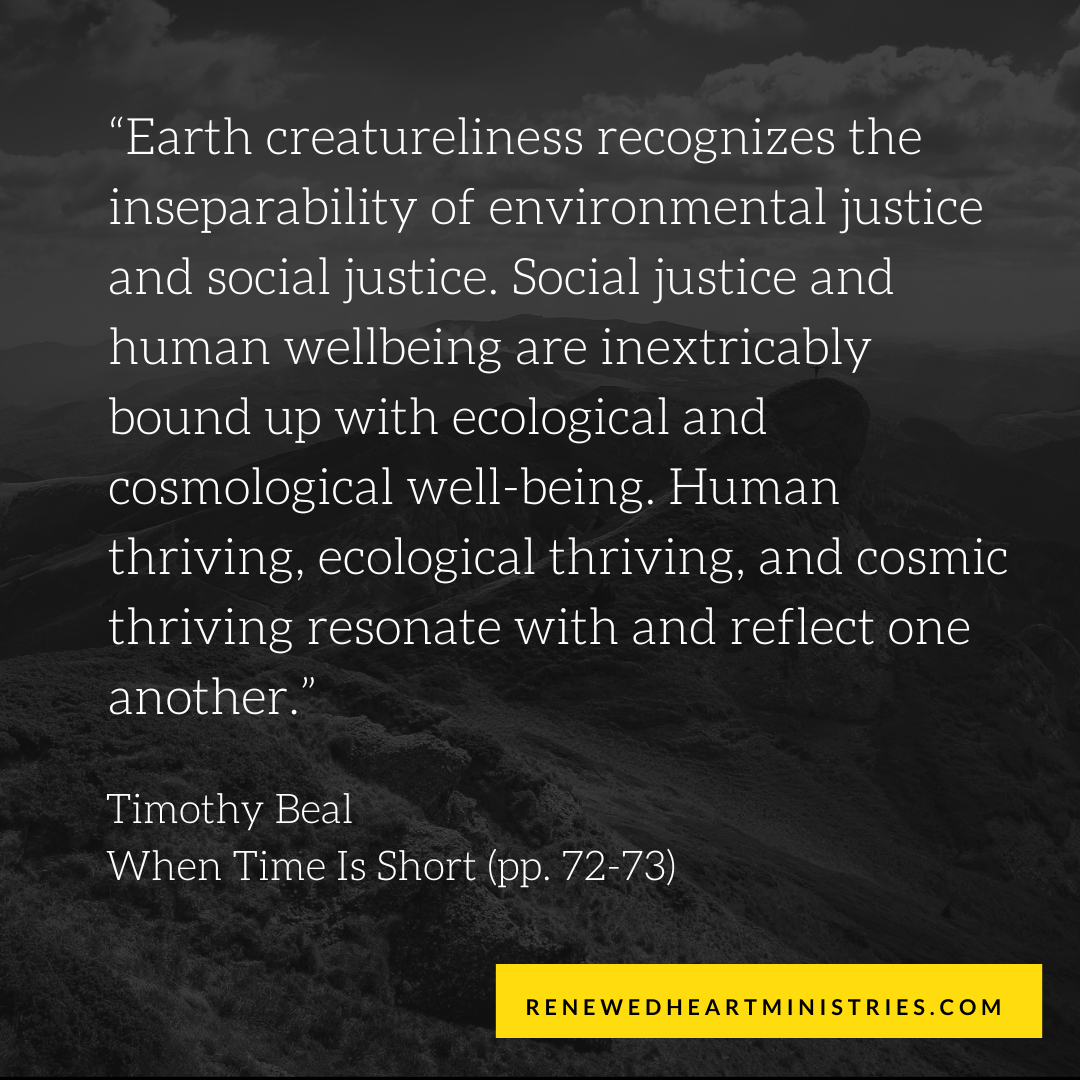
Kingdom Parables for Social Change

We want to say a special thank you to all of our supporters out there. If you would like to join them in supporting Renewed Heart Ministries’ work you can do so by going to renewedheartministries.com and clicking donate.


New Episode of JustTalking!

Season 1, Episode 23: Matthew 13:31-33, 44-52. Lectionary A, Proper 12

Each week, we’ll be talking about the gospel lectionary reading for the upcoming weekend. We’ll be talking about each reading in the context of love, inclusion, and societal justice. Our hope is that our talking will be just talking (as in justice) and that during our brief conversations each week you’ll be inspired to also do more than just talking.

If you teach from the lectionary each week, or if you’re just looking for some thoughts on the Jesus story from a more progressive perspective within the context of social justice, check it out, you might like it.

You can find the latest show on YouTube at https://youtu.be/oG16JTOGXQ8

 or (@herbandtoddjusttalking)

Please Like, Subscribe, hit the Notification button, and leave us a comment

Thanks in advance for watching!


“Kingdom” Parables for Social Change

Herb Montgomery | July 28, 2023

To listen to this week’s eSight as a podcast episode click here.

“When we discover we have been wrong, that’s okay. That’s a good thing. We can make old, death-dealing interpretations give way to new, life-giving interpretations. We can hold on to old, life-giving interpretations too, and adopt new interpretations that we think are more life-giving as new information is discovered. When what we thought was life-giving turns out not to be, we can hold on to the good old, letting go of the bad old, and replace it with the new. The object is not to protect everything that is old, but to ask whether what we are believing and practicing is truly life giving for all.”

Our reading this week is from the gospel of Matthew:

He told them another parable: “The kingdom of heaven is like a mustard seed, which a man took and planted in his field. Though it is the smallest of all seeds, yet when it grows, it is the largest of garden plants and becomes a tree, so that the birds come and perch in its branches.”

He told them still another parable: “The kingdom of heaven is like yeast that a woman took and mixed into about sixty pounds of flour until it worked all through the dough.”

“The kingdom of heaven is like treasure hidden in a field. When a man found it, he hid it again, and then in his joy went and sold all he had and bought that field.

“Again, the kingdom of heaven is like a merchant looking for fine pearls. When he found one of great value, he went away and sold everything he had and bought it.

“Once again, the kingdom of heaven is like a net that was let down into the lake and caught all kinds of fish. When it was full, the fishermen pulled it up on the shore. Then they sat down and collected the good fish in baskets, but threw the bad away. This is how it will be at the end of the age. The angels will come and separate the wicked from the righteous and throw them into the blazing furnace, where there will be weeping and gnashing of teeth.

“Have you understood all these things?” Jesus asked. “Yes,” they replied. 

He said to them, “Therefore every teacher of the law who has become a disciple in the kingdom of heaven is like the owner of a house who brings out of his storeroom new treasures as well as old.” (Matthew 13:31-33, 44-52)

There are so many beautiful themes in this week’s reading for us to dive into. First let’s consider the language here that refers to Jesus’ vision for human community as a “kingdom.”

Remember, Jesus’ gospel in these stories was not instructions for nor good news about a pathway to a post mortem heaven. Jesus’ gospel was good news that announced and called people to a new vision for human community in the here and now. A human community where those presently being marginalized and pushed to the undersides of society find a world that is safe, just, and compassionate for all. 

Kingdom

The term “kingdom” combined the imperial culture of the Roman empire with the restoration hopes of the indigenous Jewish people of Judea, Samaria, and Galilee living under Roman imperial colonization. It is the language of that time and place. Today we rightly recognize the kingdom language as hierarchical and patriarchal. It is my studied opinion that we would harmonize more with Jesus’ vision of community cast in the gospels if we referred to this community in more democratic terms, in ways reflected in the democratic principles practiced in the book of Acts by early Jesus communities. 

I also argue that the cosmic, post resurrection Jesus became the King of the early Jesus communities. Kingdom imagery was intended to help the church replace any earthly “king,” and make way for a more egalitarian community. Consider the following:

“And do not call anyone on earth ‘father,’ for you have one Father, and he is in heaven. Nor are you to be called instructors, for you have one Instructor, the Messiah.” (Matthew 23.9-10) 

This same principle could be applied: Don’t have kings among yourself, you have one King, Jesus. All of you are to relate to each other non hierarchically as equals:

“But you are not to be called ‘Rabbi,’ for you have one Teacher, and you are all brothers. (Matthew 23:8, emphasis added.)

Again, this language attempts to communicate egalitarian siblinghood and yet even this version only mentions “brothers.” Today, we might say “brothers and sisters,” or more simply “siblings.” We can push this language to be more inclusive of women and nonbinary, gender nonconforming, and other people, and still be in perfect harmony with the trajectory of the intention of the original egalitarian and non-hierarchical passage. 

Mustard (See also Mark 4:30-32; Luke 13:18-19; Gospel of Thomas 20)

The parable of the mustard seed is a political parable, not a botanical one. Botanically, mustard don’t grow into trees at all. They grow into shrubs of average size. This story is meant to be understood in the context of the political hopes of Jesus’ Jewish community. Consider the promise made to this people in Ezekiel:

“This is what the Sovereign God says, ‘I myself will take a shoot from the very top of a cedar and plant it; I will break off a tender sprig from its topmost shoots and plant it on a high and lofty mountain. On the mountain heights of Israel I will plant it; it will produce branches and bear fruit and become a splendid cedar. Birds of every kind will nest in it; they will find shelter in the shade of its branches.’” (Ezekiel 17:22-23)

A tree being used as a metaphor for a kingdom or empire was common in the scriptures. Consider how Babylon itself was described with the same language. 

“Its leaves were beautiful, its fruit abundant, and on it was food for all. Under it the wild animals found shelter, and the birds lived in its branches; from it every creature was fed . . . The tree you saw, which grew large and strong, with its top touching the sky, visible to the whole earth, with beautiful leaves and abundant fruit, providing food for all, giving shelter to the wild animals, and having nesting places in its branches for the birds—Your Majesty, you are that tree! You have become great and strong; your greatness has grown until it reaches the sky, and your dominion extends to distant parts of the earth.” (Daniel 4:12, 20-22)

In saying that Jesus’ vision for human community would ultimately grow from tiny beginnings to the fulfillment of Jewish hopes of restoration and independence, the gospel authors were appealing to the Jewish people’s hopes in the midst of their imperial colonization by Rome. 

This can be challenging for contemporary Christians to wrap their minds and hearts around, but the hard work of reading the Jesus story from the perspectives of marginalized and excluded communities is work worth doing. 

Calling Jesus’ vision of human community a mustard seed was about more than its small beginnings. Most of the agricultural world at that time deemed the mustard plant a weed. So Jesus’ kingdom vision for human community was being likened in this parable to a weed. This called out how Jesus’ vision for what human community could be was deemed by the elite, powerful, propertied and privileged: a weed that must be speedily eliminated before it took over the imaginations of the masses. 

Yeast (Luke 13:20-21; Thomas 96)

In the Passover traditions, leaven was a corrupting influence, and unleavened bread symbolized purity. So in this week’s reading, Jesus’ kingdom vision for human community is being likened to something that corrupted. Again, the elite, powerful, propertied and privileged considered this vision for human community that Jesus was casting a corrupting influence among the masses. If something wasn’t done about it quickly, it would permeate the entire society that the elites were profiting off of.

Historically, democracy was seen as a corrupting influence in societies that practiced monarchy or other forms of hierarchy. Today, even non-authoritarian, more democratic forms of socialism and communism are deemed as a corrupting influence by global capitalists who profit off the masses. (Consider the history of U.S. policy in relation to Vietnam and Cuba.) 

Jesus’ love for the poor and his vision of a human community that practiced wealth redistribution, debt cancellation, resource sharing, and mutual aid inspired the poor and marginalized in his society, and benefitted those being exploited. It threatened the elites. Truly Jesus’ preaching was corrupting leaven and a noxious weed to them.

Priority of hidden treasure or a pearl of great price

The next parable characterizes Jesus’ kingdom not as a weed or a corrupting influence but as treasure: a pearl worth a person selling everything they have to obtain it. This language aims squarely at Jesus’ wealthy listeners who had much to lose by embracing Jesus’ vision for human community. Yes, the changes would cost their bottom line, but what they would get in return would be worth so much more. It would result in a world that would be safer, more compassionate, and more just for everyone including themselves. Notice how this language is repeatedly focused toward the wealthy in the Jesus story:

Jesus looked at him and loved him. “One thing you lack,” he said. “Go, sell everything you have and give to the poor, and you will have treasure in heaven. Then come, follow me.” (Mark 10:21)

Jesus answered, “If you want to be perfect, go, sell your possessions and give to the poor, and you will have treasure in heaven. Then come, follow me.” (Matthew 19:21)

Sell your possessions and give to the poor. Provide purses for yourselves that will not wear out, a treasure in heaven that will never fail, where no thief comes near and no moth destroys. (Luke 12:33)

When Jesus heard this, he said to him, “You still lack one thing. Sell everything you have and give to the poor, and you will have treasure in heaven. Then come, follow me.” (Luke 18:22)

In the parables of the treasure located in the field and the pearl of great price, those who discovered it sold everything they had to obtain it. And in the book of Acts, wealthy Jesus followers did the same to create the kind of community Jesus’ teachings inspired them toward:

They sold property and possessions to give to anyone who had need. (Acts 2:45)

That there were no needy persons among them. For from time to time those who owned land or houses sold them, brought the money from the sales and put it at the apostles’ feet, and it was distributed to anyone who had need. (Acts 4:34-35)

A Net

Also in this week’s reading, we bump into a theme repeated in Matthew’s gospel. A wide net gathers all. Some people are labeled as good and some as wicked, and a sorting takes place at the end of the age. That “end” includes a purging or burning metaphor for the wicked. Given how long this week’s discussion is, I want to re-share last week’s critique of that way of viewing the world.

Things Old and New

In Jesus’ time, teachers of the Torah who embraced Jesus‘ kingdom paradigm would rightly be expected to bring out both old, universal truths and new ones. This reminds me today that it’s okay for Jesus followers, even within traditional expressions of Christianity, to present interpretations and teachings that mix old and new. 

When we discover we have been wrong, that’s okay. That’s a good thing. We can make old, death-dealing interpretations give way to new, life-giving interpretations. We can hold on to old, life-giving interpretations too, and adopt new interpretations that we think are more life-giving as new information is discovered. When what we thought was life-giving turns out not to be, we can hold on to the good old, letting go of the bad old, and replace it with the new. The object is not to protect everything that is old, but to ask whether what we are believing and practicing is truly life giving for all. If we hold to this standard, it will produce a Jesus follower that isn’t afraid of the new. 

Our goal is to be a source of healing and life and change for the better for everyone. And in this way, Jesus followers can, as our reading states, brings out of our storerooms new treasures as well as old.

HeartGroup Application

1. Share something that spoke to you from this week’s eSight/Podcast episode with your HeartGroup.

2. How do these parables inform your own justice work? Share that with your group.

3. What can you do this week, big or small, to continue setting in motion the work of shaping our world into a safe, compassionate, just home for everyone?

Thanks for checking in with us, today.

I want to say a special thank you to all of our supporters out there. And if you would like to join them in supporting Renewed Heart Ministries’ work you can do so by going to renewedheartministries.com and clicking donate. 

You can find Renewed Heart Ministries on Twitter, Facebook and Instagram. If you haven’t done so already, please follow us on your chosen social media platforms for our daily posts. Also, if you enjoy listening to the Jesus for Everyone podcast, please like and subscribe to the JFE podcast through the podcast platform you use and consider taking some time to give us a review. This helps others find our podcast as well.

Also I want to share that we are partnering in a new weekly YouTube show called “Just Talking.” Each week, Todd Leonard and I will be talking about the gospel lectionary reading for the upcoming weekend. We’ll be talking about each reading in the context of love, inclusion, and societal justice. Our hope is that our talking will be just talking (as in justice) and that during our brief conversations each week you’ll be inspired to also do more than just talking.

If you teach from the lectionary each week, or if you’re just looking for some thoughts on the Jesus story from a more progressive perspective within the context of social justice, check it out, you might like it. You can find JustTalking each week on YouTube at youtube.com/@herbandtoddjusttalking. Please Like, Subscribe, hit the Notification button, and leave us a comment.

And if you’d like to reach us here at Renewed Heart Ministries through email, you can reach us at info@renewedheartministries.com.

My new book, Finding Jesus: A story of a fundamentalist preacher who unexpectedly discovered the social, political, and economic teachings of the Gospels is now also available at renewedheartministries.com

Right where you are, keep living in love, choosing compassion, taking action, and working toward justice.

I love each of you dearly,

I’ll see you next week.


Now Available at Renewed Heart Ministries!

Herb’s new book Finding Jesus: A story of a fundamentalist preacher who unexpectedly discovered the social, political, and economic teachings of the Gospels, is available at renewedheartministries.com.

Get your copy today at renewedheartministries.com


Are you receiving all of RHM’s free resources each week?

Begin each day being inspired toward love, compassion, action, and justice. Free Sign-Up HERE

How Not to View the World

We want to say a special thank you to all of our supporters out there. If you would like to join them in supporting Renewed Heart Ministries’ work you can do so by going to renewedheartministries.com and clicking donate.


Just Talking

New Episode of JustTalking!

Season 1, Episode 22: Matthew 13.24-30, 36-43. Lectionary A, Proper 11

Each week, we’ll be talking about the gospel lectionary reading for the upcoming weekend. We’ll be talking about each reading in the context of love, inclusion, and societal justice. Our hope is that our talking will be just talking (as in justice) and that during our brief conversations each week you’ll be inspired to also do more than just talking.

If you teach from the lectionary each week, or if you’re just looking for some thoughts on the Jesus story from a more progressive perspective within the context of social justice, check it out, you might like it.

You can find the latest show on YouTube at https://youtu.be/oG16JTOGXQ8

 or (@herbandtoddjusttalking)

Please Like, Subscribe, hit the Notification button, and leave us a comment

Thanks in advance for watching!


How Not To View The World

Herb Montgomery | July 21, 2023

To listen to this week’s eSight as a podcast episode click here.

“We don’t need to label some as weeds with the sick assurance that one day they will be destroyed. How awful! Nor should we look at the injustices as our world as things we can do nothing about except endure until some point in the future when outside forces will set things right. We can do something about injustice, here, now, today.”

Our reading this week is from the gospel of Matthew:

Jesus told them another parable: “The kingdom of heaven is like a man who sowed good seed in his field. But while everyone was sleeping, his enemy came and sowed weeds among the wheat, and went away. When the wheat sprouted and formed heads, then the weeds also appeared. 

The owner’s servants came to him and said, ‘Sir, didn’t you sow good seed in your field? Where then did the weeds come from?’

‘An enemy did this,’ he replied.

The servants asked him, ‘Do you want us to go and pull them up?’

 ‘No,’ he answered, ‘because while you are pulling the weeds, you may uproot the wheat with them. Let both grow together until the harvest. At that time I will tell the harvesters: First collect the weeds and tie them in bundles to be burned; then gather the wheat and bring it into my barn.’

Then he left the crowd and went into the house. His disciples came to him and said, “Explain to us the parable of the weeds in the field.” He answered, “The one who sowed the good seed is the Son of Man. The field is the world, and the good seed stands for the people of the kingdom. The weeds are the people of the evil one, and the enemy who sows them is the devil. The harvest is the end of the age, and the harvesters are angels.

“As the weeds are pulled up and burned in the fire, so it will be at the end of the age. The Son of Man will send out his angels, and they will weed out of his kingdom everything that causes sin and all who do evil. They will throw them into the blazing furnace, where there will be weeping and gnashing of teeth. Then the righteous will shine like the sun in the kingdom of their Father. Whoever has ears, let them hear.” (Matthew 13:24-30, 36-43)

I’m thankful we discussed the principle of all or nothing a couple weeks ago. I didn’t realize it would also prepare us to discuss this passage, and I’m thankful for that foundation. If you have not read The Destructiveness of All or Nothing I encourage you to go back and do so. 

Our reading this week is an isolated parable found only in Matthew among the four canonical versions of the Jesus story. Outside of our canon, there is a version of the parable in the gospel of Thomas:

Jesus said, ‘My Fathers’ kingdom can be compared to someone who had seed. Their enemy came by night and sowed weeds among the good seed. The person didn’t let anyone pull out the weeds, “so that you don’t pull out the wheat along with the weeds,” they said to them. ‘On the day of the harvest, the weeds will be obvious. Then they’ll be pulled out and burned.’” (Gospel of Thomas, 57)

This parable probably circulated among the Matthean community orally before the gospel of Matthew was written. It wasn’t a saying of Jesus’ within the Markan community, the Johannine community, or the larger cosmopolitan Lukean community. 

When a problematic passage only appears in one gospel, it gives me pause. We don’t need to throw it out, but should practice the utmost care with it. It’s difficult to attribute a reading like this to the historical Jewish Jesus who is characterized in most of the gospels as an inclusive, prophet of the poor from Galilee. It is much easier to attribute the passage to the Galilean, Jesus-following community: it reflects the concerns of that young community in protecting its own purity. Concern for protecting community purity, calling people “weeds,” and looking forward to their destruction doesn’t sound like the Jesus we encounter in the rest of Matthew. It sounds more like the apocalyptic John the Baptist than Jesus. 

What this passage does do is reflect the worldview of the original audience of Matthew’s gospel. Apocalypticism divided our world between the seen and the unseen. The unseen world was composed of both good cosmic powers and evil comic powers, and that world was connected to our visible world. Good people were also connected to the good cosmic powers, while “evil” people were connected or even controlled by evil cosmic powers. We see this worldview expressed in passages such as this one from the book of Ephesians,

“For our struggle is not against flesh and blood, but against the rulers, against the authorities, against the powers of this dark world and against the spiritual forces of evil in the heavenly realms.” (Ephesians 6:12)

For the early, Jewish Jesus communities who subscribed to this worldview (not all did), Rome would have been the earthly, visible conduit of the destructive unseen cosmic powers of evil. 

This way of looking at the world was somewhat pessimistic, as well. The world was what it was, controlled by whom or whatever. Nothing would change until the “end of the age” when there would be a great reversal and evil powers (and thus evil people) would be no more. Some of the early Jesus communities explained the world around them in these apocalyptic ways, where there wasn’t much one could do but patiently endure the present injustices of our world, holding on till the day of “harvest” when the “wheat” would be gathered up while the “weeds” would be destroyed. 

Again, it is much easier to accept that this passage has its source in the Matthean community and was attributed to Jesus than that it came directly from Jesus but only the Mattheans community remembered it. Above all else, this way of looking at the world is deeply problematic and destructive. Let’s explore why.

First, we know from human history that when we forget that we are all connected and all part of one another, and we begin to define some among us as “evil,” or as “weeds” to use our parable’s language, it’s not long before those we deem to be weeds we then exclude, marginalize, scapegoat, and harm. Even if this parable says to leave “the weeds” alone, when we label someone as a weed and estimate them to be evil, we never make it our practice to let them be. We always set out at once to weed them out. 

Second, it is intrinsically harmful to others’ humanity and to our own to look at fellow human beings as evil creatures who will one day be eradicated. We can’t help but seek to eradicate them in some form now, today. Add to this social dynamic of labeling some as evil or “of the devil,” the language of rounding them up and burning them. This is a holocaust. That is how millions of Jewish people were murdered last century. This is how people were tortured and killed during the Inquisition. This is how women were hanged or drowned as witches. There are so many more horrific examples in human history.

As I said in the article The Destructiveness of All or Nothing, “wisdom is proved right by her deeds.” And we need to judge this way of looking at our world and the people in our world by deeds it has produced throughout history. By those results, this way of looking at the world is the weed, not the people it maligns.

Today, it is not life-giving to look at the world through an apocalyptic lens. We don’t need to label some as weeds with the sick assurance that one day they will be destroyed. How awful! Nor should we look at the injustices as our world as things we can do nothing about except endure until some point in the future when outside forces will set things right. We can do something about injustice, here, now, today.

Is there anything that we can redeem from this passage?

There is one thing. And it is a corrective. This passage gives us the Biblical phrase, “gnashing of teeth.” Too often, Christians have assumed that “weeping and gnashing of teeth” refers to the physical agony those in the “fires” of this parable experience. But the gnashing of teeth is not a Biblical expression about being tormented. It’s a Biblical expression about being angry, so angry that they grit or gnash their teeth together. 

Consider a few examples:

“God assails me and tears me in his anger and gnashes his teeth at me.” (Job 16:9)

“The wicked plot against the righteous and gnash their teeth at them…” (Psalms 37:12)

“When the members of the Sanhedrin heard this, they were furious and gnashed their teeth at him.” (Acts 7:54) 

In the gospels, people gnash their teeth when they see those they excluded being welcomed to the center of God’s just future while those who were so assured they were so much better and deserving to be at the center are left outside because of their own exclusionary practices. As you sow, you reap. Or to put it simply, people gnash their teeth when angry at seeing who is being “let in” when they themselves aren’t. As the gospel of Luke explains, “There will be weeping there, and gnashing of teeth, when you see Abraham, Isaac and Jacob and all the prophets in the kingdom of God, but you yourselves thrown out” (Luke 13:28)

If any are excluded in the just world we are working towards and creating, it will be those who make it a practice of labelling others as weeds. It should give us pause to see the intrinsic destructiveness of looking at the world through the same lens as the authors of this week’s reading. Today, we can and must do better.

HeartGroup Application

1. Share something that spoke to you from this week’s eSight/Podcast episode with your HeartGroup.

2. How does labelling some people as weeds harmfully impacted the way you relate to others? What better way of relating to others who are different from you have you found? Share that with your group.

3. What can you do this week, big or small, to continue setting in motion the work of shaping our world into a safe, compassionate, just home for everyone?

Thanks for checking in with us, today.

I want to say a special thank you to all of our supporters out there. And if you would like to join them in supporting Renewed Heart Ministries’ work you can do so by going to renewedheartministries.com and clicking donate. 

You can find Renewed Heart Ministries on Twitter, Facebook and Instagram. If you haven’t done so already, please follow us on your chosen social media platforms for our daily posts. Also, if you enjoy listening to the Jesus for Everyone podcast, please like and subscribe to the JFE podcast through the podcast platform you use and consider taking some time to give us a review. This helps others find our podcast as well.

Also I want to share that we are partnering in a new weekly YouTube show called “Just Talking.” Each week, Todd Leonard and I will be talking about the gospel lectionary reading for the upcoming weekend. We’ll be talking about each reading in the context of love, inclusion, and societal justice. Our hope is that our talking will be just talking (as in justice) and that during our brief conversations each week you’ll be inspired to also do more than just talking.

If you teach from the lectionary each week, or if you’re just looking for some thoughts on the Jesus story from a more progressive perspective within the context of social justice, check it out, you might like it. You can find JustTalking each week on YouTube at youtube.com/@herbandtoddjusttalking. Please Like, Subscribe, hit the Notification button, and leave us a comment.

And if you’d like to reach us here at Renewed Heart Ministries through email, you can reach us at info@renewedheartministries.com.

My new book, Finding Jesus: A story of a fundamentalist preacher who unexpectedly discovered the social, political, and economic teachings of the Gospels is now also available at renewedheartministries.com

Right where you are, keep living in love, choosing compassion, taking action, and working toward justice.

I love each of you dearly,

I’ll see you next week.


Now Available at Renewed Heart Ministries!

Herb’s new book Finding Jesus: A story of a fundamentalist preacher who unexpectedly discovered the social, political, and economic teachings of the Gospels, is available at renewedheartministries.com.

Get your copy today at renewedheartministries.com


Are you receiving all of RHM’s free resources each week?

Begin each day being inspired toward love, compassion, action, and justice. Free Sign-Up HERE
The Deceitfulness of Wealth

We want to say a special thank you to all of our supporters out there. If you would like to join them in supporting Renewed Heart Ministries’ work you can do so by going to renewedheartministries.com and clicking donate.


New Episode of JustTalking!

Season 1, Episode 21: Matthew 13.1-9, 18-23. Lectionary A, Proper 10

Each week, we’ll be talking about the gospel lectionary reading for the upcoming weekend. We’ll be talking about each reading in the context of love, inclusion, and societal justice. Our hope is that our talking will be just talking (as in justice) and that during our brief conversations each week you’ll be inspired to also do more than just talking.

If you teach from the lectionary each week, or if you’re just looking for some thoughts on the Jesus story from a more progressive perspective within the context of social justice, check it out, you might like it.

You can find the latest show on YouTube at https://youtu.be/vXMQHAoHjOI

 or (@herbandtoddjusttalking)

Please Like, Subscribe, hit the Notification button, and leave us a comment

Thanks in advance for watching!


The Deceitfulness of Wealth

Herb Montgomery | July 14, 2023


To listen to this week’s eSight as a podcast episode click here.


“But wealth creates in us a kind security that isolates us from fellow members of our human family. Community, on the other hand, is a way of finding security to weather potential future hardships together. Even evolutionarily, species that have proven to be the “fittest” over time, are species that don’t go it alone but that practice care for vulnerable members rather than some taking care of themselves at the expense of others.”


Our reading this week is from two sections of Matthew chapter 13:

“That same day Jesus went out of the house and sat by the lake. Such large crowds gathered around him that he got into a boat and sat in it, while all the people stood on the shore. Then he told them many things in parables, saying: “A farmer went out to sow his seed. As he was scattering the seed, some fell along the path, and the birds came and ate it up. Some fell on rocky places, where it did not have much soil. It sprang up quickly, because the soil was shallow. But when the sun came up, the plants were scorched, and they withered because they had no root. Other seed fell among thorns, which grew up and choked the plants. Still other seed fell on good soil, where it produced a crop—a hundred, sixty or thirty times what was sown. Whoever has ears, let them hear.” (Matthew 13:1-9)

and

“Listen then to what the parable of the sower means: When anyone hears the message about the kingdom and does not understand it, the evil one comes and snatches away what was sown in their heart. This is the seed sown along the path. The seed falling on rocky ground refers to someone who hears the word and at once receives it with joy. But since they have no root, they last only a short time. When trouble or persecution comes because of the word, they quickly fall away. The seed falling among the thorns refers to someone who hears the word, but the worries of this life and the deceitfulness of wealth choke the word, making it unfruitful. But the seed falling on good soil refers to someone who hears the word and understands it. This is the one who produces a crop, yielding a hundred, sixty or thirty times what was sown.” (Matthew 13:18-23)

The author of Mathew has mostly taken this section from the gospel of Mark (Mark 4:1-34). And for good reason. There is plenty here that it was important for the early Jesus community to remember.

The parable of the sower gives us a special glimpse into what the gospel Jesus himself preached actually was. What stands out to me is that of all the obstructions that the early Jesus community could have named to following Jesus, all the temptations that could have been mentioned, and all the sins that this parable could have railed against, the one thing named is “the deceitfulness of wealth.”

I ask why? How does wealth deceive and obstruct us from following Jesus? Why was it at the top of the list for the early Jesus community?

Wealth does not obstruct the contemporary gospel message of getting to heaven. You can “get to heaven” in many contemporary gospel narratives and still be immensely wealthy. But in Jesus’ gospel of wealth redistribution and resource-sharing from the haves to the have nots, it becomes immediately apparent how wealth obstructs. The desire to build or hold wealth is directly opposed to giving that wealth away to those negatively impacted in a system built to benefit a few at the expense of the many.

Jesus’ gospel was about creating a different way of being human together, here, now. It was not about a post mortem destination. Jesus was casting the vision of a beautiful community of people dedicated to making sure no one was pushed to the edges or undersides of their community, no one was made vulnerable, and every member of the community held a mutual commitment to share what they could to ensure everyone was cared for.

This was what the gospel authors called the “empire” or “kingdom” of God, a community in which God reigned. It was a community where people came first. So how does the deceitfulness of wealth obstruct this?

First, a community where God reigns according the gospel stories is a community where people are of a greater priority than profit or wealth-building. This is why the gospels repeatedly state that in a community such as the one Jesus describes, we have to choose between God and money. It’s one or the other.

“No one can serve two masters. Either you will hate the one and love the other, or you will be devoted to the one and despise the other. You cannot serve both God and money.” (Matthew 6.24)

This was also the practice of the early believers in the book of Acts:

“All the believers were together and had everything in common. They sold property and possessions to give to anyone who had need.” (Acts 2:44-45)

“All the believers were one in heart and mind. No one claimed that any of their possessions was their own, but they shared everything they had . . . there were no needy persons among them. For from time to time those who owned land or houses sold them, brought the money from the sales, and put it at the apostles’ feet, and it was distributed to anyone who had need.” (Acts 4:32-35)

But how is wealth deceitful?

Hoarded wealth gives us a sense of security, but this kind of security leaves us alone, isolated, on our own, each of us in our silos of hoarded resources, feeling that we will be able to take care of ourselves but living against the grain of reality and how we survive as a planet, together. As we discussed weeks ago, we are all connected. We are all part of one another. No one survives alone, and if there is such a thing as social salvation, no one is saved unless we all are saved.

But wealth creates in us a kind security that isolates us from fellow members of our human family. Community, on the other hand, is a way of finding security to weather potential future hardships together. Even evolutionarily, species that have proven to be the “fittest” over time, are species that don’t go it alone but that practice care for vulnerable members rather than some taking care of themselves at the expense of others.

This, too, was a common theme in the early Jesus community. Consider the following words from 1 Timothy:

“Command those who are rich in this present world not to be arrogant nor to put their hope in wealth, which is so uncertain, but to put their hope in God.” (1Timothy 6:17)

What does it mean in this context to “put their hope in God”. James Robinson, author of books on the historical Jesus and the gospel that Jesus taught, gives insights on what it might have meant for believers to “put their hope in God.”

“Such ‘security’ [or hope] should be replaced by God reigning, which means both what I trust God to do (to activate you to share food with me) and what I hear God telling me to do (to share clothes with you). We should not carry money while bypassing the poor or wear a backpack with extra clothes and food while ignoring the cold and hungry lying in the gutter. This is why the beggars, the hungry, the depressed are fortunate: God, that is, those in whom God rules, those who hearken to God, will care for them. The needy are called upon to trust that God’s reigning is there for them (“Theirs is the kingdom of God”) . . . Jesus’ message was simple, for he wanted to cut straight through to the point: trust God to look out for you by providing people who will care for you, and listen to him when he calls on you to provide for them.” (James M. Robinson, The Gospel of Jesus, Kindle Location 71)

Paul’s letter to the Corinthians also suggests how the members of early Jesus communities practiced this:

“Our desire is not that others might be relieved while you are hard pressed, but that there might be equality. At the present time your plenty will supply what they need, so that in turn their plenty will supply what you need. The goal is equality.” (2 Corinthians 8:13)

How can wealth be used, today, not to give us individual, privatized security but to build community where our security is in each other, in people? The Jesus story is offering us two options, two competing places in which to “put our trust.” We can either put our hope in hoarding money against potential future hardships, or we can put our hope in a community of people who are dedicated to making sure their resources care for those in their community. Jesus’ way is about facing the future together, rather than alone. It’s about having each other’s back.

Here in the United States, we are continuing to move toward a society that leaves each person on their own. From Supreme Court rulings to local political supermajorities, we are shaping a country in such a way that leaves people on their own to pull themselves up by bootstraps they don’t even have. Those our system makes most vulnerable are the most being harmed.

Some societies and countries are deeply committed to democracy and also have strong social commitments to one another. They make sure community members’ needs are met. We, too, can still practice the freedom of democracy while we move toward making sure everyone in our democracy has what they need to thrive. These are not mutually exclusive goals. In fact, making sure everyone in our democracy is on level ground is deeply democratic in itself.

This call also harmonizes much more with the call of Jesus to work toward shaping a world where we are committed not to isolated, self-sufficiency in facing survival challenges on our own, but to practice the Golden Rule, love our neighbor as ourselves, and share with those who are in need. As the books of Acts says, “Each according to their ability, and each according to their needs.”

HeartGroup Application


1. Share something that spoke to you from this week’s eSight/Podcast episode with your HeartGroup.

2. How do you wish our society practiced more socially responsible care. Share that with your group.

3. What can you do this week, big or small, to continue setting in motion the work of shaping our world into a safe, compassionate, just home for everyone? 

Thanks for checking in with us, today.

I want to say a special thank you to all of our supporters out there. And if you would like to join them in supporting Renewed Heart Ministries’ work you can do so by going to renewedheartministries.com and clicking donate.

You can find Renewed Heart Ministries on Twitter, Facebook and Instagram. If you haven’t done so already, please follow us on your chosen social media platforms for our daily posts. Also, if you enjoy listening to the Jesus for Everyone podcast, please like and subscribe to the JFE podcast through the podcast platform you use and consider taking some time to give us a review. This helps others find our podcast as well.

Also I want to share that we are partnering in a new weekly YouTube show called “Just Talking.” Each week, Todd Leonard and I will be talking about the gospel lectionary reading for the upcoming weekend. We’ll be talking about each reading in the context of love, inclusion, and societal justice. Our hope is that our talking will be just talking (as in justice) and that during our brief conversations each week you’ll be inspired to also do more than just talking.

If you teach from the lectionary each week, or if you’re just looking for some thoughts on the Jesus story from a more progressive perspective within the context of social justice, check it out, you might like it. You can find JustTalking each week on YouTube at youtube.com/@herbandtoddjusttalking. Please Like, Subscribe, hit the Notification button, and leave us a comment.

And if you’d like to reach us here at Renewed Heart Ministries through email, you can reach us at info@renewedheartministries.com.

My new book, Finding Jesus: A story of a fundamentalist preacher who unexpectedly discovered the social, political, and economic teachings of the Gospels is now also available at renewedheartministries.com

Right where you are, keep living in love, choosing compassion, taking action, and working toward justice.

I love each of you dearly,

I’ll see you next week.


Now Available at Renewed Heart Ministries!

Herb’s new book Finding Jesus: A story of a fundamentalist preacher who unexpectedly discovered the social, political, and economic teachings of the Gospels, is available at renewedheartministries.com.

Get your copy today at renewedheartministries.com


Are you receiving all of RHM’s free resources each week?

Begin each day being inspired toward love, compassion, action, and justice. Free Sign-Up HERE