Pyramids, Circles and a Shared Table: Jesus’ Vision for Human Community (Part 1)

by Herb Montgomery | May 3, 2018
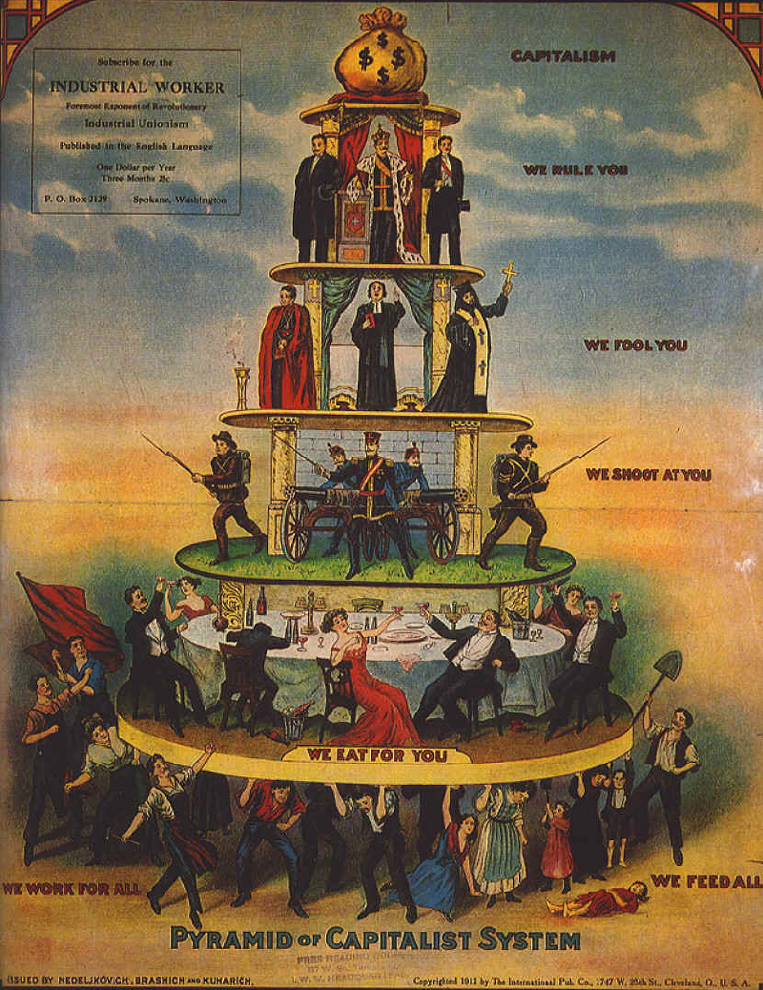
Pyramid of Capitalism


“Politics answers the question of who gets what. So Jesus was not a religious figure as much as he was a political one. He did not fundamentally challenge his Jewish religion, at least not much more than his predecessor Hillel did. He did challenge the Jewish elites of his time, much more than Hillel did. As we’ve discussed before, Hillel made concessions, such as the prozbul, that centered the wealthy while endeavoring to take care of the poor. Jesus’ teachings centered the poor and gave them the entire “kingdom.” Jesus’ teachings were political.”


Luke 6:20-26: “Looking at his disciples, he said:

‘Blessed are you who are poor, for yours is the kingdom of God.
Blessed are you who hunger now, for you will be satisfied.
Blessed are you who weep now, for you will laugh.
Blessed are you when people hate you, when they exclude you and insult you and reject your name as evil, because of the Son of Man. Rejoice in that day and leap for joy, because great is your reward in heaven. For that is how their ancestors treated the prophets.

But woe to you who are rich, for you have already received your comfort. Woe to you who are well fed now, for you will go hungry.
Woe to you who laugh now, for you will mourn and weep.
Woe to you when everyone speaks well of you, for that is how their ancestors treated the false prophets.’”

The domination structure of Jesus’ society was similar to ours today. Its structure was a combination of two two-dimensional shapes, a triangle and a circle. 

Let’s talk about the circle first. 

Circles have an inside and an outside. Societies shaped in the form of a circle can have a strongly defined border that distinguishes between insiders and outsiders. They can also have certain tests to decide who’s in and who’s out. Societal circles can also have people whose job it is to patrol the border to make sure no one from the outside is included and everyone knows when someone who was previously an insider no longer should be.

Control for circular social structures rests in the center of the circle. The more one adheres to the rules and identity of the circle, the closer one is to the center. The more someone varies, the more they are pushed to the margins of the circle. Even within the circle, among those who are insiders, some people will find themselves somewhere between the center of the circle and the edges.

What about the triangle?

The circle and the triangle are both hierarchical structures. Where the hierarchy in the circle is from the center out toward the margins, triangular societies have a top comprised of a few elites and a base composed of the majority. In triangles that practice domination and control, the closer one is to the top, the more power, privilege, control and ability to dominate others one also possesses. Your social location in the triangle determines the level to which you experience these privileges, and you can find yourself closer to the top in some areas of your life but closer to the bottom of the triangle in others. The triangle typically is structured to benefit those at the top at the expense and exploitation of those at the bottom. 

What happens when we combine these structures?

The combination of these ways of structuring human society is a cone. Within this cone, the closer one is to the center, the closer one also is to the top. The more one is marginalized, the more one finds themselves at the bottom of their society.

This hybrid of the circle and triangle shapes, the cone, is the shape of the society Jesus lived in in the 1st Century. It’s also the shape of many of our religious and civil societies today. In Luke’s version of the Jesus story, Jesus states that people his society structure had made poor, hungry, or weep would be specifically “blessed” by his vision for transforming human society. Jesus wasn’t saying it’s a blessing to be on the margins or at the bottom of society. He was saying that if you’re on the margins, you who his gospel was especially for. As we discussed in Directed Good News, those on the margins in Jesus’ society heard his gospel as good news. 

Matthew’s version of the Jesus story backs this up too. As we discussed last month in A Preferential Option for the Vulnerable, people the system had left too broken and impoverished in their spirit to keep trying, those whom the system had steamrolled over, those who hungered and thirsted for the world to be put right—these were the ones Jesus’ vision for humanity was especially targeted at (see Matthew 5:3; Luke 1:80; Matthew 5:5 and 5:6.[1]) These were the ones who had been labeled as “sinners” by those at the center/top of their society, and who, because of that labelling, had been pushed to the edges and underside of their community. They were drawn to the hope for change in Jesus’ gospel: “Now the tax collectors and sinners were all gathering around to hear Jesus. But the Pharisees and the teachers of the law muttered, ‘This man welcomes sinners and eats with them.’”(Luke 15:1-2) The term “sinners” is not a universal term here. It is used pejoratively to push some to the margins and bottom of the cone. It was a label those in power used to other people. 

Jesus’ vision for human community, his shared table, specifically inclused those his cone-shaped society had excluded. It also had an economic component. Consider the reversal of economic exploitation and reparation found in Luke’s story of an oppressor who embraced Jesus’ teachings.

“All the people saw this and began to mutter, ‘He has gone to be the guest of a sinner.’ But Zacchaeus stood up and said to the Lord, ‘Look, Lord! Here and now I give half of my possessions to the poor, and if I have cheated anybody out of anything, I will pay back four times the amount.’” (Luke 19:7-8)

Jesus’ shared table required those at the top/center of their societal cone to pay reparations to those whom they had exploited and pushed down. Tax collectors were economically part of the elite, but socially and politically within Jewish culture they were pushed to the outside and labeled as sinners because of their occupational cooperation with the Empire subjugating Judea and Galilee. They were privileged in certain areas of their lives but marginalized in others.

Jesus’ shared table was also political.

When I use the term “political,” I don’t mean partisan. Politics means related to the polis, the members of a community. Whenever you have two or more people doing life together, you have politics. Politics answers the question of who gets what. So Jesus was not a religious figure as much as he was a political one. He did not fundamentally challenge his Jewish religion, at least not much more than his predecessor Hillel did. He did challenge the Jewish elites of his time, much more than Hillel did. As we’ve discussed before, Hillel made concessions, such as the prozbul, that centered the wealthy while endeavoring to take care of the poor. Jesus’ teachings centered the poor and gave them the entire “kingdom.” Jesus’ teachings were political.

Recently, while chatting with a friend, I bumped into an often repeated misconception of how things worked in Jesus’ society. My friend claimed that Jesus never challenged the Roman civil government but only challenged the religious establishment of Judea. My friend went on to state that Jesus’ followers should ignore the state and simply focus on bringing about religious reform within their own traditions. 

This is far from how Jewish society actually functioned in the 1st Century. Today our culture believes that church and state should be separated. But Jesus’ society didn’t have these distinctions. My friend claimed that Jesus was only focused on impacting the religious views of his community, especially as they related to the temple. But this simply isn’t true, historically. 

First, the temple was not solely religious, and it was not merely the center of the Jewish “church.” The temple was the center of the Jewish state. The priests and the Sanhedrin were civil authorities, not only religious ones. In 1st Century Judea, there was not a separation between “church and state” or religious and civil duty as we understand either today. The Torah governed both, and they were not two distinct areas of life. They were just life. 

The temple received taxes that were to be redistributed to the poor. That’s why the temple functioned as a centralized banking system through which money lenders lent their monies. When the poor took over the temple in the 60s CE, the very first thing they did was to burn the debt ledgers of the temple, which until then recorded all loans. By storming the temple, they forced political and economic change: a year of Jubilee and the forgiveness of all debts. 

Secondly, Jesus was a Jewish laborer, not a Roman citizen. He didn’t have access to Rome to protest for change. But he did have access to his own state authority, the temple in Jerusalem. Note that even this distinction between the temple and Rome is not completely accurate either. Rome governed Judea through the temple. Rome determined who would be High Priest each year, and it was the temple that funneled collected tribute back to Rome. The Jewish aristocracy gained privilege and power by cooperating with Rome, and Rome received a degree of control over Judea by using the Jewish temple state in Jerusalem. 

So when Jesus overturned tables in the temple-state, this was not only a religious protest; it was political protest as well. Jesus staged his demonstration in the temple with the money changers in solidarity with and on behalf of the poor who were being economically exploited by the Temple-state. Jesus was indicting both Rome and his own state. This is why his execution in response to the temple demonstration was at the hand of Rome, on a Roman cross. 

Ched Myers confirms this in his commentary on the book of Mark, and notes the deep implications for all who should choose to follow this political Jesus.

“Jesus has revealed that his messiahship means political confrontation with, not rehabilitation of, the imperial state. Those who wish to ‘come after him’ will have to identify themselves with his subversive program. The stated risk is that the disciple will face the test of loyalty under interrogation by state authorities.” (Binding the Strong Man: a political reading of Mark’s story of Jesus, p. 247)

When answering the question of who should get what, Jesus stated his political views:

“Do not be afraid, little flock, for your Father has been pleased to give you the kingdom. Sell your possessions and give to the poor. Provide purses for yourselves that will not wear out, a treasure in heaven that will never fail, where no thief comes near and no moth destroys. For where your treasure is [in people not profit], there your heart will be also.” (Luke 12.32-34)

The poor, the marginalized, the pushed down, these were those to whom Jesus’ political views were good news. What he taught them was the gospel of hope. Gustavo Gutierrez accurately reminded us that this hope is more than a forward expectation of charity. This hope is for the creation of an entirely different social order:

“Love of neighbor is an essential component of Christian life. But as long as I apply that term only to the people who cross my path and come asking me for help, my world will remain pretty much the same. Individual almsgiving and social reformism is a type of love that never leaves its own front porch . . . On the other hand my world will change greatly if I go out to meet other people on their path and consider them as my neighbor, as the good Samaritan did… The gospel tells us that the poor are the supreme embodiment of our neighbor. It is this option that serves as the focus for a new way of being human and Christian in today’s Latin America. But the existence of the poor . . . is not neutral on the political level or innocent of ethical implications. Poor people are by-products of the system under which we live and for which we are responsible . . . That is why the poverty of the poor is not a summons to alleviate their plight with acts of generosity but rather a compelling obligation to fashion an entirely different social order.” (Gustavo Gutiérrez; Liberation Praxis and Christian Faith, p. 14)

When we follow Jesus, we don’t build a pyramid, a circle, or a cone. We build a shared table.

“Blessed are you who are poor, for yours is the kingdom of God.
Blessed are you who hunger now, for you will be satisfied.
Blessed are you who weep now, for you will laugh.” (Luke 6:20-22)

HeartGroup Application

  1. Go through the synoptic gospels (Matthew, Mark, and Luke) and find five of Jesus’ political views.
  2. What difference does it make to see Jesus not simply as a religious figure but as a political figure as well? What difference does it make to see Jesus’ temple protest not only as a religious protest but also as a political protest of those in power in response to their economic exploitation of the poor?
  3. Is there a difference between working toward a politic of distributive justice where everyone is safe and has enough, and there is equity, protection and compassion, and Christians wanting to co-opt political power in the spirit of domination and subjugation to legislate their moral views? Discuss this with your HeartGroup.

I’m so glad you checked in with us this week. 

Wherever you are, keep living in love, in survival, resistance, liberation, reparation, and transformation. 

I love each you dearly.

Another world is possible. 

I’ll see you next week.


To support these weekly podcasts and eSights and help us grow, go to renewedheartministries.com and click “Donate”! 

[1]
Matthew 5:3—“Blessed are the poor in spirit, for theirs is the kingdom of heaven.”

Luke 1:80—And the child grew and became strong in spirit; and he lived in the wilderness until he appeared publicly to Israel.

Matthew 5:4-5— Blessed are those who mourn, for they will be comforted. Blessed are the meek, for they will inherit the earth. 

Matthew 5:6—Blessed are those who hunger and thirst for righteousness, for they will be filled.

Directed Good News 

by Herb Montgomery | April 12, 2018

sign saying good news is coming

Photo Credit: Jon Tyson on Unsplash


Jesus’ gospel was good news to those who were on the margins. If they were able to shape a safer, more compassionate, just society, this would, in the long run, be good for everyone. Nonetheless, the news that power was about to shift was not good news to those who at that time held the reins of power themselves. To them, it was a threat. It had to be removed.


“. . . good news is proclaimed to the poor.” (Matthew 11:5)


The late Peter Gomes wrote, “Good news to some will almost inevitably be bad news to others.” (The Scandalous Gospel of Jesus, p. 31)

Jesus declared that in the community he envisioned, those made last in current social structures would be first, and those presently made first, would be last. 

“When the gospel says, “The last will be first, and the first will be last,” despite the fact it is counterintuitive to our cultural presuppositions, it is invariably good news to those who are last, and at least problematic news to those who see themselves as first. — Peter Gomes, The Scandalous Gospel of Jesus: What’s So Good about the Good News? p. 42 (emphasis added.)

Over and over within the gospel stories we see good news to some being not so good news for others. In Luke’s gospel, the pronouncement of blessing upon the poor was coupled with woe to those who were rich.

And this leads me to my point this week.

I believe that Jesus’ vision for human community is Good news for all, but not good news to all. 

Jesus’ gospel was directed to those at a certain social location.

“The Spirit of the Lord is on me,
because he has anointed me 
to proclaim good news to the poor.
He has sent me to proclaim freedom for the prisoners 
and recovery of sight for the blind,
to set the oppressed free…” (Luke 4:18)

The gospel is good news to the poor, to the oppressed, and to those who are victims of mass incarceration, for example. These are the people whom our system targets, exploits, or forces to the underside of our society where benefits the rest of us take for granted are kept beyond their reach. 

These were also the people who perceived Jesus’ teachings as good news. Though, if we followed Jesus’ values, they would set us on a path toward a safer, more just, more compassionate world for us all, those in whom those changes sparked fear did not perceive them as good news initially. It was good news for them, too, but they did not perceive it as good news to them.

A world where we embrace our interconnectedness and dependence on one another, where we learn to cooperate with each other rather than individualistically compete against others is a world that will be better for everyone. It’s a world where folks who daily face oppression reclaim their own humanity, and also those dehumanized by the act of being “oppressor” find in their removal from power a returning to their own humanity, too.

Good news to some, and good for all, but not good news to all. As Gomes says in his book:

“… Thus, in the name of fair-mindedness and egalitarianism, the gospel’s claim of a radical reordering, a redistribution, an exercise in almost Gilbertian topsy-turveydom, is an offense, a scandal, and hardly good news.” —in The Scandalous Gospel of Jesus, pp. 31, 42).

Today, many sectors of Christianity have abandoned changing systemic injustice here and now in our world. These Christians sing hymns that utter the words, “this world is not my home I’m just a-passin’ through.” Their focus, for better or worse, is not this life, but one they believe will come after this one. For those who suffer, these beliefs work as an opiate and leave them passive. For those who benefit from their suffering, these beliefs work as guilt alleviation, “no-condemnation,” an unconditional love that enables them to sleep better at night and believe that the gospel has little to do with anything here and now.

This type of Christianity adapts Jesus’ teachings to offer the hope of post-mortem bliss to as many people as possible. It makes Jesus’ teachings good news to all, not merely good news for all. And this has produced a myriad of problems, including allowing us to seem to follow a radical Jew like Jesus while we remain mostly moderate or even oppress others.

This “respectable middle” has almost wholly eclipsed the teachings of Jesus. You can attend entire conferences on the gospel without ever hearing the poor mentioned once. Whatever can be said of this kind of gospel, it’s not the same gospel that the Jewish Jesus taught. For the Jesus of the scriptures, the poor and that which was good news to the poor were the centerpiece of his teachings. If Jesus were present today, I can’t imagine he could give a weekend of teachings on the gospel and never mention the poor once. Is the Jesus of this type of Christianity the same as the Jesus in the stories of Mark, Matthew, and Luke?

The bottom line is that the Gospel of Jesus should be good news to the poor, exploited, incarcerated, vulnerable, marginalized, and pushed aside. Someone once warned me, “Herb,” they said, “If it’s not good news, it’s not the gospel.” But social location matters. Jesus came teaching the good news, but those benefitting from the social system perceived Jesus’ teaching as a threat and began to “hate” him, to “exclude” and “insult” him, and to “reject” him as “evil.” They labeled him dangerous. 

So before we write something off as not the gospel because it doesn’t seem good news to us, we need to check our social location. Is it good news to those on the margins? If I don’t feel that it’s good news, is that because it’s bringing attention to an area where people are being hurt and to which I’d rather turn a blind eye? Who is perceiving the gospel as good news and who is feeling threatened by it? If you are in a position of privilege and you aren’t perceiving things as good news, you’re in the right story. And if you, in a specific area of your life, are marginalized or othered, and you don’t feel like what’s being said is good news to you, then chances are, then, it’s really not the gospel.

Recently, we at RHM participated in our local, annual Race Matters summit. (You can read all about it here.) In one of the keynote addresses, Arley Johnson remarked how in the 2040’s, White Americans will be in the minority. (See http://www.baltimoresun.com/news/opinion/oped/bs-ed-op-0809-minority-majority-20170808-story.html and https://www.epi.org/publication/the-changing-demographics-of-americas-working-class/)

Stop and consider this for a moment? Is this good news to you? Do you feel threatened by it?

In a different meeting during the weekend, another speaker mentioned that the demographic shift could possibly explain why abortion is such a trigger issue among White conservatives worried about the decreasing White population. Now, political conservatism has been shown to increase when people are afraid. Also, consider that people genuinely concerned about lowering the number of abortions that take place could lower them by making birth control widely available. Making abortions illegal doesn’t lower their numbers, it only makes them more dangerous for vulnerable women. But if your concern is for the White population, then birth control is not a viable option. You’re wanting more births, not fewer unwanted pregnancies. This is not to mention that many who are pro-life are also pro-war, pro-guns, and pro-capitalism. The pro-life movement has historically been more concerned with controlling women’s sex lives than preventing unwanted pregnancies. 

So why is a demographic shift so threatening? Are White people afraid that people of color will act the way White people have? Similarly, many straight, cisgender folks, so clearly in the majority of our world’s population, are threatened by those who identify as LGBTQIA. Queer folks aren’t working to take over. Their goal is not world domination where everyone is forced to be like them. They simply want a world that is safe for them: they are in the minority. But since straight, cisgender folks have historically created closets for LGBTQIA people to hide in and pretend to live like straight, cisgender people, it only makes sense that we who have benefited from the system fear that the tables will be turned. If I have learned anything from my time within marginalized communities, it’s that no fear could be more unfounded. To date, the safest I have ever felt is when I am among my LGBTQ friends. They know firsthand what it’s like to be ill-treated and repressed, and they go to great lengths to ensure they are not treating others in the same way they have been treated.

In Matthew 21, however, Jesus tells a story about power being taken away from those at the center and given to those marginalized and excluded in Judaism. 

“Jesus said to them, ‘Truly I tell you, the tax collectors and the prostitutes are entering the kingdom of God ahead of you. For John came to you to show you the way of justice, and you did not believe him, but the tax collectors and the prostitutes did. And even after you saw this, you did not repent and believe him. Listen to another parable: There was a landowner who planted a vineyard. He put a wall around it, dug a winepress in it and built a watchtower. Then he rented the vineyard to some farmers and moved to another place. When the harvest time approached, he sent his servants to the tenants to collect his fruit. The tenants seized his servants; they beat one, killed another, and stoned a third. Then he sent other servants to them, more than the first time, and the tenants treated them the same way. Last of all, he sent his son to them. “They will respect my son,” he said. But when the tenants saw the son, they said to each other, ‘This is the heir. Come, let’s kill him and take his inheritance.’ ‘So they took him and threw him out of the vineyard and killed him. Therefore, when the owner of the vineyard comes, what will he do to those tenants?’ ‘He will bring those wretches to a wretched end,’ they replied, ‘and he will rent the vineyard to other tenants, who will give him his share of the crop at harvest time.’ . . . ‘Therefore I tell you that the kingdom of God will be taken away from you and given to a people who will produce its fruit.’ . . . When the chief priests and the Pharisees heard Jesus’ parables, they knew he was talking about them. They looked for a way to arrest him, but they were afraid of the crowd because the people held that he was a prophet.” (Matthew 21:31-45)

Here Jesus is referring to power being taken away from those at the center of their social structure and given back to the people, specifically the people those in power had pushed to the edges (tax collectors and others labeled as sinners.)

Would those on the margins or those disenfranchised do a better job than those who’d oppressed them? Only time could tell. If they failed to form a just society, eventually power would be wrested from them as well. But this leads me back to my point. 

Again: Jesus’ gospel was good news to those who were on the margins. If they were able to shape a safer, more compassionate, just society, this would, in the long run, be good for everyone. Nonetheless, the news that power was about to shift was not good news to those who at that time held the reins of power themselves. To them, it was a threat. It had to be removed. As it says, “they looked for a way to arrest him” for saying such things.

Jesus’ good news is directed. 

It’s good news for all.

It’s only good news to those presently held down by systemic injustice. 

“. . . good news is proclaimed to the poor.” (Matthew 11:5)

HeartGroup Application

1. As a group, create a list of ten sayings that could be directed good news, i.e. things that are good news to certain ones but not necessarily good news to someone else.

We began with one: “The last shall be first and the first shall be last.”

2. Discuss how each one makes you feel. Are some of these sayings good news to you? Are there some that are threatening to you? Why? What is the correlation between your social location in each of the ten sayings and your feelings toward each of them?

3. What did this exercise help you understand? What’s the lesson in this for you? Share with your group what it is.

Thanks for checking in with us this week. 

Wherever you may be, keep living in love, survival, resistance, liberation, and transformation. 

Another world is possible.

I love each of you dearly.

I’ll see you next week. 


To support these weekly podcasts and eSights and help us grow, go to renewedheartministries.com and click “Donate.”

The Parable of the Entrusted Money

 Picture of money

by Herb Montgomery | February 1, 2018


“In the story, this king’s passion was profit. The God Jesus described at the heart of the kingdom was passionate about people, not profit. Jesus’ “kingdom of God” was a community where people were valued over profit, property, power, and privilege. Debts were cancelled, slaves were set free, prisons were abolished, and wealth was redistributed more justly: no one had too much while others didn’t have enough to even survive. Jesus’ vision was a vision for a human community of connectedness, cooperation, compassion, and distributive justice.”


Featured Text: 

 “A certain person, on taking a trip, called ten of his slaves and gave them ten minas and said to them: Do business until I come. After a long time‚ the master of those slaves comes and settles accounts with them. And the first came‚ saying: Master, your mina has produced ten more minas. And he said to him: Well done, good slave, you have been faithful over a pittance, I will set you over much. And the second‚ came saying: Master, your mina has earned five minas. He said to him: Well done, good slave, you have been faithful over a pittance, I will set you over much. And the other came saying: Master, I knew you, that you are a hard person, reaping where you did not sow and gathering from where you did not winnow; and scared, I went and hid your mina in the ground. Here, you have what belongs to you. He said to him: Wicked slave! You knew that I reap where I have not sown, and gather from where I have not winnowed? Then you had to invest my money with the money changers! And at my coming I would have received what belongs to me plus interest. So take from him the mina and give to the one who has the ten minas. For to everyone who has will be given; but from the one who does not have, even what he has will be taken from him.” (Q 19:12-13, 15-24, 26)

Companion Texts:

Matthew 25:14-15, 19-29: “Again, it will be like a man going on a journey, who called his servants and entrusted his wealth to them. To one he gave five bags of gold, to another two bags, and to another one bag, each according to his ability. Then he went on his journey. . . .  After a long time the master of those servants returned and settled accounts with them. The man who had received five bags of gold brought the other five. ‘Master,’ he said, ‘you entrusted me with five bags of gold. See, I have gained five more.’ His master replied, ‘Well done, good and faithful servant! You have been faithful with a few things; I will put you in charge of many things. Come and share your master’s happiness!’ The man with two bags of gold also came. ‘Master,’ he said, ‘you entrusted me with two bags of gold; see, I have gained two more.’ His master replied, ‘Well done, good and faithful servant! You have been faithful with a few things; I will put you in charge of many things. Come and share your master’s happiness!’ Then the man who had received one bag of gold came. ‘Master,’ he said, ‘I knew that you are a hard man, harvesting where you have not sown and gathering where you have not scattered seed. So I was afraid and went out and hid your gold in the ground. See, here is what belongs to you.’ His master replied, ‘You wicked, lazy servant! So you knew that I harvest where I have not sown and gather where I have not scattered seed? Well then, you should have put my money on deposit with the bankers, so that when I returned I would have received it back with interest. So take the bag of gold from him and give it to the one who has ten bags. For whoever has will be given more, and they will have an abundance. Whoever does not have, even what they have will be taken from them.’”

Luke 19:12-13, 15-24, 26: “He said: ‘A man of noble birth went to a distant country to have himself appointed king and then to return. So he called ten of his servants and gave them ten minas. “Put this money to work,” he said, “until I come back.” . . . He was made king, however, and returned home. Then he sent for the servants to whom he had given the money, in order to find out what they had gained with it. The first one came and said, “Sir, your mina has earned ten more.” “Well done, my good servant!” his master replied. “Because you have been trustworthy in a very small matter, take charge of ten cities.” The second came and said, “Sir, your mina has earned five more.”  His master answered, “You take charge of five cities.” Then another servant came and said, “Sir, here is your mina; I have kept it laid away in a piece of cloth. I was afraid of you, because you are a hard man. You take out what you did not put in and reap what you did not sow.” His master replied, “I will judge you by your own words, you wicked servant! You knew, did you, that I am a hard man, taking out what I did not put in, and reaping what I did not sow? Why then didn’t you put my money on deposit, so that when I came back, I could have collected it with interest?” Then he said to those standing by, “Take his mina away from him and give it to the one who has ten minas.” . . . He replied, “I tell you that to everyone who has, more will be given, but as for the one who has nothing, even what they have will be taken away.”’”

Gospel of Thomas 41: “Jesus says, ’Whoever has something in his hand, something more will be given to him. And whoever has nothing, even the little he has will be taken from him.’”

Sometimes I have trouble with the stories Jesus chose to use, and I don’t like the story in this week’s saying. Scholars tell us that Jesus chose the stories that would have been familiar to his audience. Our society today is two millennia removed from that world today and sometimes Jesus’s stories seem problematic to us. Before I explain that, let me share an experience I had recently that relates to this week’s saying.

I was listening to an interview of a college economics professor who was critiquing the contradiction at the heart of capitalism. At the core of capitalism is the drive to produce more capital or profit from a product or service. One of many ways owners can achieve this profit is keeping their expenses as low as possible. “Expenses” include the cost of labor, the wages owners pay their employees. The less workers are paid, the more profit one has left in the end.

But here is the contradiction: The wages being kept low are the same funds that most workers will need to buy the product or service they produce. So if wages are too low, no one can afford to buy and owners won’t make any profit at all.

So this contradiction morphs into a balancing act between too much profit for the 1% and not enough money for the masses to survive or not enough profit to keep the 1% happy and more surplus among the masses than the 1% feel they should have. It’s a tug-o-war between the wealthy’s desire to profit and the masses desire to survive with a good quality of life.

In our system here in the U.S., this balance is achieved through government regulations and taxes. Theoretically, as the masses gain too much surplus, those who have profit to lose call for less business regulation and less taxation of their corporations, or more profit. On the flip side, when corporations and the 1% are gaining too much profit, the masses begin to call for the wealthy to pay their fair share of taxes, to redistribute wealth or regulate earnings another way (raising minimum wage for example) so that the masses aren’t crushed by the drive to produce profit.

Wagers are kept low enough to produce profit AND people need higher wages to purchase products and services that also produce this profit. Capitalism never will escape this contradiction and the cycle of struggle between the workers and those who profit from their labor and thus this tug-of-war it produces. In the 1960-70s we saw capitalists feeling like society was moving too far toward favoring workers. And they went to work! They wanted more profit and with it the exclusion of people of color from public services. Since Nixon and Regan we’ve seen a steady move toward benefits for wall street and the 1% in our society and now we are experiencing reawakening toward concern for the working class, again.

And this cycle will repeat over and over and over. Many believe there has to be another alternative that produces a safe, more just, more compassionate society for everyone.

As I was listening, the interviewer asked the professor, “How does capitalism exploit workers or employees?” “It’s quite simple,” he responded. “Let’s say an employer agrees to pay a worker $20 an hour. For that employer to be willing to pay that $20 an hour, they have to believe that that person’s labor will actually be worth more than $20 an hour. Once all business expenses have been paid, there has to be a profit to it. The labor which costs $20 has to produce a value that will cover the expenses of the business plus a profit on top. Unless it is an employee owned business, the worker never receives the value of their labor but only a portion of it. This, by definition, is what those opposed to capitalism have called ‘the exploitation of the laborers.’ Workers never receive the full value of their labor.”

Problematic Stories

Again, Jesus sometimes uses stories familiar to his audience, stories that are horrendous when compared to today’s ethical standards.

One example is the story of the righteous rich man and Lazarus the poor sinner found in Luke’s gospel. Postmortem, the expected roles are reversed. The rich man ends up in eternal, flaming, torment while Lazarus resides in Abraham’s bosom. But let it register. Although the story truth is relevant, using the image of eternal torment in the flames of the afterlife is a horrible choice. Only a few sectors of evangelical Christianity even subscribe to belief in eternal torment today because of the pure inhumanity of it. Torment is not reconcilable with Jesus’ new vision for humanity, and so.many within Christianity today see this story as teaching an economic truth rather than literally explaining what happens in the afterlife.

Luke 16:22-24: “The time came when the beggar died and the angels carried him to Abraham’s side. The rich man also died and was buried. In Hades, where he was in torment, he looked up and saw Abraham far away, with Lazarus by his side. So he called to him, ‘Father Abraham, have pity on me and send Lazarus to dip the tip of his finger in water and cool my tongue, because I am in agony in this fire.’”

Another terrible story is that of the manager who falsified customers’ bills behind the back of the business owner, making customers owe significantly less and hoping to gain favor with these costumers. I don’t see anyone recommending this story today as a way for managers to manage the businesses they work for. The story is problematic, but it was a familiar story to Jesus’ audience and therefore he used it to make a point about “the kingdom.”

Luke 16:3-6: “The manager said to himself, ‘What shall I do now? My master is taking away my job. I’m not strong enough to dig, and I’m ashamed to beg—I know what I’ll do so that, when I lose my job here, people will welcome me into their houses.’ So he called in each one of his master’s debtors. He asked the first, ‘How much do you owe my master?’  ‘Nine hundred gallons of olive oil,’ he replied. The manager told him, ‘Take your bill, sit down quickly, and make it four hundred and fifty.’”

Another problem in stories Jesus told is the repeated references to slavery. Before the US Civil War, these references were used by Christians in the South to say that Jesus actually approved of slavery.

I would argue that elsewhere Jesus taught a gospel of debts being forgiven and slaves being set free. But that fact that Jesus used stories that on the surface seem to say that slavery was a part of his vision for human society is deeply problematic. One must look deeper at the story truths of these familiar stories to arrive a different conclusion.

I share all of this to illustrate that Jesus’ stories are at times problematic while the truths they teach can be timeless.  Our saying this week is one of those stories.

What is the horrendous backdrop of this story?

As I shared in the above interview with the professor, it’s the exploitation of labor through slavery. Here a master leaves money with ten slaves for them to labor to earn more profit for the master. I often hear from those who oppose social safety nets in society saying, “Those who don’t work shouldn’t eat.” This was a slogan not only in the New Testament, and some hyper capitalists today, but also of Lenin. Lenin saw wealthy capitalists who’d invested their money have others labor to earn the investors profits yet be tagged with those who “aren’t working.” This is the kind of master we find in this week’s story:

“You knew, did you, that I am a hard man, taking out what I did not put in, and reaping what I did not sow?”

Karl Marx critiqued taking out what someone does not put in and reaping where they have not sown:

“The directing motive, the end and aim of capitalist production, is to extract the greatest possible amount of surplus value, and consequently to exploit labor-power to the greatest possible extent.” (Karl Marx, Das Kapital, Vol. I, Ch. 13, pg. 363)

If one uses this story to say that Jesus approved of capitalism’s exploitation of labor it would be almost irreconcilable with Jesus’ other teachings that teach a preferential option for the poor and exploited laborers.

So what was the point Jesus was trying to make?

As we will see in next week’s final saying, Sayings Gospel Q ends with the promise of Jesus’s followers receiving stewardship or governing roles over a liberated and restored “twelve tribes of Israel.” Those who demonstrated they understood and practiced what Jesus’ “kingdom of God” was all about would theoretically receive larger roles in that new humanity.

Is there any application in this saying for us today?

Maybe.

Just as each slave was left with funds that they were expected to use to create more, so too each of us today is called to take whatever we have and invest it in transforming our world into a safe, just, more compassionate home for everyone. But there are significant differences between the story and the world Jesus’ envisioned.

In the story, this king’s passion was profit. The God Jesus described at the heart of the kingdom was passionate about people, not profit. Jesus’ “kingdom of God” was a community where people were valued over profit, property, power, and privilege. Debts were cancelled, slaves were set free, prisons were abolished, and wealth was redistributed more justly: no one had too much while others didn’t have enough to even survive. Jesus’ vision was a vision for a human community of connectedness, cooperation, compassion, and distributive justice.

We are called to invest our lives (including our money) in the survival, liberation, reparation, and transformation of people’s lives. We invest our own lives in liberating human lives and reclaiming our own humanity by working with those who daily face some form of oppression and suffering. Jesus’ vision is of a world where the hungry are fed, those who weep now laugh, and the poor receive it all (see Luke 6:20-26) It’s a world whose coming into being is good news to the poor, the imprisoned, the exploited, and the oppressed (see Luke 4:18-19).

Jesus’ “reign of God” was about people, not money. It was about life for every person, not the exploitation of the masses for the benefit of the few.

We’re called to use what we have been given to create a world of life.

“A certain person, on taking a trip, called ten of his slaves and gave them ten minas.” (Q 19:12-13, 15-24, 26)

Thanks for checking in with us this week.

Remember, another world is possible.

Keep living in love, survival, resistance, liberation, reparation, and transformation.

I love each of you dearly.

I’ll see you next week.

God or Money

picture of the monopoly game board

“Jesus’s ethic is not capitalist. In a capitalist system, the goal is simply to create capital. The game is won by those who are able to create the most capital and use it to create more . . . Jesus asks us to lift all boats together, rather than lift one or a few boats while others sink.”

by Herb Montgomery

Featured Text:

“No one can serve two masters; for a person will either hate the one and love the other, or be devoted to the one and despise the other. You cannot serve God and Mammon.” (Q 16:13)

Companion Texts:

Matthew 6:24: “No one can serve two masters. Either you will hate the one and love the other, or you will be devoted to the one and despise the other. You cannot serve both God and money.”

Luke 16:13: “No one can serve two masters. Either you will hate the one and love the other, or you will be devoted to the one and despise the other. You cannot serve both God and money.”

Gospel of Thomas 47:1-2: “Jesus says, ‘It is impossible for a person to mount two horses and to stretch two bows. And it is impossible for a servant to serve two masters. Else he will honor the one and insult the other.’”

Jesus taught a gospel that was “easy” to hear for laborers who were weary and heavy laden (Matthew 11:28-30). It was “hard” to hear and practice for those who were “rich” (Matthew 19:23) When it came to God and money, Jesus’s message was you can’t serve both. Why? Because the God that Jesus envisioned and asked others to envision was a God who caused the rain to fall and the sun to shine on everyone.

Jesus cast a moral vision of a world where we don’t compete with one another, but rather cooperate with and help one another. It’s a world where people are valued over profit, property, power, and privilege. Jesus’s vision was of a world where people take responsibility for taking care of one another, and our resources are shared as we mutually aid each other. Jesus preached a radical wealth redistribution from the haves to the have-nots (Matthew 19:21). Not everyone would be poor. The goal was “equity,” for no one to have too much while there were those who did not have enough (2 Corinthians 8:13). The Jesus of Q did not teach a contemplative path toward privatized peace of mind. He taught a distributively just path toward peace on earth. On his path, we recognize the reality that we are in this together. We are not each our own. We are not alone here. We are connected. We belong to each other. We are part of one another. We not only share each other’s fate; we are each other’s fate.

A quotation often attributed to Gandhi is, “The world has enough for everyone’s need, but not enough for everyone’s greed.” There is truth in this. Whenever we serve money, whenever we try to hoard more than we could ever possibly need, most often someone somewhere will be going without or being exploited so we can have that surplus. You can’t serve both the accumulation of money and God too, because the God Jesus was referring to is a God who tells us to take care of people including those who would be exploited for you to accumulate. The bottom line is not our profit, but people, and taking care of people most often eats away at our profits.

Jesus’s ethic is not capitalist. In a capitalist system, the goal is simply to create capital. The game is won by those who are able to create the most capital and use it to create more, just as in Monopoly. Jesus asks us to lift all boats together, rather than lift one or a few boats while others sink. His world is not a closed end, win-lose world, but a world that is win-win. We all thrive together and no one is left out. Every person matters, and even our competitors or enemies are not disposable.

Edward Abby defines growth purely for “growth’s sake” as the “ideology of the cancer cell.” (Desert Solitaire, p. 114). If he’s right, this could mean that capitalism itself is a cancer for the global poor as well as our global environment. The wealthiest capitalist countries on the planet also have the largest disparities of wealth and inequality and all the harmful, intrinsic results for society that such inequality brings.

In this week’s saying, Jesus juxtaposed people and money. He did not teach that the way to help people is to make more money. He put the pursuit of wealth and the welfare of people in opposition: you can only pursue one or the other, but you cannot do both. This strikes at the core of differences between charity and justice.

To be clear, I think both charity and justice work are necessary. As retired Episcopal Bishop Gene Robinson accurately stated, “There‘s an old saying that the church is pretty good at pulling drowning people out of a river. You know, we‘re good at the charity thing.

But what we need to do is to walk back upstream and figure out who‘s throwing them in, in the first place.”

Pursuing money in order to help people often leaves the system unchanged. Charity can be vital for the short term. But too often it leaves systemic injustice unchallenged. It’s easy to feed the homeless without asking why people lose their homes to begin with. Our work must go beyond charity to include justice work, the work of challenging, disrupting, and changing the systemic causes of injustice.

When Jesus says you can’t serve God and money, I hear him say you can’t put people first and keep seeking to advance in a system that pushes people down the line in your priorities. People matter. Poor and working class people matter. Black people matter. Women matter. Latinx people matter. Native people matter. Arab people matter. Asian people matter. Muslim people matter. Immigrant communities matter. Lesbian, gay, bisexual, transgender, and gender non-conforming people matter. In Jesus’s social vision, it’s money or people. We must make a choice.

This month in RHM’s annual reading course, we are reading James M. Robinson’s The Gospel of Jesus. In this volume, Robinson endeavors to rediscover what could have been the first gospel that the first Jesus-followers might have heard. This passage from his book is long, but it relates to our saying this week.

“By using the ‘kingdom of God,’ Jesus put his ideal for society in an antithetical relation both to other political and social systems and to individual self-interest (‘looking out for number one’). The human dilemma is, in large part, that we are each other’s fate. We become the tool of evil that ruins another person as we look out for ourselves, having long abandoned any youthful idealism we might once have cherished. But if we each would cease and desist from pushing the other down to keep ourselves up, then the vicious cycle would be broken. Society would become mutually supportive rather than self-destructive. This is what Jesus was up to. Jesus’ message was simple, for he wanted to cut straight through to the point: trust God to look out for you by providing people who will care for you, and listen to him when he calls on you to provide for them. God is somebody you can trust, so give it a try. Jesus found his role models for such godly living in the world of nature around him. Ravens and lilies do not seem to focus their attention on satisfying their own needs in order to survive, and yet God sees to it that they prosper. Sparrows are sold a dime a dozen and, one might say, who cares? God cares! Even about the tiniest things—he knows exactly how many hairs are on your head! So God will not give a stone when asked for bread or a snake when asked for fish, but can be counted on to give what you really need. You can trust him to know what you need even before you ask. This utopian vision of a caring God was the core of what Jesus had to say and what he himself put into practice. It was both good news—reassurance that in your actual experience good would happen to mitigate your plight—and the call upon you to do that same good toward others in actual practice. This radical trust in and responsiveness to God is what makes society function as God’s society. This was, for Jesus, what faith and discipleship were all about. As a result, nothing else had a right to claim any functional relationship to him. Put in language derived from his sayings: I am hungry because you hoard food. You are cold because I hoard clothing. Our dilemma is that we all hoard supplies in our backpacks and put our trust in our wallets! Such “security” should be replaced by God reigning, which means both what I trust God to do (to activate you to share food with me) and what I hear God telling me to do (to share clothes with you). We should not carry money while bypassing the poor or wear a backpack with extra clothes and food while ignoring the cold and hungry lying in the gutter. This is why the beggars, the hungry, the depressed are fortunate: God, that is, those in whom God rules, those who hearken to God, will care for them. The needy are called upon to trust that God’s reigning is there for them, ‘Theirs is the kingdom of God.'” (Robinson, James M.. The Gospel of Jesus: A Historical Search for the Original Good News, Kindle Locations 64-77, emphasis added.)

I agree with Robinson. Jesus vision for the world was one where people took care of people. It was a call not to rest your peace of mind about the future in hoarded wealth. Jesus called his followers to build a community where we trust God to send people who will take care of us if we come into a place of need and also trust God enough to be the one God is sending today to take care of those among us in need right now.

“No one can serve two masters; for a person will either hate the one and love the other, or be devoted to the one and despise the other. You cannot serve God and Mammon.” Q 16:13

HeartGroup Application

This week I want you to do something out of the ordinary. Monopoly is a game that was created in 1903 as a “fun” way to demonstrate the benefits of an economy that rewards wealth creation and the pursuit of capital.

  1. Get a version of this game and, as a HeartGroup, sit down and play the game for 30 minutes.
  2. At the thirty minute mark I want you to change the rules. Take Jesus’s teachings on mutual aid, resource-sharing, and wealth redistribution, and try and play the game based on these teachings.
  3. What challenges do you run into with the new rules? How do you overcome those challenges? How does the goal of the game change? Can you change the rules enough so that it’s possible for everyone to thrive?
  4. Share what jumps out most to you by this exercise with the rest of the group.

Thanks for checking in with us this week. Remember, we are in this together. You are not alone. We are connected. We belong to each other. We are part of one another. We not only share each other’s fate, but we are each other’s fate. It’s not just about peace of mind, it’s a distributively just path toward peace on earth.

To those who are supporting our work, I want to say a special thank you to you this week. In a couple of weeks I’ll be in Arizona for a weekend of presentations and then off to Canada for a weekend as well. Each of these events depends on your contributions to RHM. Your support enables us to keep being a positive voice for change in our world today. Thank you! Together we are making a difference.

If you’ve benefited from RHM, and you’d like to support our ongoing work, you can make a one-time gift or become one of our regular monthly supporters by going to http://bit.ly/RHMSupport

You can also mail your contribution to:

Renewed Heart Ministries
PO Box 1211
Lewisburg WV 24901

Any amount helps!

Keep living in love, and keep following Jesus in the work of survival, resistance, liberation, restoration, and transformation till the only world that remains is a world where only love reigns.

I love each of you dearly.

I’ll see you next week.

The Reversal of the Last and the First 


by Herb Montgomery

“Economies that keeps workers desperate are structured that way by design . . . Just this past week it was published that there is not one state in the US where a 40 hours a week (full-time), minimum-wage worker can afford a 2-bedroom apartment. Let that sink in.  Not one.”

Featured Text:

“The last will be first and the first last.” Q 13:·30

Companion Texts:

Matthew 20:13-16: “But he answered one of them, ‘I am not being unfair to you, friend. Didn’t you agree to work for a denarius? Take your pay and go. I want to give the one who was hired last the same as I gave you. Don’t I have the right to do what I want with my own money? Or are you envious because I am generous?’ So the last will be first, and the first will be last.”

Luke 13:28-30: “There will be weeping there, and gnashing of teeth, when you see Abraham, Isaac and Jacob and all the prophets in the kingdom of God, but you yourselves thrown out. People will come from east and west and north and south, and will take their places at the feast in the kingdom of God. Indeed there are those who are last who will be first, and first who will be last.”

Gospel of Thomas 4:2-3: “For many who are first will become last, and they will become a single one.”

Our saying this week is found in two separate settings in Matthew and Luke. Luke shares this saying in the context of the sayings we’ve looked at over the last two weeks. Matthew’s context is different and comes at the end of the parable of the landowner who choose to pay all of that day’s workers the same full day’s wage regardless of how many hours they had worked:

“For the kingdom of heaven is like a landowner who went out early in the morning to hire workers for his vineyard. He agreed to pay them a denarius for the day and sent them into his vineyard. About nine in the morning he went out and saw others standing in the marketplace doing nothing. He told them, ‘You also go and work in my vineyard, and I will pay you whatever is right.’ So they went. He went out again about noon and about three in the afternoon and did the same thing. About five in the afternoon he went out and found still others standing around. He asked them, ‘Why have you been standing here all day long doing nothing?’ ‘Because no one has hired us,’ they answered. He said to them, ‘You also go and work in my vineyard.’ When evening came, the owner of the vineyard said to his foreman, ‘Call the workers and pay them their wages, beginning with the last ones hired and going on to the first.’ The workers who were hired about five in the afternoon came and each received a denarius. So when those came who were hired first, they expected to receive more. But each one of them also received a denarius. When they received it, they began to grumble against the landowner. ‘These who were hired last worked only one hour,’ they said, ‘and you have made them equal to us who have borne the burden of the work and the heat of the day.’ But he answered one of them, ‘I am not being unfair to you, friend. Didn’t you agree to work for a denarius? Take your pay and go. I want to give the one who was hired last the same as I gave you. Don’t I have the right to do what I want with my own money? Or are you envious because I am generous?’ So the last will be first, and the first will be last.” (Matthew 20:1-16, emphasis added.)

In Matthew, “the last will be first and the first will be last” is not a reversal of fortunes as in Luke 6 where the poor are blessed and the rich are cursed. It’s not a revolution that only proves to create a new hegemony with a new status quo someone’s still dominating and someone else is still being subjugated. This week’s saying instead describes a movement toward equality and equity. Everyone is paid based on their need, not whether they were able to find work. In Jesus’ story, those who came last did not arrive late because they did not want to work, but because “no one hired us.” They could not find any work. Nonetheless, the landowner paid every worker the same wage regardless of how many hours they had labored: payment rooted in compassion and not the dispassionate capitalism of some winning because others lose. In this parable, the owner’s compassion was proportionate to every person’s ability and need.

That part of the saying seems to contrast with the “rule” quoted later in the New Testament: “The one who is unwilling to work shall not eat” (2 Thessalonians 3:10). Many often miss the word “unwilling,” and misquote the statement as “those who don’t work shouldn’t eat.” However, youth, elderly people, people with disabilities, and those who simply can’t find work aren’t addressed by the saying in Thessalonians. They are included in the story Jesus told, where people are paid according to their need and each contributes what they are able. Also, not every disability is visible and some people are too often grouped in with the “unwilling to work” when in fact those who can work are called to take care of them as well. Peter Kropotokin describes in the book Mutual Aid what we see among the “fittest” societies in nature. He also unknowingly described the world Jesus was inviting us to create.

“While [Darwin] was chiefly using the term [survival of the fittest] in its narrow sense for his own special purpose, he warned his followers against committing the error (which he seems once to have committed himself) of overrating its narrow meaning. In The Descent of Man he gave some powerful pages to illustrate its proper, wide sense. He pointed out how, in numberless animal societies, the struggle between separate individuals for the means of existence disappears, how struggle is replaced by co-operation, and how that substitution results in the development of intellectual and moral faculties which secure to the species the best conditions for survival. He intimated that in such cases the fittest are not the physically strongest, nor the cunningest, but those who learn to combine so as mutually to support each other, strong and weak alike, for the welfare of the community. ‘Those communities,’ he wrote, ‘which included the greatest number of the most sympathetic members would flourish best, and rear the greatest number of offspring’ (2nd edit., p. 163). The term, which originated from the narrow Malthusian conception of competition between each and all, thus lost its narrowness in the mind of one who knew Nature.” (Mutual Aid: A Factor of Evolution, Chapter 1)

As Kropotkin did years later, Jesus described a society where members could “learn to combine so as mutually to support each other, strong and weak alike, for the welfare of the community.” These are communities where those who are able support and care for those who are not.

This week’s saying also confronts us with something more familiar: an economy where there are more people who are willing to work than there is work available. Economies that keeps workers desperate are structured that way by design. The supply of jobs is low so that workers don’t get too picky or organize into labor unions. They don’t ask for better wages. They are simply desperately happy to find anything. They are just happy to have a job, like the people in the Hebrew story of Joseph: We’ll sell ourselves into slavery if need be, we just need to eat/survive. (See Genesis 47:25)

Testifying before the US Senate Committee on Banking, Housing, and Urban Affairs, in February 26, 1997, Alan Greenspan described that state of job desperation in the US as good for the economy [rather than an evil]. It was good for the corporate elites and created an imbalance of power where elites could control the working masses and expect greater passivity regarding low wages and poor working conditions.

“A typical restraint on compensation increases has been evident for a few years now and appears to be mainly the consequence of greater worker insecurity. In 1991, at the bottom of the recession, a survey of workers at large firms by International Survey Research Corporation indicated that 25 percent feared being laid off. In 1996 . . . the same survey organization found that 46 percent were fearful of a job layoff. The reluctance of workers to leave their jobs to seek other employment as the labor market tightened has provided further evidence of such concern, as has the tendency toward longer labor union contracts. For many decades, contracts rarely exceeded three years. Today, one can point to five-and six-year contracts—contracts that are commonly characterized by an emphasis on job security and that involve only modest wage increases. The low level of work stoppages of recent years also attests to concern about job security. Thus, the willingness of workers in recent years to trade off smaller increases in wages for greater job security seems to be reasonably well documented.”

Make laborers’ situation desperate enough and they will work forty or more hours a week and still not be able to feed their families, all while not organizing for higher wages and being content to have one of the few jobs available. Just this past week it was published that there is not one state in the US where a 40 hours a week (full-time), minimum-wage worker can afford a 2-bedroom apartment. Let that sink in.  Not one.  There are people working full time who cannot even afford a place to sleep. And a one bedroom apartment can only be afforded in 12 counties located in Arizona, Oregon and Washington states.

The late Peter Gomes calls us to see the unfairness of these rules and to make instead a world characterized by distributive justice among those who, in our story, are first or last in our economic status quo. In The Scandalous Gospel of Jesus, Gomes writes:

“It is interesting to note that those who most frequently call for fair play are those who are advantaged by the play as it currently is, and that only when that position of privilege is endangered are they likely to benefit from the change required to ‘play by the rules.’ What if the ‘rules’ are inherently unfair or simply wrong, or a greater good is to be accomplished by changing them? When the gospel says, ‘The last will be first, and the first will be last,’ despite the fact that it is counterintuitive to our cultural presuppositions, it is invariably good news to those who are last, and at least problematic news to those who see themselves as first. This problem of perception is at the heart of a serious hearing of what Jesus has to say, and most people are smart enough to recognize that their immediate self-interest is served not so much by Jesus and his teaching as by the church and its preaching. Thus, it is no accident that although Jesus came preaching a disturbing and redistributive gospel, we do not preach what Jesus preached. Instead, we preach Jesus. Desmond Tutu is fond of the African proverb that says that when the white Christians came to Africa they had the Bible and the Africans had the land. “Then,” he says, “the Africans were given the Bible and the white Christians took the land.” The legacy of worldwide colonialism is in many cases the pacification of a culture by the Bible, and the misappropriation of that culture by those who use the Bible as an instrument of control. For the Bible to be seen as an instrument of control rather than as one of liberation is to do violence to the substance of the Bible, but it is reassuring to those in whose interests the status quo stands. Why? Because the risk of displacement and transformation is too great. If the first shall be last and the last first, what happens to all of us who have spent every waking hour devising stratagems either to remain first or to become first?” (The Scandalous Gospel of Jesus, pp. 42-44)

Since 1978, the salaries of those at the top have risen over 937% while workers’ wages have only increased an average of 10.2%. The labor of the working class has been exploited to make those at the top incredibly wealthy in the name of efficiency and customer satisfaction. There are now few protections against making the masses fully dependent on corporations for their survival. Those who know their labor history resonate deeply with this week’s saying.

What would it look like for us to work toward a world where those presently earning minimum wage earn as much as CEOs and those who are now CEOs earn the same as who once earned only a minimum wage?

As Jesus said, “The last will be first and the first last.” Q 13:·30

HeartGroup Application

Jesus gave this week’s saying in the context of 1st Century Jewish economic disparity and exploitation. John Ruskin addressed this saying in Unto the Last, and his treatment was life changing for Gandhi, who not only translated Ruskin’s work but also began experimenting with the principles of wage equity in India (see Gandhi’s autobiography The Story of My Experiments with Truth).

But not all disparities are purely economic. There are other types of disparities of resources and power too: among people of different genders, races, sexes, heritages, religions, and sexualities. And these are just to name a few.

  1. Can you imagine a world where those who are presently last experience the same equity as those who are presently first and vice versa? Make a list of those you feel are presently treated as “first” and those who are treated as “last?”
  2. Brain storm together practices that your HeartGroup can engage in to foster a community characterized by equity. How can you as a group reach out to and connect with those outside of your HeartGroup, as well?
  3. How can your HeartGroup put things right where you can? How can you also speak truth to power, making those who can change things uncomfortable until they do? Pick an item from your lists and put it into practice this upcoming week.

Thanks for checking in with us this week.

Wherever this finds you, keep living in love, survival, resistance, liberation, restoration, transformation, and thriving!

This week, too, I want to let you know about a new way that you can participate in the RHM community.  It our 500:25:1 project.  Beginning this August, we’ll begin hosting face-to-face weekend events all across the nation, and we’re so excited! You can find out more about our new project at https://renewedheartministries.org/news/500251. There you can find out why were are making this change, how you can have us come to your area, and how you can join in to assist us making these new events happen.

If you are new to Renewed Heart Ministries, we are a not-for-profit group informed by the sayings and teachings of the historical Jewish Jesus of Nazareth and passionate about centering our values and ethics in the experiences of those on the undersides and margins of our societies. You can find out more about us here.

For those of you supporting our work thank you. Together we are making a difference.

I’m so glad you’re engaging the work of making the world a safe, just, compassionate home for all, with us.

I love each of you dearly.

I’ll see you next week.

I Do Not Know You

Two paths

by Herb Montgomery

Why is the path narrow? It’s narrow simply because it’s traversed by so few. Paths are broad or narrow determined by the number of those who travel them. In other words, we too often think of this saying as describing a path that few traverse because it’s arbitrarily kept narrow. But actually, if more people traversed it, it would grow wider. The path is only narrow at first because so few presently traverse it.

Featured Text

“Enter through the narrow door, for many will seek to enter and few are those who enter through it. When the householder has arisen‚ and locked the door, and you begin to stand outside and knock on the door, saying: Master, open for us, and he will answer you: I do not know you. Then you will begin saying: We ate in your presence and drank, and it was in our streets you taught. And he will say to you: I do not know you! Get away from me, you who do lawlessness!” (Q 13:24-27)

Companion Texts:

Matthew 7:13-14: “Enter through the narrow gate. For wide is the gate and broad is the road that leads to destruction, and many enter through it. But small is the gate and narrow the road that leads to life, and only a few find it.”

Matthew 7:22-23: “Many will say to me on that day, ‘Lord, Lord, did we not prophesy in your name and in your name drive out demons and in your name perform many miracles?’ Then I will tell them plainly, ‘I never knew you. Away from me, you evildoers!’”

Matthew 25:10-12: “But while they were on their way to buy the oil, the bridegroom arrived. The virgins who were ready went in with him to the wedding banquet. And the door was shut. Later the others also came. ‘Lord, Lord,’ they said, ‘open the door for us!’ But he replied, ‘Truly I tell you, I don’t know you.’”

Luke 13:24-27: “Make every effort to enter through the narrow door, because many, I tell you, will try to enter and will not be able to. Once the owner of the house gets up and closes the door, you will stand outside knocking and pleading, ‘Sir, open the door for us.’ But he will answer, ‘I don’t know you or where you come from.’ Then you will say, ‘We ate and drank with you, and you taught in our streets.’ But he will reply, ‘I don’t know you or where you come from. Away from me, all you evildoers!’”

In this week’s saying brings us the imagery of the “strait and narrow.” Typically this saying is read in relation to a post-mortem, divinely-imposed reward or punishment. I’m going to ask you to read it instead in the more immediate cultural context of the destruction in 70 C.E. that Jesus saw looming on Jerusalem’s horizon. We’ve discussed this at length previously. As the elites rejected Jesus’ call for debt cancelation and wealth distribution, exploitation of the poor increased. The poor rejected Jesus’ nonviolent forms of resistance, and they eventually initiated an uprising against the Temple and Rome’s occupation. Their uprising became the Jewish-Roman war of 66-69 C.E. This eventually resulted in Rome’s violent backlash against Jerusalem.

When we recognize that context, our saying takes on a different taste. Jesus had witnessed many violent revolutions and revolutionaries come to destruction because of Rome’s backlash. History also tells us of many cultures where inequalities became so extreme through exploitation that they imploded and their societies were destroyed. This, we know, was how Rome’s empire eventually fell, too.

History teaches us:

Violent revolutions are typically embraced by the many and end in more costly consequences.

Exploitative societies, the way of domination and subjugation, have also been common—the way of the many. Such societies also have a self-created, expiration date: they will implode.

By contrast, there have been few revolutionaries throughout history, comparatively, who have chosen nonviolent forms of resistance and change.

Few societies have genuinely embraced egalitarianism or a distributive justice that produces life and peace. Few societies and communities have genuinely embraced the way of abundance and sharing, where each person contributes “according to their ability” (Acts 11:29), and the resources are “distributed to anyone according to their need” (Acts 4:35; cf. 2:45)

In our saying this week, Jesus is speaking about the realities of life in this world. Once again he calls fellow impoverished Jews to the form of resistance that gave them the greatest chances of surviving attempted liberation. And he also called those at the helm of their economically oppressive society to a Torah style Jubilee where all debts would be cancelled and the wealth of their society would be radically redistributed (cf. Luke 19:1-9, cf. Luke 12:33; 18:22; Mark 10:21).

Varying Failure Costs

In Walter Wink’s Jesus and Nonviolence: A Third Way, Wink compares the costs of failure for violent revolutions and nonviolent ones. Both kinds have histories of success, like the violent American Revolution that many American citizens celebrate each 4th of July. There are also successful nonviolent revolutions, and some of them are documented in the film A Force More Powerful. Our saying this week is about the cost of failure for both forms of revolutionary resistance. Wink writes:

“Once we determine that Jesus’ Third Way is not a perfectionistic avoidance of violence but a creative struggle to restore the humanity of all parties in a dispute, the legalism that has surrounded this issue becomes unnecessary. We cannot sit in judgment over the responses of others to their oppression. Gandhi continually reiterated that if a person could not act nonviolently in a situation, violence was preferable to submission. ‘Where there is only a choice between cowardice and violence, I would advise violence.’ But Gandhi believed that a third way can always be found, if one is deeply committed to nonviolence. [Jesus’ nonviolent form of resistance] means voluntarily taking on the violence of the Powers That Be, and that will mean casualties. But they will be nowhere near the scale that would result from violent revolution . . . We need to be very clear that it is in the interest of the Powers to make people believe that nonviolence doesn’t work. To that end they create a double standard. If a single case can be shown where nonviolence doesn’t work, nonviolence as a whole can then be discredited. No such rigorous standard is applied to violence, however, which regularly fails to achieve its goals. Close to two-thirds of all governments that assume power by means of coups d’etat are ousted by the same means; only 1 in 20 post-coup governments give way to a civil government. The issue, however, is not just which works better, but also which fails better. While a nonviolent strategy also does not always “work” in terms of preset goals- though in another sense it always ‘works’—at least the casualties and destruction are far less severe. I do not believe that the churches can adequately atone for their past inaction simply by baptizing revolutionary violence under the pretext of just war theory. No war today could be called just, given the inevitable level of casualties and atrocities. Nonviolent revolutions sometimes happen by accident. They are usually more effective, however, when they are carefully prepared by grassroots training, discipline, organizing, and hard work. Training, because we need to know how to deal with police riots, how to develop creative strategies, how to defuse potentially violent eruptions. Discipline, because all too often agents provocateurs are planted in peace groups, whose task is to try to stir up violence. So we need to know how to neutralize people we suspect, by their actions, to be such agents. Organize, so as to create affinity groups that can act in concert, be able to identify by name every person in their cluster, and develop esprit de corps. And all that is hard work. But also (and this is a heavily guarded secret), nonviolent action in concert can be one of the most rewarding-and sometimes fun-activities available able to human beings.” (Chapter 4)

I believe Jesus was trying to engage the work of survival and the work of liberation in creative nonviolent forms of resistance that provided the best chances for both.

Debt Forgiveness and Wealth Redistribution

At the heart of Jesus’s economic “path,” which few societies find, is the Jewish Torah’s and Hebrew prophets’ call to a distributive justice where inequality is seen as an intrinsic social harm. Debt forgiveness and support of the poor better societies, but few societies have practiced either. Yet there are a multitude of societies, much like America today, where wealth inequality became so extreme that it ultimately destroyed those societies from within. “Wide is the gate and broad is the road that leads to destruction, and many enter through it.”

Aristotle also saw this same truth:

“Poverty is the cause of the defects of democracy. That is the reason why measures should be taken to ensure a permanent level of prosperity. This is in the interest of all classes, including the prosperous themselves; and therefore the proper policy is to accumulate any surplus revenue in a fund, and then to distribute this fund in block grants to the poor.” (Aristotle’s Politics, Book VI, Chapter 5)

In his new book, Requiem for the American Dream, Noam Chomsky comments on Aristotle’s call to redistribute the wealth of the elites.

“It’s of some interest that this debate [less democracy which protects the elite vs. less poverty that protects broad democracy] has a hoary tradition. It goes back to the first work on political democracy in classical Greece. The first major book on political systems is Aristotle’s Politics— a long study that investigates many different kinds of political systems. He concludes that of all of them, the best is democracy. But then he points out exactly the flaw that Madison pointed out. He wasn’t thinking of a country, he was thinking of the city-state of Athens, and remember, his democracy was for free men. But the same was true for Madison— it was free men, no women— and of course not slaves. Aristotle observed the same thing that Madison did much later. If Athens were a democracy for free men, the poor would get together and take away the property of the rich. Well, same dilemma, but they had opposite solutions. [James] Madison’s solution was to reduce democracy— that is, to organize the system so that power would be in the hands of the wealthy, and to fragment the population in many ways so that they couldn’t get together to organize to take away the power of the rich. Aristotle’s solution was the opposite— he proposed what we would nowadays call a welfare state. He said try to   reduce inequality—reduce inequality by public meals and other measures appropriate to the city-state. Same problem—opposite solutions. One is: reduce inequality, and you won’t have this problem. The other is: reduce democracy. Well, in those conflicting aspirations you have the foundation of the [American] country.” Requiem for the American Dream: The 10 Principles of Concentration of Wealth & Power (Kindle Locations 152-163, emphasis added).

Nonviolence and Wealth Redistribution (including debt forgiveness) are the soil of distributive justice and equity from which the fruit of peace grows out of. This “narrow” path leads to life.

Why is the path narrow?

It’s narrow simply because it’s traversed by so few. Paths are broad or narrow determined by the number of those who travel them. In other words, we too often think of this saying as describing a path that few traverse because it’s arbitrarily kept narrow.

But actually, if more people traversed it, it would grow wider. The path is only narrow at first because so few presently traverse it.

Isaiah 40:3:

“In the wilderness prepare the way for the LORD; make straight in the desert a highway for our God.”

Before It’s Too Late

There is also an element of “before it’s too late” in this week’s saying:

“When the householder has arisen‚ and locked the door, and you begin to stand outside and knock on the door, saying: Master, open for us, and he will answer you: I do not know you.”

There is a point of no return that violence and inequality reaches in societies when those societies cannot recover. If Jesus could see his own society getting closer and closer to that point, it would make perfect sense that he would try to warn those who would listen. Many societies don’t accept what that means; even Jesus’s did not heed the wisdom. How often throughout history have the wealthy voluntarily let go of their power and resources to share with those who have less?

Even so, Aristotle saw this vision for Athens. Some in his day decried the inequalities in Athens that Rome was facing its last days. We see Jesus, three decades before Jerusalem would be turned to Gehenna, trying to turn the tide within first-century Palestine, too.

Today the poets and prophets still cry:

Enter through the narrow door, for many will seek to enter and few are those who enter through it. When the householder has arisen‚ and locked the door, and you begin to stand outside and knock on the door, saying: Master, open for us, and he will answer you: I do not know you. Then you will begin saying: We ate in your presence and drank, and it was in our streets you taught. And he will say to you: I do not know you! Get away from me, you who do lawlessness!” (Q 13:24-27 cf. Deuteronomy 15:1-4)

HeartGroup Application

The last phrase in our saying this week, “you who do lawlessness,” reveals that in Jesus’s call for debt forgiveness and wealth redistribution he was calling the people to follow those sections of the Torah that called for the same. Deuteronomy 15 stated clearly that if inequality were strictly guarded against, “there need be no poor people among you” (verse 4).

This week I want you as a group to watch a short documentary together and then engage in an exercise in the gospels of Matthew, Mark, Luke, and the book of Acts.

  1. The documentary I’d like to you watch is Requiem for the American Dream.
  2. Then I want you to find five places in Matthew, Mark, Luke, and Acts where you see examples of either Jesus calling for the redistribution of wealth or Jesus followers heeding Jesus’ call and engaging the redistribution of their surplus wealth.
  3. This last part will be the most challenging. What do you envision wealth redistribution looking like today? Describe what forms this could possibly take within our own society. Discuss the various descriptions your group comes up with and how each of you could lean into these descriptions, like those in the book of Acts, in your daily lives.

At Renewed Heart Ministries, we believe that this first century, Jewish prophet of the poor has something to offer us today in our contemporary work of survival, resistance, liberation, restoration, and transformation.

Each of us is called, together, to the work of making our world a safer, just, more compassionate home for all.

Where this finds you this week, lean into that work, and know you are not alone.

It is this work that defines what it means to keep living in love.

Thanks for checking in this week.

I’m so glad you’re journeying with us.

I love each of you dearly.

I’ll see you next week.

Settling out of Court

Court room scales

by Herb Montgomery

Featured Text:

While you go along with your opponent on the way, make an effort to get loose from him, lest the opponent hand you over to the judge, and the judge to the assistant, and the assistant throw you into prison. I say to you: You will not get out of there until you pay the last penny. Q 12:58-59

Companion Texts:

Matthew 5:25-26: “Come to terms quickly with your accuser while you are on the way to court with him, or your accuser may hand you over to the judge, and the judge to the guard, and you will be thrown into prison. Truly I tell you, you will never get out until you have paid the last penny.”

Luke 12:58-59: “Thus, when you go with your accuser before a magistrate, on the way make an effort to settle the case, or you may be dragged before the judge, and the judge hand you over to the officer, and the officer throw you in prison. I tell you, you will never get out until you have paid the very last penny.”

The Intended Audience

The social location of the first audience of this week’s saying impacts its meaning. As I shared last month, I believe the audience Jesus was speaking to in this discourse was in the more affluent segment of his society. Matthew compiles this saying with the collection of Jesus’ sayings that today we call the Sermon on the Mount. If all we had was Matthew’s compilation, we could wrongly conclude that this week’s saying was intended for a universal audience. Fortunately, Luke is more specific and tells us the social location of the audience Jesus aimed this week’s saying at.

“Someone in the crowd said to him, ‘Teacher, tell my brother to divide the inheritance with me.’ Jesus replied, ‘Man, who appointed me a judge or an arbiter between you?’” (Luke 12:13,14)

Arguments over inheritances aren’t common among the poor or lower middle classes. These are problems that exist among the affluent. Jesus did not see himself as called to mediate between competing factions of the affluent. Instead he had emerged among his Jewish poor peers as prophet of the oppressed and liberator of the poor (Luke 4).

“And he told them this parable: ‘The ground of a certain rich man yielded an abundant harvest.’” (Luke 12:16, emphasis added)

Jesus then tells this affluent audience the parable of a rich man, someone like themselves. To that man he says,

“Sell your possessions and give to the poor.” (Luke 12:33)

Jesus sums up this parable with the call for you, the affluent, to sell your possessions and give them to the poor. Jesus’ audience here is not the poor. He isn’t calling the poor to share their resources as a means to survive. He’s instead  speaking to the affluent and calling for radical wealth redistribution. Just as in God’s world the sun and rain belong to all alike, so too we must abandon the systems we’ve created where some have much more than they could ever use and others’ needs are going without being met.

As we’ve read thorough this cluster of sayings in the last few weeks, we’ve witnessed Jesus call his society’s affluent to wealth redistribution. We’ve described him trying to avert the political and economic crisis he saw on the horizon, and this week’s saying continues that appeal to his affluent listeners:

“While you go along with your opponent [the poor] on the way, make an effort to get loose from him, lest the opponent hand you over to the judge, and the judge to the assistant, and the assistant throw you into prison. I say to you: You will not get out of there until you pay the last penny.” (Q 12:58-59)

It could have been highly offensive to threaten someone from the upper sectors of first century Jewish social class with being thrown into debtors prison. But as is often the case in the gospels, Jesus is not speaking literally but in parable form.

What we know from history now is that the poor did finally revolt. The exploited poor of Jesus’ day did violently rise up against the elites in Jerusalem, and they went on to take up arms and revolt against Rome itself as well. As I stated in The Faithful or Unfaithful Slave, the Roman backlash was merciless and the entire “household” of the nation was laid waste. If Jesus saw this coming, I can understand his trying to warn them. The uprising of the poor would end up implicating even the wealthy elites (“your opponent would hand you over to the judge”). And they did end up losing everything down to “the last penny.” Jerusalem was left a barren waste, everything lost, for everyone.

Social Location Matters

The social location of this week’s intended audience of this week’s saying matters. Let me briefly share three examples.

The message of self-denial is heard very differently by those at the bottom and edges of society than from those whom society is shaped to benefit. While those at the top need to hear a message that involves self-denial, those at the bottom of society are already experiencing oppressors deny them their selves.

The message those at the bottom of society need is one of self-affirmation not self-denial. Their need is imaginative ways to affirm their self in a world where their self is already being denied by those pushing them to the underside or edges of their world. They need a message that affirms their standing up for themselves, not a message that denies their selves. Such would only leave them passive and the systemic injustice unchallenged and thus unchanged. Telling the self-denied to deny their self even further makes for quite a convenient gospel for White oppressors.

The same is equally true of a gospel defined only as self-sacrifice. I believe in restoring people’s true selves, not sacrificing them. Consider for a moment how the Gospel and Jesus have been reduced to a message of self-sacrifice. When we define being like Jesus to be simply self-sacrifice, we do untold damage to victims of abuse. Consider domestic violence for a moment. A survivor of domestic violence has been told at some point that they are worthy, they are valuable, that they are worth standing up for and saying no to their oppressor. Too often well meaning Christians have, through a message of “Christlike” self-sacrifice, left spouses abandoned in violent situations only to endure in the hopes of saving their victimizer. This has often had very lethal results.

Elizabeth Bettenhausen writes:

“Christian theology has long imposed upon women a norm of imitative self-sacrifice based on the crucifixion of Jesus of Nazareth. Powerlessness is equated with faithfulness. When the cross is also interpreted as the salvific work of an all-powerful paternal deity, women’s well being is as secure as that of a child cowering before an abusive father.”  (Christianity, Patriarchy and Abuse, p. xii; edited by Joanne Carlson Brown & Carole R. Bohn)

Brown and Parker in their essay, “For God So Loved the World?” write:

“The central image of Christ on the cross as the savior of the world communicates the message that suffering is redemptive . . . The problem with this theology is that it asks people to suffer for the sake of helping evildoers see their evil ways. It puts concern for the evildoers ahead of concern for the victim of evil. It makes victims the servants of the evildoers’ salvation.” (Ibid., p. 20.)

Social location matters. Listening to how certain theologies impact those on the undersides or edges of our society matters. These are perspectives and concerns that must be heard.

Lastly is the subject of self-care for those whom society either wants to extinguish from existence (Chechnya wants to eliminate gay community by end of May, reports suggest) or for those in society who still deny they even exist (Examples would be those who deny that being transgender exists).

(In 2012 the APA gave a shot of hope to the transgender community by revising its material stating that being transgender was no long a mental disorder.) Self-care is vitally important for communities of color (for both men and especially women) when these are communities find themselves within larger communities where the “justice system” of the status quo daily threatens their existence.

As Audre Lorde stated, “Caring for myself is not self-indulgence, its self preservation, and that is an act of political warfare.”

In an organizational way, alongside those who are thankful for Renewed Heart Ministers, there are also those folks who wish Renewed Heart Ministries also did not exist or could be silenced or shut out, as well. Existence matters, both personally and organizationally as we move toward transforming our world into a safe place for all of us.

In his saying, though, Jesus was not telling the oppressed, marginalized, or the subjugated that they need to make peace with their oppressors before it’s too late. He was not preaching reconciliation without concrete changes in an exploitative society. As Jacqueline Grant rightly states, “the language of partnership is merely a rewording of the language of ‘reconciliation,’ which proves to be empty rhetoric unless it is preceded by liberation.” (White Women’s Christ and Black Women’s Jesus, p. 191)

Jesus was not preaching passive reconciliation and forgiveness of those at the helm of an unjust system. On the contrary, Jesus invited those at the top, whom the oppressed were calling to change, to stop fighting those changes and instead make reparations.

Paying the Last Penny

As I shared two weeks ago, what loomed on the people’s horizon was not that the poor were finally able to take back what had been taken from them. No, poor and the rich alike were annihilated by Rome in 70 C.E. Threats of impending doom didn’t motivate those who belonged to the dominating sectors of the society to change. And it doesn’t seem to be doing so today either.

What I can attest, is that compassion, seeing my interconnectedness with others, stopping to listen to what the experience of this life is like for those on the undersides and edges of our world today does motivate me to lean into the social teachings of Jesus and actively engage in relationship with others. Just like in 70 C.E. We are all in this together. The choices we are making today will affect us all to varying degrees. We all inescapably share our world with each other. We are each other’s neighbor. And thus we must learn to love our neighbor as ourselves.

We are not as disconnected from our neighbors as we are taught to believe. What does it mean to come to terms with those who are being oppressed and marginalized in our society before we are placed in a scenario where we all pay the last penny?

It means we have the choice whether or not to share this space in a way that makes sure everyone is taken care of. To make sure there is enough for everyone. Where no one has too much and no one has too little.

The call to distributive justice mimics Jesus’ sunshine and indiscriminate rain, and later invites the decision to ensure each one possesses “their daily bread.”

The choice is stark.

Enough for everyone, or nothing for anyone.

We are in this together. We are each other’s keeper.

“While you go along with your opponent on the way, make an effort to get loose from him, lest the opponent hand you over to the judge, and the judge to the assistant, and the assistant throw you into prison. I say to you: You will not get out of there until you pay the last penny. (Q 12:58-59)

HeartGroup Application

This week I want you as a group to

1. Sit down together and watch a short 2011 Ted Talk by Richard Wilkinson.

How Economic Inequality Harms Societies.

There is an intrinsic relationship of cause and effect between inequality and societal harm. Whether the inequality is rooted in disparities based on gender, class, race, orientation, gender identity, age, ability—whatever—history bears out the fruit of inequality is not security in facing the future but greater vulnerability and risk for us all.

2. In the book of Acts we find the claim that in the beginning of the Jesus movement in Jerusalem:

“That there were no needy persons among them. For from time to time those who owned land or houses sold them, brought the money from the sales.” (Acts 4.34)

“Those who had more than they needed shared with those who had needs not being met.

Discuss together some of the things that impacted you in Wilkinson’s Ted talk.

3. List how you, as a HeartGroup, can work toward supporting one another and closing the inequality gap among even yourselves. In Paul’s letter to his church in Corinth he wrote, “Our desire is not that others might be relieved while you are hard pressed, but that there might be equality. At the present time your plenty will supply what they need, so that in turn their plenty will supply what you need. The goal is equality.” (2 Corinthians 8.13, 14, emphasis added.)

Pick just one thing off that list and put it into practice this week.

Gandhi titled his autobiography, The Story of My Experiments with Truth. That’s what we are doing here. We are experimenting with the teachings of Jesus and seeing which applications of his principles work and which only complicate our societal problems. If we don’t seek, we’ll never find. Experimenting with truth starts here.

I want to thank all of you who support the work of Renewed Heart Ministries. It’s people like you who enable us to exist and to be a positive resource in our world in the work of survival, resistance, liberation, restoration, and transformation.

If you are new to Renewed Heart Ministries, we are a not-for-profit group informed by the sayings and teachings of the historical Jewish Jesus of Nazareth and passionate about centering our values and ethics in the experiences of those on the undersides and margins of our societies. You can find out more about us here.

Everything we do at Renewed Heart Ministries is done with the purpose of making these resources as free as possible. To do so we need the help of people like you.

If you’d like to support the work of Renewed Heart Ministries, you can make a one-time gift or become a monthly contributor by going to renewedheartministries.com and clicking on the Donate tab at the top right of our home page.

Or you can mail your contribution to:

Renewed Heart Ministries

PO Box 1211

Lewisburg, WV 24901

Make sure you also sign up for our free resources on the website: we have a monthly newsletter and much, much more.

All of your support helps. Anything we receive beyond our annual budget we pass on to other not-for-profits making systemic and personal differences in the lives of those less privileged in the status quo.

For those of you already supporting our work, again, thank you.

I’m so glad you’re on this journey with us.

Where you are, keep living in love, survival, resistance, liberation, restoration, and transformation on our way to thriving!

I love each of you dearly.

I’ll see you next week.

Children against Parents 

girl spray painting a graffiti heart on wall

by Herb Montgomery

Featured Text:

“Fire have I come to hurl on the earth, and how I wish it had already blazed up! Do you think that I have come to hurl peace on earth? I did not come to hurl peace, but a sword! For I have come to divide son against father, and daughter against her mother, and daughter-in-law against her mother-in-law.” (Q 12:49‚ 51, 53) 

Companion Texts:

Matthew 10:34-38: “Do not suppose that I have come to bring peace to the earth. I did not come to bring peace, but a sword. For I have come to turn

‘a man against his father,a daughter against her mother,a daughter-in-law against her mother-in-law—a man’s enemies will be the members of his own household.’

Anyone who loves their father or mother more than me is not worthy of me; anyone who loves their son or daughter more than me is not worthy of me. Whoever does not take up their cross and follow me is not worthy of me.”

Luke 12:49-53: “I have come to bring fire on the earth, and how I wish it were already kindled! But I have a baptism to undergo, and what constraint I am under until it is completed! Do you think I came to bring peace on earth? No, I tell you, but division. From now on there will be five in one family divided against each other, three against two and two against three. They will be divided, father against son and son against father, mother against daughter and daughter against mother, mother-in-law against daughter-in-law and daughter-in-law against mother-in-law.”

Gospel of Thomas 10: “Jesus says: ‘I have cast fire upon the world, and see, I am guarding it until it blazes.’”

Gospel of Thomas 16: “Jesus says: ‘Perhaps people think that I have come to cast peace upon the earth. But they do not know that I have come to cast dissension upon the earth: fire, sword, war. For there will be five in one house: there will be three against two and two against three, father against son and son against father. And they will stand as solitary ones.’”

Micah 7:6: “For a son dishonors his father, a daughter rises up against her mother, a daughter-in-law against her mother-in-law—a man’s enemies are the members of his own household.”

Two Types of Peace Making

There are two types of peace-making. One type uses force of arms. It amounts to being the biggest bully on the hill: if you’re big, strong, and bad enough, no one will mess with you and they’ll do what you say. The other type uses distributive justice. It makes sure everyone is taken care of and everyone has enough so that there can be peace.

Marcus Borg and John Dominic Crossan mention these two types of peace in their joint volume, The First Christmas:

“Empire promises peace through violent force. Eschaton promises peace through nonviolent justice. Each requires programs and processes, strategies and tactics, wisdom and patience. If you consider that peace through victory has been a highly successful vision across recorded history, why would you abandon it now? But whether you think it has been successful or not, you should at least know there has always been present an alternative option— peace through justice.” (p. 75)

Later they insightfully contrast the two:

“The terrible truth is that our world has never established peace through victory. Victory establishes not peace, but lull. Thereafter, violence returns once again, and always worse than before. And it is that escalator violence that then endangers our world.” (p. 166)

Nonviolence Isn’t Peaceful

The road to peace isn’t peaceful, however. Even if, like Gandhi, one defines Jesus’ activism as nonviolent resistance, our saying this week indicates that Jesus wasn’t about “keeping the peace” with a lack of conflict.

The Jesus of the gospels came to “bring fire and sword.” But how we understand this saying makes all the difference.

Too often, Christians have misinterpreted these words, chosen to be the ones wielding the sword against others, and literally set heretics, witches, Muslims, and Jews on fire. Let’s look this saying more closely.

In response to an accusation that he was “disturbing the peace” by participating in the 1955 Montgomery Bus Boycott, Dr. King stated:

“True peace is not merely the absence of tension: it is the presence of justice.” (In Let the Trumpet Sound : A Life of Martin Luther King, Jr by Stephen B. Oates)

As we move toward distributive justice, nonviolent resistance to systems of disparity should disrupt. It should confront, it should disturb, it should prevent the unjust system from continuing on as normal. Unless nonviolence is disruptive, its goal is not achieved. On August 3(4), 1857, Frederick Douglass gave an address on West India Emancipation in Canandaigua, New York:

“The whole history of the progress of human liberty shows that all concessions yet made to her august claims, have been born of earnest struggle. The conflict has been exciting, agitating, all-absorbing, and for the time being, putting all other tumults to silence. It must do this or it does nothing. If there is no struggle, there is no progress. Those who profess to favor freedom, and yet depreciate agitation, are men who want crops without plowing up the ground. They want rain without thunder and lightning. They want the ocean without the awful roar of its many waters. This struggle may be a moral one; or it may be a physical one; or it may be both moral and physical; but it must be a struggle. Power concedes nothing without a demand. It never did and it never will. Find out just what any people will quietly submit to, and you have found out the exact amount of injustice and wrong which will be imposed upon them; and these will continue till they are resisted with either words or blows, or with both. The limits of tyrants are prescribed by the endurance of those whom they oppress . . . Men might not get all they work for in this world, but they must certainly work for all they get. If we ever get free from the oppressions and wrongs heaped upon us, we must pay for their removal. We must do this by labor, by suffering, by sacrifice, and if needs be, by our lives and the lives of others.” (Source)

And although Douglass did not subscribe to the theories of nonviolence as King did, he was right: Whether it be by disruptive violence or disruptive nonviolence, the point is that there has to be disruption to the status quo. Even nonviolence can be disruptive when it isn’t a co-opted nonviolence that passively demonstrates without changing a thing.

Don’t miss that the sword mentioned in this week’s saying is one being raised by the unjust system against Jesus and his followers. It isn’t a sword that Jesus and his followers raise against others. It’s a fire of disruption and a part of resistance that the those benefited by the status quo seek to extinguish. Jesus words about taking up the cross are still ahead of us in this series. They must be understood in a way that does not promote the myth of redemptive suffering.

And before we arrive at that discussion, we must note that Jesus’ followers are not the ones with the swords in their hands in this passage. They’re the ones whom those with swords in their hands threaten with crosses. They’re for standing up to what was unjust. They’re being threatened with death for standing up and taking hold of life.

Remember, Jesus didn’t die so you could go to heaven. Jesus died because he stood up to the status quo. And even if he did so nonviolently, he stood up to injustice while standing alongside the poor and exploited and marginalized (consider the temple incident).

Social Location Matters

This saying is also at the center of why many parents feel religiously compelled to reject their children and grandchildren for being perceived as out of harmony with their own faith. Painful examples are the disproportionate rates of LGBT homeless young people who are turned out of their religiously fundamentalist homes: their parents’ Christianity is a version that would cause them to reject their own children.

What we must see this week is that in the stories about Jesus’ followers, they’re the ones being rejected, not the ones rejecting. They are the ones Jesus encourages to stand up and resist even if their own family rejects them.

This saying is on the side of the youth being kicked out. It’s on the side of the women who stand up to domestic violence. It’s on the side of slaves that stand up against their enslavement. It’s on the side of straight siblings who choose to stand in solidarity with their LGBT siblings over against the fear of experiencing their parents’ rejection too. It’s on the side of the counselors and clergy that stand with survivors of relational violence and tell them not to just passively accept abuse but to leave, even when doing so will bring rejection from those who subscribe to biblical patriarchy.

This week’s saying is on the side of the abolitionists who were accused of having to throw out their Christian faith to stand against White Christian slavery. It’s on the side of people of color and their white allies who stand firm and say “Black Lives Matter” in the face of rejection from their white peers, Christian and non-Christian alike. It’s on the side of those who find themselves opposing both Democrats and Republicans in saying that bombs won’t grant self-determination for those here or in any country where they’re victims of the global economy.

Yes, when you stand up for the vulnerable, there will be push back. Stand up anyway.

Archbishop Oscar Romero, who was assassinated mid-mass, and who stood in solidarity with the poor beyond U.S. backed military repression in El Salvador said:

Christ asks us not to fear persecution, because — believe me, brothers and sisters — whoever has cast his or her lot with the poor will have to endure the same fate as the poor, and in El Salvador we know what the fate of the poor is: to disappear, to be tortured, to be a prisoner, to be found dead.” (Quoted by James Brockman in The Word Remains: A Life of Oscar Romero, Orbis Books, 1982)

Using the Jewish text of Micah, our saying this week goes on to say, “Brother will betray brother to death, and a father his child; children will rebel against their parents and have them put to death. (Matthew 10:21)

Jesus message is stand up anyway.

Standing against injustice will produce a sword in the hand of those who are threatened by a more egalitarian world. Standing up will produce a fire storm of criticism: Colin Kaepernick followed all the rules the privileged say defines a legitimate protest and has still been delegitimized and slandered.

Stand up anyway.

If those who are rejecting you for standing with the vulnerable are your own family, biological or religious, stand against injustice, fear, ignorance, violence, and oppression anyway.

Dietrich Bonhoeffer was a German Lutheran pastor and theologian who, after his time at Union Theological Seminary in New York, returned to Germany to stand with the vulnerable and against Nazism. He wrote, “There remains an experience of incomparable value… to see the great events of world history from below; from the perspective of the outcast, the suspects, the maltreated, the powerless, the oppressed, the reviled — in short, from the perspective of those who suffer” (Letters and Papers from Prison).

One’s social location matters. Reading this week’s saying from the location of those on the undersides and edges of our society makes a difference.

We don’t have to reject members of our own family. Rather, this week’s saying tells us that when we do take a stand for justice, we may be rejected by mother, father, daughter, son, brother, or sister. And it’s encouraging us to stand up anyway.

Standing with and speaking out alongside the vulnerable will create conflict. But from that soil can grow a distributive justice that produces the fruit of peace. I don’t believe that we must pass through fire and sword to get to a world that is safe, just, and compassionate for everyone. But when those threatened by the new world do raise their swords and standing up creates a fire storm, stand up anyway.

Joan Carlson Brown & Rebecca Parker remind us, “It is not the acceptance of suffering that gives life; it is commitment to life that gives life. The question, moreover, is not am I willing to suffer? but do I desire fully to live? This distinction is subtle and, to some, specious, but in the end it makes a great difference in how people interpret and respond to suffering.” (in Christianity, Patriarchy and Abuse, p.18)

“Fire have I come to hurl on the earth, and how I wish it had already blazed up! Do you‚ think that I have come to hurl peace on earth? I did not come to hurl peace, but a sword! For I have come to divide son against father, and daughter against her mother, and daughter-in-law against her mother-in-law.” (Q 12:49‚ 51, 53)

HeartGroup Application

Gustavo Gutierrez writes in his book We Drink From Our Own Wells:

“The faith and courage of the members of our communities in the face of threats, misunderstandings, and persecution for justice’ sake are sustained and strengthened by the support each individual gives the others, by the support each community gives the others, by our very struggle and activity, by meditation on the word of God, and by the recollection of the witness given by those who have struggled for justice.”

As a group:

  1. List what types of push back you fear you will experience for taking stands against injustice, oppression, and violence?
  2. Discuss how your group can support members if these fears become reality? Make an actual list.
  3. Create an action plan: people to call or reach out to, ways to respond, things to set in motion that each of you can put into practice this week to support each other if and when pushback occurs. And now, having each other’s back, stand up anyway.

Thanks for checking in with us this week. Where you are, keep living in love, survival, resistance, liberation, restoration, and transformation on our way to thriving!

Again, I want to thank all of you who support the work of Renewed Heart Ministries. It’s people like you who enable us to exist and to be a positive resource in our world in the work of survival, resistance, liberation, restoration, and transformation.

If you are new to Renewed Heart Ministries, we are a not-for-profit group informed by the sayings and teachings of the historical Jewish Jesus of Nazareth and passionate about centering our values and ethics in the experiences of those on the undersides and margins of our societies. You can find out more about us here.

Everything we do at Renewed Heart Ministries is done with the purpose of making these resources as free as possible. To do so we need the help of people like you.

If you’d like to support the work of Renewed Heart Ministries, you can make a one-time gift or become a monthly contributor by going to renewedheartministries.com and clicking on the Donate tab at the top right of our home page.

Or you can mail your contribution to:

Renewed Heart Ministries

PO Box 1211

Lewisburg, WV 24901

Make sure you also sign up for our free resources on the website: we have a monthly newsletter and much, much more.

All of your support helps. Anything we receive beyond our annual budget we pass on to other not-for-profits making systemic and personal differences in the lives of those less privileged in the status quo.

For those of you already supporting our work, again, thank you.

I’m so glad you’re on this journey with us.

I love each of you dearly.

I’ll see you next week.

The Faithful or Unfaithful Slave

piece of pie going to man, while rest of the pie goes to one

by Herb Montgomery

Featured Text:

“Who then is the faithful and wise slave whom the master put over his household to give them food on time? Blessed is that slave whose master, on coming, will find so doing. Amen‚ I tell you, he will appoint him over all his possessions. But if that slave says in his heart: My master is delayed, and begins to beat his fellow slaves‚ and eats and drinks with the drunkards‚ the master of that slave will come on a day he does not expect and at an hour he does not know, and will cut him to pieces and give him an inheritance with the faithless.” (Q 12:42-46)

Companion Texts:

Matthew 24:45-51: “Who then is the faithful and wise servant, whom the master has put in charge of the servants in his household to give them their food at the proper time? It will be good for that servant whose master finds him doing so when he returns. Truly I tell you, he will put him in charge of all his possessions. But suppose that servant is wicked and says to himself, ‘My master is staying away a long time,’ and he then begins to beat his fellow servants and to eat and drink with drunkards. The master of that servant will come on a day when he does not expect him and at an hour he is not aware of. He will cut him to pieces and assign him a place with the hypocrites, where there will be weeping and gnashing of teeth.

Luke 12:42-46: The Lord answered, “Who then is the faithful and wise manager, whom the master puts in charge of his servants to give them their food allowance at the proper time? It will be good for that servant whom the master finds doing so when he returns. Truly I tell you, he will put him in charge of all his possessions. But suppose the servant says to himself, ‘My master is taking a long time in coming,’ and he then begins to beat the other servants, both men and women, and to eat and drink and get drunk. The master of that servant will come on a day when he does not expect him and at an hour he is not aware of. He will cut him to pieces and assign him a place with the unbelievers.

A Word about Slavery and Jesus

Luke sums up Jesus’ gospel in Luke 4:18 with the phrase “to set the oppressed free.” Jesus was a prophet of the poor who called those who exploited them to radical wealth redistribution and to embrace solidarity with them. He called those at the helm of an exploitative economic system to account, speaking truth to power to the degree that the elites ultimately worked to see Jesus executed.

And yet, this week’s saying foregrounds one of the challenges with elevating Jesus and his teachings for our society today: Jesus never spoke one word against slavery. This silence was used by Christians in the U.S. to justify Christianity while they held tight to slavery. Moses Stuart of Andover Seminary in Massachusetts wrote that abolitionists “must give up the New Testament authority, or abandon the fiery course which they are pursuing.” [See Mark Noll’s, The Civil War as a Theological Crisis (The Steven and Janice Brose Lectures in the Civil War Era)][1].

Regardless of how one explains Jesus’ references to slavery and servanthood, the reality remains the same: an enslavement culture is at the heart of some of Jesus’ strongest parables about a new social order.

What Can We Glean From This Week’s Saying?

As we covered last week, much is lost when we immediately apply sayings such as these to a future second coming of Jesus rather than to the unexpected nature of the social vision Jesus shared during his life.

Jesus emerged among the exploited, poor class in his society announcing the return of YHWH’s liberating Presence among them (i.e. the kingdom or reign of God). He called for the evidence of this Presence to be expressed in his listeners taking responsibility for each other’s care. This is the centerpiece of this parable in the regrettable context of slavery:

“The master put [the slave] over his household to give” the rest of the household “food.”

The slave’s job was to distribute justice; to make sure everyone had enough, and to make sure no one had too much if someone else would go without.

The Jewish tradition is full of rich veins of calls for distributive justice.

Distributive justice is what the prophets called for.

Distributive justice is what Jesus also called for.

Distributive justice is the choice that lies before us still today.

Distributive justice calls us to become a people-oriented society. John Dominic Crossan writes in The Greatest Prayer:

“[Jesus’ distributive justice] vision derives from the common experience of a well-run home, household, or family farm. If you walked into one, how would you judge the householder? Are the fields well tended? Are the animals properly provisioned? Are the buildings adequately maintained? Are the children and dependents well fed, clothed, and sheltered? Are the sick given special care? Are responsibilities and returns apportioned fairly? Do all have enough? Especially that: Do all have enough? Or, to the contrary, do some have far too little while others have far too much? It is that vision of the well-run household, of the home fairly, equitably, and justly administered, that the biblical tradition applies to God. God is the Householder of the world house, and all those preceding questions must be repeated on a global and cosmic scale. Do all God’s children have enough? If not—and the biblical answer is “not”—how must things change here below so that all God’s people have a fair, equitable, and just proportion of God’s world? The Lord’s Prayer proclaims that necessary change as both revolutionary manifesto and hymn of hope.” (p. 3)

Today, we live in a global society right now where six men have as much wealth as half the world’s population. This past week, American linguist, philosopher, cognitive scientist, historian, social critic, and political activist Noam Chomsky released a new book on this topic: Requiem for the American Dream: The 10 Principles of Concentration of Wealth & Power. This is Chomsky’s first major book on the subject of income inequality and I’m looking forward to reading it.

The statement we considered in our HeartGroups last week from Dr. King applies:

“Increasingly, by choice or by accident, this is the role our nation has taken, the role of those who make peaceful revolution impossible by refusing to give up the privileges and the pleasures that come from the immense profits of overseas investments. I am convinced that if we are to get on to the right side of the world revolution, we as a nation must undergo a radical revolution of values. We must rapidly begin [applause], we must rapidly begin the shift from a thing-oriented society to a person-oriented society. When machines and computers, profit motives, and property rights, are considered more important than people, the giant triplets of racism, extreme materialism, and militarism are incapable of being conquered.” (Beyond Vietnam, April 4, 1967)

Jesus called us into relationship with each other in a way that makes a tangible difference in how privilege, power, resources, profits, property, and anything else we need for survival and thriving are distributed justly. Jesus’ worldview was one where God causes the sun to shine and the rain to fall on all alike (Matthew 5:45). Today, we must learn to recognize, name, and work to reverse systems that preventrain” and “sunshine” from reaching some people while being funneled off to others.

Violent Ending

This week’s saying unequivocally ends quite violently and I find it troubling. I don’t believe in a God who is going to “cut people into pieces” if they don’t do what that God says. I do believe Jesus was reasoning from cause to effect in parable form.

What history now tells us is that the exploited poor of Jesus’ day did violently revolt against the elites in Jerusalem, and they went on to take up arms and revolt against Rome itself as well.

The Roman backlash was merciless. Jerusalem in its entirety was destroyed: the entire “household” was laid waste. If Jesus saw this coming, I can understand his trying to warn them.

But here is the catch. The catch wasn’t that the poor were finally able to take back what had been taken from them. No, poor and the rich alike were annihilated by Rome in 70 C.E., so threats of violence didn’t motivate those who dominated them to change.

What motivates me today to live into the teachings of Jesus is seeing my interconnectedness with others and heeding the call to engage in relationship with others. Compassion is a far greater motivator, for me, than fear of future loss or hope of gain.

And this may be the point of this week’s saying: We are all in this together. The choices we make affect us all. And although they affect us differently, we all have to share this planet we call home. As a dear friend of mine said to me recently, “We all get clean air or we all get dirty air.” We all inescapably share space with each other. We have the choice to share this space in a way that makes sure everyone is taken care of.

Who then is the faithful and wise slave whom the master put over his household to give them food on time? Blessed is that slave whose master, on coming, will find so doing. Amen‚ I tell you, he will appoint him over all his possessions. But if that slave says in his heart: My master is delayed, and begins to beat his fellow slaves‚ and eats and drinks with the drunkards‚ the master of that slave will come on a day he does not expect and at an hour he does not know, and will cut him to pieces and give him an inheritance with the faithless.” (Q 12:42-46)


HeartGroup Application

  1. This week, as a group, consider the following statement made by Dr. King at Western Michigan University:

“Now the other myth that gets around is the idea that legislation cannot really solve the problem and that it has no great role to play in this period of social change because you’ve got to change the heart and you can’t change the heart through legislation. You can’t legislate morals. The job must be done through education and religion.

Well, there’s half-truth involved here.

Certainly, if the problem is to be solved then in the final sense, hearts must be changed. Religion and education must play a great role in changing the heart.

But we must go on to say that while it may be true that morality cannot be legislated, behavior can be regulated.

It may be true that the law cannot change the heart but it can restrain the heartless.

It may be true that the law cannot make a man love me but it can keep him from lynching me and I think that is pretty important, also.

So there is a need for executive orders. There is a need for judicial decrees. There is a need for civil rights legislation on the local scale within states and on the national scale from the federal government.” (December 18, 1963)

Discuss:

1. What do you perceive as the interim goals and long term goals in King’s statement?

2. What do the methods of working toward the interim goals involve?

3. What does engaging the work toward the long term goals look like?

4. Pick an interim and long term method and practice it this week.

Thank you, each of you, for checking in with us this week.

Also, I want to take a moment to thank all of you who support the work of Renewed Heart Ministries. It’s people like you who enable us to exist and to be a positive resource in our world in the work of survival, resistance, liberation, restoration, and transformation.

If you are new to Renewed Heart Ministries, we are a not-for-profit group informed by the sayings and teachings of the historical Jewish Jesus of Nazareth and passionate about centering our values and ethics in the experiences of those on the undersides and margins of our societies. You can find out more about us here.

Everything we do at Renewed Heart Ministries is done with the purpose of making these resources as free as possible. To do so we need the help of people like you.

If you’d like to support the work of Renewed Heart Ministries, you can make a one-time gift or become a monthly contributor by going to renewedheartministries.com and clicking on the Donate tab at the top right of our home page.

Or you can mail your contribution to:

Renewed Heart Ministries

PO Box 1211

Lewisburg, WV 24901

Make sure you also sign up for our free resources on the website: we have a monthly newsletter and much, much more.

Remember, everything we do here is free. And all your support helps. Anything we receive beyond our annual budget we pass on to other not-for-profits making systemic and personal differences in the lives of those less privileged in the status quo.

For those of you already supporting our work, again, thank you.

Together, we are making a difference, and making our world a safer, just, more compassionate home for us all.

Keep living in love.

I love each of you dearly.

I’ll see you next week.


[1] Noll’s volume is especially helpful in understanding what happens today when people calling for social change for minorities are accused of being “against the clear teachings of scripture.”

“On the other front, nuanced biblical attacks on American slavery faced rough going precisely because they were nuanced. This position could not simply be read out of any one biblical text; it could not be lifted directly from the page. Rather, it needed patient reflection on the entirety of the Scriptures; it required expert knowledge of the historical circumstances of ancient Near Eastern and Roman slave systems as well as of the actually existing conditions in the slave states; and it demanded that sophisticated interpretative practice replace a commonsensically literal approach to the sacred text.”

Mark A. Noll, The Civil War as a Theological Crisis (Kindle Locations 647-649).


The Son of Humanity Comes as a Robber

The banner reads: 'Capitalism isn't working: another world is possible'. G20, Meltdown Protest, City of London, Bank of England, 1 April 2009. Credit: Tony Hall.

The banner reads: “Capitalism isn’t working: another world is possible.”
G20, Meltdown Protest, City of London, Bank of England, 1 April 2009.
Credit: Tony Hall.

by Herb Montgomery

Featured Text:

“But know this: If the householder had known in which watch the robber was coming, he would not have let his house be dug into. You also must be ready, for the Son of Humanity is coming at an hour you do not expect.” (Q 12:39-40)

Companion Texts:

Matthew 24:43-44: “But understand this: If the owner of the house had known at what time of night the thief was coming, he would have kept watch and would not have let his house be broken into. So you also must be ready, because the Son of Man will come at an hour when you do not expect him.”

Luke 12:39-40: “But understand this: If the owner of the house had known at what hour the thief was coming, he would not have let his house be broken into. You also must be ready, because the Son of Man will come at an hour when you do not expect him.”

Gospel of Thomas 21:5 “That is why I say: ‘When the master of the house learns that the thief is about to come, he will be on guard before he comes and will not let him break into his house, his domain, to carry away his possessions.’

Gospel of Thomas 103: “Jesus says: ‘Blessed is the person who knows at which point of the house the robbers are going to enter, so that he may arise to gather together his domain and gird his loins before they enter.’”

Not The Second Coming, But The First

Typically when this saying is used in most Christian preaching today, Jesus’ words are interpreted as a prediction of his return to Earth at the end of time. Remember, though, Jesus disciples didn’t yet even understand that he was going to be taken from them, much less that he would come back at some point in the future. At this stage of the story, Jesus would have still been speaking about his unexpected emergence among the people, not about some point in the distant future.

What difference does it make to apply this saying first to Jesus’ emergence among the poor in the 1st Century, before we jump to the Christian second coming? Let’s first allow this saying to relate to the appearing of the Jewish Jesus of Nazareth two thousand years ago and see if there is any message in that for us today. We can get to secondary interpretations later.

Jesus the Thief

In our society, the haves are assumed to be the “good guys.” Law and order protects the haves from the have-nots who step outside the lines the haves set down for them. In this week’s saying, Jesus subversively calls himself a thief whom householders need protection from. He calls himself a bad guy.

Morality is defined quite differently by those at the bottom and edges of society and those who are at the top and the center. Last month’s book of the month at RHM was James Cone’s God of the Oppressed. He describes how morality functioned for black slaves in America:

“The grounding of Christian ethics in the oppressed community means that the oppressor cannot decide what is Christian behavior. Intuitively and experientially black slaves recognized this basic truth, because their mental and physical survival was at stake. They rejected the white masters’ view of morality, but they did not reject law and morality. Rather, they formulated a new law and a new morality that was consistent with black strivings for freedom . . . Thus black slaves made a distinction between ‘stealing’ and ‘taking.’ Stealing meant taking from a fellow slave, and ethics did not condone that. But to take from white folks was not wrong, because they were merely appropriating what was in fact rightfully theirs.” (pp. 191-192)

Cones uses illustrations from Olmsted and a slave named Charles that are well worth your consideration.

Consider also, how the legendary Robin Hood was viewed by the rich and how he was viewed by the exploited poor. Similarly, the “thief” Jesus in Luke preached good news to the poor (Luke 4:18, 6:30) and pronounced woes and curses on the rich (Luke 6:24).

This was in keeping with the Jewish prophetic tradition:

“For he will rescue the needy from their rich oppressors, the distressed who have no protector. He will have pity on the poor and the needy, and deliver the needy from death; he will liberate them from oppression and violence and their blood will be of high value in his eyes.” (Psalm 72:12)

Jesus’ definition of wealth as the exploitation of the poor and his call for wealth redistribution was viewed as thievery in his day. It’s still viewed as theft by many wealthy people today. I wish I had a dime for every time a well-meaning, affluent Christian responded to presentations where I talk about the wealth redistribution Jesus commanded by calling it “stealing” from them and giving to those less deserving.

Test this out yourself: take Luke 6:20 and 6:24 (Blessed are you are poor and woe to you who are rich), post it on Facebook, and see how long it takes for Evangelical Christians to chime in to qualify or condition the text. They won’t be able to let the texts sit there unexplained. They have a desperate need to qualify or censor these sayings of Jesus. And these are Christians, not the secular or nonreligious.

Jesus came preaching a new social order, a great reversal, or as Eliza Gylkison refers to it, The Great Correction. He invited those who had a lot to live in solidarity with those who had little, and he taught them to redistribute their wealth. It’s this idea of redistributing wealth to those who have less that was perceived as thievery.

Yet here is my point. Redistribution of wealth was good news to the poor in Jesus’s day and viewed as “stealing” by the rich. Not much has changed, today.

Those who are benefited and whose lives are bettered by domination systems (the haves) don’t view such an end as good news. Those on the underside of those systems, though, do see it as good news.

In the gospels these systems are replaced by a table where resources are shared wealth is redistributed, and justice is distributive justice: everyone has enough and no one has too much. This is a new humanity where people are prioritized over profit, property, possessions, power, and privilege.

Today, many both here and abroad have suffered and are suffering for the sake of the “American Dream.” America is one of the wealthiest and the most powerful nation in the world. And yet for such wealth and power, there are still 43 million people here who live below the poverty line. The wealth disparities in the American population are vast.

Today, “law and order” is the code phrase for a systemically unjust legal system that targets people of color, men especially, and takes their lives even when they have done nothing wrong. One example that top U.S. advisors to past administrations have admitted is that the “war on drugs” itself was created to target certain populations. People are targeted and arrested for nothing more than the color of their skin. That is “stealing.”

When one adds to this unjust system the capitalization of the prison industry, and the free labor that benefits large corporations from an exploited prison population, one begins to see that slavery really never ended in the U.S. It simply took another form. (To learn more, read The New Jim Crow: Mass Incarceration in the Age of Colorblindness by Michelle Alexander.)

We find ourselves in an exploitative system today that takes from those forced to the underside of society and benefits those for whom the rules are shaped. To talk about reversing that nature of things provokes the accusation of “taking from the rich to give to the poor,” or thievery. For example, socialism (a workers’ movement) is accused of being thievery and capitalism is not. Even democratic forms of socialism are continually erased from the conversation by the haves in our society. Jesus envisioned a system where the strong take care of the weak, not a world where the strong prey on the weak. But, as he said, whenever the son of man appears in every generation, he is seen by the “householders” of the present system as a thief breaking in to “take away their possessions.”

Expectations

I recently traced the title son of man used in the gospels for Jesus back to the Jewish apocalyptic book of Daniel, specifically chapter 7. In this chapter, one like the “son of man” is given a kingdom, a new social order, that ends exploitative systems of domination, subjugation, and violence. The overthrow is violent, and it could be argued that the systems overthrown in this chapter are simply replaced by another subjugating domination system (see Daniel 7:14). This would make perfect sense given the historical context of those who wrote the book of Daniel. Violent overthrow was the only way they could imagine their subjugation by violent empires coming to an end.

In Jesus’ own society, there were also those who could not imagine arriving at a different world in any other way than through violent uprising. But Jesus invited us into the end of domination, subjugation, and exploitative systems not through more domination, but in a way that was deeply unexpected. “Sell your possessions and give to the poor,” he taught (Luke 7:33). This was good news to the poor, and it was thievery to the “householders” within that society. It was counter intuitive, beyond what they had imagined.

I imagine that many who heard Jesus could not connect the dots between following his plan and bringing about a world without domination, subjugation, and exploitation. Jesus invited them into relationship with one another, into a community where they choose to take care of one another. In that community, those who had a lot gave to take care of those whose needs were not being met. As it states in Acts, “all the believers were together and had everything in common. They sold property and possessions to give to anyone who had need” (Acts 2:44-45).

In the 1st Century, Jesus was inviting his listeners into a new human society, a beloved community, that the wealthy elites indicted as theft. He was calling the people to voluntarily enter into a community that he felt could avoid the Gehenna that they were heading toward. If they chose relationship, they could avoid the uprising of the exploited, the war against Rome, and the utter destruction of Jerusalem that history now tells us was only three decades ahead of them at that time. The result of ignoring Jesus’ call to wealth redistribution and reparations for past exploitations came in 66-70 C.E. when the exploited poor in Judea rose up, drove out the wealthy from the Temple, and proceeded to take up arms against Rome itself, too. Rome put down what began as a poor people’s rebellion in a way that left nothing for anyone. It was complete destruction for all.

Revolts and revolutions don’t always come. Oppressed communities don’t always rise up. They sometimes just give up. And there aren’t always third parties such as “Rome” that come in and wipe out everyone. I still wonder what lies ahead for us that we could avoid with the choices we are making today.

What lies on our horizon?

What will be the result of our environmental abuses driven by greed?

What will be the result of our military-backed, economic exploitation of countries abroad?

What will be the result of our exploitation of the lower and middle classes here in the U.S.?

What will be the result for our refusal to make reparations for our deeply racist past?

What will be the result of our racist “law and order” and unjust criminal justice system?

What will be the result of our classism, racism, sexism, cis-heterosexism, militarism, and corporatism?

If Jesus walked U.S. streets today, what would he see on America’s horizon? Who would he be calling us into relationship, community and solidarity with? What redistribution of wealth and power in favor of those on the undersides and edges of our society would he be calling us to voluntarily embrace?

Even if one only considers the environmental impact, it will be much less catastrophic to embrace our interconnectedness today, and enter into community with the people we share this planet with and with whom we also call Earth “home.”

We are in this together.

We are each others’ fate.

The choice is ours.

“But know this: If the householder had known in which watch the robber was coming, he would not have let his house be dug into. You also must be ready, for the Son of Humanity is coming at an hour you do not expect.” (Q 12:39-40)

Heart Group Application

Jesus’ gospel calls us repeatedly to look at the world through the lens of those on the undersides and edges of our societies. This past week marks the anniversary of Dr. Martin Luther King, Jr.’s assassination. One of the news outlets I follow this week played a portion of the sermon he gave one year before his assignation, Beyond Vietnam, written by Vincent Harding.

  1. As a group, read the entire transcript of this sermon:

http://kingencyclopedia.stanford.edu/encyclopedia/documentsentry/doc_beyond_vietnam/

2. Considering this week’s saying and its historical context, a statement leaps out from for me from the transcript of King’s sermon, “It is with such activity that the words of the late John F. Kennedy come back to haunt us. Five years ago he said, ‘Those who make peaceful revolution impossible will make violent revolution inevitable.’ [applause] Increasingly, by choice or by accident, this is the role our nation has taken, the role of those who make peaceful revolution impossible by refusing to give up the privileges and the pleasures that come from the immense profits of overseas investments. I am convinced that if we are to get on to the right side of the world revolution, we as a nation must undergo a radical revolution of values. We must rapidly begin [applause], we must rapidly begin the shift from a thing-oriented society to a person-oriented society.”

What does engaging the work of transitioning from a thing-oriented society to a person-oriented society look like your area? Which local organizations can you partner with? Here in WV our work may look very different from the work in other states, for example. We have the same -isms as exist nationwide, yet they work uniquely in Appalachia from how they express themselves in larger cities.

3. Pick one of the options you discovered this week, and as a group put it into practice.

Thank you, each of you, for checking in with us this week.

Also, I want to take a moment to thank all of you who support the work of Renewed Heart Ministries. It’s people like you who enable us to exist and to be a positive resource in our world in the work of survival, resistance, liberation, restoration, and transformation.

If you are new to Renewed Heart Ministries, we are a not-for-profit group informed by the sayings and teachings of the historical Jewish Jesus of Nazareth and passionate about centering our values and ethics in the experiences of those on the undersides and margins of our societies. You can find out more about us here.

Everything we do at Renewed Heart Ministries is done with the purpose of making these resources as free as possible. To do so we need the help of people like you.

If you’d like to support the work of Renewed Heart Ministries, you can make a one-time gift or become a monthly contributor by going to renewedheartministries.com and clicking on the Donate tab at the top right of our home page.

Or you can mail your contribution to:

Renewed Heart Ministries

PO Box 1211

Lewisburg, WV 24901

Make sure you also sign up for our free resources on the website: we have a monthly newsletter and much, much more.

Remember, everything we do here is free. And all your support helps. Anything we receive beyond our annual budget we pass on to other not-for-profits making systemic and personal differences in the lives of those less privileged in the status quo.

For those of you already supporting our work, again, thank you.

Together, we are making a difference, and making our world a safer, just, more compassionate home for us all.

Keep living in love.

I love each of you dearly.

I’ll see you next week.