The Violence Inherent in the System

by Herb Montgomery | August 24, 2018
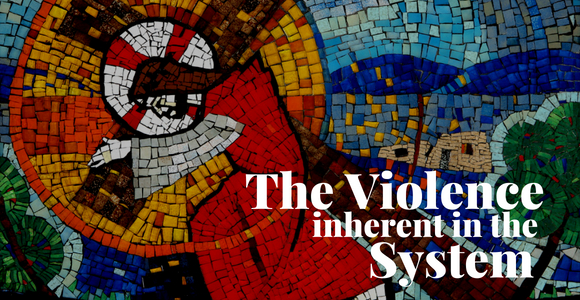
Mosaic of Jesus carrying a cross


“Those who read the Jesus story from within communities of people facing marginalization regularly see in Jesus’ crucifixion a deep solidarity with those on the margins in Jesus’ day and also those in that same ‘class’ today. Jesus and the God Jesus preached are on the side of those who are being marginalized.”


“They were on the road, going up to Jerusalem, and Jesus was walking ahead of them; they were amazed, and those who followed were afraid. He took the twelve aside again and began to tell them what was to happen to him, saying, ‘See, we are going up to Jerusalem, and the Son of Man will be handed over to the chief priests and the scribes, and they will condemn him to death; then they will hand him over to the Gentiles.’” (Mark 10:32-33)

In our last eSight/podcast (Jesus From The Edges), we focused on the importance of listening to the theologies that arise from the experiences of communities of people who daily bump up against oppression, marginalized, and/or subjugation. These sources are contrasted with theologies that come out of a more privileged social location in our society. 

As womanist theologian Jacquelyn Grant writes, “Liberation theologies including Christian feminists, charge that the experience out of which Christian theology has emerged is not universal experience but the experience of the dominant culture . . . liberationists therefore, propose that theology must emerge out of particular experiences of the oppressed people of God” (White Women’s Christ and Black Women’s Jesus, p. 1, 10). 

James Cone also writes, ““Few, if any, of the early Church Fathers grounded their christological arguments in the concrete history of Jesus of Nazareth. Consequently, little is said about the significance of his ministry to the poor as a definition of his person. The Nicene Fathers showed little interest in the christological significance of Jesus’ deeds for the humiliated, because most of the discussion took place in the social context of the Church’s position as the favored religion of the Roman State” (God of the Oppressed, p. 107). 

From my own experience I know that those on the margins of society see things in the Jesus story that those more centered in society simply miss. This doesn’t mean that some people have no blind spots. We all have blind spots. But in learning to listen to one another, especially the voices of those rarely given the mic, we discover our own blind spots and can move toward a path of compassion and justice for everyone. 

Given this reality, I would like to spend the next few eSights/podcasts contemplating the closing events of the Jesus story through the lens of the experiences of oppressed communities and the life actions these insights call us to engage. 

One of these insights has impacted my own theology for the better, has been life giving, and borne healthy fruit for me. That insight is the interpretation of Jesus death that holds that the crucifixion was not for the purpose of satisfying divine wrath, honor, or justice, but instead was an act of injustice, an expression of the violence inherent in unjust political, social, economic, and religious systems.

To the best of our knowledge, the earliest version of the Jesus story is the gospel of Mark. Three times in  that gospel, Jesus reveals that he understands that his actions in Jerusalem will lead to his arrest and crucifixion by the Romans (see Mark 8:31-34; Mark 9:30-32; and Mark 10:32-34). 

Mark’s point is that  the crucifixion was a direct response to the political, social, economic, and religious actions Jesus took in the Temple in Jerusalem, the heart of the Temple State.

“In Jesus’ first-century world, crucifixion was the brutal tool of social-political power. It was reserved for slaves, enemy soldiers, and those held in the highest contempt and lowest regard in society. To be crucified was, for the most part, an indication of how worthless and devalued an individual was in the eyes of established power. At the same time, it indicated how much of a threat that person was believed to pose. Crucifixion was reserved for those who threatened the “peace” of the day. It was a torturous death that was also meant to send a message: disrupt the Roman order in any way [and] this too will happen to you. As there is a lynched class of people, there was, without doubt, a crucified class of people. The crucified class in the first-century Roman world was the same as the lynched class today. It consisted of those who were castigated and demonized as well as those who defied the status quo. Crucifixion was a stand-your-ground type of punishment for the treasonous offense of violating the rule of Roman ‘law and order.’” (Kelly Brown Douglas. Stand Your Ground; Black Bodies and the Justice of God, p. 171)

When one interprets what we call Jesus’ “triumphal entry” as climaxing in his temple protest, it makes a lot of sense to understand the cross as the response of the powers in control at that time. “Crucifixion was and remains a political and military punishment . . . Among the Romans it was inflicted above all on the lower classes, i.e., slaves, violent criminals, and the unruly elements in rebellious provinces, not least Judea . . . These were primarily people who on the whole had no rights, in other words, groups whose development had to be suppressed by all possible means to safeguard law and order in the state ” (Martin Hengel, Crucifixion, p. 87, emphasis added).

In Mark’s gospel, Jesus doesn’t die so that people can go to heaven when they die. In Mark’s gospel, Jesus dies because he stood up to the status quo. One’s social location enables one to either see the relevance of this story detail or miss the point entirely. James Cone makes the same point in his classic book A Black Theology of Liberation: 

“What is most ironic is that the white lynchers of blacks in America were not regarded as criminals; like Jesus, blacks were the criminals and insurrectionists. The lynchers were the ‘good citizens’ who often did not even bother to hide their identities. They claimed to be acting as citizens and Christians as they crucified blacks in the same manner as the Romans lynched Jesus . . . White theologians in the past century have written thousands of books about Jesus’ cross without remarking on the analogy between the crucifixion of Jesus and the lynching of black people.” (James H. Cone, A Black Theology of Liberation, p. 158-159)  

Yet for Cone, his own experience as a Black man in America enabled him to see the cross as a violent act of injustice by an oppressive system. Seeing Jesus’ crucifixion in this light helped him to make sense of his own experience and to stand up to the injustice he faced. “The cross helped me to deal with the brutal legacy of the lynching tree, and the lynching tree helped me to understand the tragic meaning of the cross . . . I believe that the cross placed alongside the lynching tree can help us to see Jesus in America in a new light, and thereby empower people who claim to follow him to take a stand against white supremacy and every kind of injustice.” (The Cross and the Lynching Tree, Introduction)

In Mark’s gospel, we read: 

“When they were approaching Jerusalem, at Bethpage and Bethany, near the Mount of Olives, he sent two of his disciples and said to them, “Go into the village ahead of you, and immediately as you enter it, you will find tied there a colt that has never been ridden; untie it and bring it. If anyone says to you, ‘Why are you doing this?’ just say this, ‘The Lord needs it and will send it back here immediately.’” They went away and found a colt tied near a door, outside in the street. As they were untying it, some of the bystanders said to them, “What are you doing, untying the colt?” They told them what Jesus had said; and they allowed them to take it. Then they brought the colt to Jesus and threw their cloaks on it; and he sat on it. Many people spread their cloaks on the road, and others spread leafy branches that they had cut in the fields. Then those who went ahead and those who followed were shouting,

‘Hosanna!
Blessed is the one who comes in the name of the Lord! 
Blessed is the coming kingdom of our ancestor David!
Hosanna in the highest heaven!’
Then he entered Jerusalem and went into the temple; and when he had looked around at everything, as it was already late, he went out to Bethany with the twelve.” (Mark 11:1-11)

This was a planned demonstration by Jesus. Echoing Zechariah 9:9, Jesus’ entry to Jerusalem that day was to culminate in a dramatic Temple protest. Yet according to Mark, there was one flaw in his plan. When he finally arrived at the Temple, it was already “late in the day” and the majority of people had returned home. For a demonstration or protest to have effect, it must have witnesses. So what does Jesus do? He returns with the twelve and spends the night in Bethany, most likely at the home of Mary, Martha and Lazarus, and delays the final act of his demonstration for the following day.

“On the following day . . . they came to Jerusalem. And he entered the temple and began to drive out those who were selling and those who were buying in the temple, and he overturned the tables of the money changers and the seats of those who sold doves; and he would not allow anyone to carry anything through the temple.” (Mark 11.12 -16) 

Notice that these two events were supposed to be connected. They were not to happen separately but together. Jesus entering Jerusalem on a donkey and then overturning the tables in protest against how the poor were being exploited by the Temple state was intended to be one  action, not two.

Nevertheless, Jesus’ action on that second day was enough to threaten the powers, and before the end of the week, he was arrested by the “police” (Luke 22:52, CSB) and  hanging on a Roman cross. 

What does the cross say first to those facing marginalization within their larger society? 

Those who read the Jesus story from within communities of people facing marginalization regularly see in Jesus’ crucifixion a deep solidarity with those on the margins in Jesus’ day and also those in that same “class” today. Jesus and the God Jesus preached are on the side of those who are being marginalized:

 “That Jesus was crucified affirms his absolute identification with the Trayvons, the Jordans, the Renishas, the Jonathans, and all the other victims of the stand-your-ground-culture war. Jesus’ identification with the lynched/crucified class is not accidental. It is intentional. It did not begin with his death on the cross. In fact, that Jesus was crucified signals his prior bond with the ‘crucified class’ of his day. (Kelly Brown Douglas, Stand Your Ground; Black Bodies and the Justice of God, p. 171)

“The cross places God in the midst of crucified people, in the midst of people who are hung, shot, burned, and tortured.” (James H. Cone, The Cross and the Lynching Tree, p. 26)

What, then, is our first takeaway from looking at Jesus’ crucifixion through the lens of the experiences of those who belong to oppressed communities? That Jesus ended up on a Roman cross tells us that Jesus and Jesus’ God stood with those being marginalized over against the violence inherent in the system. Today, when we stand alongside those who are being marginalized, who face the violence inherent in our system, we are standing with that same Jesus and his God. We’ll consider another insight next week. For this week, contemplating this much is enough. 

“They were on the road, going up to Jerusalem, and Jesus was walking ahead of them; they were amazed, and those who followed were afraid. He took the twelve aside again and began to tell them what was to happen to him, saying, “See, we are going up to Jerusalem, and the Son of Man will be handed over to the chief priests and the scribes, and they will condemn him to death; then they will hand him over to the Gentiles.” (Mark 10.32-33)

HeartGroup Application

  1. What does standing up to injustice look like for you? Share with your group.
  2. As a group, choose and read about an injustice that doesn’t apply to you. Make sure that what you read is by a member of the affected community and directly impacted by the injustice.
  3. How does what you’ve read impact you? What would it look like to stand up to this injustice alongside those impacted? Consider, as a follower of Jesus, doing so.

I’m so glad you checked in with us, this week. Wherever you are today, keep living in love, survival, resistance, liberation, reparation, and transformation. Till the only world that remains is a world where only love, justice, and compassion reigns. 

Another world is possible. 

I love each of you dearly.

I’ll see you next week.


To support these podcasts and weekly eSight articles, go to www.renewedheartministries.com and click “donate.”

The Lost Coin

by Herb Montgomery | November 3, 2017

“Jesus willfully and intentionally transgressed the community boundaries of his day. We should too. Keep in mind, the more ritually pure you were, the more clean you were, the more included, centered and privileged you would be in Jesus’ larger culture. Those who were deemed unclean were labeled “sinners.” And it was these “sinners,” these outsiders, who were embracing Jesus’s teachings.  It was these “sinners,” these outsiders whom Jesus embraced and was living in solidarity with. These were the ones Jesus was always seen with and it was these outsiders who were often seen with Jesus.”

Featured Text:

“Or what woman who has ten coins, if she were to lose o ne coin, would not light a lamp and sweep the house and hunt until she finds? And on finding she calls the friends and neighbors, saying: Rejoice with me, for I found the coin which I lost. Just so, I tell you, there is joy before the angels over one repenting sinner.” (Q 15:·8-10)

Companion Text:

Luke 15:8-10: “Or suppose a woman has ten silver coins and loses one. Doesn’t she light a lamp, sweep the house and search carefully until she finds it? And when she finds it, she calls her friends and neighbors together and says, ‘Rejoice with me; I have found my lost coin.’ In the same way, I tell you, there is rejoicing in the presence of the angels of God over one sinner who repents.”

The term “sinner” is used in the gospels in a very particular sense. It’s not used in the universal “everyone’s a sinner” sense. We see this in Jesus’ socio-political context. Imagine a circle. Those at the center controlled and made the decisions for the circle while those pushed from the center toward the edges had less and less say the further away from the center they found themselves. What determined how close to the center someone operated was an idea that we  now have a difficult time understanding: this was the idea of purity. Those on the edges were pushed there by labelling them “sinners.” Those on the edges of the circle had no power, privilege, or voice. 

Cultural or ritual purity codes in any society are used to bring order to the chaos of our world. Ritual Purity codes are a way of organizing our communities.  What purity cultures are concerned about is found in Bruce Malina’s, The New Testament World: Insights from Cultural Anthropology, describes 

“Specifically about the general cultural map of social time and space, about arrangement within the space thus defined, and especially about the boundaries separating the inside from the outside. The unclean or impure is something that does not fit the space in which it is found, that belongs elsewhere, that causes confusion in the arrangement of the generally accepted social map because it overturns boundaries.” (p. 125)

This way of ordering societies was not just practiced back then. We practice examples of this today. We manage purity in society and smaller communities within society, too! We misuse a person’s gender, race, orientation, gender expression, and gender identity to draw boundary lines in society. Examples might be the transgression of a community defined boundary within some religious groups by having a woman pastor. Or in larger society, examples might be found in how a community responds to the marriage of people from two different races, two men holding hands in public, or how a man in drag is interpreted in certain communities as transgressing or overturning “boundaries,” not fitting the “space in which it is found,” “belonging elsewhere,” or causing “confusion in the arrangement” of a “generally accepted social map.” 

Today we may or may not use the ancient language of “purity” to name something as clean or unclean, but we still in many social settings push those who transgress community boundaries from the center of that community to its edges. We marginalize them because we perceive them as not belonging.

In Jesus’ culture this was done primarily with various interpretations of the Torah. Those whose lives aligned with the community’s interpretation of the Torah were more clean or pure than others; they belonged. Those whose lives did not align were marginalized (pushed to the edges) and labeled “sinners.” The community looked upon them as outsiders even though they were Jewish. Again, in this use of the term “sinner,” not everyone was a sinner. Only those who did not measure up to the community’s definition of “clean” or “pure.” 

First let’s consider the Torah’s rituals about cleansing, and then we’ll consider the various interpretations of the Torah competing for control in Jesus’ day. 

Mary Douglas’ Purity and Danger: An Analysis of the Concepts of Pollution and Taboo helps us to understand how the Torah’s occupation with purity operated:

“Dirt is the by-product of a systemic ordering and classification of matter, in so far as ordering involves rejecting inappropriate elements. This idea of dirt takes us straight into the field of symbolism and promises a link-up with more obviously symbolic systems of purity. We can recognize in our own notions of dirt that we are using a kind of omnibus compendium which includes all the rejected elements of ordered systems. It is a relative idea. Shoes are not dirty in themselves, but it is dirty to place them on a dining room table; food is not dirty in itself, but it is dirty to leave cooking utensils in the bedroom, or food bespattered on clothing; similarly, bathroom equipment in the drawing room . . . out of door things in doors . . . underclothing appearing where over-clothing should be, and so one. In short, our pollution behavior is the reaction which condemns any object or idea likely to confuse or contradict cherished classifications.” (p. 35)

The Torah’s concept of “clean and unclean” (or think order versus chaos) was not just about individuals but also applied to the community, the body politic, and so created and maintained community boundaries and therefore community identity as well. 

Two contemporary examples of this would be here in the United States during the Jim Crow era. All of life was once segregated based on race. Race separation is still the norm in many parts of the country today, even in the absence of explicit state enforcement. 

Another example could be how elite sectors of society still use etiquette rules today as their own purity code that maintains class separation. 

Purity Cultures historically have also resulted in exceptionalism. The pure community begins to also believe they are the “chosen” or “exceptional” or “superior” ones. Evidence of this today lies in the United States’ patriotic ideologies of global capitalism. We also witnessed it this fall in Charlottesville with white supremacists chanting “blood and soil.” We may not organize our societies around an ancient purity code, but we do follow unspoken community boundaries and practices regarding what belongs and what does not. Mary Douglas also writes, “There are no special distinctions between primitives and moderns: we are all subject to the same rules” (p. 40). As she explains, we need to begin perceiving and naming this destructive way of ordering society and become “aware of the seeds of alienation it contains.” (p. 190) 

In Jesus’s time, the society’s purity codes functioned politically and economically as well as socially. An example was given by William Herzog in 1982 and quoted in Ched Myers’ book Binding the Strong Man:

“According to Leviticus 11:38 if water is poured upon seed it becomes unclean. The passage, however, does not distinguish between seed planted in the soil and seed detached from the soil . . . In years of poor harvests, a frequent occurrence owing to the poor soil, drought, warfare, locust plaques and poor methods of farming, this text was a source of dispute. Why? During such lean years, grain was imported from Egypt. But the Egyptians irrigated their fields (putting water on seed) so their grain was suspect, perhaps even unclean. The Sadducees judged that such grain was unclean and anyone consuming it also become unclean. They were quite willing to pay sky rocketing prices commanded by the scarce domestic grain because they could afford it . . . One senses economic advantage being sanctioned, since the Sadducees were often large landowners whose crops increased in value during such times. By contrast the Pharisees argued the the Pentateuchal ordinance applied only to seed detached from soil [before being planted]; therefore . . . one could be observant and still purchase Egyptian grain.”

You can see from this example that the Sadducees’ position was not only financially advantageous to them but it also kept them centered in their community as more pure than others. 

By contrast, the Pharisees’ position would have been more liberal and been more popular among the middle and working classes. 

The dispute would have been lost on the poor who had no money to buy either the cheaper Egyptian grain or the more expensive domestic grain of Sadducee land owners. (A similar example can be seen today in how political parties “hire” unpaid interns to work for them. This fills their ranks with young people who come from wealthy families and can afford not to work for wages just to survive. Over time, the worldview supported and promoted by these parties is going to tend toward the interests of the wealthy rather than those of the poor and working classes.)

Jesus, came teaching a preferential option for the poor; a partiality and solidarity with those on the margins.  These would have been those in society who did not resonate with either the teachings of the more liberal Pharisees or the more conservative interpretations of the Sadducee elites. They were marginalized by both of these. I share all of this background to help us understand how the term “sinner” would have been used in Jesus culture by both the Sadducees and Pharisees, and how Jesus willfully and intentionally violated these boundaries. Keep in mind, the more ritually pure you were, the more clean you were, the more included, centered and privileged you would be in Jesus’ larger culture. Those who were deemed unclean were labeled “sinners.” And it was these “sinners,” these outsiders, who were embracing Jesus’s teachings.  It was these “sinners,” these outsiders whom Jesus embraced and was living in solidarity with. These were the ones Jesus was always seen with and it was these outsiders who were often seen with Jesus.

Repent

In Luke, those labeled as “sinners,” included not just the poor but the wealthy tax collectors. They, too, had been marginalized, but for them, their marginalization was based on their collusion with Rome. In Luke, these were the sector of the wealthy that responded to Jesus teachings and changed the course they were on. Jesus’ gospel was good news to the poor (Luke 4:18). Jesus called the rich into a community of shared resources with the poor. His community was a community of distributive justice. No one was to have too much while others had too little. He called the wealthy, who had more than they needed, to share with or give to those exploited by the economics of the temple and whose basic daily needs were unmet.  Jesus called the wealthy to sell their surplus land and give it to the poor from whom they had been stolen. Those who responded to Jesus weren’t those the Sadducees and Pharisees labeled as clean or pure. It was those who were wealthy “sinners,” i.e. the tax collectors, who began heeding Jesus’ call to repent. One example is the story of a tax collector named Zacchaeus:

Luke 19:8-10: “But Zacchaeus stood up and said to the Lord, ‘Look, Lord! Here and now I give half of my possessions to the poor, and if I have cheated anybody out of anything, I will pay back four times the amount.’ Jesus said to him, ‘Today salvation has come to this house, because this man, too, is a son of Abraham.’”

Wealthy “sinners” like Zacchaeus gravitated toward Jesus’s call of wealth redistribution:

Luke 7:29: “All the people, even the tax collectors, when they heard Jesus’ words, acknowledged that God’s way was right.”

Luke 15:1: “Now the tax collectors and sinners were all gathering around to hear Jesus.” 

The question was raised why Jesus was sharing table fellowship with sinners and wealthy tax collectors, these “sinners,” these outsiders. These people were repenting of their participation in the systematic social, economic, and political exploitation of the poor, they were rejecting that system, and they were choosing to walk a radically different, more communal, path of taking responsibility of the care of those being exploited by the wealthy. 

There is a beautiful story truth here. Those who had been pushed to the margins and edges of society and labeled unclean were proving to be more righteous in relation to the poor and exploited than those around whom their society was centered. It’s even possible that the tax collectors sensed a connection between their own marginalization and the marginalization of the poor; that this shared experience of being excluded prepared them to respond compassionately to Jesus’ message and his call to inclusive, distributive justice. 

A Woman

Lastly this week, I love the fact that Jesus uses the story of a woman; a member of another marginalized group in his culture. Jesus lifts up the example of a woman to exemplify a more evolved kind of social righteousness then his male critics were living.  Just as a woman knows the value of rejoicing when that which was “lost” is “found,” Jesus says through this saying, so too you men should be rejoicing right now in the wealthy sinners’ change of direction. Instead, Jesus’ critics were well centered and wealthy themselves, and could not identify with either the marginalized wealthy or the marginalized poor. I think calling Jesus a feminist is anachronistic.  But given his space and time, his treatment of women and the equity of value he saw in them is noteworthy. He lived and taught within a deeply Roman and Jewish patriarchal world, but in holding up this women as an example who was exhibiting qualities that the men he was critiquing should have been more like, we also we catch glimpses of how his valuation of women was progressive for his culture.

What’s the take away this week?

Jesus transgressed the societal rules and boundaries of his day that pushed some people to the edges and excluded them. And we are called to, too! In this inclusion, he also taught a distributive justice for the needs of the poor. Justice is not giving people who have been marginalized or discriminated against simply an equal opportunity to compete in a system that still economically exploits a certain class.  Equity isn’t giving people equal opportunity to climb a ladder that’s leaning up against the wrong wall to begin with. Jesus’ vision for a compassionate society was one where BOTH exclusionary and marginalizing practices and economic exploitation are rejected in favor of including everyone at a shared table. His vision was heterogeneous: everyone’s voice mattered and everyone’s experience was valued. It was also communal: no one had too much while there were those who didn’t have enough.  It was a community of shared values, shared production, and shared consumption.

I’ll close this week with a passage from renowned liberation scholar and theologian Gustavo Gutiérrez:

“But the poor person does not exist as an inescapable fact of destiny. His or her existence is not politically neutral, and it is not ethically innocent. The poor are a by-product of the system in which we live and for which we are responsible. They are marginalized by our social and cultural world. They are the oppressed, exploited proletariat, robbed of the fruit of their labor and despoiled of their humanity. Hence the poverty of the poor is not a call to generous relief action, but a demand that we go and build a different social order.” (Gustavo Gutiérrez, A Theology of Liberation: 15th Anniversary Edition)

There’s a lot in this week’s saying:

Or what woman who has ten coins, if she were to lose one coin, would not light a lamp and sweep the house and hunt until she finds? And on finding she calls the friends and neighbors, saying: Rejoice with me, for I found the coin which I lost. Just so, I tell you, there is joy before the angels over one repenting sinner.” (Q 15:·8-10)

HeartGroup Application

I referenced the work of Mary Douglass in this week’s article above. Mary explains that the problem with communities rooted in ritual purity is not the ritual part. The solution is not that we should become anti-ritual. The problem is how the purity part functions to marginalize, discriminate against, and exclude. She goes on to say that we must create rituals in our communities that do the opposite. These would be rituals that organize community on something better than other-ing those who are different.These would be rituals that emphasize our interconnectedness where there is no more insider and outsider; rituals that shape us into being people who cooperate and share with one another rather than competing and striving against one another.  

The early Jesus community practices the ritual of a shared meal as the centerpiece of their gatherings together. Today it’s called communion by some and Eucharist by others, but the lessons of this ritual that shapes us into a community of both shared production and shared consumption can be (and has been) lost with all the theology that has come to surround this ritual meal. 

  1. This week I want you to plan a shared meal with your HeartGroup.
  2. During the meal, discuss together how this shared meal is an expression of shared production and shared consumption.
  3. Take some time as a group to dream how you could be a community where everyone’s voice is valued AND where everyone practices the principles of shared production and shared consumption in other areas of their life. 

Keep doing potluck meals together. They can become a ritual for you and your group that over time will shape us into people who practice this shared table philosophy in other areas of our life, too.

Thanks for checking in with us this week. 

Thanks for supporting our work here at RHM. 

I’m just getting back from a month of being on the road, teaching at different events. And now we are entering our year-end season of donor support and this year we need your help. 

You can support our work by going to renewedheartministries.com/donate/

or by mailing your contribution to:

Renewed Heart Ministries
PO Box 1211
Lewisburg, WV 24901

Keep living in love, engaging the work of Luke 4:18-19 one day at a time. 

We are making a difference!

I love each of you dearly.

I’ll see you next week.

Against Enticing Little Ones

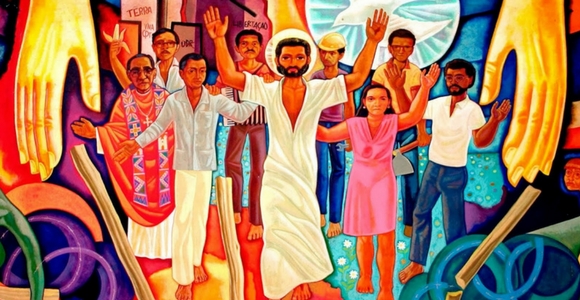
“Cristo de la Liberacion” (Christ of the Liberation) by Maximino Cerezo Barredo, who’s been dubbed “liberation painter.”

Photo Credit: “Cristo de la Liberacion” (Christ of the Liberation) by Maximino Cerezo Barredo, who’s been dubbed “liberation painter.”

“Our experiences determine not only the questions we ask, but also the answers we get back. Plain readings are not plain but are read through the lens of our own paradigms and fears. And this is one reason why it is so vital, if we are going to make our world safe and just for everyone, that we learn to listen to stories, experiences, and interpretations of our sacred texts from the most vulnerable communities in our society.”

by Herb Montgomery | October 20, 2017

Featured Text:

“It is necessary for enticements to come, but woe to the one through whom they come! It is better for him if a millstone is put around his neck and he is thrown into the sea, than that he should entice one of these little ones.” Q 17:1-2

Companion Texts:

Matthew 18:6-7: “If any of you put a stumbling block before one of these little ones who believe in me, it would be better for you if a great millstone were fastened around your neck and you were drowned in the depth of the sea. Woe to the world because of stumbling blocks! Occasions for stumbling are bound to come, but woe to the one by whom the stumbling block comes!”

Luke 17:1, 2: “Jesus said to his disciples, ‘Occasions for stumbling are bound to come, but woe to anyone by whom they come! It would be better for you if a millstone were hung around your neck and you were thrown into the sea than for you to cause one of these little ones to stumble.’”

We stumble when we’re learning to walk. This week, we are focusing on those who are walking toward a safer, more just, and compassionate world, and we’ll be considering how as they move forward, others will actively obstruct their path rather than smoothing it out. Obstructionists place stumbling blocks in the way of those moving forward, causing their advance to be harder than it should be.

We are, again, considering one of Jesus’ sayings about “little ones.” As I wrote in Thanksgiving that God Reveals Only to Children:

“The family structure in Palestine in the first century was a hierarchical pyramid with the male patriarch at the top. On the bottom rung of the social ladder, below slaves, were children (see Galatians 4:1).

Social status is typically evaluated by the degree to which one has both power and resources. Those with large measures of control over power and resources operate in higher social positions, while those with very little access to power and resources live at the bottom.

Children have access to neither power nor resources. The typical avenues to power and control of resources are education, income, or work. In our societies, children have none of these, and they are vulnerable to abuse and neglect so child advocacy and children’s rights are much needed. Discrimination on the basis of race, gender, sexual orientation, gender identity, national origin, religion, disability, color, or ethnicity are also compounded when they apply to children.”

Our focus in this week’s saying is directed toward the “little ones” Jesus spoke of—the most vulnerable sectors of society. In the Greek, “little ones” (mikros) can not only refer to children, but also any who are vulnerable to exploitation by the status quo. It doesn’t have to mean a young person; it can also refer to a person’s “rank or influence” within a society. Christianity has a long history in doing damage to our most vulnerable and most marginalized.

Native People 

One example in this history is the way Christian preachers and missionaries used the Canaanite conquest and genocide stories in the Bible to legitimize the genocide of Native peoples here in the U.S.:

“Biblical notions of extirpation influenced colonial America from the earliest days of the settlement. In a tract publicizing the new Virginia settlement, Robert Gray expressed the hope that Indians might accept Christianity, but if they did not, biblical commands were clear: ‘Saul had his kingdom rent from him and his posterity because he spared Agag . . . whom God would not have spared; so acceptable a service is it to destroy idolaters, whom God hateth.’” (Philip Jenkins, in Laying Down the Sword: Why We Can’t Ignore the Bible’s Violent Verses, p. 133)

During the colonial era, many New England preachers such as Cotton Mather compared Pequot Indians to modern Ammonites and New England to a modern Israel (see Cotton Mather, Magnalia Christi Americana, vol. 1, p. 553). With this interpretation, if Saul had had his kingdom taken away because he failed to utterly destroy the Ammonites, the new American Christians were not to fail in the complete annihilation of their modern, native “Ammonites” if they wanted ensure their place on this continent, their “promised land.” The genocide of Native people was rooted in Christians’ lethal interpretation of violent Bible passages; it was a genocide they believed God had commanded them to execute.

Slavery

During the abolitionist years leading up to the American Civil War, many Christian preachers quoted Leviticus’ passages affirming slavery and claimed that neither Paul nor Jesus had reversed those passages. One famous preacher, ironically named Moses Stuart, wrote:

“Not one word has Christ said, to annul the Mosaic law while it lasted. Neither Paul nor Peter have uttered one. Neither of these have said to Christian masters: ‘Instantly free your slaves.’ Yet they lived under Roman laws concerning slavery, which were rigid to the last degree. How is it explicable on any ground, when we view them as humane and benevolent teachers, and especially as having a divine commission-how is it possible that they should not have declared and explicitly [so] against a malum in se [something evil in itself]?”

He confidently pronounced that those calling for the end of slavery “must give up the New Testament authority, or abandon the fiery course which they are pursuing” (Moses Stuart, Conscience and the Constitution; with Remarks on the Recent Speech of the Hon. Daniel Webster in the Senate of the United States on the Subject of Slavery, 1850).

Another minister, a Southern Methodist named J.W. Tucker, proclaimed to his Confederate audience fighting for their right to own slaves, “Your cause is the cause of God, the cause of Christ, of humanity. It is a conflict of truth with error-of Bible with Northern infidelity-of pure Christianity with Northern fanaticism.” (Kurt O. Berends, “Confederate Sacrifice and the ‘Redemption’ of the South,” in Religion and the American South: Protestants and Others in History and Culture, ed. Beth Barton Schweiger and Donald G. Mathews, p. 105.) Tucker’s rhetoric sounds almost identical to the rhetoric of Christians today as they condemn movement in many faith traditions toward the affirmation of LGBTQ people.

Against Women

Christianity also has a long history with patriarchy and misogyny. Roman Catholic writer John Paul Boyer explains in Some thoughts on the Ordination of Women: 

Being a Jew, being a Palestinian, being a first century man—all these are what we might call, in the language of Aristotelian metaphysical, the ‘accidents of Christ’s humanity;’ but his being a man rather than a woman is of the ‘substance’ of his humanity. He could have been a twentieth-century Chinese and been, cultural differences notwithstanding, much the same person he was, but he could not have been a woman without having been a different sort of personality altogether.” (A Monthly Bulletin of the Church of St. Mary the Virgin, ())

Womanist scholar Jacqueline Grant rightly states in her book White Women’s Christ and Black Women’s Jesus that “the most significant use of this argument” came from Pope Paul VI on October 15, 1976, when he approved and published the following declaration:

“The Christian priesthood is therefore of a sacramental nature: the priest is a sign, the supernatural effectiveness of which comes from the ordination received, but a sign that must be perceptible and which the faithful must be able to recognize with ease. The whole sacramental economy is in fact based up on natural signs, or symbols imprinted up on the human psychology: ‘Sacramental signs’, says Saint Thomas, ‘represent what they signify by natural resemblance.’ The same natural resemblance is required for personas as for things: when Christ’s role in the Eucharist is to be expressed sacramentally there would not be this ‘natural resemblance’ which must exist between Christ and his minister if the role of Christ were not taken by a man. In such a case it would be difficult to see in the minister the image of Christ. For Christ himself was and remains a man.” (Franjo Cardinal Seper, Vatican Declaration, Feb 6, 1977, p. 6)

Never mind that the church’s own creation story states clearly that both male and female were made in the image of God. There have long been interpretations of these stories that have marginalized, wholly excluded, and damaged women personally and institutionally. Because of the patriarchal nature of many sectors of Christianity, and despite the fact that there are feminist and womanist Christians, some have gone so far as to say that Christianity is a man’s religion.

LGBTQ Fear

Anyone who lived through the 1980s here in the U.S. knows all too well how Christianity has done untold damage to the LGBTQ community, legitimizing the inmate homophobia of straight parishioners through interpretations that are trans-, bi-, genderqueer-, and homo-phobic. For a history that reaches back into the 1970s, the Southern Poverty Law Center offers an excellent history of the modern Christian anti-gay movement, starting with Anita Bryant in 1977. Just a quick read demonstrates how monstrously Christians have mischaracterized this community and used damaging interpretations of the Bible to bolster their mischaracterization. Jay Grimstead, a founder of The Coalition on Revival, bluntly stated that “Homosexuality makes God vomit”. Many similar arguments are rhetorically identical to those Christians in the 1800’s used in their opposition to ending slavery. The Christian Moral Majority didn’t get its start opposing abortion or gay people, but by opposing integration after Brown v. Board of Education. They began a network of private Christian schools to make sure their White children did not have to attend school with Black and Brown children.

I’ve given you four examples of how interpretations of our sacred text have done and continue to do damage to those who are most vulnerable within our society. I also, wrote two weeks ago:

“Interpretations are not eternal. They change with time. As we see the harmful fruit of present interpretations, we can make those interpretations give way to new ones, in the hope that new interpretations will bear the fruit of life. And if we see that our new interpretations also do harm, we will challenge them too. The goal is to continue to seek life-giving interpretations for all, work with people’s well-being and thriving in our hearts, and transform our world into a safe, just, compassionate home for us all. Anything less is not faithful to Jesus or the Spirit of our various sacred texts. Every time you’re tempted to mistake your interpretation for the sacred text itself, remember that interpretations are temporary. It’s okay for them to change, as long as what they change to is life-giving for all.”

In each of the above examples, you can come up with Bible interpretations to oppose valuing and protecting Native people and lands, ending slavery, promoting equity for women, and seeking justice for the LGBTQ community. Some claim they are just reading the Bible plainly. But we never see things objectively. As the saying goes, we do not see things as they are; we see things as we are.

Our experiences determine not only the questions we ask, but also the answers we get back. Plain readings are not plain but are read through the lens of our own paradigms and fears. And this is one reason why it is so vital, if we are going to make our world safe and just for everyone, that we learn to listen to stories, experiences, and interpretations of our sacred texts from the most vulnerable communities in our society. This is how liberation theology was born: those in South America read the Bible very differently than their colonial Christian exploiters. It’s how Black liberation theology was born: Black Christians in the U.S. read the Bible radically differently than white Christians read it. It’s how feminist and womanist theologies were born and how queer theology was born. We need these voices and perspectives if we are to arrive at interpretations of our sacred text that cease to do harm.

Today we have a broad swathe of people who want nothing to do with Jesus because of the history of the church as the largest stumbling block in the path of the vulnerable in their work toward a world of justice and compassion. They see a Christianity that seems to habitually do harm, ever landing on the wrong side of history. They don’t see a Jesus who taught survival, resistance, liberation, and justice. They don’t see a Jewish Jesus on the side of the oppressed (Luke 4:18-19). Rather, that Jesus is eclipsed by a religion that was formed in his name. This is gives me great reason to pause. I know first-hand how my own faith has been fractured by watching Christian racism, misogyny, homophobia, and transphobia just in my local community here in West Virginia. I love Jesus, but I have zero tolerance for the kind of Christianity my family seems to be surrounded by where we live.

I do not apologize for this week’s eSight. And I don’t believe the truth of our history to be too harsh to share. As someone who loves the historic, first-century Jewish Jesus, I have simply  become disillusioned with the most vocal sectors of Christianity in our culture. Just this week I’ve endured disappointment again as Christians who should have been passionately living out the value of compassionate listening to the voices of the vulnerable, who claim to believe God love’s everyone, were passionate instead to protect their own cherished theology that has been shown to be hurtful to the vulnerable. Does your God love the vulnerable or your theology? Which is it that should be given a priority of worth? As Emilie Townes states, “When you start with an understanding that God loves everyone, justice isn’t very far behind.”  But what happens when you believe God loves everyone and that doesn’t lead to justice? What about when the ones preaching “God loves everyone” are the stumbling block for those working toward a safer, just, more compassionate world for the vulnerable?

As a Christian myself, I take this week’s saying seriously. It was said to Jesus’ followers, and we who take his name today must allow this week’s saying to confront us:

“Woe to the one through [whom stumbling blocks] come! It is better for them if a millstone is put around their neck and they are thrown into the sea, than that they should cause one of the vulnerable to stumble.” Q 17:1-2 

HeartGroup Application

This week I want you to spend some time with the above article.

  1. As a group discuss what challenges this week’s eSight creates for you.
  2. Discuss together where you feel encouraged by this week’s eSight. Maybe encouragement comes just from hearing that you’re not alone in your feelings of frustration toward your Christianity being a stumbling block to so many people.
  3. What are some ways you can move toward interpretations of our sacred texts that are not damaging and don’t create stumbling blocks for those pushed to the edges of our society? Which interpretations can also move you to take tangible, concrete actions as an individual and as a group to stand in solidarity with those walking toward a more just world? How can you smooth out another person’s way toward liberation? As it states in Isaiah:

“Every valley shall be raised up,

every mountain and hill made low;

the rough ground shall become level,

the rugged places a plain.” (Isaiah 40.4)

Thank you for checking in with us this week. Wherever this finds you, keep living in love engaging the work of transforming our world.

And to each of you who are supporting the work of Renewed Heart Ministries, we simply could not do this without you. We have a lot of educational events lined up for this fall. If you’d like to support our work you can do so by going to:

https://renewedheartministries.org/donate/

Or you can always mail your support to:

Renewed Heart Ministries
PO Box 1211
Lewisburg, WV 24901

Every amount helps. Thank you!

I love each of you dearly,

I’ll see you next week.

Insipid Salt: White Christianity in the Wake of Charlottesville

Protest sign stating white silence equals complicityby Herb Montgomery

“I do subscribe to nonviolence. I teach it. I uphold it. Yet, to claim a nonviolent neutrality, saying “I’m against violence on both sides,” while you yourself are socially privileged and benefit from violence being used against people of color, both public and privatized, is a violent form of nonviolence. I reject that. To compare oppressors and resistors based only on the use of violence is intellectually lazy. The two sides are not on the same moral plane. They are not morally equivalent. Social location also matters.”

Featured Text:

“Salt is good‚ but if salt becomes insipid, with what will it be seasoned? Neither for the earth nor for the dunghill is it fit—it gets thrown out.” Q 14:34-35

Companion Texts:

Matthew 5:13: “You are the salt of the earth. But if the salt loses its saltiness, how can it be made salty again? It is no longer good for anything, except to be thrown out and trampled underfoot.”

Luke 14:34-35: “Salt is good, but if it loses its saltiness, how can it be made salty again? It is fit neither for the soil nor for the manure pile; it is thrown out. “Whoever has ears to hear, let them hear.”

Last weekend, the U.S. witnessed an evil display of racism and white supremacy/nationalism in Charlottesville, VA. We at Renewed Heart Ministries reaffirm our commitment of solidarity with Black, Latinx, Native, Arab, Asian, Jewish, Muslim, and immigrant communities, with women, our LGBTQ siblings, and the organizing working class who are all opposing White supremacy.

In a presentation on misogyny, heterosexism, and homophobia, Rev. Dr. Kelly Brown Douglas explains, “We must recognize the intersecting realities of all of these [forces]. That misogyny, heterosexism, and homophobia are all a part of a social political narrative of power. That is they are all a part of the White, patriarchal, imperialistic, capitalistic power. Misogyny, heterosexism, and homophobia are secreted by that narrative, and they feed the agenda of White, male hegemony. In as much as non-White, non-male, non-heterosexual persons can be effectively marginalized, can be set against one another, and in as much as marginalized communities marginalize and oppress one another, well then. The White, male agenda of oppressive power has been served.”

We at Renewed Heart Ministries affirm the work of those who came together and opposed and resisted White supremacy in Charlottesville, VA, last weekend. And we will continue to do our part in standing against white supremacy in all its forms.

That brings me to this week’s saying and its relevance to what we are seeing right now in the discussions around race here in the U.S. First, lets ask an important question of our saying. Our saying asks what happens to salt when it becomes salt-less. But how could that happen? How could salt lose its saltiness? That’s chemically impossible. Salt is salt is salt is salt—at least today.

In the 1st Century, rock salt in the Roman Empire naturally occurred in vast salt beds where evaporated minerals left sediment behind. Salt was not the only sediment in these beds, nor was it the only white sediment present. Salt mingled with other white sediments, was harvested, and then sold. In a cook’s broth, for example, the sediment (composed of salt and other rock) would be placed in a cooking cloth and used to stir the hot liquid broth. The salt would naturally dissolve, flavoring the broth, while other sediments with less ability to dissolve would not.

Over time, however, the salt would be used up and the other sediments left behind. The salt would be spent: it would have “lost its saltiness.” It would be “insipid” or tasteless and at that point it would be worthless, its use to be thrown out with the gravel on the road but it wasn’t even fit to be mixed with soil as fertilizer. Each of the synoptic gospels (Mark, Matthew, and Luke) mention salt becoming insipid (cf. Mark 9:49-50, Matthew 5:13 and Luke 14:34-35).

In Matthew and Luke, the context of this week’s saying is different. For Matthew, this is a saying included in the list of Jesus’ sayings that we call the Sermon on the Mount. For Luke, this saying is set among a list of criteria, an explanation of what it meant to be a follower of Jesus. Luke seems to be reminding his readers of what it means to be a Jesus follower in deeds and practice, not just in label or name.

This holds relevance for me. As I travel from place to place trying to help groups of Christians rediscover the teachings of the Jesus at the heart of their faith, I’m struck by how often we Christians are opposed to what Jesus actually taught. Recently, I was sharing Jesus’ ideas of mutual aid and wealth redistribution and once again, Christians in the audience raised strident objections. This past week, too, I watched my Christian friends on social media demonstrating an alarming lack of discernment, echoing the harmful rhetoric of blaming “many” or “both sides,” placing evil and opposition to evil on the same moral plane. These experiences have cemented the relevance of this week’s saying for me.

I have often wondered whether Christianity today has fallen much more in love with the idea of Jesus than with the reality of him. We seem to resonate with the hope of heavenly bliss after death; we want a gospel that liberates us from our mortality. We also have a very low interest in a gospel that liberates us from oppression, subjugation, and marginalization here, now, today. We like a Jesus who gives us hope for the future but leaves the present untouched. We are content with a Jesus who leaves our economic, racial, and sexist injustice in place. We are happy with a Jesus who promises heaven and leaves our present homophobia, biphobia, and transphobia unaddressed—or even worse, affirmed.

I’m working through my own frustration with this reality. I don’t resonate with a Jesus who is only concerned with our after-life, and I’m honestly at a loss to understand those only interested in that Jesus.

The Jesus in the gospel stories addressed and challenged the social, economic and political injustice of his day. We never see him telling people how to get to heaven or how to have a private relationship with him. We do see him teaching us how to enter into relationships with one another, how to share with one another, how to take care of one another. We encounter a Jesus who cautions us to make sure no one has too much and that everyone has enough. Jesus isn’t preoccupied with a future heaven but rather a present hell in which too many are trying to scrape out an existence.

A Christianity that has forgotten what the Jesus of the gospels actually taught is a Christianity that has lost its way. It’s lost the way. It’s lost its saltiness. It has become insipid or worse, dangerous.

Throughout history, forms of Christianity that have become divorced from Jesus’ ethical teachings have produced a Christianity that becomes the tool the powerful use to push the vulnerable to the underside or the margins. We see this in Europe before the Enlightenment and at the heart of colonialism. We see it in the history of America with Native people and the Africans brought here against their will through the inhumane trade of slavery. And we see it globally in the economic exploitation of developing countries by the West.

Parts of contemporary U.S. Christianity have departed starkly from the teachings of the historical Jesus. Recently one Christian claimed that “God has given Trump authority to take out Kim Jong Un.” Christians applaud the administration’s dismantling decades of protecting the vulnerable through regulation. Christians support the denial of climate change and respond “all lives matter” to silence people of color standing up to systemic injustice. Christians chant “religious liberty” as they did during the civil rights movement, as code for the demand to live out bigotry. While many CEOs demonstrated their opposition to Trump’s defense of White supremacists this past week, most Evangelical leaders carried on with business as usual.

I live in West Virginia, which is the most pro-Trump state in the U.S., but I know West Virginians are not alone in their support. I see church signs here that attribute to Trump a savior status: to some Christians, he is a “Godsend” in whom they find hope. This is the same man who bragged of sexually assaulting women and whose campaign included dog-whistle racism and blatant xenophobia. He dropped the dog-whistle this week, and defended white supremacists outright. My Christian friends who are Trump supporters took it all in stride and didn’t bat an eye. It wasn’t a deal breaker for these Christians. The Christianity of the socially privileged is not a counter cultural movement that speaks truth to the powerful or calls for a radically different way of organizing society. Although those traits are the traits of the ancient Hebrew prophets, they are either absent or opposed within this sector of Christianity today.

Last weekend, a multi-faith coalition of clergy who do demonstrate these traits met in Charlottesville, VA, to counter-protest the white supremacist, alt-right rally there. Their lives were in jeopardy multiple times, and they were saved not by police who stood by, but by groups such as Anti-fa and other anarchists who stepped in. Yet so many White Christians here in the U.S. criticized the violence of the groups that came to these faith leader’s aid with their “both sides” rhetoric, oblivious to their own social location in the discussion.

Rev. Dr. Kelly Brown Douglas spoke this week about where the critique of violence should land. “Make no mistake about it,” she said. ”Such ideologies in and of themselves are violent. For any ideology or system of thought that objectifies another human being and fails to recognize their very humanity must be recognized as violent. Moreover, such ideologies and systems serve only to precipitate more violence.”

The violence of objectification is the violence that my White Christian friends should have been critiquing. Paulo Freire’s words in Pedagogy of the Oppressed could pull back the veil from White Christians’ understanding: “Never in history has violence been initiated by the oppressed. How could they be the initiators, if they themselves are the result of violence? How could they be the sponsors of something whose objective inauguration called forth their existence as oppressed? There would be no oppressed had there been no prior situation of violence to establish their subjugation. Violence is initiated by those who oppress, who exploit, who fail to recognize others as persons— not by those who are oppressed, exploited, and unrecognized.”

I want to be clear. I do subscribe to nonviolence. I teach it. I uphold it. Yet, to claim a nonviolent neutrality, saying “I’m against violence on both sides,” while you yourself are socially privileged and benefit from violence being used against people of color, both public and privatized, is a violent form of nonviolence. I reject that. To compare oppressors and resistors based only on the use of violence is intellectually lazy. The two sides are not on the same moral plane. They are not morally equivalent. Social location also matters. It is not for us to determine what form people’s opposition should take when we socially benefit from their oppression. That’s not our place and it’s another subtle form of White supremacy to believe that we are in a moral position to critique the resistance of those threatened by White supremacists. We may not like it, but James H. Cone correctly states, “Since whites have been the most violent race on the planet, their theologians and preachers are not in a position to tell black people, or any other people for that matter, what they must do be like Jesus” (God of the Oppressed). All White people benefit from one degree to another from the White supremacy that is baked into our country’s history and design. THAT is what we should be opposing right now. If the resistance is to be critiqued, that critique should come from those being targeted by the violence of White supremacy, not those standing on the sidelines and claiming moral superiority to violence.

What should I, as a White Christian cisgender straight male be speaking out to this week? The Christianity of the socially privileged here in the U.S. is one of those things on the list.

What happened to the movement spawned by a Jewish prophet of the poor who stood in solidarity with the exploited and marginalized, and whose work was characterized as “good news to the poor” and “liberation for the oppressed?” (See Luke 4:18-19)

The salt has become insipid and its flavor is rancid. It is no longer based on the sayings and teachings of the one whose work it was founded to honor. As Rev. Willie Dwayne Francois III has stated, it has become “duplicitous.”

But there is another way to understand Christianity.

As Delores S. Williams reminds us, “It seems more intelligent and more scriptural to understand that redemption had to do with God, through Jesus, giving humankind new vision to see the resources for positive, abundant relational life. Redemption had to do with God, through the ministerial vision, giving humankind the ethical thought and practice upon which to build positive, productive quality of life. Hence, the kingdom of God theme in the ministerial vision of Jesus does not point to death; it is not something one has to die to reach. Rather, the kingdom of God is a metaphor of hope God gives those attempting to right the relations between self and self, between self and others, between self and God as prescribed in the sermon on the mount, in the golden rule and in the commandment to show love above all else.” (Sisters in the Wilderness: The Challenge of Womanist God-Talk, pp. 130-131)

Salvation in Sayings Gospel Q was not about “getting to post-mortem bliss.” Salvation was defined as righting the injustice, oppression, and violence in our world. It had a distinctly Jewish character to it, of a hope where one day all injustice, oppression and violence in the earth would be put right. Q does not point to a future messiah figure but to a then-contemporary prophet of the poor who showed a way whereby followers could choose to right injustice, oppression, and violence then and there, beginning with them.

Salvation defined this way is based on action, not in the sense of merit we earn, but intrinsically. Because our choices have intrinsic results, humanly-created problems can have humanly-chosen solutions. Q’s gospel isn’t primarily fixated on “guilt alleviation,” grace, forgiveness, no condemnation, and unconditional love for oppressors. In Q, Jesus’s salvific way included mutual aid or resource-sharing, wealth redistribution, nonviolent, self-affirming resistance. It was a values shift that centered those on edges and sat those on the undersides of society around a shared table. It wasn’t liberal, it wasn’t “progressive,” it was liberation, and it was radical! Characters in the gospels who held positions of power felt threatened by it. People in power don’t feel threatened by people handing out tickets to post mortem heaven. They feel threatened by people unifying around a shared vision of how things can change here and now, today.

Today, many people believe Christianity has become worthless, fit for neither the earth nor the dung hill. I’m not sure what Christianity’s future is. But I do believe that, to the best of our ability, we must rediscover the gospel Jesus himself taught, not merely a gospel about him. We must then take these teachings and weight their fruit, asking what they may offer our work of survival, resistance, liberation, restoration, and transformation today. Anything less, in my estimation, would be unfaithful to the Jesus stories.

“Salt is good‚ but if salt becomes insipid, with what will it be seasoned? Neither for the earth nor for the dunghill is it fit—it gets thrown out.” Q 14:34-35

HeartGroup Application

In the statement Dr. Kelly Brown Douglas made this past week, she also states:

“If it wasn’t clear before, the events in Charlottesville have now made it abundantly clear—we have reached a decision point as a nation. We must decide whether we want to be a nation defined by its Anglo-Saxon myth of exceptionalism and White supremacist culture or one defined by its democratic rhetoric of being a nation of liberty and justice for all. This question is even more poignant for people of faith. For we must decide if we are a people committed to a vision of a country that reflects an ‘Anglo-Saxon’ God or a God whose image is revealed through a racial/ethnic/religiously and culturally diverse humanity. If we are in fact committed to building a nation and being a people reflective of a God with a vision of justice and freedom for all, then we must do more than just counter-protest. Rather, we must proactively protest for the kind of nation and people we want to be.”

This week I want you to read the whole article and discuss it together as a group. You can find it at: https://btpbase.org/charlottesville-truth-america/

2. The Souther Poverty Law Center also has released a document, Ten Ways to Fight Hate. Read through this document, too, and discuss which of the ten you as a group could begin putting into practice.

3. Pick the way to fight hate that you discussed and do it.

I’m so glad you checked in with us this week. Wherever you are, keep living in love, for “when you start with an understanding that God loves everyone, justice isn’t very far behind.” (Dr. Emilie M. Townes, Journey to Liberation: The Legacy of Womanist Theology)

Remember to check out our new 500:25:1 project to discover a new way to participate in the RHM community. We just completed our 500:25:1 weekend. I wrote about it here.

I love each of you dearly.

I’ll see you next week.


The Exalted Humbled and the Humble Exalted

Person with green hair at Pride event

by Herb Montgomery


“There is a vast difference between the kind of pride that exalts self over others as if you were the normal or ideal and others were somehow less than, and the kind of pride that rejects the social shame others have tried to impose on you for being different. Pride that simply lifts oneself to a place of equality with others is not a sin!”


Featured Text:

“Everyone exalting oneself will be humbled, and the one humbling oneself will be exalted.” (Q 14:11)

Companion Texts:

Matthew 23:12: “For those who exalt themselves will be humbled, and those who humble themselves will be exalted.”

Luke 14:11: “For all those who exalt themselves will be humbled, and those who humble themselves will be exalted.”

Purity Circles

This week we once again face one of Jesus’ sayings that we must be careful not to apply to everyone. Jesus specifically pointed the saying at those who had lifted themselves up to be above their peers.

In Matthew’s story of Jesus, this saying is in the context of Matthew’s critique of the scribes and the Pharisees. A little background will help us understand.

In The New Testament World: Insights from Cultural Anthropology, Bruce Malina tells us how the purity cultures of the ancient world like the Hebrew tradition gave their members a sense of order from the chaos of the material world around us.

Specifically about the general cultural map of social time and space, about arrangements wishing the space thus defined, and especially about the boundaries separating the inside from the outside. The unclean or impure is something that does not fit the space in which it is found, that belongs elsewhere, that causes confusion in the arrangement of the generally accepted social map because it overruns boundaries.” (p. 125)

Notions of ritual cleanness or uncleanness were connected to a sense of belonging: in certain communities, well-defined boundaries marked insiders from outsiders. Within such cultures there was also a spectrum of cleanness. The greater your ability to remain clean, the purer you were. The opposite was also true. These notions of purity were not simply religious; they were but also social, economic, and political.

Think of a circle for a moment. If the circle represented the community, the purer you were, the closer you were to the center of the circle. The more unclean you were, the more you were pushed to the edges or margins. And guess who made the decisions for the group as a whole? You guessed it: those at the center. Those closer to the center had greater political, economic, and societal control. They maintained the status quo, a status quo that benefitted and privileged those at the center over those on the edges.

William Herzog once commented on the political struggle for the center in 1st Century Jewish society. His thoughts shed insight on why Matthew would have included this week’s saying.

“According to Leviticus 11:38 if water is poured upon seed it becomes unclean. [Think if you’ve ever had seeds ruined by rain water while they were still in their envelopes.] The passage, however, does not distinguish between seed planted in the soil and seed detached from the soil . . . In years of poor harvests, a frequent occurrence owing to poor soil, drought, warfare, locust plagues and poor methods of farming, this text was a source of dispute. Why? During such lean years, grain was imported from Egypt. But the Egyptians irrigated their fields (putting water on seed) so that their grain was suspect, perhaps even unclean. The Sadducees judged that such grain was unclean and anyone consuming it also became unclean. They were quite willing to pay skyrocketing prices commanded by scarce domestic grain because they could afford it. . . . One senses economic advance being sanctioned, since the Sadducees were often the large landowners whose crops increased in value during such times. By contrast the Pharisees argued that the Pentateuchal ordinance applied only to seed detached from the soil; therefore . . . one could be observant and still purchase Egyptian grain.” (in Ched Myers’ Binding the Strong Man: A Political Reading of Mark’s Story of Jesus, p. 76)

The Pharisees were the religious teachers of the masses, while the Sadducees were the elites who desired above all else to maintain their control on society. The Pharisees appeared to want to make purity more accessible to the masses, so in that context, they were considered the “liberals” while the Sadducees were the “conservatives.” Yet they were not really concerned with empowering the masses, but with placing power in their own hands, a power that the masses would legitimize. They did not dismantle the system; they only sought to co-opt it and hold the socio-political power and a populous base over the Sadducee elites in Jerusalem.

On the contrary, Jesus wanted to, proverbially, “burn the whole system down.” He repeatedly transgressed purity boundaries, bringing in those who had been pushed down and to the margins of his culture. He didn’t do this because he was anti-Jewish or anti-Torah. I believe he did this because he saw the purity model of societal order as deeply damaging to those of his Jewish siblings who were forced by those at the center to live on society’s fringes and edges.

In our saying this week, we see a Jesus who challenged and subverted the model of organizing society as a purity circle with insiders and outsiders. Jesus challenged this way of organizing society not just with his words, but also with his table, body, and temple/synagogue practices in the gospels.

We’ll come back to this in a moment.

Tax Collector Versus Pharisee 

Matthew describes a horizontal model, a circle, Luke uses a vertical image: a pyramid. The circle has a center and margins, but a pyramid has a few at the top who wield control or power over the masses below them. The lower one goes in a social pyramid, the greater the number of people and the less those people have any say about the world in which they live.

Luke places our saying this week in the context of a story about a Pharisee and a tax collector. Both of these groups were closer to the top of Jesus’ social, economic, and political pyramid. Both were typically well-to-do financially. But where one of these groups responded positively to Jesus’s teachings, the other did not. As we have already discussed, Sayings Gospel Q 7:23-30 includes the statement, “For John came to you. The tax collectors responded positively, but the religious authorities rejected him.” Luke adds this parable:

“Two men went up to the temple to pray, one a Pharisee and the other a tax collector. The Pharisee stood by himself and prayed: ‘God, I thank you that I am not like other people—robbers, evildoers, adulterers—or even like this tax collector. I fast twice a week and give a tenth of all I get.’ But the tax collector stood at a distance. He would not even look up to heaven, but beat his breast and said, ‘God, have mercy on me, a sinner.’ I tell you that this man, rather than the other, went home justified before God. For all those who exalt themselves will be humbled, and those who humble themselves will be exalted.”

In Luke’s telling of the story, “The Pharisees, who loved money, heard all this and were sneering at Jesus” and his economic vision (Luke 16:14). By contrast, the hated tax-collector responded, “Look, Lord! Here and now I give half of my possessions to the poor, and if I have cheated anybody out of anything, I will pay back four times the amount” (Luke 19:8).

The tax-collectors were the last ones expected to respond to Jesus’ economic teachings of mutual aid and wealth redistribution. Yet they came to Jesus’s shared table, while others did not, and Jesus welcomed them (see Luke 15:1-2).

In Luke, the Pharisees continued to compete with the temple elite for the exalted position of political control over the masses while the tax-collectors humbled themselves and embraced a world where there is enough for everyone. I’m sure there were exceptions; stories are often told with generalizations. What remains is the truth that when we seek to exalt ourselves over others, it leads to disastrous results for everyone.

How Not To Use This Passage

There is a difference between someone at the center or top of a group having their self-exaltation challenged, and those on the periphery and bottom working to lift themselves up to a equitable shared position. Let me explain.

I just finished reading Carol Anderson’s book White Rage. Over and over it recounted the history of how whiteness and structural racism have functioned in American society to impede social progress upward or toward the center for people of color. Sayings like ours this week have been aimed at people of color to try and silence or shame their efforts at equality.

I cannot emphasize strongly enough that there is a difference between those who would exalt themselves over others and those who simply are seeking to lift themselves up to level ground. One group seeks to maintain an unjust status quo, and the other simply works toward equality. Our saying this week is not about those lifting themselves up toward equality. It’s about those who continually impede their work, who have exalted themselves over others, who are called to humility, equity and solidarity with those lower or on the periphery.

This month I also was blessed to be able to participate with SDA Kinship International in D.C.’s Capital Pride parade. June is Pride month for the LGBTQ community. It is also a month when I see a lot of Evangelical Christians critiquing the idea of “pride” itself. “Pride is a sin!” they say. And they quote our saying this week, “Everyone exalting oneself will be humbled, and the one humbling oneself will be exalted.”

But social location matters. There is a vast difference between the kind of pride that exalts self over others as if you were the normal or ideal and others were somehow less than (think heterosexism) and the kind of pride that rejects the social shame others have tried to impose on you for being different. Pride that simply lifts oneself to a place of equality with others is not a sin! And our saying this week isn’t critiquing that kind of pride.

If a person is already being shamed and humiliated, they don’t need to humble themselves further. They are already experiencing humiliation from those who endeavor to marginalize them and their voices. Those who really need to humble themselves in that situation are those who think that just because someone is different they are broken or less than.

There was a time when those who were left-handed were considered less than, too. We don’t know why some are born one way and others are born another, but these differences do exist. Jesus subverted systems that push people to the margins or undersides of society, and that should challenge any Christian who believes cisgender heterosexuals are the ideal and all other people should stay on the margins of society. It is for them that this saying was given. They are the ones our saying this week is speaking to.

I’ve been reading Ched Myers’ book Binding the Strongman: A Political Reading of Mark’s Story of Jesus. I’m enjoying it immensely. It has been quite affirming and confirming for me personally, and I recommend the book highly if you have not read it. In the introduction, which I quoted from earlier, Ched shows how social pyramids and circles functioned in Jesus’ day and how they call those of us who want to follow Jesus to challenge similar models today.

These two statements resonated deeply inside me this week:

“White North American Christians, especially those of us from the privileged strata of society, must come to terms with the fact that our reading site for the Gospel of Mark is empire, locus imperium . . . The ‘irreducible meaning’ of empire is the geopolitical control of the peripheries by the center . . . the fact remains that those on the peripheries will have ‘eyes to see’ many things that those of us at the center do not.”

And

“The ancient Mediterranean world was dominated by the rule of imperial Rome [center]. However, whereas I read from the center, Mark wrote from the Palestinian periphery. His primary audience [was] those whose daily lives bore the exploitative weight of colonialism, whereas mine [is] those who are in a position of enjoy the privileges of the colonizer. In this sense, Third World liberation theologians, who today also write from the perspective of the collided periphery have the advantage of a certain ‘affinity of site’ in their reading of the Gospels.”

Whether we use the vertical model of a pyramid where the few at the top control everyone beneath them, or the horizontal model of a circle where those closer to the center have control of the body, our saying this week offers a critique and warning to all who push others from a position of input and influence to the margins, edges, or periphery:

Everyone exalting oneself will be humbled, and the one humbling oneself will be exalted. (Q 14:11)

HeartGroup Application

Jesus sought to change the way communities were organized. Where there were pyramids with people on top and closed circles with people outside, Jesus sought to form a shared table.

So this week I want you to do something a little different. Each of you, take time to listen to a presentation I gave in the fall of 2015 in southern California entitled, A Shared Table.

Then after listening,

  1. Discuss your responses together as a group.
  2. Brainstorm how your group can become more of a shared table experience rather than in a pyramid or closed circle. Write these strategies out.
  3. Pick something from what you’ve written and put it into practice this week.

Something that may be helpful to you in your brainstorming is our newly updated HeartGroups page.

Together we can make choices that continue to transform our world into a safe, compassionate, just home for everyone. The teachings of Jesus don’t call us to escape from a hostile world. Radical discipleship, radical Jesus-following, calls us to engage the world so that it becomes a less hostile place. In the words of Sam Wells, “The one thing everyone seems to agree on today is that there’s plenty wrong with the world. There are only two responses to this—either go and put it right yourself, or, if you can’t, make life pretty uncomfortable for those who can until they do. When we take stock of our relationship with the powerful, we ask ourselves, ‘Does the shape of my life reflect my longing to see God set people free, and do I challenge those who keep others in slavery?’” (in Binding the Strong Man: a political reading of Mark’s story of Jesus by Ched Myers)

Remember, we are in this together. We are each other’s fate.

Also remember to check out our new 500:25:1 project at http://bit.ly/RHM500251. There you can find out more about why we’re launching weekend events around the country, how you can help to make these events happen, and, best of all, how you can have us come and teach in your area.

Thanks for checking in with us this week!

Wherever this finds you, keep living in love, survival, resistance, liberation, restoration, transformation and thriving! Till the only world that remains is a world where only love reigns.

I love each of you dearly.

I’ll see you next week.

Judging the Time

by Herb Montgomery

Featured Text:

“But he said to them, ‘When evening has come, you say: Good weather! For the sky is flame red.” And at dawn: “Today it’s wintry! For the lowering sky is flame red.” The face of the sky you know to interpret, but the time you are not able to?’” (Q 12:·54-56)

Companion Texts:

Matthew 16:2-3: “He answered them, ‘When it is evening, you say,  “It will be fair weather, for the sky is red.” And in the morning, “It will be stormy today, for the sky is red and threatening.” You know how to interpret the appearance of the sky, but you cannot interpret the signs of the times.’”

Luke 12:54-56: “He also said to the crowds, ‘When you see a cloud rising in the west, you immediately say,“It is going to rain”; and so it happens. And when you see the south wind blowing, you say, “There will be scorching heat”; and it happens. You hypocrites! You know how to interpret the appearance of earth and sky, but why do you not know how to interpret the present time?’”

Gospel of Thomas 91:2: “He said to them: ‘You examine the face of sky and earth, but the one who is before you, you have not recognized, and you do not know how to test this opportunity.’”

As we’ve been discussing over the past two weeks, the context of our saying this week is the economic and political stress in Galilee and Judea in the early first century. The poor were being exploited. Movements that used nationalistic sentiments resented the rule of the Roman empire. As in most cases throughout history, those who have less to lose are the ones who are willing to take the greatest risks. These nationalistic movements would have resonated deeply with the exploited poor, and its members would have resonated most deeply with a “Make Jerusalem Great Again” kind of message. What were the results?

Three decades later the poor rose up and forced the political and economic elites from the Temple. They burned the debt ledgers, erasing all debts, forcing a “Jubilee” of cancelled debts. They then took up arms to engage in a liberation movement to free themselves from Roman taxation and rule. This Jewish-Roman war lasted from 66-69 C.E. Then, in the following year, the tense situation between the Jewish people and Rome escalated again, ending in a backlash from Rome that wiped out Jerusalem for everyone, rich, poor, elite, and the socially marginalized alike. The liberation methods chosen by the excluded and pushed down would profoundly backfire for everyone.

Roughly thirty years earlier, an itinerant, Jewish prophet of the poor endeavored to cast a societal vision of an alternative path. It was a leap for both ends of the socio-economic-political spectrum. He called the wealthy elites to see our interconnectedness with others and he called us to liquidate our vast possessions and redistribute their wealth to “the poor.” This was not a call to an isolated individual as some belief. Rather, this was Jesus message to audience at large in Luke 12:

“Sell your possessions and give to the poor. Provide purses for yourselves that will not wear out, a treasure in heaven that will never fail, where no thief comes near and no moth destroys.” (Luke 12:33; see also https://renewedheartministries.org/Esights/03-24-2017)

In the later book of Acts, the first act by all wealthy Jesus followers, to one degree or another, was to share:

“With many other words he warned them; and he pleaded with them, ‘Save yourselves from this corrupt generation.’ Those who accepted his message were baptized, and about three thousand were added to their number that day. They devoted themselves to the apostles’ teaching and to fellowship, to the breaking of bread and to prayer. Everyone was filled with awe at the many wonders and signs performed by the apostles. All the believers were together and had everything in common. They sold property and possessions to give to anyone who had need.” (Acts 2:40-45, emphasis added.)

In the book of Acts, this was an indispensable act in what it meant to follow Jesus. This would help us make sense of why Jesus was unpopular with the majority of economic elites of his day.

And if you think that’s a naive hope, Jesus’ message to the desperate poor was equally a long shot. It was one of resistance, but of nonviolent resistance. A call to see our interconnectedness with one another. A call to liberation, and justice, yes. Yet this resistance was to be expressed through self-affirming, injustice confronting, militant nonviolence. He called the exploited down a path that would, yes, remove the power to hurt others from those in control of the present society, but would not remove those ones from humanity itself. It was a call for them to also “love” their enemies. This was a tension expressed well by the words of Barbara Demming in Revolution and Equilibrium:

“With one hand we say to one who is angry, or to an oppressor, or to an unjust system, ‘Stop what you are doing. I refuse to honor the role you are choosing to play. I refuse to obey you. I refuse to cooperate with your demands. I refuse to build the walls and the bombs. I refuse to pay for the guns. With this hand I will even interfere with the wrong you are doing. I want to disrupt the easy pattern of your life.’ But then the advocate of nonviolence raises the other hand. It is raised out-stretched—maybe with love and sympathy, maybe not—but always outstretched. With this hand we say, ‘I won’t let go of you or cast you out of the human race. I have faith that you can make a better choice than you are making now, and I’ll be here when you are ready. Like it or not, we are part of one another.’ Active nonviolence is a process that holds these two realities—of noncooperation with violence but open to the humanity of the violator—in tension. It is like saying to our opponent: On the one hand (symbolized by a hand firmly stretched out and signaling, ‘Stop!’) ‘I will not cooperate with your violence or injustice; I will resist it with every fiber of my being’. And, on the other hand (symbolized by the hand with its palm turned open and stretched toward the other), ‘I am open to you as a human being.’” (p. 16)

Even if those on the undersides and edges of society embraced nonviolent resistance, the Jesus called them to learn to see the humanity of their oppressors, to seek distributive justice rather than revenge. Answering the call to not cast out oppressors from the human race but to leave open the possibility for oppresses to choose to listen, change, and embrace changing along with the changes in the larger society is difficult. Nonetheless, enemy love was also a part of Jesus’ message. To enemies, Jesus said, “Stop being enemies” To the exploited, Jesus said, “Leave open the possibility that exploiters may also change.”

Both sides met Jesus’ vision for society with a level of resistance, depending on their social location.

Today, our society’s economic exploitation and classism is compounded by the interlocking network of the societal sins of racism, sexism, heterosexism, with nationalism and militarism thrown into the mix. Today’s struggle for a society characterized by distributive justice is complex.

But solving the economic exploitation of the poor won’t necessarily reverse our other societal sins. Examples are economic solutions in the past that intentionally left out people of color. A short NPR interview illustrates this well: Historian Says Don’t ‘Sanitize’ How Our Government Created Ghettos.

Nevertheless, some movements today address economic disparities between the 1% and the rest of society and acknowledge race. We can work together toward distributive justice for all!

We must engage socio-political and religious-cultural solutions in holistic ways that recognize, name, and address the above interlocking systems of oppression including our racism, classism, sexism, and heterosexism. This, to me, is what it means to follow the Jesus of Luke 4:18-19 whose life and ministry was spent alongside the poor, alongside women, and in solidarity with outcast people:

“The Spirit of the Lord is on me,

because he has anointed me

to proclaim good news to the poor.

He has sent me to proclaim freedom for the prisoners

and recovery of sight for the blind,

to set the oppressed free,

to proclaim the year of the Lord’s favor.”

In our saying this week, Jesus was chiding his listeners’ ability to tell the weather but not see the social, political, and economic catastrophe that lay ahead of them. Today I have to pause and wonder the same.

We are witnessing a political movement that, like in first century Judea, plays on the economic hardships and the nationalism of a certain sector of American society. Tensions are escalating at home and abroad, and have the potential to produce a backlash that could wipe out everything for everyone; rich, poor, elite, and the socially marginalized alike. The liberation methods we choose matter. Genuine liberation cannot be accomplished on the backs of other marginalized and exploited people. As Fannie Lou Hamer reminds us, “Nobody’s free until everybody’s free.”

Again, we are witnessing today a number of people who have placed their hope in a solution that is deeply problematic for a majority of others. I cannot help but ask what’s on our horizon. How will things escalate over the next four years?

Racial tensions are escalating. Sexist tensions are escalating. Homophobic and transphobic tensions are escalating. Ecological tensions are escalating. Global nuclear tensions are quickly escalating. Are we heading swiftly toward our own Gehenna which wipes out everything for everyone alike?

We are in this together. We may not all be the same, but we are all connected. We may be different, but we are all part of the same varied human family. When we fail to recognize our interconnectedness to one another, when we try to solve society’s problems for ourselves, while we turn our backs on or even worsen the societal problems of our neighbor, we are headed down a path which historically leaves nothing for all of us.

But he said to them, “When evening has come, you say: Good weather! For the sky is flame red.” And at dawn: “Today it’s wintry! For the lowering sky is flame red.” The face of the sky you know to interpret, but the time you are not able to? (Q 12:·54-56)

HeartGroup Application

I mentioned a list of tensions that are presently escalating in Western societies. Jesus commissioned us to be sources of healing despite them. Here is that list again:

  • Racial tensions
  • Sexist tensions
  • Homophobic and transphobic tensions
  • Ecological tensions
  • Global nuclear tensions
  1. Which tensions would you add to this list?
  2. Where do you see these tensions escalating in our world today? List examples.
  3. In what ways, in your own sphere of influence, can you work to bring reparation, healing, and justice-rooted peace, to these escalating tensions in your own community? Make another list.

Now pick something from that last list and put it into practice this week. What we choose, what we do, affects those around us. We are bound up with one another. We are each other’s keeper.

Thanks for checking in with us this week.

I want to thank all of you who support the work of Renewed Heart Ministries. It’s people like you who enable us to exist and to be a positive resource in our world in the work of survival, resistance, liberation, restoration, and transformation.

If you are new to Renewed Heart Ministries, we are a not-for-profit group informed by the sayings and teachings of the historical Jewish Jesus of Nazareth and passionate about centering our values and ethics in the experiences of those on the undersides and margins of our societies. You can find out more about us here.

Everything we do at Renewed Heart Ministries is done with the purpose of making these resources as free as possible. To do so we need the help of people like you.

If you’d like to support the work of Renewed Heart Ministries, you can make a one-time gift or become a monthly contributor by going to renewedheartministries.com and clicking on the Donate tab at the top right of our home page.

Or you can mail your contribution to:

Renewed Heart Ministries

PO Box 1211

Lewisburg, WV 24901

Make sure you also sign up for our free resources on the website: we have a monthly newsletter and much, much more.

All of your support helps. Anything we receive beyond our annual budget we pass on to other not-for-profits making systemic and personal differences in the lives of those less privileged in the status quo.

For those of you already supporting our work, again, thank you.

I’m so glad you’re on this journey with us.

Where you are, keep living in love, survival, resistance, liberation, restoration, and transformation on our way to thriving!

I love each of you dearly.

I’ll see you next week.

Children against Parents 

girl spray painting a graffiti heart on wall

by Herb Montgomery

Featured Text:

“Fire have I come to hurl on the earth, and how I wish it had already blazed up! Do you think that I have come to hurl peace on earth? I did not come to hurl peace, but a sword! For I have come to divide son against father, and daughter against her mother, and daughter-in-law against her mother-in-law.” (Q 12:49‚ 51, 53) 

Companion Texts:

Matthew 10:34-38: “Do not suppose that I have come to bring peace to the earth. I did not come to bring peace, but a sword. For I have come to turn

‘a man against his father,a daughter against her mother,a daughter-in-law against her mother-in-law—a man’s enemies will be the members of his own household.’

Anyone who loves their father or mother more than me is not worthy of me; anyone who loves their son or daughter more than me is not worthy of me. Whoever does not take up their cross and follow me is not worthy of me.”

Luke 12:49-53: “I have come to bring fire on the earth, and how I wish it were already kindled! But I have a baptism to undergo, and what constraint I am under until it is completed! Do you think I came to bring peace on earth? No, I tell you, but division. From now on there will be five in one family divided against each other, three against two and two against three. They will be divided, father against son and son against father, mother against daughter and daughter against mother, mother-in-law against daughter-in-law and daughter-in-law against mother-in-law.”

Gospel of Thomas 10: “Jesus says: ‘I have cast fire upon the world, and see, I am guarding it until it blazes.’”

Gospel of Thomas 16: “Jesus says: ‘Perhaps people think that I have come to cast peace upon the earth. But they do not know that I have come to cast dissension upon the earth: fire, sword, war. For there will be five in one house: there will be three against two and two against three, father against son and son against father. And they will stand as solitary ones.’”

Micah 7:6: “For a son dishonors his father, a daughter rises up against her mother, a daughter-in-law against her mother-in-law—a man’s enemies are the members of his own household.”

Two Types of Peace Making

There are two types of peace-making. One type uses force of arms. It amounts to being the biggest bully on the hill: if you’re big, strong, and bad enough, no one will mess with you and they’ll do what you say. The other type uses distributive justice. It makes sure everyone is taken care of and everyone has enough so that there can be peace.

Marcus Borg and John Dominic Crossan mention these two types of peace in their joint volume, The First Christmas:

“Empire promises peace through violent force. Eschaton promises peace through nonviolent justice. Each requires programs and processes, strategies and tactics, wisdom and patience. If you consider that peace through victory has been a highly successful vision across recorded history, why would you abandon it now? But whether you think it has been successful or not, you should at least know there has always been present an alternative option— peace through justice.” (p. 75)

Later they insightfully contrast the two:

“The terrible truth is that our world has never established peace through victory. Victory establishes not peace, but lull. Thereafter, violence returns once again, and always worse than before. And it is that escalator violence that then endangers our world.” (p. 166)

Nonviolence Isn’t Peaceful

The road to peace isn’t peaceful, however. Even if, like Gandhi, one defines Jesus’ activism as nonviolent resistance, our saying this week indicates that Jesus wasn’t about “keeping the peace” with a lack of conflict.

The Jesus of the gospels came to “bring fire and sword.” But how we understand this saying makes all the difference.

Too often, Christians have misinterpreted these words, chosen to be the ones wielding the sword against others, and literally set heretics, witches, Muslims, and Jews on fire. Let’s look this saying more closely.

In response to an accusation that he was “disturbing the peace” by participating in the 1955 Montgomery Bus Boycott, Dr. King stated:

“True peace is not merely the absence of tension: it is the presence of justice.” (In Let the Trumpet Sound : A Life of Martin Luther King, Jr by Stephen B. Oates)

As we move toward distributive justice, nonviolent resistance to systems of disparity should disrupt. It should confront, it should disturb, it should prevent the unjust system from continuing on as normal. Unless nonviolence is disruptive, its goal is not achieved. On August 3(4), 1857, Frederick Douglass gave an address on West India Emancipation in Canandaigua, New York:

“The whole history of the progress of human liberty shows that all concessions yet made to her august claims, have been born of earnest struggle. The conflict has been exciting, agitating, all-absorbing, and for the time being, putting all other tumults to silence. It must do this or it does nothing. If there is no struggle, there is no progress. Those who profess to favor freedom, and yet depreciate agitation, are men who want crops without plowing up the ground. They want rain without thunder and lightning. They want the ocean without the awful roar of its many waters. This struggle may be a moral one; or it may be a physical one; or it may be both moral and physical; but it must be a struggle. Power concedes nothing without a demand. It never did and it never will. Find out just what any people will quietly submit to, and you have found out the exact amount of injustice and wrong which will be imposed upon them; and these will continue till they are resisted with either words or blows, or with both. The limits of tyrants are prescribed by the endurance of those whom they oppress . . . Men might not get all they work for in this world, but they must certainly work for all they get. If we ever get free from the oppressions and wrongs heaped upon us, we must pay for their removal. We must do this by labor, by suffering, by sacrifice, and if needs be, by our lives and the lives of others.” (Source)

And although Douglass did not subscribe to the theories of nonviolence as King did, he was right: Whether it be by disruptive violence or disruptive nonviolence, the point is that there has to be disruption to the status quo. Even nonviolence can be disruptive when it isn’t a co-opted nonviolence that passively demonstrates without changing a thing.

Don’t miss that the sword mentioned in this week’s saying is one being raised by the unjust system against Jesus and his followers. It isn’t a sword that Jesus and his followers raise against others. It’s a fire of disruption and a part of resistance that the those benefited by the status quo seek to extinguish. Jesus words about taking up the cross are still ahead of us in this series. They must be understood in a way that does not promote the myth of redemptive suffering.

And before we arrive at that discussion, we must note that Jesus’ followers are not the ones with the swords in their hands in this passage. They’re the ones whom those with swords in their hands threaten with crosses. They’re for standing up to what was unjust. They’re being threatened with death for standing up and taking hold of life.

Remember, Jesus didn’t die so you could go to heaven. Jesus died because he stood up to the status quo. And even if he did so nonviolently, he stood up to injustice while standing alongside the poor and exploited and marginalized (consider the temple incident).

Social Location Matters

This saying is also at the center of why many parents feel religiously compelled to reject their children and grandchildren for being perceived as out of harmony with their own faith. Painful examples are the disproportionate rates of LGBT homeless young people who are turned out of their religiously fundamentalist homes: their parents’ Christianity is a version that would cause them to reject their own children.

What we must see this week is that in the stories about Jesus’ followers, they’re the ones being rejected, not the ones rejecting. They are the ones Jesus encourages to stand up and resist even if their own family rejects them.

This saying is on the side of the youth being kicked out. It’s on the side of the women who stand up to domestic violence. It’s on the side of slaves that stand up against their enslavement. It’s on the side of straight siblings who choose to stand in solidarity with their LGBT siblings over against the fear of experiencing their parents’ rejection too. It’s on the side of the counselors and clergy that stand with survivors of relational violence and tell them not to just passively accept abuse but to leave, even when doing so will bring rejection from those who subscribe to biblical patriarchy.

This week’s saying is on the side of the abolitionists who were accused of having to throw out their Christian faith to stand against White Christian slavery. It’s on the side of people of color and their white allies who stand firm and say “Black Lives Matter” in the face of rejection from their white peers, Christian and non-Christian alike. It’s on the side of those who find themselves opposing both Democrats and Republicans in saying that bombs won’t grant self-determination for those here or in any country where they’re victims of the global economy.

Yes, when you stand up for the vulnerable, there will be push back. Stand up anyway.

Archbishop Oscar Romero, who was assassinated mid-mass, and who stood in solidarity with the poor beyond U.S. backed military repression in El Salvador said:

Christ asks us not to fear persecution, because — believe me, brothers and sisters — whoever has cast his or her lot with the poor will have to endure the same fate as the poor, and in El Salvador we know what the fate of the poor is: to disappear, to be tortured, to be a prisoner, to be found dead.” (Quoted by James Brockman in The Word Remains: A Life of Oscar Romero, Orbis Books, 1982)

Using the Jewish text of Micah, our saying this week goes on to say, “Brother will betray brother to death, and a father his child; children will rebel against their parents and have them put to death. (Matthew 10:21)

Jesus message is stand up anyway.

Standing against injustice will produce a sword in the hand of those who are threatened by a more egalitarian world. Standing up will produce a fire storm of criticism: Colin Kaepernick followed all the rules the privileged say defines a legitimate protest and has still been delegitimized and slandered.

Stand up anyway.

If those who are rejecting you for standing with the vulnerable are your own family, biological or religious, stand against injustice, fear, ignorance, violence, and oppression anyway.

Dietrich Bonhoeffer was a German Lutheran pastor and theologian who, after his time at Union Theological Seminary in New York, returned to Germany to stand with the vulnerable and against Nazism. He wrote, “There remains an experience of incomparable value… to see the great events of world history from below; from the perspective of the outcast, the suspects, the maltreated, the powerless, the oppressed, the reviled — in short, from the perspective of those who suffer” (Letters and Papers from Prison).

One’s social location matters. Reading this week’s saying from the location of those on the undersides and edges of our society makes a difference.

We don’t have to reject members of our own family. Rather, this week’s saying tells us that when we do take a stand for justice, we may be rejected by mother, father, daughter, son, brother, or sister. And it’s encouraging us to stand up anyway.

Standing with and speaking out alongside the vulnerable will create conflict. But from that soil can grow a distributive justice that produces the fruit of peace. I don’t believe that we must pass through fire and sword to get to a world that is safe, just, and compassionate for everyone. But when those threatened by the new world do raise their swords and standing up creates a fire storm, stand up anyway.

Joan Carlson Brown & Rebecca Parker remind us, “It is not the acceptance of suffering that gives life; it is commitment to life that gives life. The question, moreover, is not am I willing to suffer? but do I desire fully to live? This distinction is subtle and, to some, specious, but in the end it makes a great difference in how people interpret and respond to suffering.” (in Christianity, Patriarchy and Abuse, p.18)

“Fire have I come to hurl on the earth, and how I wish it had already blazed up! Do you‚ think that I have come to hurl peace on earth? I did not come to hurl peace, but a sword! For I have come to divide son against father, and daughter against her mother, and daughter-in-law against her mother-in-law.” (Q 12:49‚ 51, 53)

HeartGroup Application

Gustavo Gutierrez writes in his book We Drink From Our Own Wells:

“The faith and courage of the members of our communities in the face of threats, misunderstandings, and persecution for justice’ sake are sustained and strengthened by the support each individual gives the others, by the support each community gives the others, by our very struggle and activity, by meditation on the word of God, and by the recollection of the witness given by those who have struggled for justice.”

As a group:

  1. List what types of push back you fear you will experience for taking stands against injustice, oppression, and violence?
  2. Discuss how your group can support members if these fears become reality? Make an actual list.
  3. Create an action plan: people to call or reach out to, ways to respond, things to set in motion that each of you can put into practice this week to support each other if and when pushback occurs. And now, having each other’s back, stand up anyway.

Thanks for checking in with us this week. Where you are, keep living in love, survival, resistance, liberation, restoration, and transformation on our way to thriving!

Again, I want to thank all of you who support the work of Renewed Heart Ministries. It’s people like you who enable us to exist and to be a positive resource in our world in the work of survival, resistance, liberation, restoration, and transformation.

If you are new to Renewed Heart Ministries, we are a not-for-profit group informed by the sayings and teachings of the historical Jewish Jesus of Nazareth and passionate about centering our values and ethics in the experiences of those on the undersides and margins of our societies. You can find out more about us here.

Everything we do at Renewed Heart Ministries is done with the purpose of making these resources as free as possible. To do so we need the help of people like you.

If you’d like to support the work of Renewed Heart Ministries, you can make a one-time gift or become a monthly contributor by going to renewedheartministries.com and clicking on the Donate tab at the top right of our home page.

Or you can mail your contribution to:

Renewed Heart Ministries

PO Box 1211

Lewisburg, WV 24901

Make sure you also sign up for our free resources on the website: we have a monthly newsletter and much, much more.

All of your support helps. Anything we receive beyond our annual budget we pass on to other not-for-profits making systemic and personal differences in the lives of those less privileged in the status quo.

For those of you already supporting our work, again, thank you.

I’m so glad you’re on this journey with us.

I love each of you dearly.

I’ll see you next week.

Hearings before Synagogues

Slaves liberation, Goree Island, Dakar, Best of Senegal

by Herb Montgomery

Featured Text:

“When they bring you before synagogues, do not be anxious about how or what you are to say; for the holy Spirit will teach you in that hour what you are to say.” Q 12:11-12 

Companion Texts:

Matthew 10:19: “But when they arrest you, do not worry about what to say or how to say it. At that time you will be given what to say.”

Luke 12:11-12: “When you are brought before synagogues, rulers and authorities, do not worry about how you will defend yourselves or what you will say, for the Holy Spirit will teach you at that time what you should say.”

Synagogues

Rome referred to the synagogue as a Jewish “public school” (Josephus, Antiquities of the Jews, book 16.6.2). The book of Acts describes synagogues of places of religious worship and instruction. These were places for the local community to assemble for social, intellectual and spiritual reasons. Today, Jewish synagogues are overseen by rabbis. While 1st Century synagogues did have leadership, rabbinical leadership did not become universal till some time in the Middle Ages.

One of the ways Rome kept the peace in the territories it conquered was by working closely through the territories’ religious institutions. So the synagogues, though much more local than the temple in Jerusalem, would have played a part in the Roman occupation.

Also keep in mind that in 1st Century Jewish society, strict divisions between political/civil and religious life did not exist. These were intertwined as they are often in our time.

This week’s saying is an encouragement to followers of Jesus who got arrested for following him. In the U.S. today. Christians don’t get arrested for following Jesus. We’ll discuss a few possible reasons for this in a moment.

First, rather than pointing a finger at how the Jewish elites joined religious and civil authorities to oppose the threat of Jesus’ vision for Jewish societies, I’d like to consider our history: how most of Christianity has witnessed this same opposition to Jesus’ societal vision.

Christianity

Most scholars point to the conversion of Constantine as the period when Christianity began colluding with empire. Feminist scholars point back to patriarchal abuses of women, which have always plagued Christianity. (See Christianity, Patriarchy and Abuse, edited by Joanne Carlson Brown and Carole R. Bohn.) Christianity, embracing the violent use of the sword as justifiable in the face of Rome’s enemies, grew to become the political head of most of Europe. Christianity then became the empire itself. As the right arm of Orthodox, Catholic, and Protestant countries in Europe, imperial Christianity laid the foundation for the church’s endorsement and use of colonialism in the 15th Century during the so-called “age of discovery.” In my twenties, I visited Trinidad and Tobago as young, naive Christian “preacher.” Much to my horror I discovered history my Christian education had conveniently left out. I heard stories from the people there of how, rather than condemning colonialism as the genocidal rape of indigenous lands and people, Christianity and the name of Jesus was part and parcel of colonialism. Colonialism was viewed as an acceptable and even preferable means of carrying the “gospel” around the globe, making “disciples of all nations, baptizing them in the name of the Father and of the Son and of the Holy Spirit” with the Bible in one hand and a sword in the other (see Matthew 18:29).

Christian Colonialism took lands and resources from indigenous people viewing them as “modern Canaanites,” treating indigenous people themselves as capitalist resources that could be taken forcefully from their lands as slaves. (See Philip Jenkins, Laying Down the Sword: Why We Can’t Ignore the Bible’s Violent Verses, pp.123-142) Christians participated with clear consciences in the slave trade. (See Delores Williams, Sisters in the Wilderness, pp. 66-68) After all, their sacred text had given them permission:

“However, you may purchase male and female slaves from among the nations around you. You may also purchase the children of temporary residents who live among you, including those who have been born in your land. You may treat them as your property, passing them on to your children as a permanent inheritance. You may treat them as slaves, but you must never treat your fellow Israelites this way.” (Leviticus 25:44-46)

This moral stain still rests with Christianity today. The end of slavery in the U.S. was brought about by secularists partnering with a minority of Christians derogatorily labeled “radical Christians.” (See Susan Jacoby’s Freethinkers: A History of American Secularism and Carol Faulkner’s Lucreitta Mott’s Heresy: Abolition and Women’s Rights in Nineteenth Century America.) Jim Crow, too, was ended by secular federal legislation opposed by the majority of white Christians in the southern states. (The Real Origins of the Religious Right)

Today, Christianity again has raised its head to support the most outspokenly misogynist, racist, xenophobic American administration in modern history.  For most of my socially conscious friends, Christianity is seen not just as out of touch with Jesus’ societal vision, but actively opposed to a world that resembles what Jesus was working so tirelessly to inspire among his 1st Century followers.

Today

In the 1960s and 1970s, in North and South America, a different Christian movement was born. Latin voices in South and Central America, and Black voices here in the U.S. developed differently focused theologies that would come to be known as liberation theologies:

“If theological speech is based on the traditions of the Old Testament, then it must heed their unanimous testimony to Yahweh’s commitment to justice for the poor and the weak. Accordingly it cannot avoid taking sides in politics, and the side that theology must take is disclosed in the side that Yahweh has already taken. Any other side, whether it be with the oppressors or the side of neutrality (which is nothing but a camouflaged identification with the rulers), is unbiblical. If theology does not side with the poor, then it cannot speak for Yahweh who is the God of the poor.” (James H. Cone, God of the Oppressed, p. 65)

“Under these circumstances, can it honestly be said that the Church does not interfere in ’the temporal sphere’? Is the Church fulfilling a purely religious role when by its silence or friendly relationships it lends legitimacy to a dictatorial and oppressive government? We discover, then, that the policy of nonintervention in political affairs holds for certain actions which involve ecclesiastical authorities, but not for others. In other words, this principle is not applied when it is a question of maintaining the status quo, but it is wielded when, for example, a lay apostolic movement or a group of priests holds an attitude considered subversive to the established order.” (Gustavo Gutierrez, A Theology of Liberation, 15th Anniversary Edition, p. 40)

Both statements reveal a challenge to Christianity’s historic complicity with and empowerment of the status quo. Christian liberation movements were born in solidarity with oppressed. This marked a significant shift in theology away from North American and European centered interpretations and toward theologies being done from within oppressed communities.

These theologies were labeled “radical” expressions of Christianity and they have yet to become popularly emphasized in status quo, White, patriarchal, heterosexist Christianity. These theologies have not gone beyond the halls of academia in order to reach the people in the pew listening to most of North America’s weekly evangelical preaching.

Today, U.S. society is markedly a secular society with a plurality of religious beliefs, and the religion with the most followers is Christianity. Too often, this kind of Christianity is simply concerned with spiritual and/or post-mortem matters that prove to leave systemic oppression unchallenged for those in positions of privilege. It also leaves those underprivileged in a state of pious passivity.

Yet, if liberation theologies rooted in the experience of the oppressed and informed by their sacred texts are a reflection of what early Christianity possibly was in the first century, they sound a clarion call for Christianity to wrest itself free of its historical failures, to make reparations for the damage it has done, and to begin charting a new course where the poor, women, people of color, and those of varied orientations and gender identities are no longer the victims of Christianity but the community Jesus would call us to stand in solidarity with instead. This is not a “liberal agenda,” or “gay agenda” threatening the gospel of Jesus Christ. This IS the gospel of Jesus Christ: liberation for the oppressed. (Luke 4:18-19)

As I mentioned above, Christians are not getting arrested in the U.S. today. Is that because society has become just, safe, and compassionate for everyone so that Christianity has no opposition to a status quo to mount? Or is it because Christianity, as it has done historically, is being complicit in systemic injustices, exploitation, and harm being perpetrated out of societal fear of those who are different?

American Christians have a long way to go before they are being brought before “rulers and authorities” for standing up against injustice and a lack of compassion in our world today. It’s more likely that if one is “arrested” and brought to trial today, it will be the Christians who comprise the prosecutors.

“When they bring you before synagogues, do not be anxious about how or what you are to say; for the holy Spirit will teach you in that hour what you are to say.” Q 12:11-12 

HeartGroup Application

This week I have some passages from the Hebrew scriptures that I’d like you to contemplate together. James H. Cone in our book of the month for March, God of the Oppressed, wrote:

“For theologians to speak of this God, they too must become interested in politics and economics, recognizing that there is no truth about Yahweh unless it is the truth of freedom as that event is revealed in the oppressed people’s struggle for justice in this world.” (p. 57)

  1. Consider the following passages:

“Yahweh ’heard their groaning, and remembered his covenant with Abraham, Isaac and Jacob; he saw the plight of Israel, he took heed of it’” (Exodus 2:24—25 NEB).

“I will sing to the Lord, for he has risen up in triumph; the horse and his rider he has hurled into the sea.” (Exodus 15:1 NEB)

“The Lord is my refuge and my defense, he has shown himself my deliverer.” (Exodus 15:2 NEB)

“You have seen with your own eyes what I did to Egypt, and how I carried you on eagles’ wings and brought you here to me. If only you will now listen to me and keep my covenant, then out of all peoples you shall become my special possession; for the whole earth is mine. You shall be my kingdom of priests, my holy nation.” (Exodus 19:4—5 NEB)

“You shall not wrong a stranger or oppress him; for you were strangers in the land of Egypt.” (Exodus 22:21; cf. 23:9 RSV)

“You shall not ill-treat any widow or fatherless child. If you do, be sure that I will listen if they appeal to me; my anger will be roused and I will kill you with the sword.” (Exodus 22:23—24 NEB)

What do these passages tell us about the Hebrew God’s relationship to the oppressed?

2. The narrative states that the liberated people eventually became oppressors of the vulnerable. Consider these passages from the Hebrew prophets:

“For you alone have I cared among all the nations of the world; therefore I will punish you for all your iniquities.” (Amos 3:2 NEB)

“Shall not the earth shake for this?  Shall not all who live on it grieve? All earth shall surge and seethe like the Nile and subside like the river of Egypt. Did I not bring Israel up from Egypt, the Philistines from Caphtor, the Aramaeans from Kir? Behold, I, the Lord God, have my eyes on this sinful kingdom, and I will wipe it off the face of the earth. (Amos 8:6-8; 9:7-8 NEB)

“For among my people there are wicked men.. . Their houses are full of fraud, as a cage is full of birds. They grow rich and grand, bloated and rancorous; their thoughts are all of evil, and they refuse to do justice, the claims of the orphan they do not put right nor do they grant justice to the poor.” (Jeremiah 5:26-28 NEB)

“God has told you what is good; and what is it that the Lord asks of you? Only to act justly, to love loyally, to walk wisely before your God. (Micah 6:8 NEB)

“Put away the evil of your deeds, away out of my sight. Cease to do evil and learn to do right, pursue justice and champion the oppressed; give the orphan his rights, plead the widow’s cause.” (Isaiah 1:16–17 NEB)

3. The Davidic Kingly narrative texts teach us that the king was to rescue the needy from their rich oppressors:

“May he have pity on the needy and the poor, deliver the poor from death; may he redeem them from oppression and violence and may their blood be precious in his eyes.” (Psalm 72:12-14 NEB)

Yet we don’t see this being the ultimate outcome:

“The Lord comes forward to argue his case and stands to judge his people. The Lord opens the indictment against the elders of his people and their officers: They have ravaged the vineyard, and the spoils of the poor are in your houses. Is it nothing to you that you crush my people and grind the faces of the poor?” (Isaiah 3:13–15 NEB)

God’s people were to stand with the oppressed, like their God did:

“He who is generous to the poor lends to the Lord.” (Proverbs 19:17 NEB)

“He who oppresses the poor insults his Maker; he who is generous to the needy honors him.” (Proverbs 14:31 NEB)

“Do not move the ancient boundary-stone or encroach on the land of orphans: they have a powerful guardian who will take their cause against you.” (Proverbs 23:10-11 NEB)

In the book of Luke, we find these two descriptions of the work of Jesus:

“His name is Holy; his mercy sure from generation to generation toward those who fear him; the deeds his own right arm has done disclose his might: the arrogant of heart and mind he has put to rout, he has brought down monarchs from their thrones, but the humble have been lifted high. The hungry he has satisfied with good things, the rich sent empty away.” (Luke 1:49-53 NEB)

“The spirit of the Lord is upon me because he has anointed me, he has sent me to announce good news to the poor, to proclaim release for prisoners and recovery of sight for the blind; to let the broken victims go free, to proclaim the year of the Lord’s favor.” (Luke 4:18-19 NEB)

What does it mean to see Jesus as part of a Jewish liberation tradition?

What does it mean for us today who desire to follow this Jewish, liberative Jesus?

What if you belong to the community of the oppressed?

What if you don’t belong to the community of the oppressed?

Does this liberative Jesus call us each to stand in solidarity with those on the undersides and edges of our society?

As I mentioned a moment ago, I believe much of Western Christianity has a long way to go before this week’s saying holds any relevance to it. At most right now it is a strong rebuke of how far we have drifted from being a community of the oppressed rather than a community of oppressors.

But that doesn’t mean things are hopeless. The choice is yours today. As a follower of Jesus, whom are you being called to stand in solidarity with? Who knows, you may find yourself standing before “rulers and authorities” for living like the Jesus community of old.

Thanks for checking in with us this week. Wherever this finds you, keep living in love. Keep up the good work of survival, resistance, liberation, restoration, and transformation. Till the only world that remains is a world where only love reigns. We have our work cut out for us. Let’s get to it.

I love each of you dearly.

I’ll see you next week.

Baltimore, Black Lives Matter, and Jesus

BY HERB MONTGOMERY

images-3Do not suppose that I have come to bring peace to the earth. I did not come to bring peace, but a sword.Matthew 10:34

Before you imagine that Jesus is endorsing taking up a sword here, understand that he’s describing a sword raised against himself and his followers for calling for a change in the status quo. Those benefitting from the current social order would raise their swords against the changes Jesus came to make. If we simply keep reading, Jesus implores his followers not to take up a sword in response to others, but to instead embrace the cross:

“For I have come to turn ‘a man against his father, a daughter against her mother, a daughter-in-law against her mother-in-law—a man’s enemies will be the members of his own household.’ Anyone who loves their father or mother more than me is not worthy of me; anyone who loves their son or daughter more than me is not worthy of me. Whoever does not take up their cross and follow me is not worthy of me. Whoever finds their life will lose it, and whoever loses their life for my sake will find it.” (Matthew 10:35-39, emphasis added.)

The nonviolence Jesus taught here would create disruption. As Dr. Martin Luther King, Jr. wrote, peace is not the absence of conflict but the presence of justice. Jesus’ teachings on nonviolence not only included passive noncooperation; they also included nonviolent direct action. Nonviolent direct action disrupts the status quo, the domination system. It confronts oppression, yet at the same time seeks to win oppressors away from their systems of oppression.

“Nonviolent direct action seeks to create such a crisis and foster such a tension that a community which has constantly refused to negotiate is forced to confront the issue. It seeks so to dramatize the issue that it can no longer be ignored.” —Nonviolent direct action, Letter from a Birmingham Jail

IMG_0339This past weekend I had the privilege of traveling to Baltimore with my daughter Emarya to participate with many others in a rally against Police Brutality. Some stand in solidarity with #blacklivesmatter and others stand in solidarity with #policeofficersmatter, yet most should be able to agree that police brutality is dehumanizing and damaging both to officers and to community members.

Emarya and I left home at 5 a.m. on Saturday morning to embark on a four-and-a-half hour journey to the lawn outside of Baltimore City Hall. We arrived just before lunch, and, after a quick bite to eat, we grabbed a parking place and Emarya’s poster, and began our four-block hike to the rally.

My experience at the #blacklivesmatter rally in Baltimore took me right back to the Jesus story. Allow me to recount that narrative for a few minutes.

Jesus shut it down.

The Temple stood as a domination system of oppression toward the poor. The system sacrificed those who were innocent for the benefit of those in power. The Presence had long departed this system that demanded the sacrifice of innocents. Yet the cursing of the fig tree in Matthew and Mark, which marks the end of the Temple, is more than the end of Jerusalem as the city of the “elect” and more than the end of animal sacrifice in religious worship.

Through this story, Matthew and Mark are whispering to us about the end of a way of life founded on sacrifice.  This end began with Jesus’ exposure of the sacrificial system in the Temple, and his uncovering of a larger reality where we see that it is the marginalized, disinherited and subjugated who are the actual innocent victims of the slaughter. The Temple in Jesus’ day not only promoted the way of sacrifice, but placed it at the very heart of Jerusalem’s religion and worship. (When we add Divine affirmation to any system of oppression, the abuse becomes decisively compounded.) Jesus had come to bring an end to domination systems’ way of life here on Earth, and he initiated the commencement of an entirely new, radically different way of life. Jesus announced a radically new social order that he referred to as “the kingdom.” Though it looked nothing like any kingdom that had ever existed throughout history, it was not imperial. Jesus’ new social order took the form and shape of a shared, heterogeneous table.

The rest of the Jesus story flows from cause to effect. Jesus’ nonviolent direct action in the Temple leads to his ultimate arrest by the Temple Police. Jesus is then subjected to multiple trials from the Powers that benefit from the way of life that his kingdom threatens to take away. These three sacrificial systems, which we will cover in a moment, unite to crucify Jesus in a supreme act of injustice. But then the injustice of the Domination Systems is overturned and conquered by the resurrection of Jesus, the glorifying of him as the founder of a new healed world.

The resurrection marks the end of all domination systems that demand the sacrifice of innocent victims for the benefit of the masses. It doesn’t matter whether the domination system is political, represented by Pilate. A political domination system depends on violence against political enemies and a “religion of war” in which the present generation is sacrificed, like lambs to the slaughter, to sustain the belief that citizens are worthy of the sacrifices of past wars. It doesn’t matter whether the domination system is religious, represented by Caiaphas. A religious domination system is rooted in fear of divine repercussions. Adherents are threatened if those deemed as “sinners” are not shunned, marginalized, scapegoated, and ultimately sacrificed to maintain the favor of God or the gods. And it doesn’t matter whether the domination system is economic, represented by Herod. An economic domination system, driven by greed, sacrifices the poor at the bottom of society’s pyramid structures to maintain the lifestyle of the few positioned at the top (see Luke 6:20, 24).

The story of the Resurrected One shows that the presence of God is not found in the most exclusive “holy places” belonging to those “dirty rotten systems” as Dorothy Day called them (see Matthew 27:51; Mark 15:38; Luke 23:45). The Jesus story teaches us that the Presence truly dwells in the ones shamefully lynched on the orders of the united, threatened Powers-that-be. And the story of the Resurrected One proclaims the beginning of a whole new world in which we need not fear the consequences of our nonviolent engagement against those political, religious, and economic systems and powers, engagement rooted in transformative love for both the oppressed and the oppressors. We stand in the victory of Christ over each of these domination systems, a victory that has already been won. We are people standing in the light streaming from the empty tomb, and we are following the Resurrected One.

Seen in their own context, the stories of Jesus’ nonviolent direct action, arrest, trial, execution by crucifixion, and victory through resurrection converge to produce a worldview paradigm-shift. This shift was too significant and too exposing for political, religious, and economic systems based on violence, fear, and greed to tolerate.

The story of the Resurrected One offers the same challenge for us today. The resurrection invites each of us to align our own stories with the story of Jesus, to cleanse Temples, and, if need be, to embrace our crosses to expose and disarm the dominations systems of our day.

Yes, Jerusalem was teetering on the precipice of destruction in her relations to Rome. But Jesus wasn’t arranging deck chairs on the Titanic. He was offering Jerusalem the chance to participate in a whole new way of life and a different future from the events of A.D. 70. When we follow Jesus in our world today, we’re not arranging deck chairs on the Titanic either. God did not send the Son into the world to condemn the world, but that the world through him might be healed. And this is true of us as well.

If we would simply be open to learning how to recognize and then speak the truth about the systemic evils of oppression, violence, fear, and greed, a new awareness of, and an honesty about, could lead to a decided action toward change.

Mahatma Gandhi, Dr. Martin Luther King, Jr., and many more, far from seeing Jesus’ actions in the Temple as contradicting nonviolence, saw in his actions the first step of nonviolent direct action. Jesus shut it down. Nonviolent direct action is, at minimum, is a three-step process. First, the systemic oppression must be confronted. Second, wait for the violent response that the domination system metes out when it feels threatened. Third, bear that violent response with enemy-transforming love to awaken those who perpetuate the system and who, by perpetuating the injustice, tie their own victimhood to systemic evil.

Gandhi, King, and others saw in Jesus’ nonviolent direct Temple action hints for how we can and should engage the domination systems of our own day. Each follower of Jesus is called to engage as well. Whether we drive out livestock and overturn money-changers’ tables (Jesus), tear up a passport in South Africa or lead a salt march in India (Gandhi), or join sit-ins, freedom rides, and marches in the white, evangelical, “Christian” South (King), the Jesus story calls us to align our stories with the story of Jesus: to embrace and even to subvert our “temples,” to face, if need be, a cross, and if so, also a resurrection. The Jesus story calls us to act redemptively and transformatively toward those who benefit from the current structure and systems even when they mock, threaten, insult, accuse, and hate us for engaging them. We are to respond transformatively as we name or expose the injustice of the present systems and display the radical whole new world rooted in and centered around Jesus’ teachings. His story whispers to us that a new world is here, if only we have eyes to see it.

The Resurrection of Jesus is God’s endorsement of Jesus, his teachings, his critique, and his way. When we participate in nonviolent direct action as a method of transforming our world, again, we are simply aligning our stories with the Jesus in the Temple, putting on display, come what may, the truth that a new world has arrived. Again, we stand in the Victory of Christ over each of these domination systems—a Victory that has already been won. We are people standing in the light streaming from the empty tomb, following the Resurrected One.

Last weekend, we followed him to Baltimore City Hall

While at City Hall, I quickly saw there a broad spectrum of people who were also taking part in the events of the day. Folks came from the Black Panthers and the Nation of Islam to those who self identified as disciples of Dr. Martin Luther King, Jr., and everyone in between.

I want to say, upfront and unequivocally, that I was blessed by everyone I met at this rally. And it was a paradigm-shifting experience for me. What struck me most was not that I was a white life in the midst of many black lives, but that mine was a lower-middle-class life immersed in a world where so many precious lives were fettered to inner city poverty.

Racism and economics go hand in hand in America. We live in the shadow of a capitalist system that has been fueled by racism and enforced by militarism. Today, it is different, but not wholly corrected. Think of it in terms of Hasbro’s game Monopoly. 

During the Reconstruction era in America, Jim Crow laws significantly limited how much and how easily black people could compete in the game of capitalism. Not only has black life still not fully recovered from those limitations, but, from what I witnessed in Baltimore, the limitations themselves have also not been fully corrected. Today, for many black lives to escape inner city poverty, they have to possess a higher than average level of talent in areas such as sports, music, entertainment, general academics, or medicine. There are artificial limitations still placed on their ability to play the game, imitations that I simply never have to face. Those who live daily in the desperation of trying to survive while trapped in inner city poverty will live in ways that those in middle and upper classes simply cannot understand.

Before last weekend, I knew the intersection of race and economics in theory. And then Saturday submerged me in a community where I witnessed people still experiencing the reality of an economic system where race is a significant factor.

It was through watching these people that Jesus’ liberation work for the poor clicked for me.

Jesus’ work for the poor is the ideal point for us to start applying Jesus’ gospel to the lives of all those who are disinherited by our domination system today. Whether it be in matters of race, gender, or orientation, Jesus’ systemic change, his good news to the poor, is where we must begin.  As James Cone wrote, “Accordingly any understanding of the Kingdom in Jesus’ teachings that fails to make the poor and their liberation its point of departure is a contradiction of Jesus’ presence.” (God of the Oppressed.)

In other words, if our gospel is not first and foremost systemic good news for the poor—fatally undermining all other forms of discrimination—then we have to at least wonder whether our Jesus is the same Jesus in the story. It’s not enough to enable black lives, women’s lives, and LGBTQ lives to advance in a “dirty rotten system.” It is not enough to enable all with the same opportunity to thrive in the status quo of haves and have-nots. Jesus was not preaching equality in regards to equal “opportunity” for all. Jesus’ new social order is one where there are no more haves and have-nots, where the last are the same as the first, and where those who gather much share with those who gathered little. The system is not to be cleansed. It is to be dismantled. The status quo is not to be simply critiqued. It’s to be deconstructed. Jesus didn’t cleanse the temple and its way of sacrifice, he ended it. 

On my way home from the march, I picked up a copy of Howard Thurman’s Jesus and the Disinherited. This was the book that MLK took with him when he travelled and read from before each march.

What I began to see as I stood in the midst of America’s disinherited last Saturday was that Jesus was not someone from the upper or middle class who chose to help the poor. There is a world of difference in picturing Jesus as the helper OF the poor and a Jesus who WAS poor. He WAS the disinherited. He emerged out of the very people I was standing in the midst of. These were his roots.

The significance of seeing Jesus as one of the disinherited can’t be overestimated. This shift breathes new life into his teachings and their practical implications for how we can follow Jesus nonviolently, confronting and transforming domination systems in our day. Jesus was not lecturing the upper and middle class on how they should help the people beneath them. Jesus spoke to his disinherited peers and equipped them with the means to subvert the entire system.

Yes, this was good news to those the present system left poor, hungry, and weeping. Jesus’ message was also deeply troubling to those benefiting from the present system, who didn’t want things to change.

Broderick Greer tweeted this statement this week: “If your ‘gospel’ isn’t good news to people mourning state-sanctioned police violence and the loss of black life, then it’s not the gospel.”

And I could not agree more.

The Spirit of the Lord is on me, because he has anointed me to proclaim good news to the poor. He has sent me to proclaim liberation for the slaves, and recovery of sight to the blind in order to set the oppressed free. — Jesus (Luke 4.18)

HeartGroup Application

1. This week I want you to take time each day contemplate the following statement:

“Righteous wealth can only exist where no one is in need.”

2. Journal any thoughts, questions, agreements and disagreements, or insights you have as you reflect each day.

3. Share your notes with your HeartGroup and discuss them this upcoming week.

Till the only world that remains, is a world where Love reins.

I love each of you.

I’ll see you next week.

rtx1b9xz

Newton’s Amazingly Inaccurate Grace Myth by Herb Montgomery (Title by Keisha McKenzie)

2

“The Spirit of the Lord is on me…to set the oppressed free.” — Jesus (Luke 4.18)

I want to thank all of you for the overwhelmingly positive feedback I received from last week’s eSight.

I also want to thank Keisha McKenzie for her timely correction of my comments regarding John Newton.  For those who missed our exchange on Facebook, let me share it here.

Keisha pointed out:

“John Newton didn’t turn away from slaving ‘immediately’ after his conversion. He didn’t confess support for abolition for another 40 years. He converted to evangelicalism in 1748. Stopped active trading in 1754 (but only for medical reasons—he had a stroke). And he did not write against the slave trade until 1788. In other words, his private conversion had no impact on his relationship to the slave trade for 4 decades. Christianity switched no lights on for him regarding the relationship of white people and black people. For 40 years.”

Keisha went on to say, “we don’t have that kind of time to wait for the privately pious to become publicly concerned.”

And I agree.

According to historians, John Newton gave up profanity, gambling, and drinking after converting to evangelical Christianity in 1748, but continued to work in the slave trade. Although Newton did say, “I cannot consider myself to have been a believer in the full sense of the word, until a considerable time afterwards” (Out of the Depths, John Newton), what I want you to notice is that while he saw nothing fundamentally wrong with the slave trade for another forty years, the first fruit of his Christian life was in giving up swearing, gambling, and alcohol.I do not fault Newton for this; I fault the type of Christianity that Newton became a convert of. Notice, Newton applied to be ordained as a priest in 1757; studied Greek, Hebrew, and Syriac; was a lay minister, and was finally accepted and ordained in 1764.  Mind you, he still would not publicly speak out against the slave trade, of which he had been a part, for another twenty years.

In 1788, Newton published Thoughts Upon the Slave Trade (almost a decade after Newton’s famous hymn, Amazing Grace, was published).  He also apologized for “a confession, which … comes too late … It will always be a subject of humiliating reflection to me, that I was once an active instrument in a business at which my heart now shudders” (Bury the Chains, The British Struggle to Abolish Slavery, Adam Hochschild).

Newton later joined William Wilberforce in publicly working to end the African slave trade for the next twenty years. Still, he had privately been a “Christian” in the forty years leading up to this.

In last week’s eSight, I made the statement, “If one is privately a follower of Jesus, then one should publicly be involved in ending systems of oppression and privilege”. How does one privately become a Christian, publicly become a priest in the Church of England, but it takes twenty more years of being exposed to Jesus to publicly come out as believing that there is something fundamentally wrong with treating other humans as lesser beings or items of property?

I can speak somewhat to this, for this, to a degree, is my story too.

Before the night of August 27, 2010, when I encountered Jesus’ Sermon on the Mount, I too was reading the Bible through the conventional, domestic lens that had been handed to me by white, evangelical, male-dominated, Christian culture. It was this encounter that marked a beginning for me. There I was, encountering Jesus’ Sermon on the Mount alone in a hotel room after a radio interview on the second largest Christian radio station in America, and feeling as if I was meeting Jesus for the very first time. I want to be clear: This was only a beginning. I’m still discovering ways in which I think and interpret the world around me, ways of reading the Jesus story, that are the product of a conventional, domestic Christianity that serves the purposes of a privileged class rather than Jesus’ New World.

This is a Christianity focused more on post-mortem destinations than on healing the world around us in the here and now. [1]

This is a Christianity intent on escaping this world, judging it as too far gone, instead of following a Jesus who is “making everything new”.[2]

This is a Christianity that directs its devotees toward a private, personal, individual, “spiritual” relationship with God, while neglecting the need to be publicly engaged in confronting oppressive systems and cleansing the modern day “temples” of the privileged.

It’s a Christianity that allows its adherents to live respectable, religiously pious lives, rather than be put on crosses or lynched for standing against the status quo.

It’s a Christianity that doesn’t need the resurrection, because it will never find itself upon a cross.

It will never find itself on trial before the economic (Herod), political (Pilate), or religious (Caiaphas) social structures of the day, in danger of an execution that is being demanded by the democratic majority (the crowd).[3]

It has very little to do with changing the world around us, for it is too preoccupied with “getting off this rock”. It fails to embrace the life-giving truth found in an old Spiritual sung by African slaves under the yoke of their white owners, “I gotta home IN that rock”.

In short, what I’m discovering daily is that I’ve been wrong. As I listen to the theological voices of those who read the Jesus narrative through the lens of oppression (whether it be in matters of race, economics, gender, or orientation), I’m discovering that I’ve been wrong. The Jesus I was worshiping was very different from the one I’m encountering and learning to follow in the stories of Matthew, Mark, Luke, and John. The Jesus I was worshipping conveniently never changed the world of the oppressors who hold their tickets to heaven in one hand and their oppression in the other. In the end, it will not be my white, evangelical background that I will be able to credit. Just like John Newton, this background did not “turn the lights on” for me.  When I one day take my place at the Creator’s table, it will be the intersectional lenses of black stories, female voices, queer theologians, and the wisdom of those who walk in our societies without two pennies to rub together, that I will be able to thank for introducing this straight, white, cisgender male preacher to the Jesus of the Jesus narrative.

I still believe that a New World began in the first century.

I still believe that those to whom the announcement of this New World was entrusted allowed themselves to experience a radical change.

To this day, many of their progeny are still unaware that their course has even changed.

Others, while feeling strangely out of place in their own spiritual communities, sense that something has gone wrong and spend their lives trying to rediscover what has been lost.

Others simply feel that it’s all too far gone.

Yet, undeterred, the Spirit has continued to speak in every generation. The New World grows—regardless of creed, race, gender, or orientation—in those who were willing to listen to its whispering.

This holiday season, it strikes me that although much of what I’m discovering in the Jesus narrative is revolutionary to me personally, it is a narrative with a long history among this world’s oppressed. I am discovering a path that not only stretches far ahead of me, but far behind me as well (this is not a path we are called to blaze). This is a pathway that reaches all the way back to the Gospels and has woven its way, not through Imperial Christendom, but along its societal fringes instead. It is also a path that we (especially white Christian males like myself) are being invited to step onto today, so that in humility, we may be taught by those already on this path what it has always, truly meant to follow a liberating Jesus: a Jesus who has been standing all along in solidarity with those at the bottom of our societies.[4]

Happy holidays to each of you this week.

Till the only world that remains is a world where Love reigns;

I’ll see you next week.


1. Luke 9:2—“And he sent them out to proclaim the kingdom of God and to heal the sick.”

2. Rev. 21:5—“He who was seated on the throne said, ‘I am making everything new!’”

3. Mark 15.15—Wanting to satisfy the crowd, Pilate released Barabbas to them. He had Jesus flogged, and handed him over to be crucified.

4. Luke 6:20-26—“Looking at his disciples, he said: ‘Blessed are you who are poor, for yours is the kingdom of God. Blessed are you who hunger now, for you will be satisfied. Blessed are you who weep now, for you will laugh. Blessed are you when people hate you, when they exclude you and insult you and reject your name as evil, because of the Son of Man. Rejoice in that day and leap for joy, because great is your reward in heaven. For that is how their ancestors treated the prophets. But woe to you who are rich, for you have already received your comfort. Woe to you who are well fed now, for you will go hungry. Woe to you who laugh now, for you will mourn and weep. Woe to you when everyone speaks well of you, for that is how their ancestors treated the false prophets.’”