The Faithful or Unfaithful Slave

piece of pie going to man, while rest of the pie goes to one

by Herb Montgomery

Featured Text:

“Who then is the faithful and wise slave whom the master put over his household to give them food on time? Blessed is that slave whose master, on coming, will find so doing. Amen‚ I tell you, he will appoint him over all his possessions. But if that slave says in his heart: My master is delayed, and begins to beat his fellow slaves‚ and eats and drinks with the drunkards‚ the master of that slave will come on a day he does not expect and at an hour he does not know, and will cut him to pieces and give him an inheritance with the faithless.” (Q 12:42-46)

Companion Texts:

Matthew 24:45-51: “Who then is the faithful and wise servant, whom the master has put in charge of the servants in his household to give them their food at the proper time? It will be good for that servant whose master finds him doing so when he returns. Truly I tell you, he will put him in charge of all his possessions. But suppose that servant is wicked and says to himself, ‘My master is staying away a long time,’ and he then begins to beat his fellow servants and to eat and drink with drunkards. The master of that servant will come on a day when he does not expect him and at an hour he is not aware of. He will cut him to pieces and assign him a place with the hypocrites, where there will be weeping and gnashing of teeth.

Luke 12:42-46: The Lord answered, “Who then is the faithful and wise manager, whom the master puts in charge of his servants to give them their food allowance at the proper time? It will be good for that servant whom the master finds doing so when he returns. Truly I tell you, he will put him in charge of all his possessions. But suppose the servant says to himself, ‘My master is taking a long time in coming,’ and he then begins to beat the other servants, both men and women, and to eat and drink and get drunk. The master of that servant will come on a day when he does not expect him and at an hour he is not aware of. He will cut him to pieces and assign him a place with the unbelievers.

A Word about Slavery and Jesus

Luke sums up Jesus’ gospel in Luke 4:18 with the phrase “to set the oppressed free.” Jesus was a prophet of the poor who called those who exploited them to radical wealth redistribution and to embrace solidarity with them. He called those at the helm of an exploitative economic system to account, speaking truth to power to the degree that the elites ultimately worked to see Jesus executed.

And yet, this week’s saying foregrounds one of the challenges with elevating Jesus and his teachings for our society today: Jesus never spoke one word against slavery. This silence was used by Christians in the U.S. to justify Christianity while they held tight to slavery. Moses Stuart of Andover Seminary in Massachusetts wrote that abolitionists “must give up the New Testament authority, or abandon the fiery course which they are pursuing.” [See Mark Noll’s, The Civil War as a Theological Crisis (The Steven and Janice Brose Lectures in the Civil War Era)][1].

Regardless of how one explains Jesus’ references to slavery and servanthood, the reality remains the same: an enslavement culture is at the heart of some of Jesus’ strongest parables about a new social order.

What Can We Glean From This Week’s Saying?

As we covered last week, much is lost when we immediately apply sayings such as these to a future second coming of Jesus rather than to the unexpected nature of the social vision Jesus shared during his life.

Jesus emerged among the exploited, poor class in his society announcing the return of YHWH’s liberating Presence among them (i.e. the kingdom or reign of God). He called for the evidence of this Presence to be expressed in his listeners taking responsibility for each other’s care. This is the centerpiece of this parable in the regrettable context of slavery:

“The master put [the slave] over his household to give” the rest of the household “food.”

The slave’s job was to distribute justice; to make sure everyone had enough, and to make sure no one had too much if someone else would go without.

The Jewish tradition is full of rich veins of calls for distributive justice.

Distributive justice is what the prophets called for.

Distributive justice is what Jesus also called for.

Distributive justice is the choice that lies before us still today.

Distributive justice calls us to become a people-oriented society. John Dominic Crossan writes in The Greatest Prayer:

“[Jesus’ distributive justice] vision derives from the common experience of a well-run home, household, or family farm. If you walked into one, how would you judge the householder? Are the fields well tended? Are the animals properly provisioned? Are the buildings adequately maintained? Are the children and dependents well fed, clothed, and sheltered? Are the sick given special care? Are responsibilities and returns apportioned fairly? Do all have enough? Especially that: Do all have enough? Or, to the contrary, do some have far too little while others have far too much? It is that vision of the well-run household, of the home fairly, equitably, and justly administered, that the biblical tradition applies to God. God is the Householder of the world house, and all those preceding questions must be repeated on a global and cosmic scale. Do all God’s children have enough? If not—and the biblical answer is “not”—how must things change here below so that all God’s people have a fair, equitable, and just proportion of God’s world? The Lord’s Prayer proclaims that necessary change as both revolutionary manifesto and hymn of hope.” (p. 3)

Today, we live in a global society right now where six men have as much wealth as half the world’s population. This past week, American linguist, philosopher, cognitive scientist, historian, social critic, and political activist Noam Chomsky released a new book on this topic: Requiem for the American Dream: The 10 Principles of Concentration of Wealth & Power. This is Chomsky’s first major book on the subject of income inequality and I’m looking forward to reading it.

The statement we considered in our HeartGroups last week from Dr. King applies:

“Increasingly, by choice or by accident, this is the role our nation has taken, the role of those who make peaceful revolution impossible by refusing to give up the privileges and the pleasures that come from the immense profits of overseas investments. I am convinced that if we are to get on to the right side of the world revolution, we as a nation must undergo a radical revolution of values. We must rapidly begin [applause], we must rapidly begin the shift from a thing-oriented society to a person-oriented society. When machines and computers, profit motives, and property rights, are considered more important than people, the giant triplets of racism, extreme materialism, and militarism are incapable of being conquered.” (Beyond Vietnam, April 4, 1967)

Jesus called us into relationship with each other in a way that makes a tangible difference in how privilege, power, resources, profits, property, and anything else we need for survival and thriving are distributed justly. Jesus’ worldview was one where God causes the sun to shine and the rain to fall on all alike (Matthew 5:45). Today, we must learn to recognize, name, and work to reverse systems that preventrain” and “sunshine” from reaching some people while being funneled off to others.

Violent Ending

This week’s saying unequivocally ends quite violently and I find it troubling. I don’t believe in a God who is going to “cut people into pieces” if they don’t do what that God says. I do believe Jesus was reasoning from cause to effect in parable form.

What history now tells us is that the exploited poor of Jesus’ day did violently revolt against the elites in Jerusalem, and they went on to take up arms and revolt against Rome itself as well.

The Roman backlash was merciless. Jerusalem in its entirety was destroyed: the entire “household” was laid waste. If Jesus saw this coming, I can understand his trying to warn them.

But here is the catch. The catch wasn’t that the poor were finally able to take back what had been taken from them. No, poor and the rich alike were annihilated by Rome in 70 C.E., so threats of violence didn’t motivate those who dominated them to change.

What motivates me today to live into the teachings of Jesus is seeing my interconnectedness with others and heeding the call to engage in relationship with others. Compassion is a far greater motivator, for me, than fear of future loss or hope of gain.

And this may be the point of this week’s saying: We are all in this together. The choices we make affect us all. And although they affect us differently, we all have to share this planet we call home. As a dear friend of mine said to me recently, “We all get clean air or we all get dirty air.” We all inescapably share space with each other. We have the choice to share this space in a way that makes sure everyone is taken care of.

Who then is the faithful and wise slave whom the master put over his household to give them food on time? Blessed is that slave whose master, on coming, will find so doing. Amen‚ I tell you, he will appoint him over all his possessions. But if that slave says in his heart: My master is delayed, and begins to beat his fellow slaves‚ and eats and drinks with the drunkards‚ the master of that slave will come on a day he does not expect and at an hour he does not know, and will cut him to pieces and give him an inheritance with the faithless.” (Q 12:42-46)


HeartGroup Application

  1. This week, as a group, consider the following statement made by Dr. King at Western Michigan University:

“Now the other myth that gets around is the idea that legislation cannot really solve the problem and that it has no great role to play in this period of social change because you’ve got to change the heart and you can’t change the heart through legislation. You can’t legislate morals. The job must be done through education and religion.

Well, there’s half-truth involved here.

Certainly, if the problem is to be solved then in the final sense, hearts must be changed. Religion and education must play a great role in changing the heart.

But we must go on to say that while it may be true that morality cannot be legislated, behavior can be regulated.

It may be true that the law cannot change the heart but it can restrain the heartless.

It may be true that the law cannot make a man love me but it can keep him from lynching me and I think that is pretty important, also.

So there is a need for executive orders. There is a need for judicial decrees. There is a need for civil rights legislation on the local scale within states and on the national scale from the federal government.” (December 18, 1963)

Discuss:

1. What do you perceive as the interim goals and long term goals in King’s statement?

2. What do the methods of working toward the interim goals involve?

3. What does engaging the work toward the long term goals look like?

4. Pick an interim and long term method and practice it this week.

Thank you, each of you, for checking in with us this week.

Also, I want to take a moment to thank all of you who support the work of Renewed Heart Ministries. It’s people like you who enable us to exist and to be a positive resource in our world in the work of survival, resistance, liberation, restoration, and transformation.

If you are new to Renewed Heart Ministries, we are a not-for-profit group informed by the sayings and teachings of the historical Jewish Jesus of Nazareth and passionate about centering our values and ethics in the experiences of those on the undersides and margins of our societies. You can find out more about us here.

Everything we do at Renewed Heart Ministries is done with the purpose of making these resources as free as possible. To do so we need the help of people like you.

If you’d like to support the work of Renewed Heart Ministries, you can make a one-time gift or become a monthly contributor by going to renewedheartministries.com and clicking on the Donate tab at the top right of our home page.

Or you can mail your contribution to:

Renewed Heart Ministries

PO Box 1211

Lewisburg, WV 24901

Make sure you also sign up for our free resources on the website: we have a monthly newsletter and much, much more.

Remember, everything we do here is free. And all your support helps. Anything we receive beyond our annual budget we pass on to other not-for-profits making systemic and personal differences in the lives of those less privileged in the status quo.

For those of you already supporting our work, again, thank you.

Together, we are making a difference, and making our world a safer, just, more compassionate home for us all.

Keep living in love.

I love each of you dearly.

I’ll see you next week.


[1] Noll’s volume is especially helpful in understanding what happens today when people calling for social change for minorities are accused of being “against the clear teachings of scripture.”

“On the other front, nuanced biblical attacks on American slavery faced rough going precisely because they were nuanced. This position could not simply be read out of any one biblical text; it could not be lifted directly from the page. Rather, it needed patient reflection on the entirety of the Scriptures; it required expert knowledge of the historical circumstances of ancient Near Eastern and Roman slave systems as well as of the actually existing conditions in the slave states; and it demanded that sophisticated interpretative practice replace a commonsensically literal approach to the sacred text.”

Mark A. Noll, The Civil War as a Theological Crisis (Kindle Locations 647-649).
 

The Son of Humanity Comes as a Robber

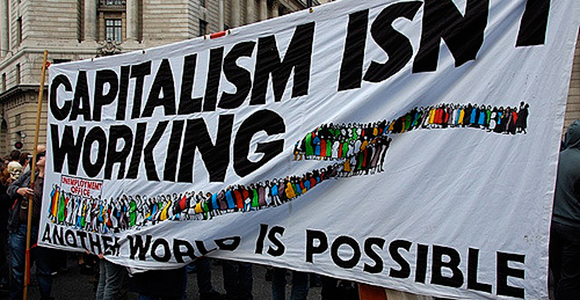
The banner reads: 'Capitalism isn't working: another world is possible'. G20, Meltdown Protest, City of London, Bank of England, 1 April 2009. Credit: Tony Hall.

The banner reads: “Capitalism isn’t working: another world is possible.”
G20, Meltdown Protest, City of London, Bank of England, 1 April 2009.
Credit: Tony Hall.

by Herb Montgomery

Featured Text:

“But know this: If the householder had known in which watch the robber was coming, he would not have let his house be dug into. You also must be ready, for the Son of Humanity is coming at an hour you do not expect.” (Q 12:39-40)

Companion Texts:

Matthew 24:43-44: “But understand this: If the owner of the house had known at what time of night the thief was coming, he would have kept watch and would not have let his house be broken into. So you also must be ready, because the Son of Man will come at an hour when you do not expect him.”

Luke 12:39-40: “But understand this: If the owner of the house had known at what hour the thief was coming, he would not have let his house be broken into. You also must be ready, because the Son of Man will come at an hour when you do not expect him.”

Gospel of Thomas 21:5 “That is why I say: ‘When the master of the house learns that the thief is about to come, he will be on guard before he comes and will not let him break into his house, his domain, to carry away his possessions.’

Gospel of Thomas 103: “Jesus says: ‘Blessed is the person who knows at which point of the house the robbers are going to enter, so that he may arise to gather together his domain and gird his loins before they enter.’”

Not The Second Coming, But The First

Typically when this saying is used in most Christian preaching today, Jesus’ words are interpreted as a prediction of his return to Earth at the end of time. Remember, though, Jesus disciples didn’t yet even understand that he was going to be taken from them, much less that he would come back at some point in the future. At this stage of the story, Jesus would have still been speaking about his unexpected emergence among the people, not about some point in the distant future.

What difference does it make to apply this saying first to Jesus’ emergence among the poor in the 1st Century, before we jump to the Christian second coming? Let’s first allow this saying to relate to the appearing of the Jewish Jesus of Nazareth two thousand years ago and see if there is any message in that for us today. We can get to secondary interpretations later.

Jesus the Thief

In our society, the haves are assumed to be the “good guys.” Law and order protects the haves from the have-nots who step outside the lines the haves set down for them. In this week’s saying, Jesus subversively calls himself a thief whom householders need protection from. He calls himself a bad guy.

Morality is defined quite differently by those at the bottom and edges of society and those who are at the top and the center. Last month’s book of the month at RHM was James Cone’s God of the Oppressed. He describes how morality functioned for black slaves in America:

“The grounding of Christian ethics in the oppressed community means that the oppressor cannot decide what is Christian behavior. Intuitively and experientially black slaves recognized this basic truth, because their mental and physical survival was at stake. They rejected the white masters’ view of morality, but they did not reject law and morality. Rather, they formulated a new law and a new morality that was consistent with black strivings for freedom . . . Thus black slaves made a distinction between ‘stealing’ and ‘taking.’ Stealing meant taking from a fellow slave, and ethics did not condone that. But to take from white folks was not wrong, because they were merely appropriating what was in fact rightfully theirs.” (pp. 191-192)

Cones uses illustrations from Olmsted and a slave named Charles that are well worth your consideration.

Consider also, how the legendary Robin Hood was viewed by the rich and how he was viewed by the exploited poor. Similarly, the “thief” Jesus in Luke preached good news to the poor (Luke 4:18, 6:30) and pronounced woes and curses on the rich (Luke 6:24).

This was in keeping with the Jewish prophetic tradition:

“For he will rescue the needy from their rich oppressors, the distressed who have no protector. He will have pity on the poor and the needy, and deliver the needy from death; he will liberate them from oppression and violence and their blood will be of high value in his eyes.” (Psalm 72:12)

Jesus’ definition of wealth as the exploitation of the poor and his call for wealth redistribution was viewed as thievery in his day. It’s still viewed as theft by many wealthy people today. I wish I had a dime for every time a well-meaning, affluent Christian responded to presentations where I talk about the wealth redistribution Jesus commanded by calling it “stealing” from them and giving to those less deserving.

Test this out yourself: take Luke 6:20 and 6:24 (Blessed are you are poor and woe to you who are rich), post it on Facebook, and see how long it takes for Evangelical Christians to chime in to qualify or condition the text. They won’t be able to let the texts sit there unexplained. They have a desperate need to qualify or censor these sayings of Jesus. And these are Christians, not the secular or nonreligious.

Jesus came preaching a new social order, a great reversal, or as Eliza Gylkison refers to it, The Great Correction. He invited those who had a lot to live in solidarity with those who had little, and he taught them to redistribute their wealth. It’s this idea of redistributing wealth to those who have less that was perceived as thievery.

Yet here is my point. Redistribution of wealth was good news to the poor in Jesus’s day and viewed as “stealing” by the rich. Not much has changed, today.

Those who are benefited and whose lives are bettered by domination systems (the haves) don’t view such an end as good news. Those on the underside of those systems, though, do see it as good news.

In the gospels these systems are replaced by a table where resources are shared wealth is redistributed, and justice is distributive justice: everyone has enough and no one has too much. This is a new humanity where people are prioritized over profit, property, possessions, power, and privilege.

Today, many both here and abroad have suffered and are suffering for the sake of the “American Dream.” America is one of the wealthiest and the most powerful nation in the world. And yet for such wealth and power, there are still 43 million people here who live below the poverty line. The wealth disparities in the American population are vast.

Today, “law and order” is the code phrase for a systemically unjust legal system that targets people of color, men especially, and takes their lives even when they have done nothing wrong. One example that top U.S. advisors to past administrations have admitted is that the “war on drugs” itself was created to target certain populations. People are targeted and arrested for nothing more than the color of their skin. That is “stealing.”

When one adds to this unjust system the capitalization of the prison industry, and the free labor that benefits large corporations from an exploited prison population, one begins to see that slavery really never ended in the U.S. It simply took another form. (To learn more, read The New Jim Crow: Mass Incarceration in the Age of Colorblindness by Michelle Alexander.)

We find ourselves in an exploitative system today that takes from those forced to the underside of society and benefits those for whom the rules are shaped. To talk about reversing that nature of things provokes the accusation of “taking from the rich to give to the poor,” or thievery. For example, socialism (a workers’ movement) is accused of being thievery and capitalism is not. Even democratic forms of socialism are continually erased from the conversation by the haves in our society. Jesus envisioned a system where the strong take care of the weak, not a world where the strong prey on the weak. But, as he said, whenever the son of man appears in every generation, he is seen by the “householders” of the present system as a thief breaking in to “take away their possessions.”

Expectations

I recently traced the title son of man used in the gospels for Jesus back to the Jewish apocalyptic book of Daniel, specifically chapter 7. In this chapter, one like the “son of man” is given a kingdom, a new social order, that ends exploitative systems of domination, subjugation, and violence. The overthrow is violent, and it could be argued that the systems overthrown in this chapter are simply replaced by another subjugating domination system (see Daniel 7:14). This would make perfect sense given the historical context of those who wrote the book of Daniel. Violent overthrow was the only way they could imagine their subjugation by violent empires coming to an end.

In Jesus’ own society, there were also those who could not imagine arriving at a different world in any other way than through violent uprising. But Jesus invited us into the end of domination, subjugation, and exploitative systems not through more domination, but in a way that was deeply unexpected. “Sell your possessions and give to the poor,” he taught (Luke 7:33). This was good news to the poor, and it was thievery to the “householders” within that society. It was counter intuitive, beyond what they had imagined.

I imagine that many who heard Jesus could not connect the dots between following his plan and bringing about a world without domination, subjugation, and exploitation. Jesus invited them into relationship with one another, into a community where they choose to take care of one another. In that community, those who had a lot gave to take care of those whose needs were not being met. As it states in Acts, “all the believers were together and had everything in common. They sold property and possessions to give to anyone who had need” (Acts 2:44-45).

In the 1st Century, Jesus was inviting his listeners into a new human society, a beloved community, that the wealthy elites indicted as theft. He was calling the people to voluntarily enter into a community that he felt could avoid the Gehenna that they were heading toward. If they chose relationship, they could avoid the uprising of the exploited, the war against Rome, and the utter destruction of Jerusalem that history now tells us was only three decades ahead of them at that time. The result of ignoring Jesus’ call to wealth redistribution and reparations for past exploitations came in 66-70 C.E. when the exploited poor in Judea rose up, drove out the wealthy from the Temple, and proceeded to take up arms against Rome itself, too. Rome put down what began as a poor people’s rebellion in a way that left nothing for anyone. It was complete destruction for all.

Revolts and revolutions don’t always come. Oppressed communities don’t always rise up. They sometimes just give up. And there aren’t always third parties such as “Rome” that come in and wipe out everyone. I still wonder what lies ahead for us that we could avoid with the choices we are making today.

What lies on our horizon?

What will be the result of our environmental abuses driven by greed?

What will be the result of our military-backed, economic exploitation of countries abroad?

What will be the result of our exploitation of the lower and middle classes here in the U.S.?

What will be the result for our refusal to make reparations for our deeply racist past?

What will be the result of our racist “law and order” and unjust criminal justice system?

What will be the result of our classism, racism, sexism, cis-heterosexism, militarism, and corporatism?

If Jesus walked U.S. streets today, what would he see on America’s horizon? Who would he be calling us into relationship, community and solidarity with? What redistribution of wealth and power in favor of those on the undersides and edges of our society would he be calling us to voluntarily embrace?

Even if one only considers the environmental impact, it will be much less catastrophic to embrace our interconnectedness today, and enter into community with the people we share this planet with and with whom we also call Earth “home.”

We are in this together.

We are each others’ fate.

The choice is ours.

“But know this: If the householder had known in which watch the robber was coming, he would not have let his house be dug into. You also must be ready, for the Son of Humanity is coming at an hour you do not expect.” (Q 12:39-40)

Heart Group Application

Jesus’ gospel calls us repeatedly to look at the world through the lens of those on the undersides and edges of our societies. This past week marks the anniversary of Dr. Martin Luther King, Jr.’s assassination. One of the news outlets I follow this week played a portion of the sermon he gave one year before his assignation, Beyond Vietnam, written by Vincent Harding.

  1. As a group, read the entire transcript of this sermon:

http://kingencyclopedia.stanford.edu/encyclopedia/documentsentry/doc_beyond_vietnam/

2. Considering this week’s saying and its historical context, a statement leaps out from for me from the transcript of King’s sermon, “It is with such activity that the words of the late John F. Kennedy come back to haunt us. Five years ago he said, ‘Those who make peaceful revolution impossible will make violent revolution inevitable.’ [applause] Increasingly, by choice or by accident, this is the role our nation has taken, the role of those who make peaceful revolution impossible by refusing to give up the privileges and the pleasures that come from the immense profits of overseas investments. I am convinced that if we are to get on to the right side of the world revolution, we as a nation must undergo a radical revolution of values. We must rapidly begin [applause], we must rapidly begin the shift from a thing-oriented society to a person-oriented society.”

What does engaging the work of transitioning from a thing-oriented society to a person-oriented society look like your area? Which local organizations can you partner with? Here in WV our work may look very different from the work in other states, for example. We have the same -isms as exist nationwide, yet they work uniquely in Appalachia from how they express themselves in larger cities.

3. Pick one of the options you discovered this week, and as a group put it into practice.

Thank you, each of you, for checking in with us this week.

Also, I want to take a moment to thank all of you who support the work of Renewed Heart Ministries. It’s people like you who enable us to exist and to be a positive resource in our world in the work of survival, resistance, liberation, restoration, and transformation.

If you are new to Renewed Heart Ministries, we are a not-for-profit group informed by the sayings and teachings of the historical Jewish Jesus of Nazareth and passionate about centering our values and ethics in the experiences of those on the undersides and margins of our societies. You can find out more about us here.

Everything we do at Renewed Heart Ministries is done with the purpose of making these resources as free as possible. To do so we need the help of people like you.

If you’d like to support the work of Renewed Heart Ministries, you can make a one-time gift or become a monthly contributor by going to renewedheartministries.com and clicking on the Donate tab at the top right of our home page.

Or you can mail your contribution to:

Renewed Heart Ministries

PO Box 1211

Lewisburg, WV 24901

Make sure you also sign up for our free resources on the website: we have a monthly newsletter and much, much more.

Remember, everything we do here is free. And all your support helps. Anything we receive beyond our annual budget we pass on to other not-for-profits making systemic and personal differences in the lives of those less privileged in the status quo.

For those of you already supporting our work, again, thank you.

Together, we are making a difference, and making our world a safer, just, more compassionate home for us all.

Keep living in love.

I love each of you dearly.

I’ll see you next week.

Free from Anxiety like Ravens and Lilies

by Herb Montgomery

Featured Text:

“Therefore I tell you, do not be anxious about your life, what you are to eat, nor about your body, with what you are to clothe yourself. Is not life more than food, and the body than clothing? Consider the ravens: They neither sow nor reap nor gather into barns, and yet God feeds them. Are you not better than the birds? And who of you by being anxious is able to add to one’s stature a cubit? And why are you anxious about clothing Observe‚ the lilies, how they grow: They do not work nor do they spin. Yet I tell you: Not even Solomon in all his glory was arrayed like one of these. But if in the field the grass, there today and tomorrow thrown into the oven, God clothes thus, will he not much more clothe you, persons of petty faith! So‚ do not be anxious, saying: What are we to eat? Or: What are we to drink? Or: What are we to wear? For all these the Gentiles seek; for your Father knows that you need them all. But seek his kingdom, and all these shall be granted to you.” (Q 12:22b-31)

Companion Texts:

Matthew 6:25-33: “Therefore I tell you, do not worry about your life, what you will eat or drink; or about your body, what you will wear. Is not life more than food, and the body more than clothes? Look at the birds of the air; they do not sow or reap or store away in barns, and yet your heavenly Father feeds them. Are you not much more valuable than they? Can any one of you by worrying add a single hour to your life? And why do you worry about clothes? See how the flowers of the field grow. They do not labor or spin. Yet I tell you that not even Solomon in all his splendor was dressed like one of these. If that is how God clothes the grass of the field, which is here today and tomorrow is thrown into the fire, will he not much more clothe you—you of little faith? So do not worry, saying, ‘What shall we eat?’ or ‘What shall we drink?’ or ‘What shall we wear?’ For the pagans run after all these things, and your heavenly Father knows that you need them. But seek first his kingdom and his righteousness, and all these things will be given to you as well.”

Luke 12:22-31: “Then Jesus said to his disciples: ‘Therefore I tell you, do not worry about your life, what you will eat; or about your body, what you will wear. For life is more than food, and the body more than clothes. Consider the ravens: They do not sow or reap, they have no storeroom or barn; yet God feeds them. And how much more valuable you are than birds! Who of you by worrying can add a single hour to your life? Since you cannot do this very little thing, why do you worry about the rest? Consider how the wild flowers grow. They do not labor or spin. Yet I tell you, not even Solomon in all his splendor was dressed like one of these. If that is how God clothes the grass of the field, which is here today, and tomorrow is thrown into the fire, how much more will he clothe you—you of little faith! And do not set your heart on what you will eat or drink; do not worry about it. For the pagan world runs after all such things, and your Father knows that you need them. But seek his kingdom, and these things will be given to you as well.’”

Gospel of Thomas 36:1, 4, 2–3: “Jesus said, ‘Do not fret, from morning to evening and from evening to morning, about your food–what you’re going to eat, or about your clothing, what you are going to wear. You’re much better than the lilies, which neither card nor spin. As for you, when you have no garment, what will you put on? Who might add to your stature? That very one will give you your garment.’”

We can best understand this week’s saying by looking at an interesting detail in Luke’s version of this saying. At the very beginning of this discourse in Luke, we read:

“Someone in the crowd said to him, ‘Teacher, tell my brother to divide the inheritance with me.’ Jesus replied, ‘Man, who appointed me a judge or an arbiter between you?’” (Luke 12:13,14)

In Jesus’ audience is a man arguing with his brother over their inheritance from their father. One brother asks for Jesus to speak to the other brother on his behalf and Jesus flatly refuses to arbitrate between them.

Arguments over inheritances aren’t common among the poor or lower middle classes. These are problems that exist among the affluent. My own mother passed away in 2014, a typical Appalachian woman with nothing. I remember having to sort through mail and having to speak with creditors. There was no inheritance to try and figure out; there was only debt to be cleared or written off.

Jesus didn’t see settling disputes between the rich as his purpose. He was a prophet of the poor and called his audience to solidarity with the poor. One example of this is Jesus call’ for the rich to “sell everything you have and give it to the poor.” It was a call for radical wealth redistribution.

It’s possible that those who heard Jesus teach believed that there would not be enough for everyone if we actually did share. This is a narrative of scarcity. It leads people to feel anxious about the future and preoccupied with accumulating as much as they think will insulate them from any negative future events. Accumulating resources and anxiety can grow into the drive to monopolize resources, exploit others and their resources, and uphold this exploitation through violence. However we label this narrative, we must learn to recognize it for what it is: a narrative of scarcity.

Jesus, on the contrary, taught a different narrative, a narrative more like the one Gandhi later taught, that “every day the earth produces enough for each person’s need, but not each person’s greed.” Jesus called us to embrace a narrative of enough or abundance, the belief that there is enough to share. This sharing replaces anxiety with gratitude, generosity, connectedness, community, and hospitality. Rather than monopolies and exploitation, abundance brings distributive justice and replaces violence with peace.

Let’s look at this week’s saying again with these two narratives in mind:

“Therefore I tell you, do not be anxious about your life, what you are to eat, nor about your body, with what you are to clothe yourself. Is not life more than food, and the body than clothing? Consider the ravens: They neither sow nor reap nor gather into barns, and yet God feeds them. Are you not better than the birds? And who of you by being anxious is able to add to one’s stature a cubit? And why are you anxious about clothing Observe‚ the lilies, how they grow: They do not work nor do they spin. Yet I tell you: Not even Solomon in all his glory was arrayed like one of these. But if in the field the grass, there today and tomorrow thrown into the oven, God clothes thus, will he not much more clothe you, persons of petty faith! So‚ do not be anxious, saying: What are we to eat? Or: What are we to drink? Or: What are we to wear? For all these the Gentiles seek; for your Father knows that you need them all. But seek his kingdom, and all these shall be granted to you. (Q 12:22b-31)

Jesus’ “Kingdom,” the “reign of God,” was his way of using the language of his own time and culture to share his social vision of people taking care of each other. James M. Robinson reminds us in The Gospel of Jesus, “This is why the beggars, the hungry, the depressed are fortunate: God, that is, those in whom God rules, those who hearken to God, will care for them. The needy are called upon to trust that God’s reigning is there for them (“Theirs is the kingdom of God”) . . . Jesus’ message was simple, for he wanted to cut straight through to the point: trust God to look out for you by providing people who will care for you, and listen to him when he calls on you to provide for them.”

This is what Pëtr Kropotkin called mutual aid:

“While [Darwin] was chiefly using the term [survival of the fittest] in its narrow sense for his own special purpose, he warned his followers against committing the error (which he seems once to have committed himself) of overrating its narrow meaning. In The Descent of Man he gave some powerful pages to illustrate its proper, wide sense. He pointed out how, in numberless animal societies, the struggle between separate individuals for the means of existence disappears, how struggle is replaced by co-operation, and how that substitution results in the development of intellectual and moral faculties which secure to the species the best conditions for survival. He intimated that in such cases the fittest are not the physically strongest, nor the cunningest, but those who learn to combine so as mutually to support each other, strong and weak alike, for the welfare of the community. ‘Those communities,’ he wrote, ‘which included the greatest number of the most sympathetic members would flourish best, and rear the greatest number of offspring’ (2nd edit., p. 163). The term, which originated from the narrow Malthusian conception of competition between each and all, thus lost its narrowness in the mind of one who knew Nature.” (Mutual Aid: A Factor of Evolution)

In the New Testament book of James, the writer comments on Jesus’ teachings in the sermon on the mount and the narrative of anxiety that leads to exploiting others: “But you have dishonored the poor. Is it not the rich who are exploiting you? Are they not the ones who are dragging you into court? Are they not the ones who are blaspheming the noble name of him to whom you belong?” (James 2:6-7)

Like the gospels do, James gives a scathing, prophetic pronouncement to those who live by the old narrative of scarcity and accumulation:

“Believers in humble circumstances ought to take pride in their high position. But the rich should take pride in their humiliation—since they will pass away like a wild flower. For the sun rises with scorching heat and withers the plant; its blossom falls and its beauty is destroyed. In the same way, the rich will fade away even while they go about their business.” (James 1:9-11)

Even in 1 Timothy, believed to have been written quite a bit later than James, there is a call away from the narrative of scarcity, anxiety, and individualistic trust in one’s own accumulated wealth to insulate one from future harm:

“Command those who are rich in this present world not to be arrogant nor to put their trust in wealth, which is so uncertain, but to put their hope in God, who richly provides us with everything for our enjoyment.” (1 Timothy 6:17)

Remember, putting one’s “hope in God” according the Jesus of Sayings Gospel Q meant trusting God enough that God would send people to take care of you as you share what you’ve accumulated with those God calls you to give to today.

“Ravens and lilies do not seem to focus their attention on satisfying their own needs in order to survive, and yet God sees to it that they prosper. Sparrows are sold a dime a dozen and, one might say, who cares? God cares! Even about the tiniest things—he knows exactly how many hairs are on your head! So God will not give a stone when asked for bread or a snake when asked for fish, but can be counted on to give what you really need. You can trust him to know what you need even before you ask. This utopian vision of a caring God was the core of what Jesus had to say and what he himself put into practice. It was both good news—reassurance that in your actual experience good would happen to mitigate your plight—and the call upon you to do that same good toward others in actual practice. This radical trust in and responsiveness to God is what makes society function as God’s society. This was, for Jesus, what faith and discipleship were all about. As a result, nothing else had a right to claim any functional relationship to him . . . [Jesus] sought to focus attention on trusting God for today’s ration of life, and on hearing God’s call to give now a better life to neighbors . . . All this is as far from today’s Christianity as it was from the Judaism of Jesus’ day. Christians all too often simply venerate the “Lord Jesus Christ” as the “Son of God” and let it go at that. But Jesus himself made no claim to lofty titles or even to divinity. Indeed, to him, a devout Jew, claiming to be God would have seemed blasphemous! He claimed “only” that God spoke and acted through him.” (James Robinson, The Gospel of Jesus, Kindle Location 102)

This is the vision Jesus cast before his listeners of what human society could look like: People taking care of people. In Jesus’ theological language, that was God taking care of people through people. It’s through us, through our choice to be compassionate and just or turn away, that we determine one another’s fate. We have a choice to make. Will we care for someone today, trusting that someone will care for us tomorrow if we have a need?

“Seeking first the Kingdom” is not seeking an artificial quid pro quo where if I help people, I expect God to supernaturally bless me. This isn’t the prosperity gospel. This is more intrinsic. As I take care of others when they need care, I’m setting in motion a world where I’ll have folks that take care of me if I need care. Like we discussed last week, I’m investing in people today. And that will intrinsically create a reality where others will share “all these things” with me if I experience a crisis.

Jesus’ teaching means the creation of human society in which we change the nature of the world we live in, where care and cooperation solve the dilemmas of survival rather than competition, domination, subjugation, and exploitation. This world is not based on a win-lose closed system, but a win-win where we learn to be each other’s keeper. Our world is what we, collectively, choose to make it. For my part, I’m choosing compassion.

Therefore I tell you, do not be anxious about your life, what you are to eat, nor about your body, with what you are to clothe yourself. Is not life more than food, and the body than clothing? Consider the ravens: They neither sow nor reap nor gather into barns, and yet God feeds them. Are you not better than the birds? And who of you by being anxious is able to add to one’s stature a cubit? And why are you anxious about clothing Observe‚ the lilies, how they grow: They do not work nor do they spin. Yet I tell you: Not even Solomon in all his glory was arrayed like one of these. But if in the field the grass, there today and tomorrow thrown into the oven, God clothes thus, will he not much more clothe you, persons of petty faith! So‚ do not be anxious, saying: What are we to eat? Or: What are we to drink? Or: What are we to wear? For all these the Gentiles seek; for your Father knows that you need them all. But seek his kingdom, and all these shall be granted to you. (Q 12:22b-31)

HeartGroup Application

This week, I’d like you to sit down with your HeartGroup and compile a list of needs and abilities that exist among you. Here’s how.

  1. Divide a piece of paper into two columns.
  2. Go around the room and list the needs that members presently have in one column
  3. Next, list in the second column the abilities and talents that people in the room have.
  4. Drawing lines between the two columns, linking needs and group members’ ability to help take care of those needs.

As you do this exercise, not all of the needs will be met, but some of them will. And as we become aware of the needs with each group, we will discover ways to meet those needs. Each group is a microcosm of a world where everyone contributes and everyone’s needs are being met. It’s people taking responsibility for one another. It’s people taking care of people. And once you begin engaging your HeartGroup in this practical, tangible way, it also really becomes fun.

Jesus’ solution to challenges we face was each one of us. Jesus’ hope for our world is us.

Thanks for checking in with us this week.

Keep living in love, survival, resistance, liberation, restoration, and transformation.

I love each of you dearly.

I’ll see you next week.

Storing up Treasures in Heaven 

Multiracial Group of Friends with World Globe Map

by Herb Montgomery

Featured Text:

“Do not treasure for yourselves treasures on earth, where moth and gnawing deface and where robbers dig through and rob, but treasure for yourselves treasures in heaven, where neither moth nor gnawing defaces and where robbers do not dig through nor rob. For where your treasure is, there will also be your heart.” (Q 12:33-34)

Companion Texts:

Matthew 6:19-21: “Do not store up for yourselves treasures on earth, where moths and vermin destroy, and where thieves break in and steal. But store up for yourselves treasures in heaven, where moths and vermin do not destroy, and where thieves do not break in and steal. For where your treasure is, there your heart will be also.”

Luke 12:33-34: “Sell your possessions and give to the poor. Provide purses for yourselves that will not wear out, a treasure in heaven that will never fail, where no thief comes near and no moth destroys. For where your treasure is, there your heart will be also.”

Gospel of Thomas 76:3: “You too look for his treasure, which does not perish, (and) which stays where no moth can reach it to eat it, and no worm destroys it.”

This week’s saying tells us to focus on storing up “treasure” in heaven rather than on earth. I want to offer a word of caution about that. Karl Marx correctly wrote that religion focused on heaven or afterlife bliss rather than survival, resistance, liberation, restoration, and transformation of our world now tends to leave oppressed people passive.

“Religion is the sigh of the oppressed creature, the heart of a heartless world, and the soul of soulless conditions. It is the opium of the people.” (Introduction to A Contribution to the Critique of Hegel’s Philosophy of Right. Collected Works, vol. 3)

James H. Cone pushes back on Marx’s blanket condemnation of all religion in his landmark book God of the Oppressed. This is a rather long quotation, but one worth considering: Cone is not addressing Marx’s critique from the perspective of someone trying to preserve the status quo. He addresses the critique as someone in an oppressed community who’s working for societal change and the dismantling of the status quo.

“The vision of the future and of Jesus as the Coming Lord is the central theme of black religion. This theme is expressed with the idea of heaven, a concept that has been grossly misunderstood in black religion. For any people the idea of heaven, in the songs and sermons of black people, is proof of Marx’s contention that religion is the opiate of the people. Unfortunately, many uninformed young blacks, hearing this Marxian analysis in college, have accepted this criticism as true without probing deeper into the thought forms of black people. To be sure, white missionaries and preachers used Jesus Christ and heaven to make black slaves obedient and docile. But in reality, the opposite happened more often than not. For any black slaves, Jesus became the decisive Other in their lives who provided for them a knowledge of themselves, not derived from the value system of slave masters. How could black slaves know that they were human beings when they were treated like cattle? How could they know that they were somebody when everything in their environment said that they were nobody? How could they know that they had a value that could not be defined by dollars and cents, when the symbol of the auction block was an ever present reality? Only because they knew that Christ was present with them and that his presence included the divine promise to come again and to take them to the ‘New Jerusalem.’ Heaven, therefore, in black religion was inseparably connected with Jesus’ promise to liberate the oppressed from slavery. It was black people’s vision of a new identity for themselves which was in sharp contradiction to their present status as slaves. This vision of Jesus as the Coming One who will take them back to heaven held black people together mentally as they struggled physically to make real the future in their present.” (pp. 119-120)

Cone continues:

“The past and present history of Jesus are incomplete without affirmation of the ‘not yet’ that ‘will be.’ The power of Christ’s future coming and the vision that it bestows upon the people is the key to why the oppressed can ‘keep on keepin’ on’ even when their fight seems fruitless. The vision of Christ’s future that breaks into their slave existence radically changes their perspective on life; and to others who stand outside the community where the vision is celebrated, black people’s talk about “long white robes” and “golden slippers” in heaven seems to be proof that black religion is an opium [sic] of the people. But in reality it is a radical judgment which black people are making upon the society that enslaved them. Black religion, therefore, becomes a revolutionary alternative to white religion. Jesus Christ becomes the One who stands at the center of their view of reality, enabling slaves to look beyond the present to the future, the time when black suffering will be ended. The future reality of Jesus means that what is contradicts what ought to be. When Jesus is understood as the Coming One who will establish divine justice among people, then we will be able to understand why black slaves’ religion emphasized the other world. They truly believed the story of Jesus’ past existence with the poor as told in the Bible. (pp. 120-121)

As someone who does not speak from Cone’s social location, I want to acknowledge Cone’s critique of Marx. When religion leaves us waiting for a future time when justice comes rather than working for distributive justice in our world today, then Marx is correct: religion is an opiate. Cone is also right that a religion that identifies God as the God of the oppressed doesn’t have to pacify people.

Yet Cone drifts awfully close to using religion as an opiate himself in the following paragraph:

“People get tired of fighting for justice and the political power of oppressors often creates fear in the hearts of the oppressed. What could a small band of slaves do against the armed might of a nation? Indeed what can the oppressed blacks today do in order to break the power of the Pentagon? Of course, we may “play” revolutionary and delude ourselves that we can do battle against the atomic bomb. Usually when the reality of the political situation dawns upon the oppressed, those who have no vision from another world tend to give up in despair. But those who have heard about the coming of the Lord Jesus and have a vision of crossing on the other side of Jordan, are not terribly disturbed about what happens in Washington, D. C., at least not to the extent that their true humanity is dependent on the political perspective of government officials.” (p. 121, emphasis added)

With this tension between Marx and Cone in mind this week, I ask the question: what did the Jesus of Sayings Gospel Q mean when he asked us to place our focus on heaven rather than earth, especially when such a focus has historically proved detrimental to the victims of oppression, injustice and violence?

James Robinson offered a possible answer in his book on Sayings Gospel Q.

“Some people get confused by the fact that in the Gospel of Matthew the ‘kingdom of God’ is usually referred to as the “kingdom of heaven,” leading them to think that the kingdom is in heaven—something one can experience only in the afterlife or at the end of time. But Jesus was talking about God reigning in the here and now. Use of the idiom “kingdom of heaven” is due to the fact that Matthew is the Gospel most closely related to Judaism and so still reflects its sensitivities. Jews have been so committed to not taking God’s name in vain, which, after all, is one of the Ten Commandments, that they have thought it best not to “take” God’s name at all. That is, they do not pronounce Yahweh out loud at all. Sometimes they carry this so far that they not only avoid pronouncing Yahweh; they even avoid pronouncing “God” and instead simply refer to the “name,” by which everyone in the Jewish community knows what they mean—God. (The Gospel of Jesus; Kindle Locations 2722-2730).

The kingdom of heaven is not a kingdom in heaven, but a new social arrangement that Jesus announced had come from heaven to earth. It was the reign of God and it was emerging from the community of the oppressed in Jesus’ day on earth. It was a social vision where people took care of people, where people practiced mutual aid and resource sharing, and where wealth inequality was met with wealth redistribution (see Acts 4:33-35). Jesus’ “kingdom of heaven” was a Jewish way of referring to the kingdom or reign of God, which had arrived here on earth in the present life, now.

This reign of God called people to trust in a God who would send other people to take care of them in the future to the degree that they would loosen their grip on hoarded wealth that insulated them from future risk so they could  be the one God sent to help those who are in need today. As Robinson points out: “This hardly means that as surely as a human parent gives bread and fish in the here and now, the heavenly Father will give ‘pie in the sky by-and-by.’ It clearly means that God will answer the petition ‘Our day’s bread give us today’ in the here and now, daily. (Ibid. Kindle Locations 2789-2791) Together, we could face the insecurity of the future, because no matter what the future brought, we could make it because we had each other.

What Jesus may be saying in this week’s Q statement is this: don’t store up material treasure on Earth, which always involves some level of risk. Invest your resources in the kingdom of heaven that has arrived here on earth, which is made manifest in people taking care of people. “Lay up treasure” in the lives of people, especially the vulnerable, the poor, those on the underside and edges of our societies. Invest in a compassionate, safe, just world for people. Put your treasure in them, for where your treasure is, there your heart will be also.

People are often not comfortable with their religion becoming this down-to-earth. They are much more comfortable with religion being about investing in a post-mortem retirement program for themselves. But I don’t think that approach to interpreting Jesus’ saying is consistent with what we have witnessed about the Jesus of sayings Q so far. His teachings are not about you gaining heavenly bliss later; they’re about bringing the liberation of heaven into people’s lives here, now, today.

What does it mean to lay up treasure in heaven? The kingdom of heaven for Jesus was the reign of God that had arrived here on earth. It called people to stop solving the challenges of survival for themselves at the expense of others around them. It called them to take responsibility for making sure one another had what they needed.

This week’s saying is not a matter of location (heaven versus earth). Nor is it a matter of timing (post mortem versus now). It is a matter of seeking plenty “for yourself” on earth now, versus seeking “the kingdom of heaven” with others on earth now. Storing up treasure in heaven means people taking care of people here.

At home, one of my projects is storing some of my daughter’s favorite belongings in our attic while she’s away at college. When she comes home, she won’t go up to the attic to enjoy her belongings. She will take those belongings out of the attic and bring them down to enjoy them in her home.

When we take care of other people, even if we use the language of “storing treasure in heaven,” we must not forget that our home is here. When we choose to take care of people, we’re transforming our home here. We’ll be able to take out and enjoy the treasures we have stored in each other in a transformed world that is a safe, just, and compassionate home for us all, on earth “as it is in heaven” (Matthew 6.10).

Do not treasure for yourselves treasures on earth, where moth and gnawing deface and where robbers dig through and rob, but treasure for yourselves treasures in heaven, where neither moth nor gnawing defaces and where robbers do not dig through nor rob. For where your treasure is, there will also be your heart.” (Q 12:33-34)

HeartGroup Application

1.  How does choosing to take responsibility for one another’s survival and care transform our world today? In what ways does doing so affirm how the world already is?

2.  List some ways that your group could lean more deeply into taking care of each other. Then list some of the ways that your group could lean more deeply into taking care of those in your neighborhood.

Separate both lists into two categories: actions that may help people today yet leave in place a system that will cause them to need help again tomorrow; and actions that will impact the systemic problems and transform society at the root as well. It is important to do both, not just one or the other. If a person is drowning, they need pulling out of the river. And those throwing people into the river need to be stopped as well. Renewed Heart Ministries’ book for March is James H. Cone’s God of the Oppressed. In that book, Cone writes, “For the oppressed, justice is the rescue from hurt; and for the oppressors it is the removal of the power to hurt others—even against their will—so that justice can be realized for all” (p. 159).

3 .  Pick two items from your group’s lists and begin putting it into practice this week. This is how we begin storing up treasure in heaven, transforming our world.

Thanks for checking in with us this week. Keep living in love, a love that bears the fruit of survival, resistance, liberation, restoration, and transformation.

I love each of you dearly.

I’ll see you next week.

Hearings before Synagogues

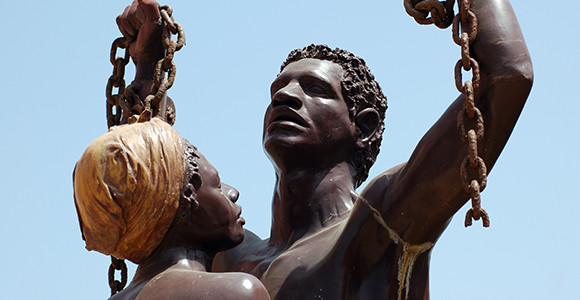
Slaves liberation, Goree Island, Dakar, Best of Senegal

by Herb Montgomery

Featured Text:

“When they bring you before synagogues, do not be anxious about how or what you are to say; for the holy Spirit will teach you in that hour what you are to say.” Q 12:11-12 

Companion Texts:

Matthew 10:19: “But when they arrest you, do not worry about what to say or how to say it. At that time you will be given what to say.”

Luke 12:11-12: “When you are brought before synagogues, rulers and authorities, do not worry about how you will defend yourselves or what you will say, for the Holy Spirit will teach you at that time what you should say.”

Synagogues

Rome referred to the synagogue as a Jewish “public school” (Josephus, Antiquities of the Jews, book 16.6.2). The book of Acts describes synagogues of places of religious worship and instruction. These were places for the local community to assemble for social, intellectual and spiritual reasons. Today, Jewish synagogues are overseen by rabbis. While 1st Century synagogues did have leadership, rabbinical leadership did not become universal till some time in the Middle Ages.

One of the ways Rome kept the peace in the territories it conquered was by working closely through the territories’ religious institutions. So the synagogues, though much more local than the temple in Jerusalem, would have played a part in the Roman occupation.

Also keep in mind that in 1st Century Jewish society, strict divisions between political/civil and religious life did not exist. These were intertwined as they are often in our time.

This week’s saying is an encouragement to followers of Jesus who got arrested for following him. In the U.S. today. Christians don’t get arrested for following Jesus. We’ll discuss a few possible reasons for this in a moment.

First, rather than pointing a finger at how the Jewish elites joined religious and civil authorities to oppose the threat of Jesus’ vision for Jewish societies, I’d like to consider our history: how most of Christianity has witnessed this same opposition to Jesus’ societal vision.

Christianity

Most scholars point to the conversion of Constantine as the period when Christianity began colluding with empire. Feminist scholars point back to patriarchal abuses of women, which have always plagued Christianity. (See Christianity, Patriarchy and Abuse, edited by Joanne Carlson Brown and Carole R. Bohn.) Christianity, embracing the violent use of the sword as justifiable in the face of Rome’s enemies, grew to become the political head of most of Europe. Christianity then became the empire itself. As the right arm of Orthodox, Catholic, and Protestant countries in Europe, imperial Christianity laid the foundation for the church’s endorsement and use of colonialism in the 15th Century during the so-called “age of discovery.” In my twenties, I visited Trinidad and Tobago as young, naive Christian “preacher.” Much to my horror I discovered history my Christian education had conveniently left out. I heard stories from the people there of how, rather than condemning colonialism as the genocidal rape of indigenous lands and people, Christianity and the name of Jesus was part and parcel of colonialism. Colonialism was viewed as an acceptable and even preferable means of carrying the “gospel” around the globe, making “disciples of all nations, baptizing them in the name of the Father and of the Son and of the Holy Spirit” with the Bible in one hand and a sword in the other (see Matthew 18:29).

Christian Colonialism took lands and resources from indigenous people viewing them as “modern Canaanites,” treating indigenous people themselves as capitalist resources that could be taken forcefully from their lands as slaves. (See Philip Jenkins, Laying Down the Sword: Why We Can’t Ignore the Bible’s Violent Verses, pp.123-142) Christians participated with clear consciences in the slave trade. (See Delores Williams, Sisters in the Wilderness, pp. 66-68) After all, their sacred text had given them permission:

“However, you may purchase male and female slaves from among the nations around you. You may also purchase the children of temporary residents who live among you, including those who have been born in your land. You may treat them as your property, passing them on to your children as a permanent inheritance. You may treat them as slaves, but you must never treat your fellow Israelites this way.” (Leviticus 25:44-46)

This moral stain still rests with Christianity today. The end of slavery in the U.S. was brought about by secularists partnering with a minority of Christians derogatorily labeled “radical Christians.” (See Susan Jacoby’s Freethinkers: A History of American Secularism and Carol Faulkner’s Lucreitta Mott’s Heresy: Abolition and Women’s Rights in Nineteenth Century America.) Jim Crow, too, was ended by secular federal legislation opposed by the majority of white Christians in the southern states. (The Real Origins of the Religious Right)

Today, Christianity again has raised its head to support the most outspokenly misogynist, racist, xenophobic American administration in modern history.  For most of my socially conscious friends, Christianity is seen not just as out of touch with Jesus’ societal vision, but actively opposed to a world that resembles what Jesus was working so tirelessly to inspire among his 1st Century followers.

Today

In the 1960s and 1970s, in North and South America, a different Christian movement was born. Latin voices in South and Central America, and Black voices here in the U.S. developed differently focused theologies that would come to be known as liberation theologies:

“If theological speech is based on the traditions of the Old Testament, then it must heed their unanimous testimony to Yahweh’s commitment to justice for the poor and the weak. Accordingly it cannot avoid taking sides in politics, and the side that theology must take is disclosed in the side that Yahweh has already taken. Any other side, whether it be with the oppressors or the side of neutrality (which is nothing but a camouflaged identification with the rulers), is unbiblical. If theology does not side with the poor, then it cannot speak for Yahweh who is the God of the poor.” (James H. Cone, God of the Oppressed, p. 65)

“Under these circumstances, can it honestly be said that the Church does not interfere in ’the temporal sphere’? Is the Church fulfilling a purely religious role when by its silence or friendly relationships it lends legitimacy to a dictatorial and oppressive government? We discover, then, that the policy of nonintervention in political affairs holds for certain actions which involve ecclesiastical authorities, but not for others. In other words, this principle is not applied when it is a question of maintaining the status quo, but it is wielded when, for example, a lay apostolic movement or a group of priests holds an attitude considered subversive to the established order.” (Gustavo Gutierrez, A Theology of Liberation, 15th Anniversary Edition, p. 40)

Both statements reveal a challenge to Christianity’s historic complicity with and empowerment of the status quo. Christian liberation movements were born in solidarity with oppressed. This marked a significant shift in theology away from North American and European centered interpretations and toward theologies being done from within oppressed communities.

These theologies were labeled “radical” expressions of Christianity and they have yet to become popularly emphasized in status quo, White, patriarchal, heterosexist Christianity. These theologies have not gone beyond the halls of academia in order to reach the people in the pew listening to most of North America’s weekly evangelical preaching.

Today, U.S. society is markedly a secular society with a plurality of religious beliefs, and the religion with the most followers is Christianity. Too often, this kind of Christianity is simply concerned with spiritual and/or post-mortem matters that prove to leave systemic oppression unchallenged for those in positions of privilege. It also leaves those underprivileged in a state of pious passivity.

Yet, if liberation theologies rooted in the experience of the oppressed and informed by their sacred texts are a reflection of what early Christianity possibly was in the first century, they sound a clarion call for Christianity to wrest itself free of its historical failures, to make reparations for the damage it has done, and to begin charting a new course where the poor, women, people of color, and those of varied orientations and gender identities are no longer the victims of Christianity but the community Jesus would call us to stand in solidarity with instead. This is not a “liberal agenda,” or “gay agenda” threatening the gospel of Jesus Christ. This IS the gospel of Jesus Christ: liberation for the oppressed. (Luke 4:18-19)

As I mentioned above, Christians are not getting arrested in the U.S. today. Is that because society has become just, safe, and compassionate for everyone so that Christianity has no opposition to a status quo to mount? Or is it because Christianity, as it has done historically, is being complicit in systemic injustices, exploitation, and harm being perpetrated out of societal fear of those who are different?

American Christians have a long way to go before they are being brought before “rulers and authorities” for standing up against injustice and a lack of compassion in our world today. It’s more likely that if one is “arrested” and brought to trial today, it will be the Christians who comprise the prosecutors.

“When they bring you before synagogues, do not be anxious about how or what you are to say; for the holy Spirit will teach you in that hour what you are to say.” Q 12:11-12 

HeartGroup Application

This week I have some passages from the Hebrew scriptures that I’d like you to contemplate together. James H. Cone in our book of the month for March, God of the Oppressed, wrote:

“For theologians to speak of this God, they too must become interested in politics and economics, recognizing that there is no truth about Yahweh unless it is the truth of freedom as that event is revealed in the oppressed people’s struggle for justice in this world.” (p. 57)

  1. Consider the following passages:

“Yahweh ’heard their groaning, and remembered his covenant with Abraham, Isaac and Jacob; he saw the plight of Israel, he took heed of it’” (Exodus 2:24—25 NEB).

“I will sing to the Lord, for he has risen up in triumph; the horse and his rider he has hurled into the sea.” (Exodus 15:1 NEB)

“The Lord is my refuge and my defense, he has shown himself my deliverer.” (Exodus 15:2 NEB)

“You have seen with your own eyes what I did to Egypt, and how I carried you on eagles’ wings and brought you here to me. If only you will now listen to me and keep my covenant, then out of all peoples you shall become my special possession; for the whole earth is mine. You shall be my kingdom of priests, my holy nation.” (Exodus 19:4—5 NEB)

“You shall not wrong a stranger or oppress him; for you were strangers in the land of Egypt.” (Exodus 22:21; cf. 23:9 RSV)

“You shall not ill-treat any widow or fatherless child. If you do, be sure that I will listen if they appeal to me; my anger will be roused and I will kill you with the sword.” (Exodus 22:23—24 NEB)

What do these passages tell us about the Hebrew God’s relationship to the oppressed?

2. The narrative states that the liberated people eventually became oppressors of the vulnerable. Consider these passages from the Hebrew prophets:

“For you alone have I cared among all the nations of the world; therefore I will punish you for all your iniquities.” (Amos 3:2 NEB)

“Shall not the earth shake for this?  Shall not all who live on it grieve? All earth shall surge and seethe like the Nile and subside like the river of Egypt. Did I not bring Israel up from Egypt, the Philistines from Caphtor, the Aramaeans from Kir? Behold, I, the Lord God, have my eyes on this sinful kingdom, and I will wipe it off the face of the earth. (Amos 8:6-8; 9:7-8 NEB)

“For among my people there are wicked men.. . Their houses are full of fraud, as a cage is full of birds. They grow rich and grand, bloated and rancorous; their thoughts are all of evil, and they refuse to do justice, the claims of the orphan they do not put right nor do they grant justice to the poor.” (Jeremiah 5:26-28 NEB)

“God has told you what is good; and what is it that the Lord asks of you? Only to act justly, to love loyally, to walk wisely before your God. (Micah 6:8 NEB)

“Put away the evil of your deeds, away out of my sight. Cease to do evil and learn to do right, pursue justice and champion the oppressed; give the orphan his rights, plead the widow’s cause.” (Isaiah 1:16–17 NEB)

3. The Davidic Kingly narrative texts teach us that the king was to rescue the needy from their rich oppressors:

“May he have pity on the needy and the poor, deliver the poor from death; may he redeem them from oppression and violence and may their blood be precious in his eyes.” (Psalm 72:12-14 NEB)

Yet we don’t see this being the ultimate outcome:

“The Lord comes forward to argue his case and stands to judge his people. The Lord opens the indictment against the elders of his people and their officers: They have ravaged the vineyard, and the spoils of the poor are in your houses. Is it nothing to you that you crush my people and grind the faces of the poor?” (Isaiah 3:13–15 NEB)

God’s people were to stand with the oppressed, like their God did:

“He who is generous to the poor lends to the Lord.” (Proverbs 19:17 NEB)

“He who oppresses the poor insults his Maker; he who is generous to the needy honors him.” (Proverbs 14:31 NEB)

“Do not move the ancient boundary-stone or encroach on the land of orphans: they have a powerful guardian who will take their cause against you.” (Proverbs 23:10-11 NEB)

In the book of Luke, we find these two descriptions of the work of Jesus:

“His name is Holy; his mercy sure from generation to generation toward those who fear him; the deeds his own right arm has done disclose his might: the arrogant of heart and mind he has put to rout, he has brought down monarchs from their thrones, but the humble have been lifted high. The hungry he has satisfied with good things, the rich sent empty away.” (Luke 1:49-53 NEB)

“The spirit of the Lord is upon me because he has anointed me, he has sent me to announce good news to the poor, to proclaim release for prisoners and recovery of sight for the blind; to let the broken victims go free, to proclaim the year of the Lord’s favor.” (Luke 4:18-19 NEB)

What does it mean to see Jesus as part of a Jewish liberation tradition?

What does it mean for us today who desire to follow this Jewish, liberative Jesus?

What if you belong to the community of the oppressed?

What if you don’t belong to the community of the oppressed?

Does this liberative Jesus call us each to stand in solidarity with those on the undersides and edges of our society?

As I mentioned a moment ago, I believe much of Western Christianity has a long way to go before this week’s saying holds any relevance to it. At most right now it is a strong rebuke of how far we have drifted from being a community of the oppressed rather than a community of oppressors.

But that doesn’t mean things are hopeless. The choice is yours today. As a follower of Jesus, whom are you being called to stand in solidarity with? Who knows, you may find yourself standing before “rulers and authorities” for living like the Jesus community of old.

Thanks for checking in with us this week. Wherever this finds you, keep living in love. Keep up the good work of survival, resistance, liberation, restoration, and transformation. Till the only world that remains is a world where only love reigns. We have our work cut out for us. Let’s get to it.

I love each of you dearly.

I’ll see you next week.

Speaking against the holy Spirit 

White dove in the cage, Pigeon locked in a cage.by Herb Montgomery

Featured Text:

“And whoever says a word against the son of humanity, it will be forgiven him; but whoever speaks against the holy Spirit, it will not be forgiven him.” Q 12:10 

Companion Texts:

Matthew 12:32: “Anyone who speaks a word against the Son of Man will be forgiven, but anyone who speaks against the Holy Spirit will not be forgiven, either in this age or in the age to come.”

Luke 12:10: “And everyone who speaks a word against the Son of Man will be forgiven, but anyone who blasphemes against the Holy Spirit will not be forgiven.”

Gospel of Thomas 44: “Jesus says: ‘Whoever blasphemes against the Father, it will be forgiven him. And whoever blasphemes against the Son, it will be forgiven him. But whoever blasphemes against the Holy Spirit, it will not be forgiven him, neither on earth nor in heaven.’”

Womanism and Spirit

For those unfamiliar with the womanist school of thought, Alice Walker writes, “Womanist to feminist is as purple is to lavender” (In Search of Our Mothers’ Gardens: Womanist Prose, pp. xii). Womanism’s origins are among Black women of the African diaspora. And within our context this week, I love the emphasis womanist writers place on Spirit.

Karen Baker-Fletcher, a Christian womanist, explains, “The Spirit is the all-encompassing, inclusive force in which God/Creator, Jesus and all of creation are inextricably entombed.” (My Sister, My Brother, p. 31). She quotes Igbo theologian Okechukwu Ogbannaya: “[Spirit] is like the amniotic fluids—the waters of the womb—that encompasses a child before it is born, and accompany it, flowing out with it as it makes its way into the world as we know it. It surrounds the child and forms the first environment out of which it is born.”

Christian womanists view Jesus as the “human embodiment of Spirit” (ibid.). Spirit is the source of strength and courage to both survive and stand up to individual and systemic oppression. Womanists join love with justice in their discussion of Spirit. Emilie Townes, for example, reminds us that we see the evidence of the Spirit at work when we see justice as the demands of love (see In a Blaze of Glory, p. 143-144). Within a womanist understanding, whenever we see love as engagement of the world of justice for the oppressed, marginalized, or subjugated, we are seeing the Spirit at work.

So a womanist would read our saying this week assuming that the Spirit expresses love through restorative, liberative, transformative, and distributive justice.

I remember an evangelical fourth of July celebration I had to attend once in California where supporters of the Christian Right repeated quoted Paul’s statement, “Now the Lord is the Spirit, and where the Spirit of the Lord is, there is freedom [liberty]” (2 Corinthians 3:17). Too often, however, this “freedom” or “small government” rhetoric has not been freedom for the oppressed, nor liberty for those imprisoned and exploited (Luke 4:18). Rather it has been about individual freedom, or state’s freedom to oppress, segregrate, imprison, and exploit.  (For an example read here.)

In other words, for those at the top of an exploitative social pyramid who are privileged, advantaged, and benefited by the status quo, freedom and liberty means something fundamentally different than it does for those at the bottom. One is fixated on the freedom of the individual to do whatever they desire. The other sees that in nature, we are not truly free from one another. As we said last week, we are interconnected. We are part of one another. We are each other’s fate, and what one does affects others. What the individual does affects the community as much as what the community does affects the individual. We are not genuinely free from one another.

The Spirit’s work in Luke is especially helpful for us to remember now:

“The Spirit of the Lord is on me,
because he has anointed me
to proclaim good news to the poor.
He has sent me to proclaim freedom for the prisoners 
and recovery of sight for the blind,
to set the oppressed free,
to proclaim the year for the cancelling of all debts [or “of the Lord’s favor.”]” (Luke 4:18-19, emphasis added.)

The Spirit works in solidarity with those on the undersides and margins of our societies. It calls those among the elite to abandon their advantage, join the rank and file, and work for a society marked by equity, fairness, compassion, and safety for all.

This week, I want to encourage you to think of the Spirit in the context of distributive justice, justice that makes an environment where each person not only survives but also thrives. This is one of the most devastating critiques of capitalism for Jesus followers because capitalism creates wealth disparity between winners and losers.

The U.S., the wealthiest nation in history, is also home to the greatest wealth disparity in history. Today six people possess as much wealth as the bottom 50% of society. Despite being so wealthy, the U.S. is still home to 43 million people who live below the poverty line. As I often say, the game Monopoly is fun for the first two rounds, but the last two rounds are only fun for one person at the table. For everyone else, it’s a slow painful death.

I want to speak for a moment to the middle class in our society. Here in the U.S., we do have a class structure. Below many of us is the lower class. Above us is the upper class, and there are large portions of the middle class of people who have drunk the upper classes’ Kool-aid. These are people who look at the upper class and long to be where they are, who subscribe to their economic philosophies and their societal “solutions.”

Even within Christianity, many people here in Appalachia think that if the poor can simply be taught how to play the upper class’s game of gaining and keeping individual wealth, this will solve poverty. (An example are churches who promote programs such as Dave Ramsey’s Financial Peace University).

What I want us to stop and consider is whether the game itself has moral ramifications. Is it enough to teach people how to succeed in an exploitative system? In Sayings Gospel Q we rather see a Jesus who critiques the exploitative system itself and casts before his listeners’ imagination a world that plays by a different set of values and priorities.

But I continue to bump into a certain resistance in Christian churches when I speak of Jesus’ preferential option for the poor. Just recently a gentleman came up to me after one of my presentations, stuck his finger on my chest, and said, “I’ll be damned if I’m going to let someone else take my hard earned money away from me and give it to lazy poor people.”

I want to try and break down what I see happening here. First within the U.S. the higher one traverses up the class structure the more tax loopholes one can use to legally avoid paying taxes. The U.S. president admitted in the third presidential debate, “I haven’t paid taxes in nineteen years. That makes me smart.”

This legal tax avoidance means that the middle class pays most for social programs that go to alleviate the economic hardships that capitalism produces for the poor. The lower middle class—those who have worked really hard just to eek across the line from lower class to middle class—pays most. They have worked really hard to get to where they are, and I get that frustration.

But what I want us to see this week is that they, too, are being played by the upper class that doesn’t pay any taxes. They get out of paying taxes, unlike us, and they place the majority of the tax burden on others. This predisposes middle class people, even in Christian congregations, to have knee-jerk negative reactions whenever helping the poor is brought up.

Most of the Christians I have the pleasure of giving presentations to are middle class Christians. They are not exempt from what I’ve described above. When Christians hear their Jesus speak of selling everything the have and giving it to the poor, they hear it from their social location and they respond, “But then we all will be poor.”

I would like us to consider that Jesus’ message to the upper class was “Sell everything you have and give it to the poor.” To the middle class Jesus would instead say, “Do not be afraid little flock, it’s the Father’s pleasure to give you the kingdom, too. Seek first Jesus’s new social order,” which the gospels refer to as “the Kingdom.” This is a social order marked by no more classism, mutual-aid among those in the lower class, resource-sharing for those in the middle class, and radical wealth redistribution for those in the upper class. Jesus envisioned class structures being replaced by a shared table with enough for everyone. Every person’s needs are met in the Kingdom, and not in the sense of “just scratching by.” No, no. This is world where everyone is thriving together!

But here is the catch: How does this relate to our saying this week on “speaking against the Spirit.” The spirit Jesus spoke of is the Spirit of liberation and restoration and transformation. It calls those who are in the middle class to stop their love affair with the upper class. Stop standing in solidarity with the rich. Stop making preferential options for the wealthy. Enter instead into a love affair with the poor. Stand in solidarity with the economically exploited. Embrace Jesus’ preferential option for the poor! When we do this, “all these things will be added unto you” intrinsically, because within a community that embraces the values and priorities of Jesus’s social vision, all these things are added to everybody!

“But seek first his kingdom and his justice, and all these things will be given to you as well.” (Matthew 6:33)

And yet the upper class continually has us think, speak, feel, and act against this “Spirit” that anoints one to bring good news to the poor. Some, in an attempt to delegitimize a world that looks like Jesus’s, use as slurs such labels as “leftist,” “socialism,” “communism” because they know that many people find these words emotionally charged. Some of those who use these terms derogatorily don’t even know what they mean! And others do know and use them accurately, but genuinely want an oligarchy where the world is ruled by the elites.

Stop falling for their fear-mongering.

Stop drinking their Kool-aid!

Recently I watched two documentaries back to back. The first was The 13th, an in-depth look at the prison system in the United States and how it reveals the nation’s history of racial inequality. Then, at the request of a friend, I watched the documentary Occupy UnMasked, which is an Alt-Right spin on the Occupy Movement written by Steven Bannon and hosted by the late Andrew Breitbart.

Watching these two films back to back is what produced a spontaneous combustion in my heart. There are people today who buy hook, line, and sinker popular misrepresentations of the Occupy Movement. (The movement did have flaws, as all movements do, but was nowhere what Breitbart accuses it of being.)

When the masses have been made solely dependent on corporate elites for survival, this has been massively detrimental to them. And yet, I have family and friends who think that documentaries like Unmasked represent the truth, while documentaries like The 13th are spin. It is calling evil good and good evil. The Hebrew prophets pointed out the same phenomena within their societies:

“Woe to those who call evil good
and good evil,
who put darkness for light
and light for darkness,
who put bitter for sweet
and sweet for bitter.” (Isaiah 5:20)

The term “fake news” was originally used to call out conspiracists whose reporting was without foundation. I have family now who calls news agencies like The Washington Post “fake news.” They are saying things like “I’m simply choosing to believe in the alternative facts.”

Each of these family members also claims to be Christian. And though they might not realize it today, their Jesus stood in solidarity with the oppressed. He taught a gospel that did have a preference, for the poor, the outcast, those forced to live on the edges of society.

Stop standing with those who once were in the driver seat of abuse and want to be restored to that place of power over others once again. Stand in solidarity with and be informed by the voices of those who historically have been abused. Equity will always feel oppressive to those with privilege. Their privilege over others is being removed. Their advantage over others is being removed. But we are making a world that is safe for everyone, including them. They rarely perceive it this way.

Wherever the liberating, holy Spirit is believed to be evil, where it is accused of being dangerous, as it was by Jesus’ enemies among the elite in his own society, these words call us to reconsider:

“And whoever says a word against the son of humanity, it will be forgiven him; but whoever speaks against the holy Spirit, it will not be forgiven him.” Q 12:10 

HeartGroup Application

Who is telling the truth? Which side should one listen to in the uphill work of making our world a safer, more compassionate, just home for us all? Jesus’ gospel calls us to make a preferential option for the voices of the vulnerable and oppressed, all of them. We cannot afford to make a world that solves the human dilemma at the expense of any group.

Sit down with your HeartGroup this week and

  1. Discuss what difference it makes to define Jesus’ holy Spirit as liberation for the poor, marginalized, and disinherited?
  2. Those in positions of privilege within the status quo will always have a different side to the story. Of course they will, because even if only subconsciously, they want to preserve their social location. What difference will it make to base your preferential option on the perspectives of underprivileged people in our society?
  3. This week choose some well respected news outlets to read and begin asking yourself which side is this person’s perspective making a preferential option for: those with privilege or the underprivileged? Then come back to your group next week and discuss any changes in the “Spirit’s work” that you began to perceive this week.

Thanks for checking in with us this week. Keep living in love, loving like Jesus, and following the gospel Jesus modeled for us by making a preferential option for the least of these. Wherever this finds you this week, keep up the good work of survival, resistance, liberation, restoration, and transformation. We are in this together.

I love each of you dearly.

I’ll see you next week.

Confessing or Denying

woman holding drawing of zipper over her mouthby Herb Montgomery

Featured Text:

“Anyone who may speak out for me in public the son of humanity will also speak out for him before the angels. But whoever may deny me in public will be denied before the angels.” (Q 12:8-9)

Companion Texts:

Matthew 10:32-33: “Whoever acknowledges me before others, I will also acknowledge before my Father in heaven. But whoever disowns me before others, I will disown before my Father in heaven.”

Luke 12:8-9: “I tell you, whoever publicly acknowledges me before others, the Son of Man will also acknowledge before the angels of God. But whoever disowns me before others will be disowned before the angels of God.”

Not Remaining Silent

The context of this week’s saying is Jesus teachings to his followers to:

This week’s saying repeats the encouragement not to remain silent that we saw three sayings ago. What could Jesus have meant by the phrase, “Speaking out for me?” I grew up believing this was about being proud to be a Christian, about boldly engaging others in a conversation about whether they had accepted Jesus as their “personal Lord and Savior” so that they could enjoy assurance about an other-worldly post-mortem life. Nothing could be further from the social context of this saying in Sayings Gospel Q.

Jesus message in Q announced the arrival of the reign of God in the hearts of people. This reign, in Q, made itself manifest in a person’s newly embraced commitment to take responsibility for the care of the people around them—especially those pushed to the underside and margins of society by the status quo. The “kingdom” in its simplest form is people helping people. It critiqued the present system, which privileged elite at the expense of the dominated and subjugated class. It called people to dismantle society’s present arrangements and replace them with the community Jesus modeled in his shared table. 

Why would Jesus need to encourage his followers to speak out and refuse to keep silent? Because whenever you begin speaking truth to power, whenever you begin speaking out against the way things are, those benefited by societal bias will always feel threatened. Equity to those who are disproportionately privileged always feels like a threat to their way of life. And rightly so, because it is! Those who benefit push back against critiques, endeavoring to silence those who speak out against injustice. To those whom others are trying to silence, the Jesus of Sayings Q encourages, “Speak out for me and the societal vision we are casting before the imaginations of any who will listen.” Adolf Deissmann in his classic volume, New Light on the New Testament From The Records of the Graeco-Roman Period, tell us that archaeological evidence indicates that the primitive Jesus community was “ a movement of the proletarian middle class.” (p. 7) Jesus was a community organizer teaching his disinherited and oppressed proletariat followers how to speak up for and work towards the changes they wanted.

Apocalyptic Worldview

Whether Jesus subscribed to an apocalyptic world view or that was the worldview of those who preserved his story, the dualism of apocalypticism is in plain view in this saying. As we covered before, this ancient worldview assumed that there were cosmic forces of good and evil connected to earthy conduits of good and evil.

Jesus accesses the cosmic imaginations of his listeners by referencing “angels” on the Day of Judgment, one of the events where those who subscribed to this worldview believed injustice, violence and oppression in our world would be put right. Jesus’ gospel was an announcement that this long awaited “putting right” had come and it was theirs if they would embrace the reign of God manifested in people choosing to take care of people. It was a deeply held belief that the Day of Judgment was a breaking in of the cosmic world into this world: a day of reckoning, a day of reward and punishment, a day of reversal, when the oppressed would be liberated and oppressors would be removed from their places of domination. The last would be first and the first would be last. In our saying this week, this vision of a future day of judgment is used to motivate the early followers of Jesus. Jesus says that those who speak out would be spoken for on that day, and those who remained silent in the face of injustice would be repudiated.

This may have been a deeply motivating idea for the first audience of the Jesus story. Today, we can use other motives to inspire one another to take care of each other. We are interconnected. We are each other’s fate, and what affects you, affects me. Whether one subscribes to the apocalyptic worldview of the 1st Century, or a more naturalistic 21st Century worldview, the truth of our interconnectedness is universal. We are in this life together. If I do not speak out for those being marginalized and pushed under, it will come back to negatively affect me as well. The world we create for others is the world we are creating also for ourselves.

Son of Humanity

I trace the “Son of man” title for Jesus back to the political imagery of Daniel 7. In this piece of Jewish apocalyptic sacred resistance literature, the Son of Man is seen:

“Coming with the clouds of heaven. He approached the Ancient of Days and was led into his presence. He was given authority, glory and sovereign power; all nations and peoples of every language worshiped him. His dominion is an everlasting dominion that will not pass away, and his kingdom is one that will never be destroyed.” (Daniel 7:13-14)

“Then the sovereignty, power and greatness of all the kingdoms under heaven will be handed over to the holy people of the Most High. His kingdom will be an everlasting kingdom, and all rulers will worship and obey him.” (Daniel 7:27)

This is not imagery where the rulers or destroyed or annihilated, but rather they are gathered into Jesus’s ethical vision for the world, and they follow it.

This imagery is picked up in the Christian scriptures in the apocalyptic book of Revelation:

“All nations will come

and worship before you,

for your righteous acts have been revealed.” (Revelation 15:4)

“The nations will walk by its light, and the kings of the earth will bring their splendor into it.” (Revelation 21:24)

We could reclaim some of this imagery today, but not in the way that the colonial nations or modern Christian Right have used it. We don’t imagine a world where everyone embraces the evangelical Christian religion and its Western White theology—or else. We could reclaim this imagery in a much more compassionate, holistic way: a vision of human societies being transformed as they embrace the universal truth that Jesus taught: we are connected. In the “everlasting dominion that will not pass way,” human society chooses to end racism, to end classism, to end sexism, to end heterosexism, and more. Humans cease their endless efforts to gain power over others in order to preserve a world that’s safe for them, but not safe, compassionate, or just for others. Our differences are not met with fear but embraced as part of the beautiful human kaleidoscope that we all are.

Taking Hold of Life

The saying of Jesus we are considering this week is Jesus’ repeated call to “speak out.” A statement that I have referenced before and will be referencing repeatedly over the next few weeks is Joanne Carlson Brown’s and Rebecca Parker’s statement on the myth of redemptive suffering. I can’t get this statement out of my head. It deeply challenges the way I have applied the teachings of nonviolence in the past as a person who benefits from the status quo.

“It is not the acceptance of suffering that gives life; it is commitment to life that gives life. The question, moreover, is not Am I willing to suffer? but Do I desire fully to live? This distinction is subtle and, to some, specious, but in the end it makes a great difference in how people interpret and respond to suffering.” (in Christianity, Patriarchy and Abuse, p.18)

In our saying this week, Jesus calls those being intimidated into remaining silent to speak out anyway. He calls them to take hold of life and keep holding onto life even if they are threatened with a cross for doing so.

This strikes home for me. Recently I was shut out of a network of Christian churches in North Dakota, a region that has been experiencing a gold-rush like financial boon over the last few years. I was told that because of my solidarity with and support of Native people’s NoDAPL movement, they do not want me speaking in their churches at this time and so my meetings in North Dakota for this month have been cancelled.

When I heard this, I had a choice to make. Do I let go of my solidarity with Native people to be able to speak, or do I maintain my hold on life (and my humanity for that matter) in spite of the negative consequences? Many people have written to me over the past few weeks having experienced social media silencing, on Twitter and Facebook. They’ve shared stories of friends telling them they are being “too political” when they have spoken out or acted in defense of people being made vulnerable in the U.S. today.

To those experiencing that silencing, I would say, keep speaking out. People matter, and therefore politics matter. Politics is much more than arguing over individual candidates, too. Don’t misunderstand me: the character and policies of politicians matter. Yet these policies and how they affect the most vulnerable among us also matters.

The subject of politics is the discussion of how power is distributed and who gets access to resources. Jesus, like the Hebrew prophets, spoke of distributive justice and an order where power and resources are distributed in a way that ensures a world that is safe, compassionate and just for all, including the most vulnerable, and the vulnerable are no longer exploited, evicted, or excluded.

While I was in Canada a couple of weekends ago, I heard stories of Canadian citizens being refused entrance to the United States just because they are Muslim. (http://www.cbc.ca/news/canada/montreal/another-canadian-citizen-refused-entry-united-states-border-1.3976230) A sports team was allowed past the border to an event being held in Boston, except for their one Muslim team member. This week mothers who were brought to the U.S. as children and are now adults with a husband and children being ripped away from their kids and shipped to a country they have never lived in. People matter, and therefore we should be speaking out.

Jesus’ gospel, as we have defined over and over again, was people taking care of people. This is what it means to speak out for Jesus. When we speak out, it isn’t in defense of Christianity, but in defense of Jesus’ vision of a world where people matter and we choose to take care of each other rather than being afraid of one another.

Over the past three years, I’ve repeatedly experienced backlash for affirming the lives of my LGBTQ and Black siblings. And the small pushback I’ve encountered as an ally isn’t even to be compared with the real and genuine crosses that LGBTQ community members and people of color face themselves for having the courage to “take hold of life,” stand up for themselves and stand up against bigotry and racism. As someone whose starting point in theology is Jesus’s gospel to the poor, I’m reminded too of how the Occupy movement was also demonized by those in power and those benefiting from the present structure. They, too, were threatened, and those who sympathize with their “taking hold of life” were misrepresented and became the focus of misinformed prejudice.

But to every group seeking to affirm their God-given selves and thrive in life, to those who are tired of the sun and rain God sends on all being systemically prevented from reaching them too, speak up and stand up.Whether you realize it or not, you are accessing the same courage that the Jewish Jesus sought to have his first followers find and take hold of as well.

Last week, Now Toronto reported around 1,300 Torontonians joined MILCK to sing the unofficial protest anthem I Can’t Keep Quiet. You can watch it here. Speaking out has a long tradition, and the Jesus of the gospels belongs to that tradition. These historical moments give us pause and a possible way to reclaim and reframe the sayings of Jesus:

Anyone who may speak out for me [and my egalitarian social vision for society] in public the son of humanity will also speak out for him before the angels. But whoever may deny me in public will be denied before the angels. (Q 12:8-9)

Heart Group Application

This week I want you to engage in a group activity. I’m hoping at least one person in your HeartGroup is a Netflix subscriber. I’d like you to sit down together as a group and watch the documentary The 13th.

  1. Watch the documentary.
  2. Afterward list 2-3 paradigm shifts you experienced during the film. Depending on your social location you could experience more than this, but start with 2-3.
  3. As many as feel comfortable, discuss as a group each person’s reaction to the film.

Lastly, spread the word. Share this film with others and have them watch it as well.

Embracing the courage to speak out, either for oneself, or in solidarity alongside others who are speaking out, is a significant step in the work of survival, resistance, liberation, restoration, and transformation. To each of you who are speaking out, keep at it! You are not alone. Countless millions both now and throughout history are standing with you.

Keep living in love, till the only world that remains is a world where only Love reigns.

Thanks for checking in with us this week.

I love each of you dearly.

I’ll see you next week.

More Precious than Many Sparrows

Sparrow sitting on a barbed wire

by Herb Montgomery

Featured Text:

“Are not five sparrows sold for two cents? And yet not one of them will fall to earth without your Father’s care. But even the hairs of your head all are numbered. Do not be afraid, you are worth more than many sparrows.” (Q 12:6-7)

Companion Text:

Matthew 10:29-31: “Are not two sparrows sold for a penny? Yet not one of them will fall to the ground outside your Father’s care. And even the very hairs of your head are all numbered. So don’t be afraid; you are worth more than many sparrows.”

Luke 12:6-7: “Are not five sparrows sold for two pennies? Yet not one of them is forgotten by God. Indeed, the very hairs of your head are all numbered. Don’t be afraid; you are worth more than many sparrows.”

Self Affirming Nonviolence

We lose a lot when we remove this week’s saying from its context and either read it in a vacuum or read it in our modern context.

The original context of Matthew and Luke is last week’s saying: Jesus is warning against following militaristic resistance. He wants to win his audience to nonviolent forms of resistance. Today, and then, people considering using nonviolence as a means of creating societal change ask whether it will work and at what cost it might fail. To put it simply, “Will I die?”

Jesus doesn’t use pie-in-the-sky promises of success to gain a following toward his form of resistance. Sparrows die. But they are valuable and so are we. Jesus reminds his followers not to remain passive but to remember how valuable they are. He affirms their worth, hopes to foster self-affirmation, and encourages them to value courage to stand up for themselves or for others who are being abused.

It is a fearful thing to resist and stand up to one’s oppressors. It can be even more terrifying to do so while commited to doing so nonviolently. Sparrows were of the lowest value in the market place, and yet Jesus’ God cared even about them. And if the sparrows were cared about, how much more were the people Jesus taught? Every hair of their head was accounted for.

History does tell us that the people chose a more violent form of resistance and Rome’s backlash was merciless. But we are not at that part of the story yet.

In this saying, Jesus is seeking to win his followers to nonviolent direct action.

When faced with a choice between passively enduring suffering and engaging the work of nonviolent resistance and direct action, Jesus encourages,

Standing up is worth it.

You are valuable.

YOU are worth it.

Stand up, and don’t remain silent.

Jesus message in the context of the last two eSights is:

  1. Don’t keep silent. (https://renewedheartministries.org/Esights/01-27-2017)
  2. Don’t use violent means of speaking out but nonviolent ones. Nonviolence offers your best chances of survival (https://renewedheartministries.org/Esights/02-10-2017)
  3. You are valuable, you are worth standing up for.

Some teach that Jesus’ nonviolence is characterized by passive self-denial or self-sacrifice. But this is not true when one considers the tactics of cheek defiance, naked shaming, and refusal to play by the oppressor’s rules (see https://renewedheartministries.org/Esights/02-19-2016).

Jesus’ nonviolence is a way for those on the underside of a society to stand up and affirm their selves, selves that are already being denied by their oppressors. It is self-affirming resistance to violence. It is standing up and refusing to let go of one’s hold on life, even if one is threatened with a cross for taking that stand.

As Joan Carlson Brown and Rebecca Parker write in Christianity, Patriarchy and Abuse: “It is not the acceptance of suffering that gives life; it is commitment to life that gives life. The question, moreover, is not Am I willing to suffer? but Do I desire fully to live? This distinction is subtle and, to some, specious, but in the end it makes a great difference in how people interpret and respond to suffering.” (p.18)

Jesus’s Use of Nature and James Robinson’s Claim of an Illiterate Jesus

Jesus’ reference to the ravens here and elsewhere, his reference to lilies and grass, his illustrations of considering the indiscriminate sunshine and rainfall all bring to mind James Robinson’s claim for a the literacy rates of first century social prophets of which Jesus would have been a part of.

James Robinson in his book The Gospel of Jesus makes the claim:

“Practically no Galilean Aramaic of the first century has survived in writing, no doubt in large part because the native population was for all practical purposes illiterate.

“Jesus was immersed in Jewish culture, for he would have soaked up the oral traditions of his village. Since we are flooded with written material, not to speak of video images, it is difficult for us to imagine the extent to which oral material lived on in an illiterate premodern population.”

Speaking of literate Essenes, Robinson continues:

“All this learnedness is very different from what is found among Jesus and his immediate followers, who not only were not learned scholars, but were largely illiterate—they could not have read the scrolls if they had seen them!”

Robinson goes on to suggest that Luke’s literate Jesus (e.g. Luke 4) emerged when the church itself ceased to be full of the poor and illiterate, and became populated by a more literate population. The writing down of the gospels was not even possible for the illiterate early followers. Whether Jesus could read or not, it is quite evident that his followers could not and were deeply dependent on the oral tradition.

This explains why Jesus often referred to what we witness in nature as evidence of his teachings rather than using only literary passages from the Torah or other sacred writings as proof.

Today, everything taught in Christianity is compared to what’s in a book, the Bible. But this was not an option for Jesus when his followers (and possibly Jesus as well) could not read. Jesus called upon his followers to look around at nature and consider the evidence before their eyes. Here was a God who caused the sun to shine on the just and the unjust, the rain to fall on the good and the evil. His teachings are rooted in oral stories with most characters being the same class as most of his audience: poor working class. Jesus didn’t refer them to a book, he called them to consider the evidence they could observe.

This is similar to today’s scientific method of deriving conclusions from what one witnesses. Jesus took note of what he saw in nature, and discerned a picture of YHWH not exclusively based on a book of writings that he had heard in the synagogue, but also deeply informed by the evidence of the natural world.

Militant Nonviolence 

In our last eSight I shared a lengthy portion of Walter Wink’s book Jesus and Nonviolence. This week I want to share just a few more gems for your contemplation.

“Nonviolence is not the final objective. Nonviolence is a lifestyle. The final objective is humanity. It is life.”

“Why then does [Jesus] counsel these already humiliated people to turn the other cheek? Because this action robs the oppressor of the power to humiliate. The person who turns the other cheek is saying, in effect, ‘Try again. Your first blow failed to achieve its intended effect. I deny you the power to humiliate me. I am a human being just like you. Your status does not alter that fact. You cannot demean me.’”

“A proper translation of Jesus’ teaching would then be, ‘Don’t strike back at evil (or, one who has done you evil) in kind.’ ‘Do not retaliate against violence with violence.’ The Scholars Version is brilliant: ‘Don’t react violently against the one who is evil.’ Jesus was no less committed to opposing evil than the anti-Roman Roman resistance fighters. The only difference was over the means to be used: how one should fight evil. There are three general responses to evil: (1) passivity, (2) violent opposition, and 3) the third way of militant non-violence articulated by Jesus.”

“The issue is not, ‘What must I do in order to secure my salvation?’ but rather, ‘What does God require of me in response to the needs of others?’ It is not, ‘How can I be virtuous?’ But ‘How can I participate in the struggle of the oppressed for a more just world?’”

“Jesus abhors both passivity and violence as responses to evil. His is a third alternative not even touched by these options. Antistenai cannot be construed to mean submission.”

“Neutrality in a situation of oppression always supports the status quo. Reduction of conflict by means of a phony “peace” is not a Christian goal. Justice is the goal, and that may require an acceleration of conflict as a necessary stage in forcing those in power to bring about genuine change.”

“Violence is not an absolute evil to be avoided at all costs. It is not even the main problem, but only the presenting symptom of an unjust society. And peace is not the highest good; it is rather the outcome of a just social order.”

“Violence simply is not radical enough, since it generally changes only the rulers but not the rules. What use is a revolution that fails to address the fundamental problem: the existence of domination in all its forms, and the myth of redemptive violence that perpetuates it?”

Remember what we read last week, and stop to consider how valuable you are. You are worth standing up for. You are valuable.

“Are not five sparrows sold for two cents? And yet not one of them will fall to earth without your Father’s care. But even the hairs of your head all are numbered. Do not be afraid, you are worth more than many sparrows.” Q 12:6-7

HeartGroup Application

  1. What difference does it make to interpret Jesus’ nonviolence as self-denial for those on the underside of society or self-affirmation? What damage does the message of self-denial do for those whose self is already being denied by those subjugating them?
  2. What difference does it make to define Jesus nonviolence as militant, nonviolent resistance rather than as passive nonresistance? Discuss these differences with your group.
  3. What difference does it make to define Jesus’s teachings as the way of life that might inspire being threatened with a cross, and defining Jesus’ teachings as a way of death that uses a cross as a path to life? What difference does this make for victims, especially victims of interpersonal relational violence or domestic violence?

I’m so glad you checked in with us this week. There is a lot to consider in this week’s saying for sure. Keep living in love, and keep up your vigilant work of survival, resistance, liberation, restoration, and transformation, engaging the work of making our world a safe, compassionate, just home for us all.

I love each of you dearly.

I’ll see you next week.

Not Fearing the Body’s Death

protest crowd

by Herb Montgomery

Featured Text:

“And do not be afraid of those who kill the body, but cannot kill the soul. But fear the one who is able to destroy both the soul and body in Gehenna.” (Q 12:4-5)

Companion Texts:

Matthew 10:28: “Do not be afraid of those who kill the body but cannot kill the soul. Rather, be afraid of the One who can destroy both soul and body in Gehenna.”

Luke 12:4-5: “I tell you, my friends, do not be afraid of those who kill the body and after that can do no more. But I will show you whom you should fear: Fear him who, after your body has been killed, has authority to throw you into Gehenna. Yes, I tell you, fear him.”

4 Maccabees 13:14-15: “Let us not fear him who thinks he is killing us, for great is the struggle of the soul and the danger of eternal torment lying before those who transgress the commandment of God.”

This week’s saying is rooted in a Jewish text that precedes the gospels. 2 Maccabees and 4 Maccabees tell the story of the martyrdom of seven Jewish brothers, their mother, and their teacher. During the time of the Maccabee family, the Seleucid Empire through Antiochus Epiphanies was threatening fundamentalist Hebrew people with death if they refused to become Hellenized.

In 4 Maccabees 13:14-15, one of the Jewish brothers says, “Let us not fear him who thinks he is killing us, for great is the struggle of the soul and the danger of eternal torment lying before those who transgress the commandment of God.” This was the rallying cry they used to strengthen Jewish resolve to resist their Hellenistic oppressors.

Fast forward two centuries to the time of Jesus. In Galilee, Samaria, and Judea, we know that there were continual efforts to spark revolution by following violent messiahs rising up against Rome. Rome also had a brutal history of lashing back against all violent uprisings. Josephus tells us how Varus responded to one of these attempts in Galilee:

“Upon this, Varus sent a part of his army into the country, to seek out those that had been the authors of the revolt; and when they were discovered, he punished some of them that were most guilty, and some he dismissed: now the number of those that were crucified on this account were two thousand.” (Antiquities 17: Book 10) [1]

It was in this same region, in the wake of memories like these, that Jesus grew up.

Jesus rephrases the Maccabean saying, and warns the people not to follow violent messiahs because complete annihilation from Rome would result. Let see how.

“Do not be afraid of those who kill the body, but cannot kill the soul. But fear the one who is able to destroy both the soul and body in Gehenna.”

In order to see what Jesus was saying, we have to step away from the Christian myth of hell and step back into a Jewish understanding of the term Gehenna.

Gehenna is a term that the Hebrew prophet Jeremiah uses regarding the deeds of Judean king Ahaz.

“And he [Ahaz, King of Judah] made offerings in the valley of the son of Hinnom, and made his sons pass through fire, according to the abominable practices of the nations whom the LORD drove out before the people of Israel. [Since his legitimate son by the daughter of the High Priest Hezekiah succeeded him as king, this is assumed to mean children by unrecorded pagan wives or concubines.]” (2 Chronicles 28:3)

“He [Manasseh, Ahaz’ grandson] made his son pass through fire in the valley of the son of Hinnom, practiced soothsaying and augury and sorcery, and dealt with mediums and with wizards. He did much evil in the sight of the LORD, provoking him to anger.” (2 Chronicles 33:6)

“And they go on building the high place of TOPHETH, which is in THE VALLEY OF THE SON OF HINNOM, to burn their sons and their daughters in the fire—which I did not command, nor did it come into my mind. Therefore, the days are surely coming, says the LORD, when it will no more be called TOPHETH, or THE VALLEY OF THE SON OF HINNOM, but THE VALLEY OF SLAUGHTER: for they will bury in TOPHETH until there is no more room.” (Jeremiah 7:31-32)

“And go out to THE VALLEY OF THE SON OF HINNOM at the entry of the Potsherd Gate, and proclaim there the words that I tell you. You shall say: Hear the word of the LORD, O kings of Judah and inhabitants of Jerusalem. Thus says the LORD of hosts, the God of Israel: I am going to bring such disaster upon this place that the ears of everyone who hears of it will tingle. Because the people have forsaken me, and have profaned this place by making offerings in it to other gods whom neither they nor their ancestors nor the kings of Judah have known; and because they have filled this place with the blood of the innocent, and gone on building the high places of Baal to burn their children in the fire as burnt offerings to Baal, which I did not command or decree, nor did it enter my mind. Therefore the days are surely coming, says the LORD, when this place shall no more be called Topheth, or the valley of the son of Hinnom, but THE VALLEY OF SLAUGHTER. [Emphasis Added.] (Jeremiah 19:2-6; see also Jeremiah 19:11-15)

Jeremiah repurposed a literal landmark, the valley of the son of Hinnom (Gehenna), as a symbol of Hebrew annihilation at the hands of foreign powers. In Jeremiah’s day, the foreign power would have been Babylon; in the time of Jesus, it was Rome. Jesus takes the same language Jeremiah used, and he makes it a metaphor for Roman destruction of Judea if the Jews follow a violent messiah.

In the original Maccabean phrase, a faithful Jewish worshiper risked losing his life for remaining faithful but was warned of a worse post mortem fate (eternal punishment) if he did not stay faithful. Jesus repurposes this warning but removes the post-mortem warning. Instead he adds a very this-world, this life, concrete warning: Gehenna, destruction by a foreign power.

Remember that Jesus has just been teaching nonviolent forms of resistance. In this week’s saying, he is saying do not allow fear of the violent Romans to push you to abandon nonviolent forms of resistance as futile, naive, or ineffective. He warns his followers not to fear him who can “destroy the body,” but to fear instead the one who will end up destroying both “body and soul.” “Body and soul” is a phrase that means complete annihilation in the worldview of Hellenized, Galilean, Jewish listeners, and physical violence like the violence of the Romans was a very real fear for those worried about nonviolent forms of resistance.

How would a violent messiah destroy both body and soul? The same way they had in the past. If Galilean impoverished followers took over Jerusalem’s temple (as they did in the Jewish Roman war) and lashed out violently against Rome, they would not only lose their lives (“destroy the body”), but also Jerusalem, the Temple itself, and the surrounding areas would be totally obliterated (“Gehenna”). Jesus isn’t saying that nonviolence revolution won’t fail. He saying that even if it does fail, it won’t fail to the same catastrophic degree that violent revolution will.

The Maccabees didn’t worry about what could happen to their bodies if they remained faithful. They worried about what would happen to their souls if they didn’t. Unlike the Maccabees, Jesus told his followers to fear the complete annihilation of their entire world, obliterated by Rome if they took up violent resistance in Jerusalem.

Jesus was concerned for the survival and liberation of his people. And, keeping survival and liberation in tension, he called his society to embrace nonviolent forms of resistance that allowed oppressors to be overcome through the transformation of society, and which also provided the best possible probabilities of them living to enjoy that liberation once it was achieved. Nonviolence offers no guarantees, but even when it fails it produces fewer losses.

This is a rather long passage from Walter Wink’s work, Jesus and Nonviolence. Yet I believe it is extremely relevant to this week’s saying.

“Once we determine that Jesus’ Third Way is not a perfectionistic avoidance of violence but a creative struggle to restore the humanity of all parties in a dispute, the legalism that has surrounded this issue becomes unnecessary. We cannot sit in judgment over the responses of others to their oppression. Gandhi continually reiterated that if a person could not act nonviolently in a situation, violence was preferable to submission. ‘Where there is only a choice between cowardice and violence, I would advise violence.’ But Gandhi believed that a third way can always be found, if one is deeply committed to nonviolence.

Jesus’ way, which is the way of the cross, means voluntarily taking on the violence of the Powers That Be, and that will mean casualties. But they will be nowhere near the scale that would result from violent revolution.

Britain’s Indian colony of three hundred million people was liberated nonviolently at a cost of about eight thousand lives. The British apparently suffered not a single casualty, dead or wounded. It took twenty-seven years (1919-46). France’s Algerian colony of about ten million was liberated in seven years (1955-1961) by violence, but it cost almost one million lives.

The staggering differential in lives lost certainly cannot be ascribed to the French being more barbaric or determined to keep their colony than the British. And most of the French were fighting merely to keep a colony, not their native soil.

Solidarity in Poland nonviolently stood up to the ruthless power of a Communist government and lost about three hundred lives over a period of ten years. About the same time Argentina, in a violent but fruitless effort to take the Falkland/Malvinas Islands, lost approximately one thousand lives in two weeks against the British.

The armed revolt in Hungary was crushed by the Soviets at the cost of five to six thousand Hungarian lives; forty thousand were imprisoned, tortured or detained. In Czechoslovakia, where a spontaneous nonviolent resistance was mounted, seventy died, and political prisoners were released.

In the Unites States civil rights struggle, about fifty thousand demonstrators were jailed, but fewer than one hundred of those engaged in campaigns were killed. By contrast, armed revolution in Cuba and Nicaragua cost twenty thousand lives each. In El Salvador, sixty thousand civilians died, quite apart from military casualties. Over the past thirty years one hundred thousand Guatemalans have lost their lives, out of a population of only 7.8 million. We cannot ignore the implications of these statistics, for the comparative degree of carnage is a moral issue.

We need to be very clear that this is in the interest of the Powers to make people believe that nonviolence doesn’t work. To that end they create a double standard. If a single case can be shown where nonviolence doesn’t work, nonviolence as a whole can then be discredited. No such rigorous standard is applied to violence, however, which regularly fails to achieve its goals. Close to two-thirds of all governments that assume power by means of coups d etat are ousted by the same means; only 1 in 20 post-coup governments give way to a civil government.

The issue, however, is not just which works better, but also which fails, better. While a nonviolent strategy also does not always “work” in terms of present goals—though in another sense it always “works”—at least the casualties and destruction are far less severe.” (Chapter 4)

I disagree with Wink’s statement that the way of the cross is synonymous with nonviolence: we must be careful not to glorify the cross or promote the myth of redemptive suffering, and we’ll discuss both at length when we get to Jesus’ saying on taking up a cross. For now, it’s worth considering that both violent resistance and nonviolent resistance come with a price tag. I believe that Jesus was seeking to help his fellow Jewish, oppressed people stand up to violent Rome in a way that allowed them to survive the encounter rather than being annihilated by it whether it succeeded or failed.

Wink states in the same volume, “Jesus was no less committed to opposing evil than the anti-Roman Roman resistance fighters. The only difference was over the means to be used: how one should fight evil. There are three general responses to evil: (1) passivity, (2) violent opposition, and 3) the third way of militant non-violence articulated by Jesus.”

It is this militant nonviolence that we see Jesus encouraging his followers to embrace. What we also see in this week’s saying is Jesus warning the people not to go down the path that they ultimately chose.

I wonder how far we can apply this militant nonviolence in our time.

The LGBTQ community has made great strides without great violence. Though I respect that many LGBTQ people no longer wish to be associated with Jesus because Jesus has been used to do much damage to them, they have nonetheless demonstrated how much society can be transformed positively by raising collective consciousness. Changing society from the inside out has borne positive fruit. Through relationships, marketing, lobbying, television media, and other nonviolent methods, this community has changed society not with a sword but by influence.

I remember being told by a friend when we were working for LGBTQ nondiscrimination here in my local town that here in Appalachia, once a person who was prejudiced against the LGBTQ community has five friends who identify as lesbian, gay, bisexual, transgender or queer, they can see common stereotypes as the destructive falsifications that they are. When they’ve released those stereotypes, people become allies and change how they vote for the protection of their friends’ rights. The discussion ceases to be about “issues” and rather becomes about human beings they know, are in community with, and actually care about. As someone who is always looking for modern examples of Jesus’ teachings on militant nonviolence, I believe this community’s experiences offer rich lessons.

This week, let’s consider the warning in Jesus’ saying. What might Gehenna—total destruction—look like in our society? We are to oppose injustice and resist oppression. But let’s do it together in a way that isn’t suicidal but could allow us to survive to enjoy liberation. There are no guarantees, and remaining passive is not an acceptable option.

And do not be afraid of those who kill the body, but cannot kill the soul. But fear the one who is able to destroy both the soul and body in Gehenna.” (Q 12:4-5)

HeartGroup Application

This week I want you as a group to spend some time together considering the statements above from Wink. Wink ends his first chapter with some tough questions and I think they are appropriate for HeartGroups, too.

  1. What objections do you have to non-violence? What objections do you have to violence?
  2. Do you think you could be nonviolent during a specific demonstration or vigil, if not consistently across your life?
  3. What reasons can you find for choosing to be nonviolent?

Thank you for checking in with us this week.

Keep living in love, a love manifested through solidarity in the work of survival, liberation, resistance, restoration, and transformation.

I love each of you dearly.

I’ll see you next week.


[1] Josephus writes of revolutionary prophets leading large groups of people into the desert around 50 C.E. These prophets told the people that once they were in the desert, God would show them signs of coming freedom. The Roman procurator, Felix, regarded these gatherings as the first stage of revolt, and sent cavalry and heavy infantry into the desert to cut the crowds into pieces (see Josephus, The Jewish War, Williamson and Smallwood, p. 147). The most infamous of these prophets who promised “signs to be observed” was a violent messiah known as “the Egyptian” and mentioned in Acts 21:38: “Then you are not the Egyptian who recently stirred up a revolt and led the four thousand assassins out into the wilderness?”

Josephus describes the event as follows:

“Arriving in the country, this man, a fraud who posed as a seer, collected about 30,000 dupes, led them round from the desert to the Mount of Olives and from there was ready to force an entry into Jerusalem, overwhelm the Roman garrison, and seize supreme power with his fellow-raiders as bodyguard.” (Josephus, The Jewish War, Williamson and Smallwood, p. 147)

In a parallel account of this event, Josephus includes the “sign” that this “Egyptian” had claimed would be shown to the people in the course of their liberating Jerusalem. It would be a sign like Joshua’s sign at the Battle of Jericho. At the “Egyptian’s” command, the walls of Jerusalem would fall down so that his followers could enter and seize the city. However, before any such a sign could be attempted, the Roman cavalry and infantry slew and captured hundreds and put the rest to flight, including the violent messiah, the Egyptian (Josephus, Antiquities, 170-172).

These were not lunatic leaders, but hopeful violent messiahs, action prophets who contemporary scholars see as attempting to lead movements of Jewish peasants in active engagements of specifically violent human effort that would be accompanied by divine acts of empowerment and deliverance. The logic went something like, “Success is dependent on combining human effort with divine power. If they wanted divine deliverance, they must first present the violent human effort for Yahweh to bless. God would meet their efforts if they acted.”  The necessity of our action is the truth to be found the above logic. That our action has to be violent is short sighted. The rhetoric of these violent messiahs was steeped in the symbols of the Exodus and the conquest of Canaan.

Josephus also describes another event where Romans massacred a thousand Jewish women and children who were acting in obedience to another Jewish violent messiah “prophet.” This violent messiah had declared to the people in Jerusalem that God had commanded them to go up to the Temple to receive the signs of deliverance (Josephus, The Jewish War, p. 360). Elsewhere, Josephus describes a “Samaritan prophet” who was a contemporary “messiah” of Jesus during the time of Pontius Pilate. This prophet’s “sign” was to lead the people up the sacred Mount Gerizim to find holy vessels left there by Moses. Instead, the armed crowd was attacked and overwhelmed by Pilate’s troops at the foot of the mountain (Josephus, Antiquities, 85-87).

Proclaiming What Was Whispered

Women's March on Washington 2017

by Herb Montgomery

#SilenceIsViolence
Why We Cannot Be Silent

Featured Text:

“Nothing is covered up that will not be exposed, and hidden that will not be known. What I say to you in the dark, speak in the light; and what you hear whispered in the ear, proclaim on the housetops.” Q 12:2-3

Companion Texts:

Matthew 10:26-27: “So do not be afraid of them, for there is nothing concealed that will not be disclosed, or hidden that will not be made known. What I tell you in the dark, speak in the daylight; what is whispered in your ear, proclaim from the roofs.”

Luke 12:2-3: “There is nothing concealed that will not be disclosed, or hidden that will not be made known. What you have said in the dark will be heard in the daylight, and what you have whispered in the ear in the inner rooms will be proclaimed from the roofs.”

Gospel of Thomas 5:2; 6:4-6; 33:1: “Jesus says: For there is nothing hidden that will not become revealed for everything is disclosed in view of the truth . . . For there is nothing hidden that will not become revealed. And there is nothing covered that will remain undisclosed . . . Jesus says: What you will hear with your ear proclaim from your rooftops.”

Our saying for this week is one that I return to often. I find great encouragement in the words of Thomas Carlyle: “For if there be a Faith, from of old, it is this, as we often repeat, that no Lie can live for ever” (The French Revolution, A History; Part 1, Book 6, Chapter 3). I truly do hope that truth and light will ultimately win, and I think Matthew’s and Luke’s use of this saying has much to offer us this week.

Matthew

In Matthew’s gospel, this week’s saying is in chapter 10, where Jesus is seeking to inspire his followers as opposition mounts and their courage is starting to wane. At this moment, Jesus calls them not to fear but to boldly speak out “from the rooftops.” The recent federal holiday, Martin Luther King Day, reminded me of how often King spoke negatively about “keeping silent.”

“We will have to repent in this generation not merely for the hateful words and actions of the bad people but for the appalling silence of the good people. Human progress never rolls in on wheels of inevitability; it comes through the tireless efforts of men willing to be co-workers with God, and without this hard work, time itself becomes an ally of the forces of social stagnation.” (Letter from a Birmingham Jail [1963])

“And some of us who have already begun to break the silence of the night have found that the calling to speak is often a vocation of agony, but we must speak. We must speak with all the humility that is appropriate to our limited vision, but we must speak.” (Beyond Vietnam: A Time to Break Silence [1967])

“There comes a time when silence becomes betrayal.” (Why I Am Opposed to the War in Vietnam [1967])

“Now, of course, one of the difficulties in speaking out today grows the fact that there are those who are seeking to equate dissent with disloyalty. It’s a dark day in our nation when high-level authorities will seek to use every method to silence dissent. But something is happening, and people are not going to be silenced. The truth must be told . . .” (Ibid.)

“Deep down in our non-violent creed is the conviction there are some things so dear, some things so precious, some things so eternally true, that they’re worth dying for. And if a man happens to be 36 years old, as I happen to be, some great truth stands before the door of his life — some great opportunity to stand up for that which is right. A man might be afraid his home will get bombed, or he’s afraid that he will lose his job, or he’s afraid that he will get shot, or beat down by state troopers, and he may go on and live until he’s 80. He’s just as dead at 36 as he would be at 80. The cessation of breathing in his life is merely the belated announcement of an earlier death of the spirit. He died . . . A man dies when he refuses to stand up for that which is right. A man dies when he refuses to stand up for justice. A man dies when he refuses to take a stand for that which is true. So we’re going to stand up amid horses. We’re going to stand up right here in Alabama, amid the billy-clubs. We’re going to stand up right here in Alabama amid police dogs, if they have them. We’re going to stand up amid tear gas! We’re going to stand up amid anything they can muster up, letting the world know that we are determined to be free!” (Sermon in Selma, Alabama; March 8, 1965; the day after “Bloody Sunday,” on which civil rights protesters were attacked and beaten by police on the Edmund Pettus Bridge.)

In the 1st Century, Jesus emerged among the Jewish economically impoverished and politically oppressed. He came in the wake of Hillel’s golden rule, and applied it to the poor. He came announcing the “rule of God” which Jesus repeatedly defined as people taking care of people. He called the rich to redistribute their wealth, and inspired the poor to share or pool what meager resources they had among themselves for their survival. People were to prioritize each other over and above power, property, profits, possessions, prosperity, and privilege.

This message always produces enemies. Over the Christmas holidays, I shared what I considered to be a very mild presentation on our responsibility to the poor. However, I was speaking to a very wealthy congregation, and repeatedly I received the question of whether or not I found the topic of helping the poor to be very popular. My response was that popularity is irrelevant. Popular or not, helping the poor is what our Jesus taught. If our gospel is not good news to the poor, then we must question whether our Jesus is the same as the one in the biblical story.

We must get this right. Jesus’ preferential option for the economically oppressed of his day is our springboard as we apply his teachings to our lives today and to all who are oppressed, marginalized, subjugated, and disinherited. Today, whether it’s age, ability, education, gender, sex, orientation, race, gender identity and expression, or whatever that becomes a basis for oppression, marginalization, exclusion, or discrimination, Jesus’ followers are called to solidarity. We’re called to walk alongside whomever is being subjugated and do the work of survival, resistance, liberation, restoration, and transformation with them.

Yes, breaking our silence in these areas is at times very unpopular. The social pressure may be immensely strong to just avert one’s gaze, shut one’s mouth, and go along to get along, but as Dr. King said the day after Bloody Sunday, the moment we begin to be silent about the oppression that any part of the human family faces, that is the moment something inside of us begins to die. For me, solidarity is not purely altruistic. It is not what reclaims the humanity of those on the undersides of our society; it also reclaims my own humanity. We are part of each other. And that is the reality I desire to lean into.

I do get feedback from time to time—some may call it hate-mail; I think that’s a little too strong—questioning why I speak out with the groups I choose to stand in solidarity with. I speak out because I cannot keep silent. The personal cost is great, yes, but I would rather lose acquaintances than be the shell of a dead person, or, as we heard from Jesus a couple weeks ago, like the “whitewashed tombs, which look beautiful on the outside but on the inside are full of the bones of the dead and everything unclean” (Matthew 23:27).

So I take this week’s saying very seriously. Come what may, we simply cannot keep silent.

Luke

Luke’s encouragement is a little different from Matthew’s. What Luke does is to point Jesus’ words toward the hypocrisy of the religious teachers of that day. He encourages Jesus’ followers with the hope that others’ hypocrisy will one day be uncovered. Luke’s saying isn’t a call to speak out. It’s rather a call to endure and to keep holding on. One day, Luke says, the truth will come to light.

Luke’s version of the saying brings to mind King’s own optimism and Carlyle’s statement that “No lie can live forever”:

“Somehow the arc of the moral universe is long but it bends toward justice. We shall overcome because Carlyle is right: ‘No lie can live forever.’ We shall overcome because William Cullen Bryant is right: ‘Truth crushed to earth will rise again.’ We shall overcome because James Russell Lowell is right: ‘Truth forever on the scaffold, wrong forever on the throne. Yet, that scaffold sways the future and behind the dim unknown standeth God within the shadow, keeping watch above his own.’ With this faith we will be able to hue out of the mountain of despair a stone of hope. With this faith we will be able to transform the jangling discords of our nation into a beautiful symphony of brotherhood. With this faith we will be able to speed up the day. And in the words of prophecy,

‘Every valley shall be exalted and every mountain and hill shall be made low. The rough places will be made plain and the crooked places straight, and the glory of the Lord shall be revealed and all flesh shall see it together.’

“This will be a great day. This will be a marvelous hour. And at that moment, figuratively speaking in biblical words: ‘The morning stars will sing together and the sons of God will shout for joy.’” (Second sermon at Temple of Israel of Hollywood; February 26, 1965)

What I believe we must guard against in King’s words as well as Luke’s is the mistake of embracing inevitability in all of this. Not all truth rises. Some truths are lost forever. And when truth does rise, it doesn’t rise on its own. Truth rises when others choose to resurrect it and lies fade when we choose to pursue the truth.

Human progress does not roll on the “wheels of inevitability.” It can be delayed; it can be prevented. It can be abandoned, and it can be chosen. We can choose whether to become a compassionate, just people who live healthy, mutually interdependent lives with one another and our planet, or take a path of extinction. We can choose to embrace truth, justice, and compassion, or we can choose the path of individualistic, independent survival in a zero-sum system, one where for one to win another must lose.

In Matthew’s gospel, Jesus describes two paths: “Wide is the gate and broad is the road that leads to destruction . . . But small is the gate and narrow the road that leads to life . . .” (Matthew 7:13,14) The redactors of the Torah chose similar language: “This day I call the heavens and the earth as witnesses against you that I have set before you life and death, blessings and curses. Now choose life, so that you and your children may live” (Deuteronomy 30:19).

Today, we too must choose between a path of life or death. Shaping this world into a just, compassionate, safe, home for us all is only an impossible task if we choose to believe it to be! This world is what we collectively choose to make it and each of us has a part to play. This is where I believe Jesus’ teachings still hold relevance for us today. The world has changed since he taught his followers, but we still tend to dominate one another rather than care for each another. Jesus envisioned a world where people take care of people and that world is still available for us to choose. He showed the way, and the results of our choice will be seen in our collective future and the future of our children. We are in this together, along with the generations that have come before us and the generations who will come after us.

In light of this week’s saying, seek truth, compassion, and justice. Then make the choice not to remain silent. Name truth. What you have discovered in the dark, bring out into the light so that others may hear and speak it, too. Proclaim it from the rooftops! It is in our “speaking in the light” what we have “heard in the dark” that we make true the statement, “Nothing is covered up that will not be exposed.”

Nothing is covered up that will not be exposed, and hidden that will not be known. What I say to you in the dark, speak in the light; and what you hear whispered in the ear, proclaim on the housetops. Q 12:2-3

HeartGroup Application

In the gospels, Jesus spends his life resisting and teaching others how to resist those elements in his society that marginalize, discriminate, and push down vulnerable people. James H. Cone in his classic volume God of the Oppressed correctly states:

“Any interpretation of the gospel in any historical period that fails to see Jesus as the Liberator of the oppressed is heretical. Any view of the gospel that fails to understand the Church as that community whose work and consciousness are defined by the community of the oppressed is not Christian and is thus heretical. Within this context the issue of heresy must be debated.” (p. 35)

In Luke 4:18-19, we find this claim:

“The Spirit of the Lord is on me,

because he has anointed me

to proclaim good news to the poor.

He has sent me to proclaim freedom for the prisoners

and recovery of sight for the blind,

to set the oppressed free,

to proclaim the year of the Lord’s favor.”

  1. This week, together, pick one of the themes in the above passage and commit the next week to exploring what it meant in its original cultural context.

“good news to the poor”

“freedom for the prisoners”

“recovery of sight for those in darkness”

“setting the oppressed free”

“year of all debts cancelled.”

2. As you explore on your own throughout the week, also explore what possible application these themes may hold today. What does the theme you are exploring mean in today’s socio-economic-political context?

3. As you come back together, discuss what you have discovered with each other and decide what action, you can take as a group and as followers of Jesus today. How can you make the world a safer, more just, more compassionate home for everyone?

Thank you for joining us this week. Wherever this finds you, my hope is that your heart is encouraged and renewed to engage with others in our continuing work of survival, resistance, liberation, restoration, and transformation. Keep living in love, a love characterized by justice for the oppressed, mercy for the subjugated and marginalized, and faithfulness in our commitment to be people who choose to take care of people. (cf. Matthew 23:23)

I love each one of you dearly.

I’ll see you next week.