Different Kinds of Christianity Produce Different Kinds of Fruit

Herb Montgomery; April 26, 2024 

If you’d like to listen to this week’s article in podcast version click on the image below:

Our reading this week is from the gospel of John.

“I am the true vine, and my Father is the gardener. He cuts off every branch in me that bears no fruit, while every branch that does bear fruit he prunes so that it will be even more fruitful. You are already clean because of the word I have spoken to you. Remain in me, as I also remain in you. No branch can bear fruit by itself; it must remain in the vine. Neither can you bear fruit unless you remain in me. 

“I am the vine; you are the branches. If you remain in me and I in you, you will bear much fruit; apart from me you can do nothing. If you do not remain in me, you are like a branch that is thrown away and withers; such branches are picked up, thrown into the fire and burned. If you remain in me and my words remain in you, ask whatever you wish, and it will be done for you. This is to my Father’s glory, that you bear much fruit, showing yourselves to be my disciples. (John 15:1-8)

This week’s saying belongs to a series of “I am” statements from the Johannine community. These sayings use various metaphors through which to imagine Jesus’ life work:

The bread of life (John 6)

The light of the world (John 8)

The pre-existent “I am” (John 8)

The good shepherd (John 10)

The resurrection and life (John 11)

The way, the truth, and the life (John 14)

The true vine (John 15)

Our reading this week is the last of these statements, about the true vine.

I want to talk about producing fruit in the Jesus story carefully. Today, we live in a social, political and economic context of global capitalism where producing fruit drives a wealthy class who profit off the never-ceasing labor and production of the working class. In this context we are taught that we are somehow less-than if we aren’t constantly producing. 

But you’re not less important if you produce less than others. It’s also okay to take a break. There is a time and place for producing and there is a time and place for just being. Too often the constant push to be producing, which most of the time profits others than ourselves, falls out of balance and our mental health and the quality of our lives suffer as a result. 

This week’s saying is about producing fruit, yes. And I would argue that it’s about producing a certain kind of fruit rather than the capitalist drive to always produce ever-increasing amounts of fruit for an unsustainable economy dependent upon never-ending growth. There has to be an ebb and flow, production and rest/recreation, not always producing.

The metaphor used in this week’s “I am” saying is a metaphor of plants, vines, canes, branches. The message is that beliefs held, ethics subscribed to, and values embraced intrinsically produce fruit in our lives. We’re called to asses whether the fruit being born out of these beliefs, ethics, and values is life-giving or death-dealing fruit.

And this imagery is not unique to John’s gospel. It’s found in the synoptics as well. Consider the following examples:

The ax is already at the root of the trees, and every tree that does not produce good fruit will be cut down and thrown into the fire. (Matthew 3:10; cf. Luke 3:9)

Produce fruit in keeping with repentance. (Matthew 3:8; cf. Luke 3:8)

Notice that these pssages discuss the nature of the fruit. The kind of fruit we are producing or what we are believing is producing is telling. Our fruit reveals the quality of whatever we are holding onto that produces that type of fruit. This is the litmus test offered in the synoptics. The test of whether something is good is not how many Bible verses prove it or even whether it’s Biblical at all. The test is what kind of fruit it’s producing in your life. In other words, what kind of human are your ethical beliefs shaping you into?

Consider how the gospels teach this point:

By their fruit you will recognize them. Do people pick grapes from thornbushes, or figs from thistles? Likewise, every good tree bears good fruit, but a bad tree bears bad fruit. A good tree cannot bear bad fruit, and a bad tree cannot bear good fruit. Every tree that does not bear good fruit is cut down and thrown into the fire. Thus, by their fruit you will recognize them. (Matthew 7:16-20)

No good tree bears bad fruit, nor does a bad tree bear good fruit. Each tree is recognized by its own fruit. People do not pick figs from thornbushes, or grapes from briers. (Luke 6:43-44)

Make a tree good and its fruit will be good, or make a tree bad and its fruit will be bad, for a tree is recognized by its fruit. (Matthew 12:33)

Textual gymnastics can show almost anything to be Biblical. But we have to ask whether our interpretations produce fruit that is healing, liberating, and life-giving.

I live in Appalachia. We have different kinds of Christianity here in these hollers. One kind is the evangelical, fundamentalist brand of Christianity, produces one kind of fruit in our communities. Another inclusive, progressive kind of Christianity is intentional about producing a different kind of fruit.

The fruit that certain kinds of Christianity we have here is to harm trans kids and other LGBTQ people; to remove the bodily autonomy and health care rights women have in society and treat women as second-class members in their faith communities while giving men more privileged leadership positions. Other harmful fruits grown in this kind of soil include bigotry and harm toward immigrants, even in the face of the wisdom found in the Hebrew Scriptures to “do no wrong or violence to the foreigner” (Jeremiah 22:3). This community also elects leaders who work to remove funding that helps the poor and unemployed. How could this align with the Jesus found in their gospel stories? That Jesus preached “good news to the poor” and taught those who have more than they need to care about and share with those who have less. 

There are also progressive kinds of Christians in Appalachia whose fruit is feeding the poor, speaking out and working for the healthcare rights and choices of women, the rights of LGBTQ folk and more. These kinds of Christianity want free school lunches for students knowing that many students live in counties where food is scarce. These kinds of Christianity want healthcare for all. These kinds of Christian communities are the ones that keep me from giving up on Christianity in its entirety here in Appalachia. They demonstrate that there is a way to interpret the Jesus of the Jesus story that produces fruit that is in harmony with the ethics we read of in the Jesus story.  

Another example is from a post I shared seven years ago now. Back in 2017, I shared a post from the good folks over at Queer Theology on Facebook on the fruit of affirming theology. It’s a great example of the principle we are considering this week. The fruit of anti-LGBTQ theology is depression, despair, suicide, fractured families, loss of faith, bullying and harassment, while the fruit of affirming theology is a return to faith, healing of relationships, vibrance and resurgence in church life. I think of Christian LGBTQ communities I’ve had the blessing of ministering to and fellowshipping with over the years and how these communities have repeatedly borne out demonstrated faith and dedication to following Jesus. And I will be forever indebted to the beautiful version of Jesus these communities introduced me to over a decade ago now. 

Christianity has often found itself at a crossroads when it comes to social engagement. Too often, historically, we have found ourselves on the death-dealing side of social issues and only making life-giving changes when the society outside of our faith communities pressures us to embrace its wisdom. We are at one of those cross-roads today, again. 

I don’t understand how so many Christians can support unChristlike, anti-sermon-on-the-mount policies, values, and politicians. I’m at a loss to explain it. Our choices will produce fruit. And by that fruit generations will assess whether Christianity has anything life-giving to offer. In Matthew, Jesus warns the elite and powerful class of his day (who were complicit in the harm of the vulnerable in his own society) of producing fruit that was out of harmony with a world that is safe, just, compassionate for everyone. Those words apply to Christianity, today, too: “I tell you that the kingdom of God will be taken away from you and given to a people who will produce its fruit.” (Matthew 21:43). Today, it is no secret that many kinds of Christianity are failing to produce the kind of fruit that makes this world a better place, fruit that is in harmony with the teachings of Jesus and the Jesus story. In fact they are producing thorns and thistles, instead. They are obstructing the kind of world their Jesus sought to create. We must be careful and intentional here. Otherwise, we will find ourselves fighting against the very people and movements who are bearing life-giving fruit. We can, if we choose, be a part of building a world that is just and safe for everyone. It will require change for some types of Christianity. And this change, in the end, will be worth all the effort it takes. 

Discussion Group Questions

1. Share something that spoke to you from this week’s eSight/Podcast episode with your discussion group.

2. List some of the life-giving societal fruit you feel Christians are contributing to society today. List some of the death-dealing societal fruit you feel Christians are contributing to society today. How can we change the death-dealing fruit? Share and discuss with your group.

3. What can you do this week, big or small, to continue setting in motion the work of shaping our world into a safe, compassionate, just home for everyone? 

Thanks for checking in with us, today.

I want to say a special thank you to all of our supporters out there. And if you would like to join them in supporting Renewed Heart Ministries’ work you can do so by going to renewedheartministries.com and clicking donate. 

My latest book Finding Jesus: A Fundamentalist Preacher Discovers the Socio-Political and Economic Teachings of the Gospels is available now on Amazon in paperback, Kindle and also on Audible in audio book format.

As always, you can find Renewed Heart Ministries each week on X (or Twitter), Facebook, Instagram and Meta’s Threads. If you haven’t done so already, please follow us on your chosen social media platforms for our daily posts. 

If you would like to listen to these articles each week in podcast form, you can find The Social Jesus podcast on all major podcast carriers. Also if you enjoy listening to The Social Jesus Podcast pllease take a moment to like and subscribe and if your podcast platform offers this option, consider taking some time to leave us a positive review. This helps others find our podcast as well.

You can watch our new YouTube show called “Just Talking” each week. Todd Leonard and I take a moment to talk about the gospel lectionary reading for the upcoming weekend. We’ll be talking about each reading in the context of love, inclusion, and societal justice. Our hope is that our talking will be just talking (as in justice) and that during our brief conversations each week you’ll be inspired to also do more than just talking. If you teach from the lectionary each week, or if you’re just looking for some thoughts on the Jesus story from a more progressive perspective within the context of social justice, check it out, you might like it. You can find JustTalking each week on YouTube at youtube.com/@herbandtoddjusttalking. Please Like, Subscribe, hit the Notification button, and leave us a comment.

And if you’d like to reach us here at Renewed Heart Ministries through email, you can reach us at info@renewedheartministries.com.

Right where you are, keep living in love, choosing compassion, taking action, and working toward justice.

I love each of you dearly,

I’ll see you next week.


Announcing a New Podcast from RHM!

The Social Jesus Podcast

A podcast where we talk about the intersection of faith and social justice and what a first century, prophet of the poor from Galilee might have to offer us today in our work of love, compassion and justice. 

This week:

Season 1 Episode 3: Different Kinds of Christianity Produce Different Kinds of Fruit

John 15:1-8

“Today, it is no secret that many kinds of Christianity are failing to produce the kind of fruit that makes this world a safer place for everyone. We can, if we choose, be a part of making our world a better place. It will require change for some types of Christianity. And this change, difficult as it may be, in the end, will be worth all the effort it takes.”

Listen at: 

https://the-social-jesus-podcast.simplecast.com/episodes/different-kinds-of-christianity-produce-different-kinds-of-fruit


New Episode of JustTalking!


Season 2, Episode 8: John 15.1-8. Lectionary B, Easter 5

Each week, we’ll be talking about the gospel lectionary reading for the upcoming weekend. We’ll be talking about each reading in the context of love, inclusion, and societal justice. Our hope is that our talking will be just talking (as in justice) and that during our brief conversations each week you’ll be inspired to also do more than just talking.

If you teach from the lectionary each week, or if you’re just looking for some thoughts on the Jesus story from a more progressive perspective within the context of social justice, check it out, you might like it.

You can find the latest show on YouTube at

Season 2, Episode 8: John 15.1-8. Lectionary B, Easter 5

 or (@herbandtoddjusttalking)

Please Like, Subscribe, hit the Notification button, and leave us a comment



Now Available on Amazon!

 

Finding Jesus: A Fundamentalist Preacher Discovers the Socio-Political & Economic Teachings of the Gospels.

by Herb Montgomery

Available now on Amazon!

After two successful decades of preaching a gospel of love within the Christian faith tradition Herb felt like something was missing. He went back to the gospels and began reading them through the interpretive lenses of various marginalized communities and what he found radically changed his life forever. The teachings of the Jesus in the gospel stories express a profound concern for justice, compassion, and the well-being of those in marginalized communities. This book navigates the intersections between faith and societal justice, and presents a compelling argument for a more socially compassionate and just expression of Christianity. Herb’s findings in his latest book are shared in the hopes that it will dramatically impact how you practice your Christianity, too.


Are you getting all of RHM’s Free Resources?

Free Sign Up Here

The Good Shepherd and a Socially Just World

Herb Montgomery | April 19, 2024

Our reading this fourth weekend of Easter is from the gospel of John:

“I am the good shepherd. The good shepherd lays down his life for the sheep. The hired hand is not the shepherd and does not own the sheep. So when he sees the wolf coming, he abandons the sheep and runs away. Then the wolf attacks the flock and scatters it. The man runs away because he is a hired hand and cares nothing for the sheep. 

I am the good shepherd; I know my sheep and my sheep know me—just as the Father knows me and I know the Father—and I lay down my life for the sheep. I have other sheep that are not of this sheep pen. I must bring them also. They too will listen to my voice, and there shall be one flock and one shepherd. The reason my Father loves me is that I lay down my life—only to take it up again. No one takes it from me, but I lay it down of my own accord. I have authority to lay it down and authority to take it up again. This command I received from my Father.” (John 10:11-18)

This reading lands in the center of what Jesus scholars have labelled the “I am statements” in John’s gospel. Jesus is: 

The bread of life (John 6)

The light of the world (John 8)

The pre-existent “I am” (John 8)

The good shepherd (John 10)

The resurrection and life (John 11)

The way, the truth, and the life (John 14)

The true vine (John 15)

Rita Nakashima Brock and Rebecca Ann Parker do an excellent job of documenting how, before the Christian faith tradition wedded the Roman Empire and while it was still socially oppressed by the Roman Empire, a very common image of Jesus in Christian art was Jesus as the shepherd. Our world was a pastoral landscape that Jesus the shepherd was restoring to paradise. 

Before Jesus is enthroned in imperial Christian theology, art, and the Christian imagination as imperial ruler or as a tortured victim of the crucifix, he was shepherd, teacher, and healer. We find this image in the canonical gospels. 

“Suppose one of you has a hundred sheep and loses one of them. Doesn’t he leave the ninety-nine in the open country and go after the lost sheep until he finds it? And when he finds it, he joyfully puts it on his shoulders and goes home. Then he calls his friends and neighbors together and says, ‘Rejoice with me; I have found my lost sheep.’” (Luke 15:4-6)

“What do you think? If a man owns a hundred sheep, and one of them wanders away, will he not leave the ninety-nine on the hills and go to look for the one that wandered off? And if he finds it, truly I tell you, he is happier about that one sheep than about the ninety-nine that did not wander off. In the same way your Father in heaven is not willing that any of these little ones should perish. (Matthew 18:12-14)

In Matthew’s gospel, the son of man of the apocalyptic book of Daniel also comes as a shepherd.

“When the Son of Man comes in his glory, and all the angels with him, he will sit on his glorious throne. All the nations will be gathered before him, and he will separate the people one from another as a shepherd separates the sheep from the goats. He will put the sheep on his right and the goats on his left. (Matthew 25:31-33)

The gospels repeatedly imagine the people Jesus ministers to as healer and teacher as sheep without a shepherd too:

“When Jesus landed and saw a large crowd, he had compassion on them, because they were like sheep without a shepherd.” (Mark 6:34) “ . . . the lost sheep of Israel.” (Matthew 10:6) “ . . . the lost sheep of Israel.” (Matthew 15:24)

The image of a shepherd and sheep also has deep roots in the Jewish wisdom and justice tradition of the Hebrew prophets:

“I will place over them one shepherd, my servant David, and he will tend them; he will tend them and be their shepherd. I the LORD will be their God, and my servant David will be prince among them. I the LORD have spoken. I will make a covenant of peace with them and rid the land of savage beasts so that they may live in the wilderness and sleep in the forests in safety. I will make them and the places surrounding my hill a blessing. I will send down showers in season; there will be showers of blessing. The trees will yield their fruit and the ground will yield its crops; the people will be secure in their land. They will know that I am the LORD, when I break the bars of their yoke and rescue them from the hands of those who enslaved them. They will no longer be plundered by the nations, nor will wild animals devour them. They will live in safety, and no one will make them afraid. I will provide for them a land renowned for its crops, and they will no longer be victims of famine in the land or bear the scorn of the nations. Then they will know that I, the LORD their God, am with them and that they, the Israelites, are my people, declares the Sovereign LORD. You are my sheep, the sheep of my pasture, and I am your God, declares the Sovereign LORD.” (Ezekiel 34:23-31)

Here in Ezekiel, this imagery is used to convey the ethics of a distributive justice for a society where the threat of violence, injustice, and oppression are no more and there is enough for everyone to thrive. The imagery of a Shepherd is used to portray our world as a paradise restored and a safe, compassionate, just home for everyone. 

Micah also uses this imagery for a similar purpose:

“But you, Bethlehem Ephrathah,

though you are small among the clans of Judah,

out of you will come for me 

one who will be ruler over Israel,

whose origins are from of old,

from ancient times . . . He will stand and shepherd his flock

in the strength of the LORD, in the majesty of the name of the LORD his God.

And they will live securely, for then his greatness

will reach to the ends of the earth.

  And he will be our peace . . .” (Micah 5:2-5, italics added for emphasis)

The shepherd brings social healing and teaches us the way of life: the path of love for one another where each of us makes sure we all have what we need.

In our reading this week, John’s gospel describes Jesus as a shepherd who is personally invested in the well-being of the sheep, more than a “hired worker” would be.

This Jesus also names “sheep of other folds” who are part of the restoration of paradise. I think the immediate meaning of this label is other Jesus communities that existed at the time the gospel was written, not just the Jesus community that recognized the apostleship of John, but also those who honored the apostleships of Mary Magdalene, Peter, and Thomas. John’s gospels does a good job here and in chapter 20 of making the Jesus movement tent big enough for each community. It was a time of development in the early church when some communities were competing with others for power, deeming themselves as the genuine Jesus community and other Jesus communities as less-than. Some churches today similarly claim to be the true church with other churches being some kind of counterfeit. And some religions seek to establish themselves as the only legitimate way to access the Divine rather than looking for the universal wisdom or the unique life-giving wisdom faith traditions have to offer to all of us. “Other sheep  not of this fold” who belong just as much as us and to whom we are connected is a much more life-giving way to look at others in our world. 

But John’s imagery of Jesus as shepherd still ends with a cross. In true Johannine fashion, the death of Jesus is not characterized as we read in Mark, Matthew, Luke and Acts, as an unjust state execution that is overcome by the resurrection. Here it is a mere portal to life that no one forces on Jesus but that he embraces freely so he might take his life back up again. 

I’ve spent a lot of time this Easter critiquing John’s version of the death of Jesus as contrasted with the synoptic gospels and the book of Acts. Here let me just say that the Johannine community’s interpretation of Jesus death, like most of the rest of John’s version of the Jesus story, is different than the synoptics’ version. (For a more detailed critique of interpretations of Jesus’ death that focus on his dying rather than the good news of the resurrection, see For God So Loved the World?)

We may all interpret the events of the Jesus story differently today. But what binds us together is commitment to the way of love, life, and justice as we perceive in the golden rule, the sermon on the mount, and the other ethical teachings and values of the Jesus of our stories. In the end, it’s not about how we read or interpret the supernatural or metaphysical elements of these ancient Jesus stories. The point of all these stories is that we learn again to relate to one another in a way that shapes our shared world into a safe, compassionate, just home for us all.

Discussion Group Questions

1. Share something that spoke to you from this week’s eSight/Podcast episode with your discussion group.

2. How does the imagery of Jesus as shepherd and this world as his pasture inform your own justice work today? Share and discuss with your group.

3. What can you do this week, big or small, to continue setting in motion the work of shaping our world into a safe, compassionate, just home for everyone? 

Thanks for checking in with us, today.

I want to say a special thank you to all of our supporters out there. And if you would like to join them in supporting Renewed Heart Ministries’ work you can do so by going to renewedheartministries.com and clicking donate. 

My latest book Finding Jesus: A Fundamentalist Preacher Discovers the Socio-Political and Economic Teachings of the Gospels is available now on Amazon in paperback, Kindle and also on Audible in audio book format.

As always, you can find Renewed Heart Ministries each week on X (or Twitter), Facebook, Instagram and Meta’s Threads. If you haven’t done so already, please follow us on your chosen social media platforms for our daily posts. Also, if you enjoy listening to The Social Jesus podcast, please like and subscribe to the SJ podcast through the podcast platform you use and consider taking some time to give us a review. This helps others find our podcast as well.

You can watch our new YouTube show called “Just Talking” each week. Todd Leonard and I take a moment to talk about the gospel lectionary reading for the upcoming weekend. We’ll be talking about each reading in the context of love, inclusion, and societal justice. Our hope is that our talking will be just talking (as in justice) and that during our brief conversations each week you’ll be inspired to also do more than just talking.

If you teach from the lectionary each week, or if you’re just looking for some thoughts on the Jesus story from a more progressive perspective within the context of social justice, check it out, you might like it. You can find JustTalking each week on YouTube at youtube.com/@herbandtoddjusttalking. Please Like, Subscribe, hit the Notification button, and leave us a comment.

And if you’d like to reach us here at Renewed Heart Ministries through email, you can reach us at info@renewedheartministries.com.

Right where you are, keep living in love, choosing compassion, taking action, and working toward justice.

I love each of you dearly,

I’ll see you next week.


Now Available on Amazon!


Finding Jesus: A Fundamentalist Preacher Discovers the Socio-Political & Economic Teachings of the Gospels.

by Herb Montgomery

Available now on Amazon!

After two successful decades of preaching a gospel of love within the Christian faith tradition Herb felt like something was missing. He went back to the gospels and began reading them through the interpretive lenses of various marginalized communities and what he found radically changed his life forever. The teachings of the Jesus in the gospel stories express a profound concern for justice, compassion, and the well-being of those in marginalized communities. This book navigates the intersections between faith and societal justice, and presents a compelling argument for a more socially compassionate and just expression of Christianity. Herb’s findings in his latest book are shared in the hopes that it will dramatically impact how you practice your Christianity, too.


New Episode of JustTalking!


Season 2, Episode 8: John 10.11-18. Lectionary B, Easter 4

Each week, we’ll be talking about the gospel lectionary reading for the upcoming weekend. We’ll be talking about each reading in the context of love, inclusion, and societal justice. Our hope is that our talking will be just talking (as in justice) and that during our brief conversations each week you’ll be inspired to also do more than just talking.

If you teach from the lectionary each week, or if you’re just looking for some thoughts on the Jesus story from a more progressive perspective within the context of social justice, check it out, you might like it.

You can find the latest show on YouTube at

Season 2, Episode 8: John 10.11-18. Lectionary B, Easter 4

 or (@herbandtoddjusttalking)

Please Like, Subscribe, hit the Notification button, and leave us a comment


Announcing a New Podcast from RHM!

The Social Jesus Podcast

A podcast where we talk about the intersection of faith and social justice and what a first century, prophet of the poor from Galilee might have to offer us today in our work of love, compassion and justice. 

This week:

Season 1 Episode 2: The Good Shepherd and a Socially Just World

John 10:11-18

“This imagery was used to convey the ethics of a distributive justice for a society where the threat of violence, injustice, and oppression are no more. Where there is enough for everyone to thrive, a world that is safe for everyone. Before Jesus was the Crucified in Christian theology he was the Shepherd. And this early shepherd imagery calls us to check the kind of world we are choosing to create for each other.”

Listen at: 

https://the-social-jesus-podcast.simplecast.com/episodes/good-shepherd-socially-just-world


Are you getting all of RHM’s Free Resources?

Free Sign Up Here

Resurrection as Injustice Undone

Now Available on Amazon!


Finding Jesus: A Fundamentalist Preacher Discovers the Socio-Political & Economic Teachings of the Gospels.

by Herb Montgomery

Available now on Amazon!

After two successful decades of preaching a gospel of love within the Christian faith tradition Herb felt like something was missing. He went back to the gospels and began reading them through the interpretive lenses of various marginalized communities and what he found radically changed his life forever. The teachings of the Jesus in the gospel stories express a profound concern for justice, compassion, and the well-being of those in marginalized communities. This book navigates the intersections between faith and societal justice, and presents a compelling argument for a more socially compassionate and just expression of Christianity. Herb’s findings in his latest book are shared in the hopes that it will dramatically impact how you practice your Christianity, too.


New Episode of JustTalking!


Season 2, Episode 7: Luke 24.36b-48. Lectionary B, Easter 3

Each week, we’ll be talking about the gospel lectionary reading for the upcoming weekend. We’ll be talking about each reading in the context of love, inclusion, and societal justice. Our hope is that our talking will be just talking (as in justice) and that during our brief conversations each week you’ll be inspired to also do more than just talking.

If you teach from the lectionary each week, or if you’re just looking for some thoughts on the Jesus story from a more progressive perspective within the context of social justice, check it out, you might like it.

You can find the latest show on YouTube at

Season 2, Episode 7: Luke 24.36b-48. Lectionary B, Easter 3

 or (@herbandtoddjusttalking)

Please Like, Subscribe, hit the Notification button, and leave us a comment


Announcing a New Podcast from RHM!

The Social Jesus Podcast

A podcast where we talk about the intersection of faith and social justice and what a first century, prophet of the poor from Galilee might have to offer us today in our work of love, compassion and justice. 

This week:

Season 1 Episode 1: Resurrection as Injustice Undone

Luke 24:36-48

“Whatever we make of the resurrection stories today, we cannot ignore the fact that nowhere in these passages is death lifted up. The good news is that injustice had been undone!  Oppression and power don’t have to have the last words in our stories. The opposition doesn’t have to have the last word. Love can conquer injustice. Our stories aren’t over yet.”

Listen at: 

https://the-social-jesus-podcast.simplecast.com/episodes/resurrection-as-injustice-undone


Resurrection as Injustice Undone

Herb Montgomery; April 12, 2024

Our gospel reading from the lectionary this third weekend of Easter is from the gospel of Luke:

While they were still talking about this, Jesus himself stood among them and said to them, “Peace be with you.”

They were startled 

and frightened, thinking they saw a ghost. He said to them, “Why are you troubled, and why do doubts rise in your minds? Look at my hands and my feet. It is I myself! Touch me and see; a ghost does not have flesh and bones, as you see I have.”

When he had said this, he showed them his hands and feet. And while they still did not believe it because of joy and amazement, he asked them, “Do you have anything here to eat?” They gave him a piece of broiled fish, and he took it and ate it in their presence.

1` said to them, “This is what I told you while I was still with you: Everything must be fulfilled that is written about me in the Law of Moses, the Prophets and the Psalms.”

Then he opened their minds so they could understand the Scriptures. He told them, “This is what is written: The Messiah will suffer and rise from the dead on the third day, and repentance for the forgiveness of sins will be preached in his name to all nations, beginning at Jerusalem. You are witnesses of these things. (Luke 24:36-48)

Let’s get the context of this reading. It all begins back in the first verse of chapter 24.

On the first day of the week, very early in the morning, the women took the spices they had prepared and went to the tomb. They found the stone rolled away from the tomb, but when they entered, they did not find the body of the Lord Jesus. While they were wondering about this, suddenly two men in clothes that gleamed like lightning stood beside them. In their fright the women bowed down with their faces to the ground, but the men said to them, 

“Why do you look for the living among the dead? 

He is not here; he has risen! 

Remember how he told you, while he was still with you in Galilee: 

‘The Son of Man must be delivered over to the hands of sinners, be crucified and on the third day be raised again.”’ Then they remembered his words. (Luke 24:1-8)

Luke’s version of the resurrection story is probably my favorite of the four versions in our sacred canon. Unlike Mark and Matthew, which set up the early Jesus movement to grow out of a Galilean center, Luke sets the movement in a Judean center that begins in Jerusalem, not Galilee, and lays the foundation for the events we will read about in the book of Acts. What makes Luke my favorite, though, is that it captures best what the good news was for the early Lukan community: “Why do you look for the living among the dead? He is not here; he has risen!”

The good news for the early Jesus movement was not that Jesus had died. How could it have been? In the beginning, and for most of the early Jewish Jesus followers, the fact that Rome had again suppressed a Jewish movement for justice and change was not good news. The good news is that this Jesus, who stood with the marginalized and oppressed—this Jesus their God had brought back to life! The execution of Jesus had been reversed, undone, and defeated. Everything accomplished through the death of Jesus had been undone! Jesus salvific work had been interrupted but not stopped. 

Now his life giving work would live on in the lives of his followers. They did not see their salvation as accomplished through the cross. They saw the cross as the status quo’s attempt to stop Jesus’ saving, life-giving work. And the resurrection was the sign that the cross had been reversed. Rome didn’t have the last word; justice, love, compassion had the last word. Now the saving work of Jesus would live on and grow.

Consider the emphasis in our reading: “The Messiah will suffer and rise from the dead on the third day.” The point is not that Jesus would suffer and accomplish something through that suffering. No, it’s that though he would suffer, God would triumph over that suffering and bring him back to life. This is Easter’s good news. Hate, injustice, bigotry, power and privilege don’t have to have the last word in our stories. Justice and love can!

The book of Acts, which continues Luke, always defines Jesus’ resurrection as the good news, not his dying:

“With great power the apostles continued to testify to the resurrection of the Lord Jesus. And God’s grace was so powerfully at work in them all.” (Acts 4:33, emphasis added)

The message was not one of death and dying, but of life and resurrection:

Fellow Israelites, listen to this: Jesus of Nazareth was a man accredited by God to you by miracles, wonders and signs, which God did among you through him, as you yourselves know. This man was handed over to you by God’s deliberate plan and foreknowledge; and you, with the help of wicked men, put him to death by nailing him to the cross. But God raised him from the dead, freeing him from the agony of death, because it was impossible for death to keep its hold on him. (Acts 2:22-24)

Their God had reversed Jesus’ death!

God has raised this Jesus to life, and we are all witnesses of it. Exalted to the right hand of God, he has received from the Father the promised Holy Spirit and has poured out what you now see and hear. (Acts 2:32-33)

When Peter saw this, he said to them: “Fellow Israelites, why does this surprise you? Why do you stare at us as if by our own power or godliness we had made this man walk? The God of Abraham, Isaac and Jacob, the God of our fathers, has glorified his servant Jesus. You handed him over to be killed, and you disowned him before Pilate, though he had decided to let him go. You disowned the Holy and Righteous One and asked that a murderer be released to you. You killed the author of life, but God raised him from the dead. We are witnesses of this. By faith in the name of Jesus, this man whom you see and know was made strong. It is Jesus’ name and the faith that comes through him that has completely healed him, as you can all see. (Acts 3:12-16)

Historically, Christians have used these passages in antisemitic ways to harm our Jewish friends and neighbors. But Peter, who is speaking in Acts 2 and 3, is also a Jew, and the Jewish people did not crucify Jesus. In Luke’s gospel, the Jewish people loved Jesus. It was the elites who had everything to lose if their society took on the shape described in Jesus’ sermon on the mount or Luke’s sermon on the plain, and it was the elites who sought to use Rome’s strong arm to silence Jesus. This was not a religious conflict but a political one. It was not a matter of Christians versus Jews as antisemitic Christians have made it out to be. It was a conflict where the rich and powerful tried to stop Jesus (Luke 6:24) and God stepped in and undid their attempt.

Then know this, you and all the people of Israel: It is by the name of Jesus Christ of Nazareth, whom you crucified but whom God raised from the dead, that this man stands before you healed. Jesus is ‘the stone you builders rejected, which has become the cornerstone.’ (Acts 4:10-11)

The God of our ancestors raised Jesus from the dead—whom you killed by hanging him from a tree. God exalted him to his own right hand as Prince and Savior that he might bring Israel to repentance and forgive their sins. We are witnesses of these things, and so is the Holy Spirit, whom God has given to those who obey him.” (Acts 5:30-32)

You know the message God sent to the people of Israel, announcing the good news of peace through Jesus Christ, who is Lord of all. You know what has happened throughout the province of Judea, beginning in Galilee after the baptism that John preached—how God anointed Jesus of Nazareth with the Holy Spirit and power, and how he went around doing good and healing all who were under the power of the devil, because God was with him.) We are witnesses of everything he did in the country of the Jews and in Jerusalem. They killed him by hanging him on a cross, but God raised him from the dead on the third day and caused him to be seen. He was not seen by all the people, but by witnesses whom God had already chosen—by us who ate and drank with him after he rose from the dead. (Acts 10:36-43)

So it is also stated elsewhere: ‘You will not let your holy one see decay.’ Now when David had served God’s purpose in his own generation, he fell asleep; he was buried with his ancestors and his body decayed. But the one whom God raised from the dead did not see decay. Therefore, my friends, I want you to know that through Jesus the forgiveness of sins is proclaimed to you. (Acts 13:35-38)

And lastly,

“We tell you the good news: What God promised our ancestors he has fulfilled for us, their children, by raising up Jesus. (Acts 13:32-33)

Whatever we make of the resurrection stories today, reading them through much more scientific lenses, we cannot ignore the fact that nowhere in the book of Acts is Jesus’ death lifted up. Nowhere does it suggest that or how Jesus’ death saves us. This is the canonical record of the gospel going forth to the world and nowhere is that gospel centered in Jesus dying. The gospel, without exception, is over and over again centered in how Jesus’ death had been reversed and overturned through him being brought back to life and what THAT now means to those who will follow Jesus’ teachings.

Now let’s get back to our reading for this week. 

In Luke 24:9-13, Mary Magdalene, Joanna, Mary the mother of James, and others tell the apostles what they’ve seen. The apostles don’t initially believe the women “because their words seemed to them like nonsense.” Then Peter gets up and runs to the tomb. (John’s gospel adds John to this part of the story, but in Luke’s version, John is not present.) 

Then we come to the setup for our passage this week, the story of two followers of Jesus who were on the road to Emmaus (Luke 24:13-32).

These two unknowingly run into Jesus as they travel, and through a series of interchanges share with him what’s been happening in Jerusalem and what the women have reported, which has left them scratching their heads. Jesus responds, “How foolish you are, and how slow to believe all that the prophets have spoken! Did not the Messiah have to suffer these things and then enter his glory?”

These disciples still don’t recognize Jesus but implore Jesus to stay with them for the night. 

“When he was at the table with them, he took bread, gave thanks, broke it and began to give it to them. Then their eyes were opened and they recognized him, and he disappeared from their sight.”

Verses 33-35 then read:

“They got up and returned at once to Jerusalem. There they found the Eleven and those with them, assembled together and saying, ‘It is true! The Lord has risen and has appeared to Simon.’ Then the two told what had happened on the way, and how Jesus was recognized by them when he broke the bread.”

The good news is that Jesus’ death had been undone!

Whatever else we make of these stories today, their truth is that oppression and power don’t have to have the last words in our story. A world shaped by compassion, love and justice may meet opposition. Our efforts may even be stopped. But we can choose to keep going. 

The opposition doesn’t have to have the last word. Love can conquer injustice. To borrow imagery used by the late Dr. Martin Luther King, Jr., we can choose to bend the moral arc of our universe toward justice even when it seems that those in power are choosing to bend it otherwise. Our stories aren’t over yet. 

Discussion Group Questions

1. Share something that spoke to you from this week’s eSight/Podcast episode with your discussion group.

2. How does defining the crucifixion as the attempted interruption of Jesus’ saving work and the resurrection as injustice undone inform your own justice work today? Share and discuss with your group.

3. What can you do this week, big or small, to continue setting in motion the work of shaping our world into a safe, compassionate, just home for everyone? 

Thanks for checking in with us, today.

I want to say a special thank you to all of our supporters out there. And if you would like to join them in supporting Renewed Heart Ministries’ work you can do so by going to renewedheartministries.com and clicking donate. 

I want to also say a special thank you this week to Quoir Publishing, Keith Giles who wrote the foreword to my latest book, all the special people on our launch team, and all of you who made this release a success. 

Finding Jesus: A Fundamentalist Preacher Discovers the Socio-Political and Economic Teachings of the Gospels is available now on Amazon in paperback, Kindle and soon also on Audible in audio book format.

As always, you can find Renewed Heart Ministries each week on X (or Twitter), Facebook, Instagram and Meta’s new Threads. If you haven’t done so already, please follow us on your chosen social media platforms for our daily posts. Also, if you enjoy listening to The Social Jesus podcast, please like and subscribe to the SJ podcast through the podcast platform you use and consider taking some time to give us a review. This helps others find our podcast as well.

You can watch our new YouTube show called “Just Talking” each week. Todd Leonard and I take a moment to talk about the gospel lectionary reading for the upcoming weekend. We’ll be talking about each reading in the context of love, inclusion, and societal justice. Our hope is that our talking will be just talking (as in justice) and that during our brief conversations each week you’ll be inspired to also do more than just talking.

If you teach from the lectionary each week, or if you’re just looking for some thoughts on the Jesus story from a more progressive perspective within the context of social justice, check it out, you might like it. You can find JustTalking each week on YouTube at youtube.com/@herbandtoddjusttalking. Please Like, Subscribe, hit the Notification button, and leave us a comment.

And if you’d like to reach us here at Renewed Heart Ministries through email, you can reach us at info@renewedheartministries.com.

Right where you are, keep living in love, choosing compassion, taking action, and working toward justice.

I love each of you dearly,

I’ll see you next week.


Are you getting all of RHM’s Free Resources?

Free Sign Up Here

The Good News Is About Life and Love, Not Death and Dying

Now Available on Amazon!


Finding Jesus: A Fundamentalist Preacher Discovers the Socio-Political & Economic Teachings of the Gospels.

by Herb Montgomery

Available now on Amazon!

After two successful decades of preaching a gospel of love within the Christian faith tradition Herb felt like something was missing. He went back to the gospels and began reading them through the interpretive lenses of various marginalized communities and what he found radically changed his life forever. The teachings of the Jesus in the gospel stories express a profound concern for justice, compassion, and the well-being of those in marginalized communities. This book navigates the intersections between faith and societal justice, and presents a compelling argument for a more socially compassionate and just expression of Christianity. Herb’s findings in his latest book are shared in the hopes that it will dramatically impact how you practice your Christianity, too.


New Episode of JustTalking!


Season 2, Episode 5: John 20.1-18 and Mark 16.1-8. Lectionary B, Easter 1

Each week, we’ll be talking about the gospel lectionary reading for the upcoming weekend. We’ll be talking about each reading in the context of love, inclusion, and societal justice. Our hope is that our talking will be just talking (as in justice) and that during our brief conversations each week you’ll be inspired to also do more than just talking.

If you teach from the lectionary each week, or if you’re just looking for some thoughts on the Jesus story from a more progressive perspective within the context of social justice, check it out, you might like it.

You can find the latest show on YouTube at

https://youtu.be/Rpy-a_aB8TA?si=giEc-Sf7VH74n7Mv

 or (@herbandtoddjusttalking)

Please Like, Subscribe, hit the Notification button, and leave us a comment


The Good News Is About Life and Love, Not Death and Dying

Herb Montgomery, March 30, 2024

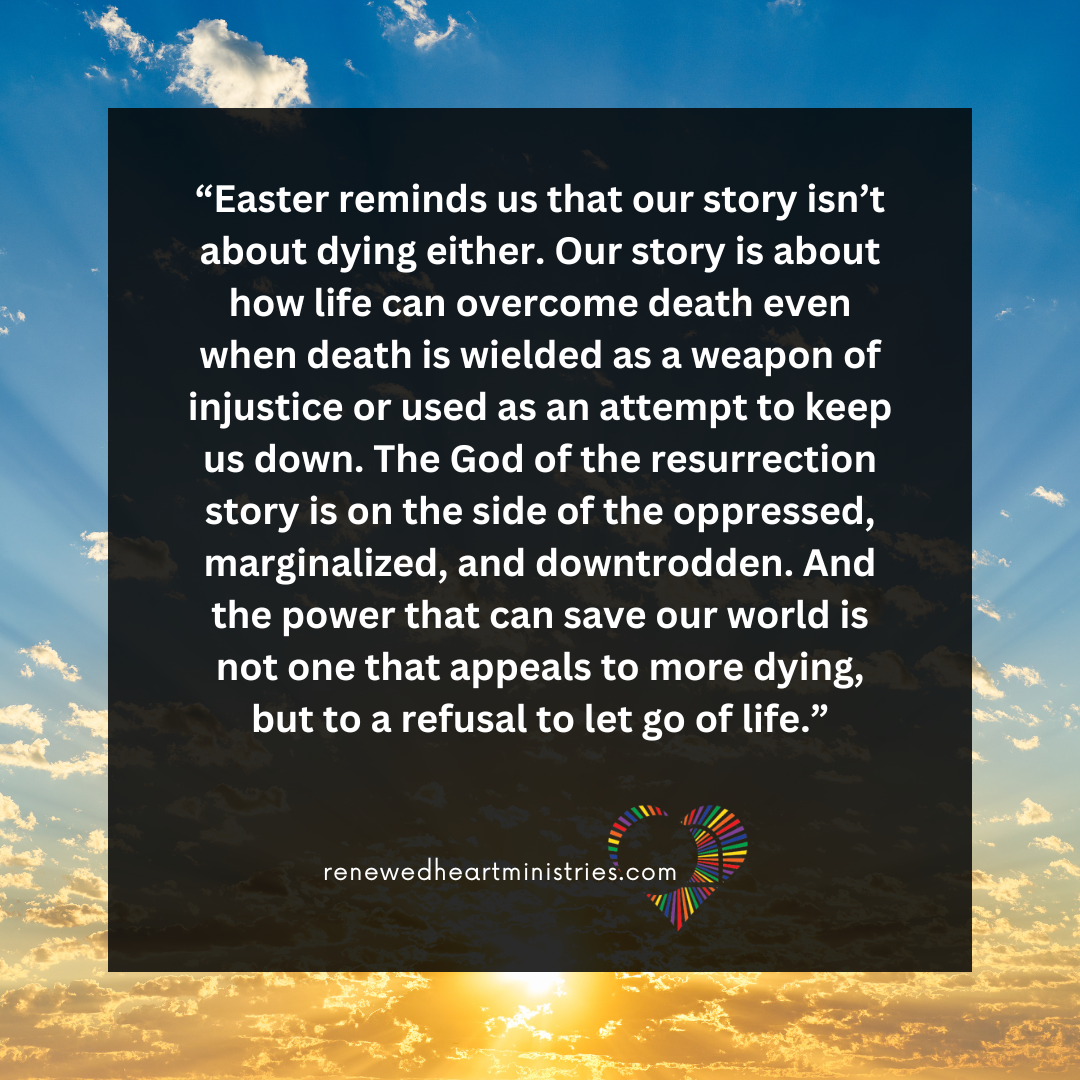
“Easter reminds us that our story isn’t about dying either. Our story is about how life can overcome death even when death is wielded as a weapon of injustice or used as an attempt to keep us down. The God of the resurrection story is on the side of the oppressed, marginalized, and downtrodden. And the power that can save our world is not one that appeals to more dying, but to a refusal to let go of life.”

To listen to this week’s eSight as a podcast episode click here.

This image has an empty alt attribute; its file name is Jesus-For-Everyone-150x150.png

This week, our readings are from the gospels of John and Mark:

Early on the first day of the week, while it was still dark, Mary Magdalene went to the tomb and saw that the stone had been removed from the entrance. So she came running to Simon Peter and the other disciple, the one Jesus loved, and said, “They have taken the Lord out of the tomb, and we don’t know where they have put him!”

So Peter and the other disciple started for the tomb. Both were running, but the other disciple outran Peter and reached the tomb first. He bent over and looked in at the strips of linen lying there but did not go in. Then Simon Peter came along behind him and went straight into the tomb. He saw the strips of linen lying there, as well as the cloth that had been wrapped around Jesus’ head. The cloth was still lying in its place, separate from the linen. Finally the other disciple, who had reached the tomb first, also went inside. He saw and believed. (They still did not understand from Scripture that Jesus had to rise from the dead.) Then the disciples went back to where they were staying.

Now Mary stood outside the tomb crying. As she wept, she bent over to look into the tomb and saw two angels in white, seated where Jesus’ body had been, one at the head and the other at the foot.

They asked her, “Woman, why are you crying?”

“They have taken my Lord away,” she said, “and I don’t know where they have put him.” At this, she turned around and saw Jesus standing there, but she did not realize that it was Jesus.

He asked her, “Woman, why are you crying? Who is it you are looking for?”

Thinking he was the gardener, she said, “Sir, if you have carried him away, tell me where you have put him, and I will get him.”

Jesus said to her, “Mary.”

She turned toward him and cried out in Aramaic, “Rabboni!” (which means “Teacher”).

Jesus said, “Do not hold on to me, for I have not yet ascended to the Father. Go instead to my brothers and tell them, ‘I am ascending to my Father and your Father, to my God and your God.’”

Mary Magdalene went to the disciples with the news: “I have seen the Lord!” And she told them that he had said these things to her. (John 20:1-18)

And Mark

When the Sabbath was over, Mary Magdalene, Mary the mother of James, and Salome bought spices so that they might go to anoint Jesus’ body. Very early on the first day of the week, just after sunrise, they were on their way to the tomb and they asked each other, “Who will roll the stone away from the entrance of the tomb?”

But when they looked up, they saw that the stone, which was very large, had been rolled away. As they entered the tomb, they saw a young man dressed in a white robe sitting on the right side, and they were alarmed.

“Don’t be alarmed,” he said. “You are looking for Jesus the Nazarene, who was crucified. He has risen! He is not here. See the place where they laid him. But go, tell his disciples and Peter, ‘He is going ahead of you into Galilee. There you will see him, just as he told you.’”

Trembling and bewildered, the women went out and fled from the tomb. They said nothing to anyone, because they were afraid. (Mark 16:1-8)

With these passages, the lectionary calls our attention to the earliest telling of the resurrection story in the gospels and the latest. What jumps out to me first is the evolution of women’s role in the stories. In Mark, women choose to be silent. But in John’s gospel, not only are women the first to announce the resurrection, but also, and in uncharacteristic fashion, the gospel names a specific woman (Mary) as the first among them to proclaim the good news of the resurrection. 

Many scholars date the writing of the book of Mark as the same time as the pseudo-epistles of Paul. While the author of Timothy was telling women to be silent (cf. 1Timothy 2:12), Mark’s gospel is showing us what would have happened in relation to the resurrection if they had been. As patriarchal forces in the early church were gaining power and influence and women began to be marginalized in the Jesus movement (cf. 1 Corinthians 14:34), Mark’s gospel warns us of such non-egalitarian trends. The implication is, “Thank God women were not silent!” Because if they had been, we might never have heard the good news of the resurrection. 

This leads me to what I believe was the original good news of the gospel for the early Jesus movement. The good news of the gospel was not that Jesus was crucified or had died for anyone, but that Jesus was alive! The cross had been reversed, overcome, and undone! And the news about that could not be contained!

Consider these passages that emphasize the preaching of the church in the books of Acts. Notice they aren’t merely preaching Jesus crucified. They are announcing Jesus has been resurrected!

With great power the apostles gave their testimony to the resurrection of the Lord Jesus, and great grace was upon them all. (Acts 4:33)

You crucified and killed by the hands of those outside the law. But God raised him up, having freed him from death, because it was impossible for him to be held in its power. (Acts 2:22-24)

This Jesus God raised up, and of that all of us are witnesses. (Acts 2:32-33)

You handed over and rejected in the presence of Pilate, though he had decided to release him. But you rejected the Holy and Righteous One and asked to have a murderer given to you, and you killed the Author of life, but God raised from the dead. (Acts 3:12-16)

. . . Jesus Christ of Nazareth, whom you crucified, but whom God raised from the dead. (Acts 4:10-11)

The God of our ancestors raised up Jesus, whom you had killed by hanging him on a tree. (Acts 5:30-32)

They put him to death by hanging him on a tree; but God raised him on the third day. (Acts 10:36-43)

Even though they found no cause for a sentence of death, they asked Pilate to have him killed. When they had carried out everything that was written about him, they took him down from the tree and laid him in a tomb. But God raised him from the dead . . . And we bring you the good news that what God promised to our ancestors he has fulfilled for us, their children, by raising Jesus. (Emphasis added) (Acts 13:35-38)

The good news for those in the book of Acts was not that Jesus had died, but that Jesus, whom the state had executed, had been brought back to life!

Whatever we make of these reports today, the lessons in these stories’ emphasis are not from Jesus’ dying but in the undoing of his death. The story is one about the ability of truth to overcome falsehood, of life to triumph over the death-dealing agents of our world, for love to conquer hate. Injustice doesn’t have to have the last word in our stories.

The good news, to use the words of Rev. Dr. Kelly Brown Douglas, was that the “crucifying powers of evil” have been defeated!

“The resurrection is God’s definitive victory over crucifying powers of evil . . . The impressive factor is how it [the cross] is defeated. It is defeated by a life-giving rather than a life-negating force. God’s power, unlike human power, is not a ‘master race’ kind of power. That is, it is not a power that diminishes the life of another so that others might live. God’s power respects the integrity of all human bodies and the sanctity of all life. This is a resurrecting power. Therefore, God’s power never expresses itself through the humiliation or denigration of another. It does not triumph over life. It conquers death by resurrecting life. The force of God is a death-negating, life-affirming force.” (Kelly Brown Douglas, Stand Your Ground: Black Bodies and the Justice of God, pp. 182-183).

And a few pages later:

“What the resurrection points to, however, is not the meaning of Jesus’ death, but of his life.” (Ibid. p. 188)

The powers of the status quo had attempted to silence Jesus’ life-giving, “saving,” redemptive work. Yet through the narrative element of the resurrection, this attempt to end Jesus’ work is turned into a mere interruption. Whereas the cross was the state’s attempt to stop Jesus’ salvific work, the resurrection causes that work to continue despite the cross, and to especially continue in the lives of Jesus’ followers as we seek to be conduits of life, healing, and liberation our own contexts today.

Christianity isn’t a death cult. I agree with womanist matriarch Dr. Delores Williams, who has been relentless through the years in pulling back the curtain and showing us the intrinsic harm of faith traditions that find meaning in Jesus’ death on a cross: “Jesus came for life and to show us something about life and living together and what life was all about” (in Dr. Kelly Brown Douglas’ What’s Faith Got to Do With It?, p. 90

Williams also wrote:

“Christians…cannot forget the cross, but neither can they glorify it. To do so is to glorify suffering and to render…exploitation sacred. To do so is to glorify the sin of defilement.” (Williams, Sisters in the Wilderness: The Challenge of Womanist God Talk, p.132)

So for me, the Jesus story isn’t about death. Easter reminds us that our story isn’t about dying either. Our story is about how life can overcome death even when death is wielded as a weapon of injustice or used as an attempt to keep us down. The God of the resurrection story is on the side of the oppressed, marginalized, and downtrodden. And the power that can save our world is not one that appeals to more dying, but to a refusal to let go of life. 

Hate doesn’t have the last word. The Jesus story doesn’t end on Friday evening. And we can choose love and life as the last word for our stories too.

Discussion Group Questions

1. Share something that spoke to you from this week’s eSight/Podcast episode with your discussion group.

2. How does focusing on the resurrection rather than the crucifixion as the redeeming element in the Jesus story shape your own experience as a Jesus follower? Share and discuss with your group.

3. What can you do this week, big or small, to continue setting in motion the work of shaping our world into a safe, compassionate, just home for everyone? 

Thanks for checking in with us, today.

I want to say a special thank you to all of our supporters out there. And if you would like to join them in supporting Renewed Heart Ministries’ work you can do so by going to renewedheartministries.com and clicking donate. 

I want to also say a special thank you this week to Quoir Publishing, Keith Giles who wrote the foreword to my latest book, all the special people on our launch team, and all of you who made this release a success. 

Finding Jesus: A Fundamentalist Preacher Discovers the Socio-Political and Economic Teachings of the Gospels is available now on Amazon in paperback, Kindle and soon also on Audible in audio book format.

As always, you can find Renewed Heart Ministries each week on X (or Twitter), Facebook, Instagram and Meta’s new Threads. If you haven’t done so already, please follow us on your chosen social media platforms for our daily posts. Also, if you enjoy listening to the Jesus for Everyone podcast, please like and subscribe to the JFE podcast through the podcast platform you use and consider taking some time to give us a review. This helps others find our podcast as well.

You can watch our new YouTube show called “Just Talking” each week. Todd Leonard and I take a moment to talk about the gospel lectionary reading for the upcoming weekend. We’ll be talking about each reading in the context of love, inclusion, and societal justice. Our hope is that our talking will be just talking (as in justice) and that during our brief conversations each week you’ll be inspired to also do more than just talking.

If you teach from the lectionary each week, or if you’re just looking for some thoughts on the Jesus story from a more progressive perspective within the context of social justice, check it out, you might like it. You can find JustTalking each week on YouTube at youtube.com/@herbandtoddjusttalking. Please Like, Subscribe, hit the Notification button, and leave us a comment.

And if you’d like to reach us here at Renewed Heart Ministries through email, you can reach us at info@renewedheartministries.com.

Right where you are, keep living in love, choosing compassion, taking action, and working toward justice.

I love each of you dearly,

I’ll see you next week.


Are you getting all of RHM’s Free Resources?

Free Sign Up Here
The Harmful Myth of Redemptive Death

Now Available on Amazon!


Finding Jesus: A Fundamentalist Preacher Discovers the Socio-Political & Economic Teachings of the Gospels.

by Herb Montgomery

Available now on Amazon!

After two successful decades of preaching a gospel of love within the Christian faith tradition Herb felt like something was missing. He went back to the gospels and began reading them through the interpretive lenses of various marginalized communities and what he found radically changed his life forever. The teachings of the Jesus in the gospel stories express a profound concern for justice, compassion, and the well-being of those in marginalized communities. This book navigates the intersections between faith and societal justice, and presents a compelling argument for a more socially compassionate and just expression of Christianity. Herb’s findings in his latest book are shared in the hopes that it will dramatically impact how you practice your Christianity, too.


New Episode of JustTalking!


Season 2, Episode 4: John 12.20-33. Lectionary B, Lent 5

Each week, we’ll be talking about the gospel lectionary reading for the upcoming weekend. We’ll be talking about each reading in the context of love, inclusion, and societal justice. Our hope is that our talking will be just talking (as in justice) and that during our brief conversations each week you’ll be inspired to also do more than just talking.

If you teach from the lectionary each week, or if you’re just looking for some thoughts on the Jesus story from a more progressive perspective within the context of social justice, check it out, you might like it.

You can find the latest show on YouTube at

Season 2, Episode 4: John 12.20-33. Lectionary B, Lent 5

 or (@herbandtoddjusttalking)

Please Like, Subscribe, hit the Notification button, and leave us a comment


The Harmful Myth of Redemptive Death

Herb Montgomery, March 15, 2024

“Truth can overcome falsehood, life can triumph over the death-dealing agents of our world, love can conquer hate, and, in the end, it may look differently than we expected, yet we can choose for justice, love and life to have the last word. No matter how hopeless the present moment, our story isn’t over yet.”

To listen to this week’s eSight as a podcast episode click here.

This image has an empty alt attribute; its file name is Jesus-For-Everyone-150x150.png

Our reading this week is from the gospel of John:

Jesus replied, “The hour has come for the Son of Man to be glorified. Very truly I tell you, unless a kernel of wheat falls to the ground and dies, it remains only a single seed. But if it dies, it produces many seeds. Anyone who loves their life will lose it, while anyone who hates their life in this world will keep it for eternal life. Whoever serves me must follow me; and where I am, my servant also will be. My Father will honor the one who serves me. 

Now there were some Greeks among those who went up to worship at the festival. They came to Philip, who was from Bethsaida in Galilee, with a request. “Sir,” they said, “we would like to see Jesus.” Philip went to tell Andrew; Andrew and Philip in turn told Jesus.

“Now my soul is troubled, and what shall I say? ‘Father, save me from this hour’? No, it was for this very reason I came to this hour. Father, glorify your name!”

Then a voice came from heaven, “I have glorified it, and will glorify it again.” The crowd that was there and heard it said it had thundered; others said an angel had spoken to him.

Jesus said, “This voice was for your benefit, not mine. Now is the time for judgment on this world; now the prince of this world will be driven out. And I, when I am lifted up from the earth, will draw all people to myself.” He said this to show the kind of death he was going to die. (John 12:20-33)

We continue in the gospel of John this week. Our passage, once again, has a problematic history of justifying death or abuse for those in disadvantaged or marginalized social locations or in predatory personal relationships. We must be careful and intentional not to perpetuate that harm (see God So Loved the World?). We’ll consider this further in a moment.

First, remember this is the last gospel to be written among those in our sacred canon. And it was written very late, almost a century removed from the events it writes about. This version of the Jesus story that was written by the Johannine community is radically different from the others as well. The few stories that it has in common with Mark, Matthew and Luke have different spins, different emphases, and different interpreted lessons (see Differences in John and Why They Matter).

In the other gospels, Jesus is executed by the state for speaking truth to power about the harm being done to the marginalized in his society. His protest culminates in his flipping the tables in the temple courtyard. In John’s gospel, this event has nothing to do with Jesus’ execution. Even the emphasis subtly changes. It’s no longer referred to with the overtones of a imperial execution for politically threatening the Pax Romana. Now its simply a “death” or “dying.” It’s referred to not as being crucified on a Roman cross, but, more opaquely, as being “lifted up.”  The emphasis, unlike the synoptics, is not so much on the redemptive resurrection of Jesus as it is undoing, overturning, and reversing everything accomplished through Jesus’ crucifixion.  The emphasis is on Jesus’ dying itself, and that death becomes redemptive.  

In Mark, the Markan community was trying to make sense out of Jesus’ execution. In their telling, Jesus must be crucified and resurrected. In fact, the only reason Jesus is allowed to be crucified is so that he can be resurrected. By the time we get to John’s telling, though, Jesus must simply die. Everything is accomplished through the dying. The resurrection is simply a mysterious afterward but all redemptive accomplishment is done through his dying.

These are not insignificant theological difference between the gospels. These theologies have produced very different results in the lives of Jesus communities that emphasize one or the other. 

I want to say one brief word about this shift in John. Even when Jesus’ death becomes redemptive in the Johaninne Jesus community, this death is never punitive or at the hands of God. Jesus doesn’t die as our substitute in John. Even though Jesus’ death is redemptive in that gospel, it doesn’t fit very easily within Western Christian penal substitutionary theology. It fits more easily in other atonement theories that have been held by Christians throughout history, especially the Christus Victor paradigm (“now the prince of this world will be driven out.”) and the Moral Influence paradigm (when I am lifted up from the earth, will draw all people to myself). But John’s gospel never says that Jesus’ death is to satisfy justice or a God that needs someone to stand in the gap and be punished for everyone else. That explanation doesn’t show up at all as an explanation to why Jesus (the seed in our reading) must die.

But this doesn’t completely solve the problems. Even if we embrace a different explanation of why Jesus died than penal substitutionary atonement, those other explanations have still produced harmful fruit for people who have subscribed to them.

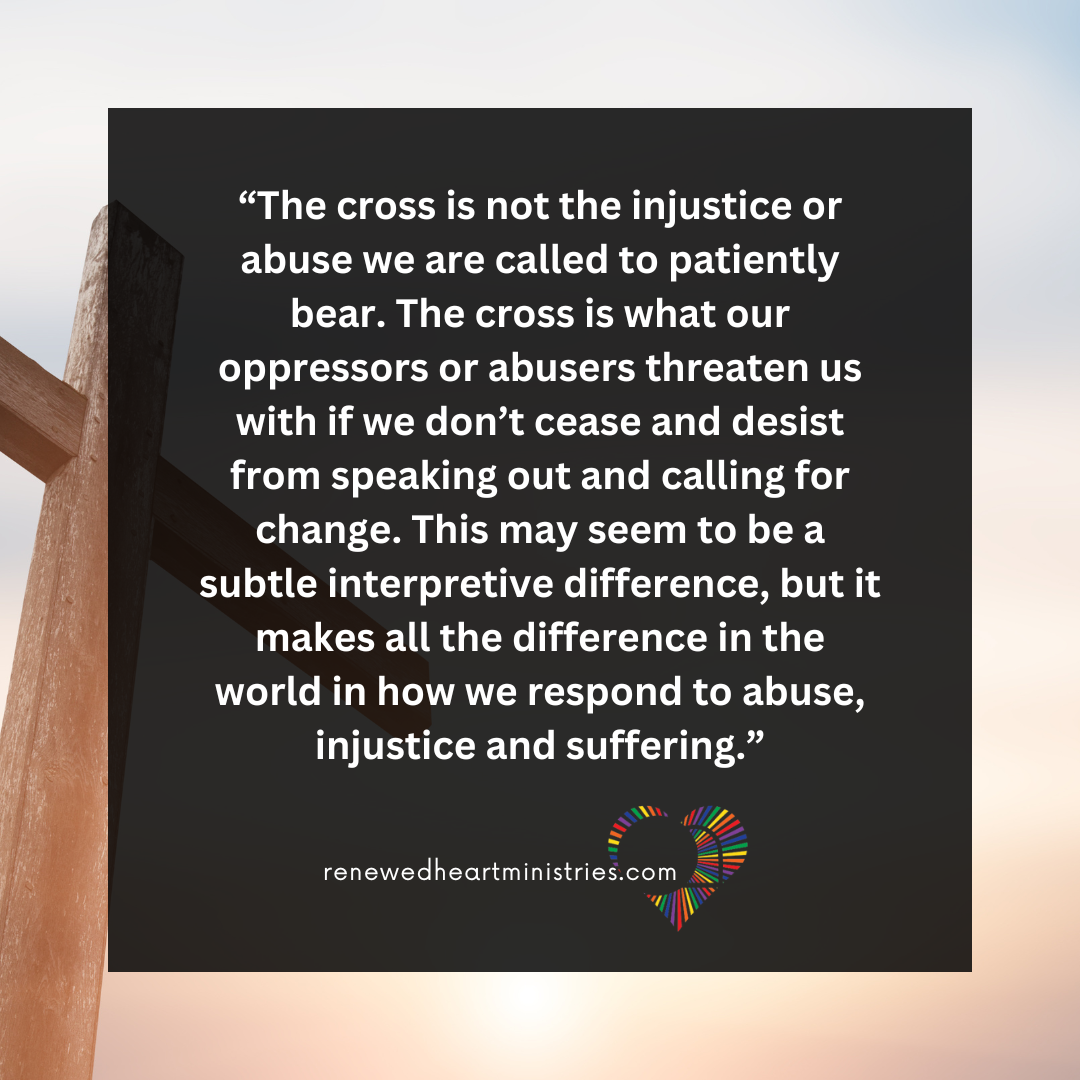
Let’s talk about the fruit produced by the Christus Victor explanation first. Those who believe Jesus’ death was redemptive too often also interpret their own suffering with similar implications. To explain their own suffering they respond by simply and sometimes lethally being patient in the face of harm. They think something good will come of this rather than see it as an evil that must be stood up to. They then are persuaded to passively endure their suffering and come to believe that God is working through their suffering. Some go so far as to believe that even if they die as a result they are fulfilling some higher divine purpose.

Joanne Brown and Rebecca Parker correctly critique this model:

“Such a theology has devastating effects on human life. The reality is that victimization never leads to triumph. It can lead to extended pain if it is not refused or fought. It can lead to destruction of the human spirit through the death of a person’s sense of power, worth, dignity. or creativity. It can lead to actual death. By denying the reality of suffering and death, the Christus Victor theory of the atonement defames all those who suffer and trivializes tragedy.” (God So Loved the World? p. 5)

The moral influence explanation doesn’t fare much better; it’s just as harmful. Again, from the deep and insightful work of Brown and Parker:

“The moral influence theory is founded on the belief that an innocent, suffering victim and only an innocent, suffering victim for whose suffering we are in some way responsible has the power to confront us with our guilt and move us to a new decision. This belief has subtle and terrifying connections as to how victims of violence can be viewed.” (God So Loved the World? p. 9)

In our work of trying to effect social change in response to social racism, classism, sexism, cis-heterosexism, or other systems, the moral influence theory has too often been peddled as a method: we suffer for the purpose of changing the hearts and minds of our oppressors or abusers. In this paradigm, victimization is “lifted up” as an agent that, if patiently endured, will persuade those responsible for our harm to embrace justice instead. Our suffering, if patiently endured, can change them. This is very destructive. It prioritizes the oppressor’s or abuser’s need for redemption over and above the rights of those who are genuinely, concretely, being harmed, included in losing their most basic right: to simply exist and live. 

Viewing Jesus’ death as redemptive, no matter how you explain that redemption, has historically proven harmful for those who apply that theology to their own suffering, abuse, and injustice.  

This is my most serious concern with the gospel of John. It is very different from the other gospels, and these differences are not always benign. The shift away from a redemptive resurrection to the salvific agent being Jesus’ cross alone may sound good at an emotionally tugging altar call. But when we try to live this theology, we need something better. 

This is why I favor Mark, Matthew’s and Luke’s attempts to explain Jesus’ execution over the Johannine community’s explanation. The goal in John’s gospel is always Jesus getting to the cross. But in the synoptics, the goal of Jesus’ death is getting past the cross to the resurrection. This difference matters to me.  For me, it has serious life or death implications for those who are choosing how to relate to their own suffering or how to navigate the injustices they face. 

I’ll close this week with words I shared a couple weeks ago, of Dr. Katie Cannon in the foreword of the 20th anniversary edition of Dr. Delores Williams classic Sisters in the Wilderness:

“Theologians need to think seriously about the real-life consequences of redemptive suffering, God-talk that equates the acceptance of pain, misery, and abuse as the way for true believers to live as authentic Christian disciples. Those who spew such false teaching and warped preaching must cease and desist.”

For me, the Jesus story is not a story that glorifies death and suffering. It’s not about the cross. It’s a story that communicates how truth can overcome falsehood, life can triumph over the death-dealing agents of our world, love can conquer hate, and, in the end, justice, love and life will have the last word. No matter how hopeless the present moment, our story isn’t over yet.

Discussion Group Questions

1. Share something that spoke to you from this week’s eSight/Podcast episode with your discussion group.

2. How do the gospel stories call you resist suffering and injustice? Share and discuss with your group.

3. What can you do this week, big or small, to continue setting in motion the work of shaping our world into a safe, compassionate, just home for everyone? 

Thanks for checking in with us, today.

I want to say a special thank you to all of our supporters out there. And if you would like to join them in supporting Renewed Heart Ministries’ work you can do so by going to renewedheartministries.com and clicking donate. 

I want to also say a special thank you this week to Quoir Publishing, Keith Giles who wrote the foreword to my latest book, all the special people on our launch team, and all of you who made this release a success. 

Finding Jesus: A Fundamentalist Preacher Discovers the Socio-Political and Economic Teachings of the Gospels is available now on Amazon in paperback, Kindle and soon also on Audible in audio book format.

As always, you can find Renewed Heart Ministries each week on X (or Twitter), Facebook, Instagram and Meta’s new Threads. If you haven’t done so already, please follow us on your chosen social media platforms for our daily posts. Also, if you enjoy listening to the Jesus for Everyone podcast, please like and subscribe to the JFE podcast through the podcast platform you use and consider taking some time to give us a review. This helps others find our podcast as well.

You can watch our new YouTube show called “Just Talking” each week. Todd Leonard and I take a moment to talk about the gospel lectionary reading for the upcoming weekend. We’ll be talking about each reading in the context of love, inclusion, and societal justice. Our hope is that our talking will be just talking (as in justice) and that during our brief conversations each week you’ll be inspired to also do more than just talking.

If you teach from the lectionary each week, or if you’re just looking for some thoughts on the Jesus story from a more progressive perspective within the context of social justice, check it out, you might like it. You can find JustTalking each week on YouTube at youtube.com/@herbandtoddjusttalking. Please Like, Subscribe, hit the Notification button, and leave us a comment.

And if you’d like to reach us here at Renewed Heart Ministries through email, you can reach us at info@renewedheartministries.com.

Right where you are, keep living in love, choosing compassion, taking action, and working toward justice.

I love each of you dearly,

I’ll see you next week.


Are you getting all of RHM’s Free Resources?

Free Sign Up Here

A Socially Engaged Gospel

Now Available on Amazon!

Finding Jesus: A Fundamentalist Preacher Discovers the Socio-Political & Economic Teachings of the Gospels.

by Herb MontgomeryAvailable.

After two successful decades of preaching a gospel of love within the Christian faith tradition Herb felt like something was missing. He went back to the gospels and began reading them through the interpretive lenses of various marginalized communities and what he found radically changed his life forever. The teachings of the Jesus in the gospel stories express a profound concern for justice, compassion, and the well-being of those in marginalized communities. This book navigates the intersections between faith and societal justice, and presents a compelling argument for a more socially compassionate and just expression of Christianity. Herb’s findings in his latest book are shared in the hopes that it will dramatically impact how you practice your Christianity, too.


New Episode of JustTalking!

Season 2, Episode 3: John 3.14-21. Lectionary B, Lent 4

Each week, we’ll be talking about the gospel lectionary reading for the upcoming weekend. We’ll be talking about each reading in the context of love, inclusion, and societal justice. Our hope is that our talking will be just talking (as in justice) and that during our brief conversations each week you’ll be inspired to also do more than just talking.

If you teach from the lectionary each week, or if you’re just looking for some thoughts on the Jesus story from a more progressive perspective within the context of social justice, check it out, you might like it.

You can find the latest show on YouTube at

Season 2, Episode 3: John 3.14-21. Lectionary B, Lent 4

 or (@herbandtoddjusttalking)

Please Like, Subscribe, hit the Notification button, and leave us a comment


A Socially Engaged Gospel

Herb Montgomery | March 9, 2024

To listen to this week’s eSight as a podcast episode click here.

This image has an empty alt attribute; its file name is Jesus-For-Everyone-150x150.png

Our reading this fourth weekend of Lent is from the gospel of John:

“Just as Moses lifted up the snake in the wilderness, so the Son of Man must be lifted up, that everyone who believes may have eternal life in him. For God so loved the world that he gave his one and only Son, that whoever believes in him shall not perish but have eternal life. For God did not send his Son into the world to condemn the world, but to save the world through him. Whoever believes in him is not condemned, but whoever does not believe stands condemned already because they have not believed in the name of God’s one and only Son. This is the verdict: Light has come into the world, but people loved darkness instead of light because their deeds were evil. Everyone who does evil hates the light, and will not come into the light for fear that their deeds will be exposed. But whoever lives by the truth comes into the light, so that it may be seen plainly that what they have done has been done in the sight of God.” John 3:14-21

Most New Testament scholars today recognize the proto-gnostic or gnostic tendencies of the Johannine community that produced the gospel of John. Later Gnostic Christians even only honored and read from the gospel of John (cf. Irenaeus, Against Heresies). 

Some of the Gnostic elements we encounter in John’s gospel include glorifying the Moses’ snake (a symbol in early Jewish gnosticism); a dualistic way of dividing our experiences between the material, deemed evil, and the spiritual, deemed good; and defining salvation as when our souls are finally liberated from our bodies and this finite, material plane.

Although those who won the power in the early Christian church deemed Christian gnosticism a heresy, much of western protestant Christianity today ironically looks a lot like early gnosticism, at least relation to the elements we have mentioned here.

Today, John’s gospel is the favorite of the New Testament gospels for many who practice the kind of Christianity that is hyper-focused either on gaining heaven or attaining the inward, individual, privatized spiritual experience with a cosmic Jesus often referred to as having “a relationship with God.” If either of these kinds of Christianity happens to be your experience, I don’t want to degrade that experience in the slightest. I just want to push it further. Whether someone’s focus is getting to heaven or having a private relationship with their individual Lord and savor, we must be honest about how those two focuses can divert our attention from the focus of the Jesus in the synoptic gospels. That Jesus was a source of healing and liberation for folks, not from a private internal hell unattached to the society around them or a post mortem one but from the living hell they were suffering through concrete social realities.

In 1958, responding to a complaint that someone’s pastor was talking about the NAACP during their sermon, Rev. Dr. Martin Luther King responded, 

“Any religion that professes to be concerned about the souls of men [sic] and is not concerned about economic conditions that cripple them and the social conditions that damn them is a dry as dust religion in need of new blood. Therefore your minister by including so-called ‘worldly things’ in his sermon revealed that he is a man of great spiritual depth and deep civic conscience. He revealed his awareness of the fact that the gospel of Jesus Christ deals with the whole man [sic]—his [sic] body as well as his soul, the earthly as well as the heavenly.” (Rev. Dr. Martin Luther King, Jr. Advice for Living, September 1958)

There are two ditches on either side of the paths we journey as Christians. One ditch is to be only focused on heaven. This is what some have referred to as being “so heavenly minded that we are no earthly good.” The other ditch is to only be focused inwardly on private and personal piety or a cosmic “relationship” to the exclusion of the center: our path following Jesus which is being a source of life-giving change in our world here and now. 

It doesn’t matter which of these ditches we fall into. Whatever we believe, our beliefs should make us a more engaged and better humans in relation to our world we are living in today.

Why does this matter in relation to our text this week? This week’s passage is a favorite for those who live solely in either ditch. For those in the ditch of getting to heaven, the phrase “whoever believes in him shall not perish but have eternal life” has special resonance. For those focused on a private, individual relationship with Jesus or God’s love, the phrases “God so loved the world” and “God did not send his Son into the world to condemn the world” especially resonate. And rightly so. 

While there may be some value in these beliefs, there is no reason why this passage should only belong to those who focus on them. This passage can also speak to those who care about making a difference in our material world and on personal and systemic suffering today. 

Why can’t the condemnation in this passage be similar to how the Hebrew prophets defined divine condemnation? In the Hebrew prophets, condemnation was not focused on individuals but on people groups, societies, and communities. When their social systems engaged in harmful practices toward the poor, the stranger, the fatherless, or the widow (in a patriarchal society), that society would suffer divine condemnation. They understood that condemnation was expressed through a calamity, natural, military, or a combination of both. If the teaching in John was similar to the Hebrew prophets’ teaching, God did not send God’s son into the world to perpetuate this cycle of unsustainable injustice and the intrinsic fruit of oppression and violence, but to shows us a way out.

And this leads to us defining salvation socially not individually. As Walter Rauschenbusch so rightly stated almost a century ago, “If our theology is silent on social salvation, we compel [people] to chose between an unsocial system of theology and an irreligious system of social salvation” (A Theology for the Social Gospel, p. 7) This social salvation can lead us into some beautifully inclusive realizations and practices. As the Rev. Dr. Jacqui Lewis so beautifully states, “If there is such a thing as salvation, none of us are saved, until all of us are saved.” 

“Perish” can refer not to some post mortem hell, but to literally perishing here, now, today. As Gustavo Gutierrez often stated, poverty is death and means an early death. Eternal life can be about quality not quantity: about the abundant life now, where there is enough for everyone to thrive (cf. John 10:10) .This vision is for a world that prioritizes making sure everyone is taken care of rather than shaping the world with greed and funneling our resources into the hands of the few in positions of power. 

Today, we can lean into this passage: God actually does loves the world! And if God’s love is universal, then we are to care about justice for everyone included in that world as the objects of that love. As Rev. Dr. Emilie Townes says, “When you begin with the idea that God loves everyone, justice isn’t very far behind.” Or as so many today are fond of saying, “Justice is what love looks like in public.” This world that is loved, we must be careful to define as everyone, with no exclusions. Those who comprise our world that are loved includes those that are different from ourselves, even those whose differences trigger our own bigotries and prejudices. We must be honest here. 

I’m thinking of how women in positions of authority can trigger insecure or patriarchal men. I’m thinking of how racial and cultural differences trigger those whose internal bias is some form of White or western supremacy. I think of how trans and nonbinary differences and gender nonconformity triggers those who have cis-biases. Or how folks who identify as gay, lesbian or bisexual trigger those with heteronormative biases. I think of class bias. I think of educational bias with what is now being called the paper ceiling

If we are serious about leaning into the belief that every person is the object of divine love, then this would radically impact how we relate to those around us. Every person we meet is our sibling. Every person we meet is a part of ourselves. What impacts and affects one affects us all. Whether we like it or not, we are all connected to each other as part of this beautifully diverse human family that is loved by a universal love. 

And this has grave implication for our everyday choices as well. You can’t love others and not care about the things they suffer from the way our society is shaped. You can’t love them and vote for legislatures who seek to do them harm. To come full circle, you can’t love them and be focused on only your own arrival into heaven or your own personal relationship with the Divine. Otherwise, our focus on God’s love mutates from God’s loving us alongside everyone else in the world into a self-absorbed need to be loved by God above all else. It’s an only-child-like syndrome where God may love others, but privately and inwardly we begin to believe that we are God’s favorite. This is the root of Christian and too often national exceptionalism. 

To authentically reinterpret our passage this week through the lens of the Jesus we see in the Mark, Matthew, and Luke can still give us assurance of heaven, and still usher us into a relationship with the divine if that is your thing. And it also has the potential, when understood more broadly and deeply, to shape our practice of Christianity in ways that shape us into humans who make our world a safer, more compassionate, just home for everyone. 

Discussion Group Questions

1. Share something that spoke to you from this week’s eSight/Podcast episode with your discussion group.

2. How do the gospel stories call you to be more socially engaged? Share and discuss with your group.

3. What can you do this week, big or small, to continue setting in motion the work of shaping our world into a safe, compassionate, just home for everyone? 

Thanks for checking in with us, today.

I want to say a special thank you to all of our supporters out there. And if you would like to join them in supporting Renewed Heart Ministries’ work you can do so by going to renewedheartministries.com and clicking donate. 

I want to also say a special thank you this week to Quoir Publishing, Keith Giles who wrote the foreword to my latest book, all the special people on our launch team, and all of you who made this release a success. 

Finding Jesus: A Fundamentalist Preacher Discovers the Socio-Political and Economic Teachings of the Gospels is available now on Amazon in paperback, Kindle and soon also on Audible in audio book format.

As always, you can find Renewed Heart Ministries each week on X (or Twitter), Facebook, Instagram and Meta’s new Threads. If you haven’t done so already, please follow us on your chosen social media platforms for our daily posts. Also, if you enjoy listening to the Jesus for Everyone podcast, please like and subscribe to the JFE podcast through the podcast platform you use and consider taking some time to give us a review. This helps others find our podcast as well.

You can watch our new YouTube show called “Just Talking” each week. Todd Leonard and I take a moment to talk about the gospel lectionary reading for the upcoming weekend. We’ll be talking about each reading in the context of love, inclusion, and societal justice. Our hope is that our talking will be just talking (as in justice) and that during our brief conversations each week you’ll be inspired to also do more than just talking.

If you teach from the lectionary each week, or if you’re just looking for some thoughts on the Jesus story from a more progressive perspective within the context of social justice, check it out, you might like it. You can find JustTalking each week on YouTube at youtube.com/@herbandtoddjusttalking. Please Like, Subscribe, hit the Notification button, and leave us a comment.

And if you’d like to reach us here at Renewed Heart Ministries through email, you can reach us at info@renewedheartministries.com.

Right where you are, keep living in love, choosing compassion, taking action, and working toward justice.

I love each of you dearly,

I’ll see you next week.


Are you getting all of RHM’s Free Resources?

Free Sign Up Here

Differences in John and Why They Matter

#1 New Release on Amazon!

Finding Jesus: A Fundamentalist Preacher Discovers the Socio-Political & Economic Teachings of the Gospels.

by Herb MontgomeryAvailable now on Amazon.

After two successful decades of preaching a gospel of love within the Christian faith tradition Herb felt like something was missing. He went back to the gospels and began reading them through the interpretive lenses of various marginalized communities and what he found radically changed his life forever. The teachings of the Jesus in the gospel stories express a profound concern for justice, compassion, and the well-being of those in marginalized communities. This book navigates the intersections between faith and societal justice, and presents a compelling argument for a more socially compassionate and just expression of Christianity. Herb’s findings in his latest book are shared in the hopes that it will dramatically impact how you practice your Christianity, too.


New Episode of JustTalking!

Season 2, Episode 2: John 2.13-22. Lectionary B, Lent 3.

Each week, we’ll be talking about the gospel lectionary reading for the upcoming weekend. We’ll be talking about each reading in the context of love, inclusion, and societal justice. Our hope is that our talking will be just talking (as in justice) and that during our brief conversations each week you’ll be inspired to also do more than just talking.

If you teach from the lectionary each week, or if you’re just looking for some thoughts on the Jesus story from a more progressive perspective within the context of social justice, check it out, you might like it.

You can find the latest show on YouTube at

Season 2, Episode 2: John 2.13-22. Lectionary B, Lent 3.

 or (@herbandtoddjusttalking)

Please Like, Subscribe, hit the Notification button, and leave us a comment


Differences in John and Why They Matter

Herb Montgomery | March 1, 2024

“Are we defining our humanity as broken and salvation as when we’re set free from our humanity? Or have we lost touch with our humanity ourselves or because others are attempting to dehumanize us? If so, salvation is our reclaiming our humanity!”

To listen to this week’s eSight as a podcast episode click here.

This image has an empty alt attribute; its file name is Jesus-For-Everyone-150x150.png

Our reading this week is from the gospel of John:

When it was almost time for the Jewish Passover, Jesus went up to Jerusalem. In the temple courts he found people selling cattle, sheep and doves, and others sitting at tables exchanging money. So he made a whip out of cords, and drove all from the temple courts, both sheep and cattle; he scattered the coins of the money changers and overturned their tables. To those who sold doves he said, “Get these out of here! Stop turning my Father’s house into a market!” His disciples remembered that it is written: “Zeal for your house will consume me.” 

The Jews then responded to him, “What sign can you show us to prove your authority to do all this?” Jesus answered them, “Destroy this temple, and I will raise it again in three days.”

They replied, “It has taken forty-six years to build this temple, and you are going to raise it in three days?” But the temple he had spoken of was his body. After he was raised from the dead, his disciples recalled what he had said. Then they believed the scripture and the words that Jesus had spoken. (John 2:13-22)

If you’re familiar with our Social Jesus Blog, Weekly eSights, Jesus for Everyone podcast, or weekly YouTube show Just Talking, you won’t be surprised by the stark differences between this version of the Jesus story, which emerged out of the Johannine community, and the earlier gospels in our sacred canon, the synoptics Mark, Matthew, and Luke. 

In the synoptic gospels, Jesus’ protest in the temple state’s courtyard comes at the end of the the story and is the reason the state executes Jesus on a Roman cross. John was written much later than any of the other canonical gospels, and by that time, Jesus’ death on the cross was far removed from his protest in the temple. The protest happens at the very beginning of the story and the crucifixion comes at the end. These events have nothing to do with each other in the Johannine community’s gospel.

It’s not only the narrative location of this story that is different between these gospels. Jesus’ motive is vastly different as well. In Mark, Matthew, and Luke, Jesus’ protest is rooted in zeal for the masses who are being marginalized and crushed by the Temple State’s complicity with the Roman empire. Consider Mark’s version of the story:

On reaching Jerusalem, Jesus entered the temple courts and began driving out those who were buying and selling there. He overturned the tables of the money changers and the benches of those selling doves, and would not allow anyone to carry merchandise through the temple courts. And as he taught them, he said, “Is it not written: ‘My house will be called a house of prayer for all nations’? But you have made it ‘a den of crooks.’” (Mark 11:15-17)

Jesus’ words in Mark’s story combine two passages from the Hebrew scriptures, the first from Isaiah and the later from Jeremiah.

“These I will bring to my holy mountain

and give them joy in my house of prayer.

Their burnt offerings and sacrifices

will be accepted on my altar;

for my house will be called 

a house of prayer for all nations.” (Isaiah 56:7)

“If you really change your ways and your actions and deal with each other justly, if you 

do not oppress the foreigner, the fatherless or the widow and do not shed innocent 

blood in this place, Has this house, which bears my Name, become a den of crooks to 

you? But I have been watching! declares the LORD.” (Jeremiah 7:5-11)

What we must pay attention to in Jeremiah is where the phrase “den of crooks” comes from. A den of thieves and robbers is not where theft is taking place but where the thieves retreat, thinking they are safe after their theft has been committed. The temple functioned in exactly this fashion for the elites and powerful in the temple state. They could oppress the “foreigner, the fatherless or the widow” while practicing their religious piety and claiming they were still in good standing with the God of the Torah because they were still practicing the ritual ceremonies of the temple:

“Will you steal and murder, commit adultery and perjury . . . and then come and stand before me in this house, which bears my Name, and say, ‘We are safe;—safe to do all these detestable things?” (Jeremiah 7:9-10)

“Do not trust in deceptive words and say, “This is the temple of the LORD, the temple of the LORD, the temple of the LORD!” (Jeremiah 7:4)

Consider how this theme appears in the book of Isaiah, another Hebrew prophet:

“The multitude of your sacrifices—

what are they to me?” says the LORD.

“I have more than enough of burnt offerings,

of rams and the fat of fattened animals;

I have no pleasure

in the blood of bulls and lambs and goats.

  When you come to appear before me,

who has asked this of you,

this trampling of my courts? 

  Stop bringing meaningless offerings!

Your incense is detestable to me.

New Moons, Sabbaths and convocations—

I cannot bear your worthless assemblies. 

Your New Moon feasts and your appointed festivals

I hate with all my being.

They have become a burden to me;

I am weary of bearing them. 

  When you spread out your hands in prayer,

I hide my eyes from you;

even when you offer many prayers,

I am not listening.

Your hands are full of blood!

  Wash and make yourselves clean.

Take your evil deeds out of my sight;

stop doing wrong.

  Learn to do right; seek justice.

Defend the oppressed. 

Take up the cause of the fatherless;

plead the case of the widow. (Isaiah 1:11-17)

For the prophets, God is much more concerned with social justice than with all the people’s religious ritual observances. It’s this Hebrew, prophetic justice tradition that Jesus is standing squarely in in the gospels of Mark, Matthew, and Luke.

But in John’s gospel, this tradition is wholly erased and Jesus’ motive is the exact opposite.

“Zeal for your house will consume me.” 

John’s Jesus is no longer zealous for the oppressed. Now, in this late gospel, Jesus is consumed by zeal for the purity of the temple and maintaining the purity of religious ritual observances there.

Another significant difference between the gospels is the overt antisemitism held in the Johannine community by the time John’s gospel was written. In the synoptics, rejection of Jesus is a matter of classism. The Jews loved Jesus and hung on his every word. Why wouldn’t they? Jesus’ message was a populist message that resonated deeply with the people who were suffering at the hands of those in power. It was the powerful, propertied, and privileged responsible for crushing the masses through complicity with Rome and who created enormous wealth for themselves who rejected Jesus’ calls for a return to the economic justice teaching of the Torah. 

Notice this difference in Luke:

“Every day he was teaching at the temple. But the chief priests, the teachers of the law and the leaders [these were political positions] among the people were trying to kill him. Yet they could not find any way to do it, because all the people hung on his words. (Luke 19:47-48)

In John’s gospel, however, there is no distinction between the rich and poor, the powerful and the marginalized, or the elites and the masses within Jesus’ Jewish society. In John, the opposition is all wrapped up in one simple, antisemitic designation: “the Jews.”

Lastly, the gospels switch from critiquing the injustice of the temple state, with its physical capital in the temple, to spiritualizing the temple as a symbol of Jesus’ body.

The presence of proto-Gnostic tendencies in the writings of the Johannine community is well-documented by scholars. Christian Gnosticism would come to teach a dualistic way of looking at our world through the lens of separating our bodies from our spirit. Later, Gnosticism would teach that the material world was evil and spiritual was good. It therefore defined salvation as the point at which our spirits are finally set free from imprisonment in our material bodies and material world. (This sounds a lot like many of the sectors of Christianity today, which is why I say that much of Christianity today is more gnostic like the Johannine community than the Jesus of the synoptic gospels.)

In the synoptics, Jesus prioritizes setting people free from material, concrete, very tangible suffering. but not from the material, concrete, and tangible itself. 

What are we to make of these differences? Both teachings are in our sacred texts. Both are biblical. And both are ways of viewing and defining Jesus. For those who want the Bible to make all of their decisions for them, it’s not that simple when the Bible offers two different options. We have to take some personal responsibility. We have to actually decide which way of practicing Christianity today in our context is more life-giving. 

We have to choose how we practice our own Christianity. Both options are biblical. And they each produce radically different fruit. Are we focused on postmortem destinations or saving people from what they are suffering in this life? Are we defining salvation as celestial, heavenly bliss in another life, or do we define salvation as the synoptics do, as being set free from death-dealing oppression, injustice, violence, and marginalization in this life? Are we defining our humanity as broken and salvation as when we’re set free from our humanity? Or have we lost touch with our humanity ourselves or because others are attempting to dehumanize us? If so, salvation is our reclaiming our humanity! (Jesus defines salvation in Luke’s story of Zacchaeus in this way.) 

I find it escapist and defeatist to separate Jesus’ gospel from this life and transform it into being solely about spiritual realities in preparation for a next life. For myself, I find the focus of the synoptic gospels in our present social context to be much more relevant and much more life-giving.

Group Discussion Questions

1. Share something that spoke to you from this week’s eSight/Podcast episode with your discussion group.

2. How do the differences in the different versions of the Jesus story in our New Testament impact your own social just work today as a Jesus follower? Share and discuss with your group.

3. What can you do this week, big or small, to continue setting in motion the work of shaping our world into a safe, compassionate, just home for everyone? 

Thanks for checking in with us, today.

I want to say a special thank you to all of our supporters out there. And if you would like to join them in supporting Renewed Heart Ministries’ work you can do so by going to renewedheartministries.com and clicking donate. 

I want to also say a special thank you this week to Quoir Publishing, Keith Giles who wrote the foreword to my latest book, all the special people on our launch team, and all of you who made this release a success. 

Finding Jesus: A Fundamentalist Preacher Discovers the Socio-Political and Economic Teachings of the Gospels is available now on Amazon in paperback, Kindle and soon also on Audible in audio book format.

As always, you can find Renewed Heart Ministries each week on X (or Twitter), Facebook, Instagram and Meta’s new Threads. If you haven’t done so already, please follow us on your chosen social media platforms for our daily posts. Also, if you enjoy listening to the Jesus for Everyone podcast, please like and subscribe to the JFE podcast through the podcast platform you use and consider taking some time to give us a review. This helps others find our podcast as well.

You can watch our new YouTube show called “Just Talking” each week. Todd Leonard and I take a moment to talk about the gospel lectionary reading for the upcoming weekend. We’ll be talking about each reading in the context of love, inclusion, and societal justice. Our hope is that our talking will be just talking (as in justice) and that during our brief conversations each week you’ll be inspired to also do more than just talking.

If you teach from the lectionary each week, or if you’re just looking for some thoughts on the Jesus story from a more progressive perspective within the context of social justice, check it out, you might like it. You can find JustTalking each week on YouTube at youtube.com/@herbandtoddjusttalking. Please Like, Subscribe, hit the Notification button, and leave us a comment.

And if you’d like to reach us here at Renewed Heart Ministries through email, you can reach us at info@renewedheartministries.com.

Right where you are, keep living in love, choosing compassion, taking action, and working toward justice.

I love each of you dearly,

I’ll see you next week.


Are you getting all of RHM’s Free Resources?

Free Sign Up Here
Bearing A Cross and the Myth of Redemptive Suffering

#1 New Release on Amazon!

Finding Jesus: A Fundamentalist Preacher Discovers the Socio-Political & Economic Teachings of the Gospels.
by Herb Montgomery

Available now on Amazon.

After two successful decades of preaching a gospel of love within the Christian faith tradition Herb felt like something was missing. He went back to the gospels and began reading them through the interpretive lenses of various marginalized communities and what he found radically changed his life forever. The teachings of the Jesus in the gospel stories express a profound concern for justice, compassion, and the well-being of those in marginalized communities. This book navigates the intersections between faith and societal justice, and presents a compelling argument for a more socially compassionate and just expression of Christianity. Herb’s findings in his latest book are shared in the hopes that it will dramatically impact how you practice your Christianity, too.

Finding Jesus by Herb Montgomery is the #1 New Release in its category.

Get your copy on Amazon, today!


New Episode of JustTalking!

Season 2, Episode 1: Mark 8.31-38. Lectionary B, Lent 2

Each week, we’ll be talking about the gospel lectionary reading for the upcoming weekend. We’ll be talking about each reading in the context of love, inclusion, and societal justice. Our hope is that our talking will be just talking (as in justice) and that during our brief conversations each week you’ll be inspired to also do more than just talking.

If you teach from the lectionary each week, or if you’re just looking for some thoughts on the Jesus story from a more progressive perspective within the context of social justice, check it out, you might like it.

You can find the latest show on YouTube at

Season 2, Episode 1: Mark 8.31-38. Lectionary B, Lent 2

 or (@herbandtoddjusttalking)

Please Like, Subscribe, hit the Notification button, and leave us a comment

Thanks in advance for watching!


Bearing A Cross and the Myth of Redemptive Suffering

Herb Montgomery | February 24, 2024

“It may seem to be a subtle interpretive difference, but it makes all the difference in the world in how we respond to abuse, injustice and suffering.”

To listen to this week’s eSight as a podcast episode click here.

This image has an empty alt attribute; its file name is Jesus-For-Everyone-150x150.png

Our reading this second week of Lent is from the gospel of Mark:

He then began to teach them that the Son of Man must suffer many things and be rejected by the elders, the chief priests and the teachers of the law, and that he must be killed and after three days rise again. He spoke plainly about this, and Peter took him aside and began to rebuke him. 

But when Jesus turned and looked at his disciples, he rebuked Peter. “Get behind me, Satan!” he said. “You do not have in mind the concerns of God, but merely human concerns.”

Then he called the crowd to him along with his disciples and said: “Whoever wants to be my disciple must deny themselves and take up their cross and follow me. For whoever wants to save their life will lose it, but whoever loses their life for me and for the gospel will save it. What good is it for someone to gain the whole world, yet forfeit their soul? Or what can anyone give in exchange for their soul? If anyone is ashamed of me and my words in this adulterous and sinful generation, the Son of Man will be ashamed of them when he comes in his Father’s glory with the holy angels.” (Mark 8:31-38)

Every year when this passage rolls around in the calendar of the lectionary, I’m reminded of how much care and intentionality must be exercised with passages like it. This passage is especially vulnerable to being interpreted in death-dealing ways rather than life-giving ones. It’s one of the central passages that has been used throughout Christian history to teach the harmful myth of redemptive suffering. Let me share a little bit of personal background. 

I grew up as an only child with a single mom. At times, my mom would find herself in abusive relationships with men. Only once did I ever see my mom try to stay and make it work, and that only resulted in harm for both her and me. After that experience, she never hesitated to leave again. I’m proud of my mom for learning how to establish healthy boundaries in her life. While she was alive, through her difficult life experiences, she developed a keen ability to defend and hold onto the value of her humanity and mine. I was her only son. And she would not allow men who even began to reveal red flags that were potentially abusive to take up space in her life. 

My mother was a Christian, and I also witnessed many pastors at various times use this week’s passage to encourage her to stay, stick it out, and “turn the other cheek,” to “be like Jesus” and be willing to “take up her cross.” At times, they encouraged this approach with the idea that somehow my mom’s suffering might change, save, or redeem her husband. This is the myth of redemptive suffering: that our suffering can redeem our abusers and oppressors. It’s not only bad advice based on harmful interpretations of what bearing a cross or being like Jesus actually means, but it has literally been lethal to so many women. Women have lost their lives staying with abusive men. (I realize that women are not the only ones who suffer at the hands of abusive partners, and I’m using my own experiences with my mother and her life as my primary reference point.)

As we consider our passage this week, I want to highly recommend the now-classic essay by Brown and Parker, “For God So Loved the World?” You can find a readable PDF of this essay at http://healingreligion.com/2490/pdf/forgodso.pdf. I’m grateful to healingreligion.com for providing this resource freely. 

The very first paragraph of Brown’s and Parker’s essay states:

“Women are acculturated to accept abuse. We come to believe that it is our place to suffer. Breaking silence about the victimization of women and the ways in which we have become anesthetized to our violation is a central theme in women’s literature, theology, art, social action, and politics. With every new revelation we confront again the deep and painful secret that sustains us in oppression: We have been convinced that our suffering is justified.”

For Christian women, the Christian traditional interpretation of the death of Jesus as redemptive serves to promote the harmful and death-dealing teaching that suffering is or can be redemptive. I’m reminded of the words of Katie G. Cannon in the foreword to the 25th anniversary edition of Delores S. Williams’ Sisters in the Wilderness: The Challenge of Womanist God-Talk:

[Williams] contends that theologians need to think seriously about the real-life consequences of redemptive suffering, God-talk that equates the acceptance of pain, misery, and abuse as the way for true believers to live as authentic Christian disciples. Those who spew such false teaching and warped preaching must cease and desist.” 

Space here does not permit me here this week to critique various atonement theories and present alternatives (I have done this elsewhere). I do want to offer some guidance this week with the specific passage we are considering. 

Too often, the cross we are to counseled to “bear” is defined as an injustice itself. When we define the injustice or abuse we are suffering as our cross to bear, then being Christlike leads to being passive and patiently enduring whatever injustice or abuse we are suffering. 

But this is not what the cross stood for in the Jesus story of the synoptic gospels. In that story, Jesus begins the week with a protest where he flips the tables of the money changers in the temple courtyard. We have to understand the context to see why.

In the time of Jesus, the poor and marginalized were being crushed under the Temple State’s complicity with the Roman Empire’s extractive economy. The poor were getting poorer and farmers were losing their land through growing indebtedness to the rich and wealthy class. Even in our reading this week, Jesus sets his sights on the heart of the Temple State in Jerusalem, the temple, and determines he must demonstrate there against the abuses that were going on. The rest of that week in these gospels, we witness the system pushing back. That doesn’t result in Jesus’ redemptive death, but in his unjust state execution for speaking out. In the story, the Divine overturns the injustice three days later. Everything accomplished through the death of Jesus was reversed, undone, and overcome through Jesus being brought back to life. 

In the story, Jesus:

  1. Stands up to the injustice he sees happening around him
  2. The system threatens him with a cross if he doesn’t shut up
  3. Jesus refuses to be passive. Refuses to be silent. Refuses to shut up. He keeps pushing. 
  4. The response of state is to put him on a cross.

The third step in this chronology is what it means to embrace the way of the cross. A cross is not intrinsic to following Jesus. A cross only comes into our Jesus-following if our oppressors or abusers choose to threaten us with one. If our standing up to injustice threatens them enough for them to use force to sit us back down and get us to be silent and passive. It is at this point that Jesus’ words begin to take on life-giving rather than death-dealing meaning. I offer my comments in brackets:

“Whoever wants to be my disciple must deny themselves and take up their cross [be willing to not be silent] and follow me [in speaking out].

For whoever wants to save their life [through remaining silent] will lose it. [We lose a part of ourselves every time we are silent in the face of injustice.]

but whoever loses their life for me and for the gospel [being willing to speak out in face of rejection and pushback] will save it [hold onto and even reclaim our humanity that the system wants to exploit while denying].

What good is it for someone to gain the whole world, [through going along with the system]

yet forfeit their soul [silence your own conscience in what you know to be right]?

Or what can anyone give in exchange for their soul? [Whatever the cost of speaking out, it’s worth it. Whatever the reward being offered for being silent, it’s not worth it.]”

The cross is not the injustice or abuse we are to bear. The cross is what our oppressors or abusers threaten us with if we don’t cease and desist speaking out. To be willing to bear a cross means instead to keep speaking out, don’t be silent, keep calling for justice, keep holding abusers and oppressors accountable. This is the only way we and they will ever experience change. 

How we define bearing a cross—whether passively bearing injustice, or refusing to be silent in the face of injustice—may seem to be a subtle interpretive difference. But for a Jesus follower it makes all the difference in the world in how we respond to abuse and suffering. 

HeartGroup Application

1. Share something that spoke to you from this week’s eSight/Podcast episode with your HeartGroup.

2. How does connecting a cross to the refusal to be silent impact how you respond to injustice? Share and discuss with your group.

3. What can you do this week, big or small, to continue setting in motion the work of shaping our world into a safe, compassionate, just home for everyone? 

Thanks for checking in with us, today.

I want to say a special thank you to all of our supporters out there. And if you would like to join them in supporting Renewed Heart Ministries’ work you can do so by going to renewedheartministries.com and clicking donate. 

I want to also say a special thank you this week to Quoir Publishing, Keith Giles who wrote the foreword to my latest book, all the special people on our launch team, and all of you who made this release a success. 

Finding Jesus: A Fundamentalist Preacher Discovers the Socio-Political and Economic Teachings of the Gospels is available now on Amazon in paperback, Kindle and soon also on Audible in audio book format.

As always, you can find Renewed Heart Ministries each week on X (or Twitter), Facebook, Instagram and Meta’s new Threads. If you haven’t done so already, please follow us on your chosen social media platforms for our daily posts. Also, if you enjoy listening to the Jesus for Everyone podcast, please like and subscribe to the JFE podcast through the podcast platform you use and consider taking some time to give us a review. This helps others find our podcast as well.

You can watch our new YouTube show called “Just Talking” each week. Todd Leonard and I take a moment to talk about the gospel lectionary reading for the upcoming weekend. We’ll be talking about each reading in the context of love, inclusion, and societal justice. Our hope is that our talking will be just talking (as in justice) and that during our brief conversations each week you’ll be inspired to also do more than just talking.

If you teach from the lectionary each week, or if you’re just looking for some thoughts on the Jesus story from a more progressive perspective within the context of social justice, check it out, you might like it. You can find JustTalking each week on YouTube at youtube.com/@herbandtoddjusttalking. Please Like, Subscribe, hit the Notification button, and leave us a comment.

And if you’d like to reach us here at Renewed Heart Ministries through email, you can reach us at info@renewedheartministries.com.

Right where you are, keep living in love, choosing compassion, taking action, and working toward justice.

I love each of you dearly,

I’ll see you next week.


Are you getting all of RHM’s Free Resources?

Free Sign Up Here

The Power of Our Voices

#1 New Release on Amazon!

Finding Jesus: A Fundamentalist Preacher Discovers the Socio-Political & Economic Teachings of the Gospels.
by Herb Montgomery

Available now on Amazon.

After two successful decades of preaching a gospel of love within the Christian faith tradition Herb felt like something was missing. He went back to the gospels and began reading them through the interpretive lenses of various marginalized communities and what he found radically changed his life forever. The teachings of the Jesus in the gospel stories express a profound concern for justice, compassion, and the well-being of those in marginalized communities. This book navigates the intersections between faith and societal justice, and presents a compelling argument for a more socially compassionate and just expression of Christianity. Herb’s findings in his latest book are shared in the hopes that it will dramatically impact how you practice your Christianity, too.

Get your copy of this #1 New Release on Amazon, today!


The Power of Our Voices

“Change does not only come from strong political winds, earth-shaking social quakes, or fire that burns the whole thing down. Change also comes from continued speaking out. What power does one voice have? This story reminds us that our voices, when we speak out together against injustice, can have power for change.”

To listen to this week’s eSight as a podcast episode click here.

This image has an empty alt attribute; its file name is Jesus-For-Everyone-150x150.png

Our reading this week is from the gospel of Mark:

After six days Jesus took Peter, James and John with him and led them up a high mountain, where they were all alone. There he was transfigured before them. His clothes became dazzling white, whiter than anyone in the world could bleach them. And there appeared before them Elijah and Moses, who were talking with Jesus. 

Peter said to Jesus, “Rabbi, it is good for us to be here. Let us put up three shelters—one for you, one for Moses and one for Elijah.” (He did not know what to say, they were so frightened.) 

Then a cloud appeared and covered them, and a voice came from the cloud: “This is my Son, whom I love. Listen to him!”

Suddenly, when they looked around, they no longer saw anyone with them except Jesus. 

As they were coming down the mountain, Jesus gave them orders not to tell anyone what they had seen until the Son of Man had risen from the dead. (Mark 9:2-9)

This is the earliest version of this story that we still have today, and the one that all other reports of this event in our sacred text are dependent on (see Matthew 17:1-8; Luke 9:28-36; 2 Peter 1:16-18).

In Mark’s narrative, Jesus is focused on Jerusalem. He will soon be protesting in the temple courts and quite probably provoking the empire’s violent response. So our story this week prepares us for the rest of the events of this gospel. First, though, this story points us back to Jesus’ baptism: 

Just as Jesus was coming up out of the water, he saw heaven being torn open and the Spirit descending on him like a dove. And a voice came from heaven: “You are my Son, whom I love; with you I am well pleased.” (Mark 1:11)

Remember, in the book of Isaiah, this language was tied to the one who would establish justice:

Here is my servant, whom I uphold,

my chosen one in whom I delight;

I will put my Spirit on him,

and he will bring justice to the nations.

He will not shout or cry out,

or raise his voice in the streets. 

  A bruised reed he will not break,

and a smoldering wick he will not snuff out.

In faithfulness he will bring forth justice;

  he will not falter or be discouraged 

till he establishes justice on earth. (Isaiah 42:1-4)

Mark then points forward to the resurrection with a detail that would appear later in Mark’s version of the story:

But when they looked up, they saw that the stone, which was very large, had been rolled away. As they entered the tomb, they saw a young man dressed in a white robe sitting on the right side, and they were alarmed. (Mark 16:4-5, italics added)

The transfiguration story that we’re looking at this week places Jesus in the context of Moses and Elijah for Mark’s Jewish audience. That’s quite possibly the real heart and power of this story for Mark’s intended audience: they would have thought back to this account of Moses:

The LORD said to Moses, “Come up to me on the mountain and stay here, and I will give you the tablets of stone with the law and commandments I have written for their instruction.” Then Moses set out with Joshua his aide, and Moses went up on the mountain of God. He said to the elders, “Wait here for us until we come back to you. Aaron and Hur are with you, and anyone involved in a dispute can go to them.” When Moses went up on the mountain, the cloud covered it, and the glory of the LORD settled on Mount Sinai. For six days the cloud covered the mountain, and on the seventh day the LORD called to Moses from within the cloud. To the Israelites the glory of the LORD looked like a consuming fire on top of the mountain. Then Moses entered the cloud as he went on up the mountain. And he stayed on the mountain forty days and forty nights. (Exodus 24:12-18)

Moses stood as the great liberator from slavery in the Hebrew stories. And, in his own time, Jesus is leading a Jewish renewal movement, calling people away from the abuses of Rome and Roman complicity back to the justice teaching of the Torah, especially toward the poor and the marginalized. Matthew goes even further in drawing parallels between Moses and Jesus throughout his gospel stories, while Luke will take a different direction. Both build on Mark’s version here. 

Elijah also held a special place in the minds of those longing for liberation from Rome among Mark’s audience.

See, I will send the prophet Elijah to you before that great and dreadful day of the LORD comes. He will turn the hearts of the parents to their children, and the hearts of the children to their parents; or else I will come and strike the land with total destruction. (Malachi 4:5-6)

Remember this gospel was written very close to the destruction of Jerusalem by Rome, either during the events leading up to that destruction or in its wake shortly after. Elijah prophetically represents all those who have stood up to and spoken truth to power. Elijah also had a mountaintop experience, yet his experience was a little different from Moses’. Elijah flees to the mountaintop in fear after standing up to Queen Jezebel. Here’s the story:

Elijah was afraid and ran for his life. When he came to Beersheba in Judah, he left his servant there, while he himself went a day’s journey into the wilderness. He came to a broom bush, sat down under it and prayed that he might die. “I have had enough, LORD,” he said. “Take my life; I am no better than my ancestors.” Then he lay down under the bush and fell asleep. All at once an angel touched him and said, “Get up and eat.” He looked around, and there by his head was some bread baked over hot coals, and a jar of water. He ate and drank and then lay down again. The angel of the LORD came back a second time and touched him and said, “Get up and eat, for the journey is too much for you.” So he got up and ate and drank. Strengthened by that food, he traveled forty days and forty nights until he reached Horeb, the mountain of God. 

There he went into a cave and spent the night. And the word of the LORD came to him: “What are you doing here, Elijah?” He replied, “I have been very zealous for the LORD God Almighty. The Israelites have rejected your covenant, torn down your altars, and put your prophets to death with the sword. I am the only one left, and now they are trying to kill me too.” The LORD said, “Go out and stand on the mountain in the presence of the LORD, for the LORD is about to pass by.” Then a great and powerful wind tore the mountains apart and shattered the rocks before the LORD, but the LORD was not in the wind. After the wind there was an earthquake, but the LORD was not in the earthquake. After the earthquake came a fire, but the LORD was not in the fire. And after the fire came a gentle whisper. 

When Elijah heard it, he pulled his cloak over his face and went out and stood at the mouth of the cave. (1 Kings 19:3-18)

The Story ends with Elijah being told “Go back . . . I reserve seven thousand in Israel—all whose knees have not bowed down to Baal and whose mouths have not kissed him.” Elijah is then told to descend from the mountain and to anoint Jehu as king and Elisha as Elijah’s successor as prophet. 

In Mark’s version of the Jesus story, Jesus is also about to descend from the mountain he’s on. When he reaches Jerusalem, he will overturn the moneychangers’ tables, speak truth to power in solidarity with those being harmed, and face the imperial response due to all who oppose the so-called Pax Romana. The temple has become a conduit of Rome. It is not Judaism that Jesus is standing up against. He’s standing up against the complicity that the elites and powerful of his day are engaged in with the empire to the harm of the masses. 

As Moses stood for liberation, Elijah stands for all those who have prophetically called for justice in the face of violent opposition by those in power who are threatened by their calls for change. 

I can’t help but wonder if Mark’s original audience caught the parallels in this week’s story of God’s voice not being found in the wind, earthquake and fire, but in the still small voice. Could Jesus have been questioning what his own still small voice would ultimately accomplish in the face of systemic injustice in his own society? Could a point of these parallels be to encourage Mark’s audience and us today to just keep speaking? 

Don’t think that change only comes from strong political winds, earth-shaking social quakes, or fire that burns the whole thing down: consider the violent events and failed attempts at liberation surrounding Jerusalem in the wake of its destruction. Change also comes from continued speaking out. What power does one voice have? This story reminds us that our voice, when we speak out against injustice, can have power for change. As Elijah was sent back down the mountain, and as Jesus was sent down from the mountain to face the powerful temple state in Jerusalem, we too today are called to speak out in our spheres of influence whenever people, the objects of God’s universal love, are being harmed. 

Again, this story marks the transition point in Mark’s version of the Jesus story. In this moment, Jesus stands with Moses the great liberator and Elijah the prophet who stood up to corrupt rulers in positions of power and experience all that came in that wake. Jesus will soon leave and turn toward those in power in his own society, time, and place, just as both Moses and Elijah did. 

That’s what’s happening in Mark’s gospel at this stage of the story. What is happening at this stage of our stories? Are we conflicted with injustice and harm being done in our world today? Do we also need some encouragement that our voice matters? Are we afraid of the consequences of speaking out? 

The way of love calls each of us, alongside of others, to speak out against injustice in your world, today.

HeartGroup Application

1. Share something that spoke to you from this week’s eSight/Podcast episode with your HeartGroup.

2. Share an experience where your own speaking out ultimately resulted in change? Share and discuss with your group.

3. What can you do this week, big or small, to continue setting in motion the work of shaping our world into a safe, compassionate, just home for everyone? 

Thanks for checking in with us, today.

I want to say a special thank you to all of our supporters out there. And if you would like to join them in supporting Renewed Heart Ministries’ work you can do so by going to renewedheartministries.com and clicking donate. 

I want to also say a special thank you this week to Quoir Publishing, Keith Giles who wrote the foreword to my latest book, all the special people on our launch team, and all of you who made this release a success. 

Finding Jesus: A Fundamentalist Preacher Discovers the Socio-Political and Economic Teachings of the Gospels is available now on Amazon in paperback, Kindle and soon also on Audible in audio book format.

As always, you can find Renewed Heart Ministries each week on X (or Twitter), Facebook, Instagram and Meta’s new Threads. If you haven’t done so already, please follow us on your chosen social media platforms for our daily posts. Also, if you enjoy listening to the Jesus for Everyone podcast, please like and subscribe to the JFE podcast through the podcast platform you use and consider taking some time to give us a review. This helps others find our podcast as well.

You can watch our new YouTube show called “Just Talking” each week. Todd Leonard and I take a moment to talk about the gospel lectionary reading for the upcoming weekend. We’ll be talking about each reading in the context of love, inclusion, and societal justice. Our hope is that our talking will be just talking (as in justice) and that during our brief conversations each week you’ll be inspired to also do more than just talking.

If you teach from the lectionary each week, or if you’re just looking for some thoughts on the Jesus story from a more progressive perspective within the context of social justice, check it out, you might like it. You can find JustTalking each week on YouTube at youtube.com/@herbandtoddjusttalking. Please Like, Subscribe, hit the Notification button, and leave us a comment.

And if you’d like to reach us here at Renewed Heart Ministries through email, you can reach us at info@renewedheartministries.com.

Right where you are, keep living in love, choosing compassion, taking action, and working toward justice.

I love each of you dearly,

I’ll see you next week.

I’ll see you next week.


Are you getting all of RHM’s Free Resources?

Free Sign Up Here

A Safe, Compassionate, Just Home for Everyone

#1 Best Seller and New Release on Amazon!

Finding Jesus: A Fundamentalist Preacher Discovers the Socio-Political & Economic Teachings of the Gospels.
by Herb Montgomery

Available now on Amazon.

After two successful decades of preaching a gospel of love within the Christian faith tradition Herb felt like something was missing. He went back to the gospels and began reading them through the interpretive lenses of various marginalized communities and what he found radically changed his life forever. The teachings of the Jesus in the gospel stories express a profound concern for justice, compassion, and the well-being of those in marginalized communities. This book navigates the intersections between faith and societal justice, and presents a compelling argument for a more socially compassionate and just expression of Christianity. Herb’s findings in his latest book are shared in the hopes that it will dramatically impact how you practice your Christianity, too.

Finding Jesus by Herb Montgomery the #1 Best Seller in its category.

Get your copy on Amazon, today!


New Episode of JustTalking!

Season 1, Episode 50: Mark 1.9-15. Lectionary B, Lent 1

Each week, we’ll be talking about the gospel lectionary reading for the upcoming weekend. We’ll be talking about each reading in the context of love, inclusion, and societal justice. Our hope is that our talking will be just talking (as in justice) and that during our brief conversations each week you’ll be inspired to also do more than just talking.

If you teach from the lectionary each week, or if you’re just looking for some thoughts on the Jesus story from a more progressive perspective within the context of social justice, check it out, you might like it.

You can find the latest show on YouTube at

Season 1, Episode 50: Mark 1.9-15. Lectionary B, Lent 1

 or (@herbandtoddjusttalking)

Please Like, Subscribe, hit the Notification button, and leave us a comment

Thanks in advance for watching!


A Safe, Compassionate, Just Home for Everyone

Herb Montgomery | February 9, 2024

“The gospel has been twisted to be mostly religious in nature, but for the early Jesus followers, Jesus’ teachings were much more about how we choose to share space with one another here on earth.”

To listen to this week’s eSight as a podcast episode click here.

This image has an empty alt attribute; its file name is Jesus-For-Everyone-150x150.png

Our reading this week is from the gospel of Mark:

At that time Jesus came from Nazareth in Galilee and was baptized by John in the Jordan. Just as Jesus was coming up out of the water, he saw heaven being torn open and the Spirit descending on him like a dove. And a voice came from heaven: “You are my Son, whom I love; with you I am well pleased.”

At once the Spirit sent him out into the wilderness, and he was in the wilderness forty days, being tempted by Satan. He was with the wild animals, and angels attended him. 

After John was put in prison, Jesus went into Galilee, proclaiming the good news of God. “The time has come,” he said. “The kingdom of God has come near. Repent and believe the good news!” (Mark 1:9-15)

In our reading this week, we begin with Jesus traveling from the region of Galilee to the River Jordan to be baptized by John. Jesus heard something in John’s anti-establishment message and call to return to the Torah’s social justice principles that resonated with his own desire for Jewish renewal and his concern for how the Roman empire had coopted the Jewish Temple State and the scribal establishment in local synagogues. Scholars are torn as to whether Jesus actually began as a disciple of John’s, but his choice to be baptized by John affirmed that he resonated with John’s preaching enough to want to be baptized by John and be a part of John’s movement. We’ll see that this changes later, when John is imprisoned. 

Mark’s language around John’s baptism of Jesus was also meant to remind Mark’s original audience of language in Isaiah. Whether we date Mark’s gospel to shortly before Rome’s destruction of Jerusalem or shortly afterward, liberation from Roman occupation and oppression was the prevailing impulse among Mark’s listeners. Getting to heaven was not on the hearts and minds of Mark’s listeners. Getting out from under the thumb of Rome was. 

The language of the heavens being torn open harkens back to Isaiah 64:

  Oh, that you would rend the heavens and come down,

that the mountains would tremble before you! 

  As when fire sets twigs ablaze 

and causes water to boil,

come down to make your name known to your enemies 

and cause the nations to quake before you! 

  For when you did awesome things that we did not expect,

you came down, and the mountains trembled before you. 

Since ancient times no one has heard,

no ear has perceived,

no eye has seen any God besides you,

who acts on behalf of those who wait for him.

  You come to the help of those who gladly do right,

who remember your ways. (Isaiah 64:1-5)

The Spirit descending and declaring Jesus’s favor also harkens back to a passage in Isaiah:

  Here is my servant, whom I uphold,

my chosen one in whom I delight;

I will put my Spirit on him,

and he will bring justice to the nations . . . 

In faithfulness he will bring forth justice;

he will not falter or be discouraged 

till he establishes justice on earth. (Isaiah 42:1-4)

It seems the writer of Mark intended to associate the desire for liberation from Rome with Isaiah’s language of establishing of justice on the earth among the nations. That’s why this week’s story attaches these references to Jesus’ baptism. In Jesus, the early followers of Jesus perceived teachings that would end oppression and establish justice for all. 

After his baptism, Jesus immediately goes into the wilderness for forty days. Forty is a significant number in the Hebrew scriptures and other sacred Jewish literature. 

One example is Moses’ forty days and nights of fasting as he received the Torah:

“Moses was there with the LORD forty days and forty nights without eating bread or drinking water. And he wrote on the tablets the words of the covenant—the Ten Commandments.” (Exodus 34.28)

There are many more examples. Forty didn’t only refer to days and nights. The scriptures also named forty years, and measurements based on the number 40. The number 40 is used repeatedly in the Talmud and the history of the second Temple (see “The Number Forty”, The Jewish Encyclopedia)

But we shouldn’t gloss over Jesus’ time in the wilderness as narrative decoration. Jesus’ wilderness experience had special significance for his original Jewish followers. While in Mark, Jesus is tempted by the Satan (the Adversary), is among the wild animals, and is attended to by angels. Matthew and Luke later add that Jesus was fasting during this time, but Mark doesn’t elaborate on the temptations here. This version of the story doesn’t say there are three temptations. Nor does it detail them, as later version of the Jesus story do. What is also interesting is how Matthew and Luke overtly connect Jesus’ temptations with the language and liberation hopes of the apocalyptic book of Daniel chapter 7. Mark, the first gospel, begins this tradition much more subtly. 

Ched Myers tells us that the book of Daniel was “a Jewish resistance tract written just before the Maccabean revolt during brutal persecutions under the Hellenistic ruler Antiochus Epiphanes IV . . . By Mark’s era it was well established as a discourse of political protest” (Binding the Strong Man, p. 101). He goes on to state the way apocalyptic literature was used in Mark’s culture was to “fire the socio-political imagination of the oppressed. First, in renewing old symbols and reappropriating Hebrew narratives of liberation, it functioned as a ‘remembering.’ Secondly, it promoted a ‘creative envisioning’ of a future in which God restored justice and full humanity to all.”

Horsley writes, “Emperors were not divine . . . The apocalyptic imagination thus had a strengthening effect on people’s ability to endure, and even a motivating effect toward resistance and revolt.” (Jesus and Spiral of Violence: Popular Jewish Resistance in Roman Palestine, p. 144)

Howard Kee, writing of the disproportionate interest by Mark’s gospel in the book of Daniel states, 

“Daniel alone among all of the Old Testament books is quoted from every chapter; it is of the highest level of significance for the New Testament as a whole as a result of its overwhelming importance for Mark.” (Community of the New Age: Studies in Mark’s Gospel, p. 45)

The wild animals and angels in this week’s story would have brought to mind the liberation of the people from oppressive world empires in Daniel Chapter 7:

“In my vision at night I looked, and there before me was one like a son of man coming with the clouds of heaven. He approached the Ancient of Days and was led into his presence. He was given authority, glory and sovereign power; all nations and peoples of every language worshiped him. His dominion is an everlasting dominion that will not pass away, and his kingdom is one that will never be destroyed. (Daniel 7:13-14)

Speaking of one of the wild animals’ little horns, Daniel writes, 

“‘But the court will sit, and his [the oppressor’s] power will be taken away and completely destroyed forever. Then the sovereignty, power and greatness of all the kingdoms under heaven will be handed over to the holy people of the Most High. His [the son of man’s] kingdom will be an everlasting kingdom, and all rulers will worship and obey him.’” (Daniel 7:26-27, italics added.)

Matthew and Luke later expand this liberation theme by referencing Daniel’s visions in one of three temptations the Satan brought to Jesus:

“Again, the devil took him to a very high mountain and showed him all the kingdoms of the world [Daniel 7’s Wild Animals] and their splendor. ‘All this I will give you,’ he said, ‘if you will bow down and worship me.’” (Matthew 4:8-9)

“The devil led him up to a high place and showed him in an instant all the kingdoms of the world. And he said to him, “I will give you all their authority and splendor; it has been given to me, and I can give it to anyone I want to. If you worship me, it will all be yours.” (Luke 4:5-7)

In Mark’s version of the wilderness temptations, these connections to Daniel 7 and liberation from empires are much more subtle.

But John’s imprisonment brings us out of the wilderness. As I shared a few weeks ago, Herod, Rome’s agent in region, was deeply threatened by John’s justice preaching and the large crowds that were starting to follow him. Josephus writes, 

“John was a good man who had admonished the Jews to practice virtue and to treat each other justly, with due respect to God, and to join in the practice of baptism. John’s view was that correct behavior was a necessary preliminary to baptism, if baptism was to be acceptable to God. Baptism was not to gain pardon for sins committed but for the purification of the body, which had already been consecrated by righteousness. Herod became alarmed at the crowds that gathered around John, who aroused them to fever pitch with his sermons. Eloquence that had such a powerful effect on people might lead to sedition, since it seemed that the people were prepared to do everything he recommended.” (Josephus, History of the Jews, 18:116-119)

Once John is arrested, Jesus begins his own preaching of the gospel of the arrival of God’s just world named in Mark as “the kingdom.” Remember the gospel was a term used in the Roman empire (see The Gospel Jesus Taught). Myers explains:

“Roman propaganda focused on eulogizing Caesar as the ‘divine man.’ This ideological strategy is well documented in coins of the period, and of course in the later emperor cults of Asia Minor. The ascension to power of a new ruler was cause for ‘glad tidings,’ and celebrations and sacrifices always followed . . . [Deification of the emperor] gives euangelion [Rome’s gospel] its significance and power . . . Because the emperor is more than a common man, his ordinances are glad messages and his commands are sacred writings . . . He proclaims euangelia [gospel, glad tidings] through his appearance . . . the first euangelium is the news of his birth. As one ancient inscription puts it, ‘The birthday of the god was for the world the beginning of the joyful messages which have got forth because of him.’” (Binding the Strong Man, p. 123)

The gospel was a term from the Roman Empire. Once one begins to delve into Roman Caesar worship, it becomes beautifully obvious how Mark’s gospel was juxtaposing Jesus with Caesar and offering Jesus’ gospel of the kingdom as resistance, an alternative to the gospel of Rome, the peace of a just world contrasted with the pax Romana.

Jesus’ gospel of the kingdom was much more concerned with our concrete realities in this life than the afterlife. The socio-political and economic implications of Jesus’ gospel are profound and often overlooked. The kingdom has been twisted today to be mostly religious in nature, but for the early Jesus followers, Jesus gospel was political. By “political,” I mean how we choose to share space together here on earth. 

Jesus was announcing a just world that had “come near.” It had arrived and Jesus traversed the margins and edges of his society inviting all to be a part of it. Jesus’ just world expressed a profound concern for justice, compassion and the well-being of those the present system marginalized. His gospel still calls us to that today. 

Jesus’ gospel calls us to a more socially compassionate, socially just expression of Christianity. His gospel still has the power to radically impact how we choose to practice our Christianity today. Are we so heavenly minded that we are no earthly good? Or do we perceive in the Jesus story a life-giving path that informs us to take up the work of making our world a safe, compassionate, just home for everyone?

HeartGroup Application

1. Share something that spoke to you from this week’s eSight/Podcast episode with your HeartGroup.

2. How does the Jesus story shape your own work in making our world a safe, compassionate, just home for everyone? Share and discuss with your group.

3. What can you do this week, big or small, to continue setting in motion the work of shaping our world into a safe, compassionate, just home for everyone? 

Thanks for checking in with us, today.

I want to say a special thank you to all of our supporters out there. And if you would like to join them in supporting Renewed Heart Ministries’ work you can do so by going to renewedheartministries.com and clicking donate. 

I want to also say a special thank you this week to Quoir Publishing, Keith Giles who wrote the foreword to my latest book, all the special people on our launch team, and all of you who made this release a success. 

Finding Jesus: A Fundamentalist Preacher Discovers the Socio-Political and Economic Teachings of the Gospels is available now on Amazon in paperback, Kindle and soon also on Audible in audio book format.

As always, you can find Renewed Heart Ministries each week on X (or Twitter), Facebook, Instagram and Meta’s new Threads. If you haven’t done so already, please follow us on your chosen social media platforms for our daily posts. Also, if you enjoy listening to the Jesus for Everyone podcast, please like and subscribe to the JFE podcast through the podcast platform you use and consider taking some time to give us a review. This helps others find our podcast as well.

You can watch our new YouTube show called “Just Talking” each week. Todd Leonard and I take a moment to talk about the gospel lectionary reading for the upcoming weekend. We’ll be talking about each reading in the context of love, inclusion, and societal justice. Our hope is that our talking will be just talking (as in justice) and that during our brief conversations each week you’ll be inspired to also do more than just talking.

If you teach from the lectionary each week, or if you’re just looking for some thoughts on the Jesus story from a more progressive perspective within the context of social justice, check it out, you might like it. You can find JustTalking each week on YouTube at youtube.com/@herbandtoddjusttalking. Please Like, Subscribe, hit the Notification button, and leave us a comment.

And if you’d like to reach us here at Renewed Heart Ministries through email, you can reach us at info@renewedheartministries.com.

Right where you are, keep living in love, choosing compassion, taking action, and working toward justice.

I love each of you dearly,

I’ll see you next week.


Are you getting all of RHM’s Free Resources?

Free Sign Up Here