The Deceitfulness of Wealth

We want to say a special thank you to all of our supporters out there. If you would like to join them in supporting Renewed Heart Ministries’ work you can do so by going to renewedheartministries.com and clicking donate.



New Episode of JustTalking!

Season 1, Episode 21: Matthew 13.1-9, 18-23. Lectionary A, Proper 10

Each week, we’ll be talking about the gospel lectionary reading for the upcoming weekend. We’ll be talking about each reading in the context of love, inclusion, and societal justice. Our hope is that our talking will be just talking (as in justice) and that during our brief conversations each week you’ll be inspired to also do more than just talking.

If you teach from the lectionary each week, or if you’re just looking for some thoughts on the Jesus story from a more progressive perspective within the context of social justice, check it out, you might like it.

You can find the latest show on YouTube at https://youtu.be/vXMQHAoHjOI

 or (@herbandtoddjusttalking)

Please Like, Subscribe, hit the Notification button, and leave us a comment

Thanks in advance for watching!


The Deceitfulness of Wealth

Herb Montgomery | July 14, 2023


To listen to this week’s eSight as a podcast episode click here.

 

“But wealth creates in us a kind security that isolates us from fellow members of our human family. Community, on the other hand, is a way of finding security to weather potential future hardships together. Even evolutionarily, species that have proven to be the “fittest” over time, are species that don’t go it alone but that practice care for vulnerable members rather than some taking care of themselves at the expense of others.”


Our reading this week is from two sections of Matthew chapter 13:

“That same day Jesus went out of the house and sat by the lake. Such large crowds gathered around him that he got into a boat and sat in it, while all the people stood on the shore. Then he told them many things in parables, saying: “A farmer went out to sow his seed. As he was scattering the seed, some fell along the path, and the birds came and ate it up. Some fell on rocky places, where it did not have much soil. It sprang up quickly, because the soil was shallow. But when the sun came up, the plants were scorched, and they withered because they had no root. Other seed fell among thorns, which grew up and choked the plants. Still other seed fell on good soil, where it produced a crop—a hundred, sixty or thirty times what was sown. Whoever has ears, let them hear.” (Matthew 13:1-9)

and

“Listen then to what the parable of the sower means: When anyone hears the message about the kingdom and does not understand it, the evil one comes and snatches away what was sown in their heart. This is the seed sown along the path. The seed falling on rocky ground refers to someone who hears the word and at once receives it with joy. But since they have no root, they last only a short time. When trouble or persecution comes because of the word, they quickly fall away. The seed falling among the thorns refers to someone who hears the word, but the worries of this life and the deceitfulness of wealth choke the word, making it unfruitful. But the seed falling on good soil refers to someone who hears the word and understands it. This is the one who produces a crop, yielding a hundred, sixty or thirty times what was sown.” (Matthew 13:18-23)

The author of Mathew has mostly taken this section from the gospel of Mark (Mark 4:1-34). And for good reason. There is plenty here that it was important for the early Jesus community to remember.

The parable of the sower gives us a special glimpse into what the gospel Jesus himself preached actually was. What stands out to me is that of all the obstructions that the early Jesus community could have named to following Jesus, all the temptations that could have been mentioned, and all the sins that this parable could have railed against, the one thing named is “the deceitfulness of wealth.”

I ask why? How does wealth deceive and obstruct us from following Jesus? Why was it at the top of the list for the early Jesus community?

Wealth does not obstruct the contemporary gospel message of getting to heaven. You can “get to heaven” in many contemporary gospel narratives and still be immensely wealthy. But in Jesus’ gospel of wealth redistribution and resource-sharing from the haves to the have nots, it becomes immediately apparent how wealth obstructs. The desire to build or hold wealth is directly opposed to giving that wealth away to those negatively impacted in a system built to benefit a few at the expense of the many.

Jesus’ gospel was about creating a different way of being human together, here, now. It was not about a post mortem destination. Jesus was casting the vision of a beautiful community of people dedicated to making sure no one was pushed to the edges or undersides of their community, no one was made vulnerable, and every member of the community held a mutual commitment to share what they could to ensure everyone was cared for.

This was what the gospel authors called the “empire” or “kingdom” of God, a community in which God reigned. It was a community where people came first. So how does the deceitfulness of wealth obstruct this?

First, a community where God reigns according the gospel stories is a community where people are of a greater priority than profit or wealth-building. This is why the gospels repeatedly state that in a community such as the one Jesus describes, we have to choose between God and money. It’s one or the other.

“No one can serve two masters. Either you will hate the one and love the other, or you will be devoted to the one and despise the other. You cannot serve both God and money.” (Matthew 6.24)

This was also the practice of the early believers in the book of Acts:

“All the believers were together and had everything in common. They sold property and possessions to give to anyone who had need.” (Acts 2:44-45)

“All the believers were one in heart and mind. No one claimed that any of their possessions was their own, but they shared everything they had . . . there were no needy persons among them. For from time to time those who owned land or houses sold them, brought the money from the sales, and put it at the apostles’ feet, and it was distributed to anyone who had need.” (Acts 4:32-35)

But how is wealth deceitful?

Hoarded wealth gives us a sense of security, but this kind of security leaves us alone, isolated, on our own, each of us in our silos of hoarded resources, feeling that we will be able to take care of ourselves but living against the grain of reality and how we survive as a planet, together. As we discussed weeks ago, we are all connected. We are all part of one another. No one survives alone, and if there is such a thing as social salvation, no one is saved unless we all are saved.

But wealth creates in us a kind security that isolates us from fellow members of our human family. Community, on the other hand, is a way of finding security to weather potential future hardships together. Even evolutionarily, species that have proven to be the “fittest” over time, are species that don’t go it alone but that practice care for vulnerable members rather than some taking care of themselves at the expense of others.

This, too, was a common theme in the early Jesus community. Consider the following words from 1 Timothy:

“Command those who are rich in this present world not to be arrogant nor to put their hope in wealth, which is so uncertain, but to put their hope in God.” (1Timothy 6:17)

What does it mean in this context to “put their hope in God”. James Robinson, author of books on the historical Jesus and the gospel that Jesus taught, gives insights on what it might have meant for believers to “put their hope in God.”

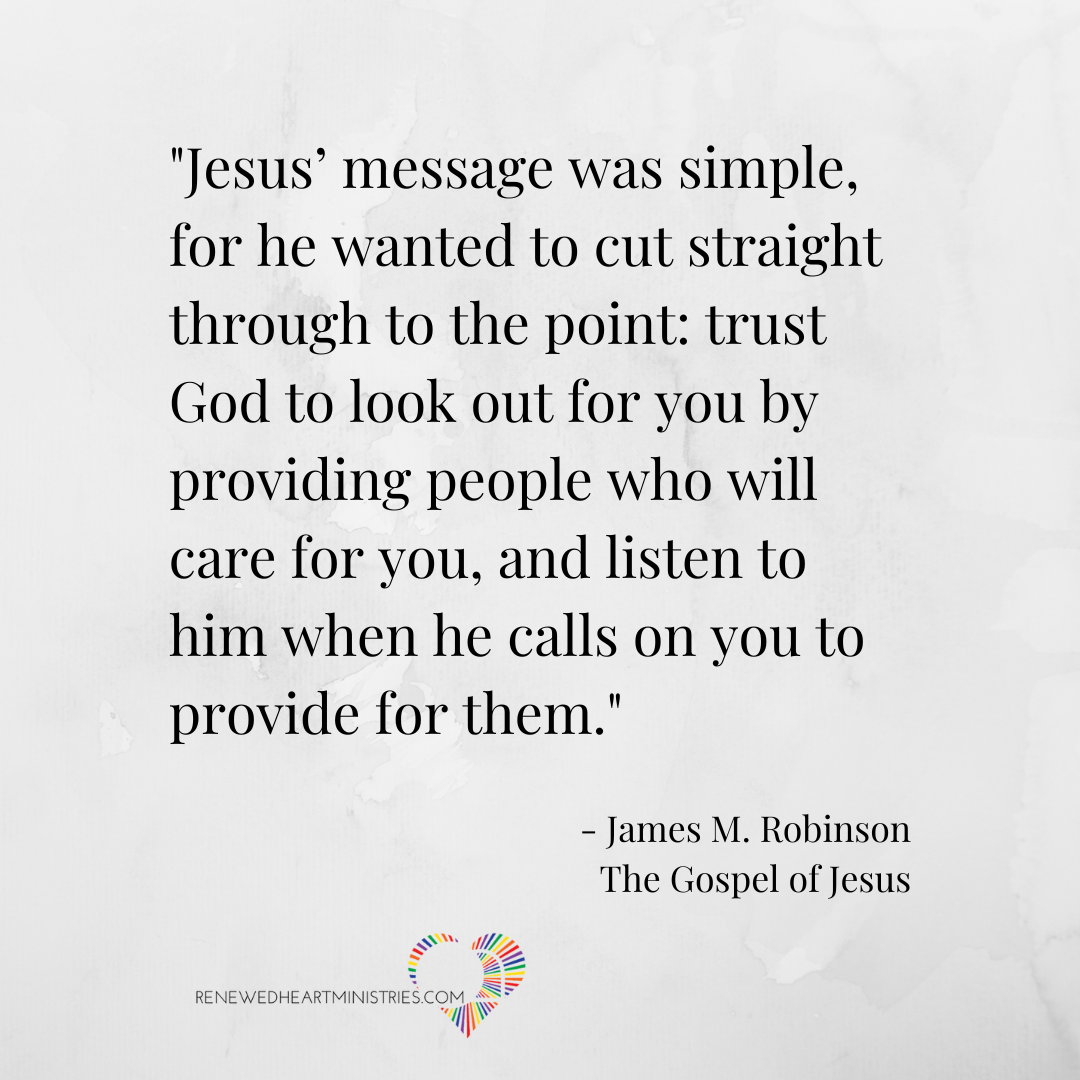
“Such ‘security’ [or hope] should be replaced by God reigning, which means both what I trust God to do (to activate you to share food with me) and what I hear God telling me to do (to share clothes with you). We should not carry money while bypassing the poor or wear a backpack with extra clothes and food while ignoring the cold and hungry lying in the gutter. This is why the beggars, the hungry, the depressed are fortunate: God, that is, those in whom God rules, those who hearken to God, will care for them. The needy are called upon to trust that God’s reigning is there for them (“Theirs is the kingdom of God”) . . . Jesus’ message was simple, for he wanted to cut straight through to the point: trust God to look out for you by providing people who will care for you, and listen to him when he calls on you to provide for them.” (James M. Robinson, The Gospel of Jesus, Kindle Location 71)

Paul’s letter to the Corinthians also suggests how the members of early Jesus communities practiced this:

“Our desire is not that others might be relieved while you are hard pressed, but that there might be equality. At the present time your plenty will supply what they need, so that in turn their plenty will supply what you need. The goal is equality.” (2 Corinthians 8:13)

How can wealth be used, today, not to give us individual, privatized security but to build community where our security is in each other, in people? The Jesus story is offering us two options, two competing places in which to “put our trust.” We can either put our hope in hoarding money against potential future hardships, or we can put our hope in a community of people who are dedicated to making sure their resources care for those in their community. Jesus’ way is about facing the future together, rather than alone. It’s about having each other’s back.

Here in the United States, we are continuing to move toward a society that leaves each person on their own. From Supreme Court rulings to local political supermajorities, we are shaping a country in such a way that leaves people on their own to pull themselves up by bootstraps they don’t even have. Those our system makes most vulnerable are the most being harmed.

Some societies and countries are deeply committed to democracy and also have strong social commitments to one another. They make sure community members’ needs are met. We, too, can still practice the freedom of democracy while we move toward making sure everyone in our democracy has what they need to thrive. These are not mutually exclusive goals. In fact, making sure everyone in our democracy is on level ground is deeply democratic in itself.

This call also harmonizes much more with the call of Jesus to work toward shaping a world where we are committed not to isolated, self-sufficiency in facing survival challenges on our own, but to practice the Golden Rule, love our neighbor as ourselves, and share with those who are in need. As the books of Acts says, “Each according to their ability, and each according to their needs.”

HeartGroup Application


1. Share something that spoke to you from this week’s eSight/Podcast episode with your HeartGroup.

2. How do you wish our society practiced more socially responsible care. Share that with your group.

3. What can you do this week, big or small, to continue setting in motion the work of shaping our world into a safe, compassionate, just home for everyone? 

Thanks for checking in with us, today.

I want to say a special thank you to all of our supporters out there. And if you would like to join them in supporting Renewed Heart Ministries’ work you can do so by going to renewedheartministries.com and clicking donate.

You can find Renewed Heart Ministries on Twitter, Facebook and Instagram. If you haven’t done so already, please follow us on your chosen social media platforms for our daily posts. Also, if you enjoy listening to the Jesus for Everyone podcast, please like and subscribe to the JFE podcast through the podcast platform you use and consider taking some time to give us a review. This helps others find our podcast as well.

Also I want to share that we are partnering in a new weekly YouTube show called “Just Talking.” Each week, Todd Leonard and I will be talking about the gospel lectionary reading for the upcoming weekend. We’ll be talking about each reading in the context of love, inclusion, and societal justice. Our hope is that our talking will be just talking (as in justice) and that during our brief conversations each week you’ll be inspired to also do more than just talking.

If you teach from the lectionary each week, or if you’re just looking for some thoughts on the Jesus story from a more progressive perspective within the context of social justice, check it out, you might like it. You can find JustTalking each week on YouTube at youtube.com/@herbandtoddjusttalking. Please Like, Subscribe, hit the Notification button, and leave us a comment.

And if you’d like to reach us here at Renewed Heart Ministries through email, you can reach us at info@renewedheartministries.com.

My new book, Finding Jesus: A story of a fundamentalist preacher who unexpectedly discovered the social, political, and economic teachings of the Gospels is now also available at renewedheartministries.com

Right where you are, keep living in love, choosing compassion, taking action, and working toward justice.

I love each of you dearly,

I’ll see you next week.


Now Available at Renewed Heart Ministries!

Herb’s new book Finding Jesus: A story of a fundamentalist preacher who unexpectedly discovered the social, political, and economic teachings of the Gospels, is available at renewedheartministries.com.

Get your copy today at renewedheartministries.com


Are you receiving all of RHM’s free resources each week?

Begin each day being inspired toward love, compassion, action, and justice. Free Sign-Up HERE

The Destructiveness of All or Nothing

We want to say a special thank you to all of our supporters out there. If you would like to join them in supporting Renewed Heart Ministries’ work you can do so by going to renewedheartministries.com and clicking donate.


New Episode of JustTalking!

Season 1, Episode 20: Matthew 11.16-19, 25-30. Lectionary A, Proper 9

Each week, we’ll be talking about the gospel lectionary reading for the upcoming weekend. We’ll be talking about each reading in the context of love, inclusion, and societal justice. Our hope is that our talking will be just talking (as in justice) and that during our brief conversations each week you’ll be inspired to also do more than just talking.

If you teach from the lectionary each week, or if you’re just looking for some thoughts on the Jesus story from a more progressive perspective within the context of social justice, check it out, you might like it.

You can find the latest show on YouTube at https://youtu.be/0fZtVrHzL7g

 or (@herbandtoddjusttalking)

Please Like, Subscribe, hit the Notification button, and leave us a comment

Thanks in advance for watching!


The Destructiveness of All or Nothing
Herb Montgomery | July 7, 2023

To listen to this week’s eSight as a podcast episode click here.

“By taking the Bible as an un-nuanced whole they are setting themselves up to always be
destined to exhibit “deeds” that mix life-giving and death-dealing practices. That’s why our own journeys within Christianity are often so complicated. All-or-nothing approaches set us up to try to follow a Christianity that is both extraordinarily beautiful in some regards and a nightmare in others. We must learn to choose between those things that are Christian but death-dealing and those things that are Christian and life-giving.”

Our reading this week is from the gospel of Matthew:

“To what can I compare this generation? They are like children sitting in the marketplaces and calling out to others:

‘We played the pipe for you,
and you did not dance;
we sang a dirge,
and you did not mourn.’

For John came neither eating nor drinking, and they say, ‘He has a demon.’ The Son of Man came eating and drinking, and they say, ‘Here is a glutton and a drunkard, a friend of tax collectors and sinners.’ But wisdom is proved right by her deeds.”

At that time Jesus said, “I praise you, Father, Lord of heaven and earth, because you have hidden these things from the wise and learned, and revealed them to little children. Yes, Father, for this is what you were pleased to do. All things have been committed to me by my Father. No one knows the Son except the Father, and no one knows the Father except the Son and those to whom the Son chooses to reveal him.

Come to me, all you who are weary and burdened, and I will give you rest. Take my yoke upon you and learn from me, for I am gentle and humble in heart, and you will find rest for your souls. For my yoke is easy and my burden is light.” (Matthew 11:16-19, 25-30)

There’s a lot in this week’s passage to unpack that could guide our justice work today. I love how our reading begins with John and Jesus being likened to pipers. John played a dirge; Jesus’ pipe called hearers to dance. Neither gets their desired response. John gets beheaded. Jesus gets crucified. But in the end, “Wisdom is proved right by her deeds.”

Two things resonate with me here. First is the feminine language for wisdom, in harmony with the Hebrew tradition. Second, she is proved right by the deeds to which she gives birth: wisdom produces deeds. It’s for us to discern from our own experience and the experiences of those not like ourselves whether what we think is wisdom has produced deeds that are life-giving or death dealing. It’s another way of saying, “by their fruits you will know them.”

Wisdom.

Is proved right.

By her deeds.

Are the actions being produced by so-called wisdom death-dealing? If they are, then we need to rethink what we have deemed to be wise.

I want to apply this to our faith tradition in a practical way for a moment. We can apply this principle to our expression of Christianity, our interpretations of the Bible, and the Bible itself, as well as the Jesus story within the Bible.

Let’s begin with the Bible. The Bible is not monolithic. The more one actually reads the Bible, the more one encounters passages in the scriptures that are life-giving and passages that are death-dealing. The Bible authors were trying make sense out of the world they were living in, within the bounds of their own time and space.

So this impacts how we relate to the Bible as a whole. I want to caution against an all-or-nothing kind of thinking. We can be honest about things in our sacred text that are not life-giving but destructive (its affirmation of slavery and texts of terror used against women are just two examples). And we can at the same time hold on to the things in the Bible that are beautifully good. We can hold on to the things that are life-giving, deeming them of enough positive value for us, yet not throwing our entire sacred text out because not everything in our sacred text has proven life-giving.

By their fruits we will know know them. Jesus practiced this method of interpreting his own sacred texts (cf. Luke 4:18-19 and Isaiah 61:1-2). We can take the good and let go of the bad by rightly discerning, or, to use Biblical language, “rightly dividing the word of truth” by testing passages by their fruit.

We can follow this same practice as we interpret specific passages as well. Sometimes it’s not the passage that is the problem but the way we have interpreted it. So we can hold our interpretations of texts to this same test: whether their fruit is life-giving or death-dealing, healing or destructive.

We can apply this to Christianity, holding its practices and doctrines to the test of “wisdom is proved right by her deeds.” And we can evaluate our interpretations of teachings we credit to the historical Jesus too. We can affirm the life-giving value of the Jesus story while also being honest about where the authors writing that story reflected the concerns and struggles of the early Jesus community out of which these stories evolved more than they reported direct transcripts from the historical Jesus. We can begin to embrace the humanity of Jesus himself, who “grew in wisdom and stature, and in favor with God and people” (Luke 2:52).

For those who object (I hear these voices loudly in my own head at times), it’s helpful to remember that there is really nothing more to be said if someone who views the Bible, or Christianity, or the Jesus story as an all-or-nothing deal, a book in which the authors never made mistakes or brought in their or their community’s concerns. By taking the Bible as an un-nuanced whole they are setting themselves up to always be destined to exhibit “deeds” that mix life-giving and death-dealing practices. That’s why our own journeys within Christianity are often so complicated. All-or-nothing approaches set us up to try to follow a Christianity that is both extraordinarily beautiful in some regards and a nightmare in others. We must learn to choose between those things that are Christian but death-dealing and those things that are Christian and life-giving. An all-or-nothing approach puts people in a place where they have to grapple with whether they are even Christian at all when nuance would give them a way to embrace the good while rejecting the bad.

Ultimately, we must instead learn to practice knowing something by its fruit or the deeds it produces. Even our sacred text can be embraced as being inspired by the Divine while having been written by humans. This allows us and it to not always get it right: neither it nor we are infallible. We are simply reaching for and attempting to find ways of answering the big questions that are life-giving. Sometimes we get it right; sometimes we do not. And some questions can’t be answered yet. It’s up to us to hold everything with an open hand, asking questions from our own to-the-best-of-our-knowledge context today. We can let go of things that are death-dealing and hold on to those things that are life-giving. And when we discover that something we thought was life-giving actually isn’t, we can then let go of that, giving way to making room to embrace that which is. We can always be in search of the most life-giving way to follow the life-giving Jesus today, not being threatened by discovering we’ve been wrong about something, and always reaching for what is true.

I feel like that’s enough this week for most of us to chew on, but there are two final things I want to address in our reading.

The exclusivity at the end our reading sounds more like the gospel of John than the Jesus we typically encounter in the synoptics. It may reflect the claims of the early Jesus community and their efforts to communicate Jesus’s importance through the language of exceptionalism.

Today, we can do better. We don’t have to put others down for Jesus and his teachings to be intrinsically valuable. And we don’t have to make Jesus the only source of life-giving things to emphasize the value of his teachings.

Lastly, I want to address the yoke of Jesus being easy and his burden being light. One’s social location matters here. This statement was addressed to those who were worn out from being over-burdened in that society. To them, the yoke of Jesus was much easier than the yoke of the system they were trying survive in. Jesus’ system of resource-sharing, mutual aid, and taking responsibility for ensuring the care and well being of one another was way easier than every person or family being for themselves in a society where every moment they were teetering between survival and catastrophe, living each day one at a time. Again, this statement was given to those whom that system had worn out and overburdened. For them, Jesus’ yoke/burden was easy and light. But for those benefiting from the present system, change would be different. It was “easier for a camel to go through the eye of a needle than for someone who is rich to enter the kingdom of God” (Matthew 19.24) and embrace the changes Jesus’ teachings called them and us to.

Again, there’s a lot in this week’s gospel lectionary reading. What in our reading this week is resonating with you?

HeartGroup Application

1. Share something that spoke to you from this week’s eSight/Podcast episode with your HeartGroup.

2. In what ways do you relate to the Bible or Christianity in nuanced ways, holding on to those things that are life-giving and rejecting those elements that are death-dealing. Discuss with your group.

3. What can you do this week, big or small, to continue setting in motion the work of shaping our world into a safe, compassionate, just home for everyone?

Thanks for checking in with us, today.

I want to say a special thank you to all of our supporters out there. And if you would like to join them in supporting Renewed Heart Ministries’ work you can do so by going to renewedheartministries.com and clicking donate.

You can find Renewed Heart Ministries on Twitter, Facebook and Instagram. If you haven’t done so already, please follow us on your chosen social media platforms for our daily posts. Also, if you enjoy listening to the Jesus for Everyone podcast, please like and subscribe to the JFE podcast through the podcast platform you use and consider taking some time to give us a review. This helps others find our podcast as well.

Also I want to share that we are partnering in a new weekly YouTube show called “Just Talking.” Each week, Todd Leonard and I will be talking about the gospel lectionary reading for the upcoming weekend. We’ll be talking about each reading in the context of love, inclusion, and societal justice. Our hope is that our talking will be just talking (as in justice) and that during our brief conversations each week you’ll be inspired to also do more than just talking.

If you teach from the lectionary each week, or if you’re just looking for some thoughts on the Jesus story from a more progressive perspective within the context of social justice, check it out, you might like it. You can find JustTalking each week on YouTube at youtube.com/@herbandtoddjusttalking. Please Like, Subscribe, hit the Notification button, and leave us a comment.

And if you’d like to reach us here at Renewed Heart Ministries through email, you can reach us at info@renewedheartministries.com.

My new book, Finding Jesus: A story of a fundamentalist preacher who unexpectedly discovered the social, political, and economic teachings of the Gospels is now also available at renewedheartministries.com

Right where you are, keep living in love, choosing compassion, taking action, and working toward justice.

I love each of you dearly,

I’ll see you next week.



Now Available at Renewed Heart Ministries!

Herb’s new book Finding Jesus: A story of a fundamentalist preacher who unexpectedly discovered the social, political, and economic teachings of the Gospels, is available at renewedheartministries.com.

Get your copy today at renewedheartministries.com


Are you receiving all of RHM’s free resources each week?

Begin each day being inspired toward love, compassion, action, and justice. Free Sign-Up HERE

Our Dependence on One Another

We want to say a special thank you to all of our supporters out there. If you would like to join them in supporting Renewed Heart Ministries’ work you can do so by going to renewedheartministries.com and clicking donate.


New Episode of JustTalking!

Season 1, Episode 19: Matthew 10.40-42. Lectionary A, Proper 8

Each week, we’ll be talking about the gospel lectionary reading for the upcoming weekend. We’ll be talking about each reading in the context of love, inclusion, and societal justice. Our hope is that our talking will be just talking (as in justice) and that during our brief conversations each week you’ll be inspired to also do more than just talking.

If you teach from the lectionary each week, or if you’re just looking for some thoughts on the Jesus story from a more progressive perspective within the context of social justice, check it out, you might like it.

You can find the latest show on YouTube at https://youtu.be/kFO67xwCAsw

 or (@herbandtoddjusttalking)

Please Like, Subscribe, hit the Notification button, and leave us a comment

Thanks in advance for watching!


Herb Montgomery | June 30, 2023

To listen to this week’s eSight as a podcast episode click here.

“We are dependent on each other whether we are willing to admit that or not. And rather than developing stalwart, privatized systems of self-sufficiency, we should work toward building community where each person is taken care of,  where we take responsibility for ensuring each person has what they need to thrive.”

Our reading this upcoming weekend is from the gospel of Matthew:

“Anyone who welcomes you welcomes me, and anyone who welcomes me welcomes the one who sent me. Whoever welcomes a prophet as a prophet will receive a prophet’s reward, and whoever welcomes a righteous person as a righteous person will receive a righteous person’s reward. And if anyone gives even a cup of cold water to one of these little ones who is my disciple, truly I tell you, that person will certainly not lose their reward.” (Matthew 10:40-42)

To get our heads around this week’s reading from the perspective of its original audience, we need to back up a bit. The subject here in Matthew 10 is Jesus’ instructions as he sends out early followers:

“Do not get any gold or silver or copper to take with you in your belts—no bag for the journey or extra shirt or sandals or a staff, for the worker is worth his keep. Whatever town or village you enter, search there for some worthy person and stay at their house until you leave. As you enter the home, give it your greeting. If the home is deserving, let your peace rest on it; if it is not, let your peace return to you. If anyone will not welcome you or listen to your words, leave that home or town and shake the dust off your feet.” (Matthew 10:9-14)

In the synoptic gospels (Mark, Matthew, and Luke), each version of these instructions differs slightly (cf. Mark 6:8-9, Luke 9:3; 10:4). But each version agrees that Jesus wasn’t sending out his followers to be independent, self-sufficient workers for Jesus’ vision of the new world. They were sent out to be wholly dependent on the hospitality, generosity, and resource-sharing of those to whom they were begin sent. This is important for our work today. 

Let’s try to understand the context around what’s happening in these passages. In his excellent book The Lost Way: How Two Forgotten Gospels Are Rewriting the Story of Christian Origins, Jesus scholar Stephen Patterson explains:

“It begins with a knock at the door. On the stoop stand two itinerant beggars, with no purse, no knapsack, no shoes, no staff. They are so ill-equipped that they must cast their fate before the feet of a would-be host. This is a point often made by historical Jesus scholar John Dominic Crossan. These Q folk are sort of like ancient Cynics, but their goal is not the Cynic goal of self-sufficiency; these itinerants are set only for dependency. To survive they must reach out to other human beings. They offer them peace—this is how the empire arrives. And if their peace is accepted, they eat and drink—this is how the empire of God is consummated, in table fellowship. Then another tradition is tacked on, beginning with the words ‘Whenever you enter a town.’ This is perhaps the older part of the tradition, for this, and only this, also has a parallel in the Gospel of Thomas (14). There is also an echo of it in Paul’s letter known as 1 Corinthians (10: 27). Here, as in the first tradition, the itinerants are instructed, ‘Eat what is set before you.’ Again, the first move is to ask. The empire comes when someone receives food from another. But then something is offered in return: care for the sick. The empire of God here involves an exchange: food for care.” (pp. 74-75)

This stands in contrast with economic and political soundbites today. Many in our American capitalist culture today expect the poor to pull themselves up by their own bootstraps in a system stacked against them. We live in a culture of independence, isolation, and self-sufficiency that ignores the reality that whether we like it or not, we are all connected. 

We are all dependent on one another for our survival. We are in this together. Social salvation means that if we are to be saved, no one is saved until everyone is saved. As King said, injustice anywhere is a threat to justice everywhere. What affects one, thought it affects others differently, affects us all because we are a part of each other. We are connected to each other. And one of the central tenets of the Jesus of the gospels is to love our neighbors as ourselves. 

Jesus wasn’t sending these disciples out as self-sufficient workers, but as disciples instructed to completely lean into our dependence on one another and make this their intentional practice. 

Not all followers of Jesus followed this instruction, however. The apostle Paul worked.

“Am I not free? Am I not an apostle? Have I not seen Jesus our Lord? Are you not the result of my work in the Lord? Even though I may not be an apostle to others, surely I am to you! For you are the seal of my apostleship in the Lord. This is my defense to those who sit in judgment on me. Don’t we have the right to food and drink? Don’t we have the right to take a believing wife along with us, as do the other apostles and the Lord’s brothers and Cephas? Or is it only I and Barnabas who lack the right to not work for a living? . . . If others have this right of support from you, shouldn’t we have it all the more? But we did not use this right. On the contrary, we put up with anything rather than hinder the gospel of Christ.” (1Corinthians 9.1-6, 12)

For whatever reason, Paul rejected dependence on those he served and choose a path of providing for himself—a practice of self-sufficient independence. But from this passage in Corinthians, we learn that he was the outlier here. Even in the Didache we see that Jesus’ original instruction was so practiced by the majority that some guidelines had to be added as a result of Jesus’ dependence instruction being abused:

“Let every apostle who comes to you be received as the Lord. But he shall not remain more than one day; or two days, if there’s a need. But if he remains three days, he is a false prophet. And when the apostle goes away, let him take nothing but bread until he lodges. If he asks for money, he is a false prophet.” (Didache: The Lords Teaching Through the Twelve Apostles to the Nations, Chapter 11) 

For Jesus followers today, this holds meaning for our justice work. We work to create a new world of mutual aid, resource-sharing, and a just wealth redistribution in the face of a world where a few have so much while too many don’t even have what they need to survive. As Jesus followers, we have to ask ourselves: does our programming of independence and being self-sufficient come from our American culture? Does it conflict with the teaching of Jesus? Does it even conflict with how our world really functions? We are dependent on each other whether we are willing to admit that or not. And rather than developing stalwart, privatized systems of self-sufficiency, we should work toward building community where each person is taken care of,  where we take responsibility for ensuring each person has what they need to thrive. 

I want to continue with Patterson’s words, because I think they are extremely relevant here:

“This warrants pause. Food for care. In the ancient world, those who lived on the margins of peasant life were never far from death’s door. In the struggle to survive, food was their friend and sickness their enemy. Each day subsistence peasants earn enough to eat for a day. Each day they awaken with the question: Will I earn enough to eat today? This is quickly followed by a second: Will I get sick today? If I get sick, I won’t eat, and if I don’t eat, I’ll get sicker. With each passing day the spiral of starvation and sickness becomes deeper and deeper and finally, deadly. Crossan has argued that this little snippet of ancient tradition is critical to understanding why the followers of Jesus and their empire of God were compelling to the marginalized peasants who were drawn to it. ‘Eat what is set before you and care for the sick.’ Here is the beginning of a program of shared resources of the most basic sort: food and care. It’s an exchange. If some have food, all will eat; if any get sick, someone who eats will be there to care for them. The empire of God was a way to survive—which is to say, salvation.” (pp. 74-75)

Years ago now I read a passage from historical Jesus scholar James Robinson that caused me to question whether I was preaching a gospel about Jesus or teaching the same gospel that Jesus himself taught:


“[Jesus’s] basic issue, still basic today, is that most people have solved the human dilemma for themselves at the expense of everyone else, putting them down so as to stay afloat themselves. This vicious, antisocial way of coping with the necessities of life only escalates the dilemma for the rest of society . . . I am hungry because you hoard food. You are cold because I hoard clothing. Our dilemma is that we all hoard supplies in our backpacks and put our trust in our wallets! Such ‘security’ should be replaced by God reigning, which means both what I trust God to do (to activate you to share food with me) and what I hear God telling me to do (to share clothes with you). We should not carry money while bypassing the poor or wear a backpack with extra clothes and food while ignoring the cold and hungry lying in the gutter. This is why the beggars, the hungry, the depressed are fortunate: God, that is, those in whom God rules, those who hearken to God, will care for them. The needy are called upon to trust that God’s reigning is there for them (“Theirs is the kingdom of God”) . . . Jesus’ message was simple, for he wanted to cut straight through to the point: trust God to look out for you by providing people who will care for you, and listen to him when he calls on you to provide for them.” (James M. Robinson, The Gospel of Jesus)

I know this flies in the face of much of how we are enculturated to live in our economic environment today. We learn early on that survival depends on competition instead of cooperation. That there is scarcity rather than enough for everyone. We are taught over time to hoard what we need rather than share with others who have needs. And this ultimately leads to us appealing to violence to protect our hoarded resources rather than a generosity that sees us rising or falling all together. Jesus’ early disciples were instructed to follow a practice of dependence and not lose sight of it. Our survival both economically and ecologically today is vitally connected to us embracing our dependence on one another. This week’s reading calls Jesus followers to take this to heart and let it inform how we live. 

HeartGroup Application

1. Share something that spoke to you from this week’s eSight/Podcast episode with your HeartGroup.

2. In what ways do you wish our society today acknowledged our connectedness to each other more? Discuss with your group.

3. What can you do this week, big or small, to continue setting in motion the work of shaping our world into a safe, compassionate, just home for everyone?

Thanks for checking in with us, today.

I want to say a special thank you to all of our supporters out there. And if you would like to join them in supporting Renewed Heart Ministries’ work you can do so by going to renewedheartministries.com and clicking donate. 

You can find Renewed Heart Ministries on Twitter, Facebook and Instagram. If you haven’t done so already, please follow us on your chosen social media platforms for our daily posts. Also, if you enjoy listening to the Jesus for Everyone podcast, please like and subscribe to the JFE podcast through the podcast platform you use and consider taking some time to give us a review. This helps others find our podcast as well.

Also I want to share that we are partnering in a new weekly YouTube show called “Just Talking.” Each week, Todd Leonard and I will be talking about the gospel lectionary reading for the upcoming weekend. We’ll be talking about each reading in the context of love, inclusion, and societal justice. Our hope is that our talking will be just talking (as in justice) and that during our brief conversations each week you’ll be inspired to also do more than just talking.

If you teach from the lectionary each week, or if you’re just looking for some thoughts on the Jesus story from a more progressive perspective within the context of social justice, check it out, you might like it. You can find JustTalking each week on YouTube at youtube.com/@herbandtoddjusttalking. Please Like, Subscribe, hit the Notification button, and leave us a comment.

And if you’d like to reach us here at Renewed Heart Ministries through email, you can reach us at info@renewedheartministries.com.

My new book, Finding Jesus: A story of a fundamentalist preacher who unexpectedly discovered the social, political, and economic teachings of the Gospels is now also available at renewedheartministries.com

Right where you are, keep living in love, choosing compassion, taking action, and working toward justice.

I love each of you dearly,

I’ll see you next week.


Now Available at Renewed Heart Ministries!

Herb’s new book Finding Jesus: A story of a fundamentalist preacher who unexpectedly discovered the social, political, and economic teachings of the Gospels, is available at renewedheartministries.com.

Get your copy today at renewedheartministries.com


Are you receiving all of RHM’s free resources each week?

Begin each day being inspired toward love, compassion, action, and justice. Free Sign-Up HERE


Refusing to Be Silent About Injustice

We want to say a special thank you to all of our supporters out there. If you would like to join them in supporting Renewed Heart Ministries’ work you can do so by going to renewedheartministries.com and clicking donate.


We’ll Be Back Next Week!

Each week, we’ll be talking about the gospel lectionary reading for the upcoming weekend. We’ll be talking about each reading in the context of love, inclusion, and societal justice. Our hope is that our talking will be just talking (as in justice) and that during our brief conversations each week you’ll be inspired to also do more than just talking.

If you teach from the lectionary each week, or if you’re just looking for some thoughts on the Jesus story from a more progressive perspective within the context of social justice, check it out, you might like it.

You can find the latest show on YouTube at https://youtu.be/MAYBXFTYygY

 or (@herbandtoddjusttalking)

Please Like, Subscribe, hit the Notification button, and leave us a comment

Thanks in advance for watching!


Herb Montgomery | June 23, 2023

To listen to this week’s eSight as a podcast episode click here.

“What does this passage have to say about how unsustainable our predatory and exploitative capitalist system today is, both environmentally and economically? What might our Gehenna look like today? Climate change scientists tell us that our Gehenna is coming too. Economic and environmental exploitation in the wake of the industrial revolution is unsustainable, period.”

This week’s reading is from the gospel of Matthew:

“The student is not above the teacher, nor a servant above his master. It is enough for students to be like their teachers, and servants like their masters. If the head of the house has been called Beelzebul, how much more the members of his household! 

“So do not be afraid of them, for there is nothing concealed that will not be disclosed, or hidden that will not be made known. What I tell you in the dark, speak in the daylight; what is whispered in your ear, proclaim from the roofs. Do not be afraid of those who kill the body but cannot kill the soul. Rather, be afraid of the One who can destroy both soul and body in Gehenna. Are not two sparrows sold for a penny? Yet not one of them will fall to the ground outside your Father’s care. And even the very hairs of your head are all numbered. So don’t be afraid; you are worth more than many sparrows.

“Whoever acknowledges me before others, I will also acknowledge before my Father in heaven. But whoever disowns me before others, I will disown before my Father in heaven.

“Do not suppose that I have come to bring peace to the earth. I did not come to bring peace, but a sword. For I have come to turn 

  ‘a man against his father,

a daughter against her mother,

a daughter-in-law against her mother-in-law—

  a man’s enemies will be the members of his own household.’ 

“Anyone who loves their father or mother more than me is not worthy of me; anyone who loves their son or daughter more than me is not worthy of me. Whoever does not take up their cross and follow me is not worthy of me. Whoever finds their life will lose it, and whoever loses their life for my sake will find it.” (Matthew 10:24-39)

This week’s reading reflects the struggles of the early Jesus community. When Matthew was written, Jesus followers were experiencing pushback and slander similar to what Jesus had experienced from those benefiting from the status quo. In our reading this week, the early Matthean community of Galilee hears Jesus encouraging them to expect being treated the same way he was treated as result of refusing to be silent about the thing Jesus also spoke out about (cf. Luke 4:18-19).

In this reading, they are encouraged to not fear those who can kill their bodies the same way they killed Jesus’ body. This community believed Jesus’ state murder and everything accomplished through his death had been overcome, undone, and reversed by God in the resurrection of Jesus. That’s why Jesus uses the language of killing the body but not killing the soul. What Jesus warns the listeners about next is being thrown whole into Gehenna. There would be no coming back from that. 

Let’s try to hear this language about Gehenna in its original Jewish context rather than in a modern Christian one. In the justice tradition of the Hebrew prophets, Gehenna had a rich history. Gehenna, the valley of the son of Hinnom, was a place where child sacrifice was practiced. Later it became a place where Gentile empires would raze Jerusalem and massacre the Jewish people. The reference in the gospels makes perfect sense: Matthew was written in the wake of Jerusalem being razed again, this time by Rome. Jerusalem’s total destruction  was what some Jews, including Jesus-followers, were trying to make sense of. Without the temple and without Jerusalem, it was as if the Jewish community had been thrown completely into Gehenna. 

Consider how Gehenna evolved in the scriptures:

“And [Ahaz, King of Judah] made offerings in THE VALLEY OF THE SON OF HINNOM, and made his sons pass through fire, according to the abominable practices of the nations whom the LORD drove out before the people of Israel.” (2 Chronicles 28:3)

“He made his son pass through fire in THE VALLEY OF THE SON OF HINNOM, practiced soothsaying and augury and sorcery, and dealt with mediums and with wizards. He did much evil in the sight of the LORD, provoking him to anger.” (2 Chronicles 33:6)

“And they go on building the high place of Topheth, which is in THE VALLEY OF THE SON OF HINNOM, to burn their sons and their daughters in the fire—which I did not command, nor did it come into my mind. Therefore, the days are surely coming, says the LORD, when it will no more be called Topheth, or THE VALLEY OF THE SON OF HINNOM, but THE VALLEY OF SLAUGHTER: for they will bury in Topheth until there is no more room.” (Jeremiah 7:31–32)

“The word that came to Jeremiah from the LORD: Stand in the gate of the LORD’S house, and proclaim there this word, and say, Hear the word of the LORD, all you people of Judah, you that enter these gates to worship the LORD. Thus says the LORD of hosts, the God of Israel: Amend your ways and your doings, and let me dwell with you in this place. Do not trust in these deceptive words: ‘This is the temple of the LORD, the temple of the LORD, the temple of the LORD.’ For if you truly amend your ways and your doings, if you truly act justly one with another, if you do not oppress the alien, the orphan, and the widow, or shed innocent blood in this place, and if you do not go after other gods to your own hurt, then I will dwell with you in this place, in the land that I gave of old to your ancestors forever and ever. Here you are, trusting in deceptive words to no avail. Will you steal, murder, commit adultery, swear falsely, make offerings to Baal, and go after other gods that you have not known, and then come and stand before me in this house, which is called by my name, and say, ‘We are safe!’—only to go on doing all these abominations? Has this house, which is called by my name, become a den of robbers in your sight? You know, I too am watching, says the LORD.” (Jeremiah 7:1–11, emphasis added.)

It’s telling that the gospel authors put Jeremiah’s words in Jesus’s mouth during his temple protest against exploitation of the poor. Jesus flips over the money changers’ tables, saying “You have made this house a den of robbers.” 

One last passage from Jeremiah:

“And go out to the VALLEY OF THE SON OF HINNOM (Gehenna) at the entry of the Potsherd Gate, and proclaim there the words that I tell you. You shall say: Hear the word of the LORD, O kings of Judah and inhabitants of Jerusalem. Thus says the LORD of hosts, the God of Israel: I am going to bring such disaster upon this place that the ears of everyone who hears of it will tingle. Because the people have forsaken me, and have profaned this place by making offerings in it to other gods whom neither they nor their ancestors nor the kings of Judah have known; and because they have filled this place with the blood of the innocent, and gone on building the high places of Baal to burn their children in the fire as burnt offerings to Baal, which I did not command or decree, nor did it enter my mind. Therefore the days are surely coming, says the LORD, when this place shall no more be called Topheth, OR THE VALLEY OF THE SON OF HINNOM, but THE VALLEY OF SLAUGHTER.” (Jeremiah 19:2–6)

I want to be clear. Jerusalem was not destroyed by Rome in 70 C.E . because God was punishing Jews for rejecting Jesus. This trope by Christians has had a long harmful history for Jewish people. The destruction of Jerusalem was instead brought about in the wake of the Jewish-Roman war of 66-69 C.E. This war resulted from the rich exploiting the poor and poor people revolting, taking over the temple, burning the records of their debt, and ultimately making Jerusalem their center of operations as they struck Rome itself. Their revolt provoked  the full weight of the Roman Empire coming down on their heads. 

In this week’s reading, then, the original audience would have heard Jesus encouraging them not to fear being killed for following him as he spoke out against the exploitation of the poor. They would have heard him advising them to fear remaining silent, to not go along with  exploitation that would plunge all of Jerusalem into a “Gehenna” at the hands of Rome. Again, it’s important to remember this was all written after the fact, with the community’s hindsight helping them to map social, political and economic causes for what they had just gone through.

What does this passage have to say about how unsustainable our predatory and exploitative capitalist system today is, both environmentally and economically? What might our Gehenna look like today? Climate change scientists tell us that our Gehenna is coming too. Economic and environmental exploitation in the wake of the industrial revolution is unsustainable, period.

Matthew’s community would have heard Jesus say that speaking out against injustice is divisive: it divides like a sword. And in that world, family ties were more than just relationships, they were also the means of economic survival. But for Jesus, preserving family ties was not a higher priority than speaking out against injustice or the harm being done to those their society had made vulnerable. 

Lastly, Jesus encourages his followers to take up their own crosses. I want to be very careful here. Too often Christians have told victims of abuse and injustice that they must simply bear their cross. This is effectively saying the opposite of our reading this week: it would mean to keep silent and passively bearing injustice. 

But in the context of our reading, remember that Jesus followers are threatened with the cross for speaking out against injustice. Bearing a cross is not inherent to following Jesus. A cross is only invoked when those with power and privilege become threatened by egalitarian change and threaten those calling for change if they don’t shut up. 

To people in that situation, Jesus is saying, don’t be silent. Speak out, resist, keep calling for change, even if they threaten you with a cross for doing so. It is better to take up one’s cross, to speak out against injustice and harm, than to lose your soul, your very being, who you are and your commitment to justice, by choosing to be silent in the face of injustice.

What does it mean to follow Jesus in the context of what we are facing today?

HeartGroup Application

1. Share something that spoke to you from this week’s eSight/Podcast episode with your HeartGroup.

2. In what ways to you choose to not be silent in the face of injustice today? Discuss with your group.

3. What can you do this week, big or small, to continue setting in motion the work of shaping our world into a safe, compassionate, just home for everyone?

Thanks for checking in with us, today.

I want to say a special thank you to all of our supporters out there. And if you would like to join them in supporting Renewed Heart Ministries’ work you can do so by going to renewedheartministries.com and clicking donate. 

You can find Renewed Heart Ministries on Twitter, Facebook and Instagram. If you haven’t done so already, please follow us on your chosen social media platforms for our daily posts. Also, if you enjoy listening to the Jesus for Everyone podcast, please like and subscribe to the JFE podcast through the podcast platform you use and consider taking some time to give us a review. This helps others find our podcast as well.

Also I want to share that we are partnering in a new weekly YouTube show called “Just Talking.” Each week, Todd Leonard and I will be talking about the gospel lectionary reading for the upcoming weekend. We’ll be talking about each reading in the context of love, inclusion, and societal justice. Our hope is that our talking will be just talking (as in justice) and that during our brief conversations each week you’ll be inspired to also do more than just talking.

If you teach from the lectionary each week, or if you’re just looking for some thoughts on the Jesus story from a more progressive perspective within the context of social justice, check it out, you might like it. You can find JustTalking each week on YouTube at youtube.com/@herbandtoddjusttalking. Please Like, Subscribe, hit the Notification button, and leave us a comment.

And if you’d like to reach us here at Renewed Heart Ministries through email, you can reach us at info@renewedheartministries.com.

My new book, Finding Jesus: A story of a fundamentalist preacher who unexpectedly discovered the social, political, and economic teachings of the Gospels is now also available at renewedheartministries.com

Right where you are, keep living in love, choosing compassion, taking action, and working toward justice.

I love each of you dearly,

I’ll see you next week.


Now Available at Renewed Heart Ministries!

Herb’s new book Finding Jesus: A story of a fundamentalist preacher who unexpectedly discovered the social, political, and economic teachings of the Gospels, is available at renewedheartministries.com.

Get your copy today at renewedheartministries.com


Are you receiving all of RHM’s free resources each week?

Begin each day being inspired toward love, compassion, action, and justice. Free Sign-Up HERE

A Different Iteration of our Present World

We want to say a special thank you to all of our supporters out there. If you would like to join them in supporting Renewed Heart Ministries’ work you can do so by going to renewedheartministries.com and clicking donate.


This Week’s Episode of Just Talking Available on YouTube

New Episode of “Just Talking” Now Online!

Season 1, Episode 17: Matthew 9.9-13, 18-26. Lectionary A, Proper 5

Each week, we’ll be talking about the gospel lectionary reading for the upcoming weekend. We’ll be talking about each reading in the context of love, inclusion, and societal justice. Our hope is that our talking will be just talking (as in justice) and that during our brief conversations each week you’ll be inspired to also do more than just talking.

If you teach from the lectionary each week, or if you’re just looking for some thoughts on the Jesus story from a more progressive perspective within the context of social justice, check it out, you might like it.

You can find the latest show on YouTube at https://youtu.be/MAYBXFTYygY

 or (@herbandtoddjusttalking)

Please Like, Subscribe, hit the Notification button, and leave us a comment

Thanks in advance for watching!


A Different Iteration of our Present World

Herb Montgomery | June 16, 2023

To listen to this week’s eSight as a podcast episode click here.

If we are choosing the unmentioned themes over the centerpiece of the Jesus stories, we have to ask ourselves why we are avoiding the central tenet of Jesus’ teachings in favor of a future or individual, privatized, and inward focus that leaves us unconcerned about social injustices and leaves our unjust systems unchallenged and unchanged.

Our reading this week is from the gospel of Matthew:

Jesus went through all the towns and villages, teaching in their synagogues, proclaiming the good news of the kingdom and healing every disease and sickness. When he saw the crowds, he had compassion on them, because they were troubled and helpless, like sheep without a shepherd. Then he said to his disciples, “The harvest is plentiful but the workers are few. Ask the Lord of the harvest, therefore, to send out workers into his harvest field.”

Jesus called his twelve disciples to him and gave them authority to drive out impure spirits and to heal every disease and sickness.

These are the names of the twelve apostles: first, Simon (who is called Peter) and his brother Andrew; James son of Zebedee, and his brother John; Philip and Bartholomew; Thomas and Matthew the tax collector; James son of Alphaeus, and Thaddaeus; Simon the Zealot and Judas Iscariot, who betrayed him.

These twelve Jesus sent out with the following instructions: “Do not go among the Gentiles or enter any town of the Samaritans. Go rather to the lost sheep of Israel. As you go, proclaim this message: ‘The kingdom of heaven has come near.’ Heal the sick, raise the dead, cleanse those who have leprosy, drive out demons. Freely you have received; freely give. (Matthew 9:35-10:8)

The first thing that jumps out at me in this week’s reading is the connection between the preaching of the kingdom and acts of healing. The kingdom was to be linked in people’s hearts with the act of healing and liberating them from whatever they were suffering in the here and now. To really get our heads around this, let’s first look at Jesus’ compassionate response to those who were troubled and helpless.

Our reading says that when Jesus saw the crowds, he “had compassion on them, because they were troubled and helpless,” like sheep without a shepherd. He then spoke to his disciples of a plentiful harvest with too few laborers to go out and get it. There is a lot to unpack here. 

The Christian church has historically used the image of a harvest as a metaphor for Christian evangelism. But that doesn’t work in this context. Why would Jesus respond to people being oppressed and being helpless by calling for more workers to save souls for heaven. There is a disconnect with this passage that I don’t often hear folks point out. “Harvest” in this passage speaks of something much different. 

First, Jesus’ people were troubled, harassed, pushed to the edges and undersides of the empire, and helpless to do anything about it! Jesus then speaks of a harvest. It helps to think of harvest through a more Jewish lens, one that Jesus himself would have used. A harvest metaphor makes a lot more sense given that context. 

In the Hebrew scriptures, the harvest was associated with justice: everyone receiving enough to thrive from the hand of the God of the Torah. In fact, the people weren’t even supposed to harvest the entirety of their fields so that those living in poverty could go and glean enough to survive (Leviticus 19:9-10, Leviticus 23:22, Deuteronomy 24:19-22).

When Jesus responds to people being troubled and helpless by saying that the harvest is plentiful, he’s confessing that everything needed for their thriving is present but that the people  are being prevented from accessing what they need. Picture a field full of grain but hungry people being prevented from being able to go into the field and harvest the grain they desperately need in order to be fed (see Matthew 12:1).

What Jesus was calling for was access to rights being denied. It was a call to society-wide justice in the face of an elite few who were prospering economically at the expense of the masses. Jesus’ God was sending sunshine and rain on all equally (Matthew 5:45), so if any did not experience what they needed to thrive, we must ask ourselves who was preventing them from receiving what they needed. What Jesus is calling for when he calls for workers for the harvest, then, is not evangelists religiously saving souls for post mortem bliss, but those who work for social justice.

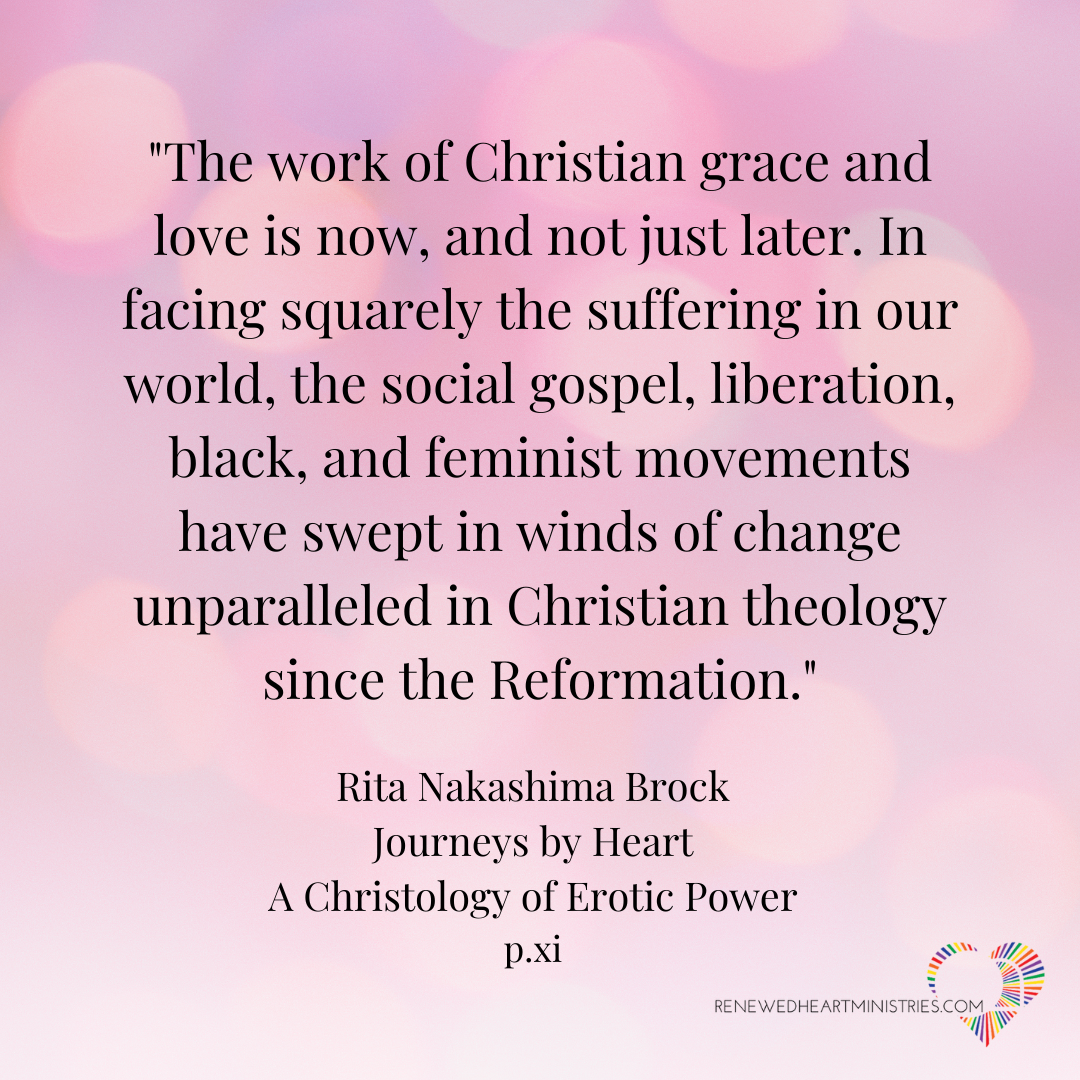
The kingdom that Jesus preached is also associated in the reading with exorcisms and healings. In the book Journeys by Heart: A Christology of Erotic Power (this month’s recommended reading from RHM), Rita Nakashima Brock points out that, in the Jesus stories, exorcisms were associated with political liberation (Mark 5:9) while healing stories were often associated with social liberation (Mark 5:25). Again, the kingdom, whatever we make of it today, was about people experiencing a liberation marked by them receiving enough to thrive. The kingdom was Jesus’ vision of a world where no one had too much while others didn’t have enough.

Now let’s return to this kingdom theme in the Jesus stories. In the synoptics and the book of Acts, Jesus’ gospel was not about getting to heaven. And as important of a corrective to abusive religion as the idea has been, Jesus’ gospel was not about a God who loves you. Don’t misunderstand me here. Both heaven and God’s love are important themes and have been life-giving to many Christians. But they simply aren’t Jesus message in the synoptics or the book of Acts. In fact, in Acts, where the gospel goes out to all the world, the disciples do not mention hell, heaven as a destination for us, or Divine love. What the gospel does proclaim is “the kingdom.”

Consider the following passages. 

After John was put in prison, Jesus went into Galilee, proclaiming the good news of God. “The time has come,” he said. “The kingdom of God has come near. Repent and believe the good news [euangelion – gospel]!” (Mark 1:14-15)

Jesus went throughout Galilee, teaching in their synagogues, proclaiming the good news [euangelion] of the kingdom, and healing every disease and sickness among the people. (Matthew 4:23)

As you go, proclaim this message: ‘The kingdom of heaven has come near.’ Heal the sick, raise the dead, cleanse those who have leprosy, drive out demons. Freely you have received, freely give. (Matthew 10:7-8)

But he said, “I must proclaim the good news [euangelion] of the kingdom of God to the other towns also, because that is why I was sent.” (Luke 4:43)

Heal the sick who are there and tell them, ‘The kingdom of God has come near to you.’ (Luke 10:9)

So they set out and went from village to village, proclaiming the good news [euangelion] and healing people everywhere. (Luke 9:6)

But when they believed Philip as he proclaimed the good news of the kingdom of God and the name of Jesus Christ, they were baptized, both men and women. (Acts 8:12)

Paul entered the synagogue and spoke boldly there for three months, arguing persuasively about the kingdom of God. (Acts 19:8)

Now I know that none of you among whom I have gone about preaching the kingdom will ever see me again. (Acts 20:25)

They arranged to meet Paul on a certain day, and came in even larger numbers to the place where he was staying. He witnessed to them from morning till evening, explaining about the kingdom of God, and from the Law of Moses and from the Prophets he tried to persuade them about Jesus. (Acts 28.23)

For two whole years Paul stayed there in his own rented house and welcomed all who came to see him. He proclaimed the kingdom of God and taught about the Lord Jesus Christ—with all boldness and without hindrance. (Acts 28:30-31)

Today the language of kingdom is problematic. Many no longer believe a kingdom is the best way to organize human society, and many subscribe to some form of democracy, not a kingdom. Secondly, a kingdom is deeply patriarchal and not the best language for the egalitarian world Jesus envisioned in his teachings.

Today we can and should call it something else. Many do. One of my favorite alternatives is Kelly Brown Douglas’ language of “God’s just future already breaking into the present.” I’ve written at length on various life-giving ways we can envision Jesus’ kingdom in chapter 5 of my book Finding Jesus. Whatever we call it, Jesus’ kingdom preaching was about a world that is compassionate, safe, just home for all, especially prioritizing those our status quo is marginalizing and making vulnerable to harm.

Too often, when people speak of the gospel today, they’re aren’t referring to Jesus’ vision for a world where no one is harmed in the here and now. If they do, they receive the pushback of being “too political.” I find this sad. As Jesus followers we should not see people being harmed as a tool to be exploited by a political party, but as people who are objects of Divine value and worth, people who are being harmed, and people who we are called to care for. It’s fine to be passionate about heaven and God’s love, but not at the expense of Jesus’ kingdom. If we are choosing the unmentioned themes over the centerpiece of the Jesus stories, we have to ask ourselves why we are avoiding the central tenet of Jesus’ teachings in favor of a future or individual, privatized, and inward focus that leaves us unconcerned about social injustices and leaves our unjust systems unchallenged and unchanged. 

Jesus’ kingdom calls each of us to participate in choosing and creating a different iteration of our present world, a world that is a safe, compassionate, just home for all.

HeartGroup Application

1. Share something that spoke to you from this week’s eSight/Podcast episode with your HeartGroup.

2. How does this more “kingdom” focus in our passage this week shape your own Jesus following? Discuss with your group.

3. What can you do this week, big or small, to continue setting in motion the work of shaping our world into a safe, compassionate, just home for everyone?

Thanks for checking in with us, today.

I want to say a special thank you to all of our supporters out there. And if you would like to join them in supporting Renewed Heart Ministries’ work you can do so by going to renewedheartministries.com and clicking donate. 

You can find Renewed Heart Ministries on Twitter, Facebook and Instagram. If you haven’t done so already, please follow us on your chosen social media platforms for our daily posts. Also, if you enjoy listening to the Jesus for Everyone podcast, please like and subscribe to the JFE podcast through the podcast platform you use and consider taking some time to give us a review. This helps others find our podcast as well.

Also I want to share that we are partnering in a new weekly YouTube show called “Just Talking.” Each week, Todd Leonard and I will be talking about the gospel lectionary reading for the upcoming weekend. We’ll be talking about each reading in the context of love, inclusion, and societal justice. Our hope is that our talking will be just talking (as in justice) and that during our brief conversations each week you’ll be inspired to also do more than just talking.

If you teach from the lectionary each week, or if you’re just looking for some thoughts on the Jesus story from a more progressive perspective within the context of social justice, check it out, you might like it. You can find JustTalking each week on YouTube at youtube.com/@herbandtoddjusttalking. Please Like, Subscribe, hit the Notification button, and leave us a comment.

And if you’d like to reach us here at Renewed Heart Ministries through email, you can reach us at info@renewedheartministries.com.

My new book, Finding Jesus: A story of a fundamentalist preacher who unexpectedly discovered the social, political, and economic teachings of the Gospels is now also available at renewedheartministries.com

Right where you are, keep living in love, choosing compassion, taking action, and working toward justice.

I love each of you dearly,

I’ll see you next week.


Now Available at Renewed Heart Ministries!

Herb’s new book Finding Jesus: A story of a fundamentalist preacher who unexpectedly discovered the social, political, and economic teachings of the Gospels, is available at renewedheartministries.com.

Get your copy today at renewedheartministries.com


Are you receiving all of RHM’s free resources each week?

Begin each day being inspired toward love, compassion, action, and justice. Free Sign-Up HERE

Jesus, Jarius, and Respect for the Bodily Autonomy of Women

We want to say a special thank you to all of our supporters out there. If you would like to join them in supporting Renewed Heart Ministries’ work you can do so by going to renewedheartministries.com and clicking donate. 

This Week’s Episode of Just Talking Available on YouTube

New Episode of “Just Talking” Now Online!

Season 1, Episode 17: Matthew 9.9-13, 18-26. Lectionary A, Proper 5

Each week, we’ll be talking about the gospel lectionary reading for the upcoming weekend. We’ll be talking about each reading in the context of love, inclusion, and societal justice. Our hope is that our talking will be just talking (as in justice) and that during our brief conversations each week you’ll be inspired to also do more than just talking.

If you teach from the lectionary each week, or if you’re just looking for some thoughts on the Jesus story from a more progressive perspective within the context of social justice, check it out, you might like it.

You can find the latest show on YouTube at https://youtu.be/QioBr152Cu0

 or (@herbandtoddjusttalking)

Please Like, Subscribe, hit the Notification button, and leave us a comment

Thanks in advance for watching!


Jesus, Jarius, and Respect for the Bodily Autonomy of Women

Herb Montgomery | June 9, 2023

To listen to this week’s eSight as a podcast episode click here.

“To Christians today who want to use political power to make it much more dangerous to be a woman, what can the life-giving Jesus of our reading this week say? It would do us well to pause and sit for a time with these stories.”

Our reading this week is from the gospel of Matthew:

As Jesus went on from there, he saw a man named Matthew sitting at the tax collector’s booth. “Follow me,” he told him, and Matthew got up and followed him. 

While Jesus was having dinner at Matthew’s house, many tax collectors and sinners came and ate with him and his disciples. When the Pharisees saw this, they asked his disciples, “Why does your teacher eat with tax collectors and sinners?” On hearing this, Jesus said, “It is not the healthy who need a doctor, but the sick. But go and learn what this means: ‘I desire mercy, not sacrifice.’ For I have not come to call the righteous, but sinners.”

While he was saying this, a synagogue leader came and knelt before him and said, “My daughter has just died. But come and put your hand on her, and she will live.” Jesus got up and went with him, and so did his disciples. Just then a woman who had been subject to bleeding for twelve years came up behind him and touched the edge of his cloak. She said to herself, “If I only touch his cloak, I will be healed.” Jesus turned and saw her. “Take heart, daughter,” he said, “your faith has healed you.” And the woman was healed at that moment.

When Jesus entered the synagogue leader’s house and saw the noisy crowd and people playing pipes, he said, “Go away. The girl is not dead but asleep.” But they laughed at him. After the crowd had been put outside, he went in and took the girl by the hand, and she got up. News of this spread through all that region. (Matthew 9:9-13, 18-26)

Having spent a lot of time in John in the lectionary this year so far, we are used to Jesus calling his listeners to “know.” In the synoptics, Jesus’ call is a little different: it’s always, “Follow me.” This is a call to action. It’s a call to emulate Jesus’ model of a life of love and justice. The Synoptics call is to follow (See Mark 2:14; Luke 5:27-28).

What I also love in the first part of our reading this week is that Jesus seems to be looking at people through the lens of healing and restoration, of making them whole. He doesn’t use a lens of obedience with punitive punishments or rewards. Instead of punishing those judged morally inferior and withholding his association from them, Jesus sees all the people in the story through a much more dynamic set of lenses. 

Jesus is well aware that tax collectors are part of the privileged social class of his day. And he knows the harm they have done. Yet he sees these as symptoms, signs that they’ve been harmed themselves. His ministry of restoring the humanity of the excluded and marginalized also extends to those harming them. They, too, need healing. Hurt people, as the saying goes, hurt people. Jesus seeks to heal the hurt and restore people’s relationships with themselves and with others. It’s a holistic view of the economic and social harms as well as those responsible for those harms. If we follow Jesus, we will also ask, what is broken and needs healing in a person that causes them to want to harm others politically, economically, or socially (see also Mark 2:17; Luke 5:31-32)?

Next the gospels introduce us to Jairus and his daughter. To the best of our knowledge, Matthew and Luke both take this story from Mark (Mark 5:21-43; Luke 8:40-56). Then, in the middle of the story of Jairus’ daughter is a different story of a woman and her healing (see also Mark 5:24-34; Luke 8:42-48).

One thing that bothers me about these stories is that they focus on a woman and little girl, yet only the male involved is named. We know Jairus by name, but not the woman nor the girl. This speaks to me, once again, of the patriarchal context in which these stories were passed down. Both the girl and the woman had names. I imagine that when the stories were originally told, their names were used. What caused these characters to become nameless objects playing a narrative role rather than the human beings their names originally communicated? I wish their names had been preserved alongside of Jairus’ name. 

So what lessons can we glean for our justice work today from these two stories?

I’m deeply indebted to the work of Rita Nakishima Brock for how I read the stories of this woman and this little girl. I recommend her book Journeys By Heart: A Christology of Erotic Power, especially Chapter 4, for a fuller treatment of these stories. Brock demonstrates how, whereas exorcism stories in the gospels are often addressing political domination and subjugation, the healing stories are often addressing social structures of injustice. 

The story of the woman with the bleeding has a strong social dimension. Her illness was a sentence of social death due to the purity codes that her bleeding continually violated. In male-dominated cultures, female sexuality and reproduction are controlled by men. Women’s reproductive ability is not their choice but governed by men to meet patriarchal needs. 

Also, within these patriarchal cultures, control of a woman’s sexual activity is coupled with labelling women’s bodies, bleeding, birthing, and genitalia as unclean. In the context of our patriarchal society today, this woman’s story represents a social reality that women still experience. 

The narrative placement of this story is also important. The story of the woman who has been bleeding for 12 years is right in the middle of the story of a little girl who is 12, just beginning menstruation and so starting to be defined as a woman by her patriarchal culture. Both are in or entering a kind of social death, and are considered inferior to the men around her. These are all signals that we are to read these stories together.


As Brock writes, “Both females are afflicted with crises associated with the status of women in Greco-Roman and Hebraic society” (p. 83). Within these cultures, the woman is “plagued” with a disease connected to having an adult female body, while the little girl is on the threshold of puberty. The woman has already suffered for the same length of time it has taken the girl to reach puberty. Both women are suffering because they are female. 

In Matthew’s version of this story, Jairus says, “My daughter has just died.” The juxtaposition of the bleeding woman gives us another hint of what connects them. By coming of age, Jairus’ daughter has just socially died in the patriarchy, but both she and the older women are about to encounter the life-giving and healing Jesus represented and that the early Jesus community envisioned for women. 

This story screams to me of the injustices many women suffer today for simply being a woman. Simply because their anatomy is different from men’s, they suffer in a society that privileges one kind of anatomy over another. As binary as this is, it doesn’t even begin to address the struggle so many trans folk have today in a society that privileges cisgender men above all else.

In both these stories, Jesus represents liberation and restoration of life for a woman and little girl whose patriarchal culture was death-dealing. 

What does this say to us today? What does it say to a faith-based community that still has yet to offer equality to women, refusing to ordain women as ministers alongside men, some of whom have proven to be less qualified but have their job because they happen to be men. 

And what does this story say to those Christians who in our larger society are seeking to control women’s sexuality, reproductive rights, bodily autonomy, and access to needed health care? The movement to deny women rights to control their own bodies and health is the direct result of a certain group of Christians who have not allowed the Jesus of this week’s stories to confront their own biases and misogyny. 

To Christians today who want to use political power to make it much more dangerous to be a woman, what can the life-giving Jesus of our reading this week say? 

It would do us well to pause and sit for a time with these stories. Let’s allow them to confront and challenge us. Is our pro-life stance really life-giving? Or could respecting a woman’s bodily autonomy and healthcare decisions be more in line with the Jesus we encounter in this week’s stories? If we can’t see the connections yet, let’s sit with our assumptions until we can. 

HeartGroup Application

1. Share something that spoke to you from this week’s eSight/Podcast episode with your HeartGroup.

2. Share one insight you gain from interpreting these stories in the context of social injustice for women? Discuss with your group.

3. What can you do this week, big or small, to continue setting in motion the work of shaping our world into a safe, compassionate, just home for everyone?

Thanks for checking in with us, today.

I want to say a special thank you to all of our supporters out there. And if you would like to join them in supporting Renewed Heart Ministries work you can do so by going to renewedheartministries.com and clicking donate. 

You can find Renewed Heart Ministries on Twitter, Facebook and Instagram. If you haven’t done so already, please follow us on your chosen social media platforms for our daily posts. Also, if you enjoy listening to the Jesus for Everyone podcast, please like and subscribe to the JFE podcast through the podcast platform you use and consider taking some time to give us a review. This helps others find our podcast as well.

Also I want to share that we are partnering in a new weekly YouTube show called “Just Talking.” Each week, Todd Leonard and I will be talking about the gospel lectionary reading for the upcoming weekend. We’ll be talking about each reading in the context of love, inclusion, and societal justice. Our hope is that our talking will be just talking (as in justice) and that during our brief conversations each week you’ll be inspired to also do more than just talking.

If you teach from the lectionary each week, or if you’re just looking for some thoughts on the Jesus story from a more progressive perspective within the context of social justice, check it out, you might like it. You can find JustTalking each week on YouTube at youtube.com/@herbandtoddjusttalking. Please Like, Subscribe, hit the Notification button, and leave us a comment.

And if you’d like to reach us here at Renewed Heart Ministries through email, you can reach us at info@renewedheartministries.com.

My new book, Finding Jesus: A story of a fundamentalist preacher who unexpectedly discovered the social, political, and economic teachings of the Gospels is now also available at renewedheartministries.com

Right where you are, keep living in love, choosing compassion, taking action, and working toward justice.

I love each of you dearly,

I’ll see you next week.


Now Available at Renewed Heart Ministries!

Herb’s new book Finding Jesus: A story of a fundamentalist preacher who unexpectedly discovered the social, political, and economic teachings of the Gospels, is available at renewedheartministries.com.

Get your copy today at renewedheartministries.com


Are you receiving all of RHM’s free resources each week?

Begin each day being inspired toward love, compassion, action, and justice. Free Sign-Up HERE

Obeying What Jesus Taught

This Week’s Episode of Just Talking Available on YouTube

New Episode of “Just Talking” Now Online!

Season 1, Episode 16: Matthew 28.16-20. Lectionary A, Proper 4, Trinity Sunday

Each week, we’ll be talking about the gospel lectionary reading for the upcoming weekend. We’ll be talking about each reading in the context of love, inclusion, and societal justice. Our hope is that our talking will be just talking (as in justice) and that during our brief conversations each week you’ll be inspired to also do more than just talking.

If you teach from the lectionary each week, or if you’re just looking for some thoughts on the Jesus story from a more progressive perspective within the context of social justice, check it out, you might like it.

You can find the latest show on YouTube at https://youtu.be/fW1lToP8HQ0

 or (@herbandtoddjusttalking)

Please Like, Subscribe, hit the Notification button, and leave us a comment

Thanks in advance for watching!


Herb Montgomery | June 2, 2023

To listen to this week’s eSight as a podcast episode click here.

“This is a path where we take responsibility for making sure everyone is taken care of and that each person has enough to thrive. No one has too much while others don’t have enough. It’s a path toward making our world a safe, compassionate, just home for everyone.”

Our reading this week is from the gospel of Matthew:

Then the eleven disciples went to Galilee, to the mountain where Jesus had told them to go. When they saw him, they worshiped him; but some doubted. Then Jesus came to them and said, “All authority in heaven and on earth has been given to me. Therefore go and make disciples of all nations, baptizing them in the name of the Father and of the Son and of the Holy Spirit, and teaching them to obey everything I have commanded you. And surely I am with you always, to the very end of the age.” (Matthew 28:16-20)

Many people refer to our reading this week as the great commission. There are other commission stories in other versions of the Jesus story, in Luke 24:47-48, Acts 1:8, and John 20:22-23, which we’ve read recently. Each commission is unique, and original to each gospel. Each commission also reflects the concerns and situations of the communities for which these gospels were written. 

While the Matthean community may have been passionate about spreading Jesus’ ethical teachings and inviting others throughout the entire world to follow them, we must be honest about how this passage has been coopted in Christianity and how Christian complicity with and participation in colonialism that has harmed Indigenous populations around the globe. Christian missions today, when coupled with the economic goals of global capitalism, still do much harm. Historically, Christian missions have served to spread European or Western values, erase Indigenous cultures, and enlarge the territories of Christian empires. So many Indigenous lives hae been negatively impacted or lost. This seems to me to contradict many of the ethics of the Jesus story, ethics like the Golden Rule, loving one’s neighbor as yourself, and sharing resources rather than exploiting them.

This passage in Matthew also seems arrogant. Let me explain. I understand why the disciples thought the teachings of Jesus had changed their lives for the better. I also understand how Jesus and his teachings represented something beautifully novel to them, something that had impacted their own lives in immeasurably positive ways. This excitement can easily translate into feeling like you have something to share with everyone else and assuming they don’t know what you have just learned. 

But my guess is that if the Matthean community had been humble enough to listen to others, they would have soon discovered that Jesus’ teachings contained universal truths that other communities outside of Galilean Judaism already also practiced. The disciples’ feelings of exceptionalism, possibly influenced by the exceptionalism found in some sectors of their own tradition, were compounded by their feelings of exceptionalism from being a follower of Jesus. 

To be clear, Jesus’ teachings were good news! The ethics and values in the Jesus story had the potential to change the world of others in the same positive way they had changed the disciples. It just seems to me that Jesus’ story can encourage us to listen and learn from others rather than first show up in their worlds to teach them something. Change is a two way street, and those we meet, share with, and listen to leave us forever changed as well. 

As a Jesus follower, I often bump into wisdom in other traditions that I feel resonance with. What has moved me about Jesus resonates with the wisdom I find already present in the lives of others. Sometimes their wisdom challenges me to rethink my own ways of considering our world. Sometimes it confirms wisdom I already possessed. And sometimes, I have something to give to them. But it is an exchange of ideas, a practice of listening and learning alongside any sharing we may do that leaves all parties positively impacted for having had their paths cross. 

One way we can redeem our reading this week from the way it has been harmfully used through Christian history is that the passages speaks of making disciples, not believers: followers not merely worshipers. It speaks of obeying in our lives everything Jesus had commanded his followers to do. This is not merely religious obedience that merits one a seat in some mystical post-mortem non-smoking section, but a social, political, and economic obedience that has the potential to set our communities on a life-giving path in the here and now. This is a path where we take responsibility for making sure everyone is taken care of and that each person has enough to thrive. No one has too much while others don’t have enough. It’s a path toward making our world a safe, compassionate, just home for everyone, a home where everyone has a place to rest securely and grow and not be afraid. 

What are some of these commands that Matthew’s Jesus tells us to obey? The lion share of them are found in Jesus’ sermon on the mount, the centerpiece of Mathew’s gospel. In this sermon we find commands such as:

“Let your light shine before others.”

“If you are offering your gift at the altar and there remember that your brother or sister has something against you, leave your gift there in front of the altar. First go and be reconciled to them; then come and offer your gift.” 

“Settle matters quickly with your adversary”

“Do not swear an oath at all . . . All you need to say is simply ‘Yes’ or ‘No’.”

“If anyone slaps you on the right cheek, turn to them the other cheek also.”

“If anyone wants to sue you and take your shirt, hand over your coat as well. 

“If anyone forces you to go one mile, go with them two miles.”

“Give to the one who asks you.” (cf. Matthew 19:21, “Sell your possessions and give to the poor.”)

“Love your enemies and pray for those who persecute you.”

“Be careful not to practice your righteousness in front of others to be seen by them.”

“When you pray, go into your room, close the door and pray.”

“Forgive other people.”

“Do not store up for yourselves treasures on earth . . . You cannot serve both God and money.”

“Do not worry about your life.”

“Seek first God’s kingdom and God’s righteousness (i.e. justice.)”

“Do not judge.”

“In everything, do to others what you would have them do to you, for this sums up the Law and the Prophets.”

“Enter through the narrow gate.”

“Watch out for false prophets . . . By their fruit you will recognize them.”

“Hear these words of mine and put them into practice.” (Matthew 6-7)

And these are just a few. Yet there is enough here already for us to wrestle with. Interpretations of these teachings can also be life-giving or death-dealing. It’s important to listen and learn. We can let go of past interpretations that have proven harmful and we can embrace that are more healthy.

But the Jesus who taught these teachings is the Jesus who the Matthean community was so excited to share with others. As stated at the end of Jesus’ sermon on the mount, “When Jesus had finished saying these things, the crowds were amazed at his teaching” (Matthew 7:28).

I used to practice a kind of Christianity that focused on themes that the Jesus of the gospels was never passionate about. The values and ethics that the Jesus in the stories was passionate about were things I never focused on. I didn’t understand the value of his ethics at that stage of their journey. I’m in a different place today. 

There is so much value in wrestling with the Jesus of the stories, and endeavoring to apply his teachings to the suffering we have created through how we’ve shaped our world today. The systems we have created, which benefit some and harm others, are still challenged by Jesus’ teachings. The status quo may have repeatedly changed over the last two millennia, but wherever we find a status quo where humans are being harmed, there we can apply Jesus’ teachings. And wherever we find humans being cared for and with enough to thrive, then we can find resonance and affirmation of those systems in the Jesus story. 

If our reading this week can be redeemed in any way for our world today, I believe it’s going to have to be through not focusing on our religion about Jesus but by focusing on the things that the Jesus of our stories actually taught himself.

HeartGroup Application

1. Share something that spoke to you from this week’s eSight/Podcast episode with your HeartGroup.

2. What teachings of Jesus in Matthew are especially meaningful to you? Share with your group why.

3. What can you do this week, big or small, to continue setting in motion the work of shaping our world into a safe, compassionate, just home for everyone?

Thanks for checking in with us, today.

You can find Renewed Heart Ministries on Twitter, Facebook and Instagram. If you haven’t done so already, please follow us on your chosen social media platforms for our daily posts. Also, if you enjoy listening to the Jesus for Everyone podcast, please like and subscribe to the JFE podcast through the podcast platform you use and consider taking some time to give us a review. This helps others find our podcast as well.

Also I want to share that we are partnering in a new weekly YouTube show called “Just Talking.” Each week, Todd Leonard and I will be talking about the gospel lectionary reading for the upcoming weekend. We’ll be talking about each reading in the context of love, inclusion, and societal justice. Our hope is that our talking will be just talking (as in justice) and that during our brief conversations each week you’ll be inspired to also do more than just talking.

If you teach from the lectionary each week, or if you’re just looking for some thoughts on the Jesus story from a more progressive perspective within the context of social justice, check it out, you might like it. You can find JustTalking each week on YouTube at youtube.com/@herbandtoddjusttalking. Please Like, Subscribe, hit the Notification button, and leave us a comment.

And if you’d like to reach us here at Renewed Heart Ministries through email, you can reach us at info@renewedheartministries.com.

My new book, Finding Jesus: A story of a fundamentalist preacher who unexpectedly discovered the social, political, and economic teachings of the Gospels is now also available at renewedheartministries.com

Right where you are, keep living in love, choosing compassion, taking action, and working toward justice.

I love each of you dearly,

I’ll see you next week.


Now Available at Renewed Heart Ministries!

Herb’s new book Finding Jesus: A story of a fundamentalist preacher who unexpectedly discovered the social, political, and economic teachings of the Gospels, is available at renewedheartministries.com.

Get your copy today at renewedheartministries.com


Are you receiving all of RHM’s free resources each week?

Begin each day being inspired toward love, compassion, action, and justice. Free Sign-Up HERE
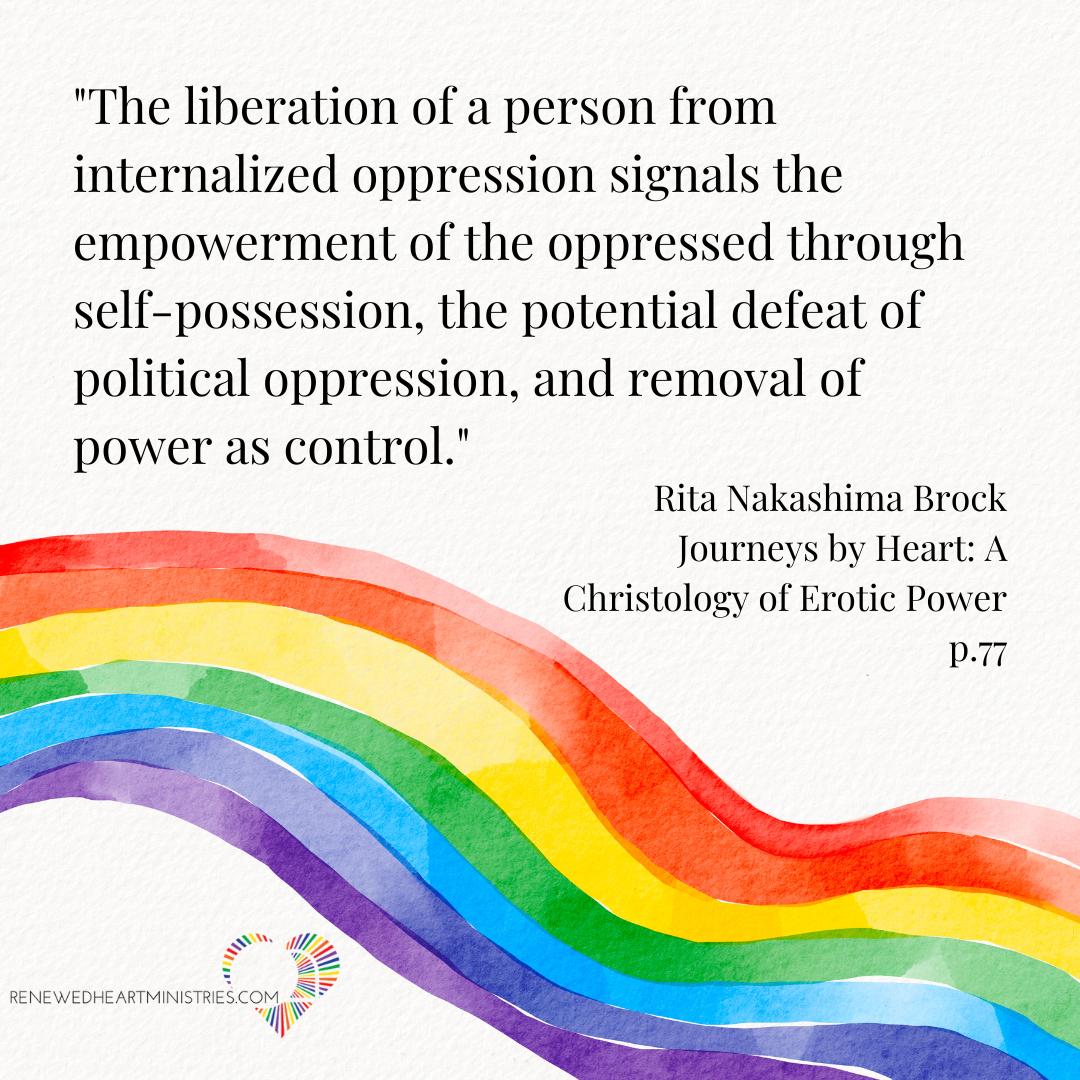
Pentecost and a Spirit of Justice

This Week’s Episode of Just Talking Available on YouTube

New Episode of “Just Talking” Now Online!

Season 1, Episode 15: John 7 & 20. Lectionary A, Pentecost

Each week, we’ll be talking about the gospel lectionary reading for the upcoming weekend. We’ll be talking about each reading in the context of love, inclusion, and societal justice. Our hope is that our talking will be just talking (as in justice) and that during our brief conversations each week you’ll be inspired to also do more than just talking.

If you teach from the lectionary each week, or if you’re just looking for some thoughts on the Jesus story from a more progressive perspective within the context of social justice, check it out, you might like it.

You can find the latest show on YouTube at https://youtu.be/ykqgj9pEP_8

 or (@herbandtoddjusttalking)

Please Like, Subscribe, hit the Notification button, and leave us a comment

Thanks in advance for watching!


Herb Montgomery | May 26, 2023


To listen to this week’s eSight as a podcast episode click here.


“Maybe you, too, still feel the pull to spiritualize that list from Isaiah and Luke, as so many Christians have before us. But what if we lean away from a gnostic response to this list and instead interpret it literally and materially? How could taking this list literally affect us? To actively participate in receiving the Spirit of Acts 2 means to care about the concrete well-being of those who are being harmed in our society today.”


Our lectionary gospel readings this week are both from John’s gospel. We considered the second reading from John 20 a few weeks ago.

On the last and greatest day of the festival, Jesus stood and said in a loud voice, “Let anyone who is thirsty come to me and drink. Whoever believes in me, as Scripture has said, rivers of living water will flow from within them.” By this he meant the Spirit, whom those who believed in him were later to receive. Up to that time the Spirit had not been given, since Jesus had not yet been glorified. (John 7:37-39)

On the evening of that first day of the week, when the disciples were together, with the doors locked for fear of the Jewish leaders, Jesus came and stood among them and said, “Peace be with you!” After he said this, he showed them his hands and side. The disciples were overjoyed when they saw the Lord. Again Jesus said, “Peace be with you! As the Father has sent me, I am sending you.” And with that he breathed on them and said, “Receive the Holy Spirit. If you forgive anyone’s sins, their sins are forgiven; if you do not forgive them, they are not forgiven.” (John 20:19-23)

This coming weekend is Pentecost, the festival commemorating when the Spirit was poured out on the first Jesus followers and they developed the ability to communicate Jesus’ teachings in other languages. 

Languages are not the only differences among members of our human family. We also have cultural differences, and political, social, and economic differences, as well. What could it mean today for the Spirit to enable us to understand one another, especially as we listen to those our present systems do the most harm?

Let’s consider the passage in John 7.

The first thing that jumps out at me in this passage is the Johannine community’s proto-Gnostic tendency to devalue the material, concrete, physical realities in which people suffered. 

So here, “if anyone is thirsty…” let’s not dig a well or find out who is stopping the community from receiving clean drinking water, but let’s promise them an ethereal spirit instead. 

In John, Jesus’ state execution liberated his spirit from his material body. Through his death and resurrection, Jesus was thereby “glorified” or transformed. This was the moment when Jesus’ spirit was freed from concrete, lowly embodiment, and was adorned with its inherent splendor.

At this time the community believed the Spirit was given to proto-Gnostic Jesus followers so they too could follow Jesus on this path, on the way to the same kind of spiritual liberation. 

As I’ve said repeatedly over the last few weeks, much of western Christianity today is more gnostic than it realizes when it prioritizes the afterlife over the here and now, or prioritizes the spiritual (i.e. saving a person’s “soul”) over setting them free from material harm they are working to survive from social, political, economic, or interpersonal systems.

I want to contrast this with the Jesus we find in the synoptic gospels. Mark’s, Matthew’s, and Luke’s version of Jesus is much more concerned with the material experience of people in his society. 

In Mark 8, for example, when the multitude was hungry, the synoptic Jesus did not offer them spiritual food or use food as a metaphor for his teachings. He stopped teaching and fed them literal loaves and fish. In Mark 10, seeing the wealth disparity in his community and noticing the poor suffer in a system that created winners and losers, he told an affluent man to literally sell his superfluous possessions and give the proceeds to the poor. Jesus didn’t simply point the poor toward the spiritual wealth of knowing him (gnosis).

I believe we don’t have to choose the spiritual over the material. I believe we can and must have a healthy balance of both. We need a holistic, life-giving interpretation of what it means to follow Jesus, one where people’s spiritual wellbeing is connected to their physical, material, emotional, psychological, economic, political, and social wellbeing. We don’t have to emphasize any of these to the exclusion of others. A more Jewish view of Jesus would have preserved his concern with liberating the whole person in whatever aspect of their lives they experienced harm. 

As Jesus followers today, we must guard against the notion that only saving a person’s soul for eternity is important. That is not what Jesus teaches in our sacred stories. Yet our Christian history is littered with examples of a religion about Jesus that has cared more about saving people for eternity than creating a better world in the here and now where people are saved from the hell they are already enduring. 

But like the water in the story of the woman at the well in John 4, the verses in this week’s reading have a gnostic bent to them. The water of life or of the Spirit is the special gnosis or knowledge that sets the believer on a path that will culminate in their own spirit being glorified once it is released from this fleshly housing at death. I understand where the Johannine community was coming from on this, but today we need a much more balanced understanding of what it means to follow Jesus or live in him. 

One way to redeem this passage is, as the lectionary does, to connect it to John 20, where Jesus breathes the Spirit onto the apostles after resurrection. Today we too can inhale this Spirit and exhale justice, liberation, and life. Consider how in Luke’s gospel, the Spirit that Jesus is imparting to his followers in John was manifested on Jesus himself:

“The Spirit of the Lord is on me,

because he has anointed me 

to proclaim good news to the poor.

He has sent me to proclaim freedom for the prisoners 

and recovery of sight for the blind,

to set the oppressed free,

to proclaim the year of the Lord’s favor.” (Luke 4:18-19)

We must be careful here not to spiritualize away the above passage. The poor here are economically poor. In both Isaiah and Luke, the writers spoke of those who were actually poor in the economic systems of their day. The prisoners are those who were literally, not  merely metaphorically, in need of liberation and justice. The blind were those who were in a Roman cell, a hole dug in the ground that was so dark they physically could not see their hands in front of their faces. The oppressed are not experiencing mystical, spiritual oppression but marginalization, subjugation, and oppression in their daily lives. And, finally, the year of the Lord’s favor was not someone’s warm and fuzzy assurance deep inside that God liked them. “The year of the Lord’s favor” was a Jewish reference to the literal year of Jubilee, when all economic debts would be forgiven and cancelled. 

Maybe you, too, still feel the pull to spiritualize that list from Isaiah and Luke, as so many Christians have before us. But what if we lean away from a gnostic response to the list and instead interpret it literally and materially? How could taking Luke 4’s Spirit literally affect us? 

To actively participate in receiving the Spirit of Acts 2 means to care about the concrete well-being of those who are being harmed in our society today. It means to care about LGBTQ people still being marginalized within and outside of our faith-based communities. It means to proclaim in solidarity that Black lives really do matter. That trans kids’ lives matter. That the children in our schools are of greater value to us than our freedom to own an AR-15. That the well-being of people migrating across our borders and coasts is a priority. 

Who else would be included if Luke 4 were re-written in our social context today? 

On this year’s Pentecost, what can it mean for us in our context to inhale the same Spirit being breathed on disciples in our gospel readings this week? How will that spirit be exhaled? What will it look like for us to breathe in and breathe out Jesus’ gift of the Spirit: a love that manifests itself in a faith that works justice, and an exhaling that is life-giving to those around us. 

This Pentecost, may this same Spirit that blew on the primordial waters of our sacred creation stories blow once again today, spawning life and life-giving things into our relationships with ourselves, with others, and with the Divine.


HeartGroup Application

1. Share something that spoke to you from this week’s eSight/Podcast episode with your HeartGroup.

2. What does the Spirit showing up and manifesting itself as activity in justice work mean for you? Share with your group.

3. What can you do this week, big or small, to continue setting in motion the work of shaping our world into a safe, compassionate, just home for everyone? 

Thanks for checking in with us, today.

You can find Renewed Heart Ministries on Twitter, Facebook and Instagram. If you haven’t done so already, please follow us on your chosen social media platforms for our daily posts. Also, if you enjoy listening to the Jesus for Everyone podcast, please like and subscribe to the JFE podcast through the podcast platform you use and consider taking some time to give us a review. This helps others find our podcast as well.

Also I want to share that we are partnering in a new weekly YouTube show called “Just Talking.” Each week, Todd Leonard and I will be talking about the gospel lectionary reading for the upcoming weekend. We’ll be talking about each reading in the context of love, inclusion, and societal justice. Our hope is that our talking will be just talking (as in justice) and that during our brief conversations each week you’ll be inspired to also do more than just talking.

If you teach from the lectionary each week, or if you’re just looking for some thoughts on the Jesus story from a more progressive perspective within the context of social justice, check it out, you might like it. You can find JustTalking each week on YouTube at youtube.com/@herbandtoddjusttalking. Please Like, Subscribe, hit the Notification button, and leave us a comment.

And if you’d like to reach us here at Renewed Heart Ministries through email, you can reach us at info@renewedheartministries.com.

My new book, Finding Jesus: A story of a fundamentalist preacher who unexpectedly discovered the social, political, and economic teachings of the Gospels is now also available at renewedheartministries.com

Right where you are, keep living in love, choosing compassion, taking action, and working toward justice.

I love each of you dearly,

I’ll see you next week.

(Scriptures taken from the Holy Bible, New International Version®, NIV®. Copyright © 1973, 1978, 1984, 2011 by Biblica, Inc.™ Used by permission of Zondervan. All rights reserved worldwide. www.zondervan.com The “NIV” and “New International Version” are trademarks registered in the United States Patent and Trademark Office by Biblica, Inc.™)


Now Available at Renewed Heart Ministries!

Herb’s new book Finding Jesus: A story of a fundamentalist preacher who unexpectedly discovered the social, political, and economic teachings of the Gospels, is available at renewedheartministries.com.

Get your copy today at renewedheartministries.com


Are you receiving all of RHM’s free resources each week?

Begin each day being inspired toward love, compassion, action, and justice. Free Sign-Up HERE

A Unity That’s Big Enough

This Week’s Episode of Just Talking Available on YouTube

New Episode of “Just Talking” Now Online!

Season 1, Episode 14: John 17.1-11. Lectionary A, Easter 7

Each week, we’ll be talking about the gospel lectionary reading for the upcoming weekend. We’ll be talking about each reading in the context of love, inclusion, and societal justice. Our hope is that our talking will be just talking (as in justice) and that during our brief conversations each week you’ll be inspired to also do more than just talking.

If you teach from the lectionary each week, or if you’re just looking for some thoughts on the Jesus story from a more progressive perspective within the context of social justice, check it out, you might like it.

You can find the latest show on YouTube at https://youtu.be/NFukfGUUlEQ

 or (@herbandtoddjusttalking)

Please Like, Subscribe, hit the Notification button, and leave us a comment

Thanks in advance for watching!


Unity

Herb Montgomery | May 19, 2023

To listen to this week’s eSight as a podcast episode click here.


What we want is a unity that is safe for everyone. A unity that is compassionate. A unity that walks arm and arm with justice. A unity that’s big enough to wrap its arms around all our varied differences and call them “good.” A unity that at its heart holds the well-being of every member as its highest priority of value.


Our reading this week is from the gospel of John:

After Jesus said this, he looked toward heaven and prayed:

“Father, the hour has come. Glorify your Son, that your Son may glorify you.

For you granted him authority over all people that he might give eternal life to all those you have given him.

Now this is eternal life: that they know you, the only true God, and Jesus Christ, whom you have sent.

I have brought you glory on earth by finishing the work you gave me to do.

And now, Father, glorify me in your presence with the glory I had with you before the world began.

I have revealed you to those whom you gave me out of the world. They were yours; you gave them to me and they have obeyed your word.

Now they know that everything you have given me comes from you.

For I gave them the words you gave me and they accepted them. They knew with certainty that I came from you, and they believed that you sent me.

I pray for them. I am not praying for the world, but for those you have given me, for they are yours.

All I have is yours, and all you have is mine. And glory has come to me through them.

I will remain in the world no longer, but they are still in the world, and I am coming to you. Holy Father, protect them by the power of your name, the name you gave me, so that they may be one as we are one.” (John 17:1-11)

Our reading this week is John’s version of Jesus’ farewell prayer. This passage deeply influenced Christians during the fourth and fifth centuries C.E., and it became the basis of the discussions and conclusions that became the orthodox doctrinal understanding of Jesus’ relation to God.

When Jesus’ followers are referenced in this prayer, it’s difficult to discern whether the prayer is talking about Jesus’ first disciples before his crucifixion or the whole Johannine community in the century afterwards.

The prayer is unique to John’s gospel. Some consider this prayer to be the Johannine community’s equivalent of the “Lord’s Prayer” in the synoptic gospels. The key words, phrases, and expressions in this prayer are all uniquely Johannine.

Firstly, this community defined eternal life or salvation as a special knowledge. Consider the following passages from this week’s reading:

Now this is eternal life: that they know you… (John 17:3)

Now they know that everything you have given me comes from you. (John 17:7)

They knew with certainty… (John 17:8)

As an exercise, look up every time “knowing” is the important element emphasized in the book of John. When we acknowledge how central “knowing” was to the Johannine community’s version of the Jesus story, we discover the entire gospel is about gaining this knowing (gnosis) from Jesus. In fact, giving us this gnosis, the gospel of John tells us, is the entire reason Jesus came.

This is a very different emphasis from the one we read in Mark, Matthew and Luke.

Secondly, the early Johannine community didn’t treat a bodily resurrection as all that necessary for Jesus. In John 17, it is through the cross (death being the separating of the gnostic soul from the material body) that Jesus would be reunited with the Father. Looking to the cross and speaking to his Father, Jesus says, “I will remain in the world no longer . . . I am coming to you.”

This is one of the many reasons why a gnostic Jesus doesn’t quite fit the versions of Jesus we encounter in Mark, Matthew, and Luke. There would come to be deep divides and differences between later gnostic Christianity and what would become orthodox Christianity, and these divides were what led many Church Fathers to deem gnostic forms of Christianity as heretical.

The gospel of John later seeks to correct the implication of this prayer in Jesus’ statement to Mary at the tomb:

“Jesus said, “Do not hold on to me, for I have not yet ascended to the Father.” (John 20:17)

As I’ve shared as we’ve re-read the gospel of John, I prefer the more material Jesus we encounter Mark, Matthew, and Luke. There are still gems to mine from the gospel of John (the supremacy of Love is one), but I resonate much more with the synoptic Jesus, who is striving to make our concrete world, here and now, a safer, more compassionate, just home for everyone. I prefer that Jesus over the Johannine Jesus, who is primarily concerned with imparting a special knowledge that is the path or “way” and that ultimately liberates our spirits from our flesh.

I also find the synoptics speak more relevantly into our justice work today. If changing our present world is the goal, I’ll take Mark, Matthew and Luke. But if getting to heaven is the goal, then John’s gospel provides the most warm and fuzzy path to that end and it depends simply on knowing the Father the way Jesus came to reveal Him.

A third theme repeated in our reading this week is the theme of unity. Unity can be both life-giving and death-dealing. Like peace, unity based on silencing opposition or accommodating harm is death-dealing. And, like peace, unity that comes through justice, through ensuring everyone is being taken care of, is life-giving. As Ched Myers rightly states in his classic commentary on Mark, Binding the Strong Man, “We may rightly be suspicious of theologies of reconciliation that promote Christian unity at the price of political silence.”

I don’t believe that unity has to mean the homogeneous conformity of everyone involved. We can have unity alongside a beautiful, heterogeneous diversity where our differences are celebrated as the rich variations that we have as a human family, and where none are excluded or made to feel “less than” because they are different from those the present system prioritizes and privileges.

If we want unity, we should be working for justice. We don’t want a unity that comes at any cost, a unity that results from people who are being hurt being told to sit down and keep silent.

For many of us, unity now will have to come through reconciliation. And that reconciliation will have to come through restitution for past injustices and the transformation of our present system that corrects harms being committed. Unity depends on change, then. It has to follow present harms being remedied and made right. Until then, unity can’t be life-giving if it calls us to ignore or passively accept the concrete harms that have been and are being done to people made vulnerable in our society.

If we are praying for a unity that is the fruit of justice being restored and rooted in care that ensures everyone has what they need to thrive, then I’m all for it. But death-dealing unity that is mere silence in the midst of harm is not what I interpret our reading this week to promote.

What we want is a unity that is safe for everyone. A unity that is compassionate. A unity that walks arm and arm with justice. A unity that’s big enough to wrap its arms around all our varied differences and call them “good.” A unity that at its heart holds the well-being of every member as its highest priority of value.

If we, alongside the Jesus in this week’s reading, are praying for this kind of unity, then and only then can we say, “Amen.”

HeartGroup Application

1. Share something that spoke to you from this week’s eSight/Podcast episode with your HeartGroup.

2. What does unity mean for you? Share with your group.

3. What can you do this week, big or small, to continue setting in motion the work of shaping our world into a safe, compassionate, just home for everyone?

Thanks for checking in with us, today.

You can find Renewed Heart Ministries on Twitter, Facebook and Instagram. If you haven’t done so already, please follow us on your chosen social media platforms for our daily posts. Also, if you enjoy listening to the Jesus for Everyone podcast, please like and subscribe to the JFE podcast through the podcast platform you use and consider taking some time to give us a review. This helps others find our podcast as well.

Also I want to share that we are partnering in a new weekly YouTube show called “Just Talking.” Each week, Todd Leonard and I will be talking about the gospel lectionary reading for the upcoming weekend. We’ll be talking about each reading in the context of love, inclusion, and societal justice. Our hope is that our talking will be just talking (as in justice) and that during our brief conversations each week you’ll be inspired to also do more than just talking.

If you teach from the lectionary each week, or if you’re just looking for some thoughts on the Jesus story from a more progressive perspective within the context of social justice, check it out, you might like it. You can find JustTalking each week on YouTube at youtube.com/@herbandtoddjusttalking. Please Like, Subscribe, hit the Notification button, and leave us a comment.

And if you’d like to reach us here at Renewed Heart Ministries through email, you can reach us at info@renewedheartministries.com.

My new book, Finding Jesus: A story of a fundamentalist preacher who unexpectedly discovered the social, political, and economic teachings of the Gospels is now also available at renewedheartministries.com

Right where you are, keep living in love, choosing compassion, taking action, and working toward justice.

I love each of you dearly,

I’ll see you next week.


Now Available at Renewed Heart Ministries!

Herb’s new book Finding Jesus: A story of a fundamentalist preacher who unexpectedly discovered the social, political, and economic teachings of the Gospels, is available at renewedheartministries.com.

Get your copy today at renewedheartministries.com


Are you receiving all of RHM’s free resources each week?

Begin each day being inspired toward love, compassion, action, and justice. Free Sign-Up HERE

Loving What Jesus Taught

This Week’s Episode of Just Talking Available on YouTube

New Episode of “Just Talking” Now Online!

Season 1, Episode 13: John 14:15-21. Lectionary A, Easter 6

Each week, we’ll be talking about the gospel lectionary reading for the upcoming weekend. We’ll be talking about each reading in the context of love, inclusion, and societal justice. Our hope is that our talking will be just talking (as in justice) and that during our brief conversations each week you’ll be inspired to also do more than just talking.

If you teach from the lectionary each week, or if you’re just looking for some thoughts on the Jesus story from a more progressive perspective within the context of social justice, check it out, you might like it.

You can find the latest show on YouTube at https://youtu.be/QnXt34XGexc

 or (@herbandtoddjusttalking)

Please Like, Subscribe, hit the Notification button, and leave us a comment

Thanks in advance for watching!


Loving What Jesus Taught

Herb Montgomery | May 12, 2023

To listen to this week’s eSight as a podcast episode click here.

“I don’t want it to be said of me that what I loved was the hope of heaven, not Jesus, because loving Jesus means actually loving the things he taught and following them. And so, in the spirit of this week’s reading, I have to ask myself: do I really love Jesus—the political, social, economic Jesus of the gospels? Or am I simply addicted to the religious candy that my religion about Jesus offers, if I only believe?”

Our reading this week is from the gospel of John:

“If you love me, keep my commands. And I will ask the Father, and he will give you another advocate to help you and be with you forever—the Spirit of truth. The world cannot accept him, because it neither sees him nor knows him. But you know him, for he lives with you and will be in you. I will not leave you as orphans; I will come to you. Before long, the world will not see me anymore, but you will see me. Because I live, you also will live. On that day you will realize that I am in my Father, and you are in me, and I am in you. Whoever has my commands and keeps them is the one who loves me. The one who loves me will be loved by my Father, and I too will love them and show myself to them.” (John 14:15-21*)

I grew up hearing Christians interpret the Spirit as Advocate as an intermediary interposing between sinful humans and a holy God. Today, I reject any interpretation of this language that places humanity and divinity on polar opposites and a mediator in between. I experienced that bearing bad fruit in my own life and I believe it produces bad fruit societally as well.

This reading is from the Johannine community’s version of the Jesus story, and we should remember that as we consider this language. Repeatedly over the past few weeks, we have seen how the Johannine community characterized the Pharisees and Jewish leaders. We have also noted the tensions between Pharisaical Judaism and the early Gnosticism that the Johannine community was part of. 

Consider the following passages in John, where being removed from the synagogue is a penalty for Jewish people who follow the Johannine Jesus.

“His parents said this because they were afraid of the Jews; for the Jews had already agreed that anyone who confessed Jesus to be the Anointed would be put out of the synagogue.” (John 9:22)

“Nevertheless many, even of the authorities, believed in him. But because of the Pharisees they did not confess it, for fear that they would be put out of the synagogue.” (John 12:42)

John’s Jesus also repeats the warning in John 12, “They will put you out of the synagogues” (John 16:2).

In this context, characterizing the Spirit as an Advocate would have meant something to this community. The Spirit would not have mediated between them and God but between them and other members of their own religious communities. We must hold all of these references in John in tension with the fact that most of the history between Judaism and Christianity is not characterized by Jews persecuting Christians but by Christians persecuting Jews. The gospel of John was also written when Gentile Christians wanted to distance themselves from their Jewish siblings under the Roman Empire.

We find a different nuance in the synoptic gospels. The early Jesus community was comprised of those on the undersides and margins of their society who were in deep need of advocacy or justice socially, politically, and economically. This is the context in which I understand the work of the Spirit as Advocate to bear the most life-giving fruit. The synoptics characterize the Spirit as an Advocate between humans in matters of justice. For the original audiences of the synoptics, “advocate” would have called to mind actual legal proceedings that elites in Judea and also from the larger Roman society initated against Jesus’ followers:

“When they bring you to trial and hand you over, do not worry beforehand about what you are to say; but say whatever is given you at that time, for it is not you who speak, but the Holy Spirit.” (Mark 13:11)

“When they hand you over, do not worry about how you are to speak or what you are to say; for what you are to say will be given to you at that time; for it is not you who speak, but the Spirit of your Father speaking through you.” (Matthew 10:19-20)

“So make up your minds not to prepare your defense in advance; for I will give you words and a wisdom that none of your opponents will be able to withstand or contradict.” (Luke 21:14-15)

“When they bring you before the synagogues, the rulers, and the authorities, do not worry about how you are to defend yourselves or what you are to say; for the Holy Spirit will teach you at that very hour what you ought to say.” (Luke 12:11-12)

A representation of the Divine that places God against us with us in need of an Advocate before God ignores this context, the social context in which these passages were originally written. 

Lastly, in this week’s reading we see an important if-then statement: If you love Jesus, then follow his teachings. 

To be honest, it is a lot easier to revere Jesus and to worship Jesus in word and song than it is to choose every day to follow the ethics and values we find in the Jesus story. In the Jesus story we find a Jesus who taught inclusion of the marginalized, resource-sharing with the poor, wealth redistribution from the rich, nonviolent resistance for the oppressed, treating others the way we would like to be treated ourselves, and an ethic expressed through justice above all else. 

It’s much easier for privileged, powerful, and propertied Christians to religiously worship a Jesus who promises us a beautiful afterlife, than it is for us to socially, politically, and economically follow the ethics and values our Jesus taught as challenging but fruitful means of reshaping the injustices, oppressions and violence of our present society.

I’m reminded of the poem “A Dead Man’s Dream” by Carl Wendell Hines, Jr. Hines who wrote this poem in 1965 after the assassination of Malcolm X. After Martin Luther King, Jr., was assassinated in 1968 his poem also came to be associated with Dr. King.

“Now that he is safely dead,
Let us praise him.
Build monuments to his glory.
Sing Hosannas to his name.

Dead men make such convenient heroes.
For they cannot rise to challenge the images
That we might fashion from their lives.
It is easier to build monuments
Than to build a better world.

So now that he is safely dead,
We, with eased consciences will
Teach our children that he was a great man,
Knowing that the cause for which he
Lived is still a cause
And the dream for which he died is still a dream.
A dead man’s dream.”

To apply this poem to Jesus of Nazareth for Christians leads to some haunting questions. Have we simply built churches as monuments to Jesus? What images of Jesus that Christianity has shaped would Jesus challenge if he physically walked the earth today? Have we built a religion when we should have been building a different world, a safe, compassionate, just world big enough for all of our differences and where each us treat each other the way we would like to be treated? Have we taught the message of Jesus’ greatness while ignoring the truths he taught and the solidarity with the marginalized he modeled that made him so great?

The phrases that give me pause in this week’s reading are: “If you love me, keep my commands” and “Whoever has my commands and keeps them is the one who loves me.”

Forget a religion or gospel about Jesus for a moment. What was the gospel our Jesus himself taught in the story? Are the things we as Christians so passionate about the same things that Jesus was passionate about? Are the things this Jesus was so passionate about, the themes and truths that he taught and emphasized, the centerpieces of our teaching and action? 

Some Christians today are intentionally endeavoring to answer in the affirmative. There are also large portions of Christianity that are known instead for their hate and bigotry. For these Christians, the Jesus of the gospels (even John) is strangely silent on the issues they are most vocal about, and the themes Jesus focused most intently on would threaten their social privileges too much. This kind of Christianity has to avoid or deprioritize the gospels because within those stories we run headlong into Jesus’ teachings. 

I have to allow myself to be confronted by this contradiction regularly. It’s much easier for me to focus on the parts of the New Testament that subtly redirect me toward cosmological claims about Jesus rather than to Jesus’ call for obedience to his teachings. I don’t want it to be said of me that what I loved was the hope of heaven, not Jesus, because loving Jesus means actually loving the things he taught and following them. And so, in the spirit of this week’s reading, I have to ask myself: do I really love Jesus—the political, social, economic Jesus of the gospels? Or am I simply addicted to the religious candy that my religion about Jesus offers, if I only believe?

HeartGroup Application

1. Share something that spoke to you from this week’s eSight/Podcast episode with your HeartGroup.

2. What are some of the things Jesus taught that you love and choose to follow? Share with your group.

3. What can you do this week, big or small, to continue setting in motion the work of shaping our world into a safe, compassionate, just home for everyone?

Thanks for checking in with us, today.

You can find Renewed Heart Ministries on Twitter, Facebook and Instagram. If you haven’t done so already, please follow us on your chosen social media platforms for our daily posts. Also, if you enjoy listening to the Jesus for Everyone podcast, please like and subscribe to the JFE podcast through the podcast platform you use and consider taking some time to give us a review. This helps others find our podcast as well.

Also I want to share that we are partnering in a new weekly YouTube show called “Just Talking.” Each week, Todd Leonard and I will be talking about the gospel lectionary reading for the upcoming weekend. We’ll be talking about each reading in the context of love, inclusion, and societal justice. Our hope is that our talking will be just talking (as in justice) and that during our brief conversations each week you’ll be inspired to also do more than just talking.

If you teach from the lectionary each week, or if you’re just looking for some thoughts on the Jesus story from a more progressive perspective within the context of social justice, check it out, you might like it. You can find JustTalking each week on YouTube at youtube.com/@herbandtoddjusttalking. Please Like, Subscribe, hit the Notification button, and leave us a comment.

And if you’d like to reach us here at Renewed Heart Ministries through email, you can reach us at info@renewedheartministries.com.

My new book, Finding Jesus: A story of a fundamentalist preacher who unexpectedly discovered the social, political, and economic teachings of the Gospels is now also available at renewedheartministries.com

Right where you are, keep living in love, choosing compassion, taking action, and working toward justice.

I love each of you dearly,

I’ll see you next week.

*Scriptures taken from the Holy Bible, New International Version®, NIV®. Copyright © 1973, 1978, 1984, 2011 by Biblica, Inc.™ Used by permission of Zondervan. All rights reserved worldwide. www.zondervan.com The “NIV” and “New International Version” are trademarks registered in the United States Patent and Trademark Office by Biblica, Inc.™


Now Available at Renewed Heart Ministries!

Herb’s new book Finding Jesus: A story of a fundamentalist preacher who unexpectedly discovered the social, political, and economic teachings of the Gospels, is available at renewedheartministries.com.

Get your copy today at renewedheartministries.com


Are you receiving all of RHM’s free resources each week?

Begin each day being inspired toward love, compassion, action, and justice. Free Sign-Up HERE