Pyramids, Circles and a Shared Table: Jesus’ Vision for Human Community (Part 1)

by Herb Montgomery | May 3, 2018
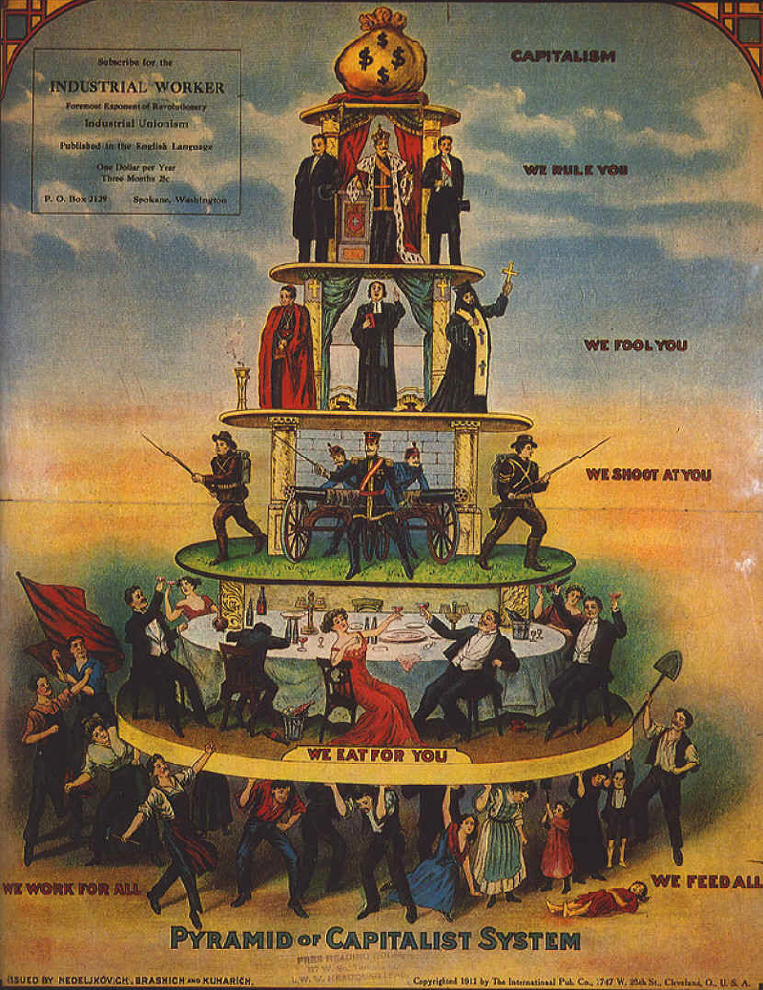
Pyramid of Capitalism


“Politics answers the question of who gets what. So Jesus was not a religious figure as much as he was a political one. He did not fundamentally challenge his Jewish religion, at least not much more than his predecessor Hillel did. He did challenge the Jewish elites of his time, much more than Hillel did. As we’ve discussed before, Hillel made concessions, such as the prozbul, that centered the wealthy while endeavoring to take care of the poor. Jesus’ teachings centered the poor and gave them the entire “kingdom.” Jesus’ teachings were political.”


Luke 6:20-26: “Looking at his disciples, he said:

‘Blessed are you who are poor, for yours is the kingdom of God.
Blessed are you who hunger now, for you will be satisfied.
Blessed are you who weep now, for you will laugh.
Blessed are you when people hate you, when they exclude you and insult you and reject your name as evil, because of the Son of Man. Rejoice in that day and leap for joy, because great is your reward in heaven. For that is how their ancestors treated the prophets.

But woe to you who are rich, for you have already received your comfort. Woe to you who are well fed now, for you will go hungry.
Woe to you who laugh now, for you will mourn and weep.
Woe to you when everyone speaks well of you, for that is how their ancestors treated the false prophets.’”

The domination structure of Jesus’ society was similar to ours today. Its structure was a combination of two two-dimensional shapes, a triangle and a circle. 

Let’s talk about the circle first. 

Circles have an inside and an outside. Societies shaped in the form of a circle can have a strongly defined border that distinguishes between insiders and outsiders. They can also have certain tests to decide who’s in and who’s out. Societal circles can also have people whose job it is to patrol the border to make sure no one from the outside is included and everyone knows when someone who was previously an insider no longer should be.

Control for circular social structures rests in the center of the circle. The more one adheres to the rules and identity of the circle, the closer one is to the center. The more someone varies, the more they are pushed to the margins of the circle. Even within the circle, among those who are insiders, some people will find themselves somewhere between the center of the circle and the edges.

What about the triangle?

The circle and the triangle are both hierarchical structures. Where the hierarchy in the circle is from the center out toward the margins, triangular societies have a top comprised of a few elites and a base composed of the majority. In triangles that practice domination and control, the closer one is to the top, the more power, privilege, control and ability to dominate others one also possesses. Your social location in the triangle determines the level to which you experience these privileges, and you can find yourself closer to the top in some areas of your life but closer to the bottom of the triangle in others. The triangle typically is structured to benefit those at the top at the expense and exploitation of those at the bottom. 

What happens when we combine these structures?

The combination of these ways of structuring human society is a cone. Within this cone, the closer one is to the center, the closer one also is to the top. The more one is marginalized, the more one finds themselves at the bottom of their society.

This hybrid of the circle and triangle shapes, the cone, is the shape of the society Jesus lived in in the 1st Century. It’s also the shape of many of our religious and civil societies today. In Luke’s version of the Jesus story, Jesus states that people his society structure had made poor, hungry, or weep would be specifically “blessed” by his vision for transforming human society. Jesus wasn’t saying it’s a blessing to be on the margins or at the bottom of society. He was saying that if you’re on the margins, you who his gospel was especially for. As we discussed in Directed Good News, those on the margins in Jesus’ society heard his gospel as good news. 

Matthew’s version of the Jesus story backs this up too. As we discussed last month in A Preferential Option for the Vulnerable, people the system had left too broken and impoverished in their spirit to keep trying, those whom the system had steamrolled over, those who hungered and thirsted for the world to be put right—these were the ones Jesus’ vision for humanity was especially targeted at (see Matthew 5:3; Luke 1:80; Matthew 5:5 and 5:6.[1]) These were the ones who had been labeled as “sinners” by those at the center/top of their society, and who, because of that labelling, had been pushed to the edges and underside of their community. They were drawn to the hope for change in Jesus’ gospel: “Now the tax collectors and sinners were all gathering around to hear Jesus. But the Pharisees and the teachers of the law muttered, ‘This man welcomes sinners and eats with them.’”(Luke 15:1-2) The term “sinners” is not a universal term here. It is used pejoratively to push some to the margins and bottom of the cone. It was a label those in power used to other people. 

Jesus’ vision for human community, his shared table, specifically inclused those his cone-shaped society had excluded. It also had an economic component. Consider the reversal of economic exploitation and reparation found in Luke’s story of an oppressor who embraced Jesus’ teachings.

“All the people saw this and began to mutter, ‘He has gone to be the guest of a sinner.’ But Zacchaeus stood up and said to the Lord, ‘Look, Lord! Here and now I give half of my possessions to the poor, and if I have cheated anybody out of anything, I will pay back four times the amount.’” (Luke 19:7-8)

Jesus’ shared table required those at the top/center of their societal cone to pay reparations to those whom they had exploited and pushed down. Tax collectors were economically part of the elite, but socially and politically within Jewish culture they were pushed to the outside and labeled as sinners because of their occupational cooperation with the Empire subjugating Judea and Galilee. They were privileged in certain areas of their lives but marginalized in others.

Jesus’ shared table was also political.

When I use the term “political,” I don’t mean partisan. Politics means related to the polis, the members of a community. Whenever you have two or more people doing life together, you have politics. Politics answers the question of who gets what. So Jesus was not a religious figure as much as he was a political one. He did not fundamentally challenge his Jewish religion, at least not much more than his predecessor Hillel did. He did challenge the Jewish elites of his time, much more than Hillel did. As we’ve discussed before, Hillel made concessions, such as the prozbul, that centered the wealthy while endeavoring to take care of the poor. Jesus’ teachings centered the poor and gave them the entire “kingdom.” Jesus’ teachings were political.

Recently, while chatting with a friend, I bumped into an often repeated misconception of how things worked in Jesus’ society. My friend claimed that Jesus never challenged the Roman civil government but only challenged the religious establishment of Judea. My friend went on to state that Jesus’ followers should ignore the state and simply focus on bringing about religious reform within their own traditions. 

This is far from how Jewish society actually functioned in the 1st Century. Today our culture believes that church and state should be separated. But Jesus’ society didn’t have these distinctions. My friend claimed that Jesus was only focused on impacting the religious views of his community, especially as they related to the temple. But this simply isn’t true, historically. 

First, the temple was not solely religious, and it was not merely the center of the Jewish “church.” The temple was the center of the Jewish state. The priests and the Sanhedrin were civil authorities, not only religious ones. In 1st Century Judea, there was not a separation between “church and state” or religious and civil duty as we understand either today. The Torah governed both, and they were not two distinct areas of life. They were just life. 

The temple received taxes that were to be redistributed to the poor. That’s why the temple functioned as a centralized banking system through which money lenders lent their monies. When the poor took over the temple in the 60s CE, the very first thing they did was to burn the debt ledgers of the temple, which until then recorded all loans. By storming the temple, they forced political and economic change: a year of Jubilee and the forgiveness of all debts. 

Secondly, Jesus was a Jewish laborer, not a Roman citizen. He didn’t have access to Rome to protest for change. But he did have access to his own state authority, the temple in Jerusalem. Note that even this distinction between the temple and Rome is not completely accurate either. Rome governed Judea through the temple. Rome determined who would be High Priest each year, and it was the temple that funneled collected tribute back to Rome. The Jewish aristocracy gained privilege and power by cooperating with Rome, and Rome received a degree of control over Judea by using the Jewish temple state in Jerusalem. 

So when Jesus overturned tables in the temple-state, this was not only a religious protest; it was political protest as well. Jesus staged his demonstration in the temple with the money changers in solidarity with and on behalf of the poor who were being economically exploited by the Temple-state. Jesus was indicting both Rome and his own state. This is why his execution in response to the temple demonstration was at the hand of Rome, on a Roman cross. 

Ched Myers confirms this in his commentary on the book of Mark, and notes the deep implications for all who should choose to follow this political Jesus.

“Jesus has revealed that his messiahship means political confrontation with, not rehabilitation of, the imperial state. Those who wish to ‘come after him’ will have to identify themselves with his subversive program. The stated risk is that the disciple will face the test of loyalty under interrogation by state authorities.” (Binding the Strong Man: a political reading of Mark’s story of Jesus, p. 247)

When answering the question of who should get what, Jesus stated his political views:

“Do not be afraid, little flock, for your Father has been pleased to give you the kingdom. Sell your possessions and give to the poor. Provide purses for yourselves that will not wear out, a treasure in heaven that will never fail, where no thief comes near and no moth destroys. For where your treasure is [in people not profit], there your heart will be also.” (Luke 12.32-34)

The poor, the marginalized, the pushed down, these were those to whom Jesus’ political views were good news. What he taught them was the gospel of hope. Gustavo Gutierrez accurately reminded us that this hope is more than a forward expectation of charity. This hope is for the creation of an entirely different social order:

“Love of neighbor is an essential component of Christian life. But as long as I apply that term only to the people who cross my path and come asking me for help, my world will remain pretty much the same. Individual almsgiving and social reformism is a type of love that never leaves its own front porch . . . On the other hand my world will change greatly if I go out to meet other people on their path and consider them as my neighbor, as the good Samaritan did… The gospel tells us that the poor are the supreme embodiment of our neighbor. It is this option that serves as the focus for a new way of being human and Christian in today’s Latin America. But the existence of the poor . . . is not neutral on the political level or innocent of ethical implications. Poor people are by-products of the system under which we live and for which we are responsible . . . That is why the poverty of the poor is not a summons to alleviate their plight with acts of generosity but rather a compelling obligation to fashion an entirely different social order.” (Gustavo Gutiérrez; Liberation Praxis and Christian Faith, p. 14)

When we follow Jesus, we don’t build a pyramid, a circle, or a cone. We build a shared table.

“Blessed are you who are poor, for yours is the kingdom of God.
Blessed are you who hunger now, for you will be satisfied.
Blessed are you who weep now, for you will laugh.” (Luke 6:20-22)

HeartGroup Application

  1. Go through the synoptic gospels (Matthew, Mark, and Luke) and find five of Jesus’ political views.
  2. What difference does it make to see Jesus not simply as a religious figure but as a political figure as well? What difference does it make to see Jesus’ temple protest not only as a religious protest but also as a political protest of those in power in response to their economic exploitation of the poor?
  3. Is there a difference between working toward a politic of distributive justice where everyone is safe and has enough, and there is equity, protection and compassion, and Christians wanting to co-opt political power in the spirit of domination and subjugation to legislate their moral views? Discuss this with your HeartGroup.

I’m so glad you checked in with us this week. 

Wherever you are, keep living in love, in survival, resistance, liberation, reparation, and transformation. 

I love each you dearly.

Another world is possible. 

I’ll see you next week.


To support these weekly podcasts and eSights and help us grow, go to renewedheartministries.com and click “Donate”! 

[1]
Matthew 5:3—“Blessed are the poor in spirit, for theirs is the kingdom of heaven.”

Luke 1:80—And the child grew and became strong in spirit; and he lived in the wilderness until he appeared publicly to Israel.

Matthew 5:4-5— Blessed are those who mourn, for they will be comforted. Blessed are the meek, for they will inherit the earth. 

Matthew 5:6—Blessed are those who hunger and thirst for righteousness, for they will be filled.

Directed Good News 

by Herb Montgomery | April 12, 2018

sign saying good news is coming

Photo Credit: Jon Tyson on Unsplash


Jesus’ gospel was good news to those who were on the margins. If they were able to shape a safer, more compassionate, just society, this would, in the long run, be good for everyone. Nonetheless, the news that power was about to shift was not good news to those who at that time held the reins of power themselves. To them, it was a threat. It had to be removed.


“. . . good news is proclaimed to the poor.” (Matthew 11:5)


The late Peter Gomes wrote, “Good news to some will almost inevitably be bad news to others.” (The Scandalous Gospel of Jesus, p. 31)

Jesus declared that in the community he envisioned, those made last in current social structures would be first, and those presently made first, would be last. 

“When the gospel says, “The last will be first, and the first will be last,” despite the fact it is counterintuitive to our cultural presuppositions, it is invariably good news to those who are last, and at least problematic news to those who see themselves as first.” — Peter Gomes, The Scandalous Gospel of Jesus: What’s So Good about the Good News? p. 42 (emphasis added.)

Over and over within the gospel stories we see good news to some being not so good news for others. In Luke’s gospel, the pronouncement of blessing upon the poor was coupled with woe to those who were rich.

And this leads me to my point this week.

I believe that Jesus’ vision for human community is Good news for all, but not good news to all. 

Jesus’ gospel was directed to those at a certain social location.

“The Spirit of the Lord is on me,
because he has anointed me 
to proclaim good news to the poor.
He has sent me to proclaim freedom for the prisoners 
and recovery of sight for the blind,
to set the oppressed free…” (Luke 4:18)

The gospel is good news to the poor, to the oppressed, and to those who are victims of mass incarceration, for example. These are the people whom our system targets, exploits, or forces to the underside of our society where benefits the rest of us take for granted are kept beyond their reach. 

These were also the people who perceived Jesus’ teachings as good news. Though, if we followed Jesus’ values, they would set us on a path toward a safer, more just, more compassionate world for us all, those in whom those changes sparked fear did not perceive them as good news initially. It was good news for them, too, but they did not perceive it as good news to them.

A world where we embrace our interconnectedness and dependence on one another, where we learn to cooperate with each other rather than individualistically compete against others is a world that will be better for everyone. It’s a world where folks who daily face oppression reclaim their own humanity, and also those dehumanized by the act of being “oppressor” find in their removal from power a returning to their own humanity, too.

Good news to some, and good for all, but not good news to all. As Gomes says in his book:

“… Thus, in the name of fair-mindedness and egalitarianism, the gospel’s claim of a radical reordering, a redistribution, an exercise in almost Gilbertian topsy-turveydom, is an offense, a scandal, and hardly good news.” —in The Scandalous Gospel of Jesus, pp. 31, 42).

Today, many sectors of Christianity have abandoned changing systemic injustice here and now in our world. These Christians sing hymns that utter the words, “this world is not my home I’m just a-passin’ through.” Their focus, for better or worse, is not this life, but one they believe will come after this one. For those who suffer, these beliefs work as an opiate and leave them passive. For those who benefit from their suffering, these beliefs work as guilt alleviation, “no-condemnation,” an unconditional love that enables them to sleep better at night and believe that the gospel has little to do with anything here and now.

This type of Christianity adapts Jesus’ teachings to offer the hope of post-mortem bliss to as many people as possible. It makes Jesus’ teachings good news to all, not merely good news for all. And this has produced a myriad of problems, including allowing us to seem to follow a radical Jew like Jesus while we remain mostly moderate or even oppress others.

This “respectable middle” has almost wholly eclipsed the teachings of Jesus. You can attend entire conferences on the gospel without ever hearing the poor mentioned once. Whatever can be said of this kind of gospel, it’s not the same gospel that the Jewish Jesus taught. For the Jesus of the scriptures, the poor and that which was good news to the poor were the centerpiece of his teachings. If Jesus were present today, I can’t imagine he could give a weekend of teachings on the gospel and never mention the poor once. Is the Jesus of this type of Christianity the same as the Jesus in the stories of Mark, Matthew, and Luke?

The bottom line is that the Gospel of Jesus should be good news to the poor, exploited, incarcerated, vulnerable, marginalized, and pushed aside. Someone once warned me, “Herb,” they said, “If it’s not good news, it’s not the gospel.” But social location matters. Jesus came teaching the good news, but those benefitting from the social system perceived Jesus’ teaching as a threat and began to “hate” him, to “exclude” and “insult” him, and to “reject” him as “evil.” They labeled him dangerous. 

So before we write something off as not the gospel because it doesn’t seem good news to us, we need to check our social location. Is it good news to those on the margins? If I don’t feel that it’s good news, is that because it’s bringing attention to an area where people are being hurt and to which I’d rather turn a blind eye? Who is perceiving the gospel as good news and who is feeling threatened by it? If you are in a position of privilege and you aren’t perceiving things as good news, you’re in the right story. And if you, in a specific area of your life, are marginalized or othered, and you don’t feel like what’s being said is good news to you, then chances are, then, it’s really not the gospel.

Recently, we at RHM participated in our local, annual Race Matters summit. (You can read all about it here.) In one of the keynote addresses, Arley Johnson remarked how in the 2040’s, White Americans will be in the minority. (See http://www.baltimoresun.com/news/opinion/oped/bs-ed-op-0809-minority-majority-20170808-story.html and https://www.epi.org/publication/the-changing-demographics-of-americas-working-class/)

Stop and consider this for a moment? Is this good news to you? Do you feel threatened by it?

In a different meeting during the weekend, another speaker mentioned that the demographic shift could possibly explain why abortion is such a trigger issue among White conservatives worried about the decreasing White population. Now, political conservatism has been shown to increase when people are afraid. Also, consider that people genuinely concerned about lowering the number of abortions that take place could lower them by making birth control widely available. Making abortions illegal doesn’t lower their numbers, it only makes them more dangerous for vulnerable women. But if your concern is for the White population, then birth control is not a viable option. You’re wanting more births, not fewer unwanted pregnancies. This is not to mention that many who are pro-life are also pro-war, pro-guns, and pro-capitalism. The pro-life movement has historically been more concerned with controlling women’s sex lives than preventing unwanted pregnancies. 

So why is a demographic shift so threatening? Are White people afraid that people of color will act the way White people have? Similarly, many straight, cisgender folks, so clearly in the majority of our world’s population, are threatened by those who identify as LGBTQIA. Queer folks aren’t working to take over. Their goal is not world domination where everyone is forced to be like them. They simply want a world that is safe for them: they are in the minority. But since straight, cisgender folks have historically created closets for LGBTQIA people to hide in and pretend to live like straight, cisgender people, it only makes sense that we who have benefited from the system fear that the tables will be turned. If I have learned anything from my time within marginalized communities, it’s that no fear could be more unfounded. To date, the safest I have ever felt is when I am among my LGBTQ friends. They know firsthand what it’s like to be ill-treated and repressed, and they go to great lengths to ensure they are not treating others in the same way they have been treated.

In Matthew 21, however, Jesus tells a story about power being taken away from those at the center and given to those marginalized and excluded in Judaism. 

“Jesus said to them, ‘Truly I tell you, the tax collectors and the prostitutes are entering the kingdom of God ahead of you. For John came to you to show you the way of justice, and you did not believe him, but the tax collectors and the prostitutes did. And even after you saw this, you did not repent and believe him. Listen to another parable: There was a landowner who planted a vineyard. He put a wall around it, dug a winepress in it and built a watchtower. Then he rented the vineyard to some farmers and moved to another place. When the harvest time approached, he sent his servants to the tenants to collect his fruit. The tenants seized his servants; they beat one, killed another, and stoned a third. Then he sent other servants to them, more than the first time, and the tenants treated them the same way. Last of all, he sent his son to them. “They will respect my son,” he said. But when the tenants saw the son, they said to each other, ‘This is the heir. Come, let’s kill him and take his inheritance.’ ‘So they took him and threw him out of the vineyard and killed him. Therefore, when the owner of the vineyard comes, what will he do to those tenants?’ ‘He will bring those wretches to a wretched end,’ they replied, ‘and he will rent the vineyard to other tenants, who will give him his share of the crop at harvest time.’ . . . ‘Therefore I tell you that the kingdom of God will be taken away from you and given to a people who will produce its fruit.’ . . . When the chief priests and the Pharisees heard Jesus’ parables, they knew he was talking about them. They looked for a way to arrest him, but they were afraid of the crowd because the people held that he was a prophet.” (Matthew 21:31-45)

Here Jesus is referring to power being taken away from those at the center of their social structure and given back to the people, specifically the people those in power had pushed to the edges (tax collectors and others labeled as sinners.)

Would those on the margins or those disenfranchised do a better job than those who’d oppressed them? Only time could tell. If they failed to form a just society, eventually power would be wrested from them as well. But this leads me back to my point. 

Again: Jesus’ gospel was good news to those who were on the margins. If they were able to shape a safer, more compassionate, just society, this would, in the long run, be good for everyone. Nonetheless, the news that power was about to shift was not good news to those who at that time held the reins of power themselves. To them, it was a threat. It had to be removed. As it says, “they looked for a way to arrest him” for saying such things.

Jesus’ good news is directed. 

It’s good news for all.

It’s only good news to those presently held down by systemic injustice. 

“. . . good news is proclaimed to the poor.” (Matthew 11:5)

HeartGroup Application

1. As a group, create a list of ten sayings that could be directed good news, i.e. things that are good news to certain ones but not necessarily good news to someone else.

We began with one: “The last shall be first and the first shall be last.”

2. Discuss how each one makes you feel. Are some of these sayings good news to you? Are there some that are threatening to you? Why? What is the correlation between your social location in each of the ten sayings and your feelings toward each of them?

3. What did this exercise help you understand? What’s the lesson in this for you? Share with your group what it is.

Thanks for checking in with us this week. 

Wherever you may be, keep living in love, survival, resistance, liberation, and transformation. 

Another world is possible.

I love each of you dearly.

I’ll see you next week. 


To support these weekly podcasts and eSights and help us grow, go to renewedheartministries.com and click “Donate.”

A Preferential Option for the Vulnerable

by Herb Montgomery | March 30, 2018

City at night behind a fence

Photo by Zac Ong on Unsplash


“To have a preference is to have a greater liking for one alternative over another or others. This is not exclusive, but rather points to who should first have our solidarity.”


Jesus looked at him and loved him. “One thing you lack,” he said. “Go, sell everything you have and give to the poor, and you will have treasure in heaven. Then come, follow me.” (Mark 10:21)

This week I want to discuss what liberation theologians such as Gustav Gutierrez call Jesus’ “preferential option for the poor.” Let’s consider a broader preferential option that includes all who are vulnerable: people who are vulnerable economically and also people vulnerable because of their race, gender, orientation, ability, age, gender identity and expression, their level of education, or any other basis for oppression.

I remember standing on the lawn of Baltimore’s city hall with my daughter when she was in sixth grade, the weekend after Baltimore police murdered Freddie Grey. She stood holding a sign she had made while I looked up at snipers who lined the upper ledges of the building surrounding that lawn.

As we lined to the speakers addressing the crowd, I saw that much of what was being said was not registering with her, but for me it was resonating deeply. With the clarity that only comes from experiencing oppression for oneself, speakers repeatedly drew the connection between economic and racial oppression in the U.S. and around the globe. It’s not enough to solve poverty for some people and exclude others from that solution, especially if your economic solutions exclude some based on their race or ethnicity. We can’t afford to solve economic exploitation for some if those solutions come at the price of exploitating others whom we deem as different. It’s also not enough to simply teach a preferential option for some who are poor. We must enlarge our preferential option to include all who are targeted and made vulnerable by the status quo.

But before we do that, let’s unpack what is meant by this phrase preferential option for the poor.

The Poor 

Although there are many different types of poverty, the “poor” in this phrase first addresses people who experience material poverty. We must be careful not to romanticize the reality of poverty. For most of those who are materially poor around the world, poverty means death. As Gustav Gutiérrez says, “It is death, death before one’s time.” For theists who believe in a God who is life, or the giver of life, this death, and thus this poverty, is contrary to a God who is life.

Material poverty can take different forms and result from many different causes. At its core, though, material poverty is an expression of marginalization. Many people view those who are materially poor as insignificant, objectify them, and consider them non-persons. This marginalization calls us to consider the connection between marginalization based on poverty and other forms of marginalization such as those based on gender, race, sexual identity/orientation, etc. Addressing the complex nature of poverty can include charity for  mitigating harm while we work toward a just society, but it is vital that we don’t stop at charity and think our work is done. We must also identify and resist the structures that create poverty, and we need philosophical, social, and scientific tools to analyze what makes people poor systemically and institutionally.

Option 

The word “option” in our phrase does not mean that it is optional, something we could do without. It implies that we can make an intentional choice from a range of possibilities. It means making a commitment to stand in solidarity with and work alongside the poor. This does not mean we become the “savior” of the poor or do-gooders. The “option” is to recognize that we reclaim our own humanity as others reclaim theirs, and we begin to see our connectedness. We live into that connection. We begin to see, love, and engage others as ourselves.

Preferential

To have a preference is to have a greater liking for one alternative over another or others. This is not exclusive, but rather points to who should first have our solidarity. Jesus taught this with this famous phrase, “Last shall be first. And the first shall be last.” (Matthew 20:16) He demonstrated this in his favor toward poor, hungry, weeping, and hated people in Luke’s sermon on the plain and the woes he proclaimed against their exploiters. Think of imbalanced scales. To rectify an imbalance one has to apply greater weight to the side that’s up in the air to bring the scales back to center. Jesus’ enemies also repeatedly critiqued his table fellowship with those who were socially marginalized. Jesus modeled a bias or preference that chose the side of the poor.

Let’s look at several examples in Mark and Luke.

In Mark, Jesus also calls the wealthy to follow him in his preferential option for the poor:

Jesus looked at him and loved him. “One thing you lack,” he said. “Go, sell everything you have and give to the poor, and you will have treasure in heaven. Then come, follow me.” (Mark 10:21; cf. Matthew 19:21, Luke 18:22)

Jesus took the side of a poor widow over even the central structure of his society’s political and ideological life—the Temple:

But a poor widow came and put in two very small copper coins, worth only a few cents. Calling his disciples to him, Jesus said, “Truly I tell you, this poor widow has put more into the treasury than all the others. (Mark 12:42-43; cf. Luke 21:2-3)

As Ched Myers explains, this widow was being “impoverished by her obligations to the temple cultus . . . The temple has robbed this woman of her very means of livelihood. Like the scribal class, it no longer protects widows, but exploits them” (in Binding the Strong Man, p. 321-322). Another author states, “Jesus condemns the value system that motivates her action, and he condemns the people who conditioned her to do it” (A. Wright; The Widow’s Mite: Praise or Lament? A Matter of Context, p. 262).

In Matthew, Jesus’ preferential option for the poor and vulnerable is the sign of confirmation to be shared with the imprisoned John the Baptist:

The blind receive sight, the lame walk, those who have leprosy are cleansed, the deaf hear, the dead are raised, and the good news is proclaimed to the poor. (Matthew 11:5; cf. Luke 7.22)

In Luke, it sums up Jesus’ entire ministry:

The Spirit of the Lord is on me,because he has anointed me to proclaim good news to the poor. He has sent me to proclaim freedom for the prisoners and recovery of sight for the blind, to set the oppressed free… (Luke 4:18)

Jesus calls the Pharisees to embrace this option to the degree that everything else about their morality would depend on it:

But now as for what is inside you—be generous to the poor, and everything will be clean for you. (Luke 11:41)

In Mark, this teaching is given to a single wealthy person, but in Luke, Jesus’ call to sell excess possessions and redistribute wealth to the poor is a universal teaching for all of his followers:

Sell your possessions and give to the poor. Provide purses for yourselves that will not wear out, a treasure in heaven that will never fail, where no thief comes near and no moth destroys. (Luke 12:33)

We see Jesus’ preferential option for the poor and vulnerable in his teaching and story on who is to be invited to the banquet:

But when you give a banquet, invite the poor, the crippled, the lame, the blind,…

The servant came back and reported this to his master. Then the owner of the house became angry and ordered his servant, ‘Go out quickly into the streets and alleys of the town and bring in the poor, the crippled, the blind and the lame.’ (Luke 14:13, 21)

In one of Jesus’ best known encounters, we meet a wealthy tax collector who embraces Jesus’ preferential option for the poor as his own ethic too:

But Zacchaeus stood up and said to the Lord, “Look, Lord! Here and now I give half of my possessions to the poor, and if I have cheated anybody out of anything, I will pay back four times the amount.” (Luke 19:8)

This preferential option for the poor and the vulnerable determined whom Jesus’ reign or kingdom of God belonged to:

Looking at his disciples, he said: “Blessed are you who are poor,

for yours is the kingdom of God. (Luke 6:20)

“Blessed are the poor in spirit, for theirs is the kingdom of heaven. (Matthew 5:3)

In Luke, Jesus refers to people who are materially poor, whereas in Matthew, the blessing is for the poor “in spirit.” One interpretation of this difference spiritualizes or privatizes what it means to be poor “in spirit.” It has arbitrarily been defined as an attitude of dependence or reliance on God as opposed to reliance on oneself. The fruit of this interpretation has been to divert attention away from the liberation of those who are materially poor. But Jesus isn’t holding up some spiritual poverty or dependence on God as a character quality to strive for in this passage, and that interpretation has too often been used to subvert Jesus’ call for us to stand in solidarity with materially poor people. Jesus is speaking, just like in Luke, to those the present structure has left poor in spirit. Note that Luke describes John not as poor in spirit himself, but as strong in spirit.

And the child grew and became strong in spirit; and he lived in the wilderness until he appeared publicly to Israel. (Luke 1:80, emphasis added.)

When Jesus describes those who are poor in spirit, he is describing those who are experiencing a poverty of the spirit or will to keep fighting against oppression. Their spirit has been broken. They are worn down. They have no more spirit with which to fight. Just this week, it was announced that the police who murdered Alton Sterling will not face any chargers. Repeated occurrences as this have a way of breaking ones will or spirit to keep trying. HealingJustice.org posted a quotation from @fancisca_porchas on social media this week and commented, “In the wake of no justice for #AltonSterling , this one goes out to @blklivesmatter & all allies. You don’t have to hold this political fight or all that pain alone. All of us are with you. Check on your people & show up for action this week, fam. The quotation read, “Organizers have to do so much spiritual work every day just to get up and fight the state, fight ferocious systems, and hold so much pain at scale.”  Jesus’s preferential option for the poor and vulnerable envisioned a world where the poor in spirit were given the kingdom (Matthew 5:3) This does not mean spiritually poor.

Just two verses later in Matthew 5:5, Jesus says, “Blessed are the meek, for they will inherit the earth.” In our present world structure the meek are not given the earth but rather walked on, walked over, and bullied. Jesus calls us to create another kind of world where even the meek, the most vulnerable among us, are taken care of and ensured a safe world to call their home as well. A preferential option for the meek is what Jesus means by “poor in spirit.” Today’s world belongs to those who have a fighting, competitive spirit, a drive to succeed. But some have had their spirit so broken, so pushed down, they simply don’t have any spirit left to try. Jesus calls us to a preferential option that creates a world where those who don’t have anything left to give are taken care of as well

The passage between these two texts in Matthew is the verse,  “Blessed are those who mourn for they will be comforted.” Those who mourn are those whom the present structure so disenfranchises, disinherits, and marginalizes. Despite their present heartbreak and loss, this new world will bring reparative, restorative, and transformative comfort as they gain hope that another world is possible. Lastly, in verse 6 of Matthew 5 Jesus, speaking of this same demographic states, “Blessed are those who hunger and thirst for righteousness, for they will be filled.” This word “righteousness” is not persona or private. It’s not a meritorious credit that admits them to the afterlife. The verse describes those who hunger for righteousness or justice here, now.

The Hebrew concept of righteousness included distributive justice, structural justice, systemic justice, and societal justice. Those who hunger for this world to be put right are those Jesus calls us to a preferential option for, to ensure that they will be filled!

All Who Are Vulnerable 

All those who desire to genuinely follow Jesus must create communities that center the most vulnerable people at the table. Not only are the vulnerable to be seated at the table but the table is also to practice a preferential option for them. Examples today might include those who are vulnerable on the basis of their race, identity as LGBTQ, or their gender as a woman. Applying Jesus’ preferential option for the poor and vulnerable today means prioritizing these communities.

Jesus’ table is not one where where every person’s opinion is of equal worth and we simply agree to disagree and still get along. Such a table leaves the status quo untouched, doesn’t challenge the balance of power, and still leaves these communities vulnerable. Instead, Jesus’ table is a table where there is a preference for the vulnerable. As the saying goes, “The voice of the oppressed does not always call out for what is just, but we will not arrive at justice without listening to them.” This is what it means to practice a preferential option for the vulnerable: choosing the side of the most vulnerable.

Christians are called to look at the world from the perspective of the marginalized and to work with them in solidarity for justice. Practicing the preferential option for the poor today might include advocating for LGBTQ rights; opposing racial red lining still being practiced today (red-lining stops people of color from accessing home ownership); or organizing with young people who are repeatedly victimized by gun violence.

The good news is we can do this. We can choose to create a world that practices a preferential option for the vulnerable. In Matthew’s gospel, Jesus tells the story of a man who did just this.

When he found one of great value, he went away and sold everything he had and bought it. (Matthew 13:46)

This is the same “sell everything” language as we read previously—“sell everything you have and give to the poor” (Mark 10:21). It’s about selling out and going all-in toward a vision for a different kind of world, one that practices a preferential option for people who face oppression daily. It’s also about taking action and believing that another world is possible now. The man in Jesus’ teaching sold everything he had for the kingdom. And we can, too! In the words of someone I deeply respect, “You have to act as if it were possible to radically transform the world. And you have to do it all the time.” (Angela Davis; Southern Illinois University, February 13, 2014)

“Jesus looked at him and loved him. “One thing you lack,” he said. “Go, sell everything you have and give to the poor . . . “ (Mark 10:21)

HeartGroup Application

University of Notre Dame’s Center for Social Concerns defines the preferential option for poor and vulnerable as looking “at the world from the perspective of the marginalized and [working] in solidarity for justice.”

  1. This week, take time to read their page on the preferential option for the poor and vulnerable. Engage the discussion and reflection sections.

2. Discuss as a group what a preferential option for the poor and vulnerable could look like for your HeartGroup.

3. Choose a way to put your ideas into practice.

Wherever you are this week, thank you for checking in with us.

Remember, another world is possible!

Keep living in love, survival, resistance, liberation, reparation, and transformation.

I love each of you dearly,

I’ll see you next week.


To support these weekly podcasts and eSights and help us grow, go to renewedheartministries.com and click “Donate.”

Peace through Nuclear Threat: A peace that put Jesus and numerous others on a cross


Picture of fence gate with sign that reads "no path."

Photo by Annie Spratt on Unsplash

by Herb Montgomery | February 15, 2018


“Yes, we are to engage in the work of justice alongside those working in matters of labor, race, and the developing world. We are to also engage that work in matters of gender equality, ability, age, sexual orientation, gender identity and expression, and indigenous people’s rights.  We have an important choice to make. Either we will choose to allow anxiety and frenzied desperation to lead us down a path of mass destruction we wrongly think will create peace, or we can choose to be fiercely loyal to our fellow human siblings, seeing ourselves in their eyes, seeing ourselves in their struggle toward distributive justice. We can choose the beautiful but difficult task of building a world that will eventually thrive through compassion, safety, justice, and peace.”


“To shine on those living in darkness and in the shadow of death, to guide our feet into the path of peace.” (Luke 1:79)

I had a smart mouth as a teenager. I was the quintessential little guy with a big mouth and I had a lot of growing up to do. But what kept me out of trouble was that I had a bigger friend whom no one in my school wanted to mess with. Most of the school was afraid of my friend, which ensured no one messed with me. It assured me a certain level of peace and freedom from anxiety as I walked through my school’s halls. I’m not proud of how I abused this social insurance in my public junior high school.

Now consider our global community. At the risk of oversimplification, there are a lot of parallels between junior high and high school and the international climate right now. On February 2, the Trump administration announced its new nuclear weapons strategy. It comes with a price tag of at least $1.2 trillion for upgrading the United States’ nuclear weapons arsenal and developing new nuclear weapons too.

Anti-nuclear advocates have stated this strategy is “radical” and “extreme.” As the climate breaks down around the globe, this new strategy (and the new global arms race it will set in motion) has caused the doomsday clock to be moved up 30 seconds to two minutes to midnight. (Read more at The Guardian.)

Whether I’m thinking back to my school’s locker lined hallways or at our global community today, I see two paths toward peace. One I would argue is not actually a path toward peace, but a lull before the next fight/war. The other path is rooted in what some refer to as enough-ism. I’ll explain.

Jesus lived in a culture where the known world’s peace was later called the Pax Romana (the Roman peace). That peace was similar to how peace is presently attempted in our global community. In a world controlled by capitalists whose primary motive is to protect their present and potential future profit, “peace” is achieved in the way I had peace roaming my school’s hallways: either have the biggest stick yourself, or be friends (allies) with the one who has the biggest stick. Be the biggest bully on the top of the hill yourself, or at least have that bully as a friend you keep happy with you. In this model, pragmatism takes a higher priority than people. Humanity as a whole is considered of less value than the fate of an elite few.

That’s the peace of Rome: achieved through fear of violence. To make waves in the Roman world was to court the possibility that you could end up on a Roman cross. Jon Sobrino refers to this in his evaluation of Jesus as a holy troublemaker who also unmasked injustice, making waves in solidarity with those being pushed to the margins and undersides of his own society:

“Jesus, then suffered persecution, knew why he was suffering it and where it might lead him. This persecution . . . reveals him as a human being who not only announces hope to the poor and curses their oppressors, but persists in this, despite persecution . . . The final violent death does not come as an arbitrary fate, but as a possibility always kept in mind.” (Jon Sobrino, Jesus the Liberator, p. 201)

True to form, like most people who stand up to the system in a way that significantly threatens those in positions of power and privilege, Jesus ended up on a cross. This is how threats are handled on this pathway to this kind of peace.

The Pax Romana, and the kind of peace America attempts to achieve globally, puts many Jesuses on many crosses along the way. Ultimately, it produces Hiroshima and Nagasaki. If Jesus’ cross does nothing else for us, it should at least unmask the results of this strategy. The human price tag alone should be enough to awaken opposition in the lives of Jesus followers. After all, this is the same policy that brought Jesus and many more with him to death before their time.

In the gospels we encounter a Jesus who had a different vision for peace than Rome did. Jesus’ vision was of peace through distributive justice: no one would have too much while others did not have enough. It was a reparative justice, a restorative justice, and a transformative justice. It was enoughism.

“Looking at his disciples, he said: ‘Blessed are you who are poor, for yours is the kingdom of God. Blessed are you who hunger now, for you will be satisfied. Blessed are you who weep now, for you will laugh.’” (Luke 6:20-21)

Jesus envisioned a world where the poor in spirit were given the kingdom (Matthew 5:3). This phrase does not mean spiritually poor. That interpretation has been used, too often, to circumvent Jesus’ call for us to stand in solidarity with those who are materially poor. It is also not a call to become poor in spirit. In Luke, we are told that Jesus, even as a child, was not poor in spirit, but “strong in spirit” (Luke 1:80).

So what does Jesus mean in Matthew by “poor in spirit”? We get a clue just two verses later in Matthew 5:5 where Jesus says, “Blessed are the meek, for they will inherit the earth.” In our present world, the meek are not given the earth but are rather walked on, walked over, and bullied. Jesus calls us to create another kind of world, one where even the meek, the most vulnerable among us, are taken care of and ensured a safe world to call their home as well. This is what Jesus means by “poor in spirit.”

Today’s world belongs to those who have a fighting, competitive spirit, a drive to succeed. But some have had their spirit so broken that they simply don’t have any spirit left to try. Jesus calls us to create a world where those whose spirits have been broken and who don’t have anything left to give are taken care of. “Blessed are those who mourn for they will be comforted.” For these people, the new world will bring reparative, restorative, and transformative comfort. A new world is possible!

In verse 6, Jesus speaks of this same demographic when he states, “Blessed are those who hunger and thirst for righteousness, for they will be filled.” The word “righteousness” is not personal or private. It’s not a meritorious credit that admits them into postmortem bliss. It’s about righteousness here, now. The Hebrew concept of righteousness includes distributive justice and societal justice: those who hunger for this world to be put right, they will be filled!

That leads me to the differences between the Pax Romana, the kind of global peace America seeks today, and the peace that is the fruit of the world Jesus envisioned. The peace in the gospels is not peace because the biggest bully with the biggest stick is sitting on top of the heap telling everyone to sit down and shut up. The peace we find in the gospels is a peace that is the intrinsic fruit of a world shaped by the values of distributive justice. Everyone has enough.

Two relevant statements from Borg and Crossan in their book, The First Christmas:

“For Augustus and for Rome it was always about peace, but always about peace through victory, peace through war, peace through violence….

“The terrible truth is that our world has never established peace through victory. Victory establishes not peace, but lull. Thereafter, violence returns once again, and always worse than before. And it is that escalator violence that then endangers our world.” (Marcus J. Borg and John Dominic Crossan, The First Christmas, p. 65, 166)

It was this same violent path toward peace that in the end put Jesus on a Roman cross. IAs Sobrino rightly states, it is also the source of “all other violences.”

“First, Jesus’ practice and teaching demand absolutely the unmasking of and a resolute struggle against the form of violence that is the worst and most generative of others because it is the most inhuman and the historical principle at the origin of all dehumanization: structural injustice in the form of institutionalized violence. It follows that we have to unmask the frequent attitude of being scandalized at revolutionary violence and the victims it produces without having been scandalized first and more deeply at its causes.” (Jon Sobrino, Jesus the Liberator, p. 215)

Again, there are two paths toward peace. We can work on bigger, more technologically advanced bombs. Or we can work toward reparations, restoration, and redistribution that considers not only what is just for us, but also what is just for those we share the world with and who are the most vulnerable among us.

“It is crucially important for Christians today to adopt a genuinely Christian position and support it with everything they have got. This means an unremitting fight for justice in every sphere—in labor, in race relations, in the ‘third world’ and above all in international affairs.” (Thomas Merton, Peace in the Post-Christian Era, p.133)

There are more spheres than the ones mentioned by Merton, too. Yes, we are to engage in the work of justice alongside those working in matters of labor, race, and the developing world. We are to also engage that work in matters of gender equality, ability, age, sexual orientation, gender identity and expression, and indigenous people’s rights.

We have an important choice to make. Either we will choose to allow anxiety and frenzied desperation to lead us down a path of mass destruction we wrongly think will create peace, or we can choose to be fiercely loyal to our fellow human siblings, seeing ourselves in their eyes, seeing ourselves in their struggle toward distributive justice. We can choose the beautiful but difficult task of building a world that will eventually thrive through compassion, safety, justice, and peace.

This is the path of peace that the gospels and the teachings of the Jesus we find there call us to:

“To shine on those living in darkness and in the shadow of death, to guide our feet into the path of peace.” (Luke 1:79)

HeartGroup Application

In the book I mentioned above, Borg and Crossan remind us that each path toward peace requires something of us.

“Each requires programs and processes, strategies and tactics, wisdom and patience. If you consider that peace through victory has been a highly successful vision across recorded history, why would you abandon it now? But whether you think it has been successful or not, you should at least know there has always been present an alternative option—peace through justice.” (Marcus J. Borg and John Dominic Crossan, The First Christmas, p. 75)

What does peace through justice look like?

What are some of the programs, processes, strategies, tactics, wisdom and patience that this alternative path toward peace involves? Discuss these with your group and see what you can come up with. And then find a way in your community that your HeartGroup can engage the work of distributive justice. Know that as you do so, you are working toward peace. As the saying goes, if you want peace, work for justice.

Another world is possible.

Keep living in love, survival, resistance, liberation, reparation, and transformation.

Thanks for checking in with us this week.

I love each of you dearly.

I’ll see you next week.

You Will Judge the Twelve Tribes of Israel

A long table set for a meal

Photo by Francois Pistorius on Unsplash

by Herb Montgomery | February 8, 2018


“Our saying this week tells us that another world is possible . . . Our challenge is to shape a society that reflects a set of values that shape our world into a safe, compassionate, just home for us all—a world where each of us has a seat at the table, regardless of our ability, age, race, gender, orientation, gender identity or expression; each of us seated at the table, each person having a say in the world we are creating, all with a preferential option for the most vulnerable among us.”


Featured Text:

“You who have followed me will sit on thrones judging the twelve tribes of Israel.” (Q 22:28, 30)

Companion Texts:

Matthew 19:28: “Jesus said to them, ‘Truly I tell you, at the renewal of all things, when the Son of Man sits on his glorious throne, you who have followed me will also sit on twelve thrones, judging the twelve tribes of Israel.’”

Luke 22:28-30: “You are those who have stood by me in my trials. And I confer on you a kingdom, just as my Father conferred one on me, so that you may eat and drink at my table in my kingdom and sit on thrones, judging the twelve tribes of Israel.”

In the book of Judges, judges were liberating revolutionaries.

In this week’s saying, the “judging” indicates governance. The ancient Hebrew hope was not the same as the hope of many sectors of Christianity today. Many Christians today have their hearts fixed on one day becoming a disembodied soul in some distant realm of heavenly bliss. The ancient Hebrews were much more concerned with this life than with an afterlife. They hoped that someday Messiah would come and all oppression, all injustice, all violence, and the earth would be put right. Our saying this week reflects this earthly hope.

What also strikes me about this week’s saying is the use of the word “thrones.” Few other words would seem more out of harmony with the ethical teachings we have looked at in the gospels so far. But just two verses earlier we find these words:

Luke 22:25-26: “Jesus said to them, ‘The kings of the Gentiles lord it over them; and those who exercise authority over them call themselves benefactors. But you are not to be like that. Instead, the greatest among you should be like the youngest, and the one who rules like the one who serves.’”

I, like some of you, am not interested in thrones, in having another person on a throne over me or being on one myself over others. What I do resonate with are more egalitarian, democratic, nonhierarchical, voluntary, non coercive forms of organizing human communities. As I’ve often remarked in this series, one of Jesus’ most foundational solutions to the individualism we face in our society today is community. His community is not one where someone sits on a throne and others bow. It’s a community where we each take responsibility for taking care of each other.

As I contemplated this week’s saying a bit further, however, it hit me. Jesus doesn’t use the singular word “throne.” He uses the plural word “thrones.” Now the idea behind this saying could have been akin to the model in Deuteronomy where the Hebrew men were to “choose some wise, understanding and respected men [sic] from each of your tribes, and I [Moses] will set them over you.” So the men did just that. The men they chose were appointed to have authority over the people at large “as commanders of thousands, of hundreds, of fifties and of tens and as tribal officials” (see Deuteronomy 1:13-15). The gospel of Matthew seems to agree with this model in that it mentions twelve specific thrones, sat on by twelve male disciples, over twelve Jewish tribes.

But in Luke we get a different image for this word “thrones,” one not limited to a hierarchal twelve. In Luke, these thrones are associated with eating and drinking and having a seat at Jesus’ table. This calls us to consider Jesus’ table fellowship in Luke’s gospel.

Luke 5:29-30: “Then Levi held a great banquet for Jesus at his house, and a large crowd of tax collectors and others were eating with them. But the Pharisees and the teachers of the law who belonged to their sect complained to his disciples, ‘Why do you eat and drink with tax collectors and sinners?’”

Luke 14:12-14: “Then Jesus said to his host, ‘When you give a luncheon or dinner, do not invite your friends, your brothers or sisters, your relatives, or your rich neighbors; if you do, they may invite you back and so you will be repaid. But when you give a banquet, invite the poor, the crippled, the lame, the blind, and you will be blessed.’”

Luke 15:2: “But the Pharisees and the teachers of the law muttered, ‘This man welcomes sinners and eats with them.’”

In the gospel of Luke, Jesus shares a table with people who faced religious, political and economic exclusion every day and were pushed to the margins and undersides of their society. Jon Sobrino, referring to how religion is used to do the same today, writes:

“The name of God is used as religious justification for oppressing others, and this is what must be unmasked . . . It is not difficult, then, to understand Jesus’ anger at the way religious people manipulate his God. (And maybe here is the place to think about the manipulation of theology, its ideologizing role, in tolerating—not to mention encouraging—the oppression of others in the name of God.) . . . When piety is used to go against creatureliness, religion becomes an oppressive mechanism. The creator who comes in conflict with creatures is a false God and false gods make even the pious inhuman.” (Jesus the Liberator, p. 168-170)

Jesus welcomed to the table those who were being denied a place there. Shirley Chisholm, who in 1968 became the first black woman in the U.S. Congress, often chided, “If they don’t give you a seat at the table, bring a folding chair.” She, being “unbought and unbossed,” was a force to be reckoned with in New York City as she advocated for the disenfranchised people in her district during her 14 years in Congress. We see that same solidarity with people who face various forms of oppression in the Jesus of the gospels.

Jesus associates with the marginalized, seats them at a table where they were welcomed to “eat and drink,” and also gives them thrones. Luke describes many thrones, an image that would make much more sense if we are called to care for each other. Each of us, in our own way, sits on a throne from which we set in motion the kind of world we will all experience together. Today we might use the word democracy. In Luke, we don’t find a king on a throne, but a people on many thrones, together determining a world where the meek are not walked over and where the poor are given the kingdom, the hungry are fed, and poverty is eliminated (see Acts 4:34).

This is a world described from the bottom up. Every person welcome at the table. Every person on a throne. Every person’s voice heard. Every person’s story valued. Every person experiencing worth.

Our society still associates the seat at the table with power today. One of the reasons people are excluded from the table in our society is to limit their say in the kind of world that those in power are shaping. Take the history of voting in the U.S. as an example. Originally only men who owned property were allowed to vote. Thomas Paine was one of the earliest voices stating that this was not right, and that the vote should also include those who did not own property, too. Eventually White women won the ability to vote. We still see efforts to exclude people of color from voting today.

If history teaches us anything, it’s that those whom we exclude today are those we will seek to exterminate tomorrow. Whatever world we create out of that exclusive table will invariably be unsafe, unjust, and heartless for those not allowed to sit at the table from the start. Consider the vote again. The U.S. out of all many-throned (democratic) nations has the lowest voter turnout. We don’t have a holiday so that working people can vote. And there are numerous other efforts made to “intrinsically” limit who gets a say. Noam Chomsky has repeatedly stated over the last few years that the poorest 70% of society is “literally disenfranchised.”

 “Their political representatives simply pay no attention to them, so it doesn’t matter what they think…This is a plutocracy, not a democracy . . . As you move up the [income] scale, you get a little bit more influence. When you get to the very top, [that’s where] policy’s made.”

This helps explain why most of the economic gains made over the past three decades have gone to the top 1%. The number of those who get a “throne” or seat at the table, a say in how things operate, is very limited. The top 1% are making the decisions.

Our saying this week tells us that another world is possible. Even anarchists, who are anti-hierarchy, believe that social society should have some form of voluntary organization. Our challenge is to shape a society that reflects a set of values that shape our world into a safe, compassionate, just home for us all—a world where each of us has a seat at the table, regardless of our ability, age, race, gender, orientation, gender identity or expression; each of us seated at the table, each person having a say in the world we are creating, all with a preferential option for the most vulnerable among us. In this world, there are self-determining “thrones” for everyone.

“You who have followed me will sit on thrones judging the twelve tribes of Israel.” (Q 22:28, 30)

HeartGroup Application

Last summer I had the pleasure of meeting of Rev. Otis Moss III of Trinity United Church of Christ. Each week, this historic community sends out a weekly email devotional and this past week’s devotional moved me deeply. It’s a reminder of the importance of community. It begins with the African proverb, “If you want to go quickly, go alone. If you want to go far, go together.” It continues, “One of the great tragedies of our time is that we live in an individualistic culture that teaches us that our ultimate value is not in what we give to the world, but in what we have and what we achieve. Our value must be derived from individual hard work, persistence, and determination! Then, along our path we find that this is a myth. We discover that we need others, and that ‘to go far,’ we must travel together . . . We all have the sacred responsibility to support one another. We all share the divine responsibility of ensuring that everyone in our community is growing, thriving, and prospering.”

I want to share with you Trinity UCC’s Prayer and weekly action with you as well, because I think that they have intrinsic value for you as well.

1. For the next seven days, I want you to take time each day to pray this very simple but profound prayer:

“Lord, help us to realize that our lives are dependent on each other. Help us to use the gifts You have given us to do justice, love mercy, and walk humbly with You. Amen.”

Also, I’d like you to journal how this prayer changes your own focus throughout the week.

2. Share with your HeartGroup how this prayer impacted your week.

3. Lastly, their weekly action:

“Find an organization that is engaged in work that you feel is important, and join them.”

Do this in your local community and share with your HeartGroup what you experience by doing so.

Another world is possible.

Keep living in love, survival, resistance, liberation, reparation, and transformation.

Thanks for checking in with us this week.

I love each of you dearly,

I’ll see you next week.

The Parable of the Entrusted Money

 Picture of money

by Herb Montgomery | February 1, 2018


“In the story, this king’s passion was profit. The God Jesus described at the heart of the kingdom was passionate about people, not profit. Jesus’ “kingdom of God” was a community where people were valued over profit, property, power, and privilege. Debts were cancelled, slaves were set free, prisons were abolished, and wealth was redistributed more justly: no one had too much while others didn’t have enough to even survive. Jesus’ vision was a vision for a human community of connectedness, cooperation, compassion, and distributive justice.”


Featured Text: 

 “A certain person, on taking a trip, called ten of his slaves and gave them ten minas and said to them: Do business until I come. After a long time‚ the master of those slaves comes and settles accounts with them. And the first came‚ saying: Master, your mina has produced ten more minas. And he said to him: Well done, good slave, you have been faithful over a pittance, I will set you over much. And the second‚ came saying: Master, your mina has earned five minas. He said to him: Well done, good slave, you have been faithful over a pittance, I will set you over much. And the other came saying: Master, I knew you, that you are a hard person, reaping where you did not sow and gathering from where you did not winnow; and scared, I went and hid your mina in the ground. Here, you have what belongs to you. He said to him: Wicked slave! You knew that I reap where I have not sown, and gather from where I have not winnowed? Then you had to invest my money with the money changers! And at my coming I would have received what belongs to me plus interest. So take from him the mina and give to the one who has the ten minas. For to everyone who has will be given; but from the one who does not have, even what he has will be taken from him.” (Q 19:12-13, 15-24, 26)

Companion Texts:

Matthew 25:14-15, 19-29: “Again, it will be like a man going on a journey, who called his servants and entrusted his wealth to them. To one he gave five bags of gold, to another two bags, and to another one bag, each according to his ability. Then he went on his journey. . . .  After a long time the master of those servants returned and settled accounts with them. The man who had received five bags of gold brought the other five. ‘Master,’ he said, ‘you entrusted me with five bags of gold. See, I have gained five more.’ His master replied, ‘Well done, good and faithful servant! You have been faithful with a few things; I will put you in charge of many things. Come and share your master’s happiness!’ The man with two bags of gold also came. ‘Master,’ he said, ‘you entrusted me with two bags of gold; see, I have gained two more.’ His master replied, ‘Well done, good and faithful servant! You have been faithful with a few things; I will put you in charge of many things. Come and share your master’s happiness!’ Then the man who had received one bag of gold came. ‘Master,’ he said, ‘I knew that you are a hard man, harvesting where you have not sown and gathering where you have not scattered seed. So I was afraid and went out and hid your gold in the ground. See, here is what belongs to you.’ His master replied, ‘You wicked, lazy servant! So you knew that I harvest where I have not sown and gather where I have not scattered seed? Well then, you should have put my money on deposit with the bankers, so that when I returned I would have received it back with interest. So take the bag of gold from him and give it to the one who has ten bags. For whoever has will be given more, and they will have an abundance. Whoever does not have, even what they have will be taken from them.’”

Luke 19:12-13, 15-24, 26: “He said: ‘A man of noble birth went to a distant country to have himself appointed king and then to return. So he called ten of his servants and gave them ten minas. “Put this money to work,” he said, “until I come back.” . . . He was made king, however, and returned home. Then he sent for the servants to whom he had given the money, in order to find out what they had gained with it. The first one came and said, “Sir, your mina has earned ten more.” “Well done, my good servant!” his master replied. “Because you have been trustworthy in a very small matter, take charge of ten cities.” The second came and said, “Sir, your mina has earned five more.”  His master answered, “You take charge of five cities.” Then another servant came and said, “Sir, here is your mina; I have kept it laid away in a piece of cloth. I was afraid of you, because you are a hard man. You take out what you did not put in and reap what you did not sow.” His master replied, “I will judge you by your own words, you wicked servant! You knew, did you, that I am a hard man, taking out what I did not put in, and reaping what I did not sow? Why then didn’t you put my money on deposit, so that when I came back, I could have collected it with interest?” Then he said to those standing by, “Take his mina away from him and give it to the one who has ten minas.” . . . He replied, “I tell you that to everyone who has, more will be given, but as for the one who has nothing, even what they have will be taken away.”’”

Gospel of Thomas 41: “Jesus says, ’Whoever has something in his hand, something more will be given to him. And whoever has nothing, even the little he has will be taken from him.’”

Sometimes I have trouble with the stories Jesus chose to use, and I don’t like the story in this week’s saying. Scholars tell us that Jesus chose the stories that would have been familiar to his audience. Our society today is two millennia removed from that world today and sometimes Jesus’s stories seem problematic to us. Before I explain that, let me share an experience I had recently that relates to this week’s saying.

I was listening to an interview of a college economics professor who was critiquing the contradiction at the heart of capitalism. At the core of capitalism is the drive to produce more capital or profit from a product or service. One of many ways owners can achieve this profit is keeping their expenses as low as possible. “Expenses” include the cost of labor, the wages owners pay their employees. The less workers are paid, the more profit one has left in the end.

But here is the contradiction: The wages being kept low are the same funds that most workers will need to buy the product or service they produce. So if wages are too low, no one can afford to buy and owners won’t make any profit at all.

So this contradiction morphs into a balancing act between too much profit for the 1% and not enough money for the masses to survive or not enough profit to keep the 1% happy and more surplus among the masses than the 1% feel they should have. It’s a tug-o-war between the wealthy’s desire to profit and the masses desire to survive with a good quality of life.

In our system here in the U.S., this balance is achieved through government regulations and taxes. Theoretically, as the masses gain too much surplus, those who have profit to lose call for less business regulation and less taxation of their corporations, or more profit. On the flip side, when corporations and the 1% are gaining too much profit, the masses begin to call for the wealthy to pay their fair share of taxes, to redistribute wealth or regulate earnings another way (raising minimum wage for example) so that the masses aren’t crushed by the drive to produce profit.

Wagers are kept low enough to produce profit AND people need higher wages to purchase products and services that also produce this profit. Capitalism never will escape this contradiction and the cycle of struggle between the workers and those who profit from their labor and thus this tug-of-war it produces. In the 1960-70s we saw capitalists feeling like society was moving too far toward favoring workers. And they went to work! They wanted more profit and with it the exclusion of people of color from public services. Since Nixon and Regan we’ve seen a steady move toward benefits for wall street and the 1% in our society and now we are experiencing reawakening toward concern for the working class, again.

And this cycle will repeat over and over and over. Many believe there has to be another alternative that produces a safe, more just, more compassionate society for everyone.

As I was listening, the interviewer asked the professor, “How does capitalism exploit workers or employees?” “It’s quite simple,” he responded. “Let’s say an employer agrees to pay a worker $20 an hour. For that employer to be willing to pay that $20 an hour, they have to believe that that person’s labor will actually be worth more than $20 an hour. Once all business expenses have been paid, there has to be a profit to it. The labor which costs $20 has to produce a value that will cover the expenses of the business plus a profit on top. Unless it is an employee owned business, the worker never receives the value of their labor but only a portion of it. This, by definition, is what those opposed to capitalism have called ‘the exploitation of the laborers.’ Workers never receive the full value of their labor.”

Problematic Stories

Again, Jesus sometimes uses stories familiar to his audience, stories that are horrendous when compared to today’s ethical standards.

One example is the story of the righteous rich man and Lazarus the poor sinner found in Luke’s gospel. Postmortem, the expected roles are reversed. The rich man ends up in eternal, flaming, torment while Lazarus resides in Abraham’s bosom. But let it register. Although the story truth is relevant, using the image of eternal torment in the flames of the afterlife is a horrible choice. Only a few sectors of evangelical Christianity even subscribe to belief in eternal torment today because of the pure inhumanity of it. Torment is not reconcilable with Jesus’ new vision for humanity, and so.many within Christianity today see this story as teaching an economic truth rather than literally explaining what happens in the afterlife.

Luke 16:22-24: “The time came when the beggar died and the angels carried him to Abraham’s side. The rich man also died and was buried. In Hades, where he was in torment, he looked up and saw Abraham far away, with Lazarus by his side. So he called to him, ‘Father Abraham, have pity on me and send Lazarus to dip the tip of his finger in water and cool my tongue, because I am in agony in this fire.’”

Another terrible story is that of the manager who falsified customers’ bills behind the back of the business owner, making customers owe significantly less and hoping to gain favor with these costumers. I don’t see anyone recommending this story today as a way for managers to manage the businesses they work for. The story is problematic, but it was a familiar story to Jesus’ audience and therefore he used it to make a point about “the kingdom.”

Luke 16:3-6: “The manager said to himself, ‘What shall I do now? My master is taking away my job. I’m not strong enough to dig, and I’m ashamed to beg—I know what I’ll do so that, when I lose my job here, people will welcome me into their houses.’ So he called in each one of his master’s debtors. He asked the first, ‘How much do you owe my master?’  ‘Nine hundred gallons of olive oil,’ he replied. The manager told him, ‘Take your bill, sit down quickly, and make it four hundred and fifty.’”

Another problem in stories Jesus told is the repeated references to slavery. Before the US Civil War, these references were used by Christians in the South to say that Jesus actually approved of slavery.

I would argue that elsewhere Jesus taught a gospel of debts being forgiven and slaves being set free. But that fact that Jesus used stories that on the surface seem to say that slavery was a part of his vision for human society is deeply problematic. One must look deeper at the story truths of these familiar stories to arrive a different conclusion.

I share all of this to illustrate that Jesus’ stories are at times problematic while the truths they teach can be timeless.  Our saying this week is one of those stories.

What is the horrendous backdrop of this story?

As I shared in the above interview with the professor, it’s the exploitation of labor through slavery. Here a master leaves money with ten slaves for them to labor to earn more profit for the master. I often hear from those who oppose social safety nets in society saying, “Those who don’t work shouldn’t eat.” This was a slogan not only in the New Testament, and some hyper capitalists today, but also of Lenin. Lenin saw wealthy capitalists who’d invested their money have others labor to earn the investors profits yet be tagged with those who “aren’t working.” This is the kind of master we find in this week’s story:

“You knew, did you, that I am a hard man, taking out what I did not put in, and reaping what I did not sow?”

Karl Marx critiqued taking out what someone does not put in and reaping where they have not sown:

“The directing motive, the end and aim of capitalist production, is to extract the greatest possible amount of surplus value, and consequently to exploit labor-power to the greatest possible extent.” (Karl Marx, Das Kapital, Vol. I, Ch. 13, pg. 363)

If one uses this story to say that Jesus approved of capitalism’s exploitation of labor it would be almost irreconcilable with Jesus’ other teachings that teach a preferential option for the poor and exploited laborers.

So what was the point Jesus was trying to make?

As we will see in next week’s final saying, Sayings Gospel Q ends with the promise of Jesus’s followers receiving stewardship or governing roles over a liberated and restored “twelve tribes of Israel.” Those who demonstrated they understood and practiced what Jesus’ “kingdom of God” was all about would theoretically receive larger roles in that new humanity.

Is there any application in this saying for us today?

Maybe.

Just as each slave was left with funds that they were expected to use to create more, so too each of us today is called to take whatever we have and invest it in transforming our world into a safe, just, more compassionate home for everyone. But there are significant differences between the story and the world Jesus’ envisioned.

In the story, this king’s passion was profit. The God Jesus described at the heart of the kingdom was passionate about people, not profit. Jesus’ “kingdom of God” was a community where people were valued over profit, property, power, and privilege. Debts were cancelled, slaves were set free, prisons were abolished, and wealth was redistributed more justly: no one had too much while others didn’t have enough to even survive. Jesus’ vision was a vision for a human community of connectedness, cooperation, compassion, and distributive justice.

We are called to invest our lives (including our money) in the survival, liberation, reparation, and transformation of people’s lives. We invest our own lives in liberating human lives and reclaiming our own humanity by working with those who daily face some form of oppression and suffering. Jesus’ vision is of a world where the hungry are fed, those who weep now laugh, and the poor receive it all (see Luke 6:20-26) It’s a world whose coming into being is good news to the poor, the imprisoned, the exploited, and the oppressed (see Luke 4:18-19).

Jesus’ “reign of God” was about people, not money. It was about life for every person, not the exploitation of the masses for the benefit of the few.

We’re called to use what we have been given to create a world of life.

“A certain person, on taking a trip, called ten of his slaves and gave them ten minas.” (Q 19:12-13, 15-24, 26)

Thanks for checking in with us this week.

Remember, another world is possible.

Keep living in love, survival, resistance, liberation, reparation, and transformation.

I love each of you dearly.

I’ll see you next week.

One Taken, One Left

by Herb Montgomery | January 25, 2018


“It’s about compassion. Either we see ourselves in others, or we don’t. And if we don’t learn to do so, we run the risk of destroying life as we know it for everyone including ourselves. We are connected. How we treat others will affect us as well—like it or not, we are part of one another.”


Featured Text:

“I tell you, there will be two in the field, one is taken and one is left. Two women will be grinding at the mill; one is taken and one is left.” Q 17:34-35

Companion Text:

Matthew 24:40-41: “Two men will be in the field; one will be taken and the other left. Two women will be grinding with a hand mill; one will be taken and the other left.”

Luke 17:34-35: “I tell you, on that night two people will be in one bed; one will be taken and the other left. Two women will be grinding grain together; one will be taken and the other left.”

Gospel of Thomas 61:1: “Jesus said: “Two will rest on a bed. The one will die, the other will live.”

I remember this passage well from my early childhood. In pulpit after pulpit, preachers used it to explain to people that a secret rapture was coming, where people would simply disappear off the earth. Two pilots flying a plane? One would be taken and the other left. Two people walking down the sidewalk? One would be taken and the other left.

Not until years later did I see how grossly out of context this passage was being taken.

Indiscriminate Fate

First let’s start with the surface of this saying. In both examples, two people are doing the same activities. There is an indiscriminate nature to being taken and being left. There is no rhyme or reason and no obvious difference between them. Taken in the context of last week’s saying about the days of Noah, riches would not be enough to save the wealthy from this fate.

As we saw last week, both Matthew and Luke lift this saying of Jesus and place it in the context of the fulfillment of the re-humanizing liberation found in Daniel 7—the revealing of the “son of humanity.” Matthew and Luke use the Jewish stories of Noah and Lot. Yet in these stories, the taken aren’t “raptured” to a celestial heaven while others are “left” down here on earth. Those “taken” in the Noah and Lot stories are those who “die” in Thomas’s gospel, whose lives are “taken.” And those who are “left” in these passages are those who remain alive, or who are “left” alive. So it’s in fact a good thing to be “left behind!”

Dystopian Future

This saying warns those who benefit from violence toward the vulnerable and economic exploitation of the poor about a coming indiscriminate destruction—a reversal of economic injustice—that turns things upside down from their present structure. The hungry are fed and the well-fed go hungry. The poor are given the kingdom, and the rich are sent away empty. Those whom present injustice causes to weep laugh, and those who now laugh, weep (see Luke 6:20-26). It’s an indiscriminate destruction and sounds very dystopian.

Today, scientists are warning that if we do not correct our present course, indiscriminate destruction will be our ecological future. We are destroying sustainable life here on the one planet that is home for everyone. And even though in our saying this week, some survive destruction, the disaster in their immediate future indiscriminately affected everyone. The destruction of Jerusalem in 70 C.E. affected both rich and poor. The poor were especially vulnerable, but destruction was indiscriminate nonetheless and affected everyone. This has striking parallels to our future. We all share the same air, water, and globe. We are all connected. We are in this together, and we’ll either survive together, or risk destruction for everyone.

Just this past week, after a season of devastating fires across the north and west US,  the east coast was pummeled with record lows and snow falls. We’re seeing evidence of our climate breaking down.

But this leads me to my third point this week. The future doesn’t have to be like this. Instead of a dystopian future where greed has ruined everything, we can choose a future rooted in compassion and justice.

A Compassionate Future 

Compassion was at the heart of Jesus’ new vision for human society and so his politics have rightly been named as a politics of compassion. In the book All We Leave Behind, Carol Off writes of the debate about refugees in Canada, but what she states could be said of any other social justice issue:

“The seething centre of the refugee debate is not really about policy; it’s about perception. Either you identify with others or you don’t. Either you see yourself in the eyes of others or you don’t.”

It’s about compassion. Either we see ourselves in others, or we don’t. And if we don’t learn to do so, we run the risk of destroying life as we know it for everyone including ourselves. We are connected. How we treat others will affect us as well—like it or not, we are part of one another. This is the point of one of Jesus’ most famous sayings, where he quotes the Torah:

“The second [greatest commandment] is this: ‘Love your neighbor as yourself.’ There is no commandment greater than these.” (Mark 12:31)

Those two words are important: “as yourself.” Either we will learn to see others “as ourselves” and live, or we’ll continue down the path of destructive, extreme, individualism that threatens us all. Individualism is an inadequate lens for life on this planet. Everything we do sets in motion a chain of cause and effect for everyone around us, including ourselves. None of us is an island, and we impact each other whether we desire to or not. It’s simply the way things are. We are individuals, yet we’re also woven together in a much larger fabric too!

And this is precisely why our future can be different than our present. We can choose a future of compassion and justice for one another. We can choose to be our siblings’ keeper. The future is not set in stone. It is open, filled with multiple possibilities based on the choices we make today.

Last week, the Daily Mail published an article exploring a new spatial theory of time: “According to the theory, if we were to ‘look down’ upon the universe, we would see time spread out in all directions, just as we see space at the moment.” In other words, time isn’t happening linearly, one thing after another, but rather past, present, and future exists simultaneously and all around us.

If this is true, perhaps time is not a single line, but a web of possible pasts, including the past that occurred, a web of possible presents, including the present that we have chosen, and a web of possibilities called the future. Each of these webs connects through various causes and effects.

This would mean that right now, we are standing alongside all those who will come after us as well as with all those who have come before us. Let’s honor the work of our most engaged ancestors who gave of themselves to make our world a safe, more just, more compassionate home for us all. And let’s also honor all those who will come after us by giving them more to work with than they would have if we did no thing.

Right now, the future looks like a dystopia, but it doesn’t have to be that. Our saying this week warns of a disastrous future only in the hopes that we will begin to make better choices.

“I tell you, there will be two in the field, one is taken and one is left. Two women will be grinding at the mill; one is taken and one is left.” Q 17:34-35

HeartGroup Application

This week I have something FUN for your group to try. It’s an exercise in cooperative action. I want you to take a marker and tie eight strings to it (Or less if you have less than 8 people in your group). Then I want you as a group to choose a word and write it out working together.

Does it make any difference how close you hold the string to the marker? Try holding the string further away from the marker and see how that works, too.

  1. What lessons did you learn about what it took to work together?
  2. How is working together different than working alone?
  3. Are there certain things we can only accomplish together? List them. What did you learn about working together that may apply to this list?

As I often say, Jesus’ solution to many of the problems in society was a vision for a new way of structuring human community. Community is not always easy. But when I consider the disastrous results of extreme, rugged individualism in our society here in the West, I believe community is worth the struggle.

Wherever you are this week, keep living in love, survival, resistance, liberation, reparation, and transformation. Till the only world that remains is a world where love reigns.

Another world is possible.

Thanks for checking in with us this week.

I love each of you dearly.

I’ll see you next week.

As in the Days of Noah

La Perla, San Juanby Herb Montgomery | January 11, 2018


“This wakefulness means possessing a continuing awareness of issues related to marginalized people and their struggle for justice. It requires an intersectional awareness of racial, gender, economic, LGBT, and other social forms of justice. Jesus-followers staying awake will characterize God as Jesus did: as being on the side of people who daily face oppression. We will live and work in solidarity with God and marginalized communities as we choose a world marked by re-humanizing liberation instead of dehumanizing oppression.”


Featured Text:

“As it took place in the days of Noah, so will it be in the day of the Son of Humanity. For as in those days they were eating and drinking, marrying and giving in marriage, until the day Noah entered the ark and the flood came and took them all, so will it also be on the day the Son of Humanity is revealed.” Q 17:26-30

Companion Texts:

Matthew 24:37-39: “As it was in the days of Noah, so it will be at the coming of the Son of Man. For in the days before the flood, people were eating and drinking, marrying and giving in marriage, up to the day Noah entered the ark; and they knew nothing about what would happen until the flood came and took them all away. That is how it will be at the coming of the Son of Man.

Luke 17:26-30: “Just as it was in the days of Noah, so also will it be in the days of the Son of Man. People were eating, drinking, marrying and being given in marriage up to the day Noah entered the ark. Then the flood came and destroyed them all. It was the same in the days of Lot. People were eating and drinking, buying and selling, planting and building. But the day Lot left Sodom, fire and sulfur rained down from heaven and destroyed them all. It will be just like this on the day the Son of Man is revealed.”

The mic crackled, “It’s imperative that you stay together, today. Women especially, never allow yourself to be found alone. Today we’ll be working in La Perla.”

Last month I spent three days in the Caribbean with a team of people providing hurricane relief and getting Puerto Rican families back into their homes. One of those three days we worked in La Perla in San Juan. Tourists are typically advised to avoid La Perla, and “The Pearl” district in Old San Juan is referred to as the “slums.”

“La Perla is a historical shanty town astride the northern historic city wall of Old San Juan . . .  established in the late 19th century. Initially, the area was the site of a slaughterhouse because the law required them and homes of former slaves and homeless non-white servants – as well as cemeteries – to be established away from the main community center; in this case, outside the city walls. Sometime after, some of the farmers and workers started living around the slaughterhouse and shortly established their houses there. Only three access points exist, one through the ‘Santa Maria Magdalena Cemetery’, one on the east side and one through a walkway right in the center of the northern wall.”  (La Perla, San Juan, Puerto Rico. 2017, December 14. In Wikipedia, The Free Encyclopedia. Retrieved 15:27, January 10, 2018, from https://en.wikipedia.org/w/index.php?title=La_Perla,_San_Juan,_Puerto_Rico&oldid=815454674)

So far, hurricane relief has not been allowed to enter this area, primarily because capitalist investors want inhabitants to give up and move out so that they can take over the area and build high-rises and resorts there.

So La Perla is the area we chose to assist. We entered La Perla through the entrance in the center of the northern wall.

We split into three teams to reinstall three roofs, clean up flood damage and hurricane debris, and get three families back into their homes. It was an amazing experience. Tears were shed and hearts were full. I’ll share pictures of our work in next week’s news update.

Though I left with joy, what I also walked away from La Perla with is a sense of how utterly dehumanizing poverty really is.

Dehumanizing Oppression and Re-humanizing Liberation

Marcus Borg’s and John Dominic Crossan’s book The First Christmas shares a little background on the phrase in this week’s saying, “The Son of Humanity.” The phrase comes from the revolution literature of Daniel 7 where the prophet’s vision includes four fantastic creatures, each representing a historical empire:

“What is at stake in Daniel is this: the first four empires are inhuman beasts; only the fifth and final empire is truly human.” (Borg, Marcus J.; Crossan, John Dominic, The First Christmas, p. 68)

In Daniel 7, all the oppressive empires are represented as violent beasts. Yet there comes after them a final kingdom that is human.

Let that register for a moment. The last kingdom is human. Paulo Freire wrote,

“The oppressors do not perceive their monopoly on having more as a privilege which dehumanizes others and themselves. They cannot see that, in the egoistic pursuit of having as a possessing class, they suffocate in their own possessions and no longer are; they merely have. For them, having more is an inalienable right, a right they acquired through their own ‘effort,’ with their ‘courage to take risks.’ If others do not have more, it is because they are incompetent and lazy, and worst of all is their unjustifiable ingratitude towards the ‘generous gestures’ of the dominant class. Precisely because they are ‘ungrateful’ and ‘envious,’ the oppressed are regarded as potential enemies who must be watched. It could not be otherwise. If the humanization of the oppressed signifies subversion, so also does their freedom; hence the necessity for constant control. And the more the oppressors control the oppressed, the more they change them into apparently inanimate ‘things.’ This tendency of the oppressor consciousness to ‘in-animate’ everything and everyone it encounters, in its eagerness to possess, unquestionably corresponds with a tendency to sadism.”

  – Paulo Freire, Pedagogy of the Oppressed: 30th Anniversary Edition (p.59)

Freire’s point is simple: Oppression dehumanizes. As they called Jesus “the Son of Humanity,” the earliest community of Jesus followers saw in his teachings the re-humanizing liberation identified in Daniel 7. In Jesus they saw Daniel’s Son of Humanity ending the violent oppression of all other empires.

An Element of Surprise

The central point of this week’s saying is that this re-humanizing liberation would include an element of surprise or unexpectedness for oppressors. Most scholars agree that both Matthew and Luke’s gospels used Mark’s gospel as an outline for their own, editing and adding to Mark’s gospel. In Mark, our saying this week appears in a parallel passage about surprise:

Mark 13:35-37: “Therefore keep watch because you do not know when the owner of the house will come back—whether in the evening, or at midnight, or when the rooster crows, or at dawn. If he comes suddenly, do not let him find you sleeping. What I say to you, I say to everyone: ‘Watch!’”

We’ll discuss what it means to “watch” in just a moment.

The Great Reversal of Economic Injustice

In both Matthew and Luke the surpise thaat catches those presently benefited by the way our world is a great reversal of economic injustice. The tables are turned upside down. For his Jewish readers, Matthew mentions those who were surprised in the Hebrew Noah story. Luke, addressing non-Jewish Christians, includes the stories of Noah and Lot. The inclusion of Lot makes sense when when one understands Sodom’s “great sin” and remembers that Luke, out of all the gospels, has the strongest economic justice theme. The Jewish prophetic tradition defines Sodom and Gomorrah’s sin as the economic exploitation of the poor:

Ezekiel 16:49: “Now this was the sin of your sister Sodom: She and her daughters were arrogant, overfed and unconcerned; they did not help the poor and needy.”

Both Noah’s and Lot’s narratives are stories where destruction comes unexpectedly. In the Noah story, the surprise falls on the violent. In Lot’s story it falls unexpectedly on rich, exploitative oppressors who lived at ease at the expense of the vulnerable. Luke emphasizes not just the violence surprised by God’s kingdom but also the economic elements of oppression. His gospel begins with Mary’s song:

Luke 1:52-53: “He has brought down rulers from their thrones, but has lifted up the humble. He has filled the hungry with good things but has sent the rich away empty.”

This week’s saying is clear. Those who create and benefit from a world like the one in La Perla will not experience Jesus’ gospel as good news. The announcement of the kingdom proclaims a radical reversal of exploitative comfort (compare with Luke 6:24-26): their way of life is cast down while those presently scratching out an existence and fighting to survive injustice, like the residents of La Perla, are lifted up, liberated, and restored.

Conclusion

The language of “keeping watch” for the arrival of this re-humanizing liberation, whether it be in Daniel’s imagery, Jesus’ teachings, or the Jewish prophets’ pronouncements, drew from the experiences of night watchmen who could not fall asleep.

The message was, “Stay awake!”

In our world today, this wakefulness means possessing a continuing awareness of issues related to marginalized people and their struggle for justice. It requires an intersectional awareness of racial, gender, economic, LGBT, and other social forms of justice. Jesus-followers staying awake will characterize God as Jesus did: as being on the side of people who daily face oppression. We will live and work in solidarity with God and marginalized communities as we choose a world marked by re-humanizing liberation instead of dehumanizing oppression.

This week’s saying warns against being on auto-pilot and just going along within the present status quo.

Stay awake and keep working for change! I can’t think of a better way to begin this new year than with a call to do just that!

“As it took place in the days of Noah, so will it be in the day of the Son of Humanity. For as in those days they were eating and drinking, marrying and giving in marriage, until the day Noah entered the ark and the flood came and took them all, so will it also be on the day the Son of Humanity is revealed.” Q 17:26-30

HeartGroup Application

As 2018 begins, make three lists as a group, together!

  1. Take some time to take inventory of 2017 and list things that happened in 2017 that you are thankful for.
  2. Then list things you wish had been different about 2017. Discuss these together. How do the things on this list make you feel? What do they inspire you to do in 2018?
  3. List three things that you as a group would like to work on bringing into reality for 2018 and make a plan for doing so. You can use the previous two lists for inspiration. Then get to work making them happen! Together we can make a difference.

Thanks for checking in with us this week. I hope this new year is off to a positive start for each of you.

Keep looking up! Keep living in love, survival, resistance, liberation, reparation, and transformation, and follow the example of Jesus in being a source of healing in our world today.

Till the only world that remains is a world where only love reigns.

I love each of you dearly.

I’ll see you next week.

Vultures Around a Corpse

An eagle sitting on a post in winter

by Herb Montgomery | January 5, 2018


“Jesus was not a Roman citizen, and so when he taught nonviolence, he was not teaching from the social location of the Roman oppressor, but from the perspective of an oppressed Jew. Jesus’ nonviolence sprang from the tension that exists for all who face oppression: the tension between liberation and survival.”


Featured Text:

“Wherever the corpse, there the vultures will gather.” Q 17:37

Companion Texts:

Matthew 24:28: “Wherever there is a carcass, there the vultures will gather.”

Luke 17:37: “‘Where, Lord?’ they asked. He replied, ‘Where there is a dead body, there the vultures will gather.’

Happy new year!

As we begin this new year, we have only four more sayings from Q in our series on the sayings of Jesus. We have been engaging this collection of Jesus’ sayings (what scholars refer to as sayings gospel Q) now for two years. It’s been quite a journey we’ve been on and I’m deeply thankful to each of you who have been tracking with us each week all along the way.  I’m also really excited about where we are headed from here. Each week we’ll continue to publish podcasts and articles that give fresh perspectives on how we can apply Jesus’s sayings and teachings in our world today, working together to continue being a sources of healing, light, love, compassion and justice in our world.  If you’d like to go back and read this series from the very beginning you can do so by going to the first installment of this weekly series— The Sayings of Jesus. 

Let’s jump right in this week! Our saying this week is about gathering vultures.

Eagles and Vultures

Scholars have pointed out that the word translated in this week’s text as “vultures” can just as accurately be translated as “eagles.” “Eagles” would have been a locally appropriate term and Jesus’ audience would have recognized it: the banner of the oppressive empire subjugating them Rome’s bronze eagle.

Whether a vulture or an eagle, Rome’s symbol, like America’s today, was a bird of prey—a bronze eagle.

And before we get too far into this week, I want to say that I believe all oppressed communities have the right to choose for themselves what manner of resistance or means of liberation will best serve their aims. It is not the violent oppressors’ place to impose on the oppressed the restriction of nonviolent resistance. At the same time, as I shared last week, I teach and believe in nonviolence. That means I believe oppressed communities have the right to self-determination and I believe nonviolence is a force more powerful than violence. I hold this tension as someone who often benefits from others’ oppression and as someone who realizes nonviolence can be used to oppress too. Oppressors can use nonviolence to force the oppressed to stay passive and so use it as a conduit of more violence upon the vulnerable. This is why, as a teacher of nonviolence, I also believe strongly that oppressed communities have the right to determine their responses for themselves.

Jesus was not a Roman citizen, and so when he taught nonviolence, he was not teaching from the social location of the Roman oppressor, but from the perspective of an oppressed Jew. Jesus’ nonviolence sprang from the tension that exists for all who face oppression: the tension between liberation and survival. For Jesus, nonviolent resistance gave those who were oppressed and working toward liberation the best odds for surviving and experiencing liberation once they achieved it. To use violent forms of liberation was suicidal when one was subjugated by Rome.

Liberation and Survival

Last month in our reading course for 2017, we were reading Delores Williams’ book, Sisters in the Wilderness. In this classic volume of womanist theology, Williams captures this tension when she writes, “How do I shape a theology that is at once committed to black women’s issues and life struggles and simultaneously address the black community’s historic struggle to survive and develop a positive, productive quality of life in the face of death? … Womanist theology challenges all oppressive forces impeding black women’s struggle for survival and for the development of a positive, productive quality of life conducive to women’s and the family’s freedom and well-being” (Kindle location 195, 235).

She states unequivocally that, like Black liberation theology, womanist theology is also concerned with liberation. Yet there is a tension between liberation and survival. “Like black male liberation theology, womanist theology assumes the necessity of responsible freedom for all human beings. But womanist theology especially concerns itself with the faith, survival and freedom-struggle of African-American women” (Ibid., 239).

What good is liberation if to accomplish it, you cease to exist? This is a vital question for all communities that face various types of oppression. Some answer by pointing to future generations that will benefit from our sacrifice today. Other womanist theologians answer by retelling the Hebrew story of the slave woman Hagar. Hagar wrested herself free from the oppression of God’s chosen people, Abraham and Sarah, and she was liberated. Yet, as a runaway slave, she almost died in the wilderness. She had no resources for survival.

What does the God of the story tell Hagar?

“Then the angel of the LORD told her, ‘Go back to your mistress and submit to her.’” (Genesis 16:9)

Williams rightly critiques liberation theologies that do not hold a people’s survival in tension with their liberation. These theologies portray God as only liberator. In contrast, Williams writes, “God’s response to Hagar’s story in the Hebrew testament is not liberation. Rather, God participates in Hagar’s and her child’s survival on two occasions.”

It was not until the second liberation scene of the Genesis narratives that we see God helping Hagar to “make a way out of no way,” and so accomplishing both her survival and her liberation (see Genesis 21:9-21). “Thus it seemed to me that God’s response to Hagar’s (and her child’s) situation was survival and involvement in their development of an appropriate quality of life, that is, appropriate to their situation and their heritage.”

Jesus, Liberation, and Survival

As we have said repeatedly throughout this series (see Renouncing One’s Rights), Jesus’ teachings about nonviolent resistance was informed by the fact that for his followers to use violent resistance against Rome was to court certain failure, and not just failure, but also suicide. Over and over, Rome leveled to the ground any movement that even hinted at taking up arms against it. Some scholars believe that it was the combination of Jesus being linked to armed transgressors and his Temple protest that resulted in his crucifixion at the hands of Rome (see Luke 22:36-37).

Using violence against Rome was, according to the Jesus of the story, to place a higher priority on pursuing liberation without any regard for the survival and quality of life of those who were engaging that work. He saw using violence against his Jewish community’s oppressors as an all-or-nothing, consequences-be-damned approach. Jesus’s social vision for the human community was to be rooted in the nonviolent transformation of society. Yes, his way might end on a cross, a cross that his followers would also have to bear if they were threatened. But in his Romans/Jewish context, to use violence as the means of liberation under Rome meant committing to the certainty of being placed on a cross, the certainty of a violent death as the definite and inevitable outcome.

Both nonviolence and violence have a failure rate. And most often, when violent liberation efforts fail, their failure is exponentially more catastrophic than when nonviolent liberation efforts fail. Communities that face oppression must weigh the success and failure rates of both kinds of efforts and choose for themselves which they believe has the best odds. Those who teach nonviolence, like me, often believe that nonviolence is more powerful and produces a better outcome if it should also fail. Nonetheless, it is up to oppressed people to determine whether they believe that to be the case or not.

History is strewn with the stories of violent and nonviolent liberation movements. I believe that people power is always more powerful than tyranny and oppression by a few. It is also true that the people do not always have access to the same kinds of power that those at the top of the status quo do. Military power is just one example.The Jesus of the gospels, in his own societal context, believed in and taught nonviolent resistance as the best possible means of channeling people power. I believe there is much that we can learn from the Jesus story as we engage in the work of survival, resistance, liberation, reparation, and transformation.

Again, it is up to the communities that face oppression to determine what methods they will use to liberate themselves. It must not be determined for them by their oppressors. Jesus stood within his own oppressed community and taught that nonviolence was the better way.

Ultimately, history tells us his Jewish society did not ultimately embrace nonviolence as the path toward liberation. The Jewish Roman War ended in devastation for Jerusalem, and the Barchokba Revolt, which followed a generation later, was even worse: a Roman genocide of the Jewish people.

To recap: Oppressed communities possess the right to self-determination. And nonviolence can be a path toward both liberation and survival.

“Violence is not an absolute evil to be avoided at all costs. It is not even the main problem, but only the presenting symptom of an unjust society. And peace is not the highest good; it is rather the outcome of a just social order . . . The issue, however, is not just which works better [violence or nonviolence], but also which fails better. While a nonviolent strategy also does not always “work” in terms of preset goals-though in another sense it always “works”—at least the casualties and destruction are far less severe.” (Walter Wink. Jesus and Nonviolence: A Third Way; Facets; Kindle Locations 316-495)

These words were a warning to all who chose, specifically under Roman oppression, to use violence as means of changing the world:

“Wherever the corpse, there the vultures will gather.” Q 17:37

HeartGroup

  1. This week I’d like you to take some time together as a group and watch Erica Chenoweth’s twelve-minute TED talk.

2. How did this TED talk both challenge and inspire you? What questions did it raise for you? What is the top take-away you are walking away from this presentation with?

3. What are some ways you too can find balance between survival, quality of life, and liberation as we together engage the work found in Luke 4.18-19?

Lastly, as we kick off this new year, if you are blessed through our resources, please consider taking a moment and making a contribution to support our work. It takes hundreds of hours each month from the entire team here at RHM to develop our podcasts, articles, and presentations. If you find blessing, encouragement, and renewal here, partner with us in making sure our work can continue and grow in this coming new year.

Thank you! All of us here at Renewed Heart Ministries wish you a happy, joyous, and peaceful new year, as we together work toward making our world safer, more just, and more compassionate home for us all.

Till the only world that remains is a world where only love reigns.

Happy new year!

I love each of you dearly.

I’ll see you next week.

Hating One’s Family

by Herb Montgomery

“We don’t have to reject members of our own family. Rather, this week’s saying tells us that when we do take a stand for justice, we may be rejected by mother, father, daughter, son, brother, or sister, and we should stand up anyway.”

Featured Text:

“The one who‚ does not hate father and mother cannot be my disciple; and the one who does not hate son and daughter cannot be my disciple.” —Q 14:26

Companion Texts:

Matthew 10:37: “Anyone who loves their father or mother more than me is not worthy of me; anyone who loves their son or daughter more than me is not worthy of me.”

Luke 14:26: “If anyone comes to me and does not hate father and mother, wife and children, brothers and sisters—yes, even their own life—such a person cannot be my disciple.”

Gospel of Thomas 55: “Jesus says: ‘Whoever does not hate his father and his mother cannot become a disciple of mine. And whoever does not hate his brothers and his sisters (and) will not take up his cross as I do, will not be worthy of me.’”

Gospel of Thomas 101:1-2: “Whoever does not hate his father and his mother as I do will not be able to be a disciple of mine. And whoever does not love his father and his mother as I do will not be able to be a disciple of mine.”

Of all the sayings of Jesus that I dislike and could be most easily misunderstood, misused, or abused, this week’s saying tops my list. I don’t like it at all. I’ve seen too many young people, especially LGBTQ young people, thrown out of their homes and cut off or shunned by their family on the basis of this week’s saying to have fond feelings about it. Whatever the saying, one must always judge its ethic on its fruit. What is the fruit of practicing one’s interpretation of the saying—life or death? If the fruit of your interpretation is death, I say change your interpretation!

What could Jesus have been thinking as he gave this teaching and made hate a core part of what it meant to follow him?

First, let’s understand that the socio-economic context of this saying is very different than our context today. We in the modern West belong to very individualistic societies. Socially and economically, we are individualists, not communalists. For middle-to-upper class people, there are retirement programs, insurance policies, and other programs and vehicles for one to take care of oneself rather than need a world where people take care of people.

These economic structures are designed to work as each individual seeks their own self-interest. Those at the top of society have structured the world to benefit them, and every act of those at the bottom of society does benefit those at the top. People desperate enough to become dependent on the system will work their lives away to survive, and their survival makes those at the top who benefit from their labor very wealthy.

In the 1st Century, Judea and Galilee was more communal. People in that region practiced a redistributive and reciprocal economy. Redistributive economies are economies where third parties (kings or aristocracies) collect the surplus from producers and then distribute that surplus to others who are not producers. This third party typically redistributes by directing and controlling labor, taxing people, or having officials make decisions rather than the people themselves. An example is an economy where rural producers feed urban dwellers. Redistribution can be done justly or unjustly: the book of Acts characterizes the early church as a redistribute economy based on voluntary giving, whereas the gospels characterize the Temple as a redistributive economy based on taxation and market selling.

Reciprocal economies are different. These types of economies are where those who belong to families or even communities freely give goods or services to each other. Yet as these gifts are given, community members keep an eye on the general ebb and flow of giving to make sure there is balance or fairness. People eventually become characterized as givers or takers. Those who give much are entitled to receive back, while those who are known to be takers are eventually starved out.

Families, in Jesus’ Jewish culture, especially in rural Galilee, practiced a more reciprocal economy. Jerusalem, through taxation, practiced a more redistributive economy. So when the gospels portray Jesus as saying, “The one who‚ does not hate father and mother cannot be my disciple; and the one who does not hate son and daughter cannot be my disciple,” this saying involved the economic aspects of these relationships.

If following Jesus caused a person to lose economic support from their parents or their children, Jesus asks his followers to prioritize his vision for society: everyone is taken care of based on their needs, not based on their family’s, clan’s or tribe’s reciprocal system.

So perhaps Jesus’ saying was much more about communal economics than individual relationships with one’s family or tribe. Ched Myers explains the connection:

“It is important to recognize that in antiquity, much more so than today, the social fabric of the rural extend family was bound to the workplace. Thus the break demanded by Jesus is not only with economic but social security as well.” (in Binding the Strong Man: a political reading of Mark’s story of Jesus, p. 132)

But what if that interpretation isn’t the whole story? What if Jesus actually was telling us to hate our parents or children for not lining up with what we deem is morally appropriate? Should we hate our moms, dads, or kids because Jesus told us to?

Religiously fueled hatred or cold-hearted rejection of one’s own family has a long history in our sacred text. In Deuteronomy we find this command against daughters believed to not be virgins:

“If, however, the charge is true and no proof of the young woman’s virginity can be found, she shall be brought to the door of her father’s house and there the men of her town shall stone her to death. She has done an outrageous thing in Israel by being promiscuous while still in her father’s house. You must purge the evil from among you.” (Deuteronomy 22:20)

This passage reflects the authors’ unjust patriarchal economy that relegated women to the level of property. Yet we must also be clear. It would be wrong for me as a father to read Deuteronomy’s injunction and seek to apply it to my children. There is no way around it. Our interpretations of our sacred texts must be held subject to love, compassion, and their fruit in our lives. As a friend of mine, Alicia Johnston, recently shared with me, “All teachings must be harmonized with love and compassion. Teachings that are inherently damaging, unhealthy, or unloving, cannot make people’s lives better. They, inherently, are not gospel.”

As we covered in Children against Parents, Matthew’s context is telling because it’s not the Jesus follower who is rejecting their family, but the family that is rejecting the Jesus follower. It makes much more sense to interpret this week’s saying as Jesus calling his followers to prioritize participating in his revolution over the rejection of family members. Matthew borrows from the Hebrew scriptures:

“For a son dishonors his father,

a daughter rises up against her mother,

a daughter-in-law against her mother-in-law—

a man’s enemies are the members of his own household.” (Micah 7.6)

The social location of the intended audience for this week’s saying really does make a difference. Is this saying telling parents to reject their children (or vice versa) who do not align with their definition of right and wrong? Or does this saying tell children who are being rejected by their parents (or vice versa) to remain committed to following Jesus’ revolution even in the face of such rejection?

Again, we don’t have to reject members of our own family. Rather, this week’s saying tells us that when we do take a stand for justice, we may be rejected by mother, father, daughter, son, brother, or sister, and we should stand up anyway.

Standing with and speaking out alongside the vulnerable often creates conflict, and often it’s conflict within one’s own family. (I know something of this myself.) I don’t believe that this suffering is good and I don’t believe that we must pass through fire and sword to get to a world that is safe, just, and compassionate for everyone.

I do believe that when those threatened by a just world do raise their swords or threaten us with a cross, we should stand up anyway, even if those opposing us are relatives. We are not to patiently submit. Rather, we are to take hold of life and, following Jesus, resist.

This is the only interpretation of this week’s saying that makes sense to me. More hate will not heal the world. Prioritizing a just, safe, and compassionate world over systems of domination and privilege, even if those at the helm of such systems are one’s own family, makes much more sense. I still would not have used the word “hate” as these translators did. But then again, I’m reading this saying two millennia and cultures away from its original time and place.

What can we glean from this week’s saying?

Reclaim your own humanity and stand alongside others who are reclaiming theirs. As we have stated so often, we are each other’s fate.

I choose to see this week’s saying as a matter, not of hate, but of priority. The difference may be subtle, but we don’t need more hate. We need compassion, justice, and equity. We don’t need more silence, even if those pressuring us to be silent are our family members. We don’t need more “submissive patience.” Take a strong position for yourself, for compassion and justice, even if that stand puts you at odds with those you still hold dear. I know it’s not easy.

“The one who‚ does not hate father and mother cannot be my disciple; and the one who does not hate son and daughter cannot be my disciple.” (Q 14:26)

HeartGroup Application

On August 16, 1967, at the 11th Convention of the Southern Christian Leadership Conference in Atlanta, GA, Martin Luther King, Jr. delivered the address, ”Where Do We Go From Here?” In this address he made the now famous declaration:

“Through violence you may murder a hater, but you can’t murder hate through violence. Darkness cannot put out darkness; only light can do that. And I say to you, I have also decided to stick with love, for I know that love is ultimately the only answer to mankind’s problems. And I’m going to talk about it everywhere I go. I know it isn’t popular to talk about it in some circles today. And I’m not talking about emotional bosh when I talk about love; I’m talking about a strong, demanding love. For I have seen too much hate. I’ve seen too much hate on the faces of sheriffs in the South. I’ve seen hate on the faces of too many Klansmen and too many White Citizens Councilors in the South to want to hate, myself, because every time I see it, I know that it does something to their faces and their personalities, and I say to myself that hate is too great a burden to bear. I have decided to love. If you are seeking the highest good, I think you can find it through love.”

In the excellent piece God So Loved the World?, Parker and Brown remind us, “It is not acceptance of suffering that gives life; it is commitment to life that gives life. The question, moreover, is not, Am I willing to suffer? but Do I desire fully to live? ….If you believe that acceptance of suffering gives life, then your resources for confronting perpetrators of violence and abuse will be numbed.”

Next week we will discuss Jesus’ saying to take up our crosses. In Christianity, European and North American theologies have mostly interpreted this saying as calling us to passive acceptance of suffering. We’ll be discussing different ways that some oppressed communities have interpreted this saying.

In light of this week, and in preparation for next,

  1. What does it mean for you to insist on compassion and justice even when those closest to you would rather you remain silent?
  2. Share with your group an experience where you had to prioritize justice and compassion over the pressure you felt from people you cared about deeply.
  3. How can your group support each other when one of your group is experiencing pushback as a result of standing up for compassion and justice?

In a world that benefits some at the expense of others, it’s not always easy to hold up the vision of a world where justice, violence and oppression are put right. It’s even more difficult when doing so is compounded by rejection from those you care for. In moments like these, we need each other.

Wherever this finds you this week, right where you are, choose love, not hate. Choose a life of compassion and justice. Remember, you’re not alone. We are in this together, till the only world that remains is a world where only love reigns.


For all of you who are in or near the Asheville, N.C. area, registration for our free event this August 4-5 is now open! Find out more about this event at http://bit.ly/SayingsOfJesusAsheville.

Space is limited. We are using Eventbrite to make it super easy for you to register and reserve your place. Our Eventbrite page is:

https://www.eventbrite.com/e/the-sayings-of-jesus-the-intersection-of-faith-and-social-justice-tickets-36048274359

The location is:

First Congregational United Church of Christ
20 Oak Street
Asheville, NC 28802

The session dates and times are:

Session 1: Friday evening, August 4 at 7 p.m.

Session 2: Saturday afternoon, August 5 at 2 p.m.

Session 3: Saturday evening, August 5 at 7 p.m.


Light refreshments will be served, and there will be discussion time at the end of each session.

500:24:1 LogoWe are so excited to be moving forward with our first 500:25:1 event. We’ll keep you posted on where we’ll be teaching next!

Remember we are taking requests for weekends all across the nation. You can request a weekend in your area at http://bit.ly/RHMSeminar Find out more about these events at http://bit.ly/RHM500251 and learn how you, too, can participate in making these events happen.

To fund our new events, go to http://bit.ly/RHM500Support.

Remember, if you are in the Asheville area, make sure you register at http://bit.ly/SayingsOfJesusAsheville. Space will be filling up quickly.

I love each of you dearly.

Thanks for checking in with us.

I’ll see you next week.