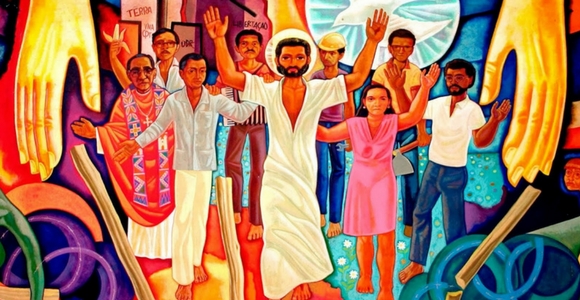
You Will Judge the Twelve Tribes of Israel

A long table set for a meal

Photo by Francois Pistorius on Unsplash

by Herb Montgomery | February 8, 2018


“Our saying this week tells us that another world is possible . . . Our challenge is to shape a society that reflects a set of values that shape our world into a safe, compassionate, just home for us all—a world where each of us has a seat at the table, regardless of our ability, age, race, gender, orientation, gender identity or expression; each of us seated at the table, each person having a say in the world we are creating, all with a preferential option for the most vulnerable among us.”


Featured Text:

“You who have followed me will sit on thrones judging the twelve tribes of Israel.” (Q 22:28, 30)

Companion Texts:

Matthew 19:28: “Jesus said to them, ‘Truly I tell you, at the renewal of all things, when the Son of Man sits on his glorious throne, you who have followed me will also sit on twelve thrones, judging the twelve tribes of Israel.’”

Luke 22:28-30: “You are those who have stood by me in my trials. And I confer on you a kingdom, just as my Father conferred one on me, so that you may eat and drink at my table in my kingdom and sit on thrones, judging the twelve tribes of Israel.”

In the book of Judges, judges were liberating revolutionaries.

In this week’s saying, the “judging” indicates governance. The ancient Hebrew hope was not the same as the hope of many sectors of Christianity today. Many Christians today have their hearts fixed on one day becoming a disembodied soul in some distant realm of heavenly bliss. The ancient Hebrews were much more concerned with this life than with an afterlife. They hoped that someday Messiah would come and all oppression, all injustice, all violence, and the earth would be put right. Our saying this week reflects this earthly hope.

What also strikes me about this week’s saying is the use of the word “thrones.” Few other words would seem more out of harmony with the ethical teachings we have looked at in the gospels so far. But just two verses earlier we find these words:

Luke 22:25-26: “Jesus said to them, ‘The kings of the Gentiles lord it over them; and those who exercise authority over them call themselves benefactors. But you are not to be like that. Instead, the greatest among you should be like the youngest, and the one who rules like the one who serves.’”

I, like some of you, am not interested in thrones, in having another person on a throne over me or being on one myself over others. What I do resonate with are more egalitarian, democratic, nonhierarchical, voluntary, non coercive forms of organizing human communities. As I’ve often remarked in this series, one of Jesus’ most foundational solutions to the individualism we face in our society today is community. His community is not one where someone sits on a throne and others bow. It’s a community where we each take responsibility for taking care of each other.

As I contemplated this week’s saying a bit further, however, it hit me. Jesus doesn’t use the singular word “throne.” He uses the plural word “thrones.” Now the idea behind this saying could have been akin to the model in Deuteronomy where the Hebrew men were to “choose some wise, understanding and respected men [sic] from each of your tribes, and I [Moses] will set them over you.” So the men did just that. The men they chose were appointed to have authority over the people at large “as commanders of thousands, of hundreds, of fifties and of tens and as tribal officials” (see Deuteronomy 1:13-15). The gospel of Matthew seems to agree with this model in that it mentions twelve specific thrones, sat on by twelve male disciples, over twelve Jewish tribes.

But in Luke we get a different image for this word “thrones,” one not limited to a hierarchal twelve. In Luke, these thrones are associated with eating and drinking and having a seat at Jesus’ table. This calls us to consider Jesus’ table fellowship in Luke’s gospel.

Luke 5:29-30: “Then Levi held a great banquet for Jesus at his house, and a large crowd of tax collectors and others were eating with them. But the Pharisees and the teachers of the law who belonged to their sect complained to his disciples, ‘Why do you eat and drink with tax collectors and sinners?’”

Luke 14:12-14: “Then Jesus said to his host, ‘When you give a luncheon or dinner, do not invite your friends, your brothers or sisters, your relatives, or your rich neighbors; if you do, they may invite you back and so you will be repaid. But when you give a banquet, invite the poor, the crippled, the lame, the blind, and you will be blessed.’”

Luke 15:2: “But the Pharisees and the teachers of the law muttered, ‘This man welcomes sinners and eats with them.’”

In the gospel of Luke, Jesus shares a table with people who faced religious, political and economic exclusion every day and were pushed to the margins and undersides of their society. Jon Sobrino, referring to how religion is used to do the same today, writes:

“The name of God is used as religious justification for oppressing others, and this is what must be unmasked . . . It is not difficult, then, to understand Jesus’ anger at the way religious people manipulate his God. (And maybe here is the place to think about the manipulation of theology, its ideologizing role, in tolerating—not to mention encouraging—the oppression of others in the name of God.) . . . When piety is used to go against creatureliness, religion becomes an oppressive mechanism. The creator who comes in conflict with creatures is a false God and false gods make even the pious inhuman.” (Jesus the Liberator, p. 168-170)

Jesus welcomed to the table those who were being denied a place there. Shirley Chisholm, who in 1968 became the first black woman in the U.S. Congress, often chided, “If they don’t give you a seat at the table, bring a folding chair.” She, being “unbought and unbossed,” was a force to be reckoned with in New York City as she advocated for the disenfranchised people in her district during her 14 years in Congress. We see that same solidarity with people who face various forms of oppression in the Jesus of the gospels.

Jesus associates with the marginalized, seats them at a table where they were welcomed to “eat and drink,” and also gives them thrones. Luke describes many thrones, an image that would make much more sense if we are called to care for each other. Each of us, in our own way, sits on a throne from which we set in motion the kind of world we will all experience together. Today we might use the word democracy. In Luke, we don’t find a king on a throne, but a people on many thrones, together determining a world where the meek are not walked over and where the poor are given the kingdom, the hungry are fed, and poverty is eliminated (see Acts 4:34).

This is a world described from the bottom up. Every person welcome at the table. Every person on a throne. Every person’s voice heard. Every person’s story valued. Every person experiencing worth.

Our society still associates the seat at the table with power today. One of the reasons people are excluded from the table in our society is to limit their say in the kind of world that those in power are shaping. Take the history of voting in the U.S. as an example. Originally only men who owned property were allowed to vote. Thomas Paine was one of the earliest voices stating that this was not right, and that the vote should also include those who did not own property, too. Eventually White women won the ability to vote. We still see efforts to exclude people of color from voting today.

If history teaches us anything, it’s that those whom we exclude today are those we will seek to exterminate tomorrow. Whatever world we create out of that exclusive table will invariably be unsafe, unjust, and heartless for those not allowed to sit at the table from the start. Consider the vote again. The U.S. out of all many-throned (democratic) nations has the lowest voter turnout. We don’t have a holiday so that working people can vote. And there are numerous other efforts made to “intrinsically” limit who gets a say. Noam Chomsky has repeatedly stated over the last few years that the poorest 70% of society is “literally disenfranchised.”

 “Their political representatives simply pay no attention to them, so it doesn’t matter what they think…This is a plutocracy, not a democracy . . . As you move up the [income] scale, you get a little bit more influence. When you get to the very top, [that’s where] policy’s made.”

This helps explain why most of the economic gains made over the past three decades have gone to the top 1%. The number of those who get a “throne” or seat at the table, a say in how things operate, is very limited. The top 1% are making the decisions.

Our saying this week tells us that another world is possible. Even anarchists, who are anti-hierarchy, believe that social society should have some form of voluntary organization. Our challenge is to shape a society that reflects a set of values that shape our world into a safe, compassionate, just home for us all—a world where each of us has a seat at the table, regardless of our ability, age, race, gender, orientation, gender identity or expression; each of us seated at the table, each person having a say in the world we are creating, all with a preferential option for the most vulnerable among us. In this world, there are self-determining “thrones” for everyone.

“You who have followed me will sit on thrones judging the twelve tribes of Israel.” (Q 22:28, 30)

HeartGroup Application

Last summer I had the pleasure of meeting of Rev. Otis Moss III of Trinity United Church of Christ. Each week, this historic community sends out a weekly email devotional and this past week’s devotional moved me deeply. It’s a reminder of the importance of community. It begins with the African proverb, “If you want to go quickly, go alone. If you want to go far, go together.” It continues, “One of the great tragedies of our time is that we live in an individualistic culture that teaches us that our ultimate value is not in what we give to the world, but in what we have and what we achieve. Our value must be derived from individual hard work, persistence, and determination! Then, along our path we find that this is a myth. We discover that we need others, and that ‘to go far,’ we must travel together . . . We all have the sacred responsibility to support one another. We all share the divine responsibility of ensuring that everyone in our community is growing, thriving, and prospering.”

I want to share with you Trinity UCC’s Prayer and weekly action with you as well, because I think that they have intrinsic value for you as well.

1. For the next seven days, I want you to take time each day to pray this very simple but profound prayer:

“Lord, help us to realize that our lives are dependent on each other. Help us to use the gifts You have given us to do justice, love mercy, and walk humbly with You. Amen.”

Also, I’d like you to journal how this prayer changes your own focus throughout the week.

2. Share with your HeartGroup how this prayer impacted your week.

3. Lastly, their weekly action:

“Find an organization that is engaged in work that you feel is important, and join them.”

Do this in your local community and share with your HeartGroup what you experience by doing so.

Another world is possible.

Keep living in love, survival, resistance, liberation, reparation, and transformation.

Thanks for checking in with us this week.

I love each of you dearly,

I’ll see you next week.

The Parable of the Entrusted Money

 Picture of money

by Herb Montgomery | February 1, 2018


“In the story, this king’s passion was profit. The God Jesus described at the heart of the kingdom was passionate about people, not profit. Jesus’ “kingdom of God” was a community where people were valued over profit, property, power, and privilege. Debts were cancelled, slaves were set free, prisons were abolished, and wealth was redistributed more justly: no one had too much while others didn’t have enough to even survive. Jesus’ vision was a vision for a human community of connectedness, cooperation, compassion, and distributive justice.”


Featured Text: 

 “A certain person, on taking a trip, called ten of his slaves and gave them ten minas and said to them: Do business until I come. After a long time‚ the master of those slaves comes and settles accounts with them. And the first came‚ saying: Master, your mina has produced ten more minas. And he said to him: Well done, good slave, you have been faithful over a pittance, I will set you over much. And the second‚ came saying: Master, your mina has earned five minas. He said to him: Well done, good slave, you have been faithful over a pittance, I will set you over much. And the other came saying: Master, I knew you, that you are a hard person, reaping where you did not sow and gathering from where you did not winnow; and scared, I went and hid your mina in the ground. Here, you have what belongs to you. He said to him: Wicked slave! You knew that I reap where I have not sown, and gather from where I have not winnowed? Then you had to invest my money with the money changers! And at my coming I would have received what belongs to me plus interest. So take from him the mina and give to the one who has the ten minas. For to everyone who has will be given; but from the one who does not have, even what he has will be taken from him.” (Q 19:12-13, 15-24, 26)

Companion Texts:

Matthew 25:14-15, 19-29: “Again, it will be like a man going on a journey, who called his servants and entrusted his wealth to them. To one he gave five bags of gold, to another two bags, and to another one bag, each according to his ability. Then he went on his journey. . . .  After a long time the master of those servants returned and settled accounts with them. The man who had received five bags of gold brought the other five. ‘Master,’ he said, ‘you entrusted me with five bags of gold. See, I have gained five more.’ His master replied, ‘Well done, good and faithful servant! You have been faithful with a few things; I will put you in charge of many things. Come and share your master’s happiness!’ The man with two bags of gold also came. ‘Master,’ he said, ‘you entrusted me with two bags of gold; see, I have gained two more.’ His master replied, ‘Well done, good and faithful servant! You have been faithful with a few things; I will put you in charge of many things. Come and share your master’s happiness!’ Then the man who had received one bag of gold came. ‘Master,’ he said, ‘I knew that you are a hard man, harvesting where you have not sown and gathering where you have not scattered seed. So I was afraid and went out and hid your gold in the ground. See, here is what belongs to you.’ His master replied, ‘You wicked, lazy servant! So you knew that I harvest where I have not sown and gather where I have not scattered seed? Well then, you should have put my money on deposit with the bankers, so that when I returned I would have received it back with interest. So take the bag of gold from him and give it to the one who has ten bags. For whoever has will be given more, and they will have an abundance. Whoever does not have, even what they have will be taken from them.’”

Luke 19:12-13, 15-24, 26: “He said: ‘A man of noble birth went to a distant country to have himself appointed king and then to return. So he called ten of his servants and gave them ten minas. “Put this money to work,” he said, “until I come back.” . . . He was made king, however, and returned home. Then he sent for the servants to whom he had given the money, in order to find out what they had gained with it. The first one came and said, “Sir, your mina has earned ten more.” “Well done, my good servant!” his master replied. “Because you have been trustworthy in a very small matter, take charge of ten cities.” The second came and said, “Sir, your mina has earned five more.”  His master answered, “You take charge of five cities.” Then another servant came and said, “Sir, here is your mina; I have kept it laid away in a piece of cloth. I was afraid of you, because you are a hard man. You take out what you did not put in and reap what you did not sow.” His master replied, “I will judge you by your own words, you wicked servant! You knew, did you, that I am a hard man, taking out what I did not put in, and reaping what I did not sow? Why then didn’t you put my money on deposit, so that when I came back, I could have collected it with interest?” Then he said to those standing by, “Take his mina away from him and give it to the one who has ten minas.” . . . He replied, “I tell you that to everyone who has, more will be given, but as for the one who has nothing, even what they have will be taken away.”’”

Gospel of Thomas 41: “Jesus says, ’Whoever has something in his hand, something more will be given to him. And whoever has nothing, even the little he has will be taken from him.’”

Sometimes I have trouble with the stories Jesus chose to use, and I don’t like the story in this week’s saying. Scholars tell us that Jesus chose the stories that would have been familiar to his audience. Our society today is two millennia removed from that world today and sometimes Jesus’s stories seem problematic to us. Before I explain that, let me share an experience I had recently that relates to this week’s saying.

I was listening to an interview of a college economics professor who was critiquing the contradiction at the heart of capitalism. At the core of capitalism is the drive to produce more capital or profit from a product or service. One of many ways owners can achieve this profit is keeping their expenses as low as possible. “Expenses” include the cost of labor, the wages owners pay their employees. The less workers are paid, the more profit one has left in the end.

But here is the contradiction: The wages being kept low are the same funds that most workers will need to buy the product or service they produce. So if wages are too low, no one can afford to buy and owners won’t make any profit at all.

So this contradiction morphs into a balancing act between too much profit for the 1% and not enough money for the masses to survive or not enough profit to keep the 1% happy and more surplus among the masses than the 1% feel they should have. It’s a tug-o-war between the wealthy’s desire to profit and the masses desire to survive with a good quality of life.

In our system here in the U.S., this balance is achieved through government regulations and taxes. Theoretically, as the masses gain too much surplus, those who have profit to lose call for less business regulation and less taxation of their corporations, or more profit. On the flip side, when corporations and the 1% are gaining too much profit, the masses begin to call for the wealthy to pay their fair share of taxes, to redistribute wealth or regulate earnings another way (raising minimum wage for example) so that the masses aren’t crushed by the drive to produce profit.

Wagers are kept low enough to produce profit AND people need higher wages to purchase products and services that also produce this profit. Capitalism never will escape this contradiction and the cycle of struggle between the workers and those who profit from their labor and thus this tug-of-war it produces. In the 1960-70s we saw capitalists feeling like society was moving too far toward favoring workers. And they went to work! They wanted more profit and with it the exclusion of people of color from public services. Since Nixon and Regan we’ve seen a steady move toward benefits for wall street and the 1% in our society and now we are experiencing reawakening toward concern for the working class, again.

And this cycle will repeat over and over and over. Many believe there has to be another alternative that produces a safe, more just, more compassionate society for everyone.

As I was listening, the interviewer asked the professor, “How does capitalism exploit workers or employees?” “It’s quite simple,” he responded. “Let’s say an employer agrees to pay a worker $20 an hour. For that employer to be willing to pay that $20 an hour, they have to believe that that person’s labor will actually be worth more than $20 an hour. Once all business expenses have been paid, there has to be a profit to it. The labor which costs $20 has to produce a value that will cover the expenses of the business plus a profit on top. Unless it is an employee owned business, the worker never receives the value of their labor but only a portion of it. This, by definition, is what those opposed to capitalism have called ‘the exploitation of the laborers.’ Workers never receive the full value of their labor.”

Problematic Stories

Again, Jesus sometimes uses stories familiar to his audience, stories that are horrendous when compared to today’s ethical standards.

One example is the story of the righteous rich man and Lazarus the poor sinner found in Luke’s gospel. Postmortem, the expected roles are reversed. The rich man ends up in eternal, flaming, torment while Lazarus resides in Abraham’s bosom. But let it register. Although the story truth is relevant, using the image of eternal torment in the flames of the afterlife is a horrible choice. Only a few sectors of evangelical Christianity even subscribe to belief in eternal torment today because of the pure inhumanity of it. Torment is not reconcilable with Jesus’ new vision for humanity, and so.many within Christianity today see this story as teaching an economic truth rather than literally explaining what happens in the afterlife.

Luke 16:22-24: “The time came when the beggar died and the angels carried him to Abraham’s side. The rich man also died and was buried. In Hades, where he was in torment, he looked up and saw Abraham far away, with Lazarus by his side. So he called to him, ‘Father Abraham, have pity on me and send Lazarus to dip the tip of his finger in water and cool my tongue, because I am in agony in this fire.’”

Another terrible story is that of the manager who falsified customers’ bills behind the back of the business owner, making customers owe significantly less and hoping to gain favor with these costumers. I don’t see anyone recommending this story today as a way for managers to manage the businesses they work for. The story is problematic, but it was a familiar story to Jesus’ audience and therefore he used it to make a point about “the kingdom.”

Luke 16:3-6: “The manager said to himself, ‘What shall I do now? My master is taking away my job. I’m not strong enough to dig, and I’m ashamed to beg—I know what I’ll do so that, when I lose my job here, people will welcome me into their houses.’ So he called in each one of his master’s debtors. He asked the first, ‘How much do you owe my master?’  ‘Nine hundred gallons of olive oil,’ he replied. The manager told him, ‘Take your bill, sit down quickly, and make it four hundred and fifty.’”

Another problem in stories Jesus told is the repeated references to slavery. Before the US Civil War, these references were used by Christians in the South to say that Jesus actually approved of slavery.

I would argue that elsewhere Jesus taught a gospel of debts being forgiven and slaves being set free. But that fact that Jesus used stories that on the surface seem to say that slavery was a part of his vision for human society is deeply problematic. One must look deeper at the story truths of these familiar stories to arrive a different conclusion.

I share all of this to illustrate that Jesus’ stories are at times problematic while the truths they teach can be timeless.  Our saying this week is one of those stories.

What is the horrendous backdrop of this story?

As I shared in the above interview with the professor, it’s the exploitation of labor through slavery. Here a master leaves money with ten slaves for them to labor to earn more profit for the master. I often hear from those who oppose social safety nets in society saying, “Those who don’t work shouldn’t eat.” This was a slogan not only in the New Testament, and some hyper capitalists today, but also of Lenin. Lenin saw wealthy capitalists who’d invested their money have others labor to earn the investors profits yet be tagged with those who “aren’t working.” This is the kind of master we find in this week’s story:

“You knew, did you, that I am a hard man, taking out what I did not put in, and reaping what I did not sow?”

Karl Marx critiqued taking out what someone does not put in and reaping where they have not sown:

“The directing motive, the end and aim of capitalist production, is to extract the greatest possible amount of surplus value, and consequently to exploit labor-power to the greatest possible extent.” (Karl Marx, Das Kapital, Vol. I, Ch. 13, pg. 363)

If one uses this story to say that Jesus approved of capitalism’s exploitation of labor it would be almost irreconcilable with Jesus’ other teachings that teach a preferential option for the poor and exploited laborers.

So what was the point Jesus was trying to make?

As we will see in next week’s final saying, Sayings Gospel Q ends with the promise of Jesus’s followers receiving stewardship or governing roles over a liberated and restored “twelve tribes of Israel.” Those who demonstrated they understood and practiced what Jesus’ “kingdom of God” was all about would theoretically receive larger roles in that new humanity.

Is there any application in this saying for us today?

Maybe.

Just as each slave was left with funds that they were expected to use to create more, so too each of us today is called to take whatever we have and invest it in transforming our world into a safe, just, more compassionate home for everyone. But there are significant differences between the story and the world Jesus’ envisioned.

In the story, this king’s passion was profit. The God Jesus described at the heart of the kingdom was passionate about people, not profit. Jesus’ “kingdom of God” was a community where people were valued over profit, property, power, and privilege. Debts were cancelled, slaves were set free, prisons were abolished, and wealth was redistributed more justly: no one had too much while others didn’t have enough to even survive. Jesus’ vision was a vision for a human community of connectedness, cooperation, compassion, and distributive justice.

We are called to invest our lives (including our money) in the survival, liberation, reparation, and transformation of people’s lives. We invest our own lives in liberating human lives and reclaiming our own humanity by working with those who daily face some form of oppression and suffering. Jesus’ vision is of a world where the hungry are fed, those who weep now laugh, and the poor receive it all (see Luke 6:20-26) It’s a world whose coming into being is good news to the poor, the imprisoned, the exploited, and the oppressed (see Luke 4:18-19).

Jesus’ “reign of God” was about people, not money. It was about life for every person, not the exploitation of the masses for the benefit of the few.

We’re called to use what we have been given to create a world of life.

“A certain person, on taking a trip, called ten of his slaves and gave them ten minas.” (Q 19:12-13, 15-24, 26)

Thanks for checking in with us this week.

Remember, another world is possible.

Keep living in love, survival, resistance, liberation, reparation, and transformation.

I love each of you dearly.

I’ll see you next week.

One Taken, One Left

by Herb Montgomery | January 25, 2018


“It’s about compassion. Either we see ourselves in others, or we don’t. And if we don’t learn to do so, we run the risk of destroying life as we know it for everyone including ourselves. We are connected. How we treat others will affect us as well—like it or not, we are part of one another.”


Featured Text:

“I tell you, there will be two in the field, one is taken and one is left. Two women will be grinding at the mill; one is taken and one is left.” Q 17:34-35

Companion Text:

Matthew 24:40-41: “Two men will be in the field; one will be taken and the other left. Two women will be grinding with a hand mill; one will be taken and the other left.”

Luke 17:34-35: “I tell you, on that night two people will be in one bed; one will be taken and the other left. Two women will be grinding grain together; one will be taken and the other left.”

Gospel of Thomas 61:1: “Jesus said: “Two will rest on a bed. The one will die, the other will live.”

I remember this passage well from my early childhood. In pulpit after pulpit, preachers used it to explain to people that a secret rapture was coming, where people would simply disappear off the earth. Two pilots flying a plane? One would be taken and the other left. Two people walking down the sidewalk? One would be taken and the other left.

Not until years later did I see how grossly out of context this passage was being taken.

Indiscriminate Fate

First let’s start with the surface of this saying. In both examples, two people are doing the same activities. There is an indiscriminate nature to being taken and being left. There is no rhyme or reason and no obvious difference between them. Taken in the context of last week’s saying about the days of Noah, riches would not be enough to save the wealthy from this fate.

As we saw last week, both Matthew and Luke lift this saying of Jesus and place it in the context of the fulfillment of the re-humanizing liberation found in Daniel 7—the revealing of the “son of humanity.” Matthew and Luke use the Jewish stories of Noah and Lot. Yet in these stories, the taken aren’t “raptured” to a celestial heaven while others are “left” down here on earth. Those “taken” in the Noah and Lot stories are those who “die” in Thomas’s gospel, whose lives are “taken.” And those who are “left” in these passages are those who remain alive, or who are “left” alive. So it’s in fact a good thing to be “left behind!”

Dystopian Future

This saying warns those who benefit from violence toward the vulnerable and economic exploitation of the poor about a coming indiscriminate destruction—a reversal of economic injustice—that turns things upside down from their present structure. The hungry are fed and the well-fed go hungry. The poor are given the kingdom, and the rich are sent away empty. Those whom present injustice causes to weep laugh, and those who now laugh, weep (see Luke 6:20-26). It’s an indiscriminate destruction and sounds very dystopian.

Today, scientists are warning that if we do not correct our present course, indiscriminate destruction will be our ecological future. We are destroying sustainable life here on the one planet that is home for everyone. And even though in our saying this week, some survive destruction, the disaster in their immediate future indiscriminately affected everyone. The destruction of Jerusalem in 70 C.E. affected both rich and poor. The poor were especially vulnerable, but destruction was indiscriminate nonetheless and affected everyone. This has striking parallels to our future. We all share the same air, water, and globe. We are all connected. We are in this together, and we’ll either survive together, or risk destruction for everyone.

Just this past week, after a season of devastating fires across the north and west US,  the east coast was pummeled with record lows and snow falls. We’re seeing evidence of our climate breaking down.

But this leads me to my third point this week. The future doesn’t have to be like this. Instead of a dystopian future where greed has ruined everything, we can choose a future rooted in compassion and justice.

A Compassionate Future 

Compassion was at the heart of Jesus’ new vision for human society and so his politics have rightly been named as a politics of compassion. In the book All We Leave Behind, Carol Off writes of the debate about refugees in Canada, but what she states could be said of any other social justice issue:

“The seething centre of the refugee debate is not really about policy; it’s about perception. Either you identify with others or you don’t. Either you see yourself in the eyes of others or you don’t.”

It’s about compassion. Either we see ourselves in others, or we don’t. And if we don’t learn to do so, we run the risk of destroying life as we know it for everyone including ourselves. We are connected. How we treat others will affect us as well—like it or not, we are part of one another. This is the point of one of Jesus’ most famous sayings, where he quotes the Torah:

“The second [greatest commandment] is this: ‘Love your neighbor as yourself.’ There is no commandment greater than these.” (Mark 12:31)

Those two words are important: “as yourself.” Either we will learn to see others “as ourselves” and live, or we’ll continue down the path of destructive, extreme, individualism that threatens us all. Individualism is an inadequate lens for life on this planet. Everything we do sets in motion a chain of cause and effect for everyone around us, including ourselves. None of us is an island, and we impact each other whether we desire to or not. It’s simply the way things are. We are individuals, yet we’re also woven together in a much larger fabric too!

And this is precisely why our future can be different than our present. We can choose a future of compassion and justice for one another. We can choose to be our siblings’ keeper. The future is not set in stone. It is open, filled with multiple possibilities based on the choices we make today.

Last week, the Daily Mail published an article exploring a new spatial theory of time: “According to the theory, if we were to ‘look down’ upon the universe, we would see time spread out in all directions, just as we see space at the moment.” In other words, time isn’t happening linearly, one thing after another, but rather past, present, and future exists simultaneously and all around us.

If this is true, perhaps time is not a single line, but a web of possible pasts, including the past that occurred, a web of possible presents, including the present that we have chosen, and a web of possibilities called the future. Each of these webs connects through various causes and effects.

This would mean that right now, we are standing alongside all those who will come after us as well as with all those who have come before us. Let’s honor the work of our most engaged ancestors who gave of themselves to make our world a safe, more just, more compassionate home for us all. And let’s also honor all those who will come after us by giving them more to work with than they would have if we did no thing.

Right now, the future looks like a dystopia, but it doesn’t have to be that. Our saying this week warns of a disastrous future only in the hopes that we will begin to make better choices.

“I tell you, there will be two in the field, one is taken and one is left. Two women will be grinding at the mill; one is taken and one is left.” Q 17:34-35

HeartGroup Application

This week I have something FUN for your group to try. It’s an exercise in cooperative action. I want you to take a marker and tie eight strings to it (Or less if you have less than 8 people in your group). Then I want you as a group to choose a word and write it out working together.

Does it make any difference how close you hold the string to the marker? Try holding the string further away from the marker and see how that works, too.

  1. What lessons did you learn about what it took to work together?
  2. How is working together different than working alone?
  3. Are there certain things we can only accomplish together? List them. What did you learn about working together that may apply to this list?

As I often say, Jesus’ solution to many of the problems in society was a vision for a new way of structuring human community. Community is not always easy. But when I consider the disastrous results of extreme, rugged individualism in our society here in the West, I believe community is worth the struggle.

Wherever you are this week, keep living in love, survival, resistance, liberation, reparation, and transformation. Till the only world that remains is a world where love reigns.

Another world is possible.

Thanks for checking in with us this week.

I love each of you dearly.

I’ll see you next week.

As in the Days of Noah

La Perla, San Juanby Herb Montgomery | January 11, 2018


“This wakefulness means possessing a continuing awareness of issues related to marginalized people and their struggle for justice. It requires an intersectional awareness of racial, gender, economic, LGBT, and other social forms of justice. Jesus-followers staying awake will characterize God as Jesus did: as being on the side of people who daily face oppression. We will live and work in solidarity with God and marginalized communities as we choose a world marked by re-humanizing liberation instead of dehumanizing oppression.”


Featured Text:

“As it took place in the days of Noah, so will it be in the day of the Son of Humanity. For as in those days they were eating and drinking, marrying and giving in marriage, until the day Noah entered the ark and the flood came and took them all, so will it also be on the day the Son of Humanity is revealed.” Q 17:26-30

Companion Texts:

Matthew 24:37-39: “As it was in the days of Noah, so it will be at the coming of the Son of Man. For in the days before the flood, people were eating and drinking, marrying and giving in marriage, up to the day Noah entered the ark; and they knew nothing about what would happen until the flood came and took them all away. That is how it will be at the coming of the Son of Man.

Luke 17:26-30: “Just as it was in the days of Noah, so also will it be in the days of the Son of Man. People were eating, drinking, marrying and being given in marriage up to the day Noah entered the ark. Then the flood came and destroyed them all. It was the same in the days of Lot. People were eating and drinking, buying and selling, planting and building. But the day Lot left Sodom, fire and sulfur rained down from heaven and destroyed them all. It will be just like this on the day the Son of Man is revealed.”

The mic crackled, “It’s imperative that you stay together, today. Women especially, never allow yourself to be found alone. Today we’ll be working in La Perla.”

Last month I spent three days in the Caribbean with a team of people providing hurricane relief and getting Puerto Rican families back into their homes. One of those three days we worked in La Perla in San Juan. Tourists are typically advised to avoid La Perla, and “The Pearl” district in Old San Juan is referred to as the “slums.”

“La Perla is a historical shanty town astride the northern historic city wall of Old San Juan . . .  established in the late 19th century. Initially, the area was the site of a slaughterhouse because the law required them and homes of former slaves and homeless non-white servants – as well as cemeteries – to be established away from the main community center; in this case, outside the city walls. Sometime after, some of the farmers and workers started living around the slaughterhouse and shortly established their houses there. Only three access points exist, one through the ‘Santa Maria Magdalena Cemetery’, one on the east side and one through a walkway right in the center of the northern wall.”  (La Perla, San Juan, Puerto Rico. 2017, December 14. In Wikipedia, The Free Encyclopedia. Retrieved 15:27, January 10, 2018, from https://en.wikipedia.org/w/index.php?title=La_Perla,_San_Juan,_Puerto_Rico&oldid=815454674)

So far, hurricane relief has not been allowed to enter this area, primarily because capitalist investors want inhabitants to give up and move out so that they can take over the area and build high-rises and resorts there.

So La Perla is the area we chose to assist. We entered La Perla through the entrance in the center of the northern wall.

We split into three teams to reinstall three roofs, clean up flood damage and hurricane debris, and get three families back into their homes. It was an amazing experience. Tears were shed and hearts were full. I’ll share pictures of our work in next week’s news update.

Though I left with joy, what I also walked away from La Perla with is a sense of how utterly dehumanizing poverty really is.

Dehumanizing Oppression and Re-humanizing Liberation

Marcus Borg’s and John Dominic Crossan’s book The First Christmas shares a little background on the phrase in this week’s saying, “The Son of Humanity.” The phrase comes from the revolution literature of Daniel 7 where the prophet’s vision includes four fantastic creatures, each representing a historical empire:

“What is at stake in Daniel is this: the first four empires are inhuman beasts; only the fifth and final empire is truly human.” (Borg, Marcus J.; Crossan, John Dominic, The First Christmas, p. 68)

In Daniel 7, all the oppressive empires are represented as violent beasts. Yet there comes after them a final kingdom that is human.

Let that register for a moment. The last kingdom is human. Paulo Freire wrote,

“The oppressors do not perceive their monopoly on having more as a privilege which dehumanizes others and themselves. They cannot see that, in the egoistic pursuit of having as a possessing class, they suffocate in their own possessions and no longer are; they merely have. For them, having more is an inalienable right, a right they acquired through their own ‘effort,’ with their ‘courage to take risks.’ If others do not have more, it is because they are incompetent and lazy, and worst of all is their unjustifiable ingratitude towards the ‘generous gestures’ of the dominant class. Precisely because they are ‘ungrateful’ and ‘envious,’ the oppressed are regarded as potential enemies who must be watched. It could not be otherwise. If the humanization of the oppressed signifies subversion, so also does their freedom; hence the necessity for constant control. And the more the oppressors control the oppressed, the more they change them into apparently inanimate ‘things.’ This tendency of the oppressor consciousness to ‘in-animate’ everything and everyone it encounters, in its eagerness to possess, unquestionably corresponds with a tendency to sadism.”

  – Paulo Freire, Pedagogy of the Oppressed: 30th Anniversary Edition (p.59)

Freire’s point is simple: Oppression dehumanizes. As they called Jesus “the Son of Humanity,” the earliest community of Jesus followers saw in his teachings the re-humanizing liberation identified in Daniel 7. In Jesus they saw Daniel’s Son of Humanity ending the violent oppression of all other empires.

An Element of Surprise

The central point of this week’s saying is that this re-humanizing liberation would include an element of surprise or unexpectedness for oppressors. Most scholars agree that both Matthew and Luke’s gospels used Mark’s gospel as an outline for their own, editing and adding to Mark’s gospel. In Mark, our saying this week appears in a parallel passage about surprise:

Mark 13:35-37: “Therefore keep watch because you do not know when the owner of the house will come back—whether in the evening, or at midnight, or when the rooster crows, or at dawn. If he comes suddenly, do not let him find you sleeping. What I say to you, I say to everyone: ‘Watch!’”

We’ll discuss what it means to “watch” in just a moment.

The Great Reversal of Economic Injustice

In both Matthew and Luke the surpise thaat catches those presently benefited by the way our world is a great reversal of economic injustice. The tables are turned upside down. For his Jewish readers, Matthew mentions those who were surprised in the Hebrew Noah story. Luke, addressing non-Jewish Christians, includes the stories of Noah and Lot. The inclusion of Lot makes sense when when one understands Sodom’s “great sin” and remembers that Luke, out of all the gospels, has the strongest economic justice theme. The Jewish prophetic tradition defines Sodom and Gomorrah’s sin as the economic exploitation of the poor:

Ezekiel 16:49: “Now this was the sin of your sister Sodom: She and her daughters were arrogant, overfed and unconcerned; they did not help the poor and needy.”

Both Noah’s and Lot’s narratives are stories where destruction comes unexpectedly. In the Noah story, the surprise falls on the violent. In Lot’s story it falls unexpectedly on rich, exploitative oppressors who lived at ease at the expense of the vulnerable. Luke emphasizes not just the violence surprised by God’s kingdom but also the economic elements of oppression. His gospel begins with Mary’s song:

Luke 1:52-53: “He has brought down rulers from their thrones, but has lifted up the humble. He has filled the hungry with good things but has sent the rich away empty.”

This week’s saying is clear. Those who create and benefit from a world like the one in La Perla will not experience Jesus’ gospel as good news. The announcement of the kingdom proclaims a radical reversal of exploitative comfort (compare with Luke 6:24-26): their way of life is cast down while those presently scratching out an existence and fighting to survive injustice, like the residents of La Perla, are lifted up, liberated, and restored.

Conclusion

The language of “keeping watch” for the arrival of this re-humanizing liberation, whether it be in Daniel’s imagery, Jesus’ teachings, or the Jewish prophets’ pronouncements, drew from the experiences of night watchmen who could not fall asleep.

The message was, “Stay awake!”

In our world today, this wakefulness means possessing a continuing awareness of issues related to marginalized people and their struggle for justice. It requires an intersectional awareness of racial, gender, economic, LGBT, and other social forms of justice. Jesus-followers staying awake will characterize God as Jesus did: as being on the side of people who daily face oppression. We will live and work in solidarity with God and marginalized communities as we choose a world marked by re-humanizing liberation instead of dehumanizing oppression.

This week’s saying warns against being on auto-pilot and just going along within the present status quo.

Stay awake and keep working for change! I can’t think of a better way to begin this new year than with a call to do just that!

“As it took place in the days of Noah, so will it be in the day of the Son of Humanity. For as in those days they were eating and drinking, marrying and giving in marriage, until the day Noah entered the ark and the flood came and took them all, so will it also be on the day the Son of Humanity is revealed.” Q 17:26-30

HeartGroup Application

As 2018 begins, make three lists as a group, together!

  1. Take some time to take inventory of 2017 and list things that happened in 2017 that you are thankful for.
  2. Then list things you wish had been different about 2017. Discuss these together. How do the things on this list make you feel? What do they inspire you to do in 2018?
  3. List three things that you as a group would like to work on bringing into reality for 2018 and make a plan for doing so. You can use the previous two lists for inspiration. Then get to work making them happen! Together we can make a difference.

Thanks for checking in with us this week. I hope this new year is off to a positive start for each of you.

Keep looking up! Keep living in love, survival, resistance, liberation, reparation, and transformation, and follow the example of Jesus in being a source of healing in our world today.

Till the only world that remains is a world where only love reigns.

I love each of you dearly.

I’ll see you next week.

Vultures Around a Corpse

An eagle sitting on a post in winter

by Herb Montgomery | January 5, 2018


“Jesus was not a Roman citizen, and so when he taught nonviolence, he was not teaching from the social location of the Roman oppressor, but from the perspective of an oppressed Jew. Jesus’ nonviolence sprang from the tension that exists for all who face oppression: the tension between liberation and survival.”


Featured Text:

“Wherever the corpse, there the vultures will gather.” Q 17:37

Companion Texts:

Matthew 24:28: “Wherever there is a carcass, there the vultures will gather.”

Luke 17:37: “‘Where, Lord?’ they asked. He replied, ‘Where there is a dead body, there the vultures will gather.’

Happy new year!

As we begin this new year, we have only four more sayings from Q in our series on the sayings of Jesus. We have been engaging this collection of Jesus’ sayings (what scholars refer to as sayings gospel Q) now for two years. It’s been quite a journey we’ve been on and I’m deeply thankful to each of you who have been tracking with us each week all along the way.  I’m also really excited about where we are headed from here. Each week we’ll continue to publish podcasts and articles that give fresh perspectives on how we can apply Jesus’s sayings and teachings in our world today, working together to continue being a sources of healing, light, love, compassion and justice in our world.  If you’d like to go back and read this series from the very beginning you can do so by going to the first installment of this weekly series— The Sayings of Jesus

Let’s jump right in this week! Our saying this week is about gathering vultures.

Eagles and Vultures

Scholars have pointed out that the word translated in this week’s text as “vultures” can just as accurately be translated as “eagles.” “Eagles” would have been a locally appropriate term and Jesus’ audience would have recognized it: the banner of the oppressive empire subjugating them Rome’s bronze eagle.

Whether a vulture or an eagle, Rome’s symbol, like America’s today, was a bird of prey—a bronze eagle.

And before we get too far into this week, I want to say that I believe all oppressed communities have the right to choose for themselves what manner of resistance or means of liberation will best serve their aims. It is not the violent oppressors’ place to impose on the oppressed the restriction of nonviolent resistance. At the same time, as I shared last week, I teach and believe in nonviolence. That means I believe oppressed communities have the right to self-determination and I believe nonviolence is a force more powerful than violence. I hold this tension as someone who often benefits from others’ oppression and as someone who realizes nonviolence can be used to oppress too. Oppressors can use nonviolence to force the oppressed to stay passive and so use it as a conduit of more violence upon the vulnerable. This is why, as a teacher of nonviolence, I also believe strongly that oppressed communities have the right to determine their responses for themselves.

Jesus was not a Roman citizen, and so when he taught nonviolence, he was not teaching from the social location of the Roman oppressor, but from the perspective of an oppressed Jew. Jesus’ nonviolence sprang from the tension that exists for all who face oppression: the tension between liberation and survival. For Jesus, nonviolent resistance gave those who were oppressed and working toward liberation the best odds for surviving and experiencing liberation once they achieved it. To use violent forms of liberation was suicidal when one was subjugated by Rome.

Liberation and Survival

Last month in our reading course for 2017, we were reading Delores Williams’ book, Sisters in the Wilderness. In this classic volume of womanist theology, Williams captures this tension when she writes, “How do I shape a theology that is at once committed to black women’s issues and life struggles and simultaneously address the black community’s historic struggle to survive and develop a positive, productive quality of life in the face of death? … Womanist theology challenges all oppressive forces impeding black women’s struggle for survival and for the development of a positive, productive quality of life conducive to women’s and the family’s freedom and well-being” (Kindle location 195, 235).

She states unequivocally that, like Black liberation theology, womanist theology is also concerned with liberation. Yet there is a tension between liberation and survival. “Like black male liberation theology, womanist theology assumes the necessity of responsible freedom for all human beings. But womanist theology especially concerns itself with the faith, survival and freedom-struggle of African-American women” (Ibid., 239).

What good is liberation if to accomplish it, you cease to exist? This is a vital question for all communities that face various types of oppression. Some answer by pointing to future generations that will benefit from our sacrifice today. Other womanist theologians answer by retelling the Hebrew story of the slave woman Hagar. Hagar wrested herself free from the oppression of God’s chosen people, Abraham and Sarah, and she was liberated. Yet, as a runaway slave, she almost died in the wilderness. She had no resources for survival.

What does the God of the story tell Hagar?

“Then the angel of the LORD told her, ‘Go back to your mistress and submit to her.’” (Genesis 16:9)

Williams rightly critiques liberation theologies that do not hold a people’s survival in tension with their liberation. These theologies portray God as only liberator. In contrast, Williams writes, “God’s response to Hagar’s story in the Hebrew testament is not liberation. Rather, God participates in Hagar’s and her child’s survival on two occasions.”

It was not until the second liberation scene of the Genesis narratives that we see God helping Hagar to “make a way out of no way,” and so accomplishing both her survival and her liberation (see Genesis 21:9-21). “Thus it seemed to me that God’s response to Hagar’s (and her child’s) situation was survival and involvement in their development of an appropriate quality of life, that is, appropriate to their situation and their heritage.”

Jesus, Liberation, and Survival

As we have said repeatedly throughout this series (see Renouncing One’s Rights), Jesus’ teachings about nonviolent resistance was informed by the fact that for his followers to use violent resistance against Rome was to court certain failure, and not just failure, but also suicide. Over and over, Rome leveled to the ground any movement that even hinted at taking up arms against it. Some scholars believe that it was the combination of Jesus being linked to armed transgressors and his Temple protest that resulted in his crucifixion at the hands of Rome (see Luke 22:36-37).

Using violence against Rome was, according to the Jesus of the story, to place a higher priority on pursuing liberation without any regard for the survival and quality of life of those who were engaging that work. He saw using violence against his Jewish community’s oppressors as an all-or-nothing, consequences-be-damned approach. Jesus’s social vision for the human community was to be rooted in the nonviolent transformation of society. Yes, his way might end on a cross, a cross that his followers would also have to bear if they were threatened. But in his Romans/Jewish context, to use violence as the means of liberation under Rome meant committing to the certainty of being placed on a cross, the certainty of a violent death as the definite and inevitable outcome.

Both nonviolence and violence have a failure rate. And most often, when violent liberation efforts fail, their failure is exponentially more catastrophic than when nonviolent liberation efforts fail. Communities that face oppression must weigh the success and failure rates of both kinds of efforts and choose for themselves which they believe has the best odds. Those who teach nonviolence, like me, often believe that nonviolence is more powerful and produces a better outcome if it should also fail. Nonetheless, it is up to oppressed people to determine whether they believe that to be the case or not.

History is strewn with the stories of violent and nonviolent liberation movements. I believe that people power is always more powerful than tyranny and oppression by a few. It is also true that the people do not always have access to the same kinds of power that those at the top of the status quo do. Military power is just one example.The Jesus of the gospels, in his own societal context, believed in and taught nonviolent resistance as the best possible means of channeling people power. I believe there is much that we can learn from the Jesus story as we engage in the work of survival, resistance, liberation, reparation, and transformation.

Again, it is up to the communities that face oppression to determine what methods they will use to liberate themselves. It must not be determined for them by their oppressors. Jesus stood within his own oppressed community and taught that nonviolence was the better way.

Ultimately, history tells us his Jewish society did not ultimately embrace nonviolence as the path toward liberation. The Jewish Roman War ended in devastation for Jerusalem, and the Barchokba Revolt, which followed a generation later, was even worse: a Roman genocide of the Jewish people.

To recap: Oppressed communities possess the right to self-determination. And nonviolence can be a path toward both liberation and survival.

“Violence is not an absolute evil to be avoided at all costs. It is not even the main problem, but only the presenting symptom of an unjust society. And peace is not the highest good; it is rather the outcome of a just social order . . . The issue, however, is not just which works better [violence or nonviolence], but also which fails better. While a nonviolent strategy also does not always “work” in terms of preset goals-though in another sense it always “works”—at least the casualties and destruction are far less severe.” (Walter Wink. Jesus and Nonviolence: A Third Way; Facets; Kindle Locations 316-495)

These words were a warning to all who chose, specifically under Roman oppression, to use violence as means of changing the world:

“Wherever the corpse, there the vultures will gather.” Q 17:37

HeartGroup

  1. This week I’d like you to take some time together as a group and watch Erica Chenoweth’s twelve-minute TED talk.

2. How did this TED talk both challenge and inspire you? What questions did it raise for you? What is the top take-away you are walking away from this presentation with?

3. What are some ways you too can find balance between survival, quality of life, and liberation as we together engage the work found in Luke 4.18-19?

Lastly, as we kick off this new year, if you are blessed through our resources, please consider taking a moment and making a contribution to support our work. It takes hundreds of hours each month from the entire team here at RHM to develop our podcasts, articles, and presentations. If you find blessing, encouragement, and renewal here, partner with us in making sure our work can continue and grow in this coming new year.

Thank you! All of us here at Renewed Heart Ministries wish you a happy, joyous, and peaceful new year, as we together work toward making our world safer, more just, and more compassionate home for us all.

Till the only world that remains is a world where only love reigns.

Happy new year!

I love each of you dearly.

I’ll see you next week.

The Son of Humanity Like Lightning

by Herb Montgomery

“Any talk of nonviolence today must include an in-depth understanding of structural and systemic violence and oppression or nonviolence will end up being a violent form of nonviolence. It will place upon oppressed people an additional burden to remain nonviolent while the status quo preaches nonviolence to them and simultaneously ignores the violent system they live in. Nonviolence will do violence. It will be a violent nonviolence.”


Featured Text:

“If they say to you, ‘Look. He is in the wilderness,’ do not go out; look, he is indoors, do not follow. For as the lightning streaks out from sunrise and flashes as far as sunset, so will be the Son of Humanity on his day.” Q 17:23-24

Companion Texts:

Matthew 24:26-27: “So if anyone tells you, ‘There he is, out in the wilderness,’ do not go out; or, ‘Here he is, in the inner rooms,’ do not believe it. For as lightning that comes from the east is visible even in the west, so will be the coming of the Son of Man.

Luke 17:23-24: “People will tell you, ‘There he is!’ or ‘Here he is!’ Do not go running off after them. For the Son of Man in his day will be like the lightning, which flashes and lights up the sky from one end to the other.”

Gospel of Thomas 3:1-2: “Jesus says: “If those who lead you say to you: ‘Look, the kingdom is in the sky!’ Then the birds of the sky will precede you. If they say to you: ‘It is in the sea,’ then the fishes will precede you.”

Our saying this week is connected to the last two statements about Jesus’ vision for a Jewish future without an exploitative Temple State. In Jesus’s day, the Temple State exploited the vulnerable and messiah movements promoted Temple reform. These movements that grew in Galilee and Judea depended on violent liberation efforts that Jesus believed were suicidal and, because of Rome’s violence, were ultimately catastrophic for those who engaged them.

As we read last week, the messiah figures of these movements implored the people to act first in faith and then YHWH would reveal a sign of confirmation. Josephus gives us examples of followers who did “go out” to the “wilderness” with these charismatic leaders expecting a sign but instead found annihilation at the hands of the Roman empire. We discussed some of these examples last week.

Before we launch into examples of these movements Jesus was warning his followers of following, I want to share a brief word about Jesus’s vision for a Jewish future without a Temple State. Long before Jesus there was a Jewish thread of “no sacrifice” in the tradition.

Hosea 6:6—“For I desire mercy, not sacrifice, and acknowledgment of God rather than burnt offerings.”

Isaiah 1:11-12—“What to me is the multitude of your sacrifices?’ says the LORD; ‘I have had enough of burnt offerings of rams and the fat of fed beasts; I do not delight in the blood of bulls, or of lambs, or of goats. When you come to appear before me, who asked this from your hand?’”

Psalms 40:6—“Sacrifice and offering you did not desire—my ears you have opened—burnt offerings and sin offerings you did not require.”

Jeremiah 7:22—“For in the day that I brought your ancestors out of the land of Egypt, I did not speak to them or command them concerning burnt offerings and sacrifices.”

Jesus embraced this strand of the tradition in his own teachings:

Matthew 9:13—“Go and learn what this means, ‘I desire mercy, not sacrifice.’”

Matthew 12:7—“But if you had known what this means, ‘I desire mercy and not sacrifice,’ you would not have condemned the innocent.”

After the devastating experience of the Jewish people in the 1st Century, some rabbis did embrace a future without sacrifice, the Temple, and violence. Karen Armstrong shares a beautiful passage about this in The Great Transformation: The Beginning of Our Religious Traditions:

“The Golden Rule, compassion, and loving-kindness were central to this new Judaism; by the time the temple had been destroyed, some of the Pharisees already understood that they did not need a temple to worship God, as this Talmudic story makes clear: It happened that R. Johanan ben Zakkai went out from Jerusalem, and R. Joshua followed him and saw the burnt ruins of the Temple and he said: ‘Woe is it that the place, where the sins of Israel find atonement, is laid waste.’ Then said R. Johanan, ‘Grieve not, we have an atonement equal to the Temple, the doing of loving deeds, as it is said, “I desire love and not sacrifice.”’ Kindness was the key to the future; Jews must turn away from the violence and divisiveness of the war years and create a united community with ‘one body and one soul.’ When the community was integrated in love and mutual respect, God was with them, but when they quarreled with one another, he returned to heaven, where the angels chanted with ‘one voice and one melody.’ When two or three Jews sat and studied harmoniously together, the divine presence sat in their midst. Rabbi Akiba, who was killed by the Romans in 132 CE, taught that the commandment ‘Thou shalt love thy neighbor as thyself‘ was ‘the great principle of the Torah.’ To show disrespect to any human being who had been created in God’s image was seen by the rabbis as a denial of God himself and tantamount to atheism. Murder was a sacrilege: ‘Scripture instructs us that whatsoever sheds human blood is regarded as if he had diminished the divine image.’ God had created only one man at the beginning of time to teach us that destroying only one human life was equivalent to annihilating the entire world, while to save a life redeemed the whole of humanity. To humiliate anybody—even a slave or a non-Jew—was equivalent to murder, a sacrilegious defacing of God’s image. To spread a scandalous, lying story about another person was to deny the existence of God. Religion was inseparable from the practice of habitual respect to all other human beings. You could not worship God unless you practiced the Golden Rule and honored your fellow humans, whoever they were.” (pp. 454-455, emphasis added.)

Three examples of the kind of liberation efforts Jesus warned his followers about going into the wilderness to meet, and which ended in the most severe failures in the first century, were the Judas Rebellion, the Jewish-Roman War, and the Bar Kochba Revolt.

The Judas Rebellion took place during the reign of Augustus while Varus was the Roman Governor in Syria. You can read Josephus’s account in his Jewish Antiquities 17.288-295. As a result of it, 2,000 Jewish people were crucified in Jerusalem alone. In Galilee, Varus “turned over part of his army to his son and to one of his friends, and sent them out to fight against the Galileans who inhabit the region adjoining Ptolemais. His son attacked all who opposed him and routed them, and after capturing Sepphoris, he reduced its inhabitants to slavery and burnt the city” (17:288–89). Archeology tells a slightly different version of this event (no evidence of burning, for example) but confirms the devastation that resulted for the people nonetheless.

The next war was even worse: the destruction of Jerusalem in 70 CE after the Roman-Jewish War under Nero (66-69 CE). The Roman legate in Syria at this time was Cestius Gallus. Not only was Jerusalem razed by Titus, one of Cestius’ columns also killed some 2,000 rebels in Galilee as well.

And lastly, the Bar Kochba revolt (the “Third Jewish Revolt”) was met with such violence by Rome that it marks the last attempt at liberation by the Jewish people. According to Cassius Dio, 580,000 Jews perished in this war and many more died of hunger and disease. In addition, many Judean war captives were sold into slavery. The Jewish communities of Judea were devastated to an extent which some scholars describe as genocidal.

Jesus’ nonviolent liberation movement belonged to a different family of 1st Century resistance movements. Two examples of this resistance were the Standards (Ensigns) incident in 26 CE and the Temple episode over the statue of Gaius Caligula in 40 CE.

Josephus writes about both cases of nonviolent noncooperation. First is the Standards incident:

“As procurator [Greek: “hegemon”] of Judaea Tiberius sent Pilate, who during the night, secretly and under cover, conveyed to Jerusalem the images of Caesar known as standards. When day dawned this caused great excitement among the Jews; for those who were near were amazed at the sight, which meant that their laws had been trampled on — they do not permit any graven image to be set up in the City — and the angry City mob was joined by a huge influx of people from the country. They rushed off to Pilate in Caesarea, and begged him to remove the standards from Jerusalem and to respect their ancient customs. When Pilate refused, they fell prone all round his house and remained motionless for five days and nights.

The next day Pilate took his seat on the tribunal in the great stadium and summoned the mob on the pretext that he was ready to give them an answer. Instead he gave a pre-arranged signal to the soldiers to surround the Jews in full armour, and the troops formed a ring three deep. The Jews were dumbfounded at the unexpected sight, but Pilate, declaring that he would cut them to pieces unless they accepted the images of Caesar, nodded to the soldiers to bare their swords. At this the Jews as though by agreement fell to the ground in a body and bent their necks, shouting that they were ready to be killed rather than transgress the Law. Amazed at the intensity of their religious fervour, Pilate ordered the standards to be removed from Jerusalem forthwith.” (War 2:175-203, emphasis added.)

Now let’s consider the incident with the statue of Caligula:

“Meanwhile, tens of thousands of Jews came to Petronius at Ptolemais with petitions not to use force to make them transgress and violate their ancestral code. They said, ‘If you propose at all costs to set up the image, slay us first before you carry out these resolutions. For it is not possible for us to survive and to behold actions that are forbidden us by the decision both of our lawgiver and of our ancestors. … In order to preserve our ancestral code, we shall patiently endure what may be in store for us… for God will stand by us…

Petronius saw that they were determined and that it would be impossible to carry out Gaius’ order without great conflict and slaughter. He went to Tiberias to determine the situation of the Jews there. Again, many tens of thousands faced Petronius on his arrival. They besought him to not put up the statue. ‘Will you then go to war with Caesar, regardless of his resources and of your own weakness?’ he asked. ‘On no account would we fight,’ they said, ‘but we will die sooner than violate our laws.’ And falling on their faces and baring their throats, they declared that they were ready to be slain. They continued to make these supplications for forty days. Furthermore, they neglected their fields even though this was the time to sow the seed. For they showed a stubborn determination and readiness to die rather than to see the image erected.

Then members of the royal family and civic leaders appealed to Petronius to refrain from the plan and instead to write to Gaius telling how incurable was their opposition to receiving the statue and how they had left their fields to sit as a protest, and that they did not choose war, since they could not fight a war, but would be glad to die sooner than transgress their customs, and that since the land was unsown there would be no harvest and no tribute. They brought pressure to bear upon him in every way and employed every device to make their plea effective. Petronius was influenced by their plea, and saw the stubborn determination of the Jews, and thought it would be terrible to bring death on so many tens of thousands of people. He thought it best to risk sending a letter to Gaius. Perhaps he might even convince him to cancel the order. If not, he would undertake war against the Jews. And thus Petronius decided to recognize the cogency of the plea of the petitioners. (Antiquities 18:261-309, emphasis added.)

Philo also writes of the statue incident in his Legatio ad Gaium, “When the Jews at large got to know of the scheme, they staged mass demonstrations of protest before Petronius, who by then was in Phoenicia with an army.”

It was in nonviolent resistance movements such as these that Jesus saw the best chances at resistance and surviving such attempts. And this is the context of this week’s saying about not following after other more violent messiah movements.

Jesus again embraced a vision for human society without the Temple. Early Jesus followers associated Jesus’ movement with the image of the son of humanity in an earlier Jewish liberation text, Daniel 7. In that vision, violent predator beasts that symbolize Gentile world empires subjugating the Hebrew people are removed and replaced by the Hebrew hope in liberation. All violence, injustice, and oppression in the world would be put right. Over 80 times, the gospels refer to Jesus as Daniel’s “son of humanity”.

Mark 14:62—“‘I am,’ said Jesus. ‘And you will see the Son of Man sitting at the right hand of the Mighty One and coming on the clouds of heaven.’” (emphasis added)

What Jesus did was turn this image on its head: change came through nonviolence instead of the violent imagery in Daniel 7. Jesus’ vision for humanity was not like the other movements that went to the wilderness, wanting to be a source of light for the world but only adding more darkness to the darkness. Jesus’ vision for humanity was of a movement that would light up the darkness of oppression in our world as lightning lights up the night sky from the east to the west. His vision was that we would be a source of light in the darkness of domination, oppression, marginalization, and exploitation, not add more darkness to the world. As Dr. Martin Luther King, Jr. so eloquently stated, “Returning hate for hate multiplies hate, adding deeper darkness to a night already devoid of stars. Darkness cannot drive out darkness; only light can do that. Hate cannot drive out hate, only love can do that” (Loving Your Enemies, 1957; in Strength to Love, 1963).

I do want to say a word of caution about nonviolence before we wrap up.

I subscribe to nonviolence. I teach it. Yet nonviolence is also used by the status quo to keep people subjugated. To be of value to the oppressed, nonviolence must be liberatory. If nonviolence is held as the highest value and liberation is secondary, then nonviolence can then be co-opted and used to keep oppressed peoples from ever achieving their liberation. Any talk of nonviolence today must include an in-depth understanding of structural and systemic violence and oppression or nonviolence will end up being a violent form of nonviolence. It will place upon oppressed people an additional burden to remain nonviolent while the status quo preaches nonviolence to them and simultaneously ignores the violent system they live in. Nonviolence will do violence. It will be a violent nonviolence.

Jesus’ nonviolence was also rooted not only in liberation, but also in survival. Jesus’s opposition to the use of violence in the liberation movements of his day was deeply informed by Rome’s heavy response making such movements not only futile but lethal. When deciding whether violence or nonviolence will be the means whereby we strive for liberation, we must consider both their success and failure rates. Both violence and nonviolence, at times, succeed. And both violence and nonviolence, at times, fail. But when violent liberation efforts fail, the results can be catastrophic, so much more than when nonviolent efforts fail. I will address this much further in next week’s saying about the circling vultures, but for now, whether we choose violent resistance or nonviolent resistance, we must consider nonviolence from the viewpoint of the oppressed rather than from the vantage point of the privileged and ask how nonviolence will affect the oppressed’s liberation work. Again, we’ll dive into this much more deeply next week.

I’ll close this week with a word from James Douglass on how this imagery of lightning lighting up the sky from east to west can be used today. In Lightning East to West: Jesus, Gandhi, and the Nuclear Age, James warns of another type of lightning that threatens to end our world as we know it—the threat of nuclear war.

“Lightning east to west can be adopted as the image of our end-time. We live in the final time [that] offers human the clearest choice in history: the kingdom or holocaust. Either end is lightning east to west: the nuclear holocaust of lightning fire or the kingdom of Reality, a lightning spirit . . . Whoever believes in Jesus’ way deeply enough, a way of life and death which is a way of seeking an objective love-force in history, will perform the same works as he did, and even greater works—which are absolutely necessary today for the continuation of human history . . . Every living person is capable, through a particular process, of creating the conditions for the expression of an objective love-force in history, a power of Reality beyond any of us which can raise humankind from the global death of our end-time.” (James Douglas, Lightning East to West: Jesus, Gandhi, and the Nuclear Age, p. 17-23)

The choice is ours: which type of lighting up the darkness will we choose?

Will we be a source of genuine light in our world’s darkness of oppression and exploitation, or will we choose a blinding light that actually results in greater darkness for us all? James Douglass offers hope: “How does one live at the [potential] end of the world? By beginning a new one.”

“If they say to you, ‘Look. He is in the wilderness,’ do not go out; ‘look, he is indoors,’ do not follow. For as the lightning streaks out from sunrise and flashes as far as sunset, so will be the Son of Humanity on his day.” Q 17:23-24

HeartGroup Application

The holiday season is upon us. Whichever holidays you choose to celebrate at this time of year, this is a time where we can choose to replace the values of individualism, consumerism, and capitalism with community, mutual care, and sharing your extra with those who have less.

  1. As a group, take inventory of some things or services you have the ability to share with those who have less during this holiday season.
  1. Make a list of who you’d like your HeartGroup to share with during this holiday season.
  1. Now combine the two lists and put this season of caring and sharing in motion in the coming week.

Thanks for checking in with us this week. Wherever you are, keep living in love, survival, resistance, liberation, reparation, and transformation. . It matters right now more than ever which values we choose to embrace and live out. Till the only world that remains is a world where only love reigns

Happy Holidays to each of you.

I love you dearly.

I’ll see you next week.

Forgiving a Sinning Brother or Sister Repeatedly

by Herb Montgomery | November 10, 2017

“Safe spaces” are not spaces where everyone’s opinion is equally valued. Safe spaces are spaces where there is a preferential option practiced for the most vulnerable in the room. Safe spaces are spaces where the voices and experiences of the vulnerable are not only believed and validated, but they are also centered. As Jesus taught, the first shall be last and the last, first (Matthew 20:16).

Featured Text:

“If your brother sins against you rebuke him, and if he repents forgive him. And if seven times a day he sins against you, also seven times shall you forgive him.” (Q 17:3-4)

Let’s jump right in this week with Matthew’s use of this week’s saying.

Matthew 18:15: “If your brother or sister sins, go and point out their fault, just between the two of you. If they listen to you, you have won them over.”

Matthew 18:21: “Then Peter came to Jesus and asked, ‘Lord, how many times shall I forgive my brother or sister who sins against me? Up to seven times?’”

This week’s saying is an in-house teaching: it’s about how Jesus followers were to relate to each other. As Deissmann reminds us, “By its very nature Primitive Christianity stood contrasted with the upper class not first as Christianity, but as a movement of the proletarian lower class” (New Light on the New Testament From the Records of the Graeco-Roman Period, 1907, p. 7). And within this lower class movement, survival was a central concern: “Christianity as it was born in the mind of this Jewish teacher and thinker appears as a technique of survival for the oppressed” (Howard Thurman, Jesus and the Disinherited, p. 29). In this early community of Jesus followers, being divided from within was just as much a threat as being divided from forces that opposed the movement from without. As we look at this week’s saying, however, it’s not about forgiving “oppressors” or “enemies” outside of the community. It’s about how to navigate wrongs committed within the community itself. There are different sayings of Jesus that relate to the subject of enemy love. Our saying this week rather focuses on the community of the oppressed: “if your brother or sister sins against you” (emphasis added).

In the community of the early movement, there were those who used to be former oppressors who had chosen to stand in solidarity with this movement, repenting of their former lives and now choosing Jesus’s preferential option for the poor. Speaking of the internal struggle between predominantly white feminism and the struggle for liberation by women of color, Jacquelyn Grant shares, “From a Black women’s vantage point then, the language of partnership is merely a rewording of the language of reconciliation, which proves empty rhetoric unless it is preceded by liberation” (Jacquelyn Grant, White Women’s Christ and Black Women’s Jesus, p. 191) This week’s saying isn’t empty rhetoric. It values liberation before reconciliation within the early community of Jesus followers. Let’s unpack it a bit.

Internal Divisions

In Mark’s gospel, Jesus states, “If a house is divided against itself, that house cannot stand” (Mark 3:25 cf. Luke 11:17). The context in Mark is that Jesus was speaking of the house of one’s oppressors, but it’s a universal truth that applies to any community working for social change as well. Last week, comments by Rev. Delman Coates of Mt. Ennon Baptist Church illustrated once again how internal differences can divide communities engaging the world of survival, resistance and liberation. He reminded me how necessary intersectional resistance is if we are going to make a difference. Those outside of our communities can divide us over our varied identities if we are not careful. “This division creates a kind of fragmented fellowship among progressives with advocates dispersed across a range of issues; income/wealth inequality, workers’ rights, mass incarceration, anti-poverty, education, environmental justice, LGBT rights, anti-violence work, healthcare, voting rights, the list goes on. This dynamic weakens our ability to create a unified front in combating the forces that oppose social and economic justice; forces which are much more unified and better financed than we are” (“The New Abolitionism” – Monetary Reform And The Future Of Social Justice)

We have to work to not allow our differences to divide us. This requires intention. Internal divisions can result from a variety of causes: intention, carelessness, ignorance, and more.

As an example, when I was first introduced to Christian LGBTQ communities, I remember being called on the carpet multiple times by two dear friends in particular. They were committed to the principle of putting liberation first, as a precursor to reconciliation or unity. They were committed to not letting me keep my blind spots or get away with my unintentional but still very real and damaging participation in their oppression.

At the time I believed respectability was required of gay, lesbian, and bisexual people if they were going to make progress in the minds and hearts of straight people. I offered the example of how seeing Christian LGBTQ folks and how that had contradicted every stereo type the kind of Christianity I was raised in had peddled to me of the LGBTQ community.

This respectability, though, was being defined by straight people, specifically certain Christian, straight people, but not required of us, and my friends were quick to call me out on it. Were the only folks of the LGBTQ community worthy of being “counted as human and therefore who get to live in a world that supports their flourishing” the Christian ones? My friends were part of a community that loved me too much to let me get away with treating them differently. It was a community of accountability. And this accountability was vital if our community was to be safe for oppressed people.

We recently covered this when we discussed Jesus’s preferential option for the vulnerable. Jesus’ community practices genuine love that does not allow people to get away with abuse and that prioritizes those to whom abuse would do the greatest damage. This starkly contrasts with the Christian communities I had been accustomed to. I was used to communities of “grace.” I know grace can have different meanings, and too often it means, “We don’t judge people other around here.” It produces an unhealthy environment where anything goes, and forgiveness is prioritized over accountability. Christian communities like that are dangerous for vulnerable people. They are communities where a preferential option for oppressors is practiced, consciously or unconsciously. They use the rhetoric of love but these communities are not loving because they don’t protect those who are most vulnerable.

This is where our saying comes in this week.

“So watch yourselves. If your brother or sister sins against you, rebuke them; and if they repent, forgive them. Even if they sin against you seven times in a day and seven times come back to you saying ‘I repent,’ you must forgive them.” (Luke 17:3-4, emphasis added.)

Jesus’s community practices rebuke and repentance when community members sin against each other. This is a community that seeks to set up healthy boundaries between what is acceptable and what is not. It not only “went out and preached that people should repent” (Mark 6:12), but also required repentance within the community. Repentance is more than saying one is sorry; it is more than apologizing. Repentance also requires someone to change their mind and behavior regarding someone or something. Repentance is a change in how someone thinks about and acts toward someone or something.

And this change in how one thinks about someone or something requires listening, openness, belief, and choice. Examples include White people changing in relation to people of color, men changing in relation to women, straight folks changing in relation to LGB folks, cisgender folks changing in relation to trans folks, and the wealthy changing in relation to the poor. In order to allow one’s thinking to be changed (to allow repentance), you have to be willing to listen to the experiences of those whose lives are unlike your own. You have to be open to believing another person’s experience, and also choose to prioritize that person’s experience in your future choices.

There is a lot of talk today about what is being called “Third Way Spaces,” communities where people simply agree to disagree. Instead of defining community around one of two opposing positions, the community seeks to maintain a unity and cohesiveness without requiring any group to repent or change its mind. These types of communities are fine if we are disagreeing on the “best” flavor of ice cream. But they can be dangerous if the disagreement is over whether a person should exist or not. In matters such as orientation, gender, racial, or economic equality, for example, repentance is the necessary foundation of forgiveness and unity. “Safe spaces” are not spaces where everyone’s opinion is equally valued. Safe spaces are spaces where there is a preferential option practiced for the most vulnerable in the room. Safe spaces are spaces where the voices and experiences of the vulnerable are not only believed and validated, but they are also centered. As Jesus taught, the first shall be last and the last, first (Matthew 20:16).

Seven times

Let’s talk about the part in both Matthew’s and Luke’s use of this saying where it is required to forgive even “seven times.” Understand that if someone makes the same so-called “mistake” seven times, that’s probably indicative that repentance, a change in how someone thinks about something or someone, has not really happened. In Mark’s gospel, we get a hint of what this could mean:

“When Jesus rose early on the first day of the week, he appeared first to Mary Magdalene, out of whom he had driven seven demons” (Mark 16:9).

Not the same demon seven time. Seven different demons. These were seven different instances, not the same instance being repeated seven times over and over again. As long as a person is willing to grow, they may have multiple issues they’re going to have to put the work into to deal with. As long as they are willing to do the necessary work intrinsic to repentance, then they can remain in the community. I think of those who were patient with me, who took note of my dedication to growing, my willingness to think differently and do the necessary work on my own, too, in challenging how I thought about things. These friends didn’t give up on me while I was still willing and working to change. I don’t want to be misunderstood. If others don’t bring to your relationship a prevenient willingness and investment in changing, it’s not your job to convince them to. They have to come to this in their own way. Our job is to create communities where reconciliation is built on the preceding foundation of liberation and that possess healthy boundaries of active repentance.

Ignorance is inevitable: our experiences are not all the same. But division is optional. Each of us can choose repentance. And if repentance is genuinely present, forgiveness can be chosen as well.

Unity at the price of silence

What I hope we are seeing this week is that in the early Jesus community, unity was not the highest value. Justice was. Liberation was. Thriving, especially for the vulnerable, was. Dr. King’s Letter from a Birmingham Jail places justice above unity and peace. This letter was Dr. King’s response to several criticisms made by his fellow clergymen who claimed to be allies and “brothers,” but published a letter entitled “A Call for Unity” and asked King to stop his work. King’s letter was the “rebuke” that called them to the kind of “repentance” required by our saying this week.

In my own faith tradition, presently there are those who are calling for ministerial ordination to include women. (I know. It’s 2017 and we’re still having to debate this.) Those opposed to ordaining women are calling for unity. But unity requires a change in how someone thinks about something or someone. There can be no unity while the official position and policy expresses that women are somehow “less than” men. There can be no unity where injustice toward others is not challenged and rejected. There is no genuine unity where injustice is practiced within the community.

I think of the recent interview of Angela Davis by Michelle Alexander hosted by Union Seminary and Riverside Church. In the question and answer session at the end, the dynamic of repentance being prioritized above unity in the relationship between White allies and people of color is discussed. It’s well worth your time to watch the entire interview if you have not already.

Choosing to think and live differently is not always easy, but it is possible. We can choose to center our community in the experiences of the vulnerable. Choosing to forgive is not easy either. Both repentance and forgiveness take work, and it’s worth it. Division only ends up empowering our oppressors.

If your brother or sister sins against you rebuke them, and if they repent forgive them. And if seven times a day they sin against you, also seven times shall you forgive them. Q 17:3-4

HeartGroup Application

  1. Those who feel comfortable sharing, share with the group a time when you found it deeply challenging to listen to another person’s experience, but chose to listen anyway. How did it end up changing the way you thought about something?
  2. Share with the group a time when someone who hurt you chose to change, and how that change impacted your ability to forgive them. Share the result of that forgiveness.
  3. Commit as a group to set up healthy boundaries where we hold each other accountable. Become a group that creates a safe space for the vulnerable among you. Practice Jesus’s preferential option for the vulnerable. Be willing to change.

Thanks for checking in with us this week. Wherever you are, keep living in love, love that holds people accountable in our work of survival, resistance, and liberation on our path toward thriving.

I love each of you dearly.

I’ll see you next week.

Against Enticing Little Ones

“Cristo de la Liberacion” (Christ of the Liberation) by Maximino Cerezo Barredo, who’s been dubbed “liberation painter.”

Photo Credit: “Cristo de la Liberacion” (Christ of the Liberation) by Maximino Cerezo Barredo, who’s been dubbed “liberation painter.”

“Our experiences determine not only the questions we ask, but also the answers we get back. Plain readings are not plain but are read through the lens of our own paradigms and fears. And this is one reason why it is so vital, if we are going to make our world safe and just for everyone, that we learn to listen to stories, experiences, and interpretations of our sacred texts from the most vulnerable communities in our society.”

by Herb Montgomery | October 20, 2017

Featured Text:

“It is necessary for enticements to come, but woe to the one through whom they come! It is better for him if a millstone is put around his neck and he is thrown into the sea, than that he should entice one of these little ones.” Q 17:1-2

Companion Texts:

Matthew 18:6-7: “If any of you put a stumbling block before one of these little ones who believe in me, it would be better for you if a great millstone were fastened around your neck and you were drowned in the depth of the sea. Woe to the world because of stumbling blocks! Occasions for stumbling are bound to come, but woe to the one by whom the stumbling block comes!”

Luke 17:1, 2: “Jesus said to his disciples, ‘Occasions for stumbling are bound to come, but woe to anyone by whom they come! It would be better for you if a millstone were hung around your neck and you were thrown into the sea than for you to cause one of these little ones to stumble.’”

We stumble when we’re learning to walk. This week, we are focusing on those who are walking toward a safer, more just, and compassionate world, and we’ll be considering how as they move forward, others will actively obstruct their path rather than smoothing it out. Obstructionists place stumbling blocks in the way of those moving forward, causing their advance to be harder than it should be.

We are, again, considering one of Jesus’ sayings about “little ones.” As I wrote in Thanksgiving that God Reveals Only to Children:

“The family structure in Palestine in the first century was a hierarchical pyramid with the male patriarch at the top. On the bottom rung of the social ladder, below slaves, were children (see Galatians 4:1).

Social status is typically evaluated by the degree to which one has both power and resources. Those with large measures of control over power and resources operate in higher social positions, while those with very little access to power and resources live at the bottom.

Children have access to neither power nor resources. The typical avenues to power and control of resources are education, income, or work. In our societies, children have none of these, and they are vulnerable to abuse and neglect so child advocacy and children’s rights are much needed. Discrimination on the basis of race, gender, sexual orientation, gender identity, national origin, religion, disability, color, or ethnicity are also compounded when they apply to children.”

Our focus in this week’s saying is directed toward the “little ones” Jesus spoke of—the most vulnerable sectors of society. In the Greek, “little ones” (mikros) can not only refer to children, but also any who are vulnerable to exploitation by the status quo. It doesn’t have to mean a young person; it can also refer to a person’s “rank or influence” within a society. Christianity has a long history in doing damage to our most vulnerable and most marginalized.

Native People 

One example in this history is the way Christian preachers and missionaries used the Canaanite conquest and genocide stories in the Bible to legitimize the genocide of Native peoples here in the U.S.:

“Biblical notions of extirpation influenced colonial America from the earliest days of the settlement. In a tract publicizing the new Virginia settlement, Robert Gray expressed the hope that Indians might accept Christianity, but if they did not, biblical commands were clear: ‘Saul had his kingdom rent from him and his posterity because he spared Agag . . . whom God would not have spared; so acceptable a service is it to destroy idolaters, whom God hateth.’” (Philip Jenkins, in Laying Down the Sword: Why We Can’t Ignore the Bible’s Violent Verses, p. 133)

During the colonial era, many New England preachers such as Cotton Mather compared Pequot Indians to modern Ammonites and New England to a modern Israel (see Cotton Mather, Magnalia Christi Americana, vol. 1, p. 553). With this interpretation, if Saul had had his kingdom taken away because he failed to utterly destroy the Ammonites, the new American Christians were not to fail in the complete annihilation of their modern, native “Ammonites” if they wanted ensure their place on this continent, their “promised land.” The genocide of Native people was rooted in Christians’ lethal interpretation of violent Bible passages; it was a genocide they believed God had commanded them to execute.

Slavery

During the abolitionist years leading up to the American Civil War, many Christian preachers quoted Leviticus’ passages affirming slavery and claimed that neither Paul nor Jesus had reversed those passages. One famous preacher, ironically named Moses Stuart, wrote:

“Not one word has Christ said, to annul the Mosaic law while it lasted. Neither Paul nor Peter have uttered one. Neither of these have said to Christian masters: ‘Instantly free your slaves.’ Yet they lived under Roman laws concerning slavery, which were rigid to the last degree. How is it explicable on any ground, when we view them as humane and benevolent teachers, and especially as having a divine commission-how is it possible that they should not have declared and explicitly [so] against a malum in se [something evil in itself]?”

He confidently pronounced that those calling for the end of slavery “must give up the New Testament authority, or abandon the fiery course which they are pursuing” (Moses Stuart, Conscience and the Constitution; with Remarks on the Recent Speech of the Hon. Daniel Webster in the Senate of the United States on the Subject of Slavery, 1850).

Another minister, a Southern Methodist named J.W. Tucker, proclaimed to his Confederate audience fighting for their right to own slaves, “Your cause is the cause of God, the cause of Christ, of humanity. It is a conflict of truth with error-of Bible with Northern infidelity-of pure Christianity with Northern fanaticism.” (Kurt O. Berends, “Confederate Sacrifice and the ‘Redemption’ of the South,” in Religion and the American South: Protestants and Others in History and Culture, ed. Beth Barton Schweiger and Donald G. Mathews, p. 105.) Tucker’s rhetoric sounds almost identical to the rhetoric of Christians today as they condemn movement in many faith traditions toward the affirmation of LGBTQ people.

Against Women

Christianity also has a long history with patriarchy and misogyny. Roman Catholic writer John Paul Boyer explains in Some thoughts on the Ordination of Women: 

Being a Jew, being a Palestinian, being a first century man—all these are what we might call, in the language of Aristotelian metaphysical, the ‘accidents of Christ’s humanity;’ but his being a man rather than a woman is of the ‘substance’ of his humanity. He could have been a twentieth-century Chinese and been, cultural differences notwithstanding, much the same person he was, but he could not have been a woman without having been a different sort of personality altogether.” (A Monthly Bulletin of the Church of St. Mary the Virgin, ())

Womanist scholar Jacqueline Grant rightly states in her book White Women’s Christ and Black Women’s Jesus that “the most significant use of this argument” came from Pope Paul VI on October 15, 1976, when he approved and published the following declaration:

“The Christian priesthood is therefore of a sacramental nature: the priest is a sign, the supernatural effectiveness of which comes from the ordination received, but a sign that must be perceptible and which the faithful must be able to recognize with ease. The whole sacramental economy is in fact based up on natural signs, or symbols imprinted up on the human psychology: ‘Sacramental signs’, says Saint Thomas, ‘represent what they signify by natural resemblance.’ The same natural resemblance is required for personas as for things: when Christ’s role in the Eucharist is to be expressed sacramentally there would not be this ‘natural resemblance’ which must exist between Christ and his minister if the role of Christ were not taken by a man. In such a case it would be difficult to see in the minister the image of Christ. For Christ himself was and remains a man.” (Franjo Cardinal Seper, Vatican Declaration, Feb 6, 1977, p. 6)

Never mind that the church’s own creation story states clearly that both male and female were made in the image of God. There have long been interpretations of these stories that have marginalized, wholly excluded, and damaged women personally and institutionally. Because of the patriarchal nature of many sectors of Christianity, and despite the fact that there are feminist and womanist Christians, some have gone so far as to say that Christianity is a man’s religion.

LGBTQ Fear

Anyone who lived through the 1980s here in the U.S. knows all too well how Christianity has done untold damage to the LGBTQ community, legitimizing the inmate homophobia of straight parishioners through interpretations that are trans-, bi-, genderqueer-, and homo-phobic. For a history that reaches back into the 1970s, the Southern Poverty Law Center offers an excellent history of the modern Christian anti-gay movement, starting with Anita Bryant in 1977. Just a quick read demonstrates how monstrously Christians have mischaracterized this community and used damaging interpretations of the Bible to bolster their mischaracterization. Jay Grimstead, a founder of The Coalition on Revival, bluntly stated that “Homosexuality makes God vomit”. Many similar arguments are rhetorically identical to those Christians in the 1800’s used in their opposition to ending slavery. The Christian Moral Majority didn’t get its start opposing abortion or gay people, but by opposing integration after Brown v. Board of Education. They began a network of private Christian schools to make sure their White children did not have to attend school with Black and Brown children.

I’ve given you four examples of how interpretations of our sacred text have done and continue to do damage to those who are most vulnerable within our society. I also, wrote two weeks ago:

“Interpretations are not eternal. They change with time. As we see the harmful fruit of present interpretations, we can make those interpretations give way to new ones, in the hope that new interpretations will bear the fruit of life. And if we see that our new interpretations also do harm, we will challenge them too. The goal is to continue to seek life-giving interpretations for all, work with people’s well-being and thriving in our hearts, and transform our world into a safe, just, compassionate home for us all. Anything less is not faithful to Jesus or the Spirit of our various sacred texts. Every time you’re tempted to mistake your interpretation for the sacred text itself, remember that interpretations are temporary. It’s okay for them to change, as long as what they change to is life-giving for all.”

In each of the above examples, you can come up with Bible interpretations to oppose valuing and protecting Native people and lands, ending slavery, promoting equity for women, and seeking justice for the LGBTQ community. Some claim they are just reading the Bible plainly. But we never see things objectively. As the saying goes, we do not see things as they are; we see things as we are.

Our experiences determine not only the questions we ask, but also the answers we get back. Plain readings are not plain but are read through the lens of our own paradigms and fears. And this is one reason why it is so vital, if we are going to make our world safe and just for everyone, that we learn to listen to stories, experiences, and interpretations of our sacred texts from the most vulnerable communities in our society. This is how liberation theology was born: those in South America read the Bible very differently than their colonial Christian exploiters. It’s how Black liberation theology was born: Black Christians in the U.S. read the Bible radically differently than white Christians read it. It’s how feminist and womanist theologies were born and how queer theology was born. We need these voices and perspectives if we are to arrive at interpretations of our sacred text that cease to do harm.

Today we have a broad swathe of people who want nothing to do with Jesus because of the history of the church as the largest stumbling block in the path of the vulnerable in their work toward a world of justice and compassion. They see a Christianity that seems to habitually do harm, ever landing on the wrong side of history. They don’t see a Jesus who taught survival, resistance, liberation, and justice. They don’t see a Jewish Jesus on the side of the oppressed (Luke 4:18-19). Rather, that Jesus is eclipsed by a religion that was formed in his name. This is gives me great reason to pause. I know first-hand how my own faith has been fractured by watching Christian racism, misogyny, homophobia, and transphobia just in my local community here in West Virginia. I love Jesus, but I have zero tolerance for the kind of Christianity my family seems to be surrounded by where we live.

I do not apologize for this week’s eSight. And I don’t believe the truth of our history to be too harsh to share. As someone who loves the historic, first-century Jewish Jesus, I have simply  become disillusioned with the most vocal sectors of Christianity in our culture. Just this week I’ve endured disappointment again as Christians who should have been passionately living out the value of compassionate listening to the voices of the vulnerable, who claim to believe God love’s everyone, were passionate instead to protect their own cherished theology that has been shown to be hurtful to the vulnerable. Does your God love the vulnerable or your theology? Which is it that should be given a priority of worth? As Emilie Townes states, “When you start with an understanding that God loves everyone, justice isn’t very far behind.”  But what happens when you believe God loves everyone and that doesn’t lead to justice? What about when the ones preaching “God loves everyone” are the stumbling block for those working toward a safer, just, more compassionate world for the vulnerable?

As a Christian myself, I take this week’s saying seriously. It was said to Jesus’ followers, and we who take his name today must allow this week’s saying to confront us:

“Woe to the one through [whom stumbling blocks] come! It is better for them if a millstone is put around their neck and they are thrown into the sea, than that they should cause one of the vulnerable to stumble.” Q 17:1-2 

HeartGroup Application

This week I want you to spend some time with the above article.

  1. As a group discuss what challenges this week’s eSight creates for you.
  2. Discuss together where you feel encouraged by this week’s eSight. Maybe encouragement comes just from hearing that you’re not alone in your feelings of frustration toward your Christianity being a stumbling block to so many people.
  3. What are some ways you can move toward interpretations of our sacred texts that are not damaging and don’t create stumbling blocks for those pushed to the edges of our society? Which interpretations can also move you to take tangible, concrete actions as an individual and as a group to stand in solidarity with those walking toward a more just world? How can you smooth out another person’s way toward liberation? As it states in Isaiah:

“Every valley shall be raised up,

every mountain and hill made low;

the rough ground shall become level,

the rugged places a plain.” (Isaiah 40.4)

Thank you for checking in with us this week. Wherever this finds you, keep living in love engaging the work of transforming our world.

And to each of you who are supporting the work of Renewed Heart Ministries, we simply could not do this without you. We have a lot of educational events lined up for this fall. If you’d like to support our work you can do so by going to:

https://renewedheartministries.org/donate/

Or you can always mail your support to:

Renewed Heart Ministries
PO Box 1211
Lewisburg, WV 24901

Every amount helps. Thank you!

I love each of you dearly,

I’ll see you next week.

Replaced by People from East and West

A table with varied people eating

by Herb Montgomery

“When you see who is welcomed and affirmed, when you see how wrong you were about those you thought should be forbidden from sitting at the table with you, it’s going to make you so angry!”

Featured Text:

“And many shall come from Sunrise and Sunset and recline with Abraham and Isaac and Jacob in the kingdom of God, but you will be thrown out into the outer darkness, where there will be wailing and grinding of teeth.” (Q 13:29, 28)

Companion Text:

Matthew 8:11-12: “I say to you that many will come from the east and the west, and will take their places at the feast with Abraham, Isaac and Jacob in the kingdom of heaven. But the subjects of the kingdom will be thrown outside, into the darkness, where there will be weeping and gnashing of teeth.”

Luke 13:28-29: “There will be weeping there, and gnashing of teeth, when you see Abraham, Isaac and Jacob and all the prophets in the kingdom of God, but you yourselves thrown out. People will come from east and west and north and south, and will take their places at the feast in the kingdom of God.”

The Sayings Gospel Q scholars titled this week’s saying “Replaced by People from East and West.” If I’d organized the sayings, I wouldn’t have used the term “replaced.” As we’ll see this week, it’s not original to the text and it has a long anti-Semitic history rooted in supersessionism.

By contrast, Jesus’ saying is well centered in the Jewish prophetic tradition of Isaiah:

“And the almighty Yahweh will prepare for all the nations on this mountain a banquet of rich foods, a banquet of preserved wines, of spread out rich foods, and preserved refined wines. And on this mountain he will swallow up the covering that is over all peoples, even the covering woven on all the nations. He will swallow up death forever. And the Lord Yahweh will wipe clean the tears from upon all faces. And the shame of his people he will remove from upon all the earth. For Yahweh has spoken.” (Isaiah 25:6-8)

In the prophetic tradition of Isaiah, the messianic feast is not prepared exclusively for the Hebrew people but includes “all the nations.” The apocalyptic Essenes of Jesus’ society were looking for this banquet in their “end of the age.” They expected it to mark the transition between the present age and the “age to come” (see The Rule of the Congregation 1QSa or The Community Rule 1QS.) And they understood this banquet both literally and metaphorically as definitive of the quality of the messianic age when all violence, injustice, and oppression was to be put right in the earth.

Matthew’s gospel tellingly tacks this saying on to the end of the story about the centurion and his slave (Matthew 8.5-10). For the Matthew’s community, the centurion story could have been seen as an evidence of how “all the nations” were to be included in Isaiah’s feast. If this is true, this would explain much about the inclusivity that this community hoped for.

Replacement versus Exclusion

The Q community did not understand including Gentiles in their feast as an anti-Jewish move. And they did not see “all the nations” being included only to replace the Jewish festival attendants. In this saying, some are being excluded. Yet, there is a vast difference between a party for everyone that some will be shut out of and a party meant exclusively for some and whose original audience would be replaced by others.

Why does this distinction matter?

The Pharisees included two schools of thought. One, the School of Shammai, drew strict lines between Jews and Gentiles, in a effort to preserve their Jewish identity. They also drew strict lines between those who practiced Torah according to the School’s interpretations and fellow Jewish people they labeled as “sinners.”

I t is understandable that a people removed from their original land and held captive in foreign territories or scattered abroad, would re-gather to seek liberation. It’s important to protect others’ heritage and identity as a people when they’re being erased by their oppressors and their oppressors’ heritage and culture.

Just like the indigenous people here on this continent, or the Africans uprooted, enslaved, and removed to colonial lands, the Jewish people were struggling desperately to preserve their own identities and uniquenesses among a people not like themselves and who dominated them. The Jewish people living in the empires that subjugated them were being dehumanized, and in that context, I can understand and applaud the School of Shammai for focusing on their people’s Jewish peculiarity.

How we preserve our identity and heritage matters, though. Subjugators typically preserve and parade their identity through exceptionalism. In the United States, for example, American exceptionalism and the Doctrine of Discovery was the soil out of which grew the destructive weed of Manifest Destiny. These dehumanizing philosophies made genocide possible for the Native peoples across this continent and those who, through slavery, were violently brought here.

Exceptionalism

Exceptionalism can also be a way for oppressed and subjugated peoples to survive: feeling superior to those dominating you can be a way to resist. This form of survival and resistance can also be unhealthy. Those under Roman domination in Jesus’ society who began to look forward to a feast eventually imagined that feast not for “all the nations” but for their own vindication. In that vision, the messianic feast would be an event where oppressors would be excluded or even punished. In Ezekiel, at the messianic banquet feast, YHWH turns the Hebrew people’s enemies into food for predators of both sky and the land.

“As for you, son of man, this is what the sovereign Lord says: Tell every kind of bird and every wild beast: ‘Assemble and come! Gather from all around to my slaughter which I am going to make for you, a great slaughter on the mountains of Israel! You will eat flesh and drink blood. You will eat the flesh of warriors and drink the blood of the princes of the earth – the rams, lambs, goats, and bulls, all of them fattened animals of Bashan. You will eat fat until you are full, and drink blood until you are drunk, at my slaughter which I have made for you. You will fill up at my table with horses and charioteers, with warriors and all the soldiers,’ declares the sovereign Lord.” (Ezekiel 39:17-19)

In our saying this week Jesus seems to be addressing those in his time who were looking for a retributive feast, one more like Ezekiel’s than like Isaiah’s inclusive, distributive, and restorative feast. Those looking forward to a time of retribution, who were so sure they were superior to others around them, would be found not at the places of honor around the festive table, but excluded and shut out from the feast entirely. They would be found “gnashing their teeth.”

This proverbial phrase is key. The gnashing of teeth referred to a level of anger that caused a person to clinch their jaw and grind their teeth (e.g. Acts 7:54).

In other words, Jesus is saying, those of you who are looking for a retributive feast where you are included to the exclusion of those you have deemed unworthy, like this Roman centurion, there will be so many from east to west included in my messianic feast that you’re not going to be able to emotionally cope. When you see who is welcomed and affirmed, when you see how wrong you were about those you thought should be forbidden from sitting at the table with you, it’s going to make you so angry!

In the new world that is coming, he continues, if any are left in “outer darkness,” it won’t be those you believe don’t measure up to your standards of respectability or virtue. It will be you! You cannot accept the welcome, affirmation, and inclusion of those you feel should be excluded. You will be excluded because you cannot accept those who are being accepted.

This was the same point of Luke’s parable of the older brother (Luke 15:1-2; 25-32) and Matthew’s wedding banquet parable where a guest did not want to be dressed the same as those he felt superior to (Matthew 22:8-11).

Conclusion

I’m happy to be able to say that before the end of the first century, the Rabbis choose the School of Hillel’s earlier and more inclusive interpretations of the Torah (see BET HILLEL AND BET SHAMMAI).

One takeaway from this week’s saying is that there are better ways to protect identities and heritages than exclusion. Our differences should be preserved and celebrated, acknowledged, and mutually valued. As each of us finds our place at the table, as we honor each person’s voice in relationships of egalitarianism rather than domination and subjugation, we can learn to listen to one another. And we then can integrate the many experiences of life into a meaningful and coherent whole: not a new homogenized mass, but a mosaic filled with beauty, diversity, and variations.

Lastly, this week we learn that exclusion is its own self-fulfilling prophecy. To hope for a world where certain ones are no longer there is to create a world where you yourself are no longer welcome. You get the world you always wanted. The only catch is that you’ll be the only one alone, in the “outer darkness,” in a world where exclusion is excluded. Exclusion won’t be included in a world that is characterized by inclusion, distributive justice, and peace.

Does inclusion still provoke anger? You bet. Over the last four years, Renewed Heart Ministries has become a more open, welcoming, affirming, and inclusive ministry, including for those who identify as LGBTQ. And do I have stories to tell. The common thread through all of them is anger from those who are upset that we’ve made this shift.

While I’m saddened by the loss of those who have rejected and now exclude RHM and me, I do take a small portion of comfort in the fact that at least we are in the right story. Solidarity breeds crosses. But the story of Jesus tells me that crosses can also be followed by resurrections.

When you practice inclusion of those whom others have inaccurately deemed as deserving exclusion, will some people get upset and angry with you? Absolutely. But be of courage: this is simply your story becoming more aligned with the Jesus story itself, for:

Many shall come from Sunrise and Sunset and recline with Abraham and Isaac and Jacob in the kingdom of God [and] there will be wailing and grinding of teeth.” (Q 13:29, 28)

HeartGroup Application

Jesus wasn’t a Christian. He was a Jew. Recently I was introduced to the work of Rabbi Michael Lerner of Beyt Tikkun, a San Francisco Bay area Jewish Renewal Synagogue for Spiritual and Social Transformation. The Jewish Jesus lived life at the intersection of faith and social justice in the 1st Century. In the spirit of tikkun olam, Rabbi Lerner is working today to develop intersections between Jewish faith and social transformation.

Last week, Rabbi Lerner published a meditative piece of writing he titled Ten Commitments. He states, “Many of us find the notion of ‘commandments’ oppressive and hierarchical. Yet we know that a community cannot be built on the principle of only doing what feels right at the moment–it requires a sense of responsibility to each other. So, we encourage our community to take on the following ten commitments, based roughly on a rereading of the Torah’s ten commandments (and incorporating the framework and many specific ideas articulated by Rami Shapiro in his book Minyan).”

HeartGroups are also communities engaged in the work of healing our world. The Jesus we desire to follow grew up hearing teachings on these same ten commandments.

So this week, as a group:

1. As a group, read through Rabbi Lerner’s “Ten Commitments”:

http://www.beyttikkun.org/article.php/what_we_think_ten_commitments

2. Share which commitments spoke most loudly to you and why.

3. For each person in the group, pick one commitment to spend some time contemplating and meditating on this week. Come back the following week ready to share your experiences practicing it.

I’ll let you in on the one I’m practicing: I love the inclusivity and respect of #3 in Lerner’s list.

Which one speaks most loudly to you?

Thank you for checking in this week.

Keep living in love. And may the teaching of this 1st Century prophet of the poor continue to inform your work of survival, resistance, liberation, restoration, and transformation. Till the only world that remains, is a world where only love reigns.

As we say each week, thank you to each of you who are supporting this ministry. We could not exist without you.

If you are new to Renewed Heart Ministries, we are a not-for-profit group informed by the sayings and teachings of the historical Jewish Jesus of Nazareth and passionate about centering our values and ethics in the experiences of those on the undersides and margins of our societies. You can find out more about us here.

Everything we do at Renewed Heart Ministries is done to make these resources as free as possible. To keep them free, we need the help of people like you.

If you’d like to support the work of Renewed Heart Ministries, make a one-time gift or become a monthly contributor by going to renewedheartministries.com and clicking on the Donate tab at the top right of our home page.

Or you can mail your contribution to:

Renewed Heart Ministries

PO Box 1211

Lewisburg, WV 24901

Make sure you also sign up for our on the website: we have a monthly newsletter and much, much more.

All of your support helps. Anything we receive beyond our annual budget we pass on to other not-for-profits making systemic and personal differences in the lives of those less privileged in the status quo.

For those of you already supporting our work, again, thank you.

I’m so glad you’re on this journey with us.

I love each of you dearly.

I’ll see you next week.

Speaking against the holy Spirit 

White dove in the cage, Pigeon locked in a cage.by Herb Montgomery

Featured Text:

“And whoever says a word against the son of humanity, it will be forgiven him; but whoever speaks against the holy Spirit, it will not be forgiven him.” Q 12:10 

Companion Texts:

Matthew 12:32: “Anyone who speaks a word against the Son of Man will be forgiven, but anyone who speaks against the Holy Spirit will not be forgiven, either in this age or in the age to come.”

Luke 12:10: “And everyone who speaks a word against the Son of Man will be forgiven, but anyone who blasphemes against the Holy Spirit will not be forgiven.”

Gospel of Thomas 44: “Jesus says: ‘Whoever blasphemes against the Father, it will be forgiven him. And whoever blasphemes against the Son, it will be forgiven him. But whoever blasphemes against the Holy Spirit, it will not be forgiven him, neither on earth nor in heaven.’”

Womanism and Spirit

For those unfamiliar with the womanist school of thought, Alice Walker writes, “Womanist to feminist is as purple is to lavender” (In Search of Our Mothers’ Gardens: Womanist Prose, pp. xii). Womanism’s origins are among Black women of the African diaspora. And within our context this week, I love the emphasis womanist writers place on Spirit.

Karen Baker-Fletcher, a Christian womanist, explains, “The Spirit is the all-encompassing, inclusive force in which God/Creator, Jesus and all of creation are inextricably entombed.” (My Sister, My Brother, p. 31). She quotes Igbo theologian Okechukwu Ogbannaya: “[Spirit] is like the amniotic fluids—the waters of the womb—that encompasses a child before it is born, and accompany it, flowing out with it as it makes its way into the world as we know it. It surrounds the child and forms the first environment out of which it is born.”

Christian womanists view Jesus as the “human embodiment of Spirit” (ibid.). Spirit is the source of strength and courage to both survive and stand up to individual and systemic oppression. Womanists join love with justice in their discussion of Spirit. Emilie Townes, for example, reminds us that we see the evidence of the Spirit at work when we see justice as the demands of love (see In a Blaze of Glory, p. 143-144). Within a womanist understanding, whenever we see love as engagement of the world of justice for the oppressed, marginalized, or subjugated, we are seeing the Spirit at work.

So a womanist would read our saying this week assuming that the Spirit expresses love through restorative, liberative, transformative, and distributive justice.

I remember an evangelical fourth of July celebration I had to attend once in California where supporters of the Christian Right repeated quoted Paul’s statement, “Now the Lord is the Spirit, and where the Spirit of the Lord is, there is freedom [liberty]” (2 Corinthians 3:17). Too often, however, this “freedom” or “small government” rhetoric has not been freedom for the oppressed, nor liberty for those imprisoned and exploited (Luke 4:18). Rather it has been about individual freedom, or state’s freedom to oppress, segregrate, imprison, and exploit.  (For an example read here.)

In other words, for those at the top of an exploitative social pyramid who are privileged, advantaged, and benefited by the status quo, freedom and liberty means something fundamentally different than it does for those at the bottom. One is fixated on the freedom of the individual to do whatever they desire. The other sees that in nature, we are not truly free from one another. As we said last week, we are interconnected. We are part of one another. We are each other’s fate, and what one does affects others. What the individual does affects the community as much as what the community does affects the individual. We are not genuinely free from one another.

The Spirit’s work in Luke is especially helpful for us to remember now:

“The Spirit of the Lord is on me,
because he has anointed me
to proclaim good news to the poor.
He has sent me to proclaim freedom for the prisoners 
and recovery of sight for the blind,
to set the oppressed free,
to proclaim the year for the cancelling of all debts [or “of the Lord’s favor.”]” (Luke 4:18-19, emphasis added.)

The Spirit works in solidarity with those on the undersides and margins of our societies. It calls those among the elite to abandon their advantage, join the rank and file, and work for a society marked by equity, fairness, compassion, and safety for all.

This week, I want to encourage you to think of the Spirit in the context of distributive justice, justice that makes an environment where each person not only survives but also thrives. This is one of the most devastating critiques of capitalism for Jesus followers because capitalism creates wealth disparity between winners and losers.

The U.S., the wealthiest nation in history, is also home to the greatest wealth disparity in history. Today six people possess as much wealth as the bottom 50% of society. Despite being so wealthy, the U.S. is still home to 43 million people who live below the poverty line. As I often say, the game Monopoly is fun for the first two rounds, but the last two rounds are only fun for one person at the table. For everyone else, it’s a slow painful death.

I want to speak for a moment to the middle class in our society. Here in the U.S., we do have a class structure. Below many of us is the lower class. Above us is the upper class, and there are large portions of the middle class of people who have drunk the upper classes’ Kool-aid. These are people who look at the upper class and long to be where they are, who subscribe to their economic philosophies and their societal “solutions.”

Even within Christianity, many people here in Appalachia think that if the poor can simply be taught how to play the upper class’s game of gaining and keeping individual wealth, this will solve poverty. (An example are churches who promote programs such as Dave Ramsey’s Financial Peace University).

What I want us to stop and consider is whether the game itself has moral ramifications. Is it enough to teach people how to succeed in an exploitative system? In Sayings Gospel Q we rather see a Jesus who critiques the exploitative system itself and casts before his listeners’ imagination a world that plays by a different set of values and priorities.

But I continue to bump into a certain resistance in Christian churches when I speak of Jesus’ preferential option for the poor. Just recently a gentleman came up to me after one of my presentations, stuck his finger on my chest, and said, “I’ll be damned if I’m going to let someone else take my hard earned money away from me and give it to lazy poor people.”

I want to try and break down what I see happening here. First within the U.S. the higher one traverses up the class structure the more tax loopholes one can use to legally avoid paying taxes. The U.S. president admitted in the third presidential debate, “I haven’t paid taxes in nineteen years. That makes me smart.”

This legal tax avoidance means that the middle class pays most for social programs that go to alleviate the economic hardships that capitalism produces for the poor. The lower middle class—those who have worked really hard just to eek across the line from lower class to middle class—pays most. They have worked really hard to get to where they are, and I get that frustration.

But what I want us to see this week is that they, too, are being played by the upper class that doesn’t pay any taxes. They get out of paying taxes, unlike us, and they place the majority of the tax burden on others. This predisposes middle class people, even in Christian congregations, to have knee-jerk negative reactions whenever helping the poor is brought up.

Most of the Christians I have the pleasure of giving presentations to are middle class Christians. They are not exempt from what I’ve described above. When Christians hear their Jesus speak of selling everything the have and giving it to the poor, they hear it from their social location and they respond, “But then we all will be poor.”

I would like us to consider that Jesus’ message to the upper class was “Sell everything you have and give it to the poor.” To the middle class Jesus would instead say, “Do not be afraid little flock, it’s the Father’s pleasure to give you the kingdom, too. Seek first Jesus’s new social order,” which the gospels refer to as “the Kingdom.” This is a social order marked by no more classism, mutual-aid among those in the lower class, resource-sharing for those in the middle class, and radical wealth redistribution for those in the upper class. Jesus envisioned class structures being replaced by a shared table with enough for everyone. Every person’s needs are met in the Kingdom, and not in the sense of “just scratching by.” No, no. This is world where everyone is thriving together!

But here is the catch: How does this relate to our saying this week on “speaking against the Spirit.” The spirit Jesus spoke of is the Spirit of liberation and restoration and transformation. It calls those who are in the middle class to stop their love affair with the upper class. Stop standing in solidarity with the rich. Stop making preferential options for the wealthy. Enter instead into a love affair with the poor. Stand in solidarity with the economically exploited. Embrace Jesus’ preferential option for the poor! When we do this, “all these things will be added unto you” intrinsically, because within a community that embraces the values and priorities of Jesus’s social vision, all these things are added to everybody!

“But seek first his kingdom and his justice, and all these things will be given to you as well.” (Matthew 6:33)

And yet the upper class continually has us think, speak, feel, and act against this “Spirit” that anoints one to bring good news to the poor. Some, in an attempt to delegitimize a world that looks like Jesus’s, use as slurs such labels as “leftist,” “socialism,” “communism” because they know that many people find these words emotionally charged. Some of those who use these terms derogatorily don’t even know what they mean! And others do know and use them accurately, but genuinely want an oligarchy where the world is ruled by the elites.

Stop falling for their fear-mongering.

Stop drinking their Kool-aid!

Recently I watched two documentaries back to back. The first was The 13th, an in-depth look at the prison system in the United States and how it reveals the nation’s history of racial inequality. Then, at the request of a friend, I watched the documentary Occupy UnMasked, which is an Alt-Right spin on the Occupy Movement written by Steven Bannon and hosted by the late Andrew Breitbart.

Watching these two films back to back is what produced a spontaneous combustion in my heart. There are people today who buy hook, line, and sinker popular misrepresentations of the Occupy Movement. (The movement did have flaws, as all movements do, but was nowhere what Breitbart accuses it of being.)

When the masses have been made solely dependent on corporate elites for survival, this has been massively detrimental to them. And yet, I have family and friends who think that documentaries like Unmasked represent the truth, while documentaries like The 13th are spin. It is calling evil good and good evil. The Hebrew prophets pointed out the same phenomena within their societies:

“Woe to those who call evil good
and good evil,
who put darkness for light
and light for darkness,
who put bitter for sweet
and sweet for bitter.” (Isaiah 5:20)

The term “fake news” was originally used to call out conspiracists whose reporting was without foundation. I have family now who calls news agencies like The Washington Post “fake news.” They are saying things like “I’m simply choosing to believe in the alternative facts.”

Each of these family members also claims to be Christian. And though they might not realize it today, their Jesus stood in solidarity with the oppressed. He taught a gospel that did have a preference, for the poor, the outcast, those forced to live on the edges of society.

Stop standing with those who once were in the driver seat of abuse and want to be restored to that place of power over others once again. Stand in solidarity with and be informed by the voices of those who historically have been abused. Equity will always feel oppressive to those with privilege. Their privilege over others is being removed. Their advantage over others is being removed. But we are making a world that is safe for everyone, including them. They rarely perceive it this way.

Wherever the liberating, holy Spirit is believed to be evil, where it is accused of being dangerous, as it was by Jesus’ enemies among the elite in his own society, these words call us to reconsider:

“And whoever says a word against the son of humanity, it will be forgiven him; but whoever speaks against the holy Spirit, it will not be forgiven him.” Q 12:10 

HeartGroup Application

Who is telling the truth? Which side should one listen to in the uphill work of making our world a safer, more compassionate, just home for us all? Jesus’ gospel calls us to make a preferential option for the voices of the vulnerable and oppressed, all of them. We cannot afford to make a world that solves the human dilemma at the expense of any group.

Sit down with your HeartGroup this week and

  1. Discuss what difference it makes to define Jesus’ holy Spirit as liberation for the poor, marginalized, and disinherited?
  2. Those in positions of privilege within the status quo will always have a different side to the story. Of course they will, because even if only subconsciously, they want to preserve their social location. What difference will it make to base your preferential option on the perspectives of underprivileged people in our society?
  3. This week choose some well respected news outlets to read and begin asking yourself which side is this person’s perspective making a preferential option for: those with privilege or the underprivileged? Then come back to your group next week and discuss any changes in the “Spirit’s work” that you began to perceive this week.

Thanks for checking in with us this week. Keep living in love, loving like Jesus, and following the gospel Jesus modeled for us by making a preferential option for the least of these. Wherever this finds you this week, keep up the good work of survival, resistance, liberation, restoration, and transformation. We are in this together.

I love each of you dearly.

I’ll see you next week.