Speaking against the holy Spirit 

White dove in the cage, Pigeon locked in a cage.by Herb Montgomery

Featured Text:

“And whoever says a word against the son of humanity, it will be forgiven him; but whoever speaks against the holy Spirit, it will not be forgiven him.” Q 12:10 

Companion Texts:

Matthew 12:32: “Anyone who speaks a word against the Son of Man will be forgiven, but anyone who speaks against the Holy Spirit will not be forgiven, either in this age or in the age to come.”

Luke 12:10: “And everyone who speaks a word against the Son of Man will be forgiven, but anyone who blasphemes against the Holy Spirit will not be forgiven.”

Gospel of Thomas 44: “Jesus says: ‘Whoever blasphemes against the Father, it will be forgiven him. And whoever blasphemes against the Son, it will be forgiven him. But whoever blasphemes against the Holy Spirit, it will not be forgiven him, neither on earth nor in heaven.’”

Womanism and Spirit

For those unfamiliar with the womanist school of thought, Alice Walker writes, “Womanist to feminist is as purple is to lavender” (In Search of Our Mothers’ Gardens: Womanist Prose, pp. xii). Womanism’s origins are among Black women of the African diaspora. And within our context this week, I love the emphasis womanist writers place on Spirit.

Karen Baker-Fletcher, a Christian womanist, explains, “The Spirit is the all-encompassing, inclusive force in which God/Creator, Jesus and all of creation are inextricably entombed.” (My Sister, My Brother, p. 31). She quotes Igbo theologian Okechukwu Ogbannaya: “[Spirit] is like the amniotic fluids—the waters of the womb—that encompasses a child before it is born, and accompany it, flowing out with it as it makes its way into the world as we know it. It surrounds the child and forms the first environment out of which it is born.”

Christian womanists view Jesus as the “human embodiment of Spirit” (ibid.). Spirit is the source of strength and courage to both survive and stand up to individual and systemic oppression. Womanists join love with justice in their discussion of Spirit. Emilie Townes, for example, reminds us that we see the evidence of the Spirit at work when we see justice as the demands of love (see In a Blaze of Glory, p. 143-144). Within a womanist understanding, whenever we see love as engagement of the world of justice for the oppressed, marginalized, or subjugated, we are seeing the Spirit at work.

So a womanist would read our saying this week assuming that the Spirit expresses love through restorative, liberative, transformative, and distributive justice.

I remember an evangelical fourth of July celebration I had to attend once in California where supporters of the Christian Right repeated quoted Paul’s statement, “Now the Lord is the Spirit, and where the Spirit of the Lord is, there is freedom [liberty]” (2 Corinthians 3:17). Too often, however, this “freedom” or “small government” rhetoric has not been freedom for the oppressed, nor liberty for those imprisoned and exploited (Luke 4:18). Rather it has been about individual freedom, or state’s freedom to oppress, segregrate, imprison, and exploit.  (For an example read here.)

In other words, for those at the top of an exploitative social pyramid who are privileged, advantaged, and benefited by the status quo, freedom and liberty means something fundamentally different than it does for those at the bottom. One is fixated on the freedom of the individual to do whatever they desire. The other sees that in nature, we are not truly free from one another. As we said last week, we are interconnected. We are part of one another. We are each other’s fate, and what one does affects others. What the individual does affects the community as much as what the community does affects the individual. We are not genuinely free from one another.

The Spirit’s work in Luke is especially helpful for us to remember now:

“The Spirit of the Lord is on me,
because he has anointed me
to proclaim good news to the poor.
He has sent me to proclaim freedom for the prisoners 
and recovery of sight for the blind,
to set the oppressed free,
to proclaim the year for the cancelling of all debts [or “of the Lord’s favor.”]” (Luke 4:18-19, emphasis added.)

The Spirit works in solidarity with those on the undersides and margins of our societies. It calls those among the elite to abandon their advantage, join the rank and file, and work for a society marked by equity, fairness, compassion, and safety for all.

This week, I want to encourage you to think of the Spirit in the context of distributive justice, justice that makes an environment where each person not only survives but also thrives. This is one of the most devastating critiques of capitalism for Jesus followers because capitalism creates wealth disparity between winners and losers.

The U.S., the wealthiest nation in history, is also home to the greatest wealth disparity in history. Today six people possess as much wealth as the bottom 50% of society. Despite being so wealthy, the U.S. is still home to 43 million people who live below the poverty line. As I often say, the game Monopoly is fun for the first two rounds, but the last two rounds are only fun for one person at the table. For everyone else, it’s a slow painful death.

I want to speak for a moment to the middle class in our society. Here in the U.S., we do have a class structure. Below many of us is the lower class. Above us is the upper class, and there are large portions of the middle class of people who have drunk the upper classes’ Kool-aid. These are people who look at the upper class and long to be where they are, who subscribe to their economic philosophies and their societal “solutions.”

Even within Christianity, many people here in Appalachia think that if the poor can simply be taught how to play the upper class’s game of gaining and keeping individual wealth, this will solve poverty. (An example are churches who promote programs such as Dave Ramsey’s Financial Peace University).

What I want us to stop and consider is whether the game itself has moral ramifications. Is it enough to teach people how to succeed in an exploitative system? In Sayings Gospel Q we rather see a Jesus who critiques the exploitative system itself and casts before his listeners’ imagination a world that plays by a different set of values and priorities.

But I continue to bump into a certain resistance in Christian churches when I speak of Jesus’ preferential option for the poor. Just recently a gentleman came up to me after one of my presentations, stuck his finger on my chest, and said, “I’ll be damned if I’m going to let someone else take my hard earned money away from me and give it to lazy poor people.”

I want to try and break down what I see happening here. First within the U.S. the higher one traverses up the class structure the more tax loopholes one can use to legally avoid paying taxes. The U.S. president admitted in the third presidential debate, “I haven’t paid taxes in nineteen years. That makes me smart.”

This legal tax avoidance means that the middle class pays most for social programs that go to alleviate the economic hardships that capitalism produces for the poor. The lower middle class—those who have worked really hard just to eek across the line from lower class to middle class—pays most. They have worked really hard to get to where they are, and I get that frustration.

But what I want us to see this week is that they, too, are being played by the upper class that doesn’t pay any taxes. They get out of paying taxes, unlike us, and they place the majority of the tax burden on others. This predisposes middle class people, even in Christian congregations, to have knee-jerk negative reactions whenever helping the poor is brought up.

Most of the Christians I have the pleasure of giving presentations to are middle class Christians. They are not exempt from what I’ve described above. When Christians hear their Jesus speak of selling everything the have and giving it to the poor, they hear it from their social location and they respond, “But then we all will be poor.”

I would like us to consider that Jesus’ message to the upper class was “Sell everything you have and give it to the poor.” To the middle class Jesus would instead say, “Do not be afraid little flock, it’s the Father’s pleasure to give you the kingdom, too. Seek first Jesus’s new social order,” which the gospels refer to as “the Kingdom.” This is a social order marked by no more classism, mutual-aid among those in the lower class, resource-sharing for those in the middle class, and radical wealth redistribution for those in the upper class. Jesus envisioned class structures being replaced by a shared table with enough for everyone. Every person’s needs are met in the Kingdom, and not in the sense of “just scratching by.” No, no. This is world where everyone is thriving together!

But here is the catch: How does this relate to our saying this week on “speaking against the Spirit.” The spirit Jesus spoke of is the Spirit of liberation and restoration and transformation. It calls those who are in the middle class to stop their love affair with the upper class. Stop standing in solidarity with the rich. Stop making preferential options for the wealthy. Enter instead into a love affair with the poor. Stand in solidarity with the economically exploited. Embrace Jesus’ preferential option for the poor! When we do this, “all these things will be added unto you” intrinsically, because within a community that embraces the values and priorities of Jesus’s social vision, all these things are added to everybody!

“But seek first his kingdom and his justice, and all these things will be given to you as well.” (Matthew 6:33)

And yet the upper class continually has us think, speak, feel, and act against this “Spirit” that anoints one to bring good news to the poor. Some, in an attempt to delegitimize a world that looks like Jesus’s, use as slurs such labels as “leftist,” “socialism,” “communism” because they know that many people find these words emotionally charged. Some of those who use these terms derogatorily don’t even know what they mean! And others do know and use them accurately, but genuinely want an oligarchy where the world is ruled by the elites.

Stop falling for their fear-mongering.

Stop drinking their Kool-aid!

Recently I watched two documentaries back to back. The first was The 13th, an in-depth look at the prison system in the United States and how it reveals the nation’s history of racial inequality. Then, at the request of a friend, I watched the documentary Occupy UnMasked, which is an Alt-Right spin on the Occupy Movement written by Steven Bannon and hosted by the late Andrew Breitbart.

Watching these two films back to back is what produced a spontaneous combustion in my heart. There are people today who buy hook, line, and sinker popular misrepresentations of the Occupy Movement. (The movement did have flaws, as all movements do, but was nowhere what Breitbart accuses it of being.)

When the masses have been made solely dependent on corporate elites for survival, this has been massively detrimental to them. And yet, I have family and friends who think that documentaries like Unmasked represent the truth, while documentaries like The 13th are spin. It is calling evil good and good evil. The Hebrew prophets pointed out the same phenomena within their societies:

“Woe to those who call evil good
and good evil,
who put darkness for light
and light for darkness,
who put bitter for sweet
and sweet for bitter.” (Isaiah 5:20)

The term “fake news” was originally used to call out conspiracists whose reporting was without foundation. I have family now who calls news agencies like The Washington Post “fake news.” They are saying things like “I’m simply choosing to believe in the alternative facts.”

Each of these family members also claims to be Christian. And though they might not realize it today, their Jesus stood in solidarity with the oppressed. He taught a gospel that did have a preference, for the poor, the outcast, those forced to live on the edges of society.

Stop standing with those who once were in the driver seat of abuse and want to be restored to that place of power over others once again. Stand in solidarity with and be informed by the voices of those who historically have been abused. Equity will always feel oppressive to those with privilege. Their privilege over others is being removed. Their advantage over others is being removed. But we are making a world that is safe for everyone, including them. They rarely perceive it this way.

Wherever the liberating, holy Spirit is believed to be evil, where it is accused of being dangerous, as it was by Jesus’ enemies among the elite in his own society, these words call us to reconsider:

“And whoever says a word against the son of humanity, it will be forgiven him; but whoever speaks against the holy Spirit, it will not be forgiven him.” Q 12:10 

HeartGroup Application

Who is telling the truth? Which side should one listen to in the uphill work of making our world a safer, more compassionate, just home for us all? Jesus’ gospel calls us to make a preferential option for the voices of the vulnerable and oppressed, all of them. We cannot afford to make a world that solves the human dilemma at the expense of any group.

Sit down with your HeartGroup this week and

  1. Discuss what difference it makes to define Jesus’ holy Spirit as liberation for the poor, marginalized, and disinherited?
  2. Those in positions of privilege within the status quo will always have a different side to the story. Of course they will, because even if only subconsciously, they want to preserve their social location. What difference will it make to base your preferential option on the perspectives of underprivileged people in our society?
  3. This week choose some well respected news outlets to read and begin asking yourself which side is this person’s perspective making a preferential option for: those with privilege or the underprivileged? Then come back to your group next week and discuss any changes in the “Spirit’s work” that you began to perceive this week.

Thanks for checking in with us this week. Keep living in love, loving like Jesus, and following the gospel Jesus modeled for us by making a preferential option for the least of these. Wherever this finds you this week, keep up the good work of survival, resistance, liberation, restoration, and transformation. We are in this together.

I love each of you dearly.

I’ll see you next week.

The Return of the Unclean Spirit 

(And standing in solidarity with the Native nations on Standing Rock Indian Reservation in the Dakotas)

by Herb Montgomery

Photo by Desiree Kane

banner being held stating "we are water"


“When the defiling spirit has left the person, it wanders through waterless regions looking for a resting-place, and finds none. Then‚ it says, I will return to my house from which I came. And on arrival it finds it swept and tidied up. Then it goes and brings with it seven other spirits more evil than itself, and, moving in, they  settle there. And the last circumstances of that person become worse than the first.” (Q 11:24-26)

Companion Texts

Matthew 12:43-45: “When an impure spirit comes out of a person, it goes through arid places seeking rest and does not find it. Then it says, ‘I will return to the house I left.’ When it arrives, it finds the house unoccupied, swept clean and put in order. Then it goes and takes with it seven other spirits more wicked than itself, and they go in and live there. And the final condition of that person is worse than the first. That is how it will be with this wicked generation.”

Luke 11:24-26: “When an impure spirit comes out of a person, it goes through arid places seeking rest and does not find it. Then it says, ‘I will return to the house I left.’ When it arrives, it finds the house swept clean and put in order. Then it goes and takes seven other spirits more wicked than itself, and they go in and live there. And the final condition of that person is worse than the first.”

This week’s saying is challenging to say the least, and as modern people with a more naturalistic understanding of how the world works, we could simply write it off as part of an apocalyptic world view that predates the Enlightenment. I agree with Karen Armstrong, who says in her volume The Great Transformation: The Beginning of Our Religious Traditions that Jesus and the gospel authors were most definitely “men of their time” (p. xxii). But that does not mean that this week’s saying has no relevance to our work of survival, resistance, liberation, restoration and transformation today.

In very general terms, this is a saying that warns about reality after liberation becoming worse, seven times worse, than the state of things before. In Delores S. Williams’ womanist classic, Sisters in the Wilderness: The Challenge of Womanist God-Talk, Williams writes:

“Among the ancient Hebrews, foreign slaves often fared worse than Hebrew and native slaves. ‘In the case of the maid-servant no release was permitted under ordinary circumstances, for it is assumed that the slave-girl is at the same time a concubine, and hence release would be against the best interest both of herself and of the home.’” See “Slave and Slavery” in the Dictionary of the Bible, pp. 864– 66.”

Notice that these customs were among the laws of a people who had been freed from Egyptian bondage. She goes on to contrast the experiences of male and female slaves:

“In the covenant code (Exodus 20:22-23:33) God identifies the rights of the Hebrew male slave. After six years of enslavement, the male slave gets his freedom in the seventh year. God does not object to Hebrew men selling their daughters as slaves. But the daughters shall not be given their freedom (except under special circumstances) as the male slaves are. God says the slave’s wife (if given him by his master) and his children belong to the slave master. Therefore, even if the slave husband is emancipated, the slave wife and her children remain in bondage. The only way the family can stay together is for the father to remain a slave.” (pp. 112-113)

Another contrast is the difference between Jewish and non-Jewish slavery:

“When non-Jewish people (like many African-American women who now claim themselves to be economically enslaved) read the entire Hebrew testament from the point of view of the non-Hebrew slave, there is no clear indication that God is against their perpetual enslavement. Likewise, there is no clear opposition expressed in the Christian testament to the institution of slavery.” (pp. 113-114)

Nevertheless, we gain a lot from embracing James H. Cone’s theological hermeneutic of liberation, which he grounded in the ancient liberation stories of Israel and Egypt:

“Yahweh is known and worshiped as the One who brought Israel out of Egypt, and who raised Jesus from the dead. God is the political God, the Protector of the poor and the Establisher of the right for those who are oppressed.” (Cone, God of the Oppressed, p. 57)

Cone also stated that “any analysis of the gospel which did not begin and end with God’s liberation of the oppressed was ipso facto unchristian.” (ibid, preface to 1975 edition)

Yet we cannot ignore that in the sacred story, the freshly liberated Israelite peoples went on to decimate the indigenous peoples of Canaan.

RHM’s 2016 Annual Reading Course Book for September was Philip Jenkins’ Laying Down the Sword: Why We Can’t Ignore the Bible’s Violent Verses. In this book, Jenkins reminds us of the years when White, European Christians used the stories of Canaanite conquest to justify decimating the Native American people. These Christians called the Indigenous peoples “modern Canaanites” to legitimize genocide of their peoples and claim their land as White Christian America’s manifest destiny.

This history has influenced how some Indigenous theologians read Exodus: in the preface to God of the Oppressed, Cone acknowledges how Native American theologian Robert Warrior reads “the Exodus and Conquest narratives ‘with Canaanite eyes.’ The Exodus is not a paradigmatic event of liberation for indigenous peoples but rather an event of colonization.”

This week’s saying reminds us that we must necessarily guard against exchanging the dehumanization of being oppressed with the dehumanization of becoming the oppressor. These are different experiences, yet both are fundamentally dehumanizing.

In the words of Paulo Freire:

“In order for this struggle to have meaning, the oppressed must not, in seeking to regain their humanity (which is a way to create it), become in turn oppressors of the oppressors, but rather restorers of the humanity of both.” (Pedagogy of the Oppressed: 30th Anniversary Edition, p. 44)

Although what we find in the Jewish scriptures is a collection of stories from a people who had embraced a liberation narrative as their national identity, the Hebrew Bible was still “written from the perspective of the dominant class in Israel” (James H. Cone; God of the Oppressed).

What Does This Mean?

Our saying this week is really about restoring our humanity. In 1st Century language, it describes a person who has been liberated from something dehumanizing yet is later dehumanized by something “worse than the first.”

In similar ways, Western Christianity can trace its roots to the liberation narrative of a 1st Century Jewish, self-educated Rabbi from among the lowest class (see Luke 4.18-19). Yet we must acknowledge the unpleasant truth that Western, White European and American Christians have also been among the most violent people in this planet’s history.

The first generation of Jewish Jesus followers was almost entirely proletarian and believed that militaristic violence was an illegitimate way to reshape the world. They believed that the battles to be fought were in the realm of winning hearts and minds to practices such as mutual aid, resource-sharing, and wealth redistribution.

Western Christianity grew out of these beginnings and become wholly unrecognizable to its origins. Though we grew out of a liberation movement of the oppressed, we became violent oppressors of others during the crusades, Inquisition, the Christian annihilation of indigenous peoples, the Holocaust on European and Middle Eastern soils, and Christian enslavement of African people on American soil.

Our theologians, preachers, and ethicists are simply not in a position to tell people whose experience of life has not been like ours, people who have been the repeated recipients of our violence, what they must do to be like Jesus. Instead, I must be willing to listen to and not stand in judgment towards those presently oppressed in our society. I must learn what it means for me to work alongside others as we work together, each of us, for the recovering of our own humanity.

In the areas of my life where I belongs to sectors of our society that are privileged by the status quo, I must embrace the reality that to be complicit in the oppression of others is to cooperate in crushing my own humanity in order to participate in the dehumanizing of others. When I say that black lives matter, that LGBTQ lives matter, that women’s lives matter, that Native American lives matter, it is not for those lives alone that I say those words. It is also for the regaining of my own humanity.

Either we are all free, or nobody is. When subjugated lives are restored, everyone’s humanity is too.

After he listened to critiques and feedback from “feminist, gay, womanist, Native American, and South African black theologians,” James Cone concluded:

“Human beings are made for each other and no people can realize their full humanity except as they participate in its realization for others.” (God of the Oppressed)

Solidarity with the oppressed is not solely for the oppressed, as if we could be someone else’s savior. We are all in this together, and we are the ones we’ve been waiting for. Together we are working to restore and recover our humanities, your humanity, and my humanity. Together, we resist oppression for the survival of our humanities, and hope in liberation despite socio-economic, political, and even religious currents that continually threaten our becoming human once again.

We have the power to think and to do. We have the power to make better choices. This world can be different, if we choose for it to be. In this light, maybe this old saying still does have something to say to each of us:

“When the dehumanizing spirit has left the person, it wanders through waterless regions looking for a resting-place, and finds none. Then‚ it says, I will return to my house from which I came. And on arrival it finds it swept and tidied up. Then it goes and brings with it seven other dehumanizing spirits more dehumanizing than itself, and, moving in, they colonize there. And the last circumstances of that person become worse than the first.” (Q 11:24-26, Personal Paraphrase)

HeartGroup Application

This week I’m asking you, as a follower of RHM, to join me in standing in solidarity with the Native nations on Standing Rock Indian Reservation in the Dakotas. One of our partners here at Renewed Heart Ministries, Dr. Keisha McKenzie, recently wrote about the Indigenous Earth Network’s latest update from Standing Rock. Keisha encouraged us all take action and help support the resistance efforts there.

Please take a moment to read her update here:

https://mackenzian.com/blog/2016/10/29/update-nodapl/.

Also circulating around Twitter this past week was the meme How To Take Action With #StandingRock for those desiring to help but unable to be there physically.

How to take action with #standingrock

This week, discuss with your HeartGroup what you could do. Anything helps. If you need to get informed first, take the time to do so, then take action.

This is love in action. Till the only world that remains is a world where only love reigns.

Thank you for taking the time to join us this week.

I love each of you dearly.

I’ll see you next week.

A New Liberator (Part 2 of 3)

The Subversive Narratives of Advent (Part 2 of 3) 

BY HERB MONTGOMERY

“Where is the one who has been born king of the Jews? We saw his star when it rose and have come to worship him.” (Matthew 2:2)

Our title this week is “A ‘New’ Liberator.” The title doesn’t imply that “new” means better or that “old” is bad. What we’ll see this week is that the “new” kind of liberation that Jesus brought varied from the approaches of the past. In Matthew’s birth-narrative, Jesus is a contemporary “Moses”: not a replacement, supersession, or denigration of the original Moses, but rather a contemporary expression of what Moses stood for in the minds and hearts of first century Jewish Christians.

First, let’s say a word about Matthew’s gospel itself. Matthew combines Sayings Gospel Q (Jewish copies of the Jesus Story) and Mark’s Gospel (Gentile copies of the Jesus Story). As the Jewish and Gentile sectors of Christianity blended, the Jewish-Gentile gospels of Matthew and Luke were written. Matthew combined the Jewish Sayings Q and the Gentile Gospel of Mark for the Jewish Christians population of Galilee. Luke/Acts combines Sayings Q (Jewish) and Mark’s Gospel (Gentile) for the much larger population of Gentile Christians (see The Gospel of Jesus by James M. Robinson).

So Matthew’s gospel is a much more “Jewish” telling of the Jesus story. This background helps us to understand Matthew’s gospel emphasis on the significance of Jesus being the renewed Moses.

Let’s look at Matthew’s parallels:

The Pentateuch

The Pentateuch is the Greek term for the “five scrolls” of the Torah. In the first century and still in traditional Judaism, the books of Genesis, Exodus, Leviticus, Numbers, and Deuteronomy were and are attributed to Moses.

Matthew draws our attention to these five sacred books repeatedly in his gospel. First, many scholars see the entire gospel of Matthew as framed by five discourses:

  1. The Discourse from the Mount (Matthew 5-7)
  2. Missional Discourse (Matthew 10-11)
  3. Parabolic (of the “Kingdom”) Discourse (Matthew 13)
  4. Communal (Community of Jesus Followers) Discourse (Matthew 18-19)
  5. Olivet Discourse (Matthew 23-25)


Mathew uses the number “five” in other ways as well, especially in his birth narrative. The birth narrative itself is composed of five scenes.

  1. The Conception of Jesus and Joseph’s Dilemma (Matthew 1:18-24)
  2. The Wise men and Herod (Matthew 2:1-8)
  3. Adoration of the Magi (Matthew 2:9-12)
  4. The Slaughter of the Innocents and the Flight in Egypt to Escape (Matthew 2:13-18)
  5. Return from Egypt and Move to Nazareth (Matthew 2:19-21)

And Matthew’s birth-narrative is built on five fulfillments.

  1. Conception—“All this took place to fulfill what the Lord had said through the prophet: ‘The virgin will conceive and give birth to a son, and they will call him Immanuel’ (which means ‘God with us’).” —Matthew 1:22
  2. Birthplace—In Bethlehem in Judea,’ they replied, ‚for this is what the prophet has written: “But you, Bethlehem, in the land of Judah, are by no means least among the rulers of Judah; for out of you will come a ruler who will shepherd my people Israel.”” —Matthew 2:5-6
  3. Egypt—“So he got up, took the child and his mother during the night and left for Egypt, where he stayed until the death of Herod. And so was fulfilled what the Lord had said through the prophet: “Out of Egypt I called my son.” —Matthew 2:14-15
  4. Infanticide—“Then what was said through the prophet Jeremiah was fulfilled: “A voice is heard in Ramah, weeping and great mourning, Rachel weeping for her children and refusing to be comforted, because they are no more.” —Matthew 2:17-18
  5. Nazareth—“And he went and lived in a town called Nazareth. So was fulfilled what was said through the prophets, that he would be called a Nazarene.” —Matthew 2:23

Lastly, Matthew outlines his birth-narrative with five dreams.

  1. To Joseph—“But after he had considered this, an angel of the Lord appeared to him in a dream . . .” —Matthew 1:20
  2. To the Magi—“And having been warned in a dream not to go back to Herod, they returned to their country by another route.” —Matthew 2:12
  3. To Joseph—“When they had gone, an angel of the Lord appeared to Joseph in a dream.” —Matthew 2:13
  4. To Joseph— “After Herod died, an angel of the Lord appeared in a dream to Joseph in Egypt . . .” —Matthew 2:19-20
  5. To Joseph—“[Having] been warned in a dream, he withdrew to the district of Galilee.” — Matthew 2:22

In a first century context, each of these repetitions reinforce that connection to the Pentateuch and, therefore, to Moses.

Law Giver

There’s another way Matthew’s gospel connects Jesus to Moses: the gospel shows Jesus in the Sermon on the Mount with a “new” law for the people. As Moses gave instruction on Mt. Sinai, Jesus also ascends a “mountain side” to give instruction (Matthew 5:1). And the Torah plays a significant role in Jesus’ instruction on his contemporary “Mt. Sinai.”

“You have heard that it was said to those of ancient times, ‘You shall not murder.’… But I say to you that if you are angry with a brother or sister, you will be liable to judgment…” (Matthew 5. 21-26)

“You have heard that it was said, ‘You shall not commit adultery.’… But I say to you that everyone who looks at a woman with lust has already committed adultery…” (Matthew 5.27-30)

“It was also said, ‘Whoever divorces his wife, let him give her a certificate of divorce.’ But I say to you that anyone who divorces his wife… causes her to commit adultery…” (Matthew 5.31- 32)

Again, you have heard that it was said to those of ancient times, ‘You shall not swear falsely.’… But I say to you, Do not swear at all…” (Matthew 5.33-37)

“You have heard that it was said, ‘An eye for an eye.’… But I say to you, Do not resist an evildoer…” (Matthew 5:38-42)

“You have heard that it was said, ‘You shall… hate your enemy.’… But I say to you, Love your enemies…” (Matthew 5:43-48)

Our focus this week is not merely Jesus as Lawgiver in the way of Moses, but Jesus as Liberator in the way of Moses. Matthew introduces this Jesus in his birth-narrative in such a way as to draw our imaginations to Jesus as representing Israel’s liberation from a contemporary “Egypt.”

Slaying of Innocents

There is no more obvious parallel between Matthew’s birth-narrative of Jesus and the ancient Jewish birth-narrative of Moses than the slaying of the innocents in Matthew 2.

As early Jewish Jesus followers listened to Herod’s order to “kill” all the “males” in and around Bethlehem (Matthew 2.16), they would no doubt have remembered the story of Moses’ birth:

“Then Pharaoh gave this order to all his people: ‘Every Hebrew boy that is born you must throw into the Nile . . .’” (Exodus 1.22)

This connection lays the foundation for the most fascinating parallel of Jesus to Moses in Matthew’s birth narrative, as we are about to see.


Jewish Midrash

This is where Matthew’s birth narrative becomes the most interesting to me. The primary audience for Matthew’s birth narrative would have been the Galilean Jewish Christian community. Being Jews as well as Christians, they would have been familiar with the Jewish midrash surrounding Moses’ birth. Midrashic stories are retellings of the ancient narratives that expand on the originals or add commentaries to answer questions that intelligent listeners or readers may have asked about the ancient text.

Through the Jewish midrash on Moses’ birth, Matthew’s birth-narrative might take on a whole new understanding for you. I’m going to move very slowly so I don’t lose you.

The most significant question that intelligent Jewish listeners asked about ancient birth-narratives of Moses was, “Why did those Jewish parents continue having children if they knew their newborn males would be doomed to certain death? Why did they keep having children?”

The Jewish midrash surrounding Moses’ birth sought to answer this question as we’ll see. But also notice that both the midrash about Moses and the gospel of Matthew share the following elements: 1) sending wives away 2) receiving a Divine revelation 3) re-uniting with wives. Matthew used these three elements from the Moses story in his own. Watch for the pattern of sending away, revelation, and reuniting:

Book of Biblical Antiquities, Pseudo-Philo, 9:1-10:

Sending Away:

Then the elders of the people gathered the people together in mourning [and said]…“ Let us set up rules for ourselves that a man should not approach his wife… until we know what God may do.” And Amram answered and said…“ I will go and take my wife, and I will not consent to the command of the king; and if it is right in your eyes, let us all act in this way.”

Revelation 1: 

And the strategy that Amram thought out was pleasing before God. And God said…“ He who will be born from him will serve me forever.”

Re-Uniting:

And Amram of the tribe of Levi went out and took a wife from his own tribe. When he had taken her, others followed him and took their own wives….

Revelation 2: 

And this man had one son and one daughter; their names were Aaron and Miriam. And the spirit of God came upon Miriam one night, and she saw a dream and told it to her parents in the morning, saying: I have seen this night, and behold a man in a linen garment stood and said to me, “Go and say to your parents, ‘Behold he who will be born from you will be cast forth into the water; likewise through him the water will be dried up. And I will work signs through him and save my people, and he will exercise leadership always.’” And when Miriam told of her dream, her parents did not believe her.

(Quoted from our textbook, The First Christmas by Marcus Borg and Dom Crossan)

In Josephus’ Jewish Antiquities we have a variation of the pattern, “perplexity” and “revelation”:

Perplexity:

Amaram(es), a Hebrew of noble birth, fearing that the whole race would be extinguished through lack of the succeeding generation, and seriously anxious on his own account because his wife was with child, was in grievous perplexity. He accordingly had recourse to prayer to God….

Revelation: 

And God had compassion on him and, moved by his supplication, appeared to him in his sleep, exhorted him not to despair of the future, and told him that…“ This child, whose birth has filled the Egyptians with such dread that they have condemned to destruction all the offspring of the Israelites, shall indeed be yours; he shall escape those who are watching to destroy him, and, reared in a marvelous way, he shall deliver the Hebrew race from their bondage in Egypt, and be remembered, so long as the universe shall endure, not by Hebrews alone but even by alien nations.” (2.210– 11)

In the Targum Pseudo-Jonathan, or Targum of Jerusalem I, we only have the “sending away” and “re-uniting” elements:

Sending Away and Re-Uniting: 

And Amram, a man of the tribe of Levi, went and returned to live in marriage with Jochebed his wife, whom he had put away on account of the decree of Pharaoh. And she was the daughter of a hundred and thirty years when he returned to her; but a miracle was wrought in her, and she returned unto youth as she was, when in her minority she was called the daughter of Levi. And the woman conceived and bore a son at the end of six months.

The last midrashic example endured as far as a Jewish medieval collection known as Sefer ha-Zikhronot, or Book of Memoirs.

Sending Away: 

When the Israelites heard this command of Pharaoh to cast their males into the river, some of the people separated from their wives, while others remained with them…. When, however, the word of the king and his decree became known respecting the casting of their males into the river, many of God’s people separated from their wives, as did Amram from his wife.

Revelation: 

After the lapse of three years the Spirit of God came upon Miriam, so that she went forth and prophesied in the house, saying, “Behold, a son shall be born to my mother and father, and he shall rescue the Israelites from the hands of the Egyptians.”

Re-Uniting: 

When Amram heard his young daughter’s prophecy he took back his wife, from whom he had separated in consequence of Pharaoh’s decree to destroy all the male line of the house of Jacob.

At the birth of Moses this midrash announces, “The whole house was at that moment filled with a great light, as the light of the sun and the moon in their splendour.”

Now, let’s look for these same elements in Matthew’s birth-narrative about Jesus.

Sending Away:

This is how the birth of Jesus the Messiah came about: His mother Mary was pledged to be married to Joseph, but before they came together, she was found to be pregnant through the Holy Spirit. Because Joseph her husband was faithful to the law, and yet did not want to expose her to public disgrace, he had in mind to send her away her quietly.

Divine Revelation:

But after he had considered this, an angel of the Lord appeared to him in a dream and said, “Joseph son of David, do not be afraid to take Mary home as your wife, because what is conceived in her is from the Holy Spirit. She will give birth to a son, and you are to give him the name Jesus, because he will save his people from their sins.” All this took place to fulfill what the Lord had said through the prophet: “The virgin will conceive and give birth to a son, and they will call him Immanuel” (which means “God with us”).

Re-Uniting:

When Joseph woke up, he did what the angel of the Lord had commanded him and took Mary home as his wife.

(Matthew 1.18-24, emphasis added.)

Notice that in the Jewish midrashic tradition about Moses, the birth-narratives focus primarily on Moses’ father, Amram. Contrary to Luke’s gospel, which focuses on Elizabeth and Mary, Matthew’s narrative does the opposite and focuses entirely on Joseph and his experience. For Matthew, Joseph is the new Amram.

Matthew’s birth-narrative is clear: Jesus is a new Moses; Herod, a tool of the Roman empire, is a new Pharaoh, and a new Exodus is dawning on the horizon with all the meaning and hope that expectation would have possessed for Matthew’s Jewish Christian listeners.

We have one more, brief, connection to Moses to compare.

The Magi and the King of the Jews

Herod’s imperial title was “King of the Jews.” Unlike Mark and John, Matthew does not refer to Jesus with the Davidic title of “King of Israel.” Matthew is very intentional in applying Herod’s Roman title, “King of the Jews,” to his Jesus.

And asked, “Where is the one who has been born king of the Jews? We saw his star when it rose and have come to worship him.” Matthew 2:2 (Emphasis added.)

Meanwhile Jesus stood before the governor, and the governor asked him, “Are you the king of the Jews?” “You have said so,” Jesus replied. Matthew 27:11 (Emphasis added.)

And then twisted together a crown of thorns and set it on his head. They put a staff in his right hand. Then they knelt in front of him and mocked him. “Hail, king of the Jews!” they said. Matthew 27:29 (Emphasis added.)

Above his head they placed the written charge against him: THIS IS JESUS, THE KING OF THE JEWS. Matthew 27:37 (Emphasis added.)

From a Jewish perspective, especially for Matthew and other Jewish Christians living in Galilee, no title for Jesus could have been more anti-Herodian and thereby also anti-Roman than King of the Jews. They were keenly aware of what it meant to live in Herod’s territory and claim his titles.

Matthew skillfully links the grinding of Roman imperialism against the hopes and dreams of first century Judaism with the ancient grinding of Egyptian imperialism against the liberation of Hebrew slaves. Matthew’s placement for Jesus is as the new Moses at the center this liberation.

Matthew’s subversive use of “Kings of the Jews” also helps us understand the role that the magi (magicians or wise men) play in Matthew’s birth-narrative.

Let’s take one more look at the Jewish midrash about Moses’s birth. The three story elements that surface in these midrash are 1) dream/revelation, 2) fear, and 3) interpretation/advice.

Targum Pseudo-Jonathan, or Targum of Jerusalem I on Exodus 1– 2:

Dream: 

“And Pharaoh told that he, being asleep, had seen in his dream, and, behold, all the land of Egypt was placed in one scale of a balance, and a lamb, the young of a sheep, was in the other scale; and the scale with the lamb in it overweighed.”

Interpretation: 

“Forthwith he sent and called all the magicians of Mizraim, and imparted to them his dream. Immediately Jannis and Jambres, the chief of the magicians, opened their mouth and answered Pharaoh: A certain child is about to be born in the congregation of Israel, by whose hand will be destruction to all the land of Egypt.”

Josephus’s Jewish Antiquities:

Revelation: 

“While they were in this plight, a further incident had the effect of stimulating the Egyptians yet more to exterminate our race. One of the sacred scribes— persons with considerable skill in accurately predicting the future— announced to the king that there would be born to the Israelites at that time one who would abase the sovereignty of the Egyptians and exalt the Israelites, were he reared to manhood, and would surpass all men in virtue and win everlasting renown.”

Fear: 

“Alarmed thereat, the king…”

Advice: 

“…on this sage’s advice, ordered that every male child born to the Israelites should be destroyed by being cast into the river.” (2.205-6)

Sefer ha-Zikhronot, or Book of Memoirs:

Dream: 

“In the 130th year after the Israelites had gone down to Egypt, Pharaoh dreamt a dream. While he was sitting on the throne of his kingdom he lifted up his eyes, and beheld an old man standing before him. In his hand he held a pair of scales as used by merchants. The old man then took the scales and, holding them up before Pharaoh, he laid hold of all the elders of Egypt and its princes, together with all its great men, and, having bound them together, placed them in one pan of the scales. After that he took a milch goat, and, placing it on the other pan, it outweighed all the others. Pharaoh then awoke, and it was a dream.”

Fear:

“Rising early next morning, he called all his servants, and told them the dream. They were sorely frightened by it…”

Interpretation:

“And one of the king’s eunuchs said, “This is nothing else than the foreboding of a great evil about to fall upon Egypt.” On hearing this the king said to the eunuch, “What will it be?” And the eunuch replied, “A child will be born in Israel, who will destroy all the land of Egypt. If it is pleasing to the king, let the royal command go forth in all the land of Egypt that every male born among the Hebrews should be slain, so that this evil be averted from the land of Egypt.”

Matthew uses these three midrashic story elements (revelation/dream, fear, interpretation/advice) in his parallel birth-narrative of Jesus:

Revelation:

“After Jesus was born in Bethlehem in Judea, during the time of King Herod, Magi from the east came to Jerusalem and asked, ‘Where is the one who has been born king of the Jews? We saw his star when it rose and have come to worship him.’”

Fear:

“When King Herod heard this he was disturbed, and all Jerusalem with him.”

Advice/Interpretation:

“When he had called together all the people’s chief priests and teachers of the law, he asked them where the Messiah was to be born. ‘In Bethlehem in Judea,‘ they replied, ‘for this is what the prophet has written….’” (Matthew 2:1-5)

Note a few things. First, Matthew’s narrative doesn’t match the dream of Pharaoh with a dream of Herod. Matthew seems to reserve all divine revelation (the five dreams) for the heroes of his story. Because Herod is playing the villainous role of Pharaoh, no divine vision is awarded him and he only receives a revelation through the arriving magi. This is why, although it seems counter-intuitive to us that the magi would need to stop and ask directions—they’ve been following a star—they must stop and meet Herod. Their announcement to Herod provides the story element of Herod’s “revelation.” The magi must initiate the narrative parallel of “fear” and “advice.”

Second, in Matthew’s stories we witness a literary reversal of the magi themselves. In the Jewish tradition, magicians (magi) and wise men provide the advice/interpretation as Pharaoh’s servants. But in Matthew’s birth-narrative, the magi aren’t the servants of the new “Pharaoh” (Herod); they have instead come to offer gifts and worship to the new “Moses” (Jesus). Why this deviation?

This is the core of what’s truly subversive about Matthew’s birth-narrative. The magi do not recognize Herod as the rightful “King of the Jews.” They have come from the east, following a westward-leading star (see Numbers 24.17), bringing gifts and to worship the rightful “King of the Jews,” a child named Jesus.

“Who is the ‘King of the Jews’? That was Herod the Great’s title, but Matthew’s story tells us Herod was more like Pharaoh, the lord of Egypt, the lord of bondage and oppression, violence and brutality. And his son was no better. Rather, Jesus is the true King of the Jews. And the rulers of his world sought to destroy him.”

The First Christmas, Borg, Marcus J.; Crossan, John Dominic. (p. 37).

HeartGroup Application

Matthew’s birth-narrative envisions Jesus as the new Moses who initiates a new exodus out of empire and liberates his followers from injustice, violence, and oppression. The synoptic gospels (Matthew, Mark and Luke) are deeply political, but not in the sense that many think of it today. The “politics” of the gospels is not a foaming-at-the-mouth pursuit of top positions in a secular government.

Rather, the Jesus narratives deeply subvert any political domination system that seeks to subjugate the many for the benefit of a few. These stories are more than personal or private: they are deeply politically subversive as well. The early Jesus community was becoming a new human society, a counter-society, and a common-wealth quite literally rooted in the sayings/teachings of Jesus. As such it not only made personal differences in the lives of Jesus followers, but it also confronted systemic injustice as well. Beginning in January, we’ll be looking at the saying/teachings (sayings Q) included in the Matthew narrative.

But for now, during this holiday season, let’s focus on our own American Empire:

1) In your HeartGroup, discuss together how understanding these parallels to Moses in Matthew affect your reading of the Christmas story.

2) Discuss what affect the reading of Mathew’s birth-narrative would have if we applied this story not only to Egypt (Moses) and Rome (Jesus and his followers), but to America today (us) and the liberation of those groups who are the subjugated in our contemporary domination system.

3) Together, begin reading Luke 1-2 as preparation for next week.

Happy holidays to each of you.  I know this week’s eSight is long.  If you made it all the way through you are amazing!

Remember, Matthew’s Jesus is a new liberator from all things that keep us from being fully human. (I feel like we should all go listen to Maddy Prior and The Carnival band’s Coventry Carol now.)

I love each of you, dearly.  I’m grateful that you are here, participating in this series.

Till the only world that remains is a world where only love reigns.

I’ll see you next week.

Is Transformative Justice Enough?

BY HERB MONTGOMERY

“Those who are well have no need of a physician.” (Mark 2.17)

This week, we continue exploring the passage that we looked at last week. Last week we said that the inclusive table of Jesus made room for “tax collectors” and “sinners,” and indicted the religious leaders who looked down on both. There is something else taking place in this passage as well.

Jesus perceived himself as a liberating physician who came not to condemn but to heal. His focus was transformation, not punishment. Tax collectors and sinners were being transformed (see Luke 19.1-9), and yet some of the people, for whatever reason, wanted to see these tax collectors and sinners suffer some chastisement for violating the Torah’s purity laws or for being unfaithful to the political interests of the Jewish people and collaborating with Rome.

I also want to be clear. The tax collectors and sinners were not changing in the ways the scribes and Pharisees wanted them to change, but they were changing. They were abandoning their participation in the systemic oppression of the poor and embracing Jesus’s teachings on the redistribution of their riches to those they had previously robbed.

There are two things to consider.

First: the tax collectors’ and sinners’ changes didn’t match the changes the scribes and Pharisees prescribed. Those who choose to follow the teachings of Jesus will be changed, but those changes may not look anything like the changes that religious onlookers expect.

This is not an “Anything goes if you turn to Jesus” approach. This is the reality that the changes that happen when we decide to follow the teachings of Jesus rarely reflect the values of religions that support and empower the status quo. The tax collectors and sinners who ate with Jesus were embracing Jesus’s bias toward the poor, but not necessarily the purity laws that the scribes and Pharisees passionately defended. And we have no indication that they were being indoctrinated into the mainstream definition of the Romans as the enemy.

Today the same is true. When someone turns to Jesus’s teachings, they may not change in all the ways others may think they need to. Change does occur. But the Jesus story offers transformation and a change in values as well. It is this values change that threatens the onlookers.

Just recently, I was accused of preaching a gospel that doesn’t produce change in the lives of those who embrace it: “Herb is preaching a gospel that tells people they can be saved in their sins.” Nothing could be further than the truth. What this claim misses is that radical change is in fact occurring, just not the changes some critics prescribe. Jesus’s gospel liberates us from both personal and systemic sin, and yet what you define as sin and what Jesus defined as sin may be radically different. We can miss ways people are changing right before our eyes because we don’t have Jesus’ tailor made plan of change for those people. Some status quo-supporting religions define as sin things that aren’t sin but are simply things that the status quo wants to suppress to maintain their societal  position. The personal and systemic transformation that Jesus’s teachings call for is transformation that will ultimately turn the status quo on its head.

Second: Jesus is much more concerned with transformation than with chastisement.

The stories of the divided kingdoms of Israel and Judah told of the ancient judges who guided the Hebrews before the days of the kings. These Judges were the people’s liberators, not their punishers.

In the books of the Old Testament prophets, justice is primarily restorative and transformative. They do speak of charity, but charity only helps with the immediate needs of those at the bottom of our societies. When justice works personal and systemic transformation, it works at the root of the system itself, and it produces no more societal tops or bottoms. It produces equity.

It may always be important to pull people out of the water who are drowning. But at some point, as Martin Luther King, Jr., taught us, somebody has to ask the question, “Who keep throwing these people in the water?”

When people benefit from the status quo, their gospel tends to define justice as punishment or retribution. These definitions work to preserve the status quo and the benefits that some can draw from it.

By contrast, Jesus’s teachings focus on justice transforming the status quo rather than a justice defined punishing those who violate the rules that preserve the status quo. Both the Old Testament prophets and Jesus taught a justice that invites transformation and not mere penal chastisement.

Hear Jesus: “You have heard that it was said, ‘An eye for an eye and a tooth for a tooth.’ BUT I say to you, Do not retaliate against an evildoer…You have heard that it was said, ‘You shall love your neighbor and hate your enemy.’ But I say to you, LOVE YOUR ENEMIES and pray for those who persecute you” (Matthew 5:38-39, 43-44, emphasis added.)

The cheek defiance and enemy love that Jesus taught affirmed those being violated, and it also sought creative ways to transform those violating them. (See the presentation entitled The Way of Enemy Love here.) Jesus’s enemy love was not in the least bit passive. It was nonviolent, and it lovingly confronted for the sake of transforming those at the helm of a harmful status quo.

The question I want to ask today is, “Is transformation enough?”

This question is for those who have already been hurt. Is it enough for those who have wronged you to be radically transformed, or do you need them to suffer something punitive as well? Can transformation take the place of retribution? Or is retribution necessary even when transformation has taken place? In my studies over the last five years, I’ve learned that there are two qualities of punishment (For more this see the presentation Do I Have To Believe in Hell? here.): One kind of punishment is transformative, and disciplines for the purpose of awakening and changing those who have hurt others. A second type of punishment is not concerned with transformation, but only seeks to satisfy the claim in the heart of the one who was hurt that says the guilty party needs to suffer.

If the Heart of the Universe is anything like the heart we see in the story and teachings of Jesus, it is primarily concerned with transformation, not penal, retributive punishment. And this insight should challenge all of us.

“An eye for an eye will leave everyone blind”.—frequently attributed to Mahatma Gandhi


HeartGroup Application

When I consider the intrinsic value of the shared table, the transformation of those who share the table is, for me, its greatest quality.

As I share here, another indispensable quality of the shared table is the room it makes for those around the table who are unlike us. As we listen to each voice around the table share their stories and experiences, we are challenged to see the world through a different lens than our own and we start out on the beautiful journey of integrating these diverse experiences into a meaningful and coherent whole. We’re each called to choose and work hard at creating a safer more compassionate world for us all.

This week:

  1. Sit down with your HeartGroup and list the similarities and the differences that exist among your group.
  2. Discuss together the differences you feel are missing within your group, what those differences would create if they were present, and active ways you could enlarge your group to include and embrace those differences.
  3. Select one of those ways to put into practice during the week.

Our differences have the potential to scare us, because when we come together, all of us walk away from the table different than when we arrived. But this is just the point of coming together—transformation. When we come to a table such as the one Jesus has set, if we will only listen to each other, every one of us gets up a different person.

It truly is a beautiful journey!

Many voices, one new world.

Till the only world that remains is a world where Love reigns.

I love each of you, and I’ll see you next week.

 Jesus—Liberator of the Oppressed, Physician of the Sick

IMG_0283BY HERB MONTGOMERY

As Jesus was walking along, he saw Levi son of Alphaeus sitting at the tax booth, and he said to him, “Follow me.” And he got up and followed him. And as he sat at dinner in Levi’s house, many tax collectors and sinners were also sitting with Jesus and his disciples—for there were many who followed him. When the scribes of the Pharisees saw that he was eating with sinners and tax collectors, they said to his disciples, “Why does he eat with tax collectors and sinners?” When Jesus heard this, he said to them, “Those who are well have no need of a physician, but those who are sick; I have come to call not the righteous but sinners.” Mark 2:14-17

I want to begin this week by thanking you for your patience over the last couple weeks. We’ve been moving our oldest daughter into college. She is our first-born child, and we’ve felt a mixture of bittersweet emotions: business, grief, excitement, joy and sorrow. I was not prepared for what I’ve been feeling about her leaving home. Please pray for me and for us as family.

We started by reading from Mark’s gospel, chapter 2. Let’s take a look at Jesus and the dinner he attended at Levi’s house.

In Mark’s gospel, salvation is defined as Jesus’ liberation from all that oppresses. Mark’s Jesus is not preoccupied with getting people through life in moral condition so their post-mortem, disembodied soul is eligible for the pearly gates. Mark’s Jesus is busy liberating those he encounters from whatever oppresses them today, right now.

Mark’s gospel also draws from the apocalyptic, dualistic world view that connects everything here on earth with a fight between good cosmic forces and evil cosmic forces. In other words, if someone is being oppressed, their oppressors are the puppets of cosmic evil. Jesus envisioned himself as a conduit of cosmic good, here to liberate those oppressed on earth. This is why Mark jumps into supernatural acts of liberation this early in the Jesus story.

Mark shows us that Jesus possessed a preferential option for the poor. Jesus wasn’t working for the equal opportunity of all to compete in a system of winners and losers. He aimed instead at a radical restructuring of human communities where there are no more winners and losers. Jesus pointed us toward communities of mutual aid, where we each strove to take care of one another rather than competing against each other. In Mark 10, Jesus tells the man, “You lack one thing; go, sell what you own, and give the money to the poor.” He envisioned community not rooted in win/lose survival, but win/win cooperation.

In the second chapter of Mark, we see the wealthy tax collectors and “sinners” responding to Jesus’ call to wealth redistribution and the wealthy Pharisees not responding well. We begin here to see in Mark’s gospel a Jesus who prioritizes liberating the oppressed over religiously defined purity and fidelity to religious ritual.

In Luke’s gospel, Jesus makes his mission clear:

“The Spirit of the Lord is upon me,
because he has anointed me
to bring good news to the poor.
He has sent me to proclaim release to the captives
and recovery of sight to those with prison-blindness,
to let the oppressed go free.”
Jesus, Luke 4:18

The Pharisees in Mark are upset that Jesus is eating with “tax-collectors and sinners.”  Jewish tax-collectors were viewed as unfaithful to the national interests of their own people and collaborators with the oppressive political and economic power of Rome. A sinner in the gospels was someone perceived to be living contrary to the Pharisees’ and teachers’ interpretation of the Torah.

Notice that those who were thought to be guilty of nationally infidelity and/or religiously disobedient were responding to Jesus’ economic teachings, yet the Pharisees, who valued national faithfulness and strict obedience to the Torah’s ritual and purity laws, were not.

Mark offers another clue to understanding what’s happening in Mark 2. In the next two stories in his gospel, Mark focuses on the Pharisees and the rituals of fasting and the Sabbath. Asked about the Sabbath, Jesus responds, “Have you never read what David did when he and his companions were hungry and in need of food” (Mark 2:25). The Torah declared it was not lawful for anyone but the priests to eat the bread of the Presence. But when it came to feeding the hungry and strict adhering to the ritual laws, Jesus chose to labor for the oppressed and to prioritize feeding the hungry over the Torah rule. The people were a weightier matter than the law.

Jesus’ teaching matches something that Judaism refers to as pikuach nefesh, the principle that the preservation of human life overrides other religious considerations. The Pharisees in our story this week subscribed to a different way of interpreting the Torah; their principle was that ritual and purity laws may not be violated, even when a life is in danger. (You can see this principle at work in Mark 3 as well. Some members of every religion still argue for this approach to religious obedience today.)

Mark’s Jesus prioritizes the lives of those who are being economically oppressed.

Following Jesus is not about greater patriotism to nationalistic interests, nor is it primarily about religious observances. Following Jesus means defining salvation not as getting to heaven but as liberating humanity today from all things that oppress and using the principles Jesus taught himself.

Those who participate in this liberation work are, by definition, following Jesus in his work. Those who don’t may be very religious, yet are not following him in the way he walked while here on earth.

Our story ends with Jesus responding, “Those that are well don’t need a physician. I came to call not the righteous, but the sinners.”

I believe Jesus was using the religious leaders’ own paradigm here. They felt they were “righteous,” and called those Jesus embraced “sinners.” Yet Jesus took on the role of a liberating physician, and those labeled “sinners” and “sick” were responding to him. They were the ones seeing the sickness of the system they’d participated in. They were the ones choosing to move in a different direction. Jesus hadn’t come to affirm or reward those who were “righteous.” He had come to heal the sick, to liberate the oppressed.

Jesus suggests to the religious leaders that even if they were more politically “righteous” than the tax collectors and more ritually “righteous” than those they referred to as “sinners,” they were just as much economic “sinners” as the wealthy tax-collectors, and just as much in need of liberation as the people they condemned. As long as they refused to consider this reality, they could have no part in and no understanding of Jesus’ work for the poor and oppressed.

This week, don’t ask yourself how successful you are in the merely religious aspects of your life. Ask yourself what you and those around you need to be liberated from so you can be fully human. Ask what you are doing in your own sphere to live out Jesus’ liberation.

Just recently, someone responded to one of my critiques of social political and economic abuses.  “What are you, Herb,” they asked me. “A minister or a politician?” My response is that I’m neither. I am simply a human being endeavoring to obediently follow Jesus. And it is that obedience that dictates that I must concern myself with more than the afterlife. I must also concern myself with whatever people need liberation from today in order to be what the great Heart at the center of the universe brought them into existence to be.

To the degree that we’re living out Jesus’ ministry of liberation from all things that oppress, to that same degree we’re working alongside Jesus. Unless we live out the wisdom of the Jesus story, we may still possess some assurance that helps us sleep at night, but we’re not following Jesus’ way.

If our Jesus today is not first and foremost a liberator of the oppressed as he declared in Luke 4:18, then we must at least ask whether our Jesus is the same one the gospels describe.

HeartGroup Application

The Jesus story calls us to fundamentally rethink theology from the standpoint of the poor and oppressed, to envision a God who is on the side of the poor and the oppressed of our world. The Jesus story calls us away from being preoccupied with getting people through life in good religious or moral condition so that when they die they can be admitted into heaven. Hope of a post-mortem Heaven, dear as it may be, cannot be our cause for excluding or ignoring the basic conditions anyone lives in today. The Jesus story calls us to ask, “What do we need to be fully liberated from in order to be fully human?”—and that liberation is physical, economic, political, religious, and social.

What do we and those around us need to be fully liberated from?

This week:

  1. Sit down with your HeartGroup and take inventory: what in your everyday lives do each of you need to be liberated from? List the issues, experiences, or needs.
  1. Brainstorm ways the group can come together along side of those needs, and live out the liberation values of the Jesus story. Write them down.
  1. Pick three things you have written down in number 2, and coordinate the carrying out of the actions previously discussed.

Charity addresses our immediate needs, but justice gets at the root of what is causing the oppression. Again, the Jesus story defines salvation as liberation from all things that oppress. Within the teachings of Jesus are the seeds of how we can embody Jesus’ work of healing in this world (see John 3:17). His teachings are where a Jesus follower begins to discover how we live out this gospel in our community and incarnate the values of this story which we hold dear.

Till the only world that remains, is a world where love reigns. 

Here’s to Jesus’ safer, more compassionate home for us all. I wish each of you much love, peace and liberation this week.

I love each one of you and I’ll see you next week.

Blessed Are Those Who Are Poor . . .

BY HERB MONTGOMERY

128Looking at his disciples, he said: “Blessed are you who are poor, for yours is the kingdom of God. (Luke 6:20)

It’s good to be back home! I truly loved my time in Brazil. It is a very beautiful place, and the hearts of its people are the most beautiful.

I encountered two polar contrasts during my trip: the severe poverty of so many, and the equally shocking, extreme, generous nature of their sharing with one another. I saw that sharing even among the poorest.

As many are aware, when colonialism “ended” in many of the developing countries, another form of oppression took its place: economic oppression. The Empires that had settled in many of these areas passed on their debts to these fledgling countries as they gained their independence. Starting off deeply indebted to those who had previously ruled them, these nations gained independence, but not freedom. Many of these countries then turned to the World Bank, the IMF, and other power brokers of the new global economy for help. The international banks, the IMF, took the form of loans with terms and conditions that would leave more than half of each country’s resources going to debt repayment rather than internal development.

Brazil, for example, owes $1,420,331,037,715 to so called “first world countries” today. Every year, Brazil’s debt incurs $138,250,530,000 in interest. That’s $4384 per second. This debt amounts to 56.08% of the country’s gross domestic product (GDP), which is the monetary value of all the finished goods and services Brazil produces in its borders in a year.

So most of Brazil’s income repays debt that it wasn’t even responsible for incurring in the first place, and doesn’t maintain the infrastructure for taking care of its 202,768,562 citizens.

Imagine what your world would look like if your municipalities were, overnight, depleted of their resources to pay for water, sewer, trash pickup, road maintenance, emergency personnel, and law enforcement.

Manaus, the place I visited first, has virtually no middle class now. The very few wealthy and affluent live alongside masses upon masses of the severely poor.

I noticed this on Friday when I arrived. But that was just the start of my adventure.

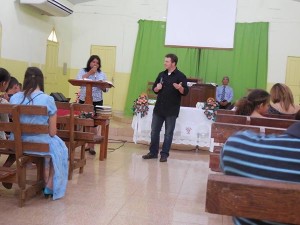
Shortly after I arrived in Brazil, I was informed that my meetings in Manaus and Novo Airão had both been cancelled at the last minute. I learned that one of the “saints,” after seeing that I would be speaking in their church, googled my name and found out I was a friend to the LGBTIQ community. Discovering my love—and I quote—“for the gays,” rumors also began to circulate that I drank, smoked, ate pork, did drugs, had multiple wives, and did not believe in the Holy Spirit. (You can’t make this stuff up.) Those of you who’re not familiar with the teetotaling, kosher nature the Adventist church, please know that just saying that someone drinks, smokes, and eats pork is enough to marginalize an Adventist. Every other rumor was gratuitous. My meetings had been scheduled to begin that first weekend, but they would at best be delayed, and at worst be permanently cancelled.

So I woke up early the next morning and attended the church where I’d been scheduled to speak. Sunday, I spent becoming familiar with the city, and then Monday afternoon, I had an appointment with the Conference President.

The president and I were not the only ones present at this meeting. Accompanying me was my host and an interpreter. It turned into a short meeting, and the president did not discuss why our meetings had been delayed. We did discuss a church policy concerning guest speakers from other countries, and so I had the opportunity to remind everyone present that I was only in the country by their prior invitation. The meetings had been approved a year previously, and we had cooperated with every stipulation they had made in that time.

After the meeting—Im still not sure what made the difference—the administration approved our meetings for the second time. They would now begin on Wednesday evening. Faced with four lost days, I started editing my presentations. I’d already edited them severely for translation, and now I had to cut the series in half. As a result of the delays, however, the Manaus series was poorly attended until the last presentation, when the house was packed.

I chose Luke 4:18-19 as my focus for the week. In these texts, we discover Jesus, the liberator of the oppressed, embracer of the outcast, and proponent of a shared table. Those who did attend repeatedly told us how thankful they were for the meetings, and they shared the different paradigm shifts they had each experienced through encountering Jesus’ teaching in a refreshing new light.

The next series was about 120 miles northwest of Manaus, in Novo Airão. Buy bus that is about a four hours distance.  This area was much more economically stressed than Manaus.

For this group, my choice to present Jesus as a first century poor Jewish teacher (Luke 2.24 cf. Leviticus 12.8) who came with good news for his fellow poor resonated deeply. We focused on Jesus’ words in the Synagogue in Luke 4 (emphasis added):

“The Spirit of the Lord is on me,

because he has anointed me

to proclaim good news to the poor.

He has sent me to proclaim freedom for the prisoners

and recovery of sight for those with prison-blindness,

to set the oppressed free.”

Never have I encountered first-hand just how important it is to couch Jesus’ ministry in the context of his liberation of the poor. The Novo Airão group showed me how much.

As we reflected on Luke 4, we explored four themes together.

1.  How Jesus taught the poor to survive. Jesus gave the poor a way to transcend “worry” and “fear” by combining what they did have and choosing to embrace, share with, and take care of one another. (See Luke 12:13-34; Matthew 5:25-34)

2.  How Jesus empowered the poor and oppressed to move beyond survival. Jesus taught the poor how to affirm themselves by nonviolently confronting oppressors and by staying rooted in enemy-love and enemy-transformation. John Dear, who has done a tremendous amount of work in nonviolence over the years, states: “Nonviolence is active love that seeks justice and peace for the whole human race, beginning with the poor and oppressed. It is the all-encompassing love that embraces every human being on the planet, refuses to kill anyone, and works for social justice for everyone.” (See Luke 4:16-29; Matthew 5:38-42)

3.  How Jesus rejected hierarchical structures in the community of his followers. Jesus promoted equity, justice, and compassion for all. This insight resonated with the audience the most as many felt as if they were living lives at the bottom of political, economic, and religious structures. (See Matthew 20:25-28; Matthew 23:8-12)

4.  How Jesus replaced systems of oppression and exclusion with a shared table. As each one of us, along with our differences, encounter one another at Jesus’ shared table, we become enabled to integrate all the many diverse experiences of life into a meaningful and coherent whole, producing a safer and more compassionate world for us all. (Luke 6:20-26; Luke 15:1, 25-32)

We ended this series with the ending of Jesus narrative. Jesus was crucified by the powers and systems that his teachings threatened, and God said “NO” to that execution in the resurrection on Sunday morning. Jürgen Moltmann defines the resurrection as a Divine protest to the domination systems of our world. The early church also perceived the resurrection as a decisive clue that a new world, like a mustard seed placed in the ground and like leaven in dough, had begun with Jesus. (See Acts 13:32-33) In overwhelming clarity, we encountered, together, a Jesus who proclaimed that the Heart of the Universe was standing with those who, as a result of the way the present world is set up, are hurting, suffering, going hungry, falling asleep many nights in tears, oppressed, marginalized and subordinated.  These are the majority of those who live in Novo Airão. And those who were present found renewed hope as decisions were made to embrace and to follow this Jesus.

On the last night of this second series, one of the more affluent members who attended shared with me this message in broken english:

“I had never looked at things this way before. Thank you so much for coming. I feel as if I cannot continue on the same way I had. If I am to embrace Jesus’ shared table, things in my life where I’m participating in ‘pyramids of oppression’ and ‘circles of exclusion’ must change.”

Over all, I view my trip to Brazil as a tremendous success for Jesus’ new world. The response of the people to the stories and teachings of Jesus was breathtaking, especially in Novo Airão, and I believe the Novo Airão church took significant strides toward Jesus’ new world of compassion and safety for everyone.

To those of you who were praying for this series here at home, thank you. Over the next two weeks the Novo Airão church will be conducting a local school building project: please keep praying for them.

And to each of you who has supported Renewed Heart Ministries, I can’t thank you enough. You made it possible for me to go to Brazil and share with the people I met.

I take Jesus’ words to his disciples, “Freely you have received, freely give” very seriously. Renewed Heart Ministries is a not-for-profit ministry, and we never charge seminar fees for local work. We also make all of our resources available on the web so the people who need to hear this message can access it freely.

This means we are directly dependent on our monthly supporters as well as those who make one-time contributions: you help us to keep lifting up Jesus and his teachings in a hurting world. Jesus’ teachings have placed us on a path that leads to life rather than death, compassion rather than condemnation, and love rather than hate. Like Jesus, we believe our call is not “to condemn the world.” Instead we do this work that the world, through Jesus and his teachings, “might be healed” (John 3:17).

I witnessed the healing nature of Jesus’ teachings firsthand during my visit to Brazil. Jesus’ words to the poor and oppressed, his uplifting of women in a patriarchal society, his embrace of the outcast and excluded, and even his self-affirming nonviolence resonated so deeply with those who participated in these two series of meetings that I, too, walked away having to agree with the Samaritans of Jesus’ day: “This man [Jesus] really is the Savior of the world.” (John 4:42)IMG_0519

Thank you for helping me to see and share that Savior. Till the only world that remains is world where love reigns, let’s keep lifting Jesus up.
And to each of you who support the ministry of RHM as we reach our around the globe, thank you.

I love each of you dearly. I’ll see you next week.

Letting Go of Three Types of Fear

BY HERB MONTGOMERY

sunny road

“Do not be afraid, little flock, for your Father has been pleased to give you the kingdom.” (Luke 12:32)

I have recently gone through a paradigm shift in the way I look at Jesus and I believe this shift is significant. In short, Jesus and his message were not outside the economically disadvantaged and subordinated in his society. Jesus’ teachings emerged from within this community. Jesus was not speaking to people whose daily experience he did not share first-hand. Jesus was speaking to and with his own peers. In Howard Thurman’s privately published volume of poems, The Greatest of These, he wrote:

“His days were nurtured in great hostilities

Focused upon his kind, the sons of Israel.

There was no moment in all his years

When he was free.”

Jesus was a poor Jew. He was oppressed on two counts: being from the community of “the poor” and being part of the politically subordinated Jewish people ruled by the Romans, he understood first-hand the implications of his teachings. Although he was a Jewish male within a Jewish patriarchal society, he choose to stand in solidarity with Jewish women (see Matthew 9.22; John 8.10; Luke 15.8; Luke 10.42; Mark 10.11; Mark 15.40), and he also also voluntarily chose a life of solidarity with people who were socially marginalized, including the eunuchs of Matthew 19:12, saying there was room in his new world for them, even though many in his day considered them “unclean.” (Deuteronomy 23.1; Acts 8.36-39; cf. Isaiah 56.3)

It is as one of the “least of these” that Jesus spoke to his peers about the topic we’re looking at this week: the continual war carried out on the nerves of the oppressed people that causes them to live in a perpetual state of fear.

There are three types of fear that we will consider this week:

  1. the fear of going without
  2. the fear of violence
  3. and the fear of isolation, helplessness, and insignificance.

Fear of Going Without

“Therefore I tell you, do not worry about your life, what you will eat or drink; or about your body, what you will wear. Is not life more than food, and the body more than clothes? Look at the birds of the air; they do not sow or reap or store away in barns, and yet your heavenly Father feeds them. Are you not much more valuable than they? Can any one of you by worrying add a single hour to your life? And why do you worry about clothes? See how the flowers of the field grow. They do not labor or spin. Yet I tell you that not even Solomon in all his splendor was dressed like one of these. If that is how God clothes the grass of the field, which is here today and tomorrow is thrown into the fire, will he not much more clothe you—you of little faith? So do not worry, saying, ‘What shall we eat?’ or ‘What shall we drink?’ or ‘What shall we wear?’ For the pagans run after all these things, and your heavenly Father knows that you need them. But seek first his kingdom and his righteousness, and all these things will be given to you as well. Therefore do not worry about tomorrow, for tomorrow will worry about itself. Each day has enough trouble of its own. (Matthew 6:25-34)

I want to point out here that Jesus was not teaching the economically oppressed to sit back and do nothing. Notice the phrase, “Seek first his kingdom and his righteousness.” Jesus was speaking to a people who had precious little: security was one of their chief concerns. Jesus is here inspiring them to risks even their own temporary security to make active advancements toward the new world (“the kingdom”). He was casting a vision in their imagination of a just world (“his righteousness”), and assuring them that if they would pursue a world that is just, safe, and compassionate for all, then in the end result, they would see a world where everyone’s needs would be met.

This passage directly refers to the mentality so many downtrodden people have: “a bird in the hand is worth two in the bush.” Those in control use present security, even when it is a facade, to dissuade people from questioning or threatening the status quo.

Fear of Violence

“So do not be afraid of them, for there is nothing concealed that will not be disclosed, or hidden that will not be made known. What I tell you in the dark, speak in the daylight; what is whispered in your ear, proclaim from the roofs. Do not be afraid of those who destroy your external well being but cannot touch your inner well being. Rather, be afraid of the one who can destroy your entire well being, both your outer as well as your inner wellbeing in Gehenna [(Annihilation of 70 C.E. by following militaristic messiahs)] Are not two sparrows sold for a penny? Yet not one of them will fall to the ground outside your Father’s care. And even the very hairs of your head are all numbered. So don’t be afraid; you are worth more than many sparrows.” Matthew 10:26-30 (Personal translation.)

Here, Jesus is speaking with those whose internalized fear of their oppressors (the Romans) had driven them to also internalize hatred of the Romans and the wealthy Jewish aristocrats who had “sold out” to complicity with the Empire. The Zealots would have only been at one end of the spectrum of those Jesus is speaking to. All across the spectrum of those disgruntled with the system, there were those who believed they could overthrow Rome by taking up the “sword” like Judah Maccabee during the Maccabean revolt. In Matthew 5.38-41, Jesus offers this audience another way. Jesus foresaw that if his people chose the way of violence toward their violent oppressors, that choice would only end in Rome’s annihilation of the Jewish people. This is exactly what transpired in the Jewish-Roman War of 66-69 C.E. that climaxed in Jerusalem’s destruction in 70 C.E. Jesus offered his peers a force more powerful than violence, a force rooted not in hatred of one’s enemies and a desire to defeat them but in love and a desire to transform them. Jesus’ teachings on nonviolence were not passive. They did involve noncooperation in some scenarios and they also included nonviolent direct action, risk, and creative imagination. Both noncooperation and direct action have their appropriate use in nonviolently “seeking” Jesus’ new world (“the kingdom”) and its justice (“righteousness”) for all.

But where all of this must begin is deliverance from fear of those in control of the present “dirty, rotten, system” (Dorothy Day). Jesus is offering a way for us to transcend fear of what others can do to our external realities and be internally immunized against the fear that so often leads to a loss of integrity and an embrace of hatred. This is what Jesus means by destroying one’s body and their “soul” as well. Fear, falsehood, and hate have the power to kill you, internally as well as externally. They produce what I would call a living and enduring hell.

Take a moment and reread the above passage in Matthew 10 with this in mind. We’ll consider Jesus’ words through the works of Thurman in just a moment.

Fear of Isolation, Helplessness, and Insignificance

“Do not be afraid, little flock, for your Father has been pleased to give you the kingdom.”  (Luke 12:32)

The adjective here for “little” is mikros. It refers not just to size but also to one’s dignity. By comparing the oppressed to a flock, Jesus is purposely drawing attention to the way that, like sheep, they have been objectified and dehumanized, and are simply part of someone’s else’s net worth. And by referring to them as little flock, he addresses the dignity they lack even among others who are objectified and dehumanized. Little flocks were worth far less than large flocks. Jesus was speaking to the least among the disadvantaged, the lowest among the community of the low.

And Jesus says, “It is to YOU, the little flock among the flocks, that the Heart of the Universe is pleased to give this new world.” 

These words of assurance are especially for those who are multiply oppressed in the community of the oppressed. (Modern examples of this would be women of color among White feminists, or transgender people in the LGBT community.)

There is something deeply humiliating and foundationally damaging to the self-respect and personal dignity of those who cannot appeal to anyone for protection from their oppressors.

I want to share three passages from Thurman’s Jesus and the Disinherited that are relevant: I cannot say it better than Thurman did! I’ll simply share his insight here and have only edited Thurman’s words to make them more gender inclusive.

“There are few things more devastating than to have it burned into you that you do not count and that no provisions are made for the literal protection of your person . . . A person’s conviction that they are God’s child automatically tends to shift the basis of their relationship with all their fellows. They recognize at once that to fear another person, whatever may be that person’s power over them, is a basic denial of the integrity of their very life. It lifts that mere person to a place of pre-eminence that belongs to God and to God alone. Those who fear are literally delivered to destruction.

“To the child of God, a scale of values becomes available by which people are measured and their true significance determined. Even the threat of violence, with the possibility of death that it carries, is recognized for what it is— merely the threat of violence with a death potential. Such a person recognizes that death cannot possibly be the worst thing in the world. There are some things that are worse than death. To deny one’s own integrity of personality in the presence of the human challenge is one of those things . . .

“The core of the analysis of Jesus is that every person is a child of God, the God of life that sustains all of nature and guarantees all the intricacies of the life process itself. Jesus suggests that it is quite unreasonable to assume that God, whose creative activity is expressed even in such details as the hairs of a person’s head, would exclude from God’s concern the life, the vital spirit, of the persons themselves. This idea—that God is mindful of the individual—is of tremendous import in dealing with fear as a disease. In this world the socially disadvantaged person is constantly given a negative answer to the most important personal questions upon which mental health depends: ‘Who am I? What am I?’  The first question has to do with a basic self-estimate, a profound sense of belonging, of counting. If a person feels that he does not belong in the way in which it is perfectly normal for other people to belong, then they develop a deep sense of insecurity. When this happens to a person, it provides the basic material for what the psychologist calls an inferiority complex. It is for a person to have no sense of personal inferiority as such, but at the same time to be dogged by a sense of social inferiority. The awareness of being a child of God tends to stabilize the ego and results in new courage, fearlessness, and power. I have seen it happen again and again.” (Adapted from Howard Thurman’s, Jesus and the Disinherited)

Dr. King spoke on fear and faith this way:

“Now it isn’t easy to stand up for truth and for justice. Sometimes it means being frustrated. When you tell the truth and take a stand, sometimes it means that you will walk the streets with a burdened heart. Sometimes it means losing a job…means being abused and scorned. It may mean having a seven, eight-year-old child asking a daddy, ‘Why do you have to go to jail so much?’ And I’ve long since learned that to be a follower to the Jesus Christ means taking up the cross. And my bible tells me that Good Friday comes before Easter. Before the crown we wear, there is the cross that we must bear. Let us bear it—bear it for truth, bear it for justice, and bear it for peace. Let us go out this morning with that determination.

“And I have not lost faith. I’m not in despair, because I know that there is a moral order. I haven’t lost faith, because the arc of the moral universe is long, but it bends toward justice. I can still sing ‘We Shall Overcome’ because Carlyle was right: ‘No lie can live forever.’ We shall overcome because William Cullen Bryant was right: ‘Truth pressed to earth will rise again.’ We shall overcome because James Russell Lowell was right: ‘Truth forever on the scaffold, wrong forever on the throne.’ Yet, that scaffold sways the future. We shall overcome because the bible is right: ‘You shall reap what you sow.’

“With this faith we will be able to hew out of the mountain of despair a stone of hope. With this faith we will be able to transform the jangling discords of our world into a beautiful symphony of brotherhood. With this faith we will be able to speed up the day when justice will roll down like waters, and righteousness like a mighty stream. With this faith we will be able to speed up the day when the lion and the lamb will lie down together, and every man will sit under his own vine and fig tree, and none shall be afraid because the words of the Lord have spoken it. With this faith we will be able to speed up the day when all over the world we will be able to join hands and sing in the words of the old Negro spiritual, ‘Free at last! Free at last! Thank God Almighty, we’re free at last!’ With this faith, we’ll sing it as we’re getting ready to sing it now. Men will beat their swords into plowshares and their spears into pruning hooks. And nations will not rise up against nations, neither shall they study war anymore. And I don’t know about you, I ain’t gonna study war no more.” (Sermon at the Ebenezer Baptist Church on April 30, 1967)

Jesus’ new world of compassion and justice for all is possible. We must, just like Jesus, not lose faith in humanity. Jesus spoke as one who himself belonged to the community of the oppressed, and his way to this new world begins with the call to abandon fear.

All that might follow begins with this. For as perfect love drives out fear, fear also drives out perfect love. And it is love for all, and only love, that compels us to sit at Jesus’ shared table and opens the way to that world where the Heart of the Universe has become the Heart of us all.

HeartGroup Application

  1. This week, go back and spend some time each day contemplating Jesus’ words in Matthew 6.25-34; Matthew 10.26-30; Luke 12.32.
  2. Journal your thoughts, your questions, your insights, and your breakthroughs as you engage with these passages every day this week.
  3. Share your journal insights with your HeartGroup, your shared table, for discussion and feedback.

Here’s to a safer, more compassionate world for us all: many voices, one shared table, one new world. Wherever this finds you this week, keep letting go of fear, living in love, and listening with compassion, till the only world that remains is a world where love reigns.

I love each of you.

I’ll see you next week.

No Such Thing As “Dogs and Pigs” . . . Only “Children.”

How “Listening” is the Cure for our Blindspots

BY HERB MONTGOMERY

Happy kids embracing and smiling in the elementary schoolyard. Interracial  friendship.

Lord,she replied, even the dogs under the table eat the childrens crumbs.(Mark 7:28)

This week, I want to place some puzzle pieces on the table for you that may not seem to fit together at first. Once we get them all on the table, though, I hope that we’ll see something fresh and relevant in Jesus’ interaction with the Syrophoenician woman in Mark 7:24-30. Let’s begin by defining three terms.

The first term is intersectionality. Intersectionality is the study of intersections between forms or systems of oppression, domination, and discrimination. It describes oppression as an interlocking matrix. The model, first developed by Kimberlé Crenshaw, helps us to examine how biological, social, and cultural categories such as gender, race, class, ability, sexual orientation, religion, caste, species and other axes of identity interact on multiple and often simultaneous levels and so contribute to systematic injustice and social inequality.

The second term is kyriarchy. Kyriarchy is a social system or set of connecting social systems built around domination, oppression, and submission. Kyriarchy encompasses sexism, racism, homophobia, economic injustice, colonialism, ethnocentrism, militarism, and other dominating hierarchies that encourage people to internalize and institutionalize the subordination of one person or group to another.

The third term is colonialism, the establishment, exploitation, acquisition, maintenance, and expansion of colonies in one territory by a political power from another territory. Colonialism depends on a set of unequal relationships between the colonial power and the colony and between colonists and the territory’s indigenous population.

Let’s use intersectionality, kyriarchy, and colonialism to look at the relationship between Rome and Jerusalem during the life of the itinerant preacher Jesus of Nazareth. Ponder the status of Jerusalem in the world during that time. Consider the Hebrew people and their own history. Jesus emerged from a people who had participated in forms of kyriarchy and colonialism but, under Rome, was now disinherited.

Jesus presents some images in his teachings that are directly related to this oppressive context.

Dogs and Pigs 

Do not give dogs what is sacred; do not throw your pearls to pigs. If you do, they may trample them under their feet, and turn and tear you to pieces. (Matthew 7:6) 

Dogs and pigs are both scavengers, and the Hebrews considered them to be unclean. You may have heard that Jews called any non-Jew “dog.” But this is not correct. According to the IVP Background Commentary of the New Testament, Jewish people reserved the slurs of “dogs” and “pigs” only for those gentile foreigners who oppressed the Jewish people, such as the Romans. Today, some use the term “pig” to refer to police constables who have become oppressive.

Jesus’ teaching in this passage critiques how Rome was being permitted to co-opt the sacred and valuable Jewish Temple for Imperial purposes. That’s the most direct interpretation of the passage. Yet I also believe there is something deeper here as well.

Throughout the Sermon on the Mount, Jesus has been speaking of inward realities—objectifying women in one’s heart, hatred toward one’s enemies—and not merely outward ones. So I have a hunch that in this passage, Jesus is speaking about the ways that oppressed and disinherited people can allow the sacred and valuable space within them to be co-opted and used for hatred toward their oppressors. Howard Thurman writes about this in his book Jesus and the Disinherited.

Tyre and Sidon

As well as teaching about dogs and pigs, Jesus also taught about Tyre and Sidon. (See Luke 4:25-26; Luke 10.13-14; Matthew 11.21-22)  In our story this week, Jesus had retreated to the region of Tyre and Sidon, ancient Phoenician cities, for a respite.  Yet what many miss is that while Jesus is there, he is met by a woman described as Syro-phoenician.  “The woman was a Greek, born in Syrian Phoenicia.” (Mark 7.26)  It is the “Syro” part that the gospel authors desire to turn our attention. This woman, being from Syria, was of Seleucid decent. (Syria was the short-hand name used by Rome to refer to the Seleucid Empire.) Why does this matter? These were the ancient oppressors of the Jewish people before Rome! Under the influence of Antiochus Epiphanies, the Seleucids had sought to exterminate the Jewish people. And although the Seleucids and the Hebrews now shared the same fate under Rome, there was a time when the Seleucids conquered and occupied the Hebrew nation. Jesus’ exchange with this woman, a descendant of those how had sought to wipe out the Hebrew people under Antiochus, takes place in a time when this was not yet distant history for the Jewish people.

Syrophoenician Woman

Before I talk about the Syrophoenician woman, I want to turn to Howard Thurman’s insightful comments on Jesus’ exchange with her.

“Opposition to the interpretation which Jesus was giving to the gospel of God had increased, and Jesus and his disciples withdrew from active work into temporary semi-retirement around Tyre and Sidon. The woman broke into his retreat with an urgent request in behalf of her child . . . ‘What mockery is there here? Am I not humiliated enough in being misunderstood by my own kind? And here this woman dares to demand that which, in the very nature of the case, she cannot claim as her due.’” (Thurman, Howard; Jesus and the Disinherited [pp. 90-91] Kindle ed.)

The issue here is not that this woman was a Gentile. Though the most prominent Phoenician woman in the Old Testament was Jezebel, Elijah also helped a Phoenician woman (1 Kings 17:17) So her non-Jewishness is not the point. In addition to being Phoenician, the woman was also of Syrian descent: she was Syro-phoenician. As Mark writes, “The woman was a Greek, born in Syrian Phoenicia. She begged Jesus to drive the demon out of her daughter” (Mark 7:26). Syria was the term Rome used to refer to the historical Seleucid Empire.

The issue in this story is that Jesus understood that his announcement of “the favor of God” was to apply to Gentiles too (see Luke 4:25-29; Matthew 8:5-13). But this Gentile begging him for a blessing was of Seleucid descent. This would be the equivalent of descendants of a Holocaust survivor being asked to share survivor reparations with a descendent of the Nazis who had fallen on hard times. It would be comparable to a White American asking to receive reparations intended for the Native American community here in the United States. It would be as if, two hundred years from now, a same-sex married couple were asked to help the descendent of a fundamentalist-evangelical business-owner from Indiana.

The encounter between Jesus and this women is set up to prick our sense of justice. Jesus came to liberate the oppressed. But now one of the oppressors was asking him to liberate her daughter too! Jesus question is valid:

Is it right to give the childrens (the Hebrew people) bread to the dogs (the Seleucids)?

According to the Torah, there were foods that were not to be eaten by the Hebrews but that could be thrown out as dog food (see Exodus 22:31). Jesus is here asking: is it just to give that which was intended to liberate my people to a person belonging to those who violently oppressed us in the past?

There are two ways I have heard this explained. One explanation is that Jesus is merely play-acting to teach the on-looking disciples an important lesson in generosity. The other explanation, which I think is more plausible, is that Jesus is growing in his own understanding and experience of intersectionality.

Yes, this woman belonged to a people who had endeavored to wipe his people off the face of the earth. But she was also a woman. Where is her husband? Why is her husband or father not making this request as the father does in Mark 5.22? In a patriarchal world, what does it mean for this woman to be speaking for herself and her daughter as if she were a single mother?

Whatever her circumstances, Jesus asks, is it right to help her? Is this how the liberation and reparations for Israel are to be used: not only to benefit those who have been oppressed but also to benefit the suffering oppressors too?

This is where intersectionality comes in. A person can be both oppressor and oppressed simultaneously. After all, the Hebrews were not innocent. Just as the Seleucids had once sought to exterminate the Hebrews from existence, the Hebrews had once engaged in the genocide and colonization of the Canaanites. The Hebrews participated in the cultural patriarchy that those in Hellenistic Tyre and Sydon lived by as well. And although the Jews in Jesus’ time suffered economic poverty under Rome’s high taxes, the Hebrew had also oppressed the poor with their own kings (Amos 2:6; 5:7, 11, 24). Yes, this Seleucid woman belonged to a people who had historically oppressed the Hebrews, but that day, she, too, needed liberation. Was there enough mercy in Jesus’ merciful theism for her as well?

In this story, the compassion of Jesus wins out. It’s worth asking ourselves just how Jesus made even a small space in that room to listen.

Lord,she replied, even the dogs under the table eat the childrens crumbs.(Mark 7:28)

There is theoretical knowledge and then there is experiential knowledge. Jesus understood a love of enemies in theory and gained a deeper understanding of it that day through experience.

I’m thankful for a Jesus who took time to listen. I’m also thankful for a woman who didn’t give up, but persisted in helping Jesus and his disciples see her need and their blind spots. Had Jesus sent her away, a great injustice would have been committed. But he listened. And he entered into a fuller experience of his own ethic that day instead. Henry David Thoreau wrote, ”Could a greater miracle take place than for us to look through each other’s eyes for an instant?”

I cannot fault Jesus for asking the question he asked. Jesus, after all, emerged from the community of the disinherited poor. Jesus faced the same dilemma we face:.how does one embrace enemy love without betraying one’s own people?. How does one stay faithful to both justice for the oppressed and the transformation of the oppressors?

Jesus and his disciples, I believe, left the region of Tyre and Sidon that day with a fuller experience of the truth that there is really no such thing as dogs or pigs.  There are only children. We are all siblings of the same Divine Parents. We all walk this earth side-by-side, and we all wear on our faces the very image of God.

HeartGroup Application

1.  Here are just a few of the categories of intersectional privilege and disadvantage in our society here in the West:

White            Wealthy        Certified Educated       Male        Straight            Cisgender

Non-White     Poor            Uncertified Education   Female     Non-straight     Transgender


These categories combine to create intersectional experiences of domination and oppression.

Consider how each of the following experiences simultaneously includes some level of privilege in our society and some level of disadvantage. Name where they are privileged first. Then look for where they are disadvantaged.

a. A White lower-class, cisgender, straight, blue-collar male

b. An African-American male president of the United States

c. A White cisgender gay female living in inner-city America

d. A bisexual cisgender woman of color living in rural poverty

e. A single White father of three living in suburban America

f. A middle-class White fundamentalist-evangelical, transgender female

d. Wealthy highly educated White, cisgender straight female

2.  We need each other. What does it mean for us to trade our dominations systems for Jesus’ heterogeneous shared table? How can we learn to listen to those who are not like us? How can we learn to incorporate each person’s varied life experience into a beautiful and coherent whole that leads to a safer and more compassionate world for all? How can we allow others to show us where our own blind spots are and also share our stories that can help others see their blind spots?

3. Discuss your thoughts with your upcoming HeartGroup this week.

I’ll close this week with Howard Thurman’s Three Hounds of Hell that dog the soul of the disinherited—fear, hypocrisy, and hatred. The ethical teachings found in the values of the Jesus story as it has come down to us today, I believe, offer the disinherited in any area of society a way to escape those three hounds nipping at our heels. This week, if nothing more, may we all learn to sit around Jesus shared table and simply listen.

Wherever this finds you, keep living in love, and listening with compassion, till the only world that remains is a world where Love reigns.

I love each one of you,

I’ll see you next week.


The Seven Last Sayings of Jesus; Part 9 of 9

Part 9 of 9

by Herb Montgomery


The Gospel of an Unstoppable Liberation

Wooden Rosary

“We tell you the good news: What God promised our ancestors he has fulfilled for us, their children, by raising up Jesus.” (Acts 13:32-33)

I want to end this series on the seven last sayings of Jesus, not on Jesus’ execution by the domination systems of his day, but with the reversal and undoing of that execution by the resurrection. This is what the early church proclaimed as the gospel.

Notice that the early church did not preach that Jesus had died to pay a divinely demanded penalty so that you can go to heaven instead of hell when you die. It was not that Jesus had died, but that Jesus had been executed and that his execution had been reversed. Remember that the great Hebrew hope was not of one day becoming some disembodied soul in some far distant heaven. No. The hope of the Hebrew people, that which had been promised to their ancestors, is that the Messiah would come and put right all oppression, violence and injustice.

Salvation, to the early church, was liberation from oppression. And this had been accomplished by God’s resurrection of the one who had been executed by their oppressors.

Notice the following passages.

“And we bring you the good news that what God promised to our ancestors he has fulfilled for us, their children, by raising Jesus…. Let it be known to you therefore, my brothers, that through this man forgiveness of sins is proclaimed to you.” [Liberation and a New Social Order] (Acts 13:23-38)

You that are Israelites, listen to what I have to say: Jesus of Nazareth, a man attested to you by God with deeds of power, wonders, and signs that God did through him among you, as you yourselves know—this man, given to you according to the definite plan and foreknowledge of God, you crucified and killed by the hands of those outside the law. But God raised him up, having freed him from death, because it was impossible for him to be held in its power…. This Jesus God raised up, and of that all of us are witnesses…. Therefore let the entire house of Israel know with certainty that God has made him both Lord and Messiah, this Jesus whom you crucified.” (Acts 2:22-36)

The God of Abraham, the God of Isaac, and the God of Jacob, the God of our ancestors has glorified his servant Jesus, whom you handed over and rejected in the presence of Pilate, though he had decided to release him. But you rejected the Holy and Righteous One and asked to have a murderer given to you, and you killed the author of life, but God raised him from the dead. To this we are witnesses.” (Acts 3:12-16)

Let it be known to all of you, and to all the people of Israel, that this man is standing before you in good health by the name of Jesus Christ of Nazareth, whom you crucified, but whom God raised from the dead. This Jesus is ‘the stone that was rejected by you, the builders; it has become the cornerstone.’” (Acts 4:10-11)

“The God of our ancestors raised up Jesus, whom you had killed by hanging him on a tree. God exalted him at his right hand as Founder and Healer that he might give repentance to Israel and forgiveness of sins.” (Acts 5:30-32)

“We are witnesses to all that he did both in Judea and in Jerusalem. They put him to death by hanging him on a tree; but God raised him on the third day…. He is the one ordained by God as LIBERATOR of the living and the dead. All the prophets testify about him that everyone who believes in him receives forgiveness of sins through his name.” (Acts 10:36-43)

The good news was not that Rome had executed someone or that someone had died. That happened all the time. The good news was that this Jesus, whose teachings offered such radical hope for a transformed world, and who had been executed by the systems his teachings threatened, had been brought back to life. This Jesus had triumphed over the religious, political and economic systems of their day, for his execution had been reversed!

In this great reversal, a new world had begun. Those systems, even the religious one that had claimed to house “God” at its heart, had been exposed, shamed and shown to be what they truly were.

The Presence was not found to be with them, but with the One they had shamefully suspended on a Roman cross.

What I want you to notice is that what liberates us, what “saves” us, for the early church, was not Jesus’ execution, but his resurrection, the undoing and reversal of Jesus’ execution by the powers, but the solidarity of The Sacred (i.e. “God”), The Divine, not simply with Jesus, but will all that had been, or would be the recipients of Oppression.

“And having disarmed the powers and authorities [i.e. religious, social, economic, and political oppression], a public spectacle of them was made, triumphing over them by him.” (Colossians 2:15)

The Sacred Dream of the Divine is of a different world, here and now, where everybody has enough, not as a product of charity, but as a result of the way the world is put together. The present way of assembling the world has been exposed and shamed by the way it executed Jesus. And it has been rendered impotent. The power by which the present systems subordinate others–using “the fear of death” and the threat of being executed at the hands of the present domination systems, what I call the “do what we say, or else” system–has been triumphed over and made of no more consequence. Through Jesus’ execution by the powers and then being resurrected by The Divine, Jesus has liberated “those who all their lives were held in slavery by their fear of death.” (Hebrews 2:14-15)

Why Do I Love Easter?

It’s not because of its co-opted pagan roots of celebrating fertility and the rebirth of spring, though I genuinely appreciate both. It’s because this is the one time Christianity remembers, though I think many have forgotten what it means, why Christianity, as a revolution (as opposed to a religion) came into being.

The story of Matthew, Mark, Luke and John is of an itinerant teacher from prophetic lineage (just like the prophets of old), who travelled the countryside giving a passionate indictment of the religious, political, economic and social systems of his day and putting on display the beauty of a world assembled in the form of a shared nonhomogenous table where every voice is valued and every story heard. A world where we all, from the varied experiences of life that we each represent, learn together how to integrate our differences into a coherent and meaningful whole.

The old order of things was to be deconstructed. Both the voiceless minorities that had been marginalized to the fringes of their society and the voiceless masses that had been oppressed were to find space at this new shared table. Transformed oppressors and the liberated oppressed  were going to have to learn how to sit beside (neither above nor below) one another, recognizing each other as the image of God, both children of the same Divine Parents, welcomed to the same family table.

This was good news to the outsiders, the disadvantaged and the dispossessed. THIS was the gospel! But to insiders, and those in top positions of privilege in the current domination system (the Pharisees, the Priests and the Scribes), this was seen as anything but “good news.”

Jesus’ nonviolent confrontation and disruption of the system in the Temple (Jesus shut it down) was the last straw. Who did he think he was? They had had enough. The priestly aristocracy and the Pharisees combined efforts to manipulate the economic systems of Herod and the political system of Pilate to create a cooperative act of lynching this radical named Jesus.

The torn veil in the temple [1] revealed the Sacred was not dwelling in the most holy places of those institutions, as they claimed. No, the Divine, as was mentioned previously, was dwelling in the One shamefully suspended on a Roman cross at the hands of those combined domination forces. [2]

THIS is the good news: Liberation has come. And it is a liberation that is unstoppable. Yes, for those placed in the position of “last” by the present system this is good news, as they learn how they are to be treated as those who had arrived “first.” And for those who had arrived “first,” well, it is at least problematic as they discover they will now be treated equally with those who had arrived “last.” The point is that each person will be “paid the same,” as the parable teaches, or treated simply as equal. [3]

This liberation could not be stopped. And I dare say, it cannot be stopped today.

They tried to kill it. But even that didn’t work.

I want to close this week with Mark’s telling of the resurrection. Very early versions of Mark’s manuscript ended at Mark 16:8. I want to highlight the value of those manuscripts. Notice the open-ended way that these Jesus stories would have concluded.

“When the Sabbath was over, Mary Magdalene, Mary the mother of James, and Salome bought spices so that they might go to anoint Jesus’ body. Very early on the first day of the week, just after sunrise, they were on their way to the tomb and they asked each other, ‘Who will roll the stone away from the entrance of the tomb?’ But when they looked up, they saw that the stone, which was very large, had been rolled away. As they entered the tomb, they saw a young man dressed in a white robe sitting on the right side, and they were alarmed. ‘Don’t be alarmed,’ he said. ‘You are looking for Jesus the Nazarene, who was crucified. He has risen! He is not here.’” (Mark 16.2-6)

Then Mark’s gospel ends with:

“Trembling and bewildered, the women went out and fled from the tomb. They said nothing to anyone, because they were afraid.” (Mark 16:8)

What is the unspoken point Mark is endeavoring to make? What is the impression he is trying to leave?

Just as Luke’s gospel would later do, Mark is whispering, “Why do you look for the living among the dead? He is not here; he has risen! Yes, those in charge killed him—but they couldn’t stop him. They crucified him and buried him in a rich man’s tomb. But imperial lynching and a tomb couldn’t hold him. He’s still loose in the world. He’s still out there, still here, still recruiting people to share, to participate in his mustard seed subversively planted in the garden, his leaven placed within the dough, his pearl of great price revolution toward a radically new social order that he called ‘the Kingdom of God’—a transformed world here and now.”

What Mark is whispering to us is the good news that yes, they killed our Jesus, but… it’s… not… over. This liberation is unstoppable, for it possesses the solidarity of The Divine.

“You killed the author of this way of life, but God raised him from the dead.” — Peter; (Acts 3:15)

HeartGroup Application

  1. This week as Easter is approaching for the West, take a moment and contemplate what the resurrection actually means for us. Lots of people have been killed for standing up against the status quo. Lots of people have suffered for attempting to dismantle the status quo. But Jesus was one with whom the Divine stood in solidarity and brought back to life.
  2. I want you, as you are contemplating the resurrection and its meaning, to also ponder what it means to follow this resurrected One. What is the most important thing you could be doing right now to further the work of healing, restoration, transformation, liberation and redemption that this Jesus began here on earth?
  3. Share what you discover with your HeartGroup.

I want to thank each one of you who has checked in each week for this nine-part series. It is my prayer that you have been inspired and encouraged to put on display, as a community, the beauty of what a world changed by that radical Jesus looks like. And who knows? It may do just that. It may change the world.

I love each of you dearly. And for those of you who will be celebrating Easter this coming weekend, The Lord Is Risen! He Is Risen Indeed!

Keep living in love, loving like Jesus, ’til the only world that remains is a world where Love reigns.

I’ll see you next week.


1. “The curtain of the temple was torn in two from top to bottom.” (Mark 15:38)

2. “God was in Christ, reconciling the world…” (2 Corinthians 5:19)

3. “For the kingdom of heaven is like a landowner who went out early in the morning to hire workers for his vineyard. He agreed to pay them a denarius for the day and sent them into his vineyard. About nine in the morning he went out and saw others standing in the marketplace doing nothing. He told them, ‘You also go and work in my vineyard, and I will pay you whatever is right.’ So they went. He went out again about noon and about three in the afternoon and did the same thing. About five in the afternoon he went out and found still others standing around. He asked them, ‘Why have you been standing here all day long doing nothing?’ ‘Because no one has hired us,’ they answered. He said to them, ‘You also go and work in my vineyard.’ When evening came, the owner of the vineyard said to his foreman, ‘Call the workers and pay them their wages, beginning with the last ones hired and going on to the first.’ The workers who were hired about five in the afternoon came and each received a denarius. So when those came who were hired first, they expected to receive more. But each one of them also received a denarius. When they received it, they began to grumble against the landowner. ‘These who were hired last worked only one hour,’ they said, ‘and you have made them equal to us who have borne the burden of the work and the heat of the day.’ But he answered one of them, ‘I am not being unfair to you, friend. Didn’t you agree to work for a denarius? Take your pay and go. I want to give the one who was hired last the same as I gave you. Don’t I have the right to do what I want with my own money? Or are you envious because I am generous?’ So the last will be first, and the first will be last.” (Matthew 20:1-15)


The Seven Last Sayings of Jesus; Part 6 of 9

Part 6 of 9

Woman, Here Is Your Son

BY HERB MONTGOMERY

Wooden RosaryMeanwhile, standing near the cross of Jesus were his mother, and his mother’s sister, Mary the wife of Clopas, and Mary Magdalene. When Jesus saw his mother and the disciple whom he loved standing beside her, he said to his mother, “Woman, here is your son.” Then he said to the disciple, “Here is your mother.” And from that hour the disciple took her into his own home. (John 19:25-27)

This week we begin to move into John’s telling of the Jesus story.

John’s telling is unique among the four canonical gospels. John’s is the latest written, and his Jesus story shows high Christology (Jesus as fully Divine). Unlike other writers in the New Testament whose Christology is more ethically centered (Jesus is defined by what he did and taught), John’s Christology seeks to define who Jesus was ontologically and cosmologically. It it in John’s gospel that the idea of a divine Jesus is most fully developed among the four gospels.

Ever since I read Irenaeus’s Against Heresies, the parallels between Irenaeus and John’s gospel have lead me to believe John was seeking to tell the Jesus story in such a way as to intersect and inform what he felt was the threat of early first-century Gnosticism.

Many aspects of John’s gospel make more sense when we place them in this cultural context. Many regard Gnosticism as the first great Christian heresy. It took the focus of Jesus’ followers off of a renewed and restored earth to an escapist goal of attaining heaven instead. Scholars today see Gnosticism’s dualism between the body and the soul (body or nature is evil/soul is good; body or nature is mortal/soul is immortal) and Gnosticism’s abandonment of the body and the good world around us as evil to have caused a significant shift in the focus of historic Christianity. This shift, coupled with other influences, is why, to a large degree, some Christians today focus on post-mortem bliss rather than the liberation of the oppressed and healing of injustices in our present world. An example of this is how White Christians in the 30’s, 40’s and 50’s were committed to “getting to heaven” while ignoring and even perpetrating a very “present hell” here on earth. Ida B. Wells once wrote, “Our American Christians are too busy saving the souls of white Christians from burning in hellfire to save the lives of black ones from present burning in fires kindled by white Christians.” [1]

John’s method then needs to be understood. His intent was to show Jesus to be fully Divine (Holy, from above) and then show how integrated he was in humanity, his body, the earth, and the dirt. He also portrayed Jesus as genuinely human.

This is the controversy John refers to in 1 John 4:2, “By this you know the Spirit of God: every spirit that confesses that Jesus Christ has come in the flesh is from God.” (Emphasis added.)

The Gnostics taught that for Jesus to have truly been Divine or Holy, he could not have genuinely possessed a physical body but only the appearance or “impression” of a body. Therefore to show Jesus as also fully human would have taken the focus of those affected by gnosticism off of their post-mortem bliss, and back onto the work of restoration and healing that we see so markedly evidenced in Jesus’ own life and work.

Reread John’s gospel and see how much John emphasizes Jesus’ body and Jesus’ genuine bodily functions. (We’ll look at this more next week when we look at John’s words of Jesus on the cross, “I thirst.”)

What John wants us to encounter first about Jesus’ experience on cross, unlike any other gospel author, is Jesus’ very human relationship with and concern for his mother. This is the humanity of Jesus that Gnostics would be confronted by and need to address.

Womanism and The Jesus Story

I also want to draw attention to a womanist reading of this passage in John this week.

In James Cone’s phenomenal book The Cross and the Lynching Tree, Cone recounts the experiences of what it was like for African Americans during America’s post slavery era in relation to the lynching being carried out by White Christians.

Cone writes, “The fear of lynching was so deep and widespread that most blacks were too scared even to talk publicly about it. When they heard of a person being lynched in their vicinity, they often ran home, pulled down shades, and turned out lights—hoping the terror moment would pass without taking the lives of their relatives and friends.” [2]

Cone retells the story of Martin Luther King, Jr.’s father, who witnessed a lynching at a very young age. Daddy King states, “All I could do was to run on home, keep silent, never mentioning what I’d seen to anyone, until many, many years later, when I understood it better.” [3]

The parallels between the lynching of African Americans in America and the lynching of Jesus in the first century are astounding. [4] The horror of crucifixion by Rome and the nightmarish atrocity of lynching in America by White Christians served very similar purposes within their perspective cultures. Both were forms of terrorism used by the dominant system of the day.

The fact that John tells us there were those who didn’t “run home” when Jesus was lynched is a testament to the Jewish women John lists, a testament we come to understand and appreciate more deeply when seen through the lens of what Black women experienced in America’s lynching history. These women did not run home, as did most of the followers of Jesus, but stood by, not abandoning Jesus when the dominant system “strung him up.”

Black women should not be made invisible in America’s lynching history. They were not exempt to White Christian mob violence in America. Not only were Black women lynched as well, but those who were not, “not only suffered the loss of their sons, husbands, brothers, uncles, nephews, and cousins but also endured public insults and economic hardship as they tried to carry on, to take care of their fatherless children in a patriarchal and racist society in which whites could lynch them or their children with impunity, at the slightest whim or smallest infraction of the southern racial etiquette.” [5]

Jewish women belonged to a similarly patriarchal society. For Mary, the mother of Jesus, to lose Jesus, the specific male she was economically dependent on, to mob violence in her day also meant economic hardship and poverty as she would be left to try and carry on.

Yet John’s Jesus is no victim. John’s Jesus will leave behind no orphans [6], and as we also see here, no widows.

John’s Jesus looks down from the cross and, much to the dismay of the Gnostics of John’s time, the first thing Jesus attends to is the human, intimately familial relationship between himself and his mother.

Again, we get a window into the reality of the necessity of Jesus’ connecting his mother to a new son through womanist perspectives today.

What we also receive from looking at this narrative detail of the interchange between Jesus and Mary through the lens of womanist theology is the knowledge that we do not have to interpret

Jesus’ death as some sort of righteous surrogacy or surrogate suffering. Remember, the cross is not the salvific act, according to the book of Acts, as much as the resurrection is [7], for it is the resurrection that undoes and reverses everything accomplished by the lynching of Jesus by the dominant system. The death of Jesus was the temporary victory of the oppression and injustice that Jesus was confronting and resisting. Far from understanding Jesus’ death as the glorification and justification of innocent suffering, the death of Jesus was a travesty of justice. It was the unjust response of evil and oppression to the threat of Jesus as he sought to heal and liberate.

Jesus in John’s gospel is not a victim. Nor is he passive. Jesus is an activist whose advocacy for the marginalized and outcast resulted in suffering. Jesus’ death was the natural result of Jesus’ confrontation of the dominant system. And as followers of Jesus we, too, are to actively oppose evil rather than passively submit to it. Yes, Jesus taught nonviolence, but we are not to interpret this as Jesus’ teaching passivity. Jesus taught a nonviolent, direct confrontation of injustice, oppression, and violence as the means of changing the world around us.

Jacquelyn Grant in her book White Women’s Christ and Black Women’s Jesus: Feminist Christology and Womanist Response rightly states, “The significance of Christ is not found in his maleness, but in his humanity,” [8] and the history of Black women today, “the oppressed of the oppressed,” can inform and educate our understanding of Jesus’ death and resurrection in life- transforming, world-transforming, ways.

What we see in John’s interchange between Jesus and Jesus’ mother is Jesus’ humanity first and foremost. We see the cultural need for making sure his mother was provided for in a patriarchal society oppressive to women. We begin to understand Jesus’ death for what it is, not an act by which justice was satisfied but an act of inhumane injustice that was the result of Jesus’ confrontation with injustice. And last, we see Jesus’ death as that which the Divine Being of the Jesus story would reverse and undo. The dominant system does not have the last world in this narrative. The story does not end with a lynching but with a Divine Being standing in solidarity not simply with Jesus but with all who have been lynched (directly or indirectly) throughout history, whispering that this is not where our stories have to end. The climax of the Jesus story is that over and against those at whose hands Jesus was lynched, stands a Voice, calling the world, both oppressed and the oppressors, to a better way.

Southern trees bear strange fruit/Blood on the leaves and blood at the root/Black body swinging in the Southern breeze/Strange fruit hanging from the poplar tree.
—“Strange Fruit,” Abel Meeropol (a.k.a. Lewis Allen)

“They put him to death by hanging him on a tree.” (Acts 10:39)

Perhaps nothing about the history of mob violence in the United States is more surprising than how quickly an understanding of the full horror of lynching has receded from the nation’s collective historical memory.—W. Fitzhugh Brundage

HeartGroup Application

We are getting closer to when the western Christian world celebrates Easter with each passing week.

This week I want you to dedicate some time to contemplating what a difference it makes to see Jesus’ death not as the appeasement of an angry God so that those who have sinned can escape this world and be let into heaven, with the resurrection being a neat little affirmation of post- mortem bliss, but as the lynching that it was, a result of Jesus’ standing up to the injustice, oppression, and violence of the dominant system of his day. Try to see Jesus’ resurrection not as a tidy ending but as a Divine Being’s solidarity with all those who have been oppressed, violated, and affected by injustice throughout time, whispering to us that in this Jesus and the values he espoused and taught, a new world is coming. In fact, as a result of the resurrection, it has already arrived.

1. As an aid in helping you shift in your contemplation of Jesus’ death this week, I recommend you watch Billie Holiday’s performance of Strange Fruit. One free way to do this would be to simply go to YouTube here. Allow Billie to inform your understanding of the Jesus narrative as you overlay Jesus’ lynching on one of the most effective teaching moments in America’s recent history. Allow Billie’s performance to help you step back into and understand anew the death—and resurrection—of Jesus.

2. Journal what you discover.

3. Share what you discover with your HeartGroup this upcoming week.

As Jesus followers, we subscribe to a narrative that does not end in the defeat of Jesus by the lynching mob. The narrative ends with Jesus’ God standing in solidarity with him in his confrontation of injustice, even to the undoing and reversing of their murderous actions. Jesus’ death is not his nonviolent protest to injustice. It was the fatal result of this nonviolent protest. The resurrection is Jesus’ God’s having the last word over the lynching mob. This should give us pause to reflect.

Our narrative is one of hope. Hope that injustice does not have the last word, ever. A new day has dawned. A light is shining from an empty tomb.

Keep living in love, loving like Jesus, until the only world that remains is a world where love reigns.

One shared table, many voices, one new world.

I’m praying for your hearts to be enlarged and liberated as you move more deeply into the contemplation of Jesus’ death and resurrection and their implications for us today.

I love each of you deeply. I’ll see you next week.


1. Wells, Ida B. Crusade for Justice, pp. 154-55

2. Cone, James H. (2011-09-01). The Cross and the Lynching Tree (p. 15). Orbis Books. Kindle Edition.

3. Daddy King, p. 30.

4. Acts 5:30—The God of our ancestors raised up Jesus, whom you had killed by hanging him on a tree; Acts 10:39—They put him to death by hanging him on a tree. (Emphasis added.)

5. Cone, James H. (2011-09-01). The Cross and the Lynching Tree (pp. 122–123). Orbis Books. Kindle Edition.

6. John 14:18—“I will not leave you orphaned; I am coming to you.”
7. Acts 13:32-33—And we bring you the gospel that what God promised to our ancestors God has fulfilled for us, their children, by raising Jesus.

8. Jacquelyn Grant, White Women’s Christ and Black Women’s Jesus: Feminist Christology and Womanist Response